







Abstract
The study of the risk and protective factors in aggression is of fundamental importance for our society. The aim of this research was to clarify the role of sensitivity to reward/punishment in aggression and provide a better understanding of the mechanisms underlying this relationship, particularly given that previous studies in the literature have yielded mixed results. To this end, two studies were conducted. In Study 1 (484 participants; Mage = 39.09; 48.6s women), we explored the relationship between sensitivity to reward and punishment and four components of aggression: physical, verbal, anger, and hostility. In Study 2 (229 participants; Mage = 21.52; 56.77% women), we investigated the moderating role of emotion regulation ability in this relationship. The findings of Studies 1 and 2 supported the existence of a positive relationship between sensitivity to reward and aggression, that is, a high reactivity to reward acted as a risk factor. With respect to sensitivity to punishment, mediation analysis revealed that this variable may act both as a protective factor as well as a risk factor for behavioral aggression. A higher reactivity to punishment had a direct negative effect on physical and verbal aggression, inhibiting aggressive behavior. However, a higher reactivity to punishment also implied a positive indirect effect on physical and verbal aggression through an increase in anger and hostility. Interestingly, Study 2 revealed that these indirect effects were moderated by emotion regulation ability. Our results could help to inform the design of aggression prevention and intervention programs for reducing the impact of this behavior on our society.
Introduction
Human aggression is a multifactorial phenomenon implying cognitive, emotional, social, and situational variables, which is defined as “any behavior directed toward another individual that is carried out with the proximate intent to cause harm” (Anderson & Bushman, 2002). Given its relevant implications for society, research has largely focused on identifying the risk and protective factors of aggression in order to control this behavior and reduce its negative consequences (e.g., Burt & Donnellan, 2008; Gómez-Leal et al., 2020; Velotti et al., 2016). Previous literature has suggested that sensitivity to reward and punishment could be associated with aggression (Bjørnebekk, 2007; Carlson et al., 2013; Granero et al., 2016; Harmon-Jones & Peterson, 2008; Morgan et al., 2014; Pederson et al., 2018). However, a number of aspects of this relationship remain unclear. Whilst a high sensitivity to reward is considered a risk factor (Bjørnebekk, 2007; Smits & Kuppens, 2005; von Collani & Werner, 2005), the role of sensitivity to punishment is controversial and it appears to depend on the type of aggression studied (Carlson et al., 2013; Granero et al., 2016; Harmon-Jones & Peterson, 2008; Morgan et al., 2014; Pederson et al., 2018). The aim of the present research was to resolve this issue and to clarify the mechanisms underlying these relationships.
Components of Aggression
Following the model developed by Buss and Perry (Buss & Perry, 1992), the construct of aggression can be divided into four components: physical aggression and verbal aggression, which represent the instrumental/motor components (i.e., behavioral aggression); anger, which represents the affective component; and hostility, which represents the cognitive component. Physical and verbal aggression are behaviors that are undertaken with the intention (physically or verbally) of hurting or harming others. Anger consists of an emotional state of displeasure and physiological arousal that prepares the organism to engage in aggressive behaviors. This is often observed in situations where people feel threatened. Finally, hostility refers to the negative evaluation of people or things, characterized by feelings of ill will, indignation, disgust, contempt, or resentment toward such people/things. In summary, while anger and hostility only allude to emotions and attitudes, physical and verbal aggression imply the involvement of an additional step, that is, behaviors targeted at harming other people (Buss & Perry, 1992; Ramírez & Andreu, 2006).
Research exploring the relationships between these four components of aggression has revealed significant positive correlations between all of them (Ramírez & Andreu, 2006; Vigil-Colet et al., 2005). Thus, anger and hostility have been shown to play a causal role in the appearance of behavioral aggression (Berkowitz, 1993; Buss & Perry, 1992; Felsten & Hill, 1999; Ramírez & Andreu, 2006). Physical and verbal aggressive behaviors are more likely to occur when people are guided by feelings of anger or present hostile attitudes toward the surrounding environment. Moreover, studies such as that of Rubio-Garay et al. (2016) have suggested that anger and hostility can contribute independently to aggressive behavior.
Sensitivity to Reward and Punishment and their Relationship with Aggression.
In the previous literature, the study of sensitivity to reward and punishment has mainly been approached from the perspective of Gray’s Reinforcement Sensitivity Theory (RST; Gray, 1982; Gray & McNaughton, 2000). According to RST, our sensitivity to reward and punishment determine part of our personality, accounting for behavioral differences between individuals. In Gray’s original theory these two factors are linked to two different motivational systems: the behavioral approach system (BAS) and the behavioral inhibition system (BIS). 1 The BAS involves conditioned appetitive stimuli, reflecting individual differences in sensitivity to reward. When this system is activated, behavior is aimed at approaching the reward. The BIS is based on conditioned aversive stimuli and innate fear stimuli, reflecting individual differences in sensitivity to punishment. When this system is activated, behavior is focused on suppressing actions associated with punishment. Thus, in individuals with high reactivity of the BAS, behavior is primarily guided by rewards, whilst those with high reactivity of the BIS are more susceptible to punishment.
There is strong evidence to suggest that a greater sensitivity to reward (higher BAS reactivity) is associated with higher levels of aggression, that is, approach behavior. Questionnaire-based research has found evidence for this association for both behavioral aggression (Bjørnebekk, 2007; Carlson et al., 2013; Granero et al., 2016; Harmon-Jones, 2003; Harmon-Jones & Peterson, 2008; Pederson et al., 2018; Smits & De Boeck, 2007; Smits & Kuppens, 2005; von Collani & Werner, 2005) and for the related components of anger and hostility (Granero et al., 2016; Harmon-Jones, 2003; Smits & De Boeck, 2007; Smits & Kuppens, 2005; von Collani & Werner, 2005). In applied contexts, Morgan et al. (2014) showed that in comparison with non-offenders, adolescent offenders show more sensitivity to reward. Constantinou et al. (2011) also observed that higher levels of sensitivity to reward are linked to a greater tendency to show aggressive driving behavior.
The relationship between sensitivity to punishment (BIS reactivity) and behavioral aggression, however, remains unclear. Although some studies have shown that a greater sensitivity to punishment is associated with a higher probability of avoiding/suppressing behavioral aggression (physical and verbal) and the associated consequences, that is, a negative relationship between sensitivity to punishment and behavioral aggression (Bjørnebekk, 2007; Carlson et al., 2013; Harmon-Jones, 2003; Morgan et al., 2014; Smits & Kuppens, 2005; von Collani & Werner, 2005), there are also a number of studies showing no such relationship (Constantinou et al., 2011; Granero et al., 2016; Harmon-Jones & Peterson, 2008), whilst some have even indicated a positive relationship (Pederson et al., 2018). Nonetheless, the previous literature does appear to support the existence of a positive relationship between sensitivity to punishment and the components of anger and hostility (Granero et al., 2016; Harmon-Jones, 2003; Smits & De Boeck, 2007; Smits & Kuppens, 2005; von Collani & Werner, 2005).
Emotion Regulation Ability as a Protective Factor of Aggression and Sensitivity to Reward and Punishment.
The ability to regulate emotions has been found to modulate levels of aggression, sensitivity to punishment, and certain aspects of sensitivity to reward (Hsieh & Chen, 2017; Roberton et al., 2014; Tull et al., 2010). For instance, Röll et al. (2012) conducted a systematic review based on longitudinal studies and identified emotion dysregulation to be a leading risk factor of aggression from childhood. In addition, the emotion regulation ability has also shown to be important in explaining the link between the various forms of aggression, by, for example, controlling the behavioral aggressive tendencies in people that feel intense levels of anger (Pond et al., 2012; Roberton et al., 2012; Shorey et al., 2011). With regard to sensitivity to reward and punishment, Tull et al. (2010) observed that self-reported emotion regulation difficulties were positively associated with a greater sensitivity to punishment (assessed by BIS scale) and negatively associated with sensitivity to reward (assessed by the reward-responsiveness dimension of the BAS scale).
Based on these findings, one of the key factors that could modulate the relationship between aggression and sensitivity to reward and punishment is the emotion regulation ability. However, no previous studies have explored this issue. The integration of emotion regulation ability in the study of this relationship could improve our understanding of such a relationship and might also help to explain some of the contradictory results reported in previous studies.
Present Research
The main aim of this research was to address the gaps that currently exist in the literature with regard to how and under what conditions sensitivity to reward and punishment can influence aggression. In particular, we focused on clarifying the role of sensitivity to punishment, given the mixed findings observed in previous studies. To address these issues in more detail, we broke down the construct of aggression into the two instrumental/motor components of aggression: physical and verbal aggression; and the other two components that are more strongly associated with cognitive and emotional factors: anger and hostility. In addition, we were interested in exploring the role played by emotion regulation ability in these processes.
To this end, we conducted two studies. In Study 1, we explored the relationship (direct and indirect effects) between sensitivity to reward and punishment and the components of aggression: physical, verbal, anger, and hostility. In Study 2, we attempted to replicate the results of Study 1 with a different sample and investigated how emotion regulation ability can moderate the effect of sensitivity to reward and punishment on aggression.
Study 1
The main aim of Study 1 was to clarify the role of sensitivity to reward and punishment in the components of aggression and provide a better understanding of the processes underlying this relationship. On the basis of this objective and the literature reviewed in the “Introduction” section, we proposed the following hypotheses:
A higher sensitivity to reward is related to higher levels of physical and verbal aggression, anger, and hostility.
A higher sensitivity to punishment is related to higher levels of anger and hostility.
With respect to the relationship between sensitivity to punishment and the variables of physical and verbal aggression, we were unable to formulate a clear hypothesis due to the contradictory results observed in the literature (refer to “Introduction” section). However, given the logic established in H2 (the higher the sensitivity to punishment, the higher the anger and hostility) and the causal role of anger and hostility in behavioral aggression (the higher the anger and hostility, the higher the verbal and physical aggression; refer to Berkowitz, 1993, or Ramírez & Andreu, 2006), we propose the existence of a positive indirect effect of sensitivity to punishment on physical and verbal aggression through the mediating role of both anger and hostility.
Method
Participants.
A community sample of 484 Spanish participants volunteered to take part in the study (235 were women [48.6%]). The average age of the sample was 39.09 years (SD = 14.56), with a range of 18–71 years. With respect to educational level, 40.57% of the participants had a university degree, 46.97% a secondary school education, and 12.46% a primary school education. The participants were recruited using the snowball sampling method with the help of undergraduate students from the University of Málaga. The first respondents (undergraduate students) were voluntarily requested to make contact with 4 additional respondents, which had to include a woman older than 40, a woman younger than 40, a man older than 40, and a man younger than 40 in order to ensure an adequate representation of age and gender. Before conducting the study, all participants were informed of the anonymity of the collected data and signed an informed consent form. They were treated in accordance with the Helsinki Declaration (World Medical Association, 2008). The study was approved by The Research Ethics Committee of the University of Málaga (approval number: 10-2019-H) as part of the research project PSI2017-84170-R.
Procedure and instruments.
The participants’ levels of sensitivity to reward and punishment were assessed by the SPSRQ–20 questionnaire and levels of aggression were evaluated by the BPAQ. Participants completed these questionnaires online through the LimeSurvey platform (http://limesurvey.org). Access to the link was provided via email from the authors. Informed consent and assurance of the confidentiality of their responses were included on the first page of the online survey. In order to avoid missing data, the questionnaires were set up so that blank responses were not allowed. Details of the assessment instruments are described below.
Sensitivity to punishment and sensitivity to reward questionnaire (SPSRQ–20; Aluja & Blanch, 2011) is a 20-item self-report used for the assessment of sensitivity to punishment (SP; 10 items) and reward (SR; 10 items). It is based on two motivational systems, which are the BIS and the behavioral activation system (BAS), described in Gray’s model of personality (Gray, 1987). Participants must respond on a dichotomous “yes–no” scale to questions about their behavior in situations that can involve aversive (for the SP subscale) or beneficial consequences (for the SR subscale). Sample items include “Are you often afraid of new or unexpected situations?” (SP subscale) and “Do you sometimes do things for quick gains?” (SR subscale). The original questionnaire has demonstrated satisfactory fit adjustment, validity, and reliability (Aluja & Blanch, 2011). The internal consistency of the questionnaire in our sample was good (sensitivity to reward: ordinal α = .88; sensitivity to punishment: ordinal α = .89).
Buss–Perry aggression questionnaire (BPAQ; Buss & Perry, 1992) is a 29-item self-report that is used to assess levels of aggression. The questionnaire is divided into four subscales: physical aggression (9 items), verbal aggression (5 items), anger (7 items), and hostility (8 items). Participants have to indicate how well each item describes themselves on a 5-point Likert scale (1 = Extremely uncharacteristic of me, 5 = Extremely characteristic of me). Sample items of each of the subscales include “If somebody hits me, I hit back” (physical aggression), “When people annoy me, I may tell them what I think of them” (verbal aggression), “When frustrated, I let my irritation show” (anger), and “When people are especially nice, I wonder what they want” (hostility). In the present study, we employed the Spanish version of the BPAQ questionnaire (Rodríguez et al., 2002), which has demonstrated adequate internal consistency and construct validity. The internal consistency in our sample was good (physical aggression: ordinal α = .91; verbal aggression: ordinal α = .79; anger: ordinal α = .83; hostility: ordinal α = .81).
Statistical analysis.
First, given the gender differences in aggression and sensitivity to reward/punishment that have been found in the previous literature (Anderson & Bushman, 2002; Li et al., 2014; Megías et al., 2018; Megías-Robles et al., 2019), we decided to verify, by Student t-tests, if these differences were also present in our sample in order to justify the inclusion of gender as a covariate in subsequent analyses. Second, Pearson’s correlations, controlling for gender, were calculated between all the variables included in the study (sensitivity to reward, sensitivity to punishment, physical aggression, verbal aggression, anger, and hostility) in order to test H1 and H2. Third, following H3, four mediation models were estimated to determine the indirect effect of sensitivity to punishment on physical and verbal aggression through the mediating effect of anger and hostility. 2 Specifically, the models were: (1) sensitivity to punishment as a predictor of physical aggression via anger; (2) sensitivity to punishment as a predictor of physical aggression via hostility; (3) sensitivity to punishment as a predictor of verbal aggression via anger; (4) sensitivity to punishment as a predictor of verbal aggression via hostility (refer to Figure 1).
Pearson’s correlations and t-tests were conducted using SPSS version 24.0 (IBM Corporation, Armonk, NY, United States). The significance level was set at .05. Mediation analyses were conducted by SPSS PROCESS macro 3.4 (Model 4; Hayes, 2018). Gender was included as a covariate in each model. Indirect effects were computed using a bias-corrected bootstrapping procedure (n = 5,000). Statistical inference was set at the 95% confidence interval (CI).
Results and Discussion
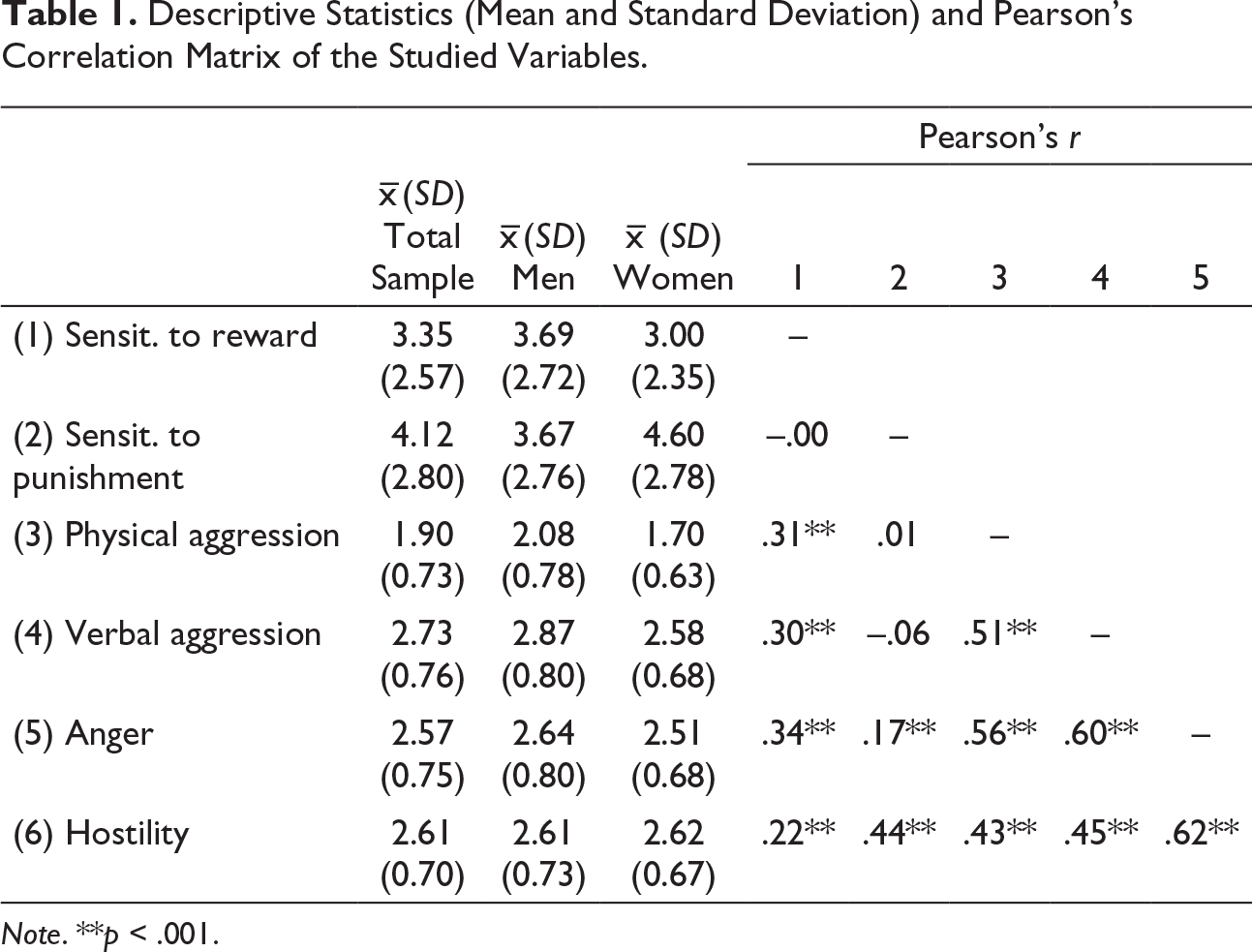
Table 1 displays descriptive statistics (for the total sample and according to gender) and Pearson’s correlation analysis for the variables included in the study. The normality assumption was reasonably satisfied for all the variables, and skewness and kurtosis coefficients varied between a minimum of –.96 and maximum of .99.
Descriptive Statistics (Mean and Standard Deviation) and Pearson’s Correlation Matrix of the Studied Variables.
Note. **p < .001.
Analysis of the gender differences revealed that men, in comparison with women, showed a higher sensitivity to reward (t(482) = 3.00, p < .01), physical aggression (t(482) = 5.80, p < .001) and verbal aggression (t(482) = 4.19, p < .001), and a lower sensitivity to punishment (t(482) = 3.73, p < .001; refer to Table 1 for means). These gender differences justified the inclusion of gender as a covariate in the subsequent analyses.
Focusing on the correlations of interest for our hypotheses, sensitivity to reward showed a positive relationship with the four components of aggression (ps < .001). Sensitivity to punishment also showed a positive relationship with anger and hostility (ps < .001), but no relationship was shown with either physical or verbal aggression (ps > .05). Refer to Table 1 for Pearson’s r values.
With respect to the mediation analyses,2 the models including sensitivity to punishment as a predictor of physical aggression revealed a significant positive indirect effect when the mediator was both anger (indirect effect coefficient = .03, 95% CI [.0137, .0398]; explained variance of the model R2 = 35.78%) and hostility (indirect effect coefficient = .06, 95% CI [.0459, .0757]; explained variance of the model R2 = 27.59%), and a significant negative direct effect when controlling for hostility (c’ = –.05, 95% CI [–.0691, –.0240]). No significant direct effect was observed when controlling for anger. The mediation analyses for the models including sensitivity to punishment as a predictor of verbal aggression also revealed a significant positive indirect effect when the mediator was both anger (indirect effect coefficient = .03, 95% CI [.0161, .0464]; explained variance of the model R2 = 39.57%) and hostility (indirect effect coefficient = .07, 95% CI [.0553, .0872]; explained variance of the model R2 = 30.65%), and a significant negative direct effect when controlling for anger (c’ = –.04, 95% CI [–.0565, –.0177]) and for hostility (c’ = –.08, 95% CI [–.0999, –.0543]; refer to Figure 1).
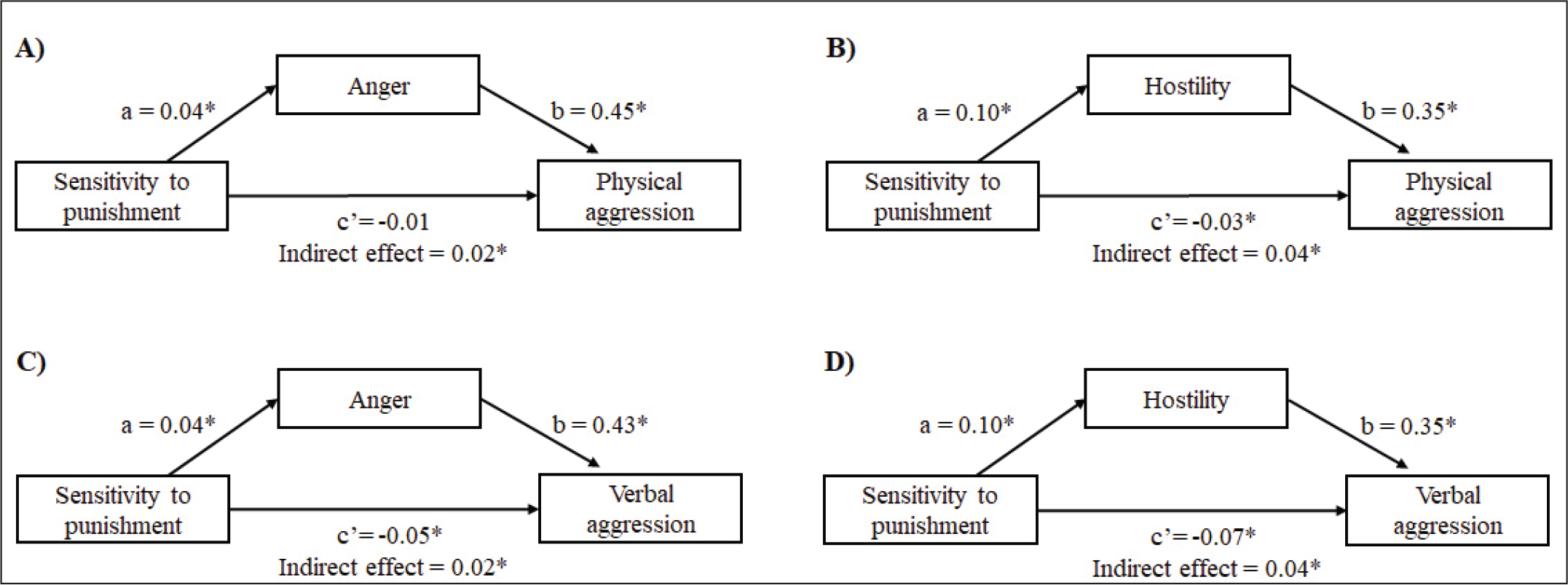
Note. Asterisk indicates a statistically significant confidence interval.
In summary, the results of this first study provided evidence to support H1 and H2, revealing that a higher sensitivity to reward is related to higher levels of the four components of aggression (physical, verbal, anger, and hostility) and that a higher sensitivity to punishment is related to higher levels of anger and hostility. With respect to H3, our predictions were also corroborated, since there was a positive indirect effect of sensitivity to punishment on physical and verbal aggression through the mediating role of anger and hostility. But in addition, the mediation analyses also revealed significant negative direct effects of sensitivity to punishment on physical aggression when controlling for the effect of hostility and on verbal aggression when controlling for the effect of hostility and anger.
Study 2
In this second study, our aim was twofold. First, we aimed to replicate the results of Study 1 using an independent sample of participants in order to confirm their reliability, and thus to be able to draw more robust conclusions about the mixed findings observed in the previous literature. Second, we were interested in investigating the role played by the emotion regulation ability (assessed through performance measures [refer to Mayer et al., 2002]) in the effect of sensitivity to reward and punishment on aggression. In this regard, we proposed the following hypotheses:
Emotion regulation ability is related to lower levels of aggression, sensitivity to reward, and sensitivity to punishment.
The emotion regulation ability acts as a moderator of the effect of sensitivity to reward and punishment on physical and verbal aggression, anger, and hostility. Thus, the higher the emotion regulation ability, the smaller these effects.
The indirect effects of sensitivity to punishment on physical and verbal aggression via anger and via hostility observed in Study 1 are moderated by the emotion regulation ability. Thus, the greater the ability to regulate emotions, the weaker the indirect effects (a moderated mediation effect).
Method
Participants, procedure, and instruments.
Two hundred and twenty-nine Spanish participants voluntarily took part in the study (130 women [56.77%]). The average age was 21.52 years (SD = 2.26), with a range of 18–30 years. Regarding the educational level of the participants, 31.44% had a university degree and 68.56% had a secondary school education (75.16% of them were studying for a university degree at the time of this study). The participants were recruited through advertisements in the University of Málaga, social networks, and online platforms. All of them were informed of the anonymity of the data, signed an informed consent form, and were treated in accordance with the Helsinki Declaration (World Medical Association, 2008).
As in Study 1, levels of sensitivity to reward/punishment and levels of aggression were assessed by the SPSRQ–20 and BPAQ, respectively. Emotion regulation ability was assessed using the MSCEIT. The questionnaires were administered in paper and pencil format in groups of eight people in a quiet room at the University of Málaga under the supervision of one of the authors of the research.
A full description of the SPSRQ–20 and BPAQ is provided in the “Method” section of Study 1. In the current sample, both the SPSRQ–20 and BPAQ showed good internal consistency (sensitivity to reward: ordinal α = .91; sensitivity to punishment: ordinal α = .78; physical aggression: ordinal α = .91; verbal aggression: ordinal α = .88; anger: ordinal α = .84; hostility: ordinal α = .82).
The Mayer–Salovey–Caruso Emotional Intelligence Test (MSCEIT; Mayer et al., 2002). This instrument is a performance-based ability measure of emotional intelligence. It is composed of 141 items divided into four branches according to Mayer and Salovey’s theory: perceiving, using, understanding, and managing emotions (Mayer et al., 2016). In accord with our aims, we focused on the managing branch, which provides a score of the ability to regulate emotions. The items belonging to this branch require respondents to assess which emotional strategies are most effective in regulating their own and others’ emotions in a set of hypothetical scenarios. We used the Spanish version of the test (Cabello et al., 2016; Extremera et al., 2006), which has demonstrated high reliability and solid evidence of convergent and discriminant validity (Sánchez-García et al., 2016). The duration of the MSCEIT assessment is approximately 50 minutes per participant. The internal consistency of the managing branch in our sample was acceptable (α = .72).
Statistical analysis.
The first part of the statistical analysis procedure was similar to that described for Study 1. We explored gender differences by Student t-tests and relationships between the study variables by Pearson’s correlations (controlled for gender). Moreover, we computed the indirect effects of sensitivity to punishment on physical and verbal aggression through the mediating effect of anger and hostility. 3 All these analyses allowed us to replicate the results from Study 1 and to test H1.
In order to address H2, we conducted a set of moderation analyses to explore the conditional effect of the emotion regulation ability on the relationship between sensitivity to reward/punishment and the components of aggression. Additionally, and in accord with the previous literature (refer to the section “Introduction”; Pond et al., 2012; Roberton et al., 2012; Shorey et al., 2011), we also explored the conditional effect of emotion regulation ability on the relationship between the emotional and cognitive components, that is, anger and hostility, and the behavioral components of aggression, that is, physical and verbal aggression. The purpose of this latter analysis was to establish those paths of the previous mediation models in which it makes sense to include emotional regulation ability as a moderating factor to create the moderated mediation models.
Finally, moderated mediation analyses were conducted to examine H3, that is, to confirm whether the previously studied mediating effects were moderated by emotion regulation ability. 4 As previously described, the conditional effect of emotion regulation ability was included only on those paths where the previous moderation analyses revealed a significant interaction (refer to Figure 2).
Pearson’s correlations and t-tests were conducted with SPSS version 24.0 (IBM Corporation, Armonk, NY, United States). The significance level was set at .05. Mediation, moderation, and moderated mediation analyses were conducted by SPSS PROCESS macro 3.4 (Hayes, 2018). Model 1 (in PROCESS) was applied for the moderation analyses, Model 4 for the mediation analyses, and Model 14 for the moderated mediation analyses. The variables were mean-centered and gender was included as a covariate in each model. Indirect effects were computed using a bias-corrected bootstrapping procedure (n = 5,000). Statistical inference was set at 95% CI. Conditional effects were assessed by applying a pick-a-point approach at the 10th, 25th, 50th, 75th, and 90th percentiles (refer to Hayes & Matthes, 2009).
Results and Discussion
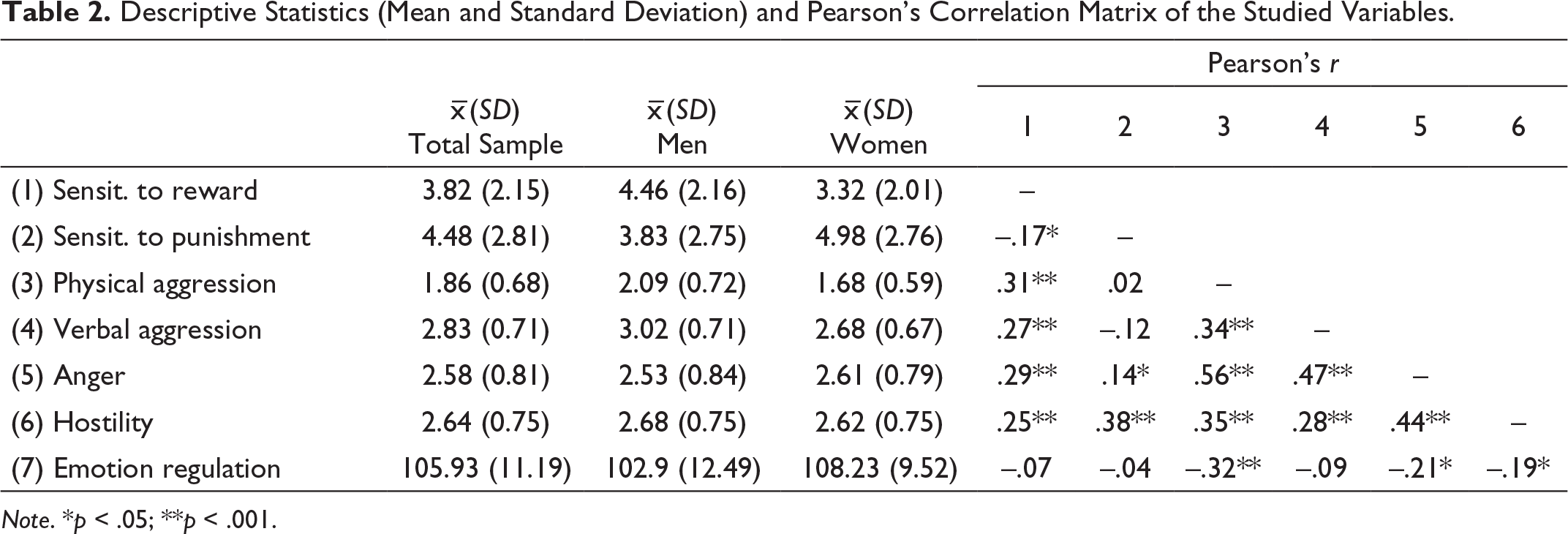
Descriptive statistics and Pearson’s correlations are presented in Table 2. The normality assumption was reasonably satisfied in all cases (skewness and kurtosis coefficients varied between –.94 and .95). In terms of gender differences, the analysis revealed that, compared with women, men had a higher sensitivity to reward (t(227) = 4.12, p < .001), physical aggression (t(227) = 4.78, p < .001) and verbal aggression (t(227) = 3.70, p < .001), and a lower sensitivity to punishment (t(227) = 3.14, p < .01) and emotion regulation ability (t(227) = 3.66, p < .001; refer to Table 2).
As in Study 1, the correlation analysis revealed that sensitivity to reward had a positive relationship with the four components of aggression (all p < .02), and sensitivity to punishment showed a positive relationship with anger (p = .03) and hostility (p < .001), but not with either physical or verbal aggression (p > .05). In addition, emotion regulation ability was negatively related to physical aggression, anger, and hostility (all p < .01), but there was no relationship with verbal aggression, sensitivity to reward, and sensitivity to punishment (p > .05). Refer to Table 2 for Pearson’s r values.
Descriptive Statistics (Mean and Standard Deviation) and Pearson’s Correlation Matrix of the Studied Variables.
Note. *p < .05; **p < .001.
The mediation analyses also replicated the results of Study 1.3 A significant positive indirect effect of sensitivity to punishment on physical aggression was revealed when the mediating variable was both anger (indirect effect coefficient = .02, 95% CI [.0002, .0363]; explained variance of the model R2 = 38.01%) and hostility (indirect effect coefficient = .04, 95% CI [.0212, .0570]; explained variance of the model R2 = 21.99%). Moreover, a significant negative direct effect of sensitivity to punishment on physical aggression was observed when controlling for hostility (c’ = –.03, 95% CI [–.0630, –.0014]), but not when controlling for anger. With respect to the mediating effects of sensitivity to punishment on verbal aggression, a significant positive indirect effect was revealed when the mediator was both anger (indirect effect coefficient = .0178, 95% CI [.0030, .0356]; explained variance of the model R2 = 30.61%) and hostility (indirect effect coefficient = .04, 95% CI [.0229, .0536]; explained variance of the model R2 = 19.19%). Moreover, a significant negative direct effect of sensitivity to punishment on verbal aggression was observed when controlling for both anger (c’ = –.05, 95% CI [–.0784, –.0215]) and hostility (c’ = –.07, 95% CI [–.1013, –.0356]).
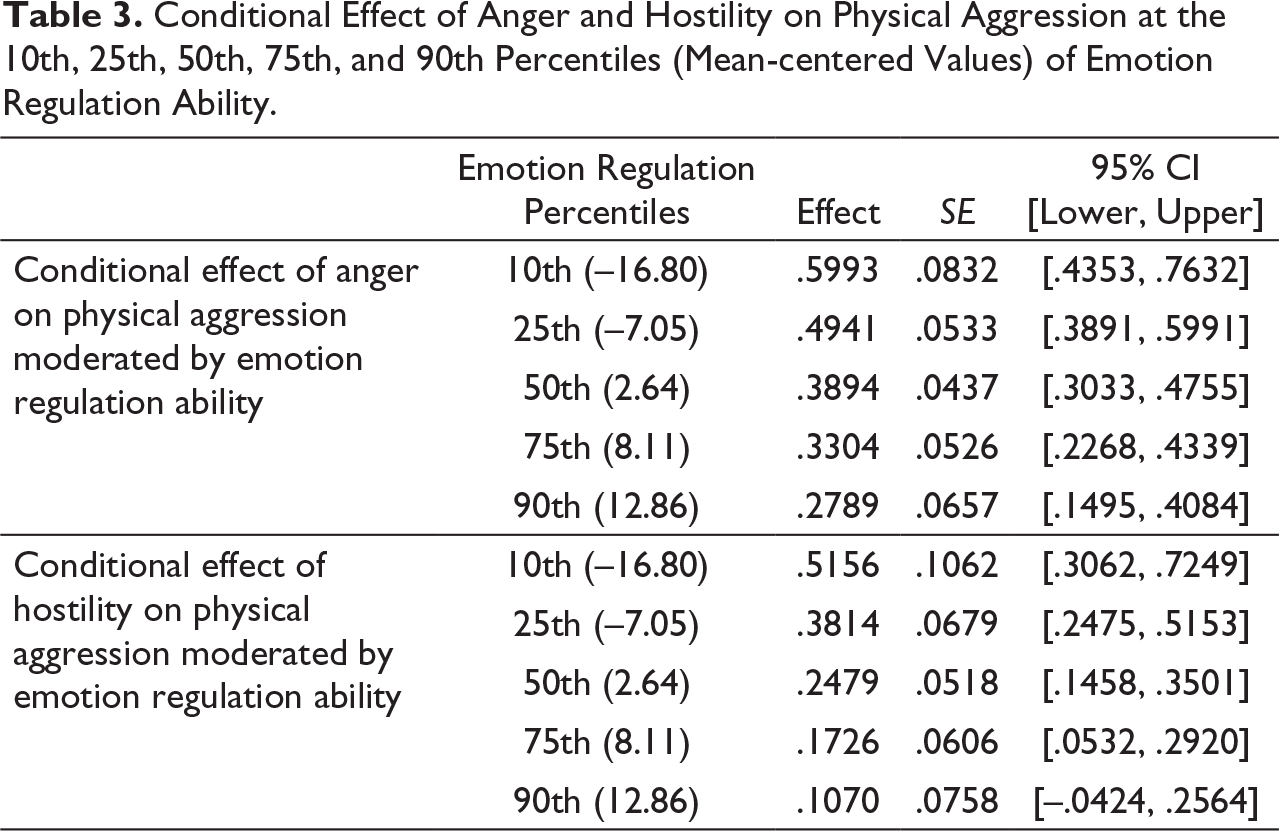
Results of the moderation analyses revealed that emotion regulation ability did not moderate any of the relationships between sensitivity to reward and punishment and the four components of aggression (all p > .31). Nonetheless, emotion regulation ability was found to moderate the effect of anger and hostility on physical aggression (for anger: interaction effect coefficient = –.0108, t(224) = –2.65, 95% CI [–.0188, –.0028]; for hostility: interaction effect coefficient = –.0138, t(224) = –2.75, 95% CI [–.0236, –.0039]). Following the pick-a-point procedure, the higher the emotion regulation ability, the lower the magnitude of the effects (refer to Table 3). We found no moderating effect of emotion regulation ability on the effect of anger and hostility on verbal aggression.
Conditional Effect of Anger and Hostility on Physical Aggression at the 10th, 25th, 50th, 75th, and 90th Percentiles (Mean-centered Values) of Emotion Regulation Ability.
Finally, we tested the moderated mediation models of interest.4 Based on the results found in the moderation analyses, we incorporated the variable of emotion regulation ability as a moderator of the effect of anger and hostility on physical aggression in those previous mediation models that included these variables: (1) sensitivity to punishment predicting physical aggression via anger, and (2) sensitivity to punishment predicting physical aggression via hostility. These moderated mediation analyses revealed a significant conditional indirect effect for both models, when the mediator was anger (index = –.0004, 95% CI[–.0011, –.0001]; explained variance of the model R2 = 43.84%) and when the mediator was hostility (index = –.0014, 95% CI[–.0028, –.0002]; explained variance of the model R2 = 30.38%; refer to Figure 2). According to the pick-a-point procedure, it appears that the higher the emotion regulation ability, the lower the magnitude of the indirect effects (refer to Table 4).
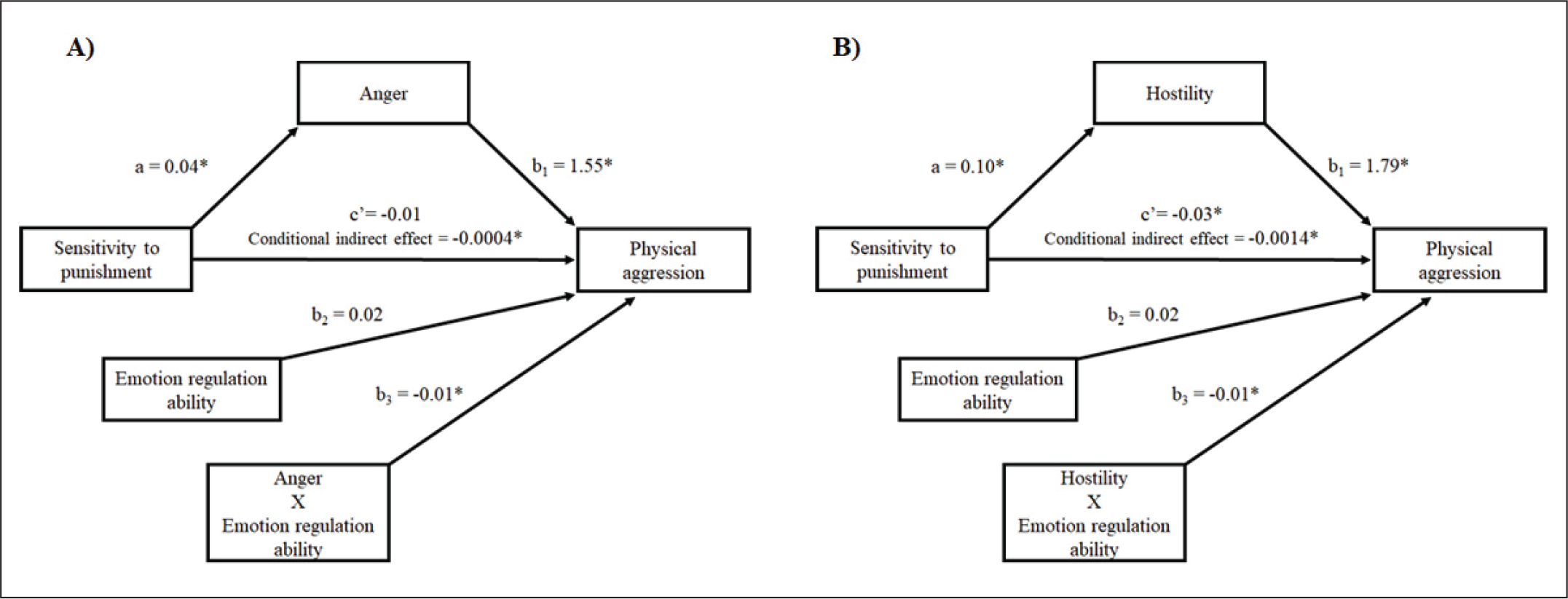
Note. Asterisk indicates a statistically significant confidence interval.
Conditional Indirect Effect of Sensitivity to Punishment on Physical Aggression via the Mediating Effect of Anger and Hostility at the 10th, 25th, 50th, 75th, and 90th Percentiles (Mean-centered Values) of Emotion Regulation Ability.
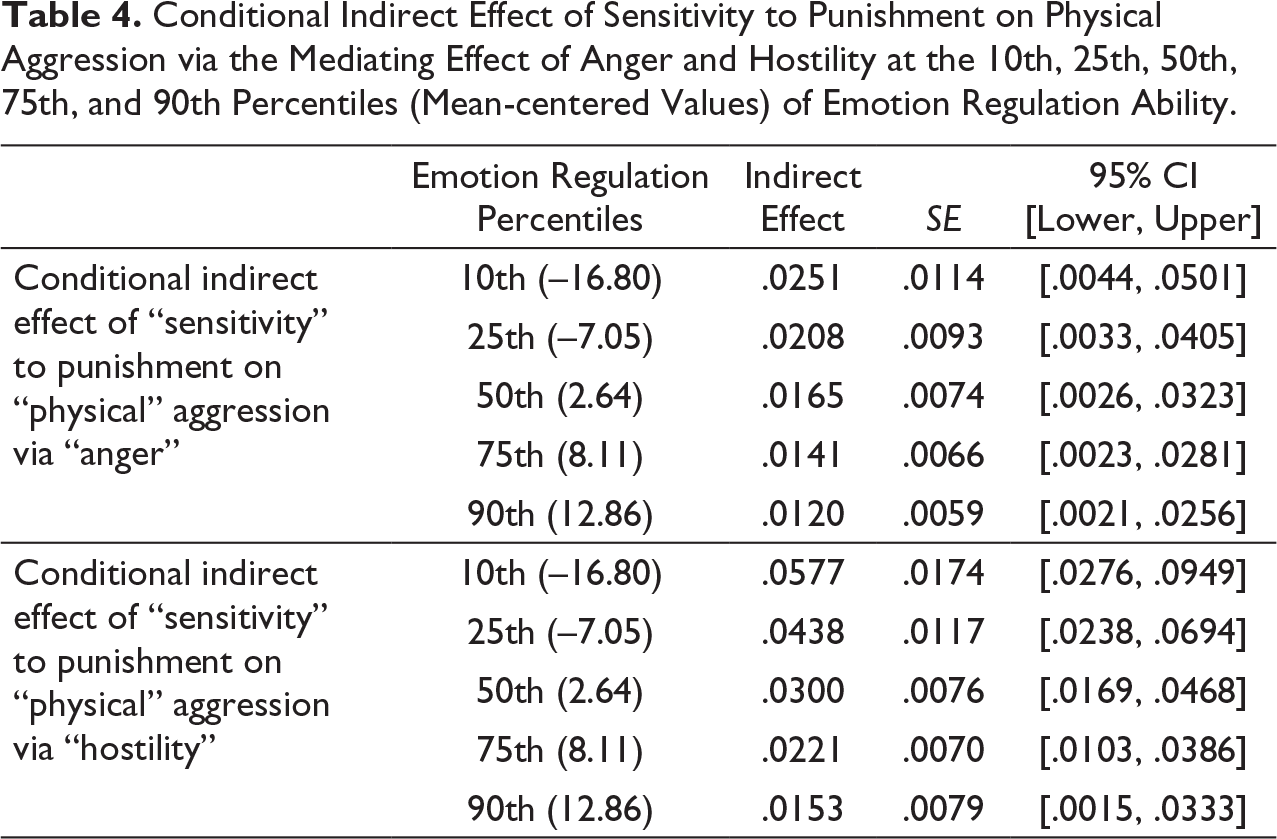
In summary, the results of Study 2 replicate, in a young adult sample, those from Study 1 and provide further information about the role of emotion regulation ability in the relationship between sensitivity to reward/punishment and the components of aggression. In particular, we observed that higher emotion regulation ability was related to lower levels of physical aggression, anger, and hostility, but these were not related to verbal aggression, sensitivity to reward and sensitivity to punishment. Thus, H1 was only partially confirmed. Our findings, however, failed to provide support for H2, since emotion regulation ability did not moderate the effect of sensitivity to reward and punishment on any of the components of aggression. Finally, H3 was partially supported. The indirect effect of sensitivity to punishment on physical aggression (through the mediating effect of anger and hostility) was moderated by emotion regulation ability, helping to reduce the levels of aggression.
General Discussion
The present research explored the role played by sensitivity to reward and punishment in various forms of aggression. For this purpose, we conducted two studies. The first study aimed at clarifying this relationship and the underlying processes, since the previous literature has shown mixed results in this regard. The second study investigated the moderating role of emotion regulation ability in this relationship.
In line with the results of previous studies (Carlson et al., 2013; Granero et al., 2016; Harmon-Jones, 2003; Harmon-Jones & Peterson, 2008; Pederson et al., 2018), our findings (in both Studies 1 and 2) revealed that sensitivity to reward was positively correlated with the behavioral components of aggression, that is, physical and verbal aggression, as well as with the two emotional and cognitive components, that is, anger and hostility. However, the direction of the relationship between sensitivity to punishment and aggression varied as a function of the type of aggression studied. Thus, as in the case of sensitivity to reward, sensitivity to punishment was positively correlated with the components of anger and hostility, whilst no such relationship was found with physical and verbal aggression. It is in these two latter components of aggression where the literature has revealed discrepant results, which was the main issue that we aimed to resolve in our research.
To clarify this issue, we proposed the existence of a positive indirect effect of sensitivity to punishment on the behavioral forms of aggression (physical and verbal components) via the mediating role of anger and hostility. The results of our mediation analyses supported this hypothesis, revealing an indirect effect both when the mediator was anger and when it was hostility. Individuals with higher sensitivity to punishment showed significantly higher levels of anger and hostility, and, in turn, higher levels of these aggression components were associated with significantly higher levels of physical and verbal aggression. Interestingly, these mediation analyses also revealed a significant negative direct effect of sensitivity to punishment on physical aggression when controlling for the effect of hostility, and a significant negative direct effect of sensitivity to punishment on verbal aggression when controlling for both anger and hostility.
Focusing on the results of these mediation analyses, we observed direct and indirect effects in opposite directions, both of which would explain the relationship between sensitivity to punishment and behavioral aggression. Whilst sensitivity to punishment was found to play a direct protective role in behavioral aggression, this was also shown to be a risk factor through its influence on anger and hostility. Based on Gray’s theory and the link that it establishes between BAS and BIS and sensitivity to reward/punishment, we propose the following explanation. On the one hand, the protective role of sensitivity to punishment can be understood if we consider the fact that individuals who are more susceptible to punishment (higher BIS reactivity) show a greater tendency to inhibit their aggressive behaviors in order to avoid the negative consequences of such behaviors. On the other hand, the sustained suppression of approach behaviors in response to emotionally charged events of a negative nature, such as contexts of provocation, would entail an increase in the cognitive and emotional components of aggression, that is, greater anger and hostility. In turn, a marked increase in the levels of these components could lead to problems of emotional and behavioral regulation and, with this, the externalization of aggression in both its physical and verbal forms. This second suggestion could account for the role of sensitivity to punishment as a risk factor in aggression.
These findings shed light on the mixed results reported in the previous literature regarding the relationship between sensitivity to punishment and aggression. Moreover, it is worth noting that our results were initially obtained in Study 1 and replicated in Study 2. The observed direct effects are in line with those studies supporting a negative relationship between the two variables (Bjørnebekk, 2007; Carlson et al., 2013; Harmon-Jones, 2003; Morgan et al., 2014; Smits & Kuppens, 2005), whilst the indirect effect could explain the results of those studies that indicate a positive relationship (Pederson et al., 2018). The combination of both effects could also underlie the failure to find a significant relationship in some studies (Constantinou et al., 2011; Granero et al., 2016; Harmon-Jones & Peterson, 2008).
Further, given the importance of managing emotions in the control of aggression and sensitivity to reward/punishment (Hsieh & Chen, 2017; Roberton et al., 2012; Tull et al., 2010), in Study 2 we were interested in exploring the effect of emotion regulation ability on the study variables and its possible effects on the relationship between sensitivity to reward/punishment and aggression. The correlation analyses in Study 2 revealed that higher emotion regulation ability was associated with lower levels of aggression (with the exception of verbal aggression). However, there was no relationship with either sensitivity to reward or punishment. With respect to the moderation analysis, emotion regulation ability did not moderate the effect of sensitivity to reward or punishment on any of the four components of aggression. Moderating effects of emotion regulation ability were only observed in the relationship between the anger and hostility components and physical aggression. Finally, the moderated mediation analyses revealed that emotion regulation ability can control the positive indirect effect of sensitivity to punishment on physical aggression via both anger and hostility, reducing the levels of aggression as emotion regulation ability increases. To summarize the findings related to emotion regulation, we confirmed that emotion regulation ability acts as a general protective factor against aggression, and in particular, according to our aims, we observed that this ability could partially underlie the relationship between sensitivity to punishment and aggression via its effect on anger and hostility. Unlike previous studies (Tull et al., 2010), however, we did not find evidence of the hypothesized relationship between emotion regulation ability and sensitivity to reward and punishment. A notable difference between our study and that of Tull et al. (2010), which could explain these results, is that the questionnaires used by Tull et al. (2010) for assessing emotion regulation abilities were self-reported, while we used a performance-based measure. Future studies should address this issue in more detail to shed light on these discrepant findings.
The findings reported here are not only of theoretical significance but also have applied value. A deeper understanding of the risk and protective factors of aggression can be beneficial for both clinical practice and society in general. Our results suggest that the promotion of strategies for reducing high reactivity to reward may be useful for controlling aggressive behavior, but that, in addition, it would also be advisable to work on high reactivity to punishment, since this reactivity could increase the levels of anger and hostility, leading to a higher likelihood of displaying aggressive behavior. In this regard, and according to our findings, the training of emotion regulation ability aimed at curbing anger and hostility caused by high reactivity to punishment could be implemented in prevention and treatment programs for reducing aggressive behavior.
Limitations and Recommendations for Future Studies
It is important to note that the methodology employed in this study is correlational in nature. Therefore, although we based our hypotheses and established the models on well-documented evidence from previous work, our results do not necessarily imply causality. Future research employing experimental designs is needed to be able to make directional inferences. A further point to consider is that two of the measurement instruments used in this research (the SPSRQ-20 and BPAQ) are self-reports, which implies that the answers are based on subjective perceptions and these can be susceptible to social desirability biases. Thus, it would be useful to replicate our findings with behavioral tasks or physiological measures. Finally, further research should also try to replicate our results using samples with a greater diversity of variables such as age, socioeconomic status, or cultural aspects.
Conclusion
The aim of the current research was to clarify the role of sensitivity to reward and punishment in aggression and identify the mechanisms underlying this relationship, particularly given that previous studies have yielded mixed results in this regard. Our findings support the existence of a positive relationship between sensitivity to reward and aggression, that is, a high reactivity to reward acts as a risk factor. The results also suggest that sensitivity to punishment can play a protective role whilst also constituting a risk factor. A higher reactivity to punishment could have a negative direct effect on behavioral aggression, inhibiting physical and verbal aggressive behaviors in order to avoid the negative consequences associated with these behaviors. However, the higher reactivity to punishment could also imply another form of influence, that is, a positive indirect effect on physical and verbal aggression via an increase in anger and hostility. Interestingly, this indirect effect is moderated by the emotion regulation ability of the individual. These results could help to inform the design of prevention and intervention programs for reducing the impact of aggressive behavior on our society.
Supplemental Material
Supplemental material for this article is available online.
Supplemental Material for The Role of Sensitivity to Reward and Punishment in Aggression by Alberto Megías-Robles, Raquel Gómez-Leal, María José Gutiérrez-Cobo, Rosario Cabello, and Pablo Fernández-Berrocal, in Journal of Interpersonal Violence
Footnotes
Declaration of Conflicting Interests
The author(s) declared no potential conflicts of interest with respect to the research, authorship, and/or publication of this article.
Funding
The author(s) disclosed receipt of the following financial support for the research, authorship, and/or publication of this article: This work was funded by the Spanish Ministry of Economy, Industry and Competitiveness (project: PSI2017-84170-R) to Pablo Fernández Berrocal, Junta de Andalucía (project: UMA18-FEDERJA-137) to Alberto Megías Robles, and the Spanish Ministry of Education (FPU grant FPU15/05179) to Raquel Gómez-Leal.
Notes

Author Biographies
References
Supplementary Material
Please find the following supplemental material available below.
For Open Access articles published under a Creative Commons License, all supplemental material carries the same license as the article it is associated with.
For non-Open Access articles published, all supplemental material carries a non-exclusive license, and permission requests for re-use of supplemental material or any part of supplemental material shall be sent directly to the copyright owner as specified in the copyright notice associated with the article.
