







Abstract
Previous research has explored offline intimate partner violence from an evolutionary perspective, primarily focusing on the role of individual differences in perpetration and victimization. However, a current form of intimate partner violence is digital dating abuse, which involves abuse toward a romantic partner, occuring online through the use of electronic communication technology. This form of abuse differs from offline abuse, in that physical proximity is not required. Although research has focused on the effects digital dating abuse has on victims, little research has focused on the perpetration of digital dating abuse. This is important as research focused on perpetration can inform a wide range of initiatives geared toward understanding the factors which drive this behavior. Recent research has focused on evolutionary mating-relevant factors that drive the perpetration of digital dating abuse. Here, we extended and replicated previous work by reporting two studies (study 1, n = 114; study 2, n = 162) which explored the roles of mate value discrepancy, intrasexual competition, and relationship-contingent self-esteem in the perpetration of digital dating abuse. We found that mate value discrepancy (studies 1 and 2) and intrasexual competition (study 2) positively predicted the perpetration of digital dating abuse. To our knowledge, this article is the first to provide support that those who report high intrasexual competition, engage in greater levels of digital dating abuse, thus furthering theoretical advancements in this field by showing digital dating abuse is a mate retention tactic. Our findings further our understanding of online behavior in romantic relationships through an evolutionary psychological lens.
Keywords
Intimate partner violence involves acts of violence and aggression toward a romantic partner (Larsen, 2016). Displays of violence may be physical, sexual, and/or psychological, signifying the many forms that intimate partner violence can take, and how it can be multifaceted (Brown & Hegarty, 2018). Although online and offline abuse both lead to negative outcomes for victims, a key factor that distinguishes online and offline abuse is that physical proximity is not required when perpetrating online abuse (Bennett et al., 2011). Social networking sites aid the perpetration of dating abuse as romantic partners can communicate instantly. There is an increase in research focusing on online intimate partner violence, known as digital dating abuse (Van Ouytsel et al., 2020).
Digital dating abuse involves abuse directed toward a romantic partner through various forms of electronic information technology, including social networking sites (Zweig et al., 2013). Electronic intrusion (a facet of digital dating abuse) involves intruding a romantic partner’s digital privacy using social media (Reed et al., 2015). Acts of electronic intrusion can include monitoring a partner’s whereabouts online (Burke et al., 2011; Reed et al., 2016), deleting friends and ex-romantic partners on social media (Stonard et al., 2015), posting humiliating photographs or comments relating to a partner (Patchin & Hinduja, 2011) or threatening a partner online (Machimbarrena et al., 2018; Zweig et al., 2013).
Research highlights that over 30% of students perpetrate digital dating abuse in romantic relationships (Smith et al., 2018; Villora et al., 2019) and 50% of students report victimization of digital dating abuse (Borrajo et al., 2015). While students are particularly vulnerable, research posits that younger adults have a higher vulnerability to both digital dating abuse victimization and perpetration than older adults (Lenhart et al., 2017), which may be because younger adults are the highest users of technology (Brown & Hegarty, 2018). Furthermore, younger individuals are more likely to engage in intimate partner violence than older adults (Pazhoohi et al., 2016).
Victims of digital dating abuse suffer from poor mental and emotional well-being (Hancock et al., 2017; Lu et al., 2018), including distress, depression, anxiety, isolation, suicide ideation, and substance misuse (Lu et al., 2018; Teten et al., 2009). Whilst much is known about victim’s experiences of digital dating abuse, little research investigates the motivations behind perpetrating such abuse (Stonard et al., 2014). To prevent perpetration of digital dating abuse through developing appropriate interventions, research must be conducted to investigate the factors which may drive one to perpetrate digital dating abuse.
Though research surrounding perpetration of digital dating abuse is limited, recent research has focused on individual differences, with findings showing that aggression (Borrajo et al., 2015; Schnurr et al., 2013), romantic jealousy (Deans & Bhogal, 2019; Elphinston & Noller, 2011), and attachment anxiety have been found to positively predict perpetration of digital dating abuse (Reed et al., 2015; Reed et al., 2016; Wright, 2015). The evidence surrounding the role of gender in the perpetration of digital dating abuse has been mixed (Bhogal et al., 2019; Hancock et al., 2017; See Taylor & Xia, 2018 for a discussion). For example, some research finds that men perpetrate digital dating abuse to a greater degree than women (Deans & Bhogal, 2019), some research finds that men and women perpetrate digital dating abuse relatively equally, and other research has found that women perpetrate digital dating abuse to a greater degree compared to men (Bennett et al., 2011; Van Ouytsel et al., 2017).
Van Ouytsel et al. (2020) argue that research into digital dating abuse often lacks a theoretical approach. Recent research has adopted an evolutionary framework to understand the perpetration of digital dating abuse, suggesting digital dating abuse is a mate retention tactic, to protect one’s investment into a relationship. Recent research suggests that digital dating abuse acts as a cost-inflicting mate retention tactic with the aim of keeping a relationship intact, and deterring mating rivals (Bhogal & Howman, 2019; Bhogal et al., 2019). In this study, we replicate and extend these previous findings by adopting an evolutionary framework to understanding the perpetration of digital dating abuse. According to Van Ouytsel et al. (2020), using theoretical frameworks to understand digital dating abuse enables researchers to design effective interventions, and to identify key variables associated with the perpetration of this behavior.
Mate Value
Previous research finds that mating factors such as mate value discrepancy significantly predicts digital dating abuse perpetration (Bhogal & Howman, 2019; Bhogal et al., 2019). Mate value refers to the number of characteristics possessed by an individual which contribute to their overall mate value (Fisher et al., 2008). Examples of characteristics which contribute to one’s mate value include physical attractiveness, maturity, sense of humor, and emotional stability.
There is often conflict between perceived self-mate value and perceived partner mate value, leading to mate value discrepancy (Goetz & Maria, 2019). Mate value discrepancy refers to the difference in perceived mate quality between partners. If there are large mate value discrepancies between a couple, this can often lead to mate retention behaviors, employed to protect a romantic partner from mate poachers (Holden et al., 2014; Miner et al., 2009).
Mate poaching is an adaptive tactic used to steal someone’s romantic partner to increase one’s own reproductive success (Arnocky et al., 2013). If mate guarding tactics are not employed, one’s romantic partner faces an increased likelihood of being poached by a competitor (Jonason et al., 2010). As a result of the risks posed by mate poaching, mate retention tactics are employed to protect one’s investment in a romantic relationship and protect a romantic partner from romantic rivals. Such behaviors may be benefit-provisioning (such as gift giving or compliments) and/or cost-inflicting (such as manipulating a romantic partner; see Davis et al., 2018). Cost-inflicting behaviors such as abuse are often employed to prevent a partner from leaving a romantic relationship (Miner et al., 2009). Digital dating abuse may be a cost-inflicting mate retention tactic used to protect a relationship as it involves engagement in risky and manipulative behaviors such as checking a partner’s whereabouts online (Bhogal et al., 2019). In support, Brem et al. (2014) found that individuals use Facebook as a mate retention tactic.
The relationship between mate value discrepancy and digital dating abuse perpetration was first explored by Bhogal and Howman (2019) who found that low perceived self-mate value and high perceived partner mate value significantly predict the perpetration of digital dating abuse. This was further replicated by Bhogal et al. (2019) who found that mate value discrepancy was positively associated with perpetration of digital dating abuse, suggesting that digital dating abuse may be a mate retention tactic. Bhogal and Howman (2019) explored whether attachment style and mate value discrepancy predicted the perpetration of digital dating abuse in a UK sample of 180 participants. They found that those who reported their partners as having greater mate value than themselves reported perpetrating greater levels of digital dating abuse. Furthermore, Bhogal et al. (2019) extended this research by conducting two studies examining the role of mate value discrepancy in two independent UK samples, successfully replicating the findings of Bhogal and Howman (2019).
In the interest of scientific replication, study 1 was conducted as a conceptual replication study aiming to replicate previous research finding a link between mate value discrepancy and digital dating abuse (Bhogal & Howman, 2019; Bhogal et al., 2019). However, we attempted to assess this relationship using a measure of mate value not used in previous research outlined earlier. Previous research has used the Kirsner et al. (2003) mate value scale, however for study 1, we used the general mate preference scale (Buss, 1989). We felt this was necessary to examine the strength and robustness of the finding that mate value discrepancy predicts digital dating abuse.
A priori H1: Mate value discrepancy would positively predict digital dating abuse.
Study 1
Method
Design and Participants
A correlational design was adopted to explore whether mate value discrepancy was related to the perpetration of digital dating abuse. The sample consisted of 114 heterosexual people (88 women, 26 men, Mage = 20.87 years old, SD = 2.22) from the general public in the United Kingdom, recruited via opportunity sampling on Qualtrics (an online survey builder). Participants took part via Qualtrics and survey links were shared on social media sites such as Twitter and Facebook. In addition, undergraduate psychology students took part via the host universities departmental research participation scheme. 1 Participants were required to be in a romantic relationship at the time of participation (Mrelationship length = 22.31 months, SD = 31.08).
Materials
Mate value. The 20-item General Mate Preference scale (Buss, 1989) was used to measure participants’ self-perceived mate value and that of their current partner. The scale lists characteristics which are scored on a 7-point Likert scale ranging from 1 (extremely low) to 7 (extremely high). High scores reflect high mate value and low scores reflect low mate value. Items measure traits such as “kindness” and “dependability.” For study 1, participants completed this scale twice, once where they rated themselves and one where they rated their partner (counterbalanced through the randomizer function on Qualtrics). Cronbach alpha is reported for all reliability analyses across both studies. The general mate preference scale was reliable in our sample (self-mate value, α = .82 and partner mate value, α = .85). Mate value discrepancy was calculated by computing the difference between self and partner mate value scores (consistent with Bhogal & Howman, 2019; Bhogal et al., 2019).
Digital dating abuse. We used the 19-item perpetration sub-scale of the Digital Dating Abuse scale (Reed et al., 2016), which measures participants’ experiences of perpetrating digital dating abuse toward their partner. Participants scored each item on how often they have carried out each behavior toward their current partner, which are all measured on a 4-point Likert scale ranging from 0 (never) to 3 (very often). An example item is “Monitored my partner’s whereabouts.” Higher scores reflected greater perpetration of digital dating abuse and low scores reflect low perpetration of digital dating abuse. The scale had acceptable reliability in our sample (α =.65).
Procedure
For both studies reported in this article, once participants provided informed consent, they were asked to provide demographic details and complete the questionnaires outlined earlier and in subsequent methods sections. Finally, participants were fully debriefed online. Data were collected anonymously, online. For both studies, the order of questionnaires was counterbalanced using the randomizer function on Qualtrics.
Results
Results of the Hierarchical Linear Regression Model Predicting Digital Dating Abuse From Mate Value Discrepancy (Study 1),
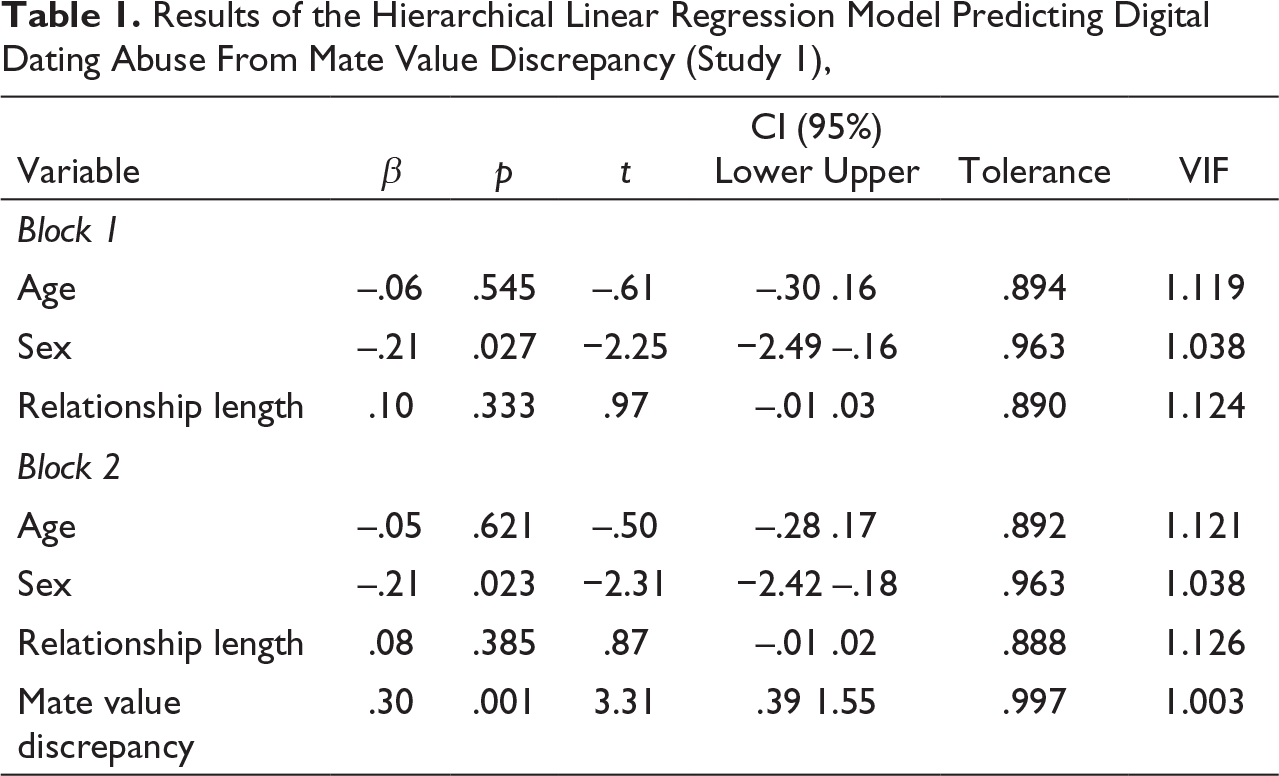
Age, relationship length, and sex were added to block 1 of the model. Here, they accounted for 5.1% of the variance in digital dating abuse (adjusted R =.026), F(3, 110) = 1.99, p = .120. Mate value discrepancy was added to block 2 of the model. This resulted in a R change of .087 and a statistically significant F change (.001).
The final model explained 13.8% of the variance in digital dating abuse, F(4, 109) = 4.37 (adjusted R = .106), p = .001, Cohens f = .16, Durbin-Watson = 2.04. Mate value discrepancy significantly, positively predicted digital dating abuse, supporting H1.
Study 2
The findings from study 1 show that when we use an alternative measure of self-perceived mate value than used in previous research, higher mate value discrepancies predict greater levels of digital dating abuse. In the interest of methods and conceptual replication, study 1 adds to the literature showing the link between mate value discrepancy and digital dating abuse (Bhogal & Howman, 2019; Bhogal et al., 2019). This finding adds to the robustness of the finding that digital dating abuse could be a cost-conflicting mate retention tactic.
Consistent with previous research, we were interested in exploring the role of alternative and previously explored mating-relevant factors in the perpetration of digital dating abuse. We therefore conducted study 2 to (a) replicate the relationship between digital dating abuse and mate value discrepancy using a further alternative measure of mate value and (b) to examine the role of intrasexual competition and relationship contingent self-esteem in the perpetration of digital dating abuse.
Psychological science is currently in a replication crisis whereby researchers fail to replicate empirical findings, casting doubt on both the strength and reliability of existing findings (Earp & Trafimow, 2015). Therefore, this highlights the importance of replication. Previous research exploring the role of mate value discrepancy and digital dating abuse has used the 17-item Mate Value Inventory Short Form (Kirsner et al., 2003). In this scale, participants are asked to rate both self and partner mate value on facets such as, attractive face, desire intimacy, and good parenting skills. In study 1, we used a similar scale which lists characteristics which form one’s mate value, finding support for the relationship between mate value discrepancy and digital dating abuse.
Where items in the Kirsner et al. (2003) scale have shown to be reliable in previous research (Bhogal & Howman, 2019; Bhogal et al., 2019), to date, no previous research has yet investigated the relationship between digital dating abuse perpetration and mate value discrepancy using the Mate Value Scale (Edlund & Sagarin, 2014). This is a more concise scale measuring self-perceived mate value with the items being presented more subtly than in the Mate Value Inventory Short Form (Kirsner et al., 2003). As a result, study 2 aimed to further investigate the relationship between mate value discrepancy and digital dating abuse perpetration, showing this study’s methodological importance.
Intrasexual Competition
Intrasexual competition refers to the competition each sex faces from same-sex romantic rivals when attempting to attract romantic partners and increasing reproductive success (Keys & Bhogal, 2018). This can involve the use of tactics such as rival derogation whereby individuals promote themselves as more attractive than their rivals by attempting to make their rivals appear less attractive (Buss & Dedden, 1990; Polo et al., 2018). Research posits that those who engage in high levels of intrasexual competition fear being replaced by mates who they perceive to be more desirable than themselves (Miner et al., 2009) and engage in acts of aggression toward romantic rivals (Keys & Bhogal, 2018). Therefore, intrasexual competition may act as a mate retention behavior to prevent mate poaching (Arnocky et al., 2018). Due to fear of being replaced by high-valued competitors, it can be suggested that intrasexual competition may predict the perpetration of digital dating abuse to protect a romantic partner from being poached by a romantic rival.
To our knowledge, the relationship between intrasexual competition and digital dating abuse has only been explored by Bhogal et al. (2019) who found no support for this relationship. However, Bhogal et al. (2019) used the self-report measure of intrasexual competition (Buunk & Fisher, 2009). Karimi and Esmaeilinasab (2019) outline key limitations of using this scale to measure intrasexual competition. Karimi et al. (2019) suggest that this scale fails to consider advances in psychological literature, whereby recent literature suggests that mate preferences are multidimensional (Atari & Jamali, 2016). For example, Buss’s (1988) bi-tactic intrasexual competition framework constitutes self-promotion and rival-derogation and the five-factor model of human mate preferences (Atari, 2017), which Buunk and Fisher’s (2009) scale does not incorporate. This model gives rise to the importance of studying long-term mate preferences by summarizing preferences into five key categories which include; kindness/dependability, attractiveness/sexuality, status/resources, education/intelligence, and religiosity/chastity (Karimi et al., 2019). Despite this, the Scale for Intrasexual Competition (Buunk & Fisher, 2009) only considers rival-derogation components of intrasexual rivalry. Therefore, a significant limitation of this scale is that it is unable to reliably measure self-promotion strategies used during intrasexual competition behaviors. This has many theoretical implications for the relationship between intrasexual competition and mate retention, whereby mate scarcity predicts willingness to engage in intrasexual competitive behaviors against mate poachers (Arnocky et al., 2014). As a result, Karimi et al. (2019) developed the Intrasexual Rivalry Scale to connect these models and components to create a more efficient measure of intrasexual competition. Therefore, here, we used the Intrasexual Rivalry Scale to reexamine whether intrasexual competition predicts the perpetration of digital dating abuse, emphasizing the methodological importance of the study.
In addition to intrasexual competition, for study 2, we aimed to extend and expand upon previous research exploring the role of self-esteem in the perpetration of digital dating abuse. Mate retentions tactics are linked to self-esteem as previous research shows that those who report low self-esteem engage in greater levels of cost-inflicting mate retention tactics (see Holden et al., 2014). As those with lower self-esteem tend to engage in greater levels of offline intimate partner violence (see Lewis et al., 2002), we, consistent with Bhogal et al. (2019) believe that the role of self-esteem in online intimate partner violence should be explored further. Furthermore, as derogation is a key facet of cost-inflicting mate retention and digital dating abuse, previous research has explored the association between self-esteem and digital dating abuse (Bhogal et al., 2019) finding no support.
Bhogal et al. (2019) used Rosenberg (1965) measure of self-esteem, which focuses on an individual’s general (explicit self-esteem) self-esteem, ignoring relationship specific self-esteem. Holden et al. (2018) argue that when exploring self-esteem in relationships, researchers should view self-esteem as multifaceted, in that we should be exploring relationship contingent self-esteem, rather than general self-esteem. Therefore, in study 2, we expanded on the work of Bhogal et al. (2019) by exploring the role of relationship contingent self-esteem rather than general self-esteem.
Aims and Hypotheses
The aim of study 2 was to replicate the finding that mate value discrepancy predicts digital dating abuse, and to further explore the role of intrasexual competition and relationship contingent self-esteem in digital dating abuse.
We hypothesized the following:
A priori H1: Mate value discrepancy would positively predict digital dating abuse.
Exploratory H2: Intrasexual competition would be related to digital dating abuse.
Exploratory H3: Relationship contingent self-esteem would be related to digital dating abuse.
Method
Design and Participants
A correlational design was adopted to explore whether mate value discrepancy, intrasexual rivalry, and relationship contingent self-esteem predicted digital dating abuse. The sample included 162 heterosexual people from the general public in the United Kingdom (144 women, 18 men, Mage = 26.32 years old, SD = 9.09). Participants were required to currently be in a romantic relationship (Mrelationship length = 38.04 months, SD = 59.23).
Materials
Relationship contingent self-esteem. The 11-item relationship contingent self-esteem scale (Knee et al., 2008) measures relationship specific self-esteem. Items are measured on a 1 (Not at all like me) to 5 (very much like me) Likert scale. An example from this scale includes “I feel better about myself when it seems like my partner and I are emotionally connected.” The scale was reliable in our sample (α = .86).
Intrasexual rivalry scale (Karimi et al., 2019). This scale includes 16-items measuring the extent to which individuals compete with members of the opposite sex for mates (intrasexual competition). There are two versions of the scale dependent on one’s sex: male and female. Each item of the scale remains the same; however, wording differs according to the participants’ sex. For example, in the male version, participants respond to statements such as “I look for negative points in kind and nice men.” Whereas in the female version, participants respond to the same statement with female pronouns, for example, “I look for negative points in kind and nice women.” Responses are measured on a 7-point Likert scale ranging from 1 (not at all applicable) to 7 (completely applicable). The scale was reliable in our sample (α = .78).
Mate value scale (Edlund & Sagarin, 2014). This scale includes 4-items measuring perceptions of self-mate value. An example item includes “Overall, how good of a catch are you?” Participants completed this scale twice; once where they rated themselves and a second time when they measured their partners mate value. To examine perceived partner–mate value, the same questions were repeated, with “your” being changed to “your partner” in the first two items and substituting “your partner” for “your” in the last two items. For example, to measure partner mate value; “Overall, how good of a catch are you?” was altered to “Overall, how good of a catch is your partner?” Responses are measured on a 7-point Likert scale ranging from 1 (extremely undesirable, very much lower than average, very bad catch) to 7 (extremely desirable, very much higher than average, very good catch).
Mate value discrepancy was calculated in the same manner as study 1. Both self and partner items were reliable in our sample; self (α = .86), partner (α = .90).
Digital dating abuse. We used the 19-item perpetration sub-scale of the Digital Dating Abuse scale used in study 1. The scale was reliable in our sample (α = .89).
Results
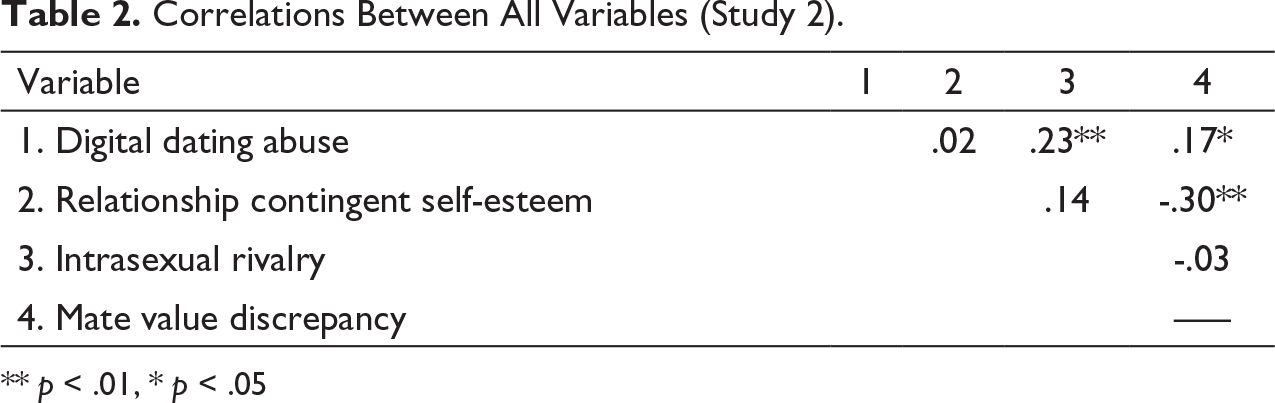
Correlations Between All Variables (Study 2).
** p < .01, * p < .05
Table 2 shows that there was a significant positive, small correlation between intrasexual rivalry and digital dating abuse. There was also a significant, positive, small correlation between digital dating abuse and mate value discrepancy. There was also a negative, small, significant correlation between relationship contingent self-esteem and mate value discrepancy, in that those who had low mate value discrepancy reported higher relationship contingent self-esteem.
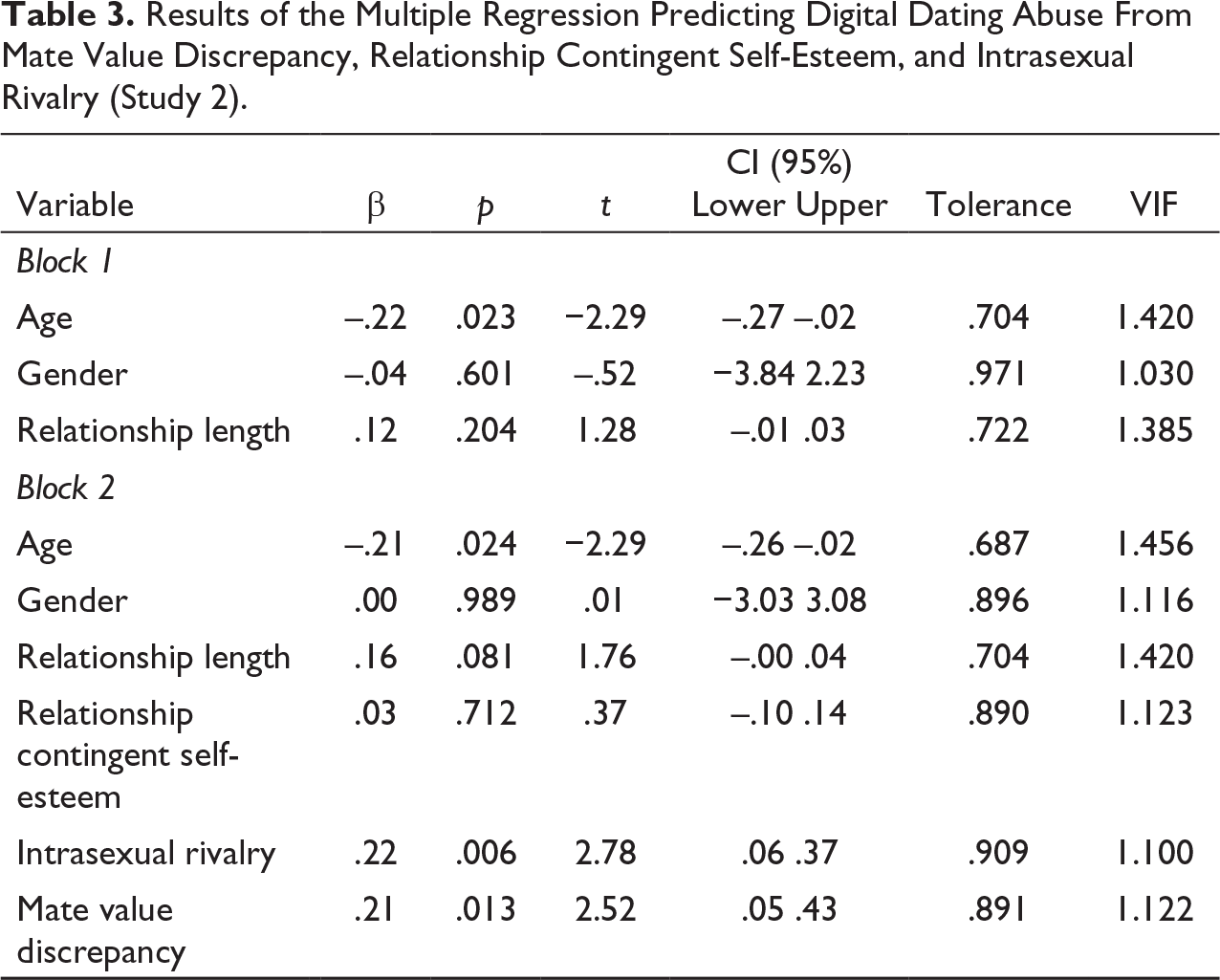
Results of the Multiple Regression Predicting Digital Dating Abuse From Mate Value Discrepancy, Relationship Contingent Self-Esteem, and Intrasexual Rivalry (Study 2).
Hierarchical Multiple Regression
Hierarchical multiple regression was conducted to predict the perpetration of digital dating abuse (Mean = 23.17, SD = 5.99) from mate value discrepancy 3 (Mean difference = –.3.78, SD = 5.08), relationship contingent self-esteem (Mean = 38.11, SD = 7.94), and intrasexual rivalry (Mean = 32.98, SD = 6.29), whilst controlling for relationship length, age, and gender.
Relationship length, age, and gender were added to block 1, explaining 3.4% of the variance in digital dating abuse (adjusted R = .015), F(3, 152) = 1.76, p = .157. Mate value discrepancy, relationship contingent self-esteem, and intrasexual rivalry were added to block 2 of the model. This resulted in a R change of .085 and a F change of 4.78.
The model was statistically significant and explained 11.8% of the variance in digital dating abuse, F(6, 149) = 3.34 (adjusted R = .08), p = .004, Durbin-Watson = 1.93, Cohens f = 0.13. Intrasexual rivalry and mate value discrepancy were significant, positive predictors of digital dating abuse, thus supporting H. Higher levels of intrasexual rivalry and mate value discrepancy predicted higher levels of digital dating abuse perpetration. Relationship contingent self-esteem was a nonsignificant predictor of digital dating abuse.
General Discussion
The primary aims of this article were to replicate and explore the relationship between mate value discrepancy and digital dating abuse using two distinct measures, and to explore mating-relevant factors associated with digital dating abuse. The findings from both studies show that when using two distinct measures of mate value, mate value discrepancy positively predicts digital dating abuse. This finding adds to the robustness of previous literature showing this association. Furthermore, when using an alternative measure of intrasexual competition which focuses on rival derogation and self-promotion tactics, we find that intrasexual competition positively predicts the perpetration of digital dating abuse. To our knowledge, this is the first article to show that those who report high intrasexual competition engage in greater levels of digital dating abuse perpetration.
Our findings are somewhat consistent with the wider literature exploring intimate partner violence from an evolutionary perspective. For example, Graham-Kevan and Archer (2009) applied an evolutionary framework to understanding physical aggression and offline controlling behaviors in men and women. They found that both men and women of lower mate value engage in greater levels of offline controlling behaviors including physical aggression toward their partners. However, they found no relationship between controlling behaviors and physical aggression when people rated their partners to be of low mate value. The relationship between mate value discrepancy and offline dating abuse (to our knowledge) has not been explored in the literature and forms an avenue for future research. Therefore, findings from both our studies add to the literature providing an evolutionary perspective of online intimate partner violence.
As well as recognizing the importance of replicating previous literature exploring evolutionary related factors in the perpetration of digital dating abuse, our findings are important given the wider context regarding concerns about the credibility of scientific research in general (Munafò et al., 2017; Nosek et al., 2012). The importance of replications lie in the fact that they are a necessary step to verify and confirm previously published work with the view of guiding future research in a more effective way (Fetterman & Sassenberg, 2015; Penders et al., 2019; Vazire, 2018). The findings reported here, therefore, show that findings in scientific research can depend on measurement and ensuring that procedures involved in replications include a variety of measurements to measure the constructs researchers explore in scientific research. We replicated previous literature showing mate value discrepancy predicts the perpetration of digital dating abuse, with the use of two distinct measures not explored in previous literature. Furthermore, we attempted to reexplore the role of intrasexual competition in the perpetration of digital dating abuse, by using a measure focused on intrasexual rivalry and competition, as opposed to previous measures used which focus on intrasexual competition only.
Although replication of previous work is necessary for the advancement of psychological science, consistent with Munafò and Smith (2018), we believe that to advance theory and empirical findings, hypotheses should be tested with a wide variety of experimental measures and an attempt at triangulation. Although we have consistently shown via the use of two distinct measures that there is a relationship between mate value discrepancy and the perpetration of digital dating abuse, we have relied on correlational data. Future research could adopt a triangulation framework to address this question via a variety of approaches. This could be adopted to further explore the role of intrasexual competition in the perpetration of digital dating abuse.
Although there are strengths to the studies reported in this article, there are notable limitations. First, we were unable to examine cultural and ethnic diversity. Both samples were recruited in the United Kingdom, and only apply to heterosexual people. Although we provide novel findings in this article, our findings are applicable to WEIRD samples (Henrich et al., 2010). Second, the samples in both studies largely included women. As outlined in the introduction, previous research shows that the role of gender in the perpetration of digital dating abuse is inconsistent (See, Taylor & Xia, 201). As a result, this gender imbalance regarding our sample may have added to the inconsistency regarding the role of gender in the perpetration of digital dating abuse. Future research should focus on recruiting a relatively equal sample of men and women, particularly when controlling for gender in statistical analyses. Third, our study relied on cross-sectional data, whereby we are unable to establish cause and effect. Fourth, many of the measures examining digital dating abuse are retrospective and rely on self-report data which may not capture the true occurrence of digital dating abuse perpetration.
Our findings, particularly the finding related to intrasexual competition should be replicated and explored in adolescents. Younger adults may engage in higher intrasexual competition than older adults as they are more likely to be actively seeking a romantic relationship than older adults who are in a secure, long-term relationship. In support, Polo et al. (2018) found that adolescents engage in intrasexual competition more so than older adults. Furthermore, due to the notion that younger adults are the highest users of technology and engage in higher intrasexual competition than older adults, perhaps younger adults may be more likely to use technology to perpetrate digital dating abuse. Future research should reexamine the relationship between intrasexual competition and digital dating abuse perpetration with a target population of younger adults. In support, Brown and Hegarty (2018) argue that researchers investigating the factors which motivate people to perpetrate digital dating abuse should aim to recruit young adults between 18 and 24 years as they are the highest users of modern technology. Due to extent to which younger adults use technology in their daily lives, they are at an increased risk of both victimization and perpetration of digital dating abuse (Lenhart et al., 2017).
Relationship contingent self-esteem was a nonsignificant predictor of digital dating abuse. Although we extend the literature by not viewing self-esteem as a unified construct, and instead, focusing on relationship specific self-esteem (as suggested by Holden et al., 2018), we find no support for this association. Perhaps future research could explore the role of implicit and explicit self-esteem in the perpetration of digital dating abuse (Holden et al., 2018). Furthermore, it would be useful to look at how fragile and secure self-esteem (Zeigler-Hill & Wallace, 2011) is related to the perpetration of digital dating abuse.
Although the focus of this article was to explore digital dating abuse from an evolutionary perspective, previous research has also adopted a social learning approach to digital dating abuse, finding peer-values influence perpetrators’ partner-directed online violence (see Van Oytssel et al., 2017). When applied to the findings reported in this article, it could be suggested that people engage in intrasexual competitive behaviors through observation and the attitudes of their peers and significant others. Future research could also explore the beliefs of participants’ significant others on dating abuse. This would enable researchers to identify whether engagement in digital dating abuse is correlated with others’ endorsement of these behaviors, as found in previous research on partner-directed violence (see Sellers et al., 2005) and online partner-related behavior such as sexting (see Van Ouytsel et al., 2017). In addition, the cycle of violence hypothesis suggests that those who have experienced or witnessed specific forms of deviant behavior are more likely to perpetrate the behaviors they have witnessed (see Heyman & Slep, 2002) which could be an explanation for our finding between intrasexual competition and digital dating abuse.
As mate value includes facets of self-esteem (such as self-rated attractiveness), it could be that self-esteem (not relationship contingent self-esteem) may moderate or mediate the relationship between mate value discrepancy and digital dating abuse. In addition, infidelity in previous relationships may mediate or moderate the relationship between high intrasexual competitiveness (being more alert of sexual rivals), and the perpetration of digital dating abuse. These are questions for future research.
Research into the perpetration of digital dating abuse can help to identify key variables which drive this behavior. In turn, by identifying these variables and factors, it helps practitioners to design intervention to understand and prevent digital dating abuse, including the negative impact it has on victims (Van Ouytsel et al., 2017). Mate value encompasses personality as well as physical characteristics. Our findings show that when people rate themselves as having lower mate value compared to their partner, they engage in greater levels of digital dating abuse compared to those do not have large mate value discrepancies between themselves and their partner. Therefore, preventative measures could be implemented in interventions to increase people’s self-esteem and self-value. This increase in self-esteem may lead to people have greater self-mate value, and in turn decrease the perpetration of digital dating abuse.
There are important policy implications for research focuses on digital dating abuse. As digital dating abuse involves electronic intrusion in romantic relationships, interventions could focus on the dangers of sharing passwords with partners, and digital privacy when using technological devices, including the legal consequences relating to data protection issues (Van Ouytsel et al., 2017).
We tested and provided support for the hypothesis that mate value discrepancy is related to the perpetration of digital dating abuse. We used two new measures of mate value in each study of this article, which have not been used in previous research finding this association (Bhogal & Howman, 2019; Bhogal et al., 2019). In summary, the results of this study further contribute to limited theoretical knowledge of digital dating abuse, further merging the gap between both cyber and evolutionary psychology. Exploring online behaviour from an evolutionary perspective is crucial in understanding the factors behind the way people choose to behave online (Piazza & Bering, 2009).
Footnotes
Declaration of Conflicting Interests
Funding
The author(s) disclosed receipt of the following financial support for the research, authorship and/or publication of this article: Study 2 was funded by the University of Wolverhampton’s Doctoral College as part of the early researcher award scheme (ERAS).
