







Abstract
Intimate partner homicide (IPH) is a global public health issue that has serious consequences for an individual’s health. Whereas prior research has made some progress analyzing the perpetrator-victim relationship in understanding the dynamics of IPH, research set in the context of China in this field using the perpetrator-victim relationship as a focal variable in analyzing IPH is still lacking. The current study addresses this gap and builds on existing research by exploring the significance of the perpetrator-victim relationship in order to facilitate a deeper understanding of IPH in China. After examining 979 IPH criminal judgments, the findings revealed that the perpetrator-victim relationship is an important clue in understanding IPH in China today. By analyzing the correlation between intimate relationships as a focal variable and other variables such as IPH characteristics and risk factors, it is possible to understand the prevalence of IPH in China in greater detail. Irrespective of the kind of relationship between the perpetrator and victim, the findings revealed that most of them come from lower socioeconomic backgrounds, have no previous history of intimate partner violence, and are not satisfied with their marriages. Although research has provided detailed explanations, the perpetrator-victim relationship remains neglected, especially in the context of research on contemporary China. The findings showed that over half of the perpetrators and victims had intimate relationships with people outside their marriages. This may be the main reason for the rapid increase in the number of instances of IPH, which seems to be in tandem with China’s rapid modernization and urbanization.
Keywords
Intimate partner homicide (IPH), a lethal form of interpersonal violence, has a significant impact both on society and individuals in terms of health, social welfare, and criminal justice. Therefore, it has been increasingly recognized as a serious and pervasive global public health problem (LeSuer, 2020; Sabri et al., 2018; Stöckl et al., 2013). A global study on homicide conducted by the United Nations Office on Drugs and Crime (UNODC) in 2019 reported that 3 out of every 10 women (34%) who are intentionally killed are murdered by their intimate partners (UNODC, 2019). To address this lethal form of interpersonal violence, some countries have set up a comprehensive range of coordinated services that include support from the police and criminal justice systems as well as health and social services (Corradi & Stöckl, 2016). With these developments, some studies have demonstrated that IPH has steadily decreased in the United States and parts of Western Europe (Caman et al., 2017; Campbell et al., 2019). However, UNODC (2013, 2019) has stressed that the decline in IPH is modest in comparison to the decline in other types of homicide and has even remained relatively constant over time. Some studies have reported that the decline in IPH is predominantly found among female perpetrators targeting male victims, whereas the drop in intimate partner femicide perpetrated by male partners is comparably modest (Caman et al., 2017; Zeoli et al., 2020). This shows that IPH is still a widespread public health concern (Matias et al., 2020; Petrosky et al., 2017; Vatnar et al., 2019).
With the rise in public awareness of and policy response to interpersonal violence, studies on IPH have also steadily grown (Spencer & Stith, 2020; Vatnar et al., 2019). To make tangible progress in reducing and preventing IPH, recent exploratory studies have focused on demonstrating the characteristics and identifying the risk factors involved in IPH (Fraga et al., 2019; Spencer & Stith, 2020; Zhao, 2020). Although a growing body of research has revealed the value of perpetrator-victim relationships in understanding the dynamics of IPH (Allen et al., 2020; Fox & Allen, 2014; Sutton & Dawson, 2018), perpetrator-victim relationships connected to the development and perpetuation of IPH have not been considered, as these studies have tended to treat IPH as a problem affecting an individual rather than both partners (Cunha & Gonçalves, 2019; Sebire, 2017). What has been noticeably absent in policing and academic research on IPH is a detailed understanding and explanation of interpersonal violence with an idea of the intimate relationship between perpetrator and victim. In China, rapid urbanization and modernization have brought about great changes, not only in the traditional concepts of marriage and family structure but also in intimate relationships (Hung, 2020; Yeung & Hu, 2016). A high rate of IPH continues to prevail in China. Therefore, a comprehensive study on intimate relationships between perpetrators and victims in IPH contexts is key to gaining insights into IPH in contemporary China.
Findings Pertaining to the Perpetrator-Victim Relationship in IPH Contexts
Since Wolfgang’s (1958) classic work, a substantial body of literature has focused on trends and patterns concerning the social relationship between perpetrators and victims. Acknowledging the significant impact of intimate relationships on a comprehensive understanding of IPH, a theme that consistently emerges from the literature is the link between IPH and perpetrator-victim relationships (Allen et al., 2020; Cunha & Gonçalves, 2019). Some scholars have argued that intimate relationships are significant in identifying risk factors and demonstrating the trend in decreasing rates of IPH (Allen et al., 2020; Carson & Sabol, 2016). Others have analyzed the value of the state and status of intimate relationships in order to understand IPH better (Farhall, 2020; Rennison et al., 2013). The key findings and trends in the literature are summarized in the following sections.
Perpetrator-Victim Relationship as a Risk Factor
The literature highlights the need for continued research on risk factors for IPH (Desta & Venema, 2020; Lynch et al., 2019). Perpetrator-victim relationships have been identified as constituting a risk factor and an issue that warrants serious attention among factors that put an individual at risk of IPH (Graham et al., 2019; Spencer & Stith, 2020). There are mixed results on the influence of the perpetrator-victim relationship status on IPH (Sebire, 2017). Studies have found that those in cohabiting nonmarital relationships are more vulnerable to IPH than those in marital or dating relationships (Cunha & Gonçalves, 2019). For example, Shackelford (2001) found that the risk of being a victim of IPH was more than 10 times higher for cohabitating men than married men and 9 times higher for cohabitating women than married women. Some scholars have argued that these differences are a result of different characteristics that individuals bring to their relationships (Kwaramba et al., 2019). For example, cohabiting couples tend to be younger, have lower levels of income, experience employment instability, and may have substance abuse problems (Sutton & Dawson, 2018).
The state of a perpetrator-victim relationship, such as separation or estrangement, is one of the most well-documented risk factors for IPH worldwide (Hayes, 2016; Sutton & Dawson, 2018). Research on IPH has also directed attention toward analyzing the state of the relationship (Desta & Venema, 2020; Sebire, 2017). Separated women are more likely to experience IPH when compared to divorced or married women (Ellis et al., 2015; Sutton & Dawson, 2018). Hotton (2001) found that nearly half of all instances of IPH occurred within two months of separation. Findings in a cross-national study identified that physical and legal separations were significant risk factors within the first three months of estrangement (Vatnar et al., 2019). Although a victim leaving the perpetrator may increase the immediate risk of IPH, some studies have suggested that leaving an abusive relationship can decrease the risk of IPH overall (Dugan et al., 2003; Farrell & Zimmerman, 2018).
Perpetrator-Victim Relationships and Decrease in IPH Rates
Although the IPH rates show a downward trend, those concerning the impact of different perpetrator-victim relationship statuses differ (Wells & DeLeon-Granados, 2004). Among married partners, there was a greater increase in the victimization rates of female victims than males (Karlsson et al., 2018; Spencer & Stith, 2020). Similarly, the rates increased for unmarried female victims, and spousal homicide decreased over time (Suonpää & Savolainen, 2019). Puzone et al. (2000) found that husbands and ex-husbands experienced twice the decrease in the percentage of homicide rates as did wives and ex-wives. Boyfriends experienced three times the decrease in homicide rates as did girlfriends (Fairbairn & Dawson, 2013).
Research has established significant correlations between the different perpetrator-victim relationship statuses and the declining trend in IPH (Dawson et al., 2009; Sutton & Dawson, 2018). Some studies have found that a high divorce rate has contributed to a corresponding decline in IPH rates (Dugan et al., 1999). Other studies have shown that much of the decline in IPH is a function of the decrease in the marriage rate of young people, where the risk of homicide victimization and offending was the highest (Wong & Lee, 2018). Some studies have explained that the reduction in nonmarital IPH was because cohabitants are more likely to terminate a threatening relationship than those who are married, thus reducing the risk of being killed by their partners (Rosenfeld, 1997; Sebire, 2017). Other studies have shown that IPH was more likely to occur in nonmarital cohabiting relationships because they lack stability and there is increased hostility between partners (Shackelford, 2001; Szalewski et al., 2019).
Research Question
Compared with the consistent and in-depth research on IPH in Western countries over the past four decades, research centered on China has been extremely scarce (Du et al., 2019; Li, 2016). However, with rapid economic development, traditional Chinese marriage and family structures have undergone major changes due to urbanization and modernization. People’s understanding and ideas of love and marriage have also undergone fundamental changes. In China, an intimate partner relationship is not only limited to marriage in the traditional family setup; various types of intimate partnerships outside marriage have also emerged. This has had a major impact on the traditional Chinese concept of marriage and has caused many social contradictions and conflicts.
In recent years, China has witnessed a soaring increase in IPH (Du et al., 2019; Zhao, 2020). As extramarital intimate relationships between perpetrators and victims have resulted in a rise in the number of instances of IPH, the status of perpetrator-victim relationships is of great significance in better understanding IPH. To deepen our knowledge of IPH and improve prevention strategies in the future, more research should be conducted. This study was undertaken to identify the significance of intimate relationships in understanding IPH in contemporary China. The official research question addressed in this study is the following: Can the perpetrator-victim relationship be used as a clue for understanding IPH in China? Can a perpetrator-victim relationship explain IPH in contemporary China?
Data and Methods
In 2014, the Supreme People’s Court of the People’s Republic of China implemented judicial reforms wherein all criminal judgments had to be published online, thus promoting access to justice and enhancing judicial credibility. According to the latest provision of the Chinese Supreme People’s Court on Publishing Judgments Online (2016), except for judgments involving state secrets, matters of personal privacy, and juvenile delinquency, the court has to publish all judgments online. Up until now, the databank China Judgments Online has already published up to 8,431,782 criminal judgments. According to the Chinese Criminal Law Code, IPH is a type of homicide in which the perpetrator and victim are in an intimate relationship as either spouses or lovers. We first chose 28,986 judgments from the China Judgments Online databank for intentional homicide from 1990 to 2015. These judgments pertain to instances of homicide that occurred in Chinese provinces other than Xinjiang and Tibet, from where no criminal judgments were published online during the said period. From these, we chose 1,500 judgments in which the perpetrator and victim were intimate partners (spouses, ex-spouses, and lovers). All these judgments dealt with IPH.
With reference to corresponding studies from other countries, we designed a questionnaire with variables concerning basic information on IPH, such as the characteristics of the perpetrator and the victim, the status and state of the perpetrator-victim relationship, and the actus reus constituting the crime. As samples were drawn from criminal judgments, some information in the judgments was redacted before they were published in order to either protect the privacy of the parties or for other purposes. Some courts believe that certain information in a judgment is not important, such as family background and the profession of the perpetrator or victim, so this information was removed from some of the published judgments, although such information may be useful in providing an in-depth understanding of IPH in China. Therefore, the 1,500 judgments selected were not full samples. After collation, we deleted some variables such as “duration of the perpetrator-victim relationship” from the questionnaire with due consideration for their importance and missing values. With the remainder, we continued to examine the 1,500 judgments we selected and found that some lacked certain information on some variables in the questionnaire. For example, information on “what caused the relationship to break” was missing in some judgments. After deleting 521 such judgments, we found that the remaining samples were still relatively large, so we deleted them and finally got 979 judgments as the sample. All the selected judgments had the relevant information on the variables used in this study.
Owing to the significant impact of IPH for both the individual and society in terms of health, social welfare, and criminal justice (van Wormer & Roberts, 2009), most research has collected the following meaningful data as variables from the samples: “gender,” “profession,” “marriage satisfaction,” “family background,” “experience with the use of violence,” “experience of being mistreated,” and “marital status” (Caman et al., 2017; Eke et al., 2011; Johnson et al., 2020; Vatnar et al., 2019). With these data, research has provided a descriptive analysis of IPH, including the basic characteristics and risk factors involved. The perpetrator-victim relationship—especially the status and state of the relationship—plays an important role in enabling an in-depth understanding of IPH (Allen et al., 2020; Peterson et al., 2019; Sebire, 2017; Sutton & Dawson, 2018). We found that the perpetrator-victim relationship is of great significance in understanding IPH and that it provides a reasonable explanation for IPH in contemporary China. We also selected variables for intimate partnerships such as “perpetrator-victim status” and “what caused the relationship to break.” Finally, we chose factors pertaining to homicide such as “directly caused-homicide events,” etc.
Results
Perpetrator and Victim Characteristics
Descriptive Characteristics of IPH Perpetrators and Victims.
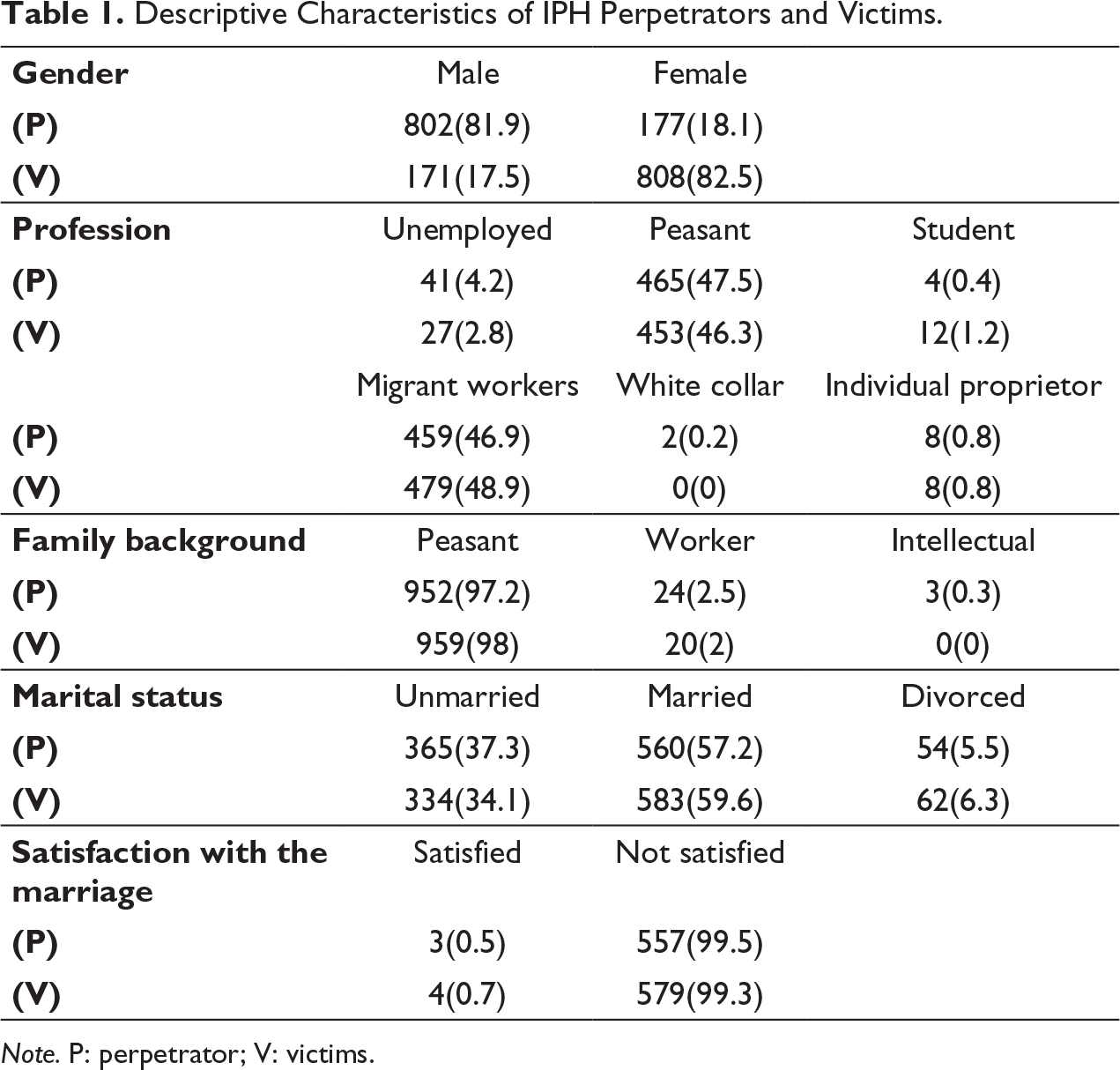
Note. P: perpetrator; V: victims.
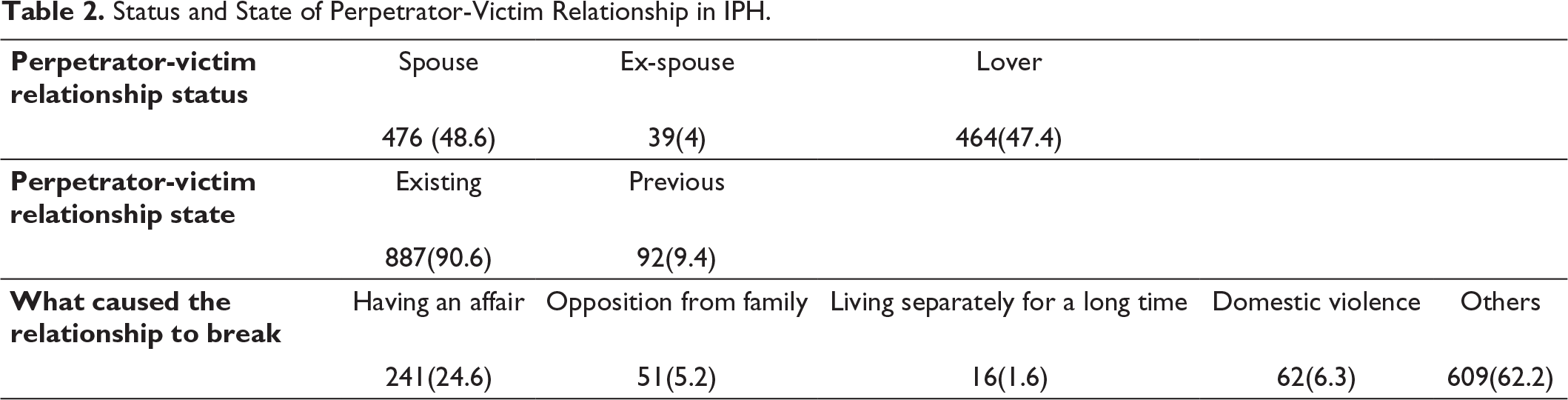
Status and State of the Perpetrator-Victim Relationship
Status and State of Perpetrator-Victim Relationship in IPH.
Perpetrator-Victim Relationship Status and Experience with Violence
Perpetrator-Victim Relationship Status and Experience With Violence.

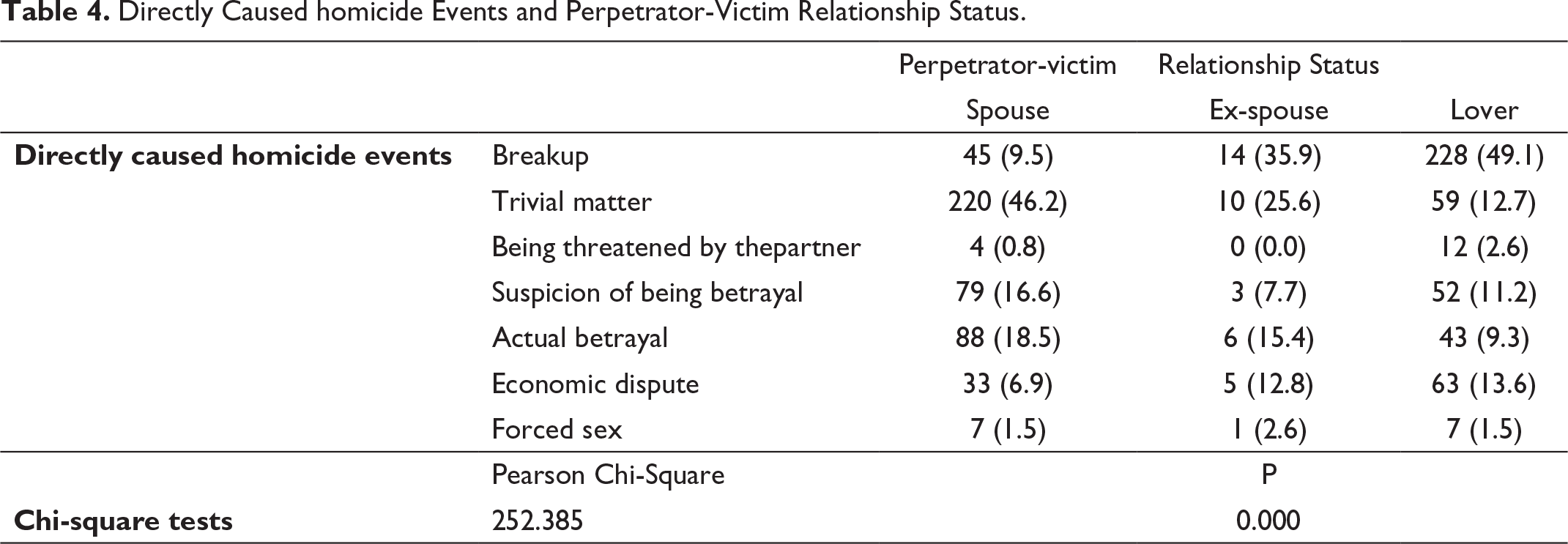
Directly Caused IPH Events and Perpetrator-Victim Relationship Status
Directly Caused homicide Events and Perpetrator-Victim Relationship Status.
Discussion
This study highlighted the value of the perpetrator-victim relationship as a clue in understanding IPH in contemporary China. By examining the correlation among the variables particular to intimate relationships and other variables such as characteristics of IPH and risk factors, a deeper understanding of IPH has emerged. Although characteristics (Elisha et al., 2010; Overstreet et al., 2020; Vatnar et al., 2019) and risk factors (Mackay et al., 2018; Petersson et al., 2019; Sheehan et al, 2015) have previously been recognized regarding perpetrator-victim relationships, a detailed understanding of IPH vis-à-vis intimate relationships, especially with its significance in explaining IPH in the Chinese context, has not been examined thus far. These elements are worthy of further consideration.
The findings in this study confirm those of previous research in which IPH has been shown to be a gendered crime, wherein 80% of males are overrepresented as perpetrators of IPH; however, when women kill, they are more likely to kill an intimate partner than someone else (Hamby, 2017; Sabri et al., 2016). The fact that women are at greater risk of being killed by an intimate or former partner than men is consistent across time and countries (Caman et al., 2017; Minello & Dalla-Zuanna, 2019; Smucker et al., 2018). In line with the “gender perspective,” which has attempted to explain the gendered nature of IPH, some findings have clearly indicated that the likelihood of IPH increases when men believe that they have a right to control their female partners and are at risk of losing that control (Johnson et al., 2019; Sabri et al., 2016). Generally, the threat of losing sexual exclusivity or entitlement over a partner can either be related to a suspicion or the actual event of infidelity, or the woman may wish to end the relationship entirely (Spencer & Stith, 2020). We found that the event that directly caused IPH in China was mainly the act of ending intimate partnerships among lovers and ex-spouses.
Studies have highlighted the importance of identifying risk factors causing IPH (Cunha & Gonçalves, 2019; Matias et al., 2020; Spencer & Stith, 2020) and developing risk assessment tools to predict risk factors (Cunha & Gonçalves, 2019; Matias et al., 2020; Spencer & Stith, 2020). For the perpetrator, there stands a widespread statement borne out of prior research that they differ from the prototypical “dangerous killer,” instead of “ordinary men”: without a history of violence and with a good income (Salari & Sillito, 2016). Consistent with these findings, the results in this study support the fact that the perpetrators of IPH were “ordinary men” in many ways. Our findings showed that 95% of the perpetrators had no experience using violence regardless of the perpetrator-victim relationship status. Over the past couple of decades, there have been mixed findings on the influence of the status and state of the perpetrator-victim relationship on IPH (Sebire, 2017; Spencer & Stith, 2020; Suonpää & Savolainen, 2019). The risk of IPH is often greater in marriages than in cohabiting and dating relationships (Sebire, 2017; Sutton & Dawson, 2018). In contrast, this study found that “lovers”—including cohabiters and dating individuals—regardless of the gender of the perpetrator, were just as likely to engage in IPH as married individuals.
Previous studies identified risk factors for IPH based on situational perspectives (Szalewski et al., 2019; Thomas et al., 2011). Some perpetrators always suffer from reactions to situational circumstances, especially distress over the termination of the intimate relationship (Szalewski et al., 2019; Wilkinson & Hamerschlag, 2005). This finding was replicated in this study, wherein most instances of IPH were caused by the termination of the intimate relationship, especially when the perpetrator and victim were lovers and ex-spouses. Among spouses, the major factor was “trivial matters.” In line with previous findings, this study presents the characteristics of the situational nature of IPH in China. Consistent with the findings in other studies (Dardis et al., 2015; Matias et al., 2020; Reichel, 2017), this study also confirms that there is a correlation between low socioeconomic status and risk of IPH. In China, regardless of the perpetrator-victim relationship status, almost 95% come from peasant families and more than 97% work as migrant workers. These people are generally regarded as having a lower socioeconomic status in China (Leng et al., 2020; Yang, 2013). Perpetrators and victims from peasant families have generally not received basic education in their childhood. Consequently, they are rarely able to find stable jobs and earn high incomes in the competitive Chinese market (Chan & O’Brien, 2019; Zhang et al., 2016). The proportion of perpetrators and victims from affluent families and those working in white-collar professions was extremely low; these people were considered to have high socioeconomic status in China.
Why is the perpetrator-victim relationship a clue to understanding IPH in China? Why is it significant in explaining IPH? With soaring modernization and urbanization, China has experienced the largest population migration in history, wherein migrants moved from rural and economically undeveloped areas to urban economically developed ones. On one hand, this large-scale population migration has caused a major change in the traditional structure of the Chinese family and its functions (Mu & Yeung, 2019; Yang, 2016). Conversely, with China’s economic development and cultural progress, sexual equality and individual freedom have gradually gained popular support (Delia, 2018; Donner & Santos, 2016; Xie, 2020). Traditional Chinese ideas around love and marriage have undergone great changes (Hung, 2020; Yeung & Hu, 2016). The intimate partner relationship is not only limited to that of a wife and husband in the traditional family but also extends to various types of intimate partner relationships that have arisen over time. Most Chinese people have extramarital affairs and “lovers” outside their marriage (Densley et al., 2017; Sung, 2019). However, traditional Chinese culture has attached great importance to marriage and family, and the state and society have always linked it to individual social responsibility (Fan et al., 2017; Yeung & Hu, 2016). With modernization and urbanization, although the traditional concepts of marriage and love have undergone tremendous changes in China, the core position of this concept in personal marriage and family evaluation remains unchanged (Dias et al., 2011; Wu, 2019). The emergence of a large number of intimate relationships outside marriage conflicts with the traditional concept of marriage and family. Therefore, such intimate partnerships are important in understanding and explaining IPH in the context of China today. Although previous research has provided reasonable explanations for IPH, the status and state of the perpetrator-victim relationship have largely been neglected.
We found that approximately 60% of the respondents were married at the time of the study. However, as many as 48% of them are lovers and 49% are spouses. Up to 91% of the perpetrators were in intimate relationships at the time of committing the offense. Almost half the perpetrators and victims in the study maintained intimate relationships with people other than their spouses. Why do so many Chinese people engage in extramarital affairs? What is its effect on the rates of IPH in China? Tao (2019) attributed extramarital affairs to personal factors like physical and mental exhaustion, life pressure, sexual pressure, etc., but this is actually more closely related to the social transformation of China (Li et al., 2019; Whyte, 2020). The data in this study show that 97% of the perpetrators and victims came from peasant families and almost half were migrant workers. Although the agricultural population continues to decline in China due to urbanization, migrant workers comprise about one-fifth of China’s population (Xiang & Zhong, 2018). Therefore, intimate relationships among migrant workers and peasants are critical to explaining IPH in China.
With large-scale urbanization in China, a great number of peasants left their villages to work and live in the cities. As the Chinese countryside is an acquaintance society, the marriage of peasants is not only the combination of men and women and the establishment of sexual relations between them but also involves an association between both their families. Thus, marriage, love, and sex in the Chinese countryside are intricately connected. Under the influence of the traditional Chinese marriage concept and family structure, as well as the supervision and restriction of social interpersonal relationships with such acquaintances, marriages are relatively stable in the countryside (Ip & Peeren, 2019; Yeung & Hu, 2016). When peasants move to the city to work, they enter a society of strangers and their social interactions are with strangers (Ren et al., 2018). This has caused traditional marriage constraints to weaken over time. At the same time, migrant workers have not fully accepted the modern concept of marriage based on legal contracts in the city, so marriage becomes unstable (Li, 2018). Migrant workers have fewer possibilities of settling down and living normal family lives with their spouses in the city, because their spouses, especially women, have to stay back in their hometowns to take care of the elderly and raise the children (Chen, 2019; Hall et al., 2019). The low incomes of migrant workers also make it difficult to pay high rent. These factors force migrant workers to separate from their spouses for long periods of time, which causes their marriages to exist only in name (Dai et al., 2015). With the popularity of the internet, smartphones, and dating websites and apps in China, it is very convenient for migrant workers to find intimate partners outside of marriage (Li, 2018; Ma & Cheng, 2005). The demonstrative effect of those with extramarital intimate partners allows more migrant workers to follow in their footsteps. Thus, more extramarital affairs have sprung up among migrant workers in China (Zhang, 2009; Zuo, 2008). The very existence of such extramarital relationships, which conflicts with the traditional Chinese concepts of marriage and family, has caused several instances of IPH in China.
Conclusion
This study examined the significance of the perpetrator-victim relationship to gain an in-depth understanding of IPH in China. Although the study facilitates a better understanding of IPH in China, some limitations point to the need for more research. The samples came from the judgments published by the Supreme People’s Court online. For many reasons, certain important private information was deleted from these judgments when they were published. Therefore, information necessary to strengthen the understanding of the status and state of perpetrator-victim relationships in the context of IPH in China is missing. The findings in this study have implications for further research, which should examine the influence of the state of estrangement among intimate partners along with urbanization in China on IPH. Research should focus on the duration of estrangement and identify ways to solve practical problems like migrant workers’ settlement in cities from a policy perspective. It should also focus on reasonable explanations for a large number of instances of IPH in China even as the tolerance for non-marital intimate relationships continues to grow in contemporary China.
Footnotes
Declaration of Conflicting Interests
Funding
The author(s) received no financial support for the research, authorship, and/or publication of this article.
