







Abstract
Measures designed to collect prevalence reports of sexual victimization need to be robust against variations of question context to yield valid findings. Previous research has examined variations in the order in which questions about unwanted sexual acts and questions about coercive tactics are presented. The current study examined potential effects of the order in which coercive tactics are presented on self-reported prevalence rates of sexual victimization. The following two versions of the Sexual Aggression and Victimization Scale (SAV-S), a validated measure for studying sexual aggression victimization and perpetration in college students, were used: (a) the standard version in which the physical-force items were presented first and the items referring to the use of verbal pressure were presented last, and (b) a reversed order in which the verbal-pressure items were presented first and the physical-force items were presented last. Items referring to the exploitation of the victim’s inability to resist were placed in the middle in both versions. In a sample of 856 participants from Germany (475 female, 381 male, mean age of 24 years), most of whom were university students, 80.4% of women and 55.3% of men reported at least one experience of sexual victimization since the age of 14. No order effects on overall victimization rates were found. For both genders, the victimization rate through verbal pressure was higher when this tactic was presented first. Victimization rates through the threat or use of force were higher in the force-first than in the force-last condition for women, but could not be tested for men due to small cell sizes. No order effects were found for both men and women on reports of victimization through exploiting the inability to resist. The implications of the results for the reliable measurement of sexual aggression are discussed.
Keywords
Sexual aggression is a pervasive problem worldwide (Basile et al., 2020; European Union Agency for Fundamental Rights, 2014; Fedina et al., 2018; Schuster & Krahé, 2017, 2019a; Winzer et al., 2019). It has serious physical, psychological, and behavioral consequences for the victims (de Visser et al., 2014; Kaufman et al., 2019). Although much research attention has been devoted to developing and improving measures of sexual victimization (Koss et al., 2007; Koss & Oros, 1982; Krahé & Berger, 2013; Straus et al., 1996), the accurate assessment of prevalence rates remains an ongoing challenge.
Over the last three decades, researchers have identified several methodological issues, such as defining the scope of sexually aggressive behavior, and wording and presenting of questions (Abbey et al., 2005; Cook et al., 2011; Koss, 1993; Krahé & Vanwesenbeeck, 2016; Krebs, 2014), which complicate the precise measurement of sexual aggression. Prevalence rates were shown to vary depending on the operational definitions of sexual aggression (see Fedina et al., 2018; Krahé et al., 2014, for reviews), and different instruments presented to the same participants yield different prevalence rates (Anderson et al., 2019a). Several analyses have shown that the use of behaviorally specific, multi-item measures is superior to broad screening questions and single-item measures (Cook et al., 2011; Krahé & Vanwesenbeeck, 2016; Krebs et al., 2017).
While the methodological rigor of measuring sexual victimization has been advanced substantially by this body of research, the question whether the order in which coercive tactics are presented in multi-item, behaviorally specific measures may influence self-reports of sexual victimization has not yet been investigated. Analyzing such order effects may be important for several reasons. First, differentiating between coercive tactics is an integral component of all validated prevalence measures of sexual aggression using behaviorally specific items, such as the Sexual Experiences Survey (SES; Koss et al., 2007), the Revised Conflict Tactics Scales (CTS2; Straus et al., 1996), or the Sexual Aggression and Victimization Scale (SAV-S; Krahé & Berger, 2013). Therefore, demonstrating that prevalence rates of sexual victimization are robust against variations of the order in which coercive tactics are presented is critical in terms of the reliability of such measures. Second, because the threat or use of physical force is a defining feature of criminally relevant forms of sexual violence (Amnesty International, 2018), it is relevant to examine whether rates of self-reported sexual victimization through the threat or use of force vary depending on whether they are elicited before or after other tactics, such as verbal pressure or the exploitation of the victim’s inability to resist. Third, accurately estimating the scale and forms of sexual victimization is crucial for developing effective prevention and intervention measures. For example, obtaining reliable data on the scale of sexual victimization by the threat or use of physical force may have implications on what type of competences (e.g., training physical self-defense rather than verbal assertiveness) to prioritize in prevention efforts. The present study is intended to fill the research gap regarding potential order effects of coercive tactics to promote the accurate measurement of sexual victimization.
Possible Order Effects on Estimating the Prevalence of Sexual Victimization
Determining the order in which items are presented in measures of sexual victimization involves both conceptual and methodological decisions. In the widely used SES by Koss et al. (2007), items are ordered by sexual acts (from unwanted touching to completed penetration), and coercive tactics are presented in increasing order of severity (from verbal pressure to use of physical force) under each item. The Sexual Assault subscale of the CTS2 by Straus et al. (1996) mixes items reflecting “minor” and “severe” sexual aggression without imposing an order of ascending severity. In the SAV-S by Krahé and Berger (2013), items are ordered by severity of the coercive tactics, starting with the threat or use of physical force, followed by exploiting the victim’s inability to resist, and the use of verbal pressure.
Despite the wide-spread use of such multi-item measures, empirical research on potential order effects of item presentation is scarce. Regarding the decision to lead with sexual acts and present coercive tactics as subordinate items, Abbey et al. (2005) used two versions of the SES: one version in which the question about the coercive tactic (e.g., verbal pressure, physical force) was presented first and questions about the sexual act (e.g., fondling/kissing, sexual intercourse) were presented under each tactic, and one version in which the question about the sexual act was presented first and questions about the coercive tactics were presented under each act. The tactic-first version elicited higher overall rates of self-reported sexual victimization in women (75% vs. 62%) and higher overall rates of self-reported sexual aggression perpetration in men (69% vs. 36%) than the sexual-act-first version. The difference between the two versions was more pronounced for the less severe (verbally forced) than for the more severe (physically forced) victimization experiences and perpetration behaviors. A recent study of men’s self-reported sexual aggression perpetration confirmed that rates of perpetration were higher in the tactic-first than in the sexual-act-first conditions, and the difference was again due to the effect of the different question format on the less severe forms of perpetration (Abbey et al., 2021). No difference between the versions was found in their associations with a range of correlates of sexual aggression perpetration.
In a conceptual replication and extension of Abbey et al.’s (2005) work, Schuster et al. (2021) used the same manipulation to create two versions of the SAV-S, in which either the coercive tactic or the sexual act was presented first. They found significantly higher overall rates of sexual victimization, defined by at least one unwanted sexual experience since the age of 14, in the tactic-first than in the sexual-act-first version for women, which is in line with the effects reported by Abbey et al. (2005). No parallel result was found for men, who were not included as victims in the Abbey et al. (2005) study. Analyzing the frequency counts for each item, differences between the two versions of the questionnaire were found for the less invasive forms of sexual victimization, with higher rates of self-reported nonconsensual sexual touch in the tactic-first version than in the sexual-act-first version for women. No effects of question format were found in the more severe categories of sexual victimization (i.e., attempted or completed rape), consistent with the findings by Abbey et al. (2005, 2021).
The findings reviewed so far suggest that variations in the way questions are phrased may yield different figures of the scale of sexual aggression victimization and perpetration, identifying a potential threat to the reliability of the measures for detecting prevalence rates. At the same time, they do not indicate problems with using the different versions to examine hypotheses about risk factors and correlates of sexual aggression victimization and perpetration. Given this differentiated picture, further research is needed to explore the methodological foundations of reliable and valid measurement tools in the study of sexual aggression.
Explanations of Order Effects in Surveys
When presented with multiple items, responses may be affected by the preceding items, and order effects in questionnaires have been demonstrated in different fields (Shorey et al., 2016; Tourangeau et al., 2003). Two related psychological processes have been suggested for explaining order effects. The first is the well-known “primacy effect”, featuring prominently in research on person perception (Asch, 1946). The primacy effect means that respondents are more likely to endorse the first response option compared to options presented later (Terentev & Maloshonok, 2019). With regard to items about sexual victimization, a primacy effect might occur because participants pay more attention to the information in the first item or are less willing to think about incidents involving other coercive tactics after reporting an experience to the first item. Anderson et al. (2021) compared two versions of the SES modeled on the tactic-first version of Abbey et al. (2005). One version presented the coercive tactics in a hierarchical order from least to most severe, the other presented the tactics in a random order. Their results found no significant differences in the overall prevalence rates identified by the different formats, but rates were substantially higher than the rates identified in an earlier study using the standard version of the SES by Koss et al. (2007) in which the items lead with the sexual acts rather than the coercive tactics (Anderson & Delahanty, 2020).
A second psychological process relevant to potential effects of item order is “priming”. According to this construct, thinking about an item may activate cognitions and memories that create an interpretative framework influencing how subsequent questions are interpreted and answered (Tourangeau et al., 2003). For example, being presented with questions about the experience of unwanted sexual contact through the use or threat of physical force may make situations in which unwanted sexual contact was experienced through verbal pressure appear less serious—and hence less likely to be reported on the respective items—than being presented with the verbal pressure items in the absence of a prior activation of thoughts about incidents involving the use or threat of force. However, evidence on the extent to which questionnaires are susceptible to order effect has been inconsistent so far, as summarized by Terentev and Maloshonok (2019). As noted by Tourangeau et al. (2000), order effects are more likely if the items have some conceptual connection, as is the case in multi-item measures of sexual victimization. Moreover, it has been suggested that coercive tactics may be more powerful cues for eliciting memories of sexual victimization compared to sexual acts because they may trigger unique negatively valenced memories compared with lead questions about sexual acts, which may be confounded with consensual sex (Anderson et al., 2021; Kensinger & Ford, 2020).
The Current Study
Testing the reliability and validity of measurement tools for eliciting self-reports of sexual aggression victimization and perpetration is increasingly recognized as a necessary requirement for building a sound knowledge base about the scale of sexual aggression, its risk factors, and its consequences. The need to pay more attention to the way questions are phrased and administered has been emphasized in recent years (Abbey et al., 2021; Anderson et al., 2021; Schuster et al., 2021). Whether variations in self-reports as a function of differences in question format undermine the psychometric soundness of measures needs to be evaluated in the context of the specific research questions addressed in a study. For example, if the focus is on establishing the overall prevalence of different forms of sexual aggression victimization and perpetration, showing that overall rates across different items are not systematically affected by differences in question format is required. If the focus is on examining specific forms of sexual aggression, such as verbally or physically coerced sexual acts, order effects have to be investigated at the item level rather than the overall level.
The current study aimed at testing effects of the order in which coercive tactics are presented on self-reported prevalence rates of sexual victimization using two versions of the SAV-S (Krahé & Berger, 2013). This measure has been used and validated in different countries and languages (Krahé & Berger, 2013; Krahé et al., 2015; Schuster & Krahé, 2019b, 2019c; Tomaszewska & Krahé, 2018). Like the SES, it uses behaviorally specific items and covers different coercive tactics and sexual acts. Going beyond the SES, victimization reports are further broken down into different relationship constellations between victims and perpetrators (i.e., current or former partners, friends or acquaintances, and strangers). The study adds to previous methodological studies on the effects of question format in sexual aggression surveys (Abbey et al., 2005; Schuster et al., 2021) and followed an inclusive approach by examining both women and men as victims of sexual aggression.
In the original version of the SAV-S, the threat or use of physical force is presented first, followed by the exploitation of the victim’s inability to resist, and the use of verbal pressure. The decision to place the items about the use of verbal pressure after the items about the threat or use of force in the construction of the measure was based on the reasoning that sexual assault incidents are likely to start with verbal pressure, which may be followed by threatening or using physical force. Presenting the verbal pressure items first might prompt participants to report the same incidents in response to different items if a situation that started off with verbal pressure escalated into the threat or use of force, resulting in an inflation of prevalence rates. However, imposing a fixed order could involve the risk of introducing bias, as the first coercive tactic might activate more memories than the later tactics, which would question the reliability of the measure. In the current study, we examined this possibility by reversing the order in which the physical force and verbal pressure questions were presented. By keeping the position of the third coercive tactic, namely exploiting the victim’s inability to resist, in the middle in both versions, we were able to additionally examine potential carry-over or priming effects of the preceding tactic. To yield reliable estimates, reported rates of sexual victimization involving the victim’s inability to resist should not be affected by answers to preceding questions about either the threat or use of force or the use of verbal pressure. The design of our study enabled us to address this issue. Because most previous research has used the SAV-S for studying sexual victimization in young adults, we focused on this group for the present study. Moreover, a large number of studies using other measures of sexual aggression were conducted with young adults, mainly college students (Anderson et al., 2019b; Cantor et al., 2020; Fedina et al., 2018; Mumford et al., 2020). Three research questions and hypotheses were proposed for the current study:
Do rates of sexual victimization through the use or threat of force and the use of verbal pressure vary depending on the order in which the coercive tactics are presented? Based on the theoretical constructs of primacy and priming, order effects were expected to take the form of higher rates of the item presented first, that is higher rates of sexual victimization across different sexual acts and victim-perpetrator relationships involving the use or threat of physical force in the force-first condition and higher rates of sexual victimization involving the use of verbal pressure in the force-last condition (Hypothesis 1). Are the proposed effects of the order manipulation the same for different levels of severity? Based on past research by Abbey et al. (2005) and Schuster et al. (2021), we expected order effects to be more likely on items referring to less severe forms of sexual victimization (the use of verbal pressure vs. the use or threat of physical force or unwanted touch vs. completed sexual intercourse), which may be less salient, leave more room for interpretation, and therefore more likely to be affected by the context of other items (Hypothesis 2). Does the order manipulation affect rates of self-reported sexual victimization involving the exploitation of the victim’s inability to resist, always presented in the middle position? As order effects are more likely to occur between items placed next to each other, and the first item may be seen as creating a context for interpreting the next item, order effects were expected to lead to lower prevalence rates on the exploitation items if they are preceded by a more serious coercive tactic in the force-first condition than if they are preceded by a less serious (verbal pressure) coercive tactic in the force-last condition (Hypothesis 3). In addition, we examined whether overall rates of sexual victimization collapsed across all coercive tactics, sexual acts, and victim-perpetrator relationships would differ between the two order conditions. This would imply that fewer instances overall were reported in one order condition than in the other. Based on a priming account, heightened salience of the items presented first should reduce the salience of experiences described in the later items, which should result in similar overall rates in the two conditions.
Method
Sample
The sample consisted of 856 participants (475 female, 381 male) recruited in Germany, who had exclusively opposite-sex contacts (n = 820) or exclusively same-sex contacts (n = 36). Participants who completed the survey and identified their gender as “other” (n = 4) or were above the age of 35 (n = 6) were not included in the sample. The first group was excluded because it was too small to warrant separate analyses, the second group was excluded because the focus of the study was on young adults, with whom the SAV-S has been most widely used. 1 For ethical reasons, the purpose of the study was advertised as a “Study on Nonconsensual Sexual Experiences” so that potential participants could make an informed decision as to whether they wanted to see items referring to sexual victimization. Participants were recruited through several thematic groups on social media platforms (e.g., in student groups of specific degree courses). The majority of the participants were university students (77.2%), 20.6% were employed or self-employed, 0.8% were high school students or vocational trainees, and the rest (0.6%) were unemployed, retired, or unable to work; 0.8% did not answer this question. The mean age of the sample across the two conditions was 24.34 years (SD = 3.86; range: 18-35 years). Men were older (M = 25.17, SD = 3.96) than women (M = 23.68, SD = 3.64), F(1, 849) = 33.18, p < .001, and participants in the force-last condition (M = 24.67, SD = 3.99) were older than those in the force-first condition (M = 24.03, SD = 3.71), F(1, 849) = 6.76, p < .01. The interaction of sex and condition was nonsignificant.
The majority of participants reported exclusively opposite-sex contacts (95.8%), the remaining 4.2% reported exclusively same-sex contacts. The mean age at first sexual contact was 17.27 years (SD = 2.54), with women being younger at their first sexual contact (M = 16.98, SD = 2.29) than were men (M =17.63, SD = 2.79), F(1, 825) =14.05, p < .001. Age at first sexual contact did not differ significantly between the two order conditions. The interaction of sex and condition was also nonsignificant. Most participants (94.3% of females, 92.1% of males) were, or had been, in a steady relationship (i.e., a relationship in which one person defines the other as their partner, and the partners are committed to each other), with no gender or condition differences on this variable. In terms of sexual orientation, 90.3% of participants self-identified as heterosexual, 4.8% as bisexual, and 4.0% as homosexual; 0.9% did not answer this question.
Instruments
Sexual victimization. To measure sexual victimization, we used the victimization part of the SAV-S (Krahé & Berger, 2013), which builds on the revised version of the Sexual Experiences Survey by Koss et al. (2007). Self-reports of victimization were recorded since the age of 14, the legal age of consent in Germany. The SAV-S combines three coercive tactics (threat or use of physical force, exploitation of the victim’s inability to resist, and use of verbal pressure) with four sexual acts (sexual touch, attempted penetration, completed penetration, and other sexual acts, e.g., oral sex) and three relationship constellations between victim and perpetrator (current/former partner, friend/acquaintance, and stranger). The cross-classification of the three coercive tactics, three victim-perpetrator relationship constellations, and four sexual acts results in 36 victimization items. To examine order effects, two versions of the SAV-S were used: (a) the original version, in which the threat or use of physical force was presented first, followed by the exploitation of the victim’s inability to resist, and the use of verbal pressure (force-first condition); (b) a modified version in which the order was reversed, with the questions about the use of verbal pressure presented first, followed by the exploitation of the victim’s inability to resist, and the threat or use of physical force (force-last condition). The tactic of exploiting the victim’s inability to resist was placed in the middle in both versions, and the four sexual activities and three victim-perpetrator relationship constellations were presented in identical fashion in the two conditions. The format variation is illustrated in the Appendix.
In both conditions, three screening questions directed participants to the questionnaire version tailored to their gender and sexual experience background: (a) their gender (female/male/other), (b) whether they had ever had sexual contact with a man, and (c) whether they ever had sexual contact with a woman. For example, men who reported only opposite-sex contacts were asked questions referring to a female perpetrator, men who reported only same-sex contacts were asked the questions referring to a male perpetrator. Men who indicated having both opposite-sex and same-sex contacts were asked gender neutral questions (a person). The response format was no (0) or yes (1) for the opposite-sex contact only and same-sex contact only questionnaire versions. The response format for both opposite-sex and same-sex contact questionnaire versions was no (0), yes, a man (1), and yes, a woman (2), which was then merged to a dichotomous format no (0) or yes (1).
Demographic, relationship, and sexual experience information. Participants indicated their gender, age, current student or occupational status, sexual orientation, and whether they were in a steady relationship at the time of the survey or had been in one in the past. They also reported whether they ever had sexual contact with a man, a woman, or both. All study materials were presented in German.
Procedure
Approval for the study was obtained from the Ethics Committee of the University of Potsdam. Two versions of the questionnaire (force-first vs. force-last) were created and separately programmed on an online platform. After activating the link to the study and giving informed consent, participants were randomly assigned by the system to one of the two versions. Because questions about sexual victimization may trigger stressful memories, participants were given the possibility to click on a help button on each of the pages with SAV-S items to access a list with relevant helplines. In return for participation, 20 gift vouchers worth 20€ were raffled among respondents who chose to participate in the raffle.
Plan of Analysis
All analyses were conducted separately for male and female participants to reflect gender differences in victimization. To examine the effect of the order manipulation, three scores were derived from the SAV-S. First, we computed overall prevalence rates of sexual victimization by aggregating “yes” responses across all items. Participants who endorsed at least one victimization item were categorized as victims, and participants who rejected all items were classified as nonvictims. Second, we computed scores across all sexual acts and victim-perpetrator relationship constellations, broken down by coercive tactic. Third, we calculated a five-level ordinal score in which participants were classified according to the most severe form of victimization they reported, similar to previous research (Johnson et al., 2017; Koss et al., 2007, 2008). The five categories were defined as follows: (0) non-victimization (“no” responses to all victimization items); (1) sexual contact (at least one “yes” response to sexual touch without penetration or the other sexual acts category and “no” responses to coercion, and attempted/completed rape); (2) coercion (at least one “yes” response to attempted or completed vaginal or anal penetration through the use of verbal pressure, but “no” responses to attempted or completed penetration through the threat or use of physical force or exploitation of the victim’s inability to resist); (3) attempted rape (at least one “yes” response to attempted vaginal or anal penetration through the threat or use of physical force or exploitation of the victim’s inability to resist, but “no” responses to completed vaginal or anal penetration through the threat or use of physical force or exploitation of the victim’s inability to resist); and (4) rape (at least one “yes” response to completed vaginal or anal penetration through the threat or use of physical force or exploitation of the victim’s inability to resist).
Significant differences of prevalence rates in the two experimental conditions and the two gender groups were analyzed with χ2 tests. For the second and third steps, we used the Holm adjusted p-value approach rather than the more conservative Bonferroni correction to control for multiple testing (Chen et al., 2017). Significance tests were only applied to comparisons for which the number of cases was > 20 per cell, which is recommended by Black et al. (2011) as a minimum cell size for obtaining reliable prevalence estimates.
Results
Overall Prevalence Rates in the Total Sample
Across both order conditions, the overall prevalence rate of sexual victimization based on at least one “yes” response across all sexual acts, coercive tactics, and victim-perpetrator relationships was 80.4% for women and 55.3% for men. The gender difference was significant, χ2 (1, N = 839) = 61.49, p < .001.
Hypothesis Testing
Sexual Victimization Since Age 14 by Coercive Tactic and Condition, % (n).
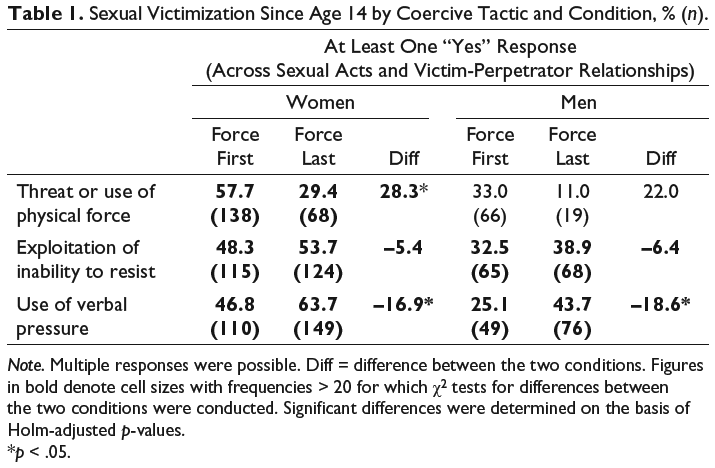
Note. Multiple responses were possible. Diff = difference between the two conditions. Figures in bold denote cell sizes with frequencies > 20 for which χ2 tests for differences between the two conditions were conducted. Significant differences were determined on the basis of Holm-adjusted p-values.
*p < .05.
Sexual Victimization of Women and Men Since Age 14 Based on Ordinal Severity Score, % (n).
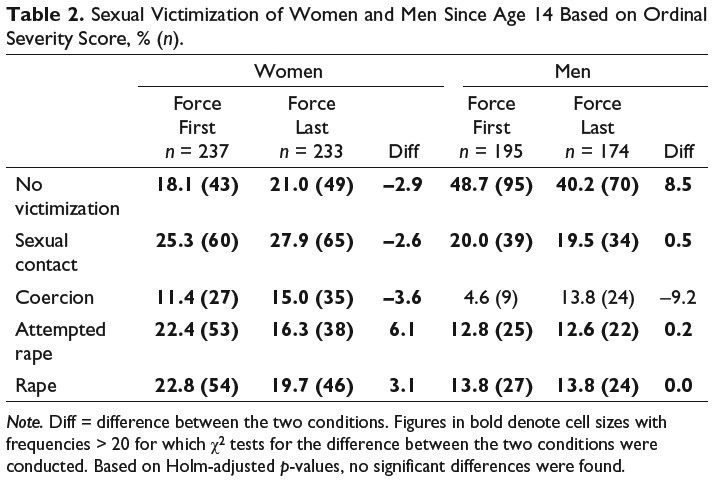
Note. Diff = difference between the two conditions. Figures in bold denote cell sizes with frequencies > 20 for which χ2 tests for the difference between the two conditions were conducted. Based on Holm-adjusted p-values, no significant differences were found.
The findings presented in Table 1 also present the evidence needed to evaluate Hypothesis 3, referring to an effect of the order manipulation on the middle category, which was the same in both conditions. No significant differences between the two experimental conditions were found in the rate of exploitation of the victim’s inability to resist either for women, χ² (1, N = 469) = 1.35, p = .246, or for men, χ² (1, N = 375) = 1.65, p = .199. These findings lend no support to Hypothesis 3.
Regarding the additional question of potential effects of the order manipulation on the overall prevalence rates, the findings showed that the percentage of participants who reported at least one experience of victimization did not differ between the two conditions in either of the two gender groups. For women, victimization rates were 81.9% in the force-first condition and 79.0% in the force-last condition, χ2 (1, N = 470) = 0.62, p = .430. For men, the victimization rates were 51.3% in the force-first condition and 59.8% in the force-last condition, χ2 (1, N = 369) = 2.68, p = .102.
Discussion
The current study aimed to advance the methodology for a reliable assessment of sexual victimization by testing potential order effects of presenting coercive tactics within the established multi-item, behaviorally specific SAV-S. Whether the order in which different coercive tactics are presented affects self-reports of sexual victimization is a question that has not been systematically tested, despite its importance for establishing the reliability of instruments assessing sexual victimization.
Although not the focus of our study, it is noteworthy that the overall prevalence rates of men’s and women’s victimization in the present study were higher than in earlier prevalence studies using the same instruments. For example, the victimization rates of 80.4% for women and 55.3% for men since the age of 14 compare to rates of 35.9% for women and 19.4% for men in the study by Krahé and Berger (2013). However, this comparison needs to be made considering the time difference between the two studies. Another recent study conducted with the SAV-S and a comparable sample of young adults in Germany revealed highly similar prevalence rates to the current study (Schuster et al., 2021; victimization rate of 80.5% for women and 46.6% for men). One reason for the high rates in these studies may be that they were advertised as studies about nonconsensual sexual experiences, which may have led to a self-selection of participants with victimization experiences into the sample. Another reason may be seen in the increased awareness about sexual victimization created by the global #MeToo movement that started in 2017. As a result, participants may have identified more experiences as nonconsensual compared with participants of the earlier study. Evidence from a recent study supports this line of reasoning (Jaffe et al., 2021). Moreover, other recent studies from the North American literature, using different instruments for collecting reports of sexual victimization, also yielded substantially higher prevalence figures than the one-in-five rate found in earlier studies. For example, studies based on the SES that assessed the prevalence of victimization since entering college, covering a much smaller time window than in the current study, yielded victimization rates above 50% for women and more than 30% for men (Howard et al., 2019; Sutton et al., 2021). Future research will reveal whether substantially higher rates in the post #MeToo era are found in a larger sample of studies.
Addressing our first two research questions, we examined whether self-reported rates of sexual victimization through the use or threat of physical force or the use of verbal pressure would be higher when the respective tactic was presented first. In line with Hypothesis 1, women and men reported higher rates of victimization by the use of verbal pressure when that tactic was presented first. Women furthermore reported higher victimization rates for the threat or use of physical force in the force-first than in the force-last condition. The finding that the coercive tactic presented first produced higher rates is consistent with an explanation in terms of primacy effects and priming processes, suggesting a greater salience of the first tactic. This pattern suggests that the order manipulation affected reports for verbal pressure and physical force in the same way, which lends no support to the assumption that less severe forms of sexual coercion would be more affected by the order manipulation.
The analysis based on the ordinal severity score of victimization also yielded no evidence that the order manipulation had a stronger effect on the less severe forms of sexual victimization. For women, the overall distribution of responses across the five levels of severity did not significantly differ between the two order conditions. For men, the overall distribution was significantly different, but within each level of severity, none of the prevalence rates differed significantly between the two order conditions. Thus, our second hypothesis, proposing that order effects would be more likely on the less severe forms of sexual victimization because these may leave more room for ambiguity, was not supported.
In our third research question, we examined whether rates of self-reported sexual victimization involving the exploitation of the victim’s inability to resist, always presented in the middle position, would be affected by the order manipulation. We did not find an effect of the order manipulation on reported rates of victimization through exploiting the victim’s inability to resist, lending no support to Hypothesis 3. This finding speaks against the possibility of carry-over or priming effects, by which responses to a previous item might shape responses to the subsequent items. Instead, it suggests that each tactic is considered in its own right without being affected by the context of preceding items.
Regarding our final question about potential effects of the order manipulation on overall prevalence rates, we found no evidence for the prediction that reports of any forms of sexual victimization aggregated across all items would be affected by the order in which the coercive tactics are presented.
Taken together, our findings demonstrate that total rates of victimization as measured by the SAV-S are robust against the order in which coercive tactics are presented. This finding is consistent with evidence by Anderson et al. (2021) based on the SES. However, order effects were found to affect the prevalence rates broken down by coercive tactic (i.e., threat or use of physical force, exploitation of inability to resist, and use of verbal pressure), yielding higher rates for the tactic that was presented first vs. last. Whether order effects need to be considered as a source of bias for prevalence rates depends on the research aim: if the focus is on establishing overall levels or ordinal severity scores, the present findings do not point to order effects being a threat to the reliability of the estimates. However, if the aim is to distinguish between coercive tactics, order effects should be considered. One possibility would be to assign participants to randomized orders of the items so that any order effects would be unsystematic. For the SES, Anderson et al. (2021) showed that overall prevalence rates did not differ between a version in which the coercive tactics were presented in a fixed order of increasing severity as opposed to a random order. A parallel study could be conducted for the SAV-S. To gain a clearer understanding of the incidents reported in response to the items, a version of the SAV-S could be designed that prompts participants to provide brief descriptions of the respective incident that triggered their “yes” response. This would clarify whether the primacy effect found for the order manipulation may be due to participants reporting any nonconsensual sexual experience they may have had to the first item, even if it did not involve the specific coercive tactic mentioned in that item and whether the same incident was reported in response to more than one item. Such an approach was used in a study by Canan et al. (2020).
Strengths, Limitations, and Directions for Future Research
Our study has several strengths. First, to our knowledge, it is the only study to date that investigated order effects of coercive tactics within an instrument measuring sexual victimization, contributing to the improvement of measurement strategies in sexual aggression research. Second, despite some cell sizes falling below the minimal cell size adopted for the analyses, the sample size was large enough to facilitate a fine-grained analysis across types of sexual acts, victim-perpetrator relationships, and gender groups. Third, because the SAV-S is a multi-item, behaviorally specific measure of sexual aggression, the findings of our study may be relevant for other measures using multiple behaviorally specific items, such as the SES (Koss et al., 2007) and the CTS2 (Straus et al., 1996). Moreover, the findings contribute to the diversity of evidence on sexual victimization by including both female and male victims and participants with different sexual experience backgrounds beyond the predominant heterosexual perspective.
However, several limitations must be noted. First, some of the analyses of victimization reports within and across coercive tactics were affected by small cell sizes, especially for men. A second limitation concerns the lack of a qualitative investigation regarding underlying processes that led to the differences detected in the prevalence rates between the two conditions. This is a problem shared with previous studies on effects of question format. While primacy and priming effects are plausible explanations, and overall prevalence rates are not affected by the order manipulation, this interpretation needs to be corroborated by empirical data. Qualitative studies examining the thought processes, recall, and categorization elicited by different question orders could provide more evidence on the psychological processes underlying any order effects. Furthermore, future research should examine whether the two versions of the SAV-S may differ in terms of their associations with vulnerability factors and/or physical, psychological, and behavioral consequences of sexual victimization.
In conclusion, the findings have implications for the methodology and interpretation of sexual violence research, not only for the SAV-S, but also for other instruments in this field of study, such as the SES. Since the assessment of coercive tactics within sexual victimization is relevant in many fields, including criminology and legal studies, our findings highlight the issue of order effects, when they are likely to occur, and how to control them by varying the order of item presentation.
Appendix
“Force-first” version of the SAV-S
Order of coercive tactics: Physical force, exploitation of inability to resist, verbal pressure. Has a man ever made (or tried to make) you have sexual contact with him My … sexual touch … attempted intercourse … completed intercourse … other sexual acts (e.g., oral sex) A … sexual touch … attempted intercourse … completed intercourse … other sexual acts (e.g., oral sex) A … sexual touch … attempted intercourse … completed intercourse … other sexual acts (e.g., oral sex) (yes or no answers to each items) Has a man ever made (or tried to make) you have sexual contact with him against your will by ... + items (a), (b), (c) as above Has a man ever made (or tried to make) you have sexual contact with him against your will by putting ... + items (a), (b), (c) as above
“Force-last” version of the SAV-S
Order of coercive tactics: Verbal pressure, exploitation of inability to resist, physical force. All remaining components of the questionnaire as above.
Footnotes
Declaration of Conflicting Interests
Funding
The author(s) received no financial support for the research, authorship, and/or publication of this article.
