






Abstract
Perceived control (PC) is considered as one of the most basic psychological needs of human beings, and it is also an important index to measure individual mental health. Previous studies have shown that negative life experience is an important risk factor for predicting PC. With the prevalence of cyberbullying among college students, this study explored how cybervictimization (CV) was related to the PC, mediated through the personal belief in a just world (PBJW). Besides, this study examined the moderating role of interpersonal forgiveness (IF) in the direct relationship between CV and PC and the indirect connection through PBJW. It was expected that CV would negatively predict the PC, and the PBJW would mediate this relationship. The direct and indirect effects were stronger in individuals with low IF than those with high IF. In this study, 837 Chinese college students were invited to conduct an online survey using a convenient sampling method. Participants were asked to complete the measurement of CV, PBJW, IF, and PC. After controlling gender and age, the results revealed that CV could directly and negatively predict college students’ PC and indirectly predict the PC through the mediation of PBJW. Additionally, IF moderated the effect of CV on PBJW and PC. Unlike what we expected, the effect of CV on PBJW was stronger for low IF individuals than those with high IF, while the effect of CV on PC was stronger for high IF individuals than those with low IF. The unexpected orientation and other results were discussed.
The development of information technology has brought great convenience to many fields, but at the same time, technology abuse has also brought significant challenges to human beings. With the popularity of mobile devices, the most frequent social interaction among college students is achieved through digital media devices. Many of them are exposed to cyberspace, thus becoming the vulnerable targets, that is, cybervictimization (CV). CV refers to repeated aggressive behaviors suffered through electronic devices (Tokunaga, 2010). Previous cross-sectional (Musharraf & Anis-ul-Haque, 2018) and longitudinal studies (Rose & Tynes, 2015) have consistently revealed that CV would lead to a series of adverse effects on individual mental health, such as depression, sleep problems, self-injury, and decreased self-esteem (Kwon et al., 2020; Urano et al., 2020). Perceived control (PC) is considered as another important but less noticed mental health indicator (Macedo et al., 2019), which is defined as an individual’s belief in one’s ability that determines whether an individual can achieve goals and control any factors that may interfere with the achievement of goals (Lachman & Weaver, 1998a). Additionally, PC is also a vital psychological resource, one of the human beings’ most basic psychological needs (Williams, 2009). A strong feeling of PC is related to the positive experiences of individuals, such as subjective well-being (Yu et al., 2018). On the contrary, poor PC is connected to anxiety, nonadaptive coping strategies, and unhealthy psychological adaptation (Henselmans et al., 2010; Keeton et al., 2008).
A large body of research has revealed that adverse life experience, like discrimination (Macedo et al., 2019), and racial exclusion (Peterson et al., 2020), is a significant risk factor leading to decreased PC. Similarly, given the destructive influence of being bullied on individuals psychological and social resources, it is unanimously considered as a prominent stressful event in individual life (Niu et al., 2020; Schacter et al., 2014). It was expected that CV would negatively predict PC in the current study. General strain theory may explain this relationship, which supposes that exposure to life stress events is unfavorable to individual psychology development (Agnew & White, 1992). Besides, PC is associated with nonadaptive coping strategies, which is especially consistent with general strain theory that emphasizes coping. In addition, existing studies also provide some indirect evidence for our expected hypothesis. For instance, being bullied often experiences a higher sense of relative deprivation (Gao et al., 2017), and in turn, relative deprivation is significantly correlated with PC (Xiong & Liu, 2020). A study of Spanish adolescents found that CV is positively related to fatalism, which refers to an attitude of resignation and a belief in a lack of personal control over the fate (Navarro et al., 2018).
The previous studies provide indirect evidence for the negative relationship between CV and PC, and the internal mechanism is still unclear. Thus, this study attempted to explore two unsolved problems. First, to our knowledge, the previous studies did not explore the mechanisms by which CV is related to PC. Several studies reported that personal belief in a just word (PBJW) is positively related to PC (Ucar et al., 2019; Yu et al., 2018). And a large-scale investigation showed that adverse events (i.e., being attacked) would be associated with lower BJW (Corey et al., 2015). Even so, no previous study has tested whether CV is associated with PC through PBJW in an integrated model. The investigation of mediating effect is conducive to understand how the CV is related to PC by threatening one’s justice perception. Thus, this research intended to explore whether PBJW mediated the relationship between CV and PC. Second, whether there are some protectors to buffer the effect of CV on PBJW and PC is also an important issue to be solved. Considering the prevalence of Confucian culture in China, the current study aimed to investigate the critical role of interpersonal forgiveness (IF) as a moderator on the impact of CV.
The Mediating Role of PBJW
Shattered assumption theory (SAT) posits that stressful life events may shatter one’s belief systems and eventually harm one’s mental health (Janoff-Bulman, 2010). PBJW is a belief that individuals get what they deserve and deserve what they get (Lerner, 1980). A recent study shows that cyberbullying, as a subtype of bullying, represents a form of unjust and deviant behavior. Cyberbullying perpetrators break interpersonal rules and societal norms and violate the personal rights of victimized students, who undeservingly suffer from the negative consequences of such behavior (Donat et al., 2019). Thus, CV is viewed as a traumatic event for victims.
The motivational function of PBJW posits that people are inclined to assume that they live in a just world where everybody gets what they deserve and everybody deserves what they get (Lerner, 1980). However, according to SAT, exposure to CV shatters this just assumption. It can, therefore, be expected that CV would present a severe threat to the victim’s just belief about themselves. As a result, the endorsement of PBJW would decline. Exposure to CV should be particularly threatening to one’s PBJW because the victim often feels personally selected for being the target of malevolence and unable to change their fate no matter what they do (Cubela & Kvartuc, 2007). CV prompts the feeling that less justly treated by others (Donat et al., 2019). The strength of PBJW might reduce when college students frequently experience severe injustice involving a certain degree of adversity (Cubela Adoric & Kvartuc, 2007; You & Ju, 2020). Several studies provided the evidence of negative effects of injustices on PBJW. For instance, a previous study on the workplace showed that unfair treatment in the process of job hunting or bullying victimization in the workplace is negatively related to PBJW (Dalbert & Sallay, 2004). Dzuka and Dalbert (2007) found that teachers who reported being victimized by students had lower PBJW, and Cubela and Kvartuc (2007) found a similar reduction in PBJW for people who are victims of mobbing at work. Being bullied online may be more stressful than offline, as messages, digital images, and videos often persist online and can be stored and viewed later, meaning that they can have repeated effects even if uploaded just once (Donat et al., 2019). Thus, experiences of CV, which students are likely to perceive as severely unjust, might shatter their PBJW.
According to Lerner (1980), PBJW allows us to maintain an illusion of PC. In other words, just-world theory predicts a positive relationship between PBJW and PC or mastery of the environment. PBJW enables individuals to deal with their social environment as orderly and stable and thus serves important adaptive functions. There is ample theoretical and empirical evidence that PBJW and PC are positively correlated (Fischer & Holz, 2010; Ucar et al., 2019). Moreover, Peng et al. (2019) demonstrated that PBJW positively correlates with PC among Chinese undergraduates. Based on the existing research, this study supposed that individuals with high PBJW would report higher PC.
The Moderating Role of IF
However, perceptions of CV are not sufficient to spur people into feeling loss of control. Therefore, it is important to pay explicit attention to variables that moderate the CV-PC linkage and strengthen or weaken the relationship between the two. Diathesis-stress model (Roisman et al., 2012) suggests that IF is one of the effective ways to resolve interpersonal conflicts. High IF can improve happiness and relationship satisfaction, promote physical and mental health (Karremans & Van Lange, 2008; Liu et al., 2013; Quintana-Orts & Rey, 2018). The systematic review results showed that IF was negatively related to bullying victimization and predicted better psychological adjustment, even after accounting for bullying behavior, victimization experiences, and general coping strategies (Quintana-Orts et al., 2019). Therefore, another focus of the current study is to explore the protective role of IF in the relationship between CV and individuals’ PBJW and PC. IF is the change of a series of prosocial motivations after an individual is offended, including the decrease of revenge and avoidance motivation and the increase of benevolence motivation (McCullough et al., 1998). Previous studies have demonstrated the protective role of forgiveness in mental health after several transgressions. Forgiveness could act as a practical coping resource to allow school students to deal with the effects of traditional and cyberbullying (Egan & Todorov, 2009; Quintana-Orts & Rey, 2018). Besides, the act of forgiveness may help alleviate victims’ concerns elicited by the cyberbullying and increase their perceptions of status/power and value consensus, thus restoring victims’ sense of justice (Wenzel & Okimoto, 2010, 2012). High forgiveness individuals often believe that the world is just (Bartholomaeus & Strelan, 2016), and they tend to ruminate less on unhappy experiences and work more to repair damaged interpersonal relationships (Adams & Inesi, 2016; McCullough et al., 2007). Additionally, forgiveness is a decision made by the victim and thus returns agency, control and power to that victim (Wenzel & Okimoto, 2012). Through the act of forgiveness, the victim might also assume a position of moral superiority, refusing to be drawn to the low moral level of the offender, which returns status to the victim (Wenzel & Okimoto, 2012). Forgiveness might reinforce the victims’ belief, hope, or trust that the offender endorses. Therefore, the present study hypothesized that the IF could alleviate the adverse effects of CV on PBJW and PC. Specifically, it was predicted that CV and PBJW, and CV and PC relationships would be weaker for individuals high in IF than for individuals low in IF.
The Current Study
Given several research gaps that might be there and inspired us to design the present research. Firstly, although the negative association between CV and mental health has been well-established, an important concept of PC that is related to nonadaptive coping strategies has been largely ignored. This variable is especially consistent with general strain theory that emphasizes coping. Secondly, most of the previous studies focused on the antecedents and consequences of cyberbullying among adolescents but largely underestimated the impact of CV on college students (Quintana-Orts & Rey, 2018; Rose & Tynes, 2015). Thirdly, prior studies may not be aware that CV has become more serious in non-Western countries, especially in China, where communication technology is highly developed. Fourthly, a lack of appropriate theoretical perspective to explore how CV is associated with individuals’ mental health from a world assumption enlightens us to explore the mediating role of PBJW with a lens of SAT. Finally, the previous researches only tested the process mechanism (i.e., mediating effect) between strain and coping and world assumptions (Borwell et al., 2021; Wu et al., 2021), insufficient attention was paid to conditional mechanisms (i.e., moderating effect). Based on these research gaps, a critical aim of our study was to investigate the effects of CV on PC in Chinese college students. Additionally, we investigated the mediating role of PBJW on this relation and tested whether the IF would moderate the relationship between CV and PBJW/PC. More specifically, we tested the following hypotheses (Figure 1):
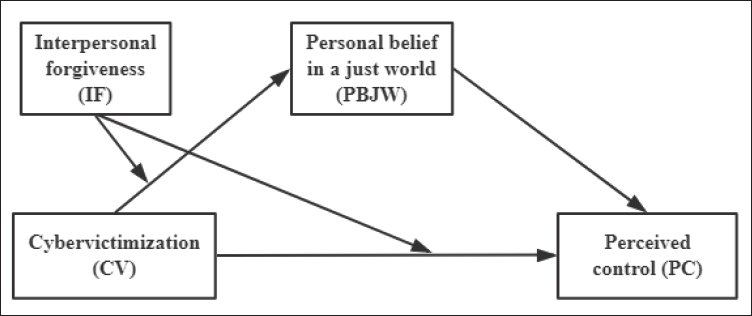
The proposed moderated mediating model.
Method
Participants and Procedure
After the research procedures and contents were approved by the IRB of the authors’ affiliation, and informed consent was given by the participants prior to data collection. The convenience sampling method was adopted to invite 880 college students from four Tier-1 universities in Beijing, China, to participate in the online questionnaire investigation voluntarily. These participants were evenly distributed in the freshmen and sophomores of four schools. That is to say, there were 110 freshmen and 110 sophomores in each university took part in the survey. Instructions and confidentiality principles were presented on the top of the questionnaire homepage. After deleting the participants whose answering time was much lower than the average level and who regularly answered (all the answers were extreme or single options), 837 valid data were retained. Participants were 281 (33.57%) males and 556 (66.43%) females, 478 (57.11%) from only-child families and 359 from non-only-child families. Almost all of them were Han Chinese (95.58%), with an average age of 19.66 ± 1.75 years. All the participants had online experience, and most of them spent between 2 and 4 hours (36%) online every day.
Measures
Cybervictimization.
The Cyberbullying Inventory developed by Erdur-Baker and Kavsut (2007) and adopted into a Chinese version by Zhou et al. (2013) was used to assess participants’ CV experience. This scale consists of 18 items (e.g., “I once received hurtful text messages from someone”). Participants rated items on a 4-point Likert scale from 1 = never to 4 = more than five times. A higher average score represents higher CV experience in a participant. In this study, the Cronbach α for the scale was 0.96.
Personal belief in a just world.
The PBJW subscale of the Belief in a Just World Scale (Dalbert, 2002) was used to assess participants’ PBJW. This seven-item subscale is widely used and has good reliability and validity in Chinese samples (Wang et al., 2021). Statements such as “I am usually treated fairly” were rated on a 6-point scale from 1 = strongly disagree to 6 = strongly agree. A higher average score indicates a higher PBJW. In the present study, the Cronbach α for the scale was 0.93.
Perceived control.
This study used the Sense of Control Scale (Lachman & Weaver, 1998b) to measure participants’ PC. This 12-item scale has good reliability and validity in Chinese samples (Yu et al., 2018). Statements such as “What happens to me in the future mostly depends on me” were rated on a 7-point scale from 1 = strongly disagree to 7 = strongly agree. A higher average score represents a higher PC. In the present study, the Cronbach α for the scale was 0.82.
Interpersonal forgiveness.
The IF subscale of the Heartland Forgiveness Scale developed by Thompson et al. (2005) assessed participants’ forgiveness. This six-item subscale has good reliability and validity in Chinese samples (Xie et al., 2020). This subscale consists of six items (e.g., “Although others have hurt me in the past, I have eventually been able to see them as good people”). Participants rated items on a 7-point Likert scale from 1 = almost always false of me to 7 = almost always true of me. A higher average score represents a higher IF is a participant. In this study, the Cronbach α for the scale was 0.81.
Data Analysis
Linear interpolation was conducted in the case of missing data. Harman’s single method was used to test the common method biases, and the results showed that the variance explained by the first factor was 23.84%, which was below the critical standard of 40%. Therefore, there were no obvious common method biases in this study. Then, the descriptive statistics were obtained using independent t-tests and Pearson’s correlation coefficients. A path analysis was used to test the relationship between CV and PC, as well as the mediating role of PBJW and the moderating role of IF in this relationship. Additionally, the 5,000 bootstrapping method was used, and a 95% confidence interval (CI) without zero indicates a statistically significant result at a level of α = 0.05. All analyses were conducted using SPSS 23.0.
Results
Preliminary Analyses
Correlations Between Variables.
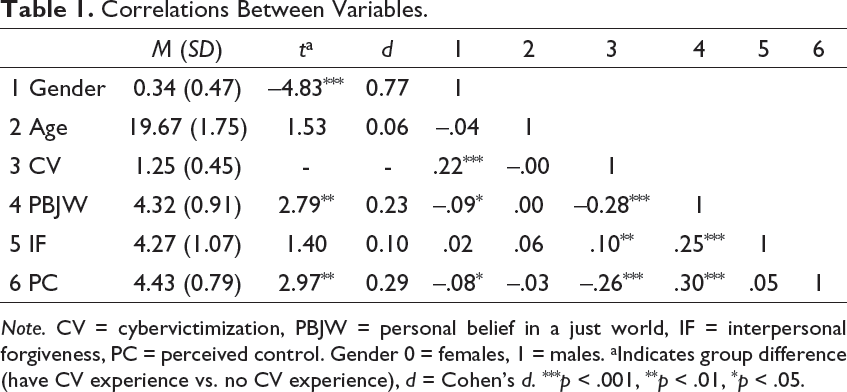
Note. CV = cybervictimization, PBJW = personal belief in a just world, IF = interpersonal forgiveness, PC = perceived control. Gender 0 = females, 1 = males. aIndicates group difference (have CV experience vs. no CV experience), d = Cohen’s d. ***p < .001, **p < .01, *p < .05.
Mediation Analyses
Mediation Analyses.
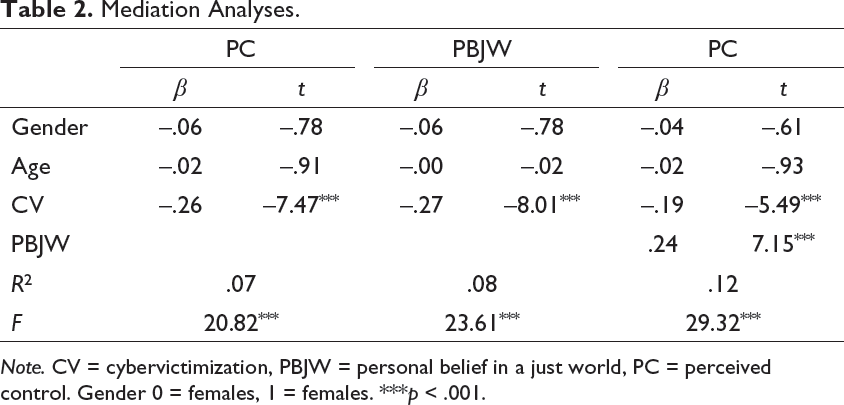
Note. CV = cybervictimization, PBJW = personal belief in a just world, PC = perceived control. Gender 0 = females, 1 = females. ***p < .001.
Moderated Mediating Effect Test
Finally, the moderating role of IF was tested. As shown in Table 3, after gender and age were included as covariates, the regression model results suggested that the interaction of CV and IF positively predicted PBJW (β = 0.12, p < .001) and negatively predicted PC (β = –0.06, p < .05). As shown in Figure 2, simple slope tests demonstrated that for low IF individuals, CV negatively predicted PBJW (β = –0.50, p < .001); for high IF individuals, CV also negatively predicted PBJW (β = –0.27, p < .001). However, this effect size was more pronounced for individuals with low IF than for those with high IF. Therefore, the mediating effect was lager for low IF individuals (ab = –0.13, 95% CI = [–0.19, –0.08]) than high IF individuals (ab = –0.07, 95% CI = [–0.11, –0.04]). Additionally, as shown in Figure 3, for high IF individuals, CV negatively predicted PC (β = –0.20, p < .001); but for low IF individuals, the relationship between CV and PC was nonsignificant (β = –0.09, p > .05). Therefore, the direct effect of CV on PC was only present for high IF individuals, the effect size was –.20, 95% CI = [–0.27, –0.13].
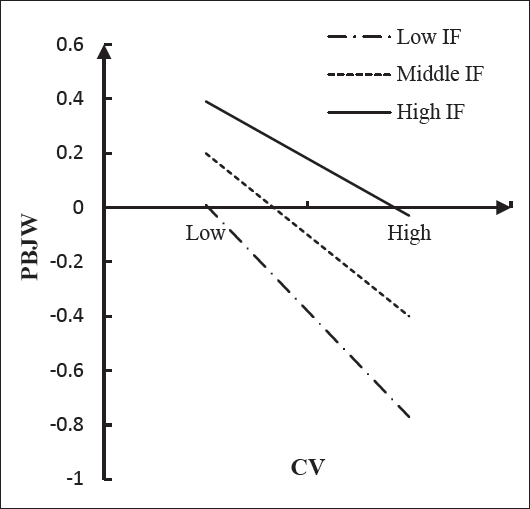
The moderating role of IF between the CV and PBJW.
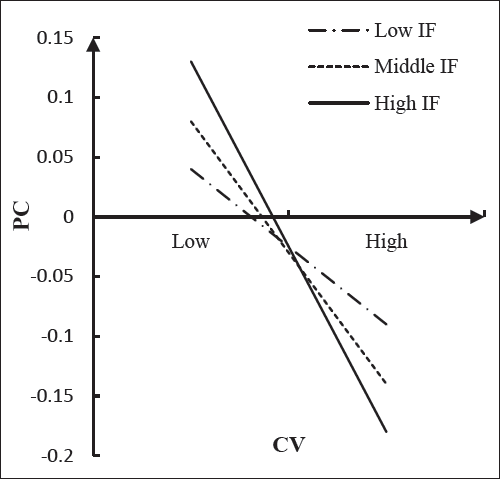
The moderating role of IF between the CV and PC.
Moderated Mediating Analyses.
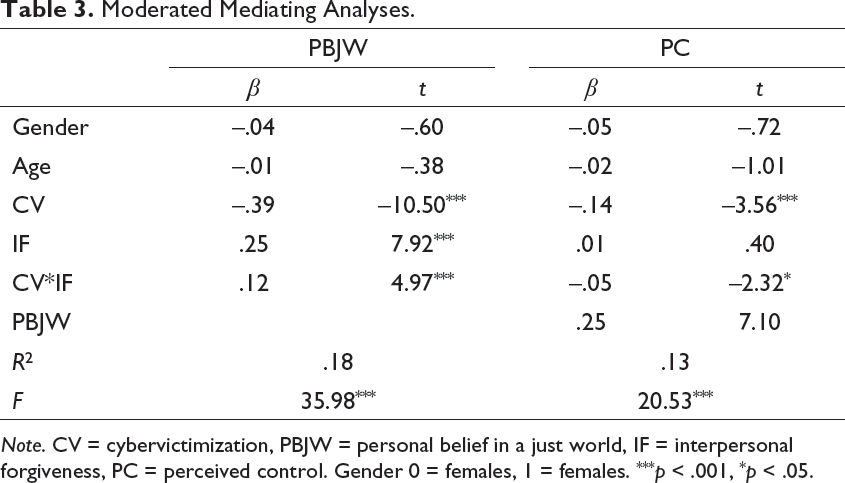
Note. CV = cybervictimization, PBJW = personal belief in a just world, IF = interpersonal forgiveness, PC = perceived control. Gender 0 = females, 1 = females. ***p < .001, *p < .05.
To sum up, these analyses indicated that IF moderated the direct and indirect effects of CV on PC. However, the direct effect was only for high IF individuals but not for low IF individuals; the indirect effect was more significant for low IF individuals than the high IF individuals.
Discussion
The current study examined the association of CV with PC among Chinese college students. Also, it explored the mediating role of PBJW and the moderating role of IF in this relationship. We expected that CV would be associated with PC negatively, mediated through PBJW. Furthermore, we expected that IF would moderate the effects of CV on PBJW and PC. The results supported the first and second hypotheses, namely, CV was directly correlated with PC and negatively correlated with PC through the mediating role of PBJW. Additionally, IF moderated the indirect effect of CV on PC through PBJW, and moderated the direct effect of CV on PC. However, only the moderating direction of IF in the relationship between CV and PBJW was consistent with our hypothesis. The moderating direction of IF in the relationship between CV and PC was unexpected. The third hypothesis predicted that the effect of CV on PBJW and PC would be stronger in individuals with low IF than in individuals with high IF. The current results only supported that the effect of CV on PBJW was stronger in individuals with low IF than in individuals with high IF. However, the moderating direction of IF in the relationship between CV and PC was the opposite. The direct effect of CV on PC was stronger for high IF individuals.
First, the present study found that CV is prevalent in Chinese college students; almost two-thirds of them reported that they had been cyberbullied in the last year. CV experience significantly negatively predicted college students’ PC, which was consistent with previous research on traditional bullying and offline peer victimization that suggested that CV may have a negative impact on the psychosocial adjustment of the victims (Musharraf & Anis-ul-Haque, 2018; Rose & Tynes, 2015). At the same time, our finding was also in line with the view of the general strain theory (Agnew & White, 1992). The current study also suggested that CV may be a risk factor for individuals to develop a cognitive coping style characterized by passive and negative attitudes (Navarro et al., 2018). This was related to the hypothesis that reduced PC may be a learned result of repeated exposure to adverse life experiences (Bhanji et al., 2016).
Additionally, we found that the CV experience of college students would affect PC through the mediating role of PBJW. Specifically, the CV experience significantly negatively predicted the PBJW and, in turn, the lower PBJW was related to a loss of control. Our finding supported the SAT (Janoff-Bulman, 2010). The PBJW builds on the individual’s experience of justice and provides the individual with the confidence to believe that efforts will eventually pay off. Being bullied online is seen as an injustice, which is bound to cause individuals to question the belief in justice, thereby reducing the positive reinforcement that efforts are bound to bring rewards, and eventually shatter one’s PBJW. Conversely, high PBJW can provide people with a sense of security and control, allowing them to be confident about the future and constantly pursue long-term goals (Yu et al., 2018). A previous study has also reported that high PBJW is closely related to strong PC, which is important for individuals to adapt to a new environment (Testé, & Perrin, 2013). The present results extend previous findings and provide valuable evidence that PBJW is an important mediating mechanism to explain the relationship between adverse experiences and adaptive psychological development (Chen et al., 2020).
Regarding the moderating effect, the present study found a two-sided effect of IF. For individuals with high IF, the negative relationship between CV and PBJW was weaker than that between individuals with low IF. This finding suggested that IF played a protective role in the relationship between CV and PBJW. Many previous studies have supported the buffer role of IF against adverse experiences (Hirsch et al., 2012; Jarrett et al., 2017; Quintana-Orts & Rey, 2018). A possible explanation is that the victim’s expression of forgiveness toward the cyberbullying perpetrators seemed to empower the victim and increase their perceived status, and in turn, this sense of status/power alleviated the victim’s feelings of injustice (Wenzel & Okimoto, 2012).
However, we also found an unexpected result. The relationship between CV and PC was stronger for individuals with high IF than those with low IF. This finding suggested that IF was a risk factor rather a protective factor in the relationship between CV and PC. The previous study also reported that forgiveness does not always play the role of protector. For instance, Xie et al. (2020) found that forgiveness intensified the effect of the experience of being phubbed on the depression of the phubbee. Two other studies reported that forgiveness not only damages relationships but is also positively associated with subsequent transgressions by partners in intimate relationships (Adams et al., 2015; McNulty, 2010). A possible explanation is that the IF of victims may make the offender feel that controlling their offending behavior is unnecessary to maintain the relationship. Cyberbullying goes unpunished, and bullies may continue their hostile behavior. The high IF of the cyberbullying victims may lead the cyberbullying perpetrators to feel that their behavior is not severe and that they do not need to stop the harmful behavior. However, individuals with low IF may respond by directly and immediately warning the cyberbullying perpetrators to stop their harmful behavior and evoke the perpetrators to experience feelings of guilt. Therefore, low IF may have stopped repeated cyberbullying just in time to help the victims regain a sense of control.
There are four limitations that should be mentioned. First, a cross-sectional study design makes it impossible to draw causal inferences or conclusions about relationships between variables. Second, given that the current study was self-reported and did not include experimental manipulation, it also affected us to make strong assertions about causality between variables. Longitudinal and experimental studies should be carried out in the future to identify how IF influences the direct and indirect effect of CV on PC and the impact of intervention programs. Third, a recent meta-analysis reported gender, age, and cultural differences in cyberbullying and victimization (Lozano-Blasco et al., 2020). And it is possible that meaningful individual difference variables (e.g., internal locus of control) would alter peoples’ responses to victimization experiences (Witt, 1989); as such, future research should be encouraged to examine these potential moderators. Finally, data were collected from a convenience sample, so generalization to the college students may be biased. Random sampling should be used for better representation of the general population in the future study. Thus, there should be caution when explaining the findings of the current study.
Although there are limitations, our study provides significant theoretical and practical enlightenment. Theoretically, the present study established a moderated mediating model to clarify the relationship of CV, PBJW, IF, and PC. This model explains the mechanism of how CV lower PC from a perspective of world assumption. The empirical basis is provided for Agnew’s classical general strain theory and Janoff-Bulman’s SAT. Based on these theories, the current study makes a further step that we found a vital moderator factor, IF, affecting the links between CV and PBJW and PC. IF is particularly important in the context of Chinese culture, which is often viewed as a “buffer” to resist adverse experiences (Egan & Todorov, 2009; Quintana-Orts & Rey, 2018). However, our findings offer some first empirical evidence that a moderate level of IF is most helpful in protecting the individual from danger.
Practically, the current study would help formulate some prevention and intervention programs to cope with CV. For instance, the CV has been widespread among Chinese college students, and the government should pay more attention to this phenomenon and speed up the introduction of anti-cyberbullying policies. Research has shown that the significant results have been achieved in Australia by raising public awareness and implementing anti-bullying programs, leading to obvious reductions in the perpetration and victimization of cyberbullying (Lozano-Blasco et al., 2020). Furthermore, a fair and just learning and living environment requires the joint efforts of the school, teachers, and parents. For example, a previous study has revealed that teachers’ justice could have a positive impact on students’ PBJW (Ucar & Dalbert, 2018). Last but not least, individuals with high IF are more likely to forgive the faults of others, but this may encourage the offender’s harmful behavior to some extent. Thus, a necessary warning should be given when being treated unfairly. This finding may have even greater practical applications for the Chinese. Given the Confucian value of group harmony is widely advocated in China, the Chinese are probably more inclined to forgive others whenever they can (Fu et al., 2004). A moderate level of forgiveness protects us from further harm and also protects others from additional adverse behavior.
Supplementing previous research into PBJW, PC, and IF in people exposed to CV, the present study explored the relationship between CV and PC, and its internal mechanism among Chinese college students. Exposure to CV was found to relate to a lower PBJW and PC. The higher the frequency of such acts, the stronger was the belief that the world is basically unjust to them, and then intensify the feeling of loss of control. Thus, PBJW is the underlying mechanism that interacts with the experience of CV to influence an individual’s developmental outcome (i.e., PC). More importantly, a significant finding of the current study is that IF has different moderating effects on CV. That is to say, IF buffers the influence of CV on PBJW but intensify this effect on PC. We provided empirical evidence for an old saying that “Too much water drowned the miller.”
Footnotes
Declaration of Conflicting Interests
Funding
The author(s) disclosed the receipt of the following financial support for the research, authorship, and/or publication of this article: The present study was supported by the Scientific Research Foundation of Renmin University of China (The Fundamental Research Funds for the central Universities) (2020030129) and the Major Innovation & Planning Interdisciplinary Platform for the“Double-First Class” Initiative, Renmin University of China.
