







Abstract
Stranger rapes are the most difficult cases to solve for the police, especially when a serial rapist is involved. Recent research in offender profiling has focused on generating inferences between crime scene variables and offender characteristics to aid the police investigation. This study aims to develop an empirical model to predict a new case of a serial stranger rapist by analyzing a Spanish sample of 231 one-off and 38 serial sexual offenders. A multivariate logistic regression model that included eight significant crime-related variables was able to predict whether an unknown offender is a one-off or serial rapist based only on the victim’s account. The predictive validity of the model was tested using receiver operating characteristic (ROC) analysis and the result of AUC value indicated a medium predictive capacity. The final model correctly classifies nearly 80% of serial stranger rapist cases. The implications of these findings for criminal investigation are discussed.
Introduction
Sexual violence is an important social and health problem worldwide. Police records of sexual crimes have dramatically increased in recent years in many countries in Europe, North America and other regions (United Nations Office on Drugs and Crime (UNODC), n.d.; Eurostat, n.d.). Contrary to public opinion, most of these sexual offences are committed by an acquaintance and only a few are committed by strangers, despite the social concern about these last cases generated by their media coverage (Breiding et al., 2014). Even though stranger rapes only constitute 20%-30% of all sexual violence (Planty et al., 2013; Waterhouse et al., 2016), these cases need to be studied in depth because they are quite difficult to solve for the police. Multiple factors make them challenging: first and foremost, the aggressor’s identity is unknown to their victim; second, the usual lack of physical evidence, and third, the absence of witnesses makes the victim’s account the only source of information for the investigators. These factors considerably reduce the police clearance rate of stranger rapes (Almond et al., 2018; Corovic et al., 2012; ter Beek et al., 2010).
To date, knowledge on how single-victim and serial rapists differ from one another in cases of stranger rape is rather scarce. Thus, more knowledge of how single-victim rapists can be distinguished from serial rapists by their crime scene behaviors is needed if we are to improve investigation strategies and possibly prevent further victimization.
Police Investigation of Serial Rape Cases
Serial rapists are those who commit more than two offences against different victims (Beauregard et al., 2007; de Heer, 2016; Park et al., 2008; Santtila et al., 2005; Slater et al., 2014). Previous research has established that most serial rapists choose strangers as their victims (de Heer, 2016; Hazelwood & Warren, 2004; Slater et al., 2014). For this reason, even though serial rapists represent only 10%-20% of all sexual offenders, they are responsible for more than 40% of all sexual crimes (Almond et al., 2018). Because their likelihood of reoffending is so high, serial rapists should be a priority for the police to investigate and detain. However, time constraints and limited resources make it more challenging to apprehend the offender (Hakkanen et al., 2004). To this end, it would be useful for the police to know whether they are dealing with a serial rapist or a “one-off” sexual offender the moment the victim reports the sexual aggression.
Offender profiling is a police technique that complements current methods of investigation by attempting to improve the investigative process of identifying, tracking, and arresting perpetrators in serial stranger rape cases (Corovic et al., 2012; Fox & Farrington, 2018). Many offender-profiling studies have increasingly focused on generating inferences between crime scene variables and offender characteristics in order to aid this police investigative process, particularly in naming and identifying potential suspects (Almond et al., 2018; Mokros & Alison, 2002; Scott et al., 2006; ter Beek et al., 2010). Offender profiling has traditionally been used to solve serial stranger rapes and homicides believed to have been committed by the same offender, where the police have had few clues as to the identity of the offender and are unsure about the type of individual they should be looking for (Hazelwood & Warren, 2004).
When a rape is reported to the police, the offender’s behavior (as reported by the victim) should be analyzed to identify any key features, backed by reliable and evidence-based research, that suggest the offence is part of a series (Slater et al., 2014), as this may mean that the serial rapist has been convicted of a sexual offence before and they are already recorded in the system (Almond et al., 2018). When such indicators are found, they should then be communicated to the investigative team who may narrow down the pool of suspects by searching in criminal record databases (Corovic et al., 2012). Several studies have found that around 84% of stranger rapists have previous convictions (Almond et al., 2018; Davies et al., 1997).
Research on One-Time and Serial Rapists
Previous research has attempted to draw a clear distinction between serial and one-off offenders, with the majority focusing on homicide (Chan et al., 2015; James & Proulx, 2016; Kraemer et al., 2004; Pakkanen et al., 2015; Santtila et al., 2004; Sturup, 2018; Trojan & Salfati, 2011; Wright et al., 2008) and only a few on rapes (Corovic et al., 2012; de Heer, 2016; Park et al., 2008; Slater et al., 2014). Research on serial versus one-off rapists has found the difference between these two groups to lie basically in terms of criminal sophistication, violence, and interpersonal involvement (Corovic et al., 2012; de Heer, 2016; Park et al., 2008; Scott et al., 2006; Slater et al., 2014).
Firstly, regarding criminal sophistication, serial rapists were in general more likely than single-victim rapists to display criminally sophisticated behaviors. To be more specific, they displayed greater forensic awareness (taking forensic precautions such as wearing gloves or a condom, wiping off traces, etc.), and were more likely to deter the victim’s resistance and control the victim verbally (with orders on what to do) as well as physically (intimidating with a weapon, binding, and gagging the victim, etc.). Criminal sophistication was also associated with severe sexual assaults but did not generally lead to severe victim injuries.
Secondly, in terms of violence, serial rapists were less violent toward the victim during the encounter. However, they tended to use a surprise or blitz-style approach, while single-victim rapists preferred a confidence-style approach. In addition, they were more likely to steal something from the victim (usually their wallet and/or cell phone) and engage in more sexual acts than one-off rapists; specifically fondling the victim, forcing the victim to masturbate the offender and complete the act of rape. On the contrary, one-off rapists displayed more violence and were more likely to verbally threaten the victim, physically hit and kick, and engage in more vaginal penetration and/or oral penetration.
Finally, with regard to personal involvement, serial rapists asked victims more questions and gave them orders on what to do while single-victim rapists were significantly more likely to engage in behaviors denoting interpersonal involvement such as kissing the victim, greater verbal interactions such as sexual comments, or inducing the victim to participate in the sexual activity. Furthermore, single-victim rapists were also more likely to have been drinking alcohol immediately prior to the rape, and to commit their offence indoors.
Although several studies have tried to identify means of differentiating between one-time rape and serial rape, there is still no conclusive empirical evidence that serial rapists have unique characteristics not found in other rapists (de Heer, 2016).
Current Study
The existing literature on whether there are differences in crime scene behaviors between serial and one-off offenders is very limited. This means that there is little guidance at present that could help the police to determine early in an investigation whether they are dealing with a serial or a one-off offender. Therefore, the first goal of this research is to develop an empirical model able to predict a serial stranger rapist based on the victim’s account. Its second goal is to compare the variables to distinguish between serial and one-off offenders found in the current study with those found in past research. Finally, it discusses the practical application of this predictive model in helping the police during the early stages of an investigation to prioritize high-risk cases and focus efforts in line with police resources. Ultimately, this could mean identifying stranger rapists more accurately, which would provide justice to victims and improve overall safety for communities.
Furthermore, a limitation of previous research is that they often use a sample of only convicted rapists. Due to the judicial difficulties involved in obtaining a conviction for sexual offences, convicted rapists may constitute a subset of offenders quite unrepresentative of the larger population of men who commit sexual offences (Lamade & Prentky, 2019). For this reason, this research has a larger sample of police reported cases of serial and one-off rapists and it includes not only a subset of rapists (convicted ones), but a larger sample of identified rapists, who may or may not be incarcerated for other reasons not related to their culpability.
Method
Data
The general community sample consisted of 231 one-off and 38 serial sexual offenders, who assaulted 291 different female victims. In this study we define serial rapist as a sexual offender who has had two or more sexual offences reported to the police within a year (2010). For the purpose of this study, the term stranger rape was defined following the classification of Waterhouse et al. (2016) which lists four types of relationships: domestic, casually acquainted, stranger, and vulnerable. Within the stranger category, the line between knowing and not knowing the victim is often vague, thus the authors provide three situations that can be included under this category are following: (a) when the victim and the offender have never met and the victim neither recognizes nor has ever heard of the offender, (b) when the offender and the victim have never met, but the victim has heard of the offender or knows him by sight, and (c) when the victim and offender have spent less than 24 hours together (Waterhouse et al., 2016).
The cases were obtained from the Spanish Criminality Statistics System, a national database administered by the Ministry of Interior which records all types of offences. The research team received authorization to access the data in 2015. We asked for the cases of 2010 in order to ensure that the police investigation had been concluded and the case solved, so we could have information regarding the perpetrator.
In 2010, 1,373 stranger sexual offences were recorded in the database mentioned above. The cases were selected based on whether the victim was female and aged over 13, the legal age of sexual consent for boys and girls under Spanish law at the time the study was designed. Of the police reports requested from Spanish police forces, we received 622. After reviewing and selecting the reports according to the aforementioned criteria (female victim and aged over 13) we were left with 342 police reports, referring to 231 one-off, and 38 serial sexual offenders. In the cases of one-off offenders, one police report corresponds to one offender and one victim (231 police reports, 231 offenders, and 231 victims). But, in the cases of serial rapists (38), one offender may have more than one police report; there may be one serial rapist with several police reports mentioning only one victim each one; or perhaps one police report mentioning several victims on several occasions, but only giving details about the last victim. For that reason, the number of victims of serial rapists in the dataset ranges from 1 (only information about the last case in the police report but other victims are referred to in it) to 6 (information of all six victims in the report), with an average of 1.8 victims per serial rapist.
Regarding the demographics of the overall sample, the average age of the perpetrators was 33.81 years (SD = 13.8), ranging from 15 to 89. Most of the offenders were Spanish (46.6%) and the foreign offenders were mostly from Maghreb countries (15.4%), South America (15.0%), or Eastern Europe (10.2%). All other foreign offenders were from other European countries (6.4%), other African countries (4.5%), Central America (0.8%), or other geographical areas (1.1%). In total, 38.5% of the sample had prior police records, with an average of 1.5 offences per offender (SD = 3.5 and a range of 0 to 38 police records). Only 10.8% of the offenders had prior police records for sexual offences (ranging from 0 to 8).
The average age of the victims was 29.6 years (SD = 12.1), ranging from 13 to 84. Over half of the victims were Spanish (62.2%) and foreign victims were mainly from Western Europe (13.2%) or South America (9.8%). The other foreign victims were from Eastern Europe (5.4%), Maghreb countries (2.7%), Central America (3.4%), other African countries (2.0%), or other geographical areas (1.4%).
Procedure
Data was extracted from 342 police investigation reports which typically included the initial rape report, victim statement, witness testimony, medical examiner’s report, crime scene report and crime scene photos, forensic laboratory results report, and the suspect’s interrogation report, once caught. For the purposes of this study, the research team developed a protocol that contained multiple-choice questions and dichotomous variables, to be filled with information from the police report and victim statement for each rape. Rapes were coded by one research assistant who was supervised by one member of the research team.
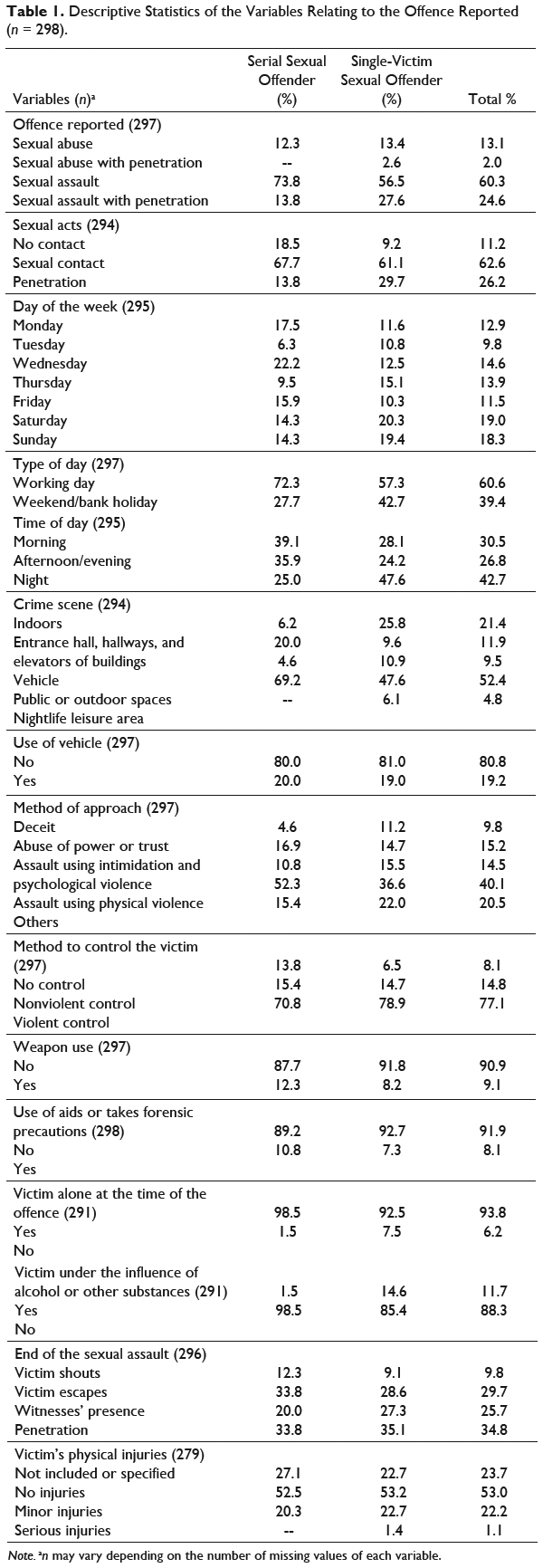
The following is a description of the variables obtained regarding the characteristics of the offenders, the victims and the acts committed (Table 1):
Information on the perpetrator includes certain sociodemographic and criminal record variables (age, country of origin, number and type of prior police records). Often in these cases, the detainee refuses to testify or provide any information to the police, therefore other facts such as marital status, employment situation, or other personal variables are unknown. With regard to information on victims, the variables collected are the ones available in the reports: age and country of origin. Only in some cases was information regarding other sociodemographic variables such as marital status, employment situation, mental or physical illness, etc. available. Therefore, these variables are included in the dataset but as they constitute a high percentage of missing values, they could not be used in further analyses. Information on the offence and modus operandi is much more detailed in the reports but it is sourced mainly from the victim’s account of the events, occasionally the visual inspection of the crime scene and only in a few cases, from the additional testimony of potential witnesses. The following variables were considered: offence reported, sexual acts, day of the week, type of day, time of day, crime scene, use of a vehicle, the victim’s circumstances, method used to approach the victim, weapon use, use of aids to control the victim or taking forensic precautions (for example, using bindings or restraints, using a mask, wearing gloves or a condom, wiping off traces, etc.), end of the assault, victim’s injuries, etc.
Analysis
The aim of this study is to predict an outcome variable of serial or one-off stranger rapist, based on crime scene variables. To this end, we first conducted simple logistic regressions with each crime scene variable (Table 1) to determine whether there were any significant variables that could predict if this was a serial stranger rapist case. All variables were coded in dichotomous form: 0 for the absence and 1 for the presence of each variable within the offence. Only statistically significant variables were then included in analyses at the multivariate level.
Secondly, we entered the significant variables (using the critical value of p < .05) into a binary logistic regression. Logistic regression generates a mathematical function that links the presence or absence of a specific crime scene variable to the odds of an offender having a specific characteristic (Aitken et al., 1995). The resulting models assess the predictive capacity of numerous independent variables (i.e., crime scene variables) on a categorical dependent variable (i.e., serial vs. one-off stranger rapist) (Pallant, 2016). These analyses have been done first with all the victims (cases) of serial rapists, and then again taking only the first and last victim (eliminating the rest of cases) to check if including all the victims could affect the results of the regression analysis. The final model was almost exactly the same with both samples (only one variable was not significant), so we decided to keep all the cases in the analyses.
Finally, we calculated AUC values for the final multivariate model. We also calculated sensitivity, specificity, positive predictive value, negative predictive value, and odds ratio (OR) values at the best cutoff point on the receiver operating characteristic (ROC) curve. We established the cutoff point of the ROC curve at 0.20 as it was the best tradeoff between sensitivity and specificity. As this study focuses on predicting serial stranger rapes, we settled for a slightly lower accuracy in predicting nonserial cases as a trade-off for the model’s significantly greater accuracy when predicting serial stranger rapes. All analyses were performed using SPSS 24.
Results
Descriptive Statistics of the Variables Relating to the Offence Reported (n = 298).
Note. an may vary depending on the number of missing values of each variable.
Results of the Logistic Regression Analysis.
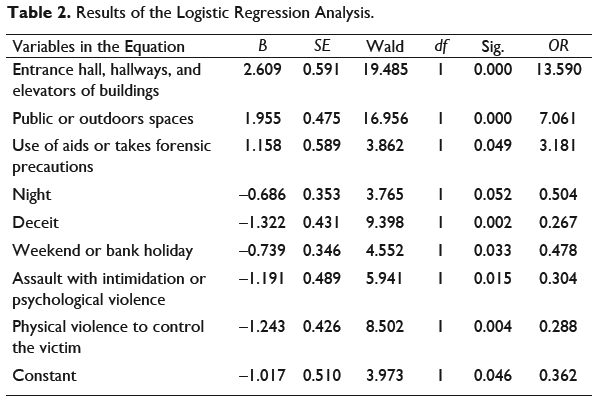
On the other hand, the results also show that it is more likely to be a one-off stranger rapist when the sexual attack occurs at night, during the weekend or on a bank holiday; when the aggressor uses deceit to approach his victim; when the assault is to intimidate or uses psychological violence; or when the offender uses physical violence to control the victim (the OR is below 1, meaning a decreased likelihood that the offender is a serial rapist).
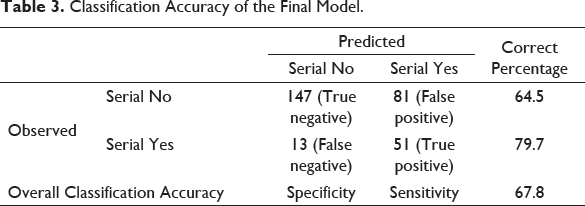
Regarding the accuracy of the final model, as can be seen in Table 3, the model correctly classifies 67.8% of stranger rape cases. Considering the cutoff point of 0.20 as the best compromise between sensitivity and specificity, the model is better at identifying serial stranger rape cases (79.7% of correct classification) than one-off stranger rapes (64.5%).
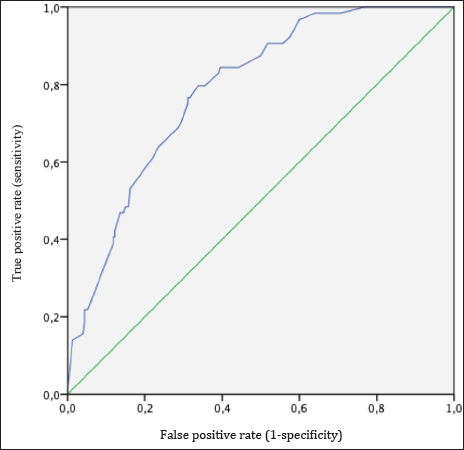
Figure 1 shows the ROC Curve of the final model. The AUC of the predictive model was 0.79. Swets (1988) suggests that AUC values greater than 0.90 show high accuracy, AUC values between 0.70 and 0.90 show medium accuracy, and AUC values less than 0.70 show low accuracy. Therefore, based on those AUC values, our final model has medium-level accuracy when distinguishing between a one-off or serial stranger rapist case, based solely on the information provided by the victim.
Receiver operating characteristic graph (ROC curve).
Classification Accuracy of the Final Model.
Discussion
The main goal of this study was to develop a statistical model from a nationwide sample of reported sex offences that could assist police investigation of stranger rapes in the initial stages of an investigation. We created a multivariate logistic regression model that includes eight significant crime-related variables, which can predict whether an unknown offender is a one-off or serial rapist, based only on the victim’s statement. We examined the predictive validity of the model using ROC analysis and the AUC value indicated a medium predictive capacity. More precisely, the final model correctly classifies nearly 80% of serial stranger rapist cases based on the victim’s report.
We found that the likelihood of a serial stranger rapist case increased remarkably when the offender used aids to control the victim or to take forensic precautions. In line with previous research, we found that serial rapists are more criminally sophisticated in terms of better controlling the victim (using bindings or restraints) and taking more forensic precautions (for example, using a mask or some sort of identity protection, wearing gloves or a condom, etc.) (Corovic et al., 2012; de Heer, 2016; Park et al., 2008).
We also found that some crime scene variables are more related to single-victim cases and decrease the likelihood of a serial stranger rapist: when the aggressor used deceit to approach his victim; when the assault was with intimidation or psychological violence; or when the offender used physical violence to control the victim. In accordance with Park et al. (2008), we concluded that single-victim rapists were more likely to display more violent behaviors to control the victim and during the aggression than serial rapists.
Furthermore, with regard to sexual behavior, the results of this study also support the conclusions of Corovic et al. (2012), suggesting sexual behaviors (vaginal penetration, anal penetration, and oral penetration of the victim) were not significant enough to differentiate between serial and one-off rapes, at least in the case of stranger rapists.
On the other hand, this research takes into account other variables that are not present in most previous studies, such as the location and time of the rape. In contrast to previous research, here these two variables were the strongest predictors for classifying an unknown offender as a single-victim or serial rapist. In conjunction with the location, the likelihood of a serial stranger rapist increases sharply when the sexual aggression is committed at the entrance hall, hallways, or elevators of buildings, or when the crime scene is in a public or outdoor space. Other authors such as Slater et al. (2014) also found that serial rapists were more likely to commit their offences outdoors while one-off rapists chose indoor locations, within the victim’s control domain.
With regard to the time of the rape, we found that the likelihood of a serial rapist decreases when the sexual attack takes place at night or during the weekend or on bank holidays. Hewitt et al. (2019) also used the time of the offence (week or weekend) and the time of the day (day or night) to distinguish between different types of serial stranger sexual offenders with regard to victim-search methods. They found that troller stranger rapists who encounter a suitable victim usually while engaged in other nonpredatory routine activities, assault their victims either during the week or on weekends (Hewitt et al., 2019). Other stranger rapists, with other victim-search strategies, did not have a greater likelihood of encountering their victims at night (Hewitt et al., 2019). Therefore, stranger rapists do not generally commit their offence on a specific type of day (week or weekend) or at a preferred time of the day (day or night).
The time of the offence and the time of the day are also crucial to our study, as their presence decreases the likelihood of a serial stranger rapist. Our results reveal that serial stranger rapists may commit their offence on any day of the week and at any time, not only during the night. On the contrary, the profile of a one-off stranger rapist tends to be linked to leisure activities during the weekend and at night within a context of alcohol consumption. These differences may be explained by the fact that single-victim rapists may be more opportunistic, taking advantage of vulnerable victims within the context of leisure activities, in comparison to serial rapists who may have a more proactive approach, using a victim-search strategy, to find their victims at any time and place (Hewitt et al., 2019). Furthermore, one-off offenders who use alcohol or drugs are unlikely to display forensic awareness due a diminished capacity for planning their actions. Therefore, these rapists who commit their offences in riskier situations are more impulsive and their lack of awareness of environmental cues may render them unconcerned about the possibility of detection. This increases the likelihood of their eventual detection and arrest.
Limitations and Future Research
This study also has several limitations that must be acknowledged. Firstly, the analyzed sample consists of stranger sexual aggression cases under police investigation. Some of these cases may not lead to a conviction and this poses certain ethical issues regarding what we deem an actual or alleged sexual offender. Secondly, this research used police reports to collect data on crime scene variables. Given that police files are not created for research but for criminal investigation, they did not always include information on all the variables of interest (such as personal information on the victim or the perpetrator, interpersonal involvement behaviors such as kissing or making sexual comments to the victim, etc.). This resulted in a higher number of missing values in some variables, rendering them unsuitable for analysis (e.g., personal information on the victim or the perpetrator), and other unavailable variables (such as behaviors denoting interpersonal involvement). Additionally, not all the police files of 2010 could be recovered due to different reasons (inability to find the paper file, errors or inconsistencies in the information included in the database, police delays in sending the information, etc.). This could lead to some issues about the generalizability of our findings. However, the loss of cases does not display a systematic pattern, therefore, as a random loss, it may not affect sample representativeness.
Furthermore, we were unable to differentiate between someone who is about to become a serial rapist (and may have been included in the group of one-off rapists) versus someone who is an established and documented (with several reported police files) serial rapist. Future research should address this topic and seek to identify the characteristics and features of a serial rapist in the initial stages or attempts in his criminal career. Another future line of research might be to look at different typologies of serial rapists. Given the limited sample of serial rapists, we were unable to differentiate between cases of adolescents and adult victims in this study. With larger samples, it would be worth analyzing the possible differences between the two types of serial rapists.
Finally, another limitation of this study is that the external validity of these results is unknown. Therefore, future studies should attempt to replicate this model using different samples from other countries in order to generalize these results. It would be also be desirable to have the model tested and validated by police forces to confirm its predictive capacity in a real-world context. In the end, offender profiling is valuable if it demonstrates that, as a complement to police investigations, it can improve the police clearance rate, especially in the most difficult cases such as stranger rapes.
Conclusion
Limitations notwithstanding, this study concludes that, with a few variables from the victim’s account, the proposed model is able to predict with a satisfactory degree of accuracy whether a new case of stranger rape is a serial rape or a one-off sexual offence. Three variables were found to increase the likelihood of a serial stranger rapist: one related to higher levels of criminal sophistication and two associated with outdoors crime scenes. We also found that serial stranger rapists use less violence to control the victim and can attack any day of the week and at any time, while one-off offender rapes tend to occur at night, during the weekend, or on bank holidays. The place and time of the rape are two strong predictors in our study but, owing to the aforementioned concerns regarding the current sample, these findings may not be generalizable to other countries. The influence of these two variables in stranger and one-off rapes may differ in other cultural contexts where leisure activities are not linked so closely to alcohol consumption at night on weekends and bank holidays.
Nevertheless, these findings have practical implications for assisting most difficult police investigations of sexual offences and may be directly applied to new stranger rape police reports in Spain. Analyzing the victim’s account and considering the variables mentioned above, police investigators can estimate the likelihood of a serial stranger rapist. The results of the final logistic regression model can be introduced into a mathematical function that generates a probability (expressed in percentage) of a serial stranger rapist.
This new method to predict offender characteristics may help to change the more traditional reactive role played by the police into a more proactive one by diverting resources and investigation time to solving cases with an increased likelihood of reoffending. By doing so, they can help to prevent new sexual offences and thus protect the victims.
Footnotes
Declaration of Conflicting Interests
Funding
The author(s) disclosed receipt of the following financial support for the research, authorship, and/or publication of this article: This research was supported by the Ministry of Economy, Industry and Competitiveness (MINECO) of Spain under Grant PSI2013-47043-C2-1-R.
