







Abstract
Keywords
Introduction
Suspension and expulsion, or disciplinary exclusion, are applied when students are perceived as engaging in unsafe behaviours, for example: being disruptive or aggressive, possessing, using or trafficking a weapon, engaging in physical or sexual assault, committing robbery, threatening, possessing alcohol or drugs, swearing at authority or bullying (Gill, 2017; Government of Ontario, 2009; NSW Department of Education and Communities, 2011). Despite the violence and adversity inherent in these situations, very little attention has been paid to experiences of violence, trauma or adversity in the lives of students who are disciplinarily excluded (Crosby et al., 2018; Mallett, 2017; Sanders et al., 2021). This lack of attention results in a lack of understanding of this group of students and how they are coping with the impacts of adverse experiences. Students who are Black and Indigenous or from lower income communities are disproportionately suspended and expelled, not primarily attributable to differences in behaviours (Finn & Servoss, 2015; Owens & McLanahan, 2019; Wallace, 2017). Due to systemic inequity and oppression, these same communities are disproportionally exposed to adversity, particularly expanded forms such as racism and community violence (Cronholm et al., 2015; Slopen et al., 2016). Further, disciplinary exclusion contributes to a disproportionate pathway out of high school and into the criminal justice system (Novak, 2018), where as many as two thirds of incarcerated adults have experienced significant and multiple early adversities resulting in severe trauma (Stensrud et al., 2019). The focus of this paper is to explicate how students who have been suspended and expelled cope with expanded forms of adversity, including exposure to school and neighbourhood violence and systemic racism and inequity.
Unacknowledged Adversity
Experiences of adversity significantly affect social, emotional, neurological development and educational outcomes (Holmes et al., 2016; Lavi et al., 2019; Morrow & Villodas, 2018; Romano et al., 2015). Trauma refers to the sequala, symptomology or impact of a distressing, disturbing or adverse experience (Santiago et al., 2013). Exposure to adversity engages the stress response system, impacting neurological functioning such as memory consolidation, concentration, sustained attention and recall (Perry & Daniels, 2016). This stress can become toxic when events are frightening, sustained or frequent, and protective factors are insufficient. Racism and poverty, for example, can produce toxic stress (Morsy & Rothstein, 2019). When the stress response is engaged over the long-term, affected students may be perceived as unruly or unmotivated (Perry & Daniels, 2016).
Individuals exposed to adversity and violence may develop a focus on self-protection and struggle with problem solving, regulating emotions, aggressive behaviours, conflict and inappropriate conduct (Cook et al., 2005; Fearon et al., 2010; Van Wert et al., 2016). Repeat exposure can result in emotional numbing, dissociation or reactive aggression, potentially interfering with identification of trauma (C. E. Bailey et al., 2014; Kerig et al., 2016). African American families who lose someone to homicide frequently engage in concealment as a form of personal coping (Sharpe & Boyas, 2011). Additionally, for some students it is unsafe to reveal the impact of adversity as this could signal vulnerability and increase exposure to further adversities such as community or school violence (Bell, 2019). Expressions of the impact of adversity, therefore, may not be easily recognizable or fit the expectations of educators. Certain students may not be viewed as traumatized by their experiences, aligning with biased perspectives of these students as perpetrators of adversity rather than experiencing adversity (Thompson & Farrell, 2019; Sanders et al., 2021).
Certain experiences are also not conventionally acknowledged or contextualized as adversity, for example, racism and poverty (Alvarez et al., 2016). The negative impact of adversity on child development is exacerbated, through systemic inequity and racism (Holmes et al., 2016). Due to oppressive social systems, one in three Black children in the U.S. live in households that are struggling financially, and Black children are more likely to experience racial discrimination, neighbourhood violence and parental incarceration (Maguire-Jack et al., 2020). While police violence and school shootings receive media attention, the more common ‘silent trauma’, witnessing a robbery or non-fatal violence, is often unacknowledged (Voisin, 2019, p. 50). Moreover, there is a disconnect between a privileged world view in which adverse experiences happen relatively rarely and one shaped by adversity (Wilkin & Hillock, 2014).
The negative outcomes of adversity are stronger if someone has experienced diverse forms of adversity, multiple exposures or exposure early in life; symptoms increase linearly as forms of adversity are experienced, and children who have experienced 11 adversities exhibit symptom levels as high as 2 SDs above the mean (Turner et al., 2010). Experiencing maltreatment increases risk for re-victimization (Finkelhor et al., 2009). Turner and colleagues (2016) found that individuals who experience multiple and diverse types of adversity, polyvictimization, have higher probability of living in disordered communities (49.4% of polyvictims in a nationwide U.S. sample of 2312 children and youth aged 10–17), engaging in problematic behaviours (47.5% of polyvictims had been involved in violence), displaying more symptoms related to adversity (.93 standardized trauma symptom score) and have a .50 probability of being involved in an incident with a weapon or that caused injury. Therefore, with differential early exposure based on systemic inequity, violence exposure disproportionately accelerates into adolescence, impacting mental health and essentially providing a feedback loop related to exposure and delinquency, disproportionately increasing the risk of future violent victimization (Andrews et al., 2019). Additionally, adolescents who exhibit aggressive behaviour are more likely to experience severe and co-occurring forms of maltreatment including physical harm, and chronic maltreatment (Van Wert et al., 2017). This points toward an accumulation of reciprocal interactions across environmental systems.
Voisin and colleagues (2011) identified that some youth exposed to community violence engaged in confrontational coping strategies such as learning to fight, self-defence or carrying a weapon. Such behaviour has been identified as fuelled by gender norms of masculinity and the ‘code of the street’, in which establishing respect is a central motivator (Anderson, 1999; Graham et al., 2017). Moreover, Patton and Roth (2016) identified that some students will find alternate and resilient strategies for coping with adversity, such as through ties to ‘deviant’ peer groups that provide financial security, physical protection, insight into navigating violence and support regarding school engagement. The current study considers the potential role of adversity and violence and the drive for safety in response to ongoing and significant expanded adversity. Within educational systems, symptoms of trauma and strategies used to cope can be misunderstood, yet they significantly impact student learning and engagement (Bargeman et al., 2020; Thompson & Farrell, 2019).
Adversity and Disproportionate Disciplinary Exclusion
The effects of adversity may be compounded by disproportionate responses to students’ coping strategies. For example, a population-based birth cohort study of children born in large U.S. cities followed prospectively and longitudinally (n = 4898) found unequal treatment or support for Black students was a significant driver of disparity in disciplinary exclusion (Owens & McLanahan, 2019). This unequal treatment however, occurred only among students exhibiting high or middle level behaviour problems; students with no behavioural concerns were treated equally. Students exposed to adversity are at particular risk for such unequal treatment. Children who are coping through problematic behaviours in response to adversity, such as the death of a caregiver, may receive disproportionate disciplinary action, particularly students of colour, resulting in a pattern that builds throughout their education. Therefore, early exposure to adversity, including racial and systemic inequity, is mutually reinforcing and can have cumulative implications (Owens & McLanahan, 2019).
In the U.S., Black students are suspended significantly more often in schools with high levels of intrusive security, which are generally found in unsafe neighbourhoods (Finn & Servoss, 2015). Moreover, high suspending schools have higher populations of Black students and students from lower income households (Finn & Servoss, 2015). This reaction to high numbers of Black students in a school is evidence of a ‘racial threat’ hypothesis (Finn & Servoss, 2015).
In Southern Ontario, where the current study was conducted, Black students were twice as likely as White students to be suspended and four times as likely to be expelled; likewise, Indigenous students were expelled at over three times their representation in the student population (James & Turner, 2017). Male students represent 77% of students who were suspended and 87% of students who were expelled, and 47% of students who were suspended have special education needs (Government of Ontario, 2019). Disciplinary exclusion is linked to lower perception of school equity and school belonging for Black students, high school dropout, arrest, incarceration and a gap in entry into post-secondary education (Bottiani et al., 2017; Noltemeyer et al., 2015; Novak, 2018; Welsh & Little, 2018). Furthermore, students from low-income urban communities in Ontario rarely challenged disciplinary actions as they were not aware of their options and believed that challenging the power within systems was futile and could result in more difficulties (Mosher, 2008).
Theoretical Foundation for the Current Study
Intersectionality, ecological systems theory, trauma theory, trauma-informed care and ACEs research provided the theoretical foundation for this analysis. Expanded ACEs and trauma-informed theory fostered acknowledgement of the role of adversity. Intersectionality informed a critical examination of systemic inequity and centred students and their perspectives in the research (Choo & Ferree, 2010). Ecological systems theory contextualized the micro level experiences of students within a macro understanding of systemic inequity.
Trauma theory, trauma-informed care and adverse childhood experiences
Trauma-informed care is an approach that recognizes the significant neurological, biological, psychological, spiritual and social effects of trauma and adversity that can overwhelm strategies used to cope in times of stress (Dombo & Sabatino, 2019; Fallot & Harris, 2001). Trauma-informed care recognizes the ways that behaviour, relationships and mental health are impacted by trauma and adversity. A trauma-informed view reinterprets coping behaviour such as substance misuse, extreme anger and self-harm as an appropriate response to adversity and fosters a shift in understanding and support within systems, such as education regardless of whether a trauma history is known (Wilkin & Hillock, 2014). For students who are disciplinarily excluded and coping with adversity, acknowledgement is the first step toward a trauma-informed, culturally attuned and wholistic understanding.
Adversity refers to experiencing harmful or threatening situations or the absence of stimulation required for typical human development (Koss & Gunnar, 2018). Adverse Childhood Experiences (ACEs) research connects forms of adversity experienced in childhood to development and long-term health (Felitti et al., 1998). Conventional ACEs are defined as: psychological, physical or sexual abuse; physical or emotional neglect or abandonment; death of a parent; violence against mother; parental separation or divorce; or living with caregivers who misuse substances, experience mental illness or suicidal behaviour, or were ever imprisoned (Felitti et al., 1998; Finkelhor et al., 2015). There are recommendations to expand ACEs to include: peer victimization, isolation and peer rejection, close network member being seriously ill or attempting suicide, exposure to community violence, low socio-economic status, experiencing racism, living in an unsafe neighbourhood and having lived in foster-care (Cronholm et al., 2015; Finkelhor et al., 2015; Turner et al., 2020). Expanded forms of adversity too often remain unacknowledged as adversity, therefore their traumatic impact can be obscured. For example, the Philadelphia ACE survey used a socioeconomically and racially diverse urban sample and found that 13.9% of participants experienced only forms of adversity that are included in the expanded definition of ACEs and would not have been included in only conventional ACEs surveys (Cronholm et al., 2015). For the current study, data was collected on both conventional and expanded forms of adversity, referred to as expanded adversities in this study.
Intersectionality, systemic racism and inequity and ecological theory
Ecological theory contextualizes individual development within multiple layers of one’s environment, from the immediate micro settings to the interconnected mezzo and micro levels (Bronfenbrenner, 1979). This development occurs within an environment of systemic inequity occurring within formal and informal social contexts, influenced by broader systemic issues and based on a range of factors including race, Indigenous status, gender, poverty, sexuality and (dis)ability, which is produced and maintained through structural and interpersonal oppression often involving violence, abuse, exploitation, exclusion and humiliation (Wilkin & Hillock, 2014). Systemic racism refers to all the ways societies foster racial discrimination through mutually reinforcing systems of housing, education, employment, earnings, benefits, credit, media, health care and criminal justice, which in turn reinforce discriminatory beliefs, values and distribution of resources (Z. D. Bailey et al., 2017). Both disciplinary exclusion and adversity disproportionately impact Black and Indigenous students (James & Turner, 2017; Maguire-Jack & Font, 2017). This study applies an intersectional perspective which identifies disadvantage, power and inequity and the influence of an entire social system, including historical inequity and oppression (Choo & Ferree, 2010). Systemic inequity creates disproportionate exposure to adversity for specific populations, and intersectionality shifts accountability from an individualized approach of ‘at risk’ students towards a historically situated social problem with distinct implications for specific groups, such as students who are disciplinarily excluded (Clark, 2016; Collins, 2015). Coping in this study is contextualized within an understanding of systemic inequity, considering both the actual availability and the perception of availability of resources to aid in the coping process.
The Current Study
The objective of the current exploratory constructivist grounded theory study was to understand the impact of adversity and strategies for coping among students who had been suspended or expelled from school (Sanders et al., 2021). The following research question guided this analysis: 1) How do experiences of expanded adversity impact students? Grounded theory encourages novel generation of theory directly from the data to explain a pattern of behaviours and inform future research and practice, particularly appropriate when little is known within a substantive area (Charmaz, 2014; Glaser, 2014). Grounded theory has its roots in symbolic interactionism which interprets actions as an interactive process in which our view of a situation influences our actions, we seek to understand the actions of others, and in turn, respond according to the meanings we ascribe to these actions (Blumer, 1969; Charmaz, 2014). These social interactions are embedded in social cultural and historical contexts; therefore, it is important to consider how power, privilege and inequity are constructed and enacted (Charmaz, 2014).
The current study addresses a number of noted gaps in the literature: a focus on expanded forms of adversity (Cronholm et al., 2015), particularly within Canada (Kimber & Ferdossifard, 2020); a focus on expanded adversity related to disciplinary exclusion (Crosby et al., 2018; Mallett, 2017); research on exclusionary discipline outside of the U.S. (Valdebenito et al., 2019); and systemic factors in discipline research beyond those within schools (McGrew, 2016). Moreover, very few studies have entailed speaking directly with students who have been disciplinarily excluded, fewer still explicitly consider adversity or trauma (see Bell, 2019; Crosby et al., 2018; Haight et al., 2014). By speaking directly with students who have been suspended or expelled, this study overcame significant barriers to gathering data related to expanded forms of adversity and students’ own views of the impact on their development, including building trust with participants in the face of endemic systemic oppressions, concerns related to legal ramifications of discussing experiences, multiple ethics review processes in multiple institutions and active parental consent for students under 18 (Kimber & Ferdossifard, 2020).
Methods
Participants were recruited through two participating school boards serving racially, culturally and socioeconomically diverse, urban (city of over 1 million) and urban emergent areas of Southern Ontario in 2018/19 (Milner, 2012). Students on long-term suspension or expelled in Ontario are provided an academic and behavioural support programme through their Caring and Safe Schools (CSS) department. In some circumstances families and school board agree to a student attending CSS without disciplinary exclusion. CSS programmes offer a secure and separate classroom location, small classes, high teacher-student ratio and child and youth workers (CYW) as well as social workers, psychologists and guidance counsellors. Students receive one-to-one support at their individual pace, participate in daily group check-ins and check-outs, prepare food, eat and play games over lunch. Staff have regular contact with families and call missing students daily to check-in and encourage attendance. Students remain in CSS programmes until completion of the suspension, or if expelled until considered ready to attend a typical or alternate setting, averaging one semester to 1 year.
Participants
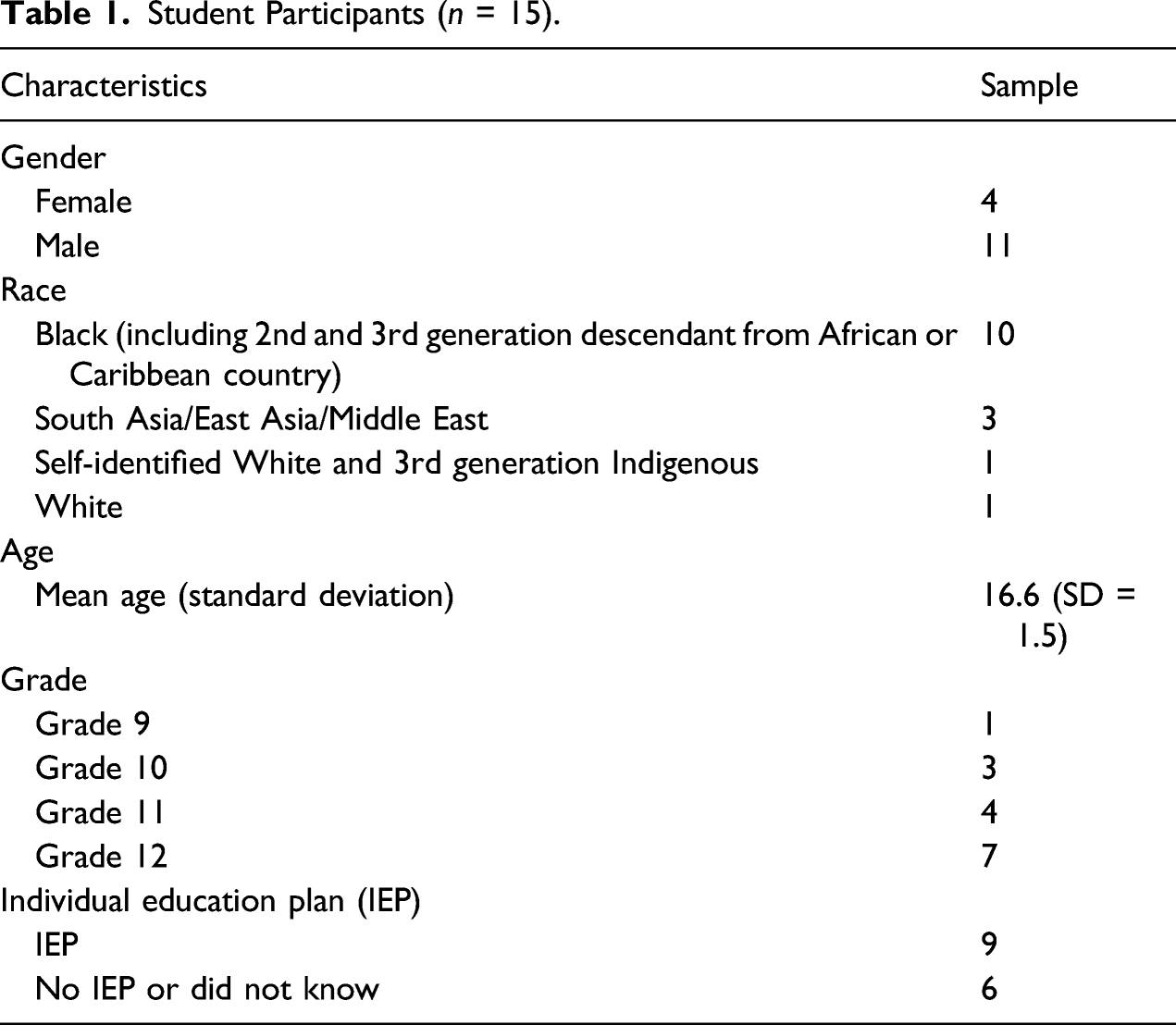
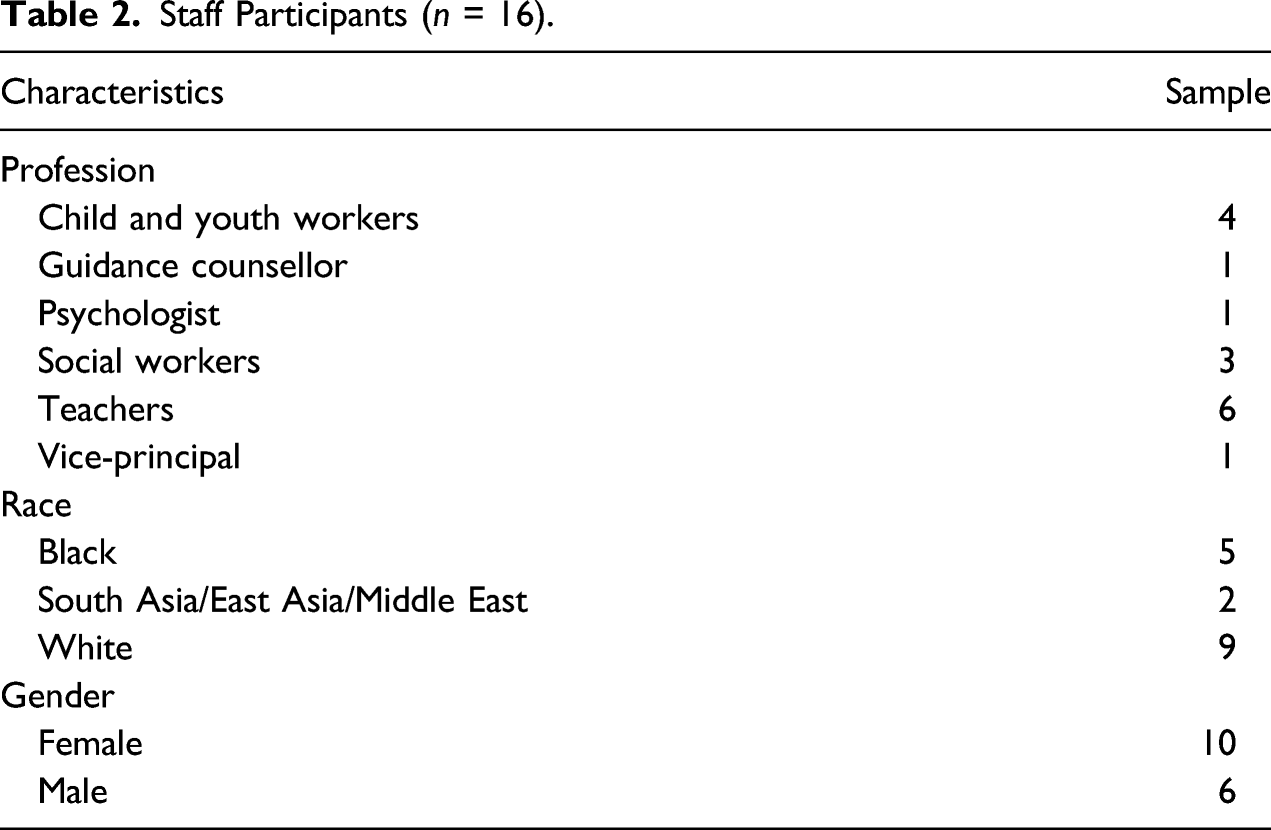
Participants (n = 31) were recruited through CSS classrooms and included students (n = 15) on expulsion, suspension or attending by agreement; and multidisciplinary staff (n = 16) in CSS programmes. The author introduced the study directly to 30 students and 25 staff. Informed consent packages were left for students who were not in attendance and were distributed to guardians through students. Only one parent was able to participate, considered too small a sample for inclusion. Student and parent participants each received a $25 gift card and staff a $5 gift card as compensation. Research ethics approval was granted through the supporting university and both participating school boards. School boards required active parental consent for students under 18.
Student Participants (n = 15).
Staff Participants (n = 16).
Data Collection Procedures
Data were collected through individual, semi-structured, in-depth face-to-face interviews lasting 60–90 minutes. The author, a White, middle age, cis-gendered female, conducted all interviews. The author had prolonged engagement through over 25-years of child, youth and family therapy, as well as research in school boards. The identification of the possible role of adversity originated from the author’s observations while working as a coordinator for CSS programmes in a school board not included in the research. Additional data were gathered through memo writing before and after every field visit; before, during and following data gathering and analysis; and while writing. These memos detailed the research, identified and analysed codes and emerging categories and theory, explored the author’s perceptions, emotional reactions, experiences and existing knowledge. All but one student consented to having the interview audio recorded. Various approaches to transcription, including by the author, by RAs and by a professional transcription service, allowed author engagement with the materials and timely transcription necessary for simultaneous data collection and analysis, and allowed constant comparison of developing codes to inform data gathering strategies.
Interviews began with open-ended questions to elicit both staff and student perspectives on students’ experiences of school, community and family, and the influence of these experiences on students’ pathways. Toward the conclusion of the student interviews the author verbally reviewed a demographic questionnaire of student’s age, gender, race/ethnicity, credit count, grade, ever assigned an IEP, suggested or identified as having a mental health concern, extracurricular activities, offered or received school or community supports and strengths and future goals. All participants were asked to reflect on the overrepresentation of specific populations within disciplinary exclusion, eliciting unstructured views of systemic racism and inequity. Finally, the expanded definition of adversity was provided, including approximately 16 forms of adversity. Every participant was asked whether, and approximately how many forms of, adversity students in the programme experienced. Participants did not identify the specific forms of adversity, rather they provided the number of different forms of adversity they experienced. Students reported their own experiences and staff were asked to reflect generally on students in CSS programmes. This combination of semi-structured interview and structured adversity question captured both complex narratives and overall number of forms of ACEs that participants may not have considered, or been reluctant or unable to detail.
Data Analysis
Initial coding
Student interviews were prioritized for initial line-by-line coding. Codes were compared, synthesized and analysed. Experiences of adversity and forms of expanded adversity consistently emerged across the first few interviews and guided ongoing data collection and analysis. Additionally, the in vivo code ‘big up’ emerged early in the interviews as a protective measure, a presentation that exuded strength, and was explicitly designed to ward off threat and prioritize safety. Questions related to this phenomenon were included in subsequent interviews and was found to be dominant across the emerging data. Researcher biases and prior knowledge were examined and included in the analysis through rigorous application of the methodology, by keeping memos exploring the researcher’s perceptions, experiences, emotional reactions and existing knowledge; engagement with other researchers; and employing constant comparison of these data with all other data (Breckenridge et al., 2012; Glaser, 1998). The author consulted throughout the study with a diverse team of researchers in terms of gender, ethnicity and age, as well as, in research specialization related to adversity, marginalized communities and theoretical orientation and education. The previous clinical and research experience of this research team provided additional prolonged engagement, and accountability related to the author’s biases. Prolonged engagement was further enhanced by data collection occurring over 7 months, involving multiple visits to each of the six CSS locations, involving 31 engagement, recruitment or interview visits, from October to April, to engage and build trust with students and staff.
Focused coding
Initial codes were reviewed through constant comparative analysis within and across interviews, and theory development. Through focused coding, ‘big up’ presentation emerged as an important and consistent strategy for coping with expanded forms of adversity. The constant comparative method guided the coding and analysis of the first 14 staff interviews as a form of triangulation, the incorporation of more than one type of observer, with the prioritized student interviews (Oktay, 2012).
Theoretical coding and saturation
Finally, codes related to experiences of adversity and strategies for coping were refined and clarified. Final theoretical sampling ensured theoretical saturation and sought negative case analysis (Charmaz, 2014). Theoretical saturation of these codes was reached at 10 student interviews and 14 staff interviews which provided triangulation. Five additional student interviews ensured saturation of codes and accommodated remaining students interested in participating. Two additional staff interviews were conducted as a form of member checking, to further check and refine categories, to test the theory in the field, ensuring fit and understandability and ensuring saturation (Charmaz, 2014). In addition to constant engagement with the research team, two PhD candidates independently coded (peer coding) four staff and four student interviews, which were incorporated into the analysis through constant comparison, enhancing the fit of the emerging theory with the data. Trustworthiness, or confidence, was enhanced through peer coding, triangulation, member checking, prolonged engagement and thick description of the findings (Charmaz, 2014). NVivo 12 (QSR International Pty Ltd, 2018) was used to organize the data and analysis.
Results
Impact of Exposure to Adversity
Both students and staff asserted that students experienced high rates of multiple forms of expanded and conventional adversities. Fourteen of the students identified experiencing at least two forms of adversity, and seven students identified five to seven distinct forms of adversity. Students shared stories that included all forms of adversity, such as being stabbed, witnessing assault and shootings in the community, sexual assault, assault and harassment by police, civil war and family financial insecurity. Most participants relayed stories of polyvictimization which, as noted, has a profound cumulative impact. One student shared, ‘I can say that I’ve financial stresses at home. I’ve had violence in the community…my dad…used to do coke before he passed away…I was molested when I was a kid...’ (SD10). This student had lost count of the number of suspensions he received, which began around the same time their dad died, at age 7, in junior kindergarten. CSS staff corroborated the high rate of adversity as one staff expounded, ‘if we were to sit down…to do a checklist of all the adverse experiences…the checklist would be full’ (SF01), and another asserting ‘I think that most of what they experience within the community, the violence, the bullying and things like that, I think they all play a factor in why they’re here’ (SF16). And yet, as noted, the impact of adversity is rarely examined in the research to date.
Indicators of poverty, experiencing racism, witnessing school and community violence, living in an unsafe neighbourhood or experiencing bullying each emerged as significant adversities in the current analysis. This was profoundly illustrated by one student who stated, ‘believe it or not, I [moved from], a city where it’s a civil war… and I felt more safer there than I did over here’ (SD12). Students were exposed to life threatening violence at school and in the community as relayed by another student, ‘it got pretty dangerous at one time, because some kid got stabbed. It got serious still. That’s why I left the school. I’m like, I can’t put up with this craziness’ (SD15). Another student stated, ‘I’d say out of every 10 fights, three of them would generally bring a weapon’ (SD10).
A number of students identified experiences of racism across systems, at times directly influencing a differential disciplinary response, as one student expressed, ‘if I was a White guy that got in trouble for fireworks, I would not have got expelled, trust me’ (SD03), and ‘even when the White kid was involved in the stabbing at school that kid didn’t get questioned. There were like four kids…all those guys did not get questioned’ (SD07). Again, staff interviews were consistent, as one staff noted, ‘the police will police this neighbourhood different’ (SF10). The impact was articulated by another staff, before they even get here, they live in these low income communities and I talked about the other things that are going on in these low income communities. Then, they go to their regular main school, they do the slightest little things that they do, that’s even considered negative, they don’t get the same equal opportunities as their peers. Then, they end up here. (SF16)
Adversities were rarely acknowledged, student experiences and situations were not appropriately contextualized at the point of discipline within a trauma-informed understanding of trauma and toxic stress.
Students spoke about the global impact of adversity; one student, who had been targeted and assaulted by a group of peers over a number of years across multiple settings commented, ‘if I wasn’t bullied… I wouldn’t have been depressed…I would be one of those kids that went to school to make friends and learn’ (SD06). Another student described, ‘I was 12, when I first started getting depressed...I got into arguments with this one teacher a lot…and just not showing up for most of the school’ and ‘I’ve had panic attacks and shit that are so severe, I’ve lost my breath and just passed out’ (SD10). Another reflected, ‘I think just everything that happened. Everything that happened to me. Like, all the negative things that happened to me, it just makes me want to rage sometimes’ (SD15). Many students noted difficulty in school as a result of violence in the community, and as a result one asserted, ‘I just, I couldn’t function in a normal school’ (SD07). A staff participant relayed the experiences of a student whose daily walk to school was full of fear: ‘He explained it as, if there’s no cars parked on this side of the street, he’s not going on that side of the street…in the event that someone starts shooting, he can duck behind a car’ (SF10).
Many participants linked exposure to adversity with referral to the CSS programme. One staff asserted ‘without those factors, I don’t think that we would have the kids that we have’ (SF14). Another staff explained, ‘They’ve been bullied and they try to protect themselves and out of that trying to protect themselves, they themselves was discovered with a weapon or something like that’ (SF15). Another noted, ‘if that student is dealing with it, and you can’t prove [bullying] is what’s happening, that’s a big thing, I would say, for school, bullying is one of the big reasons why students get suspended or expelled’ (SF07). If educators do not consider the adversity students are experiencing, they are unable to protect their students and their disciplinary response will not be trauma-informed.
Despite the extent and impact of exposure to adversity, it was rarely acknowledged or understood, as one staff commented, ‘we don’t know what our students, when they’re walking through the door, what they just came from’ (SF03). Another staff participant shared explicit statements from a student: ‘A student said to me “safety is my main priority. So you guys can talk to me about school. My priority is safety”’ (SF10). The experiences of adversity impacted student perspectives and how they walked through their world, as one student stated, ‘I feel everybody who walks around me just says in their mind self-defence, self-defence, self-defence’ (SD12). If adversity is not acknowledged, students are not supported and do not feel safe, as one student commented, ‘Just the feeling that, you know, the feeling that you have to watch your back every day and just knowing the teachers are not doing what they’re supposed to do’ (SD15).
Coping Strategies and ‘Big Up’ Presentation: Fuelled by and Fuel Bias
Many staff and student participants described a form of coping whereby students adopt a presentation that sends a message, ‘they try and present as people that others should be afraid of and it’s because they’re trying to ward off possible threats’ (SF10). One student described that if threatened in the community, ‘I would big up myself…Yeah, of course. I’m not going to get bothered’ (SD04). The aim of this ‘big up’ presentation was to project an enduring message: ‘how I walk down the halls and stuff. Like how I dress and stuff like that…Cuz like if you never met me before and like you, you don’t want to talk to me’ (SD03). Many students spoke about this way of presenting, ‘because when you show people you’re afraid, they will test your limits. I don’t want any people testing my limits…I feel like when you show people that you’re afraid, that’s what gets you in trouble’ (SD09). Another commented, ‘you minimize the amount of people who may try to come at you if you just present as always being tough’ (SD10). Another student used the term ‘hyping up’: Like I’m yelling at you. I’m paging you. I’m telling you about yourself now. I’m doing physical gestures that will make you feel like I’m going to attack you...Some people kick walls. I think doing that is really unnecessary...I wasn’t really someone to try to get like that. If I seen someone, or like someone like where me and you can’t get along because you are from a certain place, I’m going to get at you. That’s how I was. (SD07)
This student described how exposure to adversity impacted their development and fostered a progression towards a ‘big up’ presentation to cope with violence. In elementary school they witnessed violence in their neighbourhood that left them ‘terrified for the longest time’ (SD07). In grade nine, they were threatened with a shotgun in the washroom at school, ‘I was terrified...And remember, at that time I wasn’t even walking with a knife or anything’. Repeated exposures had a significant impact, ‘Like I had to install like maliciousness into my head and stuff because I was always really good at stuff. I was a good kid’ (SD07). Eventually this student started carrying a knife. The exposures compounded and a few years later this student was again confronted with a gun, ‘now this guy pulls out a gun on us and I’m like I don’t care. Like I’m laughing in his face…at this point I have seen too much shit like I don’t care’ (SD07). This statement provided a profound example of the cumulative impact of trauma for this group of students, specifically emotional numbing and the strategy of hiding vulnerability in response to trauma. Further, this student identified the unexpected benefits of a big up presentation including increased safety, ‘Now they be mindful what they say to me, people were making room for me and shit. And I don’t got to wait in the lunch line, I’m just walking straight past people. No one’s telling me nothing and shit’ (SD07). They were clear, however, that safety was the initial and primary factor, that they were facing problems on their own, and the only way to manage this was through a big up presentation, That’s the problem, when you feel like you can’t talk to people and you have to start putting things in your own hands now and that’s where a lot of these problems happen…I never really liked violence. That was just like...the most best answer. The most best problem solver. (SD07)
When exposure to adversity is unacknowledged, students may feel they have no one to talk to about what they have experienced and are managing the compounding impacts of multiple forms of adversity on their own. Again, it is important to contextualize the current findings within a critical, historical and intersectional understanding, as articulated by one staff ‘you can’t really separate gender and race, or class’ (ST15). The group of students in the current study, predominantly male students of colour, had experienced significant and multiple adversities, most notably expanded adversity that are less often acknowledged or viewed as traumatizing, and therefore collude with biased perspectives of this group of students.
Unintended Consequences of Big Up
Exposure to adversity and the drive for safety emerged as the central motivating factor for a ‘big up’ presentation. This sometimes had unintended consequences, as one student noted, ‘they’re just trying to defend their self. They don’t want to do it. They didn’t mean to hurt’ (SD09). Another student experienced years of bullying until they ‘stood up’ to one of them individually and ‘punched’ that peer; this participant was then expelled (SD06). They went on to explain how years of adversity and peer violence pushed them to a big up strategy of coping and the subsequent expulsion led to further involvement with the justice system, ‘I started getting arrested because that was the only way I knew how to deal with situations, is to do something extreme, get arrested, then people would stay away from me’ (SD06).
Many students felt the need to carry a weapon, as one staff observed, ‘I know from speaking with them that they feel that it’s necessary to carry weapons…feeling quite honestly “... I’m not safe without it. I have to carry it, just I don’t have an option”’ (SF08). However, students found themselves in situations they had never intended: I had almost gotten robbed one time...So I started carrying a knife…I never really thought I would have to use it, a lot of people would just run the opposite way. Like it’s a knife. You’re going to run. And I would just put it back and I would just go my separate way. And I was shocked when I pulled out a knife and this kid still tried to fight me. (SD07)
This experience was echoed by a staff participant who described a similar situation, ‘one kid pulled out a knife…for protection…Well, the other kid…He goes and he pulled out a bigger knife and those are the things that scare you’ (SF05).
The ‘big up’ presentation identified in the current study included seeking a protective community. As explained by one student, ‘let’s say that kid that’s getting bullied, who wouldn’t want to get bullied no more, so then he would hang out with those kids, just to get his reputation up’ (SD15). Staff and students indicated however, that this could be counterproductive, as one student stated, ‘because, you can’t think you’re going to be the boss of everyone and not expect someone to defend their-self’ (SD15). Similarly, one staff commented, They align themselves with people that they feel can protect them, that are going to help them get things. So, as much as that is a protection, it also puts them at risk for other people to look at them and now they have to always walk in a group and they don’t want to walk by themselves. It just becomes a bigger mess. (SF16)
Students felt that teachers were scared to talk to them based on factors of race and neighbourhood where they resided. Students could tell that their difficulties focussing on their schooling were interpreted as a lack of motivation and felt teachers had given up on them. As one student said, ‘he didn’t care. He gave up on us. Like, yo, these guys don’t want to learn, then I’m not helping them’ (SD13). They also recognized that limited resources impacted the amount of time they were given as one student articulated, my teachers, they would be running around, like, five different kids at one time. So, I didn't really get that much help... there's just too much people’ (SD15). All of these factors were seen as barriers to connecting with students and listening to them, particularly at the moment of discipline, as another student noted, ‘They wouldn’t ask me about it. They would just go and make their decision’ (SD02). Students, therefore, developed big up strategies for coping based on of both the actual availability and the perception of availability of resources, particularly for this group of students, who as noted earlier, perceived themselves as being more likely to be disciplined based on social location, notably race.
The emergent theory suggests that students who are expelled or suspended had experienced multiple and diverse expanded adversities. These expanded forms of adversity are often unacknowledged and expressions of trauma were not recognized as trauma. In an effort to prioritize safety, this group of students coped through a big up presentation. This presentation avoids any display of vulnerability, leading to unintended consequences including biased perspectives of them as perpetrating adversity rather than experiencing adversity and violence. Teachers were likely to perceive them as unmotivated, not needing support and even scared to talk to them, further limiting access to support and potentially contributing to disproportionate disciplinary responses rather than trauma-informed approaches. One student summarized this process, ‘for the situation that brought me here, violence kind of just stopped everything, even though it’s not fair, but I guess that’s what happened for me, right? That’s my reality’ (ST06).
Discussion
This is one of only a few studies in which students who have been suspended or expelled were interviewed, with fewer still, that explicitly explored exposure to trauma or adversity with this group of students (see Bell, 2019; Coleman, 2015; Crosby et al., 2018; Haight et al., 2014; Kennedy-Lewis & Murphy, 2016). It begins to address the profound gap in knowledge related to adversity and school discipline. The findings illustrate the significant impact of expanded forms of adversity and polyvictimization on student development, coping and academic outcomes as evidenced by statements about depression, arguing with teachers, non-attendance and feeling the need to carrying weapons. Expanded forms of adversity, or silent trauma, have received insufficient attention, and the role of trauma or adversity in school discipline has been under examined (Alvarez et al., 2016; Cronholm et al., 2015; Crosby et al., 2018; Kimber & Ferdossifard, 2020; Mallett, 2017; Sanders et al., 2021; Thompson & Farrell, 2019; Turner et al., 2020; Voisin, 2019). The emergent exploratory theory proposes that students who have been suspended or expelled experience multiple and diverse forms of adversity which have influenced coping strategies for this group of students. The complex and unequal systems in which students live and learn are understood as impacting them and their school relationships. When experiences of adversity, including systemic racism, inequity and exposure to violence are unacknowledged, the strategies used to cope can be misunderstood, particularly when viewed from a privileged worldview that understands the world as relatively safe (Sanders et al., 2021; Wilkinson et al., 2019). The emergent theory suggests that when expanded adversities are unacknowledged or overwhelm available supports, this group of students were coping through a ‘big up’ presentation, presenting as strong, not needing help or support, despite the well-known impact of adversity on academics. The unacknowledged impact of trauma and exposure to expanded forms of adversity may contribute to biased disciplinary responses based on intersecting identities, fed by and feeding biased perspectives of students as perpetrators of adversity. This was indicated in statements such as, ‘if I was a White guy…I would not have got expelled’. Students were engaging in resilient coping strategies based on the perceived and actual availability of resources. Students were engaging with systems that disproportionately discipline them and teachers who may misinterpret traumatic stress as a lack of motivation for learning, as evidenced in statements such as ‘he gave up on us’. Experiences of adversity, including racism and inequity and school and community violence, are acknowledged through the inclusion of expanded forms of adversity and a trauma-informed and culturally attuned lens. It is hypothesized that disproportionate exposure to adversity that is unacknowledged, and students who feel unsupported, may contribute to a big up student presentation that is misunderstood and too often met with a disciplinary response rather than a trauma-informed and culturally attuned response.
The emergent theory is consistent with the ‘racial threat’ hypothesis (Finn & Servoss, 2015) and the disproportionate discipline of Black students compared to White students when both present with difficult behaviours (Owens & McLanahan, 2019). The current findings are also consistent with existing theories, such as the code of the street (see Anderson, 1999; Bell, 2019; Graham et al., 2017). The current research, however, stresses a trauma-informed understanding of expanded forms of adversity which emphasizes the profound global impact of expanded forms of adversity and stresses the underlying need for safety as the primary motivation for a big up presentation. Applying a trauma-informed and intersectional view to a big up presentation reframes this presentation as resiliency based coping strategies in the face of significant threat and adversity where other options, such as talking to an adult or walking away, are perceived as ineffective, unavailable or even unsafe for this group of students. Mosher’s 2008 findings that certain communities feel it is futile to address the power structures related to discipline, are seemingly still as relevant today in statements such as ‘when you feel like you can’t talk to people and you have to start putting things in your own hands’. These findings stress the importance of ensuring student safety, of recognizing the underlying drive for safety in students displaying big up presentation to avoid retraumatization and to dedicate appropriate resources to supporting students coping with experiences of expanded forms of adversity.
Implications
It is hoped that the findings of this study will provide a foundation for future work on the importance of adversity within school discipline. It is suggested that researchers and educators acknowledge the disproportionate impact of adversity among this population of students and the ways that students are coping; if we do not acknowledge it, we cannot address it. Again, there has been very little attention on adversity, trauma or violence with regard to students who are disciplinarily excluded from school (Crosby et al., 2018; Mallett, 2017; Sanders et al., 2021). This lack of focus colludes with biased perspectives of these students as perpetrators of adversity rather than acknowledging the impact of adversity on this group of students. Not only are certain forms of adversity less likely to be acknowledged (racism, poverty and community violence), as noted, but expressions of the impact of trauma among this population of students may not fit the expectations of educators. Acknowledgement requires that we attend to the historical and structural conditions that maintain disproportion and take an intersectional view of the impact of adversity on student coping strategies and school success (Annamma et al., 2014; McGrew, 2016). Once the reality of trauma has been acknowledged, educators can work towards supporting and connecting with students well ahead of the moment in which a disciplinary decision is required.
The focus for change should not be on individual ‘at risk’ students, as this study illustrated that coping through a big up presentation was in fact effective for maintaining safety as evident through statements noting that ‘violence kind of just stopped everything’. Rather it is important to recognize and address the conditions that allow early exposure to adversity, particularly the structural factors that perpetuate disproportionate exposure among certain communities, notably Black and Indigenous communities (Sanders et al., 2021). This includes, but should not be limited to, addressing all violence within schools, such as weapons, bullying and fighting. Secondly, where student presentation indicates that exposure to adversity is possible or can be reasonably assumed, such as systemic racism and community and school violence, schools must be places of refuge rather than retraumatizing. The current findings suggest a trauma-informed and culturally attuned approach. When students are unsafe and exposed to adversity, particularly in multiple forms, we need to understand the impact and the diverse ways they may be coping. Coping for the group of students in the current study was consistent. Rather than being identified and supported as students who were managing adversities, however, they and the staff involved in this study perceived they were disproportionately consequenced based on gender, race and SES, another experience of adversity. Educators are encouraged to listen and connect with their students throughout their education, well in advance of, as well as at the point of discipline, and consider all the factors involved when developing a plan to address safety concerns in the school. Finally, schools require adequate resources to provide a truly trauma-informed and culturally aware approach. This means teachers, social workers, psychology staff, administrators all have the time, training, resources and ongoing support for the difficult task of recognizing and connecting with students who may be coping with adversity, as well as their families and communities (Sanders et al., 2021). Such support would include but not be limited to educational support, attending to the social, emotional and mental health impact of adversity.
Strengths and Limitations
While the current qualitative study is not generalizable, the findings are consistent with extant literature and provide direction for future research. Additional study is warranted to understand the prevalence of adversity among this population, and the potential role disproportionate exposure to adversity may play in disproportionate disciplinary exclusion. It is suggested that all future research on school discipline include expanded forms of adversity. In particular, research that examines the drivers of disproportion in school discipline should control for exposure to expanded forms of adversity. Consistent with grounded theory and an intersectional approach, participant knowledge was centred (Charmaz, 2014; Choo & Ferree, 2010). Although the inclusion of both student and staff perspectives is a strength of the study, parent and guardian perspective would have strengthened the study further. Additionally, ongoing peer consultation with the research team mitigated researcher bias; however, it is not possible to fully understand the impact of the researcher’s social location (Charmaz, 2014).
Conclusion
Students and staff in the current study asserted the pervasive impact of expanded adversity in all forms for this group of students. It is essential to recognize expanded forms of adversity, particularly for disciplinarily excluded students, for whom adversity and violence is often unacknowledged as traumatic. Adversity negatively influences academic outcomes, yet its pervasive impact is rarely acknowledged as traumatic for students who have been suspended or expelled. Moreover, when students’ strategies for coping, such as big up presentation, are misunderstood, there are missed opportunities to support students and ensure safety for all. The experiences of the students in this study can guide systemic awareness to ensure the profound impact of expanded adversity are acknowledged and understood as adversity for all students.
Footnotes
Acknowledgements
I am deeply grateful to the students, families and staff who generously shared their stories and supported this research. I am indebted to Faye Mishna, Lance McCready, Barbara Fallon, Tanya Sharpe, Sarah Todd, Karen Sewell, and Bethany Good for their research support and critical insight.
Declaration of Conflicting Interests
The author(s) declared no potential conflicts of interest with respect to the research, authorship and/or publication of this article.
Funding
The author(s) disclosed receipt of the following financial support for the research, authorship and/or publication of this article: This work was supported by the Social Sciences and Humanities Research Council [grant number 767-2017-1521].
