







Abstract
Sexual harassment and other forms of gendered discrimination are social psychological phenomena, yet the psychological impact of sexual harassment has rarely been examined through a model which considers the role of diverse content of gender identity (i.e. norms). We used an experimental design to investigate how salient norms associated with the social identity of ‘women’ affect coping with sexual harassment. Participants who identified as women (N = 291) were randomly assigned to either a feminist, traditional feminine, or control norm condition, in which the salience of particular norms associated with womanhood was manipulated. Participants completed measures of personal growth (as a proxy for post-traumatic growth), and help-seeking intentions in response to a hypothetical sexual harassment scenario. Participants in the feminist condition reported significantly greater personal growth relative to those in the traditional feminine and control conditions. Participants in both the feminist and traditional feminine conditions reported significantly greater intentions to seek help from formal supports (e.g. primary care doctor), relative to those in the control condition. The findings suggest that the salience of social identities and their content may be valuable resources in promoting recovery following experiences of gendered discrimination and support the role of social identities in influencing post-trauma trajectories.
Recent discussions surrounding the #MeToo movement have made explicit what women have known for centuries: sexual harassment and other forms of gender-based discrimination are pervasive throughout society. What has also become more apparent is the nuanced and complex role that social psychological phenomena such as gender norms play in the development and response to such behaviours. Some contexts are more supportive of women in coping with these unacceptable experiences, for instance, by empowering them and facilitating access to appropriate support.
Although women’s responses to experiences of sexual harassment vary, there is widespread consensus that experiencing sexual harassment negatively impacts mental and physical wellbeing (Schmitt et al., 2003). In the workplace, high levels of sexual harassment are associated with decreased job satisfaction, absenteeism, and decreased organisational commitment (Chan et al., 2008). Experiencing sexual harassment also places a person at risk of developing post-traumatic stress symptoms, particularly when future harassment is anticipated (Larsen & Fitzgerald, 2011).
Of course, not everyone who experiences sexual harassment will also experience detriments to mental health. Indeed, some individuals report experiencing personal growth following, or alongside, post-traumatic stress. Post-traumatic growth is a psychological phenomenon whereby individuals report positive changes following trauma, such as a greater sense of meaning and appreciation for life, enhanced interpersonal relationships, and recognition of one’s own strength and resilience (Tedeschi & Calhoun, 2004). Researchers have found evidence of post-traumatic growth in individuals who have experienced sexual harassment, particularly in circumstances of ongoing or frequent exposure (Jirek & Saunders, 2018).
Women’s responses to sexual harassment are influenced by both contextual factors surrounding the event (i.e. when and how the event occurred), and their own psychological interpretation of the event. It has long been recognised that the appraisal of a potentially traumatic event is important in determining its effect on an individual (Lazarus & Folkman, 1984). For example, women who attribute an act of discrimination to pervasive sexism suffer greater detriments to their self-esteem, relative to women who attribute it to an isolated incident (Schmitt et al., 2003). However, dominant models of trauma trajectories tend to focus on individual contributing factors (such as personality, coping skills or prior mental health history) rather than placing primary focus on the role of social factors, such as salient norms.
The Social Identity Approach
The social identity approach, comprised of Tajfel’s (1978) social identity theory, and Turner and colleagues’ self-categorisation theory (1987), provides a model for understanding how social factors can affect appraisals and coping with Gender-based discrimination (GBD). The social identity approach suggests that individuals hold subjective and dynamic psychological representations of the groups to which they and others belong (e.g. basketball players, Catholics and women).
Group memberships may become salient in a particular context, leading an individual to self-categorise as a member of the group (Turner & Onorato, 1999). These social identities have wide-ranging implications for their thoughts, feelings and behaviour (Abrams et al., 1990; Turner, 1991). In particular, self-categorisation in terms of a particular group membership leads people to consider other people in the group (ingroup members) to be a meaningful reference point which in turn enables social influence.
Although many social identities and their content may be relevant to GBD and other traumatic experiences, gender identity is particularly central to this process. Prior research suggests that the salience of gender identity impacts on how GBD is experienced. For example, when gender identity is made salient, people are more likely to perceive negative treatment as GBD, relative to those for whom gender identity was not salient at the time of the incident (Wang & Dovidio, 2017). Moreover, gender identity salience also helped women in this study to cope with GBD, such that those for whom gender identity was primed were more likely to confront those who had discriminated against them – a form of action-focussed coping – relative to those for whom gender identity was not primed (Wang & Dovidio, 2017). Similarly, Major et al. (2003) demonstrated that women who recognised negative treatment as being sexist (i.e. as due to their gender) reported higher self-esteem than those who attributed it to a personal attack against themselves as individuals. As such, merely being aware of one’s gender identity appears to increase awareness of discrimination, which in turn decreases the likelihood of attributing such events to personal failure.
Social Identity Content and Coping with GBD
Social groups are, of course, not merely labels, but are also associated with identity content, which includes group norms, stereotypes, and the affect associated with this identity (Hogg & Reid, 2006). The content of one’s social identity may influence how events are experienced and the meaning that is derived from them. In the context of gender identity, what it means to be a woman is not a fixed, objective set of qualities, but rather, each person’s conceptualisation of this identity is contested, constructed, and negotiated (Brown & Turner, 2002). For example, norms of traditional femininity (e.g. wearing makeup and being nurturing) as well as modern feminist norms (e.g. empowerment and rejecting structural inequality) are widely and often simultaneously endorsed among women (Pickens & Braun, 2018). Indeed, feminism may be fruitfully conceptualised either as a social identity in itself, or as a set of norms associated with womanhood (Van Breen et al., 2017). Liss et al. (2004) found that identifying as a feminist predicted women’s engagement in collective action and commitment to gender equality. However, they also found that greater social identification with women overall was associated with increased collective action (Liss et al., 2004). Taken together, it appears that the norms associated with being a woman are intertwined with both the traditional concepts of femininity and with feminism. Likewise, endorsement of the content that is associated with a particular social identity is not fixed, but rather is dynamic and changes across both time and context.
In other contexts, social identity content has been shown to influence how events are appraised and experienced. Experimental research has shown that perceptions of hearing loss (St Claire & He, 2009), cognitive capacity (C. Haslam et al., 2012) and cold symptoms (St Claire et al., 2008) can all be influenced by the norms of salient social identities. Additionally, identity content influences how individuals appraise an anticipated traumatic event. A study by Levine and Reicher (1996) recruited trainee physical education teachers to investigate these processes. They found that women whose gender identity was made salient anticipated more distress when contemplating a hypothetical facial scar compared to a hypothetical knee injury. Conversely, women whose identity as PE teachers was made salient anticipated greater distress from a knee injury compared to a facial scar. The interpretation of these findings was that a hypothetical facial scar posed a greater threat to the gender-relevant norm of attractiveness, whereas a hypothetical knee injury posed a greater threat to the norms of physical ability associated with an athletic identity.
Social Identities Impact Responses to Trauma
Trauma experiences have been increasingly viewed through a social lens, in which the identities that people hold influence both the types of trauma they experience and how they respond (Muldoon et al., 2021). Recent work in the social cure tradition has found that social identities can benefit both mental and physical health (C. Haslam et al., 2018; Jetten et al., 2012). Social identities yield these wellbeing benefits due to the psychological resources that arise from them (Jetten et al., 2012). These psychological resources can include the perceived and actual support that can be drawn upon in times of need, as well as greater meaning in life, enhanced self-esteem, and a sense of belonging (Greenaway et al., 2016).
Research by Muldoon et al. (2019) suggests that social identities can facilitate resilience following trauma; specifically, via development of new meaningful social identities in the wake of a trauma, or when current social identities are maintained or extended following trauma. This aligns with evidence from the GBD context: the rejection-identification model (Branscombe et al., 1999) states that women (and other marginalised groups) are buffered against the detriments to wellbeing resulting from pervasive sexism or discrimination to the degree that they socially identify with their gender. In an applied context, women who appraised an experience of GBD through a feminist lens (i.e. attributed the act to sexism) experienced reduced shame and self-blame compared to those who attributed their experience to personal failure (Valentine et al., 2017, see also; Major et al., 2003). These findings may indicate that identification with women, particularly when defined in terms of feminist content, bolsters one’s ability to cope with the negative effects of GBD.
Conversely, when a GBD experience is perceived to undermine one’s valued social identity, this may lead to poorer outcomes. For example, qualitative research by Kellezi and Reicher (2011) found that women who had experienced rape during the Kosovo conflict were burdened by extreme shame and decreased psychological wellbeing, in part because the experience of being raped devalued their identity as women. Among this community, a woman’s value is closely linked to upholding moral virtue and abiding by purity culture. Thus, an experience of rape directly undermined this identity because it ran counter to norms associated with womanhood, leading to decreased wellbeing (Kellezi & Reicher, 2011). This suggests that when a trauma calls into question a valued social identity (or the content thereof), there may be a particularly high risk for subsequent mental ill-health.
Although social identities may be protective in themselves, seeking appropriate support is also critical to positive outcomes following a traumatic experience. Some researchers posit that disclosure of traumatic events such as GBD, and subsequent help-seeking, is beneficial and may even be necessary for positive post-trauma recovery trajectories (Campbell et al., 2015). However, this finding is contested in the broader literature on help-seeking, as disclosure may not always yield positive outcomes (Ahrens et al., 2007). People who have experienced GBD must not only choose whether to seek help, but also from whom to seek help.
Stronger identification with a group may lead to greater help-seeking from identity-relevant sources of support. A study by Klik et al. (2019) found that individuals who more strongly identified as a person with mental illness were more likely to seek psychological support, relative to those who were less identified with their mental illness diagnosis. For some people, however, social identity content can be a barrier to help-seeking. Kearns et al. (2015) found that university students who were highly identified with their institution were less likely to seek help from university counselling services for mental health issues relative to low identifiers, because the norms associated with their ‘university student’ identity were not inclusive of poor mental health and thus of requiring mental health support. This suggests that the specific content and meaning of social identities influences how (and whether) individuals will seek help from a particular social group. In the context of gender identity and GBD, there has not been any investigation of the relationship between normative content and help-seeking. However, we might theorise that in emphasising the pervasiveness and unacceptability of sexual harassment, feminist norms may bolster women’s confidence that support is available and seeking it is appropriate (van Zomeren et al., 2012).
In summary, the evidence suggests that the social identity of womanhood may be central to how people appraise and respond to GBD events. However, what is not clear from prior work is how the content of gender identity norms, including feminist versus traditional perspectives, influences how individuals appraise these experiences and their capacity to cope with and respond to GBD, including sexual harassment. The present study sought to experimentally examine this question.
The Present Study
Given that both gender identity salience and gender identity content appear to influence responses to GBD, we designed a study to investigate the role of these identity processes in appraising and responding to GBD events. We recruited a large community sample of women to examine the effect of salient gender norms on coping with GBD. Specifically, we used an experimental design to compare the effects of identity content (feminist norms vs. traditional feminine norms vs. control) on our primary outcomes of interest: post-traumatic growth and help-seeking. Building on the findings of Valentine et al. (2017), we hypothesised the following:
H1: Feminist norms will lead to greater intention to seek help following sexual harassment relative to traditional feminine norms.
Further, feminist psychology theorises that the development of a feminist identity is characterised by stages of revelation and subsequent growth (Downing & Roush, 1985). Thus, feminist identity content may include norms of growth and empowerment, particularly in response to the experience of GBD. As such, we also hypothesised the following:
H2: Feminist norms will be associated with greater post-traumatic growth relative to traditional feminine norms.
We made no specific hypotheses regarding the control condition, which was included to aid the interpretation of the two focal experimental conditions.
Method
Participants
Participants were 291 adult women recruited from the United Kingdom. Ages ranged from 18 to 70 years (M = 34.23, SD = 11.57). All participants described their current gender identity as ‘woman’; one participant indicated being assigned male sex at birth. The majority of participants identified as heterosexual (87%), with 6.9% identifying as bisexual and 4.9% as homosexual. Participants mostly identified their ethnicity as white (82%). A substantial minority (27%) indicated having received a diagnosis of mental illness from a health professional.
An a priori power analysis using G*Power (version 3.1.9.6) found that a sample size of N = 252 would be necessary to detect an effect size of d = 0.25 at an alpha level of 0.05 (a small effect; Cohen, 1988). To ensure this power target was met, and that the sample included a diversity of attitudes regarding feminism and traditional femininity, and experiences with GBD, 300 participants were recruited. Data were collected from 301 respondents, of whom 291 met criteria for inclusion in the final sample according to the study’s pre-registration. Three participants were excluded due to failed attention and/or manipulation checks (described below), and six were excluded for completing less than 75% of the study. One participant was excluded for scoring extremely low on social identification with women, meaning that they were outside the population of interest. We pre-registered the measures, hypotheses and analyses: link.
Materials and Procedure
We invited participants to take part in an online study titled Understanding the effects of gender identity on wellbeing and coping. Recruitment was conducted via Prolific, an academic research platform, and was advertised to Prolific members who identified as ‘female’ or ‘trans female/trans woman’.
First, participants read an information sheet outlining the aims of the research and provided informed consent to participate. Ethics approval was granted by the first author’s institution. All participants were paid £1.25 for their participation, and re-confirmed consent at the conclusion of the study following debriefing.
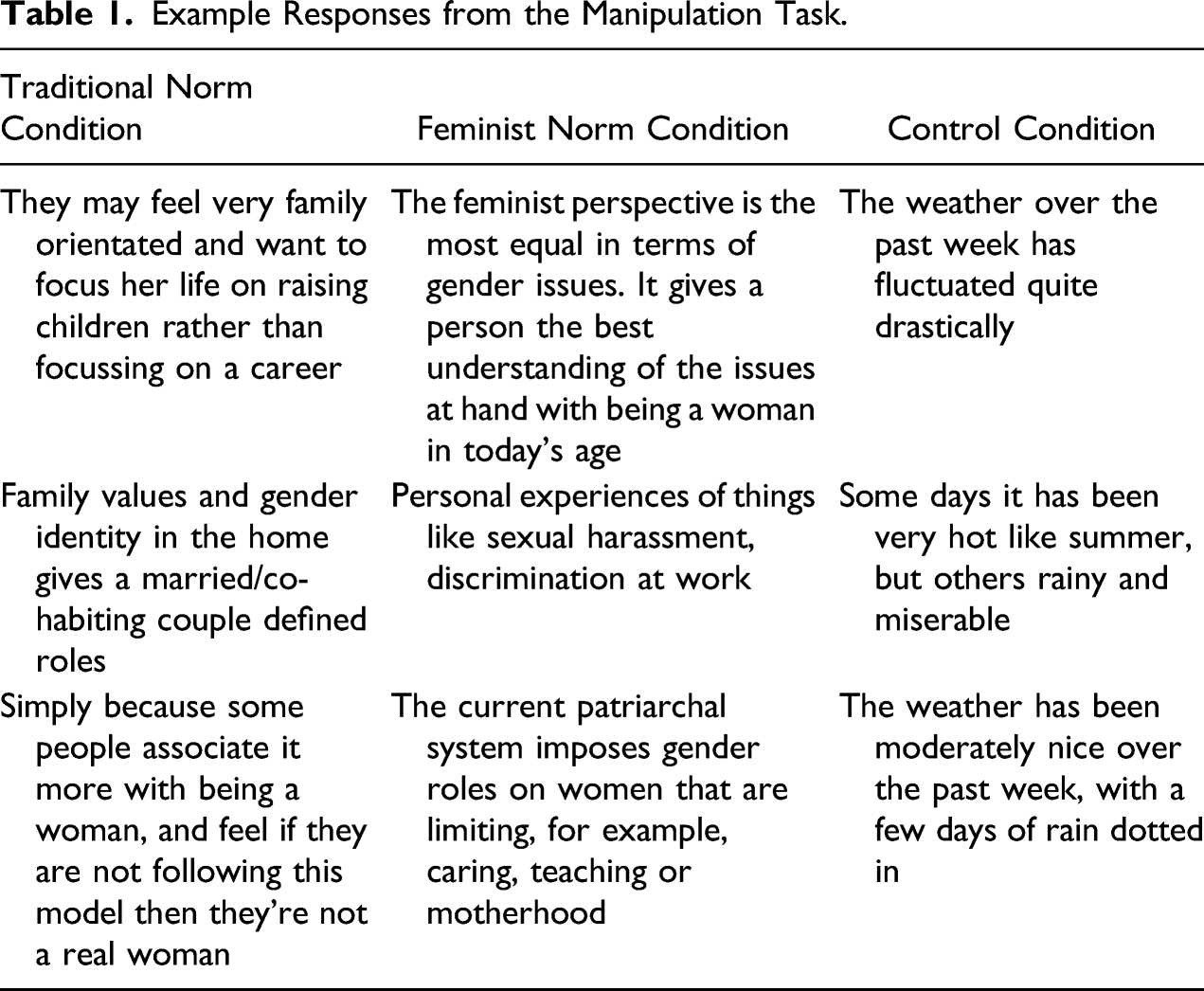
We randomly assigned participants to one of three conditions: (1) feminist norm, (2) traditional feminine norm or (3) control. We presented the experimental manipulation at the start of the study, which involved a writing task in which we asked participants to generate three arguments in favour of the condition to which they had been assigned.
In the feminist and traditional feminine conditions, participants were provided with the following text (as an adaptation of a paradigm developed by S. A. Haslam et al., 1999): Some people support a [feminist perspective/ traditional model] of womanhood. Our study is seeking to understand the different perspectives that people hold. What are the three strongest arguments you can think of why women might support a [feminist perspective/ traditional model]?
In the control condition, participants were provided with the following text: Some people believe the weather impacts our mood and behaviour. Using as much description as you can, please write approximately three sentences detailing the weather over the past week.
Measures
The following measures were completed after the manipulation. Note that several other measures were also completed in addition to ones reported here; these were not relevant to this analysis (details are available in the preregistration).
Social identification: Participants completed the Multicomponent Scale of In-group Identification (Leach et al., 2008), to measure strength of social identification with women. The scale includes 14 items on a 7-point Likert scale from 1 = Strongly disagree to 7 = Strongly agree. An example item is “I feel solidarity with other women”. This scale has been found to have good reliability (α = .80 to .93; Leach et al., 2008), which was also true in the present sample (α = .91).
Help-seeking intentions. To measure help-seeking intentions, participants read a vignette detailing an experience of workplace sexual harassment, in which a woman is touched inappropriately by a male colleague at a bar, and were asked to imagine themselves in the situation described (see Appendix A). They then completed the General Help-Seeking Questionnaire (Wilson et al., 2005). The questionnaire asks participants to rate their likelihood of seeking help from 12 sources, such as ‘friend’, ‘mental health professional, for example, psychologist, social worker, counsellor’, and ‘phone helpline, for example, Lifeline’. Response options range from 1 = Extremely unlikely to 7 = Extremely likely. This measure was chosen to assist in identifying trends in help-seeking intentions, both in terms of overall willingness to seek help, and also patterns in seeking help from different sources of support assessed via factor analysis. A further advantage is that the General Help-Seeking Questionnaire allows for substitution of items with contextually relevant sources of support, whilst maintaining strong psychometric properties (Wilson et al., 2005). For the present study, the items ‘youth worker’ and ‘teacher’ were dropped from the scale due to limited relevance to the work context and ‘work colleague’ and ‘workplace representative (e.g. Human Resources representative)’, were added.
Personal growth: Many measures of post-traumatic growth were unsuitable for the present sample because they require participants to self-identify as having experienced a traumatic event. Therefore, we utilised the personal growth subscale from Ryff’s (1989) Psychological Wellbeing Scales, which we considered analogous to post-traumatic growth. Previous research by Holtmaat et al. (2019) has found that this subscale loads on the same factor as items used in one of the most common measures of post-traumatic growth, the Posttraumatic Growth Inventory (Tedeschi & Calhoun, 1996). This suggests that personal growth and post-traumatic growth are largely overlapping constructs, and therefore the personal growth subscale is an appropriate proxy measure. This scale includes seven items, such as ‘For me, life has been a continuous process of learning, changing and growth’ which participants rate on a scale from 1 = Strongly disagree to 6 = Strongly agree. In prior research, this subscale has been found to have good internal consistency (α = .87; Ryff, 1989), which was also found in the present sample (α = .83).
Demographics: Demographic information was collected at the end of the study, including age, gender identity, sexual orientation, mental illness diagnosis, and ethnicity.
Data quality checks: Two attention checks were used to prevent random responding. Both items asked participants to select Strongly agree, with one item embedded in the Multicomponent Scale of In-Group Identification and the other in the Personal Growth scale. Participants who failed to select Strongly agree on one or both of these items were excluded.
One manipulation check was used in this study. Participants selected what they had been asked to write about in the manipulation, with response options of ‘Traditional model of womanhood’ (1), ‘Feminist model of womanhood’ (2), ‘The weather’ (3) and ‘I do not remember’ (4). Participants who selected the incorrect condition, or who selected ‘I do not remember’, were excluded.
Results
Example Responses from the Manipulation Task.
Help-seeking
An omnibus ANOVA with pairwise comparisons was first conducted, using the independent variable of condition and the dependent variable of score on the General Help-Seeking Questionnaire. Overall intentions to seek help did not significantly differ across conditions F (2,288) = 1.861, p = .157 (Mtraditional = 3.444, Mfeminist = 3.380, Mcontrol = 3.360).
Rotated Factor Matrix of Help-Seeking Intentions items.
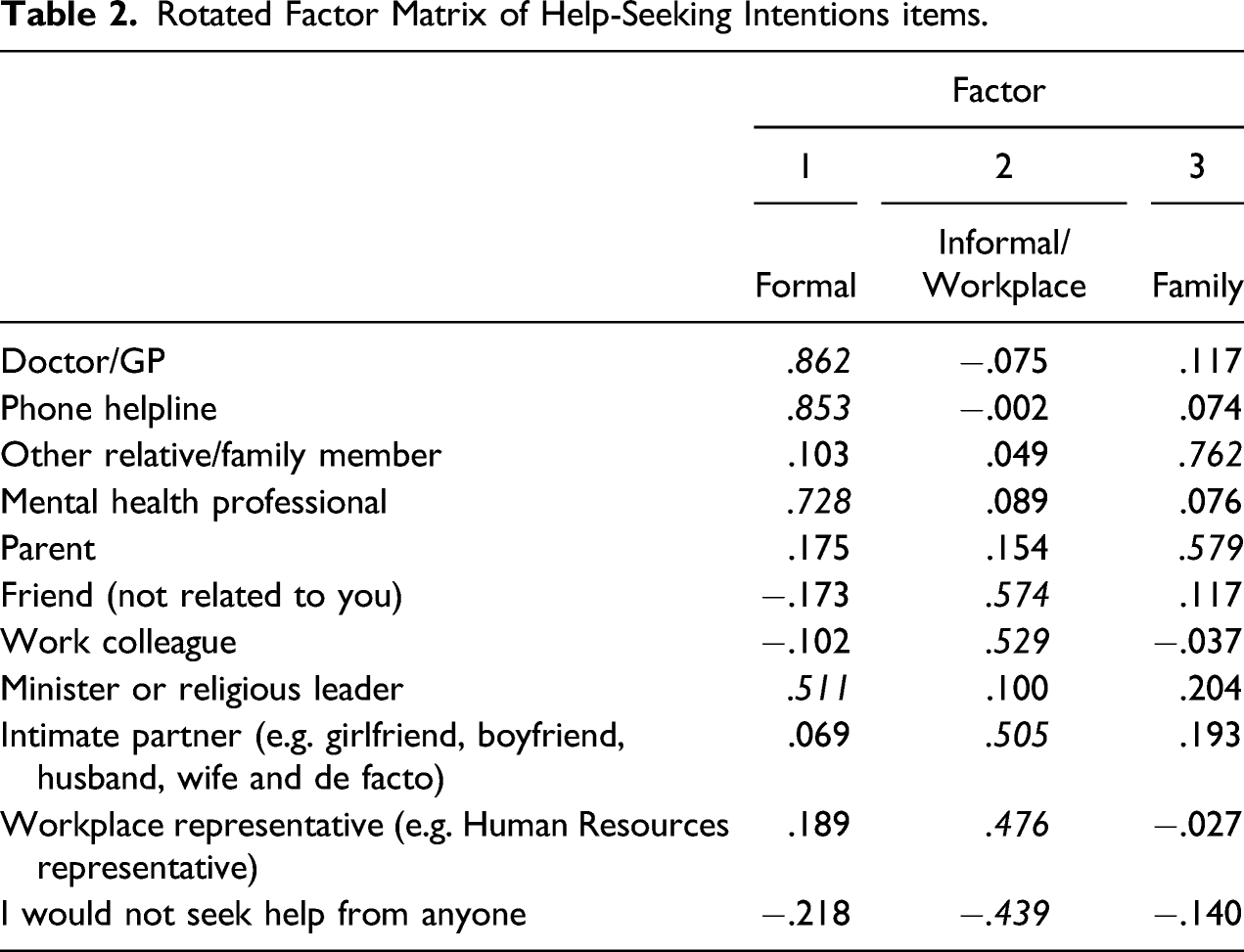
To test H1, an omnibus ANOVA was conducted for each of the three factors. Intention to seek help from formal supports did not significantly differ across conditions, F (2,281) = 2.347, p = 0.098 (Mtraditional = .097, Mfeminist = .079, Mcontrol = −.163). Intention to seek help from informal and workplace supports did not significantly differ across conditions, F (2,281) = .060, p = .942 (Mtraditional= .015, Mfeminist = .018, Mcontrol = −.018). Intention to seek help from family did not significantly differ across conditions, F (2,281) = 1.030, p = .358 (Mtraditional = .089, Mfeminist = −.081, Mcontrol = −.013). These results did not support H1.
On inspection of the pattern of results, however, it appeared that help-seeking intentions for formal sources of support were greater for participants in both traditional and feminist conditions, compared to those in the control condition. Post-hoc analyses were then conducted in which participants in the two conditions in which gender identity was made salient (feminist and traditional conditions) were compared to those in the control condition. Participants in the gender identity salient conditions displayed significantly greater intention to seek help from formal sources of support than participants in the control condition, F (1,282) = 4.693, p = .031 (Mcombined gender identity conditions = .088, Mcontrol = −.163). These results are displayed in Figure 1. Participants whose gender identity was made salient (either with feminist or traditional content) were more likely than participants in the control condition to seek help for GBD from formal supports. Note. The column with subscript b (control condition) is significantly different from combined columns a (feminist and traditional conditions) at p < .05. Error bars represent standard error. Scores represent factor scores of help-seeking intentions from formal sources of support on the GHSQ (M = 0, SD = 1).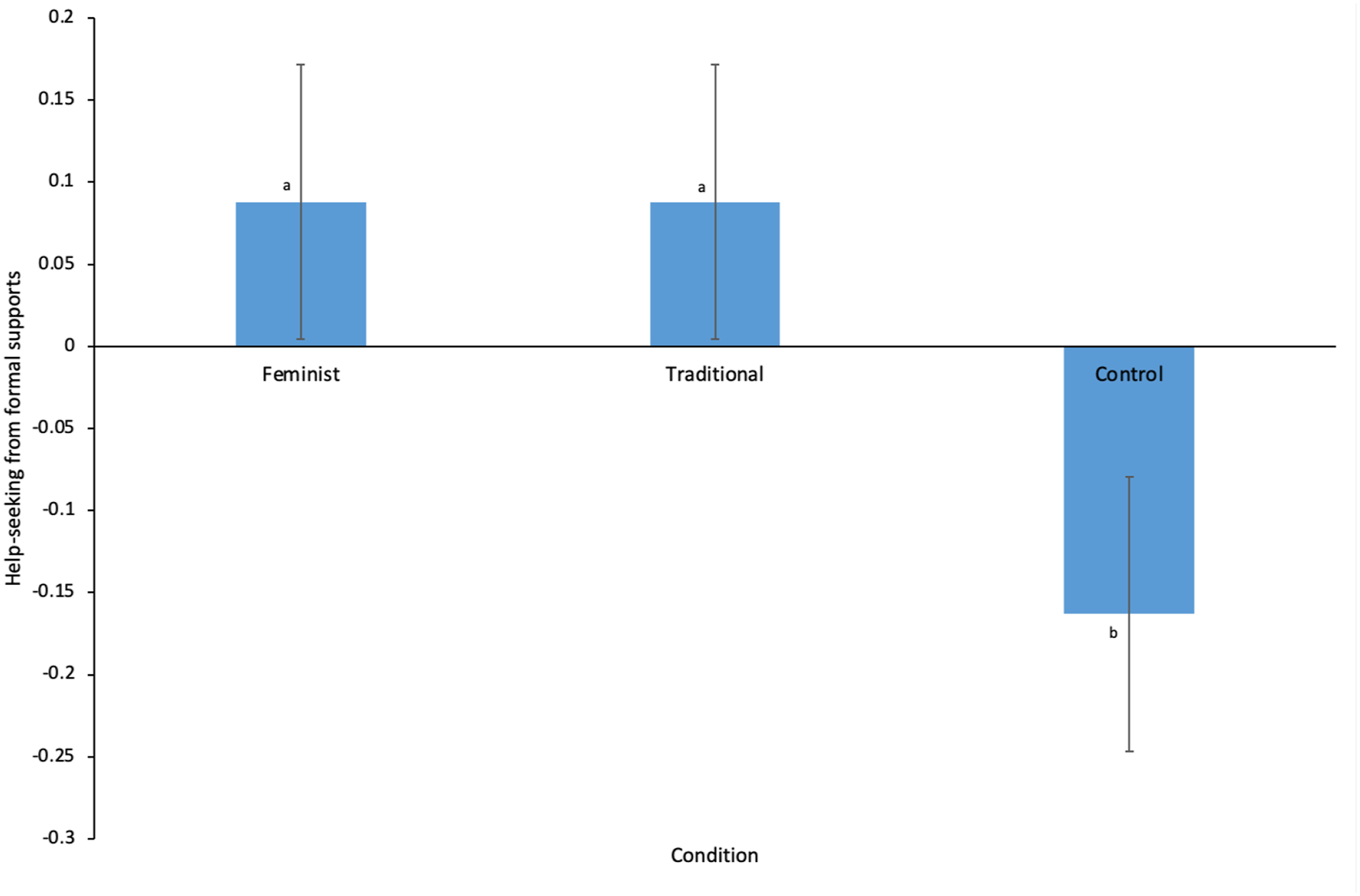
We also ran a further post-hoc analysis to check if strength of social identification moderated the relationship of norm condition on help-seeking from formal supports. First, to confirm that treating social identification as a moderator was appropriate, we ran an omnibus ANOVA with the independent variable of condition and the dependent variable of social identification, and found no significant relationship, F (2,288) = 2.196, p = .113 (Mtraditional = 5.053, Mfeminist = 5.291, Mcontrol = 5.054). Next, we used the PROCESS macro (Hayes, 2017) to examine the interactive effect of social identification and norm condition on help-seeking
2
. The higher-order interaction was significant, R
2
change
= .02, F (2, 278) = 3.169, p = .044. This effect was such that among high identifiers only, the feminist condition led to significantly more endorsement of help-seeking from formal supports compared to both the traditional condition, t (279) = −2.13, p = .034, and the control condition, t (279) = 2.07, p = .040 (see Figure 2)
3
. In the feminist condition, participants who were high on social identification with women were more likely to endorse seeking help from formal supports, relative to those who were low on social identification with women. Note. Scores represent factor scores of help-seeking intentions from formal sources of support on the GHSQ (M = 0, SD = 1).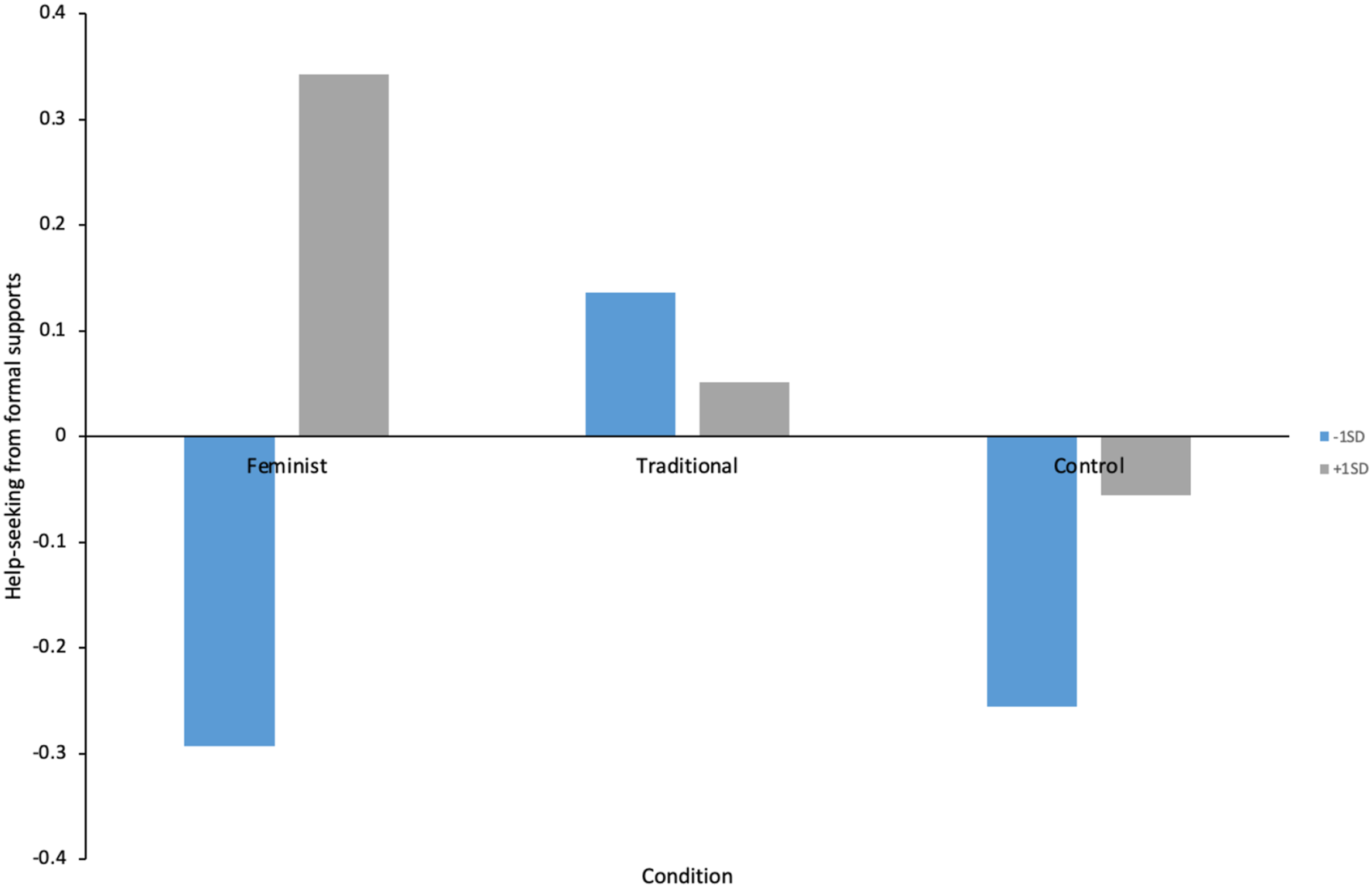
Post-traumatic growth
To test H2, an omnibus ANOVA with pairwise comparisons was conducted, using the independent variable of condition and the dependent variable of score on the Personal Growth scale. The main effect of condition was significant, F (2,288) = 4.158, p = .017. Pairwise comparisons indicated that participants in the feminist condition scored significantly higher on post-traumatic growth than both participants in both the traditional feminine condition and participants in the control condition (Mtraditional = 4.437, Mfeminist = 4.734, Mcontrol = 4.427). These results supported H2 (see Figure 3). Participants in the feminist condition reported significantly greater personal growth than those in the traditional womanhood or control conditions. Note. Error bars represent standard error.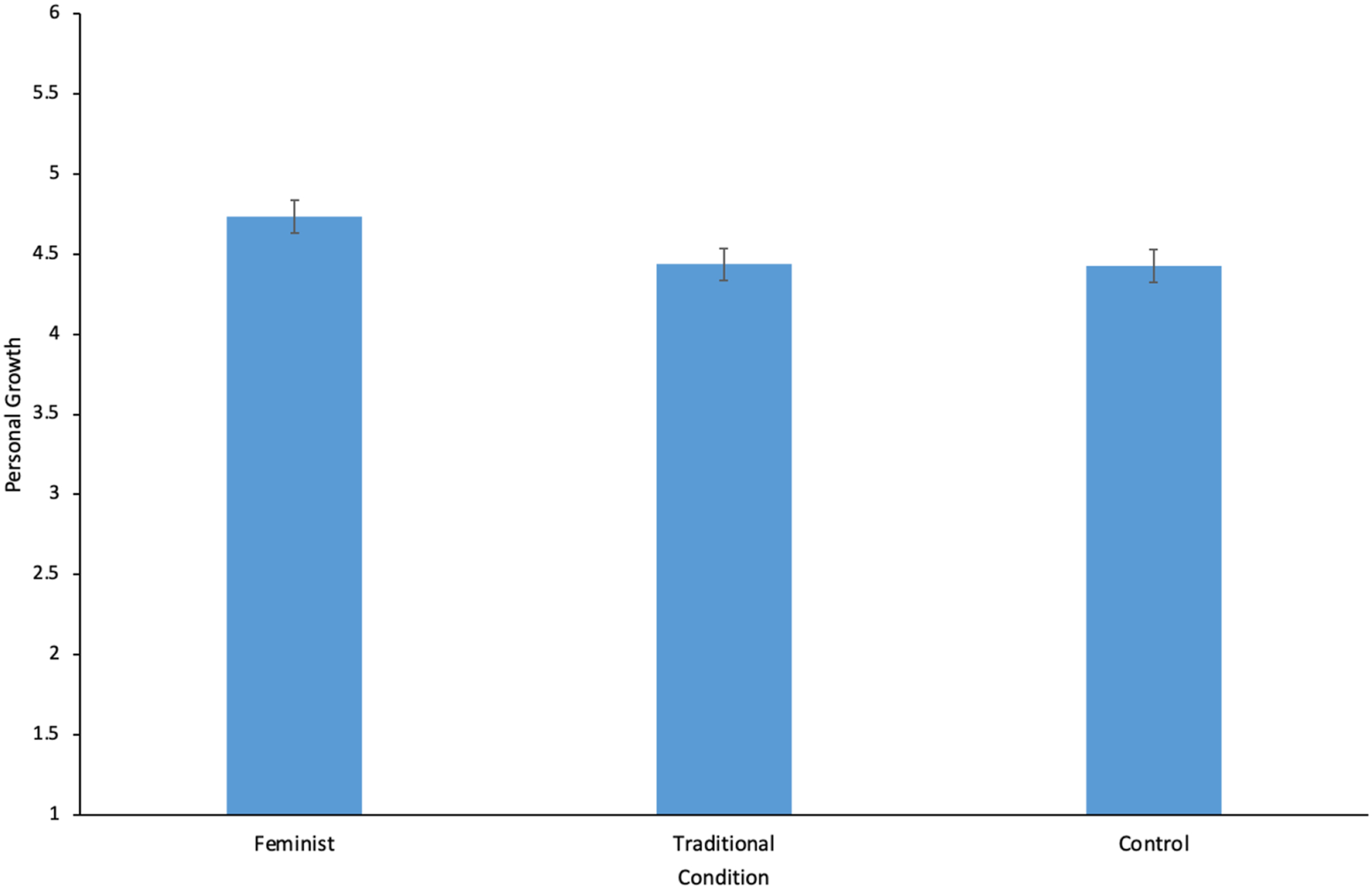
Discussion
The present study investigated the role of gender identity content on coping with GBD. We found that participants for whom feminist norms were made salient reported greater personal growth relative to participants for whom traditional feminine norms were made salient, supporting our hypothesis. Further, post-hoc analyses found that participants in both the feminist and traditional conditions reported greater help-seeking intentions from (only) formal supports, compared to participants in the control condition. This suggests that reflecting on one’s identity as a woman, regardless of the identity content that is salient, increases willingness to seek help from formal supports. Given that gender identity salience increases the likelihood of appraising potentially discriminatory acts as sexist Wang and Dovidio (2017), it may be that participants in both the traditional and feminist conditions were more likely to appraise the scenario through this lens, compared to those in the control condition for whom gender identity salience was not primed. Nevertheless, it was still the case that the highest levels of willingness to seek help were found among high identifiers in the feminist condition.
These findings speak to the role of identity content in coping with traumatic events, including sexual harassment. That is, these results suggest that feminist identity content increases one’s sense of personal growth, relative to traditional feminine identity content or a lack of salient identity content. The experimental nature of this study increases our confidence that this relationship is causal in nature. The results suggest that it is not (only) the process of self-categorising as a woman that is important for recognising one’s own growth, but rather the content that is associated with this identity.
Implications
There are clear theoretical as well practical implications from these findings. These results speak to the promise of social identities as potentially protective psychological resources, consistent with work by Jetten and colleagues (2012). From a clinical standpoint, these findings suggest that feelings of growth can be facilitated in people who have experienced traumatic events, and as such there are implications for how survivors of GBD can best be supported. For example, women’s and healthcare organisations that explicitly endorse feminist or related norms may aid coping and potentially help foster post-traumatic growth. Similarly, there are implications for fostering growth following other, non-GBD traumas. More specifically, empowering trauma survivors on the basis of relevant valued social identities is likely to have protective benefits in a wide variety of contexts.
Although our study conceptualised feminism as part of the content that may be associated with a womanhood identity, feminism may be conceptualised as an identity in itself. Women who endorse a feminist identity are more likely to endorse collective action (Van Breen et al., 2017). A feminist identity, by nature, is a politicised stance in reaction to the enduring social hierarchy, and some have argued that some form of oppression or victimisation (such as GBD) must be experienced to develop such an identity (Downing & Roush, 1985). Indeed, women who have experienced GBD report greater awareness of its prevalence and increased desire to help other survivors (Valentine et al., 2017). Additionally, researchers have found that identifying as an activist is associated with greater post-traumatic growth following experiences of GBD (C. Haslam et al., 2021), which suggests that emphasising collective action norms in response to victimisation may facilitate trajectories of growth. A clear direction for future research would therefore be to consider the effect of historical sexual victimisation on appraisal of present or hypothetical GBD. It is possible that prior GBD experiences may lead to increased feminist identification (or increased salience of feminist norms), which may lead to greater help-seeking intentions and personal growth.
There are more serious and somewhat sobering implications from the finding that increasing the salience of a womanhood identity increases help-seeking intentions from formal supports following a hypothetical sexual assault scenario. If the salience of womanhood broadly leads to increased help-seeking intentions, what does this mean for individuals who are nonbinary, gender fluid, or only weakly identified with other women? Importantly, we do not suggest that this finding should be used to advocate for increasing gender salience to promote help-seeking, as doing so would exclude and further alienate a large proportion of people who already face serious marginalisation and indeed, increased risk of GBD (Coulter et al., 2017; Heidt et al., 2005). Instead, we see this as evidence for a broader ‘social cure’ (cf. C. Haslam et al., 2018): closely held and salient social identities provide a sense of agency and facilitate collective action (Greenaway et al., 2015; C. Haslam et al., 2021). In this way, it is likely too that social identification with other contextually meaningful groups may show similar benefits in terms of help-seeking, or indeed, other desirable health outcomes.
Strengths and Limitations
This study has both strengths and limitations. Strengths include its experimental design, pre-registration, a priori power analysis and large sample size, and use of reliable measures. However, some limitations must also be noted. First, data collection occurred during the global COVID-19 pandemic, meaning that psychological wellbeing was likely reduced for all participants relative to prior to the pandemic. Formal help-seeking is shown to increase with worsening distress (Walters et al., 2008), and it is possible that the situational context may have inflated participants’ help-seeking intentions. Second, although the manipulation was designed to minimise reactance, it is likely to have had varied success in producing endorsement of feminist and traditional norms. A further limitation is that the study only examined help-seeking intentions in relation to sexual harassment. Help-seeking intentions may not necessarily correlate with actual help-seeking behaviour (Swim & Hyers, 1999; Woodzicka & LaFrance, 2001), and therefore it is difficult to generalise these results to actual help-seeking following GBD. Finally, participants were predominantly white, cisgender 4 , and heterosexual, meaning that these findings are not generalisable to people of other backgrounds, genders, and sexual orientations. Although participants with sexual and ethnic minority identities would have been randomised across conditions in our study, our findings are unable to speak to the impact of multiple sources of marginalisation on GBD appraisals. There is a clear need for further investigation of the impacts of GBD through an intersectional lens.
Conclusion
The novel findings of this study suggest that appraisals of one’s sense of personal growth can be influenced by changes in identity content associated with self-categorisation processes. That is, salient feminist identity content enhanced women’s sense of personal growth. It would be valuable to explore this in a group of women who self-identified as having experienced a trauma such as sexual harassment or other forms of GBD, to build upon the community sample used here. Specifically, given the overlap between Ryff’s (1989) personal growth subscale and the Posttraumatic Growth Inventory (Tedeschi & Calhoun, 1996), it would be worthwhile to explore whether post-traumatic growth could be similarly influenced. Given the prevalence of GBD and the potential for devastating psychological consequences following such experiences, these findings provide an important avenue for future research.
Finally, it is important to acknowledge that although this study focussed on efforts to facilitate effective coping with sexual harassment, ultimately the onus of changed behaviour should lie not with women to ‘cope more effectively’, but on society as a whole to change attitudes and norms surrounding acceptable treatment of women. Until then, these findings have shown that we can support women to derive less traumatic meanings from experiences of GBD, including ones that encourage empowerment and personal growth.
Footnotes

Declaration of Conflicting Interests
The author(s) declared no potential conflicts of interest with respect to the research, authorship, and/or publication of this article.
Funding
The author(s) disclosed receipt of the following financial support for the research and/or authorship of this article: This work was supported in part by a European Research Council Consolidator Grant (ERC-CoG 725128) awarded to MKR and a NHMRC Grant (1173270) awarded to TC.