







Abstract
The treatment homicide co-victims receive from the criminal justice system often leaves them aggrieved and feeling alienated. A neglected but important area of investigation is the courtroom workgroup’s handling of murder cases. This exploratory study examines the nature and extent to which varying secondary victimization experiences are common among co-victims as the murder cases are processed through the court system. The sample consists of 27 co-victims connected to 24 separate cases where the murders occurred in a major metropolitan area in the southeastern United States. Drawing upon focus group data, Nvivo 10 was employed to identify themes that illustrate common secondary victimization experiences among co-victims along with positive and mixed reactions to court processes and personnel. The findings indicate that court requirements to provide notifications are infrequently met and attorney’s practice to supply information about case progress and counseling to family members regarding plea-bargaining and sentencing decisions are greatly restrictive. When information is offered, it is often perceived as highly technical and when assistance is provided, it is frequently limited or intermittent. Despite the prevalence of negative experiences, there also were reports of positive interactions with the district attorney and victim advocates. The study concludes by identifying ways in which the courtroom workgroup can uphold the rights afforded to co-victims while at the same time meeting the duties and responsibilities of the workgroup.
Introduction
The Center for Victim Research (2019) estimates that 64,000–213,000 people in the United States experience a homicide each year. It is also estimated that 9–15% of adults and 8–18% of youth suffer the loss of a loved one to homicide (Center for Victim Research, 2019). The pain of losing a loved one to homicide is described as “intense, persistent, and inescapable” and “the greater the perceived intentionality and malevolence of the killing, the higher the distress seen in survivors” (Miller, 2009, p. 68). The bereavement experience for many family members of homicide victims (referred to hereafter as co-victims 1
We use the term co-victim to refer to family members of homicide in line with previous academic literature on the population of interest (Armour, 2002; Connolly & Gordon, 2015; Reed & Blackwell, 2006). Some scholars have utilized somewhat different terminology to reference this group, including “homicide survivor,” “survivor-victim,” “secondary victims,” and “indirect victim,” but co-victim is the most frequently used and accepted term.
Despite the established relationship between homicide co-victimization and secondary victimization experiences, there is little contemporary literature on this topic (Goodrum, 2019). This is particularly problematic in the context of homicide, as it is co-victims who experience continued trauma beyond the event itself (Mastrocinque et al., 2015). A sizable portion of this research was conducted between the 1970s through the 1990s, immediately before and after the implementation of victim’s rights legislation. A growing number of contemporary studies have explored participation from the co-victim’s perspective (for example, Goodrum, 2019). However, many focus on co-victims’ health consequences (Miller, 2009; Mastrocinque et al., 2015), coping (Englebrecht et al., 2016; Hammett, 2000), victim impact statements (Englebrecht, 2012), views on the death penalty (Vandiver, 2003), and interactions with law enforcement (Reed et al., 2020; Stretesky et al., 2010). Few contemporary studies have focused on co-victims’ secondary victimization experiences related to their interactions and participation within the criminal justice system, specifically, during the trial and sentencing phases. This study attempts to address this lacuna in the literature through focus groups with homicide co-victims who recount their experiences during the trial and with the courtroom workgroup.
Literature Review
Crime Victims’ Rights, Participation, and Impact on the Criminal Justice System
In the late 1970s, the Victim’s Rights Movement brought considerable attention to crime victims and sought to improve the privacy, protection, and participation of victims throughout the criminal justice process (Garvin, 2010). Following initiatives to grant victim’s rights through state-level legislation and amendments (Davis & Mulford, 2008), then-President Reagan established the President’s Task Force on Victims of Crime (1982) to assess the handling of victims by the criminal justice system. Soon after, the Victims of Crime Act (VOCA) of 1984 was passed, which created the Office for Victims of Crime and established the Crime Victims Fund (42 U.S.C.A. § 10601). In the 1990s, the Victim Rights and Restitution Act and Violent Crime Control and Law Enforcement Act were implemented, which ensured that victims receive mandated emergency medical and social services, notices of the status of the investigation and court proceedings, and provided increased funding for crime prevention programs. The Crime Victim Rights Act of 2004 further expanded victims’ rights, placed a duty on the federal courts to ensure those rights are upheld, and regarded crime victims and homicide co-victims 2
The Crime Victim Rights Act of 2004 defines the term “crime victim” as
a person directly and proximately harmed as a result of the commission of a Federal offense or an offense in the District of Columbia. In the case of a crime victim who is under 18 years of age, incompetent, incapacitated, or deceased, the legal guardians of the crime victim or the representatives of the crime victim’s estate, family members, or any other persons appointed as suitable by the court, may assume the crime victim’s rights under this chapter…
(1) The right to be reasonably protected from the accused. (2) The right to reasonable, accurate, and timely notice of any public court proceeding, or any parole proceeding, involving the crime or of any release or escape of the accused. (3) The right not to be excluded from any such public court proceeding, unless the court, after receiving clear and convincing evidence, determines that testimony by the victim would be materially altered if the victim heard other testimony at that proceeding. (4) The right to be reasonably heard at any public proceeding in the district court involving release, plea, sentencing, or any parole proceeding. (5) The reasonable right to confer with the attorney for the Government in the case. (6) The right to full and timely restitution as provided in law. (7) The right to proceedings free from unreasonable delay. (8) The right to be treated with fairness and with respect for the victim’s dignity and privacy. (Crime Victims’ Rights Act of 2004, 18 U.S.C. § 3771)
Criminal Justice Professionals and Resistance to Victim’s Rights Legislation
With the advent of victims’ rights legislation and policies to promote the inclusion of victims in the justice process, similar efforts to include family members of crime victims, particularly in cases of homicide, have been slow to take hold and have been occasionally met with resistance from criminal justice professionals. As crime victims and their family members were afforded an increasing role in the justice process, members of the courtroom workgroup (i.e., prosecutors, defense attorneys, victim advocates, and judges) were tasked with implementing new policies at the ground level. Throughout the implementation of victim’s rights legislation and amendments, research has examined how members of the courtroom workgroup have reacted to the new role for crime victims in the criminal justice system, with mixed results. Initially, some studies found that the majority of the courtroom workgroup expressed positive views about victims’ rights legislation and increased participation and believed that space could be carved out for victims in the justice process with minimal conflict between victims’ and offenders’ rights (Henley et al., 1994; Hillenbrand & Smith, 1989). Alternatively, research documents resistance from some criminal justice personnel to certain policy-prompted changes, particularly those requiring significant adaptations to their daily work regime (Harris & Jesilow, 2000). This may be due, in part, to the interest of those working in the criminal justice system to retain their “autonomous status” as well as organizational demands (e.g., equity and efficiency) that conflict with allowing victims a strong voice in the process (Erez & Rogers, 1999). Davis et al. (1984) found that prosecutors resisted this “new voice” if it forced them to relinquish control over case outcomes.
The victim’s advocate has become a defining facet of the criminal justice process as the system adapted to victims’ rights legislation. Victim witness assistance programs (VWAPs) provide many services to crime victims and families, including court accompaniment, legal advocacy, and aid with victim impact statements. Despite the legislation affording crime co-victims the right to participate in criminal justice proceedings, victim advocates and other criminal justice personnel may have differing—or conflicting—views on what this entails or what should be included in the prosecution’s narrative (Regehr & Alaggia, 2006). For example, research has documented that legal professionals—including judges, prosecutors, and defense attorneys—believed victim impact statements were unnecessary and had little, if any, significant impact on sentencing decisions or the criminal justice system itself (Erez & Rogers, 1999; Henley et al., 1994). However, practitioners felt victim impact statements had “some impact” on sentencing (Hillenbrand & Smith, 1989) and are a crucial outlet for victims to express harm. Furthermore, as agents of the state, prosecutors are tasked with considering broader (i.e., communal) interests, while a victim advocate seeks to meet the needs of individual victims. As a result, criminal justice officials tasked with considering victim harm often “typified” victims’ experiences and relied on their own ideas about what the “average” victim experienced afterward based on the severity of the offense (Erez & Laster, 1999).
The emergence of VWAPs has been instrumental in offering a voice and support for crime victims and their families. While many advocates work for the prosecution or are located within police departments, others are not “bureaucratically attached” to the criminal justice system (Payne, 2007); instead, they may be a part of private nonprofit organizations that focus on specific crimes (National Center for Victims of Crime, 2008). Nevertheless, there are a limited number of victim advocates available in VWAPs and through nonprofit organizations for court accompaniment (Spungen, 1998). As a result, some co-victims may not receive the accompaniment they need or want. Additionally, advocates employed by the state and working within prosecutors’ offices have sometimes demonstrated “role conflict” whereby they “identified with the prosecutor’s interests and behaviors” which “hampered their ability to aid victims” (Davis et al., 1984, p. 497). While not always the case, such alignment may be problematic for victims whose interests compete with those of the district attorney (Loge, 2006) and raises concerns regarding prosecution-based advocates’ ability to support co-victims’ interests.
A consequence of resistance from criminal justice professionals includes a failure to notify—or inadequate notification of—homicide co-victims, contributing to co-victims’ feelings of alienation and exclusion. Many victims may not be aware—or informed—of available services, have access to an advocate, or are not informed of sentencing hearings or of their right to submit a victim impact statement (Herman, 2003; U.S. Department of Justice, 1998). Studies have found that approximately half of all violent crime victims were not informed of plea agreement negotiations, even when they had a legal right to be consulted (Beatty et al., 1997; O’Hara, 2005). Victims are further marginalized when court officials fail to notify them of schedule changes, despite victims’ purposeful re-arrangement of their own work and family schedules in order to accommodate attendance (U.S. Department of Justice, 1998). The link between such issues and secondary victimization is clear in co-victims’ frequent descriptions of contacts with the criminal justice system as frustrating and protracted (Redmond, 1996). As Rock (1998) explains, families’ alienation during the criminal justice process “constitutes one of the most potent symbolic assaults suffered by families in the wake of murder” (p. 78).
Secondary Victimization and Dissatisfaction With the Court System
For co-victims, the criminal justice system is often seen as the primary outlet for achieving justice and obtaining closure, but a lack of understanding of the process and their role in the process influences their experiences. For example, co-victims often misunderstand the prosecutor’s role as representing them (Davis et al., 1984), expect input into trial decisions (Erez, 2000), and expect to have an intimate involvement with the case or work in tandem with the prosecution. While co-victims do have the right to be “reasonably heard” and to “confer” with the prosecution, co-victims often report that they are relegated to onlookers in a system perceived to favor the defendant’s rights (Goodrum, 2019; Miller, 2009; Thompson et al., 1996) and the deceased’s rights are largely ignored (Englebrecht et al., 2014). Additionally, throughout the investigative and court proceedings, the actions of criminal justice professionals engender added stress among co-victims. This stress is inextricably tied to co-victims’ negative perceptions of how they are treated by the system (Englebrecht et al., 2014).
Criminal justice professionals are both observers and managers of justice (Goodrum & Stafford, 2001). The courtroom workgroup wields considerable power and influence over the processes and outcomes of court cases. In particular, prosecutors hold a great deal of influence over the management and processing of homicide cases. In contrast to other key players in case processing such as detectives, prosecutors have more flexibility in releasing information to co-victims, determining whether to offer a plea bargain, or providing sentencing recommendations (Goodrum & Stafford, 2001). This, in turn, makes the prosecutor’s office a focal point for co-victims’ perceptions of how court cases are handled and how they are treated.
Secondary victimization (Williams, 1984) refers to the trauma that victims of crime experience as a result of the system processes and/or interactions with criminal justice personnel (see Reed & Blackwell, 2006; Spungen, 1998; Vandiver, 2003). Specifically, secondary victimization is defined as “the protraction and exacerbation of consequences related to crimes that are the product of negative, and generally judgmental, attitudes and behaviors directed at a victim” (Reed & Blackwell, 2006, p. 254). The notion of secondary victimization is rooted in the experience of rape and sexual assault victims. Over a quarter of a century ago, the court processing of rape crimes propelled the development of rape shield laws, whose proponents asserted that such victims were further victimized by a system that directed blame toward the victim rather than the accused (Madigan & Gamble, 1991). Yet, even today, rape victims with cases that were not prosecuted describe law enforcement as engaging in secondary victimization behaviors (Patterson, 2010). For homicide co-victims, secondary victimization often stems from negative treatment by criminal justice professionals as the case is processed through the formal channels of the justice system.
Studies have identified five common experiences among homicide co-victims, including difficulty accessing information, insensitive treatment, perceived unfairness of the criminal justice system, negative media reporting, and limited access to victim advocates (Connolly & Gordon, 2015; Englebrecht et al., 2014). Feeling disrespected, discounted, or even excluded are common reactions to what crime victims and their families experience, and this often impedes their ability to participate and have a voice before and during court proceedings. These secondary victimization experiences have a profound effect, often leaving crime victims and their families feeling aggrieved, alienated, and subsequently dissatisfied with court outcomes (Connolly & Gordon, 2015). These experiences may not only hinder closure for co-victims, but may be deemed “retraumatizing” and result in the development of PTSD symptoms, anxiety, and depression (Amick-McMullan et al., 1989; Connolly & Gordon, 2015; Englebrecht et al., 2014). Some co-victims have even described secondary victimization as more traumatic than the murder itself (Redmond, 1996). It is important, therefore, to understand not only how those working within the system attempt to “manage” victim participation and input (Erez & Laster, 1999), but also how co-victims themselves feel about their inclusion (Goodrum, 2019).
The Present Study
A neglected area of research has been co-victims’ subjective assessment of their interactions with the criminal justice court group. Specifically, it remains unknown if secondary victimization increases through interactions with the courtroom workgroup. Key findings from studies on the general dissatisfaction with the courts reveal that families are particularly dissatisfied with the responses of court personnel (e.g., Getzel & Masters, 1984; Thompson et al., 1996). In particular, Thompson et al. (1996) found that activities associated with the court, including poor treatment from the prosecutor or the defense attorney, were described as the most upsetting. Regehr et al. (2008) reported that empathy by criminal justice personnel seems to increase co-victims’ satisfaction with the system and willingness to accept certain outcomes such as sentencing.
The purpose of this qualitative study is to identify common themes associated with co-victims’ interactions with key players—namely, prosecutors—in the courtroom workgroup, as well as during the various stages of the court processes and trial outcomes. This includes both positive interactions and secondary victimization experiences among co-victims as the murder cases are processed through the court system. While there has been discussion about secondary victimization in the literature, it is at a broad level and, therefore, its component pieces or variables have not been specifically defined nor have those variables been explored for dimensions and depth.
Method
Data and Sample
The data are drawn from four focus groups of homicide 3
Homicide, here, is any criminal killing involving the death of another individual. Referral from the District Attorney’s office did not specify criminal charges such as murder or manslaughter and did not specify degrees, which may have indicated premeditation or level of violence.
The vast majority (85.2%, n = 23) of co-victims were female. Over one-half (55.6%, n = 15) of the participants were White. The remaining co-victims were non-White, comprised mostly of African Americans (37%, n = 10). Most of the victims were male (79.2%, n = 19). The relationship of the participants to the victim is quite varied: 59.3% were parents, 7.4% were wives, 14.8% were sisters, 7.4% were daughters, 7.4% were nieces, and 3.7% were girlfriends.
An examination of the circumstances and arrest outcomes across the 24 cases reveals that nearly one-half (45.8%) of them were felony murders, of which the majority of the victims were killed during the commission of a robbery. Arrests were made in 79.2% (n = 19) of the cases. All 19 cases resulted in some form of court processing, ranging from a plea bargain hearing to a court trial to a sentencing hearing to a verdict. The remaining five cases involved non-arrests and were classified as cold cases.
Recruitment
The study participants were recruited from two sources. First, the participants for three of the focus groups were recruited using contact information received from the directors of VWAP located in the district attorney’s offices in five neighboring counties. Specifically, VWAP directors sent out study invitations to clients on their lists and those interested contacted the principal investigator for possible inclusion in the study. Not all cases were prosecuted. Referral from the District Attorney’s office did not specify criminal charges such as murder or manslaughter and did not specify degrees which may have indicated premeditation or cases of extreme violence. Second, participants for the fourth focus group were recruited from a local homicide survivor support group. In particular, the Executive Director of a local not-for-profit crime victim assistance program solicited members from its monthly homicide support group to participate in the study. A comparison of the VWAPs and the local support group indicated no differences in the number and type of secondary victimization experiences between participants. All potential participants had to be at least 18 years old, an immediate family member or close friend of the victim and had some contact with criminal justice personnel involving the case. Contacts ranged from receiving death notifications to meeting with prosecutors to attending hearings and court trials.
Use of Focus Group Methodology
The focus group methodology was chosen because of its ability to create a rich, detailed description from which variables can be elucidated (Stewart & Shamdasani, 2014). Additionally, the methodology affords participants the opportunity to share their unique voice among others who have had similar experiences. Of particular significance and unlike personal interviews, the dialogue within the focus group discussions exposed participants to different perspectives and allowed them to identify issues common to their shared experience. Increasingly, focus groups are being used to examine family members’ responses to homicide, including ways of grieving and coping unique from other victims (Goodrum, 2019; Englebrecht et al., 2016) and how their involvement with the criminal justice system helps or hinders recovery (Englebrecht et al., 2014; Reed & Blackwell, 2006; Reed et al., 2020).
Description of Focus Group Protocol
The protocol for handling each focus group consisted of four distinct phases, including participant introductions, storytelling, group discussion, and a debriefing session. The storytelling often provided valuable information about the homicide incident, the arrest and police investigation, court hearings, and sentencing outcomes. Drawing upon the work of Zehr (2001), an interview schedule was developed and adapted for use with focus groups. For purposes of this study, the schedule asked participants to identify issues experienced while participating in the various criminal court proceedings, including the plea bargain, trial, sentencing, and appeal processes involved in the murder cases. Co-victims were able to describe their reactions—both positive and negative—to these processes and outcomes. To begin, co-victims were asked, “When dealing with the loss, what was the most remarkable experience that you had with the criminal justice system and the way the case was handled?” A series of key questions ensued, probing descriptions of the various processes and interactions, the problems they encountered, and their reactions to the different experiences. For example, co-victims were asked, “If you attended any of the hearings, what was that process like and how did it make you feel?” Similar questions were asked about the trial process and their experiences with victim advocates, judges, defense attorneys, and prosecutors. Finally, the participants were asked questions about the verdict, sentencing, and appeals process (e.g., What was that experience like? How did it make you feel?).
These sessions ranged from 1½ hours to 2 hours. The focus groups were moderated by a university researcher with training and experience in conducting focus groups, interviewing homicide co-victims, and using crisis intervention. Participants provided informed consent prior to their participation and signed a confidentiality agreement that they would not disclose any names or information shared in the discussions with anyone outside the focus group. Strict ethical protocols were followed, allowing distressed participants the opportunity to leave the group if desired or to meet with the Executive Director, who is a professional counselor and trained in crisis intervention. No participants ever left the group or sought counseling assistance. The group was fully debriefed after each session. Finally, each subject received $40 as compensation for their participation.
Tape recorded focus group sessions were transcribed and subject to thematic content analysis (Berg, 2007). Audited transcriptions were coded, re-coded, and analyzed using Nvivo 10 software. A manual coding process was used with each transcription, generating a hierarchical model of interrelated concepts with themes and subthemes for categorization. A coding scheme was developed by analyzing a pre-determined set of themes found in the homicide co-victimization literature with the themes that emerged from the transcriptions. Once all transcriptions were coded, queries were run for each code, providing the basis for the findings below (see Table 1 for the complete list of the secondary victimization themes and subthemes). All incidents involving actions with and attitudes toward the courtroom workgroup members were linked to the particular theme.
List of Secondary Victimization Themes and Subthemes
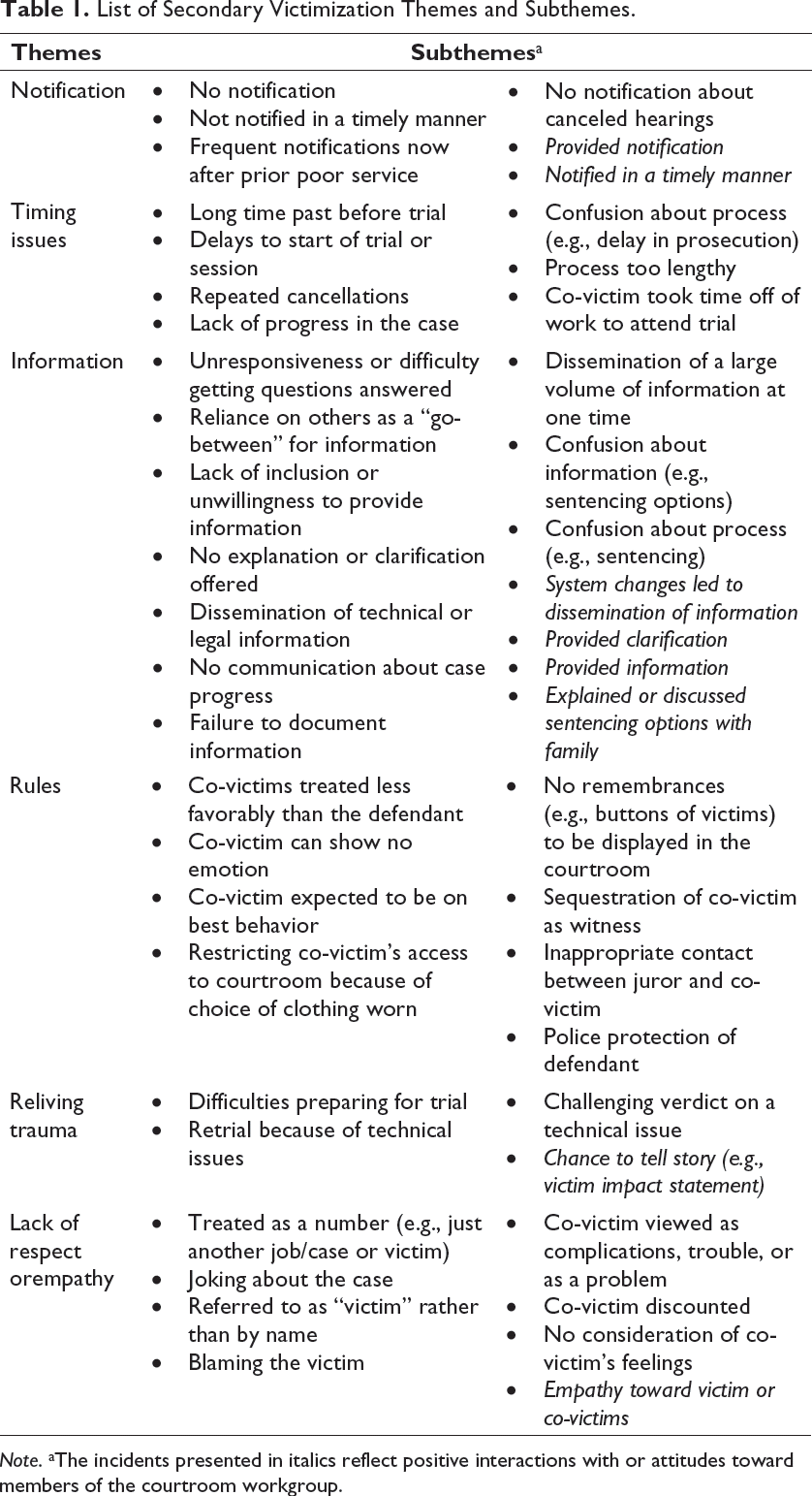
Note. aThe incidents presented in italics reflect positive interactions with or attitudes toward members of the courtroom workgroup.
Results
The results below detail themes that were observed involving the perceptions of the co-victims during their encounters with the court personnel and proceedings. Direct quotes and paraphrasing from the focus group transcripts are used to illustrate various substantive themes that emerged from the multi-layered thematic content analysis. The results show that 84.2% of the 19 cases in court proceedings involved co-victims who reported at least one secondary victimization incident; in fact, 73.7% of the cases involved co-victims who reported at least three separate incidents. Over one-third (36.8%; n = 7) of the cases involved co-victims who reported at least five separate secondary victimization incidents over the course of the court proceedings and trials.
Table 2 presents the prevalence of secondary victimization experiences across the six themes and among the members of the courtroom workgroup. Of the 19 cases processed through the court system, the most frequent problematic interactions concerned information issues (63.2%) and lack of respect or empathy toward the co-victim or victim (52.6%). The results also reveal that most of the negative or problematic interactions were between the co-victims and their district attorney and associates (63.2%), followed by judges (21.1%) and defense attorneys (21.1%). Crime victim advocates were reported to have the lowest percentage of negative interactions (10.5%). When describing various court processes and outcomes, 47.4% of the co-victims identified problematic interactions with the court system or its personnel. Finally, only one co-victim (5.3%) in the study had problematic interactions with the jurors.
Despite the prevalence of negative experiences, positive interactions with members of the courtroom workgroup were also mentioned. For example, 26.3% of the co-victims reported positive experiences with the District Attorney. As a consequence, five co-victims had a mixture of both positive and negative experiences with members of the courtroom workgroup. Finally, unlike any of the other courtroom workgroup interactions, positive interactions with victim advocates (21.1%) were more prevalent than negative victim advocate encounters (10.5%).
Prevalence of Secondary Victimization Incidents (N = 19).
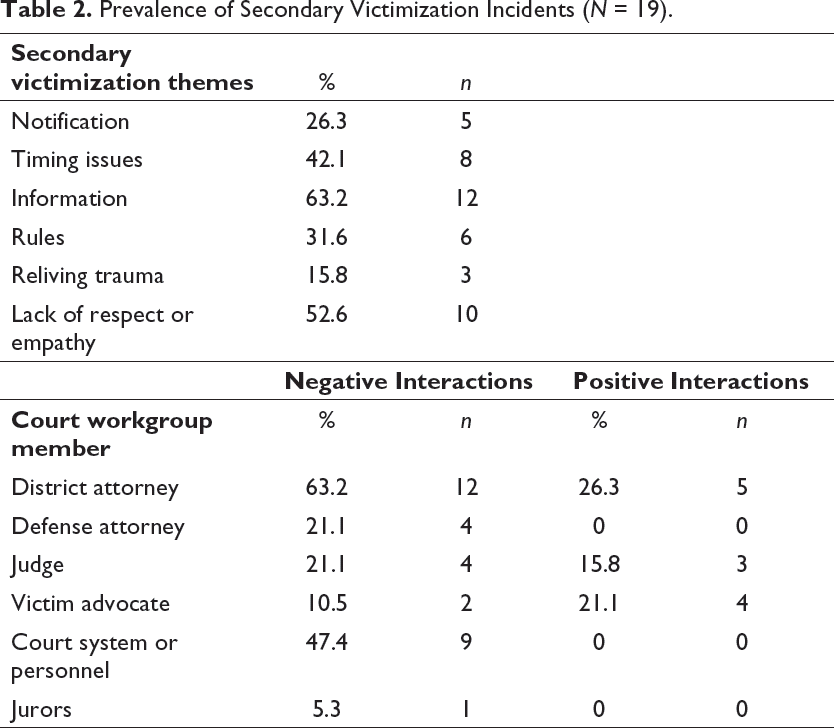
This study provides iconographic examples of the problems encountered by homicide co-victims. The co-victims provide unique and vivid accounts of the problems faced with the courtroom workgroup. Particularly, the notion of secondary victimization was the overarching theme in focus group discussions. As a father of his murdered son testifies, they were “…victimized by the defense attorneys for not doing their job, the prosecutors for not doing their job, judges for not doing their job, causing all kinds of havoc in your life.” Secondary victimization is divided into six subthemes relating to co-victims’ interactions with the courtroom workgroup and involving various court proceedings: notification, timing issues, information, (perceived) rules, reliving trauma, and lack of empathy/respect from criminal justice agents.
Notification
Notification was among the key rights afforded to victims in Victim’s Rights legislation. Notification is the primary means by which co-victims are informed of scheduled criminal proceedings, outcomes of those proceedings, and when hearings have been canceled and rescheduled. Notification also includes advance notice of the co-victim’s right to attend proceedings and/or make a statement. The majority of focus group participants received such notifications. However, five co-victims (26.3%) reported not receiving notifications or failures in the process. A wife of her murdered husband recalls her frustrating experience: “Before the first trial, I didn’t get the information. Nobody called me. But the second one, I got all the information. They changed something in the system or the Director. Everything really changed.” A father of his murdered son describes how only after complaining about not receiving notifications did he start to receive them: “Well, imagine not being notified of the hearing. They still didn’t bother to tell me that the District Attorney screwed up. We’re back eight years later.… I get plenty of notifications now, because we’re back down [at the D.A.’s office.]” Finally, a mother of her murdered daughter bemoaned not being notified in advance: “But the most crucial time that we missed was the sentencing phase for two of the kids. [A court staff member] called me at 10:30 to tell me, ‘It’s this morning … at 11 o’clock.’” Goodrum (2019) also documented a case in which the co-victim was given 30 minutes’ notice, suggesting that such issues may not be isolated incidents.
Timing Issues
Co-victims have the right to “timely notice of any public court proceedings” and the “right to proceedings free from unreasonable delay,” but often prosecutorial actions and murder trials are perceived as protracted and wearisome. Two-fifths of the co-victims (42.1%, n = 8) in this study expressed frustration, disbelief, and confusion over the excessive delays in prosecution, court hearings and even the start of the trials themselves:
It’s been going on four years. No one’s been charged. No guns have been found. They’ve got three people that did it. But they’re saying because this man won’t turn anybody in, we can’t prosecute them.
The bond hearing … [is] gonna take place at 8:00 the next morning, [but it] doesn’t take place. … you set yourself up. You’re trying to get ready for this court hearing. And you really have to steel yourself up because you are going to see the person who killed the person that you love. You go in there and sometimes it just gets dropped. You’re not even going to see him and you’re not even gonna progress.
The bad thing was four years passed before the trial. I didn’t know what was going on. Why was it taking so long?
Co-victims’ lack of understanding of the process coupled with potential breakdowns in communication explaining reasons for delay likely increase confusion and frustration. Other co-victims made extraordinary efforts to attend hearings, only to have them canceled—and canceled repeatedly. In response to repeated cancelations of a hearing, a frustrated and angry father of a murdered son exclaims: “But I’m not coming down here for the fifth trip to not have a hearing.” Contributing to this frustration and anger is the lengths to which co-victims go to attend these hearings. The father goes on to explain:
And they got me coming from [name of city] for this hearing. And they got this other lady whose daughter was killed by this guy … she’s been out of work three different times a half a day at a time and she’s been through this now for eight years.
Delays had a psychological and lifestyle impact. First, co-victims work to mentally and emotionally prepare for hearings, being in the same room as a person who killed their loved one, and potentially listening to painful evidence presented during a trial. Attendance required calling out of work, arranging childcare or missing school, and managing other affairs around the court’s schedule and repeated cancelations or postponements become a burdensome process for co-victims. The anticipation of court proceedings may stir confusion, disappointment, and frustration when delayed, requiring emotional preparation and leading to increased distress when proceedings do not progress.
Information
Co-victims commonly seek out information about the status of the case, as well as the progress of court proceedings and the trial itself. Information is the most frequently mentioned theme (63.2%) that detailed many of the co-victims’ problems during interactions with members of the courtroom workgroup. Most of the complaints about unresponsiveness were directed at district attorney’s offices. Despite co-victims’ rights to confer with the attorney for the Government in their loved one’s cases, a number of co-victims reported little to no communication at all. A wife of her murdered husband recalls: “I get very little response from the District Attorney’s office, probably five communications in almost four years. They tell me nothing about the case.” Commenting on a murder trial, a victim’s father recalled that the district attorney’s office did not readily provide him and his family with information. “It was like pulling teeth to get anything out of them. They just wouldn’t tell us anything. Finally, we [said,] ‘Tell us enough so that we can get by for a few days.’” Finally, a girlfriend of her murdered boyfriend criticized the district attorney’s office for their lack of communication with the victim’s family:
But I have to be proactive. I’d say the biggest disappointment is in [the] responsiveness of the D.A.’s office … I don’t expect them to pick up the phone and call me per se. Just pick up the phone and call the family to let them know what’s going on. I took it upon myself because I’m a proactive person. I said, “Well, I want to know. I have some questions I want answered.”
As previously noted, consultation is inconsistently and sometimes reluctantly implemented. While this co-victim took matters into her own hands, others are less resourceful or uncomfortable taking the initiative. Most of the complaints about unresponsiveness were directed at district attorney’s offices. However, in some cases, co-victims were fortunate to have crime victim advocates who intervened and provided assistance and information: “They assigned a victim’s advocate to us. If we couldn’t find something out from the district attorney’s office, we would call her.” Crime victim advocates frequently served as a “go-between” among the co-victim and district attorney.
The failure to communicate and provide information further fuels a perception of exclusion among co-victims. A wife complains: “Nobody asked me. Nobody wanted to know anything. I felt like I wasn’t even a part of the process.” Take the example of a frustrated father trying to get information from the District Attorney after someone in his office failed to file the murder warrants and lost other critical paperwork on the case: “Come here (District attorney’s name). I want to have a word with you. And this is gonna stop today—now. How are we gonna do it?” Reflecting on his exchange with the district attorney, he goes on to say,
I’m telling you. You have to light a fire in somebody’s trash can down there. They’ve got to know that you really mean [business] and that they’re gonna do their job. They work for you. Don’t they? I told (District attorney’s name), You work for me, buddy. If your trash can don’t need the fire, tell me whose does and I’ll light it in theirs.
In this particular case, the deliberate withholding of information in order to cover up incompetence in the district attorney’s office only served to enrage the father. Yet, this example also illustrates a common misperception that the District Attorney “works for” the victim—not for the state. There is an expectation of “service” from co-victims with little understanding of the legal process, which results in conflict when there is a lack of communication. Misconceptions need to be addressed with co-victims from the outset so there is a mutual understanding of roles and expectations.
Two observations are worth noting at this juncture. First, this lack of inclusion is not always intentional, but rather the result of failures in an overburdened court system. Most complaints are directed at district attorney’s offices with heavy caseloads and jurisdictions with crowded dockets. The stress of managing caseloads and the time required to investigate and prepare a case often necessitates treating co-victims’ questions as secondary. Second, these unintended breakdowns in the system do not alter the realities of what the co-victims experienced and the obstacles they pose for their healing and recovery. Prosecutors often recognize that such problems exist; yet, failure to implement procedures to inform co-victims about case progress may be done to preserve its integrity. Without clarification, this decision only intensifies co-victims’ feelings of exclusion.
Other criticisms focused on district attorneys’ failure to understand that most co-victims are unfamiliar with the law and legal proceedings. One co-victim explains: “[The District Attorney] did not make it clear. They do not take the time, realizing that we are pretty much laymen.” More importantly, co-victims are especially critical of district attorneys for failing to recognize that the emotional trauma of the murder makes it extremely difficult for co-victims to understand and process the information at one time. A father of his murdered son protests:
And the other part of that is that we’re experiencing a traumatic situation. Our minds are not clear. There’s anger. There’s hurt. There’s revenge. All kinds of emotions are going on inside of you. And there needs to be a system whereby, a procedure whereby, a formality whereby, they make sure that we understand the concepts from A to Z.
A mother of her murdered son also explains:
To get up in the morning and take a bath, [that] is an achievement. Okay? But to sit down and listen to a lot of information and a lot of technical information, even though [the District Attorney] may be giving it out, it is very, very hard to retain it all.
She goes on to say, “…you really have to be told some things multiple times, because it is a very overwhelming experience.”
It is imperative to highlight, however, that in several instances, district attorneys or their assistants were praised for taking the time to answer questions or explain legal terms or sentencing options. As one co-victim explained:
[Name of district attorney] was better than what you see on Law and Order, he showed PowerPoint presentations, he was just outstanding. I was really impressed. And [Name of district attorney] is a young DA, which kind of put me off at first. But he stopped what he was doing and so I had [Name of district attorney], and he kept me informed, always called back. I couldn’t ask for a better set of people.
Rules
The courts have imposed greater restrictions on conduct in the courtroom. Six co-victims (31.6%) cited problems with courtroom rules that added further distress. Co-victims are often told to show little or no emotion in the courtroom so as not to influence the jury. This is especially difficult to do when they face an alleged killer and hear painful details of their loved one’s death. In two separate cases, co-victims were sequestered from the court trial because of their inability to control their emotions. A Black mother of her murdered son recalls:
I was kicked out [of the courtroom]. The victim advocate said, “Just sit there and be quiet.” But I would give death eyes to the killer (co-victim laughs) and even to the defense lawyer. They even put me up on the stand and they were questioning me about stuff. But I didn’t back down. I was just so angry at this kid for what he did. I think that’s partly why I got kicked out.
In this case, the defense attorney excluded the victim’s mother from further testimony to prevent undue influence on the jurors. It is unclear how well the co-victim was prepared to handle the emotional stress of testifying, but she also recognizes that her anger likely influenced her exclusion from the courtroom.
As has been reported in previous studies, what is most debilitating for co-victims is feeling as though they are being treated less favorably than the alleged murderer (Englebrecht, 2012) or the defendants’ family. Several co-victims expressed concern about the unequal treatment of victims’ and defendants’ families in the courtroom. For example, many felt that greater restrictions on dress were placed on the victim’s family, including wearing items of remembrance such as a button with the victim’s picture on it. One co-victim remarks:
The thing I don’t understand is, the defendants can say whatever they want to the family members. They can sit over there. They can laugh. They can bring pictures. They can wear shirts of their loved one being tried for murder, but the victims cannot.
Perceptions of unequal or unfair treatment trigger frustration and added distress to co-victims due to the lack of communication of rules or the inconsistency to which the rules are applied or enforced across parties.
Reliving Trauma
Re-experiencing the trauma of the loss is a frequent occurrence. In this study, several co-victims (15.8%) reported reliving the trauma during the court proceedings. In preparing herself for the trial, a mother of a murdered son remembers: “That aspect is just very, very hard. You just can’t imagine what those letters, those notices … setting yourself up for those trials does to you.” Two co-victims recall similar circumstances involving the retrial of one case and challenging the verdict on an appeal—both on technical grounds. A daughter of her murdered mother recalls: “I just couldn’t believe it. I thought, ‘Oh, my God. Please. We don’t wanna go through this again.’”
Seeing images or hearing details of the murder is often extremely triggering for co-victims, but, alternatively, having the ability to address the court can provide a sense of empowerment or provide a “voice for the dead” (Englebrecht et al., 2014). In this study, two co-victims appreciated the opportunity to give an impact statement, describing how the murder affected their lives. As one co-victim explained, “I had lost a daughter, and I felt that they wanted to hear from us and that’s what they wanted to hear from us … I felt that I was listened to.”
Lack of Respect and Empathy
Crime victims have the right to “be treated with fairness and with respect for the victim’s dignity and privacy.” Ten co-victims (52.6%) expressed concern about the lack of respect or empathy toward themselves or the victim. Many of the co-victims experienced the nakedness of alienation and “disenfranchised grief” (Armour, 2003). The co-victims felt that prosecutors and their respective offices effaced them by ignoring them or not corresponding. As a Black mother of her murdered son so aptly put:
But it’s just being alone. We had no help from the justice system and no one to tell you what to do, or if you have to write someone. It just happened. And you’re just left there naked. You feel totally naked. You don’t know where to go for a cover.
Although many of the co-victims expressed similar sentiments, it took on special significance for persons of color. The notion of “absolute nakedness” reflected a broader perception of the justice system as unfair and unjust, failing people of color in particular (Sharpe et al., 2018).
It is also notable that victims of homicide are seldom referred to by name, which can be viewed as insensitive by loved ones. A function of the state as the “victim” of a criminal offense is the diminishing of human harm incurred. Recollecting the hearing in her boyfriend’s murder case, the co-victim describes how the prosecutor “never called him by his name. He always referred to [him] as ‘the victim.’ And I think it’s really dehumanizing.”
The perception of court officials as disrespectful is couched within a broader social context in which co-victims feel that officials are never fully invested in the case. A mother exclaims:
[H]e didn’t stand up for us. It was like, “Let’s get this over with as quickly as we can because I have to golf at noon.” That’s just how it felt. Why even hold him if that’s the amount of information that you have. It wasn’t even worth going to trial for. It was just awful.
One co-victim described how a judge responded to the readings of impact statements in her loved one’s case:
I had the opportunity to, but when I left home that day, I knew that they were gonna do what they do, no matter what I said. My family, there were two people up, [Deceased’s name]’s aunt and myself. She wrote out an excellent statement. I won’t forget the judge’s name, Judge [Last name], who said “I wish you’d hurry up because I want to get to lunch.” I made it short and brief. I never even read it.
Such interactions impede a victim’s right to be “reasonably heard” and communicate to co-victims that court personnel have a “business as usual” mentality to their loved ones’ homicide cases. Co-victims made statements like “I expect they all draw a paycheck, and that’s it” and “It wasn’t like anybody was there or cared. It was just another day.” At times, co-victims described the officials and their interactions with them as “evasive,” “rude,” “insensitive,” “awful,” and “managed.”
Co-victims’ perception of court officials as insensitive, disrespectful, and indifferent to the outcome of the case sends a message of “disregard.” This perceived lack of commitment or passion reflects what Armour (2002) describes as a systematic regression of co-victim’s status to that of a bystander or onlooker. The “bystander” status is often coupled with co-victims’ perceptions that they are viewed as “complications” or “trouble.” This resonates with many co-victims as evidenced in their own testimonials:
In these hearings, we were “complications” to be disposed of. We were [seen as] too much trouble. But you go to this hearing, they don’t even think enough of you.
So, these hearings are a joke. They hurriedly carry them out because we are just another problem that causes them to work full days.
They tend to be very insensitive to situations like this. That’s so devastating. Very insensitive. But, at the same time, the state’s saying, “State people can lose documentation,” but expect you to be alright with it. I’m not alright. No. No.
Discussion
The problems faced by homicide co-victims throughout the court proceedings often stem from the perceived difficulty in balancing the rights of criminal defendants and those of crime victims, supplemented by professionals’ resistance to policy changes. The first public call for crime victims’ rights came from the President’s Task Force on Victims of Crime (1982) where the American justice system was declared as “appallingly out of balance.” (p. vi). While it is important to note that defendants’ rights are not being disputed, nor that negative interactions with court personnel are the norm, we are suggesting that more needs to be done to ensure that victim’s rights are equally communicated and enforced. Imbalance harms victims and their families, who self-identify as “the stepchildren of the criminal justice system” (U.S. Department of Justice, 1998, p. 97). The courts’ operational design in which the state is treated as the “surrogate victim” and the harm done by offenders to victims is handled as if it is harm done to the state (Armour, 2003) removes the intimacy of harm done to individuals and provides the legal context within which the secondary victimization of co-victims by the criminal justice system occurs. Herman (2003) asserts, “if one sets out intentionally to design a system for provoking symptoms of posttraumatic stress disorder, it might look very much like a court of law.” (p. 159). The prosecutorial pursuit, in turn, overshadows co-victims’ trauma, and their feelings of invisibility and abandonment by the criminal justice system descends into what Doka (1989) calls “disenfranchised grief.” He describes this symptom as the feeling of exclusion as “legitimate mourners” and the absence of support in their own process of bereavement (Armour, 2002). This “people v. the offender” insignia should not be regarded as a simple apostrophe but should actually reflect the involvement, even if minimal, of those who were harmed as a result of a criminal act.
The federal government and states have passed numerous laws and provisions to ensure the rights of crime victims and their families are provided and upheld; yet, gaps and imbalances in the implementation remain. Taking from an earlier example, notifying a co-victim of a sentencing hearing 30 minutes before the proceeding may legally fulfill a notification requirement, but, in practice, poses systemic barriers to participation. Such occurrences must be rectified systemically, and may necessitate a reallocation of funding from another area of the court system to ensure co-victims are not revictimized by the very system seeking to impose justice.
The current study supports previous research findings, demonstrating that lack of information (Connolly & Gordon, 2015), and perceived lack of respect/empathy (Englebrecht et al., 2014) are common experiences among co-victims during criminal justice proceedings. Although murder trials will never be a truly neutral or purely positive experience for co-victims, more can be done to ensure their rights are upheld and reduce the negative experiences that fuel secondary victimization. Importantly, some co-victims reported mixed encounters—both positive and negative, depending upon the timing and interactions with different actors in the courtroom workgroup, while others had largely positive experiences, often enhanced by their interactions with victim advocates.
The investigation and trial are about justice for the murder victim, the victim’s family, and the community. Co-victims’ legal conferral of the rights of the deceased serve as a reminder that they are not simply onlookers or bystanders, but representatives of the murder victim. Knowing why homicide co-victims are specifically dissatisfied with the criminal justice process can help professionals redefine their management techniques to maximize the inclusion of co-victims at the various stages of the court proceeding, within reason. Due to limited resources, crowded dockets, and statutory requirements, the issues of timing and turnover are the organizational issues that are a top priority on the district attorney’s list (U.S. Department of Justice, 1998). Understandably, prosecutors’ management of both their caseload and the co-victims may seem insensitive, but the criminal justice officials stress the fact that the bereaved misunderstand the role of the criminal justice system in society (Goodrum & Stafford, 2001). In their experiential reflections with co-victims, criminal justice professionals suggest that the system’s function is not to reaffirm co-victims’ beliefs or their interests (Goodrum, 2019; Goodrum & Stafford, 2001). Taken together, it has been important to understand the logic and the operational philosophy behind criminal justice officials’ actions in order to propose recommendations that are proportionally in sync with victims’ needs, rights, and concerns.
Implications
Instrumental to achieving balance is a constructive collaboration based on a syncretic consideration of victims’ concerns and the criminal justice professional guidelines. The majority of criminal justice professionals may deem the restoration of the existing legal codes and the addition of victim’s constitutional amendments, despite their concerns and needs—a Pyrrhic victory, from both a systematic and operational perspective. Critics of the victims’ rights movement question the direct participation of victims in the legal arena, arguing that such changes and accommodations unduly tip the scales of justice toward victim’s rights, thereby challenging decades of legal reform for defendant’s rights. Additionally, others have argued that “giving victims ‘constitutional rights’ is a step down a slippery slope to returning our criminal justice system to a time of private prosecutions when personal vengeance ruled the outcome of cases” (King, 2000, p. 359). However, the overall consensus among victims and victim advocates does not reflect an extremist overhaul of the criminal justice process, but rather an exegesis of the available practices and legal codes.
Drawing from earlier co-victim statements, a systematic procedure for ensuring co-victims understand the roles, expectations, and procedures of the court process “from A to Z” is necessary for improvement. The Department of Justice (DOJ) already has much of this information on its website. Ensuring that co-victims have access to it—or even know where to look—may alleviate some of the burdens on criminal justice professionals while providing guidance on technical matters to co-victims seeking answers. This may reduce the need for “explaining things multiple times” and ensuring efficiency for professionals. Standardizing many of these procedures would eliminate the potential for inconsistent implementation across jurisdictions, ensuring that cases in overburdened jurisdictions are not less adequately informed than those in more resource-rich jurisdictions.
Limitations of the Study
Given the nature of this study, a number of limitations need to be noted. First, one of the most significant challenges facing homicide co-victim research is the difficulty in accessing an underserved, often hidden population. Agency lists or records identifying homicide co-victims are often inaccessible or greatly restricted for use in scholarly research. As in this study, future studies should target local VWAPs as a source of data where researchers can work closely with victim advocates to encourage greater participation of homicide co-victims in research. Second, purposive sampling is an appropriate method for qualitative research; yet, its emphasis on homogeneity (e.g., shared participant characteristics or experiences with a specific phenomenon) almost certainly guarantees the unrepresentativeness of the sample. Future research should employ random sampling methods across multiple study sites to increase the generalizability of the findings to the population of homicide co-victims. Third, the secondary victimization themes uncovered in this study were based exclusively on homicide co-victims’ own experiences. While co-victims’ perceptions are meaningful and powerful, they also only represent one side of the story—one voice. Future research to examine system involvement with homicide co-victims should include courtroom workgroup members’ reactions to their interactions with homicide co-victims (see, e.g., Goodrum, 2019). Finally, though we were unable to address the impact of race/ethnicity, or other minority groups, future research should delineate these experiences to address the potential for systemic bias or unique experiences by these groups (Sharpe et al., 2018). Such insight will allow for a holistic understanding of the organizational dynamics at play that helps or hinder healing and recovery.
Conclusions
The presence of victims’ advocates and councils is paramount, considering the psychological link between homicide co-victims and their satisfaction with their treatment by criminal justice officials. The Office for Victims of Crime concluded that prosecutors should ensure that staff includes victim advocates and reflect the cultures and languages of the community (U.S. Department of Justice, 1998). Victim advocates contend that victim input would promote more informed, democratic sentencing decisions (Tobolowsky, 1999). Recognizing victims’ status as the injured party, improving communication, and ensuring victim’s rights are upheld would likely increase victim satisfaction and cooperation with the criminal justice system and assist victims in healing (Amick-McMullan et al., 1989; Armour, 2003; Herman, 2003; Herzog, 2004; Tobolowsky, 1999).
The courtroom is a decisive arena from which criminal justice proceedings flow (U.S. Department of Justice, 1998). The matrix of courtroom rulings and procedures does not need to be replaced but should be annexed with constituents that offer support and legal explanation to co-victims of homicide. Bereft co-victims long for an expeditious resolution of the case; however, the courts often exacerbate the bereaved process with frustrating delays and, as a consequence, diminish the co-victims’ faith in the system and reduce their confidence in the court’s ability to handle the case (Goodrum & Stafford, 2001). In effect, the court system is cast as an “iron cage” where all aspects of life get reduced to calculation, measurement, and control (Goodrum & Stafford, 2001).
To conclude, scholars should consider if the negative treatment of co-victims increases the likelihood of supporting more punitive policies, decreases support for potential restorative justice or reentry initiatives, or increases involvement as an offender in the criminal justice process, particularly among juveniles and communities with less quality access to victim advocates. Given the academic and public push for decarceration and increased services/reintegration, it is imperative to have buy-in from co-victims who may feel that killers have more rights, freedoms, and support than those killed. Excluding them from the conversation may increase political support for zero-tolerance and other punitive policies that have been shown to be financially burdensome, ineffective, and, for co-victims, retraumatizing. Alternatives such as the Restorative Justice Model may aid co-victims in their pursuit of closure, offer cost-effective alternatives to lengthy incarceration, and warrant further study as a potential for long-term reform (Eschholz et al., 2003).
Footnotes
Declaration of Conflicting Interests
The author(s) declared no potential conflicts of interest with respect to the research, authorship, and/or publication of this article.
Funding
The author(s) disclosed receipt of the following financial support for the research, authorship, and/or publication of this article: This study was supported by a grant from the Georgia State University Research Office to the first author.
