







Abstract
Recent literature has described a rise in the activity of right-wing extremists in the United States. Several studies have examined this phenomenon in relation to the actions of President Trump. Comparatively, little research has examined the impact of the Obama presidency on right-wing extremism despite a peak in the number of right-wing extremist groups during his second term. Using a power-threat framework, this study examines the unique effects of the presidential candidacies and elections of Obama and Trump on the frequency of attacks committed by right-wing extremists in the U.S. as documented in the Global Terrorism Database (GTD). Autoregressive Integrated Moving Average (ARIMA) modeling is applied to monthly counts (n = 151) of 141 domestic terrorist attacks committed by right-wing extremists that occurred in the U.S. between June 3, 2006, and December 31, 2018. Consistent with the political threat hypothesis, our findings indicate that the re-election of President Obama was associated with a gradual, permanent increase in the frequency of attacks by right-wing extremists. Yet, none of the intervention components associated with his first candidacy or election were associated with statistically significant changes in right-wing terrorist attacks. In contrast, and in accordance with the emboldenment hypothesis, all intervention components associated with the candidacy and election of Donald Trump predicted permanent increases in the frequency of attacks—and most were abrupt in nature. In view of these findings, political leaders on the left and right must anticipate the ability of their rhetoric and behavior to both alienate and embolden extremist groups and individuals, particularly within the far-right. As our findings demonstrate, failure to do so risks contributing to increased activity among far-right extremists as a product of either political threat or emboldenment.
Introduction
It is well established among terrorism researchers that right-wing extremist ideologies are broadly grounded in White supremacy and anti-government sentiment (Chermak & Gruenewald, 2006; Doering & Davies, 2019; Piazza, 2020; Seegmiller, 2007). Furthermore, right-wing extremism continues to represent a clear and present danger to the safety and security of the United States (Berger, 2016b; Gardell, 2003; McCooey, 2012; SPLC, 2020). Despite this persistent threat, the emergence of organizational fragmentation, movement diversification, and lone-wolf terrorism has made the study of right-wing extremism increasingly difficult (Perkoski, 2015; Spaaij & Hamm, 2015).
A potentially fruitful line of inquiry, however, is the relationship between the words and actions of political elites and the frequency of terrorist attacks by right-wing extremists (Kluch & Vaux, 2016; Piazza, 2020; Pilecki et al., 2014). Researchers have long noted that “political resentment” might serve as a powerful motivator for right-wing extremism (Piazza, 2016; Risen & Thomas, 1998; Simi, 2010). Specifically, changes at the federal level of government perceived as threats by right-wing extremists may prompt increases in the frequency of terrorist attacks (Dugan & Chenoweth, 2020; Piazza, 2016; Risen & Thomas, 1998; Simi, 2010). As an example, Risen and Thomas (1998) noted that the election of Democrat Bill Clinton as U.S. president triggered an increase in anti-abortion terrorist attacks. More recently, Piazza (2016) reported that political resentment maintained a statistically significant influence on the frequency of right-wing domestic terrorism, even after controlling for relevant economic factors. Conversely, researchers have also described a terrorism-inducing effect associated with right-wing populism (Hewitt, 2003), whereby extremists may feel encouraged or empowered to engage in terrorist activity (Dugan & Chenoweth, 2020). As recent examples, the works of Piazza (2020) and Schaffner (2018) have described correlations between statements made by President Donald Trump and terrorist attacks and hate crimes committed by right-wing extremists. Their findings coalesce with those of Chyzh and colleagues (2019), who noted “hateful” Tweets by U.S. politicians preceded increases in hate crimes, both violent and non-violent, across the United States.
Cumulatively, these studies provide support for the power-threat perspective and suggest a potentially important relationship between the presidency and the frequency of terrorist attacks committed by right-wing extremists in the United States. Despite the implications of such a relationship, however, the literature is noticeably absent of studies that compare the effects of multiple mainstream presidential candidacies through the use of longitudinal analysis. These gaps prompted the current study to apply Autoregressive Integrated Moving Average (ARIMA) models to monthly counts of terrorist attacks described in the Global Terrorism Database (GTD) to determine the unique effects of the presidential candidacies and elections of Barack Obama and Donald Trump on right-wing extremism in the United States.
Review of the Literature
Right-Wing Extremism in the United States
The scope of recent counter-terrorism efforts in the United States has largely been limited to international actors, a fact that belies the threat posed by right-wing extremism. Following the events of 9/11, federal response and public perception allowed for the framing of terrorism as an external threat perpetrated by international actors. Historically, however, the most consistent threat has been home-grown and typified by acts of violence committed by right-wing extremists (START, 2021).
Although right-wing extremism is composed of several different ideologies, they tend to maintain a number of similarities. Chermak and Gruenewald (2015) describe right-wing extremism as: Fiercely nationalistic (as opposed to universal and international in orientation), anti-global, suspicious of centralized federal authority, reverent of individual liberty (especially their right to own guns, be free of taxes), believe in conspiracy theories that involve a grave threat to national sovereignty and/or personal liberty and a belief that one’s personal and/or national “way of life” is under attack and is either already lost or that the threat is imminent (sometimes such beliefs are amorphous and vague, but for some the threat is from a specific ethnic, racial, or religious group), and a belief in the need to be prepared for an attack either by participating in or supporting the need for paramilitary preparations and training or survivalism. (p. 140)
According to Taylor (2019), contemporary right-wing extremism can be divided into two broad categories: anti-government and White supremacist movements. Anti-government extremism refers to a fringe ideology that rejects the idea of a governing body and includes movements such as the Patriot Movement, Sovereign Citizens, and the Militia Movement (Taylor, 2019). As described by the Southern Poverty Law Center (SPLC) (2020), 576 active anti-government groups operate in the U.S. The anti-government movement saw a rise in membership the year following the 1995 Oklahoma City bombing, with 858 active groups (SPLC, 2020). Further, a study of anti-government groups from 1995 (Clinton presidency) to 2019 (Trump presidency) revealed the largest peak in groups occurred during the Obama presidency, with 1360 active groups in 2012 (SPLC, 2020). The highest concentration of these groups is observed in California (46 groups), Texas (38 groups), Ohio (32 groups), and Pennsylvania (28 groups) (SPLC, 2020).
In contrast, the ideological underpinnings of white supremacist movements are tied to the superiority and preservation of the so-called Aryan race. White supremacist groups such as the Ku Klux Klan (KKK), Christian Identity, Aryan Brotherhood, American Front, and Hammerskins generally espouse racist ideology, including race-based segregation and genocide, and exhibit xenophobic tendencies (Doering & Davies, 2019; Taylor, 2019). At the time of this writing, the SPLC (2020) had identified more than 300 groups with such leanings operating within the U.S., with large concentrations in the South, as well as Eastern and Western seaboards.
In practice, however, these ideologies frequently converge in both practice and the abstract. For example, the fictional novels of William Luther Pierce, The Turner Diaries and Hunter, depict dystopian White futures, racial genocide, and the overthrow of the U.S. government. These novels have fueled a variety of White nationalist and anti-government extremists, such as Robert Jay Matthews and Timothy McVeigh (Berger, 2016b; Kushner, 2003; Lambret, 2011; Lei, 1997; McCooey, 2012). Moreover, many of the most horrific acts of domestic terrorism in U.S. history have been committed by right-wing extremists, including the bombing of the Alfred P. Murrah Federal Building in Oklahoma City, the Olympic Park bombing in Atlanta, and numerous mass shootings targeting a multitude of racial, ethnic, and religious minorities (Abutaleb, 2019; Berger, 2016b; Laris et al., 2012; Seegmiller, 2007; TMJ4, 2020). Overall, these actions and the nationalistic, White supremacist ideologies that motivate them appear to dovetail nicely with the power-threat perspective.
Power-Threat Perspective
Advanced by Blalock (1967), the power-threat perspective argues that dominant groups will mobilize their resources to maintain power in the face of threats posed by minority groups. Over time, the dominant group maintains an equilibrium of inequality by negating gains made by minority groups and replacing one oppressive system with another (Alexander, 2020; Wacquant, 2006; Western & Pettit, 2010). The dominant group may, however, experience ideological or political fragmentation that weakens its position over minority groups (Dugan & Chenoweth, 2020; Epps, 1998). This fragmentation diminishes the likelihood that the dominant group will marshal the full strength of its resources to re-establish the social order, leading to the development and eventual acceptance of more equitable equilibria (Dugan & Chenoweth, 2020). Still, this process is fragile and may be upended by backlash effects related to political threat or emboldenment.
The political threat hypothesis predicts that minority groups will experience backlash in response to their political gains. Backlash is frequently violent and operationalized through various measures of targeted violence committed by the dominant group as a means of reestablishing their preferred social order and hierarchy (Blalock, 1967; Dugan & Chenoweth, 2020; Eitle, D’Alessio, & Stolzenberg, 2002). As described by Dugan and Chenoweth (2020), an increase in violent hate crimes would be expected in response to increased political power among minority groups that is perceived to threaten control held by the dominant group.
In contrast, the emboldenment hypothesis predicts increases in the frequency of targeted violence may be promulgated by high-profile government officials who, through words or actions, embolden members of the dominant group to violently offend against minority groups (Dugan & Chenoweth, 2020). Interestingly, as noted by Dugan and Chenoweth (2020), speech and policy proposals by government officials may induce backlash effects absent actual benefits to minority groups (e.g., increased political and economic gains). Instead, such benefits need only be anticipated for a backlash to occur. Further, speech and policy proposals that negatively target minority groups may similarly embolden members of the dominant group to victimize minorities.
Presidents, Emboldenment, and Political Threat
As high-profile political figures, presidents and presidential candidates maintain a unique ability to communicate with the populace through both traditional and social media outlets. Given their status as figures and symbols of executive authority, their rhetoric frequently shapes and guides popular understanding of people and events (Pilecki et al., 2014). Moreover, their platforms and messaging are easily weaponized, particularly in times of intense political polarization.
Piazza (2020) cites political polarization as a leading factor in conditions that increase the propensities for domestic terrorism when the rhetoric or language used directly condemns a particular group. Further, Piazza (2020, p. 436) notes that “hate speech facilitates the dehumanization of out-group members which makes it easier for militants to commit acts of political violence against them.” These assertions coalesce with the notions of dominant group fragmentation, political threat, and emboldenment described in tests of the power-threat perspective (Blalock, 1967; Dugan & Chenoweth, 2020).
Piazza (2020), for example, identified at least 15 countries since 2000 where hateful rhetoric used by high-profile political figures to target ethnic, racial, social, or religious minorities, as well as some rival political groups, had been a factor in domestic terrorism. Similarly, Chyzh et al. (2019) found that hateful Twitter speech by U.S. politicians preceded increases in a range of anti-minority incidents, both violent and non-violent, across the U.S. Their findings echoed those of Piazza (2016) and Schaffner (2018), each of whom reported a link between hate speech by politicians and increases in minority targeted crimes, racism, and discrimination. Indeed, multiple studies have linked racially charged or prejudiced statements made by President Trump with increases in a variety of hate crimes both in the U.S. and abroad (Müller & Schwarz, 2018; Piazza, 2020; Schaffner, 2018).
As described by Berger (2016a) and Fisher et al. (2019), the Trump candidacy represented a major shift in U.S. politics insofar as it seemed to legitimize the ideologies espoused by White nationalists. In particular, they argue that Trump’s campaign rhetoric on immigration and criminal justice effectively rallied White nationalists while disenfranchising racial, ethnic, and religious minorities. Fisher et al. (2019) further suggested that Trump’s online activities openly communicated his allegiance to the far right. The arguments of Fisher et al. (2019) are supportive of those advanced by Berger (2016a, p. 2), whose analysis of White nationalist blogs and websites indicated that committed far-right actors believed they were “receiving clear and frequent signals of support” via Trump’s Twitter feed. This finding prompted Berger (2016a) to express fear that Trump’s election to the U.S. presidency would share a causal relationship with increased domestic terrorism, effectively emboldening right-wing groups and actors to engage in violence.
Conversely, the candidacy and (re)election of Barack Obama to the U.S. presidency might also have spurred increases in right-wing extremism, albeit for different reasons. First, the emergence of a Black man as the Democratic front-runner and his election to the nation’s highest office may have been perceived as a threat to the political dominance of White persons. Second, the Obama administration championed a number of executive orders, domestic policies, and international agreements that were likely viewed by the far-right as both attacks on personal and national sovereignty and prioritization of ethnic, racial, and religious minorities that challenged the social and political equilibria.
The Affordable Care Act (ACA), for example, was a hallmark of the Obama administration and represented increased government involvement in the sphere of health insurance. The ACA was signed into law on March 23, 2010, and most of its major provisions were phased into practice by January 1, 2014. The ACA provided increased health care and insurance access to underserved communities, particularly racial and ethnic minorities. Yet, the individual mandate of the ACA remained a contested issue under the Trump administration (Barnes et al., 2020). The ACA was also associated with increased premiums and deductibles, and a reduction in employer-sponsored insurance plans, among many working-class White persons (Uberoi et al., 2016). In the midst of his campaign for re-election in 2012, President Obama also maintained publicly vocal positions on the death of Trayvon Martin and race-based disparities in the U.S. criminal justice system (Joseph, 2016). Further, his executive memorandums in relation to the Deferred Action for Childhood Arrivals (DACA) and public response to the 9/11 attack on the American embassy in Benghazi provided fodder for the nationalistic and White supremacist platforms of the far-right. In their totality, these actions were likely viewed as threats to the political and social dominance of White persons. The extent to which the candidacies and elections of Barack Obama and Donald Trump to the presidency influenced changes in the frequency of right-wing terrorist attacks, however, remains an open empirical question. The current study explores these relationships through application of interrupted time-series analysis to monthly counts of right-wing terrorist attacks in the United States.
Data, Measures, and Methods
Prior studies have found that specific communications from President Trump were associated with increases in hate crimes targeting racial, ethnic, and religious minorities (Müller & Schwarz, 2017; Piazza, 2020; Schaffner, 2018). Further, participation in right-wing anti-government groups appears to have spiked during the Obama administration (SPLC, 2020). This study explores the extent to which the candidacies and elections of these former presidents impacted the frequency of right-wing terrorist attacks within the U.S. To explore this relationship, this study applies time-series analysis in the form of ARIMA models to monthly aggregates of terrorist attacks committed by right-wing extremists from 2006 through 2018 and assesses the impact of the Obama and Trump candidacies and elections on the frequency of right-wing terrorism in the U.S.
Data and Sample
Data used in this study were obtained from the GTD, an open-source database containing information for more than 190,000 incidents of terrorism from 1970 through 2018 (START, 2021). 1 The GTD is maintained by the National Consortium for the Study of Terrorism and Response to Terrorism (START). Study of Terrorism and Response to Terrorism works with leading social scientists at over four dozen academic and research institutions, including the Center for Terrorism and Security Studies, the United Nations Department of Safety and Security, in the scientific study of “causes and human consequences of terrorism in the United States and around the world” (START, 2021). Study of Terrorism and Response to Terrorism’s efforts are further supported by the U.S Department of Homeland Security’s Science and Technology Directorate, along with funding from a variety of academic institutions, federal agencies, and private foundations (START, 2021). All incidents recorded in the GTD meet the criteria of a terrorist attack, which includes “the threatened or actual use of illegal force and violence by a non-state actor to attain a political-economic, religious, or social goal through fear, coercion, or intimidation” (START, 2021). Further, all recorded incidents include such information as the date, location, target type, weapons used, number of casualties, perpetrator, and motivation of the attack (START, 2021).
The current study maintained a specific interest in the impact of the Obama and Trump candidacies and elections on right-wing extremism in the United States. Therefore, we examined all incidents of terrorism committed by right-wing extremists in the United States between June 3, 2006, and December 31, 2018—the last date for which terrorism information is available in the GTD
2
. To achieve this, all incidents of domestic terrorism occurring between these dates were inspected, including the perpetrator (individual and/or group), target, and motivation for the attack. This resulted in the identification of 141 terrorist attacks committed by right-wing extremists. For the purposes of the analysis described below, these incidents were aggregated into monthly counts, resulting in a final sample of 151 monthly observations (see Figure 1). Terrorist attacks committed by right-wing extremists in the United States (1/3/06–12/31/18).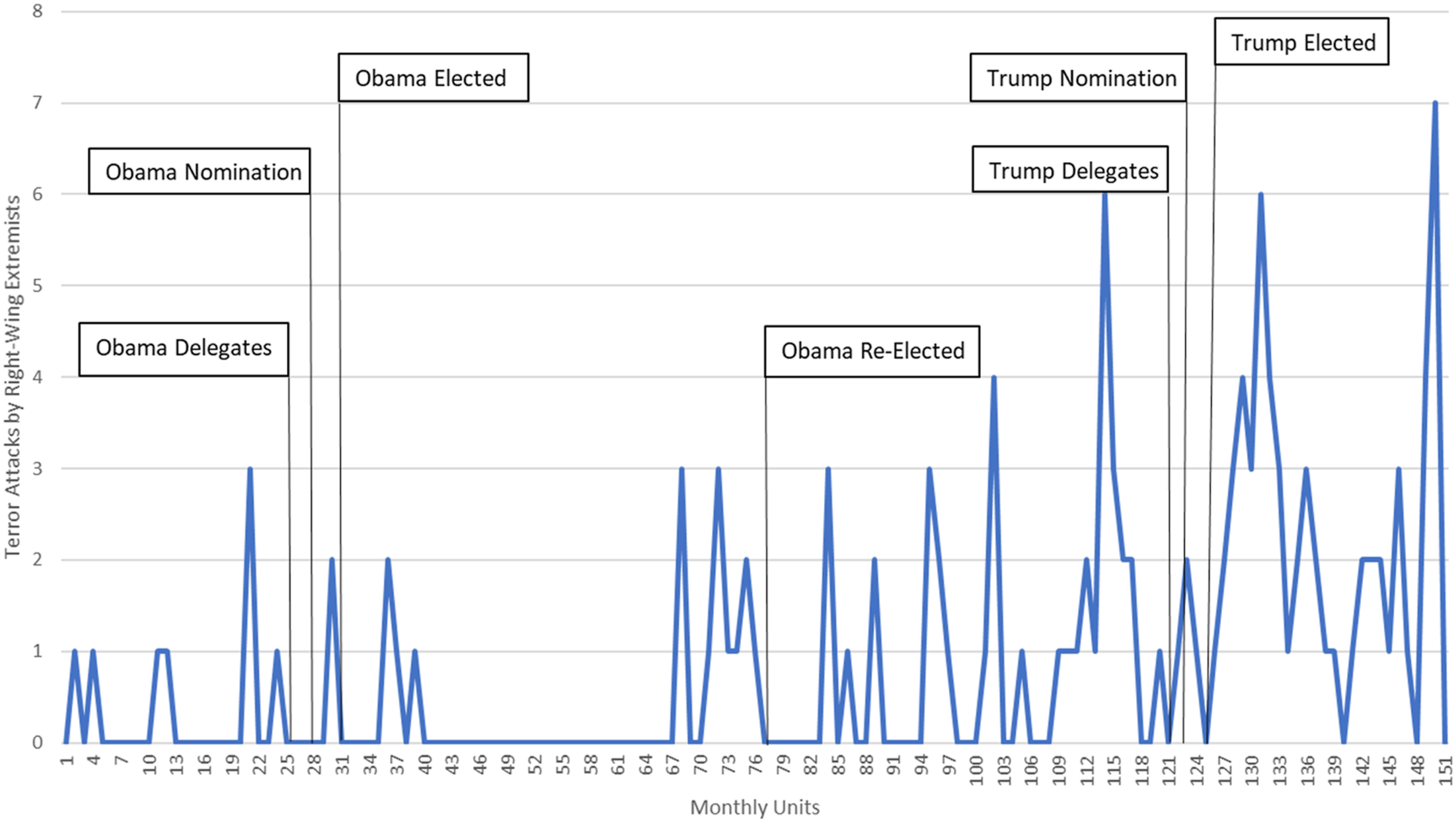
Dependent Variable
For the purposes of this study, right-wing extremism was conceptualized as an attempted or successful symbolic attack motivated by right-wing ideology. As described by Chermak and Gruenewald (2015), this ideology encompasses White supremacy, anti-Semitism, anti-immigration, anti-government, and anti-abortion tendencies. Individuals who commit such attacks are often ‘fiercely nationalistic,’ believing there is a threat to national sovereignty and/or their personal liberty and way of life are under attack by ethnic, racial, or religious groups (Chermak & Gruenewald, 2015). Examples of right-wing extremist groups include the Patriot Front, United Aryan Empire, Sovereign Citizens, and Minutemen American Defense. In accordance with this conceptualization, right-wing extremism was operationalized through monthly counts of attempted or successful terrorist attacks motivated by right-wing ideology in the United States between June 3, 2006, and December 31, 2018.
Independent Variables
This study uses multiple intervention components associated with the candidacies and elections of Barack Obama and Donald Trump to test the effects of each on the frequency of right-wing extremism in the U.S. Each intervention component was selected based on the expectation that it should elicit a response from right-wing extremists in the form of terrorist attacks. Specific to Barack Obama’s first candidacy, the following events were selected as intervention components: (1) Candidate Barack Obama secures enough delegates to clinch the Democratic Party nomination (June 3, 2008), (2) Candidate Barack Obama is formally named the Democratic Party nominee (August 27, 2008), (3) and the election of Barack Obama as 44th president of the United States (November 4, 2008). The re-election of President Obama on November 6, 2012, is also treated as an intervention component.
Specific to Donald Trump, the following events were chosen as intervention components: (1) Candidate Donald Trump secures enough delegates to clinch the Republican Party nomination (May 26, 2016), (2) Candidate Donald Trump is formally named Republican Party nominee (July 19, 2016), and (3) Donald Trump is officially elected 45th president of the United States (November 11, 2016). In accordance with assumptions of interrupted time-series analysis described below, these measures are treated as dichotomous intervention components (0 = pre-intervention, 1 = post-intervention).
Analytic Strategy
This study adopted a quasi-experimental, longitudinal design. Specifically, interrupted time-series analyses were used to assess the impact of the Obama and Trump candidacies and elections on right-wing terrorism across time. Time-series designs are frequently adopted in longitudinal studies of crime outcomes, including terrorism (Carson, 2014; Jacobs & Carmichael, 2002), and provide an effective method of determining the impact of a discrete intervention on a social process (Dugan, 2010; McDowall et al., 1980). Interrupted time-series analysis, in particular, allows researchers to discern the effect of social policy and legislation on crime through comparison of observations (e.g., terrorist attacks) that precede and follow the introduction of an intervention (Dugan, 2010; McDowall et al., 1980). This analytical approach is desirable because it is capable of modeling and controlling for serial dependence that frequently manifests in criminal justice research (Dugan, 2010; McDowall et al., 1980). As described by McDowall et al. (1980), trend, seasonality, and random error represent the three sources of noise that may obscure the effect of an intervention. This study utilized ARIMA models, which control for all three sources of noise (Dugan, 2010; McDowall et al., 1980).
Examination of the 151 monthly counts of right-wing terrorist attacks revealed a mean of .841 (approximately 1) right-wing terrorist attacks per month during the observation period. There was, however, a high degree of skewness (2.02) and kurtosis (7.60) present in the data which resulted in a square root transformation of the dependent variable. The transformed data were then subjected to the Augmented Dickey-Fuller test to determine if there was a unit root and, in turn, the need for differencing. Each critical value (1% = −3.493, 5% = −2.887, 10% = −2.577) was smaller in absolute magnitude in comparison to the test statistic (−7.458) and grew smaller in magnitude. Considered in tandem with the MacKinnon approximate p-value (.0000), it was concluded that the series was stationary and did not require differencing. A visual inspection of the autocorrelation function (ACF) and partial autocorrelation function (PACF) was then performed for evidence of autoregressive (AR) and moving average processes. A funneling effect was observed in the ACF and PACF functions, suggesting a first order AR process. Further, the presence of a spike at the 12th lag of the PACF suggested a possible seasonal effect defined by a first order moving average process. In tandem, the nature of the ACF and PACF functions suggested prompted tentative identification of an ARIMA (1,0,0) (0,0,1)12 model for the right-wing terrorist attack series. Model parameters were then estimated and the statistical significance of the AR1 and seasonal MA1 validated the use of an ARIMA (1,0,0) (0,0,1)12 model. Further examination of ACF and PACF residuals confirmed that the residuals were not different from white noise at a statistically significant level.
Hypotheses
As described in the review of the literature, the political threat hypothesis predicts a violent backlash effect in response to the political gains, both real and anticipated, of minority groups (Blalock, 1967; Dugan & Chenoweth, 2020; Eitle, D’Alessio, & Stolzenberg, 2002). We anticipate that the emergence of Barack Obama as a front-runner for the presidency and his election to that office prompted such a backlash in the form of right-wing terrorist attacks. Accordingly, the following hypotheses were derived: H1a: Candidate Obama securing enough delegates to clinch the Democratic party nomination will be positively related with violent acts of terrorism committed by right-wing extremists. H1b: Candidate Obama being formally named the Democratic party nominee will be positively related with violent acts of terrorism committed by right-wing extremists. H1c: The election of Barak Obama to the presidency will be positively related with violent acts of terrorism committed by right-wing extremists.
Similarly, it is expected that President Obama’s re-election triggered an increase in the frequency of domestic terrorist attacks committed by right-wing extremists as a consequence of executive orders, domestic policies, and international agreements associated with this first time that were favorable toward racial, ethnic, and religious minorities. H1d: President Obama’s re-election will be positively related with violent acts of terrorism committed by right-wing extremists.
Finally, the literature has consistently suggested that the Trump candidacy likely emboldened White nationalists and other right-wing extremists (Berger, 2016a; Fisher et al., 2019). In accordance with these assertions, the following hypotheses were constructed: H2a: Candidate Trump securing enough delegates to clinch the Republican party nomination will be positively related with violent acts of terrorism committed by right-wing extremists. H2b: Candidate Trump being formally named the Republican party nominee will be positively related with violent acts of terrorism committed by right-wing extremists. H2c: The election of Donald Trump to the presidency will be positively related with violent acts of terrorism committed by right-wing extremists.
Results
Once model parameters for the ARIMA model were estimated, the effects of each of the intervention components were tested. As described by Dugan (2010) and McDowall et al. (1980), three distinct patterns can be expected when assessing the impact of an intervention: abrupt and temporary, gradual and permanent, or abrupt and permanent. A fourth pattern, gradual and temporary, is rarely observed in research and is extremely difficult to model (Dugan, 2010; McDowall et al., 1980). Dugan (2010) and McDowall et al. (1980) suggest that researchers should first model abrupt, temporary effects because the significance and magnitude of the slope maintain implications for the likelihood of permanent effects. In particular, if while modeling abrupt and temporary effects, the slope is near one and statistically significant, then the effects are more likely to be permanent. Gradual, permanent effects should then be modeled. This effect is the most common in the social sciences and involves replacing the pulse function (ωPt) with a step function (ωIt). If, while modeling gradual and permanent effects, the slope is statistically non-significant, this may suggest that the effect is abrupt and permanent. This effect involves removing the slope component of the equation for gradual, permanent effects.
Time-Series Analysis of the Impact of the Presidency on Right-Wing Extremism.
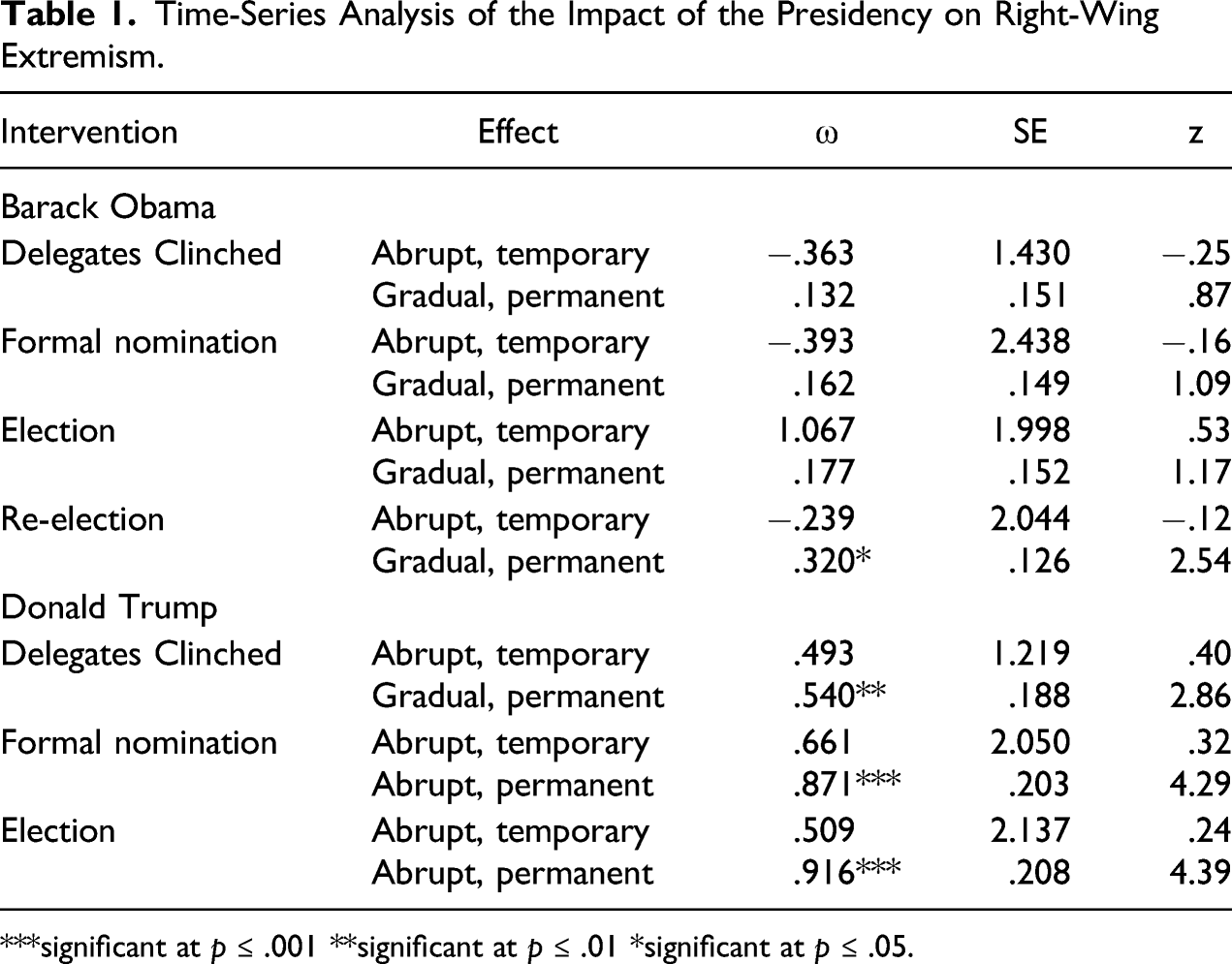
***significant at p ≤ .001 **significant at p ≤ .01 *significant at p ≤ .05.
By comparison, results related to the Trump-specific intervention components were all statistically significant. Consistent with Hypothesis 2a, Trump’s securing enough delegates to clinch the Republican party nomination was associated with a gradual, permanent increase in the frequency of right-wing terrorist attacks. His formal nomination as the Republican party candidate (H2b) and election to the presidency (H2c) were also associated with permanent increases in the frequency of domestic terrorist attacks committed by right-wing extremists, but these effects were abrupt rather than gradual. It is also noteworthy that the effect sizes for each of the Trump-specific intervention components were comparatively larger than the effect size associated with President Obama’s re-election.
Discussion and Conclusions
The purpose of this study was to explore and compare the impact of the Obama and Trump presidential candidacies and elections on right-wing extremism in the U.S. Prior works have suggested that specific words and actions by Presidents Obama and Trump impacted targeted forms of violence, including hate crime and terrorism during their respective presidencies. In this vein, our methodology represents a substantive contribution to the literature given that we explore the impact of Obama and Trump on right-wing terror in terms of their candidacies and elections rather than their behavior only after assuming office.
This study does, however, exhibit several limitations that merit further discussion. First, time-series analyses frequently experience a trade-off between statistical power and stability (Dugan, 2010). This study is no exception. Terrorism is a statistically rare event, and although the use of a smaller temporal unit of analysis (e.g., weeks) would increase statistical power, it would also result in decreased model stability. Thus, the selection of months as the temporal unit represents an imperfect but necessary approach. Relatedly, as noted by Dugan (2010), temporal aggregation runs the risk of imposing false homogeneity across heterogenous events, while masking both the effects of intervention components and possible context-specific dependence between events. Further, the decision to aggregate all events that occurred in the U.S. during the observation period likely resulted in a ‘binning effect’ that obscures regional variation in right-wing extremism. Because right-wing terrorist attacks are statistically rare, however, these shortcomings are difficult to adequately address. Finally, this study fails to incorporate potentially important controls. As noted in the review of the literature review, for example, media attention and social media traction associated with comments and actions by political leaders may exert their own unique influence on extremist activity.
Despite these limitations, our findings carry with them a number of implications in light of the increasing polarization of the two-party system in the U.S., as well as in relation to the power-threat perspective. Simi (2010) argued that the election of Barack Obama to the presidency was the ‘tipping point’ that mobilized right-wing recruitment efforts in the U.S. Specifically, he argued that Obama’s candidacy posed a threat to White supremacy. Accordingly, Hypotheses 1a through 1c expressed the expectation that milestones associated with his first candidacy and election would be associated with discernible increases in the frequency of right-wing terrorist attacks. The results of our ARIMA analyses, however, offered no support for these hypotheses. Yet, President Obama’s re-election was associated with a gradual, permanent, and statistically significant increase in the frequency of domestic terror committed by right-wing extremists.
In their totality, these findings suggest that the candidacy and election of a Black man to the nation’s highest office may have been viewed by right-wing extremists as an abstract or symbolic rather than practical, mobilizing threat. Indeed, had the emergence of Obama as a front-runner for the presidency and his election to that office been viewed as a legitimate threat to the political dominance of White persons, a backlash effect should have been observed in the form of increased terrorist attacks committed by right-wing extremists. Instead, the gradual and permanent increase in attacks by right-wing extremists that began with President Obama’s re-election may be attributed to heightened anti-government beliefs and racial animus based on perceptions of events of his first term. The failure of the federal government to hold Wall Street accountable for the Great Recession, coupled with a slow economic recovery, may have signaled both the government’s protection of the wealthy and inability to protect blue collar workers—millions of whom had lost their homes and livelihoods (MacAskill, 2009). Further, although the ACA was proposed to expand the number of U.S. citizens' access to comprehensive healthcare, it also held an individual mandate that all Americans were required to have health insurance or pay a fine. To many conservatives, this signaled an extension of government oversight into the sphere of health care that bordered on socialism (Thompson, 2015). Certain consequences of the ACA may have exacerbated such sentiments. In particular, despite promises to the contrary, millions of Americans lost their insurance plans. Further, between 2011 and 2016, deductibles, co-payments, and out-of-pocket maximums grew significantly faster than wages for group market participants (Hamel et al., 2016). The Obama administration’s response to the attack on U.S. personnel in Benghazi on 9/11/12, role in the Arab Spring from 2010 to 2012, and extension of key provisions of the Patriot Act that allowed for the violation of U.S. citizens' privacy rights might also have served as individual motivations for increased activity by right-wing extremists.
One should also be mindful that certain comments made by President Obama, even prior to his first election, may have planted these seeds. For example, when describing the impact of the loss of manufacturing jobs on working-class White persons in the Northeast and Midwest, Obama was quoted as saying, “They get bitter, they cling to guns or religion or antipathy to people who aren't like them or anti-immigrant sentiment or anti-trade sentiment as a way to explain their frustrations” (Pilkington, 2008). These comments were seized on by fellow presidential candidate Hillary Clinton, who described them as “demeaning,” “elitist,” and “out of touch” (Pilkington, 2008). It is possible that these and other statements created feelings of alienation and disenfranchisement among a demographic that had already pushed to the fringes of the economic system in the wake of the Great Recession—creating a group of individuals primed for recruitment by the far right. The Obama administration’s aforementioned activities may have served to further cultivate discontent, even in liberal strongholds. Indeed, in addition to a rise in right-wing activity in the Rust Belt following President Obama’s re-election (DHS, 2009; McQuarrie, 2017; SPLC, 2020), Donald Trump swept each of these states in his first presidential run.
In line with these assertions, all Trump-specific intervention components achieved statistical significance. Interestingly, Trump securing enough delegates to win the nomination exerted a gradual influence over the frequency of right-wing terrorist attacks, while his formal nomination and election to the presidency each exhibited an abrupt impact. Cumulatively, these findings suggest that the right-wing extremist community was not ‘all in’ on Trump throughout his candidacy. This assertion is consistent with the qualitative observations of Berger (2016a), who noted that it was some time before right-wing extremists warmed to Trump. In fact, the very extremists who eventually embraced Trump referred to him as a “Jew-snuggler” and “asshole” early in his candidacy (Berger, 2016a, p. 3). Yet the consistency of his nationalistic agenda in relation to immigration, terrorism, manufacturing, and trade appears to have emboldened right-wing actors and groups to engage in domestic terrorism—a fact that is illustrated in our findings. Indeed, public comments and Tweets made by Donald Trump, both as a candidate and president, likely energized certain right-wing extremist groups in addition to political conservatives. Trump’s attacks on the political establishment, as well as nationalistic approaches to trade, manufacturing, and immigration, likely provided affirmation to a demographic increasingly abandoned by the Democratic party. In addition, they likely emboldened right-wing extremists. In this vein, the findings presented here are largely supportive of prior works that describe a connection between President Trump’s comments and increases in minority-targeted crimes (Crandall et al., 2018; Müller & Schwarz, 2018; Piazza, 2016, 2020; Schaffner, 2018). They are also prescient given the events surrounding the capitol siege in Washington, D.C., on January 6th, 2021. Whether or not President Trump is legally responsible for the subsequent siege on the Capitol continues to be a subject of debate, despite his acquittal in the Senate. What transpired on the U.S Capitol grounds that day does, however, suggest that the words of presidents matter—and can influence abrupt shifts in right-wing domestic terrorist activity.
Our findings move us to suggest that political leaders on the left and the right, as well as media pundits, must be more cognizant of the effects of their rhetoric and its ability to alienate individuals and embolden both extremist groups and individuals. Neither elected officials nor candidates for political office should espouse, condone, or encourage violence in the name of any cause. President Biden has expressed similar sentiment in his recent calls for unity (Biden, 2021), but it is imperative that it amount to more than lip service. Second, and relatedly, in the wake of the rise in right-wing extremism, federal officials must take care to avoid heavy-handed responses that may result in a backlash effect, whereby extremist groups benefit from increased sympathy and recruitment from the general population (Lafree et al., 2009). Given this implication, federal officials and media personalities must reflect on the failed federal sieges at Waco and Ruby Ridge and the subsequent increase in right-wing activity (Lind, 2016; Pruitt, 2018; Seegmiller, 2007; Simi et al., 2016), as well as methods of avoiding such failures in the future. Failure to abide by these recommendations risks deepening a divide to the point that it cannot be reconciled—and, in turn, the end of the American experiment.
Footnotes
Declaration of Conflicting Interests
The author(s) declared no potential conflicts of interest with respect to the research, authorship, and/or publication of this article.
Funding
The author(s) received no financial support for the research, authorship, and/or publication of this article.
