







Abstract
Previous research links unstructured socializing with victimization. In addition, recent research also links digital media use with particular forms of online victimization (e.g., cyberbullying, harassment, sex solicitation, phishing, computer viruses, etc.). Very limited research, however, has explored how socialization through virtual means (e.g., using social networking sites, video chatting, and texting) is associated with in-person victimization. This is a pertinent gap in the literature as trends in adolescent socializing have been shifting from spending time in-person to spending more time socializing through virtual means. As a result, the current state of the literature cannot adequately assess the risks that may be posed by spending time engaging in virtual socializing. This article addresses this gap in the literature by examining the relationship between virtual socializing and several indicators of in-person victimization (i.e., property, violent, and in-school bullying victimization) along with one indicator of online victimization (i.e., cyberbullying) in a nationally representative sample of adolescents. Specifically, our study utilizes negative binomial regression and logistic regression to test associations between time spent using social networking sites, video chatting, texting, and phone usage and in-person victimization using data drawn the 2018 eighth and tenth grade cohort of Monitoring the Future . Our findings reveal that time spent engaging in virtual socializing activities is associated with a greater likelihood of property, violent, in-school bullying, and online bullying victimization. In addition, these associations remain significant when taking into account time spent engaging in in-person unstructured socializing. The implications of these findings for future research and policy are discussed.
Introduction
Increased use of technological devices such as mobile phones and computers has changed many aspects of social life, including adolescent socialization (Baumer et al., 2020; Common Sense Media, 2015; Tozer, 2017). Youth nowadays spend several hours each day on social media sites, texting, and video chatting (Common Sense Media, 2015). This rise in virtual socializing may have led to a reduction in in-person socialization, as data from the Bureau of Labor Statistics’ American Time Use Survey finds that adolescents currently spend less time socializing in-person than they did a decade ago (Tozer, 2017). Though socializing through virtual means seems to comprise a considerable portion of an adolescent’s day, little is known about the effects of virtual socializing. Of consequence, a few recent studies have documented a link between aspects of virtual socialization and delinquency (Leal et al., 2022; Meldrum & Clark, 2015; Weerman et al., 2015), which dovetails with a body of criminological research that consistently finds that a victim offender overlap exists, wherein individuals involved in delinquency experience higher risks of victimization (see Jennings et al., 2012). However, despite the growing literature on the impact of online socialization on delinquency, and the established connection between delinquent involvement and experiencing victimization, research has yet to determine whether virtual socializing is directly linked with in-person victimization.
Although the relationship between virtual socializing and victimization is currently unknown, research on unstructured socializing may shed some light on possible associations. Unstructured socializing involves interactions with peers that occur outside the supervision of authority figures and the activities engaged in do not require time to be spent in a particular manner (i.e., just hanging out) (Osgood et al., 1996). Criminological studies have consistently found that unstructured socializing is strongly predictive of delinquency (Anderson & Hughes, 2009; Augustyn & McGloin, 2013; Barnes et al., 2007; Bernburg & Thorlindsson, 2001; Haynie & Osgood, 2005; Maimon & Browning, 2010; Osgood & Anderson, 2004) and also affects victimization (Averdijk & Bernasco, 2015; Dong et al., 2020; Engström, 2018; Maimon & Browning, 2012). Virtual socializing and unstructured socializing share many similar features, as activities such as texting, talking on the phone, video chatting, and social networking, involve interactions with peers, outside the supervision of authority figures, that are not organized in a particular manner (Osgood et al., 1996). As a result of these shared features, it is possible that virtual socializing could impact victimization similarly to unstructured socializing. On the other hand, if being in the physical presence of peers is necessary for the effects of unstructured socializing on victimization to emerge, then it is possible that virtual socialization could decrease victimization in the case that adolescents are spending less time socializing in-person.
Currently, little is known about the possible effects of virtual socializing, in particular the effects of virtual socializing on victimization. The extant research that links facets of virtual socializing to forms of victimization generally focuses on cyberbullying (Marcum et al., 2014; Seiler & Navarro, 2014) or other forms of online victimization (Marcum et al., 2010; Ngo et al., 2020). Additionally, although research has linked aspects of virtual socializing to in-person delinquency, and in-person delinquency has been linked to in-person victimization, studies have yet to determine whether virtual socializing directly impacts in-person victimization. This is an important gap in the literature as it is possible that virtual socializing could have a positive or negative association with victimization. The current study addresses this gap by examining the associations between a novel measure of virtual socializing and various forms of victimization (violent, property, in-person bullying, and online bullying) using a nationally representative sample of American adolescents collected in 2018.
Unstructured Socializing and Victimization
Osgood et al. (1996) coined the term unstructured socializing when they expanded routine activities theory to explain individual level offending. They assert that the risk of delinquency increases when adolescents are in the presence of their peers, in the absence of authority figures, and engaging in situations conducive to delinquency that have no inherent structure (Osgood et al. 1996). Specifically, delinquency is predicted to occur when engaging in unstructured socializing because peers may encourage and reward deviance, and no authority figures are present to exert social controls. Additionally, unorganized activities, such as just hanging out, are more conducive to delinquency than structured activities (such as going to the movies or playing sports) because there are no specific events that must occur in order for these activities to occur. A large body of literature has linked unstructured socializing to many types of delinquent and deviant behaviors. Of note, this relationship appears to hold true across gender and international samples (see Hoeben et al., 2016).
While the literature on the relationship between unstructured socializing and delinquency is expansive, far fewer studies examine the effect of unstructured socializing on victimization. These studies find that higher levels of unstructured socializing among adolescents increases the likelihood of victimization (Averdijk & Bernasco, 2015; Dong et al., 2020; Engström, 2018; Maimon & Browning, 2012). For example, Maimon and Browning (2012) found that unstructured socializing is positively related to violent victimization of youth in their neighborhoods. Additionally, a recent study discovered that unstructured activities increase the likelihood of violent victimization at particular geospatial locations during both daytime and nighttime (Dong et al., 2020).
The link between unstructured socializing and victimization can be explained through the same mechanisms as its association with delinquency. When adolescents socialize in unregulated activities without the supervision of authority figures, it increases the chances of deviance and delinquency. Specifically, the odds of delinquency increase because peers can provide reinforcement for delinquent acts, authority figures cannot exert social controls to prevent delinquency, and engaging in activities that do not require any particular events to occur leaves more time for deviance (Osgood et al., 1996). Studies consistently find an overlap between victimization and delinquency, whereby exposure to risky criminal lifestyles can increase the chances of victimization (Jennings et al., 2012; TenEyck & Barnes, 2018). Thus, as a result of increased delinquent involvement, unstructured socializing also increases the likelihood of victimization (Engström, 2018). For example, Engström (2018) examined whether a variety of risk factors were associated with being a victim only, offender only, or victim and offender. The study found that unstructured socializing “enables adolescents to commit acts of violence, but also makes them more exposed to others’ violent behavior” (Engström, 2018, p. 914). As virtual socializing contains many elements that are similar to unstructured socializing, it would not be surprising if virtual socializing impacted victimization in the same way.
Virtual Media Use and Victimization
Research in the area of virtual media use and victimization generally finds that particular forms of virtual media (such as social networking, Internet use, emailing, etc.) impacts certain types of victimization such as cyberbullying or online victimization (Marcum et al., 2010, 2014; Ngo et al., 2020; Seiler & Navarro, 2014). For example, Seiler and Navarro (2014) found that Internet use via cell phones and daily use of social networking sites increased the likelihood of being both cyberbullied and bullied offline. Importantly, this study suggests that cyberbullying is not categorically distinct from offline bullying, which underscores the significance of studying the effects of virtual media on both in-person and online victimization. Additionally, a recent study investigated whether specific activities and types of information being shared online affect cybercrime victimization above and beyond just the length of time spent online. They found that hours spent online, specific online activities (banking, reading news, shopping, planning travel, socializing, and communicating with strangers) and certain types of information being posted online (phone number, home address, and other information) were associated with particular types of cyber victimization including computer viruses, harassment by non-strangers, unwanted porn, sex solicitation, and phishing (Ngo et al., 2020).
Of note, the majority of the research in this area focuses on how virtual media use affects various types of online victimization. Very little research, however, examines whether virtual socialization impacts in-person victimization. What research has been conducted in the area has tended to focus on the risks of sexual victimization of minors by online contacts. Existing research, for instance, has found that motivated offenders may use social networking sites to target minors for sex crimes (Hasebrink et al., 2008; Marret & Choo, 2016; Mitchell et al., 2010, 2011). As a result, engagement in social networking for minors may be seen as a risk factor for being targeted for at least some specific forms of in-person victimization. There is also evidence to indicate that adolescents who engage in online activities related to chatting with otherwise unknown online-acquaintances may be at risk for verbal, physical, and sexual assaults (Marret & Choo, 2016). For example, according to a study by Marret and Choo (2016) approximately 5.5% of adolescents who met up with online acquaintances in person reported being assaulted. However, additional research employing a Danish sample of adolescents revealed that while a significant portion of adolescents report meeting Internet acquaintances in person (41%–45%) very few of these meetings (0.5%–1.2%) led to victimization experiences (Helweg-Larsen et al., 2012). As a result, the current research seems to indicate that at least some virtual socializing related behaviors (e.g., meeting up with online acquaintances in person) may not pose as much of a threat as previously thought. Much of this research, however, focuses on very particular forms of victimization (i.e., sexual victimization) and very specific forms of risky online activities.
As can be seen, the majority of research exploring the intersection of virtual socializing and victimization has primarily focused on online victimization, and very little research has explored how virtual socializing may be related to the risks on in-person victimization. This is an important gap in the literature as there is currently no reason to believe that socialization through virtual means would only impact online forms of victimization. As virtual socialization shares many features with traditional in-person unstructured socialization, it is reasonable to suggest that the effects of virtual socialization on victimization would extend to both in-person and online victimization for several reasons. First, virtual socializing may widen social networks making individuals more vulnerable to victimization. Adolescents with active social networking profiles or who are active in various forms of virtual chatting, for instance, may encounter more individuals who could pose a potential danger to them than they would have if they were restricted to only traditional in-person unstructured socializing. Second, adolescents who are active on social media and active in online chatting may post information about themselves, their property, and their daily activities, which may make them vulnerable to victimization from other adolescents (who they may not socialize with in person) above and beyond their vulnerability if this information was not publicly available (Haynes & Robinson, 2014; Mitchell et al., 2010; Rosenblum, 2007; Weir et al., 2011). For example, an adolescent may post information concerning their new phone or tablet and their daily activities at school on a social networking site, which may alert motivated offenders at their school to the presence of a new desirable tech item they may be interested in acquiring for themselves—thus increasing the chances of theft. Moreover, if adolescents post additional information concerning their property (e.g., locker number, usual parking space, where they may leave their backpack unattended, etc.), then this information could be used by motivated offenders to steal/vandalize property of interest (Haynes & Robinson, 2014).
A third possibility is that virtual socializing allows for an additional forum for unstructured socializing (in general) and for interpersonal conflicts to play out, outside of the observation or monitoring of parents/guardians/teachers. Social interactions and conflicts may, therefore, play out in a covert setting even while adolescents are generally in the vicinity of adults who would otherwise be able to monitor their behavior. As a consequence of this covert forum for handling interpersonal issues, students may be more likely to argue, get in fights, or otherwise be antagonized by other adolescents, which may then lead to an increased chance of having an adverse encounter (violent or property victimization) spill over into the physical realm. However, before the current era of social media and virtual socializing, many conflicts would have mostly played out in person and may have been interrupted or stopped by adults motivated to constrain adolescent behavior (e.g., parents, teachers, and school administrators).
On the other hand, it is possible that virtual socializing may be linked with lower levels of victimization, as adolescents who spend a significant portion of their socializing virtually may spend considerably less time socializing in-person. That is, if adolescents are spending a significant amount of time on their technological devices instead of going out and socializing in-person (traditional unstructured socializing), then they may be less vulnerable to victimization as they are spending the majority of their time in a controlled environment (e.g., home). If this were the case, than it would be expected that spending more hours engaging in virtual socializing would be associated with a lower likelihood of both property and violent victimization. In contrast, as these adolescents are spending more time online, it may be expected that virtual socializing would be positively associated with experiencing victimization online such as cyber-bullying.
The Current Study
Previous research has documented associations between unstructured socializing and victimization (Averdijk & Bernasco, 2015; Dong et al., 2020; Engström, 2018; Maimon & Browning, 2012) and has also found that certain forms of virtual media use affect particular types of online victimization (Marcum et al., 2010, 2014; Ngo et al., 2020; Seiler & Navarro, 2014). Very limited research, however, has explored whether virtual socializing may be related to in-person victimization. The current study addresses this gap in the literature by utilizing a novel scale of virtual socialization to determine whether socializing in the virtual sphere is associated with several forms of in-person victimization, and one type of online victimization, in a nationally representative sample of adolescents. To our knowledge, this is the first study to directly examine relationships between virtual socializing and in-person victimization. This is an important contribution to the existing literature as it is possible that virtual socializing could increase the risk of in-person victimization if it operates in a manner similar to traditional in-person unstructured socializing; however, it is also possible that it could decrease in-person victimization if adolescents are spending more time at home engaging in virtual socializing and less time socializing with their peers in-person. As the association between virtual socializing and in-person victimization is currently unknown and could possibly be either positive or negative, it is important to directly test this association.
Methods
Data
This study uses data drawn from the 2018 eighth and tenth grade Monitoring the Future (MTF) cohort. MTF is an annual survey of middle school and high school students that contains items pertaining to substance use, daily activities, school engagement, and victimization. The survey was first administered in 1972, and each year of data collection has been supported by the National Institute of Drug Abuse. Of note, each year, the MTF survey is administered in several different forms so that not all respondents are asked all possible questions. As a result, the analyses for this study are restricted to respondents who completed Form 1 (N = 9,995) of the survey, which is the only form that contains questions pertaining to victimization. After restricting the sample to respondents who had complete data on all key independent and dependent variables, the final analytic sample for this study is 7,209 respondents. Missing data for the covariates was handled using multiple imputation with chained equations (resulting in 20 multiply imputed datasets).
Measures
Outcome measures
Several measures of property and violent victimization over the last year were assessed in Form 1 of the 2018 cohort of MTF. These items were prefaced with the statement “The next questions are about some things which may have happened TO YOU while you were at school (inside or outside or in a school bus).” As a result, the victimization measures are primarily focused on victimization within and around school settings.
Theft
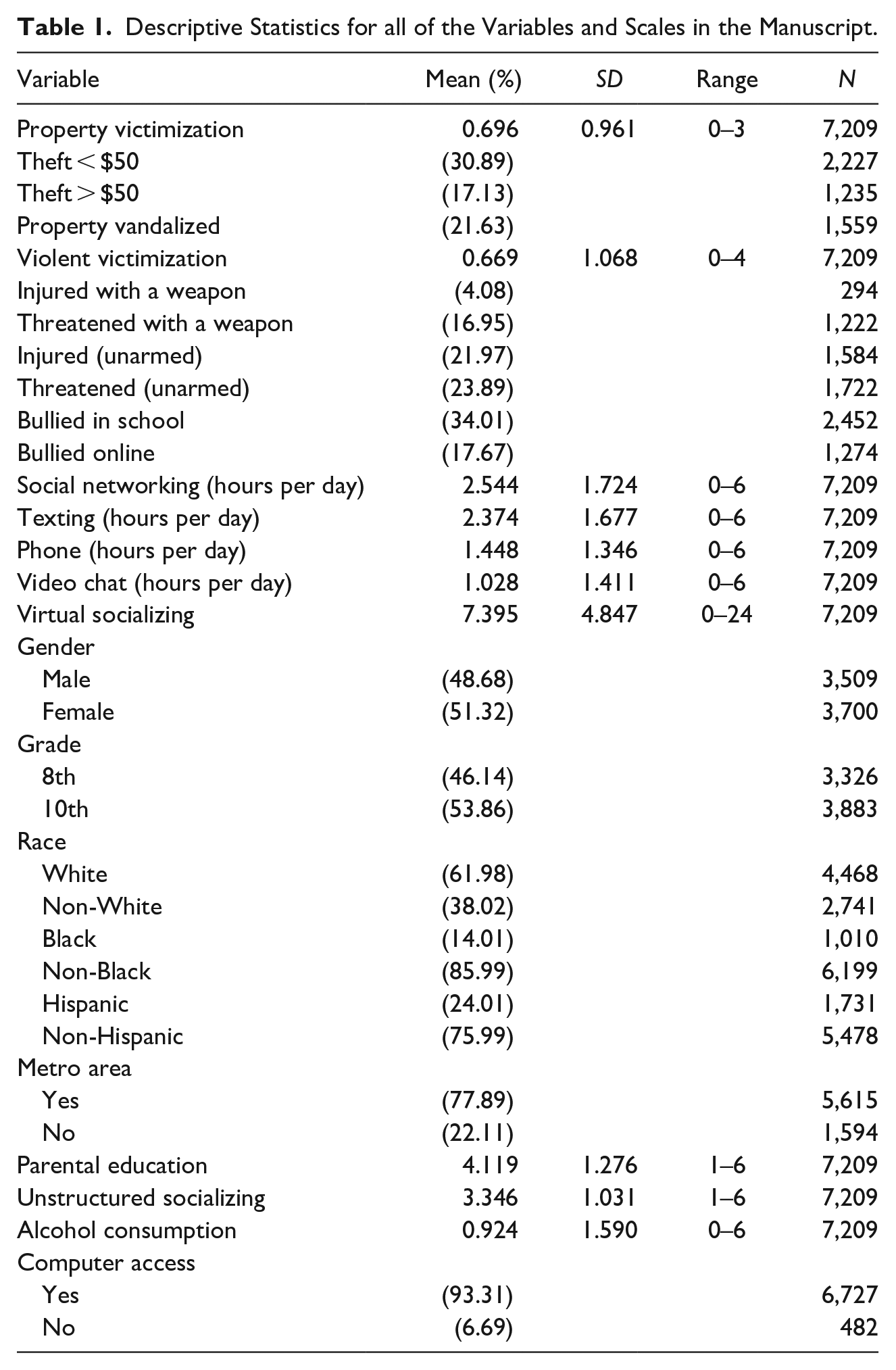
Experiencing theft was measured using two items. First, respondents were asked to indicate “During the last 12 months, how often. . .has something of yours (worth under $50) been stolen” and “During the last 12 months, how often. . .has something of yours (worth over $50) been stolen?” Response categories for these items included “not at all” (0), “once” (1), “twice” (2), “3–4 times” (3), to “5+ times” (4). These items have been recoded as dichotomous indicators of experiencing theft under $50 and theft over $50 (0 = no; 1 = yes). Descriptive statistics for these items and all other items and scales included in this study are presented in Table 1.
Descriptive Statistics for all of the Variables and Scales in the Manuscript.
Property vandalized
Experiencing property vandalization was measured using a single item where respondents were asked to indicate “During the last 12 months, how often. . .has someone deliberately damaged your property (your car, clothing, etc.?)” Responses to this item ranged from “not at all” (0), “once” (1), “twice” (2), “3-4 times” (3), to “5+ times” (4). This item has been recoded as a dichotomous indicator of having one’s property vandalized (0 = no; 1 = yes).
Property victimization index
A variety index of property victimization was created by summing together the dichotomous indicators of theft of over $50, theft of under $50, and property vandalization (0–3). This item is coded so that higher values represent experiencing more types of property victimization.
Injured with weapon
Being injured with a weapon was measured using a single item where respondents were asked to indicate how often during the last year (12 months) has “someone injured you with a weapon (like a knife, gun, or club?)” Response options for this item and the remaining victimization items are identical to the response options available for the property victimization measures. This item was recoded as a dichotomous indicator of having been injured with a weapon (0 = has not been injured with a weapon; 1 = has been injured with a weapon).
Threatened with weapon
Being threatened with a weapon was measured using a single item where respondents were asked to indicate how often in the last year they were threatened “with a weapon, but not actually injured.” This item was coded as a dichotomous indicator of having been threatened with a weapon where 0 = has not been threatened with a weapon and 1 = has been threatened with a weapon.
Injured without a weapon
Being injured without the use of a weapon was measured using a single item where respondents were asked “During the last 12 months, how often. . .has someone injured you on purpose without using a weapon?” This item been recoded so that 0 = has not been injured without a weapon and 1 = has been injured without a weapon.
Threatened without a weapon
Being threatened without a weapon was assessed using a single item where respondents were asked “During the last 12 months, how often. . .has an unarmed person threatened you with injury, but not actually injured you?” This item is coded as a dichotomous indicator where 0 = has not been threatened by an unarmed person and 1 = has been threatened by an unarmed person.
Violent victimization index
A variety index of violent victimization was created by summing together the dichotomous indicators of injured with a weapon, threatened with a weapon, injured without a weapon, and threatened without a weapon (0–4). This item is coded so that higher values represent experiencing more types of violent victimization.
Bullied in school
Being bullied in school was measured using a single item where respondents were asked “How often do you. . .feel bullied at school?” Response categories for this item ranged from “never” (0), “rarely” (1), “somedays” (2), “most days” (3), to “everyday” (4). This item has been recoded as dichotomous indicator of experiencing school bullying where 0 = has never been bullied and 1 = has been bullied.
Bullied online
Online bullying was measured using a similar item where respondents were asked to indicate how often they “feel bullied online?” The response categories for this item were identical to the response categories for the school bullying item. This item has been recoded so that 0 = has not experienced online bullying and 1 = has experienced online bullying.
Predictor measures
Virtual socializing
Virtual socializing was measured using responses to a series of questions concerning the daily use of digital media (i.e., texting, video chat, and social networking). The 2018 iteration of the MTF survey contains nine items pertaining to digital media use; however, only four of them were found to be specifically related to virtual socializing. In order to determine which items were related to virtual socializing, we performed principal component analysis (PCA) of the original nine items tapping digital media use. Results of the PCA suggested three components with Eigenvalues greater than one indicating that the nine items tapping digital media use do not load on a single construct. Four of the items (primarily focused on socializing through digital media) were revealed to load on a single component. These four items (i.e., social networking, texting, talking on the phone, and video chatting) were then combined together into a scale of virtual socializing (α = .79). Further examination of this scale revealed that removing any of the four items lead to a reduction in inter-item consistency. This item is coded so that higher values indicate more time spent virtual socializing on a daily basis.
Virtual socializing items
Social networking was measured using a single item where respondents were asked “About how many hours on an average day do you spend. . .on social networking sites like Facebook, Twitter, Instagram, etc.?” Response options for this item included “none” (0), “<1 hour” (1), “1–2 hours” (2), “3–4 hours” (3), “5–6 hours” (4), “7–8 hours” (5), and “9+ hours” (6). These same response options are included for the other digital media use/virtual socializing measures. This item is coded so that higher values represent more hours spent on social networking sites. Texting was measured using a similar item where respondents were asked to indicate how many hours per day they spend texting. Phone usage was measured using a single item where respondents were asked to indicate how many hours per day they spend “talking on the phone.” Video chatting was measured using a similar item where respondents were asked how many hours per day they spend “video chatting (Skype, etc.)?”
Controls
All of the analyses of this study were estimated controlling for eight variables. First, gender was measured using a single dichotomous indicator where 0 = female and 1 = male. Second, grade was measured using a single item where 1 = eighth grade and 2 = tenth grade. Third, race was measured using a series of dummy variables for white (0 = non-white; 1 = white), black (0 = non-black; 1 = black), and/or Hispanic (0 = non-Hispanic; 1 = Hispanic). For ease of interpretation, white was employed as the reference category for all analyses in this study. Fourth, living in a metro area was measured using a dummy variable 0 = does not live in a metro area and 1 = lives in a metro area. Fifth, parental education was measured using two items where respondents were asked to indicate the highest level of education completed by each of their parents. The first item, for instance, asked respondents this highest level of education completed by their father. Response options ranged from grade school to graduate or professional school after college. This item is coded so that higher values represent higher levels of education. The second item asked respondents to report the highest level of education completed by their mother. This item included the same response options as the previous education question. In order to assess overall parental education, responses to these two items were averaged.
Sixth, unstructured socializing was measured using responses to three items assessing socializing with peers outside of parental supervision. Respondents were asked, for instance, how often they “get together with friends informally (in your free time),” “go to parties or other social affairs,” and “ride around in a car (or motorcycle) just for fun.” Responses to these items ranged from “never” to “everyday.” Responses to these three items were combined together to create a scale of unstructured socializing (α = .58) where higher numbers reflect a higher degree of unstructured socializing. This unstructured socializing scale is identical to other unstructured socializing scales created previously with MTF data (Jackson et al., 2019). Seventh, alcohol consumption was measured using a single item where respondents were asked “On how many occasions (if any) have you had alcoholic beverages to drink—more than just a few sips—in your lifetime?” Response options for this item spanned from “0 occasions” to “40+” occasions. This item is coded so that higher values represent consuming alcohol on more occasions. Finally, computer access was measured using a single item where respondents were asked to indicate if they “have access at home to a computer (tablet, laptop, desktop computer)?” This item is coded so that 0 = does not have computer access and 1 = has computer access.
Analytic Strategy
The analytic strategy for this study took place in a number of steps. First, negative binomial regression and logistic regression were used to examine associations between virtual socializing and property victimization, violent victimization, being bullied in school, and being bullied online. Following these initial analyses, we also conducted a set of ancillary analyses to examine associations between each of the individual indicators of virtual socializing and the victimization outcomes. These analyses are presented in Supplemental Appendix A. Second, logistic regression was used to test association between virtual socializing and the odds of experiencing any of the three forms of property victimization. Finally, logistic regression was employed to examine the association between virtual socialization and the odds of experiencing each of the four types of violent victimization.
Results
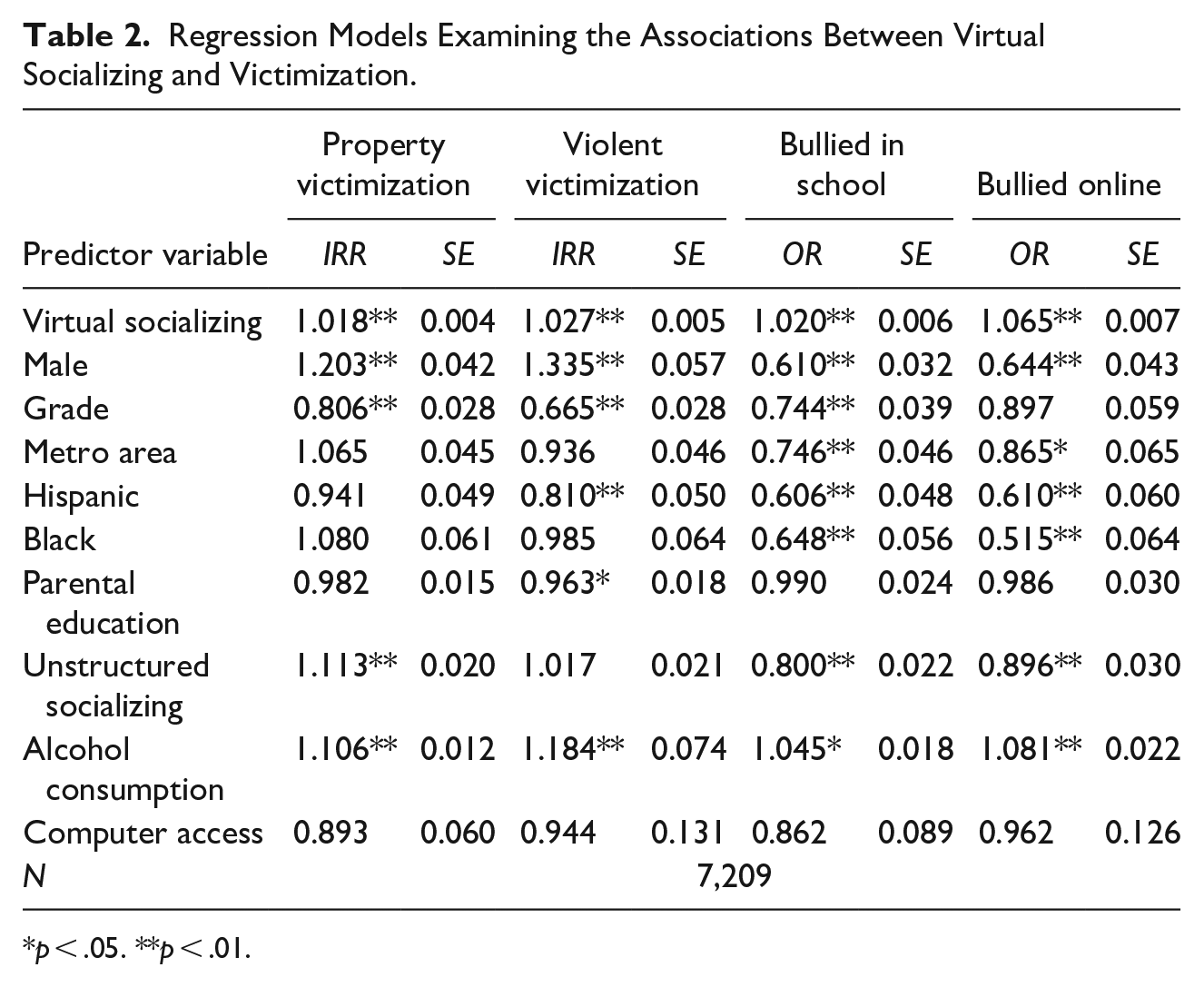
In the first step of the analysis, we examined the associations between virtual socializing and the four indicators of victimization. Examination of Table 2 reveals that virtual socializing is positively and significantly associated with both the property victimization (incidence rate ratio [IRR]) = 1.018, p < .01) and violent victimization (IRR = 1.027, p < .01) indexes. These findings indicate that respondents who spend more time texting, talking on the phone, video chatting, and on social networking sites are more likely to report a greater variety of both property and violent victimization experiences. Similarly, virtual socializing appears to be positively and significantly associated with the odds of reporting being bullied in school (odds ratio [OR] = 1.020, p < .01) and being bullied online (OR = 1.065, p < .01). Ancillary analyses (presented in Supplemental Appendix A) also revealed that each of the four indicators of virtual socializing is positively and significantly associated with the property and violent victimization indices. In addition, three of the virtual socializing activities (social networking, phone usage, and video chatting) are associated with the odds of being bullied in school and all four indicators are associated with the odds of being bullied online. Taken together, these findings indicate that greater engagement in virtual socializing is associated with experiencing more types of property victimization, more types of violent victimization, and greater odds of bullying victimization both online and in school.
Regression Models Examining the Associations Between Virtual Socializing and Victimization.
p < .05. **p < .01.
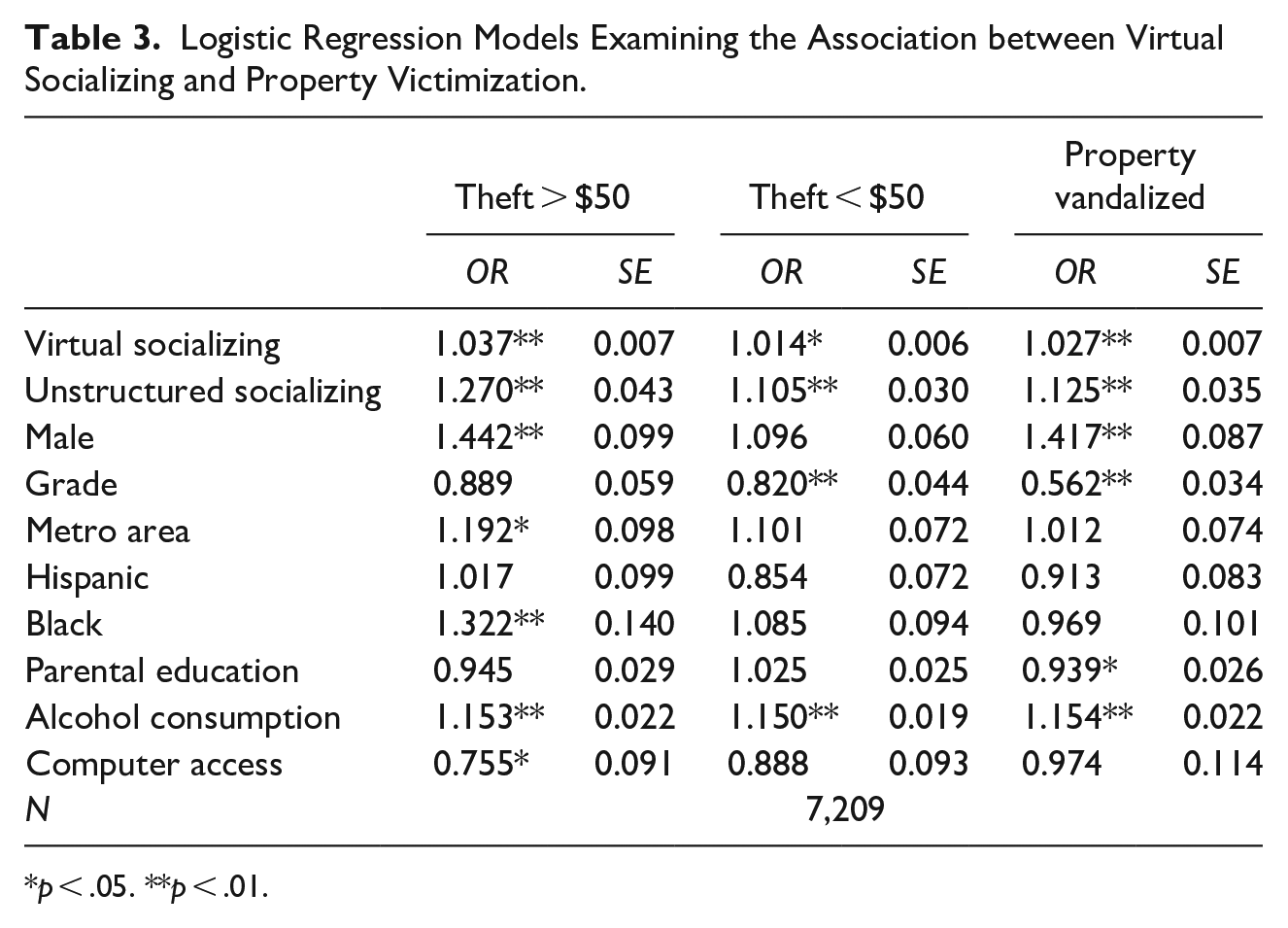
In the next step of the analysis, we examined the association between virtual socialization and the odds of experiencing each of the three forms of property victimization. As can be seen in Table 3, virtual socializing is positively associated with the likelihood of experiencing each of the three forms of property victimization (OR = 1.037, p < .01; OR = 1.014, p < .05; and OR = 1.027, p < .01). These findings indicate that the more time respondents spend engaging in virtual socializing, the more likely they are to experience each type of property victimization—even when adjusting for in-person unstructured socializing.
Logistic Regression Models Examining the Association between Virtual Socializing and Property Victimization.
p < .05. **p < .01.
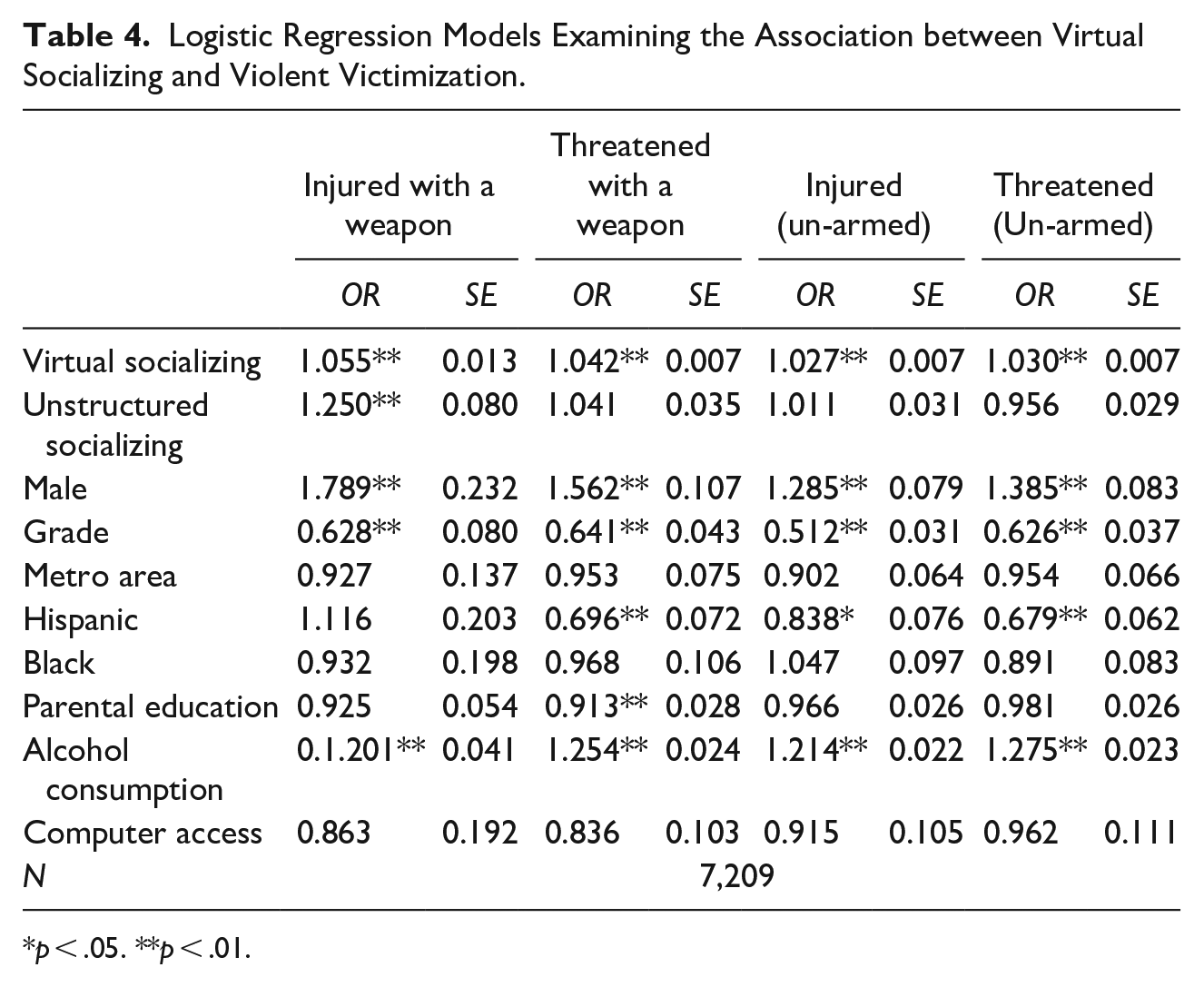
Finally, in the last step of the analysis, we examined the association between virtual socializing and the likelihood of experiencing each of the four types of violent victimization. Table 4 reveals that similar to the findings for property victimization, virtual socializing is positively associated with the odds of each of the four types of violent victimization (OR = 1.055, p < .01; OR = 1.042, p < .01; OR = 1.027, p < .01; and OR = 1.030, p < .01). These results indicate that respondents who spend more time engaging in virtual socializing are more likely to experience each of the four types of violent victimization net of controls.
Logistic Regression Models Examining the Association between Virtual Socializing and Violent Victimization.
p < .05. **p < .01.
Discussion
Previous research links virtual socializing with delinquency (Meldrum & Clark, 2015; Weerman et al., 2015), and online activities with online victimization (Marcum et al., 2010, 2014; Ngo et al., 2020; Seiler & Navarro, 2014); however, at present, very limited research has explored whether virtual socializing may be linked with victimization outside of virtual settings. Our study addressed this gap in the literature by exploring the connections between virtual socializing and several different indicators of victimization. The findings of our study yielded two major findings.
First, the findings of our study revealed that time spent engaging in virtual socializing (i.e., social networking, texting, talking on the phone, and video chatting) is positively associated with the scores on variety indexes of property and violent victimization. These findings indicate that time spent engaging in each of these activities is associated with reporting a greater variety of victimization experiences. In addition, the ancillary analyses revealed that time spent engaging in most of the virtual socializing activities (i.e., social networking, talking on the phone, and video chatting) is also associated with being bullied in school. These results suggest that somehow virtual socializing appears to increase the risks of experiencing victimization in the real world.
The second major finding is that virtual socializing as a whole appears to be associated with a greater likelihood of experiencing each of the individual forms of property and violent victimization net of controls. Similarly, the virtual socializing scale was also positively associated with the odds of experiencing bullying in school and bullying online. These results appear to indicate that there is something about virtual socializing, which makes adolescents more vulnerable to several different forms of victimization. Although the results concerning cyber bullying are not that surprising and are in line with previous research (Marcum et al., 2010, 2014; Ngo et al., 2020; Seiler & Navarro, 2014), the findings concerning victimization in the real world raise questions over how virtual socializing activity may influence adolescent social networks and social interactions in the real world in such a way that they increase the odds of victimization. For instance, it could be possible that adolescents are socializing with a wider network of peers through the use of a virtual medium and therefore may increase their likelihood of being victimized. On the other hand, it may be that social networking sites and other forms of virtual communication allow for interpersonal conflicts to escalate in a forum that is not visible to adults who may otherwise intervene, allowing for conflicts between adolescents to escalate to a greater degree than would be possible without these virtual forms of communication. Another possibility may be that adolescents who are particularly active on social media may post information about themselves, their property, and their daily activities online in a such a way that makes them more vulnerable to predation from motivated offenders. Additional research will be needed in order to explore the mechanism of the association between virtual socializing and property and violent victimization.
The findings of this study reveal that virtual socialization is significantly associated with property victimization, violent victimization, in school bullying, and cyber bullying. The findings of this study, however, need to be interpreted with caution taking into account several limitations. First, the data employed for this study are cross-sectional in nature limiting our ability to test causal relationships between virtual socializing and victimization. In other words, as virtual socializing and victimization are measured at the same time we cannot determine if virtual socializing (or changes in patterns in virtual socializing) occurred before victimization experiences, after victimization experiences, or at the same time/between victimization experiences. Future research employing longitudinal data that can examine patterns of virtual socializing activity and victimization over a significant period of time is needed in order to examine the temporal relationships between these two constructs. Second, the virtual socializing measures are limited in the sense that they do not contain data concerning who adolescents are socializing with online. Information pertaining to who adolescents are socializing with virtually would be ideal for examining the mechanism of the association between virtual socializing and victimization. Future research employing richer data concerning virtual socialization is necessary to examine whether adolescents are associating with the same peers they socialize with in person or if they are engaging with a significantly wider network of peers through the online environment. Third, the victimization measures are primarily focused on victimization in and around school contexts. As a result, the findings of this study are limited in their ability to examine the relationship between virtual socializing and other venues for victimization. Additional research will be needed in order to examine how virtual socializing is associated with victimization in other environments. Finally, this study examined a representative sample of eighth and tenth grade students and, as a result, the findings of this study may not adequately capture the association between virtual socializing and victimization in high-risk groups. For instance, previous research suggests that victimization rates vary across racial, ethnic, and sexual orientation status (Peguero et al., 2011; Webb et al., 2021). Therefore, future research examining higher risks groups of adolescents will be necessary in order to assess whether the association between virtual socializing and victimization holds for higher risk samples.
The findings of this study collectively demonstrate that virtual socializing impacts victimization both in the real world and the virtual world. As adolescent socialization is moving more in the virtual direction, criminologists should continue to examine the role virtual socializing plays in victimization. With the rise in personal technological devices, adolescents now have access to all the information and the people available on the Internet. If studies continue to find a connection between hours spent socializing through virtual means and victimization, it will be crucial for caretakers and parents to know this information. Caretakers could then make informed decisions about whether they want to limit their children’s access to some of their technological devices or use programs that monitor Internet and phone usage to learn about the types of activities that their children engage in through their devices.
This type of information would also be useful to teachers and school administrators. Throughout the last decade, schools have become more accepting of cell phones and other technological devices (such as tablets) as learning tools. For example, a survey of over 2,000 advanced placement and National Writing Project teachers found that about 73% of the teachers surveyed allow students to use their cell phones in the classroom to complete assignments (Purcell et al., 2013). Although this may be helping students academically, it could also be contributing to their victimization. As such, school administrators and teachers should consider this type of information when making decisions on the role of technological devices in the classroom.
Supplemental Material
sj-docx-1-jiv-10.1177_08862605221109922 – Supplemental material for Does Socializing in the Virtual World Impact Victimization in the Real World?
Supplemental material, sj-docx-1-jiv-10.1177_08862605221109922 for Does Socializing in the Virtual World Impact Victimization in the Real World? by Cashen M. Boccio and Wanda E. Leal in Journal of Interpersonal Violence
Footnotes
Declaration of Conflicting Interests
The author(s) declared no potential conflicts of interest with respect to the research, authorship, and/or publication of this article.
Funding
The author(s) received no financial support for the research, authorship, and/or publication of this article.

Supplemental Material
Supplemental material for this article is available online.
Author Biographies
References
Supplementary Material
Please find the following supplemental material available below.
For Open Access articles published under a Creative Commons License, all supplemental material carries the same license as the article it is associated with.
For non-Open Access articles published, all supplemental material carries a non-exclusive license, and permission requests for re-use of supplemental material or any part of supplemental material shall be sent directly to the copyright owner as specified in the copyright notice associated with the article.
