







Abstract
The higher moral sensitivity to bullying a student has, the more likely they are to help the victim or inhibit bullying rather than ignore it. Research has mainly focused on particular sensitivity to bullying, and it remains unknown whether sensitivity to everyday moral issues functions similarly. The present study aimed to examine the effect of everyday moral sensitivity (EMS) on bullying bystander behaviors. We included a range of school children (n = 1,655, Grades 3–12, 27.6% girls) in Southwest China. The results show 6.10% have been a victim-only, 0.48% have been a bully-only, 0.85% have been the bullying victim, 92.57% have been neither a bully nor a bullying victim, and 45.86% have observed bullying. Students in lower grades are more likely to be bullied. After controlling for covariates (i.e., gender, grade, and social desirability), EMS is positively associated with positive bystander behaviors. Moreover, empathy and moral disengagement (MD) play a mediating role in the relationship between EMS and positive bystander behaviors. The results reveal two parallel processes of EMS influenced bystander behaviors (i.e., empathy and MD). The findings indicate the possibility of cultivating EMS and highlight the role of morality development in preventing school bullying.
Introduction
The concept of basic moral sensitivity concentrates on the sensitivity to moral transgressions in bullying situations (Thornberg & Jungert, 2013). Documented evidence indicates that the more morally sensitive to bullying a child or adolescent is, the more likely they are to help the victim and inhibit bullying rather than ignore it (Thornberg & Jungert, 2013). The previous research focused on the degree to which students are aware of the harmful effects of bullying; however, it remains unclear whether sensitivity to everyday moral issues also functions by a similar mechanism. To address this research gap, we would examine the effects of children’s everyday moral sensitivity (EMS) on bullying bystander behaviors.
Moral sensitivity is an intellectual ability related to the self-schema formed during socialization (Jiang et al., 2020; Robertson et al., 2007; Sparks, 2015). The general understanding of oneself, based on life experiences, provides an essential condition for shaping moral sensitivity. In ambiguous social situations, sensitivity aids individuals in “decoding” a situation more quickly and accurately, as well as having a greater understanding of the possible consequences of actions (Jiang et al., 2020). As a result, a child or adolescent can apply the ability to identify everyday moral issues in peer interactions.
The domain-independent (not domain-dependent) moral sensitivity may have a facilitative/inhibitory effect on positive/negative bullying bystander behaviors. This domain-independent sensitivity reflects people’s sensitivity to everyday moral situations within the framework of the fundamental social norms. Thus, it was named EMS to distinguish it from domain-dependent sensitivity, especially bullying sensitivity. Evidence on this topic might deepen the theoretical understanding of the function of moral sensitivity in bystander bullying behavior. Furthermore, rather than focusing exclusively on the immoral behavior of bullying, current moral education is strongly related to daily life for the sake of comprehensiveness and generalizability. From the practical perspective, the investigated mechanisms may give educators more confidence in encouraging students to resist bullying through general moral education.
The Possible Relationship Between EMS and Bystander Behavior
Bystander’s reactions to bullying may be influenced by their ability to notice the moral relevance of bullying (Thornberg & Jungert, 2013). Yet, how students understand this specific behavior needs to be traced back to students’ sensitivity to the immorality of various behaviors in their daily lives. It is understood as the ability to be aware of the moral content of the situation and to be conscious of how the behavior affects others (i.e., to be sensitive to the fact that “this is a moral issue”; Robertson et al., 2007). As an essential component of Rest’s model of moral functioning, moral sensitivity occurs before moral judgment, moral motivation, and moral implementation (Rest, 1982).
According to Salmivalli et al. (1996), bystander behaviors can be classified into two types: positive and negative bystander behaviors. This classification represents bystanders’ encouragement (e.g., ignoring the bullying or reinforcing the bully’s behavior) and inhibiting behaviors (e.g., stopping the bully’s behavior, comforting the victim, or helping the victim), respectively. With reference to the work of Thornberg and Jungert (2013), we hypothesized that students with higher EMS would be inclined to engage more in positive bystander behavior, and less in negative bystander behavior (Hypothesis 1).
Empathy as a Mediator Between EMS and Bystander Behavior
Moral sensitivity consists of two structures, namely, moral perception and moral interpretation (Jordan, 2007). Moral perception is the unconscious or preconscious processing of events that precedes moral interpretation and involves the perception of “whether there are moral issues.” In contrast, moral interpretation is primarily controlled by consciousness, and it involves the processing and understanding of “what and how moral issues are.” Thus, the perception and interpretation of moral situations is led by moral sensitivity in the first place, and then, individuals can recognize others’ thoughts and feel others’ affections, which is depicted by empathy. Empathy is defined as an intuitive ability, which means that a person can understand the emotions of others (i.e., cognitive empathy) and share the emotional states of others (i.e., affective empathy; Jolliffe & Farrington, 2004). When moral sensitivity prompts individuals to notice moral issues, it is more likely to mobilize individual cognitive and emotional empathy, enabling individuals to generate similar emotional experiences to others by assessing their internal states.
As a common protective factor, empathy is effective in reducing the occurrence of bullying (Espelage et al., 2018; Graf et al., 2019). Previous studies found that students with high empathy are more likely to help victims in bullying situations (e.g., Lucas-Molina et al., 2018; Zych, 2019). Thus, high levels of empathy can potentially boost students’ positive bystander behavior and reduce negative behavior in bullying incidents.
To give a short summary, the EMS enables individuals to identify and interpret moral situations, which further motivates their empathy. As a result, they will be more likely to reach out to victims in distress rather than ignore them. Thus, empathy may be a mediator in the relationship between the EMS and bystander behaviors (Hypothesis 2).
Moral Disengagement as a Mediator Between EMS and Bystander Behavior
Moral sensitivity has the potential to predict bystander behavior by reducing moral disengagement (MD). When confronting or committing moral violations inconsistent with learned moral standards, individuals may disengage from morality to minimize the sense of responsibility in moral events through a series of cognitive tendencies: moral justification, euphemistic labeling, advantageous comparison, displacement of responsibility, diffusion of responsibility, ignoring or distorting outcomes, dehumanization, and blaming the victim (Bandura, 2002; Thornberg & Jungert, 2013). These mechanisms can be interrupted by moral sensitivity, as they imply the ability to be ashamed of immoral behavior (whether one’s own or that of others). Previous findings have demonstrated that at the highest level of moralization, moral sensitivity can encourage individuals to publicly express their moral judgments and correct violations (Lovett & Jordan, 2010). Thus, higher moral sensitivity may help reduce MD.
Recent research demonstrates that the higher the degree of MD, the more likely individuals are to stand by in the face of bullying (Gini et al., 2020; Jiang et al., 2020). This may partly be due to the bystander’s lack of moral perception of misbehavior in their socialization process. As a result, they have trouble linking bad group behavior with immorality when engaging with their peers. In addition, the negative consequences of bullying may induce confusion and tension, as individuals do not perceive bullying as immoral behavior. To relieve these negative emotions, they tend to engage in cognitive regulation, such as generating the belief that “someone deserves to be bullied.” On the contrary, less MD can promote positive bystander behaviors and prevent negative bystander behaviors.
To sum up, EMS may reduce MD, thereby increasing positive bystander behavior and decreasing negative bystander behavior. Thus, MD may act as a mediator between EMS and bystander behaviors (Hypothesis 3).
The Parallel Mediating Roles of Empathy and MD
According to Darley and Latané (1968), bystanders may go through five cognitive steps in making intervention decisions and behaviors: (a) noticing a critical situation, (b) interpreting the situation as an emergency, (c) establishing a sense of personal responsibility, (d) feeling confident in themselves and believing they can help, and (e) deciding to provide help. More importantly, whether bystanders decide to offer help is influenced by some personal traits (Fredrick et al., 2020; Menolascino et al., 2018; Troop-Gordon et al., 2019). EMS is crucial in the first and second stage of the model, as it motivates individuals to perceive and interpret moral situations. In the third stage, the establishment of personal responsibility may be hampered by MD, such as displacement and diffusion of responsibility. In the same stage, empathy also potentially functions as an important factor.
In conclusion, there may be a parallel dual psychological process between EMS and bullying bystander behaviors. Specifically, via empathy and MD, higher EMS is more likely to enhance the tendency to help victims and weaken the negative tendency to reinforce, join in bullying, or turn a blind eye (see Figure 1).
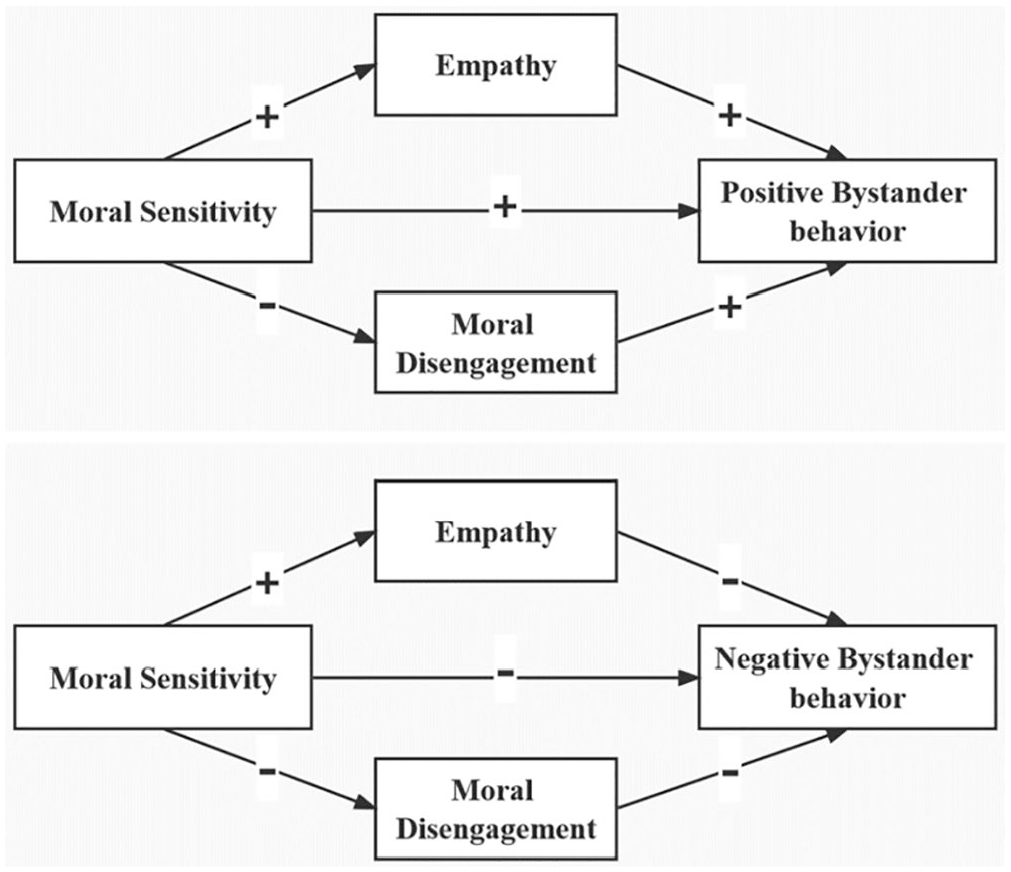
Hypothesized path model of relations among everyday moral sensitivity and positive bystander behavior and negative behaviors.
In addition, gender and age differences were examined as covariates to predict bullying bystander behavior, considering that previous studies produced mixed results both on gender (Nickerson & Mele-Taylor, 2014; Parris et al., 2020; Shelley & Craig, 2010) and age differences (Bjärehed et al., 2020; Pöyhönen et al., 2012; Saarento et al., 2015).
Methods
Participants
The participants were recruited from primary and secondary schools in Sichuan Province (the largest Province in southwest China). A range of school children was included to maximize the representativeness of samples in terms of grade and region. Data collection took place over two stages. In the first stage, the recruitment information was posted on the online communication group of the Sichuan Psychological Guidance and Research Center for Juvenile Support and Growth. The group comprises teachers from schools and heads of workstations widely distributed in cities and prefectures across Sichuan Province. From the online group, volunteers who were willing to help with the survey were recruited. To diversify the regional sample, people were also recruited through peer recommendations. In the second stage, primary, junior, ordinary, and vocational high school students were sampled to ensure that students from each grade level participated in the survey.
A total of 1,655 responses remained after removing duplicate, contradictory, and invalid responses that failed the instructional manipulation checks. The final samples were between the ages of 10 and 19 (M = 15.51, SD = 2.51) and covered 9 grade levels from 3rd to 12th. The gender of participants was not equally distributed, with 72.4% of the sample boys, 27.6% girls. Table 1 shows the key characteristics of the sample.
The Distribution of the Four Roles in Gender, Grade, Ethnicity, Sibling Structure, and Family Structure.
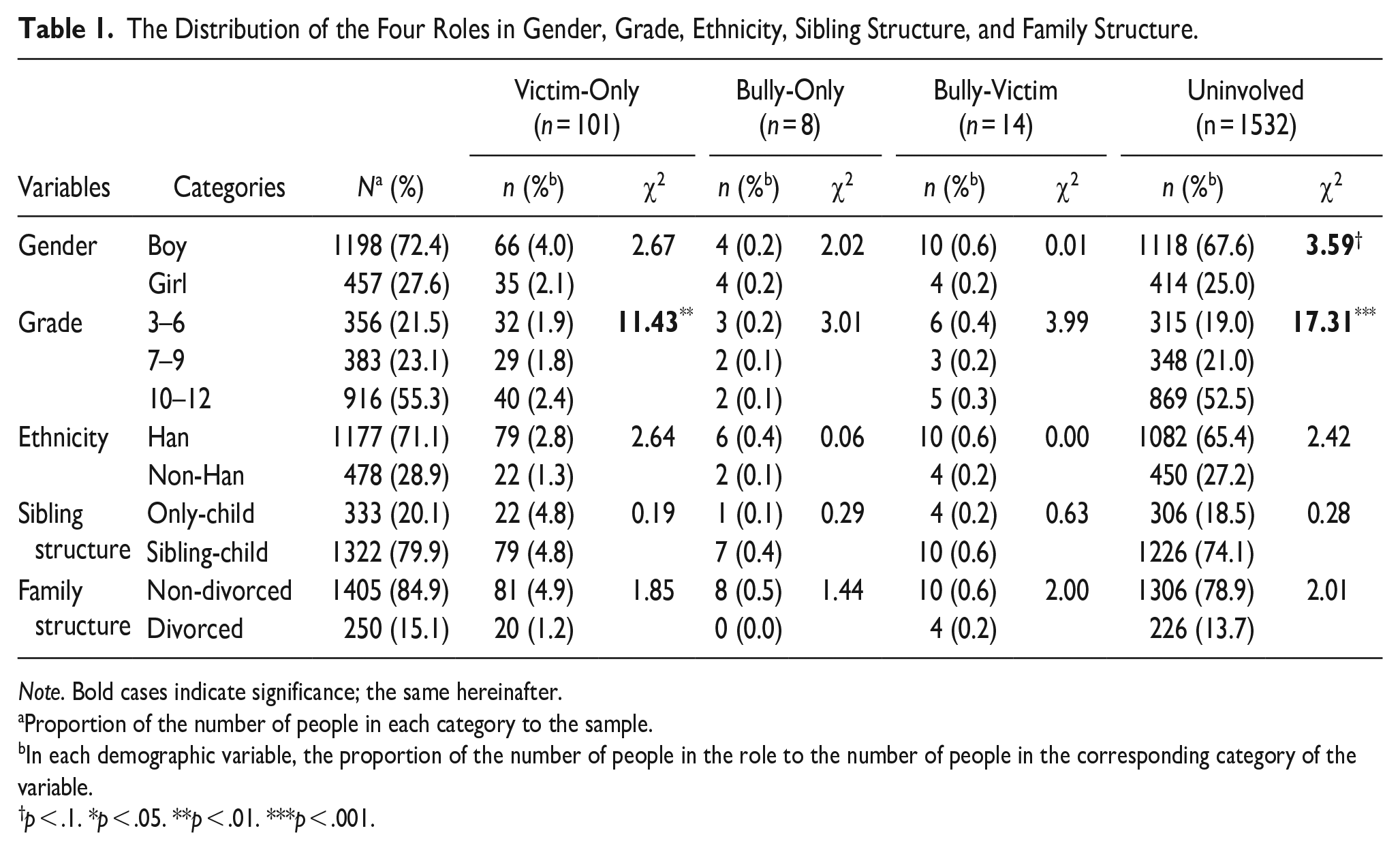
Note. Bold cases indicate significance; the same hereinafter.
Proportion of the number of people in each category to the sample.
In each demographic variable, the proportion of the number of people in the role to the number of people in the corresponding category of the variable.
p < .1. *p < .05. **p < .01. ***p < .001.
Procedure
A combination of online and offline survey was used for data collection. First, Wenjuanxing ( www.sojump.com ), a Chinese professional survey website, was used to upload the questionnaire and generate the answer URL link and quick response (QR) code. As Bryan et al. (2022) mentioned, gathering information electronically allows for more complete data and minimizes variations in risky behavior across modes. The following steps were carried out in consideration of the obvious safety concerns during the COVID-19 pandemic, as well as the limitations of electronic conditions in some project schools. The QR code and website address of the online questionnaire were printed onto paper instructions. These paper instructions were then sent to the teachers at the project schools for distribution to the students before the weekend break. After the students returned home, they could scan the QR code with their parents’ cell phones to participate in the survey.
The survey was conducted with the respondents’ informed consent and their head teachers or psychology teachers. The electronic questionnaire was titled “Campus Life Questionnaire.” All participants completed an informed consent form on the home page of the electronic questionnaire, and authorized the researcher to use their data for teaching and research purposes. The questionnaire contained measures of participants’ EMS, empathy, MD, bullying/victimization/observation experiences, and demographic information. In addition, instructional manipulation checks were conducted. If a respondent did not pick a specific option as instructed, the response was considered invalid and will not be involved in the subsequent analysis (Oppenheimer et al., 2009).
Measures
Everyday moral sensitivity
The EMS was measured by the 10 items provided by the Chinese General Social Survey (CGSS). The CGSS, which began in 2003, is the earliest national, comprehensive, and continuous large-scale social survey project in China. The 10 items applied in this study can be seen in part B9 of the CGSS 2015 annual questionnaire (resident questionnaire).
The questionnaire aims to investigate the attitudes of the respondents towards moral issues. The 10 items consist of the dimensions of Moralization to Others and Public Expression of Moralization. The former is related to individuals’ bad behaviors and habits, which can elicit disgust and stimulate individuals’ moral sensitivity (e.g., “Spit everywhere”). The latter is related to general social norms, which may cause individuals’ anger (e.g., “Do not keep time”). A Likert-type five-point scale score was used (1 = not disgusted to 5 = very disgusted), with no reverse scoring items. The higher the total score, the higher the sensitivity to immoral events. The scale has good reliability among Chinese participants aged 18 to 95 years (Zhang & Xiang, 2021). The Cronbach’s α coefficient of it in this study was .86.
Bullying, victimization, and bystander behavior
The short version of the School Bullying Victim Questionnaire (SBVQ-S; Zhao et al., 2021) was used to assess the bullying prevalence. The questionnaire consists of seven first-order factors and two second-order factors (i.e., real-life bullying and cyberspace bullying), with a total of 40 items. Real-life bullying includes verbal bullying, relationship bullying, sexual bullying, and torture bullying. Cyberspace bullying contains the three types of cyber verbal bullying, cyber relationship bullying, and cyber sexual bullying. The SBVQ-S has 28 items and is scored on a Likert-type five-point scale, with vague frequency as the evaluation index (1 = never to 5 = frequently), without reverse scoring. The questionnaire has good reliability and validity and can be used to measure bullying prevalence among Chinese adolescents (Zhao et al., 2021).
In this study, some adaptations have been made to the SBVQ-S to make it more suitable for research objects with different age characteristics (see Supplemental Appendix I for details). In all versions of questionnaires, we provided a list of behaviors without any bullying-related terminologies and definition to control for subjective explanatory bias (Xie et al., 2023). Participants were asked to recall the frequency of bullying incidents they had observed (e.g., “How often did I see or hear about a classmate or classmates doing each of the following behaviors to other classmates . . .”), suffered (e.g., “How often did other students do each of the following behaviors to me . . .”), or perpetrated (e.g., “How often did I do each of the following behaviors to other students . . .”) in the past 3 months on a five-point scale (0 = never, 1 = only once or twice, 2 = 2 or 3 times a month, 3 = about once a week, 4 = several times a week). The reliability analysis results show that the Cronbach’s α coefficient of the three subscales of SBVQ-S ranged from .94 to .96 in this study.
Empathy
The Chinese version of the Basic Empathy Scale (BES; Li et al., 2011) was used to assess the extent to which participants understood and shared the emotions of others. The BES consists of 20 items and contains two dimensions: cognitive empathy and affective empathy. The former refers to the ability to perceive and respond to the emotions of others (e.g., “It is hard for me to understand when my friends are sad”); the latter reflects the individual’s ability to understand the purposes and thoughts of others and to distinguish them from his or her own emotions and thoughts (e.g., “I usually feel calm when other people are scared”). The BES was rated on a five-point scale ranging from 1 (strongly disagree) to 5 (strongly agree), with eight positively phrased items reverse-coded. The higher the total score, the higher the level of empathy. In this study, the Cronbach’s α coefficient for the BES was .80.
MD
The 6 items measuring MD in bullying situations (Thornberg & Jungert, 2013) were used to assess the extent to which participants justify bullying, blame the victim, and weaken the severity of bullying (e.g., “It’s okay to bully someone who you don’t like”). The original version of the scale was in English and was translated into Chinese under the guidance of a teacher majoring in English. It was rated on a seven-point scale ranging from 1 (not true at all) to 5 (very true), with no reverse-coded item. A higher score indicates a higher degree of MD. In the current sample, the Cronbach’s α coefficient was .84.
Social desirability
The short forms of the Social Desirability Scale (SDS-S; Crowne & Marlowe, 1960) were used to assess participants’ social desirability responses. To minimize the cognitive load due to the excessive length of the questionnaire, 3 items with the highest factor loading were selected (i.e., “I sometimes feel resentful when I don’t get my way”; “There have been times when I was quite jealous of the good fortune of others”; “I am sometimes irritated by people who ask favors of me”) in SDS-S according to the test results of Crowne and Marlowe (1960). Participants were asked to answer the three statements in a binary response format (i.e., “Yes” or “No”). A higher score on this measure indicates a greater tendency to respond in a socially desirable manner. The Cronbach’s α coefficient for this study’s 3-item SDS was .52.
Demographic variables
Demographic characteristics included gender (boy = 0; girl = 1), age, grade (Grades 3–6 = 1; Grades 7–9 = 2; Grades 10–12 = 3), ethnicity (Han = 0; non-Han = 1), sibling structure (only-child = 0; sibling-child = 1), and family structure (non-divorced family = 0; divorced family = 1).
Data Analytic Strategy
The issue of common method bias was controlled for and tested as the data for this study were collected through self-reporting. For procedural control, two instructional manipulation checks were inserted, with reference to Oppenheimer et al. (2009). For statistical control, the Harman one-way test was conducted (Podsakoff et al., 2003; Zhou & Long, 2004).
For the individual differences test, a χ2 test was conducted for the distribution of the four roles (i.e., victim-only, bully-only, bully-victim, and uninvolved) regarding gender, grade, ethnicity, sibling structure, and family structure. One-way analysis of variance (ANOVA) was used to test the differences in EMS, empathy, and MD among four roles. Pearson correlation was used to analyze the bivariate correlations.
Mediation analyses testing indirect effects were conducted with the Process macros for SPSS (Preacher & Hayes, 2004) using the bootstrapping method. The bootstrapping strategy allows for the inclusion of multiple mediators in a single model that does not impose the assumption of normality in the data distribution (Hayes, 2009; Preacher & Hayes 2008). Therefore, the bootstrapping approach is considered applicable to the mediation model testing of this study.
Results
Common Method Bias Analysis
The unrotated exploratory factor analysis extracted 15 factors with eigenvalues exceeding one. The first factor explained 15.98% of the total variance, which was much less than the critical value of 40% (Podsakoff et al., 2003), indicating that there was no significant common method bias in this study.
Descriptive Analyses
The status quo and characteristics of school bullying
Of the 1,655 students, 101 (6.10%) students were victim-only; 8 (0.48%) students were bully-only; 14 (0.85%) students were bully-victims; and 1,532 (92.57%) students were uninvolved. Of those uninvolved in bullying, 759 (45.86%) reported having observed bullying on campus in the past three months.
The results of the χ2 test (see Table 1) reveal that a slightly larger proportion of girls is uninvolved in bullying compared to boys (p = .058). In terms of grade differences, the proportion of victim-only was significantly higher among the lower-grade compared to the higher-grade students (p = .003), while the proportion of those uninvolved was slightly lower (p < .001). There were no significant differences in the proportions of the four roles among children of different ethnicities, sibling structures, and family structures.
The results of one-way ANOVA are shown in Table 2, and the post hoc comparisons indicate that victim-only scored significantly higher than bully-only (p = .049) and bully-victims (p = .018) in terms of the EMS. In contrast, uninvolved scored significantly higher than both simple bullies (p = .031) and bully-victims (p = .008). For empathy, the scores for uninvolved were significantly lower than those for victim-only (p < .001). For MD, the uninvolved scored lower than the remaining three roles simultaneously (victim-only, p < .001; bully-only, p < .001; bully-victim, p < .001), while the victim-only scored lower than both the bully-only (p < .001) and bully-victim (p = .001).
Differential Characteristics of the Four Roles on EMS, Empathy, and MD (M ± SD).
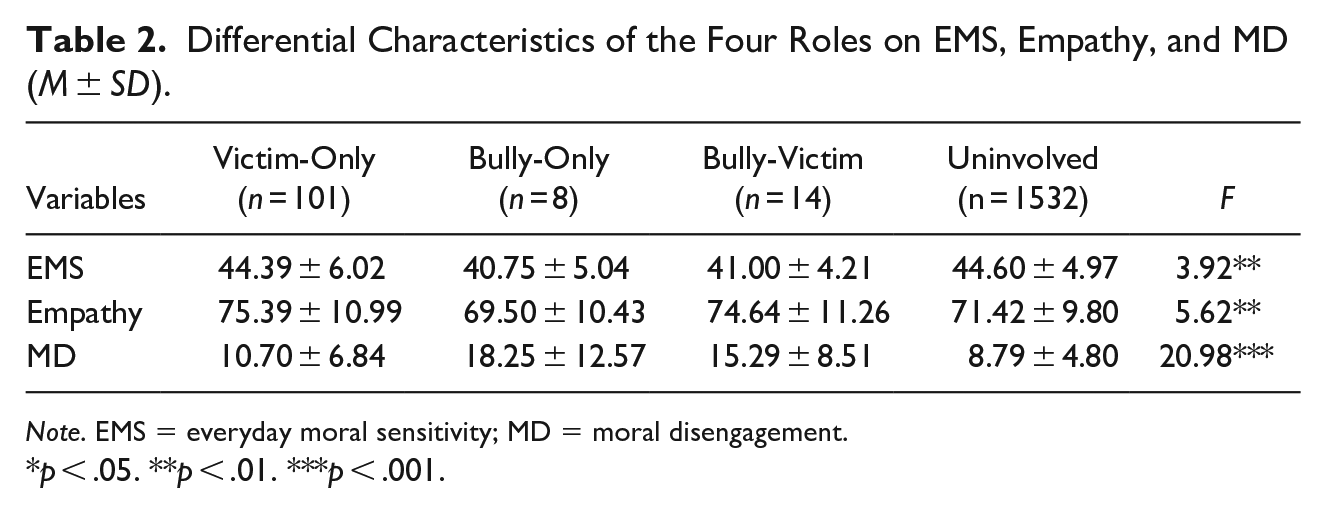
Note. EMS = everyday moral sensitivity; MD = moral disengagement.
p < .05. **p < .01. ***p < .001.
Correlations between variables
Correlations between key variables are shown in Table 3. With high EMS and high levels of empathy, the students are less morally disengaged and undertake more positive bystander behavior as well as less negative bystander behaviors. However, students with high MD engage in less positive bystander behaviors and more negative bystander behaviors, and they experience victimization and bullying more frequently.
Bivariate Correlations Between Variables.
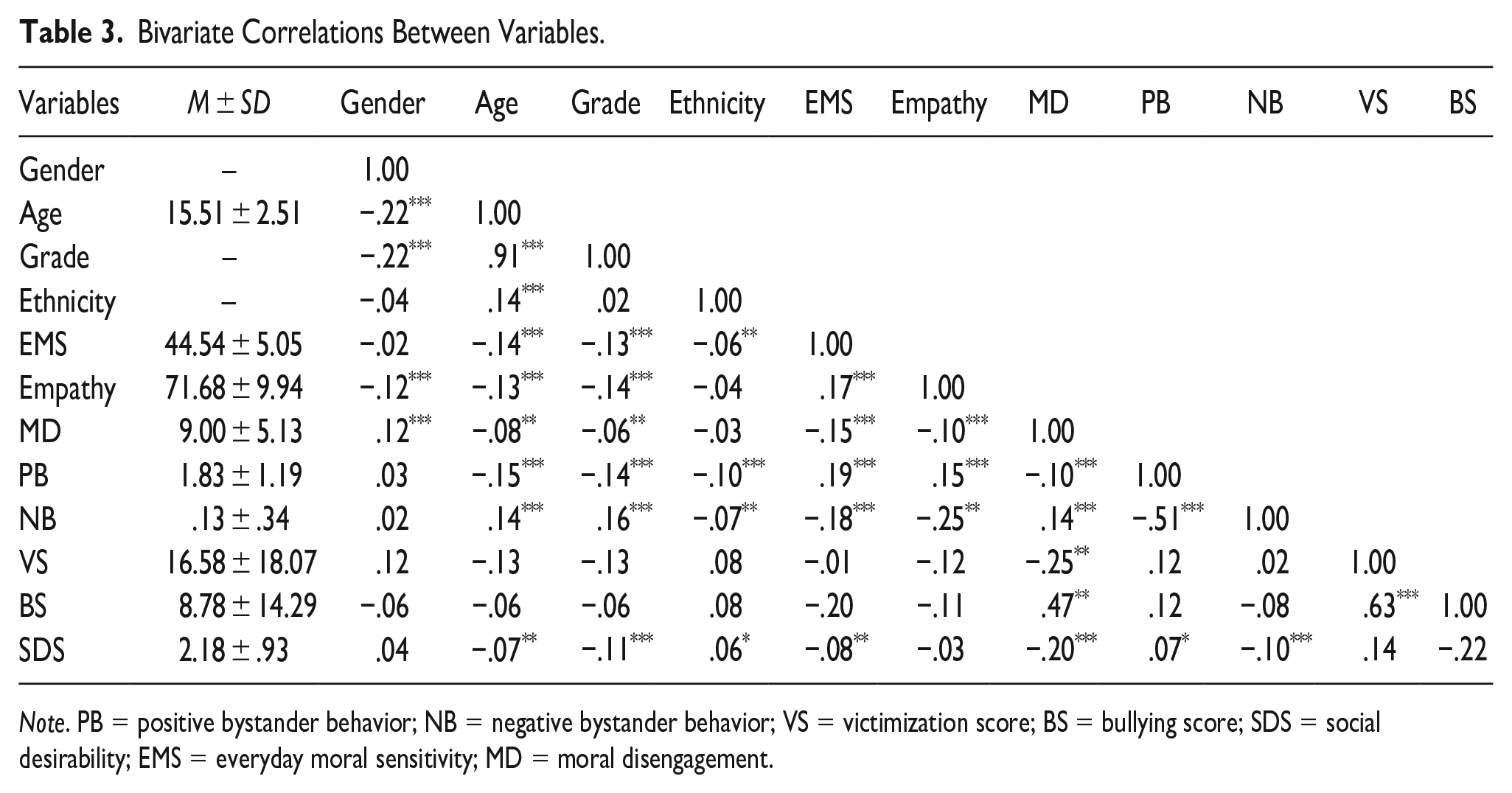
Note. PB = positive bystander behavior; NB = negative bystander behavior; VS = victimization score; BS = bullying score; SDS = social desirability; EMS = everyday moral sensitivity; MD = moral disengagement.
Association Between EMS and Positive/Negative Bullying Bystander Behavior
Positive bystander behavior as dependent variable
The mediating effects of empathy and MD between EMS and positive bystander behavior were examined, controlling for gender, grade level, and social desirability. The results in Tables 4 to 5 show that EMS significantly predicts empathy positively (t = 5.39, p < .001) and MD negatively (t = −4.29, p < .001). In the mediation model, both EMS (t = 5.30, p < .001) and empathy (t = 5.91, p < .001) significantly positively predicted positive bystander behavior, and MD negatively predicted positive bystander behavior (t = −2.40, p = .011). The bootstrapping tests (resampling 5,000 times) indicate that the mediating effect value for empathy was 0.006, with a 95% confidence interval (CI) of [0.003, 0.009]. CI that does not include zero indicates a significant mediating effect. Similarly, the mediating effect value for MD was 0.002, with a 95% CI of [0.000, 0.004]. The interval does not contain zero, indicating a significant mediating effect. Thus, EMS can not only affect positive bystander behavior directly and positively, but also predict it through the mediating effects of empathy and MD.
Mediating Effects of Empathy and MD between EMS and Positive Bystander Behavior and Negative Bystander Behavior.
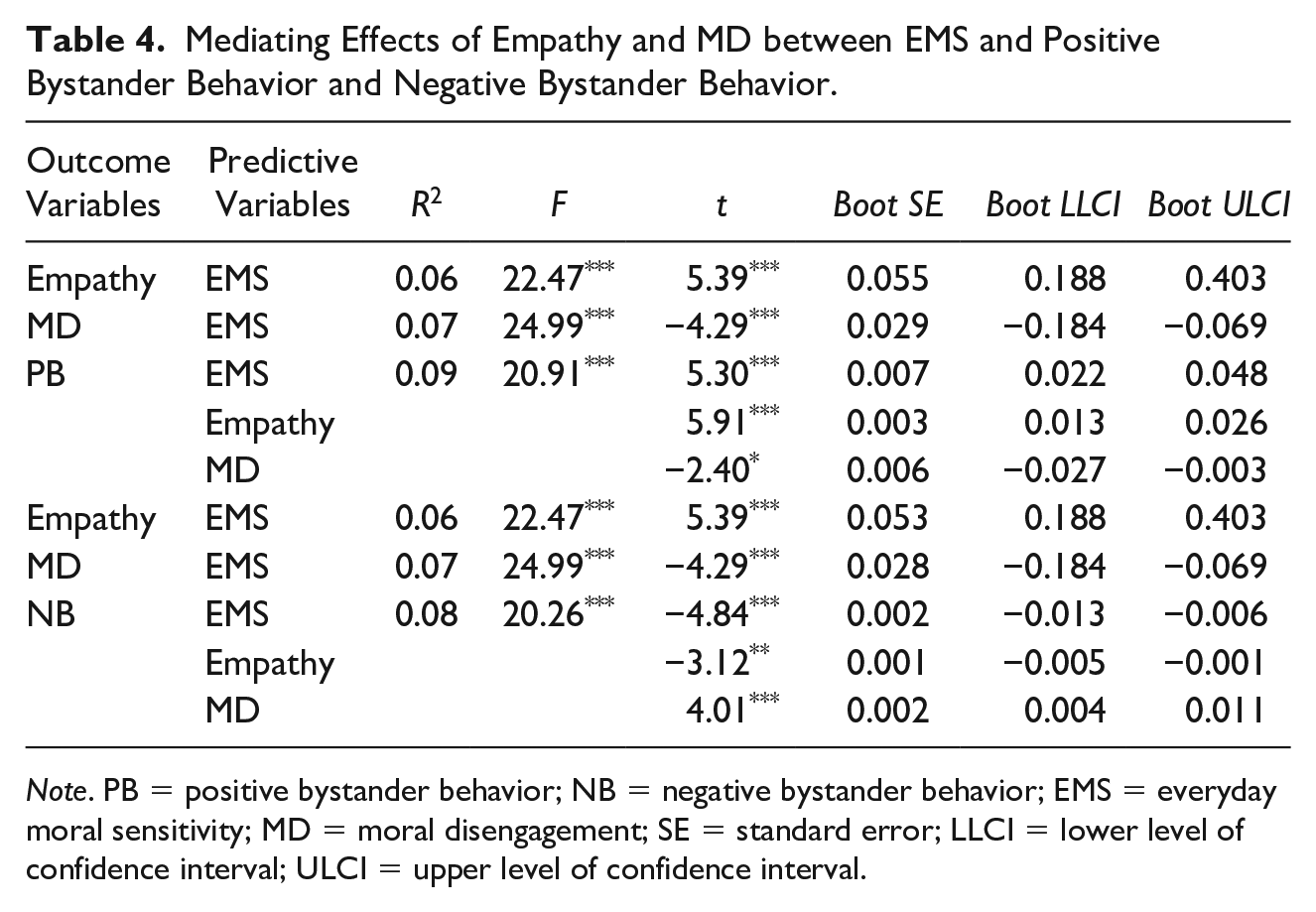
Note. PB = positive bystander behavior; NB = negative bystander behavior; EMS = everyday moral sensitivity; MD = moral disengagement; SE = standard error; LLCI = lower level of confidence interval; ULCI = upper level of confidence interval.
Decomposition of the Mediating Effects of Empathy and MD between EMS and Positive Bystander Behavior and Negative Bystander Behavior.
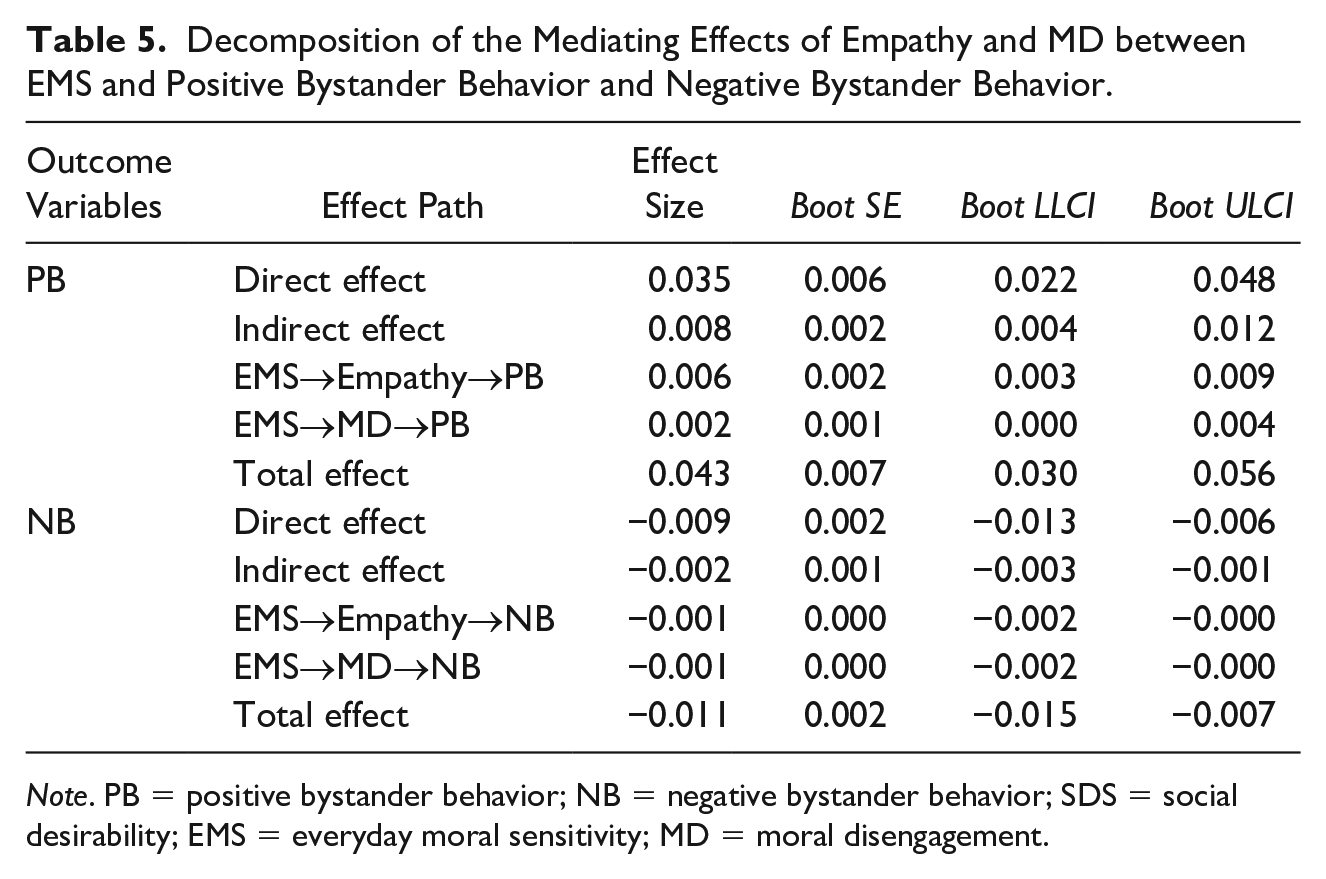
Note. PB = positive bystander behavior; NB = negative bystander behavior; SDS = social desirability; EMS = everyday moral sensitivity; MD = moral disengagement.
Negative bystander behavior as dependent variable
This was the same as above, except that negative bystander behavior was put into the model as the dependent variable for testing. The results in Tables 4 to 5 show that both EMS (t = −4.84, p < .001) and empathy (t = −3.12, p = .001) significantly negatively predicted negative bystander behavior. MD positively predicted negative bystander behavior (t = 4.01, p < .001). The bootstrapping tests (resampling 5,000 times) indicate that the mediating effect value for both empathy and MD was −0.001, with a 95% CI of [−0.002, −0.000]. A CI that does not include zero indicates that the mediation effect of empathy and disengagement reached a significant level. Thus, EMS can not only affect negative bystander behavior directly and negatively, but also predict it through the mediating effects of empathy and MD.
Discussion
The findings expand on previous research on the influence of a specific moral sensitivity to bullying on bystander conduct. Students with higher EMS were more likely to help victims and inhibit bullying, and less likely to reinforce or ignore bullying. Students with higher EMS, who are more aware of the moral issues in everyday situations, are more likely to empathize with the victim’s misfortune and less likely to morally disengage themselves from responsibility in the bullying incident. Based on this psychological process, they are more likely to avoid becoming passive bystanders, and instead choose to reach out to the victim or ask parents and teachers for help. Individual differences analyses indicated that lower grades were risk factors for victimization.
In bullying contexts, EMS, as a social schema, is activated to help individuals to notice immoral behaviors more quickly, and better understand ambiguous social situations. This then helps students identify those behaviors as bullying. This mechanism expands the results highlighted in previous studies on bullying sensitivity (Jiang et al., 2020; Jordan, 2007; Thornberg & Knutsen, 2011), and proves that EMS largely influences students’ identification and processing of bullying. Consistent with expectations, higher EMS predicts more positive behaviors when a bystander perceives the occurrence of bullying.
The present study shows a parallel dual psychological process between EMS and bullying bystander behaviors. In the effect path of EMS to bystander behavior, empathy and MD play an indirect role. In other words, those students who are more capable of distinguishing between moral and immoral behavior in everyday life are better equipped to empathize and understand the plight of the bullied, rather than cognitively disengage from bullying.
The findings extend the five-stage model of bystander intervention. We found that higher MD interfered with the perception and understanding of moral issues brought by higher EMS. Parallel to MD, empathy also mediates the relationship between EMS and bystander behavior. This implies that moral-emotional and moral-cognitive factors are active concurrently when developing responsibility in the third stage of the intervention model. It can also be speculated that there may be an effect of the relative strength of empathy and MD. If the former is relatively more robust, students may tend to engage in positive bystander behavior, as they have assumed the responsibility as bystanders. Conversely, bystanders are more likely to behave negatively if the inhibition of MD is so strong that it drowns out the painful feelings brought by empathy. Future research can examine whether such an effect of relative strength exists, and if so, how the effect is formed and acts.
The results of the individual differences analysis show that the proportion of victimization in the group of girls was not significantly different from boys sampled in this study. However, many studies have reported higher victimization rates for boys (Markkanen et al., 2021; Nguyen et al., 2020; Zhou et al., 2020), as they are generally more aggressive and motivated to pursue power than girls (Roland & Idsøe, 2001; Sijtsema et al., 2009). The inconsistency may be due to the uneven distribution of the samples in this study in terms of gender. In terms of victimization rates, the downward trend with age or class replicates the results of previous studies (Markkanen et al., 2021). On one hand, cognitive development plays an important role in distinguishing between bullying and harmless, playful behavior for older students. On the other hand, higher grades provide more opportunities for students to join new peer groups or build new social structures. This allows for avoiding victimization, especially for students who have just transferred or moved up in school (Lereya et al., 2015; Pellegrini & Bartini, 2000; Schäfer et al., 2005).
In the present study, the victim-only group had significantly higher empathy and MD than uninvolved individuals. Differences in empathy can be explained by the bystanders’ past victimization experiences. Those who have been the target of bullying are likely to show more concern for the victims when they observe bullying. This further makes them more empathetic to their schoolmates who are being bullied. Nevertheless, these former victims have more potential to disengage from moral standards in bullying. This could be interpreted as a cognitive regulatory mechanism to keep them safe from emotional and physical harm. Some victims may indeed consider bullying as immoral before they are bullied. However, being bullied means being in a position of weakness (Olweus, 2013), making them find it challenging to resist bullying. As a result, they have to believe that “bullying is common” to reduce confusion and psychological tension (Jiang et al., 2020). Studies have shown a significant correlation between peer victimization and self-blaming attribution (e.g., “my fault and cannot change it”; Schacter & Juvonen, 2015). Accordingly, the increasing self-blaming attribution in their victimization contributes to the customary belief that the victims of other bullying incidents deserve it.
Relatedly, both the bully-only and the bully-victim were higher in MD than the victim-only group, while the bully had the highest level of MD among these three groups. This is consistent with previous findings on the MD mechanism for these two groups (Gini et al., 2014; Runions et al., 2019; Tanrikulu & Campbell, 2015). Due to a lack of experience with victimization, the bully-only may be more likely to perceptually ignore, minimize, or distort the harm on victims (Runions et al., 2019). They are more inclined to diffuse responsibility in bullying acts (Thornberg, & Jungert, 2014) and may even experience positive feelings such as pride and self-approval for doing so (Pornari & Wood, 2010). In contrast, the MD of the bully-victim may be suppressed in part by victimization experience, since it is difficult for them to interpret bullying just as a kidding (Runions et al., 2019).
Limitations, Contributions, and Implications
Some limitations should be considered when interpreting the findings. First, three items with a high factor loading of the SDS were included in the survey. However, the exploratory factor analysis in this study sample showed a poor fit of the three-item. The Cronbach’s α coefficient is .52, not reaching the ideal level .70. Thus, control for social desirability may not play an effective role. Data from multiple disclosers or the inclusion of an entire SDS could be considered in the future to minimize the effect of social desirability.
Second, the online survey cannot ensure a consistent environment for students to fill out the questionnaire. Participants are susceptible to many confounding factors (e.g., discussions among classmates about the survey contents), especially on the sensitive topic of school bullying. The disadvantages of the self-report approach may be further amplified. Still, the electronic data are acceptable. A recent empirical study found small differences in student and school response rates between surveys conducted by “paper and pencil instruments” and “electronic data collection” (Bryan et al., 2022). Meanwhile, the present study largely takes advantage of online research’s strengths, such as the optimization of research procedures (Bryan et al., 2022). For researchers, the convenience of data collection and collation is improved by issuing questionnaires online. It is also easier for the subjects to fill in the answers by setting the logic of skipping questions (i.e., participants answer or skip certain questions according to the logic that has been established).
Last, the cross-sectional study design prohibited the examination of the direction of causality among EMS, empathy, MD, and bullying bystander behaviors. Additional studies may examine the causality with longitudinal study, randomized controlled study and some other approaches.
Notwithstanding these limitations, the present study extends research on bullying based on the perspective of bystanders and provides empirical evidence for identifying effective targets in anti-bullying education practices. Specifically, the effect of moral sensitivity on bullying was found to be domain-independent rather than domain-dependent. This serves as a reminder that perceptions of everyday immoral behaviors developed during socialization also function in the identification of specific bullying behaviors. Additionally, the mechanism of EMS to bystander behavior can be achieved through the parallel dual process. Empathy as a motivator promotes positive bystander behavior and correspondingly reduces negative bystander behavior, while MD is a suppressor with the opposite effect. High EMS simultaneously acts on these two factors, and further predicts more prosocial behaviors and less negative behaviors in the case of stronger empathy and lower MD.
Furthermore, our conclusions of the above dual-process mechanism are strengthened by the diversity of our samples. We examined school-aged adolescents from different ethnic groups (e.g., Zang, Yi) of Southwest China, which enriched the diversity in our sample. We also involved participants from a wide scope, having sampled adolescents from almost every administrative city and grade. Thus, our sample could be representative of adolescents in Southwest China. However, our findings should also be taken with caution when generalized to all Chinese adolescents.
For practical implication, introducing moral sensitivity-related content in school ethics education programs might be a better approach to future bullying intervention. Before promoting a deep understanding of bullying, it is advisable to guide students to reason over and judge various everyday immoral behaviors on their own initiative. Meanwhile, we should discourage students’ tendency to attribute responsibility to the victim (either themselves or others as victims) to enhance the motivation to help victims in distress. Moreover, more research can be conducted to explore in-depth factors and boundary conditions that influence decision-making and specific behaviors in the fourth and fifth stages of the bystander intervention model, such as reducing the learned helplessness of bystanders, and then making them aware of what defensive actions to take, and how they can effectively help victims (preferably some defensive acts that ensure their safety).
Conclusion
The present study highlights that EMS education can be essential in bullying prevention. By enhancing empathy and minimizing MD, EMS education might assist bystanders in altering their adverse reactions. This finding has important implications for developing future prevention courses for bullying.
Supplemental Material
sj-docx-1-jiv-10.1177_08862605221147071 – Supplemental material for The Effect of Everyday Moral Sensitivity on Bullying Bystander Behavior: Parallel Mediating Roles of Empathy and Moral Disengagement
Supplemental material, sj-docx-1-jiv-10.1177_08862605221147071 for The Effect of Everyday Moral Sensitivity on Bullying Bystander Behavior: Parallel Mediating Roles of Empathy and Moral Disengagement by Zhongju Xie, Chuanjun Liu and Zhaojun Teng in Journal of Interpersonal Violence
Footnotes
Author Contributions
ZX and CL conceived the research. ZX and CL collected the data. ZX and CL analyzed and drafted the manuscript. ZT and CL revised the manuscript. All authors contributed to the article and approved the submitted version.
Data Sharing and Declaration
The datasets generated and analyzed for the current study are not publicly available but are available from the corresponding author on reasonable request.
Declaration of Conflicting Interests
The author(s) declared no potential conflicts of interests with respect to the authorship and/or publication of this article.
Funding
The author(s) disclosed receipt of the following financial support for the research and/or authorship of this article: The present research is funded by Sichuan Psychological Guidance and Research Center for Juvenile Support and Growth (Mianyang Social Sciences Key Research Center in Southwest University of Science and Technology) to Chuanjun Liu, Grant number: SCWCN2022ZD01, also funded by Social Science Research Project of Sichuan Province to Chuanjun Liu, Grant number: SC21C024, and the National Social Science Foundation of China to Zhaojun Teng, Grant number: 20CSH095.
Ethical Approval
The studies involving human participants were reviewed and approved by Institutional Review Board of the Philosophy and Social Science Research Project Office of Sichuan Province (SC21C024). The procedures used in this study adhere to the tenets of the Declaration of Helsinki.
Informed Consent
Informed consent to participate in this study was provided by the participants’ legal guardian/next of kin.

Supplemental Material
Supplemental material for this article is available online.
Author Biographies
References
Supplementary Material
Please find the following supplemental material available below.
For Open Access articles published under a Creative Commons License, all supplemental material carries the same license as the article it is associated with.
For non-Open Access articles published, all supplemental material carries a non-exclusive license, and permission requests for re-use of supplemental material or any part of supplemental material shall be sent directly to the copyright owner as specified in the copyright notice associated with the article.
