







Abstract
It has been argued that increasing the number of women in the science, technology, engineering, and math (STEM) fields could mitigate violence against women by advancing gender equality. However, some research points to a “backlash” effect wherein gains in gender equality are associated with heighted sexual violence (SV) against women. In this study, we compare SV against undergraduate women majoring in STEM disciplines to those majoring in non-STEM disciplines. Data were collected between July and October of 2020 from undergraduate women (N = 318) at five institutions of higher education in the United States. Sampling was stratified by STEM versus non-STEM majors and male-dominated versus gender-balanced majors. SV was measured using the revised Sexual Experiences Survey. Results indicated that women majoring in STEM disciplines that are gender balanced reported more SV victimization in the form of sexual coercion, attempted sexual coercion, attempted rape, and rape compared to their peers in both gender-balanced and male-dominated non-STEM and male-dominated STEM majors. These associations held even after controlling for age, race/ethnicity, victimization prior to college, sexual orientation, college binge drinking, and hard drug use during college. These data suggest that the risk of repeated SV victimization within STEM populations may be a threat to sustained gender parity in these fields and ultimately to gender equality and equity. Gender balance in STEM should not be furthered without addressing the potential use of SV as a potential means of social control over women.
Introduction
In the United States, efforts to increase the number of women in the science, technology, engineering, and math (STEM) disciplines have seen some success (Cheryan et al., 2017). However, pervasive gender stereotypes and patriarchal gender role beliefs are continued barriers to gender parity (Casad et al., 2021; National Academies of Sciences, Engineering, and Medicine [NASEM], 2018; Piatek-Jimenez et al., 2018). These patriarchal gender roles are likewise linked to hostility and violence against women, especially those women perceived to violate their socially prescribed gender role (Reidy et al., 2009, 2020). To date, little research has examined the experiences of violence among the women challenging these gender stereotypes in STEM disciplines (D’Inverno et al., 2016).
Sexual violence (SV) is a global health epidemic, with victims experiencing a range of mental and physical health consequences including chronic pain, seizures, gastrointestinal disorders, cardiac disease, depression, anxiety, posttraumatic stress, and substance abuse (Basile et al., 2016). Victims also suffer a host of economic consequences (e.g., ongoing healthcare costs, lost wages due to missed work) accumulating to a cost over $3 trillion (Peterson et al., 2017). Critically, this violence is inextricably linked to gender equality, or a lack thereof. Studies have suggested that rates of violence against women are highest in states and countries where gender inequality—including educational, occupational, and economic opportunity—is greatest (Austin & Kim, 2000; Baron & Straus, 1987; Kearns et al., 2020; Whaley, 2001; Yodanis, 2004). Conversely, in countries where women achieve higher educational and occupational status, rates of victimization are lower (Yodanis, 2004). Thus, it would seem increasing women’s educational and occupational attainment, and subsequent social standing, could potentially reduce rates of violence against all women (i.e., the amelioration hypothesis; Chon, 2013). Given this, it has been suggested that increasing women’s matriculation into the STEM disciplines may potentially decrease violence against women by increasing educational attainment and income (D’Inverno et al., 2016).
However, when women make strides toward gender equality, there is a risk of violent “backlash.” For example, analysis of Interpol crime data from 89 countries revealed that more gender equality, as measured by a greater percentage of female managers and administrators, was associated with higher rates of SV against women (Austin & Kim, 2000). Chon and Clifford (2021) analyzed data from 70 countries and found several indices of gender equality (e.g., female education, female life expectancy, female income, ratio of female to male income, female seats in government) were positively related to rates of rape victimization. In the United States, gender equality—as measured by male to female ratios for income, education, and occupational attainment—has been linked with higher rates of women’s SV victimization (Bailey, 1999; Whaley, 2001). This violence against women is reasoned to be a “social control strategy” intended to maintain men’s relative dominance (Austin & Kim, 2000; Bailey, 1999; Jewkes et al., 2002; McCloskey, 1996; Whaley, 2001). That is, as women are perceived to be rising to positions that challenge the male hegemony, these advances are met with increasingly overt methods of social control such as SV. For example, women who work in stereotypically masculine professions experience more sexual harassment (a form of gender-based aggression toward women) than women in stereotypically feminine professions (Berdahl, 2007). Similarly, women in STEM at institutions of higher education (IHEs) experience more sexual harassment by faculty and staff relative to women in non-STEM disciplines (NASEM, 2018). This backlash, coupled with campus climates that are already intrinsically permissive of SV (Moore & Mennicke, 2020; Quinlan et al., 2016; Sinko et al., 2021), may increase these women’s risk of victimization exponentially. However, no research to date has looked at rates of more severe forms of SV against women (i.e., rape, attempted rape, sexual coercion) in STEM fields relative to non-STEM women.
There are several reasons to hypothesize that women in STEM would, in fact, be at higher risk of SV. Even subtle violations of female gender roles (e.g., playing sports, dressing in masculine clothes) can increase hostile and violent reprisals against women by men (Berdahl, 2007; Reidy et al., 2009). When women matriculate into stereotypically masculine disciplines, they may be viewed as violating their gender role and therefore be at subsequent risk of hostility and victimization by their patriarchal male counterparts. Given that STEM disciplines have traditionally been male dominated, women in STEM may be perceived as violating typical female gender roles thus provoking the hostility of their male colleagues, thereby increasing the risk of SV victimization. Notably, hostile attitudes toward women is a robust risk factor for violence against women (Abbey & McAuslan, 2004; Fitzgerald et al., 1995; Parrott & Zeichner, 2003) and one of the strongest predictors of men’s SV against women (Abbey & McAuslan, 2004; Degue et al., 2010; Robertson & Murachver, 2007; Vivolo-Kantor et al., 2013). Moreover, being a victim of sexual harassment is correlated with being a victim of SV (Rosenthal et al., 2016). Given the documented higher rates of sexual harassment of women in STEM (NASEM, 2018), it follows that they would also be at elevated risk of SV victimization.
On whole, the literature seemingly offers support for opposing theories as to whether matriculating into STEM fields would alleviate (the amelioration hypothesis) or exacerbate (the backlash hypothesis) SV against women. This contradiction may be explained, in part, by gender parity (or lack thereof) in the various STEM disciplines. When women are the minority in their field, they may be more likely to be seen as violating female gender roles and thus subject to hostile and aggressive retaliations. For example, sexual harassment is most severe in professions and environments where the ratio of men to women is greatest (Berdahl, 2007; Willness et al., 2007). Accordingly, SV victimization may be greater in the STEM disciplines that are male dominated. Conversely, as female representation in STEM increases and achieves gender balance, it becomes commonplace to see women in these roles. Subsequently, women would no longer be seen as violating their prescribed gender roles and therefore less likely to experience violent backlash. Currently, we are aware of no research that has examined the rates of SV victimization for women in STEM relative to non-STEM women. Nor are we aware of any research that has compared SV against women within gender-balanced versus male-dominated STEM fields. The purpose of this study is to redress this gap by examining the rates of SV against undergraduate women majoring in STEM disciplines relative to women majoring in non-STEM disciplines.
SV against women in STEM at IHEs is of particular salience to the present research question. For one, IHEs represent the entry stage on the pathway to careers in STEM. Though students receive education in STEM prior to college, education during primary and secondary school is likely less essential in an employer’s decision to hire. However, it is rare to achieve a career in STEM without at least an undergraduate degree in the discipline. This is also one of the periods during which number of women in STEM fields is highest given the progressively disproportionate rates of attrition for women in STEM (Blickenstaff, 2005; Cheryan et al., 2017). Accordingly, STEM education at IHEs is a critical stage in the STEM pipeline. This is also a critical period for women’s risk of SV. Women aged 18–24 have the highest incidence of SV victimizations of all adult women (Black et al., 2014) with nearly 40% of all SV victims experiencing their first rape during this period (Breiding et al., 2014). Moreover, women attending IHEs may be disproportionately at risk of SV victimization compared to their non-collegiate counterparts (Hart, 2013; Kilpatrick et al., 2007; Quinlan et al., 2016; Rennison & Addington, 2014) and rates of SV against women at IHEs continue to rise (Cantor et al., 2020). As such, this population represents an important area of investigation for both SV risk and women’s attrition from the STEM fields.
Based on prior gender role violation research (Berdahl, 2007; Reidy et al., 2009), we expected that women in STEM majors would report more SV victimization than non-STEM women. We further expected that this difference would be moderated by the gender ratio of the STEM major such that only women in male-dominated STEM majors would report more SV victimization. We tested these hypotheses with a group of female-identified undergraduates established in their majors.
Methods
Participants and Procedures
Data were collected between July and October of 2020 from undergraduate women at five IHEs in separate regionally dispersed U.S. states. Sampling frames with email addresses, academic rank, and major were obtained from Registrars’ offices at each institution. Data from the National Science Foundation (NSF) and the National Center for Education Statistics were used to identify male-dominated (less than 40% female) and gender-balanced (more than 40% female) majors. Within STEM, Biological Sciences, Chemistry, and Math/Statistics were gender-balanced majors; Engineering, Physics, and Computer Science comprised the male-dominated majors. Among non-STEM, Business, Architecture, Agriculture, and Accounting were gender-balanced majors; Economics, Political Science, Philosophy, and History were male-dominated majors.
We used a systematic random sampling procedure to recruit women stratified by IHE, STEM classification, and gender ratio. Selected women were invited via email to complete a brief online eligibility survey. Eligibility criteria include being female-identified; a full-time student; rank of junior, senior, or graduated in 2020; and confirming their major as being one of the aforementioned prerequisite majors. Freshman and sophomore women were excluded as we reasoned they would have higher rates of undeclared majors, are more likely to change majors, and they have completed less discipline-specific courses. Women meeting eligibility criteria were automatically taken to the online consent and survey. Upon completion of the survey, participants received a $12 Amazon e-gift card. All procedures were approved by Georgia State University’s IRB.
The final sample (N = 318) comprised 26.1% women in male-dominated STEM, 25.8% in gender-balanced STEM, 25.5% in male-dominated non-STEM, and 22.6% in a balanced non-STEM major. Table 1 provides full demographic and descriptive statistics.
Descriptive Statistics for Demographic, Predictor, and Criterion Variables.
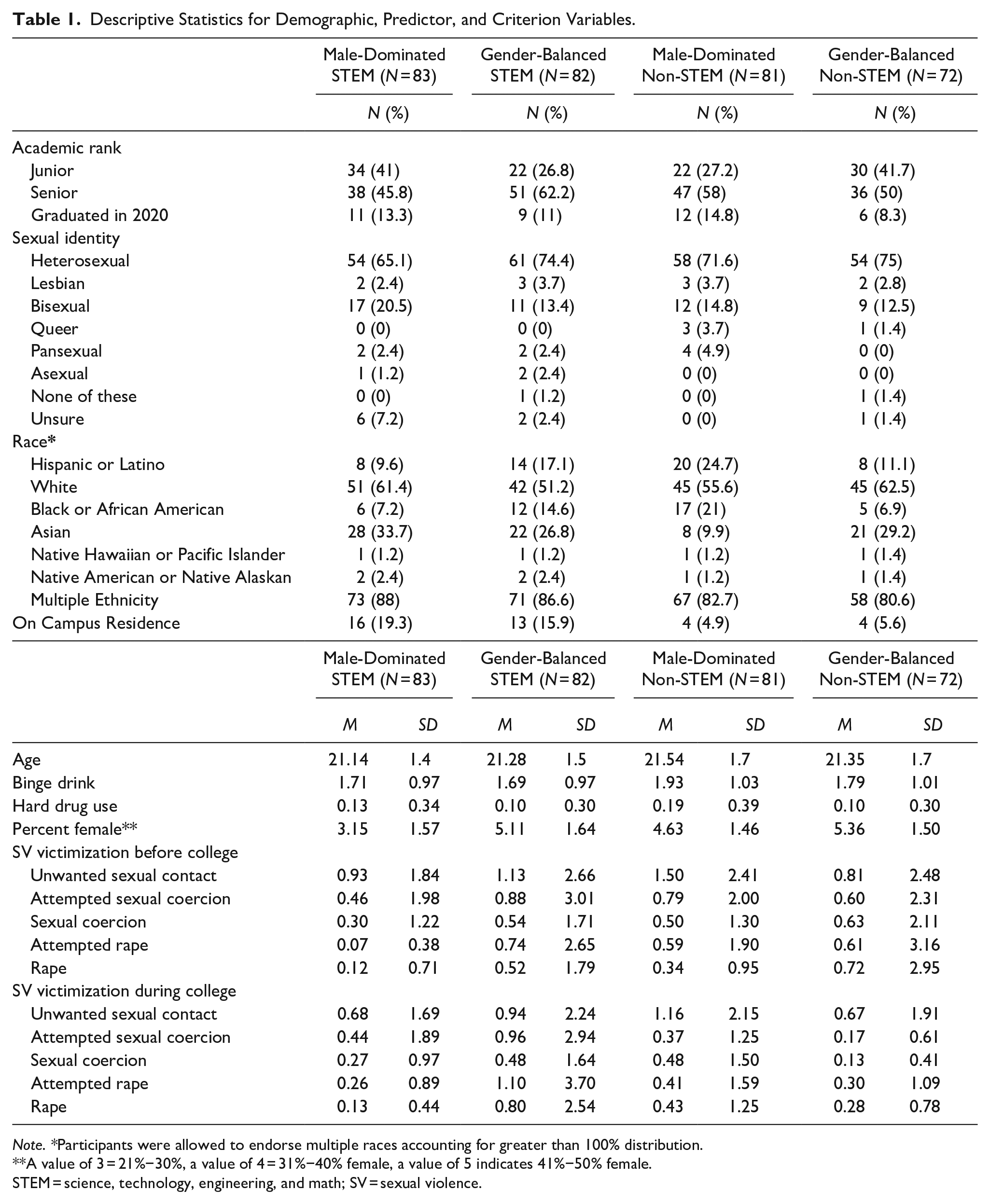
Note. *Participants were allowed to endorse multiple races accounting for greater than 100% distribution.
A value of 3 = 21%−30%, a value of 4 = 31%−40% female, a value of 5 indicates 41%−50% female.
STEM = science, technology, engineering, and math; SV = sexual violence.
Measures
Data collection was intended to begin in the spring semester of 2020. Because the COVID-19 pandemic caused most IHEs to close campuses and transition to virtual learning in March of 2020, data collection was delayed. Because the closure of IHEs and onset of the COVID-19 pandemic may have altered risk for SV and substance use outcomes, it was necessary to alter the reporting time frames for these outcomes. As such, participants were asked to report on time period “in the time between starting college and when your college closed for COVID-19.”
Demographics: Participants were asked to provide information about age, academic rank, race/ethnicity, sexual orientation, citizenship, whether they were raised in the United States, academic major, and whether they resided on or off campus.
Perceived gender ratio: Women completing the survey were asked to estimate the percentage of women in their academic major at their school that were female. Response options range from 0 to 100 in deciles (i.e., 1%–10%, . . ., 91%–100%).
Binge drinking: Participants reported on their alcohol use “in the time between starting college and when your college closed for COVID-19.” Participants indicated how often they had “six or more drinks on one occasion” with response options ranging from 1 (“never”) to 5 (“daily or almost daily”).
Drug use: Participants reported on the number of times that had used different types of drugs in the period of time “between starting college and when your college closed for COVID-19.” Three questions asked about three categories of “hard drug” use: (1) opiates (heroin, morphine, methadone), (2) prescription opioids other than as prescribed for you by a doctor (e.g., fentanyl, codeine, oxycontin, Vicodin, Percocet, tramadol, Lortab), and (3) other hard drugs (cocaine, ecstasy, lysergic acid diethylamide, crack, meth, mushrooms, molly). Response options were on a 5-point ordinal count scale range from 0 to 20+ times. Answers to the three questions were summed to create a single “hard drug” use variable.
SV: The revised Sexual Experiences Survey (Koss et al., 2007) was used to assess for SV victimization “prior to starting college” and again “in the period of time between starting college and when your college closed due to the COVID-19 pandemic.” The socioeconomic status (SES) uses behaviorally specific language to assess unwanted sexual experience outcomes and tactics used by the perpetrator to achieve those outcomes. The five types of SV victimizations include the following: (1) unwanted sexual contact (e.g., fondling), (2) attempted sexual coercion, (3) sexual coercion, (4) attempted rape (oral, vaginal, or anal), and (5) rape (oral, vaginal, or anal). Examples of tactics used by perpetrators to commit the SV acts include telling lies, verbal threats, making promises known to be untrue, or using verbal pressure; showing displeasure, criticizing, or getting angry; incapacitation (e.g., due to alcohol or drug intoxication); threatening and using physical force. Participants were asked how often each sexual experience was obtained by each tactic with response options ranging from 0 to 3+ times.
Analysis and Results
A multilevel fixed effects linear regression was computed for each of the five SV outcomes with school as the cluster. To test the main hypotheses, we regressed the outcomes on a set of dummy codes for the STEM by gender ratio categories using gender-balanced non-STEM as the reference category. In all regression equations, we controlled for age, race and ethnicity, self-identified sexuality, binge drinking, “hard drug” use, and participant perceived gender ratio within their major. Perceived gender ratio was included to account for potential school-level variance in gender ratio for a major from national estimates of gender ratio of that major. In addition, for each SV outcome, the corresponding type of SV victimization prior to college was included. Thus, when coercion was the outcome of interest, we controlled for coercion prior to college, when rape was the outcome of interest we controlled for rape prior to college, etc. Because of the low cell numbers within each of the non-heterosexual orientation categories, we aggregated sexual orientation into a single binary variable (heterosexual vs. non-heterosexual).
Results of regression equations are presented in Table 2. Women in gender-balanced STEM majors reported more frequent rape, attempted rape, coercion, and attempted coercion experiences. There were no differences among groups on the experience of unwanted sexual contact.
Results of Fixed Effects Regressions.
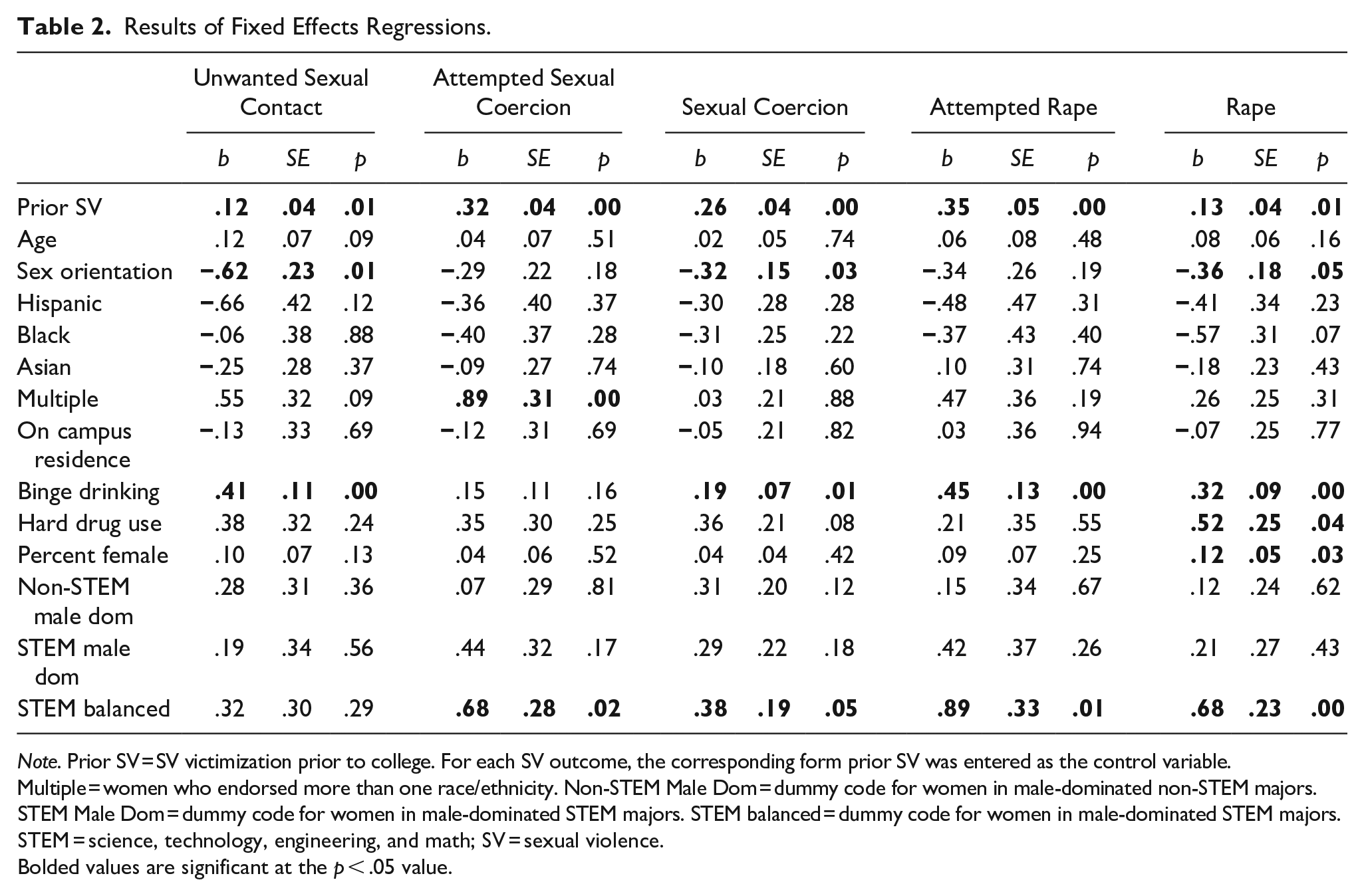
Note. Prior SV = SV victimization prior to college. For each SV outcome, the corresponding form prior SV was entered as the control variable. Multiple = women who endorsed more than one race/ethnicity. Non-STEM Male Dom = dummy code for women in male-dominated non-STEM majors. STEM Male Dom = dummy code for women in male-dominated STEM majors. STEM balanced = dummy code for women in male-dominated STEM majors.
STEM = science, technology, engineering, and math; SV = sexual violence.
Bolded values are significant at the p < .05 value.
Discussion
We hypothesized that female-identified women in male-dominated STEM majors would experience a disproportionate amount of SV victimization. We reasoned that women in male-dominated STEM majors would be more likely to be perceived as violating gender roles than women in gender-balanced STEM majors and non-STEM women. Contrary to our hypotheses, it was the women in gender-balanced STEM majors that reported the most victimization. Compared to their non-STEM peers and fellow students in STEM fields that are male dominated, women in gender-balanced STEM experienced significantly more rape, attempted rape, sexual coercion, and attempted sexual coercion. These associations held even after controlling for victimization prior to college, race/ethnicity, sexual orientation, age, college binge drinking, and hard drug use during college. Though contrary to our expectation, our findings may still be in line with the backlash hypothesis that as women gain access to male-dominated spaces and have improved SES, they will face backlash that results in violent victimization (Russell, 1975). These findings could reflect a threshold effect in which women in the minority (i.e., male-dominated STEM) are viewed as the “exception” and therefore not as much of a threat to the male hegemony. However, when large enough numbers of women enter a discipline thereby threatening the hegemony, backlash is triggered. In this way, it is possible that increasing the number of women who enroll in STEM fields in college could exacerbate negative behaviors toward women, at least initially. Further research is necessary to replicate and expand these findings.
However, even if the present findings are indicative of backlash, this does not preclude the need to increase women’s matriculation into STEM fields. Fortunately, there is empirical reason to believe that backlash would subside. Whaley (2001) used panel data over three decades for 109 U.S. cities with a population of 50,000+. In cross-sectional analyses, there was a positive correlation between rape and gender equality, as measured by income and education ratios such that more equality was associated with more rape. But, when Whaley (2001) employed a longitudinal analysis, gender equality was inversely associated with changes in rates of rape. In other words, cities with more gender equality had higher rates of rape initially but experienced a decrease in the rates of rape over the 20-year period. Conversely, cities with more gender inequality experienced significant increases in the rates of rape over the same time period. In addition, there is a body of evidence indicating an inverse relationship between gender equality and violence against women further suggesting any exacerbation of violence would ultimately subside (Gressard et al., 2015; Heise & Kotsadam, 2015; Kearns et al., 2020; Redding et al., 2017; Sanz-Barbero et al.,, 2018; Straus, 1994; Whaley, 2001; Yodanis, 2004). Of course, we have no way of knowing how long it would take for violent backlash to subside. Rates of violent crime can often surge rapidly as they did in 2020 (Pino et al., 2022; Schleimer et al., 2021) but it is not clear whether violence subsides as quickly. Given that the violent backlash is linked to entrenched social and cultural gender norms that are unlikely to change quickly (if they change), it is reasonable to suspect that backlash would be slow to abate.
Regardless, an increase victimization, even if temporary, cannot be ignored. Effort must be made to prevent any potential backlash as continued strides toward equality are made. Risk of repeated SV victimization within STEM populations would present a threat to sustained gender parity in these fields and ultimately to gender equality and equity. SV of all kinds, including coercion, threaten student academic achievement, degree completion, occupational attainment, and SES (Howard et al., 2019; Jordan et al., 2014; Macmillan & Hagan, 2004; Mengo & Black, 2016; Potter et al., 2018). Academic impacts are both independent and in conjunction with mental health consequences of SV, such as depression, PTSD, and hazardous drinking (Basile et al., 2016; DeRoma et al., 2009; Pereira et al., 2018; Walsh et al., 2020). Furthermore, SV victimization in college is highly correlated with subsequent assaults in college. If left unaddressed, the repeated SV victimization may contribute to the movement of women away from STEM majors (i.e., the leaky pipeline; Blickenstaff, 2005). Thus, to meet the goal of increasing gender parity in STEM and attendant gender equality, strategies to prevent SV assaults, improve equity and safety in campus climate, and reduce negative mental health and academic impacts related to SV are critical.
Of course, our findings are novel and require further replication and expansion before we can draw conclusions about their meaning or indication of backlash. This study possesses all of the characteristic limitations of survey research: the data are cross-sectional; they rely on retrospective self-reported sensitive information; and the sample is ultimately a convenience sample. Future research should prospectively follow students throughout their college career to track how major enrollment and changes in major connect to SV experiences. Moreover, it will be important to examine these phenomena at later stages of STEM pipeline where women are increasingly underrepresented (e.g., during graduate education and employment settings). In addition, as the focus of the this study was on SV, measures of sexual harassment were not included. Likewise, we do not have direct measures of actual oppression or discrimination experienced by women. Including these questions would provide a more robust picture of the totality of sexual victimization experiences college women in STEM disciplines face. Perhaps the most notable limitation of this research is the lack of information about the relationship between SV victims and their perpetrators. While women in gender-balanced STEM reported more SV victimization, we do not know that this victimization was at the hands of their male counterparts in those majors. Thus, these findings do not indicate that men in gender-balanced STEM majors are more likely to perpetrate SV; to make such interpretations would be improper at this point. Future research should seek to explicate the relationship between SV victims in STEM and their perpetrators and attempts should be made to collect data on SV perpetration (and victimization) directly from the men in STEM disciplines themselves.
In addition, the intersection of identity positions merits further examination. While being a woman in a STEM discipline may be viewed by some as a gender role violation, identifying as a sexual and/or gender minority (SGM) can be thought of a more “extreme” form of gender role violation (Reidy et al., 2009, 2022). SGM are disproportionately victims of SV (Kann et al., 2018; Rasberry et al., 2018; Reidy et al., 2022; Walters et al., 2013). Future research should seek to explore if and how being both SGM and a woman in STEM affects risk for SV victimization beyond simply being a woman in STEM. It is possible that the combination of these identity positions amplifies perceived gender role violations and exacerbates the risk of SV victimization. Furthermore, it is critical to recognize that STEM fields are plagued not just by sexism, but also by overt and structural racism (Allen et al., 2022; Dortch & Patel, 2017; McGee, 2020; McGee & Bentley, 2017; Reyes, 2011). Women of color are considerably underrepresented in the STEM fields (National Center for Science and Engineering Statistics, 2021). Backlash may occur whenever a dominant group perceives a challenge to their status. Thus, challenges to the hegemony can be based on membership in any marginalized or minority population. It will likely be of value to explore in future research the potential of compounding backlash for women of color in STEM.
Finally, the climate at IHEs is not set by the beliefs and behaviors of student population alone. The policies and processes implemented by the institution have a role in signaling a culture that is not permissive of SV. The visibility and availability of prevention programming, training of campus police on how to respond to reports of sexual assault, availability of support services for victims, etc., all contribute to campus climate (McMahon et al., 2021). Notably, increasing the number of women in position of leadership at IHEs may help establish safer climates that do not condone SV (Glass et al., 2020). Future research should explore how increasing women in leadership roles and STEM faculty positions at IHEs affects SV against collegiate women in STEM (and all women) at those institutions.
Implications
Following revelations that girls and women were drastically underrepresented in STEM classrooms and careers, NSF instituted the Program for Women and Girls in 1993 and the ADVANCE initiative in 2001 to increase women’s access to education and careers in these disciplines (Clewell, 2000). These and other efforts over the last 30 years have resulted in growing numbers of women entering STEM disciplines (Diekman et al., 2015; Glass & Minnotte, 2010). While these outcomes proffer social and economic benefits for women and society in general (Morais Maceira, 2017), the present research suggests that gender balance in STEM should not be furthered without also addressing the potential use of SV as a means of social control over women. Our findings suggest that women in these majors may be at disproportionate risk for SV and therefore in need of targeted interventions that go beyond traditional campus approaches such as bystander training interventions.
Prevention strategies are needed that address historical attitudes related to women in STEM, challenge pervasive patriarchal gender role norms, and engage peers to create more supportive and safer climates. This is true independent of SV victimization. In addition, robust intervention strategies are needed for all SV survivors on college campuses so they can meet their academic goals, stay in their preferred major, and access needed supports.
Footnotes
Declaration of Conflicting Interests
The author(s) declared no potential conflicts of interest with respect to the research, authorship, and/or publication of this article.
Funding
The author(s) received no financial support for the research, authorship, and/or publication of this article.
