







Abstract
The present study empirically investigates how school-based bullying victimization affects students’ learning outcomes, taking into consideration international and gender perspectives. The main objective of the present research is to provide a better understanding of the consequences of bullying victimization in the learning process of adolescents. We estimate a statistical function that empirically establishes the relationship between the students’ outcomes in mathematics, reading, and science (output) and a wide set of explanatory variables (educational factors), one of which is that of being bullied. The present study uses a large sample of 612,004 students between 15 and 16 years old, attending 21,903 schools in 79 countries. The data come from the 2018 round of the Programme for International Student Assessment. The results indicate that bullying victimization is associated with decreases in academic achievement in mathematics, reading, and science. In addition, no relevant differences by gender are observed in reading and science but, other factors being equal, bullied males score less than bullied females in mathematics.
Introduction
In recent years, bullying has become a global concern. According to the United Nations Educational, Scientific and Cultural Organization (UNESCO) data for 2021, one in three students (32%) was a victim of violence in schools worldwide. The regions with the highest prevalence of victimization are Sub-Saharan Africa (48%), North Africa (43%), and the Middle East (41%). North America has a prevalence rate of 32%, and South America of 30%, whereas the regions with the lowest prevalence are Europe (25%), the Caribbean (25%), and Central America (23%). Although prevalence of bullying has remained unchanged at a rate of one in three students, some regions have seen an increase in recent years (North Africa, Sub-Saharan Africa, and the Middle East), whereas other regions have reduced the number of bullying cases (Europe, America) (UNESCO, 2021).
The problem of childhood bullying is worldwide and contributes significantly to the global burden of violence (Fry et al., 2018; Rigby, 2000; Wolke et al., 2001a). Nowadays, bullying is a serious socio-biological problem related to mental and physical health that requires detailed research and prevention (Baldry, 2004; Gorman et al., 2019; Lever et al., 2019; Wolke et al., 2001b; Zarate-Garza et al., 2017). It is well known that both victims and offenders tend to experience prolonged negative consequences of bullying, sometimes extending throughout their life span (Wolke & Lereya, 2015). It can affect their psychological well-being (Carretero Bermejo et al., 2022; Savahl et al., 2019), and cause emotional difficulties (Camodeca & Nava, 2022) and suicidal behavior (Olweus, 2014). There are also economic effects, such as lower income received in adulthood or unemployment (Brimblecombe et al., 2018; Gorman et al., 2019), and an enhanced risk of substance abuse (Guo, 2021; Maniglio, 2015; Pichel et al., 2022) and delinquency (Aldridge et al., 2018; Bender & Lösel, 2011), particularly as a result of poor coping strategies and insufficient self-regulatory processes (Maniglio, 2009). Carlisle and Rofes (2007) argued that these effects can also be similar to those experienced by survivors of child abuse. Despite all these antecedents, little is known on the matter of how school-based bullying affects students’ academic performance, taking into consideration the international perspective and gender analysis.
Literature on the association between bullying and academic performance indicates that bullying affects academic performance on several levels. Both bullying victimization at the student level (Li et al., 2020; Mundy et al., 2017; Okafor, 2021; Ottem, 2018) and bullying at the school level (Daily et al., 2019; Konishi et al., 2010; Kutsyuruba et al., 2015) can harm students’ academic performance in school. However, not all research studies produce consistent findings on the relationship between bullying and academic performance; more empirical evidence is needed to be able to draw the appropriate conclusions. We focus our empirical research on adolescents, since puberty is the most susceptible period of life for exposure to bullying due to issues such as social adjustment (Racz et al., 2017), a desperate search for self-identification and independence (Sumter et al., 2009) but with a need to belong to the relevant group of peers (Newman et al., 2007; Tomova et al., 2021), and heightened emotional vulnerability (Zimmer-Gembeck & Skinner, 2015).
There are many definitions of school bullying, but the most widely accepted is that a victim of bullying is a student who has been exposed to negative, repetitive, and deliberate actions by one or more students. In addition, bullying is considered to have three relevant characteristics that differentiate it from other forms of violence: an asymmetrical relationship between victim and bully, persistence over time and deliberation with the aim of harming the victim (Olweus, 1980). It is also common to distinguish different types of bullying depending on gender, age, and the circumstances (Rivers & Smith, 1994; Scheithauer et al., 2006). A social-ecological model is one of the theoretical approaches to understanding the nature of bullying and intervention in school violence (Espelage & Swearer, 2004, 2010). According to this theoretical framework, bullying is the result of the interconnection between the psychosocial environment and the personality of the victim (Barboza et al., 2009; Swearer et al., 2010), linked with the development of new behavioral patterns in adolescents based on social learning mechanisms (Bandura & Walters, 1977).
Our main hypothesis in this article is that bullying negatively affects academic performance (Programme for International Student Assessment [PISA] test scores in Mathematics, Reading and Science), and that this impact differs according to the gender of the student.
Additional hypotheses are: (a) at the student level, student age and economic, social, and cultural indexes are positively associated with student scores, whereas immigration status is negatively associated; (b) at the school level, perceived teachers’ interest, adaptation of instruction, school average economic, social, and cultural statuses (ESCS) and proportion of all teachers fully certified are positively related to student scores, whereas shortage of education material, teacher behavior hindering learning, and shortage of educational staff are negatively related to student scores; and finally (c) at the country level, countries with higher Human Development Index score better on the PISA.
The objective of the present study is to provide a better understanding of the consequences of bullying victimization on the learning process of adolescents. To do this, we estimate a statistical function that empirically establishes the relationship between the students’ outcomes in the form of test scores in mathematics, reading, and science (output) and a wide set of explanatory variables (educational factors), one of which is being bullied.
School-Based Bullying and Students’ Academic Performance
Many studies have shown that bullying at school negatively affects students’ academic performance (Barriga et al., 2002; Connor, 2004; Okafor, 2021; Woods & Wolke, 2004). However, low academic performance itself cannot predict bullying behavior (Olweus, 1993), even though it was revealed that students with lower levels of academic achievement are more prone to developing conduct problems such as aggression, bullying, and substance abuse (Davis et al., 2018; Weidman et al., 2015). The connection between school-based bullying and academic performance is complex, reciprocal, and often burdened by the conflictual relationships that bullies tend to develop with their teachers, resulting in a reduction in academic task engagement (Stipek & Miles, 2008). Being a victim of bullying in school may negatively affect not only current but also future student academic performance (Ammermueller, 2012). Many factors are known to weaken, or strengthen, the connection between school-based bullying and students’ academic performance; among these are social support (Van Rijsewijk et al., 2018; Xiong et al., 2020), positive teacher–student relationships (Longobardi et al., 2021), socio-emotional characteristics, family and school environment (Chaux et al., 2009; Saiz et al., 2019), or damaging or prosocial bystander behavior (Evans et al., 2019).
Juvonen et al. (2011) showed, in longitudinal research carried out on a huge sample of students in the United States, that students’ learning outcomes suffered from self-perceptions of victimization and peer nominations of victim reputation, which differed between students. According to the results of other studies carried out in Latin America, victims of peer bullying victimization performed less well in math and language (Delprato et al., 2017; Roman & Murillo, 2011). The consequences of having been a victim of bullying can be carried over for years and affect academic results in higher education; teenagers who suffered bullying in school demonstrated less motivation to study in their first semester in college (Goodboy et al., 2016).
Buhs and Ladd (2001) found that, with regard to the influence of bullying victimization at the student level, students who experienced negative treatment from their peers, such as victimization and exclusion, did not fully participate in the study process. They learned less in the classroom and had poorer educational performance than other students. Li et al. (2011) found that bullying negatively influences school engagement, and this association becomes more detrimental over time, as does the positive influence of social support. A more recent study by Mundy et al. (2017) has revealed that children who suffered physical victimization were 6 to 9 months behind their non-victimized peers on measures of academic performance. The authors suggested that there are increasing reasons for education systems to invest in bullying prevention and to promote positive peer relationships from the early years of school.
With regard to the bullying climate at school level, Konishi et al. (2010) found that this negatively predicted the reading and math performance of 15-year-old Canadian students. Also, Waasdorp et al. (2011) have shown that the bullying climate at school level affected students’ perceptions of safety and belonging to the school and, in doing so, hindered the educational development of students. Along the same lines are the conclusions of other authors, such as Berkowitz et al. (2015), Kutsyuruba et al. (2015), and Daily et al. (2019), who established that school climate is a variable that improves or moderates academic performance. It is worth mentioning the results obtained by Benbenishty et al. (2016), who found that improving academic performance could predict a better school climate and lower victimization over time.
However, not all studies find a consistent relationship between bullying victimization and academic achievement. For example, Hanish and Guerra (2002) examined the effects on the behavioral, social, emotional, and academic functioning of children who were victimized by their peers, and found that not all victimized children experienced the same types of results and that there was heterogeneity in children’s responses to victimization.
Commonly, gender is an important factor affecting bullying (Cook et al., 2010; Riffle et al., 2021). It is typically suggested that males are more likely to be bullied in school than females (Bouffard & Koeppel, 2016; Cosma et al., 2020; Nuñez-Fadda et al., 2022). However, other research shows the opposite to be the case (Merrill & Hanson, 2016; Smith et al., 2002). Thus, the findings are somewhat contradictory, and the academic literature points out that gender differences may be specific to the type of bullying, being males more prone to suffer physical bullying (Boel-Studt & Renner, 2013). In fact, the relationship between bullying victimization and gender differences seems to vary across countries and individual contexts. Research in the field has shown that gender also affects perceptions of risk and behavior within different social contexts (Reniers et al., 2016).
In relation to bullying and academic performance, Riffle et al. (2021) have found a significant negative association between academic score and victimization for girls, but not for boys, whereas Li et al. (2020) noted that boys reported higher victimization and lower academic achievement than girls. The relationship is, therefore, not clear. However, as far as we can see, research on gender differences and academic achievement in connection with school-based bullying has been scant and, yet, is a theme that warrants further attention.
Method
Dataset
The present study used a large sample of 612,004 students attending 21,903 schools in 79 countries. The data came from the 2018 round of the PISA. The Organization for Economic Co-operation and Development (OECD) has carried out this large-scale international assessment every 3 years since 2000. In every participating country, the priority population was composed of students between 15 and 16 years at the beginning of the testing period. The students were in Grade 7 or higher and attended educational institutions located within the country. Moreover, with a large multinational sample such as this, diversity is addressed.
OECD (2020a) explains in detail the sampling process of the participating schools and students in PISA 2018. At least 150 participating schools were selected in each country, although the requirements for national analyses often demanded a larger sample. In each school, 42 students of the eligible 15-year-old population were chosen randomly to respond to a 2-hour assessment that evaluates their ability to use their reading, mathematics, and science knowledge and skills to respond to real-life situations. The questionnaire responses compiled by PISA served as the source for our dependent variable, students’ outcomes. Additionally, students and school principals were asked to answer supplementary questionnaires, which provided information about learning factors that included characteristics of the students, their homes, and schools. The PISA work team used these responses to construct the indexes that constituted our student- and school-level predictors. All the indexes were standardized to have a mean value of around 0 and a standard deviation of 1. Cronbach’s alpha was used to check the internal consistency of each index within the countries and to compare it among countries. The coefficients ranged from .7 to .9, which indicated high internal consistency. OECD (2020b) presents Cronbach’s alpha for the scaled indices. The information is available online at the OECD website through the link https://doi.org/10.1787/888934030838.
The PISA questionnaires present some differences between countries. In the case of questions on bullying victimization, only 58 participating countries posed the questions to their students. Additionally, we found missing data on student- and school-level indicators derived from the PISA questionnaire. However, since we were working with such a large data sample, the results were not affected by the presence of missing data. For this reason, following the suggestion of Fernández-Gutiérrez et al. (2020) in the context of PISA, missing data were eliminated using listwise deletion when performing the analyses. After excluding missing values, our final sample consisted of 322,905 students from 13,621 schools and 58 countries.
Measures
We established a statistical relationship between students’ outcomes in PISA (dependent variables) and the learning factors (predictors). As learning factors, we employed a set of characteristics at the student, school, and country levels.
Dependent Variables
The dependent variables in our study were students’ outcomes in math, reading, and science, measured by test scores in PISA at the student level (Level 1). The PISA assessments take a literacy perspective, focusing on how students apply what they have learned at school to new situations and practical contexts. In particular, it evaluates “the extent to which students can use their reading skills to understand and interpret the various kinds of written material that they are likely to meet as they navigate everyday life; the extent to which students can use their mathematical knowledge and skills to solve various kinds of numerical and spatial challenges and problems; and the extent to which students can use their scientific knowledge and skills to understand, interpret, and resolve various kinds of scientific situations and challenges” (OECD, 2023, p. 2).
The cognitive assessments had a duration of 2 hours. The answers were digitally recorded and evaluated. PISA measures student performance in points on an arbitrary scale, considering the difficulty of the questions and the answers given by all participating students. To make the information comparable, the results were standardized so that the mean score within OECD countries is 500 points, and the standard deviation is 100. Table A1 of the Statistical Appendix describes the countries we worked with and their gendered statistics on PISA scores and bullying victimization at school. Table A2 of the Statistical Appendix shows the descriptive statistics of the variables in the study.
Predictors
Level 1: Student.
Demographic Characteristics
At the student level, we included Gender, Age, Country of birth, and the composed index for the Economic, social and cultural status. 1
Female students usually outperform male students in reading but underperform in technical subjects, in which males are usually more competitive (Niederle & Vesterlund, 2010; Sánchez et al., 2019). There can be a difference of up to 11 months in students’ age in PISA, and empirical evidence shows that older students get higher scores, on average (OECD, 2019a). Students born outside the country where the test is taken are likely to have greater social and cultural integration difficulties and linguistic problems that lead them to perform worse academically than their peers (OECD, 2019b; Potochnick, 2018). Socio-economically disadvantaged students tend to underperform compared to those from advantaged backgrounds (Schleicher, 2019).
Bullying Victimization
The central variable in our study was the PISA index of bullying victimization at school. The PISA questionnaire asked students how often, during the 12 months before the PISA questionnaire, they experienced various situations, described below, at school (“never or almost never”; “a few times a year”; “a few times a month”; “once a week or more”), including those experienced via social media. The answers were in response to the following prompts: “Other students left me out of things on purpose”; “Other students made fun of me”; “I was threatened by other students”; “Other students took away or destroyed things that belong to me”; “I got hit or pushed around by other students”; and “Other students spread nasty rumors about me.” The PISA work team combined the students’ answers to the three first statements to construct the composite PISA index of bullying victimization, which is a synthetic measure of physical, verbal, and relational bullying (OECD, 2020b). 2 Positive values on this scale indicated that the student was more exposed to bullying at school than the average student in OECD countries; negative values indicated the opposite.
Level 2: School.
School Resources and Learning Environment
School principals completed a questionnaire that covered school organization, resources, and the learning environment. With their responses, the PISA work team constructed composite indexes; these were used in our study as school-level predictors. Specifically, in our model, we introduced the following as predictors of students’ outcomes (all of them are standardized indexes except the Proportion of all teachers fully certified, which is a ratio over one): Proportion of all teachers fully certified, Teacher behavior hindering learning, Perceived teachers’ interest, Shortage of educational material, Shortage of educational staff, and Adaptation of instruction.
School Type and Location
We introduced the following three schools characteristics: whether the school was public or private, the categorical variable School location, which captured the size of the community where the school was located, and each school average value of the PISA index of ESCS, as a measure of peer effects.
A significant part of a successful learning experience is associated with school policies and teaching practices (Freeman & Viarengo, 2014). Teachers’ qualifications and training levels positively influence students’ outcomes (Harris & Sass, 2014). Furthermore, schools with teachers who are motivated by their profession, build good relationships with their students, care about them and foster a stimulating work climate have better academic results (Gimenez et al., 2019; Palardy & Rumberger, 2008). The quality of resources and whether they are used efficiently explain, to a large extent, the differences in students’ performance between schools (Rivkin et al., 2005). The shortage of educational materials and staff can be considered a lack of inputs in an educational production function and this negatively affects learning (Hanushek & Woessmann, 2011). Urban schools tend to have better infrastructure and teachers than rural ones, which contributes to higher students’ outcomes (Gimenez et al., 2018, Lentini et al., 2023; Sullivan et al., 2013). Private schools usually have more autonomy in designing teaching activities and managing the school, leading to their students achieving better results (Fuchs & Wößmann, 2007). Finally, students attending schools with higher average ESCS can benefit from positive externalities in the form of peer effect (Gimenez et al., 2021).
Level 3: Country.
Country Development Level
At the country level, we considered the predictor Human Development Index, retrieved from the Human Development Report 2018 elaborated by United Nations (United Nations Development Programme, 2018). This index was based on three dimensions (health, education, and standard of living), and was computed by the normalized values of the geometric mean of each of these dimensions.
Analytic Plan
We used a hierarchical linear model hierarchical linear model (HLM) in three levels. The model consisted of two equations. The first equation predicted a student’s expected test score based on various characteristics and educational factors at student, school, and country levels. It also included the level of bullying experienced by the student. The second equation estimated the effect of the unobservable characteristics at school and country levels on the student’s expected test score. The expected test score referred to three different subjects (mathematics, reading, and science). This was expressed as:


In the first equation, equation (1), Yijk was the expected test score (in math, reading and science) of student i enrolled in school j in a country k.
3
Equation (2) modeled the school and country-specific intercepts and the associated complex error structure; ν0k and μ0jk were the respective deviations of the schools’ and the countries’ means from the overall mean γ00. They were assumed to be normally distributed, with a mean of 0, and uncorrelated with eijk.
The Maximum Likelihood Estimations was carried out using version 17 of the Stata Software. The database and the routines carried out can be found in the Supplemental Material that accompanies this article (Estimates Link).
Empirical Results
Descriptive Results on Selected Variables
Table 1 shows descriptive statistics by the PISA Index of bullying victimization and gender in math, reading, and science tests. We distinguished between high or low bullying according to the mean value of the variable PISA Index of bullying victimization (0.09). High referred to values bigger than the mean value and low to smaller values. When the PISA Index of bullying victimization was high, the mean scores for academic performance in the three areas of PISA were lower than in cases when the PISA Index of bullying victimization was low. Moreover, female students had a lower mean score than males in math, whereas the mean score in reading was higher. In the case of science, there did not seem to be a significant difference in the mean values. The t-test for the difference in means by gender resulted in the rejection of the null hypothesis (which assumed a null hypothesis that the two means were equal) in the subjects of mathematics and reading but not in science.
Descriptive Statistics by the PISA Index of Bullying Victimization and Gender.
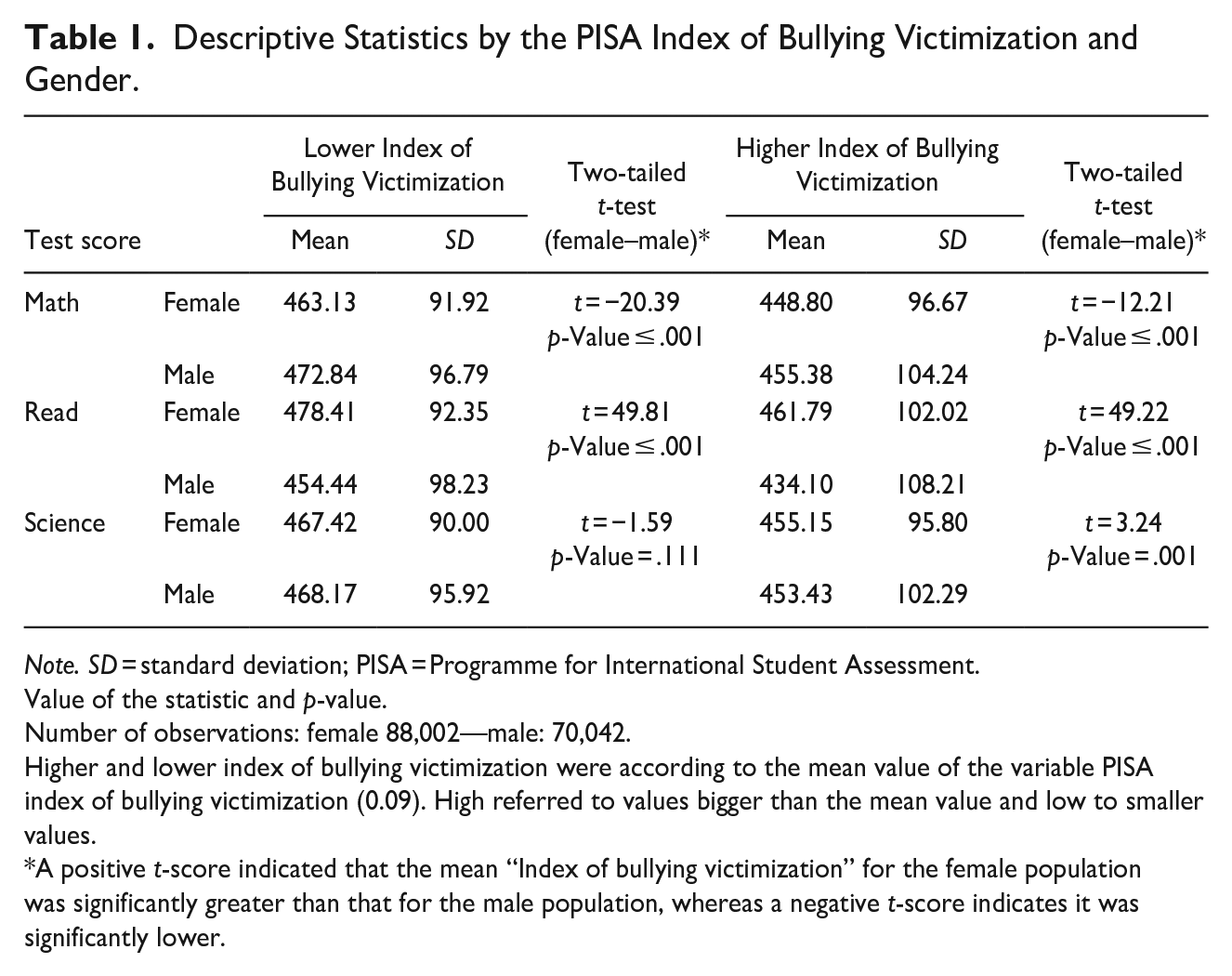
Note. SD = standard deviation; PISA = Programme for International Student Assessment.
Value of the statistic and p-value.
Number of observations: female 88,002—male: 70,042.
Higher and lower index of bullying victimization were according to the mean value of the variable PISA index of bullying victimization (0.09). High referred to values bigger than the mean value and low to smaller values.
A positive t-score indicated that the mean “Index of bullying victimization” for the female population was significantly greater than that for the male population, whereas a negative t-score indicates it was significantly lower.
Estimations of Students’ Outcomes and Bullying Victimization
The results suggested that bullying victimization had a significant negative association with test scores in mathematics, reading, and science. Additionally, individual-level factors, such as age and economic, social, and cultural status, were positively associated with test scores. Attending schools with higher perceived teacher interest and adaptation of instruction was also positively associated with academic achievement. Finally, the estimation found that attending schools in countries with higher human development indexes was related to better academic performance.
Specifically, Table 2 shows the results of the estimations of equations (1) and (2) for mathematics, reading, and science. The estimations included the fixed and random effects. The fixed effects accounted for the overall expected effects of the characteristics of the students, schools, and countries on the students’ outcomes. The random effects gave information on whether this effect differed between schools and countries by showing the standard deviations from the overall mean, with origin in the school and country-level variances unaccounted for in the model.
HLM Estimates of Academic Performance in PISA.
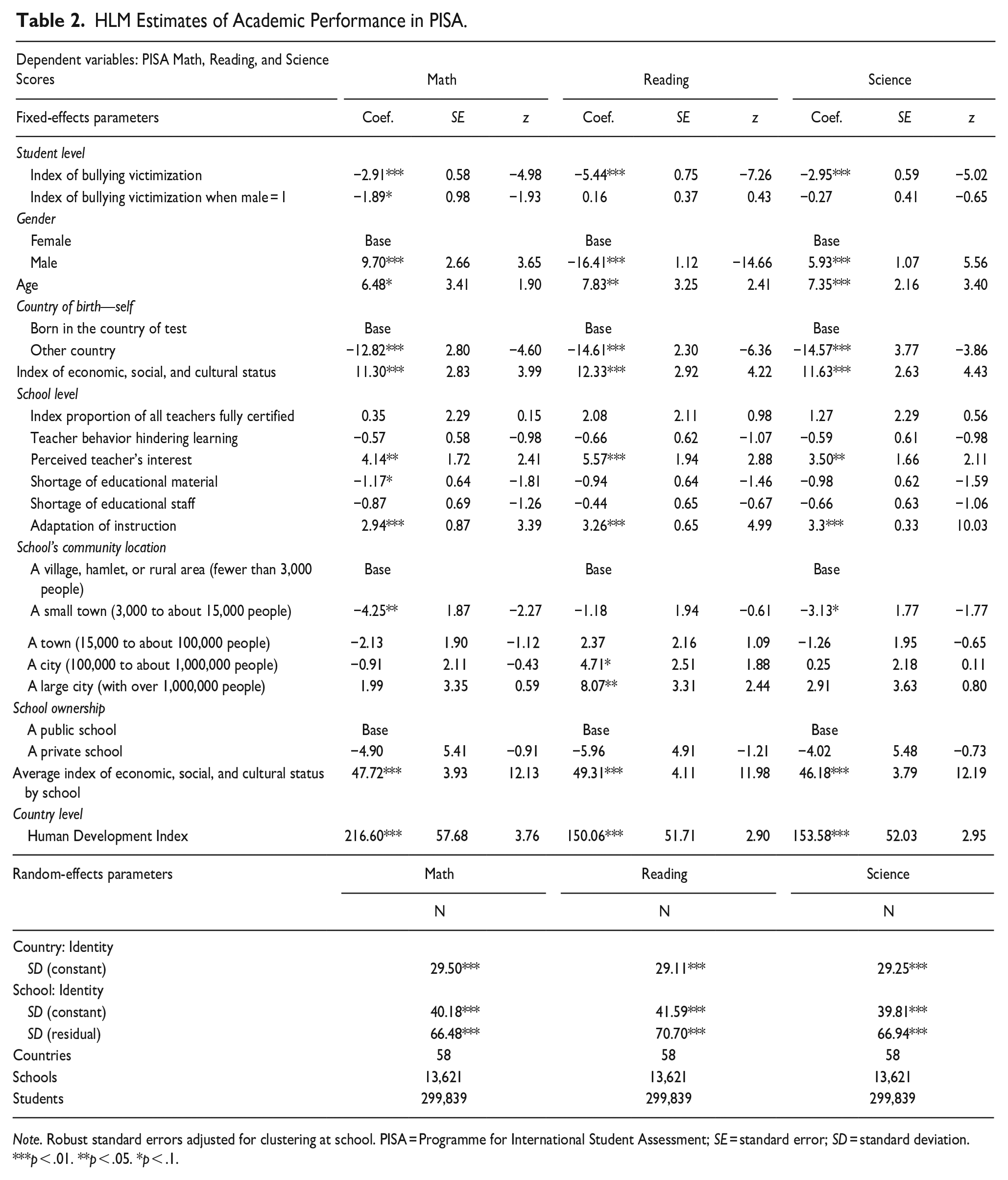
Note. Robust standard errors adjusted for clustering at school. PISA = Programme for International Student Assessment; SE = standard error; SD = standard deviation.
p < .01. **p < .05. *p < .1.
The fixed effects analysis showed a significant negative relation between bullying victimization and test scores. The coefficient of the variable Index of bullying victimization was higher in reading than in mathematics and science. An increase in the Index of bullying victimization of one standard deviation (SD) was associated with a decrease of 2.91 points in math score, 5.44 in reading, and 2.95 in science. Some studies had already confirmed these results (Karakus et al., 2022; Lee et al., 2018; Yu & Zhao, 2021). Analyzing the link between bullying victimization and test scores, but differentiating by student gender, we found that there were no major differences between males and females, which was in line with the findings of other authors (Begum et al., 2019; Van der Werf, 2014). Only in the case of mathematics (a subject where males traditionally get better results, OECD, 2015) did a male victim of bullying score 1.89 points less than a female who had the same values in the index of bullying victimization, all the other factors being equal.
Additional results at the student level showed that male students scored lower than females in mathematics, whereas there were no significant differences in reading and science. In addition, the greater the student’s age was, the higher the scores. Immigrant students scored lower than students born in the country of the test. Students’ index of economic, social and cultural status was positively related to their scores.
At the school level, the indexes Perceived teachers’ interest and Adaptation of instruction were positively and significantly related to students’ scores. Attendance at schools located in larger cities was related to higher reading scores but was not significantly related to the scores in math and science. Furthermore, attendance at schools in small towns was related to lower scores in math and science. Students who studied in schools with higher average economic, social, and cultural status benefited from this peer effect, which allowed them to score higher. By contrast, the index of Shortage of educational material was negatively related to math and science test scores, but the relation was not significant in reading. The coefficients of the indexes of Proportion of all teachers fully certified, Teacher behavior hindering learning, and Shortage of educational staff were not significant, neither was the coefficient of the variable indicating a private school.
At the country level, the results showed that students who attended schools located in countries with higher Human Development Index performed better in the PISA tests.
Finally, regarding the random effects, the variance components for the random intercepts were large relative to their standard error. This showed that some school- and country-level variances remained unaccounted for in the model, which justified the inclusion of the school and country levels in the HLM.
Exploratory Results
Different forms of bullying could have a different impact on academic performance. We added Table 3, which shows the results examining the relationship between the components of the Index of bullying victimization and students’ outcomes in math, reading, and science. The fixed-effects parameters of the multilevel model are three different forms of bullying victimization that consider relational, verbal, and physical bullying: being left out of things on purpose, being made fun of, and being threatened by other students. There were three levels of frequency of bullying victimization: “Never,” “A few times a year,” “A few times a month,” and “Once a week or more.” The table also included the gender of the students, with male and female categories. Overall, the table provided insight into the impact of bullying victimization on academic achievement and how it may vary by frequency of victimization and gender, once we had controlled for the rest of the covariates in the model. The results showed that different forms of bullying victimization had a significant negative correlation with students’ outcomes, with more frequent victimization presenting larger coefficients. In other words, greater bullying victimization was associated with worse academic results, which was observed for both males and females.
HLM Estimates of Academic Performance in PISA by Bullying Sources.
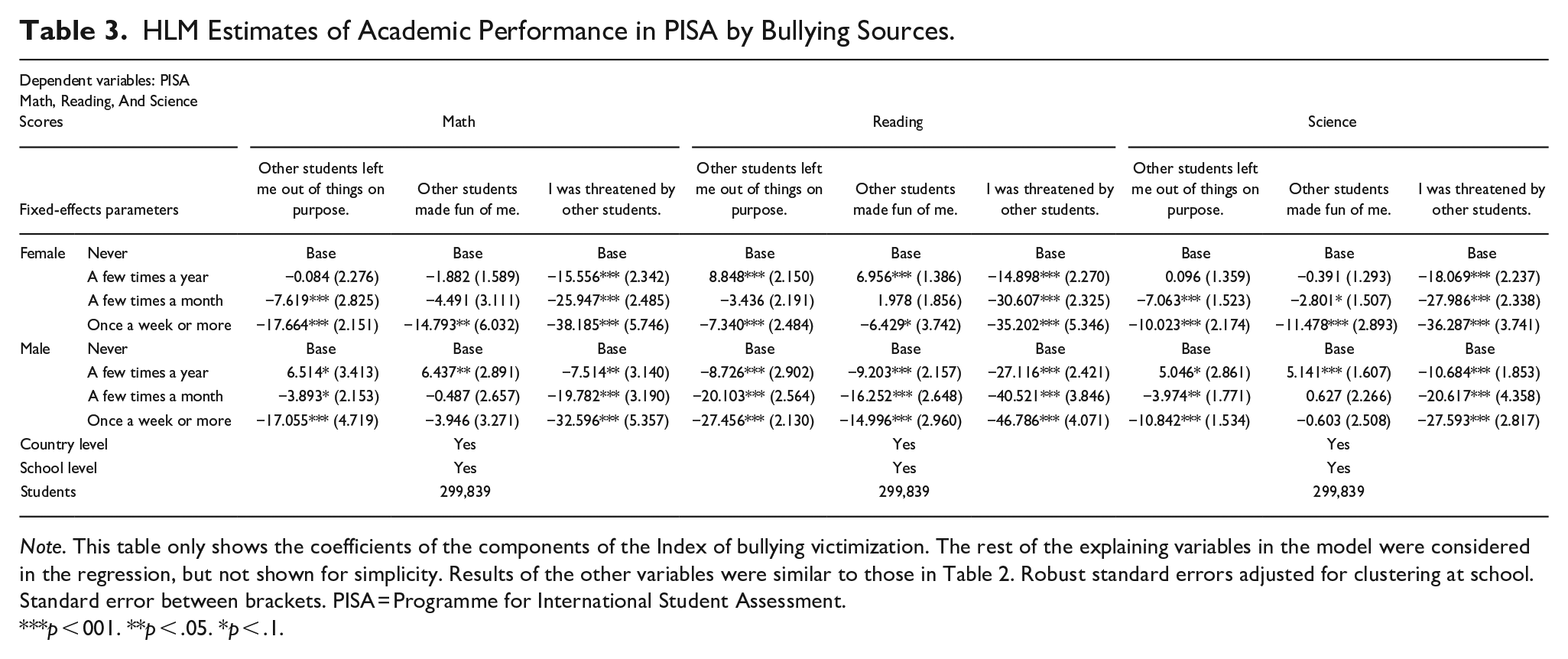
Note. This table only shows the coefficients of the components of the Index of bullying victimization. The rest of the explaining variables in the model were considered in the regression, but not shown for simplicity. Results of the other variables were similar to those in Table 2. Robust standard errors adjusted for clustering at school. Standard error between brackets. PISA = Programme for International Student Assessment.
p < 001. **p < .05. *p < .1.
Discussion and Conclusions
The present study has empirically investigated how bullying affects students’ academic performance, from an international and gender perspective. Our aim was to provide a better understanding of the consequences of bullying victimization in the learning process of adolescents. To this end, we estimated a statistical function to establish the relationship between students’ results in mathematics, reading, and science and a broad set of explanatory variables, among which was bullying victimization. We used a large sample of 322,905 students, aged 15 to 16, who participated in PISA 2018 and were from schools located in 58 countries.
The results indicate that bullying victimization is associated with declines in academic performance in all tested subjects, which in line with the findings of other authors (Karakus et al., 2022; Lee et al., 2018; Yu & Zhao, 2021). Lee et al. (2018) found that students who engaged in negative behaviors have lower academic achievement, especially if they are immigrants. Yu and Zhao (2021) noted that boys are more prone to victimization, which is associated with poor academic outcomes and integration problems. Karakus et al. (2022) also concluded that students who experienced bullying victimization are associated with more significant negative outcomes.
Moreover, no relevant differences by gender were observed, a result that is consistent with others studies (Begum et al., 2019; Van der Worf, 2014). Van der Werf (2014) found that the effects of bullying show differences in terms of age (stronger in younger students in the short term), but no significant differences in terms of gender. Begum et al. (2019) also found that there are no significant effects of cyberbullying on academic performance in terms of gender.
Finally, various types of bullying victimization are strongly linked to negative outcomes for students, with more frequent victimization resulting in more significant negative effects. This means that experiencing bullying more often is associated with poorer academic performance, affecting both male and female students alike.
We can add that our results indicate that there are individual and school characteristics that are positively associated with the score obtained. To begin with, the older the student, the higher his or her PISA score and students who are immigrants obtain lower scores, whereas students who have a higher economic, social, and cultural index or attend a school with a higher average economic, social, and cultural status benefit from this characteristic by scoring higher on the test. These results are consistent with the findings of Jayanthi et al. (2014), who found that the average score has a positive association with age, and Santos et al. (2016) who found that the scores of both native and immigrant students had a positive association with their age, but found that the relationship was stronger for native students than for immigrants. Another study that yielded similar results was that of Strand (2014) who indicated that immigrants and low-income natives are those with lower scores, identifying that the socioeconomic index is relevant.
At the school level, the positive association of students’ scores with the variables Perceived teachers’ interest and Adaptation of instruction is corroborated, and the Shortage of education material is negatively associated with math and science scores. This coincides with Karakus et al. (2022), who positively related the academic achievement of immigrant students to perceived teacher interest and adaptation of instruction, and also negatively related the variable to a shortage of educational material and educational staff. Finally, students living in countries with a higher Human Development Index obtained better results in the assessment.
Considering the negative association that we have found between bullying and academic performance, it becomes clear that it is necessary to invest resources and effort in designing policies to prevent bullying. These policies should be contextualized and, if possible, customized to the characteristics of the students to ensure positive effects (Salmivalli et al., 2021). Personalization of efforts is complex, but contextualization is necessary. Prevention also involves identifying the phenomenon and, therefore, teacher training in this regard is vital to be able to ensure its early detection and the adequate approach (Bradshaw, 2015). We have found that variables such as perceived teacher interest or adaptation to instruction positively influence academic performance. If we combine this with a possible moderating effect of bullying coming from increased teacher training, the prevention programs designed could guarantee their objectives.
To mention some strengths, we use a large and multinational sample that confers greater robustness to the results obtained. The main contributions of the work are, on the one hand, to quantify the association between bullying and academic performance, verifying its negativity. And secondly, to provide more clarity regarding the existence of gender differences in the impoverishment of the academic performance of the victims of bullying compared to their peers.
We acknowledge several limitations. First, the countries participating in PISA are middle- or high-income countries (Vargas-Montoya et al., 2023; Tuttle et al., 2022), so poorer nations would not be represented in our research. Moreover, despite the rigorousness with which the PISA dataset is compiled, it is not immune to measurement errors. Either because of the complexity of formulating questions that will be administered to students from very different countries, cultures, and educational systems, or because students may be imbued with a lack of interest in answering questions anonymously, knowing that they will not affect their academic record Rutkowski and Rutkowski (2010). Finally, the model we have proposed includes a broad set of explanatory factors for academic performance. However, we recognize that there could be a number of factors, not included in the PISA dataset and in the model, that could be conditioning academic performance and, so, its relationship with bullying victimization. Students’ innate ability would be a good example.
Although this evaluation cannot be extrapolated to demonstrate causality, the large amount of data used supports our view that the relationships found between bullying and academic achievement when making international comparisons are consistent and plausible.
For future research, we recommend a qualitative analysis focusing on certain countries with high rates of bullying victimization in order to identify the existence of heterogeneous effects, taking into account the idiosyncratic and environmental factors particular to each social environment. Moreover, it would also be interesting to complement this research with case studies focused at the school level in order to get closer to the problem and to be able to make more accurate recommendations related to bullying prevention in the classroom.
Supplemental Material
sj-docx-1-jiv-10.1177_08862605231222457 – Supplemental material for Bullying at School and Students’ Learning Outcomes: International Perspective and Gender Analysis
Supplemental material, sj-docx-1-jiv-10.1177_08862605231222457 for Bullying at School and Students’ Learning Outcomes: International Perspective and Gender Analysis by Gregorio Gimenez, Mauro Mediavilla, David Giuliodori and Gisela Carolina Rusteholz in Journal of Interpersonal Violence
Supplemental Material
sj-docx-2-jiv-10.1177_08862605231222457 – Supplemental material for Bullying at School and Students’ Learning Outcomes: International Perspective and Gender Analysis
Supplemental material, sj-docx-2-jiv-10.1177_08862605231222457 for Bullying at School and Students’ Learning Outcomes: International Perspective and Gender Analysis by Gregorio Gimenez, Mauro Mediavilla, David Giuliodori and Gisela Carolina Rusteholz in Journal of Interpersonal Violence
Footnotes
Declaration of Conflicting Interests
The author(s) declared no potential conflicts of interests with respect to the authorship and/or publication of this article.
Funding
The author(s) received no financial support for the research and/or authorship of this article.

Supplemental Material
Supplemental material for this article is available online.
Notes
Author Biographies
References
Supplementary Material
Please find the following supplemental material available below.
For Open Access articles published under a Creative Commons License, all supplemental material carries the same license as the article it is associated with.
For non-Open Access articles published, all supplemental material carries a non-exclusive license, and permission requests for re-use of supplemental material or any part of supplemental material shall be sent directly to the copyright owner as specified in the copyright notice associated with the article.
