







Abstract
Quarantine guidelines that arose with the COVID-19 pandemic limited opportunities for social interaction, raising concerns about increases in intimate partner violence and cyberabuse while simultaneously restricting access to help. The current study assessed increases in cyberabuse, sexual aggression, and intimate partner violence victimization and perpetration during the first year of the COVID-19 pandemic in a U.S. nationally representative sample of young adults ages 18 to 35, recruited from a probability-based household panel. Data were collected between November 2020 and May 2021. Descriptive analyses were conducted to assess the prevalence of any self-reported increase in cyberabuse, sexual aggression, or intimate partner victimization or perpetration during the COVID-19 pandemic. Logistic regression models were run for each outcome measuring any increase compared to no increase. Approximately one in ten U.S. young adults ages 18 to 35 reported experiencing an increase in cyberabuse victimization (12.6%) and cyberabuse perpetration (8.9%) during the pandemic. Similar proportions were observed for increased sexual aggression victimization (11.8%) and perpetration (9.0%). More than one in five respondents (21.4%) reported that their intimate partner was more physically, sexually, or emotionally aggressive toward them during the pandemic. Conversely, 16.2% of respondents reported that they were more physically, sexually, or emotionally aggressive themselves toward an intimate partner, compared to their behavior before the onset of the pandemic. Having an intimate partner and staying at home more than usual during the pandemic were protective factors for both cyberabuse and sexual aggression victimization. Respondent age, education, and race and ethnicity were not associated with increased victimization or perpetration of cyberabuse or sexual aggression. However, women reported lower odds of increased sexual aggression perpetration than men. These findings improve understanding of changes to interpersonal abuse and associated risk factors during a period of social disruption.
Keywords
The COVID-19 pandemic fundamentally altered individuals’ way of life, at times requiring many to stay at home due to public health measures and government restrictions. Given guidance to engage in social distancing and limit social interactions to small, closed networks, some experts were concerned about the potential for intimate partner violence (IPV) to increase when people were also more isolated from typical sources of informal and formal help (Evans et al., 2020; SAMHSA, 2020). Preliminary data indicate that disruptions to typical routines exacerbated IPV, and countries around the world reported increased calls to domestic violence emergency support lines (Boserup et al., 2020; Bradbury-Jones & Isham, 2020; Bradley et al., 2020; Kaukinen, 2020; Taub, 2020). Concerns about increased IPV during the pandemic are consistent with violence patterns observed during other disasters, such as Hurricane Katrina (Buttell & Carney, 2009). A rapid review of IPV during natural disasters by Brabete et al. (2021) showed increased prevalence and severity of IPV post-disaster, with similar conditions applicable in a pandemic context. There has been limited research on changes in IPV and sexual violence since the onset of the COVID-19 pandemic, but findings thus far have suggested that physical and sexual violence has increased (Boxall et al., 2020; Jetelina et al., 2021).
COVID-19 spurred a dramatic increase in internet use (Gartner, 2020; Hawdon et al., 2020; Yitzhak, 2020), and evidence suggests that cybercrimes increased during the pandemic (Federal Bureau of Investigation Internet Crime Complaint Center, 2020). Within the vast array of cybercrimes, cyber-harassment and cyberstalking, in particular, have increased during the pandemic (although there is not a gold standard measure of what constitutes cyberabuse (Wilson et al., 2020)). A study of violence experiences in California showed a twofold increase in reports of past year cyber sexual harassment from 2020 to 2021, disproportionately reported by women (Center on Gender Equity and Health, 2021).
Some abusers used the pandemic as a tool to coerce and control survivors (Ragavan et al., 2022). Ragavan et al. (2022) conducted interviews with IPV advocates who described additional opportunities for abusers to further isolate their partners, exert financial control of stimulus checks, and jeopardize their partner’s health by purposefully exposing their partner to COVID-19 or restricting personal protective equipment. An integrative review of violence against women during the pandemic reported controlling behavior of the abuser as a barrier to accessing help (Sánchez et al., 2020). Pandemic-related stay-at-home orders may leave victims more vulnerable to cyberabuse surveillance because the perpetrator has greater certainty of the victim’s location (Bracewell et al., 2020) and opportunities for victims to access help are diminished (Mazza et al., 2020). Additionally, reduced economic opportunity, experienced at a disproportionate rate by women and people of color during the pandemic (Lopez et al., 2021; Zamarro et al., 2020), may increase financial dependency and make it more difficult to leave an abusive situation. While stay-at-home orders were mainly implemented at the beginning of the pandemic, many governmental and public health authorities continued to encourage people to stay home and practice social distancing during subsequent COVID-19 waves, which may have meant that victims of IPV continued to experience increased risk for abuse because of prolonged isolation.
Theoretical Background
Several theories provide possible explanations for why and how pandemic-related disruptions to daily life might have increased risk for cyberabuse and sexual violence victimization. Routine activities theory proposes that crime occurs in the presence of a motivated offender, suitable target, and the absence of a capable guardian (Cohen & Felson, 1979). As compared to offline victimization, cyberspace alters the traditional motivated offender and suitable target relationship, presenting an increased risk of victimization (Agustina, 2015; Hawdon et al., 2020; Reyns et al., 2011). Unprecedented levels of unemployment from the pandemic might have increased the number of motivated offenders of cybercrimes or sexual violence due to diminished income opportunities, heightened agitation, and more time spent in the home.
As with routine activities theory, stress-frustration theory (Holtzworth-Munroe et al., 1997) highlights elevated risks due to an increase in the number of motivated offenders and, in the case of cyberabuse, an increase in suitable targets due to the rise in online activity (Kaukinen, 2020). At the same time, stress-frustration theory would suggest that the risk of IPV and sexual aggression victimization and perpetration may be further elevated due to pandemic-induced stressors (Brooks et al., 2020; Kaukinen, 2020). Reduced economic resources within a household elevate levels of stress and conflict, which subsequently heightens the risk of violence (Kaukinen, 2020; Lawson et al., 2020). The pandemic and pandemic-related restrictions have increased relationship conflict among U.S. adults; Luetke et al. (2020) found that 34% of U.S. adults reported some degree of conflict with their romantic partner due to COVID-19 and COVID-related restrictions. Pandemic-related stressors also impact the risk of sexual violence outside of an intimate partnership, as an individual’s stress may lead to more aggressive behaviors in general. Even under conditions of limited in-person contact, increased stressors may influence online interactions. Fewer opportunities to meet potential partners in social settings could result in additional reliance on online interactions and increased exposure to cyber sexual harassment or violence. Anomie and strain theories, when applied in the context of the pandemic, suggest that increased deviant behaviors may occur because of social strain and instabilities in an individual’s environment (Ma & McKinnon, 2021). Taken together, the theoretical framework drawn from routine activities theory, stress-frustration theory, and anomie and strain theories suggests that social conditions that have arisen from the pandemic would lead to increases in cyberabuse, IPV, and sexual aggression.
Sexual Violence, IPV, and Cyberabuse Among Different Sociodemographic Identities
Sexual violence, IPV, and cyberabuse are exceedingly common. Estimates suggest that over half of women and one-third of men experience sexual violence in their lifetime (Centers for Disease Control and Prevention, 2022). As many as one in three women and one in four men have experienced physical IPV (Black et al., 2011), and 41% of U.S. adults have experienced some form of online harassment (Vogels, 2021). Online harassment is even more common among young adults (64%) (Vogels, 2021). While these forms of violence are common across society at large, there are distinct differences in the likelihood of victimization by sociodemographic identity.
Black and African American people experience disparate rates of sexual violence and IPV victimization compared to other racial and ethnic identities. Estimates from the National Intimate Partner and Sexual Violence Survey found that 22.0% of Black women have experienced rape at some point in their life, compared to 18.8% of White non-Hispanic women and 14.6% of Hispanic women (Black et al., 2011). Mosley reviewed medical records of individuals who received a sexual assault forensic exam and found that Black survivors of sexual assault (who sought professional support) had 1.77 times the odds of IPV victimization compared to White survivors (Mosley et al., 2021). Other racial and ethnic minorities also face an increased risk of sexual violence. Over half of multiracial women (58.0%) and half (49.0%) of American Indian or Alaska Native women reported experiencing sexual violence other than rape in their lifetime (Black et al., 2011). Increased risk of IPV and sexual violence for racial and ethnic minorities stems from structural and situational contexts created by generations of structural and institutional racism against communities of color, most notably Black and African American communities (Hampton et al., 2003; Waltermaurer et al., 2006).
Women also experience higher rates of sexual violence and IPV victimization than men (Black et al., 2011; Centers for Disease Control and Prevention, 2022; Devries et al., 2013). Men and women experience similar rates of online harassment; however, the severity and pervasiveness of online harassment is much more extreme for women. In a nationally representative survey of Americans 15 and older, Lenhart et al. (2016) found that women were nearly three times as likely as men to report that the online harassment they experienced made them feel scared.
Pandemic-Related Impacts on Sexual Violence and IPV
Patterns of increased IPV and violence against women during the COVID-19 pandemic have been seen globally (Bettinger-Lopez & Bro, 2020; Bradbury-Jones & Isham, 2020; Kelly & Morgan, 2020; Said-Foqahaa, 2020). One qualitative research study on gender-based violence in Indonesia documented shifts in sexual violence from in person to online among four victims of technology-facilitated abuse (Jatmiko et al., 2020). Piquero et al.’s (2021) systematic review of 18 empirical studies that evaluated the effect of COVID-19 restrictions on IPV found significant increases in IPV between pre- and post-lockdown periods. Of note, incidents of IPV were measured from police calls for service, emergency room admissions, or domestic violence hotline records; studies of self-reported increase were excluded. Further, Piquero et al. found that the overall average percent increase in U.S.-based IPV was higher than aggregated U.S. and international rates.
Wood et al. (2023) conducted a survey of recent IPV survivors in Texas to assess IPV victimization in the first year of the pandemic (March–December 2020). Over three quarters of respondents (77.3%) reported physical victimization and nearly all survivors reported psychological abuse victimization (94.7%). Among these survivors, 55.5% reported increases in violence victimization since the pandemic began; Black respondents reported disproportionate rates of IPV. Jetelina et al. (2021) evaluated changes in physical or sexual violence by an intimate partner during the pandemic, finding that 17% of respondents who were currently experiencing IPV at the time of the survey (April 2020) reported that levels of victimization worsened since the COVID-19 pandemic began. Individuals who experienced physical violence by an intimate partner had 2.3 times the odds of worsening victimization compared to those who experienced nonphysical IPV, and individuals who experienced sexual violence had 2.5 times the odds of worsening victimization compared to nonsexual IPV.
Pandemic-Related Impacts on Cyberabuse
Research evaluating changes in cyberabuse from pre- to post-pandemic is more limited. Hawdon et al. (2020) conducted an online survey among a national sample of U.S. adults on seven types of cybercrime victimization (four of which focus on financial fraud) and cyber behaviors across two independent samples: a pre-COVID survey conducted in November 2019 and a post-COVID survey conducted in April 2020. Hawdon et al. (2020) did not observe changes in overall rates of cyber-routine activities nor cybervictimization. However, the online behaviors of young adults can differ from those of older adults, and young adults may have experienced changes that the older adult population did not.
Gaps in the Literature
While there are several studies of the pandemic’s impact on IPV (Boxall et al., 2020; Jetelina et al., 2021; Wood et al., 2023; Piquero et al., 2021), few have studied changes in cyberabuse (Hawdon et al., 2020) or sexual violence (Boxall et al., 2020; Jetelina et al., 2021) victimization during the pandemic. Moreover, the currently available research regarding changes in cyberabuse or sexual violence victimization are nonrepresentative samples and reflect broad age ranges. Further, to our knowledge, no studies have estimated the impact of the pandemic on perpetration of cyberabuse or sexual aggression in the U.S. This leaves a gap in rigorous research estimating changes in cyberabuse and sexual aggression victimization and perpetration among young adults in the U.S.
The Present Study
To address these gaps, the current study assessed increases in both victimization and perpetration of cyberabuse, sexual aggression (not necessarily within the context of cyberabuse), and IPV during the first year of the COVID-19 pandemic in a U.S. nationally representative sample of young adults ages 18 to 35. We focused on this age group given their developmental familiarity and usage of technology and social media, in that the experiences of different generational cohorts with technology would likely vary.
Our objectives were to identify sociodemographic and pandemic-related behavioral factors that were associated with increased odds of experiencing or perpetrating cyberabuse, sexual aggression, or IPV during the pandemic. Our hypotheses for the present study are as follows:
First, we expected that abusive interactions would increase during the pandemic because people were staying at home more. We expected that this would be true for all forms of victimization as a result of anxiety arising from health concerns, economic stressors, and constraints on social support systems. Because of the reciprocal relationship between perpetration and victimization (Jennings et al., 2011; Marie Skubak & Emily, 2013; Taylor et al., 2019), we expected to see increases in cyberabuse, sexual aggression, and IPV experience among young adults who were more isolated (by quarantine guidance) during the pandemic, and perhaps more reliant on online interactions as a result, as compared to young adults who were less isolated.
Second, given evidence of increased risk for sexual violence victimization for racial and ethnic minorities, and for women, (Black et al., 2011; Hampton et al., 2003; Mosley et al., 2021; Rennison & Welchans, 2000), we hypothesized that we would find greater increases in sexual aggression victimization among these populations.
Third, because existing research suggests similar rates of cyberabuse victimization between men and women in the context of dating violence (Henry et al., 2020; Price-Feeney, 2016; Wolford-Clevenger et al., 2016), we hypothesized that a similar pattern of increases in cyberabuse victimization and perpetration would be observed between men and women regardless of relationship status.
Fourth, because the IPV measure that we used captured a range of abuse, inclusive of physical, sexual, and emotional aggression, we hypothesized that increases in IPV victimization and perpetration would not differ by gender. While men are more likely to perpetrate sexual and physical violence, men and women perpetrate emotional aggression at similar rates (Harned, 2001; Hines & Saudino, 2003; Taylor et al., 2019).
Methods
Study Sample
Data for the Cyberabuse Research Initiative (CARI), funded by the Office of Violence Against Women, were collected over the period of November 2020 to May 2021 from a nationally representative sample of U.S. adults ages 18 to 35 using NORC’s AmeriSpeak® Panel (https://amerispeak.norc.org/us/en/amerispeak/about-amerispeak.html) for survey sampling and fielding. The AmeriSpeak® Panel is representative of approximately 97% of U.S. households (Montgomery et al., 2016). The sample was selected using 48 sampling strata based on age, race and Hispanic ethnicity, education, and gender. African American or Black and Hispanic panelists were oversampled to ensure adequate representativeness in the final sample. The survey was offered in English and Spanish and was available to be taken either online or over the phone. To encourage study participation, sampled web-mode panelists received email and SMS reminders throughout the fielding period. Panelists were offered the cash equivalent of $10 for participation in the study. Out of the 8,620 invited panelists, a total of 2,752 respondents (32%) completed the survey, 2,739 by web and 13 by phone.
Inclusion in the current analytic sample was based on if the respondent answered all outcome variables and covariates included in the analytic model (~80% of the total sample). Limited demographic information was missing (~3%); however, for the outcome variables, respondents were given an option of “Not applicable—did not interact with anyone,” which was coded as missing. This accounts for 12%–14% of data missing not at random in the models. For the cyberabuse models, the total analytic sample was n = 2,168 for victimization and n = 2,179 for perpetration. For the sexual aggression models, the total analytic sample was n = 2,213 for victimization and n = 2,217 for perpetration. In total, 146 cases were excluded due to a missing value on at least one covariate. Due to a small sample size of gender minority respondents (N = 60), only cismales and cisfemales were included in the analysis. Subgroup analytic models of IPV were run for those who indicated they had an intimate partner at any point during the pandemic (n = 1,624).
Measures
To ask specifically about experiences since the onset of the pandemic, the key outcomes of interest were introduced by the following language, “Thinking about the time that you were engaged in social distancing, quarantined, or otherwise staying at home because of corona virus. . ..” Individual measures of cyberabuse, sexual aggression, and IPV included “during this time” to re-emphasize the pandemic timeframe. The outcome measures, increased cyberabuse, sexual aggression, and IPV, were a self-reported and self-assessed determination of experiencing “more” of each respective form of abuse since the onset of the pandemic.
Cyberabuse
All respondents were asked about increases in cyberabuse during the pandemic. Specifically, respondents were asked if they experienced “any increase in cyberstalking or cyber-harassment during this time” or if they engaged in “more cyberstalking or cyber-harassment during this time.” Although no definitional detail for the terms cyberstalking or cyber-harassment were provided, and respondents interpreted these terms for themselves, these items appeared at the end of the survey that had asked about a variety of forms of technology-facilitated abuse. Thus, there may have been a learning effect for all study participants regarding what might constitute cyberabuse. Increase in cyberabuse victimization and perpetration was measured on a scale of “not at all,” “a little,” “a lot,” and “a whole lot,” with a “N/A- no contact with anyone” option. For the present analysis, these measures were dichotomized into 1 for any increase and 0 for no increase. “N/A- no contact with anyone” was coded as missing. For brevity, we refer to the cyberstalking or cyber-harassment measure results as “cyberabuse.”
Sexual Aggression
All respondents were asked about increases in sexual aggression victimization and perpetration during the pandemic. Sexual aggression was not defined as pertaining to either an online or offline environment. Specifically, for the victimization item, respondents were asked “Was anyone more sexually aggressive toward you during this time?” on a scale of “not at all,” “a little,” “a lot,” and “a whole lot,” with a “N/A- no contact with anyone” option. Conversely, perpetration was measured by asking if the respondent was more sexually aggressive toward anyone during this time. For the present analysis, these measures were dichotomized (1 for any increase and 0 for no increase, with “N/A” coded as missing).
Intimate Partner Violence
Respondents who reported that they had an intimate partner at any point during the pandemic were asked if aggression by or to that partner increased during the pandemic. Specifically, they were asked “Was your intimate partner, boyfriend/girlfriend, or spouse more physically, sexually, or emotionally aggressive toward you during this time?” and “Were you more physically, sexually, or emotionally aggressive toward an intimate partner, boyfriend/girlfriend, or spouse during this time?” Increased victimization and perpetration were measured on a scale of “not at all,” “a little,” “a lot,” and “a whole lot,” then dichotomized (1 for any increase and 0 for no increase).
Pandemic Behavior
Respondents were asked if they stayed at home more than usual during the pandemic (yes coded 0, no coded 1) to assess the potential for interacting with others outside of their residence.
Respondent Characteristics
Demographics included age (continuous), gender identity (cismale coded 1 or cisfemales coded 2), race and ethnicity (White Non-Hispanic [ref.], Black Non-Hispanic, Hispanic, or Non-Hispanic Other), education level (high school equivalent or less coded as 0, some college or greater coded as 1), relationship status (if they had an intimate partner at any point during the pandemic coded as 0, if they did not coded as 1), and household income (18 category variable treated as continuous).
Analytic Plan
Descriptive analyses were conducted to assess the prevalence of any self-reported increase in cyberabuse, sexual aggression, or IPV victimization or perpetration during the COVID-19 pandemic. The data were weighted to ensure national representativeness (DiSogra, 2009); weights were calculated with the probability of selection and adjusted for survey nonresponse. To test our hypotheses, design-adjusted logistic regression models were fit to assess the relationship between individual characteristics and likelihood of increased victimization or perpetration. In the exploratory phase of analysis, multinomial logistic regression models were fit to assess differences between three-category outcome variables for victimization and perpetration (any increase, no increase, and NA-no contact with anyone). Comparison of the “no contact” group to the “no increase” group does not provide a clear interpretation, and there were some inconsistencies in respondents reporting no contact with anyone. For these reasons, a simple logistic regression model was selected as the final model for all outcomes, measuring any increase compared to no increase.
Preliminary Analyses for Model Selection and Reporting
Models were run with gender interaction terms by each covariate (age, education, race and ethnicity, relationship status, did not stay at home more during the pandemic, and income) to assess any differences in increased victimization or perpetration between males and females. No significant differences were observed by gender, except for income in the sexual aggression victimization (β = −.126; p = .018) and perpetration models (β = −.120; p = .031). The interaction terms were excluded from the final models to fit the most parsimonious model for each outcome. Subgroup analyses were conducted among those with an intimate partner during the pandemic to assess any increase in IPV. Models were fit with respondent demographic characteristics (excluding relationship status) to adjust for sociodemographic differences in increased victimization or perpetration. No statistically significant findings were observed for the IPV victimization nor perpetration model, and thus, the regression results are not reported in this paper.
Results
Descriptive Findings
Table 1 presents sample characteristics. The sample was evenly balanced on gender. Most respondents identified as non-Hispanic White (57.7%) compared to non-Hispanic Black (12.3%), Hispanic (18.8%) or non-Hispanic other race (11.2%). About three-quarters of respondents had some college education or greater (72.8%).
Sample Description (N = 2,112*).
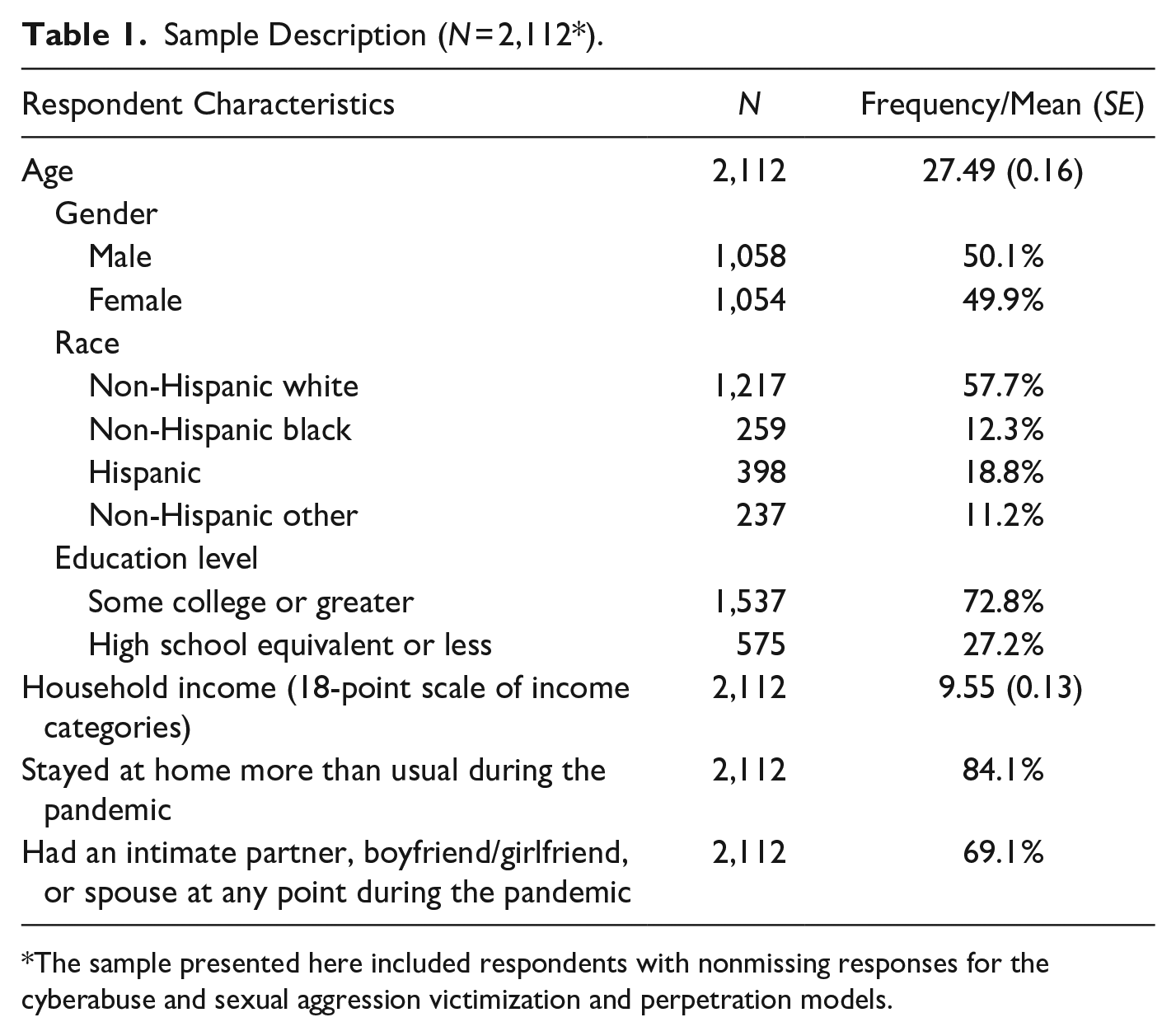
The sample presented here included respondents with nonmissing responses for the cyberabuse and sexual aggression victimization and perpetration models.
Table 2 presents the weighted distribution of increases in cyberabuse and sexual aggression victimization and perpetration, as well as increases in IPV victimization and perpetration among the sub-sample of respondents with an intimate partner during the pandemic. In our sample of young adults ages 18 to 35, 12.6% reported experiencing an increase in cyberabuse victimization and 8.9% of young adults reported an increase in cyberabuse perpetration during the pandemic. Similar proportions were observed for sexual aggression victimization and perpetration; 11.8% of young adults reported that anyone had been more sexually aggressive toward them and 9.0% reported being more sexually aggressive toward anyone during this time. People who had an intimate partner at any point during the pandemic reported higher increases in IPV victimization and perpetration than reported increases in sexual aggression victimization and perpetration by or toward anyone. More than one in five respondents (21.4%) said that their intimate partner was more physically, sexually, or emotionally aggressive toward them during the pandemic, and 16.2% reported that they were more physically, sexually, or emotionally aggressive toward an intimate partner during the pandemic, compared to experiences before the onset of the COVID-19 crisis.
Prevalence of Cyberabuse, Sexual Aggression, and IPV During the First Year of the COVID-19 Pandemic.
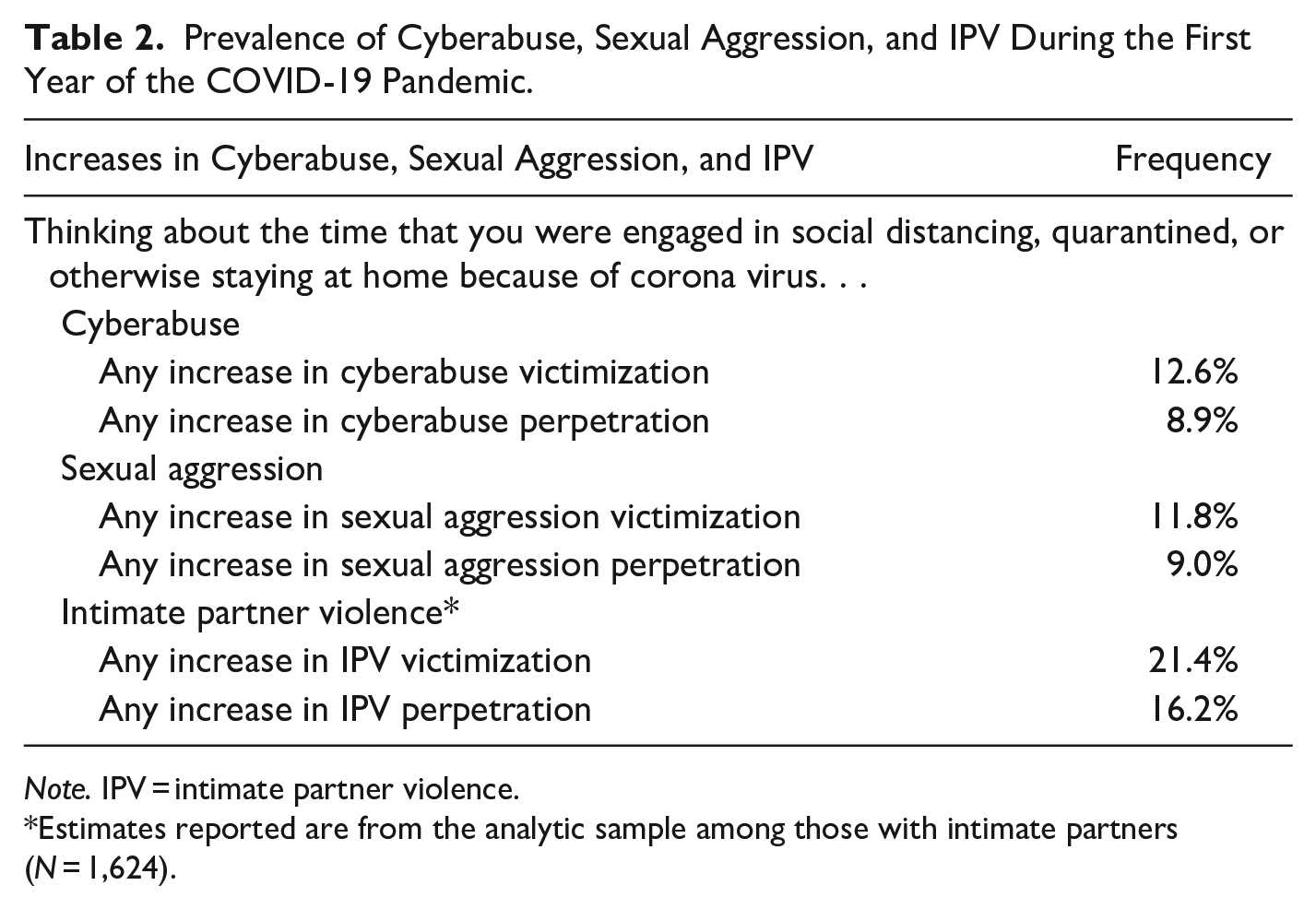
Note. IPV = intimate partner violence.
Estimates reported are from the analytic sample among those with intimate partners (N = 1,624).
Cyberabuse and Sexual Aggression Victimization
Table 3 presents multivariate logistic regression results of the adjusted odds of increases in cyberabuse and sexual aggression victimization and perpetration during the pandemic. Contrary to expectations, having an intimate partner and staying at home more during the pandemic were protective factors for both cyberabuse and sexual aggression victimization. Those who did not have an intimate partner at any point during the pandemic had 1.7 times the odds of experiencing any increase in sexual aggression victimization as compared to those who had an intimate partner (β = .522; SE = 0.251; 95% CI [1.03, 2.76]). Young adults without an intimate partner had a marginally statistically significant increase in cyberabuse victimization experiences, with 1.5 times the odds of experiencing any increase in cyberabuse during the pandemic as compared to those with an intimate partner (β = .392; SE = 0.205; 95% CI [0.99, 2.21]).
Logistic Regression Models of Any Increase in Cyberabuse and Sexual Aggression Victimization and Perpetration.
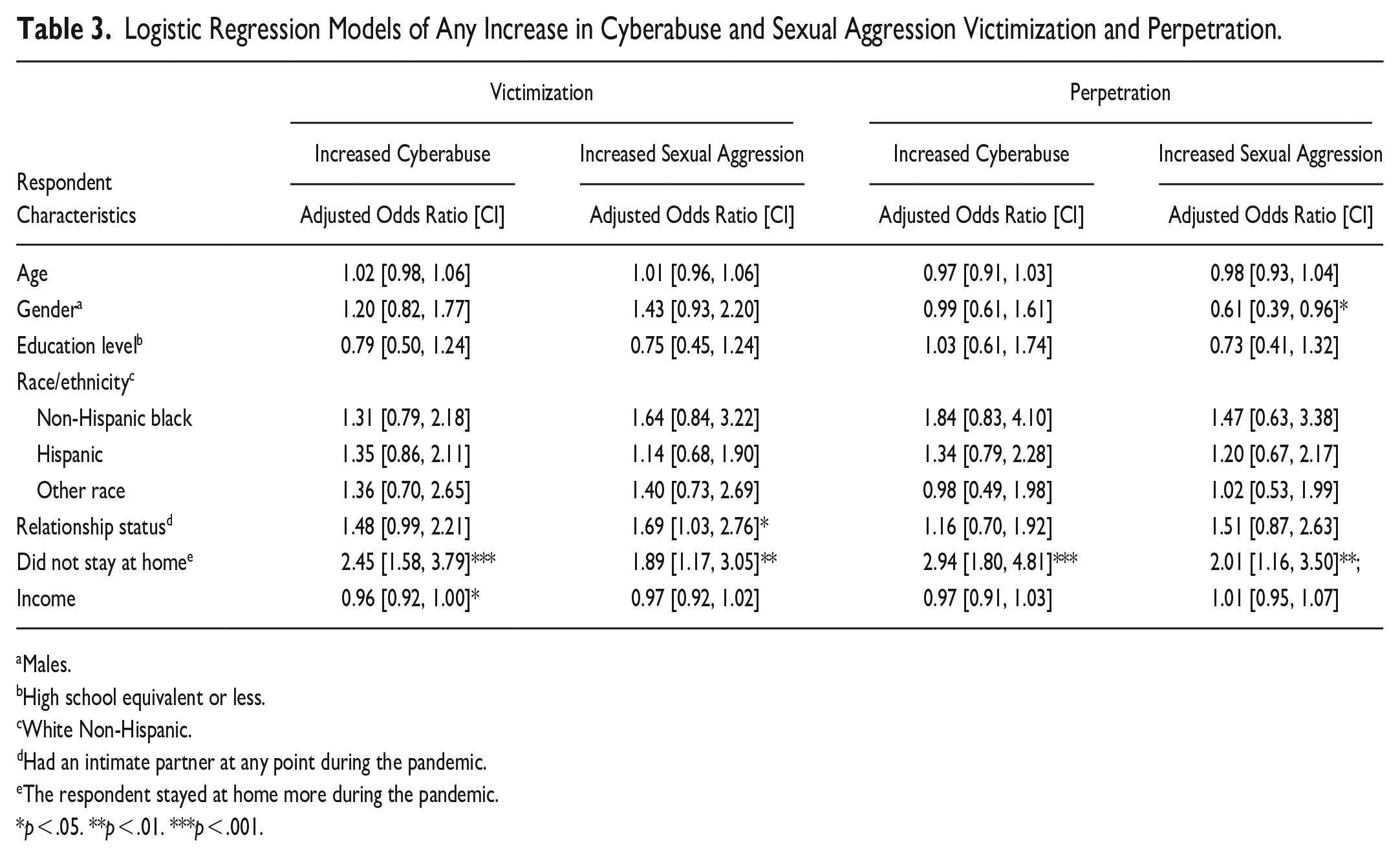
Males.
High school equivalent or less.
White Non-Hispanic.
Had an intimate partner at any point during the pandemic.
The respondent stayed at home more during the pandemic.
p < .05. **p < .01. ***p < .001.
Young adults who did not stay at home more often during the pandemic had 1.9 times the odds of experiencing an increase in sexual aggression victimization (β = .636; SE = 0.244; 95% CI [1.17, 3.05]) and 2.5 times the odds of experiencing any increase in cyberabuse victimization (β = .895; SE = 0.223, 95% CI [1.58, 3.79]), compared to those who stayed at home more often. Age, gender, education level, and race and ethnicity were not significantly associated with an increase in cyberabuse or sexual aggression victimization. Income was negatively associated with odds of cyberabuse victimization, although the effect was small (OR 0.96, β = −.041; SE = 0.021; 95% CI [0.92, 1.00]).
Cyberabuse and Sexual Aggression Perpetration
Factors related to sexual aggression and cyberabuse perpetration, as opposed to victimization, were slightly different. As with victimization, those who did not stay home more than usual during the pandemic had twice the odds of being more sexually aggressive toward anyone (β = .699; SE = 0.282; 95% CI [1.16, 3.50]) and 2.9 times the odds of engaging in more cyberabuse compared to those who did stay at home more than usual (β = 1.079; SE = 0.251; 95% CI [1.80, 4.81]). While gender was not significantly associated with increased sexual aggression victimization, women had reduced odds of being more sexually aggressive than men (OR 0.61, β = −.487; SE = 0.227; 95% CI [0.39, 0.96]). Gender was not statistically significantly associated with increased cyberabuse perpetration during the pandemic. Age, education level, relationship status, race and ethnicity, and income were not statistically significantly associated with any increase in sexual aggression or cyberabuse perpetration (Table 3).
Discussion
To our knowledge, this is the first nationally representative study of changes in cyberabuse, sexual aggression, and IPV victimization and perpetration among young adults since the onset of the COVID-19 pandemic. The increase in IPV since the onset of pandemic is well documented (Boxall et al., 2020; Bracewell et al., 2020; Center on Gender Equity and Health, 2021; Gosangi et al., 2021; Jetelina et al., 2021; Mazza et al., 2020; Mohler et al., 2020), but studies to date have focused on IPV specifically rather than broader interpersonal violence by any perpetrator, intimate partner or otherwise. Our descriptive results, which found that IPV victimization increased during the pandemic, are consistent with other research (Boxall et al., 2020; Wood et al., 2023; Jetelina et al., 2021; Piquero et al., 2021). However, unlike prior research, we did not observe significant differences in increased IPV between different sociodemographic groups (data not shown).
The significant methodological differences between the present study and existing research on IPV during the pandemic may explain differences in observed results. We measured increase in IPV victimization through self-report, broadly defined as physical, sexual, or emotional aggression, whereas most research on IPV during the pandemic relied on standardized outcome measures of IPV such as hotline call volume or crime data. While not reliant on self-interpretation of IPV, these standardized measures may undercount IPV experiences in that they only capture cases that result in formal help-seeking. Additionally, increases found in prior studies are based on aggregate counts of reported IPV incidents, while the present study captures respondents’ perceptions of whether IPV has increased. Our findings of increases in IPV victimization were slightly higher than estimates from Jetelina et al. (2021), who measured worsening IPV since the onset of the pandemic through self-report among IPV survivors. This is not surprising, given our sample was not limited to IPV survivors. This highlights that some young adults may have newly experienced IPV since the COVID-19 pandemic began, although this inference cannot be substantiated based on the differences in the present study measurement and the measurement used by Jetelina et al. (2021). Wood et al. (2023) found a much higher rate of self-reported increases in violence victimization in the first year of the pandemic (55%). Further study is warranted to understand pandemic-related changes to IPV and severity of IPV among survivors.
Increases in perpetration of cyberabuse and sexual aggression were similar to the respective increase in victimization, increasing confidence in the observed estimates. We did not directly measure the overlap between victimization and offending, but similar increases in victimization and perpetration potentially reflect the victim–offender overlap found in other research on violence among U.S. young adults (Taylor et al., 2019). While Hawdon et al. (2020) did not find a significant increase in cybercrime victimization, their sample included people from a broader age range than our study. The Hawdon et al. (2020) sample was, on average, 4 years older in the pandemic cross-sectional sample (46.5) than in the pre-pandemic sample (42.7)—and the outcome measures of online victimization differed from our measure. Our findings that women had lower odds of being more sexually aggressive than men, but that there was no significant gender difference found for cyberabuse perpetration, are consistent with our original hypotheses. Prior research has found that both men and women perpetrate dating violence, but that men perpetrate more sexual aggression than women (Harned, 2001; Hines & Saudino, 2003).
In our study, there were no observed differences in sexual aggression victimization by race and ethnicity subgroups, contradicting our original hypothesis. This difference may be attributed to our survey measurement. It is important to note that we measured increases in victimization rather than prevalence of victimization. As such, the absence of significant differences in increases in sexual aggression victimization may indicate that while there are disparate rates of sexual violence victimization among Back and African American people compared to other racial and ethnic identities (Black et al., 2011; Hampton et al., 2003; Mosley et al., 2021; Rennison & Welchans, 2000), the marginal increase in victimization (during the study period of heightened social distancing due to COVID-19 guidance) did not differ by race or ethnicity. Other sociodemographic factors such as the ability to stay at home during the pandemic and economic security may be stronger predictors of risk for the finding of increased sexual aggression victimization than racial and ethnic identity alone. Future qualitative research with young adults to examine different perspectives on these experiences by race and ethnicity would be constructive to strengthen measurement. Looking specifically at increases in sexual aggression during the pandemic lends itself to examining online violence due to the majority of people who stayed home during the pandemic (84.1% in our sample). Young adults are nearly ubiquitously online (Pew Research, 2021) and were more reliant on technology as a means for socialization and connection during the pandemic. Thus, the increased opportunities for motivated offenders, coupled with pandemic-induced stressors, may have resulted in increases in sexual aggression victimization broadly across all racial and ethnic identities.
The current results also contradicted our hypothesis that any increase in perpetration and victimization would be greater for those individuals who stayed at home more than usual because of the pandemic. Young adults who did not stay at home more than usual had significantly higher odds of both increased victimization and perpetration of cyberabuse and sexual aggression. It is possible that the young adults who did not stay at home more often were more likely to have one or more jobs that required them to interact with the public, such as those in the service industry, and less financial flexibility. The inability to work at home during the pandemic may have increased stress from higher levels of exposure to the virus and economic constraints and, as a result, led to higher levels of perpetration. Following the theoretical foundations of this study, elevated levels of stress in the home may have co-occurring effects of increased sexual aggression perpetration and victimization.
Observed differences between those who did not stay at home more often versus those who did may alternatively be due to differing perceptions of severity of the pandemic rather than for employment-related reasons. Those who did not stay at home more during the pandemic may not have perceived COVID-19 as a significant threat to their own or the public’s health, and thus continued to interact and socialize with others similar to pre-pandemic levels. Denial of the health risks associated with COVID-19 infection, and in some instances existance of the virus itself, likely would not result in increased stress levels and as such would contradict the general strain theory. Differences in pandemic-related behaviors could have stemmed from political beliefs, regional and cultural differences, or variation in timing of COVID-19 peaks for different locations. For example, ongoing interpersonal interactions outside the home could have posed an increased risk of sexual aggression victimization from in-person encounters. Further, young adults who were not in an intimate partnership and continued to feel comfortable socializing outside of their home may have used online dating sites/apps and interacted online with strangers more frequently than individuals who were in an intimate partnership and/or stayed home more, increasing their risk for cyberabuse victimization and online sexual aggression.
Research and Policy Implications
The pandemic has highlighted dramatic racial, ethnic, gender, and economic inequities regarding employment stability and the ability to work from home (Shah et al., 2020). However, we observed no statistically significant differences in the odds of experiencing an increase in cyberabuse or sexual aggression victimization during the pandemic by gender, race and ethnicity, or education level. Men had greater odds of increased sexual aggression perpetration than women, suggesting that impacts of the pandemic may manifest in more aggressive behaviors for males as compared to females. Higher income was slightly protective of increased cyberabuse victimization, suggesting that those with less economic security may face greater risk of cyberabuse, controlling for age and other demographic factors. Staying at home more often may be indicative of more stable economic conditions, which in turn may be a marker of less stress at home and a possible explanation for why we observed a lower increase in sexual aggression victimization in this sample. Additionally, the pandemic spurred a large increase in gig economy workers (Belsie, 2023), who may have faced higher risk of increased sexual aggression or cyberabuse victimization due to interacting with more people and job-related functions relying heavily on technology. These findings point to the importance (and perhaps inadequacy) of social support services and economic stimuli that were provided as stopgaps during the pandemic. For example, companies that employ gig economy workers should consider support services available for workers tasked with communicating with customers online or in person. Corporate awareness and dissemination of resources to support employees (e.g., the Safety Net Project’s Tech Safety app (https://techsafetyapp.org/), or Survivor Toolkit (https://www.techsafety.org/resources-survivors) would be a constructive step toward protecting at least this community of young adults.
Future research is needed to better understand equity issues regarding the impact of the pandemic on cyberabuse victimization among sexual and gender minority individuals, as some literature has shown that both sexual and gender minority groups experience disparate rates of technology-faciliated abuse (Powell et al., 2020). Finally, the potential for negative impact on older (and younger) age groups under periods of social isolation is obvious and has been examined since the early days of the COVID19 pandemic (e.g., Almeida et al., 2021; Brannen et al., 2023; Chang & Levy, 2021); future research may follow the current design with different age groups.
Limitations
Findings from this study are limited by several features of the research design. First, the data from CARI are self-reported over a web-based survey; individuals who have experienced cyberabuse may have been reluctant to participate in an online survey on this topic and/or to report certain forms of abuse if they feared their abuser would see their responses. We conducted a pilot test of the instrument with cyberabuse survivors to investigate how they felt about reporting their experiences and their comfort with the web modality. To protect participant safety, a Quick Close button and a button for helpful resources were available on each page of the survey. Second, the sample size of gender minority respondents in the overall CARI sample was small (n = 60), and thus, these respondents were excluded from the present analyses due to an insufficient subgroup size for analytic models. Third, results are from cross-sectional data; we do not have victimization or perpetration data from this sample prior to the COVID-19 pandemic for objective comparisons. Fourth, results are based on respondents’ subjective recall and interpretation of “cyberstalking and cyber-harassment”; no explicit definition of cyberstalking or cyber-harassment was provided to respondents. Fifth, the timeframe for the pandemic was broadly defined as “the time that you were engaged in social distancing, quarantined, or otherwise staying at home because of corona virus. . .,” which likely varies between respondents. However, while not a standard timeframe, this would capture a broader time period where increases in cyberabuse, sexual aggression, or IPV may have occurred that was still an impact from the pandemic. Lastly, for the measures of IPV, we do not know if the intimate partner resided in the same home as the respondent. When asked about sexual aggression victimization and perpetration, some respondents who reported having an intimate partner also reported having no contact with anyone and were excluded from the sexual aggression models. These respondents may have been living in a different household as their partner but not perceived virtual communication as “contact with anyone.”
Conclusion
To our knowledge, our study is the first representative research to focus on changes in cyberabuse, sexual aggression, and IPV victimization and perpetration related to the pandemic. Across the U.S., young adults whose social and public activity was not curtailed by COVID-19 restrictions reported increased odds of cyberabuse and sexual aggression victimization and perpetration compared to their experiences prior to the pandemic. To the extent that many pandemic-induced behavior changes, such as the shift to working from home, persist, the results presented here will have continued salience as we navigate living in a post-COVID society.
Footnotes
Declaration of Conflicting Interests
The author(s) declared no potential conflicts of interests with respect to the authorship and/or publication of this article.
Funding
The author(s) disclosed receipt of the following financial support for the research and/or authorship of this article: Grant No. 2019-SI-AX-0003 awarded by the Office on Violence Against Women, U.S. Department of Justice. Points of views in this document are those of the authors and do not necessarily represent the official position or policies of the U.S. Department of Justice or any other organization.
