







Abstract
The #MeToo movement of 2017 ushered in a wave of online disclosure of sexual victimization. The ways in which people respond to the disclosure of sexual victimization can play an important role in a survivor’s recovery process. This study conducted an exploratory structural equation model (ESEM) of a questionnaire aimed at characterizing the ways in which others respond to the disclosure of sexual victimization in online spaces. Participants (N = 767) were recruited via social media to participate in a study of disclosure of unwanted sexual experiences, with 25.4% (n = 195) endorsing disclosing an unwanted sexual experience online using the hashtag #MeToo and were included in analyses. Participants completed the Online Social Reactions Questionnaire (OSRQ). The questionnaire included all 16 original items from the Short Version of the Social Reactions Questionnaire (SRQ). An additional 8 items specific to online disclosure, not covered by the SRQ were added at the end, bringing the proposed OSRQ to a total of 24 items. The updated measure included the 16 original items of the Short Version of the SRQ as well as 8 additional items, for a total of 24 items. ESEM confirmed the OSRQ as a 23-item measure with a four-factor structure: (a) Turning Against+, (b) Unsupportive Acknowledgment, (c) Positive Support+, and (d) Online Sharing; model fit: χ2(186) = 387.125, p < .001, CFI = 0.976, RMSEA = 0.074 (90% CI [0.064, 0.085]), SRMR = 0.034. The OSRQ revealed excellent Cronbach’s alpha (α = .93) and McDonald’s Omega (ω = .93). The OSRQ represents a new measure that can be used to characterize the way in which others respond to online disclosure of sexual victimization.
Rates of sexual victimization in the United States are high (Fedina et al., 2018). Data suggest that 54.3% of women and 30.7% of men experience some form of unwanted sexual contact in their lifetime, with approximately one in four women reporting attempted or completed rape at some point in their lifetime and one in nine men reporting being made to penetrate someone during their lifetime (Basile et al., 2022). Sexual victimization is associated with numerous health consequences, including increased risk of transmission of sexually transmitted infections, chronic health issues (e.g., chronic pelvic pain), mental health issues (e.g., posttraumatic stress disorder, anxiety, depression, suicidal ideation), sexual dysfunction, and unintended pregnancies (Ahrens, 2006; Bicanic et al., 2015; Cusano et al., 2021; Dworkin & Allen, 2018). Given the high prevalence of sexual victimization and its high public health burden, it is important to understand how to best support survivors in their recovery following the experience.
Impact of Social Reactions to Sexual Victimization Disclosure
Although numerous factors contribute to psychological outcomes following sexual victimization, numerous studies suggest that how others respond to the disclosure of sexual victimization plays an important role in recovery (Dworkin et al., 2019). Anywhere from 65% to 92% of individuals who experience sexual victimization disclose the experience to at least one person in-person (Ahrens et al., 2007; Fisher et al., 2003; Orchowski & Gidycz, 2012). With the advent of social media, and the onset of the #MeToo movement, survivors of sexual victimization are also turning to online spaces to disclose sexual victimization (e.g., Andalibi et al., 2016; Bogen et al., 2022; Moors & Weber, 2013). Although the #MeToo movement can be traced back to Tarana Burke’s use of the term via MySpace in 2006 (JustBe Inc., 2006), the hashtag #MeToo “went viral” in 2017 after actress Alyssa Milano encouraged survivors to post “me too” in response to her tweet regarding the allegations of sexual harassment against Harvey Weinstein reported by the New York Times (Kantor & Twohey, 2017). Early analysis of the #MeToo movement suggested that there were over 85 million social media posts with the hashtag #MeToo in 45 days (Sayej, 2017).
When disclosing the experience, survivors may receive responses that are broadly classified as either positive or negative (Ullman, 2023). The SRQ (Ullman et al., 2017) is a well-established self-report questionnaire for characterizing the responses others give to the disclosure of sexual victimization. For example, two types of positive social reactions to disclosure of sexual victimization assessed on the SRQ include receiving instrumental support or emotional support (Ullman, 2000). Types of negative reactions to disclosure of sexual victimization assessed on the SRQ include responses that attempt to control a survivor’s decisions, blame the survivor, distract from the survivor’s experience, or egocentric reactions of focusing on the disclosure recipient’s own needs, instead of the victim’s (Ullman, 2000) which are associated with adverse outcomes (e.g., Relyea & Ullman, 2015; Ullman, 2023). However, the original SRQ measure does not assess responses that are specific to online disclosures of sexual victimization (e.g., sharing a #MeToo disclosure post).
Qualitative analysis of social reactions to disclosure of sexual victimization in online forums suggests that responses to disclosure in online spaces may vary from the type of responses survivors receive to in-person disclosure (Andalibi et al., 2018; Bogen et al., 2019, 2021a, 2021b; Schneider & Carpenter, 2020). For example, the possibility of remaining anonymous when responding to online disclosure posts may cause recipients to engage in harassing or “trolling” responses that recipients may not necessarily engage in if responding to in-person disclosures (Joinson, 1998; Suler, 2004). Additionally, trolling responses may cause onlookers in an online forum to intervene and address such behavior through proactive bystander intervention (Bogen et al., 2021b). Furthermore, the architecture of online spaces may elicit unique reactions such as “retweeting the post,” “liking” the post, or choosing not to respond at all (Barta, 2019). Social reactions to online disclosure of sexual victimization have been characterized as both positive as well as negative in nature (Hosterman et al., 2018; Manikonda et al., 2018; Schneider & Carpenter, 2020). For example, an examination of 1,660 tweets with the hashtag #MeToo found that some Twitter users responded to survivors in the forum in a supportive way, whereas others responded in a manner that distracted from survivors’ experiences (Bogen et al., 2021a). When responding to online disclosure of sexual victimization via social media, individuals may also respond in ways that attempt to take control of a survivor’s decisions, blame the survivor, or shift the focus onto their own needs (Bogen et al., 2019). However, the inquiry into characterizing responses received upon online disclosure of sexual victimization is limited by examining comments to disclosure posts or qualitative interviews (Bogen et al., 2021b). No study has used self-report quantitative measures to ask survivors to report on the reactions received upon online disclosure of sexual victimization which also highlights the lack of measurement for online social reactions. Lack of measurement of online social reactions is a major oversight as qualitative studies shows that positive responses to online disclosure of sexual victimization help in decreasing feelings of shame about the experience (Gundersen & Zaleski, 2021; Loney-Howes, 2018), whereas negative reactions are perceived to be hurtful and cause psychological distress (Bhuptani et al, 2023; PettyJohn et al., 2022).
There is also research to suggest that the way in which people respond to disclosure of victimization—whether in person or online—impacts the process of recovery for a survivor. Although numerous studies document the impact of negative social reactions to in-person disclosure of sexual victimization on mental health (see Dworkin et al., 2019 for a review), research is mixed regarding the association between positive social reactions to in-person disclosure of sexual victimization and well-being (Ahren, 2006; Campbell et al., 2001; DiMauro & Renshaw, 2021, Orchowski & Gidycz, 2015; Sigurvinsdottir & Ullman, 2016; Ullman & Peter-Hagene, 2014, 2016). Research is just starting to examine the impact of social reactions to online disclosure of sexual victimization on recovery. However, such examination is limited by the absence of psychometrically validated measures of online social reaction to online disclosure of sexual victimization. Thus, this study sought to evaluate a measure of online social reactions to sexual violence disclosure among a sample of adults who disclosed sexual victimization via #MeToo.
Formulation of the Online Social Reactions Questionnaire (OSRQ)
The initial scale development occurred through consultation with experts in the field, a review of qualitative literature documenting survivor perspectives on common reactions to online disclosure (Bogen, 2019; Bogen et al., 2021a; Gorissen et al., 2021; Hosterman et al., 2018; Manikonda et al., 2018; Schneider & Carpenter, 2020), and through collaboration among members of the survey development team. First, based on an analysis of the existing qualitative literature (Gorissen et al., 2021; Gundersen & Zaleski, 2021; Loney-Howes, 2018), it was anticipated that some reactions that occur when disclosing in person (e.g., providing comfort) would also occur when disclosing online. Thus, the Social Reactions Questionnaire-Shortened (SRQ-S; Ullman et al., 2017) was used as a starting place for the development of the OSRQ. The SRQ-S is a 16-item questionnaire to measure social reactions to disclosures of sexual assault among women. The SRQ-S is a shortened version of the 48-item SRQ (Ullman, 2000). Three primary scales exist within the original SRQ-S scale: Turning Against, Unsupportive Acknowledgment (UA), and Positive Reactions and eight, two-item subscales: Blame, Stigmatize, Infantilize (e.g., treat like a child or somehow incompetent), Control (e.g., take away control of decisions), Distract (discourage talking about assault), Egocentric (e.g., focus on one’s own needs, not survivor’s), Emotional Support (e.g., comfort, reassurance), and Tangible Aid (e.g., information, help). The SRQ-S uses a five-point scale with answers ranging from “never” to “always.” Items pertaining to the Turning Against scale include 3 and 13 (stigmatize subscale), 14 and 16 (infantilize subscale), and 1 and 9 (blame subscale). Items pertaining to the UA scale include 4 and 11 (distract subscale), 6 and 8 (control subscale), and 7 and 12 (egocentric subscale). Items pertaining to the Positive Support scale include 2 and 5 (emotional support subscale), and 10 and 15 (tangible aid subscale). Composite scales are calculated using the averaged items; higher scores indicate greater endorsement of each construct (e.g., higher scores on positive reactions indicate more positive reactions). The items and scoring from the original scale were retained.
Analysis of the existing qualitative literature in the field also pointed toward the existence of unique types of social reactions that occur to disclosure of sexual victimization in an online context (e.g., sharing a link to resources or liking a post; see ; Andalibi et al., 2018; Bogen et al., 2021a; Schneider & Carpenter, 2020). Consultation of the literature and collaboration with experts in the field resulted in the generation of eight additional items reflecting the following types of online social reactions: (a) Shared a relevant link with you; (b) Shared your post(s) with other people; (c) Reposted your #MeToo post(s); (d) Liked your #MeToo post(s); (e) Directed you to a web page of resources; (f) Shared their own experience with you in solidarity; (g) Made fun of you, insulted you, or said something to hurt you; and (h) Defended you to other people. The wording of items was refined by the research team and in consultation with expert collaborators. In alignment with other assessments of online social reactions, items were assessed on five-point scales with answers ranging from 1 “never” to 5 “very often.” Additional changes to item wording occurred to accommodate administration within the online sphere. For example, the words “or by holding you” were removed from item five. Any instances of the word “tweet” were changed to “post” to encompass more universal distribution of online social media formats (e.g., Facebook, Instagram). Participants received the following directions prior to completing the items: “The following is a list of reactions that other people sometime have when responding ONLINE to a person with this experience. Please indicate how often you experienced each of the listed responses from other people online?”
Purpose of the Current Study
Prior research has determined the pervasive impact of social reactions to in-person disclosure of sexual victimization (Dworkin et al., 2019). A significant portion of survivors are turning to online spaces to disclose sexual victimization and are receiving both positive and negative responses (Andalibi et al., 2016; Hosterman et al., 2018; Manikonda et al., 2018; Schneider & Carpenter, 2020). Thus, assessing the impact of responses received to online disclosure is important. Notably, the impact of online social reactions to online disclosure of sexual victimization cannot be examined until we have an empirical measure of online social reactions. The field, to date, has yet to establish and psychometrically validate a measure of online social reaction to online disclosure of sexual victimization. Thus, the current study sought to evaluate a measure of online social reactions to sexual violence disclosure among a sample of adults who disclosed sexual victimization via #MeToo. The proposed study aims were
Aim 1: Develop construct validity for the OSRQ.
Aim 2: Assess internal consistency across all factors of the OSRQ.
Methods
Participants
Participants were recruited via social media to participate in a study of the disclosure of unwanted sexual experiences. To enroll in the study, participants needed to endorse that they were over the age of 18. Of the total sample (N = 767), 26.1% (n = 200) indicated they disclosed an unwanted sexual experience online using #MeToo. To ensure that the sample consisted of survivors of sexual victimization from the age of 14 to the time of the current study, participants completed the Sexual Experiences Survey-Short Form Victimization (SES-SFV; Johnson et al., 2017; Koss & Gidycz, 1985). Five participants were eliminated for not reporting an experience of sexual victimization on the SES-SFV, resulting in an analytic sample of 195 participants. The majority of the sample self-identified as White (72.3%, n = 141), with 6.7% (n = 13) identifying as Black, 7.7% identifying as Latinx or Hispanic (n = 15), 4.6% (n = 9) identifying as Native American/American Indian, 3.6% (n = 7) identifying as Asian/Pacific Islander, 2.1% identifying as multiracial (n = 4), 2.1% listing “other” as their race (n = 4) and 1% preferring not to answer (n = 2). Self-reported gender of the sample was 70.8% cisgender women (n = 138), 11.8% cisgender men (n = 23), 13.3% nonbinary (n = 26), 2.6% transgender men (n = 5), 1% selecting “other” (n = 2), and 0.5% preferring not to answer (n = 1). Regarding sexual orientation, 45.6% of the sample self-identified as heterosexual (n = 89), 31.3% as bisexual (n = 61), 5.6% as lesbian (n = 11), 3.6% as gay (n = 7), 8.2% as pansexual (n = 16), 0.5% as asexual (n = 1), 4.1% listed “other” regarding sexual orientation (n = 8), and 1% preferred not to answer (n = 2). A majority of the survivors had experienced rape (n = 145, 74.4%), attempted rape (n = 12. 6.2%), sexual coercion (n = 22; 11.3%), and unwanted sexual contact (n = 16; 8.2%).
Procedures
The Institutional Review Board from Rhode Island Hospital approved all study procedures. Participants were recruited in the United States via social media (e.g., Instagram, Facebook, and Twitter) and were asked to fill an online survey using publicly available online survey software. Advertisements were posted on Facebook, Instagram, and Twitter and were displayed to only U.S.-based users. Before accessing survey items, participants were asked to read a detailed informed consent document, provide consent to participate in the study, and confirm they met study eligibility criteria via three self-report questions (i.e., residing in the United States, over the age of 18, and experienced unwanted sexual experiences). After confirming eligibility, participants were directed to the full survey. Participants were compensated with a $10 Amazon gift card for their time. The survey took approximately 25–30 min to complete. To prevent random responses and the possibility of bots, participants were asked to check a reCAPTCHA box, prior to accessing survey items, to verify that they are not a robot. A quality control check was conducted by researchers to evaluate each collected response. The quality control check included going through each response and flagging responses for inconsistent responses, suspected ballot stuffing (i.e., one respondent filling the survey multiple times), and suspicious response patterns. Responses that were flagged with at least one quality response concern were not included in the analysis of the data. A total of 1,191 responses were collected and 767 responses (64.3%) passed the quality control check.
Measures
Sexual Victimization Since the Age of 14
Experiences of sexual assault was measured by the SES-SFV which is a self-report measure designed to assess experiences of unwanted sexual contact since the age of 14. The SES-SFV is a valid and reliable measure of sexual victimization in a variety of different populations and is one of the most commonly used measures in sexual victimization research (Johnson et al., 2017; Koss et al., 2007). SES-SFV was administered as a part of the survey to ensure that individuals who were included in the final sample reported a history of sexual victimization, as behaviorally defined by the SES-SFV.
Disclosure of Sexual Victimization Online
One item question assessed whether and where individuals disclosed their unwanted sexual experiences. Participants were asked “Earlier in the survey, you shared that you had an unwanted sexual experience. Have you told anyone about this experience? Please indicate whether you told anyone in person (only), online via #MeToo (only), both in person and online via #MeToo, or never (not at all)” and asked to choose from the following responses: “No, I did not disclose online via #MeToo nor have I told anyone in person,” “Yes—I disclosed in person, but NOT via #MeToo,” “Yes—I disclosed online via #MeToo but NOT in person,” and “Yes—I disclosed in person AS WELL AS online using #MeToo.”
Online Social Reactions Questionnaire
The 24-item OSRQ was administered. Participants responded on a five-point scale with answers ranging from one “never” to five “very often.”
Data Analysis Plan
The analysis sample consists of n = 195 participants. To understand the factor structure in Aim 1, an Exploratory Structural Equation Model (ESEM; a structural equation model approach to exploratory factor analysis [EFA]) was conducted in Mplus version 8.6 (Muthén & Muthén, 2017). The factors were iteratively tested against one another, and inter-correlations were determined among items. To assess model fit in, the Hu and Bentler (1999) standards of SRMR ≤ 0.08, RMSEA ≤ 0.06, and CFI ≥ 0.96 were utilized (Hu & Bentler, 1999). Consistent with previous studies of measure development, items were considered for deletion through analyzing factor loadings, content of items, and residuals (Freeman et al., 2021; Martens et al., 2005). In addition, recommendations to drop shared factor loadings of 0.35 and higher for two factors and 0.20 and higher for three factors were utilized (Yong & Pearce, 2013). Cross-loadings were identified on multiple factors loading on any factors. Essentially, these items share too much variance with other items. For Aim 2, Cronbach’s alpha and McDonald’s Omega was utilized to examine internal consistency across the measure as a whole and within each factor.
Results
Aim 1: Identifying and Confirm the Factor Structure
Responses for the OSRQ were categorical, thus the Weighted Least Square Mean and Variance adjusted errors estimator was used to estimate the models. An EFA was first conducted in Mplus version 8.6 (Muthen & Muthen). An EFA showed the best models to be either three-factors, model fit: (χ2[207] = 475.238, p < .001, CFI = 0.968, RMSEA = 0.082 (90% CI [0.072, 0.091]), SRMR = 0.049) or four-factors, model fit: (χ2[186] = 387.125, p < .001, CFI = 0.976, RMSEA = 0.074 (90% CI [0.064, 0.085]), SRMR = 0.041). The model was re-run with an ESEM to confirm the four-factor model had the best model fit (χ2[186] = 387.125, p < .001, CFI = 0.976, RMSEA = 0.074 (90% CI [0.064, 0.085]), SRMR = 0.034). It was discovered that item two of the original scale had low ratings/factor loadings, had high cross-loading, and was not significant. EFA suggested this was a ‘bad’ item, due to nonsignificance (Yong & Pearce, 2013). Although the model fit decreased without item two (“Reassured you that you are a good person”), final model fit: (χ2[224] = 646.804, p < .001, CFI = 0.949, RMSEA = 0.098 (90% CI [0.090, 0.107]), SRMR = 0.079), we removed this item from analysis (Yong & Pearce, 2013).
Aim 2: Internal Consistency
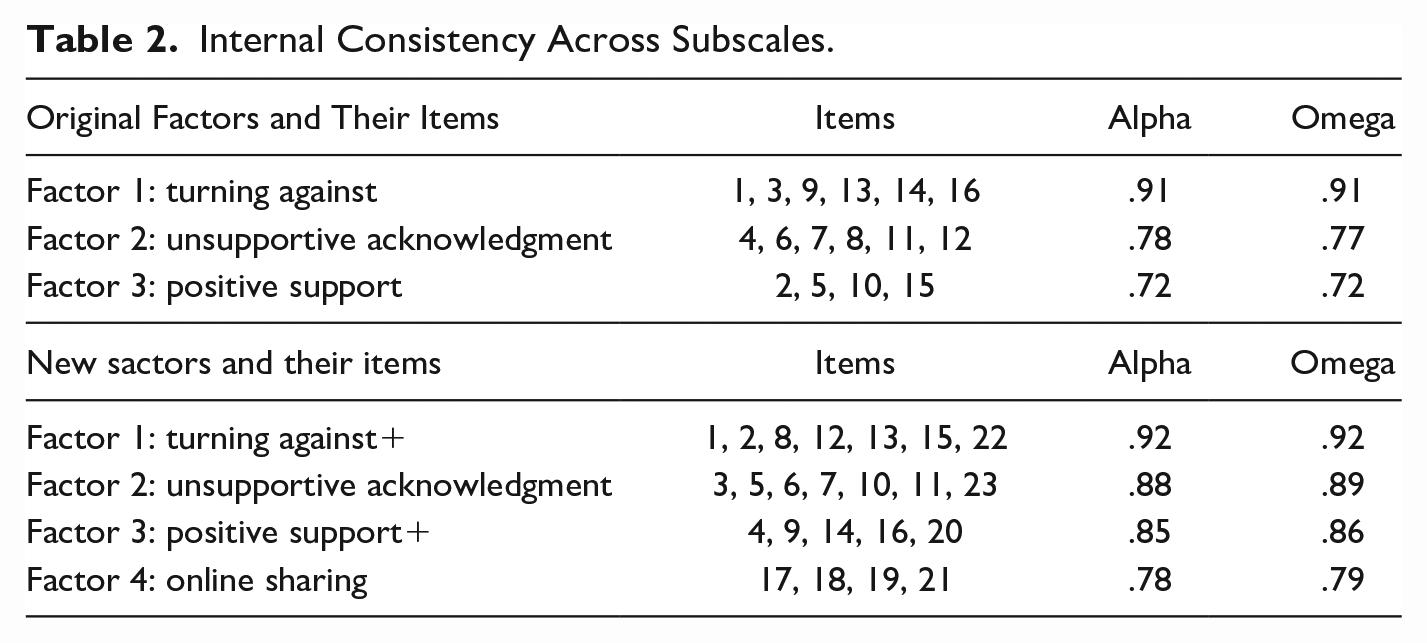
For the original 16 items of the SRQ, Cronbach’s α = .88 and McDonald’s ω = .89 were observed. For the final 23 items on the OSRQ (omitting item 2), Cronbach’s α = .93 and McDonald’s ω = .93 were observed. Correlations between items can be observed in Table 1. Internal consistency across subscales can be seen in Table 2.
Descriptive Statistics and Bivariate Correlations at Baseline.
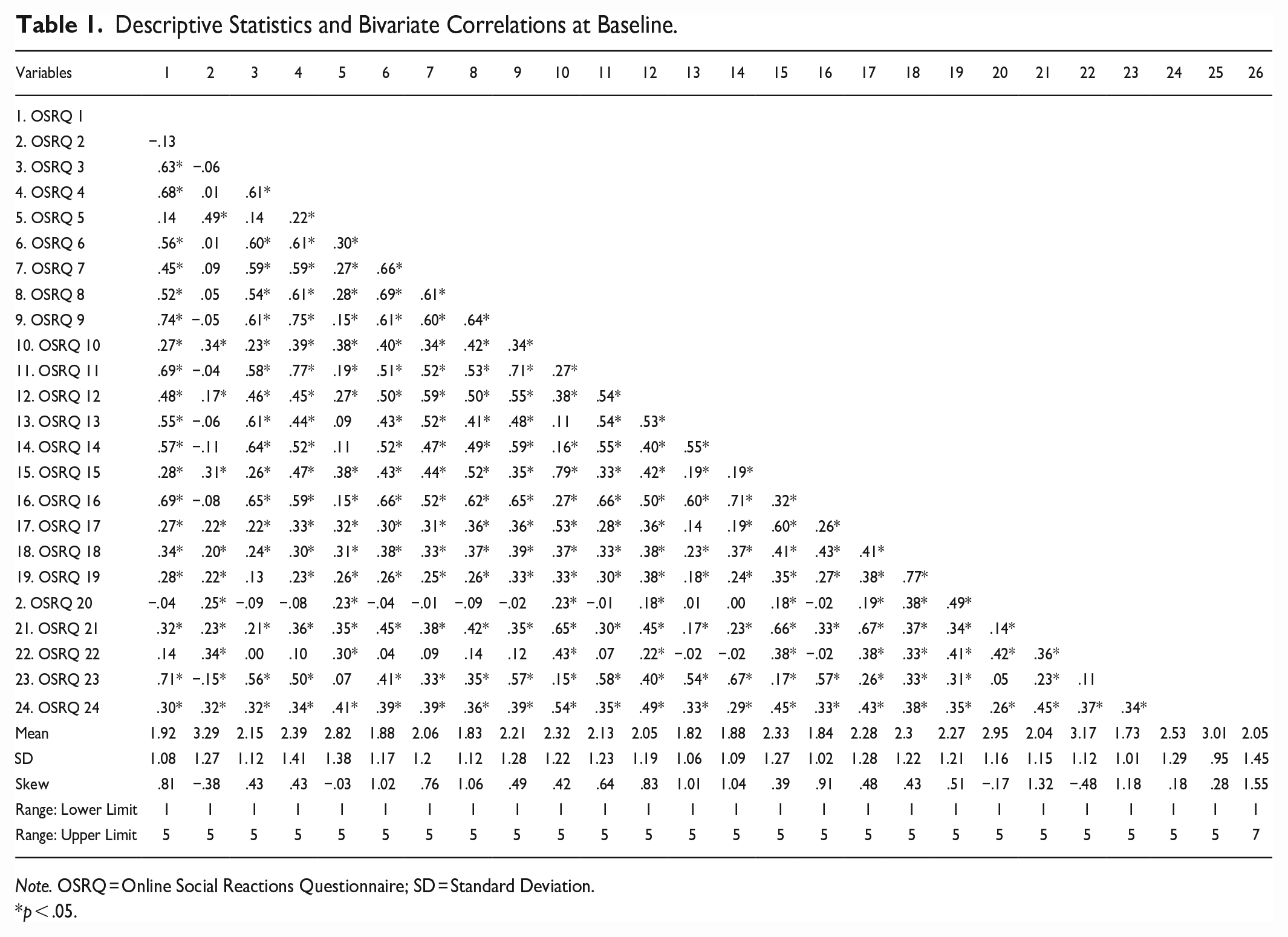
Note. OSRQ = Online Social Reactions Questionnaire; SD = Standard Deviation.
p < .05.
Internal Consistency Across Subscales.
Discussion
The advent of social media has led to increased online disclosure of sexual victimization. Thus, there is a need to assess unique social reactions occurring in response to online disclosure of sexual victimization. This study focused on adapting the SRQ-S (Ullman et al., 2017) to capture unique social reactions occurring in response to online sexual victimization disclosure via #MeToo. The study also aimed to evaluate the adapted and revised version of SRQ-S among a sample of adults who disclosed sexual victimization via #MeToo. The OSRQ is a 23-item measure with a four-factor structure: Factor 1: Turning Against+, Factor 2: UA Factor 3: Positive Support+, and Factor 4: Online Sharing.
The four factors included in the OSRQ capture negative and positive responses received by survivors upon online disclosure of sexual victimization. For example, the Turning Against+ factor involves responses that include blaming the survivors, treating them differently, or trolling them. All items from the Turning Against subscale of the SRQ-S (Ullman et al., 2017) were retained in the Turning Against+ factor indicating that survivors receive similar negative reactions when they disclose in-person or online. However, an additional item “Made fun of you, insulted you, or said something to hurt you” also emerged as a relevant response to online disclosure of sexual victimization. The item captures trolling that survivors may often receive upon disclosure and report as a source of harm (Barta, 2019; Bhuptani et al, 2023; PettyJohn et al., 2022).
The results also indicate that survivors may receive UA responses that distract, control, or serve as egocentric reactions when disclosing online. Whereas all items of this factor correspond to the UA subscale of the SRQ-S (Ullman et al., 2017), one additional item “defended you to other people” was also retained in the factor. Results suggest that survivors may receive responses defending them in front of trolls or blaming responses. Indeed, qualitative interviews with survivors have documented that individuals disclose online to express solidarity for survivors and engage in advocacy on issues related to sexual violence (Gueta et al., 2020; Gundersen & Zaleski, 2021; Naresh et al., 2022). Thus, it is possible that survivors may defend other survivors in the face of negative responses to online disclosure.
The third factor, Positive Support+, captured responses involving the provision of tangible aid to the survivors such as sharing links to resources or helping survivors make a decision. The items correspond to the positive response subscale of the SRQ-S (Ullman et al., 2017) and also had responses unique to online disclosure such as sharing a relevant webpage. The fourth factor, Online Sharing, consisted of responses that are all unique to online disclosure of sexual violence such as “reposting the post” or “liking it.”
Limitations
This study is not without its limitations. First, the plans for this study were born out of a need to validate the additional eight items added to the SRQ; therefore, the outset of this study was not originally one of measure development and validation. While appropriate power was available for these analyses, the results of this study are secondary to a larger disclosure study. Second, while the sample is almost evenly split by sexual orientation (45.6% heterosexual), the sample is also predominantly white (72.3%), cisgender women (70.8%). Therefore, to both the first and second points, further evaluation will be needed with a more diverse group of individuals, with a much larger sample to provide more opportunity to observe validation of the OSRQ factors and items, and its potential impacts on symptoms of posttraumatic stress and alcohol use. Third, responses to online disclosure were examined by participation in only one movement, that is, the #MeToo movement, which has been criticized for almost exclusively focusing on experiences of sexual victimization that impact largely white, cisgender, and heterosexual survivors (Ison, 2019; Kagal et al., 2019). It is possible that participants who participated in other parallel movements such as #UsToo or #NotOkay may receive other responses not captured here. Thus, future studies should assess participation in any online disclosure movement. Lastly, this study consulted the qualitative data from prior research on online social reactions to inform item development, this study could also be strengthened through the utilization of interviews, focus groups, or cognitive interviewing for the purpose of item development.
Future Clinical and Research Implications
Apart from the aforementioned future directions, the results of the study pave the way for several clinical and research implications. The OSRQ can be used in both research and clinical settings to understand how individuals interpret other’s reactions to their disclosure. Specifically, prior research shows that in-person reactions to sexual victimization disclosure may be perceived in a variety of ways (Campbell et al., 2001; Dworkin et al., 2018). Some survivors may perceive certain reactions as neither positive nor negative, that are either unclear or mixed in nature. Future work should examine the extent to which survivors perceive various online reactions to disclosure—such as sharing a social media post—to be helpful or unhelpful. Future research inquiry can also be directed toward examining how online social reactions may impact survivor’s well-being, how online social reactions are related to in-person social reactions to disclosure, and assist in the psychological processing of this experience. Additionally, given that survivors may turn to online spheres to disclose experiences of sexual violence, reactions received to such disclosure, and their impact on recovery should be attended to in therapy settings. Investigation of motivations that guide the online disclosure (or nondisclosure) decision-making process and which social media platform to use would assist in developing a comprehensive understanding of online disclosures.
Conclusion
The OSRQ is a psychometrically sound 23-item measure of social reactions to disclosure of sexual victimization in the online sphere. The four-factors of the OSRQ include Factor 1: Turning Against+, Factor 2: UA+, Factor 3: Positive Support+, and Factor 4: Online Sharing, (see Supplemental material Appendix for full measure). These factors provide specifics on how individuals experience social responses to online disclosure of their unwanted sexual experiences, specifically online. How individuals respond to disclosure, especially online, is important, knowing that online disclosures will continue to remain a prevalent and relevant part of daily life going forward.
Supplemental Material
sj-docx-1-jiv-10.1177_08862605241271339 – Supplemental material for Validation of the Social Reactions-Online Questionnaire Among Adults Who Disclosed Online Victimization Via #MeToo
Supplemental material, sj-docx-1-jiv-10.1177_08862605241271339 for Validation of the Social Reactions-Online Questionnaire Among Adults Who Disclosed Online Victimization Via #MeToo by Prachi H. Bhuptani, Roselyn Peterson, Lindsay M. Orchowski and Sarah E. Ullman in Journal of Interpersonal Violence
Footnotes
Declaration of Conflicting Interests
The author(s) declared no potential conflicts of interests with respect to the authorship and/or publication of this article.
Funding
The author(s) disclosed receipt of the following financial support for the research, authorship, and/or publication of this article:Authors’ effort on this publication was supported by the National Institute on Drug Abuse (1K99DA057993; PI: Bhuptani).

Supplemental Material
Supplemental material for this article is available online.
Author Biographies
References
Supplementary Material
Please find the following supplemental material available below.
For Open Access articles published under a Creative Commons License, all supplemental material carries the same license as the article it is associated with.
For non-Open Access articles published, all supplemental material carries a non-exclusive license, and permission requests for re-use of supplemental material or any part of supplemental material shall be sent directly to the copyright owner as specified in the copyright notice associated with the article.
