







Abstract
In the past decades, an increasing body of research has delved into the mechanisms of adolescent delinquency from various perspectives, including individual characteristics, interpersonal relationships, school environments, and community settings. However, limited research focused on its association with community gun violence exposure. Utilizing data from 3,595 adolescents (M = 15.63, SD = 0.71) and their families, we examined how the number of gun violence incidents proximal to adolescents’ homes and schools was linked with their self-reported delinquent behaviors, controlling for other important individual, interpersonal, and community-level predictors of adolescent delinquency. Results revealed relationships between gun violence within 1,000 and 500 m of homes (but not schools) and adolescent delinquency; yet the direction of the relationship differs by distance.
Scholars have investigated factors that are linked with delinquent behaviors in adolescence such as individual characteristics, interpersonal relationships, and contextual factors from various perspectives (Makarios et al., 2017; Murray et al., 2021). Gun violence is a crucial contextual factor that might be intertwined with adolescent behaviors (Centers for Disease Control and Prevention, 2018b) and is an urgent public health issue. However, there is a dearth of empirical studies that have thoroughly examined how the impact of gun violence exposure would be associated with adolescent delinquent behaviors while controlling for other important factors. The current study aimed to fill this research gap by providing empirical evidence on the relationship between community gun violence exposure and adolescent delinquency.
Adolescent Delinquent Behaviors
Adolescence is widely considered a critical developmental period featuring multiple developmental challenges and changes (Barbot & Hunter, 2012; Murray et al., 2021). A significant concern during adolescence is engagement in delinquent behaviors. Participating in delinquent behaviors during adolescence may increase the risk of various adverse consequences such as academic failure, social and psychological problems, and contact with the juvenile justice system (Makarios et al., 2017; Murray et al., 2021). A large body of theoretical and empirical studies has demonstrated the long- and short-term impacts of adolescent delinquency (Defoe et al., 2022; Warner & Warner, 2019). For example, using longitudinal data, Defoe et al. (2022) found that adolescent delinquency was positively associated with later drug use and alcohol disorder. Also, exposure to community gun violence has been associated with increased mental health symptoms later on, in addition to physical harm (Allwood et al., 2023).
Prior empirical studies have found links between various factors and adolescent delinquency, including parental incarceration, substance use, delinquent peers, community violence, and gang problems (DiClemente & Richards, 2022; Shek & Zhu, 2019; Turney, 2022; Walters, 2019). For example, individual factors, including the history of or exposure to deviant behaviors, can set the stage for adolescent delinquency. Pardini et al. (2021) suggested that juvenile offenders who consume alcohol often were more likely to perpetrate gun violence, as were juvenile offenders who had greater indirect and direct exposure to violence. Involvement in violence unrelated to firearms, increased connection with antisocial peers, and poor impulse control have also been associated with adolescent delinquency (Pardini et al., 2021). Moreover, previous delinquent experiences were positively associated with an overall higher risk of delinquency and violent behaviors (Murray et al., 2021). Additionally, community-level factors have been associated with adolescent delinquency in the literature. Beardslee et al. (2021) indicated that socioeconomic disadvantages in childhood were associated with youth gun violence exposure, with peer misbehavior and behavioral problems as mediators. Ashton and Bussu’s (2020) empirical study in the United Kingdom also suggested that proximity to street gangs and negative neighborhood relationships were related to juvenile crime. However, few articles have discussed and explicitly examined the relationship between gun violence exposure in neighborhoods and adolescent delinquency. One study suggested that after controlling for previous gun violence and other protective and risk factors, carrying a gun remained a substantial predictor of future gun violence (Rowan et al., 2019). This was consistent with data showing that having a firearm was associated with the engagement of young people in serious violence and other criminal activity (Keil et al., 2020).
However, few studies have investigated the impact of community gun violence exposure on adolescent delinquent behaviors. Additionally, according to James Kelly’s (1968) ecological theory, children’s behaviors, including delinquency, are contextualized in their living environments (e.g., family, neighborhood, school) and may be associated with environmental factors. Thus, when investigating correlates of delinquent behaviors, community psychology suggests that we should focus on not only the individual level of analysis but also the person-in-environment level (Trickett, 1995). Trickett (1995) emphasizes that a context-grounded understanding of delinquency enables a more respectful framework for interpreting behavior within the person-context interaction. Therefore, informed by the ecological theory, the present study aimed to thoroughly investigate the correlation between community gun violence exposure and adolescent delinquency with a comprehensive account of relevant correlates at the individual, interpersonal, and community levels.
Gun Violence and Adolescent Delinquent Behaviors
Gun violence has become an increasingly pressing public health concern, with steadily increasing gun-related deaths during the past decade (Nickerson et al., 2020). Nearly 20,000 people perished from interpersonal gun violence in 2020, and more than 4,000 adolescents aged 12 to 17 were killed or injured via firearm (Panchal, 2024). Both the Centers for Disease Control and Prevention (2018a) and the World Health Organization (2016) have underlined the significance of broad gun violence prevention initiatives that involve schools, families, and the community (David-Ferdon & Simon, 2014). Gun violence exposure is a pressing and complicated social issue that necessitates evidence-based and community-driven solutions (Arp et al., 2017). Problems related to urban gun violence and gang involvement in the United States are a result of interactions among risk variables over time (American Psychological Association, 2013; Centers for Disease Control and Prevention, 2018b), including personal characteristics (e.g., age, gender, minority background, history of violence, drug use); interpersonal factors (e.g., family poverty, parenting, peer delinquency); and community-level factors (e.g., neighborhood disadvantage and disorganization; Arp et al., 2017; Beardslee et al., 2021; Hardiman et al., 2019). For example, previous empirical studies found that compared with older adults, adolescents were at higher risk of being victims of gun violence, Black individuals faced a higher risk of being murdered than White individuals, and those living in socially and economically disadvantaged neighborhoods were at greater risk of homicide than those in more affluent areas (Hardiman et al., 2019; Malcolm & Swearer, 2018). Between 2010 and 2020, homicide with a gun was the leading cause (39.8%) of violence-related death for adolescents (Panchal, 2024). Therefore, investigating the association between gun violence exposure and adolescents’ delinquency could help us better understand the significance of urban gun violence in the adolescent population.
The Present Study
Based on the literature, there is a lack of empirical research on the correlation between community gun violence exposure and adolescent delinquency using updated large-scale datasets. Therefore, using a secondary dataset with a large sample of adolescents aged 15 years old from at-risk families, this study examined the associations linking community gun violence exposure—within 1,000 and 500 m from adolescents’ homes and schools in the past year—with adolescent delinquency (Figure 1). Importantly, these associations were examined after controlling for key correlates of delinquency at the individual level (i.e., mental health symptoms or diagnosis, impulsivity, and prior delinquency at age 9), interpersonal level (i.e., peers’ delinquent behaviors), and community level (i.e., neighborhood collective efficacy, economic disadvantage, residential instability, racial heterogeneity). Greater exposure to gun violence (i.e., a larger number of incidents occurred) was hypothesized to be linked with a greater number of delinquent behaviors reported by adolescents.
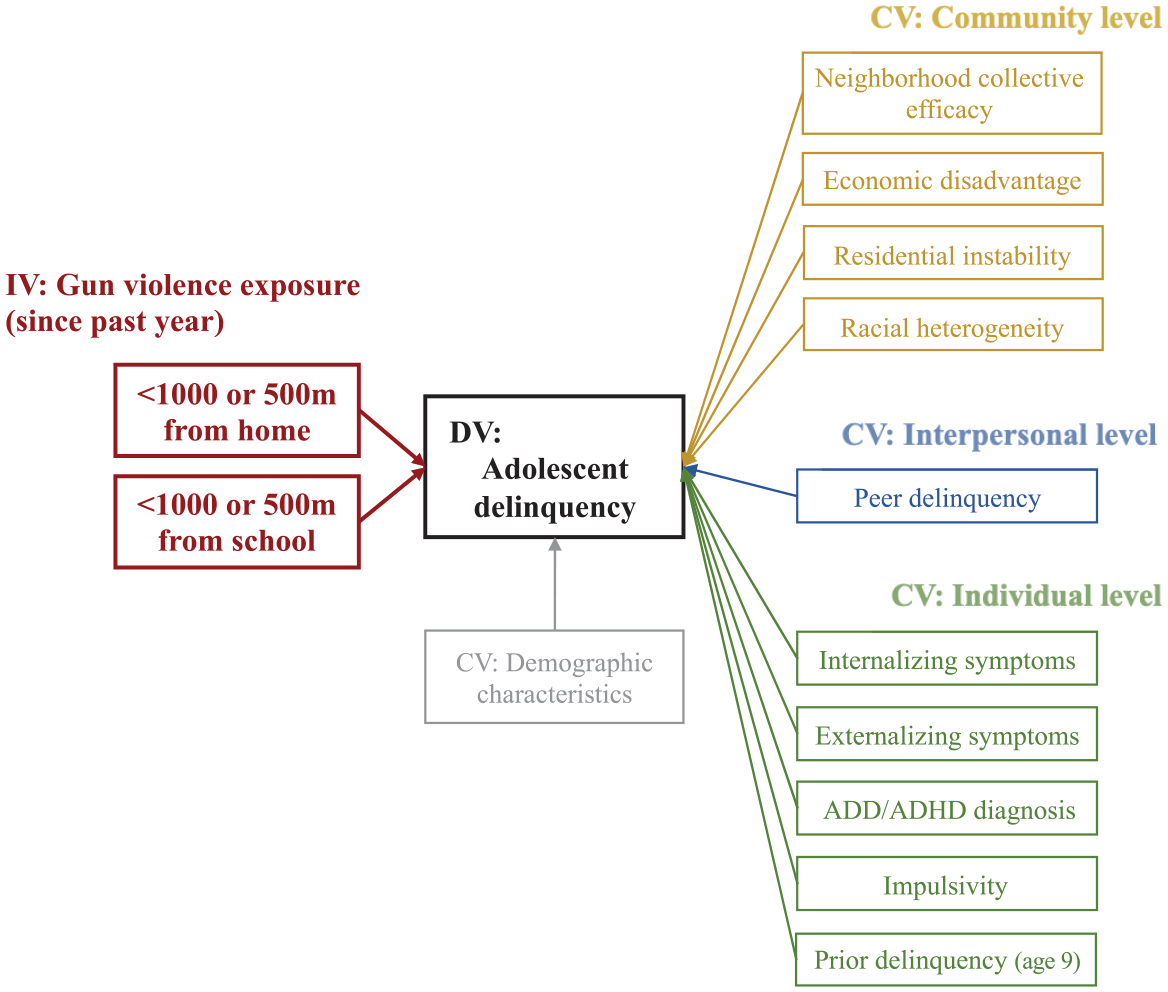
Conceptual diagram for the associations between gun violence exposure and adolescent delinquency at year 15 controlling for key predictors at community, interpersonal, and individual levels.
Method
Sample and Data
Data came from the Future of Families and Child Wellbeing Study (FFCWS, McLanahan et al., 2003), a longitudinal study spanning six waves when children were about 0, 1, 3, 5, 9, and 15 years old. Our study sample included 3,595 families who participated in wave 6 (adolescents aged 15; for demographic information, see Table 1). The FFCWS has both publicly available data, which includes reports from adolescents and their primary caregivers on a plethora of surveys, and restricted data, which offers information on various statistics, including the number of gun violence incidents surrounding participating families (Gun Violence Archive, 2018), labor market conditions, neighborhood characteristics, and school characteristics. Data on gun violence incidents were linked to the latitude and longitude coordinates of the adolescents’ homes and schools and to the date of their wave 6 survey completion by the FFCWS research team (Picard, 2010). The current study utilized three main sources: publicly available surveys from adolescents and their primary caregivers at wave 6 (and one adolescent self-report measure at W5), as well as deadly gun violence incidents from the Gun Violence Archive at wave 6.
Demographic Information for Participating Adolescents and Primary Caregivers.
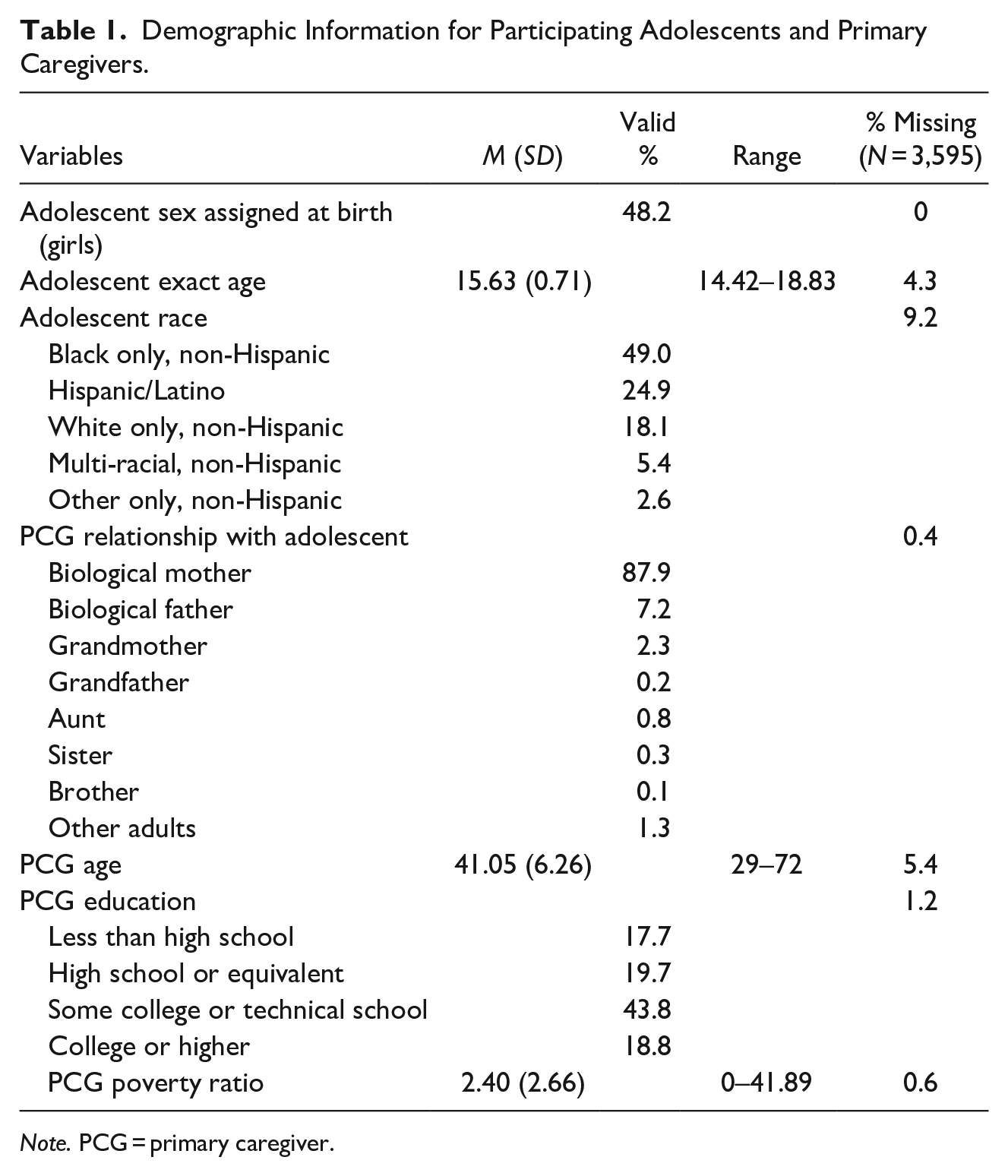
Note. PCG = primary caregiver.
Measures
Adolescent Delinquency
Adolescents reported on the frequency of their delinquent behaviors using a 13-item scale adopted from the National Longitudinal Study of Adolescent to Adult Health (https://addhealth.cpc.unc.edu): painting graffiti, damaging property, shoplifting, stealing (two items), fighting (two items), injuring others, driving recklessly, breaking in, using a weapon to threaten others, selling drugs, and behaving in socially inappropriate ways in public places. The original rating scale ranged from 1 (never) to 4 (five or more times), which we recoded into a 0 to 3 scale for ease of interpretation (i.e., no delinquent behavior was represented with a score of 0). A sum score across items was computed to represent total frequency. This measure was reliable (Cronbach’s α = .74).
Community Gun Violence Exposure
Adolescents’ exposure to gun violence was obtained on September 1, 2017, from the Gun Violence Archive (2018, http://www.gunviolencearchive.org) by the FFCWS team at the age 15. FFCWS data were collected between 2014 and 2017. The Gun Violence Archive data was matched to the FFCWS cases by the FFCWS research team with geodetic distance calculated between the gun violence incident and adolescents’ homes/schools for counting the total number of incidents within a certain distance and then provided to users of the FFCWS dataset. Measures include the total number of deadly gun violence incidents that occurred within 500 and 1,000 m of homes and schools in the past year from their survey completion date, resulting in four dependent variables.
Community-Level Covariates
Neighborhood Collective Efficacy
Primary caregivers reported on the collective efficacy in their neighborhood in terms of informal social control and social cohesion. The informal social control subscale assessed whether people are willing to intervene when they observe negative incidents, such as children spray-painting buildings with graffiti. The social cohesion subscale asked participants to rate their neighbors’ kindness and friendship. Each subscale included five items. The survey was developed and modified for use in the Project on Human Development in Chicago Neighborhoods (Sampson et al., 1997).
Economic Disadvantage, Residential Instability, and Racial Heterogeneity
Seven items in the restricted FFCWS data were used to describe the neighborhood structural indexes. The restricted FFCWS data links census tract-level measures from the U.S. Census American Community Survey (ACS) to each case, providing a detailed view of the living environment. The year 15 survey includes data from the 2015 ACS 5-year estimates. Using principal component analysis to avoid multicollinearity (e.g., Castellini et al., 2011), three neighborhood structural indexes were constructed using seven items: economic disadvantage, residential instability, and racial heterogeneity. The items were the percentage of the population below the federal poverty line, unemployment rate, percentage of individuals with an academic degree lower than a bachelor’s, and percentage of the non-Black population in a census tract (economic disadvantage); percentage of renter-occupied homes (residential instability); and percentage of non-White populations, including Latino, Black, and Asian, and percentage of foreign-born residents (racial heterogeneity).
Interpersonal Covariates
Peer Delinquency
The focal adolescent reported on the delinquent behaviors of their peers using an 11-item instrument (e.g., “Friend tried marijuana,” “Friend smoked an entire cigarette”) that resembled the measure of their self-reported delinquency. The original rating scale ranged from 1 (often) to 3 (never). To align with the conceptualization that higher scores reflect more, rather than less, peer delinquency, we recoded the scale (0 = never, 1 = sometimes, 2 = often). A sum score across items was computed. This measure was reliable (Cronbach’s α = .85).
Internalizing and Externalizing Problems
Primary caregivers reported adolescent behavior problems using the Child Behavior Checklist (Achenbach & Rescorla, 2001). This measure assesses distinct constructs or syndromes using two scales: internalizing and externalizing. The internalizing component includes the anxious/depressed behavior subscale (six items) and the withdrawn subscale (two items). The externalizing component includes the aggressive behavior subscale (11 items) and the rule-breaking behavior subscale (9 items). Original items, rated on a scale from 1 (not true) to 3 (often true), were recoded to 0 to 2 following common practice. We computed a composite score for each scale by summing all relevant items. Reliability was good (Cronbach α = .74 and .89 for internalizing and externalizing, respectively).
Attention-Deficit/Hyperactivity Disorder Diagnosis
Adolescents who were diagnosed with attention-deficit/hyperactivity disorder (ADD or ADHD) by a doctor were coded as 1, and their counterparts without the diagnosis were coded as −1.
Impulsivity
Adolescents reported on the adapted Dickman’s Impulsivity Scale (Dickman, 1990). Example items are: “I often get into trouble because I don’t think before I act” and “I don’t spend enough time thinking over a situation before I act.” The original scale ranged from 1 (strongly agree) to 4 (strongly disagree). Items were reverse-coded such that higher scores represented a higher degree of impulsivity. A sum score was created across all items. The reliability of this scale was good (Cronbach’s α = .79).
Prior Delinquency (Age 9)
Children identified their delinquent behaviors on a checklist in a binary format (0 = no, 1 = yes). This section was adapted from the Things That You Have Done scale (Maumary-Gremaud, 2000) and the National Longitudinal Survey of Youth 1997. Example items are: “Taken or stolen something” and “Taken money at home.” The reliability of this scale was satisfactory (Cronbach’s α = .70).
Demographic Covariates
The demographic information encompassed gender, education level, and race and ethnicity. Gender was coded 1 for boys and −1 for girls. Ethnicity was coded into non-Hispanic White only as 1; non-Hispanic Black or African American only as 2; Hispanic or Latino as 3; non-Hispanic other only as 4; and non-Hispanic multiracial as 5. Education levels were represented by the following codes: 1 (less than high school), 2 (high school or equivalent), 3 (some college or technical education), and 4 (college or graduate degree).
Analytic Plan
Data cleaning and preliminary analyses (descriptive statistics, bivariate correlations) were performed in IBM SPSS Statistics (version 29). To address the study objective (i.e., determine the association between gun violence and adolescent delinquency at age 15), we conducted a zero-inflated Poisson regression analysis because our dependent variable—adolescent delinquent behavior—was a count variable with excess zeros. Independent variables included 4 variables of gun violence exposure (i.e., <500 or 1,000 m from home or school) and 15 covariates at the community (4 variables), interpersonal (1 variable), individual (5 variables), and demographic (5 variables) levels. This analysis was conducted in Mplus 8 (Muthén & Muthén, 2017), and missing data was handled using list-wise deletion. Model fit was indicated by AIC and BIC, which were used to compare if the zero-inflated Poisson regression fit better than the regular Poisson regression.
Results
Table 2 summarizes the descriptive statistics and bivariate correlations for continuous study variables. Table 3 summarizes results from the zero-inflated Poisson regression of community gun violence exposure (i.e., number of deadly incidents within 500 and 1,000 m of home and school) predicting adolescent delinquency at age 15. Partially consistent with our hypothesis, more incidents within 1,000 m of home but fewer incidents within 500 m of home were associated with more delinquent behaviors. Specifically, for each unit increase in gun violence incidents within 1,000 m of home, the expected log count of delinquent behaviors increased by 0.05, and the incidence rate of delinquent behaviors increased by 5% (i.e., e0.05 − 1). Yet, for each unique increase in gun violence indicated within 500 m of home, the expected log count of delinquent behaviors decreased by 0.13, and the incidence rate of delinquent behaviors decreased by 12% (i.e., e−0.13 − 1). These results emerged after controlling for the expected associations linking key covariates, greater adolescent delinquency at age 15, including greater peer delinquency, more externalizing symptoms, greater impulsivity, greater prior delinquency at age 9, being a boy, and lower poverty rate. No association was found for school-centered gun violence exposure variables. The zero-inflated Poisson regression model fitted better than the regular Poisson regression model, indicated by a smaller AIC (8094.95 vs. 8575.27) and BIC (8218.71 vs. 8693.13).
Descriptives and Bivariate Correlations among Continuous Study Variables.
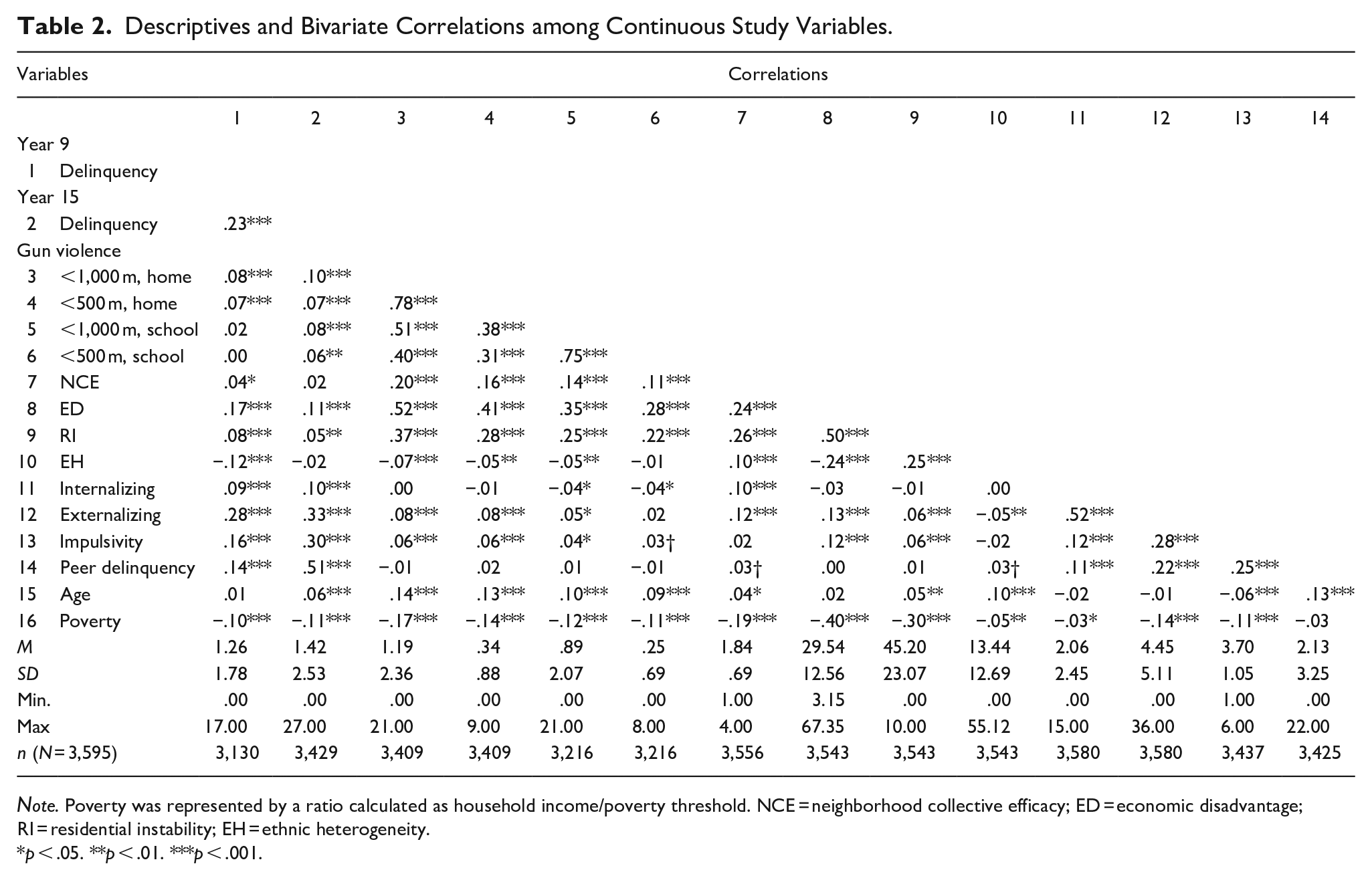
Note. Poverty was represented by a ratio calculated as household income/poverty threshold. NCE = neighborhood collective efficacy; ED = economic disadvantage; RI = residential instability; EH = ethnic heterogeneity.
p < .05. **p < .01. ***p < .001.
Zero-Inflated Poisson Regression of Gun Violence Exposure Predicting Adolescent Delinquency at Year 15 (N = 2,679).
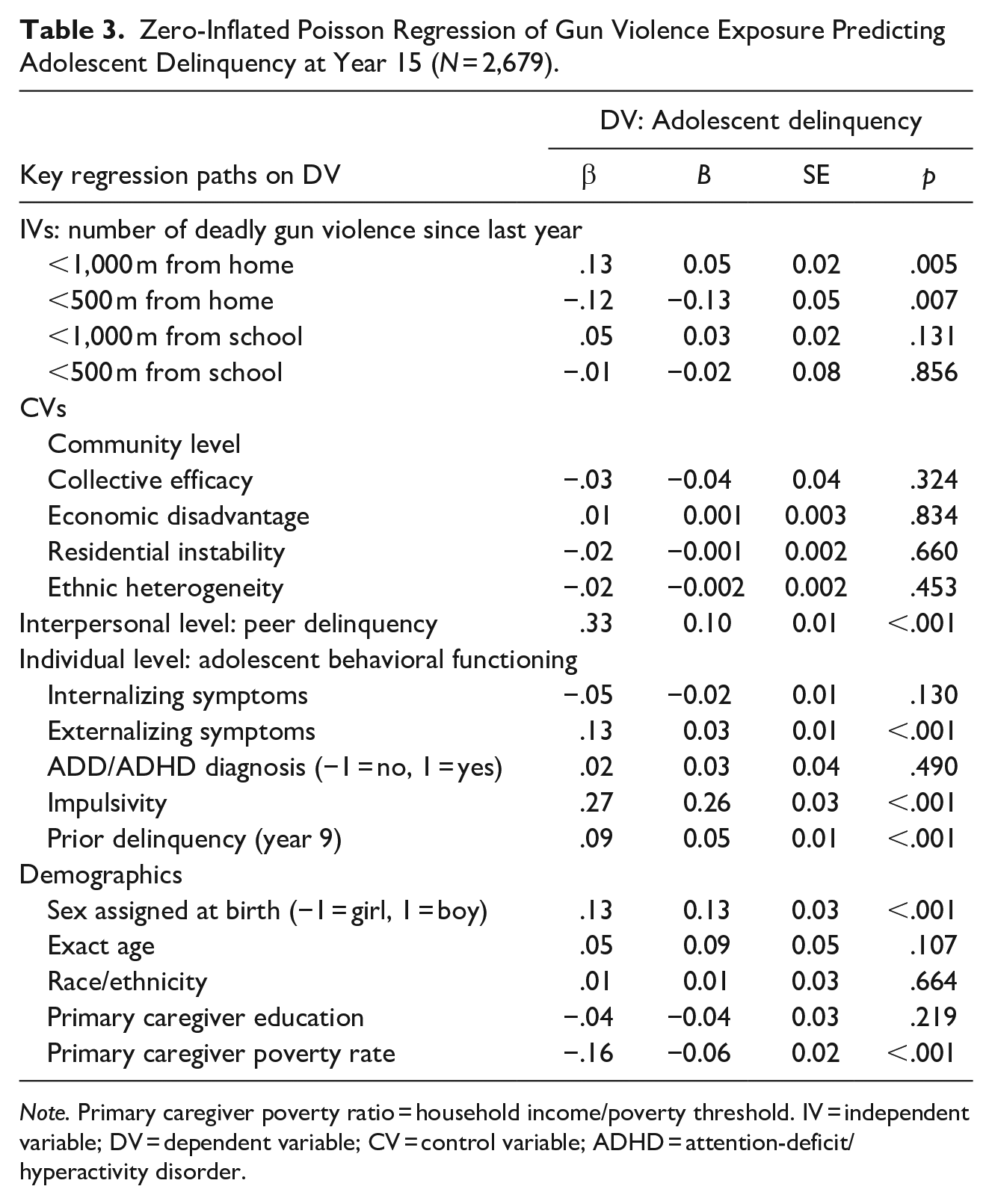
Note. Primary caregiver poverty ratio = household income/poverty threshold. IV = independent variable; DV = dependent variable; CV = control variable; ADHD = attention-deficit/hyperactivity disorder.
Discussion
The current study investigated the relationship between community gun violence exposure during the past year and delinquent behaviors in a sample of at-risk adolescents aged 14 to 19 years, making important contributions to the field in two ways. First, our findings show that there is a significant association between the number of gun violence incidents around adolescents’ homes and their delinquency. However, this association varies depending on the proximity, with different patterns observed within 500 and 1,000 m of the home. Notably, no such link was found for gun violence around their schools. Second, and importantly, these associations were significant after controlling for 10 key well-known correlates of adolescent delinquency at the individual, interpersonal, and community levels. Precisely capturing the relationship between community gun violence exposure and adolescent delinquency can inform intervention efforts to foster healthy development among adolescents.
Consistent with the literature on the significance of exposure to gun violence (Arp et al., 2017), preliminary analyses yielded positive bivariate correlations between greater adolescent delinquency and more gun violence within 1,000 and 500 m of home. In the main regression analysis, the positive association between gun violence occurring within 1,000 m of home and adolescent delinquency remained significant beyond the effects of lower collective efficacy, higher peer delinquency, fewer internalizing symptoms, more externalizing symptoms, an ADD/ADHD diagnosis, greater impulsivity, greater prior delinquency at age 9, being a boy, and lower poverty rate. Thus, our findings align with existing research indicating that residing in a more violent environment, particularly between a 1,000- and 500-m radius of home constitutes a distinct community-level risk factor for adolescents’ involvement in delinquent behaviors (Beardslee et al., 2021; Collins & Swoveland, 2014). However, this finding cannot be generalized beyond the 1,000-m radius. Future empirical research is needed to empirically investigate the effects of gun violence occurring within broader radii, such as 3,000 or 5,000 m, from adolescents’ homes.
Interestingly, after controlling for gun violence within 1,000 m of home, we found that less (but not more) gun violence within 500 m was associated with greater adolescent delinquency. In other words, accounting for the precipitating role of gun violence within a wider radius (i.e., 1,000 m) revealed a unique inhibiting role of gun violence more proximal to adolescents’ residence (i.e., 500 m). One possible explanation is that adolescents may benefit from social bonds formed among their family members and neighbors in close-knit communities with more gun violence. It is worth noting that this examination accounted for primary caregiver-reported neighborhood collective efficacy—social cohesion and informal social control. However, there may be unmeasured routines and dynamics among community members in high-crime areas that protect adolescents from engaging in delinquent behaviors. Alternatively, from a resilience perspective (Wang et al., 2020), more frequent gun violence incidents near adolescents’ residences may increase their tendency to avoid dangerous situations and use coping strategies that disengage them from these disturbing situations, which could be generalized in other contexts in which delinquent behaviors are instigated. Additionally, while this study did not capture the different dimensions of adolescent delinquency, it is crucial for future research to examine whether the specific types of delinquency are equally affected by gun violence.
Notably, despite significant bivariate correlations between greater gun violence exposure near school (within 1,000 and 500 m) and more adolescent delinquency behaviors, these links were non-significant in the regression analysis after controlling for gun violence exposure near home, as well as individual, interpersonal, and community factors. The discrepancy between correlation and regression patterns suggests that the simple bivariate association between gun violence exposure near school and adolescent delinquent behaviors may have been accounted for by other covariates included in the regression analysis. Alternatively, the null regression finding could be interpreted based on the different nature of gun violence incidents near home versus school and the distinct structures of family and school systems. Deadly gun violence near schools typically involves mass shootings on campus or near schools, suicide near or in schools, and illegal carrying of guns on school property or at school events (Kolbe, 2020). Following such incidents, teachers, staff members, and school resource officers in educational institutions typically organize events to mitigate the negative impact on students. These may include debriefing sessions, discussions, preventive seminars, or lectures, which can prevent negative learning behaviors among adolescents. Hence, gun violence incidents near schools may be more likely to result in longer-term psychological consequences rather than immediate acquisition of delinquent behaviors (Kolbe, 2020; Rajan et al., 2019). However, further empirical studies focusing on school gun violence are needed to investigate the relationship between such incidents and adolescent delinquency.
Limitations
One noteworthy limitation of our study lies in its concurrent nature. The assessment of gun violence exposure and adolescent delinquency occurred simultaneously, and both measures were retrospective. As a result, we could not disentangle the directionality of the association—that is, whether greater violence exposure preceded and prompted more delinquent behaviors, or vice versa This study does not establish causal relationships. Nonetheless, we attempted to include covariates in a comprehensive way in an effort to avoid the third variable problem that is often prevalent in cross-sectional studies. Despite our efforts to control confounding variables in this cross-sectional study, some may still remain unaccounted for. Also, future studies with at least three time points may also consider employing a mediating model to examine the indirect effects of certain covariates on adolescent delinquency. Additionally, considering the original study oversampled people who experienced socioeconomic disadvantages, the findings from this study may not be generalizable to other populations.
Conclusion
Gun violence exposure is a prominent community issue that requires more empirical studies, particularly regarding its impact on adolescents. This study explored the relationship between community gun violence exposure and delinquent behaviors among adolescents after controlling for individual, interpersonal, and community factors, differentiating the direction of association based on varying distances from gun violence incidents to school and home. It stands as one of the pioneering studies to examine this topic closely using a national dataset. The intriguingly different findings between gun violence within 1,000 and 500 m of home addresses suggest a new direction for future research: the significance of distinct locations of gun violence incidents regarding their respective roles. Findings from this study offer valuable empirical evidence from a community psychology perspective for interventions to address the influences of gun violence exposure on adolescents.
Footnotes
Acknowledgements
This document includes data from the Future Families and Child Wellbeing Study (FFCWS), which was developed by Princeton University. The data were provided by Princeton University’s Office of Population Research (OPR) Data Archive. This study is funded by the Seed Grant of Syracuse University, Falk College. The authors have no competing interests to declare that are relevant to the content of this article.
Declaration of Conflicting Interests
The author(s) declared no potential conflicts of interests with respect to the authorship and/or publication of this article.
Funding
The author(s) received no financial support for the research and/or authorship of this article.
