






Abstract
The present study examined the frequency and content of implicit questions asked to 6- to 17-year-olds during cross-examinations (N = 122) of children in child sexual assault trials and analyzed how often they rebutted these questions. Through qualitative content analysis, we found that defense attorneys most commonly asked children implicit questions about: ulterior motives, coaching, being untruthful, missing disclosure opportunities, having poor memory, and other credibility issues. Implicit questions were posed in 63% of cases, with children rebutting only 11% of implied inquiries. We observed no significant correlations between the age of children testifying and the overall frequency of implicit questions or rebuttals. However, age differences were found based on the content of the questions; younger children (aged 6–12) were more frequently subjected to implicit inquiries about coaching, whereas teenaged adolescents (aged 13–17) faced more questions related to truthfulness and credibility issues. In conclusion, children were frequently asked implicit questions that implied credibility concerns, which may be difficult for children to understand. Furthermore, defense attorneys change the focus of the content of their implicit questions depending on the age of the child testifying.
Keywords
Introduction
In criminal cases across courts systems (e.g., United Kingdom, Canada, United States) the prosecution’s objective is to persuade the jury of the defendant’s guilt. To defend their client, defense attorneys use case facts, knowledge of the law, and their understanding of thoughts and behaviors to build a convincing counter-narrative. As such, defense attorneys aim to expose the weaknesses of the victim’s testimony, often attacking areas of plausibility, consistency, and honesty (St. George et al., 2022b). The role of cross-examination is especially important in cases of child sexual abuse (CSA) because most of these crimes are reported without physical evidence and in the absence of other witnesses, and as such, children’s firsthand accounts often become the primary evidence (Fessinger et al., 2024).
To defend their client’s innocence, beyond a reasonable doubt, defense attorneys commonly attack child witnesses’ credibility (St. George, et al., 2022b). One strategy is to ask polite questions that subtly attack credibility (St. George, et al., 2022c), a tactic that may go unrecognized by children. For example, when a child is asked, “Did your mom help you remember?” the question may seem to the child to ask whether they would ascribe the positive trait of helpfulness to their mother. However, adult evaluators recognize these types of questions as trying to ascertain if the mother coached the child. This linguistic complexity can lead the child to agree with the statement because their mother was supportive when they recounted the experience, without necessarily admitting that their mom coached them. A recent series of laboratory studies, using questions that parallel those asked in court that imply the child has been coached, found that children regularly failed to recognize the implied attacks on credibility, with performance improving in tandem with children’s socio-cognitive development (Wylie et al., 2022, 2023a).
While researchers find that children do not recognize questions that allude to coaching, no work has examined implied questions more broadly—both in terms of the content of the questions asked, and whether there are developmental effects whereby older children and adolescents rebut these attacks. Thus, the current study conducted a comprehensive examination of implied attacks on children’s credibility, as well as whether children rebuff such inquiries.
Cross-Examination
Cross-examination is a key time for the defense to discredit alleged victims. In CSA trials, defense attorneys attempt to challenge the credibility of children by utilizing questions in cross-examination that attack children’ honesty and inconsistent testimony (Szojka et al., 2017). Furthermore, defense attorneys also utilize traditionally accepted rape myths to discredit children, and to shift the blame for the alleged assault from the defendant to the child (St. George et al., 2022a). Cross-examination is an especially vulnerable time for children, “75% of the children changed at least one aspect of their testimony during cross-examination; many made considerably more than one change, and some retracted their allegations altogether” (Zajac et al., 2012). One reason for changes to a child’s report is that during cross-examinations children are exposed to problematic questioning, including, but not limited to, closed questions, directives, and other suggestive questions (Andrews et al., 2015). What is especially problematic is that children may not understand the questions they are asked, especially questions that attack the credibility of their own reports (Wylie et al., 2023b). During trials, there is no check on the ability of a child to understand the questions being asked or the implications of those questions, though attorneys can challenge these questions While adults may acknowledge that children are still developing crucial cognitive skills necessary for understanding questions posed, judges, juries, and attorneys may easily misinterpret a child’s linguistic abilities (Hanna et al., 2012).
Implicit Questions
Children’s understanding of implied meanings (called implicatures) is an active area of study (e.g., Yoon & Frank, 2019). Yet only the above-mentioned studies examine how defense attorneys utilize implicit questions to attack a child’s credibility in trials. In court cases of alleged sexual abuse, children are vulnerable to affirmatively answering questions that imply positive traits to the child but have negative implications for adult evaluators (Wylie et al., 2022). Implicit questions about coaching (as exemplified above) were examined by a team of researchers who presented 5- to 10-year-olds with vignettes where an adult committed a transgression against a child and the child character disclosed to their mother. Then, child participants were asked questions that would imply coaching to adults (“Did his mom help him remember?” “Did she practice with the boy what to say?” “Did she tell the boy what happened?”); in these instances, 65% of younger children and 42% of older children acquiesced to these questions (Wylie et al., 2022).
According to one study by St. George et al. (2022c) the authors examined defense attorneys’ overt (e.g., “Did your sister tell you what to say in court?”) and subtle inquiries (“Did your sister help you remember?”) about suggestive influences of children’s (aged 5–12) testimony and found that in 88% of the cases an attorney made at least one indirect accusation. Furthermore, they found that in 82% of all defense attorneys’ questions, inquiries about suggestive influence were done in subtle ways that encouraged endorsement by children but would suggest coaching to adults, as opposed to more overt accusations. This study indicated that defense attorneys ask questions about suggestive influence in subtle or indirect ways, appearing less combative to younger children who lack the comprehension skills needed to identify the implications.
Altogether, research on implicit questions within the legal context is limited. The only published study examining implicit questions asked during cross-examinations focused exclusively on coaching and suggestive influence, neglecting to examine whether attorneys ask implicit questions attacking other concerns (St. George et al., 2022c). It is likely that there are other implicatures that occur, such as inquiring whether children’s reports were truthful, whether their reports were vengeful, why and how they delayed their disclosures, and whether others could have been privy to abuse or were present during alleged episodes.
Furthermore, researchers have identified that preadolescents (aged 9–12) begin to develop inconsistent use of abstract reasoning and continue to acquire language skills, while adolescents (aged 13–21) are able to consistently use abstraction and continue to develop brain areas associated with gains in declarative language and in understanding linguistic complexities (Ciccia et al., 2009). Therefore, as children develop they are increasing the ability to understand implied meaning. Due to this, it is likely that older children may recognize the implicit meanings in questions, and be more likely to rebuff implications. Yet, no work has examined this.
Current Study
The present study aimed to identify the prevalence and content of implicit questions that potentially threatened a child’s credibility during cross-examination in cases of alleged CSA. We coded and analyzed 122 cross-examinations of 6- to 17-year-olds (M = 12.67, SD = 3.08) testifying about alleged CSA in criminal trials. In doing so, we focused on cross-examination, when defense attorneys questioned children’s allegations. We were particularly interested in what kinds of implicatures would be asked, and what they would focus on, as previous studies have only examined implicatures about coaching; as such, the current study explored content of all implicit questions asked and, therefore, can provide an expanded understanding of what kind of implicature questions are asked in court. We hypothesized that as children age, the frequency of implicit questions being asked would decrease. There are two potential explanations for this prediction. First, defense attorneys may be attempting to appear as non-aggressive and polite toward young children, instead of combative, both to uphold their credibility with the trial’s fact finders, and to be gentle when attempting to discredit a child’s testimony of abuse. Second, defense attorneys may recognize that younger children are prone to misunderstanding implicit questions and responding in ways that support the defense’s narrative, meaning they are intentionally misleading children to give credibility-damaging responses.
We also analyzed the content of children’s responses, focusing on their ability to rebuff implicit attacks on credibility. Building on Wylie et al.’s (2022, 2023a) prior findings, which identified that acquiescence to coaching questions decreased with age, we hypothesized that as children age, they would be more likely to challenge and rebut the implications of implicit questions. This suggests that older children are more aware of these credibility-attacking implicatures and are more inclined to defend their own narratives.
Method
Sample
In collaboration with the Maricopa County Attorney’s Office, we obtained a sample of 398 victims represented across 252 cases of CSA occurring between January 2005 and December 2015 in Maricopa County. The County Attorney’s Office provided a list of all eligible cases. Cases were deemed eligible if they involved at least a single charge of: Sexual Conduct with a child (A.R.S.13-1405), Child Molestation (A. R.S. 13-1410), or Sex Abuse (A. R.S. 13- 1404). We contacted and paid court reporters to share transcripts of cases; 73 court reporters were contacted and 47 responded (64% response rate). We received 214 complete victim testimonies across 142 cases (some cases included multiple victims); the remaining court reporters were non-responsive. Of these 214 testimonies, 134 were children at testimony (across 101 cases; Mvictim per case = 1.33, SDvictim per case =0.65), whereas the remaining transcripts involved young adults testifying about alleged victimization during their childhood. Defense attorneys declined to cross-examine 8 of the 134 children testifying. Additionally, we excluded the testimonies of four children who were cross-examined by the defendant. Therefore, this study utilized 122 transcripts that contained cross-examinations conducted by a defense attorney.
The 122 testimonies included minors (10% male) who ranged in age from 6 to 17 years old (M = 12.67, SD = 3.08), with the following distribution: 6-year-olds (N = 3), 7-year-olds (N = 4), 8-year-olds (N = 5), 9-year-olds (N = 9), 10-year-olds (N = 12), 11-year-olds (N = 15), 12-year-olds (N = 9), 13-year-olds (N = 9), 14-year-olds (N = 14), 15-year-olds (N = 12), 16-year-olds (N = 17), and 17-year-olds (N = 13). About a third of the children were white, 26% Latinx/Hispanic, 15% Black, Asian, or Native, and 25% were of unknown race or ethnicity. The defendants, 99% of whom were male, were either the child’s parent or caregiver (40%), another family member (26%), a family friend or other familiar adult such as coaches, babysitters, and neighbors (29%), and a stranger (5%). About 45% of the defendants were White, 40% were Latinx/Hispanic, 13% were Black, Asian, or Native, and 2% were of unknown race or ethnicity. Children alleged penetration or attempted intercourse in 34% of cases, oral copulation or genital contact in an additional 14% of cases, and less severe abuse in 52% of cases (fondling, exhibitionism, etc.). Additionally, 55% of the cases alleged the child experienced more than one instance of abuse. About 90% of cases resulted in a conviction of at least one charge.
Coding and Qualitative Content Analysis
A qualitative content-based coding process was employed. In doing so, we developed a systematic coding guide to discern and classify implicit questions within defense attorneys’ lines of questioning. All codes focused on identifying questions aimed at discrediting child victims or challenging their testimony but doing so subtly where questions held both an explicit question and implicit attack. Once implicit questions were identified, we then coded the content of the implicit question (using categories described below, see also Table 1). Furthermore, we coded the child’s responses to these questions, paying particular attention to whether children “rebuffed” or protested the implicit attack on their credibility.
Implicit Questions and Rebuttals Coding Guide and Prevalence.
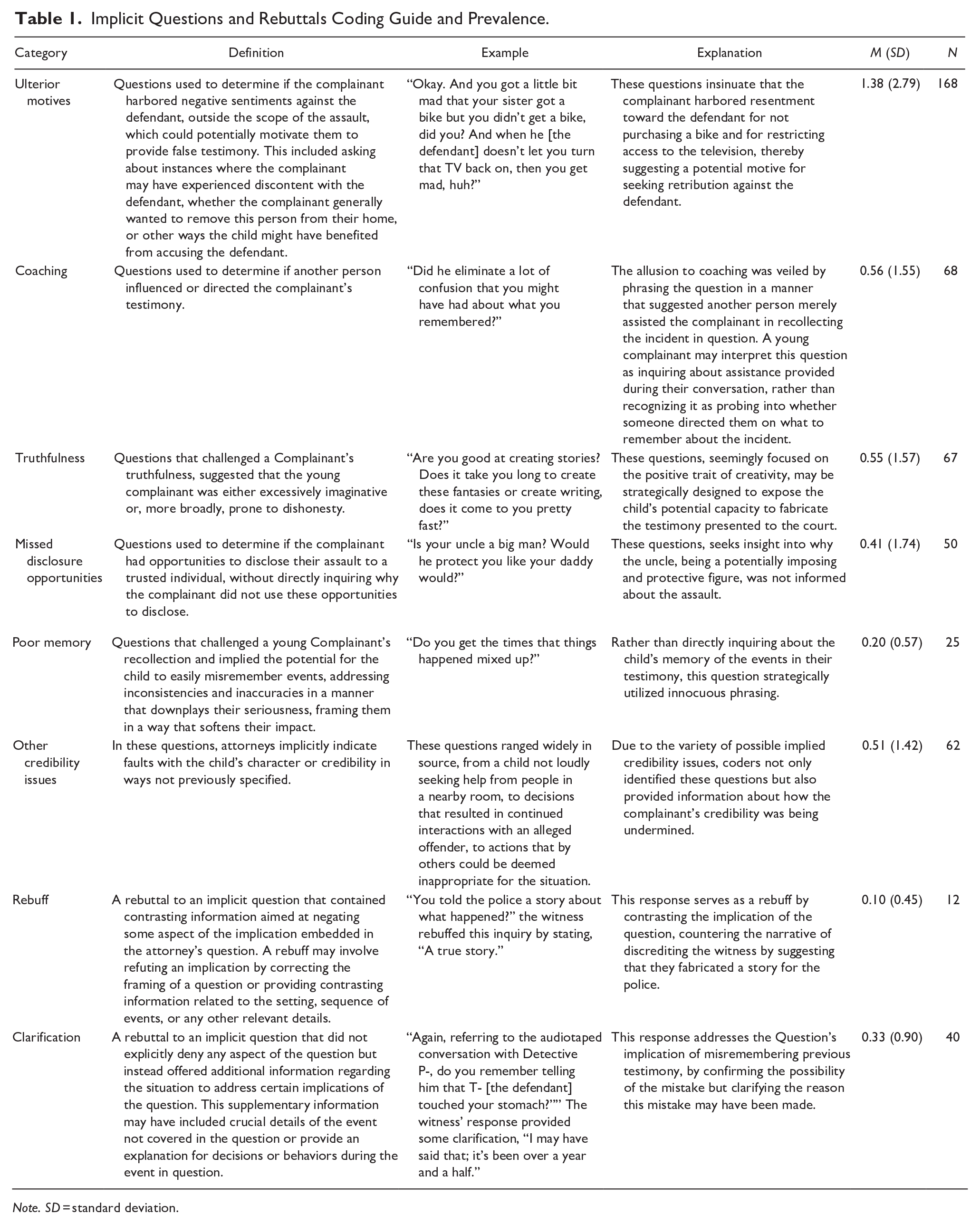
Note. SD = standard deviation.
Implicit Questions
To determine whether a question posed by a defense attorney was implicit, the initial coding involved identifying the absence of clear and direct language (e.g., “Did you lie?” would be clear and direct; “Do you like to make up stories?” would be unclear and have an implicit meaning). Subsequently, we assessed whether questions contained some kind of subtle attack on credibility. As such, questions were considered implicit attacks if (a) they had dual meanings—both an explicit (face-level) meaning and an implied meaning, consistent with prior work in this area (St. George et al., 2022c; Wylie et al., 2022, 2023a), and (b) the implied meaning insinuate something about the minor, or their account, that could affect their credibility. These questions were characterized by a positively or innocuously framed explicit question, while the implicit question may attack the child’s credibility. For instance, consider the implicit question, “Did your mom help you remember?” Taken explicitly, it inquires about the mother’s assistance in the child recalling an event. However, the implicit meaning suggests an inquiry into whether the child was coached or suggestively influenced by their mother.
Qualitative Coding Procedures and Reliability
One coder reviewed 20% of the transcripts to identify and examine implicit questions, aiming to identify recurring themes and patterns, and potential rebuttal responses. Previous research (i.e., St. George et al., 2022a, 2022c; Szojka et al., 2017; Wylie et al., 2022, 2023a), guided the coder’s recognition of implicit questions related to coaching, the veracity of testimony, and rape myths. Themes extended beyond the scope of previous research, resulting in the identification of additional implicit question categories regarding children’s ulterior motives, missed disclosure opportunities, poor memory, and other credibility issues (see Table 1 for definitions, descriptions, examples, and prevalence of each theme identified). Then upon examining the content of children’s rebuttal responses to implicit questions two categories emerged: (a) clarifications with supplementary information or (b) rebuffs with contrasting information. These categories formed the basis of the coding guide. Following rigorous training utilizing five transcripts, two coders independently coded 20% of the sample; a high level of reliability (PABAK >.97) across all coded variables was achieved. Following this, the two coders coded the remaining sample, including the previously independently coded transcripts. An additional reliability analysis was performed upon completion of the entire sample, with high reliability, PABAK >.93.
Results
We reliably identified 440 instances in which implicit questions were asked about a child’s credibility. Defense attorneys posed at least one implicit question attacking the credibility of children in 63% (n = 77) of transcripts. Contrary to our hypothesis, age was not significantly related to the number of overall implicit questions asked, r(120) = .01, p = .875. To determine if age was related to the frequency of any category of implicit questions or rebuttal responses, we examined the correlation between age and each coding category individually (as reported in Table 2). Additionally, independent t-tests were conducted comparing younger children aged 6 to 12 to teenaged adolescents aged 13 to 17. These analyses (as seen in sections below) aimed to provide deeper insights into potential differences between these distinct age groups. Confirming our prior finding, there was still not a statistically significant relationship between the number of implicit questions asked and the age of the child as the defense attorneys were equally likely to ask younger and older children implicit questions, t(120) = −1.31, p = .193; d = −0.24. The remaining analyses focus primarily on the qualitative analyses looking at the content of implicit questions and rebuttal responses.
Implicit Questions and Rebuttals Age Correlations.

All implicit questions were categorized based upon their content, including implying the child had an ulterior motive for accusing the defendant (38% of implicit questions), was coached during interviews or prior to testifying (15%), was being untruthful in their current or previous testimony (15%), missed disclosure opportunities prior to their initial disclosure (11%), had poor memory while testifying or when previously interviewed (6%), and had other credibility issues (14%). Table 1 presents the frequency of each type of question per transcript.
Ulterior Motives (38%, n = 168)
Implicit inquiries into ulterior motives covered a range of causes, including dislike for the defendant, a desire to be rehomed, safeguarding siblings, not wanting to disappoint family members, and seeking attention. It was commonly implied that motivations arose from a broader pattern of negative interactions such as yelling at or hitting the child, or from dissatisfaction with the way the defendant manages the household, such as being overly strict or controlling.
Dislike for the Defendant
Many implicit questions focused on children’s dislike of alleged offenders more generally (i.e., “Because you were angry at your dad, correct?”; “Now, in March of last year, you were upset at your dad, right?”) and how that might have motivated a fabricated report. This dislike could be due to the defendant’s treatment of the child, the way the defendant manages the household where the child resides, how the defendant treats their family, or other various offenses. However, questions about ulterior motives were often more complex. Questions alluding to a child’s ulterior motivations often went beyond disliking or being upset with the offender in a single instance or due to isolated actions.
Seeking to Be Rehomed
A commonly presented ulterior motive is the child seeking to be rehomed or have someone removed from their home. For example, a 17-year-old girl accused her former stepfather of repeated digital penetration. When the attorney began questioning her about a possible ulterior motive, the defense attorney established that the girl preferred to live with her neighbors rather than with her mother and stepfather. Then the attorney alluded to the fact that the child disliked the controlling environment at her mother and stepfather’s house.
Q: And did you enjoy the lifestyle at R- and J-’s [the neighbor’s] house more so than you did at T- [the defendant] and your mom’s house?
A: Yes.
Q: More comfortable?
A: Yes.
Q: A little looser?
A: Yes.
Q: Nobody yelling at you?
A: No.
Q: Nobody making you go to bed at 9:00 at night?
A: Well, I mean they made us go to bed, but not at 9:00.
Q: So it’s fair to say that you were more comfortable at R- and J-’s house than T- and your mom’s house, right?
A: Yes.
Q: And as it turned out, the stories that you told about the alleged incidents of his sexual molestation of you ended up being the reason that allowed you to move out of his house, is that right?
A: Yes.
Taken altogether, these questions alluded to the child falsely accusing her stepfather because she did not want to live with him, and preferred to live with her neighbors.
These instances alluding to children seeking to be rehomed did not always involve a long and complex questioning sequence. These implicit inquiries can be as simple as, for example, “Right. So it excited you at the prospect that you would be living with L-?” These questions pose a particular challenge because when taken explicitly, they inquire about the child’s preferences and feelings about the prospect of living with someone else. However, the questions could be interpreted differently by fact finders, who may view the child’s response as an indication of whether the child harbored an ulterior motive (i.e., to be rehomed) for accusing the defendant.
Safeguarding Siblings
Implied ulterior motivations for providing false testimony extended beyond the child’s wants and needs to include the well-being and safety of their family members. In the following case, a 14-year-old girl accused her uncle of repeatedly exposing his genitals to her. The defense attorney began the line of inquiry by establishing the child’s dislike of her uncle who was frequently intoxicated from alcohol and drug use. Then the attorney introduces the idea that the girl is concerned with safeguarding the well-being of her siblings who are also affected by the defendant’s actions.
Q. So you didn’t like the disruption that it caused when he [the defendant] was drunk and when he was using?
A. Yes.
Q. You didn’t like to see how it affected your siblings?
A. Yes.
Q. You love your siblings?
A. Of course.
Q. As you testified, you’d do anything for them?
A. Well, yes.
These questions, at the explicit level, sought to determine the testifying girl’s love for and willingness to take care of her siblings. However, at the implicit level, fact finders may interpret her responses to the implicit questions as an admission of her possessing an ulterior motive for providing this testimony (i.e., to protect her siblings from the frequently intoxicated defendant).
Disappoint Family Members
These questions implied that because a child wished to avoid disappointing a family member, they possessed an ulterior motivation for accusing the defendant (e.g., “You wouldn’t want to disappoint your mom at this point?”; “Do you think that if you came into court and said that [defendant] didn’t touch you, that that would disappoint your mom?”). The preceding questions suggested that the child’s testimony was motivated by a desire to avoid disappointing their mother. However, without further examination, it could simply be that the child feared that they would disappoint others if they did not provide testimony for reasons such as being intimidated by the courtroom, discomfort at being questioned, or other reasons that would not provide motivation for providing a false accusation.
Seeking Attention
These questions alluded to children accusing defendants as a way to get attention from adults in their lives. For example, in a case where a 16-year-old girl accused her father of repeatedly attempting to have intercourse, the defense attorney asked, “Okay. Back when you talked with your cousin and stuff, you said you were looking for attention at that point; right?” In this question the defense attorney implies that the child had an ulterior motive for accusing the defendant due to her wanting to gain attention from others. For the overarching category of questions about children’s ulterior motives, defense attorneys were equally likely to ask younger children and teenage adolescents implicit questions about memory; t(120) = −0.23, p = .821; d = −0.04.
Coaching (15%, n = 68)
Implicit inquiries about coaching were often framed as a child receiving assistance in remembering or telling someone about their abuse. For example, in a case of an 11-year-old girl who accused a stranger of repeatedly sodomizing her, the defense attorney implicitly asked the child if her mother coached her on what to say to the forensic interviewer.
Q. Okay. So she [the child’s mother] talked to you before you interviewed with B-[the interviewer]?
A. Yes.
Q. Okay. And so she helped you figure out what to say?
A. Yes.
The implicit nature of this question could have resulted in the girl misinterpreting the meaning of the defense attorney’s question. This girl, who affirmed that her mother helped her prepare for an interview, could have considered “help” to encompass various actions. For example, the girl may have regarded her mother believing what she said or expressing support as help and was simply affirming her mother’s role as a caring listener prior to the girl being interviewed. Therefore, this girl’s affirmative response to this implicit question is not necessarily confirmation of her being coached by her mother on what to say in the forensic interview.
Other commonly asked questions implied that children were coached by police. For example, in a case where a 13-year-old girl accused her adoptive father of repeatedly raping her and her sister, the defense attorney’s implied she was coached by multiple police officers.
Q. So you never said anything until he prompted you to say something because he told you or he intimated to you that B- had told him things?
A. It wasn’t for me –
Q. And it’s true, isn’t it, that as Detective N- interviewed you, he would sometimes make suggestions to you about maybe it happened this time or that time, maybe something happened around these dates. Isn’t that true?
A. No.
In these implicit questions the detectives’ role is minimized. This was achieved by the defense attorney employing terms like “prompt” and “suggest” rather than “told you to say,” to downplay the officers’ involvement in the creation of the child’s testimony. However, these questions still intimate that the child’s testimony is a result of police prompting rather than the girl’s true account. While the implication of coaching may be apparent to adults who hear these questions, a minor, who is still developing linguistic and cognitive skills, may not be as attuned to the subtle allusions made by an attorney. Defense attorneys asked more implicit questions about coaching to younger children compared to teenage adolescents; t(65.13) = 2.05, p < .045; d = 0.39.
Truthfulness (15%, n = 67)
Defense attorneys asked about children’s ability to lie or if they are prone to lying, as a means of implicitly questioning the truthfulness of allegations. For example, in the following case an attorney asked an 11-year-old girl who accused a neighbor of repeatedly sodomizing her, “Do you believe you have a pretty good imagination?” implying that the girl possesses the imaginative ability to make up her testimony. However, questions that focus on assessing a child’s ability to lie were not the only way attorneys imply the child was untruthful.
Implicit questions can imply a child is lying by comparing their current and past testimony. An especially egregious example of this attempted to ascribe the positive quality of helpfulness to a child while also accusing the child of providing inaccurate information. In a case in which a 13-year-old girl accused her uncle of repeatedly fondling her, the defense attorney asked “Earlier, now when you told us that you were wearing pants, you just couldn’t remember, so you were guessing to try and help us out?” In this way the attorney framed her previous testimony as false and as an attempt to help. A likely problem is that the girl may be less sensitized to the question being used as proof of her being untruthful, and instead she may focus on the ability to attribute a positive quality to herself.
These questions can also frame children as being untruthful because they are sharing information with the court that was not included in police or interviewer reports. For example, in a case where a 16-year-old boy accused a stranger of forcing him to perform oral sex in a gym, the defense attorney situated the boy’s testimony in opposition to a police officer’s report.
Q. Officer T- indicated that after you reported this, you were taken to an office where you then told them what occurred. So that’s different than what you told us today. So is Officer T- again incorrect?
A. I don’t understand what you’re saying.
Q. If the officer said you described what happened inside the office, he’d be incorrect?
A. I described it in both places.
These questions implied that the boy’s veracity is questionable due to possible inconsistencies in his narrative over time, and also because being perceived as less trustworthy than a police officer, the boy would need to assert the officer’s error for his testimony to be considered truthful. Defense attorneys asked more implicit questions about truthfulness to teenage adolescents compared to younger children; t(71.08) = −3.21, p < .002; d = −0.55.
Missed Disclosure Opportunities (11%, n = 50)
These questions identify people children trust (e.g., family, friends, police, teachers, etc.. . .) and times children could have disclosed their assault to them, but did not. The implication being that, because a child did not disclose their assault to a trusted person when there was an opportunity to do so, the assault did not occur. Commonly, implicit questions about missed disclosures asked about whom a child normally tells secrets to without explicitly inquiring about why they did not disclose to these people. For example, in the case of an 11-year-old girl who accused her step-grandfather of repeatedly sodomizing her, the defense attorney implied that if the abuse had occurred the girl would have disclosed this abuse to her friends whom she normally shares her secrets with.
Q. Have you had the same friends for a long time?
A. Yes.
Q. So they’re really close, good friends for you?
A. Yes.
Q. Now, I know sometimes friends like to tell each other secrets and things that are going on in their lives.
A. Yes.
Subsequent to these questions the defense attorney shifted away from this subject and never asked any more explicit inquiries about the girl disclosing to her friends. If these questions had been asked explicitly (e.g., “If you tell your friends your secrets, why did you not tell your friends about being abused?”) the girl may have provided insights into why she did not disclose her abuse to her close friends. Without this explicit question being asked, this girl would have to make a significant logical leap to understand what this line of questioning is alluding to.
After a defense attorney identifies someone the child could confide in, they commonly ask if a child had moments in which they could disclose to this person. For example, in the case of a 14-year-old girl who accused her father of repeatedly raping her, the defense attorney implied that if the assaults had occurred the girl would have disclosed to her mother sooner.
Q. And you mentioned you have a pretty close relationship with your mother?
A. Yes.
Q. And you have always had a good relationship with your mother?
A. Yes.
Q. Able to speak freely with her?
A. Yes.
Q. You spend a lot of time with her?
A. I tried to.
Q. Even while your dad was at work?
A. Yes.
Q. It would just be you and your mom in the house?
A. Yes.
Q. And you mentioned that these incidents involving your dad were going on for a while?
A. Yes.
Q. But you never said anything to your mother prior to June 5, 2007, correct?
A. Correct.
The implication being made here is that because the girl had both a trusted adult and an opportunity to disclose the abuse to this adult prior to her initial disclosure the abuse did not occur. Again, the line of inquiry’s lack of explicit questioning prevents the girl from having the opportunity to explain why she did not disclose to her mother until she did. Defense attorneys were equally likely to ask younger children and teenage adolescents implicit questions about missed disclosure opportunities; t(120) = −0.77, p = .444; d = −0.14.
Poor Memory (6%, n = 25)
These questions suggest that children had difficulty recalling or misremembered an event. These questions were asked infrequently and typically centered on the child’s potential struggles with recalling the timeline of events related to the assault. However, of the few times attorneys asked these questions, attorneys were more focused on how possible discrepancies in memory suggest the child is an unreliable and unconvincing testifier, rather than attempting to ascertain the truth of the events. They were often framed in a way that implied the child’s memory of the event was inadequate due to issues with sequencing or timing, thereby casting doubt on their credibility. For example, in a case where a 14-year-old girl accused her uncle of molesting her repeatedly over multiple years, the defense attorney asked her about a discrepancy in between her current and previous testimony about when the first incident of assault occurred.
Q. There’s quite a difference in years there; isn’t there?
A. Well, it’s hard to remember.
This inquiry did not explicitly request an explanation for the discrepancy, nor did it inquire about the accuracy of either the current or prior testimony. Instead, the question implied that this discrepancy was indicative of the girl having a poor memory and, consequently, suggested that the girl was not a credible or reliable source of information. Defense attorneys were equally likely to ask younger children and teenage adolescents implicit questions about missed disclosure opportunities; t(104.52) = −1.20, p = .231; d = −0.21.
Other Credibility Issues (14%, n = 62)
Questions in this category consisted of implicit inquiries not captured by other coding categories. These implicit questions encompassed a broad range of content. Some of them focused on implying credibility issues related to common rape myths surround sex crimes including casting the child as a delinquent (e.g., sexting, breaking curfew, concealing information from law enforcement, etc.). Multiple times these lines of implicit questions focused on a child’s actions not being in their own best interest or being incongruous with the archetype of a traumatized individual. For example, in a case where a 13-year-old girl accused her friend’s stepfather of fondling her over her clothing, the defense attorney used implicit questions to undermine her credibility.
Q. You just decided to stay there, didn’t you?
A. Yes.
Q. And you decided to spend the night there?
A. Yes.
These questions undermined the girl’s credibility by implying that because she failed to act in a manner perceived as sensible after the assault (i.e., staying at the friend’s house instead of leaving), that the assault did not occur.
For many questions in the “other category” defense attorneys seemed to imply that children would employ adult logic when making decisions in these situations. However, there should not be an assumption that a child who has been assaulted would be able to think logically about their actions prior to, during, or after an assault. This logical fallacy is similar to rape myths, such as the idea that if a child does not immediately resist or disclose the assault, they implicitly consented or wanted the assault to occur. Such assumptions fail to account for the cognitive, emotional, and psychological differences between children and adults. Trauma, especially in the context of sexual abuse, disrupts typical decision-making processes, leading children to react in ways that may seem illogical from an adult perspective—such as freezing, dissociating, or delaying disclosure (Cromer & Goldsmith, 2010; Hopper, 2020).These questions are used to undermine the credibility of children without considering the shock a child may have been experiencing and the fact that their socio-cognitive abilities are still developing (Ciccia et al., 2009). When these questions are posed to children, an unfair situation arises wherein a trial’s fact finders might believe a child’s actions are illogical without considering the child’s lack of adult reasoning abilities. Defense attorneys asked more implicit questions about truthfulness to teenage adolescents compared to younger children: t(85.76) = −2.03, p < .046; d = −0.35.
Rebuttals
As expected, rebuttals to implicit queries were infrequent, manifesting in only 52 total instances (11% of responses to all implicit questions asked [N = 440]). These rebuttal responses were more frequently clarifications (N = 40), where a child provided additional information to clarify their response when addressing the implication of a question, than rebuffs (N = 12), where a child provided information that countered a question’s implication. Contrary to our hypothesis, younger children and teenage adolescents were equally likely to produce rebuttals, clarifications, and rebuffs, likely because children were so unlikely to give these responses (rebuttals: t[85] = −1.34, p = .185; d = −0.23, clarifications: t[120] = −0.94, p = .349; d = −0.17, p = .396, rebuffs: t[78.02] = −1.53, p = .129; d = −0.26).
Clarification responses often followed a consistent format in which a child responded with assent to an implicit question but added context for why they assented. For example, in a case in which a 10-year-old girl accused her friend’s father of fondling her under her clothing, an implicit question was asked about her potentially having an ulterior motive (i.e., protecting others from the defendant because he has a history of abuse) for accusing the defendant.
Q. Well, at some point you were told that Mr. S- [the defendant] had done some other bad things before you. Were you told that, right?
A. Yes.
Q. And certainly after that, you didn’t believe it was an accident; is that correct?
A. Yes, but that really didn’t make anything change.
The child clarified her assent to the implicit question addressing part of the implication. In clarifying her response the girl confirmed that after learning about the defendant’s previous misconduct, that she did not believe her assault was an accident. However, the girl clarifies that her awareness of the defendant’s past behavior did not change that the assault was purposeful.
Rebuffs were rare responses to implicit questions. Rebuff responses were only coded when a child responded to an implicit question with no acquiescence and when a child provided information that counters the question and its possible implications. For example, in a case in which a 14-year-old girl accused her stepfather of fondling her while she had no clothes on, she rebutted the defense attorney’s implicit question about her being untruthful about using a clock to figure out the time her assault occurred.
Q. Okay. You know there were no batteries in that clock, had not been for a while?
A. I know that there is a battery in that clock.
Discussion
The purpose of the present study was to examine how often defense attorneys use implicit questions that potentially threaten children’s credibility. In doing so, we examined the content of these questions, age differences, as well as whether children would rebuff these attacks. Little prior work has examined how defense attorneys might use implicit questions when questioning children, separate from a series of studies focused on questions about coaching and suggestive influence (St. George et al., 2022c; Wylie et al., 2022, 2023a). In the current study, we broadened the perspective; we explored the range of content of implicit questions attacking children’s credibility. Through qualitative content analysis, we found that defense attorneys most commonly asked children implicit questions about: ulterior motives, coaching, being untruthful, missing disclosure opportunities, having poor memory, and other credibility issues. Contrary to our predictions, we did not find that the frequency of defense attorneys’ use of implicit questions about credibility decreased with age. In addition, we found that children rarely rebuffed these attacks and that the rate of rebuffing did not improve with age.
Although we hypothesized that younger children would more frequently encounter implicit questions, we did not observe a correlation between the age of the child providing testimony and the frequency of implicit questions. This deviation from our initial expectations could imply that the use of implicit questions may not be specifically targeted toward younger children, but rather a standard legal practice and something taught in legal training, independent of developmental factors. This notion aligns with the discussion by Hobbs (2003), who noted that lawyers are trained to strategically utilize questions to advance their narrative, which may involve the use of complex and implicit questioning techniques. However, it is possible that attorneys employ these techniques more frequently with children than with adults, possibly in an effort to appear polite and non-confrontational to potentially sympathetic children. Nevertheless, this approach may inadvertently lead to confusion or misunderstanding among children providing testimony, regardless of their age (Wylie et al., 2022, 2023a). In the future, researchers should investigate how defense attorneys employ implicit questions across a wider age range (including adulthood), with a specific focus on possible developmental patterns, to gain a deeper understanding of this practice.
Overall, defense attorneys asked children at least one implicit question in the majority of cases, illustrating the widespread use of implicit questioning within legal proceedings. This aligns with the goals of defense attorneys during cross-examination, which are to elicit responses that may cast doubt on the credibility or reliability of victim’s testimony. When examining the content of implicit questions, we found a broader range of topics beyond those implying coaching, dishonesty, or inconsistent testimony including ulterior motives, missed disclosure opportunities, and other credibility issues. Furthermore, implicit questioning appears to be utilized across a wide age range of children and adolescents providing testimony. These questions require children to understand pragmatics and the intentions of the speaker, which prior researchers have demonstrated that children (up to 12 years of age) often struggle with (St. George et al., 2022c, Wylie et al., 2022, 2023a).
Interestingly, we found some indication that defense attorneys asked more implicit questions about some topics, depending on children’s age. Implicit questions alluding to coaching were more frequently asked to younger children (age 6–12) while implicit questions relating to truthfulness and credibility issues were more frequently asked to teenaged adolescents (age 13–17). Researchers find that as children improve their linguistic skills, they become less susceptible to suggestion (Kulkofsky & Klemfuss, 2008). Therefore, it is reasonable that younger children, being a more vulnerable population to coaching, are subjected to a higher frequency of implicit questions about coaching; defense attorneys are aware of this concern and want to ask children about whether they have been influenced. However, by doing so in subtle ways defense attorneys may elicit inaccurate reports from children about whether they have been suggestively influenced (Wylie et al., 2022, 2023a).
Additionally, our findings indicate that teenage adolescents were more likely to be asked implicit questions concerning truthfulness and other credibility concerns (i.e., delinquency, a child’s actions not being in their own best interest, a child’s actions being incongruous with the archetype of someone who was traumatized). These findings support the previous findings of St. George et al. (2022a) that examined the use of rape myths when questioning children and indicated that adolescents (aged 14 and older) were more likely to be asked about various topics that may threaten their credibility compared to younger children. This research found that adolescents were more likely to be questioned about (a) motives to lie, (b) precipitation events, including trading sex for money, soliciting dates online, and being under the influence of alcohol or drugs at the time of abuse, and (c) character issues, criminal behavior, and questions about habitual drug and alcohol use. Our findings are thus consistent with the rape myths literature as applied to cases of alleged CSA (St. George et al., 2022a).
In the current study, we also examined whether children would refute implicit attacks on credibility, and whether this kind of response would increase with age. Consistent with the findings of Wylie et al. (2022), who found that children acquiesce to implicit questions about being coached when in fact no coaching occurred, children in the current study rarely rebutted attorney’s implicit attacks (11% of the time). Upon examining the content of these responses, it was observed that the majority of rebuttals were clarifications (77% of the rebuttals). It is possible that even adolescents and teenagers are struggling to understand these implicit accusations. Contrastingly, the power differential, in addition to the formality of the setting, may make it harder for children to rebuff implicit attacks outright, preferring to instead add additional contextual information in their responses. In the future, researchers should continue to look at this, in both the laboratory and the field, to assess when, developmentally, respondents can identify the implicit attack in these questions as well as when they are willing to refute them.
As noted, we found no correlation between children’ age and their tendency to rebuff these questions, which contrasts with the findings of Wylie et al. (2022, 2023a) who observed a decline in acquiescence to coaching questions with increasing age. This discrepancy might be explained by the fact that Wylie et al. (2022, 2023a) and focused solely on one type of implicature—coaching. It is possible that developmental differences in rebuttals do not manifest uniformly across all types of implicatures. Additionally, the low prevalence of rebuttal responses in our study suggests that a larger sample size may be necessary to more accurately assess potential developmental effects. Moreover, this discrepancy could potentially be attributed to the unique characteristics of the present study’s maltreated sample, who may have encountered heightened cognitive demands associated with the cross-examination process within a trial setting, thereby negatively impacting their performance. Furthermore, Wylie et al. (2022, 2023a)also noted that acquiescence was more likely when coaching questions were subtler, similar to the implicit questions examined in our study. Therefore, the absence of an age-related effect in our findings may be influenced by the nuanced nature of the implicit questions posed during cross-examinations.
Limitations and Future Directions
This study utilized real court transcripts. Nevertheless, reliance on such transcripts introduced several limitations, notably a restricted sample size and the inherent challenge of determining the ground truth of events. Furthermore, because the transcripts used were public records, we were unable to assess the frequency of children’s delayed disclosures, previous interviews, the number of children who attended child advocacy centers in preparation for court, or data regarding the children’s education, culture, family environment, and possible developmental delays or developmental disorders—all of which are important factors that should be considered in future research (Brendli, et al., 2022; Corte-Real, et al., 2023; Lyon & Ahern, 2011; Nathanson & Saywitz, 2015). Moreover, an important facet absent from the study was an exploration of how adults within the courtroom environment perceived the utilization of implicit questions. This absence hinders a full understanding of the broader context in which these questioning techniques operate. These limitations warrant further investigation.
Another limitation of this study was the utilization of transcripts from one jurisdiction in the United States, and our witness sample was relatively homogenous across race and gender (90% female; majority White, or Latinx). This could be addressed by examining other court jurisdictions with different witness demographics that are more representative of the gender and racial distribution of CSA victims and provide greater diversity among defense attorneys in terms of their legal training and state licensure. Additionally, given the narrow focus on the conduct of American courts, it remains unclear whether other forms of jurisprudence operate in the same way. In the future, researchers could address this by expanding the scope to engage a more global audience, examining court systems from diverse legal traditions.
Given that implicit questions concerning children’ ulterior motives were the most prevalent in our study, a more comprehensive examination of how questions about ulterior motives are more broadly utilized against children, and the specific content of these questions could provide valuable insight into how children are discredited in legal contexts. This deeper analysis could help elucidate the strategies employed by legal professionals to undermine the credibility of child witnesses. In the future, researchers could delve deeper into comparing these implicit questions with the types of arguments made by defense attorneys during closing statements. This comparative analysis could verify whether the implicit questions were indeed alluding to the arguments presented by the defense, and whether the children’ responses were interpreted in the manner intended by the attorneys. Such research would provide a more comprehensive understanding of how implicit questioning strategies are integrated into the broader context of legal proceedings and their impact on the credibility of children.
Although defense attorneys may intentionally ask victims (and in particular, child victims) implicit questions, prosecutors may be unintentionally asking questions about suggestive influence, leading to clear miscommunications. As we gain a deeper understanding of how children are asked implicit questions in court, there is an opportunity to advocate for practices that safeguard children and elicit accurate information during criminal trials. This could involve collaborating with legal professionals, policymakers, and child advocacy organizations to establish practices that promote fair and appropriate questioning practices when children are involved in legal proceedings. For example, researchers could focus on identifying effective strategies for training legal practitioners (e.g., prosecutors) to communicate with children in a manner that is clear, age-appropriate, and conducive to eliciting accurate testimony without undue influence or confusion, as well as when to object to misleading and implicit questions asked by the defense. In recent research, a team of researchers found that prosecutors rarely object during cross-examination, even when it seems wise to do so (Andrews & Lamb, 2017; Andrews et al., 2015). This seems like a clear avenue for intervention. Additionally, a more significant shift away from direct testimony toward pre-trial interviews, as seen in the United Kingdom, could offer several advantages, including reducing the complexity of questions (Criminal Practice Directions, 2015; H. Henderson & Lamb, 2017; H. M. Henderson & Lamb, 2019; Ministry of Justice, 2013; Stevens et al., 2021).
Conclusion
We found that defense attorneys commonly pose implicit questions to children during legal proceedings, covering a range of topics. Children, across ages, were asked implicit questions; furthermore, they seldom rebuffed these implications. Our findings expand the existing research on implicatures in court. In prior studies, researchers focused on how attorneys imply coaching, overlooking the broader scope of implicit questioning techniques.
We found that defense attorneys routinely employ implicit questioning techniques to undermine the credibility of child witnesses, a practice that often goes unchallenged by the children themselves, rendering them susceptible to such attacks. These findings underscore the imperative for further investigation into whether and when young victims can identify these attacks, and respond in ways that ensure their accurate reporting (and protection of their credibility). Moreover, there is a pressing need to explore the potential ramifications of this phenomenon on adults’ perceptions of children’ testimony.
Footnotes
Acknowledgements
We thank Sage Furr-Johnson and Susan Overstreet for their help coding this data.
Authors’ Note
The data were part of the Master’s Thesis project for Lea Sobrilsky, completed at Arizona State University. This study’s design was not pre-registered. Data and analysis codes are available upon request by contacting the study team.
Declaration of Conflicting Interests
The authors declared no potential conflicts of interests with respect to the authorship and/or publication of this article.
Funding
The authors received no financial support for the research and/or authorship of this article.
