







Abstract
Researchers have examined the role of low self-control in sexually coercive behaviors over the past few decades. While a handful of studies have found low self-control to be directly associated with sexual coercion, some researchers have pointed to other factors that should be considered. The purpose of the current study is to examine the association between low self-control and sexual coercion in college men and women, with the inclusion of two factors shown to be important in predicting sexually coercive behaviors: rape myth acceptance and hypersexuality. The results of this study mirror what has been found in previous research. Namely, low self-control had an indirect effect on sexually coercive behavior through rape myth acceptance and hypersexuality, and that direct effects for low self-control are fully mediated once these other variables are added to the model. This indicates that while low self-control does play a role in sexually coercive behaviors, it is not the only factor that must be considered. This is especially true for hypersexuality, which has been a treatment target for practitioners working with individuals who have sexually offended. The results of this study affirm previous findings regarding the importance of addressing rape myths to prevent sexually coercive behaviors and highlight the need to also address hypersexuality, to develop more effective prevention programming.
Introduction
Sexual coercion has been and continues to be a major concern among college students. A recent survey of 33 institutions of higher education throughout the United States revealed that 1 in every 4 women, as well as about 1 in every 20 men, report experiencing sexual coercion at some time during their college career (Cantor et al., 2019). There have been several political and social efforts at curbing sexual coercion on college campuses, such as the White House Task Force on preventing sexual violence and the formation of the “It’s On Us” organization, which aims to establish awareness and prevention education programs on college campuses. While these efforts have contributed to the public awareness of an issue that was generally swept under the rug, campus sexual coercion remains a concern among college students, and more specifically, among college women (Cantor et al., 2019). Efforts at improving political and social responses to sexual coercion require a strong body of evidence indicating what underlying mechanisms drive sexually coercive behaviors. Of interest to the current study is the line of research that has examined the role of low self-control in sexual coercion.
Gottfredson and Hirschi (1990) developed the “General Theory” of crime, which holds that low self-control is the underlying cause of all types of criminal behavior for all individuals. According to this theory, individuals who demonstrate high levels of low self-control are at the greatest risk of criminal behavior, which includes acts of sexual coercion. Some studies have found support for this idea, which shows that low self-control is associated with engaging in sexually coercive acts. While these studies have found support for the association between self-control and sexual coercion, researchers have identified additional variables that may work alongside self-control to increase likelihood of engaging in sexual coercion. First, variables such as rape myth acceptance, male peer support, and hostile masculinity have been shown to not only be associated with sexual coercion but even partially or fully mediate the relationship between low self-control and sexual coercion (Franklin et al., 2012; Vazsonyi et al., 2023). Additionally, more recent research has begun to look at the role that hypersexuality plays in sexually coercive behaviors. While this is the case, researchers have yet to examine how previously examined variables like rape myth acceptance, and the more recently examined hypersexuality, affect the association between low self-control and sexual coercion. Second, this body of research has not looked at gender differences in the relationship between low self-control and engaging in sexually coercive acts. Previous research examining gender differences in low self-control and deviant behavior indicates that there is some interplay between these factors (Nofziger, 2010). Still, researchers have yet to examine this for sexually coercive behaviors. Thus, the purpose of the current study is to examine the relationship between low self-control, rape myth acceptance, hypersexuality, and sexual coercion in a sample of college men and women.
Literature Review
Self-Control and Sexual Coercion
The idea of low self-control being a singular explanation for criminal behavior was introduced by Gottfredson and Hirschi (1990) in their General Theory of Crime. They posit that individuals demonstrate low self-control through impulsivity, risk-seeking, self-centeredness, having a bad temper, and a preference for physical over mental activities. Individuals low in self-control are more likely to engage in criminal behavior, as well as risky behaviors that, while not illegal, are considered deviant (e.g., substance use, risky sexual behaviors). According to Gottfredson and Hirschi (1990), the level of self-control one exhibits is established by about the age of 10, and its development is contingent upon the environment and experiences one is exposed to before age 10. Beyond this age, Gottfredson and Hirschi (1990) maintain that self-control remains static. Support for the general theory of crime has been nearly unanimous in criminological research (Pratt & Cullen, 2000; Vazsonyi et al., 2017), but the application of low self-control to sexual coercion is less developed.
Studies examining the association between low self-control and sexual coercion typically reveal that there is a significant direct effect, but these effects are either partially or fully mediated once other variables are considered. Franklin et al. (2012) incorporated self-control and male peer support theory (Schwartz & DeKeseredy, 1997), and found that while low self-control was significantly associated with engaging in sexually coercive acts, this relationship was no longer significant in a multivariate model containing male peer support variables. The researchers note that low self-control did have a significant indirect effect through the male peer support variables, indicating that low self-control still may play a role in sexual coercion. More recent research by Vazsonyi et al. (2023) provides a similar understanding. Franklin et al. (2012) and Vazsonyi et al. (2023) found that low self-control was associated with sexual coercion likelihood, but this direct effect was fully mediated once it was included in a multivariate path model. Low self-control did have a significant indirect effect on sexual coercion through date rape attitudes and promiscuous sexual norms.
An examination of the body of research on self-control and sexual coercion reveals that a host of variables seem to be coming into play, ranging from other developmental characteristics to attitudes toward women, sexuality, and gender norms. A larger body of research has examined two variables that are of interest to the current study: hypersexuality and rape myth acceptance.
Attitudinal Correlates of Sexual Coercion
Rape myth acceptance is the level to which an individual subscribes to myths about sexual assault that permeate through society (Lonsway & Fitzgeralds, 1994). Examples of these myths include blaming women for their victimization, such as blaming victims because of what they are wearing or believing that a husband can’t rape their spouse. The idea that rape myth acceptance leads to sexually coercive behaviors is founded on the assumption that rape myth acceptance represents a type of cognitive distortion that can neutralize any apprehension to engaging in the act, as well as any kind of guilt they may feel after committing the act that would prevent future coercive behaviors (Yapp & Quayle, 2018). Literature testing this connection has consistently indicated that a relationship between rape myth acceptance and sexual coercion exists. Yapp and Quayle (2018) conducted a systematic review of cross-sectional and longitudinal studies examining the association between rape myth acceptance and male-on-female sexual violence. They found that in all but one of the nine studies, rape myth acceptance was significantly related to sexual violence. A more recent meta-analysis conducted by Trottier et al. (2021) examined the relationship between rape myth acceptance and sexual coercion. In addition to casting a wider net of problematic sexual behaviors, Trottier et al. (2021) included studies containing samples of both men and women. The results mirrored the earlier systematic review: there is a significant effect of rape myth acceptance on sexually coercive behaviors. This is notable, considering the effect was present in both men and women, highlighting the fact that rape myths also include the idea that “men cannot be raped.”
While research is fairly consistent regarding the relationship between rape myth acceptance and sexual coercion, there are still some areas that warrant attention. For instance, for preventive efforts to be most effective, it is necessary to understand what may make someone more likely to subscribe to rape myths. It has already been stated that rape myth acceptance may serve as a mediator between self-control and sexual coercion, in that someone who has lower self-control will be more likely to engage in sexual coercion if they endorse rape myths. Another characteristic that has garnered the attention of researchers when it comes to sexually coercive behaviors is hypersexuality.
Hypersexuality and Sexual Coercion
Hypersexuality is typically defined as a consistent inability to control intense sexual urges and impulses (Kraus et al., 2018). An individual who demonstrates high levels of hypersexuality may also be unable to stop the behaviors, regardless of their attempts or desire to, which also leads to negative emotional states and an inability to derive satisfaction from sexual behavior. Though there is still some debate about hypersexuality, evidenced by the rejection of its inclusion in the DSM-V (Kafka, 2010), researchers have found that it is an important factor to consider for individuals who have sexually offended. Most notably, the fact that it is associated with violent and sexual recidivism in men who have committed sexual offenses (Kingston & Bradford, 2013) is significantly related to fantasies about engaging in sexual coercion among general population men (Engel et al., 2019), and is significantly related to sexual coercion in hook-up contexts for both college-aged men and women (Basting et al., 2023).
Contrary to research on rape myth acceptance, researchers have yet to examine the role hypersexuality may play in the relationship between low self-control and sexual coercion. It does seem that the concept of impulsivity, which is one element of low self-control as constructed by Gottfredson and Hirschi (1990), may interact with hypersexuality to influence sexually coercive behaviors (Du & Knight, 2024), but researchers have yet to directly examine this.
Current Study
Research over the past decades has consistently indicated that the role of low self-control in engaging in sexual coercion is complex, and that other factors must be considered when examining this association. The purpose of the current study is to extend this line of research further, by examining self-control, rape myth acceptance, and hypersexuality as predictors of sexual coercion in a sample of college men and women. Results of the study will contribute an additional test of the role of self-control and rape myth acceptance, while providing the first analysis of these variables in conjunction with hypersexuality in a sample of both men and women.
Methods
Sample
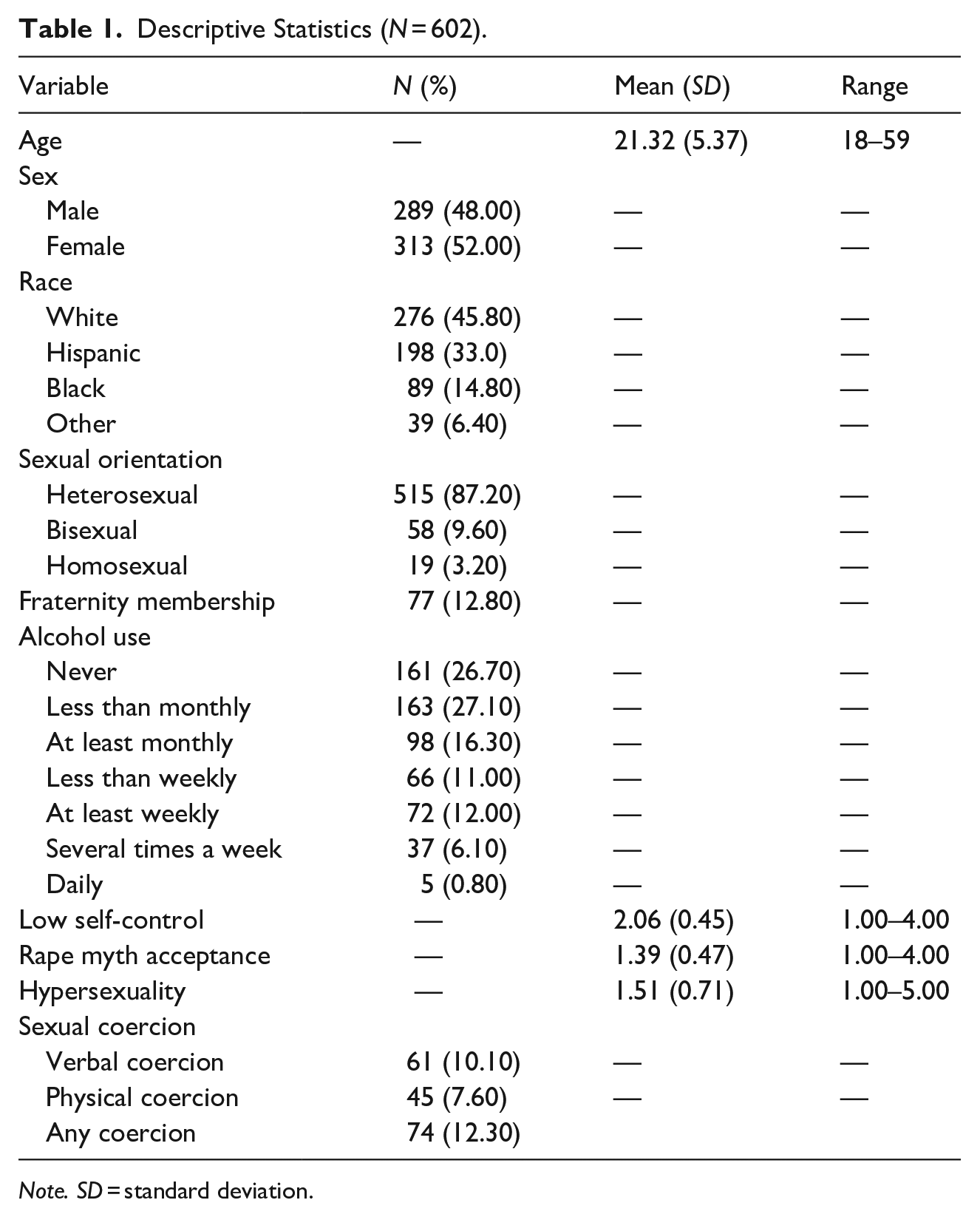
The sample for this study consisted of 602 college men and women from a rural college in the Southern United States. Descriptive statistics for the sample can be found in Table 1. Just over 50% of the sample in the study identified as female, with slightly less than 50% identifying as male. The largest portion of students identified as White (45.8%), followed by Hispanic (33.0%), Black (14.8%), and those who identified as “other” (6.4%). Most students identified their sexual orientation as heterosexual (87.2%), followed by bisexual (9.6%), and homosexual (3.2%). A small portion of students indicated that they had participated in a fraternity (12.8%), and just under 50% indicated that they consume alcohol at least monthly.
Descriptive Statistics (N = 602).
Note. SD = standard deviation.
Procedure
Data for the study were collected with online surveys distributed through Qualtrics. The research team contacted faculty who were teaching large auditorium classes to request the ability to survey their students. Faculty who agreed allowed the research team to attend a class session where they could inform students of the purpose of the study and answer any questions they may have. Students were also informed that they would be given extra credit for participating in the survey but were also given an alternative assignment that they could complete for extra credit if they did not want to participate in the survey for any reason. Those who agreed to participate following this brief presentation were sent a link to the Qualtrics survey, where they could complete the protocol outside the classroom. The question protocol took 25 to 30 min to complete. No identifying data was captured in the survey protocol, and extra credit was given to all students who signed and submitted an informed consent form. The study was approved by the Institutional Review Board at which the study took place.
Measures
Dependent Variable
Sexual coercion perpetration was assessed using the Sexual Experiences Survey-Short Form Perpetration (SES-SFP; Koss et al., 2007). The survey assesses the use of five different tactics (lying to someone, pressuring them, getting someone drunk/drugged, threatening physical force, and using physical force) to engage in four sexual behaviors, which are fondling, oral sex, vaginal sex, and anal sex. Respondents are asked the number of times in which they used each of these tactics to engage in the four sexual behaviors in the last 12 months, and since they were 14 years old. Response options include zero times, one time, two times, and three or more times. These data contained an abundance of zeros leading to a positive skew in these data, thus, responses were recoded into two dichotomous items representing whether someone reported engaging in any verbal coercion (e.g., lying to someone to obtain sex, pressuring them) or physical coercion (e.g., getting someone drunk/drugged, threatening physical force, and using physical force). Due to the low number of individuals reporting engaging in physical coercion, this category was collapsed into one category indicating “any kind of sexual coercion.” Descriptive statistics for each of these variables can be found in Table 1.
Independent Variables
Self-control was measured using the Grasmick Low Self-Control measure (Grasmick et al., 1993). This measure contains 24 Likert-type items across 6 domains of self-control, which are Impulsiveness, Risk-Seeking, Temper, Preference for Physical Activities, Self-Centeredness, and Preference for Simple Tasks. Response options for all items are (a) Strongly Disagree, (b) Disagree, (c) Agree, and (d) Strongly Agree. The reliability for the entire instrument was excellent (α = .91).
Rape myth acceptance was assessed using the Rape Myth Acceptance scale (Lonsway & Fitzgeralds, 1995), which contains 19 Likert-type items assessing rape myths such as “In some rape cases, the woman actually wanted it to happen” and “Many rapes happen because women lead men on.” Response options to all the items include (a) Strongly disagree, (b) Disagree, (c) Agree, and (d) Strongly agree. Internal consistency for the scale was excellent (α = .94).
Hypersexuality was measured using the Hypersexual Behavior Inventory-19 (HBI-19; Reid et al., 2011). This instrument contains 19 Likert-type items that can all be responded to with (a) Never, (b) Rarely, (c) Sometimes, (d) Often, and (e) Very Often. The items assess behaviors, feelings, and thoughts surrounding using sex as a coping strategy, the ability to control one’s sexual urges, and the consequences of sexual behavior. Internal consistency for the scale was excellent (α = .96).
Control Variables
To account for other potential causes of sexually coercive behavior, several control variables were included. Alcohol use was assessed using one item capturing the frequency of respondent alcohol consumption, which includes (a) Never, (b) Less than monthly, (c) At least monthly, (d) Less than weekly, (e) At least weekly, (f) Several times a week, and (g) Daily. As is evident in Table 1, a number of these categories contained few individuals. Thus, the “at least monthly” and “less than weekly” categories, and the “at least weekly,” “several times a week,” and “daily” categories were collapsed into their own categories entitled (a) Never, (b) Rarely, (c) Occasionally, and (d) Frequently. Fraternity status was captured with two dichotomous items assessing whether (a) the respondent was currently a part of a fraternity and (b) whether they had ever been a part of a fraternity. This item was intended to capture involvement in Greek life across both men and women, not just among the men in the sample. Due to the low response rates to both items, these items were combined into one item assessing whether the individual had ever been or is currently in a fraternity. For the purpose of the analysis, individuals who indicated they had never been a part of a fraternity were chosen as the reference category.
Race, sexual orientation, and age were also included as control variables. For the purpose of the analyses, race was dummy coded into (1) White and (0) non-White, with the non-White group being selected as the reference group. Finally, sexual orientation was dummy coded into (1) Heterosexual and (0) Bisexual/Homosexual, with the Bisexual/Homosexual group chosen as the reference group.
Analytic Plan
First, bivariate analyses will be run for all the independent and control variables to assess whether they had a significant bivariate association with self-reported sexual coercion. Second, a path model will be run using Mplus version 8 to test whether low self-control is significantly associated with sexual coercion after controlling for hypersexuality, rape myth acceptance, and all the control variables. Additionally, this model will assess whether low self-control has indirect effects on sexual coercion through hypersexuality and rape myth acceptance. For this model, the weighted least square mean and variance adjusted estimator will be used, as this is the appropriate estimator to use for models where the outcome variable is categorical or dichotomous (Suh, 2015).
Results
Bivariate Results
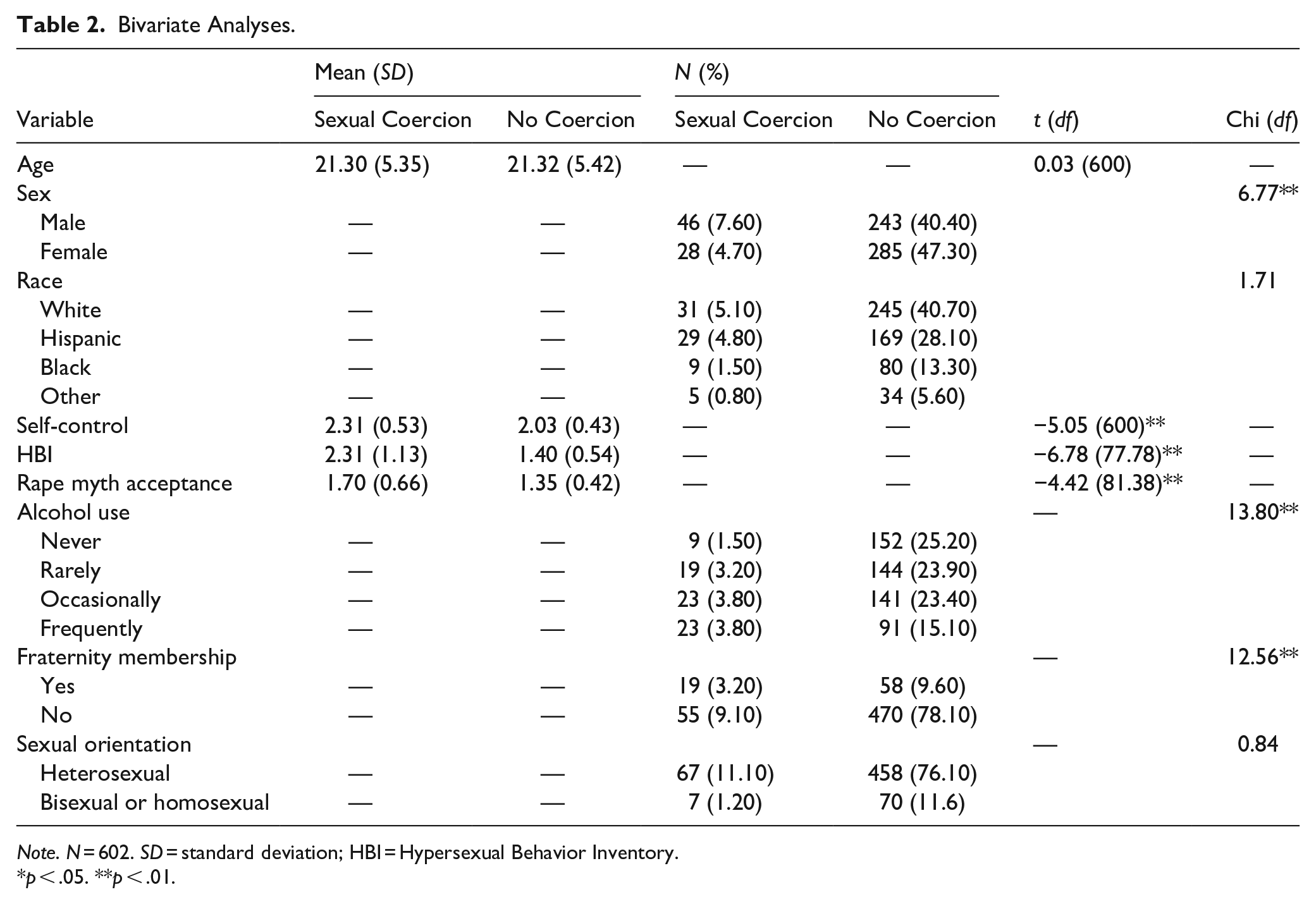
The first set of bivariate analyses examined whether any significant differences existed in measures of self-control, hypersexuality, rape myth acceptance, and all control variables between respondents who reported engaging in sexual coercion and those who did not (see Table 2). The results indicated significant differences for all measures except for age, race, and sexual orientation. Individuals who reported engaging in any form of sexual coercion scored significantly higher on measures of low self-control (p < .01), rape myth acceptance (p < .01), and hypersexuality (p < .01). As for control variables, individuals who reported engaging in sexually coercive behaviors were significantly more likely to identify as male (p < .01) and report current or previous fraternity membership (p < .01). Finally, individuals who had engaged in sexual coercion reported significantly more frequent alcohol use than those who did not report engaging in sexual coercion (p < .01).
Bivariate Analyses.
Note. N = 602. SD = standard deviation; HBI = Hypersexual Behavior Inventory.
p < .05. **p < .01.
Path Analysis Model
The second analysis involved testing if low self-control was significantly associated with sexual coercion after controlling for hypersexuality, rape myth acceptance, and the control variables. Additionally, the path model will detect if there are any indirect effects of low self-control on sexual coercion through hypersexuality and rape myth acceptance. Results of the model can be found in Figure 1.
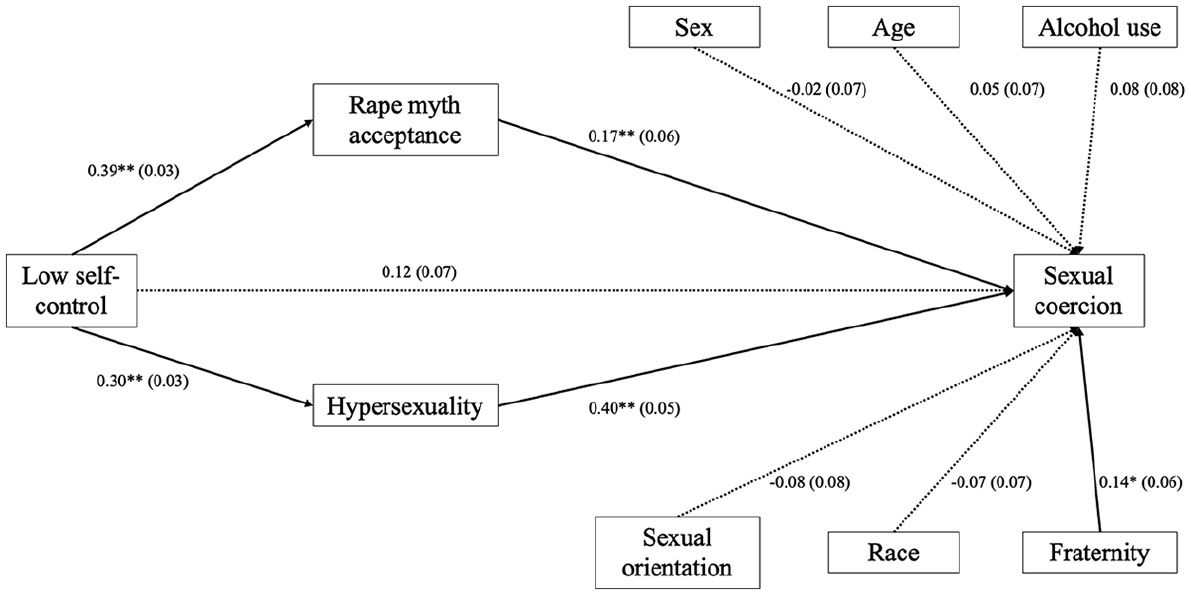
Path model for low self-control, rape myth acceptance, hypersexuality, and sexual coercion.
The results indicated that both hypersexuality (b = 0.40, p < .01) and rape myth acceptance (b = 0.17, p = .04) had significant direct effects on sexual coercion, with increased levels of hypersexuality and rape myth acceptance being associated with engaging in sexually coercive behaviors. Low self-control did not have a significant direct effect on sexual coercion (b = 0.12, p = .08). For control variables, only fraternity status has a significant direct effect on sexual coercion (b = 0.14, p = .01), such that individuals who reported any fraternity membership were significantly more likely to report engaging in sexually coercive behaviors. Low self-control did have significant direct effects on hypersexuality (b = 0.31, p < .01) and rape myth acceptance (b = 0.39, p < .01), with higher levels of low self-control contributing to increased rape myth acceptance and hypersexuality. Finally, there were significant indirect effects of low self-control on sexual coercion through hypersexuality (b = 0.12, p < .01) and through rape myth acceptance (b = 0.07, p < .01).
Discussion
The relationship between low self-control and sexually coercive behaviors has been researched for several decades, and the results of these studies have been inconsistent in regard to low self-control either directly impacting sexual coercion likelihood, or whether it works through other predictors of sexual coercion. The purpose of this current study was to extend this body of research by examining low self-control as a predictor of sexually coercive behaviors while also including two other factors that have garnered the attention of researchers: rape myth acceptance and hypersexuality. In addition, the study aimed to assess whether indirect effects exist between low self-control, these factors, and sexual coercion. The results of the study mirror what has been found previously. First, the effect of low self-control is fully mediated once other correlates of sexual coercion are included in the analyses. Finally, rather than having direct effects on sexual coercion, low self-control has an indirect effect through other important correlates of sexual coercion.
Bivariate Results
The first set of analyses examined whether the independent and control variables were significantly associated with sexual coercion. Results indicated that low self-control, rape myth acceptance, alcohol use, fraternity status, and hypersexuality were all associated with engaging in sexual coercion. The only control variable that was significantly associated with sexual coercion was sex, with men being more likely to report sexual coercion than women. Together, these findings align with previous research on correlates of sexual coercion.
The significant association between self-control and sexual coercion for men and women confirmed prior findings on the topic; significant bivariate correlations are consistently found between low self-control and sexual coercion (Franklin et al., 2012; Ha & Beauregard, 2016; Larson et al., 2015; Vazsonyi et al., 2023). Similarly, the findings regarding rape myth acceptance parallel findings from a recent meta-analysis by Trottier et al. (2021), who found that rape myth acceptance was associated with sexual coercion in studies containing both men and women. Finally, the findings regarding the significant association between hypersexuality and sexual coercion aligned with previous research on this topic (Basting et al., 2023; Hertz et al., 2022; Kingston & Bradford, 2013). These studies, however, focused either on samples of men who have already committed sexual offenses and examined sexual recidivism as the outcome or focused specifically on sexual coercion in hook-up situations among college men and women. The results of this study extend this finding to a more comprehensive measure of sexual coercion and do so in a non-offending sample of individuals. This demonstrates the importance of accounting for hypersexuality when looking at factors related to sexually coercive behavior.
Path Analysis
The next set of analyses examined whether the significant association between low self-control and sexual coercion was mediated by rape myth acceptance, hypersexuality, and the other control variables included in the model. Additionally, the model examined whether significant indirect effects between low self-control, the mediating variables, and sexual coercion existed. Results of the study indicated that the significant bivariate association that existed between low self-control and engaging in sexually coercive behaviors was fully mediated once it was included in a model with hypersexuality, rape myth acceptance, and the other control variables. The full model demonstrated that only hypersexuality, rape myth acceptance, and fraternity status had significant direct effects on engaging in sexually coercive behaviors. However, the path model did indicate that indirect effects existed through low self-control, the included mediating variables, and sexual coercion. These findings provide several implications.
First, these findings align with previous research on low self-control and sexual coercion (Franklin et al., 2012; Vazsonyi et al., 2023). Specifically, the effects of low self-control seem to wash out when other known correlates of sexual coercion are included. Despite the use of different mediating variables in the current study compared to previous studies (rape myth acceptance and hypersexuality), the results remained the same: the direct effects of low self-control are washed out once other variables known to be associated with sexual coercion are added. This is not to say, however, that low self-control is not an important factor to consider. The results of the mediation model also mirror those of previous studies: low self-control has indirect effects on sexual coercion through variables relating to attitudes and sexual behaviors (Franklin et al., 2012; Vazsonyi et al., 2023). Additionally, these indirect effects were strongest through hypersexuality. One potential explanation for this finding could be an overlap between low self-control and hypersexuality. Namely, the HBI includes a subscale assessing the lack of sexual self-control. While the sexual self-control subscale does not encompass the entire concept of hypersexuality, its presence in the measure is a specific type of impulsivity that only pertains to sexual behavior. Thus, it could be that individuals who are high in low self-control are more likely to have similar control issues for their sexual behaviors. Rather than simply being an overlap in concepts, however, some researchers indicate that hypersexuality interacts with both impulsivity and the callous/manipulative aspects of psychopathy (see Knight & Du, 2021). While not a direct measure of impulsivity and callous/manipulative acts, the measure used to assess low self-control contains four items assessing impulsivity and four assessing self-centeredness, which includes items assessing using others as a means to an end (Grasmick et al., 1993). Thus, it could be that hypersexuality and these components of low self-control are working in tandem to influence sexual coercion.
Second, the importance of rape myth acceptance as a significant correlate of sexually coercive behavior was further supported by this study. Meta-analyses have shown that rape myth acceptance exhibits a small, but still significant, effect on sexual coercion (Trottier et al., 2021), and recent research has highlighted the mediating role rape myth acceptance plays between low self-control and sexual coercion (Vazsonyi et al., 2023). These studies have yet to incorporate hypersexuality, but the results of this study indicate that even after including hypersexuality, rape myth acceptance still exerts a unique effect on sexual coercion, both directly and as a mediator for low self-control. As stated in the last paragraph, hypersexuality and low self-control encompass adjacent aspects of human behavior, such as poor impulse control and emotional dysregulation. Neither of these concepts involves belief systems that excuse or legitimize these behaviors, but rape myth acceptance does. Thus, these beliefs may produce unique effects on an individual’s propensity to engage in sexual coercion, as well as serve to amplify these effects for individuals who have poor impulse control. Thus, any research conducted on sexual coercion should include predictors that encompass not only poor impulse control, preoccupation with sex, and emotional dysregulation, but also those that account for attitudes supportive of engaging in these behaviors.
Third, it should be noted that, while sex was significant in the bivariate analysis, sex was not significantly associated with sexual coercion. This is a notable finding, considering research consistently showing that men are more likely to commit sexually coercive acts (see DiMarco et al., 2024). What this could be implying, however, is that these correlates of sexual coercion operate similarly in both men and women. As mentioned previously, rape myth acceptance (Trottier et al., 2021) has been shown to be significantly associated with sexual coercion, but this is especially true for hypersexuality (Basting et al., 2023). Basting et al. (2023) conducted a recent study examining whether the effects of hypersexuality on sexual coercion perpetration were moderated by gender, and their results indicated that the associations were consistent for both the college men and women in their sample. This study provides further support for these findings, as the current study included more relevant control variables than were included in the study conducted by Basting et al. (2023). Thus, while this finding may seem notable, it aligns with recent research on sexual coercion perpetration.
Finally, it should be noted that other than hypersexuality, fraternity status was the only control variable that was significantly associated with sexual coercion in the path model. Considering the long history of research indicating the importance of fraternity status in predicting sexual coercion, this finding is not surprising (see Murnen & Kohlman, 2007). Hoxmeier et al. (2022) note the frequent attendance of parties, alcohol consumption, and engagement in hook-ups create an environment where sexual coercion may be likely. Additionally, research examining samples of men and women in hook-up situations indicate similar rates of sexual coercion perpetration across both sexes (Basting et al., 2023), implying that in the types of scenarios that are more common in the lives of fraternity members, sexual coercion perpetration could be similarly likely for both men and women.
Limitations
This study was the first to examine low self-control, rape myth acceptance, and hypersexuality in a sample of college men and women, but it is not without its limitations. First, the sample consists of college students from an institution located in rural Southern United States. Thus, generalization of the findings from this study is limited. That being said, college campuses continue to struggle with problematic rates of sexual violence, and problematic attitudes regarding gendered attitudes toward sexual violence seem to be more prevalent among the rural south (Campbell & Marsden, 2012; Rice & Coates, 1995). Thus, the researchers believe this population was fitting to examine these associations. An additional limitation was the small number of individuals who did not identify as heterosexual. Research has noted increased issues with sexual violence among the LGBTQ+ community (Trottier et al., 2021), but this study is hindered from making any kind of assertions about sexual coercion in these populations.
Second, there are some limitations regarding the measures used for this study. The SES-SFP is a widely used instrument to assess sexual violence, but it is not without its drawbacks. As a measure of sexual coercion, the SES-SFP casts a wide net, assessing the use of verbal coercion and physical coercion. Thus, the instrument does not only assess illegal sexually coercive behaviors, though the behaviors assessed are certainly problematic. Thus, what is conceptualized in the measure of sexual coercion is not equivalent to sexual offending behaviors assessed in other studies. The use of these verbal coercive strategies, regardless of criminality, is still problematic and can lead to negative consequences for those who experience them. The measure of hypersexuality used for the current study is also one of a handful of measures available to assess hypersexuality (see Compulsive Sexual Behavior Inventory; Coleman et al., 2001). Each measure focuses more on specific aspects of hypersexuality, and, thus, future studies may consider including multiple measures of hypersexuality, to test how these different components may interact with low self-control to influence sexually coercive behaviors.
Finally, the cross-sectional nature of these data presents limitations for the interpretation of these findings, especially pertaining to the path analysis that was run for this study. First, cross-sectional data are considered inadequate to establish causal inferences, since the proposed direction of these effects cannot be tested, which is an assumption of mediation models, and the increased likelihood of biased estimates (Maxwell et al., 2011; Schuler et al., 2025). Theoretically speaking, low self-control is thought to stabilize by about the age of 10 (Gottfredson & Hirschi, 1990), which means the establishment of this trait would precede the measure of self-reported sexual coercion. However, the same cannot be said about rape myth acceptance and hypersexuality in reference to their development and stabilization. Thus, this represents a limitation to the interpretation of these findings.
Conclusion
Public awareness of sexual coercion has increased drastically over the last two decades, but this has not resulted in any kind of apparent decrease in victimization experiences for individuals. Whether this is emblematic of increased reporting, or an actual increase in sexually coercive behaviors, researchers still have a long way to go before fully understanding the etiology of sexual coercion. The purpose of this study was to examine the association between low self-control and sexual coercion while considering the role that rape myth acceptance and hypersexuality play. The results of the study indicate that low self-control, rape myth acceptance, and hypersexuality play a distinct role in sexually coercive behaviors for men. The role of hypersexuality among individuals who have committed acts of sexual violence is well known, and these findings extend this to a sample of college men and women. For prevention and treatment programs to be effective in addressing sexual coercion, they must not only focus on low self-control or problematic attitudes but hypersexuality and some of the problematic behaviors that stem from this concept.
Footnotes

Funding
The author received no financial support for the research and/or authorship of this article.
Declaration of Conflicting Interests
The author declared no potential conflicts of interests with respect to the authorship and/or publication of this article.