







Abstract
The heightened level of aggression poses a dual challenge to both individual mental well-being and societal stability. The present study aimed to develop our understanding of the relationship between subjective social status and aggression, as well as the mediating role of belief in a just world and self-compassion. A sample size of 538 Chinese adult participants (males: n = 216, Mage = 30.92 years, SD = 6.23) completed self-report questionnaires at two time points with a 10-month interval to evaluate subjective social status, aggression, belief in a just world, and self-compassion. The results indicated that subjective social status was negatively associated with aggression. Both belief in a just world and self-compassion mediated the relationship between subjective social status and aggression. In addition, the sequential mediation of belief in a just world and self-compassion was observed. These findings further elucidate the mechanisms underlying the links between subjective social status and aggression and highlight the significance of considering individuals’ just world beliefs and self-compassion as potential factors contributing to mitigating aggressive behavior, to develop efficacious interventions.
Human aggression is defined as any behavior directed toward another individual that is carried out with the proximate intent to cause harm (Anderson & Bushman, 2002). The issue of aggression has emerged as a prominent concern in the public domain, exerting detrimental effects on personal mental well-being, interpersonal harmony, and social stability (F. Quan et al., 2021).
A possible predictor of aggression is subjective social status (Chen et al., 2024). Unlike objective social status, subjective social status assesses an individual’s subjective perceptions of rank relative to others in one’s school, community, or country. Although the association between objective social status and aggression was also observed, the role of subjective social status is more robust and stable in a rapidly changing society (Chen et al., 2024). The evidence indicated a negative correlation between subjective social status and trait aggression, and lower subjective social status was found to be causally associated with heightened hostility and aggressive behavior (Greitemeyer & Sagioglou, 2018, 2019a). Previous studies also found the positive relationship between subjective social status and aggression (Greitemeyer & Sagioglou, 2019b), which indicated the complicated and indirect relationship between subjective social status and aggression. In Chinese adults, subjective social status, but not objective social status, was found to have a negative correlation with aggressive behavior, indicating a potential influence of social standing on behavioral outcomes (Chen & Zhao, 2017).
According to relative deprivation theory (Smith et al., 2012), individuals who perceive themselves as having a lower social status may experience a sense of disadvantage and encounter challenges in their social relationships, which can potentially elicit interpersonal hostility and aggressive responses under specific circumstances (Greitemeyer & Sagioglou, 2016; Sagioglou et al., 2019). Despite the existing evidence, further empirical research is necessary to elucidate the underlying mechanisms governing the relationship between subjective social status and aggression, thereby facilitating a more comprehensive understanding of this phenomenon.
According to the cognitive–affective personality system theory, specific features or self-related situations activate cognitive–affective mediating units that include encoding, expectancies and beliefs, affects, goals and values, competencies, and self-regulation (Mischel & Shoda, 1998). Individuals’ behavior (e.g., aggression) can be influenced by self-relevant situations (e.g., subjective social status) through the activation of internal cognitive–affective mediating units encompassing beliefs (e.g., belief in a just world [BJW]) and self-regulation (e.g., self-compassion). To further examine how the subjective social status affects aggression, BJW, as a crucial individual characteristic, was taken into consideration in the current study. BJW entails the perception of individuals that the world they live as equitable and that people receive what they deserve in this world (Lerner & Miller, 1978). It encompasses two dimensions: personal BJW and general BJW, referring to individuals’ perception of justice regarding their life events and the broader global context, respectively (Lipkus et al., 1996).
The relatively unfavorable situation may pose a threat to just world belief among adolescents with lower subjective social status (Y. Zhang et al., 2017) and family socioeconomic status (Liu et al., 2020). At the same time, college students with higher subjective social status reported higher BJW in Chinese culture (Zhou, 2013). In addition, the impact of subjective social status on adaptive functions can be mediated by BJW, as supported by numerous previous studies (S. Quan, 2021; Yu et al., 2020).
Previous studies have proved the negative correlation between BJW and extensive antisocial behavior (e.g., extreme emotional reactivity, adoption of antisocial attitudes, engagement in delinquency, perpetration of offline and cyber-bullying behavior) among primary to high school students, college students, and employed individuals (Donat et al., 2023; Kong et al., 2021). Individuals with high BJW are capable of effectively regulating their cognitive processes and attitudes toward pressure, inequitable or negative events (Bègue & Muller, 2006), resulting in a reduction of negative emotions and a lower possibility of aggressive behaviors (Poon & Chen, 2014). In addition, research has also confirmed that BJW plays a mediating role in the relationship between negative factors and aggressive behavior. For example, peer victimization can indirectly affect adolescents’ aggression and self-injury through BJW (R. Zhang et al., 2022), and BJW plays a mediating role in the association between relative deprivation and aggressive behavior in college students (M. Wang, Chen, & Chen, 2023). These studies indirectly indicated that BJW may serve as a mediator in the relationship between subjective social status and aggression.
Specific self-regulation could also be related to the subjective social status-aggression link. Self-compassion involves an impartial and tolerant attitude of concern toward oneself in the face of failure, defects, or distress in life, as opposed to self-criticism, thereby maintaining physical and mental harmony (Neff, 2003). Self-compassion comprises three essential components, namely self-kindness, common humanity, and mindfulness. Specifically, individuals can deal with suffering through treating themselves with self-kindness, perceiving their difficulties as universal human experiences, and approaching their painful thoughts and emotions with acceptance. Self-compassion serves as a constructive emotion regulation strategy, facilitating individuals to approach adversity with a positive mindset while providing themselves with adequate understanding and comfort. Research indicated that self-compassion has been associated with greater adaptive functioning (Neff et al., 2007), self-efficacy (Liao et al., 2021), optimism (A. Lutz et al., 2004), and well-being (Tran et al., 2024).
Research suggested a positive correlation between socioeconomic status and both self-compassion (Marsh et al., 2018) and mindfulness (Jensen et al., 2019; Yuan et al., 2023). Furthermore, greater subjective social status was significantly positively associated with mindfulness (Heitz & Mitchell, 2022). However, the relation between subjective social status and self-compassion remains unstudied across the lifespan (Pullmer et al., 2019). Research should yield further empirical evidence regarding the association between subjective social status and self-compassion in adults.
Self-compassion can serve as an accessible and indispensable resource, facilitating the enhancement of well-being and the cultivation of positive mindsets. Self-compassionate people tend to recognize the inherent interconnectedness of all human beings, which promotes them to be benevolent toward others (Barnard & Curry, 2011). There is a wealth of research evidence to support a negative link between self-compassion and aggression (Barry et al., 2015; C. Zhang et al., 2023), aggressive behavior (Miyagawa & Taniguchi, 2022), impulsivity (Zhong et al., 2022), anger (Fresnics & Borders, 2017), as well as cyberbullying perpetration (Zeng et al., 2020). Empirical research has also shown that a high level of mindfulness is associated with lower levels of cyberbullying perpetration (Emirtekin et al., 2020), aggression (Garofalo et al., 2019), online trolling (Wu et al., 2022), aggressiveness (Eisenlohr-Moul et al., 2016), and trait hostility (Kim et al., 2022). As mindfulness is related to more effective regulation of negative emotions, better cognitive flexibility, and self-awareness (Heppner et al., 2008), mindfulness intervention could have contributed to a reduction in aggression (DeSteno et al., 2018). Based on the above findings, subjective social status was closely related to self-compassion, which, in turn, predicted aggression.
I3 Model and the Perfect Storm Theory explain aggressive behavior as a result of strong instigation and impellance, coupled with weak inhibition (Finkel & Hall, 2018). Accordingly, BJW as well as self-compassion may be considered as a kind of inhibition that can help individuals to inhibit aggressive impulse and behavior (Geng & Lei, 2021). We also expected that subjective social status influences aggression through the sequential mediating role of BJW and self-compassion. Although the mechanism underlying this remains inadequately investigated, preliminary evidence has been identified.
BJW plays a pivotal role in shaping individual emotions, while self-compassion represents an essential skill for regulating one’s emotional responses (McBride et al., 2022). BJW enables individuals to enhance their sense of control over their surroundings and have full confidence in the future when facing threats (Ucar et al., 2019). The positive correlation between BJW and self-compassion has been empirically demonstrated (Kang et al., 2020). The just world beliefs would shape one’s general tendency to respond self-compassionately in moments of personal inadequacy and failure or external life challenges. When individuals hold the belief that the world operates on principles of justice, this perception will encourage people to believe that happiness and hardships are universally deserved (Kong et al., 2021) and to constantly accept and value themselves (Liang, 2016). Therefore, it can be inferred that BJW is an important variable affecting self-compassion, which can significantly predict self-compassion. Drawing on both theoretical and empirical evidence, we propose the current model to further elucidate the relationship between subjective social status and aggression. We posit that individuals with higher subjective social status are inclined toward developing a BJW and are more likely to exhibit elevated levels of self-compassion, subsequently reducing the likelihood of engaging in aggressive behavior. This study might be able to elucidate the role of the cognitive–affective personality system in the pathway from subjective social status to aggression, thereby contributing to the development of aggression theory.
Based on the cognitive–affective personality system, the objective of this study is to further investigate the delayed chain mediating role of BJW and self-compassion in the predictive effect of subjective social status on aggression with a longitudinal design, building upon prior research findings. Putting these rationales together, two hypotheses were generated: (a) subjective social status would have negative associations with aggression and (b) BJW and self-compassion would mediate the link between subjective social status and aggression, both in a parallel and sequential way. The hypothesized model is shown in Figure 1. To the best of our knowledge, this study represents the first investigation into both direct and indirect effects between subjective social status and aggression in a sample of Chinese adults.
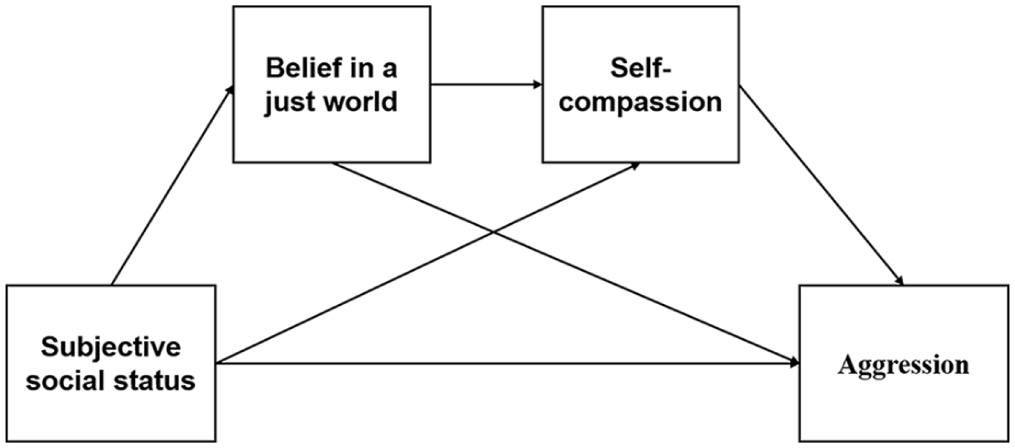
Hypothesized conceptual models.
Methods
Participants
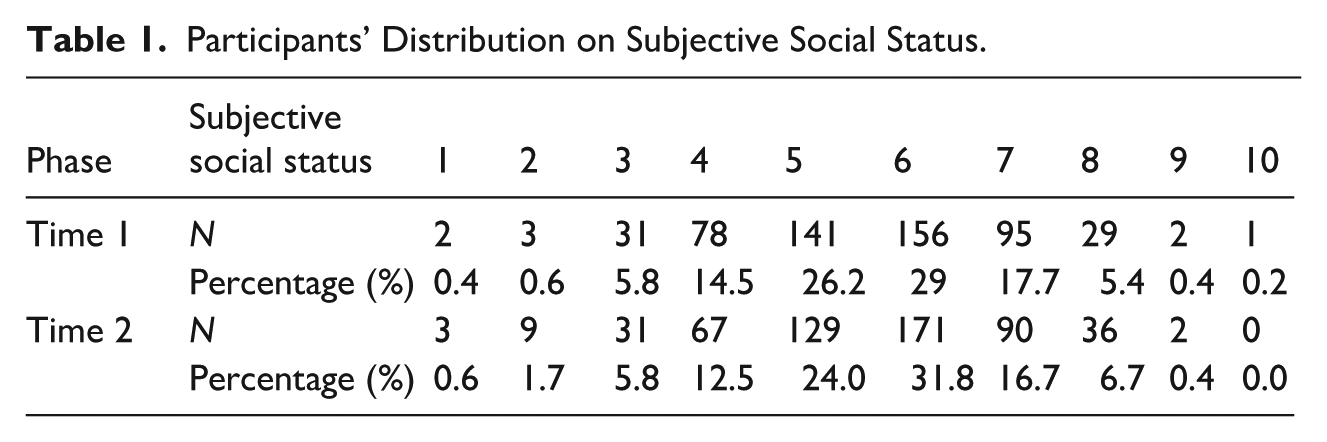
A total of 805 adults (males: n = 333) from different provinces in China were surveyed in Time 1 (October 2021), and 538 of them (males: n = 216) completed the survey in Time 2 (August 2022) with a time lag of 10 months. Since an online survey was employed, participants were mandated to fully respond to all questions prior to submission, thereby ensuring the integrity of the data. The final participants ranged in age from 19 to 55, with a mean age of 30.92 (SD = 6.23). The participants were recruited from 29 provinces or municipalities across China, including Guangdong, Shanghai, Hubei, Henan, Shandong, and others. In terms of occupational diversity, the sample represented a wide range of job types, including administrative personnel, manual laborers, clerical workers, technicians, educators, and college students. Among the participants, 16.7% were categorized as single, 7.2% were identified as being in a romantic relationship, the majority (75.7%) reported being married, and 0.6% reported being in other situations. The levels of educational attainment were categorized into five tiers: junior high school or below (0.6%), senior high school (2.8%), associate’s degree (8.9%), bachelor’s degree (79.6%), and master’s degree or above (8.2%). The mean subjective social status was 5.537 (SD = 1.336) at Time 1 and 5.556 (SD = 1.392) at Time 2. The distribution of participants’ subjective social status is presented in Table 1. According to our study design, we measured BJW at Time 1 while assessing self-compassion and aggression at Time 2. The informed consent of all participants was obtained prior to their completion of the online survey. All research procedures have undergone review and approval by the ethics committee affiliated with the corresponding author’s university (Approval No. SXULL2021081).
Participants’ Distribution on Subjective Social Status.
Subjective Social Status
The widely employed MacArthur Ladder was utilized to evaluate subjective social status at T1 and T2 (Adler et al., 2000). Participants were presented with an image of a 10-rung ladder and instructed to conceptualize it as a representation of social hierarchy. They were told that those who occupy the top rungs of the social ladder are characterized by their affluence, educational attainment, and prestigious occupations, whereas those at the bottom end of this hierarchy are marked by their poverty, lack of education, and low-status jobs or unemployment. Participants were then instructed to indicate where they think they stand on a scale of 1 to 10 in relation to other people at this stage of their life.
Belief in a Just World
BJW was measured by the BJW Scale at T1 (Dalbert, 1999; Su et al., 2012). The scale comprised 13 items, with responses ranging from 1 (strongly disagree) to 6 (strongly agree). Six items measured general BJW (e.g., “I think the world is a just place”) and others measure personal BJW (e.g., “I am usually treated fairly”). The mean score of all items was calculated, with a high score representing a higher level of BJW. The Cronbach’s α of this scale in this study was .871. The Cronbach’s α values for the subscale of personal BJW and general BJW were .825 and .757, respectively.
Self-Compassion
The 12-item Self-Compassion Scale-Short Form (SCS-SF) was adopted to measure self-compassion at T2 (Gong et al., 2014; Neff 2003). This scale has been validated among Chinese adults and is widely utilized in studies involving Chinese adult populations (D. Wang, Xie, et al., 2023). The scale used in this study incorporated three dimensions of self-kindness (e.g., “I’m tolerant of my own flaws and inadequacies”), common humanity (e.g., “When I’m really struggling, I tend to feel like other people must be having an easier time of it”), and mindfulness (e.g., “When something painful happens, I try to take a balanced view of the situation”). The scale was scored on a 5-point Likert scale ranging from 1 (not at all) to 5 (always), with five items being reverse-scored. The mean score of all items was calculated, with a high score representing a higher level of self-compassion. The Cronbach’s α in this study was .759. The Cronbach’s α values for the subscales of self-kindness, common humanity, and mindfulness were .492, .668, and .791, respectively.
Aggression
A 30-item scale of Buss–Perry Aggression Questionnaire (BPAQ; Buss & Perry, 1992; Li et al., 2011) was used to assess aggression at T2. The scale was adapted into Chinese forming five subscales of physical aggression (seven items), verbal aggression (five items), anger (six items), hostility (seven items), and self-aggression (five items), which yielded satisfactory reliability and validity in Chinese adults (Li et al., 2011; Sun et al., 2021). Responses were given on a 5-point scale from extremely disagree to extremely agree. The mean aggression score of all items was calculated. Higher scores referred to a greater presence of aggression in daily life. In the current study, the Cronbach’s α was .910. The Cronbach’s α values for the subscales of physical aggression, verbal aggression, anger, hostility, and self-aggression were .767, .656, .839, .817, and .760, respectively.
Data Analysis
Data were analyzed using SPSS 22.0 software and the PROCESS macro (version 3.3). First, descriptive analyses were conducted to present basic information regarding the study variables. The second step involved conducting bivariate correlations to examine the interrelationships among all study variables. Then, the PROCESS macro model 6 (Hayes, 2017) was employed to investigate the mediating effects (via BJW and/or self-compassion) of subjective social status on aggression. The bias-corrected percentile bootstrap confidence interval (CI) method was used to test the significance of the mediation model. This procedure bootstrapped 5,000 times to estimate the indirect effects with 95% CI. If the 95% CI did not include zero, the corresponding effect was considered significant.
Results
Descriptive Statistics
Table 2 presents the means and standard deviations of subjective social status (T1), BJW (T1), and self-compassion (T2), aggression (T2), and the Pearson correlation coefficients between these variables pairwise. The results of the correlation analyses indicated a significant correlation between each main variable. Age was positively correlated with subjective social status and self-compassion. Thus, age was controlled in the following analysis.
Descriptive Statistics and Correlations.
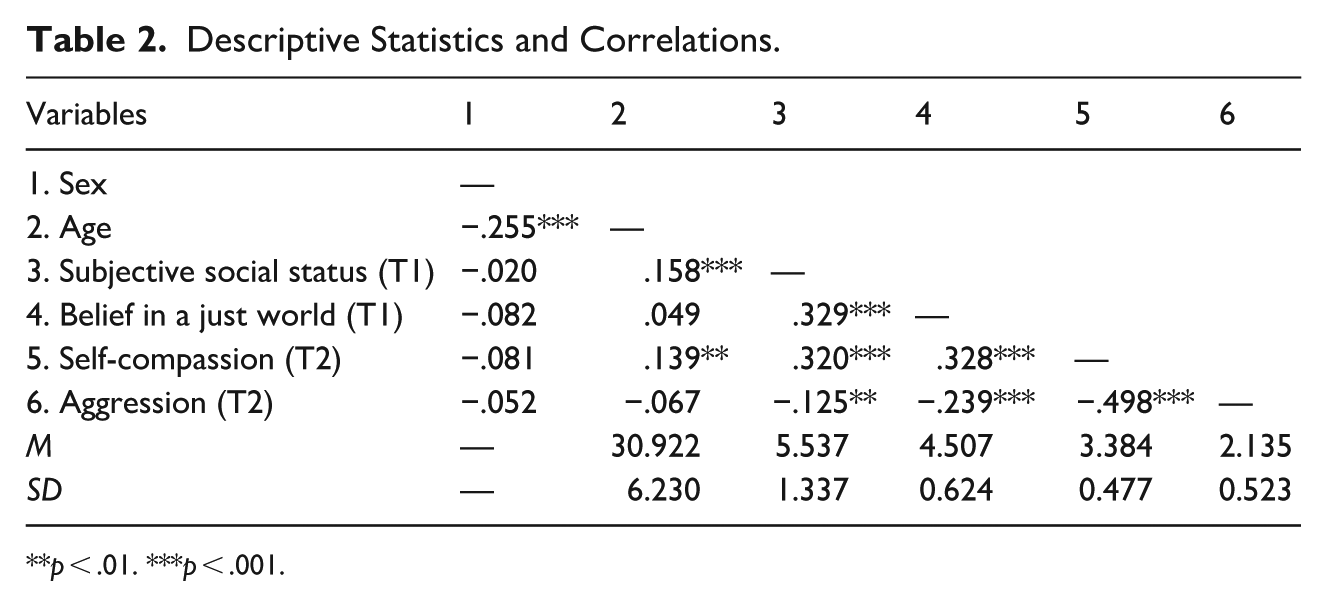
p < .01. ***p < .001.
Multiple Mediation
Results indicated that the total effect of subjective social status on aggression was significant, β = −.117, SE = 0.045, 95% CI [−0.206, −0.030]. When the mediators were included in the analysis, this coefficient was no longer statistically significant (direct effect), β = .064, SE = 0.043, 95% CI [−0.019, 0.149]. Subjective social status significantly and positively predicted BJW, BJW significantly and positively predicted self-compassion, and self-compassion significantly and negatively predicted aggression (for standardized path coefficients, see Table 3). The indirect effect of subjective social status on aggression through BJW was significant, indirect effect = −0.033, SE = 0.015, 95% CI [−0.066, −0.004]. The indirect effect of subjective social status on aggression via self-compassion was also significant, indirect effect = −0.108, SE = 0.023, 95% CI [−0.154, −0.062]. The indirect effect of the subjective social status on aggression via BJW and self-compassion was significant, indirect effect = −0.040, SE = 0.010, 95% CI [−0.060, −0.023]. To avoid any potential confounding effects of education level, we conducted additional analyses and confirmed that the model remains valid even when education level is controlled for in the analysis (see Table S1 and S2).
Multiple Regression Analyses of the Mediation Effect (Age Was Controlled).
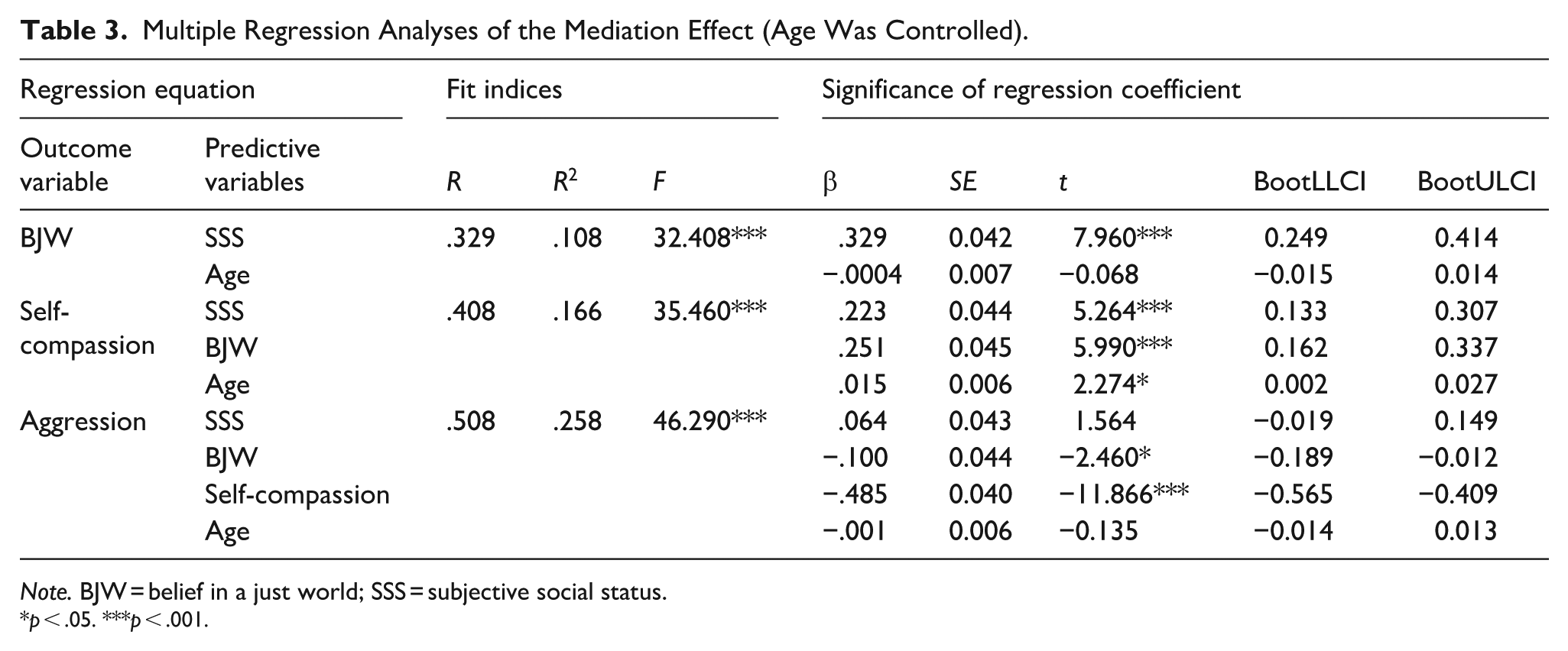
Note. BJW = belief in a just world; SSS = subjective social status.
p < .05. ***p < .001.
Discussion
This study established a multiple mediation model to investigate whether BJW and self-compassion mediated the effects of subjective social status on aggression using a more diverse and comprehensive sample. The two hypotheses were both supported. Based on previous research, the present study further examines the role of these crucial positive resources as mediators in the relationship between subjective social status and aggression.
Relationship Between Subjective Social Status and Aggression
Consistent with previous studies, this study further provides evidence for the negative association between subjective social status and aggression (Chen & Zhao, 2017). Individuals with lower subjective social status exhibit a heightened tendency toward aggression in comparison to those with higher subjective social status. The cognitive neo-associationistic theory posits that aversive events elicit negative affect, thereby triggering automatic activation of thoughts, memories, and physiological responses associated with fight-or-flight tendencies (Berkowitz, 1990). Repetitive exposure to adverse events is frequently encountered by individuals from lower socioeconomic backgrounds, resulting in heightened negative affect and an increased inclination toward aggressive behavior. Consistent with social cognitive theory (Bandura, 2001) and relative deprivation theory (Smith et al., 2012), lower sense of control and social support, heightened perception of disadvantage, and impaired executive functioning have been identified as crucial factors in the relationship between lower social class and increased aggression (Chen et al., 2018, 2024).
The Multiple Mediation Model
The present findings provide further support for the cognitive–affective personality system theory, as they elucidate how self-specific features lead to aggression through the activation of cognitive–affective mediating units (Mischel & Shoda, 1998). Results indicated that the association between subjective social status and aggression was mediated by BJW and self-compassion, both in parallel and sequential manners. Specifically, all three pathways (two-mediator pathways via BJW and self-compassion, as well as the single-mediator pathway via either BJW or self-compassion) exhibited statistically significant relationships.
The data indicated that BJW played a mediating role in the relationship between subjective social status and aggression. BJW is a cognitive factor that formed in the complex and dynamic interplay between individuals and their surrounding environment over an extended period of time. Subjective social status serves as a significant environmental factor in shaping cognitive development regarding one’s perception of the world (Yu et al, 2020). This may be attributed to the fact that perception of lower social class can lead to heightened vulnerability toward systemic injustices and experience of unfairness (S. Quan, 2021). The present study provides additional evidence to support the negative association between BJW and aggression. The just world theory holds that if people believe they will be treated fairly, they can experience a heightened sense of security and control, enabling them to approach the future with confidence and pursue long-term goals (Lerner & Miller, 1978). Consequently, BJW plays a crucial role in facilitating adaptive social behaviors, such as the control of anger and aggressive intentions (Nesbit et al., 2012). It seems that when individuals perceive the world as equitable and fair, they are more likely to embrace a system of regulations, thereby facilitating adherence to proper conduct to achieve desirable outcomes (Ma et al., 2022). On the contrary, individuals who experience a lower subjective social status may perceive unfairness and subsequently have reduced BJW, thus leading to negative interpersonal and intergroup outcomes such as anger, conflict, and aggression (R. Zhang et al., 2022).
More importantly, the mediating role of self-compassion was also supported in the study, indicating that people with lower subjective social status lack a compassionate attitude toward themselves, which leads to higher levels of aggression. Our findings reinforce and extend prior literatures that examine the relationships between subjective social status and self-compassion. Consistent with the previous studies, subjective social status was positively related to self-compassion (Jensen et al., 2019). Individuals with lower subjective social status typically experience heightened levels of financial stress, familial conflict, domestic violence, and social challenge. These adverse events are more likely to impede the development of self-compassion (Neff & McGehee, 2010). In addition, higher levels of self-compassion were associated with less aggression. Cumulative evidence revealed that people with high self-compassion or mindfulness self-reported less aggressive behavior in different ways in various populations (Kim et al., 2022; Miyagawa & Taniguchi, 2022). Our study replicated and extended this finding by showing that self-compassion was negatively related to aggression in Chinese adults (C. Zhang et al., 2023). There are many potential explanations for the negative correlation (Fresnics & Borders, 2017). Neurologically, this attitude of self-acceptance is strongly associated with various beneficial outcomes, such as activation of brain regions involved in self-processing and emotion regulation (J. Lutz et al., 2020) and as well as inhibition of the threat response system (Johnson & O’Brien, 2013). In other words, poor self-compassion or mindfulness may be associated with individual failure in emotional management (McBride et al., 2022; Modinos et al., 2010). Self-compassion is positively correlated with skills in handling interpersonal conflict and social functioning, which may help promote interpersonal adaptation and communication (Jin et al., 2023). Thus, individuals with lower subjective social status may generate more self-criticism and helplessness, rather than positive aspects such as self-compassion, thus leading to aggression.
The present serial multiple mediation analysis revealed that subjective social status could also influence aggression via the sequential mediation of BJW and self-compassion. As a kind of individual value, BJW may also indirectly influence conduct problems through some other psychological constructs. In line with this argument, previous research demonstrated that individuals with a high level of BJW can control and use their emotions more positively (Ma et al., 2022). The present study provides direct evidence of the positive association between BJW and self-compassion across the lifespan, which is consistent with findings conducted among medical students (Kang et al., 2020). Individuals with a strong BJW tend to experience equitable treatment and positive outcomes, which, in turn, enhances their self-regulation abilities and fosters a more positive and optimistic attitude (Jiang et al., 2016). This optimistic perception encourages individuals to embrace self-acceptance and self-understanding, thereby leading to an increase in self-compassion (Austin et al., 2023). From a perspective of social cognition, individuals who hold a BJW typically exhibit an enhanced sense of social identity, which, in turn, facilitates adaptive self-regulation strategies such as self-compassion (Phillips, 2021).
On the whole, the current study demonstrates how subjective social status shapes one’s behavior through cognitive–affective mediating mechanisms. Specifically, individuals with a lower subjective social status tend to face greater risks and feel unfair treatment in life. Such long-held beliefs, which stem from personal experiences, may lead individuals to fall into emotional distress, hindering the development of self-regulation and consequently increasing the risk of aggression. On the contrary, higher subjective social status promotes individuals’ just world beliefs, which can enhance their sense of self-compassion over time and further help them prevent engaging in aggressive behaviors. Similarly to this viewpoint, prior research has demonstrated that family socioeconomic status fosters BJW of adolescents, subsequently enhancing emotional intelligence, which in turn promotes prosocial behaviors on the internet (H. Wang et al., 2021). Based on the cognitive–affective personality system theory, our multiple mediation model provides a more comprehensive mechanism connecting subjective social status and aggression, by considering the mediating roles of BJW and self-compassion.
Limitations and Future Research
The current study has several limitations that can be addressed in future work. First, we employed a questionnaire-based approach to collect data, utilizing a two-wave longitudinal design to investigate the relationship between four variables. Although previous studies have provided a solid foundation for this study and BJW was assessed at Time 1, while self-compassion was assessed at Time 2 according to the model, we did not test all data in both waves, which limited its ability to establish causal relationships between variables. Future research should employ a more rigorous empirical methodology, such as a multi-wave longitudinal panel design, to replicate and validate these findings. Second, all variables were assessed through self-ratings. Future research could utilize a multi-informant approach to gather comprehensive data. Third, while we used a national sample that reflects diverse groups across educational attainment, occupation, and geography, it does not necessarily capture all aspects of human differences. For example, the educational level of the majority of participants (over 80%) is at the college level or higher, indicating a skewed distribution in the sample’s objective socioeconomic status. Future research should employ more representative samples to better establish the generalizability of these findings. Moreover, as this is a sample from China, findings are not necessarily generalizable to people in other countries. It is possible to replicate the models with other groups. Fourth, much more information about the sample should be collected and controlled in future studies (e.g., socioeconomic status). Furthermore, the study hypotheses were not pre-registered, as the data were collected prior to pre-registration becoming routine practice. Further research concerning mechanisms of aggressive behavior from subjective social status should be pre-registered to improve its transparency and reproducibility.
Implications
Despite the acknowledged limitations, our study significantly contributes to the understanding of the association between subjective social status and aggressive behavior. The present study employed the cognitive–affective personality system theory to establish the pathway from beliefs about the world to self-regulation to explain the relationship between one’s self-perception and behavioral response. These findings and theoretical constructs may deepen our understanding of the law of the occurrence of aggression and extend the current framework of maladaptive behavior patterns.
Evidence supporting their relationships would also be conducive to developing targeted strategies to decrease aggression. Policies for attenuating the actual class inequality may help to reduce instances of aggression. In addition, we contribute to the existing body of research by elucidating indirect pathways involving BJW and self-compassion. This finding points to the possibility that inducing just world beliefs and self-compassion may be helpful in reducing aggression. It would be highly advantageous for society to place greater emphasis on fairness, as this can help cultivate individuals’ BJW. Meanwhile, enhancing the emotion-regulation skills of individuals, particularly those who perceive themselves as belonging to a lower socioeconomic status, may potentially attenuate their propensity for aggression to some extent.
Conclusion
The present study contributed to the literature by examining how subjective social status was associated with aggression through BJW and self-compassion. Results indicated that there was a significant relationship between subjective social status and aggression. Meanwhile, BJW, self-compassion, and the chain from BJW to self-compassion play mediating roles in the relationship between subjective social status and aggression.
Supplemental Material
sj-docx-1-jiv-10.1177_08862605251368930 – Supplemental material for Longitudinal Association of Subjective Social Status With Aggression: The Mediating Role of Belief in a Just World and Self-Compassion
Supplemental material, sj-docx-1-jiv-10.1177_08862605251368930 for Longitudinal Association of Subjective Social Status With Aggression: The Mediating Role of Belief in a Just World and Self-Compassion by Xiaole Ma and Haoyuan Wu in Journal of Interpersonal Violence
Footnotes

Ethical Considerations
All materials and procedures were approved by the Ethics Committee of the first author’s university (protocol no. SXULL2021081), and in accordance with the 1964 Helsinki Declaration and its later amendments.
Consent to Participate
Informed consent was obtained from all individual participants included in the study.
Author Contributions
Funding
The author(s) disclosed receipt of the following financial support for the research and/or authorship of this article: This study was funded by the Youth Project of Shanxi Basic Research Program (free exploration), China [Grant number 202203021222020].
Declaration of Conflicting Interests
The author(s) declared no potential conflicts of interests with respect to the authorship and/or publication of this article.
Data Availability Statement
Supplemental material
Supplemental material for this article is available online.
Author Biographies
References
Supplementary Material
Please find the following supplemental material available below.
For Open Access articles published under a Creative Commons License, all supplemental material carries the same license as the article it is associated with.
For non-Open Access articles published, all supplemental material carries a non-exclusive license, and permission requests for re-use of supplemental material or any part of supplemental material shall be sent directly to the copyright owner as specified in the copyright notice associated with the article.
