






Abstract

Stranges, T. N., Marshall, R. A., Godard, R., Simonetto, D., & van Donkelaar, P. (2024). Characterizing Intimate Partner Violence-Caused Brain Injury in a Sample of Survivors in the Two Spirit, Lesbian, Gay, Bisexual, Transgender, Queer or Questioning Community. Journal of Interpersonal Violence, 40(3-4), 906-927. https://doi.org/10.1177/08862605241256390 (Original work published 2025)
The authors contacted us saying that incorrect demographic information for gender identity and sexual orientation was reported in Table 1 (this includes one paragraph description in the abstract as well as results). This was an editing oversite as the correct data was used for all statistical analysis. None of the substantive conclusions or study outcomes are affected.
The following updates have been made to the online version of the article:
Abstract has been updated as: “Research in the field of intimate partner violence-caused brain injury (IPVBI) has predominantly focused on heterosexual women, ignoring the unique needs of the Two Spirit, Lesbian, Gay, Bisexual, Transgender, Queer or Questioning (2S/LGBTQ) community. The purpose of this exploratory research was to better understand the prevalence of IPV and IPV-BI in 2S/LGBTQ relationships where IPV was defined as physical, psychological, financial, sexual, and/or identity-based abuse from a current of former intimate partner. This study used a cross sectional internet-based survey that ran from September to December of 2022. In addition to descriptive statistics, prevalence rates and their corresponding Wilson Score confidence intervals are reported to estimate the proportion of individuals who experienced IPV and IPV-BI. Finally, for both gender identity and sexual orientation, we tested whether participants with each identity had differing levels of brain injury severity compared to participants who did not hold that identity using Mann–Whitney U tests. In total, 170 2S/LGBTQ+ adults responded to the survey. Among the respondents, 54% identified as Two-Spirit, 36% (n = 61) identified as gay, 30% (n = 58) identified as queer, 23% (n = 39) identified as bisexual, and 19% (n = 33) identified as lesbian, and 16% (n = 27) identified as pansexual. Respondents were predominantly multiracial, post-secondary educated, full-time employed, transgender-men (41%; n = 69) or transgender-women (27%; n = 45). The overwhelming majority reported lifetime prevalence of IPV at 98% (n = 166, 95% CI [94.11, 99.08]). Additionally, 68% (n = 115, 95% CI [60.29, 74.22]) of participants reported symptoms consistent with an IPV-BI. These results are consistent with the findings that the 2S/LGBTQ community are at heightened risk of experiencing physical IPV. These findings are the first to our knowledge to report a high rate of symptoms consistent with an IPV-BI in the 2S/LGBTQ population.”
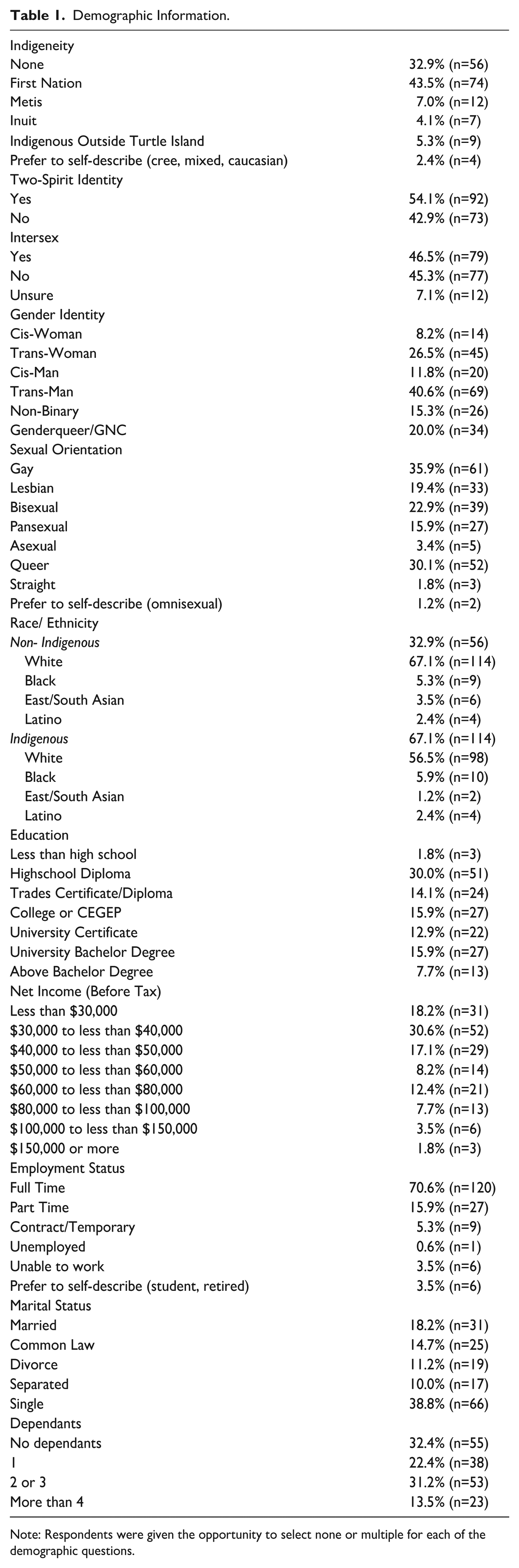
On page 912, the first paragraph of ‘Results’ section has been updated as: “Table 1 shows demographic characteristics of the respondents. Mean age of the sample was 30 years (SD = 8.4). Among the respondents, 62% (n = 104) were Indigenous, and 54% (n = 92) identified as Two-Spirit. Across all participants, 36% (n = 61) identified as gay, 30% (n = 58) identified as queer, 23% (n = 39) identified as bisexual, and 19% (n = 33) identified as lesbian, and 16% (n = 27) identified as pansexual. Respondents were predominantly multiracial, postsecondary educated, full time employed, transgender-men (41%; n = 69) or transgender-women (27%; n = 45).”
Table 1 has been updated as below:
Demographic Information.
Note: Respondents were given the opportunity to select none or multiple for each of the demographic questions.