






Abstract
Academic environments are expected to uphold high standards of integrity and professionalism. Yet, sexual misconduct by faculty has been a persistent and deeply concerning issue in U.S. colleges. Furthermore, sanctions for such misconduct remain lenient and inconsistent across colleges, which potentially contributes to victims’ exposure to risky environments. Previous scholarly efforts found cultural factors leading to lenient sanctions for sexual misconduct. However, the earlier approaches did not fully examine broad external factors that could affect institutional sanction decisions. College administrations make critical decisions regarding sanctions for faculty sexual misconduct cases. Therefore, understanding factors that influence colleges’ decisions is important for sexual misconduct prevention through clearer and consistent policies. To contribute, the current study aims to investigate (a) how U.S. colleges respond to sexual misconduct by the faculty and (b) which external factors are associated with the severity of sanctions. By analyzing the Academic Sexual Misconduct Database (ASMD), the current study found that (a) tenured faculty tend to receive lenient sanctions and (b) non-white faculty tend to receive harsher sanctions. Notably, the seriousness of sexual misconduct is not associated with sanction severity. These findings are consistent with sociological and criminological theories regarding institutional decision-making processes—colleges’ decision-making processes follow rational choices based on cost estimation, and it may eventually lead to bias against non-white faculty who commit similar misconduct as white faculty. To promote safer academic environments, the current study recommends that colleges prepare better standards based on the nature of sexual misconduct. Additional implications for future research are also discussed.
Introduction
Sexual misconduct by faculty has long been a persistent issue in U.S. colleges 1 (Cantalupo & Kidder, 2018; Young & Wiley, 2021). Even though victimization rates vary across institutions, the incident rates tend to remain underreported (Hemphill & Reynolds, 2021). While policies to prevent sexual misconduct by faculty have been implemented, the impact is still controversial (N. B. Porter, 2022). The challenge highlights the need for a more comprehensive understanding of how U.S. colleges respond to sexual misconduct cases by faculty.
Studies have shown that sanction decisions by college administrations tend to be inconsistent and discriminatory (Cantalupo & Kidder, 2019; Jogani & Ruiz Sánchez, 2023; Weiss & Lasky, 2017). A majority of the accused faculty tend to hold powerful positions, such as full professors, deans, and department chairs (Espinoza & Hsiehchen, 2020). Due in part to this reason, only a small proportion of faculty perpetrators face serious administrative sanctions, such as employment termination (Espinoza & Hsiehchen, 2020; Jogani & Ruiz Sánchez, 2023). Collectively, these findings suggest that there might be additional contributing factors affecting the sanction severity, rather than the severity of sexual misconduct. Similar to practices in criminal justice systems, levels of punishment do not simply correspond to the severity of the offense, yet are largely shaped by external conditions (Garland, 1991; Heimer et al., 2012; Steffensmeier et al., 1993).
Due to a lack of research, less is known about why colleges make lenient and inconsistent decisions in sexual misconduct cases committed by faculty (Espinoza & Hsiehchen, 2020; Young & Wiley, 2021). Colleges might consider multiple factors in sanction decisions, such as cultures in colleges, politics, and the nature of misconduct (Cantalupo & Kidder, 2018, 2019; Richards et al., 2021). However, the approaches have not fully addressed multifaceted factors and mechanisms shaping administrative decisions. For instance, colleges are rational entities, and thus they may try to maximize their institutional benefits or minimize damages (Coleman, 1990). In addition, considering focal concern theoretical arguments (Steffensmeier et al., 1993), colleges may consider ancillary factors in administrative decisions, such as characteristics of faculty perpetrators and victims, making sanctions less relevant to the nature of misconduct.
Accordingly, the current study examines colleges’ administrative sanction decisions on faculty sexual misconduct by drawing explanations from the rational choice perspective (Coleman, 1990) and the focal concerns theory (Steffensmeier et al., 1993). Given the complexity of organizational structures in colleges, we argue that administrations are influenced by multiple external factors beyond legal frameworks. This explanation will allow us to explore how ancillary factors influence administrative responses, similar to practices in the criminal justice system. Ultimately, this study aims to identify mechanisms behind sanction decisions and discuss enhanced preventive methods to contribute to establishing safer academic environments.
Literature Review
The Scope of Sexual Misconduct by Faculty and Systemic Issues in U.S. Colleges
There have been significant legal efforts to define and prohibit sexual misconduct in U.S. colleges. Title IX prohibits sexual discrimination in educational institutions, and the scope includes a wide range of discriminatory behaviors, such as verbal or nonverbal behaviors, intimidation, and hostility based on sexual stereotypes or sexual orientation (American Association of University Women, n.d.). Additionally, the U.S. Equal Employment Opportunity Commission (n.d.) defines sexual harassment as unwanted sexual conduct, including “unwelcome sexual advance, request for sexual favor, and other verbal, nonverbal, or physical conduct of sexual nature.” Given that colleges are both educational and working environments, such definitions set boundaries for prohibited behaviors that impact the well-being of their members.
Despite the growing awareness, sexual misconduct is still prevalent in U.S. colleges. According to recent research, about 20% of female college students report unwanted sexual contact during their time in school (Fedina et al., 2018). Among these student victims, many are victimized by another student (70%; Association of American Universities, 2020). Also, other student victims identify faculty as perpetrators for their unwanted sexual experiences; in 2019, a survey from the University of Virginia found that, among students who reported sexual harassment victimization, 5% of undergraduate students and 24% of graduate and professional students identified faculty as the perpetrators (Cantor et al., 2019). Additionally, in a study with a sample of 953 women faculty members at U.S. medical schools, nearly 30% reported sexual harassment victimization at some point in their careers (Carr et al., 2000). Capturing accurate data remains challenging due to limited access to detailed case information and inconsistent reporting practices across institutions. Moreover, considering the fact that sexual offenses are likely to be underreported (Scurich, 2020), the actual victimization rates could be higher than the current statistics.
Cultural factors in academia may influence sexual misconduct perpetration by faculty (Slagter & Forbes, 2009; Young & Wiley, 2021). For instance, the male-dominant culture in academia (Poole et al., 2025; Slagter & Forbes, 2009) and the power hierarchy between students and faculty (Young & Wiley, 2021) could facilitate the occurrence of sexual misconduct by faculty. In the study by Wood et al. (2018), which surveyed 26,417 college students in the southwestern United States, 78% of incidents involving faculty perpetrators were committed by male faculty. Considering that these male perpetrators tend to hold senior or tenured academic roles (Espinoza & Hsiehchen, 2020), a male-dominant institutional culture may be reluctant to change because the reform could be perceived as a potential threat to the current institutional power structure.
While many student victims find that institutional resources (e.g., campus counseling services and victim support services) help them to recover from their victimization trauma, those female victims perpetrated by faculty are skeptical of the sanction determinations by school officials. Within the power hierarchy, it is believed that officials will not impose punitive sanctions on the faculty perpetrators and may not ensure victims’ safety and protection (American Association of University Professors, 2012; Association of American Universities, 2020; Lighty et al., 2011; Marken, 2020). Indeed, research shows that victims of sexual harassment experience the incidents repeatedly as perpetrators tend to target the same person (Rosenthal et al., 2016). Also, student victims could be exposed to the faculty perpetrators once the perpetrators return to the campus after completing given sanctions (Espinoza & Hsiehchen, 2020). Since the nature of academia is small and narrow (Young & Wiley, 2021), victims and perpetrators are often confined to the same discipline unless one party quits or leaves the field. Moreover, even when faculty perpetrators resign from their institutions following investigations, the institutions may allow them to transition to other institutions (i.e., “pass the harasser”), thereby increasing the likelihood of continued encounters between victims and perpetrators (Fortney & Morris, 2021). These findings highlight colleges’ systemic failure to punish faculty perpetrators, a dynamic that undermines the safety of campus environments.
Sanction Leniency and Inconsistency in U.S. Colleges: Rationales, Procedures, and Contributing Factors
Sanctions 2 against faculty perpetrators tend to remain lenient in U.S. colleges (Euben & Lee, 2006; Stubaus & Harton, 2022; Young & Wiley, 2021). For instance, unlike practices in other industries in the United States, “at will” termination is not prevalent in academia, which makes it difficult to expel faculty immediately after they commit serious sexual misconduct (Euben & Lee, 2006; Young & Wiley, 2021). Especially, strong due process guaranteed by the tenure system in college may indirectly shield perpetrators from harsh sanctions (Stubaus & Harton, 2022).
When sexual misconduct by faculty is reported, colleges go through complex decision-making processes (Coy et al., 2022; Stubaus & Harton, 2022). In general, college administrations in the United States have adopted a collegial approach, which suggests that decision-making processes are influenced by multiple entities on campus. Each group may attempt to minimize potential damages in the stages of an investigation because they want to protect their reputation by concealing incidents (Zenteno & Hauck, 2022). Meanwhile, faculty perpetrators may seek to protect themselves from potential negative consequences (Young & Wiley, 2021). At the same time, administrative units may want to manage situations cost-effectively while operating under limited resources (Bolger, 2016). Following this logic, colleges may justify certain rationales to yield ideal decisions for them. Furthermore, entities in colleges may have different levels of discretionary power, which may influence sanction decisions. Coy et al. (2022) showed that unit heads are responsible for final decisions in a chain communication style, but the heads do not have to report their decisions to the public. The circumstances may allow unit heads to make favorable decisions toward perpetrators, based on expected gain and loss following the decisions.
Moreover, colleges may be concerned about reputational damage by publicizing sexual misconduct cases and potential financial loss because of the unfavorable public image associated with the scandal (Yung, 2015). For example, Michigan State University (MSU) was under public scrutiny for mishandling sexual assault cases by the former sports doctor Larry Nassar in 2016. In the aftermath of the outrage, MSU’s undergraduate application rates for the fall of 2018 dropped by 8%, which negatively affects the university’s financial conditions (Paterson, 2018). These expected adverse consequences may shape colleges’ decisions to minimize harm to their institutions. Below, by drawing on rational choice and focal concern theories, we further discuss how employment status and demographic characteristics of the faculty perpetrators could lead to more or less severe sanction decisions in U.S. colleges. Colleges also choose to divert faculty perpetrators to resign or to leave before final decisions are made, which is known as “pass the harasser” or “pass the trash” (Fortney & Morris, 2021; Young & Wiley, 2021). By allowing this, colleges may give the impression that they are taking action by distancing perpetrators from victims, while avoiding faculty reactions that could harm the institutions.
Theoretical Background and Application
Rational Choice, Human Behaviors, and Organizational Decisions
Rational choice theories frame human behavior as inherently pleasure-seeking in order to maximize individuals’ own benefits; thus, individuals intentionally make decisions that maximize benefits while minimizing costs (Homans, 1961). Coleman (1990) extended this perspective beyond individual behavior to the group level, arguing that collective decisions should be traced back to individual choices made in response to available opportunities. According to Coleman (1990), individuals exchange available information and resources in order to obtain what is more valuable or surrender what is less valuable. Through the processes, individuals’ choices accumulate into collective outcomes, becoming norms or policies, which eventually shape individuals’ subsequent choices.
Rational choice theoretical perspectives (Coleman, 1990) can explain the rationales behind sanctions made by colleges. Colleges are groups where multiple units operate in tandem (Coy et al., 2022). When faculty perpetrate sexual misconduct, multiple entities, including Title IX offices, unit heads (e.g., department chairs and deans), Human Resources, and senior leadership (e.g., provosts and presidents) are involved to discuss the case (Coy et al., 2022). Such engagement of multiple units creates complex relationships both within and outside the institution, which influence information or resources related to decision-making processes. Even though legal protection for students can be provided on campus (e.g., Title IX), colleges should also consider potential risks, such as lawsuits from faculty alleging breaches of due process when decisions result in employment termination (Euben & Lee, 2006). Due to such potential costs related to unexpected events, colleges may impose more lenient sanctions or choose not to make any decisions. They may recognize the potential risk of lenient sanctions, such as repeated perpetration by faculty. However, colleges may choose not to expel the faculty if the perceived total advantages (e.g., financial benefits brought by the faculty) outweigh the potential disadvantages in the institutional context (Jogani & Ruiz Sánchez, 2023; Stubaus & Harton, 2022). Also, colleges can choose to avoid potential damage by avoiding the announcement of their decisions. For instance, faculty perpetrators may be allowed to resign from the position, or colleges may delay critical decisions by involving legal prosecution in order to shift their responsibility onto relevant sectors in the government (Young & Wiley, 2021).
In sum, rational choice theoretical perspectives suggest that colleges may estimate advantages and disadvantages before making decisions and choose a way to maximize their benefits (Abell, 1991; Coleman, 1990). According to Jogani and Ruiz Sánchez (2023), from administrative viewpoints, terminating tenured faculty members’ contracts may turn into lawsuits alleging a breach of due process (Euben & Lee, 2006), which require additional costs to defend the college. Additionally, such terminations may be considered a loss of prominent scholars who bring benefits to their colleges (Jogani & Ruiz Sánchez, 2023; Stubaus & Harton, 2022). Following the theoretical rationale, we expect that tenured faculty, compared to non-tenured faculty, may receive more lenient sanctions from colleges. Accordingly, we offer our first hypothesis below:
Additionally, faculty from the Science/Technology/Engineering/Mathematics (STEM) majors can provide crucial financial advantages to colleges, such as bringing external grants (Farris, 2019) and leading to more student enrollment in colleges (National Science Board & National Science Foundation, 2021). Considering rational choice theoretical perspectives, we provide another hypothesis that STEM faculty may receive less severe sanctions, as colleges may want to preserve such financial benefits brought by the STEM faculty:
Focal Concerns Theory and Organizational Decisions
Focal concerns theory offers insights into how extra-legal factors influence judges’ decisions regarding sentencing (Steffensmeier et al., 1993). The theory proposes three factors associated with increased severity of punishment: blameworthiness, protection of the community, and practical constraints (Steffensmeier et al., 1993). Blameworthiness refers to offenders’ culpability and aligns with the concept of retribution, which implies that punishment should fit the crime. Protection of the community means the consideration of potential threats to the community posed by offenders, such as recidivism or danger after release. Practical constraints refer to concerns regarding organizational costs associated with sentencing, including those incurred by the criminal justice system. Prison capacity, administrative workload, and public perception of sentencing are examples of those constraints (Gottlieb & Arnold, 2021; Steffensmeier et al., 1998; Ulmer et al., 2022).
According to Steffensmeier et al. (2017), focal concerns are not definitive standards for sentencing, but they serve as cognitive frameworks that affect judges’ decision-making processes. Judges may face uncertainty in their work, such as ambiguity led by time constraints, an abundance of information, or undesirable consequences of sentencing. Under the circumstances, focal concerns function as cognitive filters that manage the uncertainty effectively by reinforcing stereotypes about certain races, genders, and age groups (Steffensmeier et al., 2017). The group-based stereotypes work as auxiliary factors to avoid potential risks related to decision-making processes, particularly in certain circumstances where such bias is inherent. For instance, when judges are required to make decisions within a limited time frame, they may perceive a certain racial group as more crime-prone, who potentially pose a threat to the community. As both citizens and decision-makers, judges may be reluctant to release some offenders earlier due to racial-criminal stereotypes and public demands for more punitive control over people of color. Based on these cognitive processes, people who are young, male, and perceived as non-white tend to receive disproportionately severe sentences (Steffensmeier et al., 2017). In addition, victim credibility could affect case decisions (Spohn et al., 2014). For instance, a victim’s marginalized socioeconomic status, criminal record, and inconsistent statements about the incident can diminish the victim credibility, which may lead to a more favorable legal decision for the accused perpetrator (Beichner & Spohn, 2012, Davies & Rogers, 2009). Steffensmeier et al. (2017) describe the theory as an integrated explanation regarding race, gender, and class inequality that reflects organizational and practical insights into criminal justice procedures.
The application of focal concerns extends beyond the scope of sentencing studies (Higgins et al., 2011). As Steffensmeier et al. (2017) indicated, focal concerns theory explains organizational behaviors as reactions to uncertainty. This organizational characteristic implies that colleges’ decisions may also be influenced by external factors that are not specified in policies, and the process may result in disproportionate outcomes against certain groups. For instance, even though colleges have standards for tenure and promotion, there are still undocumented criteria that may hinder the promotion of non-white faculty, as reviewers’ stereotypes tend to downplay the qualifications of non-white faculty (Masters-Waage et al., 2024). It highlights the possibility of bias against certain racial groups, which helps colleges justify inequitable decisions and potentially reduce costs under complex situations. Moreover, colleges also face practical constraints, particularly related to their costs. Colleges are responsible for substantial workloads in general. 3 College administrators are expected to handle issues effectively while sustaining their functions, which leads to work overload in addition to their educational responsibilities. Under such pressure, colleges may perceive non-white faculty through racial stereotypes, thus may perceive harsher sanctions as appropriate for them (Dixon, 2006).
In sum, considering the focal concern theoretical perspectives, decision makers will review the severity of misconduct to find the level of blameworthiness. If perpetrators are involved in more serious offenses, they are likely to face more severe sanctions (Steffensmeier et al., 1993). Also, when a sexual misconduct case involves multiple victims, this case may be perceived as more blameworthy because of the cumulative nature of harm and the broad impacts on victims (Rolfe et al., 2025). We thus expect that the sanction severity will increase with the presence of multiple victims. Finally, according to Steffensmeier et al. (1998), non-white individuals are disproportionately subjected to harsher punishment due to racial-criminal stereotypes. Given that colleges face practical constraints while managing heavy workloads within a limited timeframe, such racial bias may function as a cognitive framework for sanction decisions. Thus, we argue that non-white faculty may receive more severe sanctions. Following the focal concerns theoretical arguments, we summarize additional hypotheses for our study below:
Data
The current study used the Academic Sexual Misconduct Database (ASMD), published by MSU 4 (Libarkin, 2024). The dataset represents the only aggregated source on sexual misconduct by college professionals in U.S. colleges, derived from publicly reported qualitative information that can be coded into quantitative form. All cases in the dataset include incidents that entered the public domain through media outlets, following formal complaints, investigations, and sanction decisions by colleges (Libarkin, 2024).
In the original data, perpetrator positions include academic, administrative, and operational roles (N = 1,274). However, this study focuses only on academic positions (N = 701), which include all professionals who are primarily engaged in teaching and research. This category includes titles such as professors at any rank, instructors, adjunct instructors, adjunct professors, clinical professors, lecturers, tutors, teaching specialists, and visiting professors. Faculty members who hold both teaching and leadership positions are also included.
For analysis, we further created new variables using the original data. The original dataset included information on the names of institutions, the names of perpetrators, perpetrators’ positions, perpetrators’ majors, institutions’ sanction decisions, the years of outcome, and URLs of news articles or case briefs as sources for each incident. We revisited each source to collect more information. Ultimately, the new dataset incorporates the following additional variables: (a) types of misconduct, (b) type of institution (i.e., private or public), (c) perpetrator’s sex, (d) perpetrator’s race, (e) whether a lawsuit was filed by the perpetrator, and (f) whether the misconduct involved multiple victims. The outcome years range from 1978 to 2023.
After removing cases in which all variables had missing values, the dataset included a total of 657 cases. STATA 13 performs listwise deletion in the analysis, which ultimately includes 442 cases in the final model. The data are missing at random, and both listwise deletion and multiple imputation provide unbiased results (Pepinsky, 2018). After performing both, we did not observe critical differences between the two methods. Thus, listwise deletion estimation is reported, which provides model fit indices.
Variables
Dependent Variable: Level of Sanctions
In the raw data, the outcomes include types of sanctions to punish faculty perpetrators in colleges (i.e., official or unofficial warning, training, counseling, campus ban, demotion, pay reduction, suspension, probation, or termination). Offenders may receive a single sanction or multiple sanctions, depending on the policies of the colleges. For the analysis, we classified the sanction decisions as follows: No outcome (coded as 0) 5 ; sanctions except for termination (coded as 1); termination (coded as 2).
Independent Variables
(a) Tenure (Tenured = 1; non-tenured = 0): Our first hypothesis is whether tenured faculty tend to receive more lenient sanctions in their sexual misconduct cases, compared to non-tenured faculty. Accordingly, we create a measure that codes whether a faculty perpetrator is tenured (1) or not (0) to examine the first hypothesis.
(b) STEM majors (STEM majors = 0; non-STEM majors = 1): Considering rational choice perspectives, our second hypothesis expects that faculty from STEM majors tend to receive more lenient sanctions compared to faculty with non-STEM majors. Thus, we create a binary variable that measures whether a faculty perpetrator is from a STEM major (coded as 0) or a non-STEM major (coded as 1). STEM and non-STEM were distinguished based on criteria suggested by the Department of Homeland Security’s STEM Designated Degree Program List (U.S. Immigration and Customs Enforcement, 2024), a guideline to support visas for international students and scholars.
(c) Severity of sexual misconduct 6 (Misconduct without intercourse = 1; Misconduct with intercourse = 2; and Both = 3): Following the focal concern theoretical arguments, we expect that the severity of sexual misconduct is positively associated with the level of sanction severity (Hypothesis 3). Thus, our study categorizes the behaviors into three levels: (1) Misconduct without intercourse (i.e., sexual comments, exposure of body parts, unwanted touching, hugging or groping, storage of sexual images or videos on campus devices, taking pictures of victims’ body parts, and making sexually discriminatory remarks against women and LGBTQ+); (2) misconduct involving intercourse (i.e., vaginal, anal, or oral); and (3) misconduct involving all misbehaviors described in both (1) and (2).
(d) Multiple victims (No = 0; Yes = 1): Our fourth hypothesis predicts that when a faculty perpetrator is accused of a sexual misconduct case involving multiple victims, they may receive harsher sanctions. Accordingly, we create a binary variable that indicates whether the sexual misconduct case involves multiple victims (coded as 1) or not (coded as 0).
(e) Being non-white (Being white = 0; non-white = 1): Finally, our last hypothesis examines whether non-white faculty receive harsher sanctions compared to white faculty. To examine this hypothesis, we create a measure that codes whether the faculty is non-white (1) or white (0).
Control Variables
(a) Other misconduct (No = 0; Yes = 1): In some cases, faculty misconduct involves multiple wrongdoings (i.e., academic and professional misconduct). We thus control such misconduct that may affect sanction severity.
(b) Practical limitations (No = 0; Yes = 1): External events that occur off campus may influence institutional sanction outcomes. For example, events such as a perpetrator’s suicide or suicide attempt, flight abroad, or involvement in criminal procedures (e.g., arrest or conviction) may lead to the dismissal of the investigation, immediate termination of the perpetrator’s contract, or the imposition of sanctions following the investigation. Such incidents are controlled in the analysis, as they may limit colleges’ ability to make final decisions.
(c) Lawsuit by faculty (No = 0; Yes = 1): From the rational choice perspectives (Coleman, 1990), colleges may want to avoid imposing harsh sanctions, especially termination, considering the anticipated risks of lawsuits brought by faculty. Lawsuits are filed after the college begins investigations or makes final decisions regarding termination. Since filing lawsuits is a reaction by faculty following colleges’ primary decisions, we control for this variable, not treat it as an independent variable, as it does not preexist colleges’ decisions.
(d) School type (Public colleges = 0; private colleges = 1): Related to organizational characteristics, whether the college is public or private may impact procedures and outcomes associated with sexual misconduct (Graham et al., 2017).
(e) Perpetrator sex (Female = 0; Male = 1): According to previous studies (Steffensmeier et al., 1993), male offenders are more likely to receive harsher sanctions.
Analytic Strategies
The current study aims to examine the effects of multiple explanatory variables on colleges’ sanction decisions by integrating rational choice theory and focal concerns theory. To extend prior studies (Espinoza & Hsiehchen, 2020; Jogani & Ruiz Sánchez, 2023; Stubaus & Harton, 2022), it is essential to move beyond descriptive analyses and empirically test how theoretically relevant variables collectively shape sanctions. To address this goal, we not only transformed text-based data into quantitative form, but also systematically coded variables to indicate the magnitude of key variables for statistical testing. We then use the ordered logit model (Williams, 2016). This is because our dependent variable in this study includes three ordered categories with unequal intervals (0 = no outcome, 1 = sanctions except for termination, and 2 = termination). An important assumption of the Ordinary Least Squares (OLS) regression is the use of a continuous dependent variable on an interval scale. Thus, employing the OLS model for an ordinal-level outcome can lead to biased estimates (Peel et al., 1998). We handle this issue by employing the ordered logistic model, which assumes that the dependent variable is continuous, but that the intervals between the values are not equal (Williams, 2016). The ordered logistic model compares the probability of being at a threshold (cut-off point) to the probability of being below or beyond that threshold (Fullerton, 2009). Assuming that an unobserved latent value Y* exists, an observed value Y is determined based on the following equation with covariates:

where X is a vector of observed covariates, β is a vector of coefficients, and ε is an error term (Fullerton & Anderson, 2023). The ordered logit model does not provide an intercept. Instead, the observed outcome Y falls into ranges between thresholds that are determined based on maximum likelihood estimation:

where τ represents the threshold of categories (Fullerton & Anderson, 2023). As the ordered logit model is expressed as a cumulative logistic model, the probability of observing Y within certain ranges between cut-off points is estimated by (Fullerton, 2009):

Results
Descriptive Statistics
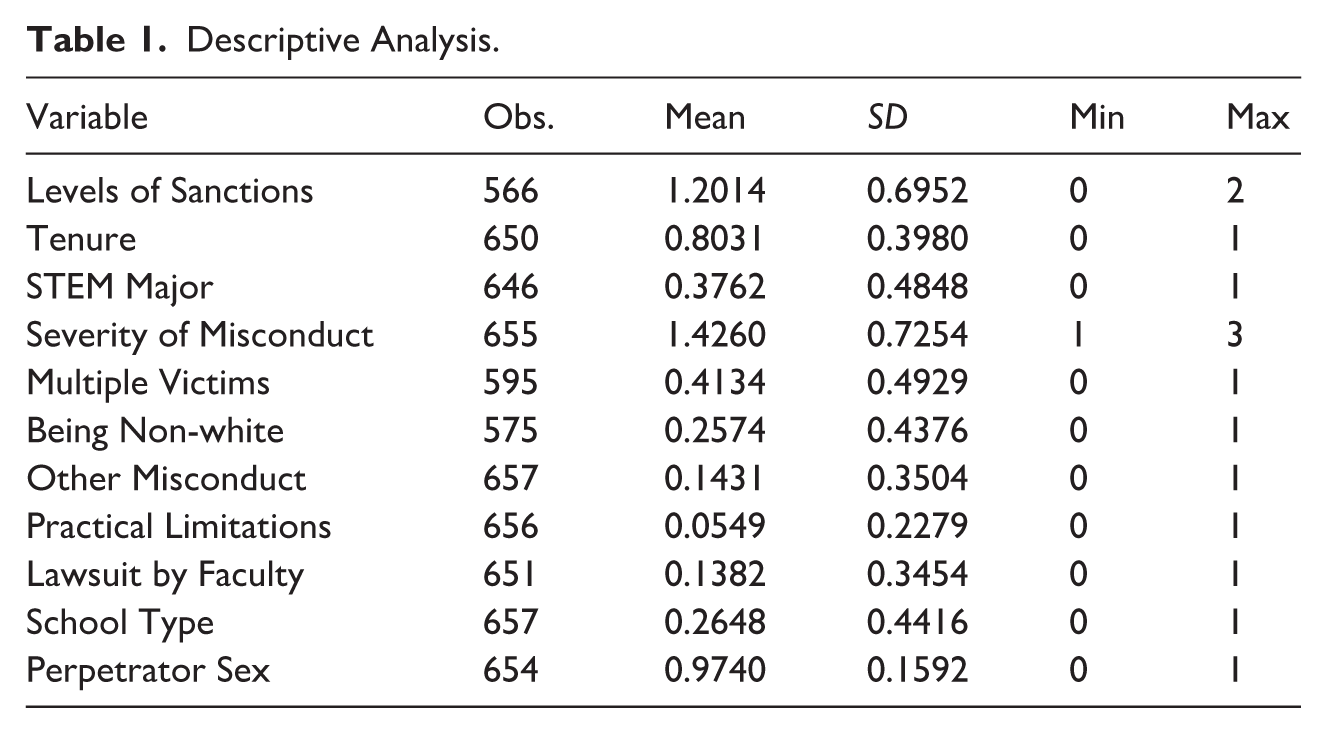
Table 1 presents the descriptive analysis (N = 657). Out of 566 cases, 91 perpetrators (16.08%) faced no outcome or moved to other institutions without sanctions. 270 perpetrators (47.70%) received sanctions excluding termination. 205 perpetrators (36.22%) faced termination. Regarding demographic profiles, about 80% of perpetrators were tenured faculty. Non-white faculty were approximately 25% of the perpetrators, and 35% of the perpetrators sued the college as the investigations progressed. Also, 40% of the entire cases involved multiple victims. Lastly, 15% of the perpetrators engaged in other types of misconduct that violated institutional policies.
Descriptive Analysis.
Ordered Logistic Regression Modeling and Results
Table 2 presents the results of the ordered logistic regression. The likelihood ratio (LR) test is statistically significant (χ2 = 33.64, p < .01). The model explains 3.7% of the variation in the outcome variable (McFadden’s Pseudo R2 = .037). The relationship between outcome and being tenured is negative (OR = 0.62, p = .073). Although it is marginally significant, this result shows that faculty receive less harsh sanctions when they are tenured. Specifically, the odds of harsher sanctions decrease by 38% for tenured faculty perpetrators. On the other hand, being non-white is positively associated with sanction severity (OR = 1.63, p < .05). More specifically, the odds of harsher sanctions increase by 63% when faculty are non-white. Beyond the hypothesized relationships, the results indicate that lawsuits by faculty are positively associated with sanction severity (OR = 3.16, p < .001). This collateral finding will be discussed further in the following section.
Ordered Logistic Model (Sanction Decisions by Colleges, N = 442).
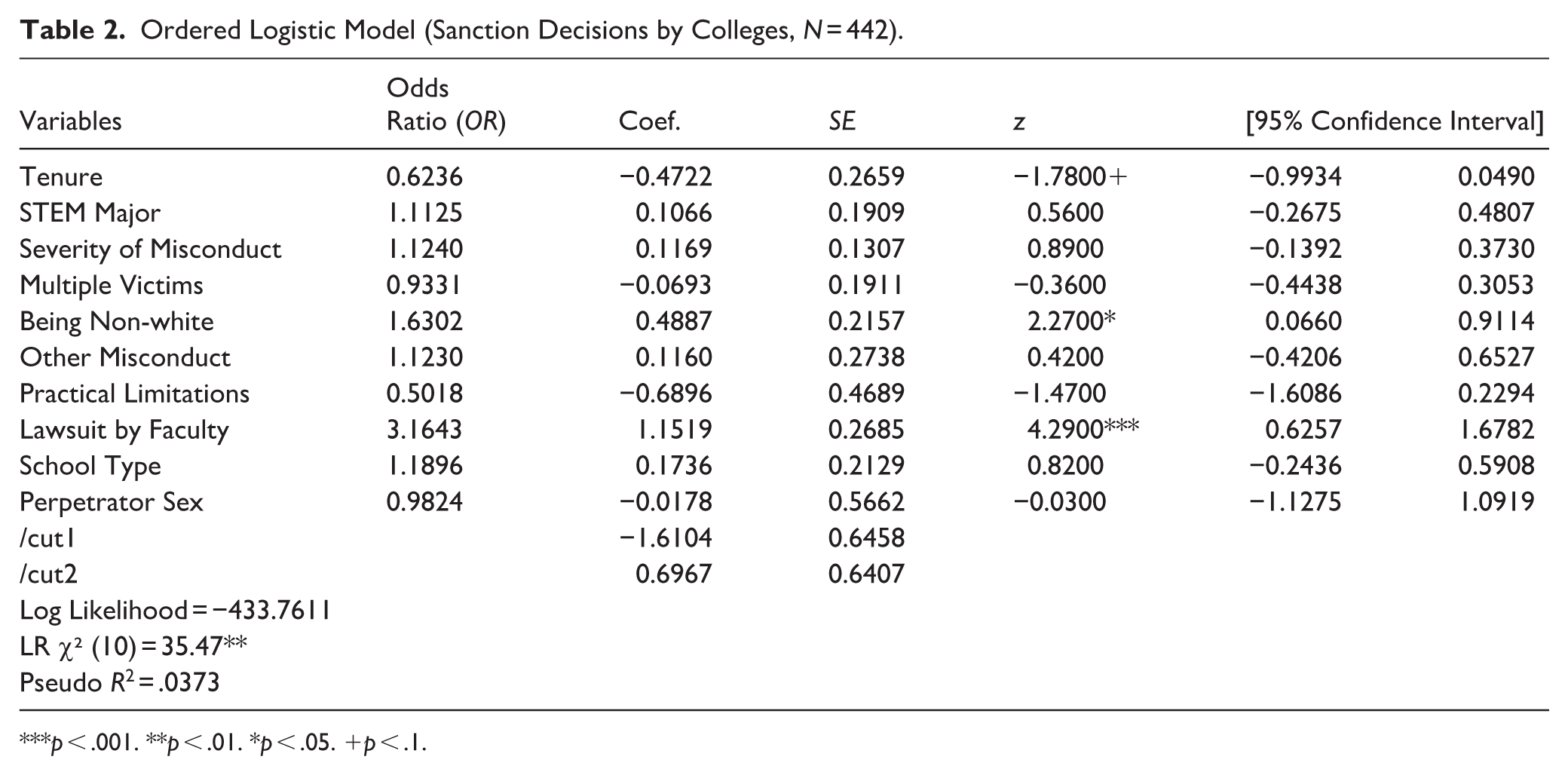
p < .001. **p < .01. *p < .05. +p < .1.
Discussion
The current study aims to understand colleges’ administrative responses to sexual misconduct by faculty. Our findings show that the seriousness of sexual misconduct is not relevant to sanction severity. However, certain characteristics of faculty, such as their employment status and demographic features, are associated with sanction severity. The findings align with broad punishment literature, which argues that punishment decisions are largely shaped by external factors rather than the severity of the offense (Garland, 1991; Heimer et al., 2012; Steffensmeier et al., 1993). Below, we discuss our findings and their implications.
First, we find that tenured faculty tend to receive more lenient sanctions for their sexual misconduct cases, supporting Hypothesis 1. Although this result is marginally significant, we highlight this finding with caution as it supports previous findings (Jogani & Ruiz Sánchez, 2023). Additionally, this result offers important insights into how power hierarchy could shape sanction decisions by altering college administrators’ cost-benefit analysis. Considering rational choice perspectives, colleges may avoid terminating tenured faculty’s contracts, possibly due to strong due process protections and perceived benefits that would be brought by faculty. Also, related to direct and indirect costs, once an investigation is initiated, potential resources that faculty bring to the institutions could be drained (Jogani & Ruiz Sánchez, 2023). Consequently, other employees are obligated to perform extra work beyond their regular operational routines, such as rearranging faculty during suspensions, to fill the labor vacuum. Moreover, when faculty contracts are terminated, colleges may face legal expenses.
In this sense, the collateral finding regarding lawsuits in this study may not be a coincidence. Although this relationship was not hypothesized, a collateral finding indicates that perpetrators’ lawsuits are positively associated with sanction severity. Given the nature of regression analysis, which indicates correlation rather than causation, we suggest that severe sanctions may lead to more lawsuits by faculty perpetrators. Such lawsuits are faculty’s responses after the initiation of the investigation rather than preventive actions before the investigation. Even though lawsuits do not exist prior to formal proceedings, such legal actions by perpetrators may constrain colleges’ future decision-making processes. From the rational choice perspective (Coleman, 1990), colleges may see higher cost and complexity of faculty perpetrators’ termination when the perpetrators defend their rights with legal challenges. Also, given that sanction decisions by one college could set an example (Coleman, 1990), other higher education institutions may also make lenient decisions when handling sexual misconduct cases by faculty.
Second, we find that non-white faculty tend to receive harsher punishment compared to white faculty, supporting Hypothesis 5. This finding is consistent with what the focal concerns theory (Steffensmeier et al., 1993) explained about the theoretical mechanisms regarding penal decisions in criminal justice. Young people of color tend to receive harsher sentences because judges perceive them as potential threats to U.S. communities due to racial-criminal stereotypes. These judges also consider public demands for more punitive control over people of color. As a result, such stereotypes and public opinion could affect the way judges make racially biased decisions.
Regarding our findings on the harsher punishment toward non-white faculty, we do not argue that colleges intentionally target non-white faculty for severe sanctions. However, many studies show institutional racism where non-white faculty face more difficulties in their promotion and tenure (Pololi et al., 2010; Rodríguez et al., 2014). In addition, non-white faculty tend to receive biased evaluations from their students (Reid, 2010), which can cultivate negative opinions toward these non-white faculty on campus. The previous studies collectively imply that non-white faculty face various and unique challenges. Under the circumstances, administrative decision-makers on campus may perceive that terminating non-white faculty’s contracts can satisfy the campus community’s expectations and demands.
During the post-civil rights movement era, the United States has made efforts to embrace diversity policies across institutions, emphasizing “inclusiveness, mutual respect, and multiple perspectives . . . as a catalyst for expanding knowledge and practice with all human beings” (Conte, 2021, p. 4935). As a part of the broad effort, many U.S. colleges have adopted Diversity/Inclusion/Equity (DEI) policies. However, unlike their publicized goal, many non-white faculty have faced hardship due to inadequate institutional support and the absence of mentors to help their success (Espino & Zambrana, 2019; Rodríguez et al., 2014; Settles et al., 2021). Mentorship is a crucial source of social capital, which enables individuals to find adequate resources and helps them to understand important institutional policies and legal rights (Aikens et al., 2016; Coleman, 1988; Lin, 1999). Consequently, such a lack of social capital can hinder non-white faculty from finding appropriate resources and legal options to respond to the accused misconduct case (Davis et al., 2022; Diggs et al., 2009), thus placing them in a more vulnerable position for the sanction determinations.
Limitations and Implications
While the current study contributed to highlighting issues related to colleges’ decision-making processes in sexual misconduct cases, we acknowledge several limitations that should be addressed by future studies. First, the analysis may be subject to selection bias. The ASMD consists of incidents that were covered by media or online platforms (Libarkin, 2024). It thus may not capture all sexual misconduct cases. Especially, sexual misconduct by authority figures is less likely to be publicized when it is considered less serious (Lopez et al., 2017). The characteristics of misconduct and media coverage may be closely related to a potential bias that was inevitable in this study.
Second, the current study would be improved by considering time-sensitive social factors, which can influence victims’ willingness to report or institutional responses to perpetrators. For instance, the #MeToo Movement advocated for victims’ rights and encouraged victims to report their victimization (Levy & Mattsson, 2023). The movement also led to public support for severe punishment against perpetrators of sexual misconduct (Nodeland & Craig, 2021). Such broader social changes can affect colleges’ decisions on sexual misconduct cases by faculty. Therefore, we recommend that future studies examine how the #MeToo movement has reshaped college responses to sexual misconduct by their faculty members.
Third, we note that future studies should incorporate more comprehensive cultural and institutional factors and their impact on college-level sanction decisions for sexual misconduct cases. For instance, institutional factors such as the presence of a faculty union (S. R. Porter, 2013) or support for Title IX entities (Stubaus & Harton, 2022) may influence the decision-making processes. Employing interviews with relevant entities could improve the understanding of decision-making processes and support the development of fair and consistent strategies.
Finally, future studies may benefit from examining examples in other sectors where institutional responses to sexual misconduct have been more intensively studied (Cheng et al., 2024). 7 Although corporate cultures and practices may differ from those in academia (Euben & Lee, 2006), which may contribute to gaps in responses to sexual misconduct cases, future research still can identify more effective approaches for improving consistency and transparency in handling sexual misconduct cases perpetrated by faculty.
Footnotes
Acknowledgements
We appreciate Dr. Julie Libarkin (Professor, Department of Earth and Environmental Sciences; Director, Geocognition Research Laboratory, Michigan State University) for publicly providing a valuable dataset on sexual misconduct in academia.

Funding
The authors received no financial support for the research and/or authorship of this article.
Declaration of Conflicting Interests
The authors declared no potential conflicts of interests with respect to the authorship and/or publication of this article.