







Abstract
Plenty of studies have shown that individuals who reported more adverse childhood experiences (ACEs) were more likely to commit dating violence (DV) than those who reported fewer ACEs. However, the underlying mechanism of the relationship remains understudied. Given that an individual’s self-esteem is associated with both ACEs and DV behavior, this study aimed to explore the mediating role of self-esteem in the ACE-DV relationship. Cross-sectional research was conducted using a survey sample of 319 university students (177 with ACEs, and 142 without ACEs) from different universities located in different regions in China. Nearly half of the participants (41.4%) perpetrated DV in the past year, and more than half of the participants (55.5%) experienced at least one type of ACEs. The results showed that the direct effects of cumulative ACE and three subdimensions of ACEs (i.e., child maltreatment, family dysfunction, and socio-community adversity) on DV perpetration were statistically significant. Moreover, self-esteem partially mediated the relationships between cumulative ACE, as well as two subdimensions (child maltreatment and socio-community adversity), and DV perpetration. Self-esteem did not mediate the relationship between family dysfunction and DV perpetration. These results implied that children who had more ACEs were more likely to develop lower self-esteem, which may increase the likelihood of perpetrating DV in adulthood. Considering the findings, the urgency to involve community-based organizations in identifying children at high risk and improve the mandatory reporting system of child maltreatment in China is discussed. Also, the importance of early intervention in self-esteem building among children with ACEs, and implications for curbing dating violence in the university setting are discussed.
Background
In 2019, an incident of dating violence (DV) captured attention nationwide in China. A female university student attending Peking University, one of the country’s most prestigious universities, died by suicide after suffering long-term psychological abuse from her boyfriend (X. Chen, 2020). DV refers to intimate partner violence (IPV) among current unmarried intimate partners, commonly including physical violence, sexual violence, stalking, and/or psychological aggression (including coercive tactics) by a dating partner (Breiding et al., 2015). According to data collected by the International Dating Violence Study (IDVS) in 32 nations from 2001 to 2006, around 25% of 3,601 university students reported physical DV perpetration toward their partner during the past year (Straus, 2008). The China dataset in IDVS showed that 34.7% of dating relationships on Chinese campuses reported physical violence (ranking 8 out of 32 countries in the IDVS), while 15.9% reported severe physical violence (ranking 6 out of 32 countries; Straus, 2008). Besides, a small-scale local survey on DV in China also revealed the pervasiveness of partner-based violence in dating relationships. The survey of 2,264 undergraduate students from Anhui province – one of the most densely populated provinces in China – found that approximately 69% of them engaged in any type of DV perpetration in the past year (Li et al., 2020). The notable prevalence of DV indicated by IDVS highlights its significance as a global public health issue. Moreover, the relatively higher prevalence in China, compared to other countries, suggests that it could be an ideal region to explore the DV issue.
Dating Violence Perpetration and Adverse Childhood Experiences
Given the pervasiveness of DV perpetration, it is urgent to explore the factors underpinning this dynamic and develop appropriate prevention and intervention programs. The social development model posits that antisocial behaviors (e.g., delinquency and substance abuse) have roots in life circumstances and/or experiences in childhood or early adolescence (Catalano & Hawkins, 1996). Children and adolescents are more likely to exhibit antisocial behaviors if the socializing agents (e.g., family, school, peers, and community) that they are repeatedly interacting with demonstrate antisocial norms, values, and behaviors (Haydon et al., 2011). Aligning with the social development model, adverse childhood experiences (ACEs) are viewed as a key contributing factor to DV perpetration later in life. The ACE-DV relationship is well documented, as increasing studies have found that individuals who reported more ACEs were more likely to commit DV than those who reported fewer ACEs (Davis et al., 2019; Forster et al., 2022; Luft et al., 2022). For example, one ACE-DV study, which measured ACEs by dichotomizing and summing the adversities to create a cumulative score, found that participants who had higher scores on cumulative ACE were more likely to perpetrate DV than those who had lower scores (Luft et al., 2022). This cumulative approach, while widely employed, limits our understanding of the heterogeneous nature of ACEs because it conflates and fails to distinguish between the different subdimensions of ACEs. Consequently, it cannot capture the potential distinct impacts of specific subdimensions of ACEs on DV. ACE is a multidimensional concept, including direct experiences, such as childhood maltreatment, and indirect experiences, such as being exposed to family dysfunction in the household (Almeida et al., 2024). Adversities at the community and even societal level, such as peer victimization and low socioeconomic status (SES), have also been suggested as forms of ACEs by previous studies (Finkelhor et al., 2015). Revealing the limitation of the cumulative approach to operationalizing ACE (i.e., conflating the subdimensions into a single aggregate score), past studies have demonstrated mixed findings in the relationship between subdimensions of ACE – child maltreatment (e.g., physical abuse, psychological abuse, sexual abuse), exposure to family dysfunction (e.g., witnessing interparental violence, parental divorce, parental mental illness), and community-level risks (e.g., bullying, deviant peers, neighborhood hazards) – and DV perpetration. One recent study, for example, tested the impact of witnessing interparental violence and child maltreatment on DV perpetration, respectively, and found that the relationship between witnessing interparental violence and DV perpetration was significant, whereas the relation between child maltreatment and DV perpetration was nonsignificant (Russell & Voith, 2025). On the contrary, a longitudinal study found that child maltreatment was found to be a significant risk factor for DV perpetration, whereas witnessing parental violence was not (Lavoie et al., 2002). Other studies have shown a positive relationship between the subdimensions of ACE and DV perpetration (Navarro et al., 2022; Park & Kim, 2018). Thus, while there is general consensus around the ACE-DV relationship, there are mixed findings regarding which subdimensions of ACEs are related to DV perpetration. As far as we know, no study has systematically compared the impact of different subdimensions of ACEs (i.e., child maltreatment, family dysfunction, and socio-community adversity) on DV perpetration.
The Role of Self-Esteem
While there is empirical support for the relationship between ACEs and DV perpetration later in life, it is well known that not all children who experience ACEs grow to have worrisome dispositions; indeed, some do grow in healthy ways with adaptive coping mechanisms. This fact raises interest in the protective factors or mediators that influence the ACE-DV relationship. Self-esteem, conceptualized as an evaluative attitude toward oneself, encompassing both global and domain-specific self-beliefs and feelings that are intrinsically positive or negative (Sedikides & Gress, 2003), is often considered to be a protective factor (S. S. Chen et al., 2022; Rosenberg et al., 1989). Fennell’s (1997) cognitive model posits that low self-esteem arises from the interaction between temperament and adverse environments, ranging from neglect or lack of validation to severe abuse. These experiences foster a stable negative self-schema (e.g., ‘I am no good’), suggesting that greater childhood adversity leads to lower self-esteem persisting into adulthood. Humanistic psychologists, such as Rogers (1961), argued that a lack of unconditional positive self-regard can be related to psychological problems, including aggression, across the lifespan. Murray et al. (1998) conducted experiments showing that individuals with low self-esteem reacted to both relational and nonrelational threats to self-esteem with greater concerns about their partners’ positive regard and possible rejection. As this concern heightened their anxiety, they became less dependent on their partners or even disparaged their partners (Murray et al., 1998, 2002), because devaluing partners – who are an important source of need satisfaction and an important informant on their value – can decrease their partners’ power to hurt them in the future (Murray et al., 2006). Beyond disparagement, empirical studies further demonstrate that low self-esteem lead to aggressive behavior, such as DV perpetration (Lapierre et al., 2019; Pflieger & Vazsonyi, 2006). These findings suggest that individuals with lower self-esteem are more likely to perpetrate DV than those with higher self-esteem.
Based on the abovementioned theories and experiments supporting the links between ACEs and self-esteem, as well as between self-esteem and DV perpetration, we can assume that self-esteem may mediate the ACE-DV perpetration relationship. Empirical studies that directly test this mediating mechanism are scant. O’Keefe (1998) compared adolescents who witnessed frequent interparental violence and subsequently perpetrated DV, and the adolescents who witnessed frequent interparental violence but did not perpetrate DV. In their study, self-esteem was found to be a significant factor that distinguished the two groups, suggesting that self-esteem is a protective factor that may mediate the relationship between witnessing interparental violence and DV perpetration (O’Keefe, 1998). Other studies have examined self-esteem as a mediator between ACEs and IPV more generally (i.e., examining violence perpetrated within current non-married as well as married intimate partnerships). For example, Goodman et al. (2021) identified the mediating role of self-esteem in the ACE-IPV perpetration link in a sample of 251 Kenyan men in intimate partnerships, while Xu et al. (2025) found a similar effect of self-esteem in the relationship between ACEs and lifetime IPV victimization among 264 Chinese transgender women. Longitudinal studies also provide empirical evidence to substantiate the significance of self-esteem as a mediator in the relationship between child maltreatment and IPV perpetration. Friesen et al. (2010) showed that early exposure to sexual abuse in childhood was positively associated with developing low self-esteem, which further predicted IPV perpetration in adulthood. Similarly, Díaz-Faes and Widom (2024) found that self-esteem at age 41 mediated the relationship between childhood maltreatment and IPV perpetration in middle adulthood. Moreover, in a two-wave study of 2,251 college students in Germany, Krahé and Berger (2017) demonstrated that sexual self-esteem mediated the pathway from child sexual abuse to sexual violence perpetration among males and to sexual violence victimization among females in early adulthood.
Current Study
In view of the prevailing gaps in literature, this study seeks to clarify the role of self-esteem in the ACE-DV perpetration relationship. We account for ACEs in its broader conceptualization (i.e., the cumulative approach), as well as its component parts (i.e., the subdimension approach), to compare the effects of three ACE subdimensions (i.e., child maltreatment, family dysfunction, socio-community adversity) on DV perpetration. To address the research aims, we propose a mediation model with three hypotheses. First, consistent with the reviewed literature, we argue that ACE (as a cumulative predictor) and its three subdimensions (i.e., childhood maltreatment, family dysfunction, and socio-community adversity) are positively associated with DV perpetration (Hypothesis 1). In addition, we hypothesize that self-esteem would mediate the ACEs-DV relationship, both in the cumulative approach of operationalizing ACEs and when adopting the subdimension approach (Hypothesis 2). Finally, we develop an exploratory hypothesis that the direct and indirect (i.e., through self-esteem) effects of the three subdimensions of ACEs on DV perpetration are different (Hypothesis 3).
Method
Participants and Procedure
This study surveyed Chinese university students, including both undergraduate and graduate levels, in China. Ethical approval was granted by the Institutional Review Board of the first author’s home university to conduct this study and collect the data. Convenience sampling and snowball sampling methods were employed to reach a diverse student body across different regions (e.g., Beijing, Hubei Province, Guangdong Province, and Jiangsu Province) and university tiers in China. On July 25, 2022, an online survey was distributed via WeChat groups, offering 3 yuan for completion. The survey ran from July 26 to August 21, 2022. Prior to completing the e-survey, participants were shown a cover sheet that detailed the study’s objectives, scope, incentive for survey completion, anticipated benefits, and anticipated risks. Also, participants were informed about their rights to voluntary participation and withdrawal from the study. In total, 327 responses from students in from 9 different universities were received. Among the received 327 responses, 4 questionnaires were not completed because participants refused to participate in the study after reading the cover sheet, and 4 questionnaires had problematic patterns of responses (i.e., rating the same value regardless of the items for two scales or more). 1 After removing the 8 questionnaires, eventually, 319 questionnaires were deemed to be eligible for inclusion in the sample.
Measurements
Adverse Childhood Experiences
To measure ACEs, the Chinese version of Revised Adverse Childhood Experience Questionnaire (ACEQ-R; Finkelhor et al., 2015), which was translated by Y. Wang et al. (2018), was used in this study. ACEQ-R measures ACEs that participants experienced before 18 years old. The scale consists of 14 items scored on a binary scale (1 = The participant used to experience it, and 0 = The participant never experienced it). Three subdimensions of ACEs were captured in the 14 items. The first subdimension, child maltreatment, was measured with five items (e.g., ‘Did a parent or other adult in the household ever push, grab, slap, or throw something at you?’). The second subdimension, family dysfunction, was measured with five items (e.g., ‘Was your mother or stepmother often or very often pushed, grabbed, slapped, or had something thrown at her?’). Finally, to capture adversities from the external environment, the remaining four items measured peer victimization, peer isolation/rejection, community violence exposure and low SES, respectively. Based on the Adverse Adolescent Experiences framework proposed by Pollmann et al. (2025), the first author of this study synthesized these four items into the third subdimension and named it ‘Socio-community adversity’. A higher sum of scores would indicate that the participant experienced more ACEs (range: 0–14). The measurement demonstrated acceptable reliability in this study (Cronbach’s α = .78).
Dating Violence Perpetration
To measure DV perpetration, subscales from the revised Conflict Tactics Scales (CTS-2) by Straus et al. (1996) were adopted. Specifically, totaling 27 items, three subscales were used: physical aggression (e.g., ‘I pushed, shoved, or slapped my partner’), psychological aggression (e.g., ‘I threatened to hit or throw something at my partner’), and sexual coercion (e.g., ‘I used force to make my partner have sex’). Each item measured participants’ DV perpetration behaviors in the past 12 months. Quantitative response categories were used, measured along an 8-point Likert scale, and scores were coded using mid-points of items to create a measure of the frequency of DV perpetration in the past 12 months (0 = ‘Never happened’, 1 = ‘Once’, 2 = ‘Twice’, 4 = ‘3–5 times’, 8 = ‘6–10 times’, 15 = ‘11–20 times’, 25 = ‘More than 20 times’; Chapman & Gillespie, 2019). A higher sum of scores reflected more frequent DV perpetration. The Chinese version by Chan (2004) was adopted for this study. The measurement showed good reliability in this study (Cronbach’s α = .80).
Self-Esteem
To measure participants’ self-esteem, the Chinese version of the Self-Esteem Scale (SES; Rosenberg, 1979), which was translated by Ji and Yu (1993; as cited in X. Wang, 2019) was adopted in this study. The scale consisted of 10 items, scored on a 4-point Likert scale. The response categories ranged from 0 = Strongly disagree to 3 = Strongly agree. Items 3, 5, 9, and 10 were reverse-scored. Scores ranged from 0 to 30, with higher scores reflecting a higher level of self-esteem. The measurement yielded a high reliability in this study (Cronbach’s α = .89).
Control Variables
Gender, age, education level, monthly income, residence (i.e., urban or rural), and gender role attitude 2 were measured to control their effects in the multivariate analysis. Gender, age, education level, monthly income, and residence were chosen because previous studies have similarly controlled their effects in models examining the relationship between ACEs and DV perpetration as well as the relationship between self-esteem and DV perpetration (Davis et al., 2019; Goodman et al., 2021; Pflieger & Vazsonyi, 2006). The impact of gender role attitude was also controlled, as traditional male-dominance gender role attitude was found to be a significant risk factor for DV perpetration (You & Shin, 2022).
Data Analysis
After data preparation, first, descriptive statistics on the main variables of interest were conducted in SPSS 27.0 (IBM Corp, 2020). Then, correlation analysis and multicollinearity tests were conducted in SPSS 27.0 to examine the linear relationships between the variables. Next, to test Hypothesis 1, multiple regressions models with DV perpetration as the dependent variable were performed. In the first regression model, an aggregated score of ACE was set as the main explanatory variable to examine the relationship between cumulative ACE and DV perpetration. Then, child maltreatment, family dysfunction, and socio-community adversity were set as the main explanatory variables independently in multiple regression models to examine the relationship between each subdimension of ACE and DV perpetration. To test Hypotheses 2 and 3, mediation models were performed to examine the mediating role of self-esteem in the ACE-DV perpetration relationship in its cumulative (i.e., an aggregated score of ACE as the explanatory variable) and subdimension arrangements (i.e., with child maltreatment, family dysfunction, and socio-community adversity set as the explanatory variables). Hypothesis testing was conducted in Mplus 8.0 (Muthén & Muthén, 1998-2017). Maximum likelihood estimation was employed to estimate the parameters. The 95% confidence interval of the effect was obtained with 5,000 bias-corrected bootstrap resamples to test if the effects were statistically significant. Effects are statistically significant when the coefficient’s confidence interval does not contain zero.
Results
The sample consisted of 206 females and 110 males. Most participants (89.9%) were between 19 and 25 years old, and the average age was 22.1 years old. In terms of education level, 187 participants (58.6%) were working on or had obtained their bachelor’s degree, while 125 of them (39.2%) were working on or had obtained a master’s degree or above. Most participants (77.4%) had disposable income between 1,001 yuan and 5,000 yuan per month, and the participants whose hometowns were in the urban area (65.5%) were almost twice as many as those whose hometowns were in the rural area (34.5%). Regarding gender role attitude, the participants’ mean score on the scale was 6.2, which indicated relatively little support for male dominance (i.e., given the total score ranges from 4 to 16).
Prevalence of ACE and DV Perpetration
As Table 1 shows, more than half of the sample (55.5%) experienced ACEs. Regarding those who reported experiencing ACEs, 105 participants (32.9%) reported having experienced one to three items of ACEs, while 72 participants (22.6%) reported having experienced four or more items of ACEs. On average, each participant had experienced 1.8 items of ACEs. Among the three subdimensions of ACEs, socio-community adversity was the most frequently experienced subdimension. Each participant reported having experienced 0.7 out of 4 items of socio-community adversity. Following socio-community adversity, child maltreatment was the next most experienced subdimension of ACEs (0.8 out of 5 items), while family dysfunction was reported to be the least experienced subdimension (0.3 out of 5 items). Almost half of the participants (41.4%) engaged in DV perpetration at least once against their partners in the past 12 months. The average score of self-esteem was 20.75 (out of 30), showing a normal level of self-esteem.
Descriptive Statistics of the Main Variables of Interest.
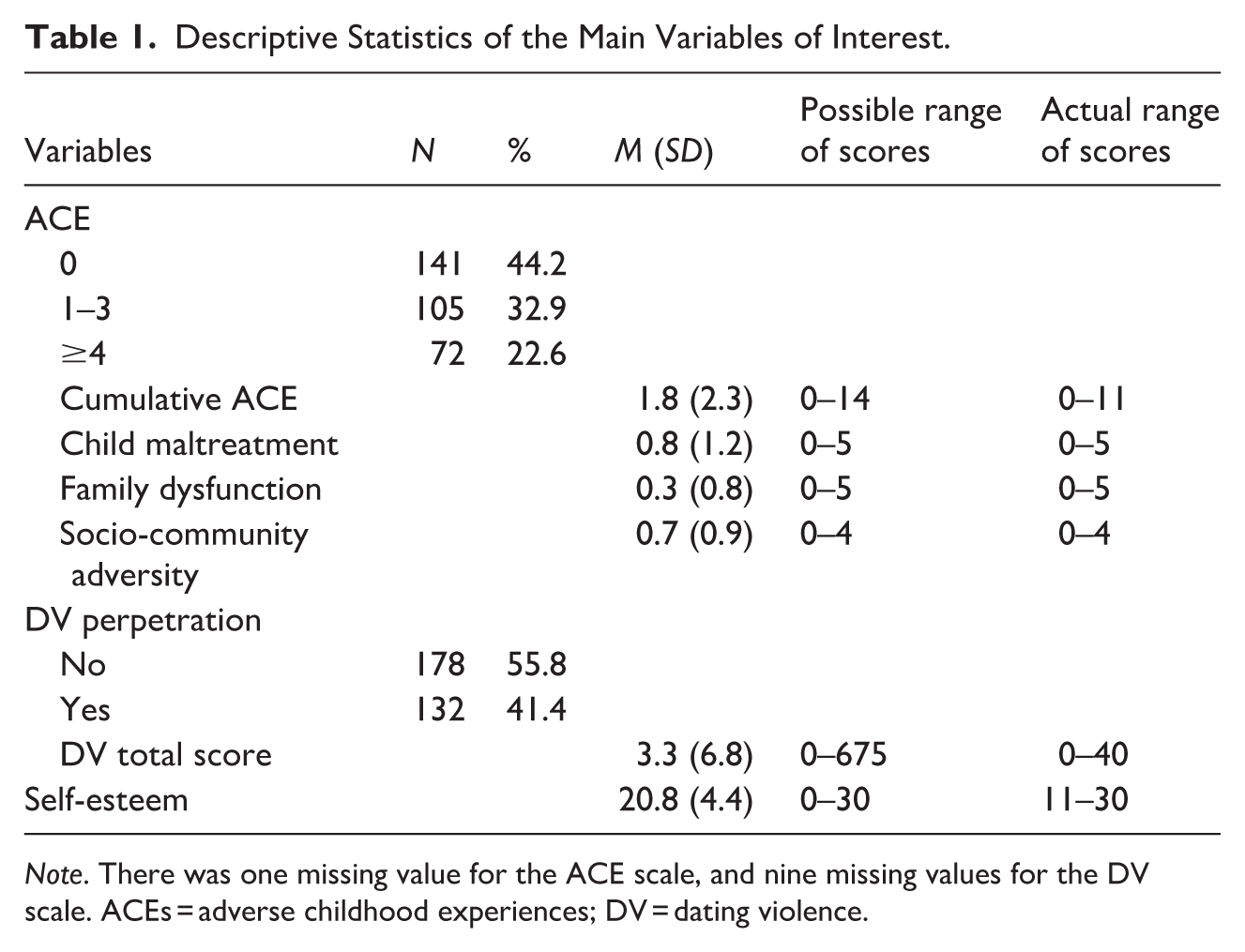
Note. There was one missing value for the ACE scale, and nine missing values for the DV scale. ACEs = adverse childhood experiences; DV = dating violence.
Correlation Analysis and Multicollinearity Test
Correlation analysis was performed to examine the associations between the main variables. As shown in Table 2, cumulative ACE was negatively correlated with self-esteem and positively correlated with DV perpetration. DV was negatively correlated with self-esteem. Regarding subdimensions of ACEs, child maltreatment and socio-community adversity were both negatively correlated with self-esteem and positively correlated with DV perpetration. Family dysfunction was not significantly associated with self-esteem but was positively correlated with DV perpetration. By comparing the correlation coefficients, among the three subdimensions of ACEs, child maltreatment was found to be most strongly correlated with self-esteem and DV. The computed values for the variance inflation factor lied between 1.00 and 5.00, suggesting that the explanatory variables were moderately correlated with no multicollinearity (Belsley, 1991).
Correlation Matrix of ACE, DV Perpetration, and Self-Esteem.
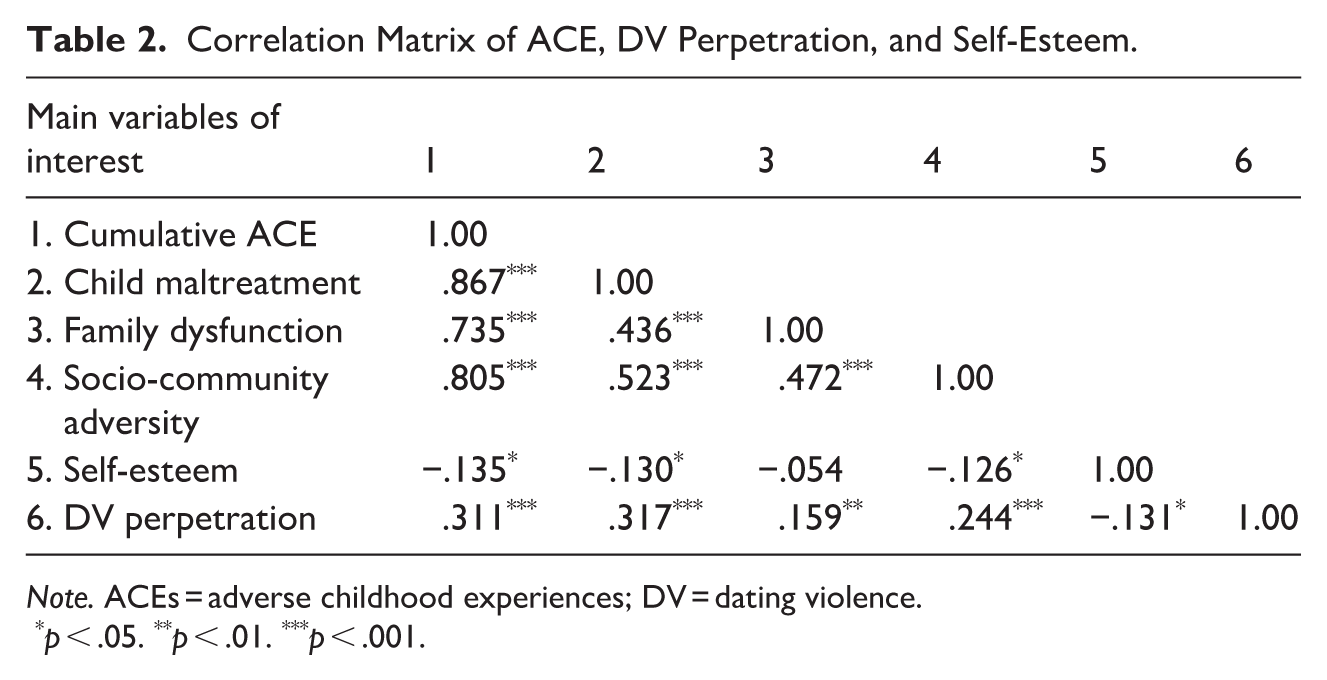
Note. ACEs = adverse childhood experiences; DV = dating violence.
p < .05. **p < .01. ***p < .001.
The ACE-DV Perpetration Relationship and the Mediating Role of Self-Esteem
As shown in Tables 3 and 4, the mediation models yielded three main findings. First, on the total effects, experiencing adverse childhood events and circumstances early in life – in its cumulative (β = .306, 95% bootstrap CI [0.170, 0.427]) and subdimension operationalizations (Child maltreatment: β = .302, 95% bootstrap CI [0.180, 0.411]; Socio-community adversity: β = .244, 95% bootstrap CI [0.122, 0.362]; Family dysfunction: β = .157, 95% bootstrap CI [0.024, 0.306]) – had significant positive associations with DV perpetration later in life. This suggested that experiencing more ACEs, regardless of whether we differentiate them by subdimension or conflate them, associated with more DV perpetration in the past 12 months. Second, the results partially supported the mediating role of self-esteem in the ACE-DV perpetration relationship. On cumulative ACE, participants who had higher cumulative ACE scores had lower self-esteem (β = −.167, 95% bootstrap CI [−0.287, −0.041]), and participants who had lower self-esteem reported more DV perpetration (β = −.129, 95% bootstrap CI [−0.221, −0.025]). The indirect effect of cumulative ACE on DV perpetration via self-esteem was statistically significant (β = .022, 95% bootstrap CI [0.004, 0.046]). Besides, the direct effect of cumulative ACE on DV perpetration, regardless of its indirect impact via self-esteem, was also significant (β = .284, 95% bootstrap CI [0.156, 0.382]). These results suggested that cumulative ACE may contribute to developing low self-esteem, which may increase the risk of engaging in DV perpetration.
The Mediating Effect of Self-Esteem Between Cumulative ACE and DV Perpetration.
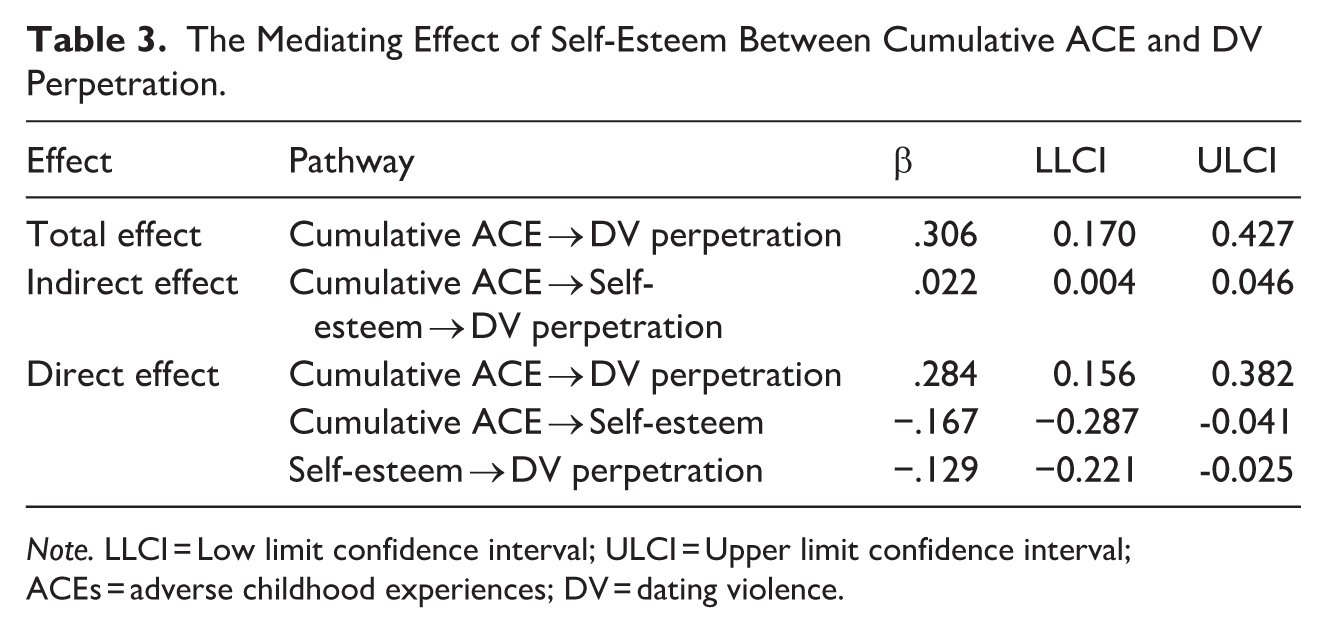
Note. LLCI = Low limit confidence interval; ULCI = Upper limit confidence interval; ACEs = adverse childhood experiences; DV = dating violence.
Mediating Effect of Self-Esteem Between Child Maltreatment, Socio-Community Adversity, and Family Dysfunction and DV Perpetration.
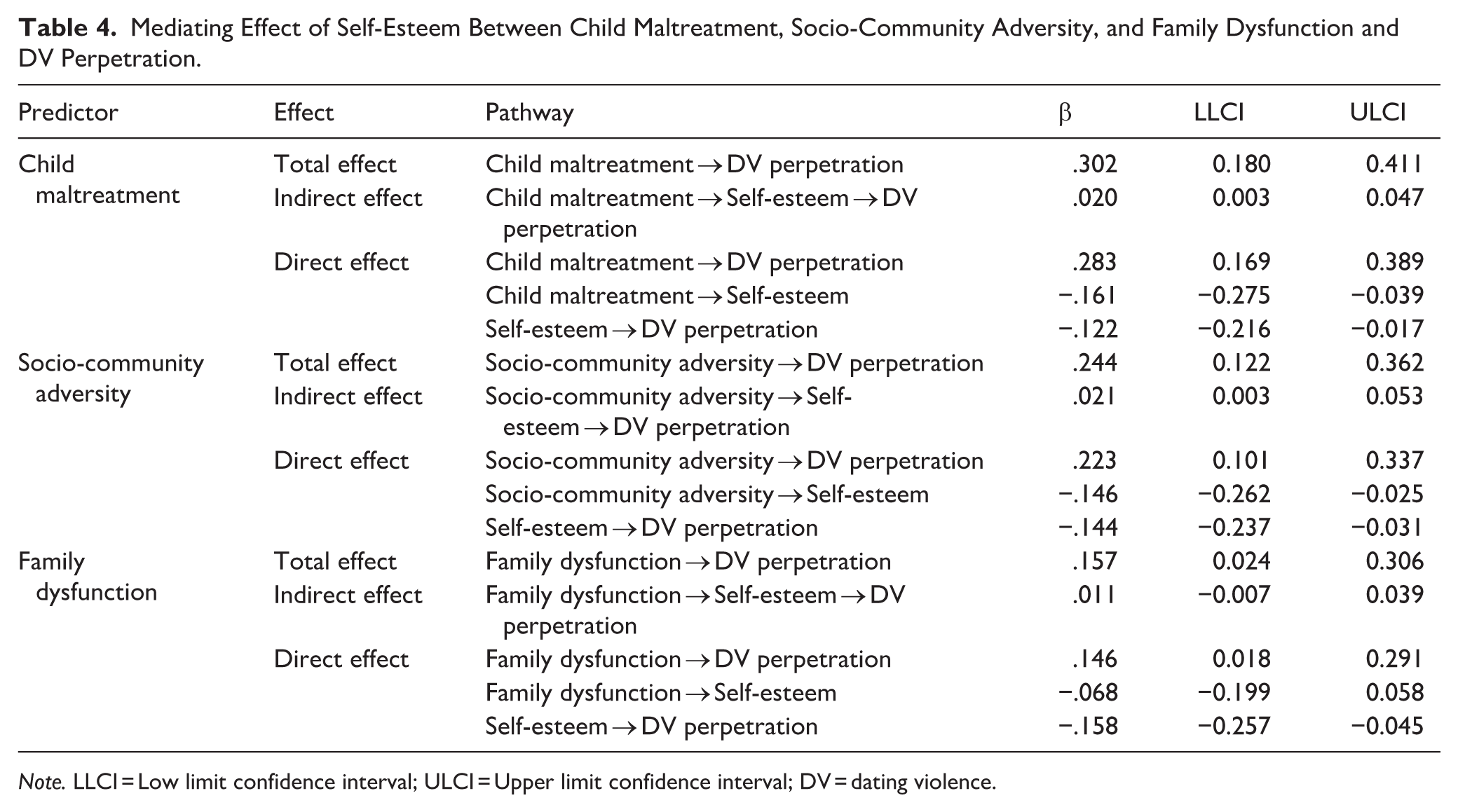
Note. LLCI = Low limit confidence interval; ULCI = Upper limit confidence interval; DV = dating violence.
On modeling the three subdimensions of ACEs as explanatory variables in the ACE-DV relationship, however, there were mixed findings on the mediating role of self-esteem. The indirect and direct effects of child maltreatment on DV perpetration were both statistically significant (β = .020, 95% bootstrap CI [0.003, 0.047] for indirect effect; β = .283, 95% bootstrap CI [0.169, 0.389] for direct effect). Similarly, the indirect and direct effects of socio-community adversity on DV perpetration were both statistically significant (β = .021, 95% bootstrap CI [0.003, 0.053] for indirect effect; β = .223, 95% bootstrap CI [0.101, 0.337] for direct effect). However, self-esteem did not mediate the relationship between family dysfunction and DV perpetration, as the association between family dysfunction and self-esteem was not statistically significant (β = −.068, 95% bootstrap CI [−0.199, 0.058]). Thus, although participants who reported more early experiences of family dysfunction at home were at greater risk for DV perpetration later in life, this development may not be due to changes in self-esteem.
Third, when the three subdimensions of ACEs were modeled together as independent variables in one mediation model, we found that the indirect effect of any subdimension of ACE on DV perpetration through self-esteem was statistically insignificant at the 95% confidence level. Only the direct effect of child maltreatment on DV perpetration (β = .223, 95% bootstrap CI [0.093, 0.357]) and the direct effect of self-esteem on DV perpetration was statistically significant (β = −.123, 95% bootstrap CI [−0.219, −0.017]; see Table 5). When we lowered the confidence level to 90%, the indirect effect of child maltreatment on DV perpetration via self-esteem was statistically significant (β = .016, 90% bootstrap CI [0.001, 0.039]), whereas the indirect effects of the other two subdimensions of ACEs on DV perpetration were still insignificant.
Mediation Model with Three Subdimensions of ACEs, Self-Esteem, and DV Perpetration.
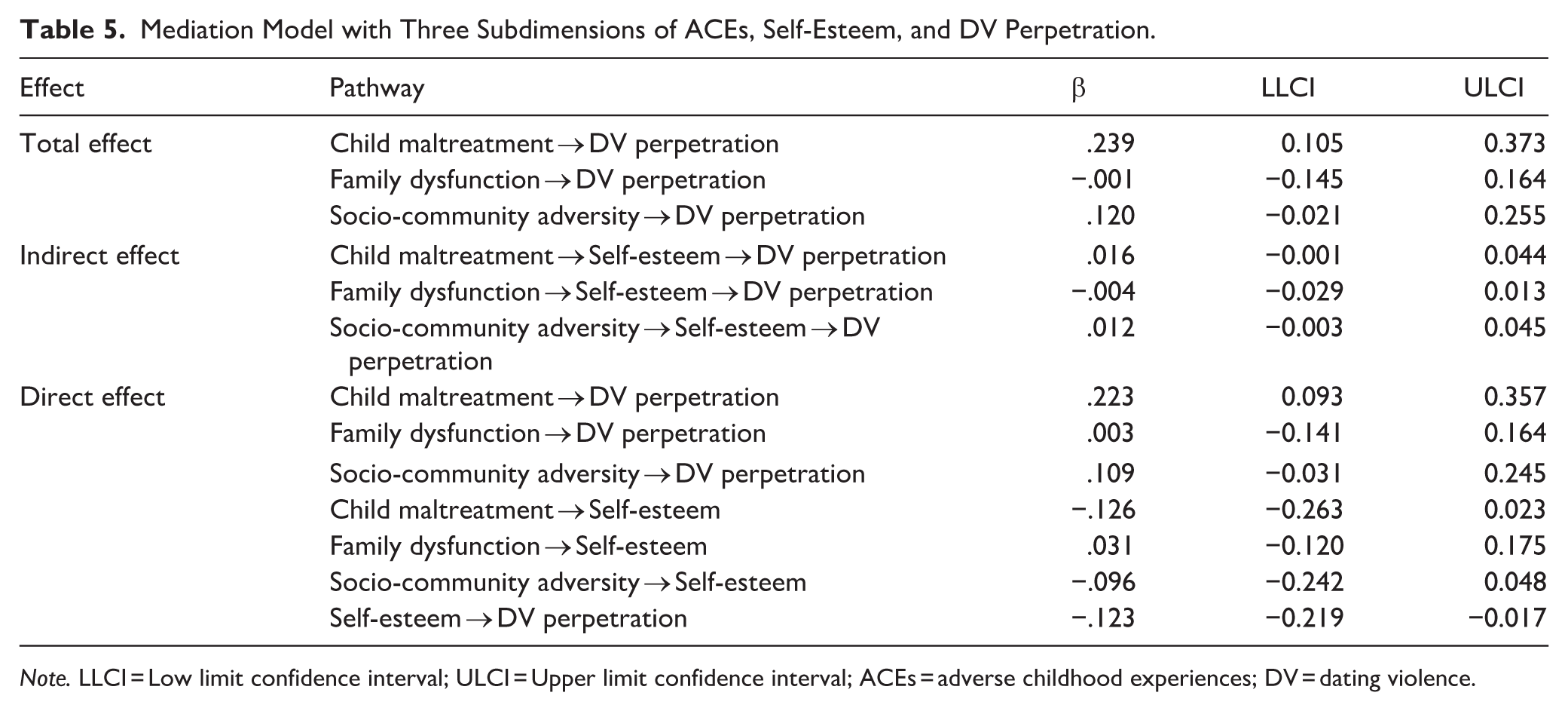
Note. LLCI = Low limit confidence interval; ULCI = Upper limit confidence interval; ACEs = adverse childhood experiences; DV = dating violence.
Discussion
The current study attempted to examine the relationship between ACE – as an aggregate/cumulative score and as delineated into three subdimensions (i.e., child maltreatment, family dysfunction, and socio-community adversity) – and DV perpetration, and the mediating role of self-esteem in this relationship among Chinese university students. Our findings clearly showed that, first, ACE has a positive association with DV perpetration. This observation was consistent regardless of whether we operationalized ACE as an aggregate score or delineated it in subdimensions of child maltreatment, family dysfunction, and socio-community adversity. These findings provide evidence against rejecting Hypothesis 1. In general, our findings echo those yielded by previous studies on the impact of ACE on DV perpetration among young adults and teens (Davis et al., 2019; Forster et al., 2022; Luft et al., 2022). Also, it supports the tenets of the social development model (Catalano & Hawkins, 1996), which argues that antisocial behaviors in adulthood could be attributed to repeated interactions or exposure earlier in life to antisocial behaviors and/or norms, mainly from family members (e.g., inconsistent monitoring or corporal punishment) and peers, as well as broader adversities, such as low SES.
Second, our findings demonstrate that self-esteem has a non-trivial role as a mediator in the ACE-DV relationship. Specifically, apart from family dysfunction, all other operationalizations of ACE – cumulative ACE, as well as child maltreatment and socio-community adversity – were positively related to DV perpetration through decreasing self-esteem. This general observation from the findings, however, only held when we independently modeled ACE and its subdimensions. When we accounted for all three subdimensions in a mediation model, there were no indirect effects found in the model. Thus, our findings partially support Hypothesis 2. The significant indirect effect of cumulative ACE on DV perpetration via self-esteem is consistent with one similar study on the mediating effect of self-esteem in the ACE-IPV relationship. In their study, Kenyan males’ level of self-esteem mediated the association between ACEs and IPV perpetration (Goodman et al., 2021). In the mediation models that examined subdimensions separately, we found that self-esteem was significantly associated with child maltreatment dimension and socio-community adversity dimension, but was not significantly associated with family dysfunction dimension. This finding echoes previous studies which found that compared to child maltreatment, family dysfunction had a less predictive effect on mental health outcomes (e.g., depressive symptoms or trauma symptoms; Negriff, 2020; Ryan et al., 2000). One possible interpretation for why self-esteem is differentially associated with the three ACE subdimensions is that self-esteem is more likely to be affected by adversities that are directly experienced, such as physical child abuse in the child maltreatment dimension and/or peer isolation in the socio-community adversity dimension, rather than adversities that are observed, like witnessing IPV between parents in the family dysfunction dimension. Adverse experiences of the latter classification (i.e., indirectly experienced) may impact antisocial behaviors later in life through other mediators. Further research is needed to clarify if indeed adversities that are directly experienced are qualitatively different from those that are experienced indirectly, and the mediating role of self-esteem in both cases. Regarding the non-significance of self-esteem as a mediator in the full mediation model (i.e., when all three subdimensions were included in one model), we suspect that the three ACE subdimensions are working through other mediators to impact DV perpetration. This does not mean that self-esteem is not important in the ACE-DV perpetration relationship. The overall importance of self-esteem in individual development is confirmed in our analysis. The significant associations between cumulative ACE and self-esteem supports Fennell’s (1997) cognitive model that an individual’s low self-esteem can be significantly shaped by negative experiences. Also, the significant associations between self-esteem and DV perpetration across all mediation models echoes clinical findings that have shown that people with lower self-esteem may be more likely to disparage their partners (Murray et al., 1998; Murray et al., 2002; Murray et al., 2006), as well as survey studies that have demonstrated that low self-esteem is a significant risk factor for DV perpetration (Lapierre et al., 2019; Pflieger & Vazsonyi, 2006). Rather, we speculate that there are other mechanisms/mediators unaccounted for in the relationship between ACEs and DV.
Third, child maltreatment, family dysfunction, and socio-community adversity have distinguishable effects on DV perpetration. When examined together in one mediation model, child maltreatment demonstrated the strongest effect on the outcome variable, regardless whether we observe the direct effect or indirect effect via self-esteem. Thus, the results provide evidence that fails to reject Hypothesis 3. Different dimensions of ACEs indeed have distinct impacts on DV perpetration, and child maltreatment seemed to be the most impactful. This finding implies that the cumulative approach of operationalizing ACE (i.e., counting and aggregating how many subdimensions of adversity the participants had ever experienced into a single score) may obscure the differential impacts of distinct subdimensions of ACEs on DV perpetration.
Practical Implications
Given that being exposed to adversities in childhood, especially child maltreatment, is associated with long-term negative effects on an individual’s development and may even lead to displays of delinquency or violence in adulthood, it is vital to identify children who are experiencing various adversities and intervene promptly and appropriately. In China, the residents’ committee plays a significant role in grassroots governance and social welfare. Residents’ committees possess basic information of resident families, conduct regular visits to households in need (e.g., those experiencing poverty or with left-behind children), mediate conflict within and between resident families, and provide preliminary counseling services for residents in need. To leverage the advantages of residents’ committees in identifying children at high risk, we may popularize the concept of ACEs among committee members through awareness education and training. Taking these steps would empower residents’ committee members to assume an active role in early identification and initial intervention for children experiencing adversities. However, relying solely on community-based organizations, such as residents’ committees, are far from enough. It is also important to strengthen the sense of responsibility and executive capacity of mandatory reporters, such as police officers, teachers, and doctors, in identifying and reporting child maltreatment cases. In China, even though the mandatory reporting of child maltreatment has been implemented in the newly revised Law on the Protection of Minors, and officially became national law in 2020, a survey across four provinces in China after the implementation of mandatory reporting of child maltreatment showed that 45% of the social workers had never heard of the mandatory reporting system (Zhang, 2020). Therefore, it is urgent that mandatory reporters need to be well trained on how to perform effectively. Sharing similar Confucian family norms, China could learn from the experiences of South Korea and Japan on establishing mandatory reporting systems.
Second, the current study found that DV perpetration was quite prevalent among Chinese university students. In our sample, a sizable portion of Chinese young adults (i.e., 41.4 % of the participants) engaged in DV perpetration against their partners at least once during the last year. Even though this prevalence rate is not as large as those yielded by previous studies among Chinese university students (e.g., 68.8% in Li et al., 2020), it still echoes the concern that DV is a noticeable issue in China. It may be helpful to offer a general curriculum about healthy intimate relationships in universities to address this issue. One survey of 1,028 Chinese university students showed that 88.2% of the students were keen to learn about how to handle campus romances, and more than half of the students (55.54%) believed that it would be helpful to form a positive attitude toward intimate relationships if their university could offer a course about how to have and keep a romantic relationship (X. Lin, 2020). Meanwhile, many bystander intervention programs in the United States, such as ‘Green Dot’ (Coker et al., 2019) and ‘Men’s Program’ (Langhinrichsen-Rohling et al., 2011), have demonstrated promising results in reducing adolescents’ and young adults’ DV acceptance and increasing their intention to intervene in suspected incidences of DV. University campuses in China may consider to develop similar bystander programs to prevent DV perpetration and offer timely help to the victims of DV.
Finally, self-esteem was found to be a significant mediator in the pathway from cumulative ACE to DV perpetration in early adulthood. This finding highlights the importance of designing interventions to improve the self-esteem and self-evaluation of children who have experienced multiple adversities, especially child maltreatment, to prevent them from potentially exacting violence later in life against their dating partner. Mindfulness-based therapy could be beneficial for children with a history of ACEs, as it has been shown to mitigate the psychological, behavioral, and physiological changes associated with ACEs (e.g., depressive symptoms, posttraumatic stress disorder symptoms, anxiety; Ortiz & Sibinga, 2017). Given that low self-esteem is another psychological consequence of ACEs identified in the current study, therapists may consider incorporating specific sessions focused on building and enhancing the self-esteem of children with high ACE scores in mindfulness-based therapy.
Limitations and Recommendations for Future Research
The results of this study have limited generalizability due to the convenience sampling strategy adopted. Future studies are recommended to employ representative sampling methods. Some scholars have indicated that using cross-sectional data to examine longitudinal mediation models would generate biased estimates of parameters (Maxwell & Cole, 2007). Thus, future studies are suggested to employ longitudinal data to gain more accurate estimates. Insofar as our findings are concerned, we encourage readers to take our claims and conclusions as premised on correlational – rather than causal – grounds. Also, the current study is retrospective; therefore, the results are susceptible to memory recall bias, as people may have difficulties in recalling ACEs before 18 years old and DV perpetration in the last year. Future studies may consider adopting a prospective cohort study with longitudinal data collected since childhood. Another limitation to note is that we did not differentiate between passive DV perpetration (i.e., violence perpetrated out of self-defense after receiving violence from the partner first) and active DV perpetration, which the current study was interested in. Thus, the scores of DV perpetration used in the analysis might conflate these two types of DV perpetration. This limitation may exaggerate the predictive effect of ACEs on DV perpetration or underestimate the negative effect of low self-esteem on DV perpetration. Therefore, recruiting couples instead of individuals and measuring both perpetration and victimization are recommended for yielding more rigorous results. Also, while we accounted for the cumulative and single subdimension approaches in modeling the ACE-DV relationship, we did not consider clustering adversities or distinct adversity patterns that may exist among young adults (S. S. Chen et al., 2022). Future studies may adopt latent class or profile analytical techniques to perform person-oriented analyses of the ACE-DV relationship. Finally, our study drew a sample of university students in heterosexual dating partnerships. Future studies are needed to explore the ACE-DV relationship in dating partnerships with different sexual orientations (e.g., bisexual, homosexual, or mixed orientation relationships).
Footnotes
Acknowledgements
This article is revised from the first author’s master’s thesis. Prof. Kihyun KIM’s supervision during the development of the original thesis is sincerely appreciated.

Funding
The authors received no financial support for the research and/or authorship of this article.
Declaration of Conflicting Interests
The authors declared no potential conflicts of interests with respect to the authorship and/or publication of this article.