







Abstract
Studies show that racialized sexual harassment, a form of gendered racism, contributes to increased psychological distress among Black women. To cope, some Black women may adhere to the Superwoman Schema (i.e., an obligation to display strength, resistance to vulnerability, intense motivation to succeed despite limited resources, and an obligation to help others), which may be associated with decreased willingness to seek help. In this study, we investigated the association between racialized sexual harassment, Superwoman Schema, and its dimensions, and help-seeking intention. Participants included 155 Black female college students who completed an online survey. We found a negative association between racialized sexual harassment and help-seeking intention. We also found that racialized sexual harassment was positively associated with Superwoman Schema, which in turn correlated with help-seeking intention, suggesting that Superwoman Schema may help explain the association between racialized sexual harassment and help-seeking intention. Further analyses with Superwoman Schema dimensions revealed that both an obligation to suppress emotions and resistance to vulnerability explained the nature of these associations. Findings indicate the complex nature of the Superwoman Schema as a response to gendered racialized oppression.
Keywords
Introduction
Black women are disproportionately at risk of sexual violence. By the age of 18, 40% to 60% of Black women have experienced coercive sexual contact (RAINN, 2017). Black girls have consistently reported higher instances of sexual harassment than any other demographic within and beyond educational settings (National Black Women’s Justice Institute, 2022). Indeed, scholars have suggested that oppression at the intersection of racism and sexism (i.e., gendered racism) explains these differences (Essed, 1991; Thomas et al., 2008). One form of gendered racism is racialized sexual harassment, which is both distinct from racial harassment and sexual harassment, and frequently reported in Black women’s experiences (Buchanan, 2005; Buchanan & Fitzgerald, 2008; Buchanan & Ormerod, 2002). In previous research, racialized sexual harassment has been positively associated with post-traumatic stress (Woods et al., 2009). Racialized sexual harassment may also result in decreased reporting and psychological help-seeking behaviors. For example, school-age Black girls experiencing racialized sexual harassment refrained from reporting due to inadequate or ignored responses (Wilmot et al., 2021). Further, in an investigation of gendered racial microaggressions, researchers have found that Black women engaged in disengagement coping responses, which were deleterious for mental health and help-seeking behavior (Lewis et al., 2017). However, it is less clear how culturally specific coping responses might explain the relationship between racialized sexual harassment and help-seeking intention.
The Superwoman Schema (SWS), conceptualized as an obligation to display strength, resist vulnerability, suppress emotions, succeed despite limited resources, and help others, describes the cognitive, behavioral, and affective characteristics of the Strong Black Woman (SBW) or Superwoman role (Woods-Giscombé, 2010, 2018; Woods-Giscombé et al., 2019). The SBW/Superwoman role emerged from the historical mistreatment Black women endured in Western society and often serves as a mechanism to help navigate oppression and marginalization at the intersection of racism, sexism, and classism. As a stress-coping response, researchers have examined Superwoman Schema as both a mediator and moderator in investigations of gendered racism and negative health outcomes (Moody et al., 2023; Volpe et al., 2024). While previous studies have linked increased gendered racism to adherence to SWS, they have not examined specific characteristics of SWS. This gap in understanding suggests that certain aspects of SWS might explain the relationship between racialized sexual harassment and help-seeking intention. Therefore, we aim to investigate this relationship among Black college women, with a focus on SWS as a potential explanatory factor.
Stereotypical Images of Black Women and Intersectionality
According to Black feminist theorists, race, class, and gender are inseparable and function as interlocking constructs and systems of oppression (Collins, 2000; Crenshaw, 1989). Black feminist and critical race theories conceptualized intersectionality as a theoretical framework to highlight how Black women make meaning of and navigate the unique ways that their intersecting identities experience oppression (Crenshaw, 1991). Intersectionality has historical underpinnings dating back to the 19th and 20th centuries that were best captured by African American foremothers such as Sojourner Truth, Harriet Tubman, Maria Stewart, Anna J. Cooper, and Ida B. Wells, who fought for Black liberation and women’s rights (Collins, 2000, 2019, 2023; Hancock, 2016; Harris-Perry, 2011; Hooks, 1989). Tenets of intersectionality continued to drive the work of Black feminist scholars and activists such as Patricia Hill Collins, bell hooks, Audre Lorde, and the Combahee River Collective as they advocated for social justice among Black women impacted by sexism, racism, classism, and homophobia. One of the most prominent scholars of intersectionality theory, Kimberlé Crenshaw (1989), explains that discrimination is like a traffic accident at an intersection: An accident is caused by multiple cars coming from multiple, if not all, possible directions. Similarly, a woman can experience either sex discrimination, race discrimination, or both if she is at the intersection (Crenshaw, 1989). As such, intersectionality underscores Murrell’s (1996) assertion that “sexual harassment should be defined as a form of both gender discrimination and race discrimination because they are historically and experientially tied to one another” (p. 57).
Black women’s gendered racial identity is a developmental process that encompasses awareness of the relationship between gender and race and feelings about their gendered racial identity (Williams & Lewis, 2021). Gendered racial identities are also influenced by gendered racial encounters that Black women must navigate (Williams & Lewis, 2021). One important component of this process are stereotypical images of Black women which include the Mammy (i.e., self-sacrificing, obedient mother figure), the Sapphire (i.e., angry, domineering), and the Jezebel (i.e., hypersexual, promiscuous seductress; Harris, 2021; West, 1995). The Jezebel stereotype, which has been used to systematically exploit and harm Black female bodies, is particularly relevant in understanding the history of racialized sexual violence among Black women (Jewell, 2002; Leath et al., 2021). This image originated during slavery and served to justify the slave owners’ brutality and sexual assault of enslaved Black women (Jewell, 2002). In the present, the Jezebel stereotype not only fuels violence against Black women (Cheeseborough et al., 2020) but also dehumanizes them through both sexual objectification and racialized stereotyping (Cheeseborough et al., 2020).
Racialized Sexual Harassment
Despite the rationale for investigating racialized sexual harassment among racial and ethnic minoritized women (Gómez, 2022; Murrell, 1996), in the extant literature, much of the scholarship has focused on sexual harassment or racial harassment. Notwithstanding, the sexual harassment of Black female college students is prevalent on college campuses in the United States. For example, in a nationally representative study, approximately 46% and 31% of Black women reported sexual harassment and sexual assault, respectively (Raj et al., 2021). Nearly 20% of Black students at a historically Black college/university reported experiencing nonconsensual sexual contact (Collington et al., 2019). Approximately 66% of a sample of Black female undergraduate students at a predominantly White institution reported sexual harassment, and half experienced either violence and/or racial discrimination with sexual harassment (Gómez, 2022). Together, sexual harassment and racial discrimination have been associated with increased anxiety and sleep problems (Gómez, 2022).
Black girls as young as seventh grade report experiencing verbal and physical sexual harassment, as well as a lack of support from teachers because they are Black girls (Harris & Kruger, 2020). Online harassment toward Black women overwhelmingly features themes of attractiveness, promiscuity (i.e., hypersexuality), and racism/stereotypes, with the term “black” being the most used word within each theme (Francisco & Felmlee, 2022). Participants described verbal sexual harassment as stemming from the hyper-sexualization and objectification of Black women, along with the misogyny prevalent in hip-hop music (Harris & Kruger, 2020). Tweets that were aggressive toward Black women also relied on stereotypes to attack their sexuality, race, and physical appearance (Francisco & Felmlee, 2022). Middle school-aged girls reported a lack of teacher support when reporting sexual harassment—such as teachers laughing, agreeing that the actions are inappropriate without taking action, or telling them to empathize with the boys (Harris & Kruger, 2020; Wilmot et al., 2021)—which can harm their mental health (Lewis et al., 2017). Since fears of not being believed may discourage Black women from seeking support (Collington et al., 2019), it is crucial to examine the relationship between racialized sexual harassment and the help-seeking process.
Mental Health Help-Seeking Intention
Mental health help-seeking is a complex process. An individual’s conceptualization of mental health, treatment options, and past experiences with mental health care all influence their decision to seek treatment (Cardemil et al., 2015). Cultural beliefs and traditions also shape how people experience and address emotional distress. Moreover, to improve access to mental healthcare, especially for Black Americans who underutilize services (Cummings & Druss, 2011), we need a deeper understanding of the help-seeking process (Nauphal et al., 2023). Stigma, discrimination, and negative experiences with mental health care and mental health providers explain these disparities (Taylor & Kuo, 2019; Thompson et al., 2004). For example, Black college students were less likely to seek support following intimate partner violence to avoid judgment from family and friends and embarrassment about experiencing and/or sharing the situation (An et al., 2024). Further, the perception of psychological help-seeking with weakness is common. For example, African American women who experienced high levels of perceived negative family norms (i.e., “according to my family, anyone who needs psychological counseling is weak”) were less likely to intentionally seek mental health services (Barksdale & Molock, 2008). Further, concerns about potential harm from treatment discourage help-seeking intention (Watson-Singleton et al., 2017).
In an integrated review of psychological help-seeking intention among Black Americans, Taylor and Kuo (2019) found low intentionality to seek help from mental health providers (Conner et al., 2010). Black college students who experienced intimate partner violence were more likely to seek informal help from family and friends than formal help from health professionals (An et al., 2024). This is concerning as help-seeking intention among emerging adults in general—many of whom are college students—and college Black women specifically, have promise for prevention. In a recent call to action, researchers have proposed that targeting help-seeking behaviors might be a way to enhance the effectiveness and long-term impact of prevention programs (Nauphal et al., 2023). Additionally, scholars have argued that investigating culturally specific “help-seeking factors'' for Black Americans is critical (Taylor & Kuo, 2019). Moreover, there is reason to believe that Black women may rely on the Superwoman Schema to cope with racialized sexual harassment, which may impact help-seeking intention.
Superwoman Schema and Potential Indirect Effects
The Superwoman Schema (SWS) is a conceptual framework that describes the cognitive, behavioral, and affective components of the SBW/Superwoman role (Woods-Giscombé, 2010; Woods-Giscombé et al., 2019). Defined by strength, invulnerability, emotion suppression, motivation to succeed, and caring for others, SWS emerged from a qualitative study with African American women (Woods-Giscombé, 2010). Perceived assets (e.g., self-preservation) and liabilities (e.g., embodiment of stress) of SWS underscore its complexity (Woods-Giscombé, 2010). For many Black women, maintaining strength and masking emotions in the face of adversity represents a means of survival and protection against decades of being mistreated, disregarded, and humiliated as a result of racism, sexism, and classism. Notably, some dimensions of SWS have been associated with anxiety, depression, and perceived stress (Leath et al., 2022; Nelson, Cardemil, et al., 2024; Platt & Fanning, 2023; Woods-Giscombé et al., 2019). Other aspects have been associated with resilience and flourishing, as well as decreased psychological distress and allostatic load (Abrams et al., 2014; Allen et al., 2019; Leath et al., 2022; Nelson, Cardemil, et al., 2024; Nelson et al., 2022; Perez et al., 2023; Watson-Singleton et al., 2024).
The “both/and” nature of SWS is nuanced among Black women (Woods-Giscombé, 2010). Black women’s adherence to SWS has been posited as a response to unique stressors that often stem from gendered racism (Woods-Giscombé, 2010). That is, as a stress-coping strategy, some Black women may endorse SWS to navigate interpersonal and systemic level racism and sexism (Volpe et al., 2024; Woods-Giscombé et al., 2018, 2019). Moreover, there is reason to believe that racialized sexual harassment might be associated with increased adherence to dimensions of SWS, which in turn may be associated with decreased mental health help-seeking intention. Consequently, more research is needed to understand these possible relationships.
The Current Study
Given the limited research investigating SWS and its characteristics as a possible explanatory factor in the association between racialized sexual harassment and help-seeking intention, we investigated the indirect effects of racialized sexual harassment and help-seeking intention through Superwoman Schema among Black college women. We predicted that racialized sexual harassment would be negatively associated with help-seeking intention and positively associated with the SWS as a unidimensional construct and its characteristics (i.e., an obligation to present an image of strength, emotional suppression, resistance to being vulnerable, intense motivation to succeed, despite limited resources, and an obligation to help others, despite limited resources). Finally, we predicted that all SWS characteristics would mediate the relationship between racialized sexual harassment and help-seeking intention.
Method
Participants
The current study included 155 Black college women with a mean age of 22 (SD = 5.83). Most participants were first- and second-year students (44%). Nearly 72% of the sample identified as heterosexual and 28% identified as lesbian, gay, bisexual, or other. Finally, 55% of participants reported first-generation college student status; 17% were born outside of the United States. Nearly 43% of participants reported receiving past mental health treatment. The current study is part of a larger study on Black women’s mental health help-seeking (Nelson, Gebretensay, et al., 2024).
Measures
Racialized Sexual Harassment
Racialized Sexual Harassment was measured using the Racialized Sexual Harassment Scale (RSHS; Buchanan, 2005, 2016). The racialized sexual harassment subscale consists of seven items that measure participants’ experience of harassing behaviors based on their gender and ethnicity in the past twelve months. For example, a sample item included, “During the time that you have attended your school, were you ever in a situation in which any of your teachers, classmates, advisors, students, or staff made comments about your body that emphasized your gender and ethnicity” (RSHS; Buchanan, 2005, 2016). Participants responded to items on a five-point Likert scale ranging from 0 = never to 4 = many times. Racialized sexual harassment scores were calculated by adding all seven items. Higher scores indicate more experiences of racialized sexual harassment. The psychometric properties of the RSH are good with a reliability coefficient of .86 among a sample of college students (Buchanan, 2016). The RSH has been previously used with Black populations (Woods et al., 2009). The Cronbach alpha for this sample was .94.
Superwoman Schema
Superwoman Schema (SWS) was assessed using the Giscombé Superwoman Schema Questionnaire (G-SWS-Q; Woods-Giscombé et al., 2019). Based on Woods-Giscombé’s (2010) qualitative research with Black women, the G-SWS-Q consists of 35 items that measure five characteristics of the SWS, including an obligation to present an image of strength, an obligation to suppress emotions, resistance to being vulnerable, an intense motivation to succeed, despite limited resources, and an obligation to help others. Participants responded to items on a 4-point scale ranging from 0 = not true for me to 3 = true for me all the time. A sample item included, “I feel obligated to present an image of strength for my family” (Woods-Giscombé et al., 2019). The G-SWS-Q is scored by summing across the 35 items to create a unidimensional construct. Subscale scores are calculated by summing the items within each subscale representing its characteristics. Higher scores on the full scale and subscales indicate greater identification with the Superwoman Schema and its characteristics. The G-SWS-Q has demonstrated strong psychometric properties, including a clear factor structure, high internal consistency, and construct validity (Woods-Giscombé et al., 2019). The Cronbach alpha for this study was .93.
Help-Seeking Intention
Help-seeking intention was assessed using the Mental Help-Seeking Intention Scale (MHSIS; Hammer & Spiker, 2018). The MHSIS contains three items that provide a unidimensional assessment of an individual’s help-seeking intention from a mental health professional if experiencing a mental health concern. Participants responded to items on a seven-point Likert scale ranging from 1 to 7. A sample item included, “If I had a mental health concern, I would intend to seek help from a mental health professional.” Mean scores were calculated by adding scores for all three items and dividing by three. Higher scores indicate an increased intention to seek help. The MHSIS has excellent psychometric properties (Hammer & Spiker, 2018) and has been used in previous studies with Black women (Nelson, Gebretensay, et al., 2024). The Cronbach alpha for this sample was .92.
Demographics
Participants were asked questions about their age, sexual orientation, generation status, nationality, class year, and experience with mental health treatment.
Procedure
The authors’ institutional review board approved this research. College Black women were recruited through email announcements sent to the listserv coordinator or contact person at the college’s multicultural or African American/Black student centers, as well as African American student/faculty groups and African American Studies programs. The email requested recipients to share the recruitment message with their listservs. Only students enrolled at the university were invited to participate in the online survey hosted on Qualtrics, after providing their institutional email. This email included a link to the study site. After reviewing the informed consent, participants indicated their consent by clicking a button that directed them to the survey page, which included various measures and a demographic questionnaire. To incentivize participation, participants received a $10 Amazon electronic gift card upon completing the study. We maintained participant anonymity by using a separate incentive database to avoid linking responses to personal data.
Data Analysis
We examined normality, skewness, and kurtosis for all predictors and outcomes in this study. All variables were deemed fit for analysis. Bivariate Pearson correlations were examined to investigate the relationship between age, measured as a continuous variable, racialized sexual harassment, Superwoman Schema, and its characteristics, and help-seeking intention. Independent-sample t-tests were examined to determine if there were statistically significant differences in help-seeking intention by sociodemographic variables. Statistically significant differences in help-seeking intention by sociodemographic variables were controlled for in subsequent analyses. The Missing Value Analysis module in SPSS 29.0 was used to determine if data were Missing Completely at Random (MCAR). Little’s (1988) MCAR chi-square test was used to determine if the data were MCAR. A nonsignificant p value indicates that the data are MCAR and missing values are ignorable. We tested the indirect effect of Superwoman Schema, both as a unidimensional construct and through its dimensions, on the association between racialized sexual harassment and help-seeking intention. For all analyses, we used 5,000 bootstrap estimates to estimate bias-corrected confidence intervals. All descriptive statistical analyses were conducted in SPSS Version 29.0; all indirect effects analyses were performed using PROCESS Macro Version 4.2 (Hayes, 2018) in SPSS Version 29.0 (IBM Corp., 2022).
Results
Preliminary Analyses
We examined all variables of interest for skewness, kurtosis, outliers, missing values, and multicollinearity. All predictors and outcomes were in the acceptable range for skewness and kurtosis. We identified a few outliers (range of 1–5) for some characteristics of the Superwoman Schema (i.e., obligation to present an image of strength; an obligation to suppress emotions; resistance to vulnerability; an intense motivation to succeed, despite limited resources; and an obligation to help others). As bootstrapping in PROCESS Models (2017) was used, all data were retained. Less than 10% of data was missing for demographic variables; only 5% of data were missing for racialized sexual harassment. We examined patterns of missing data for our predictors and outcomes by sociodemographic variables and did not detect significant differences. Little’s (1988) MCAR chi-square test, χ2(18) = 27.30, p = .074, was not statistically significant. Finally, the inspection of variance inflation factors indicated no presence of multicollinearity (Kim, 2019).
Bivariate Pearson correlations (see Table 1) revealed a significant positive association between age and help-seeking intention (r = .21, p = .01). Racialized sexual harassment was also associated with Superwoman Schema (r = .23, p = .004), and three of its characteristics (i.e., an obligation to present an image of strength, resistance to being vulnerable, and an obligation to help others). There was an inverse association between racialized sexual harassment and help-seeking intention (r = −.16, p = .048). Similarly, there were inverse associations between Superwoman Schema as a unidimensional construct and help intention (r = −.18, p = .022). Two Superwoman Schema characteristics (i.e., an obligation to suppress emotions and resistance to being vulnerable) were also negatively associated with help-seeking intention. Independent-sample t-tests revealed significant differences in help-seeking intention by past mental health treatment coded as a binary variable, t(153) = −5.034, p ≤ .001, Cohen’s d = .818, such that participants who reported past mental health treatment (M = 5.68, SD = 1.61) reported a higher level of help-seeking intention compared to participants who did not (M = 4.35, SD = 1.63). Thus, we controlled for age and past mental health treatment in subsequent analyses, given its relationship with help-seeking intention (Tables 2 and 3).
Summary of Means, Standard Deviations, Correlations, and Reliability for Study Variables.
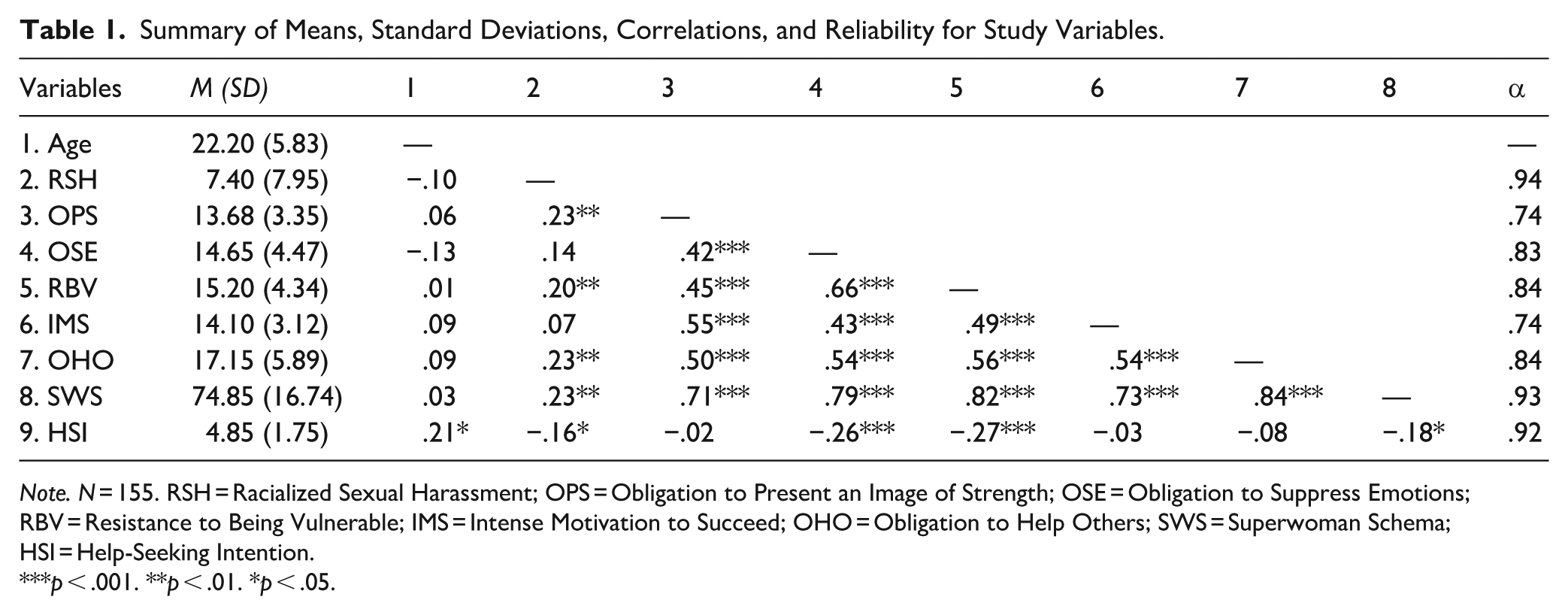
Note. N = 155. RSH = Racialized Sexual Harassment; OPS = Obligation to Present an Image of Strength; OSE = Obligation to Suppress Emotions; RBV = Resistance to Being Vulnerable; IMS = Intense Motivation to Succeed; OHO = Obligation to Help Others; SWS = Superwoman Schema; HSI = Help-Seeking Intention.
p < .001. **p < .01. *p < .05.
The Mediating Role of SWS on Racialized Sexual Harassment and Help-Seeking Intention.
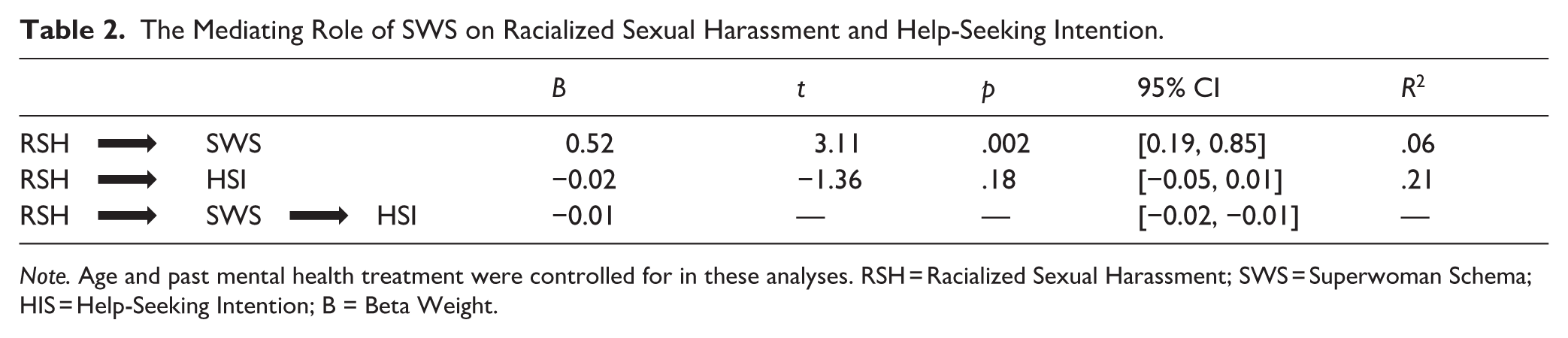
Note. Age and past mental health treatment were controlled for in these analyses. RSH = Racialized Sexual Harassment; SWS = Superwoman Schema; HIS = Help-Seeking Intention; B = Beta Weight.
The Mediating Role of Superwoman Schema Characteristics on Racialized Sexual Harassment and Help-Seeking Intention.
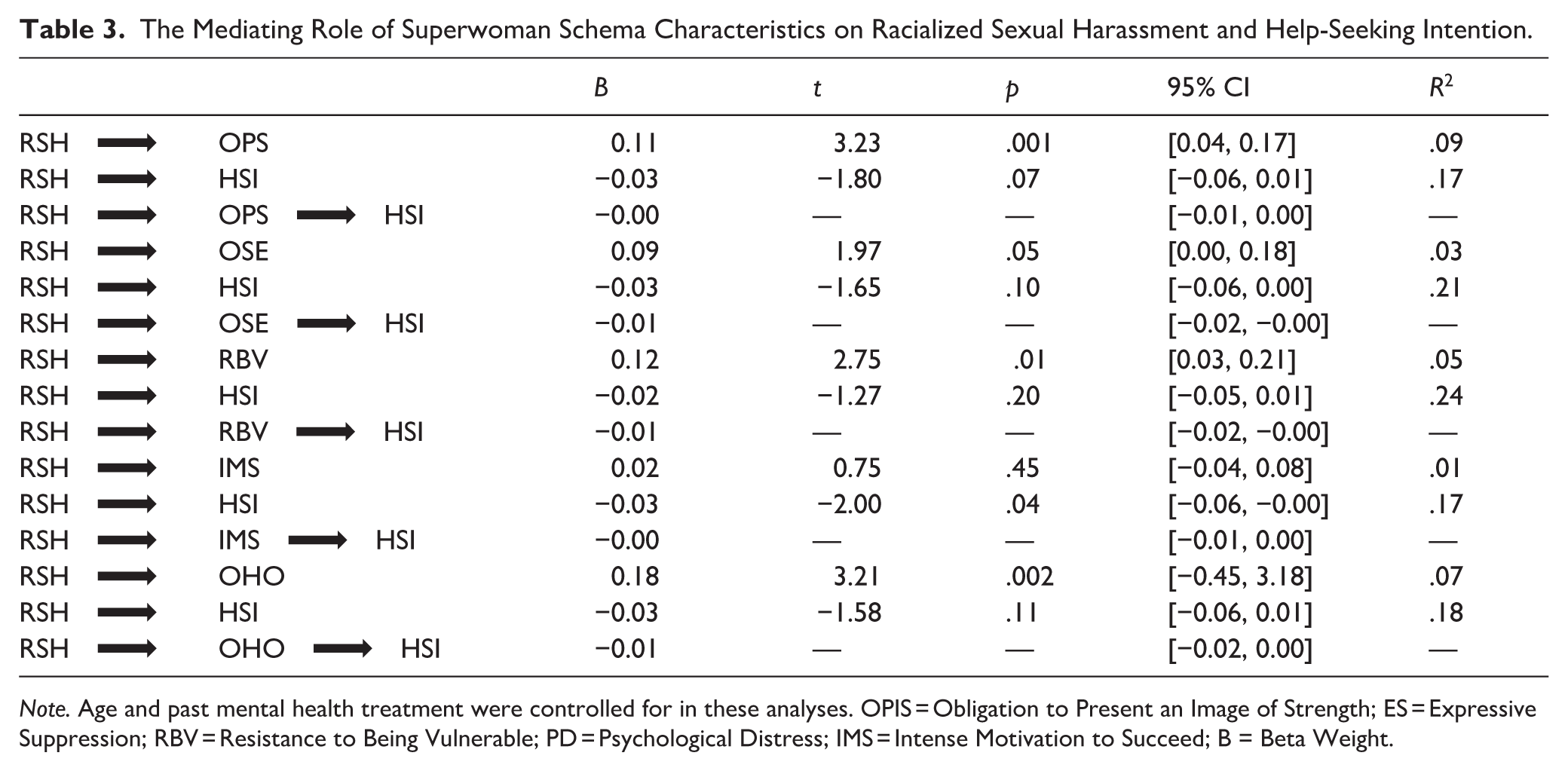
Note. Age and past mental health treatment were controlled for in these analyses. OPIS = Obligation to Present an Image of Strength; ES = Expressive Suppression; RBV = Resistance to Being Vulnerable; PD = Psychological Distress; IMS = Intense Motivation to Succeed; B = Beta Weight.
Primary Analyses
We conducted six indirect effects analyses with help-seeking intention as the outcome variable, racialized sexual harassment as the predictor, and Superwoman Schema (as a unidimensional construct and the individual five characteristics) as an explanatory factor while controlling for covariates. When SWS was examined as a unidimensional construct, findings revealed that racialized sexual harassment was not a significant predictor of help-seeking intention (B = −0.02, t = −1.36, p = .18, R2 = .21); however, racialized sexual harassment was a significant predictor of Superwoman Schema (B = 0.52, t = 3.11, p = .002, R2 = .06) which mediated the relationship between racialized sexual harassment and help-seeking intention. Indirect Effect (ab) = −0.01, 95% CI [−0.02, −0.01].
We examined all characteristics of SWS (i.e., an obligation to present an image of strength; an obligation to suppress emotions; resistance to vulnerability; an intense motivation to succeed, despite limited resources; and an obligation to help others) as explanatory factors of the relationship between racialized sexual harassment and help-seeking intention. Findings revealed that an obligation to suppress emotions, Indirect Effect (ab) = −0.01, 95% CI [−0.02, −0.00], and the resistance to being vulnerable, Indirect Effect (ab) = −0.01, [−0.02, −0.00], mediated the relationship between racialized sexual harassment and help-seeking intention.
Discussion
In the current study, we investigated relationships between racialized sexual harassment, mental health help-seeking intention, and Superwoman Schema among Black college women. Bivariate correlations revealed that racialized sexual harassment was negatively associated with help-seeking intention and positively associated with SWS, as a unidimensional construct. In addition, racialized sexual harassment was also positively associated with three Superwoman Schema characteristics (i.e., an obligation to present an image of strength, resistance to being vulnerable, and an obligation to help others). As a unidimensional construct, SWS, and two of its characteristics (i.e., an obligation to suppress emotions and resistance to being vulnerable), were negatively associated with help-seeking intention. Indirect effects analyses indicated that SWS and its characteristics of an obligation to suppress emotions and resistance to being vulnerable mediated the association between racialized sexual harassment and help-seeking intention.
Our findings add to the literature highlighting the harmful impact of racialized sexual harassment (Woods et al., 2009) on the lives of Black women’s mental health help-seeking. The association between racialized sexual harassment and increased adherence to SWS complements findings by Volpe et al. (2024), where gendered racial microaggressions were associated with increased adherence to SWS and less self-compassion. Thus, to mitigate the negative psychological effects of gendered racism, Black women might rely on coping mechanisms that center around disengagement, self-blame, self-silencing, and isolation (Nelson et al., 2023; Shahid & Dale, 2024; Szymanski & Lewis, 2016). The longstanding history of racialized sexualization among Black women often being minimized and ignored may also serve as a deterrent to emotional vulnerability and, in turn, reinforce Black women’s obligation to present strength despite suffering. Moreover, findings extend previous research by indicating two specific SWS characteristics (i.e., emotion suppression and resistance to vulnerability) in response to gendered racialized oppression associated with less favorable outcomes. This context is important given the emphasis on SWS as an aspiration or ideal for Black women, coupled with their increased exposure to adverse life events due to experiencing oppression at the intersection of racism and sexism. For example, in one study, adherence to the Superwoman Schema was associated with increased experiences of violence in intimate relationships (Debnam et al., 2021). Notwithstanding, it is critical to understand the unique stress-coping responses of Black women (Woods-Giscombé et al., 2015) especially given that some SWS characteristics have been associated with both positive and negative outcomes (Allen et al., 2019; Leath et al., 2022; Nelson, Cardemil, et al., 2024; Nelson, Gebretensay, et al., 2024; Perez et al., 2023; Watson-Singleton et al., 2024; Woods-Giscombé et al., 2019). Overall, this may explain the lack of support for other characteristics of SWS (i.e., an obligation to present an image of strength, an intense motivation to succeed despite limited resources, and an obligation to help others) in explaining the relationship between racialized sexual harassment and help-seeking intention.
Scholars have theorized that help-seeking intention is a key target for preventing anxiety and depression among emerging adults (Nauphal et al., 2023), focusing on SWS among college Black women may enhance efforts. This is important as Black women tend to underutilize mental health services for several reasons: perceived negative consequences of help-seeking, community pressure to not seek help, or reliance upon SWS despite favorable attitudes toward formal help-seeking (Nelson et al., 2020). In addition, fears of not being believed or dismissed may further discourage Black college women from seeking help (Collington et al., 2019). Consequently, Black women may rely upon informal sources of support (Mattis, 2002; Sosulski & Woodward, 2013) in response to racialized sexual harassment. For example, in a study of Black women who experienced a traumatic event, which included an uncomfortable sexual experience, the majority sought informal help (i.e., friends, family members, partners, and roommates) instead of formal help (White et al., 2023). While informal help might be therapeutic for some Black women, others might be less likely to seek any type of support because they have assumed responsibility instead of attributing it to others (Carr et al., 2014). Moreover, internalizing experiences of sexual objectification and racism may lead Black women to adhere to SWS rather than disclose their experiences to a mental health professional.
Limitations
There are several limitations to this study. First, the study design was cross-sectional. Thus, we cannot draw causal or longitudinal inferences from these findings. Secondly, the study focused specifically on Black college women in the northeast region of the United States. While this allows for a deeper understanding of this specific population, it also restricts the generalizability of the findings to other demographics. Replication of the study with diverse groups of Black women, including in different regions, generational status, and other sociodemographics, is crucial to enhance our understanding of this phenomenon. In addition, we did not collect data on mental health diagnoses and treatment history, which may influence psychological help-seeking behaviors. Finally, this study relied on self-report data, and it is plausible that participants may have overreported or underreported measures of interest due to social desirability or recall bias. These limitations highlight the need for further investigation into the complex interplay between gendered racism, adherence to SWS, and help-seeking for mental health conditions among Black women. Future research should incorporate longitudinal designs to reveal developmental patterns and causal mechanisms and mixed-methods studies to add context to understanding Black women’s experiences of adhering to SWS in response to racialized sexual harassment.
Conclusion
Racialized sexual harassment is a profoundly distressing experience, often leading to social isolation. Many Black women fear disbelief when reporting their experiences, hindering their willingness to seek support. Clinicians and researchers dedicated to the well-being of Black women must understand how unique stressors at the intersection of racism, sexism, and classism, and the coping mechanism of SWS, might hinder help-seeking. Furthermore, actively inquiring about Black women’s sense of being heard and validated is crucial. By doing so, clinicians and researchers can create culturally responsive support systems that truly address the specific needs of this population. In addition, policies aimed at addressing gendered racism and sexual violence as public health issues are warranted across institutions (e.g., hospitals and universities) and community settings. Interventions and preventative efforts focused on advocacy, empowerment, and social justice among Black women and girls are needed to help reduce racialized sexual harassment and promote their overall health and well-being.
Footnotes

Funding
The authors received no financial support for the research and/or authorship of this article.
Declaration of Conflicting Interests
The authors declared no potential conflicts of interests with respect to the authorship and/or publication of this article.