







Abstract
Intimate partner violence (IPV) is present even during adolescence, and both victims and perpetrators may sometimes perceive it as justifiable. This study investigated gender differences in adolescents’ justification of IPV and examined the role of gender essentialism. A sample of 710 cisgender, heterosexual adolescents completed self-report measures assessing justification of various violent behaviors and endorsement of gender essentialist beliefs. Boys were more likely to justify sexually coercive acts enacted by boys, whereas girls more often justified verbal and physical aggression enacted by girls. Gender essentialism was positively associated with all forms of IPV justification and mediated the relationship between participants’ gender and IPV attitudes. These findings highlight the importance of addressing gendered beliefs in prevention programs targeting adolescents.
Keywords
Introduction
Intimate partner violence (IPV) refers to the violence occurring within a romantic relationship (Ali et al., 2016; Ellsberg et al., 2015), and can be observed not only among adults, but also among adolescents and young adults (Johnson et al., 2015; Lundgren & Amin, 2014). Indeed, a growing body of research highlights that IPV – in terms of both physical and psychological violence (Reeves & Orpinas, 2012) – may occur at a young age within adolescent relationships (Karakurt & Silver, 2013; Muñoz-Rivas et al., 2007). In this regard, the World Health Organization (WHO) reports that 24% of adolescent girls aged 15 to 19 have experienced at least one episode of partner violence during their lifetime, and 16% in the past years. Furthermore, 10.3% of boys and 9.3% of girls report having been intentionally hit or slapped by their partner at least once in the past year (Eaton et al., 2010; Haegerich & Dahlberg, 2011).
A troubling facet of IPV is that it may often be accepted to some extent (Lelaurain et al., 2018) or perceived as normal (Frías, 2013) by both men and women. Specifically, research has shown that men and women, as well as boys and girls, may consider some form of violence within a relationship as acceptable or justifiable (Cinquegrana et al., 2022; Gracia et al., 2020; Reeves & Orpinas, 2012). Furthermore, the belief that some forms of violence are legitimate increases the likelihood of both perpetrating and experiencing dating violence (Diaz-Aguado & Martinez, 2015; Fernández-González et al., 2019; Machado et al., 2010). However, research also indicates that (a) not all forms of violence are justified to the same extent (Storer et al., 2020), (b) boys and girls justify certain forms of violence differently (Adams & Williams, 2014; Kuijpers et al., 2021; Waltermaurer, 2012), and (c) some gender-related beliefs can increase the likelihood of justifying violence (e.g., ambivalent sexism and gender system justification; Mouafo & Nzekaih, 2021; Lelaurain et al., 2018; see also Gracia et al., 2020).
This study focuses on adolescence and aims to assess gender differences in the perceived legitimacy of different IPV‑related behaviors (e.g., hitting, demanding sex, controlling behaviors) and tests whether gender essentialism – the belief that men and women have fixed, biologically determined traits – helps explain these gender differences.
Gender Difference in IPV Justification and Adolescence
Previous studies have shown that adolescents often exhibit a higher tolerance for certain violent behaviors, such as slapping and controlling actions, perceiving them as sometimes acceptable in relationships (Ocampo Bernasconi et al., 2024; Sundaram, 2013). A recent study by Save the Children (2024) found that a significant percentage of adolescents aged 14 to 18 consider jealousy and occasional violence (e.g., slapping) as sometimes acceptable within relationships. Furthermore, many adolescents reported difficulties in refusing sexual intercourse initiated by their partners because they believe that engaging in sexual activity is a natural or expected part of being in an intimate relationship. Adolescents’ involvement in IPV has been explained through different factors, including psychopathological and individual traits (Penado Abilleira et al., 2019) and early experience of violence within family during childhood (Kaufman-Parks et al., 2018). In this paper, we take a different approach, adopting a socio-constructionist meta-theory, which suggests that people’s beliefs and behaviors are shaped within a social context where norms and expectation regulate interactions (Gergen, 1994; Hibberd, 2005). While the link between gender norms and violence justification is documented among adults (Flood & Pease, 2009; Krivoshchekov et al., 2023; Serrano-Montilla et al., 2020), such dynamics may be even more pronounced in adolescence, a critical stage in individual development (Hegde et al., 2022) marked by significant changes across various domains of life (Martín-Salvador et al., 2021). During this period, individuals begin to engage in their first romantic relationships (Hickman et al., 2004; Widman et al., 2016), which often serve as a foundation for future adult relationships (Xia et al., 2018). Adolescence is characterized by heightened sensitivity to peer influence (Blakemore, 2018; Chierchia et al., 2020) and the strong pressures to conform, driven by the desire to belong. Thus, the need for acceptance within peer groups (Cialdini & Goldstein, 2004; Gommans et al., 2017) may increase adolescents’ conformity to social norms, including gender expectations. Accordingly, Smith (2011) defined adolescent conformity as “the degree of compliance (e.g., peer pressure or fitting in) with peer-defined socially acceptable norms on how to act, think, and feel” (pp. 402–403). Given that gender norms define what is considered appropriate and acceptable for each gender, they may also influence the perception of mild and acceptable forms of violence (Mulla et al., 2019). In this sense, one could expect that girls and boys will be more likely to justify forms of violence that align with socially shared representations of genders’ characteristics.
More specifically, we argue that gender differences in the legitimation of IPV can be linked to different gender norms and beliefs which are shared in societies (Cislaghi & Heise, 2020). These norms and beliefs portray femininity and masculinity as fundamentally distinct: male traits are expected to be naturally dominant (Schilt & Westbrook, 2009), assertive, independent, and competent (Jost & Kay, 2005), whereas female traits are viewed as naturally submissive, emotional, and sensitive (de Lemus et al., 2012; Glick & Fiske, 2001; West & Zimmerman, 1987). These socially shared beliefs, in turn, can affect the extent to which adolescents appraise and justify violent behaviors. For instance, the belief that girls are inherently emotional and physically weaker than boys may lead observers to frame girls’ slapping, pushing, or verbal aggression as a mere loss of control driven by emotion (Scarduzio et al., 2017). Conversely, the notion that boys are driven by biological sexual urges (Kim et al., 2007) reinforces the idea that they lack self-control and “need to be satisfied by orgasm once sexually stimulated” (Jeffrey & Barata, 2019, p. 92). As a result, pressuring a partner for sex may be perceived as an acceptable behavior more for boys but less for girls.
Gender Essentialism as a Correlate of IPV Justification
Gender norms and stereotypes are far from being merely lists of expected gendered behaviors and attributes as they contain also “the underlying explanations for the relations among the attributes” (Yzerbyt et al., 2001, our emphasis). By linking characteristics of masculinity and femininity to inherent features presumed common to all men and women, these beliefs function as a justification and rationalization of existing gender differences and inequalities (Yzerbyt & Rocher, 2002). Accordingly, research highlights that gender stereotypes are often rooted in the belief that gender differences have a biological origin (Coleman & Hong, 2008). This lay theory suggests that differences between men and women are phenotypic expressions determined by genotypic differences. For example, previous research suggests that exposure to biological explanations of gender differences increases support for gender stereotypes and strengthens beliefs about the immutability of traits (Brescoll & LaFrance, 2004). The belief that gender differences are biologically and intrinsically rooted in men and women has been termed gender essentialism. This construct includes the belief that gender is binary, biologically determined, and fixed across time and contexts, as well as informative of behaviors and attitudes (Brescoll et al., 2013; Ching et al., 2020; Keller, 2005; Skewes et al., 2018). Accordingly, research shows that essentialism strengthens stereotypical expectations (Bastian & Haslam, 2006), reduces the perceived similarity of social categories (Prentice & Miller, 2007; Yzerbyt et al., 2001), and promotes the view that existing hierarchies are stable, reducing social motivation to change (Williams & Eberhardt, 2008).
This lay belief-based social process of explaining gender differences as stemming from inherent traits may have significant implications for legitimizing IPV. When gendered behaviors are perceived as stemming from innate dispositions, their controllability is minimized, prompting individuals to attribute them to underlying biological drives. By framing male and female stereotypical traits as biologically grounded, essentialist beliefs make gender-congruent behaviors – including some forms of aggression or sexual pressure – more understandable, predictable, and less volitional. Consequently, violence may be interpreted as a “natural” expression of gendered dispositions. In this way, gender essentialism functions as a system-justifying belief (Jost & Banaji, 1994; see also Rossi & Caricati, 2025), providing a shared interpretive lens through which adults and adolescents make sense of interpersonal behaviors. These rationalization mechanisms have been explicitly examined within the frameworks of System Justification Theory (SJT, Jost & Banaji, 1994) and Social Dominance Theory (Pratto et al., 1994; Sidanius et al., 1994), both of which posit that societies are permeated by a range of beliefs that can either support or challenge existing group inequalities, including gender-based violence. For example, it has been shown that ambivalent gender stereotypes and domestic violence myths help individuals rationalize and justify violence against women and increase tendencies to blame victims (Bates et al., 2019; Friesen et al., 2019; Gutiérrez & Leaper, 2024; Rollero & De Piccoli, 2020; Sidanius & Pratto, 1999), including among adolescents and young adults (Lelaurain et al., 2018; Rollero & De Piccoli, 2020). Research confirms that also gender essentialism can function as a system-justifying belief, as the naturalization of gender differences contributes to legitimizing gender inequalities among both majority and minority groups (Rossi & Caricati, 2025). Indeed, studies indicate that individuals who strongly believe in the biological origins of gender differences are more likely to uphold ambivalent stereotypes (Lee et al., 2020), blame victims of violence as well as support myths about rape and domestic violence (Lys et al., 2021; Rollero & De Piccoli, 2020), and justify discrimination practices (Klysing, 2020; Morton et al., 2009).
While both boys and girls may use gender essentialism to justify existing gender discrimination and violence, they differ in the extent to which they support such beliefs. Indeed, according to both SJT and SDT, system-justifying beliefs are more likely to be endorsed by groups that benefit from the prevailing social order (i.e., boys). It has been indeed shown that, compared to women and girls, men and boys are more likely to support gender system justification (Kray et al., 2017), gender essentialism (Caricati et al., 2024; Smiler & Gelman, 2008), social dominance orientation (Wilson & Liu, 2003), and ambivalent sexism (e.g., Caricati et al., 2024, especially hostile sexism, e.g., Chen et al., 2009). This gender difference has been explained considering that men, as the advantaged group, have a greater interest in supporting beliefs that sustain existing social structures favoring them. In other words, beliefs about gender differences can serve ingroup interests so that members of the advantaged (e.g., boys) may be more likely to support certain gender-based beliefs because these help legitimize existing hierarchies and their privileged position relative to subordinated groups (e.g., girls; Rubin et al., 2023; Tajfel & Turner, 1979).
Aim and Hypothesis
While some research suggests that boys and girls justify only certain forms of gender-based violence and that this support is linked to system-justifying beliefs, we should notice the available evidence remains relatively sparse. Moreover, the role of gender essentialism has been largely overlooked in previous research. Therefore, the aim of this study was to examine whether boys and girls differ in the extent to which they justified various forms of violence and whether this difference can be explained, at least partially, by differing levels of support for gender essentialism. We hypothesized that the justification of violent behavior would depend on the extent to which these behaviors align with expected behaviors of male and female individuals. Additionally, we examined some violent behaviors which can be considered a “covert” form of violence, namely pressuring a partner for sex, exerting control over the partner, physical aggression (e.g., hitting and threatening), and verbal aggression. We speculated that, based on stereotypical portrait of masculinity and femininity, pressuring for sex and exerting control would be more justified for boys. Indeed, given that boys are expected to be naturally pushed by sexual drive and expected to “protect girls,” a boy’s request for sex can be seen as consistent with his supposed nature and therefore more justified. Similarly, boys’ behaviors such as monitoring a partner’s clothing choices, friendships, or social outings can be rationalized as protective rather than controlling, particularly when framed as protecting women from external dangers (Agadullina et al., 2022). Conversely, since girls are often depicted as naturally emotional and weaker than boys, behaviors such as slapping, threatening, and using verbal aggression may be perceived as more consistent with girls’ inherent characteristics and therefore considered legitimate or justifiable when enacted by them. In sum, we predicted that boys and girls would be more likely to justify violent behaviors that align with masculine and feminine stereotypes respectively. Specifically, we expected that boys would be more likely to justify behaviors exhibited by other boys related to demanding or coercing sex and controlling a partner (hypothesis 1a), while girls would be more likely to legitimize behaviors such as pushing, threatening, and yelling when enacted by other girls (hypothesis 1b).
Following SJT (Jost & Banaji, 1994) and SDT (Pratto et al., 1994; Sidanius et al., 1994), we also hypothesized that gender essentialism would operate as a rationalizing belief for gender-based behaviors and, consequently, be positively associated with the justification of gender-based violence (hypothesis 2). Similarly, given that gender essentialist beliefs have been described as mechanisms for maintaining the status quo and favoring dominant group, we expected boys to be more motivated than girls to endorse these beliefs as a means of preserving male dominance (i.e., the ingroup) in society. Therefore, we hypothesized that boys would score higher on gender essentialism (hypothesis 3). Finally, based on previous expectations, we also expected that gender essentialism would mediate the relationship between participants’ gender and their justification of violent behaviors (hypothesis 4; see Figure 1 for the research model).
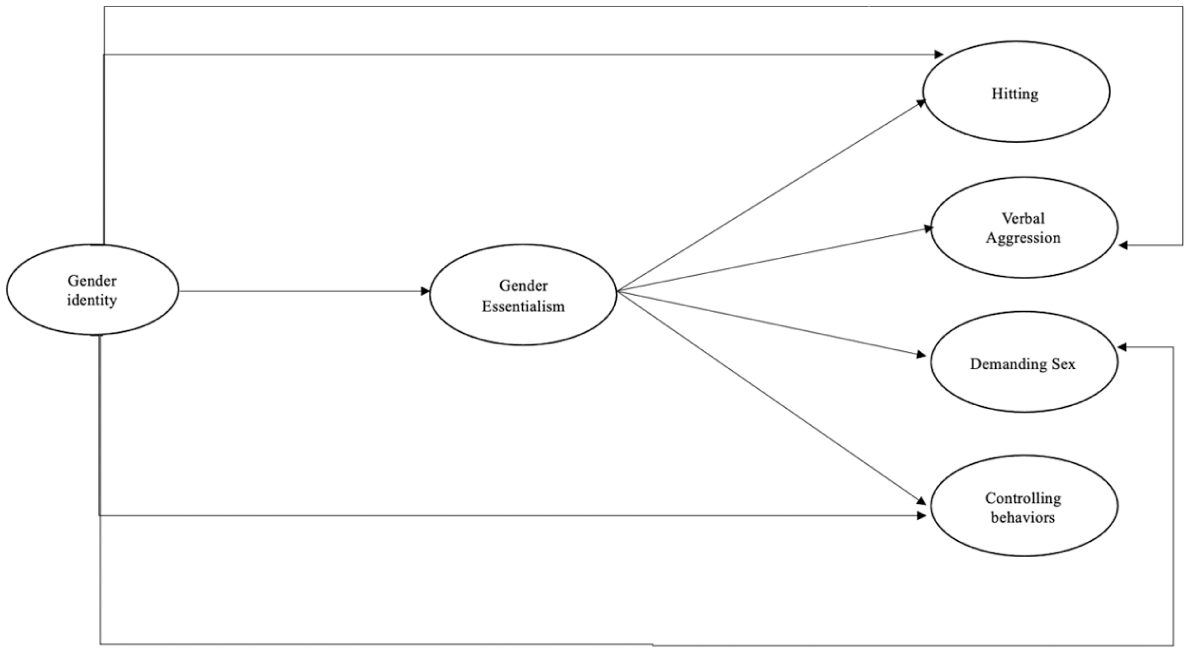
The hypothesized model.
Methods
Participants
The participants were recruited through convenience sampling from two comprehensive school complexes in northern Italy over 3 days, between mid-December 2023 and early February 2024. These school complexes offer multiple study programs and several parallel classes within each grade. The choice of the two school complexes was primarily based on their willingness to participate in the study, which made them accessible and feasible for recruitment. Additionally, both of these schools were interested in educational programs aimed at raising awareness about gender-based violence and in collaborating with a local anti-violence center. This context provided a supportive environment for the study and facilitated the implementation of the research activities. While this approach reflects a convenience sampling strategy which may limit generalizability of results, it allowed us to gather data in a naturalistic educational setting and ensured full cooperation from the schools involved. It is worth noting that, in Italy, education is centrally regulated by the Ministry of Education. Although regional performance highlights a well-established North–South divide in attainment (Cantalini et al., 2025), the centralized governance helps to make curricula and school types (e.g., liceo, technical, vocational tracks) homogeneous across the country. For example, anti-violence education efforts are virtually the same across the country, with small regional differences (Ministero dell’Istruzione e del Merito, 2025).
A total of 1,072 students participated; however, 61 responses were excluded as incomplete, and an additional 301 individuals were removed for not meeting the study’s criteria. Specifically, we excluded 19 participants who identified as transgender or nonbinary individuals, 83 whose sexual orientation was not heterosexual, and 199 who had never been in a romantic relationship or had a dating experience. Consequently, the final sample consisted of 710 students, 60.85% of whom were cisgender heterosexual girls. We restricted the sample to cisgender and heterosexual adolescents for both theoretical and methodological reasons. Dominant gender norms and expectations are primarily structured around heterosexual and cisgender identities, making these groups particularly relevant for investigating how adherence to social norms may facilitate the legitimation of IPV. In addition, while we acknowledge the importance of understanding IPV processes among LGBTQIA+ youth, the number of non-cisgender (n = 19) and non-heterosexual participants (n = 83) was too small to allow meaningful subgroup comparisons. Including them risked adding noise and reducing estimate reliability without sufficient analytical power.
In addition, we decided to include only individuals who had already experienced a romantic relationship because, as highlighted by Save the Children (2024), the justification of violence in intimate and dating relationships tends to be more prevalent among those who have had prior relationship experience, compared to those who have not yet started dating.
As requested by the Ethics Committee, we did not collect participants’ age. This was made to minimize the risk of identifying individuals, as pairing precise age information with class could potentially reveal identities (e.g., in cases of students repeating a grade). Therefore, we only collected information on the class year attended. It is important to note that, in general, secondary education in Italy typically begins at age 13 or 14 and continues until approximately 18 or 19 years of age. Based on this structure, our sample was distributed as follows: 15.35% of the students were in the first year, 13.24% in the second, 21.97% in the third, 21.55% in the fourth, and 27.89% in the fifth and final year.
Procedures
The ethical committee of our university approved the research protocol (prot. no. 254667). The research was cross-sectional with an anonymous online questionnaire that was created on LimeSurvey, and accessible via a QR code. Participants were provided with informed consent 1 week before the study, containing all the necessary information to help them decide whether to participate. Participation was voluntary; parental consent was obtained for minors, and self‑consent for students of legal age. The questionnaire comprised closed‑ended items. At the end of the questionnaire, participants read a debriefing that explained the research objectives and the methodology used. The researcher, who was present in the classrooms during questionnaire completion, addressed any questions and provided clarifications about the study. The questionnaire was completed at school during class time. All the procedures were in accordance with the ethical standards of the institutional and national research committees, as well as the 1964 Helsinki Declaration and its later amendments or comparable ethical standards.
The data that support the findings of this study, the analysis code, and the full list of items are freely available in osf.io at https://osf.io/kmwrd/?view_only=fc851f5a5d2e4879b111105c2d7fa55f.
Measures
Gender essentialism was measured using the Essential Sex and Gender subscale from the Italian adaptation (Scandurra et al., 2021) of the Heteronormative Attitudes and Beliefs Scale (Habarth, 2015). This scale consists of eight items requiring participants to indicate their agreement with statements such as “Masculinity and femininity are determined by biological factors, such as genes and hormones, before birth” on a 7-point Likert scale (1 = “strongly disagree,” 7 = “strongly agree”). Reliability was acceptable (α = .75).
Attitudes legitimizing intimate partner violence was measured using 13 items that were selected and adapted for this study from those used in a previous European project (Romagnoli et al., 2011; Sotiriou et al., 2011). Additionally, both the scale and the instructions were adapted based on the participants’ gender identity. Participants were asked to indicate how acceptable they believed it was for a person of their same gender (“How right you think it is for a woman/a man”) to engage in certain behaviors (e.g., “slap a partner if he/she have been unfaithful”) on a 5-point Likert scale (1 = “Never acceptable,” 5 = “Always acceptable”). We preliminary tested the factor structure of the scale with exploratory factor analysis (EFA). Bartlett’s test of sphericity (χ2[78] = 3,392.91, p < .001) confirms the adequacy of the correlation matrix for EFA, and the KMO index indicated a good sample adequacy (global MSA = 0.86). Parallel analysis suggested the presence of four factors, and then we conducted an EFA using principal factor method, specifying four dimensions and applying promax rotation. Results revealed that the four-factor solution explained 54% of the total variance, with all items loading on a single factor with loadings greater than 0.30. Subsequently, we conducted a confirmatory factor analysis (CFA) with maximum likelihood and robust standard error estimation to evaluate the fit indices. The CFA had an acceptable fit, χ2(59) = 203.87, p < .001, χ2/df = 3.46, robust Comparative fit index (CFI) = 0.93, robust Tucker–Lewis index (TLI) = 0.90, robust Root mean square error of approximation (RMSEA) = 0.076 (90% CI [0.065, 0.088]), and robust Standardized root mean square residual (SRMR) = 0.062. The reliability of the four dimensions was satisfactory: hitting and threatening the partner (α = .81), demanding sex (α = .79), controlling (α = .70), and verbal aggression (α = .77). For further details on EFA and CFA analyses, see Tables S1 and S2 in the Supplemental Material. We then named the four dimensions as “Hitting and Threatening,” “Demanding Sex,” “Controlling,” and “Verbal Aggression.”
Sex assigned at birth and gender identity were measured using items created ad hoc. Participants were first asked to indicate their assigned sex at birth and then their current gender identity by selecting from a range of possible responses. For sex assigned at birth, the options were “male,” “female,” and “intersex.” For current gender identity, the options were “man,” “woman,” “transgender,” and “nonbinary.”
Past romantic relationships and dating experiences were assessed using an adapted item from Wolfe et al. (2001), and participants were asked to select the statement that best described them (“I have never had a romantic relationship and I have never dated anyone,” “I have already had a romantic relationship,” and “I have not had a romantic relationship but I have already dated someone”).
Results
Descriptive Statistics
All the analyses were conducted using R (R Core Team, 2023), with the primary use of the psych package (Revelle, 2023) and the lavaan package (Rosseel, 2012).
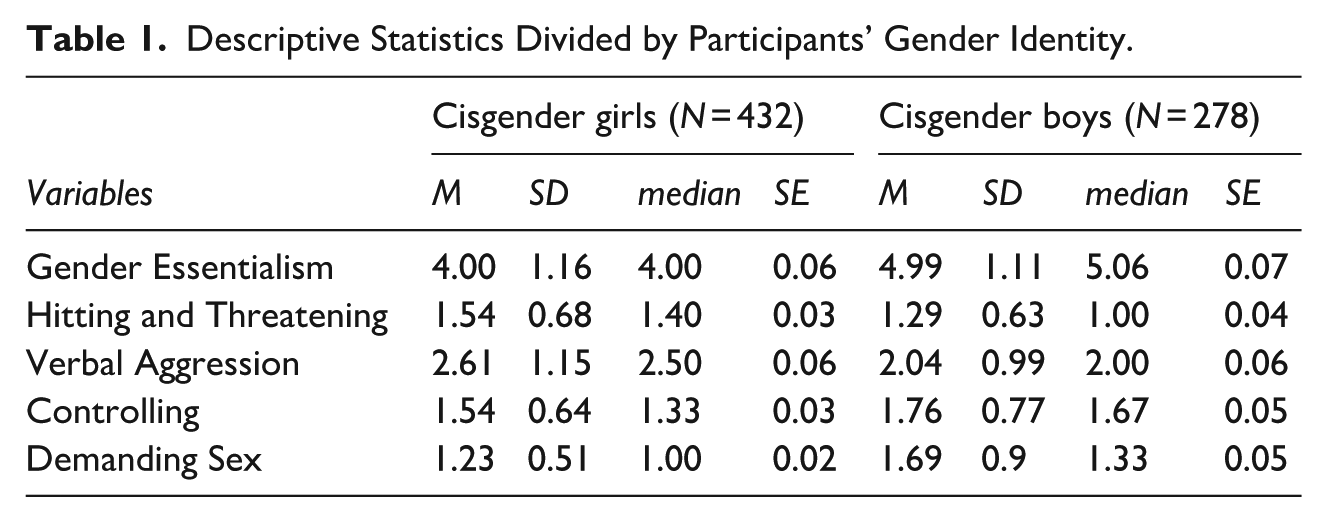
Preliminarily, we compared the mean scores of girls and boys using a t-test. Table 1 presents descriptive statistics of the considered variables, according to participants’ gender identity. Overall, girls reported lower levels of gender essentialism compared to boys, with a significant difference, t(708) = −11.30, p = <.001, d = −0.87. As expected from hypothesis 1a, boys were higher in “Controlling” behaviors (t[708] = −4.10, p < .001, d = −0.32), and “Demanding Sex” (t[708] = −8.71, p < .001, d = −0.67). Conversely, girls scored higher on legitimizing behaviors such as “Hitting and Threatening” (t[708] = 5.08, p < .001, d = 0.39) and “Verbal Aggression” (t[708] = 6.76, p < .001, d = 0.52), supporting hypothesis 1b.
Descriptive Statistics Divided by Participants’ Gender Identity.
Hypothesis Testing: Measurement Model
We tested hypotheses with two subsequent structural equation models (SEM). The first model tested the measurement model, which was used to assess the adequacy of the items in capturing the expected latent constructs, that is, gender essentialism and the four dimensions of attitudes legitimizing IPV. Next, we estimated the full SEM by incorporating regression paths into the measurement model. Specifically, the structural model was tested on the latent traits defined by the measurement model. Gender identity was dummy-coded, assigning a value of 0 for girls and 1 for boys. To assess the mediating role of gender essentialism in legitimizing IPV, we assessed the significance as well as 95% confidence intervals of the indirect effects. All the models were estimated using maximum likelihood with robust standard error estimation.
The measurement model had a good fit, χ2(179) = 483.31, p < .001, χ2/df = 2.70, robust CFI = 0.917, robust TLI = 0.903, robust RMSEA = 0.055 (90% CI [0.049, 0.061]), and robust SRMR = 0.056. All the items were significantly measured by the intended latent dimension (all ps < .001, except for one item in the gender essentialism measure, which remained statistically significant, though at a slightly higher p-value, p = .004). The five latent dimensions were positively and significantly correlated, except for verbal aggression and gender essentialism, which showed no significant correlation (see Table 2). For all the results of the measurement model, see Supplemental Material S3.
Correlation Among Latent Variables.
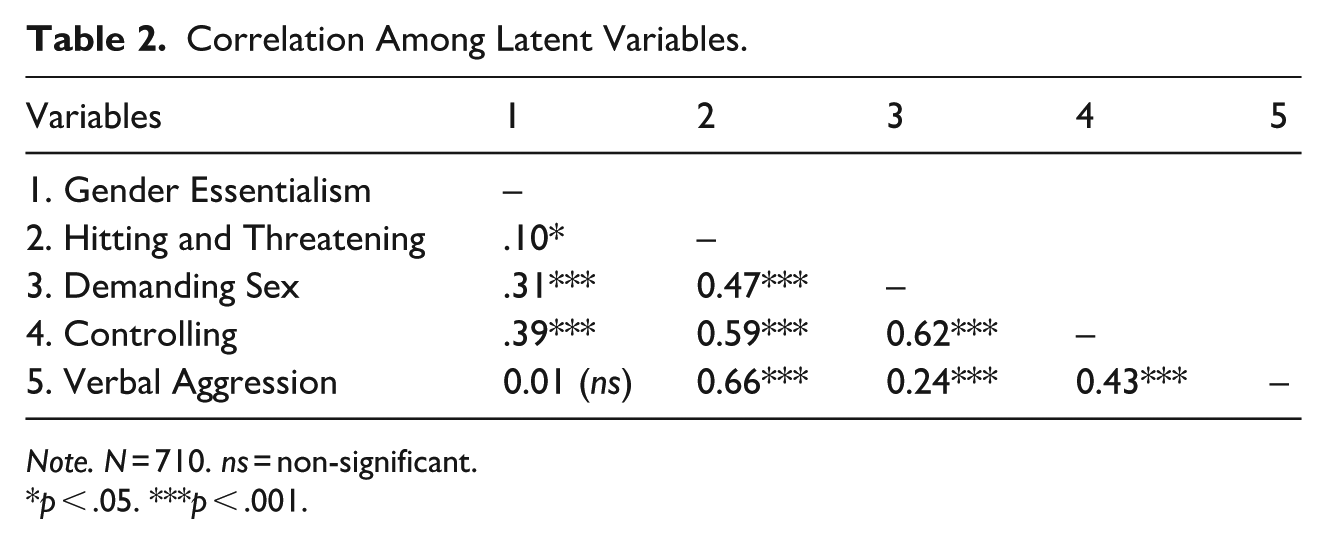
Note. N = 710. ns = non-significant.
p < .05. ***p < .001.
Adding the Regression Model
When the path model was added to the measurement model, the overall model showed a good fit, χ2(195) = 549.49, p < .001, χ2/df = 2.82, robust CFI = 0.912, robust TLI = 0.895, robust RMSEA = 0.056 (90% CI [0.051, 0.062]), and robust SRMR = 0.057.
Results showed that, in line with hypothesis 2, gender essentialism had a direct association with the justification of IPV regarding all the types of behaviors considered, that is, hitting and threatening (b = 0.15, p < .001, β = .23), demanding sex (b = 0.15, p < .001, β = .21), controlling behaviors (b = 0.25, p < .001, β = .38), and verbal aggression (b = 0.16, p = .01, β = .16). In line with hypothesis 3, participants’ gender identity had a significant direct effect on gender essentialism (b = 0.85, p < 0.001, β = .43), with boys reporting higher levels of gender essentialism than girls (see Figure 2). Finally, consistent with our hypothesis 4, gender essentialism mediated the relationship between gender identity and attitudes toward hitting and threatening behaviors (b = 0.12, p < .001, β = .10), demanding sex (b = 0.12, p < .001, β = .09), controlling behaviors (b = 0.21, p < .001, β = .16), and verbal aggression (b = 0.13, p = .01, β = .07; Table 3).
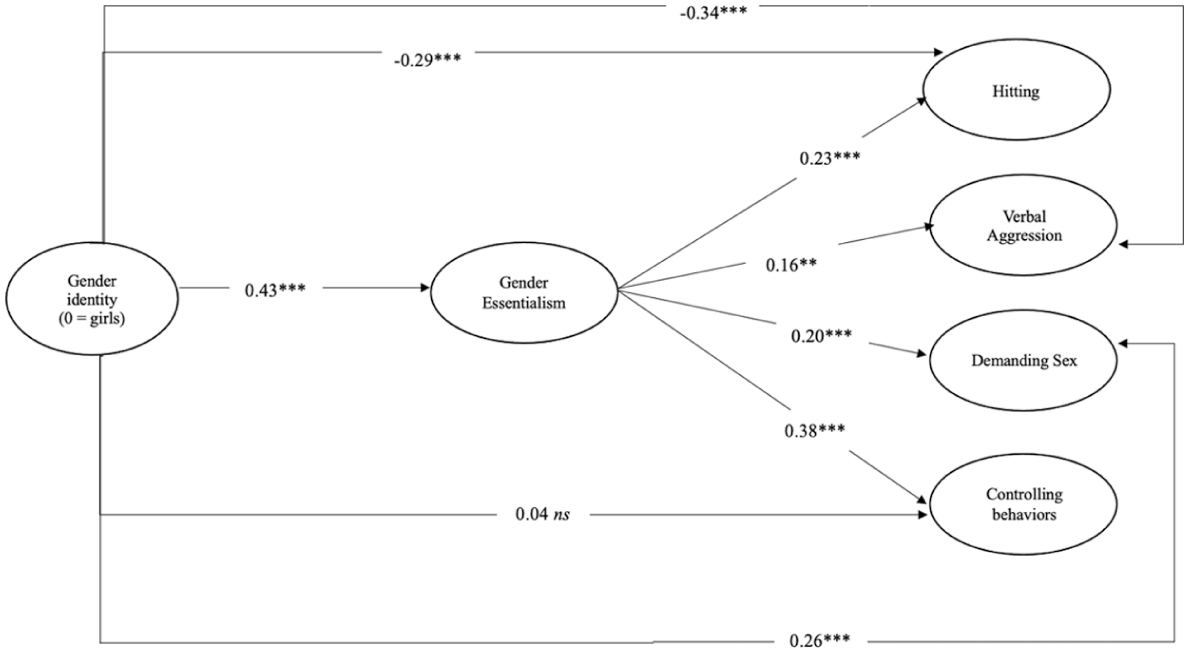
Results of path analysis.
Estimates From the Structural Equation Model (Regression).
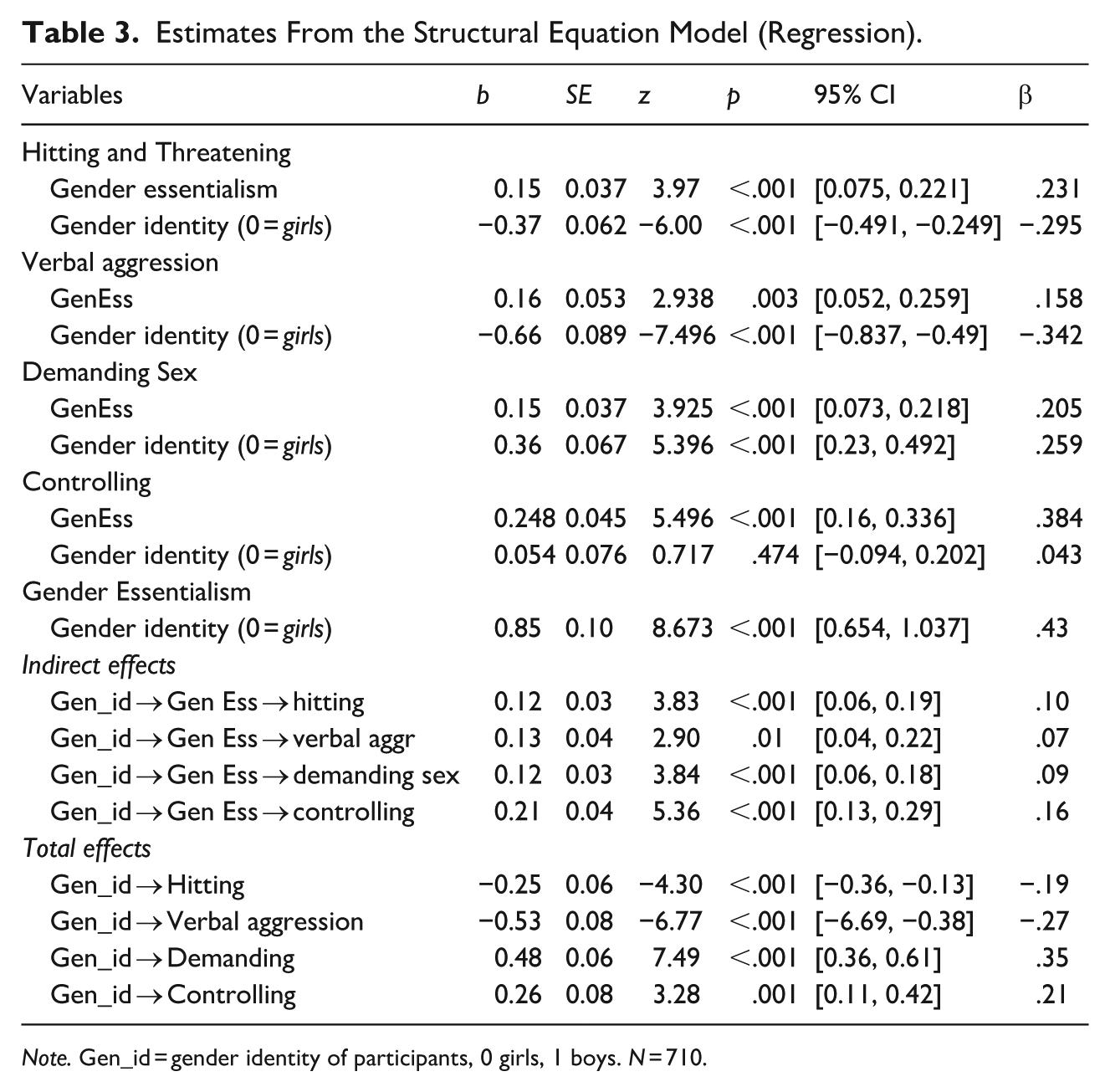
Note. Gen_id = gender identity of participants, 0 girls, 1 boys. N = 710.
Discussion and Conclusion
This study aimed to examine differences between heterosexual and cisgender boys and girls in justifying various IPV-related behaviors, as well as the role of specific gender norms – namely, gender essentialism – in shaping these attitudes. Indeed, IPV not only occurs within adolescent couples but may also be accepted or considered justifiable to some extent. Accordingly, previous research has shown that boys and girls tend to justify different types of IPV-related behaviors. While attitudes legitimizing IPV have been linked to system-justifying beliefs, particularly those rooted in traditional gender norms (e.g., ambivalent sexism; Lelaurain et al., 2018; Rollero & De Piccoli, 2020), the role of gender essentialism – the belief that gender differences are biologically determined – has not yet been thoroughly investigated. This study is novel in that it examines the role of gender essentialist beliefs in explaining gender differences in adolescents’ acceptance of IPV-related behaviors.
As expected, the results confirmed gender differences in IPV justification, with boys being more likely to justify behaviors related to demanding sex, while girls were more likely to legitimize behaviors such as hitting, threatening, and verbal aggression. This suggests that boys and girls are more inclined to justify forms of violence that align with social expectations about masculine and feminine roles and traits. For example, since men are socially portrayed as being driven by sexual impulses (Kim et al., 2007), it is easier to justify pressuring for sex when it is initiated by boys rather than girls. Conversely, because women are often depicted as being more emotional and weaker than men (Scarduzio et al., 2017), physical and verbal aggression may be more easily justified when enacted by girls rather than boys. Unexpectedly, however, we found no gender difference in justification of behaviors related to partner control, as both boys and girls perceived controlling a partner as equally unjustifiable. This could be related to the idea that, in today’s society, controlling behaviors increasingly occur through the Internet and social media, where they are often normalized and even humorized (Burton & Gormally, 2024; Scothorne et al., 2025). Viral content on platforms such as TikTok frequently depicts behaviors such as checking a partner’s online activity, asking them to delete posts, and expecting constant accessibility as romantic rather than coercive (e.g., “I saw it you take it down” trend; Scothorne et al., 2025). Users may even comment humorously on such behaviors (e.g., “lol”), contributing to the downplaying of their seriousness and to a portrayal that frames them as playful relationship norms (Haase & Worthington, 2023). As a result, coercive control may be perceived as less harmful, particularly when no physical violence is involved, making these dynamics more difficult to recognize as problematic. Such behaviors, which have traditionally been considered gender-specific – more often associated with boys and men under the guise of “protecting” rather than controlling their partners (Agadullina et al., 2022) – may instead now be perceived as equally (in)appropriate for both boys and girls. While suggestive, this interpretation requires direct empirical support.
Results also highlight that gender essentialist beliefs were positively associated with the justification of all four types of IPV we examined – namely, hitting and threatening, monitoring a partner, pressuring for sex, and verbal aggression. In other words, adolescents who strongly believed that differences between boys and girls are biologically determined were generally more likely to justify violence within intimate relationships. This suggests that, in line with SJT (Jost & Banaji, 1994) and SDT (Pratto et al., 1994), gender essentialism may function as a system-justifying belief, allowing adolescents to rationalize IPV as a phenomenon rooted in the essence of individuals – in this case, their gender (see also Rossi & Caricati, 2025). Essentialism can lead individuals to perceive violent behaviors as stemming from internal, biological, and uncontrollable forces, thereby reducing personal and social responsibility. Consistent with group-interest-based accounts (Rubin et al., 2023), our results also reveal that boys exhibited higher levels of gender essentialism than girls, aligning with previous research (Caricati et al., 2024; Habarth, 2015; Scandurra et al., 2021; Smiler & Gelman, 2008). According to the idea that essentialist beliefs serve system-justification motives, this pattern may be explained by the fact that boys and men are more motivated than girls and women to justify the existing social system that confers advantages to them (Jost & Banaji, 1994; Rubin et al., 2023).
The important role of essentialism was also confirmed by the mediation analysis. Specifically, results showed that essentialist beliefs mediated the relationship between gender identity and the justification of all types of IPV. When essentialism was included as a mediator, gender differences increased for feminine‑congruent behaviors (i.e., hitting and verbal aggression) but decreased for masculine‑congruent behaviors (i.e., demanding sex and controlling). This indicates that part of the difference between girls’ and boys’ justification of violent behavior was due to different levels of essentialism between genders, with boys being more essentialist than girls. Once again, this evidence suggests that boys and girls differ in the extent to which they justify gender-based violence, and these differences are partially explained by their varying adherence to general beliefs about gender. This, in turn, highlights that gender-based violence is not solely a matter of individual characteristics such as attachment styles, psychological issues, and personal distress (Kaufman-Parks et al., 2018; Penado Abilleira et al., 2019). Rather, it is also influenced by widely shared social representations of gender and gender relations, which provide individuals with norms and meanings that define what is considered just and legitimate versus what is deemed wrong and unacceptable (Cislaghi & Heise, 2020; Rossi & Caricati, 2025).
Practical Implications and Limitations
These findings have some implications for both researchers and practitioners involved in designing future research and interventions aimed at reducing IPV in adolescence. The mediating role of gender essentialism suggests that future programs should address traditional gender ideologies, particularly beliefs about the “natural” and intrinsic characteristics that differentiate men and women. Addressing these beliefs could help to reshape attitudes that legitimizing IPV.
Future research should further investigate how boys and girls perceive subtler forms of violence and how justifications they provide for such behaviors. Additionally, studies should expand beyond heterosexual relationships between cisgender people to include individuals with diverse gender identities and sexual orientations, to determine whether different patterns mediate or influence attitudes toward legitimizing IPV. This study is limited in this regard, as it focuses solely on cisgender and heterosexual participants. In addition, data were collected via convenience sampling from two northern Italian school complexes. Although the sample was large and curricula and school types are fairly homogeneous across the country, regional factors may still affect the processes examined in this study. For example, the economic disparity in the North–South divide (Panichella, 2022) also affects educational opportunities and inequalities, as well as the functioning and efficiency of social services (Ballarino et al., 2014; Cantalini et al., 2025). Thus, our results may not be directly generalizable to the entire Italian adolescent population. Another limitation of the study is its cross-sectional design which prevents us to make causal inferences between variables. Finally, other potentially influential variables, such as socio-economic status and political orientation, may affect the results and future research should incorporate these factors and control for them.
Concluding Remarks
In conclusion, these findings confirm the importance of considering also general beliefs about gender relations when analyzing IPV. Our findings highlight that, along with individual differences, also traditional gender norms and ideologies spread within societies, and influence the acceptance of IPV behaviors by boys and girls.
Supplemental Material
sj-docx-1-jiv-10.1177_08862605261426593 – Supplemental material for Attitudes Toward the Legitimation of Intimate Partner Violence in Adolescence: The Role of Gender Essentialism
Supplemental material, sj-docx-1-jiv-10.1177_08862605261426593 for Attitudes Toward the Legitimation of Intimate Partner Violence in Adolescence: The Role of Gender Essentialism by Francesca Rossi, Luca Caricati and Martina De Vito in Journal of Interpersonal Violence
Footnotes

Ethical Considerations
The research protocol was approved by the institutional ethics committees of University of Parma on 26/09/2023 (prot. no. 254667). All the procedures performed in studies involving human participants were in accordance with the ethical standards of the institutional and/or national research committee and with the 1964 Helsinki Declaration and its later amendments or comparable ethical standards.
Consent to Participate
Regarding informed consent, we obtained written and signed informed consent from the parents for underage students or directly from the students themselves if they were of legal age prior to participation.
Funding
The authors received no financial support for the research and/or authorship of this article.
Declaration of Conflicting Interests
The authors declared no potential conflicts of interest with respect to the authorship and/or publication of this article.
Data Availability Statement
Supplemental Material
Supplemental material for this article is available online.
Author Biographies
References
Supplementary Material
Please find the following supplemental material available below.
For Open Access articles published under a Creative Commons License, all supplemental material carries the same license as the article it is associated with.
For non-Open Access articles published, all supplemental material carries a non-exclusive license, and permission requests for re-use of supplemental material or any part of supplemental material shall be sent directly to the copyright owner as specified in the copyright notice associated with the article.
