







Abstract
Nearly one-third of ever-married Indian women experienced spousal violence at some point in their lives, with the highest proportion reporting physical violence. Couple-focused research, rather than individual-level analysis, can better capture the dynamics of attitudes toward violence within families, an area still underexplored in the Indian context. This study, using a dyadic approach, assesses the association between spousal concordance and discordance in attitude toward wife-beating and the experience of spousal physical violence among married women in India. Bivariate analysis and binary logistic regression were performed on data from 44,933 couples covered in the National Family Health Survey-5 (2019–21). An informed consent procedure was followed, and only those who voluntarily consented were interviewed. The odds of experiencing spousal physical violence was highest (Adjusted odds ratios [AOR] = 2.02, confidence interval [CI] [1.98, 2.07]) when both spouses had concordance in justifying wife-beating. Among the discordant couples where only the wife justified wife-beating exhibited a higher likelihood (AOR = 1.92, CI [1.88, 1.96]) of spousal violence than among the couples where only the husband justified it (AOR = 1.20, CI [1.18, 1.23]). Couples in which both spouses had witnessed their father beating their mother in their childhood were more likely (AOR = 3.44, CI [3.34, 3.54]) to experience spousal physical violence. The findings indicate that concordance in spouses’ justification of wife-beating is a strong predictor of spousal physical violence, with the risk being highest when both partners approve of such behavior. Policy efforts should prioritize couple-focused interventions to address shared gender norms within marriages, as acceptance of wife-beating by both partners, particularly women, is linked to higher risk of spousal physical violence. Programs should target patriarchal beliefs and entrenched gender attitudes through joint counseling, community education, and behavior-change initiatives to reduce the social acceptance of wife-beating and strengthen gender equity.
Keywords
Introduction
Intimate partner violence (IPV) is defined as all forms of physical, sexual, and emotional abuse perpetrated against the intimate partner in a close relationship, including current and former spouses and dating partners (Sardinha et al., 2022). Wife beating is one aspect of IPV that is frequently viewed as physical chastisement, that is, the husband’s right to “correct” an erring wife (Jejeebhoy, 1998), which is believed to be widespread across Asia (Rani & Bonu, 2009). Nearly one-third of ever-married Indian women experienced spousal violence at some point in their lives, and the highest proportion of them reported physical violence (Chandra et al., 2023). Wife beating, a manifestation of gender inequality, adversely affects women’s physical (International Institute for Population Sciences [IIPS] & ICF, 2021) and mental wellbeing (Chakrabarty et al., 2026). It is also associated with poor sexual and reproductive health outcomes among Indian women, including higher odds of unintended pregnancy (Raj & McDougal, 2015), increased risks of miscarriage, stillbirth, and pregnancy complications (Dhar et al., 2018; Pengpid & Peltzer, 2018), lower condom and contraceptive use (Dasgupta et al., 2018), and a higher risk of HIV infection (Silverman et al., 2008).
Studies have compared the difference in the degree to which wife-beating is viewed as acceptable across countries and regions, finding that there are high levels of acceptance in sub-Saharan Africa and South Asia (Sardinha & Catalán, 2018; Tausch, 2019; Tran et al., 2016; Uthman et al., 2009, 2010; Waltermaurer, 2012). Historically, Indian society, stemming from patriarchal norms and a conservative social structure (Pradhan & De, 2024), has culturally sanctioned the use of physical violence by men against women (Boyle et al., 2009) as a means of exerting control and resolving conflicts between couples (Segal, 1999). As IPV is more likely to occur in households wherein individuals believe that such violence is acceptable (Flood & Pease, 2009; Speizer, 2010), it becomes all the more important to understand the differentials in attitude toward wife-beating (Behrman & Frye, 2021).
Although IPV is inherently a relational event shaped by couple-level dynamics and individual characteristics (Conroy, 2014; Ghuman et al., 2006; Rodriguez & Straus, 2017), several studies have used individuals as the unit of analysis, primarily focusing on women (Cools & Kotsadam, 2017; Pierotti, 2013; Swindle, 2018; Uthman et al., 2010; Waltermaurer, 2012). Studies have established that socio-economic conditions like poverty (Bangdiwala et al., 2004; Hindin & Adair, 2002; Jewkes, 2002; Koenig et al., 2003), low education (Bangdiwala et al., 2004; Gage, 2005; Jewkes, 2002; McQuestion, 2003), substance abuse, and controlling behavior of husbands (Chandra et al., 2023; Dalal & Lindqvist, 2012; Tayyab et al., 2017; Zakar et al., 2016) influence the attitude toward wife-beating. Further, childhood exposure to a father’s violence against the mother has also been observed to enhance violent behavior in adulthood (Martin et al., 2002; Uthman et al., 2011), as individuals end up believing that violence is an acceptable way to exert control within a relationship (Pradhan & De, 2024).
The individual-level variation in attitude toward IPV can be understood through two theoretical perspectives, that is, cultural diffusion and bargaining power (Behrman & Frye, 2021). Bargaining power refers to an individual’s ability to influence decisions within a relationship, which depends on access to resources, alternatives outside the relationship, and relative status between partners. For women, this power is often strengthened by factors such as higher education, paid employment, ownership of assets, or support networks, which enhance their capacity to negotiate or exit unfavorable relationships (Lundberg & Pollak, 1996; Manser & Brown, 1980). Greater bargaining power can further reduce women’s tolerance of controlling or abusive behavior (Friedman et al., 2016). Cultural diffusion, on the other hand, highlights the influence of global cultural shifts—such as the promotion of gender equality and nonviolence—on individuals, transmitted through education, media exposure, and social interactions (Baker & LeTendre, 2005; Boli & Thomas, 1997; Elliott, 2007; Meyer, 2010; Meyer & Jepperson, 2000). These perspectives, although macro-level in orientation, manifest in the micro-level spousal dynamics. Cultural diffusion may lead to asymmetric adoption of egalitarian values—where one partner, typically the woman, internalizes nonviolent norms while the other retains patriarchal views—creating the difference in attitude toward IPV. Meanwhile, differences in bargaining power between spouses can shape how each partner justifies or rejects wife beating.
Both husbands and wives enter into marriage as individuals, bringing forth their own experiences and perspectives, which are further reshaped as they share a number of experiences and information as their lives unfold (Behrman & Frye, 2021). While individual-level research has improved our understanding of marital violence and attitudes toward it, they often fail to capture the interactive nature of intimate relationships. Analyzing the data from one partner can limit the perception of what a couple experiences, as the data would be restricted to a single perspective (Bengesai & Khan, 2023). On the other hand, a dyadic approach provides a more nuanced and comprehensive view by incorporating the perspectives of both partners (Eisikovits & Koren, 2010), thus allowing the researchers to examine the concordance and discordance in attitudes and their association with IPV. Using this method, the reliance on unilateral accounts, which can be subject to recall bias or reporting bias in context of sensitive issues like spousal violence, can be reduced. Furthermore, asymmetric perceptions toward justifying violence are often missed in the individual-level analysis. Thus, combining the husband and wife’s perspectives using dyadic analysis can bring forth a stronger predictor of IPV than individual attitudes alone, which has been missing in the Indian context. For this reason, our study adopts a dyadic approach with a hypothesis that spousal concordance in attitude toward wife-beating is associated with the wife’s experience of spousal physical violence in India.
Methods
Source of Data and Study Participants
The study utilized data from the National Family Health Survey (NFHS)-5 (2019/21), a large-scale nationally representative survey that gathered information on various health indicators, including attitudes toward wife-beating from women aged 15 to 49 years and men aged 15 to 54 years. The survey report includes a detailed description of the study design, sampling design, data collection technique, nonresponse rate, quality control mechanism, and ethical considerations (IIPS & ICF, 2021). Respondents who voluntarily agreed to participate were interviewed. The present study utilized data from the couple’s file of NFHS-5. After considering the sample to which the domestic violence module was administered and eliminating the missing values and the “do not know” cases of key variables for analysis, the study analyzed a sample of 44,933 couples. The data utilized in this study are available in the public domain and can be assessed through www.dhsprogram.com through individual registration.
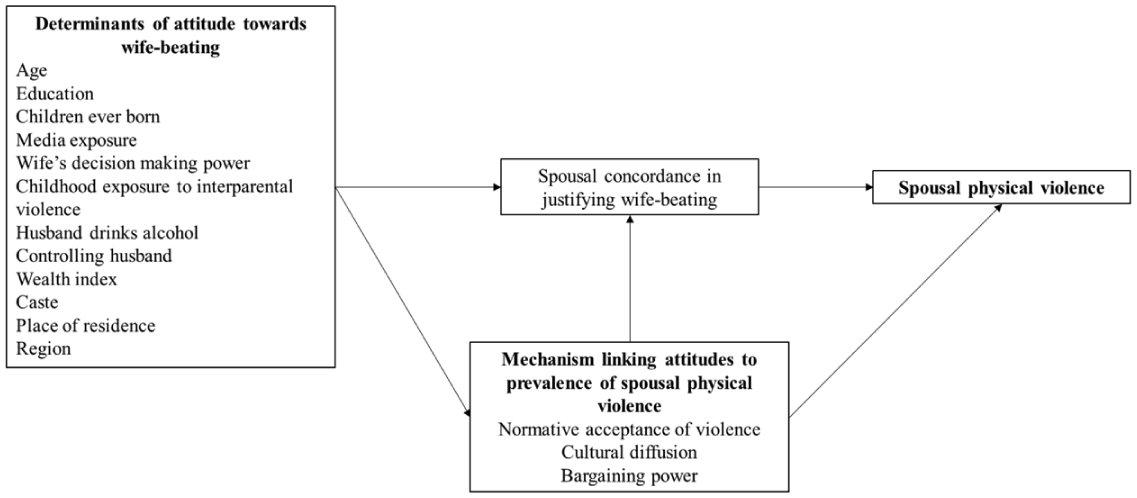
Conceptual framework.
Outcome Variable
The primary outcome variable was the experience of spousal physical violence among women. It was assessed through the wives’ response to the following that their husbands have ever done to them: (a) push them, shake them, or throw something at them, (b) slap them, (c) punch them with his fist or with something that could hurt you, (d) kick them, drag them or beat them up, (e) try to choke them or burn them on purpose, (f) threaten or attack them with a knife, gun, or any other weapon, and (g) twist their arm or pull their hair. Physical violence was considered as yes (coded 1) if the response to any of the above questions was affirmative; otherwise, no (coded 0).
Explanatory Variable
The spousal attitude toward justification of wife-beating was the principal predictor variable. It was assessed through the husbands’ and wives’ responses to the following seven circumstances of justifying wife-beating: (a) if she goes out without telling, (b) neglects house or children, (c) argues with him, (d) refuses to have sex, (e) does not cook food properly, (f) suspected of being unfaithful, and (g) is disrespectful to in-laws. While clubbing them, a value of “1” was assigned to men and women who justified wife-beating for any mentioned reasons nested within the category; otherwise, they were assigned “0.” Spousal justification to wife beating was recoded as “0” (Concordance—both reject) when both do not justify wife-beating, “1” (Discordance—wife only accepts) when wife justified wife-beating for any reason, and husband does not justify it, “2” (Discordance—husband only accepts) when husband justified wife-beating for any reason and wife does not justify it and “3” (Concordance—both accept) when both husband and wife justified wife-beating for any of the reasons.
Covariates
The spousal, household, and community-level covariates, which have been associated with the outcome variable in several studies (Alio et al., 2011; Behrman & Frye, 2021; Pradhan & De, 2024), have also been included in the analysis. The spousal-level indicators considered were the age gap (wife same age or older than husband, husband older by 1 to 5 years, and husband older by more than 5 years), the gap in education (same education level, wife more educated, and husband more educated), total children ever born (no child, 1 to 2 children, and 3+ children), childhood exposure to father beating mother (none, wife responded yes & husband responded no, husband responded yes & wife responses no, and both responded yes), women’s involvement in household decision-making (no and yes), husband’s alcohol drinking (no and yes) and controlling husband (no and yes). Four questions on decision-making were asked of the women: decisions on respondents’ health care, large household purchases, visits to family or relatives, and what to do with the money the husband earned. The decision-making variable was coded as 1 “herself or with husband” if the decision-making for all four aspects was done by the woman alone or jointly with the husband. Alcohol consumption among husbands had been recorded as “yes” if the husband or wife had affirmatively responded to the husband drinking alcohol. Women have been asked if their husbands were jealous if they talked with other men, accused them of unfaithfulness, did not permit them to meet female friends, tried to limit their contact with family, insisted on knowing where they were, and did not trust them with money. The variable controlling husband was coded as 1 “yes” if the wife responded yes in any of the abovementioned cases; otherwise, 0 “no.” Furthermore, the household and community-level variables included in the study were the wealth index (poorest, poorer, middle, richer, and richest), place of residence (urban and rural), and region (North, Central, East, Northeast, West, and South).
Analytical Approach
Descriptive statistics were done to estimate the spousal concordance–discordance in attitude toward wife-beating on spousal physical violence faced by the wife. Cross-tabulation was used to assess the bivariate percentage (weighted)in physical violence by the predictor variables. Further, binary logistic regression was conducted to evaluate the effects of the predictor variables on spousal physical violence, using two models that present the unadjusted and adjusted odds ratios (AOR). Multicollinearity among predictor variables was checked through the variance inflation factor method before finalizing the variables for the regression analysis. All the statistical analyses were performed on weighted data using Stata version 17.0 (StataCorp LLC).
Results
Socio-Demographic Profile of the Study Population
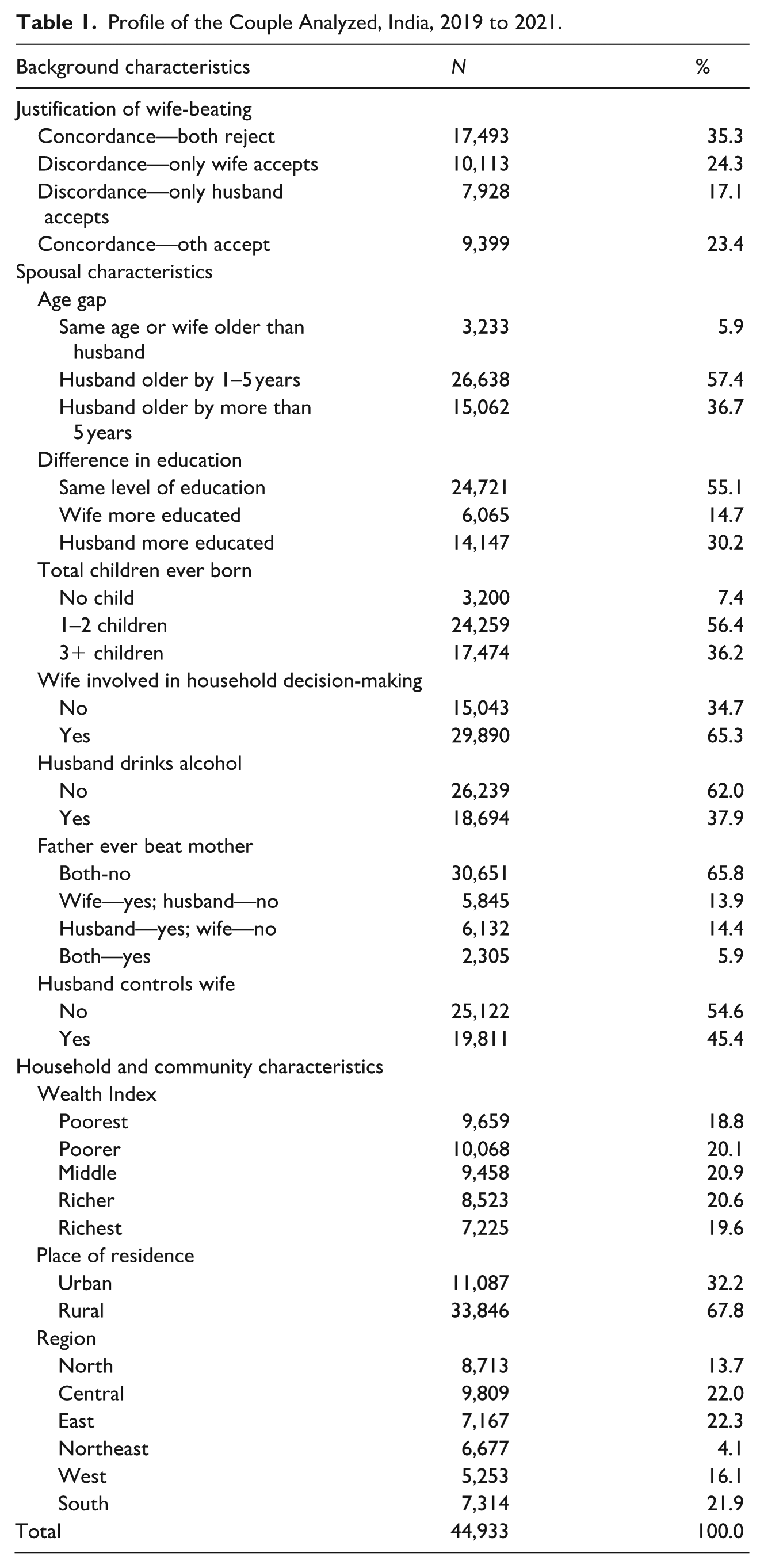
Among the couples, 35% did not justify wife beating under any circumstances, with 24% of couples having only the wife justifying it, 17% of couples with only the husband justifying it and 23% where both partners justified wife beating (Table 1). Among 57% of the couples, husbands were older than their wives by 1 to 5 years. There were half of the couples where both spouses had the same level of education. More than a half (56%) of the couples had 1 to 2 children, 36% had three or more children, and only 7% had no children. In 65% of the couples, wives were involved in household decision-making, independently or with their husbands. Further, in 38% of the couples, either the husband or the wife reported that the husband drinks alcohol. There were three in ten couples where either husband or wife reported that their father ever beat their mother. Around four out of every 10 wives reported that their husband controls them in one way or more. A majority (68%) of the couples reside in rural areas, with the sample spread across North (14%), Central (22%), East (22%), Northeast (4%), West (16%), and South (22%) India.
Profile of the Couple Analyzed, India, 2019 to 2021.
Differentials in Experiencing Spousal Physical Violence by Wives
Data in Table 2 revealed clear differences in the prevalence of spousal physical violence based on the couples’ attitudes toward wife-beating. The prevalence of physical violence was highest at 39% among the couples where both spouses concordantly justified wife-beating. When only the wife justified wife-beating, that is, an internalized acceptance of IPV, the prevalence was slightly lower at 35%, whereas when only the husband justified wife-beating, there were 23% of wives who reported experiencing physical violence. The prevalence was lowest at 18% among couples where neither spouse justified wife-beating.
Experience of Spousal Physical Violence Among Married Women by Background Characteristics, India, 2019 to 2021.
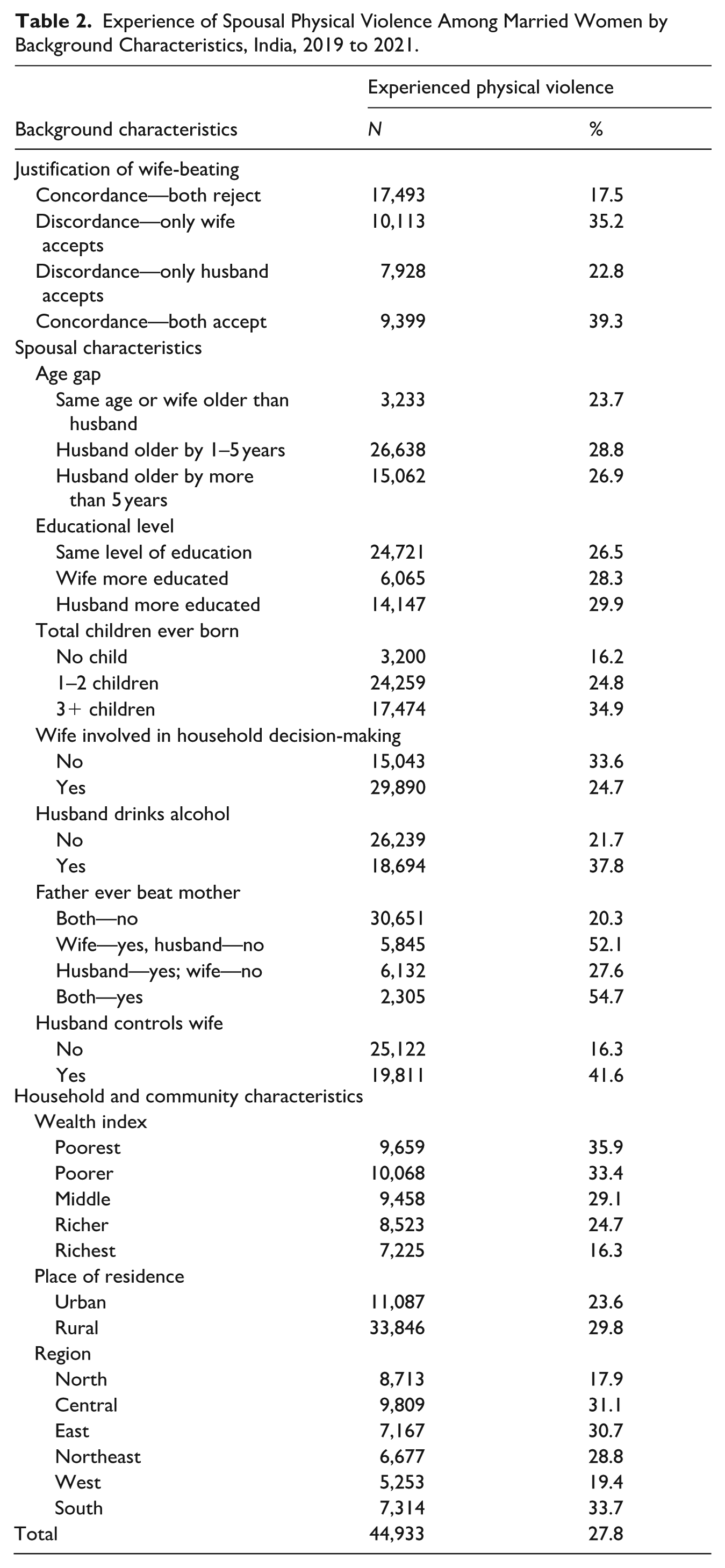
Spousal physical violence was more prevalent among the women who had husbands older than them by 1 to 5 years (29%) and were more educated than they (30%) were. Further, women with three or more children had the highest prevalence of experiencing spousal physical violence (35%). Women who were not involved in household decision-making had a higher prevalence of spousal physical violence (34%) compared to those involved in decision-making (25%).
Spousal physical violence was notably higher among women whose husbands consumed alcohol (38%) and among those, whose husbands displayed controlling behavior (42%). The prevalence of spousal physical violence was also highest among couples where both spouses reported that their father ever beat their mother (55%), followed by 52% reporting it if only the wife reported her father ever beating her mother and 28% reporting it if only the husband reported their father ever beating their mother. Spousal physical violence was more prevalent among women from the poorest households, living in rural areas (30%), specifically living in the Southern (34%) and Central regions (31%).
Determinants of Spousal Physical Violence
Table 3 presents the results of a binary logistic regression analysis that examines the likelihood of women experiencing spousal physical violence. Model 1 provides the unadjusted odds ratios (UOR), and Model 2 provides the adjusted odds ratios (AOR) of justification of wife beating on experiencing spousal physical violence adjusted by the background variables. The likelihood of experiencing spousal physical violence by the wife was higher among the couples where both justified wife-beating (UOR = 3.05, Confidence interval [CI] [2.99, 3.10]; AOR = 2.02, CI [1.98, 2.07]) compared to the couples who were concordant in not justifying wife beating. The chances of spousal physical violence were higher among the couples where only the wife justified wife-beating (UOR = 2.56, CI [2.51, 2.61]; AOR = 1.92, CI [1.88, 1.96]) than among the couples where only the husband justified wife-beating (UOR = 1.39, CI [1.36, 1.42]; AOR = 1.20, CI [1.18, 1.23]).
Odds Ratios of Experiencing Spousal Physical Violence Among Married Women, India, 2019 to 2021.
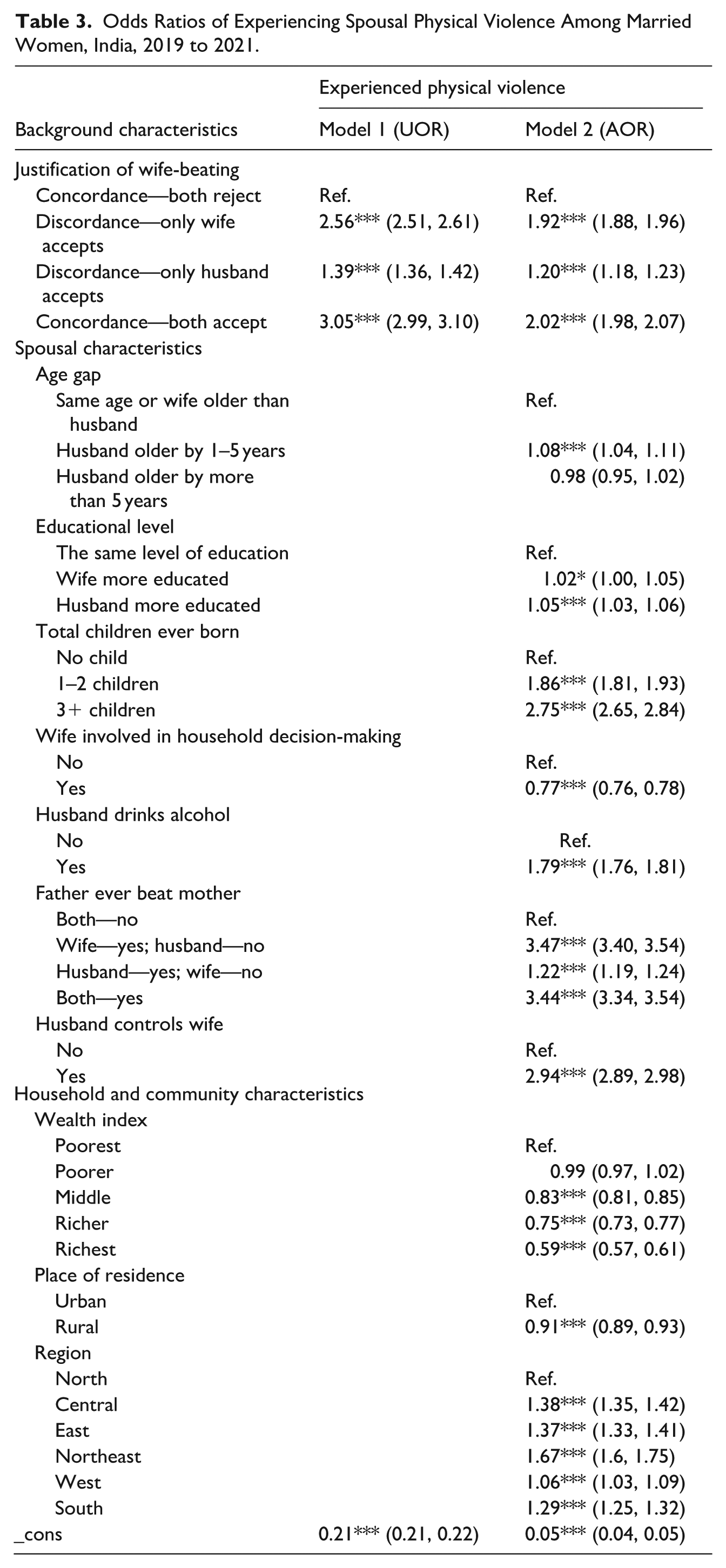
Women with husbands who were 1 to 5 years older than them were 8% more likely to face spousal physical violence compared to women who were of the same age or wives older than their husbands (AOR = 1.08, CI [1.04, 1.11]). The likelihood of spousal physical violence was also higher among the couples when the wife or the husband was more educated than the couples who had the same level of education. With an increase in the number of children ever born to couples, there was an increase in the likelihood of spousal physical violence against women.
The likelihood of spousal physical violence was lower if the wife was involved in decision-making (Odds ratio [OR] = 0.77, CI [0.76, 0.78]), but was higher among couples where the husband drank alcohol (OR = 1.79, CI [1.76, 1.81]) and had a controlling behavior (OR = 2.94, CI [2.89, 2.98]). Compared to the couples where none reported witnessing their father beating their mother, the likelihood of spousal physical violence was 3.47 times higher if only the wife reported a history of parental violence, 3.44 times higher if both reported it, and 1.22 times higher if only the husband reported it.
With an increasing wealth quintile of the household, there was a decreasing likelihood of spousal physical violence. Further, the likelihood of spousal physical violence by women was lower among the couples living in rural areas (AOR = 0.91, CI [0.89, 0.93]) in comparison to the women living in urban areas. Compared to the women living in North India, the likelihood of spousal physical violence was highest among women living in the Northeast (OR = 1.67, CI [1.6, 1.75]), followed by the Central (OR = 1.38, CI [1.33, 1.41]) and Eastern (OR = 1.37, CI [1.33, 1.41]) India.
Discussion
The study using a dyadic approach revealed a strong association between the concordance in a couple’s justification of wife-beating and the occurrence of spousal physical violence against women, with the likelihood being highest when both spouses justified wife-beating. This result is consistent with the findings from other studies that adopted a dyadic approach (Alio et al., 2011; Behrman & Frye, 2021; Bengesai & Khan, 2023). Previous research has also indicated that women who supported their husbands’ affirmative attitudes toward violence were more likely to experience various forms of IPV than those who rejected such attitudes (Aboagye et al., 2021; Abramsky et al., 2011; Alio et al., 2011; Mondal & Paul, 2021; Stith et al., 2004; Tlapek, 2015). In the Indian context, these findings resonate strongly with the prevailing patriarchal gender norms and power dynamics within marriages, which reinforce the acceptance of violence as a form of discipline or control. Further, women who conform to their husband’s justification might face greater societal pressure to endure the abuse or violence, as they see it as a part of their marital duty.
Among the discordant couples, our findings suggest that the likelihood of spousal physical violence was higher when only the wife justified wife-beating than when it was justified by only the husband, consistent with prior studies (Behrman & Frye, 2021; Bengesai & Khan, 2023). While it is generally expected that the risk of violence would be higher when men perceive violence as normal, the lower likelihood of reporting spousal physical violence by women can be explained by the following arguments. One reason might be that women who have internalized patriarchal norms, view wife-beating as a justified means of “correction” by husbands, reflecting their acceptance of unequal gender norms in a male-dominated society (Rani & Bonu, 2009; Visaria, 2008). Many women grow up in surroundings with traditional gender roles, where men are seen as the heads of the household, and the primary role of women is to be obedient, serve, and maintain harmony within the family, even if they have to endure abuse. Women thus internalize these norms to such an extent that spousal violence is not perceived as a violation of their rights but a legitimate response of their husbands to their wrong behavior. Also, the resulting low self-esteem among women and self-blaming for the reasons causing the violence (Devenish et al., 2019; Foshee et al., 2016; Okenwa-Emegwa et al., 2016) could lead to further perpetuation of spousal physical violence and its reporting. While low self-esteem is usually a result of living in a patriarchal society, limited access to education and employment opportunities, and being financially dependent, the self-blame is often reinforced by the family members and community, who advise the woman to “adjust” or “compromise” for the sake of the family or marriage.
On the other hand, there is a lower occurrence of spousal physical violence by wives who did not justify wife-beating. This could be because women who do not justify wife-beating are more empowered and aware of the rights that enable them to resist spousal violence. They could also have supportive social networks that help them prevent it. However, the lower reporting could be explained by the reporting bias due to the involvement of sensitive or socially undesirable traits of their husbands (Cullen, 2023; Freeman et al., 2015). In India, there exists a social stigma in publicly acknowledging marital problems, particularly those that involve violence, as it could tarnish the reputation of women’s families as well. With the expectation to preserve the sanctity of their marriage and prevent shame and social judgment in their household, women often refrain from reporting violence.
We found that women with greater decision-making power, reflecting more equitable power dynamics between partners and within the household, had a lower likelihood of spousal physical violence, which is supported by multiple studies (Antai, 2011; Tenkorang, 2019). Additionally, male domination over women, deeply rooted in the patriarchal norms pervading the society, as evidenced by the controlling behavior of the husband, has been shown to increase the risk of spousal physical violence in this study and across others as well (Antai, 2011; Gage & Hutchinson, 2006; Kwagala et al., 2013; Lamichhane et al., 2011; Nasrullah et al., 2014; Rahman et al., 2013; Tenkorang, 2019; Visaria, 2008). Our study found that couples who have witnessed their fathers beating their mothers during childhood reported a higher likelihood of experiencing physical violence, consistent with research conducted in various geographical and cultural contexts (Chowdhury & Mathur, 2021; Copp et al., 2019; Martin et al., 2002; Zhu & Dalal, 2010). Witnessing such behavior fosters an intergenerational transmission of conflict resolution patterns wherein violence is seen as an acceptable or inevitable part of intimate relationships (Zhu & Dalal, 2010).
Women from economically better-off households had the lowest likelihood of experiencing spousal physical violence, which could be because of individuals’ exposure to egalitarian gender norms discouraging violence against women (Ackerson et al., 2008; Osei-Tutu & Ampadu, 2017; Oyediran, 2016; Pradhan & De, 2024; Rani & Bonu, 2009; Zhu & Dalal, 2010). Additionally, socioeconomic deprivation and inequalities, in addition to patriarchal gender norms, can contribute to violent behavior among poorer households (Pradhan & De, 2024). Women in rural areas had a lower likelihood of experiencing physical violence by their spouses, which contrast with much of the existing literature that often associates residence in rural areas with higher prevalence of spousal violence due to existing traditional gender norms, economic vulnerability of women and limited access to services. However, some studies conducted in India (Babu & Kar, 2009) and Ghana (Owusu Adjah & Agbemafle, 2016) have shown similar patterns to this study. Women in rural areas might be less likely to recognize certain behaviors as violence or may be more reluctant to disclose abuse due to social stigma, or stronger internalization of patriarchal norms. On the other hand, urban women may be more exposed to public awareness campaigns and legal resources, increasing the recognition of IPV and their willingness to report it, contributing to the observed rural–urban variation in reporting spousal violence.
The study’s findings, taken together, highlight the intricate interactions that shape the prevalence and rationalization of physical violence in intimate relationships, emphasizing the urgent need for comprehensive interventions that address the societal and individual factors contributing to the continuation of violence against women. While traditionally strategies have focused on empowering women, our findings underscore the importance of targeting couples as a unit in order to challenge the shared gendered norms and perceptions that legitimize violence. Community-based education and awareness campaigns that promote equitable gender norms and challenge patriarchal standards are important. At the policy level, India has already taken steps toward this goal through frameworks such as the Protection of Women from Domestic Violence Act (2005) and the establishment of One Stop Crisis Centres (OSCCs). Furthermore, the Dilaasa model, a hospital-based crisis intervention center initiated in Mumbai, provides integrated services, medical treatment, psychosocial support, and legal aid to survivors of IPV, informed the establishment of these OSCCs across the country that aim to offer comprehensive support services under one roof (Verma et al., 2020). However, limited resources, low social awareness and societal stigma continue to undermine the impact of these steps. Drawing on the international examples such as the multisectoral OSCC models adopted in Southeast Asia and the Caribbean, and the community-based outreach programs in Rwanda (Colombini et al., 2008; Lyons et al., 2024), India’s response to IPV can be further strengthened by enhancing the cross-sector coordination between legal, healthcare, and social systems. A dyadic focus that acknowledges the relational and transitional dimension of gender norms through generalizations can offer policy-relevant insights for holistic, culturally grounded, and effective interventions.
Strengths and Limitations
The study employed a large-scale, nationally representative sample, thus enabling us to generalize the findings to the country. We analyzed the association of concordance among couples in attitude toward wife-beating with spousal physical violence, adding evidence to how addressing gender norms around violence among wives is as essential as it is to be discussed among the husbands in the context of India.
However, a significant limitation of this study is the use of cross-sectional data that does not allow us to assess causal relationships. Additionally the data are based on self-reporting, which can lead to respondent bias; further compounded by the recall bias due to the retrospective nature of the NFHS data. Respondents, both husbands and wives, might be inclined to provide socially desirable responses, particularly in an interviewer-administered survey setting, potentially leading to underreporting or misreporting of experiences of physical violence. While wives may be reluctant to disclose violence due to the fear of social stigma or internalized norms that normalize abuse, husbands might underreport their justification of violence due to social desirability bias, or the desire to present themselves in a socially desirable manner. Another limitation of the study lies in the categorization of attitudes toward wife-beating into the four dyadic groups. Justification of IPV can exist along a continuum, ranging from conditional acceptance in some situations to outright rejection; classifying them into binary categories might oversimplify the subtleties, but this approach helps to capture the key patterns for spousal agreement or disagreement, offering clarity for the dyadic analysis. Additionally, NFHS does not employ indirect questioning techniques or triangulate the IPV reports with other measures. However, the use of this dyadic approach in this study offers a partial methodological advancement by detecting the asymmetries in the attitudes and reporting, providing an additional layer of insight that is difficult to capture using individual-level analysis. Despite these limitations, this study has demonstrated that the dyadic approach to attitudes toward wife-beating is a significant risk factor for spousal physical violence among women.
Conclusion
The risk of spousal physical violence is strongly associated with the concordance of a couple’s justifications for wife-beating, with the likelihood being highest when both spouses justified the behavior. The significantly higher risk of spousal physical violence when both spouses, and specifically, the woman justify wife-beating, suggests the need to address the shared gender norms in spousal relationships. It further emphasizes the need for interventions that are couple-focused rather than individual-focused to oppose the patriarchal standards and the ingrained gender norms, to lower the acceptance of wife-beating and promoting gender equity. Future research should incorporate qualitative in-depth interviews with couples to explore the underlying beliefs, power dynamics, and contextual factors shaping the justification of wife-beating, thereby providing deeper insights to inform more effective, context-sensitive interventions.
Footnotes
Ethical Considerations
The study is based on the secondary, identified publicly available survey data, and survey agencies that conducted the field survey for the data collections have also collected a prior consent from the respondents. The NFHS was approved by the Institutional Review Board of the Institutions involved, and the datasets are available on registration at  for broader use in social research. The authors assert that all procedures contributing to this work comply with the ethical standards of the relevant national and institutional committees on human experimentation and with the Helsinki Declaration of 1975, as revised in 2008. They rules that no formal ethical consent was required to conduct research from this data source.
Author Contributions
M.R.P: Conceptualization, methodology, writing the first draft, writing-review, editing and final approval; H.C.: Conceptualization, data analysis, methodology, literature review, and writing the first draft and final approval.
Funding
The authors received no financial support for the research and/or authorship of this article.
Declaration of Conflicting Interests
The authors declared no potential conflicts of interests with respect to the authorship and/or publication of this article.