






Abstract
Moral courage is a cognitive process based on the determination to help others despite personal and social costs. Understanding how moral courage activates defending behaviors in bullying requires the use of instruments adapted to contextual characteristics. This study aimed to develop and validate the Moral Courage Bullying Scale. Participants were 1,628 Spanish students (48.4% girls) aged 11 to 16 years (Mage = 13.47 years; standard deviation = 1.02), randomly assigned to two subsamples. In Sample 1 (n = 811), Exploratory Factor Analysis identified a one-factor structure with good internal consistency and test-retest reliability. In Sample 2 (n = 817), Confirmatory Factor Analysis confirmed this structure and its invariance across time, developmental stage, and gender. Convergent validity showed that moral courage was positively associated with moral anger, sympathy, and prosociality. Discriminant validity suggested that moral courage is not associated with both dimensions (justice and aversion) of Schadenfreude—enjoyment when seeing other people suffer. Longitudinal analyses demonstrated that moral courage predicts greater involvement in defending behaviors and less involvement in passive bystander behaviors over time. To sum up, this study provides a validated measure of moral courage in bullying for adolescents, highlighting its relevance in decision-making when witnessing peer victimization.
Keywords
Introduction
Bullying is a harmful social phenomenon, characterized by intentional and repeated aggression sustained by a power imbalance (Ortega-Ruiz, 2010). Bullying is not an isolated event but rather a social dynamic that involves the participation of other peers as bystanders (Salmivalli, 2010). Some of them decide to act in favor of the victims (Bravo et al., 2023). Defending behavior represents a prosocial response that requires not only concern for the victim—sympathy—or indignation at the violation of moral values—moral anger— but also the willingness to confront aggression despite potential personal and social costs (Pury & Lopez, 2010). This willingness has been conceptualized as moral courage, which unlike automatic moral cognition processes, entails a deliberate decision to uphold moral principles even under conditions of real or perceived risks (Baumert et al., 2024). Moral courage has been widely studied in domains such as healthcare (Numminen et al., 2019) or civil actions (Kutlaca et al., 2020), but little is known about its role in adolescence (Bronstein et al., 2007; Fan & Yang, 2025). This stage is characterized by the joint development of personality and moral principles while navigating relational peer contexts, where peer approval and group belonging strongly shape adolescents’ decision-making and behavior (Steinberg, 2023). Despite this relevance, no validated instruments assess moral courage in school contexts. This lack of adolescent-focused and context-sensitive scales hinders progress in understanding the moral mechanisms underlying bystander behavior in bullying scenarios (Pouwels et al., 2019). The present study addresses this gap by developing and validating a Moral Courage Scale for adolescents in the context of bullying. It was tested for its factorial structure, measurement invariance, concurrent (moral anger, sympathy and prosocial behaviors) and discriminant (Schadenfreude) validity with other variables, which are (not) related to moral courage and longitudinal predictive validity of bullying bystander behaviors.
Moral Courage in Bullying Bystander Behaviors
Courage is understood as the capacity to act despite the presence of fear, risk, or threat (Pury & Lopez, 2010). It entails a cognitive-moral process through which individuals translate moral intention into real action (Baumert et al., 2024). Moral courage, unlike other forms of prosocial behaviors aimed at helping others, is triggered when bystanders perceive a situation as risky and lacking personal benefit yet still choose to intervene (Niesta et al., 2010). Although some studies question the prosocial nature of moral courage due to its inherently confrontational nature (Sasse et al., 2022b), recent research suggests that it is more closely associated with an ethics of care and cooperative forms of prosocial behavior than with aggressive and impulsive behaviors (García-Carrera et al., 2026).
The theoretical foundations of moral courage draw on multiple perspectives, reflecting the evolution of the construct. For Rest’s (1986) Four Component Model, it is framed as part of moral character, being the inner strength that enables people to translate moral judgment into action, where emotion and motivation, play a central role in sustaining this process despite risks. Bandura’s (1991) social cognitive theory of moral agency highlights the importance of resisting moral disengagement and sustaining a sense of moral self-efficacy to act courageously under adverse conditions. Virtue-based approaches conceptualize it as a strength of character grounded in integrity and coherence between values and behavior (Pury & Lopez, 2010). Integrative socio-psychological frameworks (Li et al., 2025; Osswald et al., 2010) suggest that moral courage emerges from the convergence of moral judgment, emotional-motivational processes and contextual influences, enabling individuals to translate moral judgment into action within socially risky situations.
Moral courage has been identified with other-oriented emotions, like moral anger or sympathy, which are felt when individuals show a personal disposition to help others (Malti et al., 2021), but it is also opposed to other moral emotions, such as schadenfreude, which is not associated with concern for others’ well-being. Experimental studies highlight moral anger as a stronger predictor of intervention than other emotions, such as guilt or fear (Sasse et al., 2022a), because this emotion provides the strength and motivation to combat the fear and respond to the perception of injustice (Falla et al., 2025). Sympathy reflects concern for others’ misfortune (Malbois, 2023). Although closely related to empathy, these constructs differ in important ways. Whereas empathy involves sharing another person’s emotional state, sympathy is characterized by concern without directly experiencing that state. Empathy also tends to be biased toward in-group members and specific individuals, potentially hindering impartial moral judgment by narrowing focus to emotionally salient targets (Decety, 2021; Ferguson et al., 2020). In this sense, sympathy may provide a more stable foundation for moral action in contexts where empathy is limited, as it can motivate helping behavior by fostering a sense of responsibility aligned with justice and concern for others (Daniel et al., 2014; Malti et al., 2016). For this part, schadenfreude represents a distinct moral emotion that may shape bystanders’ responses in morally relevant situations. Defined as the pleasure derived from witnessing another person’s adversity, schadenfreude reflects a reaction that, although elicited by the situation of others, is not driven by concern for their well-being but rather by the indirect enjoyment of other people’s suffering (Cabrera-Vázquez et al., 2025; Van Dijk & Ouwerkerk, 2014). Schadenfreude is associated with emotional distancing and reduced prosocial motivation toward the person experiencing adversity.
Moral courage may be conceptualized in terms of its functional role in social contexts involving moral transgressions—such as bullying, harassment, or discrimination—where bystanders must choose between passivity and intervention despite potential social or personal costs. During adolescence, bullying represents one of the most frequent immoral interaction dynamics (Romera et al., 2019a). While most adolescents express moral disapproval of bullying and state that they would try to stop it and/or support the victims (Pouwels et al., 2017), fewer than half of those who witness bullying actually engage in defending acts (Ma et al., 2019). Previous qualitative studies have highlighted that witnesses in bullying situations perceive the costs associated with defending, emphasizing both social (e.g. social disapproval or exclusion) and personal costs (e.g. fear of becoming the next victim or low perceived competence) among the most frequent reasons for choosing not to intervene (Forsberg et al., 2018; Thornberg et al., 2012). Evidence further indicates that adolescents consciously evaluate these potential costs before deciding whether to intervene (Spadafora et al., 2018). From a social-cognitive perspective (Bandura, 2016), this decision can be understood as an evaluative process in which bystanders first interpret the situation as a moral transgression and then assess whether intervening is both morally required and personally feasible. During this appraisal, adolescents may engage in a form of socio-cognitive cost-benefit analysis in which anticipated risks, evaluation of their competence to intervene, and the absence of direct personal benefit are considered before action is taken (Li et al., 2025). This socio-cognitive evaluation is consistent with models of bystander decision-making in bullying, which suggest that witnesses must interpret the situation as requiring intervention and assess both personal efficacy and potential consequences before deciding to act (Nickerson et al., 2014; Pozzoli & Gini, 2010). From this perspective, acting courageously requires not only recognizing moral wrongdoing but also resisting social pressures and cognitive mechanisms that justify inaction (Thornberg et al., 2023). Moral courage is therefore more likely to emerge when the perceived moral obligation to defend the victim outweighs anticipated personal and social costs.
In this regard, moral courage does not result from a cognitive bias that underestimates risk, but from the predominance of justice and moral responsibility in this evaluative process, enabling action despite potential negative consequences. When the perceived moral imperative to defend the victim outweighs anticipated personal and social costs, adolescents may translate moral judgment into courageous action (Halmburger et al., 2016). This strong moral conviction encompasses the ability to resist social pressure, preserve self-efficacy, and persist resiliently in the face of potential consequences. Consequently, the level of activation of moral courage may predict the type of behavior adolescents adopt when they are witnesses to school bullying.
Instruments for Measuring Moral Courage
Research on the measurement of moral courage has been conducted through a variety of strategies, including experimental designs (Sasse et al., 2022b), personal previous situations (Santilli et al., 2021), moral dilemmas (Dal Cason et al., 2020), self-reports (Numminen et al., 2019), and other rating reports (Kutlaca et al., 2020).
To understand the diversity of instruments, it is important to first consider those scales in which moral courage was not directly measured. Some studies have explored moral courage as one dimension of general courage (Gibbs et al., 1986; Santilli et al., 2021). A representative example of scale is the Woodward-Pury Courage Scale (Woodward & Pury, 2007), which measures general courage and includes social–moral courage as one of its four dimensions. Other contributions come from scales that conceptualize moral courage as a kind of prosocial behavior, such as the Online Prosocial Scale (Kinnunen et al., 2016), which comprises two subscales: help-giving and moral courage. Moral courage has also been measured through instruments specifically designed for a specific context, especially in workplace setting where moral decision-making is central. For example, the Nurse Moral Courage Questionnaire (Numminen et al., 2019), which includes sub-dimensions like commitment to good patient care or genuine presence with the patient, or scales designed for digital contexts, where anonymity plays a differential role (Kinnunen et al., 2016; Pan et al., 2024). A domain-specific approach is also relevant for the study of bullying, given the unique social and personal risks faced by bystanders (Forsberg et al., 2018). While some studies have explored the moral courage of bystanders in bullying situations (Dal Cason et al., 2020; Steward, 2020), none have used instruments specifically designed to measure moral courage in this context. Using domain-specific instruments makes it possible to capture the evaluative process bystanders engage in when deciding whether to intervene, including both social costs (fear of group rejection or social exclusion) and personal costs (e.g. fear of retaliation, becoming the next victim, or feeling unprepared) associated with defending behavior (Forsberg et al., 2018; Thornberg et al., 2012). Instruments developed for this context should include items that reflect these perceived risks, as they represent the main barriers adolescents face when deciding to intervene. Considering these dimensions allows for a more accurate assessment of adolescents’ willingness to defend victims despite potential social and personal costs.
In addition to the contextual focus, another limitation of existing instruments is their predominant application to late adolescence and adulthood, leaving a notable gap in research on early and middle adolescents. One of the few instruments developed for this population is the Moral Courage Scale (Bronstein et al., 2007). This 15-item measure assesses individuals’ willingness to stand up for their values and beliefs, particularly in situations involving fairness and justice. It is organized into two dimensions: moral courage and moral reticence. The scale has been used in studies with children and adolescents (Fan & Yang, 2025). Despite its contributions, the scale presents some limitations: it adopts a broad conceptualization of moral courage by including elements of personal courage (e.g. defending oneself in unfair situations), and it does not focus on specific situations such as bullying, which is essential for capturing the complex social dynamics of these situations.
To address these limitations, this study aims to examine and validate the factor structure of the Moral Courage in Bullying Scale (MCBS), an instrument specifically designed for young adolescents and the school context, with particular attention to peer aggression (Romera et al., 2024). The development of a conceptually aligned, developmentally adapted, and context-specific instrument is essential for advancing research on the role of moral courage in predicting defensive behaviors and fostering moral reasoning among students. Supporting this approach, a recent study using the MCBS (García-Carrera et al., 2026) found that moral courage was positively associated with prosocial defending behaviors (e.g. comforting the victim or using solution-focused strategies), but not with aggressive forms of defense.
Current Study
The present study had three main objectives: (a) to develop and validate a scale for measuring moral courage specifically adapted to the context of bullying among adolescents; (b) to analyze whether the factor structure of the scale is invariant across gender (boys and girls) and developmental stage (early and middle adolescence); and (c) to examine convergent, discriminant and criterion validity of the scale through its associations with emotional processes (sympathy, moral anger and schadenfreude), prosociality and bystander behaviors.
Four sets of hypotheses were formulated. It was expected that responses would reflect adolescents’ moral courage with good psychometric properties, including factorial validity and internal reliability (Hypothesis 1). An equal conception of the construct of moral courage between boys and girls was expected (Hypothesis 2a: invariance of the scale), and according to previous studies with adolescents (Fan & Yang, 2025; García-Carrera et al., 2026), similar levels of moral courage in both genders and developmental stage were expected (Hypothesis 2b). Third, to establish convergent validity of the scale, it was hypothesized that moral courage would be moderately and positively related to the three variables: moral anger (Hypothesis 3a), sympathy (Hypothesis 3b), and prosociality (Hypothesis 3c). But there would be no link between moral courage and both dimensions of schadenfreude (Hypothesis 3d). Moral anger has been identified as a motivational force for confronting injustice and supporting victims in bullying situations (Falla et al., 2025). Sympathy could directly activate the desire to protect and care for others, thereby placing it in a closer relationship with moral courage (Malbois, 2023). Additionally, prosociality requires moral courage when the action involves potential costs (Sasse et al., 2022b). By contrast, malicious joy—whether driven by justice or aversion—is directed at others’ distress, unlike the emotions underlying moral courage (Cabrera-Vázquez et al., 2025). Lastly, criterion validity was examined, exploring the longitudinal predictive associations between moral courage and different kinds of bystander behaviors. Consistent with findings that courage enables adolescents to intervene despite fear of costs (Pouwels et al., 2019). Moral courage was expected to be positively associated with defending behaviors (Hypothesis 4a) and negatively associated with reinforcing (Hypothesis 4b) and passive (Hypothesis 4c) behaviors.
Method
Participants
Participants were recruited as part of a National Research project about the risk and protective factors involved in bullying. Data were collected in eight secondary schools from southern Spain, 25% of which were public schools. Parental consent was obtained from the 79% of the 2,057 students who were invited to take part in the study. This resulted in a final sample of 1,628 students (48.4% girls), aged 11 to 16 years (M = 13.47 years; SD = 1.02). Participants were distributed in the first 3 grades of the Spanish secondary school: 554 (34%) students in first grade, 573 (35.2%) in second grade, and 501 (30.8%) in third grade. Socio-economic data showed that 36% of the participants came from low-income areas, 25.6% from medium-income areas, and 38.4% from high-income areas.
To cover the study’s aims, the sample was randomly divided into two equally distributed samples, based on gender and school grade. Sample 1 (n = 811 participants; 48% girls; Mage = 13.47, SD = 1.02) was used to analyze the MSBS’ factor structure, psychometric properties, internal reliability and invariance. While Sample 2 (n = 817 participants; 49% girls; Mage = 12.56, SD = 1.58) was used for confirmatory analyses and concurrent validity.
Of the total participants, 1,510 were retained for the second measurement point. Specifically, 508 students progressed from first to second grade of secondary school (5% repeated the grade), 494 progressed from second to third grade (6% repeated), and 419 progressed from third to fourth grade (7% repeated).
Measures
Moral Courage in Bullying Scale
A self-report scale was specifically designed as the first objective of this study. Items were answered on a five-point Likert scale (from 1 = totally disagree to 5 = totally agree). The item generation is described in the “Procedure” section, and validity and internal consistency indices are presented in the “Results” section.
Moral Anger in Peer Aggression Scale (Falla et al., 2025). It was composed of 11 items (e.g. “I get irritated when I see someone being hit”). Items were answered on a five-point Likert scale (from 1 = Strongly disagree to 5 = Strongly agree). Internal consistency was adequate on both waves (ω = .92–.93).
Sympathy dimension of the Adolescent Measure of Empathy and Sympathy (Vossen et al., 2015), which was composed of four items (e.g. “I feel sorry for someone who is treated unfairly”). Items were answered on a five-point Likert scale (from 1 = Strongly disagree to 5 = Strongly agree). Internal consistency was adequate on both waves (ω = .83–.89).
Perceived Social Competence Scale II (Anderson-Butcher et al., 2014). This scale measures general prosocial tendencies toward peers (e.g. helping, concern, or supportive behaviors directed at others). It was composed of five items (e.g. “I show concern for others”). Responses were measured on a five-point Likert scale (from 1 = Definitely not true to 5 = Totally true). Internal consistency was adequate on both waves (ω = .83–.86).
Schadenfreude in Bullying and Cyberbullying Scale (Cabrera-Vázquez et al., 2025). This scale is composed of nine items organized on two factors: aversion (5 items; e.g. “I find it amusing when someone I don’t like is criticized”) and justice (4 items; e.g. “I’m pleased when a classmate who has treated others badly is punished”). Items were answered on a five-points Likert scale (from 1 = Totally disagree to 5 = Totally agree). The internal consistency was adequate on both dimensions and waves (ωaversion = .86–.88; ωjustice = .89–.90).
Bystander Behavior Scale (Thornberg et al., 2017). It was composed of 15 items, 5 for each kind of behavior, which adolescents can adopt when they witness a bullying situation (defending: “I comfort the bullied student,” reinforcing “I participate in bullying the student”; outsider: “I just walk away”). Participants were instructed to recall situations in which they had observed a peer being victimized (e.g. teased, threatened, physically or socially excluded) and indicate how frequently they engaged in each behavior over the past few months. The items were answered on a seven-point Likert scale (1 = Strongly disagree to 7 = Strongly agree). A good internal consistency per dimension was obtained (defending: ω = .77–.83; reinforcing: ω = .6–.72; non-intervention: ω = .65–.73).
Gender was codified as 0 = boys and 1 = girls.
Developmental stage was codified as 0 = early adolescence (11–13 years) and 1 = middle adolescence (14–16 years).
Procedure
Data collection was performed in May of the two academic years 2021 to 2022 and 2022 to 2023. Schools were selected based on accessibility. Parent written consent was required to participate in the survey. Participation was anonymous, confidential, and voluntary. The questionnaires were administered during regular lessons under the supervision of research staff. Data collection took about 40 min. The study design was conducted in accordance with the Declaration of Helsinki and was reviewed and approved by the Ethics and Biosafety Committee of the Universidad de Cordoba [Code: CEIH-21-17].
Item Generation of MCBS
The development of the MCBS follows the international guidelines for test construction and validation established in Standards for Educational and Psychological Testing (AERA et al., 2014), and the methodological steps proposed for the design of evaluation instruments (Muñiz & Fonseca-Pedrero, 2019). The process was based on the framework proposed by Boateng et al. (2018). The format of the items and the response options were defined according to psychometric writing recommendations to ensure clarity and validity (Moreno et al., 2015). First, a comprehensive review of scientific literature was conducted to establish a well-founded definition of moral courage in bullying situations. Moral courage was conceptualized as the deliberate decision by a witness to act according to moral values despite personal or social costs. Item development was guided by motivational themes identified in previous qualitative studies (Forsberg et al., 2018; Thornberg et al., 2012), which showed that adolescents consider both personal risks (e.g. fear of becoming a victim, lack of confidence) and social risks (e.g. opposing group norms, social rejection) when deciding whether to intervene. By incorporating these dimensions, the instrument aims to capture adolescents’ willingness to act in defense of victims despite potential risks, providing a realistic and context-sensitive assessment of moral courage in bullying situations. As a result, an initial set of 10 items was developed. All items were phrased in terms of behavioral willingness (e.g. “I would defend a bullying victim even if. . .”) rather than perceived capability (“I could. . .”), to capture adolescents’ readiness to act according to moral values despite anticipated personal or social costs.
Next, the content validity was assessed with the target population. Four focus groups with 40 secondary school students (57.5% girls; Mage = 13.48, SD = 1.24) were conducted in 2 schools located in Cordoba (Spain), which did not participate in the study. Informed consent from participants and their parents was obtained. Sessions were audio-recorded, transcribed, and analyzed. Two trained researchers guided the focus groups to ensure participants understood the items. This process led to linguistic, semantic, and functional revisions, refining and optimizing the original items. As a result, some words and the structure of the items were modified. Subsequently, three expert judges reviewed the revised items to reduce bias and ensure clarity, parsimony, and internal consistency. As a result, two items were removed due to conceptual imprecision (items 2 and 6 in Table S1). Item 2 was removed because expert reviewers found that it emphasized potential reputational benefits rather than the moral willingness to act despite social costs. This focus could introduce ambiguity regarding the moral motivational basis of behavior. Item 6 was removed because experts consider it complex and unclear regarding the specific cost it referred to. A pilot study was then conducted with 202 secondary students (50% girls; Mage = 13.24, SD = 0.98) to examine the psychometric properties of the remaining 8 items using exploratory factor analysis (EFA). Two additional items with low factor loadings (<0.40) were eliminated (items 5 and 10 in Table S1). As a result of this refinement process, the final version of the MCBS retained six items, three related to personal costs (retaliation, perceived efficacy, and personal gain) and three about social costs (group disapproval, low relational obligation with the victim, and social rejection or exclusion) in bullying defending (see Table S1 to find the specific retained item associated to each kind of cost). Lastly, the scale was applied to the study sample.
Data Analysis
The factor structure of the MCBS was explored through EFA in the Sample 1 and confirmatory factor analysis (CFA) in the Sample 2. The Kaiser–Meyer–Olkin (KMO) sampling adequacy measure (>0.6 value) and Bartlett’s test of sphericity (Watson, 2017) were run to determine the appropriateness of applying the EFA (Kaiser, 1974). These analyses were conducted in SPSS 28.0. The number of factors were established when the eigenvalues exceeded one (Kaiser–Guttman criterion) and were greater than the values extracted from Horn’s parallel analysis (Franklin et al., 1995). Items with communalities and factor loadings lower than 0.40 were excluded (Costello & Osborne, 2005).
A CFA was conducted to confirm the goodness of fit of the factor model proposed by the AFE. Model fit was evaluated using Comparative Fit Index (CFI) and Tucker-Lewis Index (TLI) —≥0.90 for acceptable and ≥0.95 for good—and the Root mean square error of approximation (RMSEA) and the Standardized Root Mean Square Residual (SRMR)—≤0.08 for acceptable and ≤0.06 for good—(Chen, 2007). Internal reliability of factors was estimated through Cronbach’s α, McDonald’s ω, and composite reliability (ρc), with >.7 considered acceptable (Geldhof et al., 2014). Average variance extracted (AVE) was calculated to check the external discriminant validity (≥0.5; Hair et al., 2010). Test-retest reliability (1 year later) was calculated using the intraclass correlation coefficient (ICC (A,1)), reflecting the consistency of individual scores across repeated measurements (Shrout & Fleiss, 1979).
Measurement invariance was analyzed across gender (boys vs. girls), developmental stage (early vs. middle adolescence), and time (T1 vs. T2) to identify whether the factor structure was equivalent across genders, developmental stage, and whether it measured the same construct over time. For this purpose, a series of increasingly restrictive nested models (configural vs. metric and metric vs. scalar) were performed, and it was verified that no more than two fit criteria were violated: ΔCFI < .01, ΔRMSEA < .015, and Δχ² > .05, which indicated that the more restrictive models maintain good metric and scalar equivalence between groups. Invariance and latent means were compared between Samples 1 and 2 to examine the lack of bias in the measurement of the construct.
Data from both samples were combined to explore concurrent and longitudinal validity. Gender differences were analyzed using t-tests, with effect sizes estimated by Cohen’s d (Cohen, 1992). Concurrent and discriminant validity were examined using Pearson correlations with conceptually related constructs and with conceptually unrelated constructs. Longitudinal validity was tested using hierarchical linear regression analyses to determine whether moral courage at Time 1 predicted the kind of bystander behaviors adopted in a bullying situation. In the first step, gender, age, and bystander behavior on Time 1 were included as control variables. In the second step, moral courage in Time 1 was included as a predictor of bullying bystander behaviors (Time 2). Regression assumptions were checked. Multicollinearity was tested using the variance inflation factor (VIF; 1–10 indicates no multicollinearity); and tolerance measures (T > 0.40 as accepted). The Durbin-Watson statistic was run to check correlation errors; values from 1.5 to 2.5 indicate independent errors (Durbin & Watson, 1971).
EFA, CFA, and invariance analyses were developed in Mplus Version 8.11 (Muthén & Muthén, 1998) with maximum likelihood robust estimator as recommended for five responses categories (Rhemtulla et al., 2012). All validity analyses were performed in SPSS 28.0. (IBM Corp., 2021) Statistical significance was set at p < .05. This research was not preregistered. Data, analytic code, and materials associated with this manuscript are not publicly accessible.
Results
Exploratory Factorial Analysis
In Sample 1, the KMO value (0.87) and the statistical significance of Bartlett’s test of sphericity, χ2 (15) = 1,583.661, p < .001, supported that EFA was appropriate for the screening of the MCBS factor structure. The eigenvalue criteria indicated that a one-factor structure was the most appropriate (3.46). Horn’s parallel analysis confirmed the structure because the eigenvalue in EFA for two factors (0.72) was lower than the eigenvalue in parallel analysis (1.07). The single-factor model explained the 57.7% of the total variance. All items had factor loading greater than 0.40 (see Table S2 in the Supplemental Material).
Descriptive statistics showed that the first item (“I would stand up in a bullying situation, even if most people disapprove”) had the highest mean scores (M = 3.8), while the lowest levels (M = 3.25) were reported on item 4 (“I would defend a bullying victim, even if my classmates turn their backs on me for it”). Only MCBS4 and MCBS6 showed slight deviation in skewness (K = −1.13 and K = −1.08, respectively). The bivariate correlations revealed a moderate and significant association among all items (from r = .4 to .63), which confirmed the absence of multicollinearity among them (see Table S3 in the Supplemental Material).
CFA and Measurement Invariance Analyses
The CFA of the unidimensional structure of the scale showed optimal fit indices: χ2 (9) = 39.196, p < .001, CFI = 0.972, TLI = 0.953, RMSEA = 0.068, 90% CI [Confidence interval] [0.047, 0.091], SRMR = 0.028. Factor loadings were statistically significant, greater than 0.70, and low in measurement errors (see Figure 1). This factor had good internal reliability: Cronbach’s α = .87 (CI [0.85, 0.88]); McDonald’s ω = .87 (CI [0.85, 0.88]); ρc = .87. The AVE was 0.52, indicating acceptable convergent validity for a single-factor model. The six retained items addressed 43.25% of the variance of the model. The ICC indicated a good test-retest reliability (ICC(A,1) = 0.71, 95% CI [0.67, 0.74]). This result confirmed an adequate stability and reproducibility of the instrument scores in two separate measurement moments.
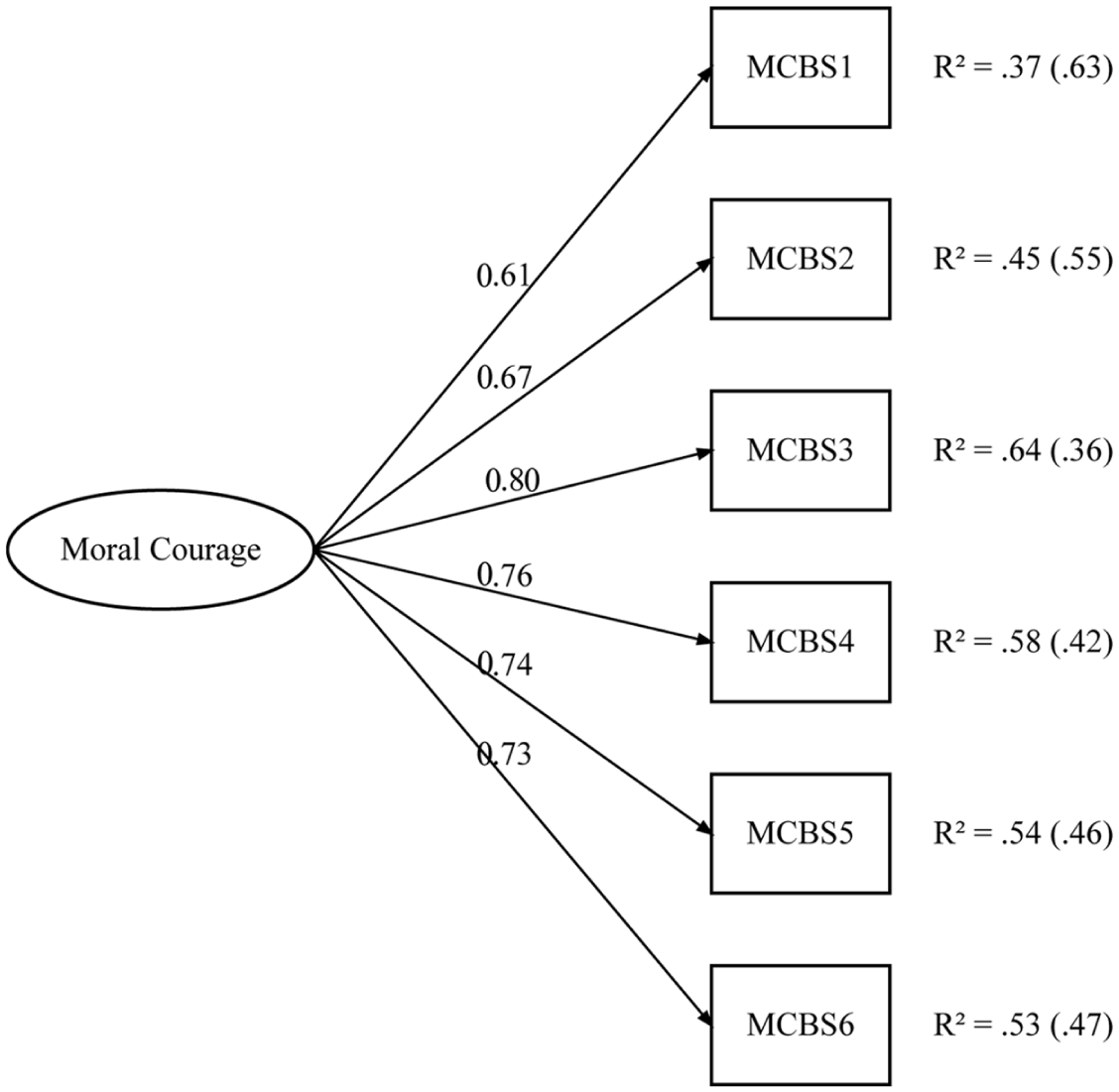
Confirmatory factor analysis for the one-dimensional MCBS model.
The results of the multi-group analysis showed that the unrestricted configural invariance model had a good baseline fit for gender, developmental stage, and time. Measurement invariance results (ΔCFI/ΔTL < .01 and ΔRMSEA < .015) showed that the one-factor-structure of the 6-items MCBS was invariant across gender, developmental stage, and longitudinally (see Table 1).
Multi-Group Invariance of MCBS across Gender.
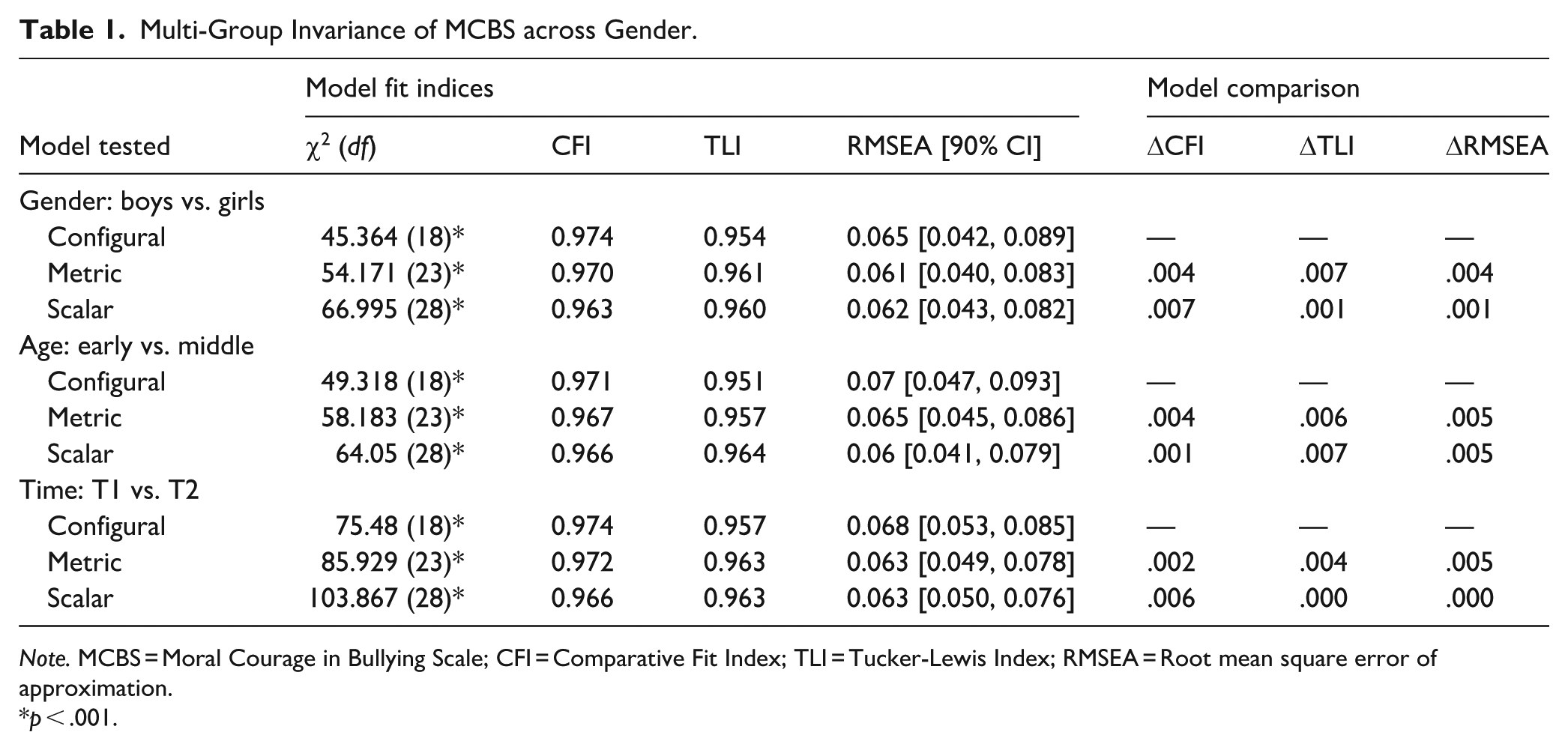
Note. MCBS = Moral Courage in Bullying Scale; CFI = Comparative Fit Index; TLI = Tucker-Lewis Index; RMSEA = Root mean square error of approximation.
p < .001.
Concurrent, Discriminant, and Longitudinal Validity
Students’ t-test showed that girls had significantly higher levels of moral courage than boys, as well as of moral anger, sympathy, and prosociality. While boys had significantly higher levels of schadenfreude for aversion. All these results were replicated on Time 2 (see Table 2). Students’ t-test was not significant for comparative analyses between early and middle adolescents for all variables, except schadenfreude for aversion (t = 4.531, df = 1,121, p < .001, d = .39). Specifically, early adolescents had higher levels than middle adolescents (T1: M = 1.84, SD = 0.94 vs. M = 1.6, SD = 0.79; T2: M = 1.82, SD = 0.99 vs. M = 1.58, SD = 0.85). Correlation analyses revealed that moral courage was positively associated with all analyzed variables (moral anger: r = .44, p < .001; sympathy: r = .4, p < .001; prosocial behaviors: r = 0.39, p < .001), which suggests that these constructs are related but not equivalent. Both dimensions of schadenfreude were not correlated to moral courage (see Table 2).
Descriptive, Gender Comparative and Correlations Analysis for Concurrent and Discriminant Validity.
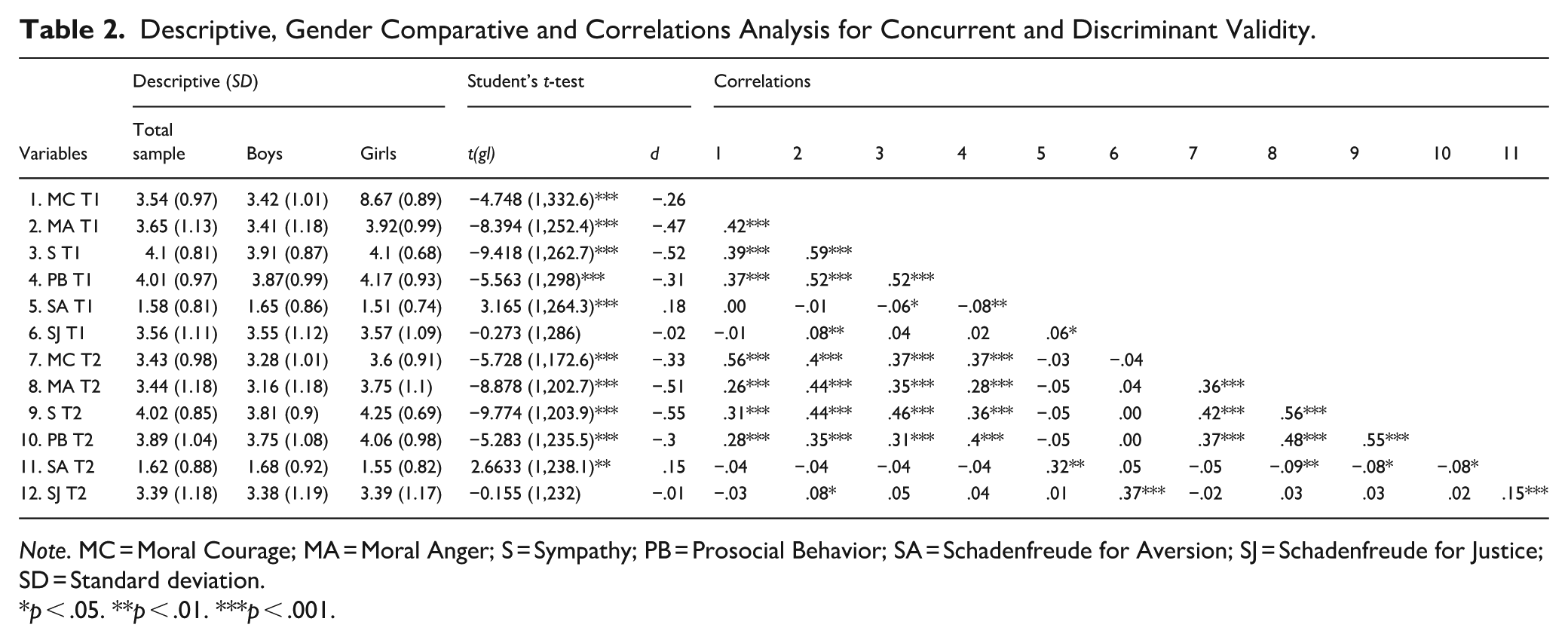
Note. MC = Moral Courage; MA = Moral Anger; S = Sympathy; PB = Prosocial Behavior; SA = Schadenfreude for Aversion; SJ = Schadenfreude for Justice; SD = Standard deviation.
p < .05. **p < .01. ***p < .001.
Preliminary analyses showed that there was no evidence of multicollinearity for any of the bystander behaviors: bully reinforcer (T = from 0.96 to 0.99, VIF = from 1.01 to 1.04), victim defender (T = from 0.59 to 0.99, VIF = from 1.01 to 1.7) and outsider (T = from 0.77 to 0.99, VIF = from 1.01 to 1.31). The Durbin-Watson statistics were 1.95 for bully reinforcing, 1.93 for victim defending, and 1.88 for outsider behaviors, indicating that the errors were independent among the independent variables. The results of the three hierarchical linear regression models, one for each kind of bystander behavior, showed that moral courage did not have a significant effect on reinforcing behaviors. But it had a positive effect on defending behaviors, while a negative effect was found for outsider behaviors (see Table 3).
Hierarchical Regression Analyses Predicting Three Kinds of Bullying Bystander Behaviors.
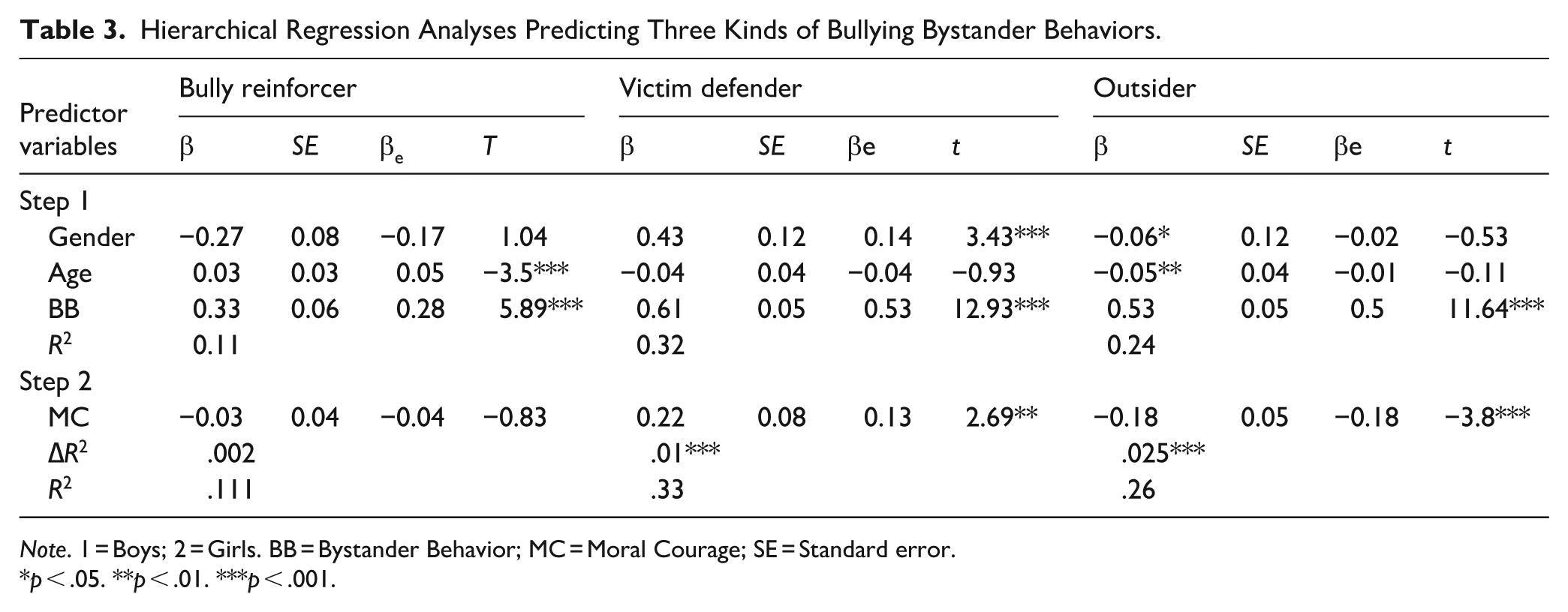
Note. 1 = Boys; 2 = Girls. BB = Bystander Behavior; MC = Moral Courage; SE = Standard error.
p < .05. **p < .01. ***p < .001.
Discussion
Moral courage is the ability to act in the face of social pressure, fear, or negative consequences, to defend moral principles or protect others (Baumert et al., 2024; Osswald et al., 2010). Adolescents often identify the perception of risks as one of the major barriers to acting when witnessing immoral situations such as bullying (Forsberg et al., 2018). Thus, moral courage would be activated in bystanders who, despite being aware of possible personal and social costs (e.g. becoming the next target or being excluded from the peer group), still decide to intervene. Although there are various studies and scales aimed at measuring moral courage, most have been designed for adults (Dal Cason et al., 2020; Numminen et al., 2019). To date, only one scale has been developed and applied with children and adolescents—the Moral Courage Scale (Bronstein et al., 2007). Nevertheless, its lack of domain-specific focus limits its applicability. This limitation is particularly relevant in the context of bullying, since defending behaviors are strongly shaped by moral evaluations and perceived risk. Therefore, the development and validation of a scale to assess moral courage in this context among adolescents is key to understanding witness decision-making.
The first aim was to develop and validate a scale specifically designed to assess moral courage in the context of bullying among adolescents. Results from the EFA confirmed a one-factor structure, which supported Hypothesis 1. This finding contrasts with the two-factor solution of the Moral Courage Scale (Bronstein et al., 2007), which distinguished between moral courage and moral reticence. The latter reflects an inhibition of behavior that can be inferred indirectly when moral courage levels are low. Including both constructs may create conceptual overlap and multicollinearity, particularly among young people, leading to reduced reliability indices and psychometric problems (Bronstein et al., 2007; Fan & Yang, 2025). Thus, including both constructs on the same scale may not be necessary when the objective is to capture involvement in morally courageous and risky behaviors in school bullying situations.
The MCBS showed an optimal fit with good internal consistency, composite reliability, and test-retest reliability, confirming its stability and reproducibility. Its six items provide a robust framework for assessing moral courage, reflecting the willingness to act according to moral values despite potential personal or social costs. Each item contributes uniquely to the construct by incorporating a distinct personal or social cost, highlighted as relevant for adolescents when they witness bullying situations (Forsberg et al., 2018; Thornberg et al., 2012). Items 3, 5, and 6 focus on personal costs, such as fear of retaliation, insecurity about effective action, and the lack of direct rewards. While items 1, 2, and 4 explicitly incorporate social risks associated with acting differently from the group, peer rejection, disapproval, or exclusion for supporting a non-group member. Together, these items capture both external and internal barriers to moral action. The scale also adopted an integrative socio-psychological perspective since items integrated the components which theoretical approaches have highlighted as part of the concept (Halmburger et al., 2016; Li et al., 2025): individual dispositions, relational factors, and situational dimensions. The domain-specific focus on school bullying ensures that the scale captures moral courage in a context in which aggressive situations are sometimes perpetuated over time by bystanders’ silence (Ortega-Ruiz, 2010), and moral action is both developmentally relevant and socially challenging for youth. These design decisions improve the scale’s ecological and conceptual relevance, reflecting realistic peer dynamics and encouraging accurate self-assessment of their involvement in morally risky behaviors.
Invariant analysis indicated that gender differences in moral courage are not attributable to item interpretation, but to actual differences in the construct levels. This confirmed Hypothesis 2a, but Hypothesis 2b was not supported, as girls had significantly higher moral courage levels than boys. Few studies have examined gender differences in moral courage during adolescence, and a recent research has reported no significant differences (García-Carrera et al., 2026). This discrepancy may be explained by methodological differences. Specifically, the study by García-Carrera et al. (2026) focused on adolescents who had previously witnessed bullying, whereas the present study included a broader adolescent population based on the willingness to defend. One possible explanation is that exposure to bullying contexts may homogenize responses, whereas gender differences are more likely to emerge when examining willingness to defend in the general population (Bravo et al., 2023; Romera et al., 2019a). According to the Ethics of Care theory (Gilligan, 1982), girls tend to develop a stronger orientation toward relational responsibility and care for others, whereas boys are more likely to emphasize principles of justice and rule-based reasoning. From this perspective, girls may be more inclined to perceive bullying as a moral transgression that elicits empathetic concern and protective action, in line with a relational approach to morality. Gender differences in moral courage may also reflect broader socialization processes. Developmental research suggests that girls are often encouraged to adopt caring and protective roles within peer relationships, whereas boys may face stronger social pressures discouraging involvement in emotionally or socially risky interventions (Killen & Dahl, 2021). Cultural factors, family dynamics, and social media can reinforce gendered expectations that influence how adolescents evaluate morally risky situations and the potential social costs associated with intervening, thereby shaping the likelihood of displaying moral courage.
The third objective was to examine the convergent, discriminant, and predictive validity of the scale. Moral courage was positively correlated with moral anger, sympathy, and prosociality (Hypotheses 3a-c), and these variables were also correlated among themselves. All of this suggests that these constructs shared aspects such as concern for justice, sensitivity to others’ suffering, and motivation to defend moral values. But the low-to-moderate correlation levels underscore that they are independent concepts. Unlike moral anger and sympathy, which reflect emotional reactions to injustice, moral courage involves a deliberate decision to act despite personal or social costs (Baumert et al., 2024; Malbois, 2023). Future studies should explore whether the association between these variables is not only correlational but also predictive. It is reasonable to expect that other-focused emotions may play a predictive role in moral courage. Prosociality also involves helping others in low-risk situations, whereas moral courage specifically requires prosocial decisions in situations that involve potential risks or social opposition (Li et al., 2025). Only a few studies have examined moral courage independently from other similar prosocial behaviors, such as helping others, and highlighted the importance of considering their differences (Kinnunen et al., 2016; Niesta et al., 2010). Future studies should investigate whether different types of victim-defender behaviors are differently associated with both helping and moral courage. Finally, the discriminant validity hypothesis 3c was confirmed; moral courage was not correlated with any dimension of schadenfreude (aversion and justice). The lack of a strong negative correlation suggests that both constructs are not opposites but rather distinct psychological processes. Schadenfreude activation may be more closely related to feelings of satisfaction and indirect personal gratification for other suffering (Cabrera-Vázquez et al., 2025), whereas moral courage reflects a willingness to act in accordance with ethical values despite potential personal costs or social risks. To sum up, accurate measurement of each construct is essential to understand adolescents’ social and relational realities (Malti et al., 2021).
Hierarchical linear regression analyses were conducted to capture predictive validity. Three models tested whether moral courage levels influenced adolescents’ bystander behaviors in bullying situations. Theoretical approach has already emphasized that moral courage plays a distinctive role in predicting involvement in morally risky behaviors, such as defending victims (Malti et al., 2021; Romera et al., 2019b). Differences were found which confirmed Hypotheses 4a-c. Moral courage positively predicted defending behavior (Hypothesis 4a) but was not longitudinally associated with reinforcing the aggressor (Hypothesis 4b). On the one hand, its predictive role in defending suggests that defending is a prosocial behavior that requires the activation of cognitive processes and the interpretation of the situation as risky. This may help explain the lack of involvement observed in many adolescents, who recognize bullying, but ultimately decide not to act (Forsberg et al., 2018). On the other hand, reinforcing the aggressor involves complex motivational and cognitive processes in which the disconnection from morality could play a key role (Thornberg et al., 2023). Further studies should explore the relationship between this type of behavior and other components of moral cognition. Lastly, moral courage negatively predicts the outsider role (Hypothesis 4c), suggesting that the construct of moral reticence, understood as the inhibition or reluctance to act in the face of a morally problematic situation (Bronstein et al., 2007), could be captured from low levels of moral courage. To sum up, moral courage is highlighted as a key component in breaking the silence that often characterizes school bullying (Ortega-Ruiz, 2010).
Limitations and Practical Implications
These findings must be considered in light of several limitations. First, the use of non-probabilistic sampling restricted the study to adolescents from a single region in Spain. Moreover, the sample was large and homogeneous in age and gender, but no data were collected on nationality or other cultural indicators, so it is not possible to determine whether perceptions and expressions of moral courage would be consistent in different cultural contexts. Cross-cultural studies are needed to test the scale’s generalizability across diverse demographic and cultural contexts. In addition, the influence of other factors such as race, religion, socioeconomic status, or disabilities should be explored on the scale’s reliability and invariance. Second, the study relied on self-reports, which capture personal moral-cognitive processes and are less affected by reputational biases; but may be affected by social desirability bias and participants’ mood. Combining self-reports with peer or teacher reports could improve measurement accuracy. Thirdly, criterion validity with other existing moral courage scales was not assessed; future research should explore its convergence with other instruments. Lastly, although the present study examines criterion validity of the scale through its associations with emotional processes (sympathy and moral anger), the construct may partially overlap with other related concepts that also involve helping under potential social costs, such as prosocial risk-taking (Armstrong-Carter & Telzer, 2025). While moral courage emphasizes a moral–normative motivation to confront wrongdoing, prosocial risk-taking describes different ways to provide meaningful, practical, and emotional support to others, even when doing so involves personal risk. A relevant difference between both is that moral courage places greater emphasis on the moral-normative motivation underlying the behavior, rather than solely on the risk structure of the decision. Future research should examine and clarify these conceptual boundaries more directly by incorporating comparative measures of prosocial risk-taking and testing discriminant validity through multi-construct designs.
The development of a robust and psychometrically valid scale to assess moral courage in bullying situations represents a significant advancement for both research and educational practice. Having a reliable measure of moral courage facilitates the detection of student profiles more likely to intervene as defenders, thereby helping to disrupt power dynamics that perpetuate bullying. The application of this scale in schools could provide key information for the design of educational public policies and school-based programs, strengthening the development of socio-emotional and moral competence, critical thinking, and an ethics of care. Understanding adolescents’ moral courage in witnessing injustice is crucial for fostering ethical, civic, and prosocial behavior, contributing to a more sustainable and peaceful society.
Conclusions
This study provides new evidence by introducing a specific scale with strong psychometric properties for assessing moral courage in school bullying contexts. This tool enables a more contextualized and realistic exploration of its association with bystander behaviors. Moreover, the scale demonstrates both gender and longitudinal invariance, supporting its reliability and validity, and captures the distinct nature of moral courage in relation to other constructs such as moral anger, sympathy, and prosociality. These features enable more nuanced research into the complexity of moral-cognitive processes involved in bullying. Longitudinal analyses showed that moral courage predicts increases in defending behaviors and decreases in passive bystander behaviors over time, highlighting its role in shaping adolescents’ proactive engagement in bullying situations. In contrast, the lack of association with reinforcing behavior suggests the need to explore additional moral, motivational, and cognitive mechanisms to fully understand the multifaceted nature of bullying dynamics.
Supplemental Material
sj-docx-1-jiv-10.1177_08862605261451861 – Supplemental material for Design and Validation of the Moral Courage in Bullying Scale in Adolescents
Supplemental material, sj-docx-1-jiv-10.1177_08862605261451861 for Design and Validation of the Moral Courage in Bullying Scale in Adolescents by Ana Bravo, Paula García-Carrera, Rosario Ortega-Ruiz and Eva M. Romera in Journal of Interpersonal Violence
Footnotes
Author Note
All authors agree with the authorship order and the content of the manuscript.

Ethical Considerations
All procedures performed in studies involving human participants were in accordance with the ethical standards of the 1964 Helsinki declaration and its later amendments or comparable ethical standards. The project was approved by Ethics Committee for Bioethics and Biosecurity committee of the Universidad de Córdoba (Spain). Code: CEIH-21-17.
Consent to Participate
Written informed consent was obtained from all parents of participants.
Author Contributions
Funding
Declaration of Conflicting Interests
The authors declared no potential conflicts of interest with respect to the authorship and/or publication of this article.
Data Availability Statement
The data that support the findings of this study are available on request from the corresponding author.*
Supplemental Material
Supplemental material for this article is available online.
Originality Statement
This work is original, has not been published elsewhere, and is not under consideration by any other journal.
Author Biographies
References
Supplementary Material
Please find the following supplemental material available below.
For Open Access articles published under a Creative Commons License, all supplemental material carries the same license as the article it is associated with.
For non-Open Access articles published, all supplemental material carries a non-exclusive license, and permission requests for re-use of supplemental material or any part of supplemental material shall be sent directly to the copyright owner as specified in the copyright notice associated with the article.
