







Abstract
Community violence (CV) has been linked to negative psychosocial outcomes including conduct problems among youth. Perceptions of the neighborhood environment may affect the way youth respond to CV; however, the role of neighborhood perceptions in the association between CV and conduct problems is unclear. The current study explored the role of youth neighborhood perceptions of safety and cohesion in moderating the association between CV and conduct problems. A sample of 427 African American adolescents completed measures of CV witnessing and victimization, neighborhood safety, neighborhood cohesion, and conduct problems in 10th and 11th grade. Regression analyses were conducted with grade 10 CV and neighborhood perceptions as predictors of conduct problems in grade 11. Results indicated significant interactions between CV witnessing and neighborhood safety (B = 0.17, p < .05) and between CV victimization and neighborhood safety (B = 0.27, p < .05). For both witnessing and victimization, associations between CV and conduct problems a year later were stronger when perceived neighborhood safety was high. The counterintuitive findings highlight the contextual effects of CV on youth conduct behavior. Future research is needed to understand the complex interplay of neighborhood perceptions and the experience of CV.
Introduction
A longstanding body of research documents the adverse impacts of community violence on adolescents’ health and wellbeing (Dubé et al., 2018; Elsaesser, 2018; Miliauskas et al., 2022). Beyond physical harms, adolescents’ community violence exposure has been linked prospectively with numerous internalizing and externalizing problems including symptoms of depression, anxiety, and trauma, difficulties with attention and concentration, and aggressive and acting out behaviors (Fowler et al., 2009; Miliauskas et al., 2022). Among the negative outcomes influenced by violence exposure, externalizing behaviors, in particular conduct problems, are of major concern developmentally. Conduct problems in adolescence interfere with concurrent emotional, behavioral, social, and academic functioning (Bierman et al., 2014) and forecast problems in mental and physical health, involvement in risky behaviors, and difficulties with education and employment during adulthood (Bevilacqua et al., 2018; Colman et al., 2009). Thus, understanding the nuances of the connection between community violence exposure and conduct problems and what may affect the connection is needed.
Negative perceptions of the neighborhood, such as disorder and low safety, have been linked with increased problem behaviors (Yoon, 2021). However, there remains a gap in understanding how perceptions of the neighborhood environment might determine, at least in part, how adolescents respond to community violence exposure, including whether they exhibit conduct problems. Understanding how the perceived neighborhood accounts for variation in youth responses to community violence will help clarify reasons for variation in youth responses to community violence exposure and can identify aspects of the neighborhood that can be integrated into interventions for community violence-exposed youth and those at risk of exposure. Thus, this research examined the role of perceived neighborhood cohesion and perceived neighborhood safety in associations between community violence exposure and conduct problems.
Community Violence and Conduct Problems
Conduct problems encompass a range of externalizing behaviors that violate the rights of others, social rules, and/or norms for age-appropriate behaviors (e.g., aggression, physical destruction, stealing; American Psychiatric Association, 2013). Among community samples of adolescents, exposure to community violence as a witness or victim has been linked prospectively with more conduct problems (Pearce et al., 2003; Ruchkin et al., 2023) and conduct disorder (McCabe et al., 2005), and these associations are evident for male and female adolescents (Ruchkin et al., 2023). Community violence-exposed youth also are more likely to be involved in delinquent behaviors (Chen et al., 2013; Hong et al., 2014), which commonly overlap or co-occur with conduct problems as both delinquency and conduct problems are characterized by similar indicators (e.g., norm-violating, aggressive, and/or illegal behaviors). It is important to note that prior research has identified reciprocal associations between community violence and conduct problems (Mrug et al., 2009), and youth with conduct problems have a higher likelihood of being exposed to violence than those without conduct problems (Kersten et al., 2017). Nonetheless, research that has examined reciprocal associations between community violence and conduct problems has found that the links from community violence to conduct problems are stronger than the reverse, with differences in effects based on whether youth were witnesses to violence or victims of violence (Farrell et al., 2020). The distinction in CV witnessing and victimization has been shown to impact youth outcomes such as physical aggression and anxiety, with youth victimized by CV reporting higher levels of negative outcomes (Pittman & Farrell, 2022).
Given interest in safeguarding the wellbeing of community violence-exposed youth, research has focused on factors that may weaken the link between community violence and externalizing problems and help to explain variation in youth’s externalizing responses to community violence. Warm and close relationships, family support and monitoring, and school engagement and performance have been identified as factors that can attenuate the association between community violence and externalizing problems (see Ozer et al., 2017 for a review; Poquiz et al., 2018). However, few have considered characteristics of the neighborhood as potential moderators of the association between community violence and externalizing problems (Yule et al., 2019), and studies focused on conduct problems are rare. As an exception, Li et al. (2007) found that perceived positive neighborhoods, characterized by neighborhood involvement and cohesion, had a protective stabilizing effect against community violence-exposed youth’s externalizing behaviors, including conduct problems and delinquency. Specifically, the association between exposure to community violence and externalizing behavior was nearly twice as strong when youth perceptions of a positive neighborhood were low as compared to when youth perceptions of a positive neighborhood were high. Extending that work, this research examines whether perceived neighborhood cohesion and neighborhood safety alter prospective associations between community violence and adolescents’ conduct problems.
Perceived Neighborhood Cohesion
As youth gain more autonomy outside their familial home, peers and neighbors in the community may become more prominent in their neighborhood environments. Perceived neighborhood cohesion, that is, perceptions of the extent to which a person can trust and lean on other members of the community to positively intervene when issues arise, has been studied as a protective factor against neighborhood stressors (Kingston, 2009). Most research demonstrating the protective effects of cohesion against adverse outcomes of contextual stress has focused on depressive symptoms, showing protection against the effects of structural disadvantage (Dawson et al., 2019) and racial discrimination (Saleem et al., 2018) on depressive symptoms. In addition, neighborhood cohesion has been found to protect against externalizing behaviors among adolescents experiencing racial discrimination (Riina et al., 2013). Likewise, Kingsbury et al. (2020) found that the association between significant life events and adolescents’ aggression and conduct disorder symptoms was lower in neighborhoods high in social cohesion as compared to those with low social cohesion. The few studies examining neighborhood cohesion’s protective effects against community violence suggest similar protective effects. Among a sample of Black adolescents, DiClemente et al. (2018) found that neighborhood cohesion had a protective, enhancing effect for males such that exposure to community violence was associated with more self-esteem for males who perceived more neighborhood cohesion. Likewise, Meléndez Guevara et al. (2022) found that community belongingness attenuated the association between community violence exposure and aggressive cognitions that were linked with conduct problems in a sample of Columbian youth.
Perceived Neighborhood Safety
Social disorganization theory (Sampson & Groves, 1989) highlights social and physical characteristics of neighborhoods that may signal that a neighborhood is not safe. For example, the presence of graffiti and litter, abandoned buildings and cars, and high unemployment can suggest low social control and dysregulation of detrimental behavior such as crime and delinquency among community members. These neighborhood characteristics have been linked with neighborhood crime and violence (Barton et al., 2021) and, as a result, may also engender perceptions of violence and low perceived safety. Low perceived safety might be associated with stronger, and perceived safety with weaker, associations between contextual stressors and adolescent outcomes. As an example, Fite et al. (2010) found that the positive association between peer delinquency and proactive aggression was weaker when adolescents perceived their neighborhoods as safe. The authors proposed that unsafe neighborhoods might have more opportunities for socialization processes that are conducive to aggressive behavior. Other studies indicate that the protective benefits of contextual supports are less if perceived safety is low (Fauth et al., 2007). Taken together, the available research suggests that perceptions of neighborhood safety can have implications for externalizing responses to contextual stress, though research has not specifically focused on community violence and conduct problems.
Impact on Racially and Ethnically Minoritized Youth
The need for understanding the relationships between different forms of CV and psychosocial outcomes is heightened, given the disproportionate exposure and subsequent effects of CV on youth of color. Youth with minoritized racial and ethnic identities have higher risks of exposure to gun violence, up to 7 times more likely than their White counterparts (Kravitz-Wirtz et al., 2022). Moreover, youth of color often must change behaviors and social interactions in neighborhoods impacted by high levels of community violence, leading to social isolation (Fenner et al., 2024). Given the heightened risks and heightened behavioral and emotional impacts on diverse youth in communities, there needs to be further investigation into contextual factors that may play a role in exacerbating or lessening the effects of CV.
Current Study
There is increasing recognition that perceptions of the neighborhood context have implications for how adolescents experience and respond to contextual stressors. The available studies considering the protective benefits of positive neighborhood perceptions have been cross-sectional, considered other types of stressors, have not focused specifically on conduct problems. To address these gaps, this study used a prospective design to examine perceived neighborhood cohesion and perceived neighborhood safety as moderators of the association between community violence exposure and conduct problems. We hypothesized that these positive neighborhood perceptions would be associated with a weaker prospective association between community violence exposure and conduct problems.
Method
Participants and Procedure
Participants were 429 African American youth originally assessed in grade 1 as part of an evaluation of two school-based universal preventive interventions whose immediate targets were early learning and aggressive behavior (Ialongo et al., 1999). These 429 youths were selected based on their participation in subsequent grades and their inclusion in the experimental group. The original sample consisted of 678 children and families representative of students entering first grade in 9 public elementary schools (Ialongo et al., 1999). Three first grade classrooms in each of the nine elementary schools were randomly assigned to one of the intervention conditions or a control condition. The interventions were provided over the first grade year only, following a pretest assessment in the early fall. Of the 678 children who participated in the original study in the fall of 1993, 585 were African American. Of these 585 African American youth, approximately 73.33% (n = 429) had parental consent, provided assent, and reported about their community violence exposure, neighborhood cohesion, neighborhood safety, and conduct problems in grades 10 and 11. These children (48% female) comprised the sample of interest. At the 10th grade assessment, youth ranged in age from 15.11 to 17.01 years old (M = 15.80, SD = 0.36). As an indicator of socioeconomic status, approximately 72% of the current sample received free or reduced-priced meals (FARMs). Chi-square tests showed no differences in gender or percentage receiving FARMs between the 427 participants included in this study and the 156 African American youth in original sample who did not provide data at the 10th grade follow-up assessments (ps > .05). A face-to-face interview was used to gather data from youth in each spring of participants’ 10th and 11th grade years. All procedures in this study were conducted in accordance with APA ethical standards, and the Johns Hopkins School of Public Health IRB approved the study protocols (IRB# 9223). Written informed consent was obtained from parents, and verbal assent was obtained from the youth.
Measures
Community Violence Exposure
Community violence exposure was assessed at 10th grade using a modification of the Children’s Report of Exposure to Violence (Cooley et al., 1995), a self-report instrument used to assess the frequency of exposure to community violence through witnessing, victimization, hearsay, and media. Previous studies have yielded good internal consistency with Cronbach’s alphas ranging from .78 to .89 (Cooley et al., 1995; Purugganan et al., 2000). Only the witnessing and victimization subscales were used. There were a total of 10 items corresponding to different types of community violence. Respondents indicated whether they had directly witnessed or been victimized by nine violent events (shooting, stabbing, beating, robbing, pulling a gun on someone, pulling a knife on someone, threatening to kill someone, threatening to beat someone, and chasing) or directly witnessed a killing. The number of events directly witnessed was summed to create a community violence witnessing score (range = 0–10), and the number of these events experienced as victims was summed to create a victimization score (range = 0–9).
Perceived Neighborhood Cohesion
Youth reported on perceptions of connections and support in their neighborhood at 10th grade using six items from the Neighborhood Cohesion Index (Buckner, 1988). Participants reported how much they agreed with statements about their neighborhood and neighbors on a four-point Likert scale (1 = “strongly disagree” to 4 = “strongly agree”). The measure included questions such as, “I fit in with my neighbors” and “I believe my neighbors would help me in an emergency.” The six items were averaged to create a mean score, where higher scores indicated stronger feelings of cohesion in the neighborhood. Cronbach’s alpha for this scale was .74 in 10th grade.
Perceived Neighborhood Safety
Adolescent perceptions of safety in their neighborhoods were assessed at 10th grade using two items from the Neighborhood Environment Scale Index (Elliott et al., 1985). Youth reported the extent that they agreed with statements about their neighborhood and neighbors on a four-point Likert scale (1 = “Not at all true,” 4 = “Very true”). The two items were questions indicating feelings of safety while walking around their neighborhood: “I feel safe when I walk around my neighborhood during the day” and “I feel safe when I walk around my neighborhood at night.” These neighborhood safety items were averaged to create a mean score, where higher scores indicated stronger rating of feeling safe while walking in the neighborhood. Cronbach’s alpha for this scale was .67 in 10th grade.
Conduct Problems
The Diagnostic Interview Schedule for Children (DISC-IV; Shaffer et al., 2000), a fully structured interview aligned with the Diagnostic and Statistical Manual of Mental Disorders (4th ed.; DSM-IV; American Psychiatric Association, 1994), generates a diagnosis, as well as symptom and criterion count for disorders. The count of the 15 diagnostic symptom criteria for Conduct Disorder was used in this study. Criterion counts for grade 10 and 11 were used. Although full psychometric information of the DISC-IV has yet to be published, data on a previous version, the DISC 2.1, suggest adequate and acceptable test–retest reliability (.71 for Conduct Disorder; Shaffer et al., 2000).
Analytic Strategy
We conducted linear regressions of 11th grade conduct problems on all study variables of interest to note any main effects. To examine whether adolescent community violence exposure was associated with an increase in conduct problems and if those associations varied by perceptions of neighborhood safety or neighborhood cohesion, moderation analyses were conducted using model 2 of the PROCESS macro 4.2 in SPSS 29 (Hayes, 2022). Model 2 of the PROCESS macro allows for the probing of two moderators simultaneously. Community violence exposure was examined in two separate models: one for witnessing violence and one for victimization. Conduct problems in 11th grade were regressed on sex, community violence exposure, 10th grade conduct problems, perceived neighborhood safety and neighborhood cohesion in 10th grade, and their interactions with community violence exposure to assess whether neighborhood perceptions buffered the direct effect of community violence exposure on conduct problems. All continuous variables were mean-centered. The conditional effects of community violence exposure on conduct problems were assessed at +1/−1 SD levels of the respective moderators. Bootstrapped confidence intervals were calculated using 5000 bootstrap samples. Simple slopes were plotted to provide a visual interpretation of a significant interaction.
Results
Descriptive Statistics
Descriptive statistics and correlations of study variables are presented in Table 1. There were low average numbers of reported community violence witnessing (M = 2.42, SD = 2.26) and victimization (M = 1.12, SD = 1.46). Over three-fourths (n = 336, 78.7%) of youth reported witnessing violence in the past year, while less than half (n = 244, 57.1%) of youth reported being victimized in the last year. In terms of frequency, 56.2% (n = 240) of youth witnessed more than one instance of community violence, and 24.5% (n = 105) of youth were victimized more than once in the past year. Both community violence witnessing (r = .388, p < .01) and victimization (r = .365, p < .01) in the 10th grade were positively associated with conduct problems in 11th grade. Neighborhood cohesion (r = −.205, p < .01), but not neighborhood safety (r = .041, p > .05), was associated with fewer conduct problems prospectively.
Correlations and Descriptive Statistics.
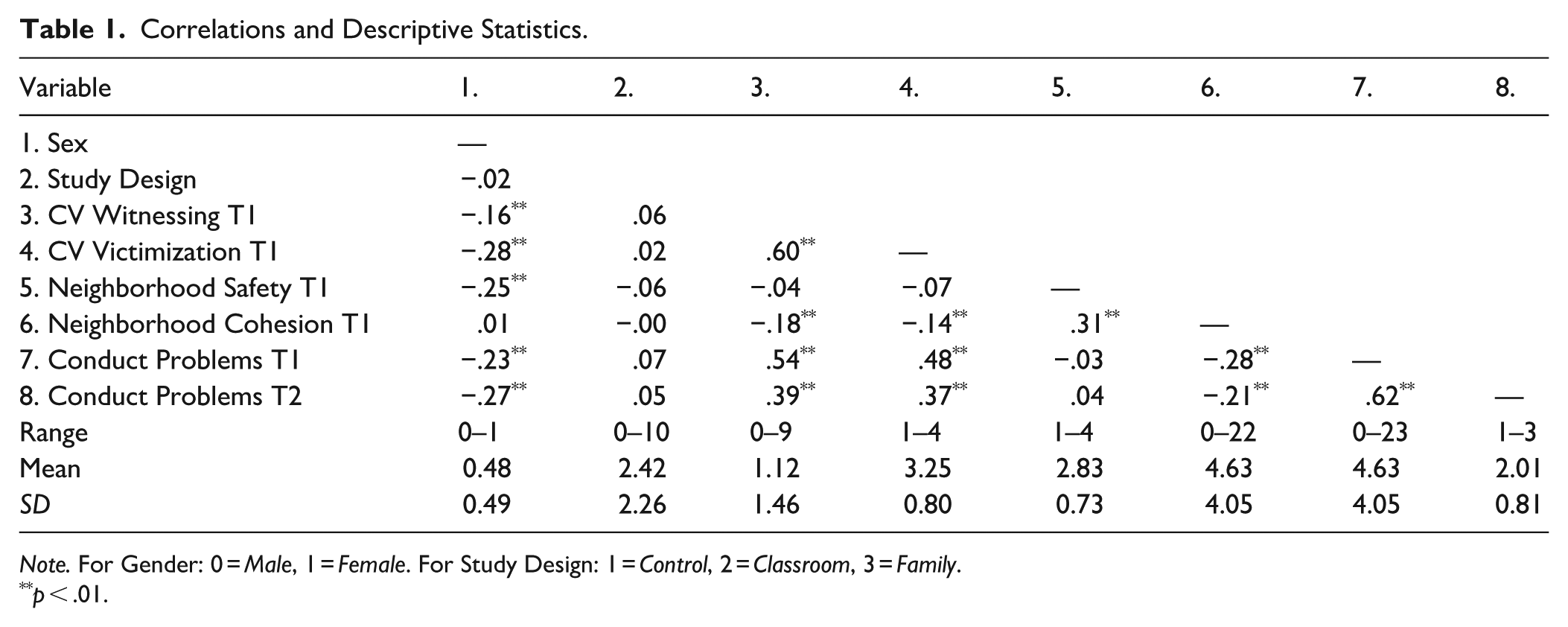
Note. For Gender: 0 = Male, 1 = Female. For Study Design: 1 = Control, 2 = Classroom, 3 = Family.
p < .01.
Regression Results
Main Effects
Main effects of all study variables are presented in the first half of Table 2. Of note, only previous 10th grade conduct problems and participant sex were significantly associated with 11th grade conduct problems. None of the CV or neighborhood perceptions was significantly associated with 11th grade conduct problems when taking account all other study variables.
Regression Models of Conduct Problems T2 on Community Violence, Neighborhood Safety, and Neighborhood Cohesion.
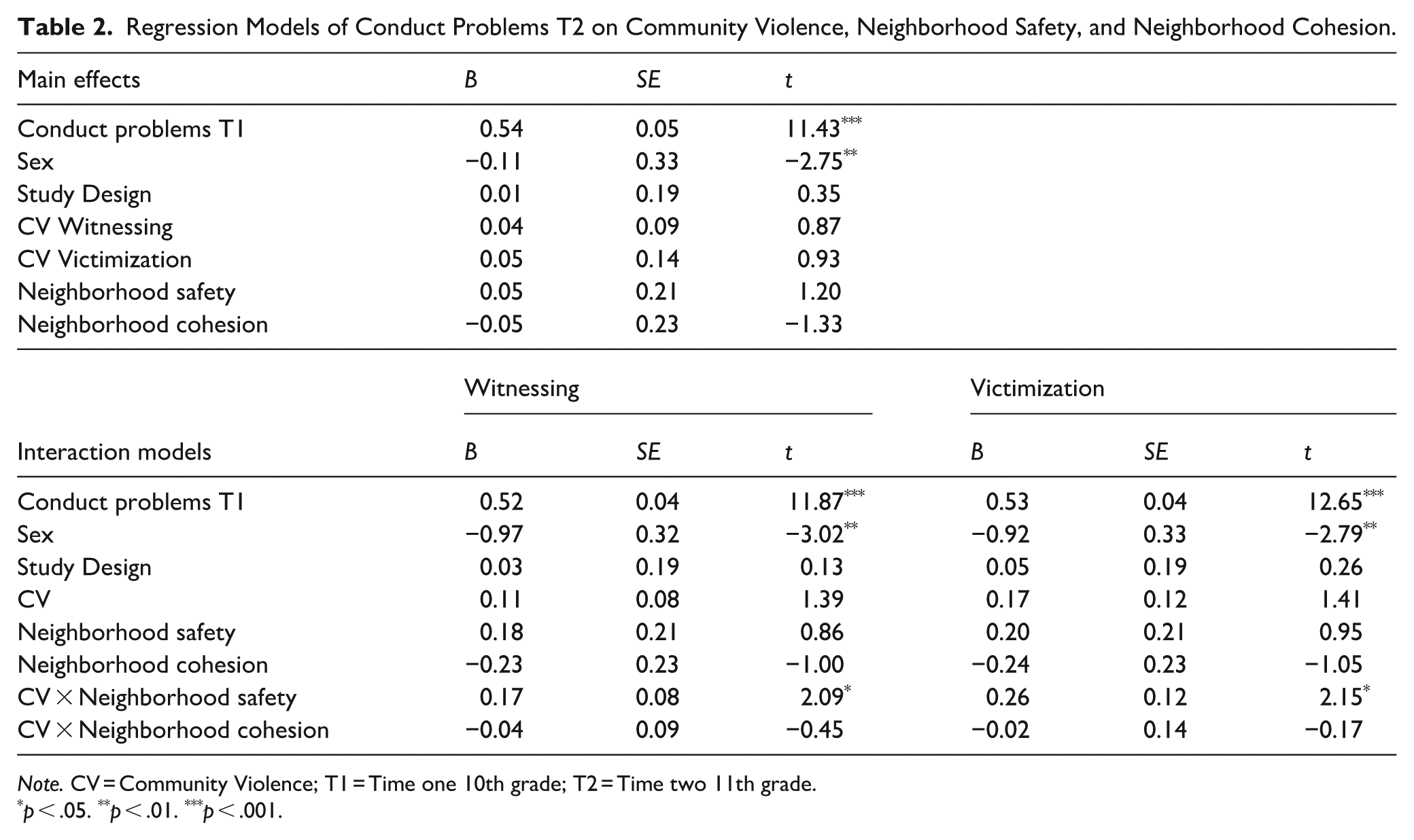
Note. CV = Community Violence; T1 = Time one 10th grade; T2 = Time two 11th grade.
p < .05. **p < .01. ***p < .001.
Moderation Analyses: Community Violence Witnessing
Results of the moderation regression models for witnessing community violence are presented in Table 2. The model was significant (F7,421 = 43.31, p < .001) with an R2 of .42. There were no significant main effects of community violence witnessing, neighborhood safety, or neighborhood cohesion. Covariates of sex and 10th grade conduct problems were significantly associated with 11thgrade conduct problems. The interaction between witnessing and neighborhood cohesion was not significant. There was a significant interaction between neighborhood safety and witnessing on conduct problems in 11th grade (B = 0.17, p < .05). When probing the interactions at the mean and +1/−1 SD levels, the association of witnessing violence was only significant at high levels of neighborhood safety (Effect = 0.241, t = 2.41, p < .05, BSCI [0.045, 0.437]) and not at the mean level (Effect = 0.111, t = 1.389, p = .165, BSCI [−0.046, 0.268]) or low levels of neighborhood safety (Effect = −0.028, t = −0.267, p = .790, BSCI [−0.233, 0.177]). Plotting the simple slopes (Figure 1) revealed that youth who reported high levels of witnessing and high levels of neighborhood safety exhibited high conduct problems compared to youth reporting being in a less safe neighborhood.
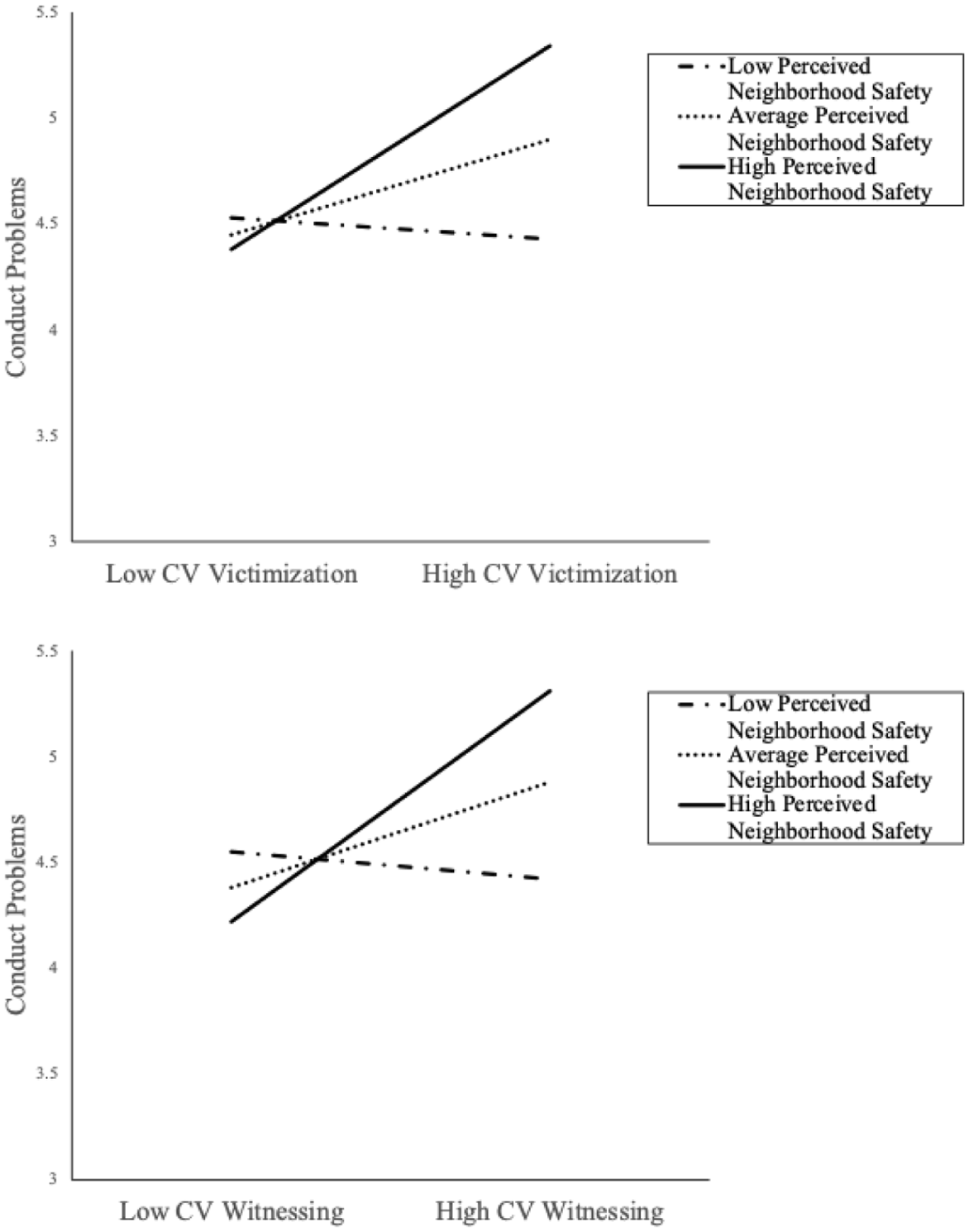
Simple slopes interaction plots at +/−1 SD of the moderator.
Moderation Analyses: Community Violence Victimization
Results of the moderation regression models for being victimized by community violence are presented in Table 2. The model was significant (F7,421 = 43.37, p < .001) with an R2 of .42. There were no significant main effects of community violence victimization, neighborhood safety, or neighborhood cohesion. Covariates of gender and 10th grade conduct problems were significantly associated with 11th grade conduct problems. The interaction between witnessing and neighborhood cohesion was not significant. There was a significant interaction between neighborhood safety and victimization on conduct problems in 11th grade (B = 0.27, p < .05). When probing the interactions at the mean and +1/−1 SD levels, the association of witnessing violence was only significant at high levels of neighborhood safety (Effect = 0.373, t = 2.46, p < .05, BSCI [0.076, 0.671]) and not at the mean level (Effect = 0.175, t = 1.405, p = .161, BSCI [−0.070, 0.419]) or low levels of neighborhood safety (Effect = −0.041, t = −0.251, p = .802, BSCI [−0.358, 0.277]). Plotting the simple slopes (Figure 1) revealed that youth who reported high levels of victimization and high levels of neighborhood safety exhibited high conduct problems compared to youth reporting being in a less safe neighborhood.
Discussion
This research examined perceived neighborhood cohesion and perceived neighborhood safety as neighborhood experiences that might affect the link between community violence and adolescents’ conduct problems. Unlike in prior research (Fowler et al., 2009), witnessing and victimization by community violence were not linked with more conduct problems above and beyond the other factors in our study. However, the tests of moderation by perceived neighborhood cohesion and perceived neighborhood safety linked CV with subsequent conduct problems and yielded similar results for community violence witnessing and victimization. Measurements of CV witnessing and victimization were highly correlated in our sample and may explain the observation of similar effects. These similar findings for witnessing and victimization reinforce other research suggesting that the type of violence exposure may distinguish whether youth display internalizing problems, but externalizing problems may be a more universal response to community violence exposure.
Our findings highlight the importance of considering adolescents’ subjective experience of their neighborhoods to understand the development of conduct problems among violence-exposed youth. Contrary to expectation, perceived neighborhood cohesion did not protect against conduct problems for community violence-exposed youth. Also, against expectation, the association between community violence exposure and conduct problems was stronger for adolescents who perceived their neighborhoods as safer. These contradictions point to a need for a more nuanced understanding of how the subjective perceptions youth hold about their communities can play a role in how neighborhood stressors such as CV can manifest into maladaptive behaviors.
Perceived Neighborhood Cohesion Did Not Protect Against Conduct Problems for Community Violence-Exposed Youth
Considerable prior research highlights the benefits of neighborhood social cohesion for adolescents’ emotional and behavioral adjustment (Breedvelt et al., 2022; Kim et al., 2024), and there is evidence that neighborhood cohesion can attenuate the adverse effects of contextual stressors (Dawson et al., 2019; Riina et al., 2013; Saleem et al., 2018). However, while more perceived neighborhood cohesion was associated with fewer teacher-reported conduct problems in this study, neighborhood cohesion did not protect against the effects of community violence exposure on conduct problems. This was surprising. However, it is important to note that most prior research has found that cohesion protects against internalizing problems, and prior research showing that cohesion protects against the effects of contextual stress on adolescents’ externalizing behaviors has demonstrated protection against stressors other than community violence (Kingsbury et al., 2020; Riina et al., 2013). While DiClemente et al. (2018) showed that neighborhood social cohesion had a protective enhancing effect for male adolescents exposed to community violence that result was for self-esteem. Meléndez Guevara et al. s’ (2022) finding that community belongingness attenuated the association between community violence exposure and aggressive cognitions that were linked with conduct problems suggests that cohesion’s protection against conduct problems for community violence-exposed youth might be indirect, through its impact on cognitions related to aggression or violence. The moderating effect of neighborhood cohesion may be more contextualized with other factors and environments. Future research should explore whether neighborhood cohesion protects against antecedents to conduct problems to understand possible mechanisms through which cohesion might have protective benefits.
Some research suggests that the effects of cohesion are dependent on other characteristics of the neighborhood. For example, Bjornstrom et al. (2013) found that neighborhood physical disorder (e.g., abandoned cars, garbage or litter, graffiti) moderated the effects of social cohesion such that perceived cohesion was associated with better adult health for low and moderate levels of neighborhood physical disorder but was not associated with better health when participants reported high physical disorder. It is possible that for youth in our sample, protective effects of cohesion might be conditional on other aspects of the neighborhood environment as in the aforementioned studies. However, it also should be noted that some research suggests that social cohesion is not always protective against problem behaviors. As an example, Martins et al. (2017) found that adolescents’ perceptions of social capital were associated with more binge drinking. Future research should examine conditions under which neighborhood social cohesion confers protective benefits for community violence-exposed youth.
Perceived Neighborhood Safety was Associated With Greater Conduct Problems for Community Violence-Exposed Youth
It was unexpected that perceptions of neighborhood safety were associated with greater conduct problems for youth exposed to community violence. Prior research has found that perceptions of safety are linked with less risky behavior and conduct problems (Midouhas et al., 2021). Given this evidence, we expected that youth who perceive their neighborhood as safe would engage in fewer conduct problems. However, as suggested above, it is possible that the protective effects of perceived safety might be conditional on other aspects of the neighborhood environment. For example, perceptions of safety might not be protective when the neighborhood context is characterized by violence. If perceptions of safety are discrepant from conditions in the environment, youth might have more exposure to community violence and its adverse outcomes. It is also possible that the association between community violence and conduct might be stronger when perceived safety is high because one’s perceptions of neighborhood safety might be due to engaging in self-protective behaviors that have been linked with conduct problems (e.g., proactive aggression). Future research should consider perceived neighborhood safety along with neighborhood crime and violence to better understand the conditions under which perceived neighborhood safety might be protective. Given links between community violence exposure and proactive aggression (Pittman, 2023), it will be important for future research to explore whether community violence-exposed youth’s proactive aggression increases their perceptions of safety and involvement in conduct problem behaviors. Youth might consider proactive aggression and related actions a means to protect themselves against future community violence victimization. These actions might protect against future violence victimization, though not protect against conduct problems.
Implications
These study findings have implications for research and intervention with community violence exposed-youth and youth at risk for exposure. Though neighborhood cohesion did not protect against conduct problems in this study, the main effect of cohesion suggests that efforts to promote neighborhood cohesion have value. Following other research indicating that the protective benefits of cohesion are evident when disorder is low, there is a call for more consistent efforts to improve and strengthen neighborhoods in ways that counter neighborhood disorder. These efforts should parallel work to remove neighborhood conditions that are conducive to neighborhood violence, and youth’s potential for exposure to community violence. While Braga et al. (2024) found in their review that policing strategies have been shown to be effective in reducing crime and neighborhood disorder, they emphasize that police need to engage the community and center efforts around community-defined concerns and collaborative problem-solving approaches. Interventions designed to decrease neighborhood disorder by targeting access and quality of housing have yielded mixed results regarding improvement of mental health (Oswald et al., 2024).
One of the most effective strategies used by organizations and governments to enhance connections in communities is creating opportunities for positive contact and coordination between community members (Orazani et al., 2023). Ferguson et al. (2018) evaluated the CONNECT Program, which was community-based, service-coordination and delivery intervention that utilized peer outreach workers recruited from the community. They used their skills in connecting and engaging with their community members, through walking the streets of the neighborhood and visiting public spaces like parks and businesses. Results showed significant increases in neighborhood trust and social capital, along with service utilization. Likewise, engaging with neighborhood residents fostered connections based on bottom-up approach to needs-based assessments and providing community members people they could more closely identify with compared to members from outside the community (Orazani et al., 2023). Given our current findings, interventions that focus on enhancing and promoting neighborhood and community cohesion should coincide with interventions that lower neighborhood disorder to ensure effectiveness.
Our finding that perceptions of neighborhood safety are associated with a stronger link between community violence and conduct problems suggests a need for investigating what contributes to these perceptions. Youth perceptions of safety might reflect a safe environment or could be a consequence of youth’s affiliations or behavior that heighten their sense of safety. An enhanced understanding of reasons for youth’s perceptions of neighborhood safety is important for individuals working in youth serving capacities.
Given that our study focused on neighborhood experiences and perceptions, these findings may provide additional insight on how to address conduct problems in the context of community violence. As noted, Black youth are exposed to community gun violence at much higher rates than their White counterparts (Kravitz-Wirtz et al., 2022), a fact emphasizing the need to address CV. Our findings highlight the importance of understanding how Black youth perceive the context in which community violence takes place. Past research has not centered or ignored the lived experiences in of Black youth in their neighborhoods, instead focusing mainly on structural or purely quantitative measures of communities (Fike & Mattis, 2024).
Strengths, Limitations, and Future Directions
A strength of this study was examining how perceptions of the neighborhood environment relate to conduct problems for community violence-exposed adolescents. Prior research has focused mainly on individual and family factors as possible protective factors. Understanding how the broader neighborhood context might inform community violence-exposed youth’s behavioral adjustment broadens possibilities for intervention beyond focusing only on the individual and family level. While neither perceived neighborhood cohesion nor perceived safety emerged as protective factors, these results highlight the importance of considering how and for whom perceived cohesion and perceived safety is a benefit for adjustment. That perceived cohesion was associated with fewer conduct problems but did not protect against the effects of community violence on conduct problems suggests, in line with other research (Bjornstrom et al., 2013; Kingsbury et al., 2020), that cohesion alone is insufficient to guard against community violence effects on externalizing behaviors.
These study strengths should be considered in the context of some limitations. First, while the focus on neighborhood perceptions as possible modifiers of the effect of community violence on adolescents’ conduct problems was a strength, neighborhood perceptions also might be consequences of community violence exposure. Future research should consider neighborhood perceptions as possible mechanisms linking violence exposure and behavioral adjustment and evaluate possible reciprocal pathways between neighborhood perceptions and risk behaviors as have been identified in other research (Midouhas et al., 2021). Second, only two types of neighborhood perceptions, cohesion and safety, were considered in this research. Other types of neighborhood perceptions should be evaluated. For example, perceived neighborhood disorder has been linked with conduct problems in prior research (Edwards & Bromfield, 2009), and whether perceived cohesion protects against contextual stressors may depend on neighborhood disorder (Bjornstrom et al., 2013). Future research also will benefit from examining different types of neighborhood perceptions and examining how these operate together. For example, perceiving oneself safe in the context of perceived disorder and perceiving oneself safe in the context of low disorder could have markedly different consequences for behavioral adjustment, including the likelihood of conduct problems after community violence exposure. Likewise, evaluating neighborhood perceptions in combination with administrative data about the neighborhood might offer similar nuanced information. While research has demonstrated that adolescents’ perceptions of their neighborhood are a valid source of information (Martin et al., 2017) and may better predict youth outcomes than administrative data about neighborhoods (Goldman-Mellor et al., 2016), combining youth perceptions with other types of information about the neighborhood context can yield important information about the extent to which and under what conditions perceptions about the neighborhood can be protective. In our measure of community violence exposure, we did not assess for sexual violence or sexual assault, which have been previously linked with the development of conduct problems (Maniglio, 2015). Future inquiries on community violence exposure should ask about this subset of possible violence exposure and victimization. Finally, qualitative inquiry will be important for understanding how perceived safety is linked with conduct problems for community violence-exposed youth. Survey data alone likely cannot fully capture how experiences with violence and perceptions of the neighborhood are linked with youth’s involvement in conduct problems.
Footnotes

Ethical Considerations
This study was approved by the Johns Hopkins University Research Ethics Committee.
Consent to Participate
All participants provided written informed consent prior to participating.
Funding
The authors disclosed receipt of the following financial support for the research and/or authorship of this article: This work was supported by the National Institute on Drug Abuse [DA11796]; the National Institute of Mental Health [MH057005, MH078995]
Declaration of Conflicting Interests
The authors declared no potential conflicts of interests with respect to the authorship and/or publication of this article.
Data Availability Statement
Data is available upon request to the authors.