







Abstract
Research has established that sexual assault is a persistent social problem among college students. Throughout the last decade, research has found that sexual minority college students disproportionately experience sexual assault in the college context, compared to heterosexual students. While potential mental and physical health consequences of sexual assault are well-documented in the literature, less is known about the academic outcomes. Further, few studies have accounted for other variables to better understand the nuances of this relationship. This cross-sectional study investigates how sexual assault victimization and other factors (i.e., campus climate, institutional response, and social support) are associated with academic outcomes. Participants were recruited via paid Facebook and Instagram social media advertisements. The sample included 241 sexual minority college students in the United States. Linear regression analysis was used to assess how different factors were associated with academic outcomes among this sample. Results from this study indicate that when accounting for other factors, the higher level of social support, a stronger sense of inclusion, and the more trust they felt in their campus’s ability to respond to a report of sexual assault in a fair and just way all uniquely predicted a stronger commitment to continue their education at their current college or university. Students who experienced sexual assault in college and lower levels of social support uniquely predicted lower levels of focus on their current academics. These findings have real-world implications for campus administrators, policy makers, and advocates. Campus investment in inclusive practices and programming, as well as support for sexual minority students, may significantly benefit academic outcomes for this population. Also, building trust in campus responses to sexual assault may positively influence the academic path of students. And finally, the well-being of survivors may be further supported through accessible academic supports and accommodations from staff who work in this area.
Introduction
Research has established that sexual assault is a significant issue for undergraduate college students in the United States (Cantor et al., 2020; Krebs et al., 2016), however, not all sub-groups are impacted by this phenomenon in the same way. In exploring how prevalence rates may differ within the college population, researchers have found that sexual minority (i.e., lesbian, gay, bisexual, pansexual, queer, etc.) college students disproportionately experience sexual assault victimization in the college context when compared to their heterosexual peers (Borgogna et al., 2023; Kammer-Kerwick et al., 2021). It is well known that when college students experience sexual assault, there is an increased risk of adverse mental health outcomes such as depression and anxiety (Carey et al., 2018; Rothman et al., 2021). More recently, associations have also been identified between sexual assault victimization and a variety of different academic outcomes, such as considering dropping out of school (Banyard et al., 2020) and class attendance (Cantor et al., 2020). To further that line of inquiry Molstad et al. (2023) called for future research that considers additional factors in the analysis of the relationship between victimization and academic outcomes, as well as more studies that consider the role of sexual orientation. This study seeks to help fill this gap by investigating how victimization is associated with academic outcomes for sexual minority students when controlling for other variables known to influence academics. A more nuanced and specific understanding of these relationships is intended to help institutions of higher education identify ways to support the well-being of student survivors after sexual assault.
Literature Review
The following literature review will explore existing research on the relationship between sexual assault victimization, academic outcomes, campus climate, and social support with the goal of identifying important connections between these concepts as well as potential gaps. The review begins with an overview of research that investigates how sexual assault victimization influences various academic outcomes, with a focus on the experience of sexual minority college students. This is followed by sections that explore current research on how campus climate and social support may affect academic outcomes for sexual minority students. The information in this review leads to the hypotheses for this study.
Sexual Assault Victimization and Academic Outcomes
Sexual assault is defined as non-consensual sexual contact (i.e., sexual touching, oral sex, anal sex, and/or penetration). Research has found that sexual minority college students experience disproportionate rates of sexual assault while in college (Borgogna et al., 2023; Kammer-Kerwick et al., 2021). Further analysis also indicates that within the sexual minority population, bisexual cisgender men and women have a particularly high risk of victimization (Coulter et al., 2017; Ford & Soto-Marquez, 2016; Ménard et al., 2023). In addition to variation in prevalence rates, research has found that sexual minority college students who experience sexual assault have higher rates of negative psychological outcomes (Smith et al., 2016) and an increased sense of institutional betrayal (Smidt et al., 2021) compared to heterosexual survivors. Sexual assault in college has also been found to have detrimental impacts on substance use within this population (Delaney et al., 2020).
While a strong body of research has established the mental and physical health consequences of sexual assault, it is only recently that researchers have begun to explore the relationship between experiencing sexual assault in college and various academic outcomes (Molstad et al., 2023). Multi-site campus climate studies have found that sexual assault victimization is associated with decreased class attendance (Cantor et al., 2020; Stermac et al., 2020), difficulty meeting academic commitments (Banyard et al., 2020) and students considering dropping out of school (Banyard et al., 2020; Cantor et al., 2020; Stermac et al., 2020). Research that has investigated the relationship between sexual assault victimization and grade point average (GPA) has had mixed results, finding either a weak correlation (Baker et al., 2016) or a relationship but from a small sample at a single campus (Mengo & Black, 2016).
As with other negative and adverse outcomes, sexual minorities who experience sexual assault are at higher risk for negative academic outcomes than their heterosexual peers. These students report higher levels of academic disengagement than heterosexual survivors (Kammer-Kerwick et al., 2021), and sexual minority women are more likely to indicate that the victimization has a negative impact on their academics than heterosexual women (Moschella-Smith et al., 2023). However, little research has explored how other academic outcomes among sexual minority students, such as academic commitment (i.e., intent to remain at your school) and conscientiousness (i.e., meeting your deadlines and attending class), may be associated with victimization. Further, no research to date has sought to control for other factors that may be important to the experience of sexual minority survivors in college, such as how inclusive their campus is, how they believe their campus responds to sexual assault, and the level of support they have. This study seeks to contribute to the knowledge base on sexual assault and college students by exploring how victimization is associated with various academic outcomes when accounting for campus climate as it pertains to inclusion, perceptions of how a campus will respond to sexual assault, and a student’s level of social support. The following sub-sections provide a more detailed review of the literature on these additional variables.
Campus Climate: Inclusion
Campus climate within the context of higher education and sexual minority students is understood to be how welcome these students feel in their campus communities (Garvey et al., 2018; S. Rankin & Reason, 2008). The campus climate is further delineated into two different dimensions. First, the amount or nature of discrimination and harassment that students experience on campus due to their sexual orientation, and second, student perceptions of inclusion in the college environment (Coulter & Rankin, 2017; S. R. Rankin et al., 2010). The level of perceived inclusion is associated with depression (Heiden-Rootes et al., 2020), while experiencing heterosexist harassment on campus is connected to negative mental and physical health symptoms (Woodford et al., 2015). In addition, campuses where students experience more harassment due to their sexual orientation and perceive the campus to be less inclusive also have higher rates of sexual assault victimization among sexual minority students (Coulter & Rankin, 2017).
Throughout the last decade, researchers have explored how campus climate may be related to metrics of academic success and persistence for this population. Studies have found that when sexual minority students perceive a negative campus climate for sexual minority students, they have a more negative perception of their academic success (Garvey et al., 2018; Szymanski & Bissonette, 2020). In one single campus study, researchers found that when students experienced personal heterosexist harassment, it was negatively associated with their GPA (Woodford & Kulick, 2015). Also, several studies of sexual minority undergraduate students have found that lower levels of perceived inclusion predicted intentions to leave the school (Crane et al., 2022; Szymanski et al., 2024).
Campus Climate: Institutional Response to Sexual Assault
Throughout the last decade, researchers have investigated how students perceive their campus’s response to reports of sexual assault (Cantor et al., 2020). Measuring these perceptions can provide insight into how students believe the institution functions and may be related to attitudes and behaviors (Moylan et al., 2021). Several studies have found that sexual minority college students generally had a less positive perception of how their campus responds to sexual assault compared to their heterosexual peers (Hoxmeier et al., 2022; Mennicke et al., 2020; Paulk et al., 2017; Seabrook et al., 2018). Further, sexual minority college students are more likely to perceive they have been betrayed by their institution after an assault, which researchers also suggest is linked to increased adverse mental health outcomes (Smidt et al., 2021; Smith et al., 2016). While these previous studies indicate that sexual minority college students may have unique perceptions of institutional response and that survivors report more institutional betrayal, little research has considered how perceptions of institutional response may be associated with academic success.
Social Support
Social support is broadly considered to be an interaction between people that supports the well-being of the recipient (Shumaker & Brownell, 1984). A strong body of research links social support from family and friends to the impact of sexual assault on survivors. Among college students, social support has been found to be a protective factor against depression (Fielding-Miller et al., 2024) and the severity of post-traumatic stress symptoms (Dworkin et al., 2018). Additionally, negative social reactions to disclosing sexual assault are particularly harmful to the well-being of survivors (Dworkin et al., 2019).
Research has also found that, among college students, social support is associated with academic success (Hassan et al., 2023). Social support from family is correlated with academic motivation (Marley & Wilcox, 2022) and GPA (Roksa & Kinsley, 2019). Support from peers, in the academic realm, is also associated with academic self-efficacy (Altermatt, 2019) and better academic outcomes (Beattie & Thiele, 2016).
An emerging area of research has also explored the relationship between social support and academics among sexual minority college students. In one study, affiliating with a sexual and gender minority peer crowd on campus was associated with academic well-being (Blankenau et al., 2023). And in a comprehensive review of LGBTQ+ college student experiences, researchers found that peer support was an important factor in academic outcomes (Beattie et al., 2021).
Summary and Hypotheses
The review of the literature indicates that the experience of sexual assault in college may influence academic outcomes for survivors. However, researchers call for analysis that includes the control of additional variables (Molstad et al., 2023). Inclusion for sexual minority students, perceptions of institutional response to sexual assault, and social support are all factors that previous research identifies as associated with victimization and academic outcomes, such as institutional commitment, academic conscientiousness, and GPA, and so have been included in this analysis. To build on this previous research, the following hypotheses were developed:
Method
Procedures
Sexual minority students are a hard-to-reach population, and social media recruitment tactics have proven effective in creating more diverse samples in survey research targeted at this population (Guillory et al., 2018; Sterzing et al., 2018). Inclusion criteria included: be at least 18 years of age, currently attending a 4-year college in the United States, be an undergraduate student, and identify as a sexual minority. Anyone who did not meet all of the inclusion criteria was screened out of the survey. For this analysis, participants who indicated they were seniors were removed from the sample. This was necessary as some key questions related to the dependent variable necessitate that it is possible for the participant to return to their current college the following year. Only participants who were first-year, sophomore, or junior college students were retained in the sample.
Prior to implementing recruitment efforts, approval was attained by the Institutional Review Board to conduct research with human participants. Participants were then recruited via paid social media posts on Facebook, Instagram, and Reddit from February 10, 2023 through April 21, 2023. The sponsored post was circulated to individuals who identified as “in-college” on social media and included clear information on the inclusion criteria related to sexual orientation and that the study focused on sexual assault. Approximately 80% (n = 192) of participants found the survey from a Facebook advertisement, 20% (n = 43) from an Instagram advertisement, and 3% (n = 7) from a Reddit advertisement. No incentive was provided for participants so as to deter misuse.
Sample
A total of 241 participants were included in this sample. The average age of participants in the sample was 19.8. Participants in this sample attended colleges in all 50 states of the United States. While they provided the state in which they attended school when completing the survey, to maintain anonymity, these locations have been grouped into four U.S. Census Bureau data regions. Approximately 32% (n = 78) of participants attend college in the South, 38% (n = 67) in the Midwest, 23% (n = 55) in the Northeast, and 17% (n = 41) in the West. A majority of participants attended public institutions (63%, n = 151), while 35% (n = 84) attended private institutions and 2.5% (n = 6) were unsure. Approximately 37% (n = 89) were first-year undergraduate students at the time of the survey, 28% (n = 68) were second-year students, and 35% (n = 84) were third-year undergraduate students.
Regarding sexual orientation, the largest proportion of participants (43%, n = 104) selected more than one sexual identity, while 20% (n = 48) indicated they were bisexual, 11% (n = 26) were lesbians, 9% (n = 21) were queer, 6% (n = 14) were pansexual, 5% (n = 13) were gay, 4% (n = 10) were asexual, 0.8% (n = 2) were questioning and 1.2% (n = 3) were another minority sexual identity. There was also diversity related to gender identity. Approximately 39% (n = 95) indicated they were women, 23% (n = 56) as non-binary, 11% (n = 26) as genderqueer, 10% (n = 25) as trans men, 7% (n = 17) as men, 7% (n = 17) preferred to self-describe, 1.7% (n = 4) as trans women, and 0.4% (n = 1) preferred not to say. However, there was limited racial diversity in the sample. Only 5% (n = 12) of the sample identified as Hispanic, Latino/a/x, or of Spanish Origin. A majority of the sample was white (84%, n = 201), followed by multi-racial (8%, n = 20), Asian (4%, n = 10), Black (1.3%, n = 3), prefer not to say (1.3%, n = 3), and another (0.8%, n = 2). Almost half of the sample indicated they had a disability (48.5%, n = 117). Of those who indicated they had a disability, 26% (n = 63) had a psychological/psychiatric disability, 21% has Asperger’s/autism, 15.8% (n = 38) had post-traumatic stress disorder, 14% (n = 34) had a medical condition, 10% (n = 24) had a learning disability, 6% (n = 15) had allergies, 6% (n = 14) had a neurological disorder, 5% (n = 12) were blind or had low vision and 3% (n = 6) were deaf or hard of hearing.
Measures
Dependent Variable: Academic Outcomes
Academic outcomes were operationalized through measures of institutional commitment, academic conscientiousness, and reported GPA.
Institutional Commitment
Participants were provided with questions from the Institutional Commitment sub-scale of the College Persistence Questionnaire (Davidson et al., 2009). Four questions were asked, with responses on a 5-point Likert Scale. This scale had previously been tested for reliability and validity with college students and found to accurately predict retention (Davidson et al., 2009). The Cronbach’s alpha for the Institutional Commitment sub-scale was .821 in this study. A sample item is “How likely is it that you will earn a degree from here?”
Academic Conscientiousness
Academic conscientiousness was also measured from a sub-scale of the College Persistence Questionnaire, which has been validated with the college population (Davidson et al., 2009). Three questions were asked, with potential responses on a 5-point Likert Scale. The Cronbach’s alpha for the academic conscientiousness sub-scale was .701 with this sample. A sample item from the sub-scale is “I am disinterested in academic work and do as little as possible.”
Reported Grade Point Average
GPA was measured through a single question, “To the best of your understanding, what is your current cumulative Grade Point Average (GPA).”
Independent Variables
Sexual Assault Victimization
Sexual assault victimization was measured through prompts and a question from the Campus Climate Survey Validation Study Final Technical Report (Krebs et. al, 2016). First, participants had to read and click through clear and specific definitions of unwanted sexual contact that included unwanted touching of sexual body parts, oral sex, anal sex, sexual intercourse, and penetration of a vagina or anus with a finger or object. After reading the definitions, they were then asked to answer the following question: “Since you became a student at your current college or university, has anyone had unwanted sexual contact with you?”
Perceptions of Institutional Response
Participants were provided the prompt “If someone were to report a sexual assault to a campus authority at your college, how likely is it that. . .” followed by 12 items, with each response on a 5-point Likert scale ranging from “very unlikely” to “very likely” (White House Task Force to Protect Students from Sexual Assault, 2014). Sample items include “campus officials would take the report seriously” and “campus officials would take steps to protect the person making the report from retaliation.” The Cronbach’s alpha for the institutional response scale with this sample is .982.
LGBTQ Campus Climate
LGBTQ campus climate was measured through four separate items on a scale (Coulter & Rankin, 2017). For two of the items, participants were asked to rate how “homophobic,” “sexist,” and “transphobic” their current campus is on a scale of 0 to 100. The final item asked students to rate the climate for LGBTQ students on their campus from 0 (negative) to 100 (positive). The Cronbach’s alpha for the LGBTQ campus climate is .882 with this sample.
Connectedness to the LGBTQ Community
Connectedness to the LGBTQ community was measured through eight items with potential responses ranging from “agree strongly” to “disagree strongly” on an 8-point Likert scale (Frost & Meyer, 2013). The scale was tested for validity and reliability with an adult population in New York City (Frost & Meyer, 2013). Sample items include “You feel a bond with the LGBT community” and “You are proud of the LGBT community.” The Cronbach’s alpha was .877 with this sample.
Perceived Social Support
Perceived social support was measured through 12 items on the multidimensional scale of perceived social support (Zimet et al., 1988). Participants could select responses for each item on a 7-point scale ranging from “very strongly disagree” to “very strongly agree.” Sample items include “There is a special person with whom I can share joys and sorrows” and “My family really tries to help me.” The Cronbach’s alpha for perceived social support with this sample is .885, indicating strong internal consistency.
Disability Status
Disability status was measured through a single question, “Do you have any type of disability?” with three possible responses: “yes,” “no,” and “prefer not to respond.”
Gender Identity
Gender identity was measured through a question that asked, “Which best describes your gender identity?” Possible responses were “woman,” “men,” “trans woman,” “trans man,” “non-binary,” “genderqueer,” “prefer to self-describe,” and “prefer not to say.”
Racial Background
Racial background was measured through a single item where participants could mark one or more backgrounds that best described them. Possible responses were “American Indian or Alaskan Native,” “Asian,” “Black or African American,” “Native Hawaiian or Other Pacific Islander,” “White,” “Prefer to Self-Describe,” and “Prefer not to Say.” Participants who selected multiple backgrounds were re-coded into a group called “Multiracial,” and those who self-described were coded into a group called “Another.”
Region
Region of the university or college that participants attended was established from a question asking which state the college or university was located. To protect the anonymity of participants, states were grouped into four regions, “Northeast,” “South,” West,” and “Midwest” based on U.S. census maps.
Data Analysis
The first step in the data analysis process was to screen for missing data. Next, a series of tests for reliability, normality and multicollinearity were conducted to assess whether the data met the appropriate criteria for further statistical testing. A power analysis was conducted (Tabachnick & Fidell, 2013) and it was determined that up to 23 variables could be included in the model. The primary data analysis was then conducted. Three separate linear multiple regression models were run to explore how independent variables (sexual assault victimization, campus climate, social support) are associated with institutional commitment, academic conscientiousness and reported GPA, respectively All data analysis was completed in IBM SPSS version 29.
Results
Preliminary Analyses
The first step in data analysis was to screen for missing data. The initial raw data included a total of 535 participants. Approximately 33% (n = 177) of these surveys included substantial missing data (i.e., >40% of answers were missing). A total of 97 of these cases were immediately removed from the dataset as the participant had stopped taking the survey during or directly after completing the initial demographic questions. At that point, 80 cases remained with substantial missing data, and tests of mean difference were performed (Tabachnick & Fidell, 2013). This analysis supported the missing data to be completely at random and thus, the cases were deleted from the dataset. The resulting data set of 358 participants had less than 5% missing data on any given variable. At this point, all participants who indicated their class standing was senior or above (n = 117) were removed from the data set as the measurement of institutional commitment requires that the participant has an option of returning to campus the following year. The final sample was thus 241 participants.
The sample was also assessed for clustering. Approximately 86% (n = 208) of participants identified the name of the 4-year college that they attended, with the knowledge that this would be used for assessment purposes only and would not be reported out. No single school has more than two participants who attended, indicating that clustering is not an issue with this analysis.
Several statistical tests were conducted to assess normality, linearity, multicollinearity, and homoscedasticity. Visual inspection of the normal P-P plot indicated a reasonably straight-line diagonal from bottom left to top right, and the Scatterplot portrayed a roughly rectangular distribution. In the assessment of the Mahalanobis distances, only one case exceeded the critical value. Further assessment found that the maximum value of the Cook’s distance was .044, well under the cut-off for a problem with outliers, so the single case was retained. The data was also assessed for multicollinearity through an assessment of the correlation, whereby the highest Pearson R score was −.461. In addition, the lowest tolerance score was .712 and the highest variance inflation factor was 1.404, also supporting that multicollinearity is not an issue.
Descriptive statistics were assessed for all of the primary independent and dependent variables. In regard to the dependent variables, on average, participants indicated a moderately high level of institutional commitment (M = 16.49, SD = 3.97), a fairly high level of academic conscientiousness (M = 6.97, SD = 2.55), and an average self-reported cumulative GPA of 3.42 (SD = 0.57). Independent variables that assessed the campus climate found that, on average, participants were fairly neutral about how their campus would respond to a report of sexual assault (M = 37.74, SD = 8.46) and that their campus had a somewhat positive LGBTQ campus climate (M = 144.23, SD = 82.46). Additional independent variables related to support found that, on average, participants reported moderate social support (M = 5.04, SD = 1.07) and felt a moderately high connection to the LGBQ community (M = 27.18, SD = 4.12). And finally, approximately 32% (n = 76) of the sample indicated that they had experienced sexual assault while attending their current college. See Table 1 for further descriptive statistics and a correlation matrix.
Descriptive Statistics and Correlations for Study Variables.
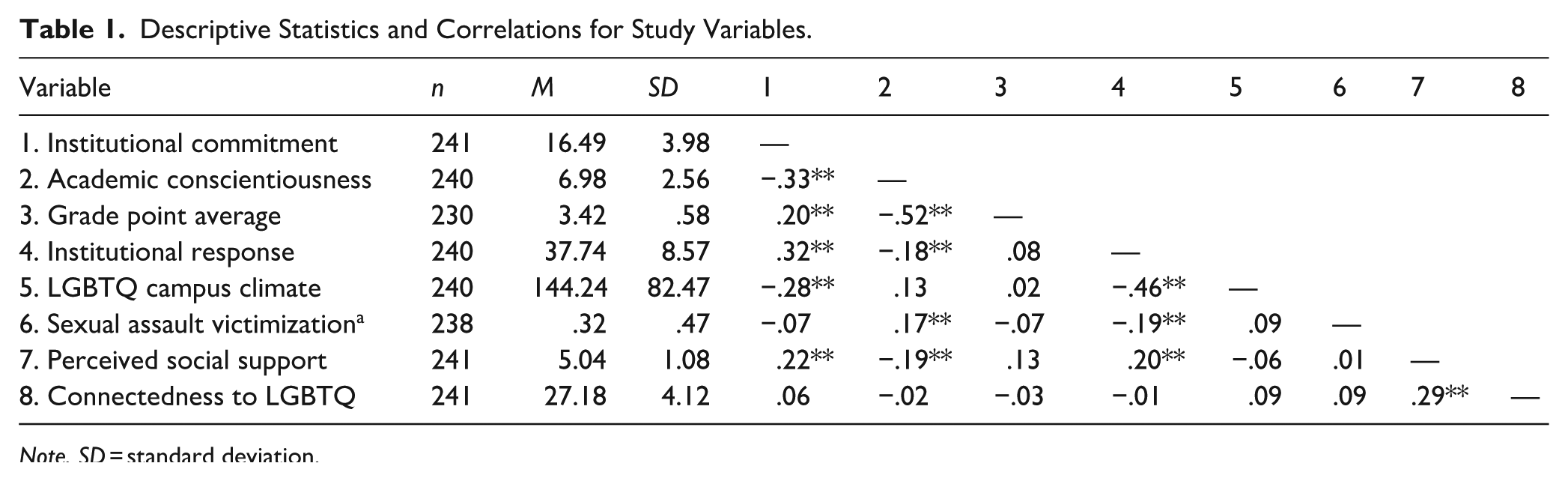
Note. SD = standard deviation.
0 = no sexual assault experience and 1 = experienced sexual assault.*p < .05. **p < .01.
Primary Analysis
Three separate multiple regression models were assessed to determine how campus climate, social support, and victimization are associated with academic outcomes (i.e., institutional commitment, academic conscientiousness, and self-reported GPA).
Model 1: Institutional Commitment
Multiple regression was used to assess the ability of five measures (institutional response, LGBTQ campus climate, connectedness to the LGBTQ community, social support, and victimization) to predict institutional commitment when controlling for region of college, race, gender, and disability status. The total variance explained by the model as a whole was 18.2%, F(9, 227) = 5.61, p < .001. Three measures made unique, statistically significant contributions to the model. The LGBTQ campus climate recorded the highest beta value (β = −.204, p = .004) followed by institutional response (β = −.183, p = .011) and social support (β = .151, p = .020). H(1) asserted that all independent variables would be associated with Institutional Commitment, and this is partially supported by these results.
Model 2: Academic Conscientiousness
Multiple regression was used to assess the ability of five measures (institutional response, LGBTQ campus climate, connectedness to the LGBTQ community, social support, and victimization) to predict academic conscientiousness when controlling for region of college, race, gender, and disability status. The total variance explained by the model as a whole was 8.1%, F(9, 227) = 3.325, p < .001. Two measures made unique, statistically significant contributions to the model. Social support recorded the highest beta value (β = −.161, p = .018) followed by victimization (β = .156, p = .016). H(2) also asserted that all independent variables would be associated with academic conscientiousness and so is partially supported by these results.
Model 3: Self-Reported GPA
Multiple regression was used to assess the ability of five measures (institutional response, LGBTQ campus climate, connectedness to the LGBTQ community, social support, and victimization) to predict self-reported GPA when controlling for region of college, race, gender, and disability status. The model was not statistically significant, F(9, 217) = 1.00, p = .438. H(3) is not supported by these results as no independent variables were associated with GPA.
See Table 2 for further details on statistics from the regression analysis.
Multiple Regression for Academic Outcomes.
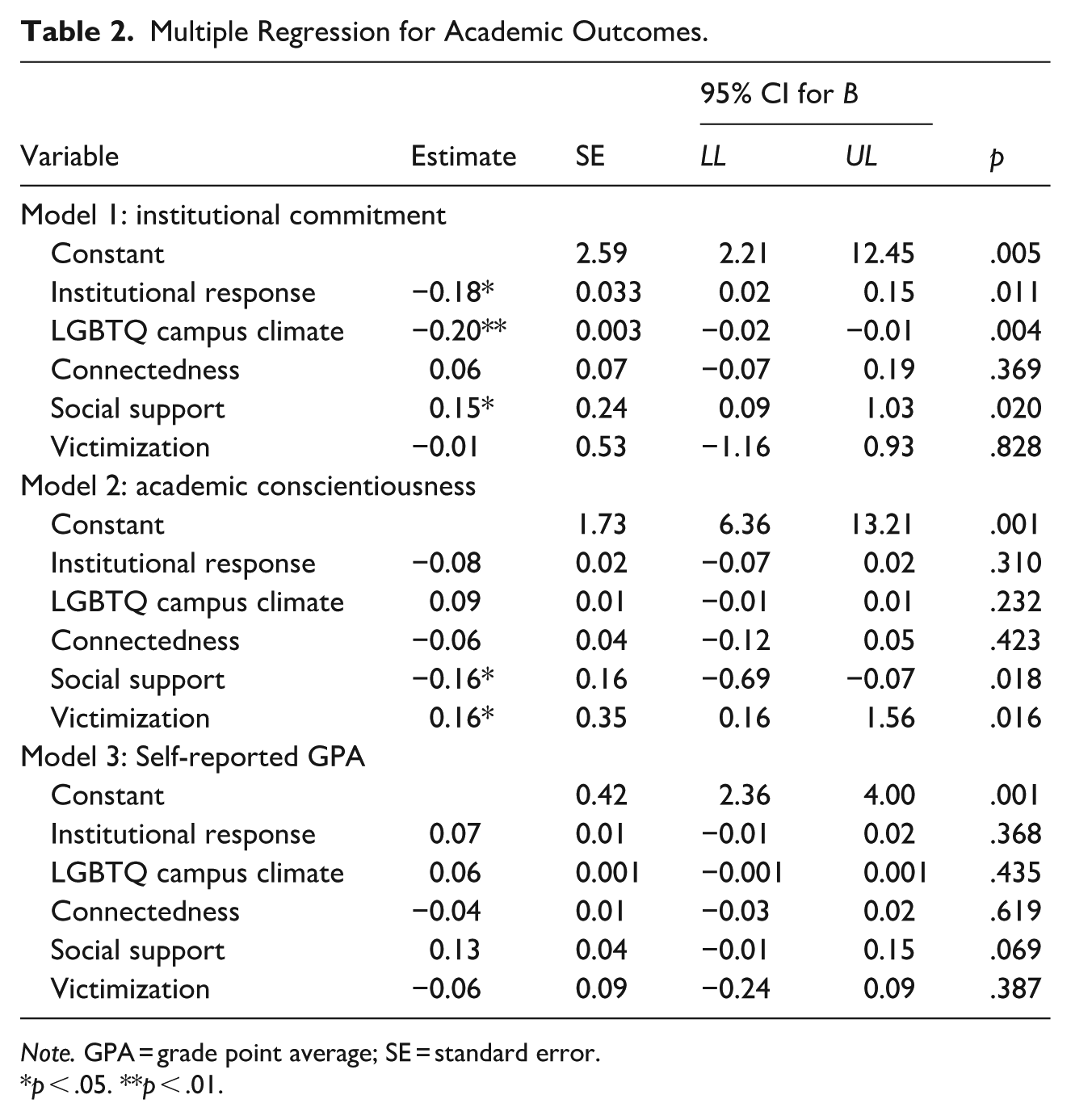
Note. GPA = grade point average; SE = standard error.
p < .05. **p < .01.
Discussion
Using a sample of sexual minority students, this study contributes to the literature by examining how victimization is associated with academic outcomes when accounting for campus climate and social support for this population. Findings suggest that, when accounting for other factors, a more nuanced picture of the relationship between sexual assault and academic outcomes for sexual minority students emerges. A primary finding of this study is that campus climate, perceptions of institutional response, and social support all significantly contributed to the variance in institutional commitment among participants in this sample. However, sexual assault victimization and connectedness to the LGBTQ community did not. Next, social support and sexual assault victimization did significantly contribute to academic conscientiousness, while campus climate, institutional response, and connectedness did not. And finally, no variables tested contributed to the variance in GPA for this sample. These findings suggest that how sexual minority students perceive the campus environment, in terms of inclusion and trustworthiness, has a real association with their commitment to remain at the institution. However, when it comes to their day-to-day academic conscientiousness, it is their experiences of victimization and the amount of emotional support from family and friends that makes the difference.
It is clear from this study that GPA was not associated with victimization, campus climate, social support, or connectedness. This adds to the ongoing discussion within the academic literature. While Baker et al. (2016) found a weak correlation between GPA of record and victimization in a comprehensive longitudinal study, Mengo and Black (2016) analyzed cases at a single institution and found a decrease in GPA for students who experienced sexual violence. This study adds to the discussion by using regression analysis to control for other factors that may also have a relationship with GPA. It also includes students who did not report sexual assault to their institution but who did experience campus sexual assault. However, it should be noted that the GPA in this study was self-reported, and participants may have been influenced by social desirability to self-report a higher GPA than they actually earned.
Findings from this study also support research that has identified connections between campus climate and institutional commitment. In three separate studies, campus climate for LGBTQ students predicted their intention to leave school (Crane et al., 2022; Szymanski et al., 2024; Tetreault et al., 2013). This study supports these findings and found that this association is maintained even when accounting for other factors that have powerful associations with institutional commitment. It is also an important finding that how students perceive their campus’s response to sexual assault predicted institutional commitment. While perceptions of response have been connected to the health and well-being of survivors (Smidt et al., 2021; Smith et al., 2016), little research has considered how these perceptions may play a role in institutional commitment. This finding, whereby perceptions of response but not the experience of victimization, predicted institutional commitment, also suggests that it is not the experience of sexual assault that shifts how students feel about their institution but how colleges are perceived to respond to sexual assault when it happens to oneself or others.
This research also fully supports previous findings related to the importance of social support to student academic outcomes. Social support from family (Marley & Wilcox, 2022) and peers (Altermatt, 2019) has been found to be a strong predictor of positive academic outcomes. This study reinforces this finding and suggests that social support is a uniquely important factor in academic outcomes for sexual minority college students. And finally, this study found that experiencing campus sexual assault uniquely predicted academic conscientiousness but not GPA or institutional commitment. The participants in this study who experienced campus sexual assault reported lower levels of academic conscientiousness, which, in the context of the aftermath of sexual assault, makes sense.
Limitations
As with all research, this study has multiple limitations. First, the research design for this study was cross-sectional, so data were collected at one point in time. Also, in order to best reach a sample of sexual minority college students, a non-probability sampling strategy was used. Because of the research design and sampling strategy, these results cannot be generalized to the greater population of sexual minority college students. Next, as noted earlier in this section, GPA was collected by self-report and so this measure could be influenced by social desirability bias. Also, the sample for this study lacked racial diversity. As racial background is known to influence perceptions of campus climate, it is possible that this could have influenced the findings. Finally, it was not possible to include all factors that could influence academic outcomes in these models, and there could be factors, such as mental health, that could influence these relationships.
Implications
There are implications from the results of this study for higher education administrators, advocates, policy makers, college students, and others. First, retention of students is a long-standing concern for college administrators and policymakers. As campus leadership works to retain students at colleges throughout the United States, it is warranted to consider how the campus climate for sexual minority students does, or does not, feel inclusive and welcoming. As previously recommended by Crane et al. (2022) and McAfee et al. (2023), investing in resources, staffing, and training that contribute to an inclusive environment may be beneficial to student institutional commitment.
The importance of maintaining transparent, fair campus sexual assault response on campuses has been well-documented (Smidt et al., 2021; Smith et al., 2016). Additionally, while all campuses should strive to go beyond legal compliance in their response to sexual assault on campus, how they message these efforts to students may also inform retention efforts. When campuses respond consistently, fairly, and justly to sexual assault on campus, and students perceive that this is the case, it may influence student commitment to their university. Administrators and advocates should consider not just how to have excellence in response efforts, but what resources and structures need to be in place to have transparent and open messaging to students about their response efforts.
Results from this study reinforce how experiencing sexual assault in college may influence the day-to-day academic conscientiousness of survivors. Voth Schrag et al. (2023) identified the importance of academic support in victim services on college campuses. Advocates and administrators should consider how to integrate academic support services as a regular component offered in survivor support services. This may be an additional resource that could benefit the well-being of survivors. And finally, this study highlights the importance of family and peer social support for sexual minority college students, as social support uniquely predicts institutional commitment and academic conscientiousness. As previously noted by McNaughton-Cassill et al. (2021), administrators and advocates should consider how to bolster social support for students on their campus. This could include sessions on support for parents and guardians at orientation and information for students on how to support their friends in required first-year courses.
Sexual minority college students experience disproportionate levels of campus sexual assault (Cantor et al., 2020), which is associated with adverse mental health outcomes (Rothman et al., 2021). This study contributes to the knowledge base with a nuanced picture of how victimization among sexual minority college students is associated with academic outcomes. Campus climate and perceptions of response to sexual assault are important factors in student institutional commitment. Social support and victimization predict academic conscientiousness. Understanding the relationship between these variables may provide signals for administrators, advocates, and others who are invested in creating more inclusive, safer campuses where students can achieve their primary goal in higher education – academic success.
Footnotes

Funding
The authors disclosed receipt of the following financial support for the research, authorship, and/or publication of this article: This research was supported by a CSU-AAUP Research Grant at Eastern Connecticut State University.
Declaration of Conflicting Interests
The author declared no potential conflicts of interests with respect to the authorship and/or publication of this article.