







Abstract
Parenting stress is a prevalent challenge for preschool parents, closely linked to the use of corporal punishment (CP). However, the cognitive factors associated with parental attitudes toward CP and the potential gender-specific patterns in this association remain inadequately elucidated. The present study investigated the relationship between parenting stress and CP behaviors among Chinese parents of preschool children, focusing on the statistically mediating role of attitudes and the moderating effect of parental gender. A total of 2,257 mothers and 500 fathers of preschool children were recruited from a city in Hebei Province, China, through online standardized questionnaires in March 2025. Results revealed that parenting stress exhibited a positive association with CP behaviors (r = .16; p < .001), and this relationship remained statistically robust after controlling for demographic variables. Critically, parental acceptance of CP partially and statistically mediated the relationship between parenting stress and CP behaviors, with the indirect effect accounting for 59% of the total effect. Furthermore, parental gender served as a significant moderator of the link between CP acceptance and actual CP behaviors. The positive association between CP acceptance and actual CP behaviors was significantly stronger in fathers (b = 0.91, p < .001) than in mothers (b = 0.68, p < .001). Gender did not moderate the direct pathway from parenting stress to CP or the pathway from parenting stress to CP attitudes. These findings highlight the inherent cognitive processes underlying stress-induced CP and the gender-specific characteristics of parenting practices, offering empirical evidence for targeted interventions.
Keywords
Introduction
Parenting stress is a pervasive, realistic challenge commonly experienced by parents, referring to the psychological strain experienced arising from child-rearing responsibilities (Abidin, 1990, 1992). For parents of preschool-aged children, this stress is particularly acute, intensified by the unique demands of early childhood care (Kulik, 2019), including logistical burdens of arranging childcare, high financial costs, and persistent concerns regarding children’s health and safety (Craig & Churchill, 2018; Pilarz & Hill, 2017). This developmental period is critical for the emergence of corporal punishment (CP), which is highly prevalent in early childhood (Fréchette & Romano, 2015; Lorber & Slep, 2015). Unlike the academic performance-focused discipline of adolescents, disciplinary triggers in early childhood are rooted in basic care routines. In China, these stressors are further compounded by Confucian culture values and collectivist values, which profoundly shape parental perceptions of child-rearing (Fu et al., 2016; Sun & Mulvaney, 2021). Chinese parents often link parental self-worth to children’s achievements (K. Sun & Mulvaney, 2021; Zhong & Xu, 2024) and strive for perfection in their parenting practices (Leung, 2022), a dynamic that likely exacerbates stress levels.
Extensive empirical evidence links parenting stress to poor parenting practices (Kang et al., 2022; Nathalie et al., 2018; Qian et al., 2023). CP, a typical manifestation of abuse, can be regarded as a relatively mild yet harmful form of abuse, often associated with the accumulation of parenting stress. Straus (1994) defined CP as an act aimed at correcting or controlling a child’s behavior without causing physical injury. Cumulative evidence confirms the prevalence of CP among Chinese preschoolers and its robust associations with both internalizing difficulties, such as anxiety and depression, as well as externalizing difficulties, such as aggression and conduct problems (Liu & Wang, 2015; World Health Organization, 2020; Zhang et al., 2024). Critically, the use of CP increases the likelihood of escalating into physical abuse (Chung et al., 2021; Liu & Wang, 2015; Zolotor et al., 2011).
Despite previous studies have explored various external and demographic factors associated with CP, including cultural norms (Gracia & Herrero, 2008b; Zhou & Zhen, 2022), parental education, age, gender, and adverse childhood experiences (Combs-Orme & Cain, 2008; Gagné et al., 2007; Gershoff, 2002; Lee et al., 2011; Walker & McKinney, 2021), the underlying processes linking parenting stress to CP behavior remain under explored. In addition, key moderating variables, particularly within the Chinese cultural context where traditional norms shape unique gender differences in discipline, have not been adequately examined (Liu & Wang, 2015; L. Sun & Lin, 2018).
Therefore, this study aims to systematically investigate the mediating role of parents’ attitudes toward CP in the relationship between parenting stress and CP behaviors among preschool children’s families, while also examining the potential moderating role of parents’ gender. By elucidating these pathways, this research seeks to provide empirical evidence for formulating targeted intervention strategies to reduce stress-induced CP and protect child well-being.
Parenting Stress and Corporal Punishment
Parents experiencing high stress are more likely to adopt strict or harsh parenting behaviors, with some resorting to strategies that pose significant risk for physical abuse (Azar & Wolfe, 2006; Barry et al., 2009; Calkins et al., 2004; Liu & Wang, 2015; Niu et al., 2018; Rodriguez & Richardson, 2007). This association persists across cultures, family structures, and gender-based parenting styles (Crum & Moreland, 2017; Liu & Wang, 2015; Miragoli et al., 2018; Niu et al., 2018; Rodriguez et al., 2017; Tucker et al., 2017). Among various harsh disciplinary practices, psychological aggression and CP are the most prevalent strategies employed during early childhood (Gershoff, 2002; Liu & Wang, 2015; Straus et al., 1998). A large-scale survey in mainland China revealed that 53.73% of mothers and 48.29% of fathers reported using CP within 1 year (Liu & Wang, 2015), which underscores its pervasiveness. Stress-induced CP not only strains parent-child relationships (Ma et al., 2022; Peets et al., 2021) but also results in more internalized and externalized problems in children (Carapito et al., 2020; Crnic et al., 2005; Gershoff, 2002; Kingsbury et al., 2020; Ma et al., 2022; M. Wang & Liu, 2018).
The Mediating Role of Parents’ Attitudes Toward Corporal Punishment
Parenting stress alone explains only a small-to-moderate proportion of the variance in parental strictness (Anthony et al., 2005), which suggests the critical involvement of cognitive mediators. According to the transactional theory of stress and coping (Lazarus & Folkman, 1987), behavioral responses are determined not merely by stressors themselves but by the cognitive appraisal of those stressors by the individual. The key to understanding parental stress lies in identifying how family members define, perceive, and evaluate stressors (Guo & Chiu, 2023). This perspective aligns with social information processing (SIP) models, which argue that parenting behaviors are directly guided by preexisting cognitive schemas rooted in parents’ knowledge, beliefs, and attitudes (Azar et al., 2008; Milner, 1993, 2003; Sigel & McGillicuddy-De Lisi, 2002).
Within this framework, attitudes toward CP serve as a core cognitive component and are defined as the value judgments of parents regarding the acceptability and justification of CP (Ateah & Durrant, 2005; Crouch et al., 2010; Graziano et al., 1996; Holden et al., 1999; Lansford et al., 2005; Milner, 2003; Rodriguez, 2018; F. Wang et al., 2018). Such cognitive variables have even been found to predict abuse risk more strongly than emotional factors (Haskett et al., 2003). Consistent with social cognitive theory, behavioral choices tend to align with perceived effectiveness (Deater-Deckard et al., 2003), and robust evidence confirms that positive CP attitudes significantly increase the likelihood of implementing harsh discipline (Bower-Russa, 2005; Bower-Russa et al., 2001; Burkhart et al., 2018; Liu & Wang, 2015; Vittrup et al., 2006; Y. Xing et al., 2019). Notably, Crouch and Behl (2001) provided preliminary empirical support for the mediating role of CP attitudes between parenting stress and CP behaviors. Theoretically, high situational stress independently predicts CP risk, with high stress explicitly impairing SIP (Milner, 1993, 2000) and leading to cognitive biases where parents view CP as a reasonable disciplinary technique (Ateah & Durrant, 2005; Di Blasio et al., 2017; Miragoli et al., 2018; Rodriguez, 2018). Indeed, McCurdy (2005) found that elevated stress strengthened mothers’ acceptance of CP, thereby increasing their tendency to use it.
However, the link between attitudes and behavior is not absolute. Parental physical aggression typically manifests along a continuum, yet most research focuses on more severe physical abuse. In addition, research conclusions are not consistent. Some studies report inconsistency between parents’ attitudes and their actual disciplinary behaviors (Cappa & Khan, 2011), while others find no association between fathers’ positive beliefs about punitive discipline and child abuse risk (Miller & Azar, 2019). These discrepancies suggest that the influence of parental attitudes toward CP on disciplinary behavior may be contingent upon contextual factors such as parental gender. Furthermore, differential analyses based on children of specific age groups have not been conducted. The small sample size may affect the external validity of the research findings (Crouch & Behl, 2001; Vittrup et al., 2006).
Gender Differences in Parenting Stress and Corporal Punishment
Growing evidence indicates that gender plays a pivotal role in shaping how parenting stress is translated into harsh discipline (Cuartas et al., 2025; Liu et al., 2022). Mothers and fathers experience distinct stressors and enact different disciplinary roles. Mothers often bear primary responsibility for daily caregiving and face routine disciplinary scenarios (Liu et al., 2022; Walker et al., 2021). Specifically, Chinese mothers spend more time with children than fathers (Xu et al., 2024), exposing them to repeated interaction cycles that elevate stress and increase mild disciplinary acts (Liu et al., 2022; X. Xing et al., 2017). Their involvement in co-parenting with grandparents may further introduce intergenerational conflicts as additional stressors (Dubois-Comtois et al., 2013; Xu et al., 2024). Even in cross-cultural contexts, the proportion of mothers who used CP was slightly larger than that of fathers (Mehlhausen-Hassoen, 2021), consistent with their role as primary caregivers.
In contrast, fathers’ parenting stress stems from external demands such as occupational pressures and breadwinning obligations (Liu et al., 2022), alongside societal expectations of paternal authority. Traditional gender norms position fathers as enforcers of discipline and expect them to maintain firmness and control (Morgan et al., 2022). Consequently, stressed fathers may view CP not as a reaction to misbehavior, but as a symbolic assertion of authority (Morgan et al., 2022). Cultural context further shapes these dynamics by systematically influencing how parental discipline is socially evaluated. In Confucian societies, harsh parenting by fathers is often perceived as a legitimate expression of care and responsibility under the “strict father, kind mother” ideal, which renders it more socially acceptable and resistant to intervention (Chao, 1994; Cuartas et al., 2025; Deater-Deckard & Dodge, 1997; Xu et al., 2024; H. Yang & Chen, 2025). Conversely, when mothers employ CP, it is frequently interpreted as a sign of emotional dysregulation or impatience rather than appropriate discipline (Cuartas et al., 2025).
Empirical studies consistently show gender differences in the incidence and severity of disciplinary practices. While mothers may use CP more frequently, fathers’ use is often more severe and predictive of negative outcomes (Cuartas et al., 2025; Liu et al., 2022; Mehlhausen-Hassoen, 2021; Xing et al., 2017). Although earlier research suggests that men are more supportive of CP than women (Gracia & Herrero, 2008a), empirical data from Walker et al. (2021) do not confirm this conclusion, showing instead that only mothers’ CP experiences predict endorsement of CP through attitudes. Collectively, these findings underscore that gender differences in parenting stress and discipline are not merely behavioral but are deeply shaped by cultural norms, role expectations, and the structural realities of caregiving responsibilities.
The Current Study
To address the gaps in previous studies, this study uses a larger sample to explore the impact of parental stress levels on CP behaviors among Chinese parents of preschool children. The main research questions are as follows:
Method
Participants and Procedure
This study is based on a family education project in Xiongan city, Hebei Province, China, and employed an online questionnaire in March 2025. With the assistance of teachers from nine kindergartens, the questionnaire was disseminated to parents across three core urban zones and their surrounding areas. These three central urban zones differ in functional orientations, while the inclusion of surrounding towns and rural areas expands the sample’s coverage. The nine kindergartens were selected to span these diverse functional and regional contexts, ensuring the sample encompasses parents with varying socioeconomic backgrounds, living environments, and parenting scenarios, thus enabling the collected data to reflect universal parental upbringing issues in the region. Participation was voluntary, with all respondents providing informed consent. To ensure data validity, each IP address was only allowed to complete one questionnaire. Questionnaires completed in an abnormally brief period of time were excluded from the final analysis to uphold data quality standards. Of the initial 2,776 participants, 9 were removed due to incomplete responses, resulting in a final sample of 2,757 parents (M = 34.02 ± 4.49 years), including 500 fathers and 2,257 mothers.
Measures
Parenting Stress
The assessment of parenting stress was conducted utilizing the Parenting Stress Index-Short Form (PSI-SF), a validated instrument that has undergone revision for the Chinese context by Ren (1995). The questionnaire consists of 15 items, covering three dimensions: “Parenting Difficulties,” “Dysfunctional parent-Child Interaction,” and “Difficult Children.” It measures the stress perceived by parents due to role constraints inherent in the parenting process, insufficient emotional connection, and poor interaction quality between parents and children, as well as parents' perception of their children’s emotional instability and other related behavioral manifestations. The scale adopts a 5-point scoring system (1 represents “very inconsistent” and 5 represents “completely consistent”). The higher the total score, the greater the stress that parents feel during the parenting process. In this study, the Cronbach’s alpha of this scale was .91.
Attitudes Toward Corporal Punishment
Parents’ acceptance of CP was assessed using four items from the Attitudes Toward Spanking (ATS) scale developed by Holden (2001). This abbreviated 4-item version was selected based on recommendations from the scale’s author and prior validation studies (Taylor et al., 2011, 2017), which identified these items as having the highest item-to-total correlations and demonstrated strong reliability. The scale adopts a 5-point Likert rating system, with responses ranging from 1 (“strongly agree”) to 5 (“strongly disagree”). Two items, namely “Corporal punishment is a normal part of parenting” and “Sometimes the only way to get a child to behave is corporal punishment,” were reverse-coded prior to data analysis. A composite score was computed as the average of all four items, where higher scores indicate a more favorable attitude toward CP. This study discussed that the ATS scale demonstrated acceptable internal consistency with a Cronbach’s alpha coefficient of .70.
Parental Corporal Punishment Behaviors
To assess parental CP, the Parent-Child Conflict Tactics Scale (PCCTS; Straus et al., 1998) as utilized, and corporal punishment and physical abuse items were selected, as this subscale matched our research focus. The items assess whether the participating parents have engaged in behaviors such as slapping their children’s buttocks or limbs, hitting their children’s buttocks with a wrist strap, a comb, a stick, or other hard objects, pinching their children with their hands, or shaking them. The subscale employs a 9-point scale (0 = ”0 times,” 8 = ”8 times or more”), with higher scores reflecting a higher frequency of CP practices. The Chinese version of the PCCTS has been extensively validated and applied in empirical research (Cheng et al., 2018). In the current study, the CP subscale demonstrated acceptable internal consistency, with a Cronbach’s alpha of .75.
Control Measures
In addition to core variables, all models controlled for the following parent and child characteristics. Child factors include gender and only-child status. Parent factors include gender, age, education level, and employment status. Other sociodemographic variables (e.g., occupation) were not included in the final models due to their nonsignificant associations with the outcome in bivariate analyses, to maintain model parsimony.
Statistical Analysis
Data were directly exported from the online questionnaire system and subjected to rigorous statistical analysis using Stata 16.0. Descriptive analysis was conducted to assess the parenting stress, attitudes toward CP, and self-reported CP behaviors toward children (within the past 2 months) among parents of kindergarten children.
Preliminary regression analyses were first conducted to examine the direct relationships between CP behavior and other related variables. Given the count nature and substantial zero-inflation (52.6% of parents reported no CP) of the CP behavior variable, we first considered Poisson regression. However, a likelihood ratio test rejected the null hypothesis of equidispersion (α = 2.86, p < .001), indicating significant overdispersion. Thus, negative binomial regression with robust standard errors was employed as the primary analytical approach to account for overdispersion and the non-negative, skewed distribution. Sensitivity analyses using linear regression yielded consistent directional effects, with the negative binomial model demonstrating superior fit. The collinearity diagnosis results showed that the variance inflation factor of parenting stress, attitudes toward CP, CP behaviors, and control variables of kindergarten parents were all less than 1.5, indicating that there is almost no multicollinearity among these variables and thus the model’s estimation results are reliable. The Bootstrap sampling method with 1,000 resamples was used to test the significance of the mediating effect of CP attitudes, generating bias-corrected 95% confidence intervals for direct, indirect, and total effects.
The moderating effect of parental gender was analyzed by using negative binomial regression with interaction terms. The moderation model incorporated two interaction terms, and their p-values indicated the presence of a moderating effect. When interactions were significant, simple slope analyses were used to derive predicted coefficients for mothers and fathers separately, and moderation effect plots were produced. The gender distribution of the sample (81.9% mothers) reflects the gendered division of caregiving roles in Chinese families, where mothers are more likely to serve as primary caregivers and to engage in daily disciplinary practices, as well as to respond to kindergarten-based surveys. Therefore, the original sample was retained for the main analyses to preserve ecological validity rather than being treated as a sampling bias to be corrected. To address potential concerns about gender imbalance, we conducted a sensitivity analysis using a gender-balanced subsample to examine whether our findings were robust across different sample compositions.
Results
Descriptive Findings
Table 1 shows the demographic characteristics of the participants. The majority of participants were mothers, accounting for 81.9% (n = 2,257). The majority of participants had education below college level (51.8%), were not full-time caregivers (75.0%), and had non-only children (66.4%). In terms of child gender, boys slightly predominated, making up 51.9% (n = 1,438). The mean total score for parenting stress was 33.46 (standard deviation, SD = 8.86). For attitudes toward CP, the mean score was 2.16 (SD = 0.76), and the mean score for CP behaviors was 2.44 (SD = 5.93).
Descriptive Characteristics of the Participants (n = 2,757).
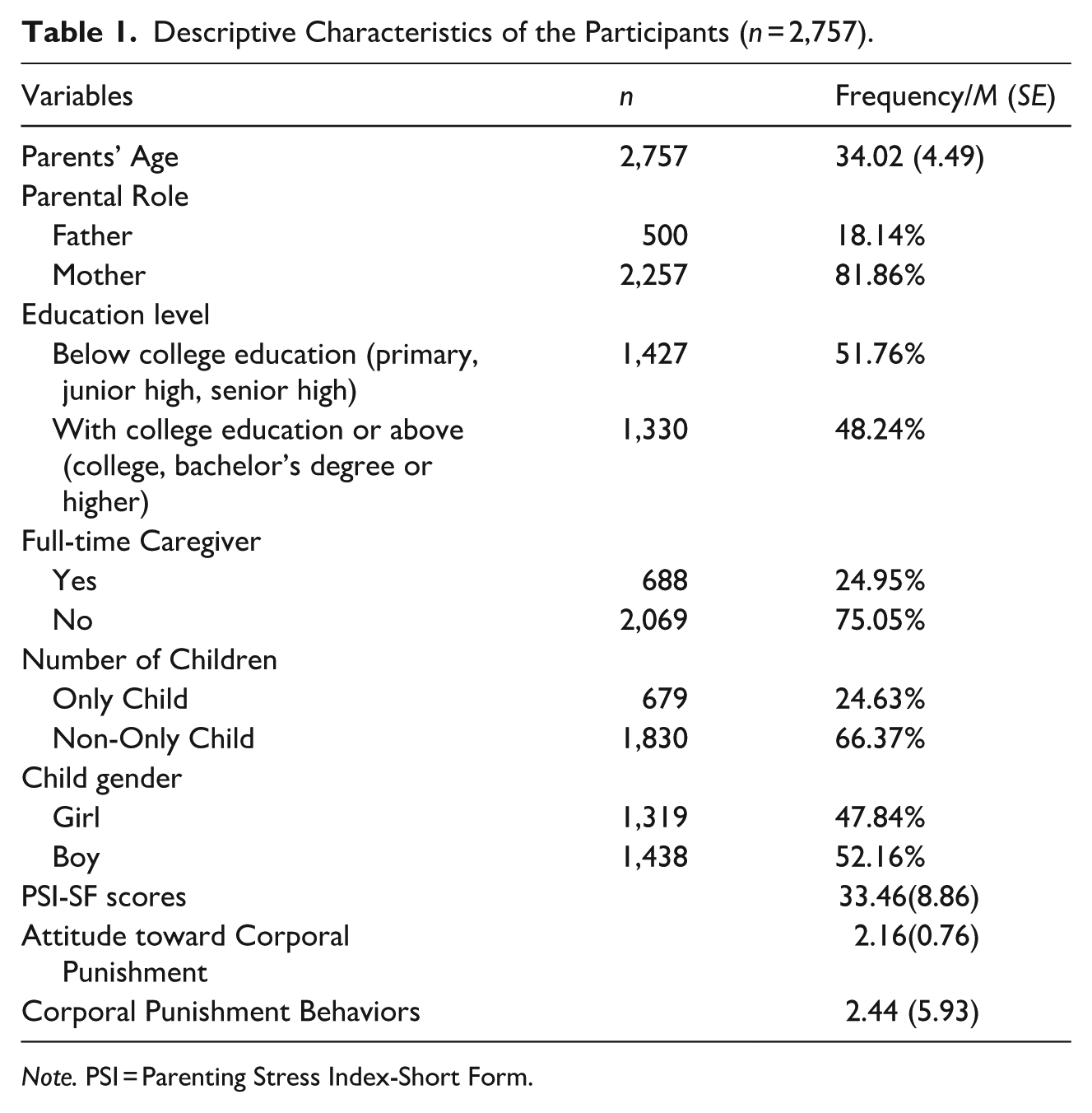
Note. PSI = Parenting Stress Index-Short Form.
Table 2 presents descriptive statistics for all study variables. CP exhibited a highly skewed distribution (skewness = 6.06, kurtosis = 53.31), justifying the use of negative binomial regression. In addition, preliminary analyses indicated that CP was positively associated with parenting stress (b = 0.03, p < .001) and attitudes toward CP (b = 0.75, p < .001).
Descriptive Statistics and Distributional Characteristics of Parenting Stress, Attitude Toward Corporal Punishment, and Corporal Punishment.
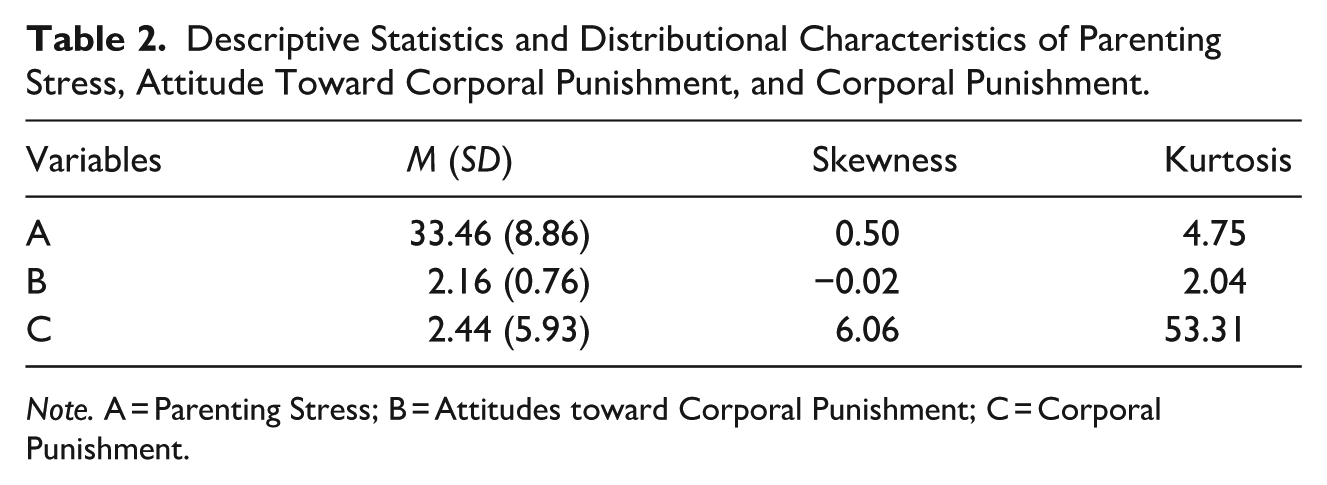
Note. A = Parenting Stress; B = Attitudes toward Corporal Punishment; C = Corporal Punishment.
Regression Analyses: Parenting Stress and Corporal Punishment Behaviors
In Model 1 of Table 3, parenting stress was positively associated with the frequency of CP (incidence rate ratio [IRR] = 1.03, p < .001). In Model 2, after including parental attitudes toward CP, parenting stress remained a significant positive predictor (IRR = 1.02, p < .001). Attitudes toward CP, however, became a significant positive predictor of the outcome variables (IRR = 2.12, p < .001). Taken together, these findings suggest that attitudes toward CP play a potential mediating role in the relationship between parenting stress and CP behaviors.
Negative Binomial Regression Analyses of Attitudes Toward Corporal Punishment in the Relationship Between Parenting Stress and Corporal Punishment Behavior.
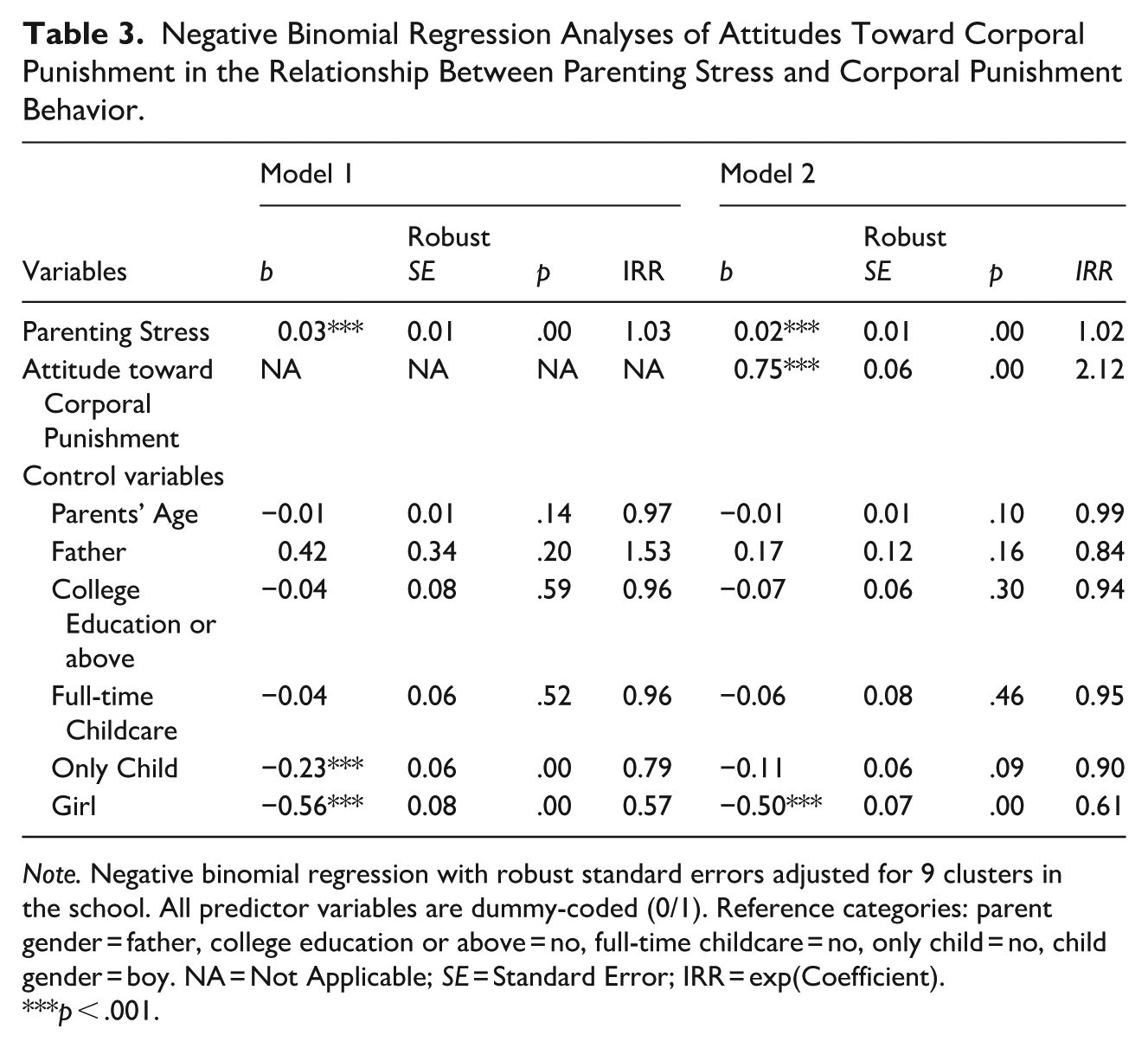
Note. Negative binomial regression with robust standard errors adjusted for 9 clusters in the school. All predictor variables are dummy-coded (0/1). Reference categories: parent gender = father, college education or above = no, full-time childcare = no, only child = no, child gender = boy. NA = Not Applicable; SE = Standard Error; IRR = exp(Coefficient).
p < .001.
Testing the Mediating Effect
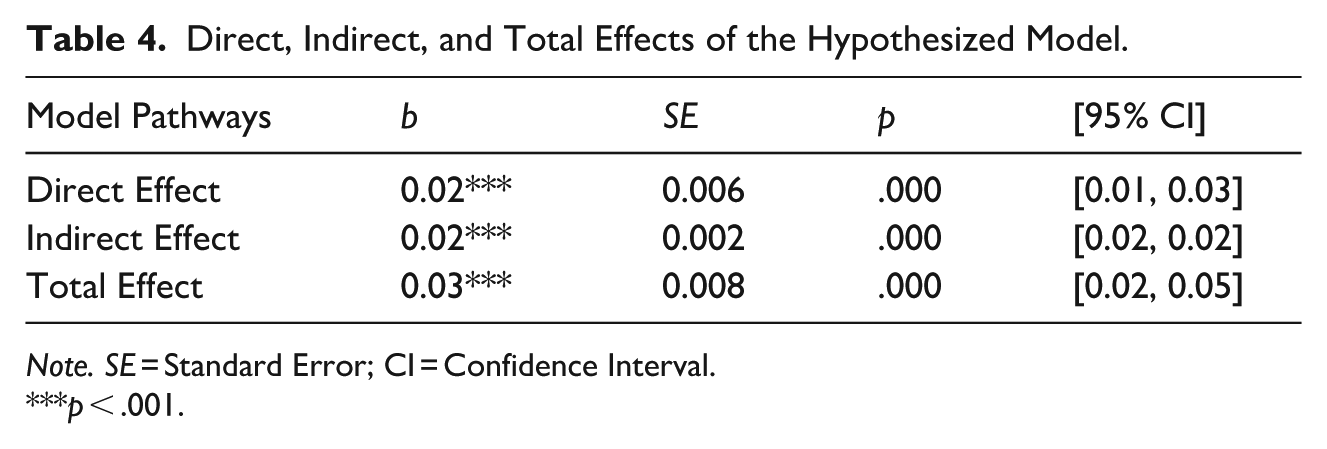
To investigate the mediating role of parents’ attitudes toward CP in the relationship between parenting stress and CP behavior, we conducted a bias-corrected Bootstrap analysis with 1,000 resamples using Stata 16.0 to estimate the confidence intervals for direct and indirect effects. As shown in Figure 1 and Table 4, both the direct and indirect influences of parents’ attitudes toward CP were significant in the CP behavior model. In combination with the Bootstrap test results, the direct effect of parental stress on CP behavior was significant (b = 0.02, 95% CI = [0.010, 0.033]), and the indirect effect of corporal punishment attitudes was also significant (b = 0.02, 95% CI [0.015, 0.023]), representing 59% of the total effect. The overall effect of parental stress on CP behavior was equally significant (b = 0.03 [0.018, 0.047]). In practical terms, a one-standard-deviation increase in parenting stress (SD = 8.86) was associated with an estimated 0.29 additional CP incidents over 2 months, with 0.18 incidents via the indirect path.
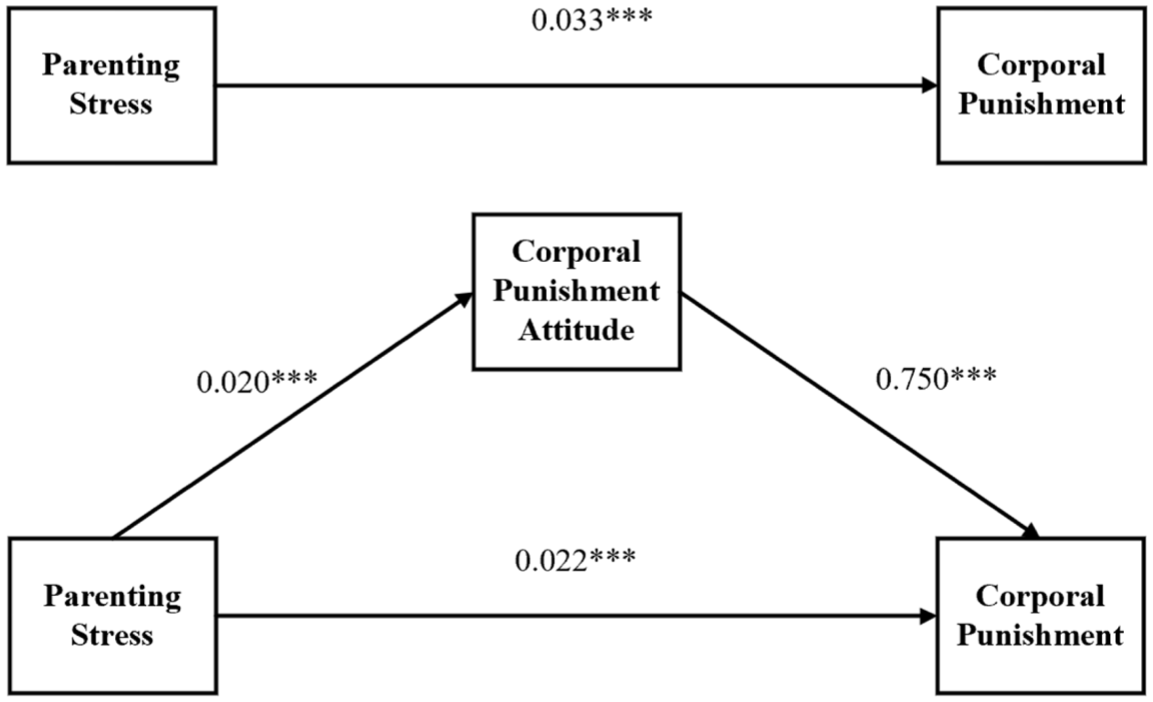
The path of parenting stress influencing corporal punishment behavior through punishment attitudes.
Direct, Indirect, and Total Effects of the Hypothesized Model.
Note. SE = Standard Error; CI = Confidence Interval.
p < .001.
Testing the Moderated Mediating Effect
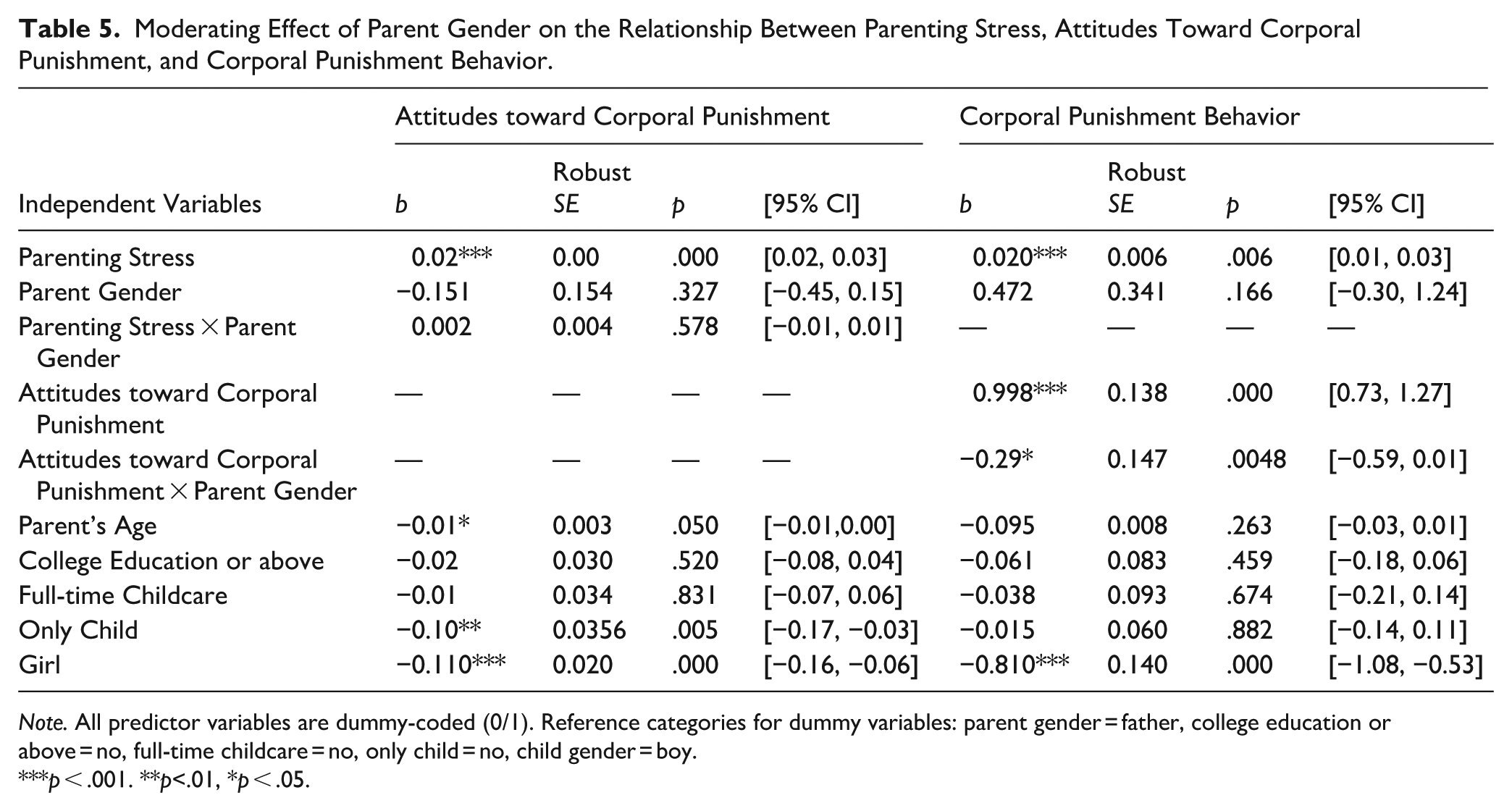
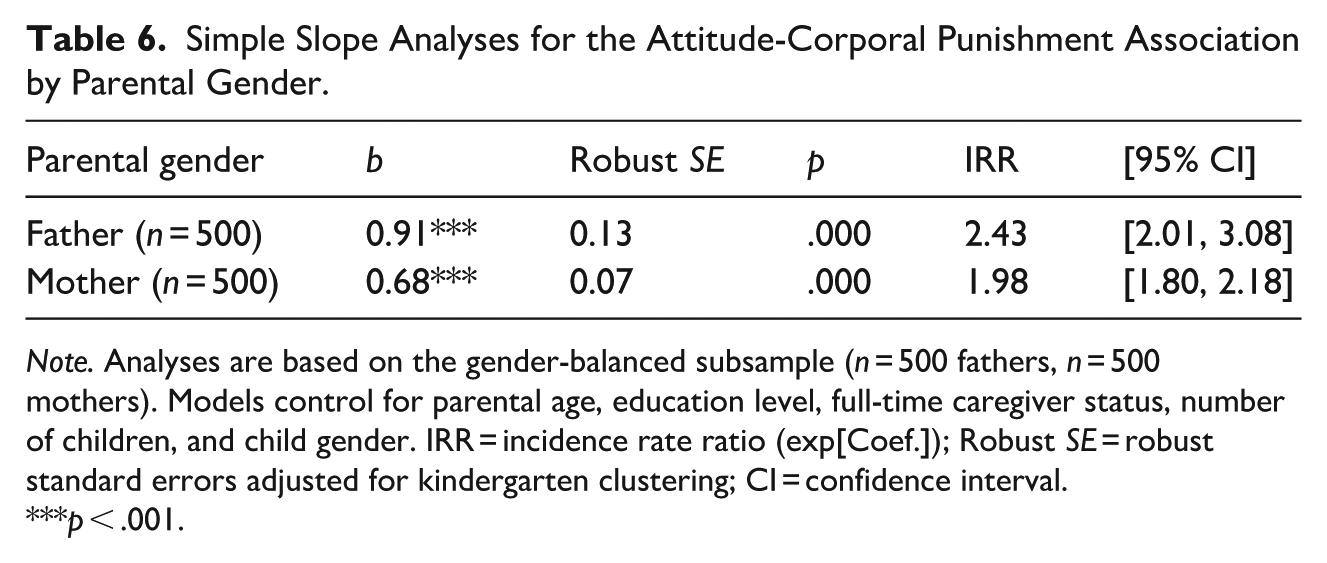
To examine whether parental gender moderates the mediating pathway, we analyzed the interaction effect. As seen in Figure 2 and Table 5, the interaction term was statistically significant (b = −0.29, p = 0.05, 95% CI [−0.59, 0.01]), indicating that the strength of the attitude-corporal punishment association varies by parental gender. To avoid potential bias from the unequal group sizes, we further conducted simple slope analyses using a gender-balanced subsample (500 fathers and 500 mothers, randomly selected from the original sample) to examine the attitude-behavior interaction separately by parent gender, with results presented in Table 6.
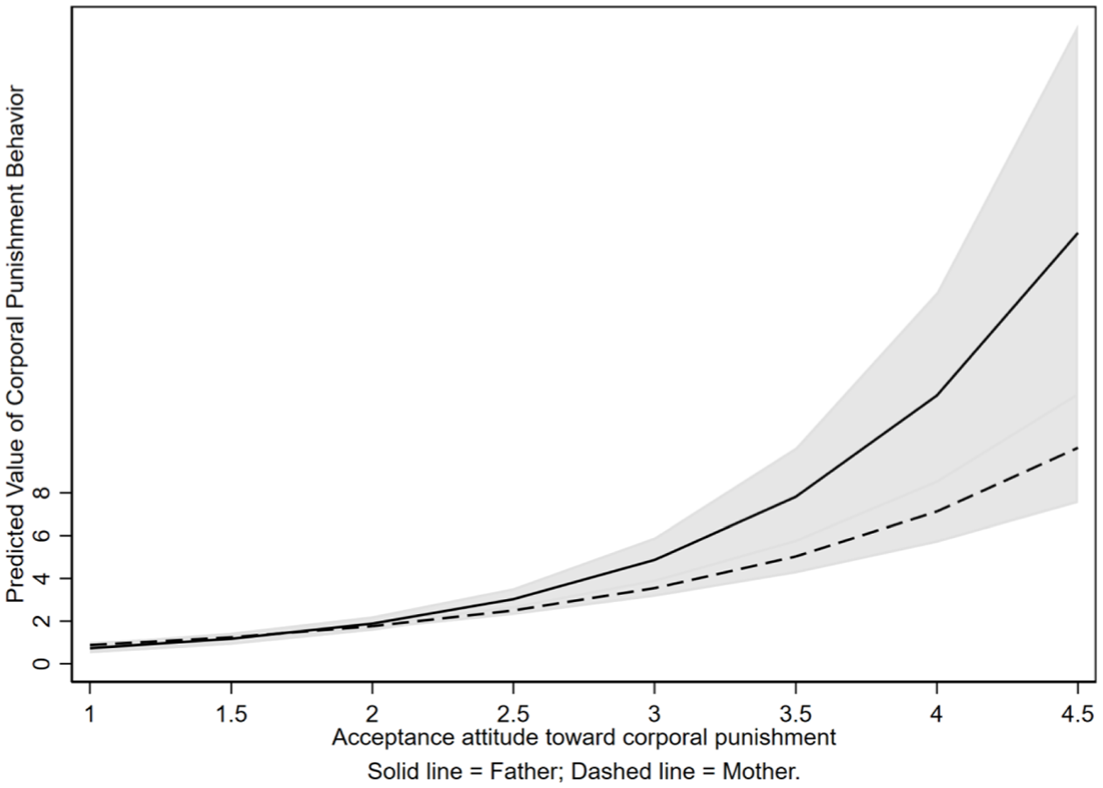
Moderating effect of parent gender on the relationship between acceptance attitudes toward corporal punishment and corporal punishment behavior.
Moderating Effect of Parent Gender on the Relationship Between Parenting Stress, Attitudes Toward Corporal Punishment, and Corporal Punishment Behavior.
Note. All predictor variables are dummy-coded (0/1). Reference categories for dummy variables: parent gender = father, college education or above = no, full-time childcare = no, only child = no, child gender = boy.
p < .001. **p<.01, *p < .05.
Simple Slope Analyses for the Attitude-Corporal Punishment Association by Parental Gender.
Note. Analyses are based on the gender-balanced subsample (n = 500 fathers, n = 500 mothers). Models control for parental age, education level, full-time caregiver status, number of children, and child gender. IRR = incidence rate ratio (exp[Coef.]); Robust SE = robust standard errors adjusted for kindergarten clustering; CI = confidence interval.
p < .001.
For fathers (n = 500), a one-unit increase in acceptance of CP was significantly associated with a 0.91-unit increase in the log-transformed frequency of CP (p < .001, 95% CI [0.65, 1.17]), corresponding to an IRR of 2.49 [2.01, 3.08]. For mothers (n = 2,257), the association was also significant but of smaller magnitude: a one-unit increase in attitude was linked to a 0.68-unit increase in log-transformed CP frequency (p < .001 [0.54, 0.82]), with an IRR of 1.98 [1.80, 2.18]. These findings confirm that fathers are more likely than mothers to translate their accepting attitudes toward CP into actual disciplinary practices.
In addition, we tested whether parental gender moderates the effects of parenting stress on both attitudes toward CP and CP behavior. The interaction between parenting stress and parent gender showed no significant moderating effect when predicting attitudes toward CP (b < .001, p = .58 [−0.01, 0.01] or behavior (p > .05), indicating parental gender does not moderate the impact of parenting stress on either variable.
Given the unequal group sizes in our original sample (81.9% mothers vs. 18.1% fathers), we conducted a sensitivity analysis using a gender-balanced subsample to examine whether our findings were robust to potential sampling bias. The balanced subsample was constructed by randomly selecting an equal number of mothers to match the number of fathers (n = 500 each). As shown in Table 7, the key results remained robust. The association between attitudes toward CP and actual behavior was stronger for fathers (b = 0.91, p < .001) than for mothers (b = 0.68, p < .001), and parenting stress significantly predicted corporal punishment only among mothers (b = 0.03, p < .001). These results provide preliminary evidence that our main conclusions are robust to the overrepresentation of mothers in the original sample, although future research with more balanced samples is needed to fully rule out potential bias.
Moderating Effect of Parent Gender on the Relationship Between Parenting Stress, Attitudes Toward Corporal Punishment, and Corporal Punishment Behavior in a Gender-Stratified Analysis.
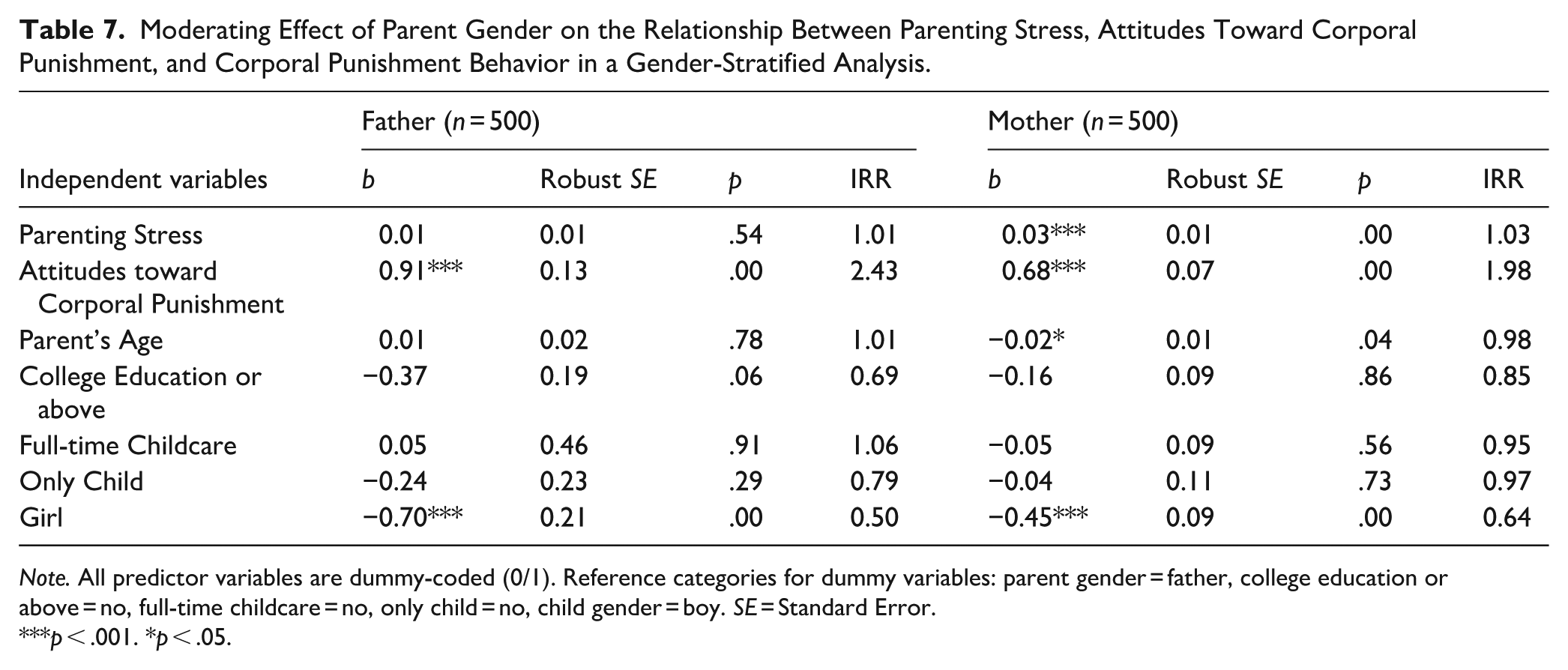
Note. All predictor variables are dummy-coded (0/1). Reference categories for dummy variables: parent gender = father, college education or above = no, full-time childcare = no, only child = no, child gender = boy. SE = Standard Error.
p < .001. *p < .05.
Discussion
This study examined the relationships among parenting stress, attitudes toward CP, and CP behaviors among Chinese parents of preschool children. While previous studies have primarily focused on the direct impact of parenting stress on CP behaviors, the current study provides a more nuanced understanding by revealing an indirect pathway. This finding elucidates the underlying processes and statistical patterns associated with maladaptive parenting practices. In addition, the study identifies a moderating effect of parental gender within this mediating process. These results suggest that addressing and reshaping parental attitudes toward CP could potentially correspond to lower levels of the occurrence of CP, particularly among families experiencing high levels of parenting stress. Consequently, these findings provide empirical evidence to inform the development of targeted family-support programs and policy initiatives.
This study confirmed a significant positive correlation between parenting stress and CP behavior, consistent with findings reported by Liu and Wang (2015) and Niu et al. (2018) in the Chinese cultural context. Theoretical frameworks suggest that elevated stress is associated with emotional exhaustion and cognitive distortion. Under high stress, parents are more prone to immediate negative emotions such as irritability and hostility, which may trigger CP as an impulsive, automatic, and less rational disciplinary strategy aimed at rapidly alleviating parenting difficulties.
The mediation analysis further revealed that parents’ acceptance of CP accounts for a significant portion of the association between parenting stress and CP behavior. This finding suggests high parenting stress is linked to more automatic and simplified cognitive processing. According to SIP theory (Milner, 1993), stress impairs the ability of parents to accurately perceive and attribute the behaviors of their children. Stressed parents may exhibit perceptual biases, prioritizing negative cues and misinterpreting normative behaviors as defiance. These biases are positively associated with the belief that CP can effectively correct behaviors (Ateah & Durrant, 2005; Rodriguez, 2018). At a deeper cognitive level, these biases relate closely to a core schema that views CP as harmless and effective (Milner, 2003), a belief system often reinforced by Confucian traditions of family hierarchy (Gartstein & Putnam, 2018). Within this framework, discipline is seen as an expression of parental responsibility (Y. C. Wang & Supple, 2010). Hence, positive parental attitudes toward CP were significantly associated with their disciplinary practices, which aligns with findings from Vittrup et al. (2006) and F. Wang et al. (2018). Notably, McCurdy (2005) similarly demonstrated that heightened stress negatively influences parental attitudes and corresponds to higher acceptance of CP. While stress is a significant risk factor, its influence on CP may be partially mediated by cognitive appraisals, wherein heightened stress is associated with a greater tendency to view CP as justified.
Notably, González and Trujillo (2024) found stress directly linked to CP among Colombian parents, whereas our study found an indirect pathway via attitudes in a Chinese sample. This discrepancy may stem from methodological, developmental, or sociocultural differences between samples. While we did not assess cultural variables directly, the attenuation of the stress–behavior link through attitudes in our data suggests that cognitive appraisals play a key role in shaping disciplinary responses in this specific context. This attitude-behavior link implies intergenerational transmission risk. Parental use of CP may implicitly model children’s aggression as a conflict resolution tool (Simons & Wurtele, 2010), leading children to internalize spanking as legitimate. Early parent-child interactions are associated with internal working models that relate to children’s subsequent development and adult parenting (Bowlby, 1988; Xing & Wang, 2015). Without intervention, this maladaptive disciplinary pattern may perpetuate across generations. From a practical perspective, efforts to reduce CP often focus on altering parents’ beliefs about its efficacy (Gagné et al., 2007; Taylor et al., 2017), consistent with the statistical mediation pattern identified in this study.
The findings further reveal that parental gender moderates the pathway from attitude to behavior. Specifically, the acceptance of CP by fathers translates into behavior more strongly than it does for mothers. Rather than indicating inherent gender differences, the observed moderation may reflect the gendered division of caregiving labor and disciplinary roles in Chinese preschool families. The division of labor creates distinct contexts for discipline, rooted in patriarchal norms intertwined with Confucian traditions that position women as primary caregivers (Yang, 2023). Mothers in China typically bear the primary burden of daily care, spending significantly more time on core caregiving and housework than fathers (Chen, 2024; Du & Zhao, 2025). This reality is reflected in our sample’s overrepresentation of mothers. For mothers, this high frequency of interaction necessitates greater emotional regulation and caution, often constraining the direct translation of punitive attitudes into behavior to maintain relationship harmony. In contrast, fathers engage less frequently in routine care but often intervene selectively for disciplinary purposes. Cultural expectations differentially shape the legitimacy of punishment. The traditional “strict father, kind mother” norm positions fathers as moral guardians tasked with enforcing discipline through strictness (Fei, 2021; L. Sun & Lin, 2018), which lowers the psychological threshold for fathers to use CP and associates them with a higher likelihood to act on their accepting attitudes. Conversely, mothers are culturally expected to provide emotional support and gentleness (Chen, 2024; Fei, 2021; Yang, 2023). For mothers, using CP conflicts with these role expectations, creating an internal barrier that weakens the attitude-behavior link. Furthermore, fathers tend to adopt more authoritarian styles that rely on harsh discipline under stress (McKinney & Renk, 2008), whereas mothers’ caregiving role encourages more cautious responses. While social modernization has encouraged greater paternal involvement (Schoppe-Sullivan & Fagan, 2020), traditional role perceptions continue to be associated with parenting practices (Laney et al., 2015) and may correspond to a higher risk of harsh discipline (Gowda & Rodriguez, 2019). It is important to note that our sample was predominantly composed of mothers, mirroring the real-world gendered division of childcare in China. While the overrepresentation of mothers in our sample reflects the current reality of childcare in China, the resulting underrepresentation of fathers means these gender-specific findings should be interpreted as exploratory and warrant further investigation with more balanced samples.
Implications of Study Findings
This study advances understanding of how parenting stress relates to strict discipline by indicating that parents’ attitudes toward CP mediate this link and parental gender moderates it. These findings enrich evidence on cognitive factors related to CP, support SIP theory and the parenting stress model in family research, and provide critical evidence from a Chinese sample for cross-cultural insights into family discipline. Given the gender differences observed, interventions could potentially prioritize modifying these attitudes. Programs may consider challenging the perceived effectiveness of CP and including stress management components, potentially tailored by gender. However, these suggestions should be interpreted cautiously as they are based on statistical associations from self-reported, single-city data. Future experimental studies are essential to test whether attitude modification actually reduces CP behavior.
Limitations and Future Research Directions
This study has several limitations that should be noted. First, data relied on parental self-reports, potentially introducing social expectation and memory biases. Although we used anonymous surveys to reduce social desirability bias and statistical controls to address multicollinearity, future research would benefit from a multi-source approach, incorporating teacher evaluations, observation records, or objective measures from other disciplines, to enhance validity. Second, the cross-sectional design precludes strong causal inferences. Prior disciplinary practices may shape parental beliefs, and longitudinal studies are needed to clarify causal pathways. Third, although the sample encompassed central urban areas and surrounding towns and rural regions, the geographic scope was relatively limited, which may constrain generalizability to other cultural or socioeconomic contexts with differing parenting norms. Fourth, the sample was predominantly mothers, reflecting the gendered division of caregiving in Chinese families, where mothers typically assume primary disciplinary roles. While the overrepresentation of mothers in our sample reflects the current reality of childcare, the resulting underrepresentation of fathers means these gender-specific findings should be interpreted as exploratory and warrant further investigation. Thus, findings regarding parental gender are best interpreted as context- and role-specific, and future research could further clarify these patterns by directly measuring caregiving involvement or intentionally engaging fathers.
Conclusion
This study systematically examined the relationships among parenting stress, parental attitudes toward CP, and actual CP behavior. Results indicate that parenting stress is significantly positively associated with parental CP use, parents’ attitudes toward CP partially mediate this relationship, and Chinese parenting stress shows an association with CP primarily mediated by attitudinal factors in statistical models. In addition, the accepting attitudes of fathers toward CP translate more strongly into CP behavior than the attitudes of mothers. These findings indicate that Chinese parenting stress influences corporal punishment primarily through attitudinal pathways, which differ from direct stress–behavior models observed in other cultures.
Footnotes
Acknowledgements
The authors would like to express sincere gratitude to all participating parents for their valuable time and honest responses. We also appreciate the teachers from the kindergartens involved in this study for their assistance in questionnaire distribution and data collection.

Ethical Considerations
Prior to participation, all parents were provided with detailed information about the study purpose, procedures, potential benefits, and risks. All data were processed anonymously to ensure the confidentiality of participants’ personal information, in compliance with relevant ethical guidelines for social science research.
Consent to Participate
Written informed consent was obtained from each participant, who was informed of their right to withdraw voluntarily at any stage without penalty.
Funding
This study has been supported by the Fundamental Research Funds for the Central Universities, and the Research Funds of Renmin University of China (202430066).
Declaration of Conflicting Interests
The authors declared no potential conflicts of interests with respect to the authorship and/or publication of this article.
Data Availability Statement
The data that support the findings of this study are not publicly available due to privacy and ethical restrictions, but are available from the corresponding author upon reasonable request.*