






Abstract
Sexual violence is a prevalent trauma that affects core beliefs among victims, including belief in a just world (BJW), a fundamental worldview that enables individuals to find meaning and to invest in long-term goals. In this study, based on a national online survey carried out in France with 57,505 college students, we found that victims of four major kinds of sexual violence, namely attempted sexual assault, sexual assault, attempted rape, and rape, showed an overall decrease in BJW compared to non-victims. As hypothesized, multiple victimization was significantly related to a weaker BJW compared to single victimization, except in the case of attempted rape where no significant association emerged. Importantly, we found that the more victims believed in a just world, the less they reported shame and guilt following sexual assault, attempted rape, and rape. However, the magnitude of the association was very small. These results suggest that core assumptions of BJW are lower among individuals who experienced sexual violence, with repeated sexual violence associated with a potential cumulative negative effect on these worldviews.
Introduction
Sexual violence impacts millions of people worldwide (Borumandnia et al., 2020; Dworkin et al., 2021; Smith et al., 2018) with serious and long-lasting consequences on many victims’ mental and physical health (Dilip & Bates, 2021; Dworkin, 2020; Li et al, 2023; Spencer et al., 2024). Some studies indicate that students face a unique risk of sexual violence (Goodman-Williams et al., 2023; Krebs et al., 2009; Shorey et al., 2011), which may be greater than for individuals of the same age who are engaged in other occupations (Shorey et al., 2011). A study involving 118,221 undergraduates across 33 American universities showed that about 26% of women, 7% of men, and 23% of students with other sexual identities reported experiencing sexual violence since arriving on campus (Cantor et al., 2015).
Sexual violence is considered an especially negative experience compared to other traumatic events (Moor & Farchi, 2011) and is specifically related to a loss of self-esteem and increased levels of self-criticism, social avoidance, and anxiety (Schnittker, 2022; Yadav & Herres, 2026). Among the lasting consequences of sexual trauma (Dunmore et al., 2001; Ferrajão & Elklit, 2020; Park et al., 2012), changes of individual’s basic assumptions about the world represent an important outcome (Janoff-Bulman, 1992).
Sexual Violence, Trauma, and Belief in a Just World
Sexual violence is defined as “any sexual activity where consent is not obtained or freely given and incorporates physically, verbally and/or psychologically coercive acts such as being touched in a sexual manner and/or being forced/pressured to have sex against one’s will” (Tharp et al., 2013, p. 133). Victims of sexual violence indicate that the traumatic consequences are lasting and may result in post-traumatic stress disorder (PTSD; Dworkin et al., 2017). A meta-analysis of 22 unique samples found that about 75% and 40% of individuals met diagnostic criteria for PTSD at 1 and 12 months following sexual assault, respectively (Dworkin et al., 2021). Enduring changes in worldviews are also observed among victims. According to Janoff-Bulman (1992), individuals generally hold positive perceptions of themselves and others and believe in a just, meaningful, and benign world. This assumptive world (Parkes, 1971) or “working model” (Bowlby, 1969) provides individuals a trusting orientation to life, a sense of security, controllability, and relative invulnerability. After a traumatic life event like bereavement, incest, rape, or disaster, these core assumptions are modified among some victims, thereby potentially undermining individuals’ assumptive world, that is fundamental schemas that allow individuals to function daily. Janoff-Bulman’s assumptive world theory was mainly developed to understand reactions to one’s trauma, while Lerner’s belief in a just world (BJW) theory initially focused on how people react to other’s misfortune. Janoff Bulman’s contends that people believe in a meaningful and benevolent world (Schwartzberg & Janoff-Bulman, 1991), while Lerner’s theory is more specific and deals with basic perceptions of justice (Hafer & Bègue, 2005; Lerner, 1980; Lerner & Miller, 1978).
The BJW theory, wherein people believe that individuals get what they deserve, was described more than 50 years ago by Lerner (1980) and has led to the development of extended experimental research (reviewed in Ellard et al., 2016; Hafer & Bègue, 2005; Hafer & Rubel, 2015) and individual differences correlational research (Bartholomaeus & Strelan, 2019; Dalbert, 2009; Furnham, 2003; Hafer & Sutton, 2016).
Specifically, stronger BJW has been associated with optimism (Goodwin & Williams, 2023), purpose in life (Bègue & Bastounis, 2003), hope (Strelan et al., 2025), well-being (Correia & Dalbert, 2007; Donat et al. 2016; Dzuka & Dalbert, 2006; Hafer et al., 2020; Hoolihan & Thomas, 2020; Nartova-Bochaver et al., 2019), empowerment (Bartholomaeus et al., 2023), self-esteem (Tatsi et al., 2023), lower stress (Lucas et al., 2007; Yang & Shim, 2023), and less anxiety and depression (Bartholomaeus et al., 2024; Ritter et al., 1990; Schniesko & Ludmann, 2025; J. Wang et al., 2021). BJW is very stable over time (Janoff-Bulman, 1992; Park & Blumberg, 2002) but can be eroded by social adversity and traumatic events.
In a recent study, Catlin and Scherr (2022) observed that individuals who reported being a victim of sexual aggression endorsed weaker BJW than participants who reported never being a victim of sexual aggression. In the same study, the authors contrasted two competing hypotheses regarding the correlation between frequency of victimization and BJW. According to the additive frequency hypothesis, a negative relationship was expected between frequency of victimization and BJW endorsement. In contrast, according to the threshold frequency hypothesis, multiple instances of victimization would not produce further meaningful shift in BJW compared to single victimization. Consistent with this latter hypothesis, no difference in BJW endorsement was observed between participants having experienced single victimization and those who reported multiple victimization (Catlin & Scherr, 2022). However, this result was in disagreement with studies generally demonstrating a cumulative effect of victimization on many outcomes like anxio-depressive symptomatology and PTSD (Ackard & Neumark-Sztainer, 2003; Banyard, 2001; Casey et al., 2005; Dworkin et al., 2017; Ellis et al., 1982; Ellonen & Salmi, 2011; Finkelhor et al., 2007; Follette et al., 1996; Karam et al., 2014; Schumm et al., 2006). Multi-victimized individuals bear a considerable burden of symptoms (Turner et al., 2010, 2015) and in clinical samples, psychosocial impairment is especially high among poly-victims (Ford et al., 2009).
The absence of BJW differences between single and multiple victimization in Catlin’ and Scherr’s (2022) study may have been the result of the aggregation of behaviors with very different intensities in a single score of sexual violence. Moreover, no factual definition of the behaviors listed in the online survey question was provided to participants. Indeed, the use of behaviorally anchored and explicit description limit measurement error in sexual violence research (Cook et al., 2011; Fisher, 2009; Koss & Gidycz, 1985). For example, an experimental survey showed that reports of forced penetration are approximately five times higher when using a behaviorally anchored measure compared to the question “Have you ever been raped?” (Presutti et al., 2025). Moreover, in order to understand how various kind of victimization may be related to BJW, it is relevant to study separately various types of crimes, from attempted or completed non-consensual touching to attempted or completed oral, vaginal, or anal penetration. In the present study, we focus on four distinct types of sexual violence: attempted sexual assault, sexual assault, attempted rape, and rape.
BJW, Posttraumatic Shame, and Guilt Following Sexual Violence
According to many studies carried out with victims, shame and guilt represent common emotional experiences of individuals who suffer sexual violence (Aakvaag et al., 2016; Hassanpour et al., 2025; Janoff-Bulman, 1979; Stone, 1992). Shame is a self-conscious emotion characterized by negative self-evaluation, while guilt arises from a victim’s belief that they should have felt, thought, or acted differently (Kubany & Watson, 2003). Studies suggest that sexual violence produces more shame and guilt than other traumas do (Amstadter & Vernon, 2008). Experiencing shame and guilt may be related to posttraumatic adjustment problems and mental health issues (Aakvaag et al., 2016; Pugh e al., 2015), also representing an obstacle to seeking medical, social, and legal help (Munro, 2014).
BJW may exacerbate blame. Among observers, BJW contributes to the derogation of rape victims (Furnham, 2003; Furnham & Boston, 1996; Hayes et al., 2013; Kleinke & Meyer, 1990; Pinciotti & Orcutt, 2017; Russell & Hand, 2017; Sinclair & Bourne, 1998; Strömwall et al., 2012; Yamawaki, 2009). Following this reasoning, we may expect that victims with strong BJW could internalize society’s victim-blaming narrative, resulting in increased shame and guilt (Amstadter & Vernon, 2008) and could experience with more intensity these emotional reactions than those who adhere less to BJW. In other words, if a victim believes that people get what they deserve, then they may experience greater shame and guilt to make sense of how such a horrible thing could happen to them. In fact, only a few studies suggest that people with high BJW tend to feel more emotional reactions (including guilt) following injustice or failure (Dalbert, 2002). In a study involving a sample of students, it was shown that strong BJW was associated with more disappointment and anxiety than weak BJW after getting a poor grade (Hafer & Olson, 1998).
On the other hand, other lines of research on the consequences of BJW leads to alternative predictions. Believing in a just world represents a “positive illusion” (Taylor & Brown, 1994) related to many psychological benefits like optimism (Goodwin & Williams, 2023), purpose in life (Bègue & Bastounis, 2003), hope (Strelan et al., 2025), well-being (Correia & Dalbert, 2007; Donat et al. 2016; Dzuka & Dalbert, 2006; Hafer et al., 2020; Hoolihan & Thomas, 2020; Nartova-Bochaver et al., 2019), empowerment (Bartholomaeus et al., 2023), self-esteem (Tatsi et al., 2023), lower stress (Lucas et al., 2007; Yang & Shim, 2023), and less anxiety and depression (Bartholomaeus et al., 2024; Ritter et al., 1990; Schniesko & Ludmann, 2025; J. Wang et al., 2021). Given these correlates, we might expect that individuals with higher BJW can better cope with adversity (Bègue, 2005a, 2005b; Bègue & Muller, 2006; Dalbert & Sallay, 2004). In a laboratory study, people with high BJW had a less threatening appraisal of stressful events and lower stress-related autonomic reactivity (Tomaka & Blascovich, 1994). In another study, BJW was correlated with lower inflammation and metabolic risk levels among people who had experienced an unfair event. They also had a better sleep (Levine et al., 2017). BJW also shapes responses to personal misfortune. Bulman and Wortman (1997) observed that among individuals who had been paralyzed in serious accidents, those who displayed a higher BJW displayed a higher level of happiness. In the same vein, individuals confronted with job loss who had higher BJW displayed better well-being (Lerner & Somers, 1992). Likewise, a study with victims of natural disaster also showed that strong BJW was associated with less anxiety, depression, and general psychological distress (Otto et al., 2006).
However, in some studies, no relationship was observed between various indicators of psychological adjustment and BJW, as was the case in a sample of burn patients (Kiecolt-Glaser & Williams, 1987). Similarly, in a classic natural experiment, participants who learned that their probability of being drafted and sent to battlefield during the Vietnam war was high following a draft lottery endorsed significantly lower self-esteem compared to those whose probability of being sent to war was low (Rubin & Peplau, 1973). However, the same pattern was not observed among those with a high BJW: neither BJW, nor the interaction between BJW and the likelihood of being drafted, significantly predicted participants’ self-esteem.
Current Study
Overall, the literature contains conflicting evidence concerning (a) the relationship between BJW and sexual violence and (b) the relationship between BJW and posttraumatic experiences. Therefore, using data collected from students enrolled in higher education in France, we looked at the relationship between sexual violence victimization (both singular and multiple), the type of sexual violence (attempted sexual assault, completed sexual assault, attempted rape, and completed rape), BJW, and posttraumatic shame and guilt.
Based on the extant literature, we offer three hypotheses. Specifically, we hypothesized that in comparison to non-victims, victims of sexual violence would have a lower level of BJW, regardless of the type of sexual violence. Second, among victims, multiple victimization would be related to lower BJW than single victimization, again, regardless of the type of sexual violence. And third, BJW and self-reported shame and guilt would be inversely related regardless of sexual violence type. Because previous research suggests possible gender differences on BJW (Harding et al., 2020; O’Connor et al., 1996), we also included sex (male vs. female) in our analyses.
Method
The study sample was composed of participants in a government-funded, national, web-based survey aimed at students from all over France between November 2023 and February 2024. All the universities (including French universities overseas) were targeted. The survey was presented as a study on student social relationships rather than on sexual victimization to minimize potential self-selection bias. As in many similar surveys (e.g., the AAU survey; Cantor et al., 2015), to encourage participation, respondents were entered into a lottery with the chance of winning various prizes (e.g., smartphones and Bluetooth speakers). Although experimental studies have shown that trauma and sexual surveys do not elicit more negative affect than tests of cognition (Yeater et al., 2012), precautions were nevertheless taken to avoid this possibility. On each page of the survey, participants could press a “resources button” that opened a page which advised them on how to get help from victims’ services. The respondents were allowed to skip any question in the survey at any point during the process of completion to ensure the quality of responses and limit any negative reaction that may be induced by forced answers (Buchanan & Hvizdak, 2009; Sischka et al., 2022).
Measures
Belief in a Just World
BJW was measured with a three-item BJW for others scale. By using this form, we intended to focus on a general BJW as in Catlin and Scherr’s (2022) study. The scale was based on Lipkus et al.’s (1996) version, had been translated into French, and has been previously used and validated in France (Bègue & Bastounis, 2003; Bègue & Muller, 2006). Example items include: “I feel the world treats people fairly” and “I feel that people get what they deserve.” We used 7-point Likert-type scales with options ranging from 1 (absolutely false) to 7 (absolutely true) in order to provide the same response format that was used throughout the rest of the survey. Responses were aggregated and averaged such that higher values represent stronger BJW (M = 3.51, SD = 1.16, Cronbach’s α = .73).
Sexual Violence
The measure of sexual violence was adapted from the AAU climate survey (Cantor et al., 2015; see Table 1 for a full description of the survey items).
The Four Questions Measuring Sexual Victimization in the Survey.
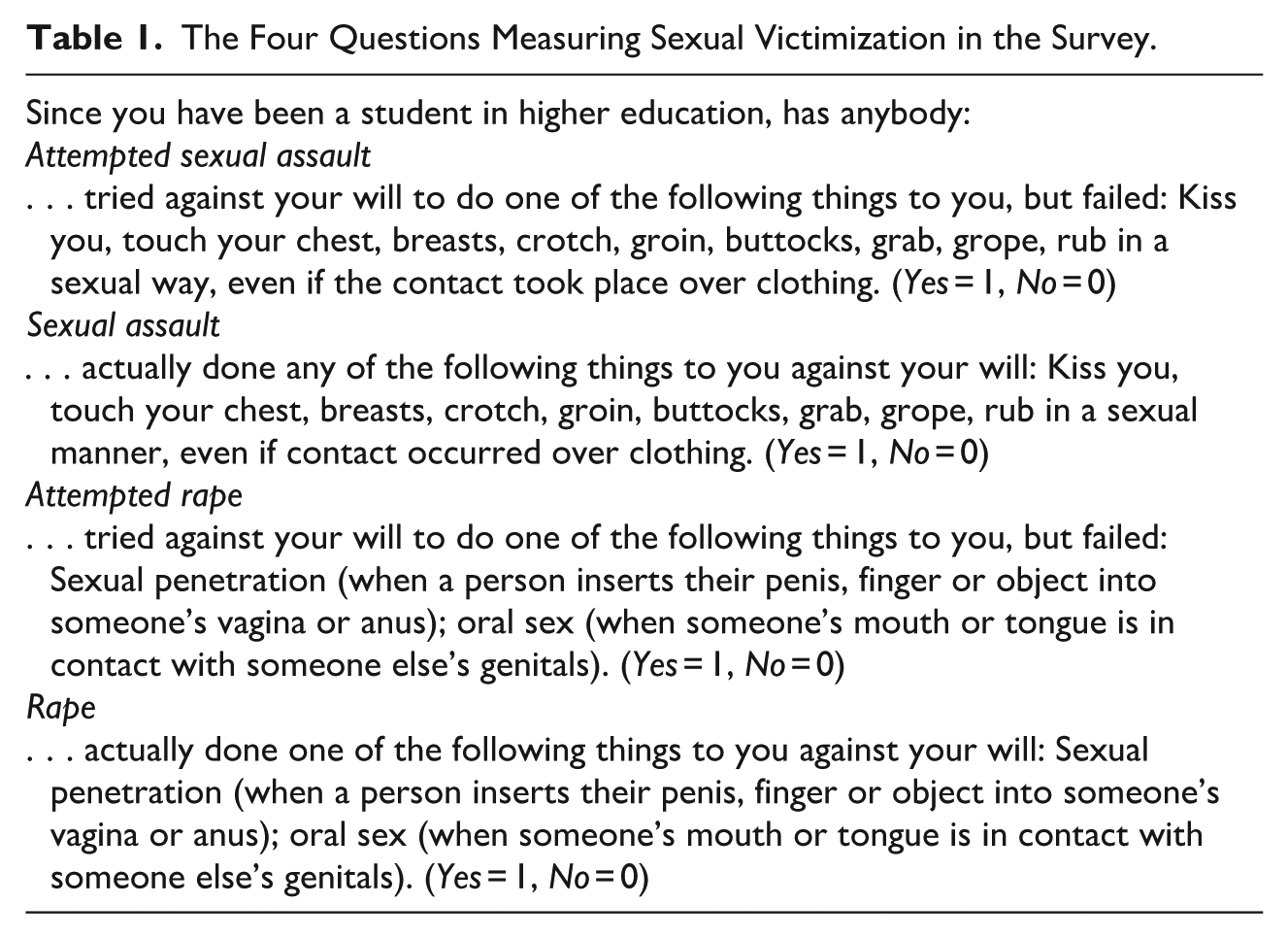
After every victimization item, if participants answered yes, two additional questions were asked. We asked participants if they experienced that particular type of victimization more than once. Participants also answered the following question after each victimization item separately: “Did you feel guilty or ashamed about what happened?” We again used a 7-point Likert-type scale with options ranging from 1 (absolutely false) to 7 (absolutely true). The means and standard deviations for self-reported guilt and shame were the following: Attempted sexual assault (M = 3.58, SD = 2.18); Sexual assault (M = 4.02, SD = 2.18); Attempted rape (M = 5.15, SD = 1.91); and Rape (M = 5.55, SD = 1.71).
Data Quality Check and Analytic Plan
A total of 86,426 observations were recorded via Qualtrics. The survey data were exported from Qualtrics to SPSS (version 29; IBM, USA) for analysis. Observations were removed if participants did not reply to the item on student status or indicated that they were not a student (n = 8,829). A first data quality item near the beginning of the survey asked whether participants started the questionnaire “just to see” and provided inaccurate responses; participants that did not confirm they had responded precisely and accurately were removed (n = 4,504). Another quality check near the end of the survey asked if participants had responded as truthfully as possible to this study; the question assured participants that they were still eligible to be drawn for the lottery and to receive study results irrespective of their answer. We removed participants who indicated their replies were not reliable (n = 89). Data were further limited only to those reporting “male” or “female” sex at birth due to insufficient sample sizes for other response categories (“Neither” = 44; “Don’t know” = 22; “Don’t wish to answer” = 163; “NA” = 11). Finally, those who did not answer any of the BJW items (n = 15, 259) or had missing values on victimization items were removed. The rates of missing values on these items were the following: Attempted sexual assault: 1.4%; sexual assault: 2%; Attempted rape: 1.3%; and rape: 1.7%. No outlier were removed from the sample. This resulted in a total eligible sample of N = 57,505 participants with a median age of 20 years (M = 21.24; SD = 3.95). As in similar surveys on sexual violence (Steele et al., 2024), female respondents were over-represented. A total of 66.9% (n = 38,448) of the respondents self-defined as female, 32.7% (n = 18,805) as male, and the remaining 0.4% (n = 252) as another gender identity or did not reply. Regarding their year of study, about 29% (n = 16,519) were in their first year of higher education, 21% (n = 11,700) in the second year, 18.5% (n = 10,439) in the third year, 13% (n = 7,253) in the fourth year, 11% (n = 6,332) in the fifth year, and 7.5% (n = 4,065) in the sixth year or more. Non-parametric tests (Spearman’s ρ) were planned in case of non-normal distribution of the variables (which was actually the case for the single-item measure of guilt/shame).
Results
BJW Among Single Victims, Poly-Victims, and Non-Victims
Participants reported the following rates of victimization: attempted sexual assault, 16.6% (n = 9,428; 61.3% more than once); sexual assault 13.6% (n = 7,639, 52.4% more than once); attempted rape 2.7% (n = 1,511, 43.2% more than once); and completed rape 3.8% (n = 2,123, 43.6% more than once).
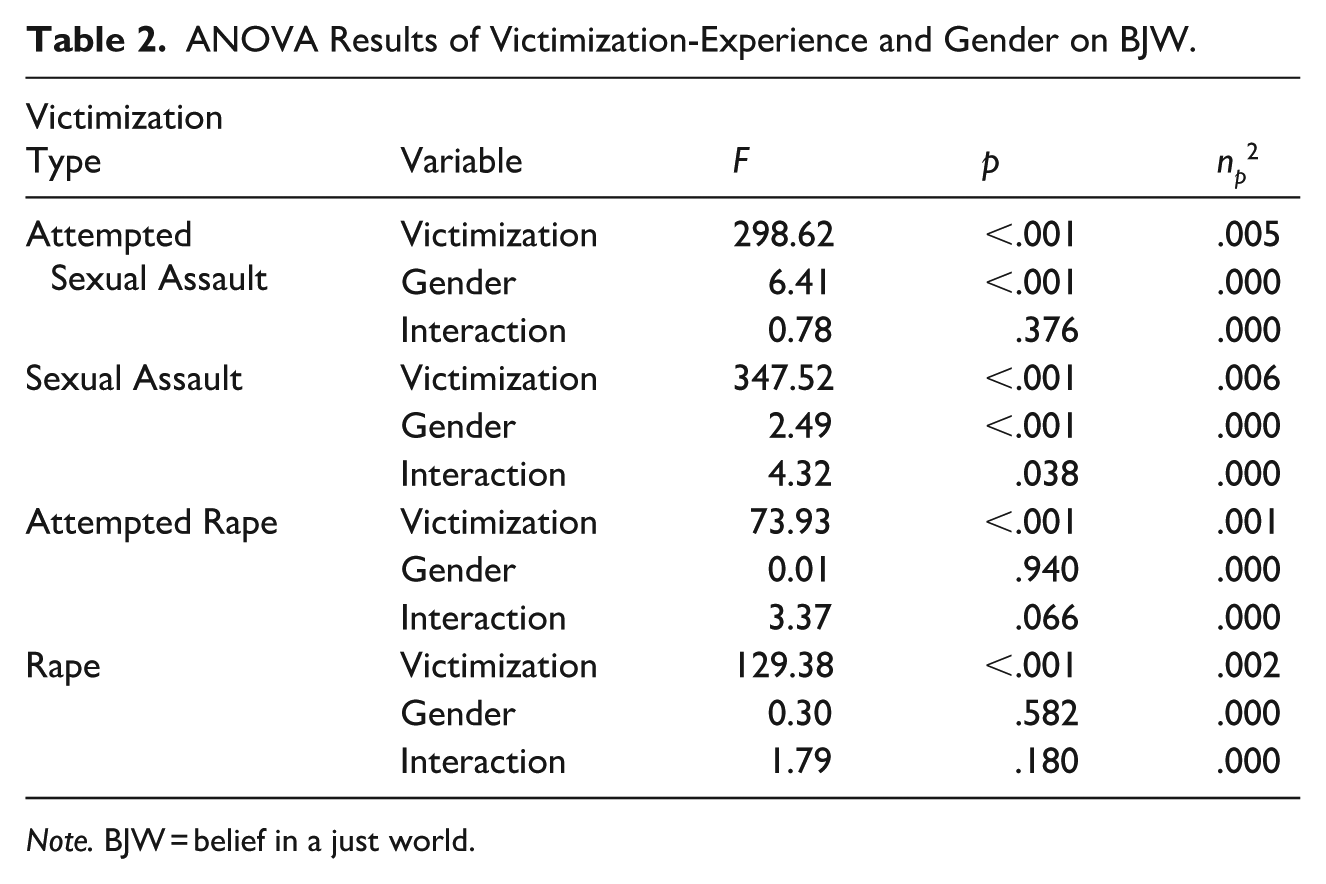
To look at differences between those who had and had not experienced sexual victimization, we performed separate analysis of variance (ANOVA) tests for every type of crime introducing victimization (binary: victim vs. non-victim) and gender as independent variables and BJW as the dependent variable (see Table 2).
ANOVA Results of Victimization-Experience and Gender on BJW.
Note. BJW = belief in a just world.
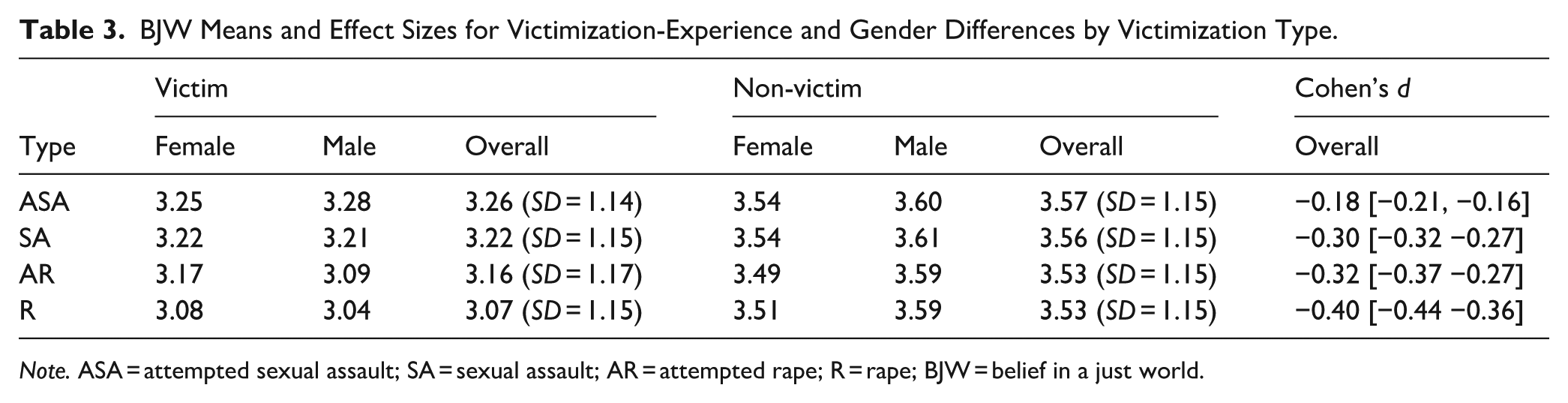
As hypothesized, BJW was lower among participants who reported attempted sexual assault, sexual assault, attempted rape, and rape compared to participants who had not experienced that particular type of victimization. Notably, the magnitude of these differences ranged from medium to large effects (see Table 3).
BJW Means and Effect Sizes for Victimization-Experience and Gender Differences by Victimization Type.
Note. ASA = attempted sexual assault; SA = sexual assault; AR = attempted rape; R = rape; BJW = belief in a just world.
Looking at the relationship between gender and BJW, we found that males reported significantly higher levels of BJW compared to females for both attempted sexual assault and sexual assault. As indicated in Table 2, gender generally did not significantly moderate the relationship between victimization on BJW, except in the case of sexual assault. In the case of sexual assault, we found an interaction between victimization and gender such that while there was no significant gender difference among victims, males had a higher BJW than females among non-victims, t(48540) = 6.23, p < .001).
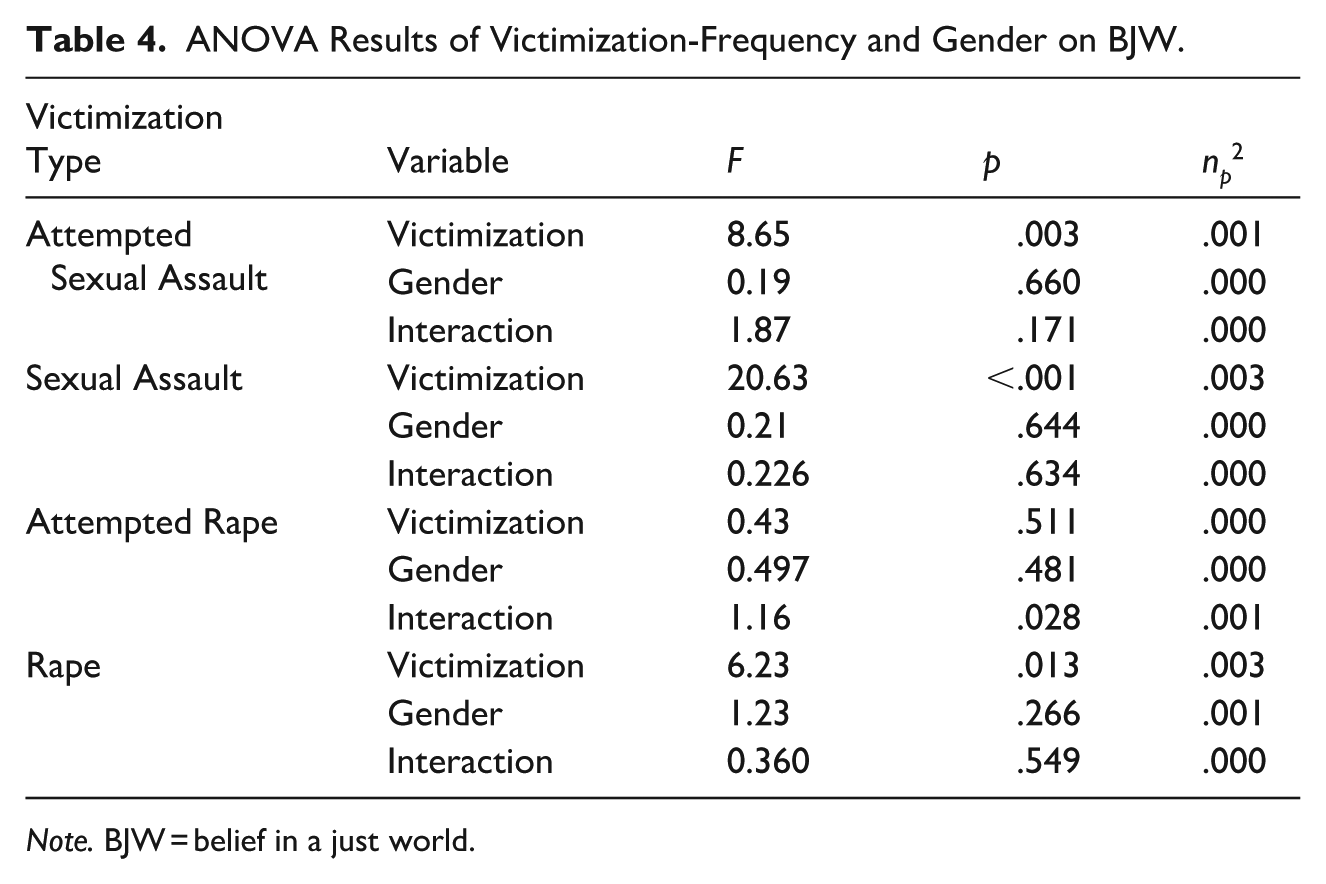
In order to compare victims with single versus poly-sexual victimization, we next performed separate ANOVAs for every type of crime introducing victimization (binary: single-victim vs. poly-victim) and gender as independent variables and BJW as the dependent variable (see Table 4). As expected, BJW was lower among poly-victims who experienced attempted sexual assault, sexual assault, and rape. However, no significant difference was observed for attempted rape (see Table 5).
ANOVA Results of Victimization-Frequency and Gender on BJW.
Note. BJW = belief in a just world.
BJW Means and Effect Sizes for Victimization-Frequency and Gender Differences by Victimization Type.
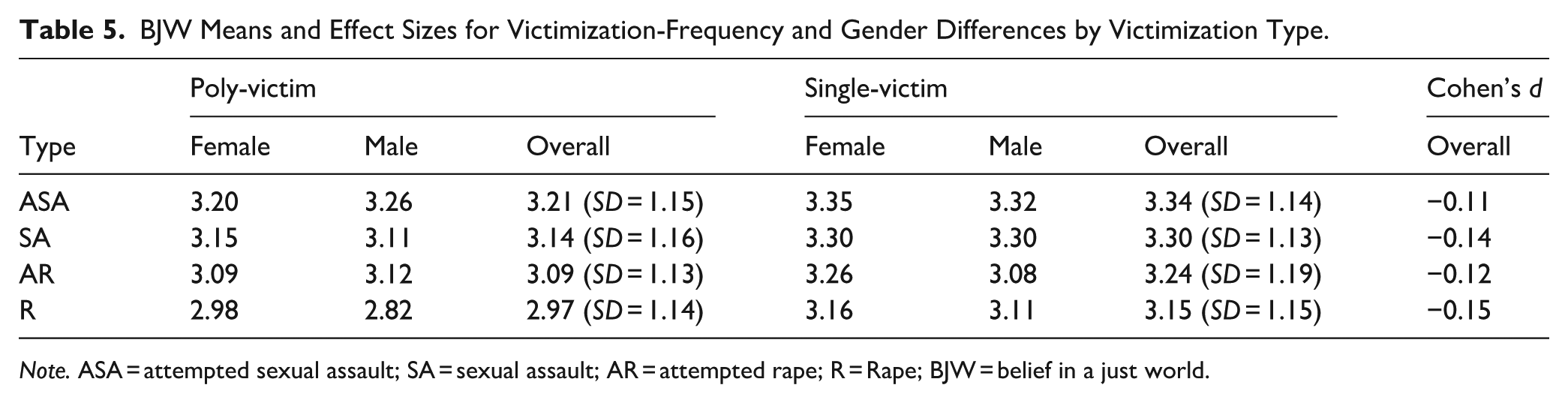
Note. ASA = attempted sexual assault; SA = sexual assault; AR = attempted rape; R = Rape; BJW = belief in a just world.
Guilt, Shame, and BJW
Finally, we examined the correlation between the single-item measure of participant’s guilt and shame after each type of sexual violence with BJW (two-tailed tests). The measure of guilt and shame was significantly associated with BJW in the case of attempted sexual assault (Spearman’s ρ = −.04, p < .001), sexual assault (Spearman’s ρ = −.05, p < .001), and completed rape (Spearman’s ρ = −.04, p = .048). However, there was no significant correlation between guilt/shame and BJW for victims of attempted sexual rape (Spearman’s ρ = −.04, p = .099). When we analyzed males and females separately, we again found that BJW was inversely related to shame/guilt following attempted sexual assault (Spearman’s ρ [women] = −.03 p < .010; Spearman’s ρ [males] = −.07, p = .016), sexual assault (Spearman’s ρ [women] = −.05 p < .001; Spearman’s ρ [males] = −.06, p = .051). A significant correlation was observed between BJW and attempted rape among males (Spearman’s ρ = −.18, p = .024) but not women (Spearman’s ρ = −.02, p = .396). Finally, the observed link between BJW and rape in the full sample became non-significant when males and women were analyzed separately (Spearman’s ρ [women] = −.04, p = .119; Spearman’s ρ [males] = −.11, p = .106). Notably, in each of these cases, the inverse relationship between BJW and shame/guilt is stronger for men than women.
Discussion
Experiencing sexual violence is related to core beliefs, including BJW. In this study, we showed that victims of four major kinds of sexual violence, namely attempted sexual assault, sexual assault, attempted rape, and rape, exhibited a lower level of BJW. Among individuals who had experienced one of these forms of sexual violence, we also observed that multiple victimization was related to even weaker BJW. The associated decrease of BJW is potentially concerning as our findings also highlight that BJW was inversely related to negative emotions following sexual violence among participants. Specifically, the more victims endorsed a BJW, the less they reported shame and guilt.
Sexual Violence Victimization and Weak BJW
Given the traumatic and lasting effects of sexual violence, we expected such an experience would be associated with lower levels of BJW. This first hypothesis was in line with literature suggesting that traumatic events can shift core beliefs and worldviews (Schwartzberg & Janoff-Bulman, 1991) and previous research comparing BJW between victims and non-victims where victims endorsed weaker BJW (Catlin & Scherr, 2022). Among our robust sample of university students in France, the same pattern emerged. Given the cross-sectional nature of our data, we cannot make any causal claims regarding the relationship between experiencing sexual violence and lower BJW. In other words, our observed effects cannot conclusively speak to whether the lower levels of BJW preceded or were the outcome of the experienced sexual violence.
Exploring the question of temporal precedence further, we start with an assumption that participants’ weaker BJW existed prior to the incident(s) of sexual violence. For example, perhaps lower BJW is related to greater risk-taking behaviors which in turn increase the risk of sexual violence victimization. Or perhaps lower BJW is related to greater trust, and perpetrators take advantage of that trust. Putting aside the problematic victim-blaming tone, the literature does not support either pathway. In fact, across two studies, Lambert et al. (1999) found strong correlations between BJW and perceptions of risk. In theory, someone who does not perceive any risk is unlikely to take precautions and therefore may be vulnerable. However, Lambert et al. (1999) found that people with high BJW perceive less risk of several types of victimization (e.g., hijacking, flooding). Importantly, in both samples, the relationship between BJW and risk perception was qualified by an interaction with participants’ endorsement of right-wing authoritarianism, only emerging at high levels of authoritarianism. Therefore, it is unlikely that low BJW would result in lower perceptions of risk, leaving little theoretical reason to suspect that low BJW would increase risk-taking behavior and ultimately increase the likelihood of victimization. Likewise, people with low BJW have been found to be less trusting than individuals with high BJW (Bègue, 2002; Zuckerman & Gerbasi, 1977). Of course, it is possible that some other mechanism could explain this pathway. According to Lerner and Miller (1978), people are very reluctant to give up BJW because this belief serves important functions. However, our results highlight the impact of experiencing sexual violence because our observed effects suggest the possibility that these traumatic experiences are powerful enough to weaken BJW. Recent studies suggest that BJW may be less stable than previously considered. In a study based on intensive daily diary data (Lutz et al., 2025), BJW appeared surprisingly plastic, fluctuating within individuals as a direct cognitive response to daily emotional shifts and personal successes.
Single Versus Multiple Victimization and BJW
A review of 90 empirical articles found that 2 out of 3 victims of sexual violence will be revictimized within their lifetime (Classen et al., 2005). Being revictimized is associated with greater levels of self-blame and higher prevalence of mental health problems (Classen et al., 2005). Despite other research showing no relationship between the frequency of victimization and BJW (Catlin & Scherr, 2022), our second hypothesis was supported in that multiple victimization was associated with lower BJW compared to single victimization in most types of sexual victimization.
Some methodological differences between the two studies might help explain the discrepant findings. First, regarding the definition of sexual violence itself, Catlin and Scherr (2022) used a much broader question than in the present study (e.g., ranging from stalking to sexual harassment and rape) and, critically, did not offer precise definitions associated with sexual violence. In contrast, our study used four specific types of sexual violence and offered definitions for participants. Therefore, the present study is likely to have a much cleaner measure of sexual violence victimization than Catlin and Scherr (2022). Second, and relatedly, by having a much broader/ambiguous definition of sexual violence, it is possible, that when asked about frequency of victimization, participants may have considered themselves as having experienced revictimization based on myriad experiences. For example, a participant may have reported revictimization based on sexual harassment which is both qualitatively and legally distinct from the types of sexual violence we examined in the present study. Third, there are differences in analytic approach. The present study looked at revictimization in a binary manner, whereas Catlin and Scherr (2022) looked at victimization frequency in a continuous manner. Perhaps related to this point, the present study had a much larger sample size, giving us the ability to detect small differences that the Catlin and Scherr (2022) study may not have been powered to detect. This idea is supported by the similarity in observed effect sizes. Finally, the two studies used different scales to capture participants’ BJW.
In terms of BJW, some research has suggested that both the just and unjust subscales of BJW scales show differences across countries (Furnham, 1993). Specifically, looking at 12 different countries, cross-cultural differences in BJW tended to be associated with differences in power-distance and individualism (Furnham, 1993). Though it is not clear that the United States and France differ enough on those two factors to warrant concern that cross-cultural differences could explain differences between our study and U.S.-based research. Further minimizing this particular concern is research suggesting that measures of BJW are cross-culturally generalizable (Furnham, 2003).
BJW and Post-Victimization Shame and Guilt
Our last hypothesis was supported by significant associations between BJW and post-experience blame and guilt. Specifically, we found that participants with higher BJW endorsed lower levels of shame and guilt following sexual violence victimization. This finding contradicts ideas that high BJW could lead to internalization of rape myths and ultimately serve to increase self-blame and guilt (Amstadter & Vernon, 2008). Likewise, it contradicts research that has found no effect of BJW on mental health following undesirable events (Rubin & Peplau, 1973). It does, however, support a series of studies that have found that strong BJW can serve a protective function (Bulman & Wortman, 1997).
Research has suggested there are several mechanisms that might explain BJW’s positive function. Specifically, high BJW is related to many psychological benefits as previously indicated. It remains an empirical question which of these benefits of high BJW, if any, decrease self-blame and guilt following sexual violence victimization.
Limitations and Future Directions
Our study involved a robust sample of individuals enrolled in French universities. As such, we were able to examine with ample statistical power the relationships between sexual violence and BJW. That said, there are limitations to consider.
First, in line with previous research and to minimize measurement error, our questions surrounding sexual violence were precisely defined for participants with behavioral-anchors. This decision, however, means our definition of sexual violence is limited to specific kinds of aggression (i.e., attempted/completed assault and rape). Furthermore, by the nature of close-ended questions, participants did not have the option to label their specific experiences for themselves. The label is important both because it can influence legal options and how others (like helping professionals) respond to victims, and research has shown that victims’ labeling of their own experience—independent of the behavioral components of the assault—can influence victims’ distress. Future research might consider experimenting with the measurement of sexually aggressive behavior to better understand the relationship between victims’ experiences and BJW.
Second, the measure of self-reported negative emotions following victimization was based on a single item which combined the experience of guilt and shame. While existing studies combine the measure of guilt and shame in a single item (Kidd, 2007), future research should distinguish between these emotions and rely on more extended measures such as the Trauma-Related Guilt Inventory (Kubany et al., 1996, see also Tilghman-Osborne et al., 2010).
Third, the cross-sectional nature of the study precludes any definitive claims of causality. That said, only a longitudinal study might be able to capture the causal relationship between victimization and BJW. Along a similar vein, as alluded to above, our data cannot speak to any potential explanatory mechanisms between sexual violence, reduced BJW, and subsequent experience of shame and guilt. The literature suggests several mechanisms that might explain the chain of relationships we observed and warrants further investigation. Finally, the inverse relationship between BJW and the experience of shame and guilt following sexual assault, attempted rape, and rape was of limited magnitude.
Conclusion
Sexual violence represents a worldwide problem that impacts millions of individuals. Our findings highlight how the trauma of sexual violence, particularly repeated victimization, can be related to victims’ worldviews—the very beliefs that might have offered some protection against the self-blame that often accompanies sexual violence. As long as sexual violence continues to plague society, more work needs to be done to minimize the deleterious effect it has on its victims.
Footnotes

Ethical Considerations
All procedures performed were in accordance with the ethical standards for questionnaire studies at University Grenoble Alpe, and with the 1964 Helsinki Declaration and its later amendments or comparable ethical standards.
Funding
The authors received no financial support for the research and/or authorship of this article.
Declaration of Conflicting Interests
The authors declared no potential conflicts of interests with respect to the authorship and/or publication of this article.
Data Availability Statement
Data are available upon request.