






Abstract
Despite substantial scholarly interest in workplace sexual harassment, bullying, and aggression, research has largely treated these phenomena as distinct, resulting in fragmented literatures and limited empirical integration. Conceptual debates increasingly suggest these experiences may be intertwined, yet empirical investigations remain scarce. This study addresses this gap by examining whether, and how, employees perceive sexual harassment, bullying, and aggression at work as interconnected experiences. Drawing on survey data from 871 university employees, we employed Latent Class Analysis (LCA) to explore the underlying structure of these experiences. Our findings reveal that while the three constructs are best represented as distinct latent factors, they are considerably related and their distinctiveness depends on the level of exposure. Specifically, the constructs are harder to distinguish at low exposure levels, diverge as intensity increases, and reconverge in the most severe cases – most prominently between bullying and aggression. These results challenge the notion of rigid categorical boundaries and underscore the need for a more nuanced understanding of different forms of negative social behaviors at work. The study advances construct clarity and encourages more integrative perspectives that align with the complexity of employees’ lived experiences.
Keywords
Introduction
Over the last decades, scholarly attention has focused on various forms of severe negative social behavior in the workplace. In accordance with common practice and international legislation (International Labour Organization, 2022), the most prominent research lines today are centered around sexual harassment, bullying, and aggression – recognized as some of the gravest social stressors at work (Hershcovis & Barling, 2010; Nielsen & Einarsen, 2018) and each associated with substantial consequences for both professional and personal well-being (Nielsen & Einarsen, 2018; Samnani & Singh, 2012). These experiences have been linked to similar detrimental outcomes (e.g., anxiety, depression, absenteeism; Glomb, 2002; O’Leary-Kelly et al., 2009; Samnani & Singh, 2012) as well as to shared driving forces (e.g., role stressors, destructive leadership styles, tolerant social climates; Barling et al., 2009; Feijó et al., 2019; Lee, 2018; Pina & Gannon, 2012).
However, efforts to understand and mitigate these problems have resulted in three largely separate literatures on sexual harassment, bullying, and aggression at work. Although this siloed development has generated valuable domain-specific insights, cross-fertilization or integration across these literatures remains limited (Hershcovis, 2011). Increasingly, scholars argue that these negative workplace experiences may be entangled, questioning whether it is conceptually justified to maintain separated research lines and whether they should be treated as distinct phenomena or rather as interconnected manifestations of a broader, underlying experience (Aquino & Thau, 2009; Dhanani & Bogart, 2025; Hershcovis, 2011; Larsen et al., 2019). This debate echoes the broader discussion on the ‘semantic jungle’ present in mistreatment literature more generally (Nixon & Spector, 2015), raising concerns about the proliferation of overlapping concepts that may ultimately capture equivalent underlying phenomena and, hence, questions whether some should be collapsed into broader categories (Dhanani & Bogart, 2025; Tepper & Henle, 2011). Conceptually, sexual harassment, bullying, and aggression all involve verbal and/or physical, negative, unsolicited, and offensive interpersonal behaviors (Shapiro et al., 2008) that – intended to or not – significantly harm targets and others involved. Their shared characteristics make clear conceptual boundaries difficult to draw. Recognizing that these experiences may transcend rigid categorical distinctions (Aquino & Thau, 2009) highlights the need for more integrated and fine-grained examinations of these phenomena in tandem to disentangle if and how they intertwine.
Despite growing theoretical debate, to date, no empirical research has directly tested sexual harassment, bullying, and aggression simultaneously to assess whether – and how – employees actually experience these phenomena as distinct or interwoven. To develop a more informed view of their potentially interconnected nature, rigorous empirical tests are warranted (Dhanani & Bogart, 2025). Consequently, this study seeks to move beyond conceptual arguments and empirically disentangle if and how sexual harassment, bullying, and aggression connect in employees’ work experiences.
In line with dominant approaches in these literatures, we adopt a target-centered perspective focused on victimization. Additionally, we take an insider lens, examining experiences of sexual harassment, bullying, and aggression among organizational members, thereby excluding incidents involving outsiders such as clients, customers, or patients. To assess the possible interconnectedness between the three phenomena, we employ Latent Class Analysis (LCA), a method that has proven particularly effective in capturing the complexity of behavioral data in bullying research (Notelaers & Van der Heijden, 2019).
The current study adds to the literature in several ways. First, by gaining insight into how workplace sexual harassment, bullying, and aggression are related, we help bridge the now fragmented research traditions. This is important because the proliferation of conceptually similar constructs can impede scientific clarity and theoretical progress (Aquino & Thau, 2009). Being the first to empirically assess how (non)overlapping these experiences might be in reality, we directly address the increasingly urgent calls for empirical construct reconciliation (Dhanani & Bogart, 2025). As such, the study provides an empirical foundation to clarify how future theory development and the literature in general might move forward. Second, we apply LCA, an emerging technique in bullying research that addresses several statistical challenges encountered in prior empirical work, and extend its application to workplace sexual harassment and aggression.
Workplace Sexual Harassment, Bullying, and Aggression: A Comparative Perspective
Distinguishing workplace sexual harassment, bullying, and aggression is well justified in the literature, as each of the concepts captures unique manifestations of negative social behavior, reflecting meaningful differential experiences (Tepper & Henle, 2011). Workplace sexual harassment refers to unwelcome sex(gender)-related behaviors in the workplace that recipients perceive as offensive, overwhelming their coping resources, or threatening their well-being (Fitzgerald et al., 1997). Workplace bullying involves repeated and prolonged exposure to acts of harassment, insults, exclusion, or undermining, in a context where targets end up in an inferior position and have difficulties defending themselves (Einarsen et al., 2003; Nielsen & Einarsen, 2018). Finally, workplace aggression is often explicitly characterized as deliberate attempts to harm coworkers (Neuman & Baron, 1998).
Typically, the behavioral expressions of these three phenomena are argued to differ along dimensions of content, intent, power dynamics, and patterns (frequency, duration, escalation). Sexual harassment involves negative social behaviors of an explicit sexual or gender-related nature, whereas the bullying and aggression literature do not restrict the content of hostile acts. This also implies that discriminatory behaviors shaped by sociocultural characteristics – such as gender – are not necessarily excluded from aggression or bullying either (Cowie et al., 2002). Regarding intent, both sexual harassment and bullying do not require that perpetrators act with the explicit intent to cause harm, whereas intent is a key defining feature of aggression (Shewach & Sackett, 2024). Nevertheless, scholars note that perceived malintent may also become central in bullying, as targets frequently infer hostile intent due to the repeated nature of bullying behaviors (see below; Baillien et al., 2017). Of the three constructs, only bullying explicitly specifies and elaborates on the presence of a power imbalance between perpetrator and target as a defining criterion. In such situations, targets are perceived to end up in an inferior position compared to the perpetrator and therefore struggle to defend themselves. This imbalance can stem from various factors, including not only formal hierarchical status, informal social influence, or tenure, but also gender (Hershcovis, 2011), leaving room for overlap with sexual harassment. Although not a formal defining criterion in sexual harassment, its literature places significantly more emphasis on power relations in explaining the origins of the phenomenon than is typical for either bullying or aggression. Sexual harassment is often understood within a broader ‘gender hierarchy’ shaped by patriarchal societal structures and gender role socialization that carries over into workplace settings, reflected in the fact that the majority of reported cases involve women targeted by men (Cortina & Areguin, 2021). In this hierarchy, the masculine is associated with greater power than the feminine, and sexual harassment is viewed as a means, whether conscious or unconscious, of gaining or preserving that power (Burn, 2019; O’Donohue, 1998). The aggression literature, by contrast, gives relatively less explicit attention to power dynamics as a constituting element. Nevertheless, hierarchical power differences often create conditions under which aggression, particularly verbal aggression, can more easily be legitimized. Because supervisors hold authority over subordinates, the boundary between a firm management style and aggressive conduct can be thin, a dynamic that is central to the abusive supervision literature (Tepper et al., 2017). Finally, bullying distinguishes itself through its systematic nature. Its defining characteristic is persistence: involving repeated negative acts occurring over an extended period (Notelaers & Van der Heijden, 2019). A single incident cannot constitute bullying (Einarsen et al., 2003), whereas a single incident may suffice to classify sexual harassment and aggression, even though both often also occur repeatedly (Blindow et al., 2024; Rospenda et al., 2006). Bullying is therefore uniquely understood as a dynamic – an unfolding process often marked by escalation over time – rather than an isolated event (Notelaers & Van der Heijden, 2019).
Taken together, the discussion above suggests that although experiences of workplace sexual harassment, bullying, and aggression vary along several dimensions, their defining characteristics may be less differentiating as they initially appear (Aquino & Thau, 2009). This complicates drawing sharp boundaries and makes their communalities difficult to overlook. Historically, early scholars approached negative workplace behaviors in a far less segmented way than modern conceptualization. Even Leymann (1990a) composed his foundational Leymann (1990b) Inventory of Psychological Terror (LIPT) to consider a broad and comprehensive range of hostile acts – such as exclusion, verbal hostility, physical aggression, and unwanted sexual behaviors – examining them as systematic victimization altogether as opposed to differentiating subforms. Certain scholars even argue that defining features such as sexualized content, behavioral repetition, or deliberate harm could be rather trivial or peripheral in the lived experience of negative social behavior, implying that these concepts might just be more of the same (Aquino & Thau, 2009). Indeed, at their core, all three forms ultimately entail negative, unwanted, unsolicited, social interactions, often manifested through similar behavioral expressions, including psychologically and physically abusing acts as well as material and sociocultural forms of maltreatment, many of which recur over time (Aquino & Thau, 2009; Verschuren et al. 2021). Experiencing acts such as insults, negative comments, shouting, physical contact/attacks, vandalism, or sexualized remarks may, depending on their connotation or social context, constitute sexual harassment as well as bullying or instances of aggression. Additionally, each experience inflicts similar types of harm across physical, material, psychological, and social domains and involves comparable role dynamics among targets, perpetrators, and bystanders (Verschuren et al., 2021).
Given this growing acknowledgment of the conceptual similarities (and differences) between sexual harassment, bullying, and aggression at work, a substantial number of researchers argue that these phenomena are highly interrelated (Aquino & Thau, 2009; Bowling & Beehr, 2006; Dhanani & Bogart, 2025; Hershcovis, 2011). So far, scholars have highlighted different ways in which they may conceptually connect to one another. For instance, some scholars have suggested a nested structure in which one experience constitutes a specific manifestation of another, as depicted in Figure 1. Namely, workplace sexual harassment as well as bullying have been regarded as forms of a broader category of aggression (or, violence) at work (Hershcovis, 2011; Van De Griend & Messias, 2014). Sexual harassment is regarded as a sexually oriented type of aggression (Piquero et al., 2013; Schat & Kelloway, 2005) and bullying as a subset of aggression manifested in multiple incidents (Gururaj & Schat, 2025; Samnani et al., 2013). Since physical attacks can be a prominent component of aggression (Bartlett & Bartlett, 2011; Rayner & Hoel, 1997), behaviors such as sexual assault or physical manifestations of bullying are easily classified under aggression due to this shared physical feature (Bartlett & Bartlett, 2011; Piquero et al., 2013). Alternatively, when physical acts are excluded from definitions of bullying, some conceptualize bullying it as the ‘psychological’ segment of aggression (Schat et al., 2006). Conversely, albeit to a lesser extent, others have argued the reverse; that physical violence and verbal aggression could equally be components of a broader bullying conceptualization (Einarsen, 1999). Additionally, several researchers have followed the possibility of sexual harassment being a form of bullying that uses sexuality or gender as a means of oppression (Cowie et al., 2002; Einarsen, 2000).
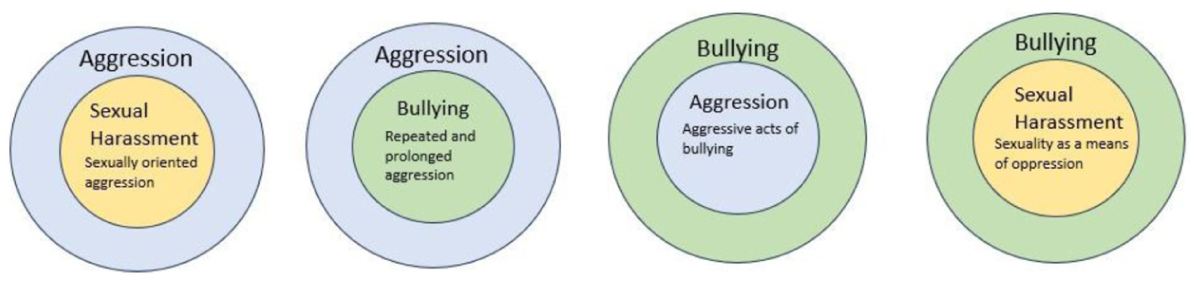
Visualization of suggested nested relationships between workplace sexual harassment, bullying, and aggression.
Another perspective views the behaviors as interconnected elements of the same overarching phenomenon, as represented in Figure 2. Recent literature has aimed to formulate a more comprehensive concept of negative social behaviors at work, often exemplified through operational definitions encompassing a wide range of experiences, including sexual harassment, bullying, and aggression (Verschuren et al., 2021). In this, all three concepts are seen as interrelated because they are similar components of one overarching superstructure or macro-construct. Accordingly, researchers have introduced umbrella-concepts like workplace harassment (Bowling & Beehr, 2006; Neall & Tuckey, 2014), workplace victimization (Aquino & Thau, 2009), workplace (interpersonal) mistreatment (Dhanani & LaPalme, 2019), and workplace emotional or generalized abuse (Keashly & Harvey, 2005) aiming to embody these experiences collectively. Yet, given the diversity of labels introduced, this has furthered conceptual fragmentation in a similar ‘semantic jungle’, transforming the initial promise for clarity of such superstructures into an additional source of confusion.
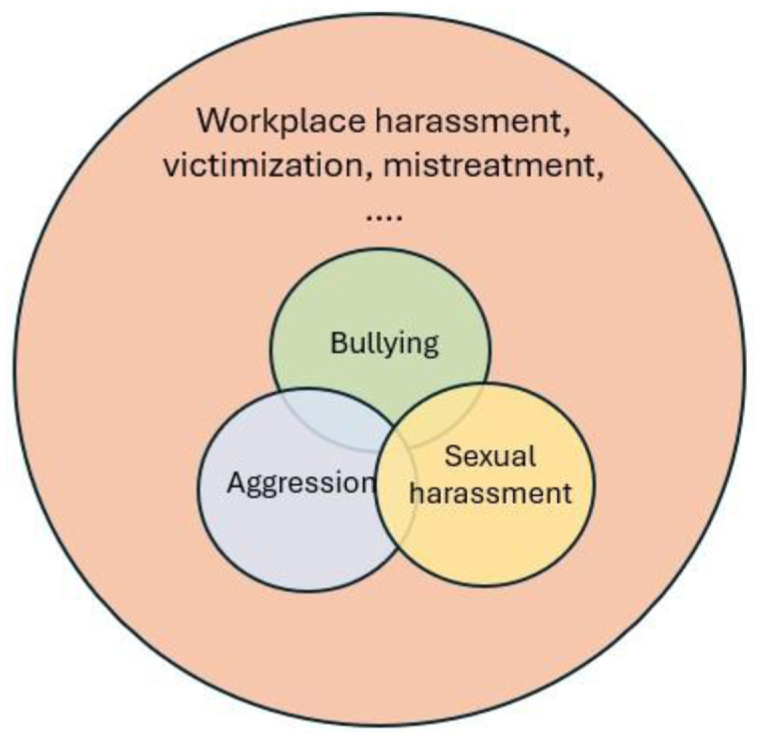
Visualization of suggested overarching structures for workplace sexual harassment, bullying, and aggression.
While these perspectives offer valuable starting points for understanding the relationships between workplace sexual harassment, bullying, and aggression, they remain largely theoretical. To date, discussions have been grounded primarily in conceptual debate, often relying on literature reviews and definitional critiques (Shapiro et al., 2008). Empirical evidence on whether, and to what extent, employees perceive these experiences as connected is still lacking. Without empirical validation, our knowledge of the actual nature of these potential relationships is tentative at best. Despite the absence of joint empirical investigations into sexual harassment, bullying, and aggression, a handful of studies have explored how other, related forms of negative interpersonal conduct at work might interrelate. Unfortunately, the methods and methodological rigor employed vary widely and the results have produced disparate and inconclusive findings. For instance, researchers examining the psychometric properties of large and comprehensive instruments such as the LIPT (Leymann, 1990b) more in-depth, which initially include items that may reflect all three concepts, have identified multiple distinct underlying factors. For example, using principal component analysis, the French validation of the LIPT revealed separate components for, among others, verbal violence and threats, physical violence, and sexual harassment (Niedhammer et al., 2006). Similarly, the Turkish validation study employed confirmatory factor analysis and distinguished sexual and physical harassment from bullying behaviors (Korukcu et al., 2014). When comparing more narrowly defined scales, Larsen et al. (2019) conducted bifactor analyses and propose that sexual harassment, aggression at work, and gender discrimination share a considerable degree of overlap, to the extent that suggests a single underlying general factor, although individual constructs continued to account for a portion of the variance. Conversely, Lim and Cortina (2005) used confirmatory factor analyses to highlight that general incivility, sexualized harassment, and gender harassment do not fall under one overall negative behavioral experience but are better represented by three standalone factors. Yet, they did find strong correlations and notable co-occurrences among the three concepts. Similarly, through confirmatory factor analysis, Fendrich et al. (2002) observed that more generalized workplace abuse and sexual harassment ‘are two distinct but strongly related constructs’ (Fendrich et al., 2002, p. 501). Using LCA, Notelaers et al. (2018) found that the measurement items for bullying, conflict, and aggression were best represented by two distinct latent factors – one corresponding to bullying, and another combining conflict and aggression. In conclusion, our understanding of how the different negative social experiences might be entwined remains elusive.
Therefore, we aim to address this research gap by conducting a comprehensive empirical examination of workplace sexual harassment, bullying, aggression, and their potential interconnections. Based on the recognized communalities in the existing literature, we consider that employees may perceive sexual harassment, bullying, and aggression as more intertwined than traditionally assumed in research. This could imply they are seen as facets of a broader construct, or they remain distinct experiences but still tend to co-occur or relate in other meaningful ways. Accordingly, we aim to explore and untangle if and how sexual harassment, bullying, and aggression are connected in employees’ lived experiences. To this end, we employ LCA, an exploratory technique proven valuable in bullying research (Notelaers et al., 2018).
Method
Sample and Procedure
For this study, we use data collected during June to July 2017 among employees of a university in the Low Lands. The data were collected by an independent work environment assessment company through submitting electronic questionnaires to 4,836 employees, of which the response rate was 26%. Participation in the survey was voluntary, and anonymity was ensured by all parties. For the present analyses, a subsample of 871 employees was selected, comprising only respondents who had completed all relevant behavioral items on sexual harassment, bullying, and aggression. In this sample, most employees, 61%, identified as female. The average respondent was 43 years old (SD = 12.06) and 57.4% of respondents worked full-time. Among the part-time workers, 20% worked more than 80%, 16.7% of employees worked between 50% and 80% of the time, and 6.3% occupied positions less than half-time. The sample included a nearly equal distribution of employees in administrative (51%) and academic (49%) positions.
Measures
Workplace Sexual Harassment was measured with five items of the 11-item Bergen Sexual Harassment Scale (Nielsen et al., 2010). The scale encompasses common verbal, nonverbal, and physical harassing behaviors such as ‘unwanted verbal comments with sexual content, such as jokes or sexist remarks’, ‘sexually charged staring or glances which felt uncomfortable’, or ‘unwanted physical contact with sexual undertones, like patting, pinching, touching or embracing’. Respondents indicated whether they experienced these behaviors (1) zero, (2) one, (3) two to five, or (4) more than five times during the last 6 months.
Workplace bullying was measured using the nine-item Short Negative Acts Questionnaire (SNAQ; Notelaers et al., 2019). Example items include both person- and work-oriented behaviors such as experiencing ‘gossip or rumors about you’ or ‘someone withholding information which affects your performance’. Respondents were asked to evaluate how often (from [1] never to [5] daily) they experienced these bullying behaviors during the last 6 months.
Workplace aggression was measured using one item from the original Negative Acts Questionnaire (Einarsen & Raknes, 1997) and two from the Negative Acts Questionnaire-Revised (Einarsen et al., 2009). Respectively, these items asked respondents whether they experienced ‘verbal violence’, ‘being shouted at or being the target of spontaneous anger outbursts’, and, more physically, ‘intimidating behaviors, such as finger-pointing, invasion of personal space, shoving, blocking your way’ during the last 6 months. The five response categories were used that ranged from (1) 0 times to (5) weekly or more often.
Statistical Considerations
Using Latent Gold 6.1, we conduct LCA because this statistical approach can address some of the methodological challenges faced by prior research on negative social behaviors, particularly those related to response scale types and distributional assumptions (Notelaers et al., 2018). Ordinarily, these measures all employ response categories reflecting exposure frequency (from ‘never’ to ‘always’). However, strictly speaking, the observed responses to such behavioral items are ordinal in nature rather than continuous, despite commonly treating them as interval-level data in traditional factor analysis or (linear) regression techniques (Hershcovis & Reich, 2013). Even when categorical accommodations are made by adopting a weighted least squares estimation method, thresholds are estimated for a pseudo-continuous latent variable for which normality still is assumed (Jöreskog, 2003). While moderate deviations from the normality assumption can be tolerated, severe departures can bias results and threaten statistical validity (Li, 2016; Magidson & Vermunt, 2001). Consequently, conventional techniques such as correlational or covariance modeling pose notable challenges when applied to negative social behaviors at work. LCA offers several advantages that address the aforementioned challenges. Importantly, it does not rely heavily on distributional assumptions and therefore accommodates non-normal data. Moreover, LCA can incorporate count, continuous, interval, nominal and ordinal measures variables, making it a versatile technique for capturing heterogenous response patterns. This flexibility gives LCA an advantage over traditional clustering methods, as it can more effectively model categorical response patterns (Magidson & Vermunt, 2004).
Ultimately, LCA is a statistical method that allows to uncover hidden structures within datasets. It classifies respondents into mutually exclusive classes or ‘profiles’ that represent the categories of an unobservable variable (McCutcheon, 1987; Notelaers et al., 2006). LCA begins with a baseline, single-class model. Sequentially, classes are added until an optimal model fit is achieved (Magidson & Vermunt, 2004; McCutcheon, 1987). Not only the number of classes can be increased, but also the number of underlying latent variables, factors, can be expanded as well. Given its conceptual resemblance to traditional factor analysis, a model with multiple latent variables is called a ‘Latent Class Factor analysis’ (LCF; Magidson & Vermunt, 2001).
Determining the fit of LC models requires an extensive and nuanced evaluation process. Model comparison primarily relies on the Bayesian Information Criterion (BIC), with the model showing the lowest BIC value considered the most suitable (McCutcheon, 1987, Vermunt & Magidson, 2002). In addition, several other statistics inform us about the quality of the retained model. First, there is the (mis)fit of the model itself. When a model in its own does not fit the data, it has a significant L2. However, assessing significance in cases of heavily skewed data (and resulting sparse multiway tables) is not as straightforward. In such cases, Langeheine et al. (1996) proposed using a bootstrapping procedure. Beyond global fit measures such as the BIC and the L2, local misfit and its origin can be inspected through the Bivariate Residuals (BVRs), which should ideally be below 3.84 (Statistical Innovations, 2013). However, given BVR’s sensitivity to large sample sizes, a more relative and pragmatic threshold suggests at least 85% reduction in BVR as criterion (Notelaers et al., 2006). This may also avoid adding spurious clusters arising from residual associations among only a few indicators (Uebersax, 2009). Finally, a model’s classification quality is evaluated using R2, entropy R2, and the adjacent classification error. This multifaceted assessment ensures a comprehensive evaluation of the model’s fit, significance, and classification accuracy.
Results
Table 1 summarizes the fit statistics of the different primary models that were estimated. First, we compared the respective fits of cluster models (LCC) to factor models (LCF). Preferring an LCC solution would imply that the manifest indicators of sexual harassment, bullying, and aggression are intertwined to such an extent that they cannot be modeled as distinguishable concepts. Instead, these behaviors unfold into several clusters that each represent a complex but meaningful combination of cross-concept indicator responses, eventually forming a typology of one single, broader construct. Conversely, an LCF solution would imply that the three concepts are experienced as three distinguishable phenomena or factors, which can still be correlated to a substantial degree. According to the BIC, the most appropriate models were three-factor factor models and not cluster models. As a result, sexual harassment, bullying, and aggression do not fit well into one enmeshed concept but are better reflected as separate phenomena that are correlated. We also verified whether only two out of three constructs may be collapsed. Nevertheless, the three-factor models also fit considerably better than the two-factor alternatives.
Fit Statistics of Primary Models.
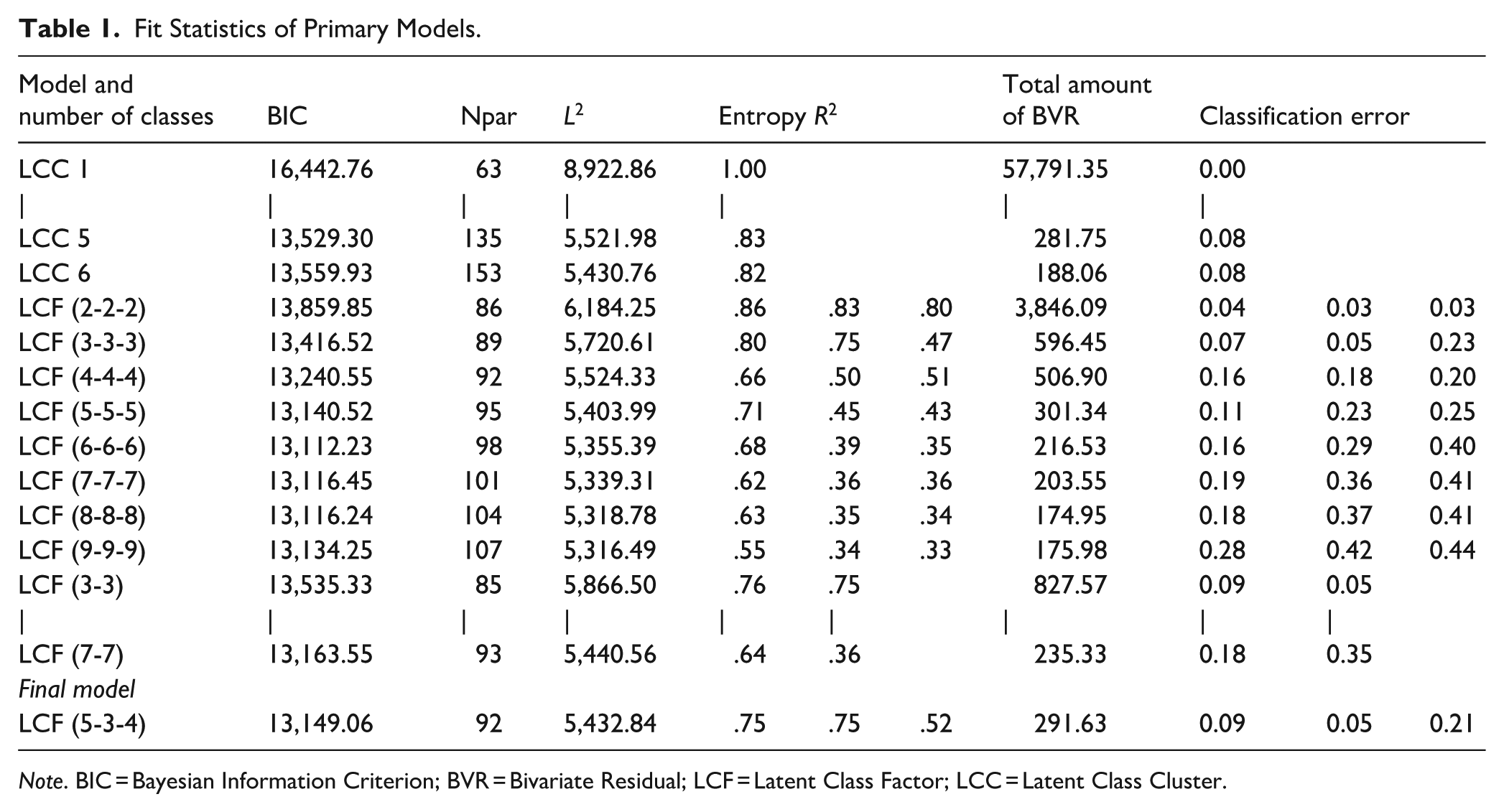
Note. BIC = Bayesian Information Criterion; BVR = Bivariate Residual; LCF = Latent Class Factor; LCC = Latent Class Cluster.
The BIC of the LCF models continued to decline substantially until reaching a solution with seven classes. However, the decrease in BIC compared to a six and five class LCF model was marginal while the classification error increased to 19%–41%. Additionally, the seven and six class models did not explain considerably more of the associations among the indicators than a five-class model in terms of BVRs. On top of that, most of the additional classes defined in a six and seven class model were almost indistinguishable from the other classes in terms of content of behaviors, therefore making no theoretical sense to model it a separate class. Taken together, five classes seemed to be the maximum allowed distinction in a factor in order to yield a solution with a near-optimal BIC and an acceptable classification error while also being theoretically informative. Even in a (5-5-5) model, both the aggression and sexual harassment factor contained latent classes that represented similar, theoretically redundant classifications that had little added meaning above and beyond the other classes. In the aggression factor, the (5-5-5) model yielded two classes with approximately the same chance of never experiencing any of the indicators. Similarly, three of the five classes in the sexual harassment factor represented analogous profiles of respondents that never experience harassment. Hence, we decided to estimate a (5-3-4) model that had five classes for bullying, but only three for sexual harassment and four for aggression. While the BIC slightly increased again, the model fitted the data well, as the bootstrapped L2 was non-significant. Furthermore, there was a very slight drop in the total BVR from 301 in a (5-5-5) model to 292 in a (5-3-4) model and the overall classification error decreased from 11% to 9%. We concluded that a (5-3-4) LCF model was the most appropriate as it was the most parsimonious model, encompassing only meaningful classes and importantly, had a very good fit to the data.
In addition to the LCC and LCF models, we conducted supplementary analyses to test alternative factor structures, beyond the LCC models, that could offer different ways of representing the phenomena’s interrelatedness. These structures can be thought of as ‘middle-ground’ solutions between a fully integrated LCC class solution and a distinct LCF factor solution. For example, even when the three phenomena are represented within an LCF factor structure, it is still possible to specify an overarching factor that explains part or all of the shared variance – such as in Second-Order or Bi-Factor models. 1 Nevertheless, looking at Table 2 displaying the fit indices of the supplemental analyses, the second-order model exhibits a higher BIC than the (best) original first-order factor solution(s). The BIC of the Bi-Factor model is lower than the original Latent Factor model(s). Yet, the bootstrap of L2 did not turn insignificant, which indicated that the model does not fit well. In addition, the classification accuracy of the specific models was very low, leading us to conclude that the (5-3-4) LCF solution remains most appropriate.
Fit Statistics of Supplementary Models.
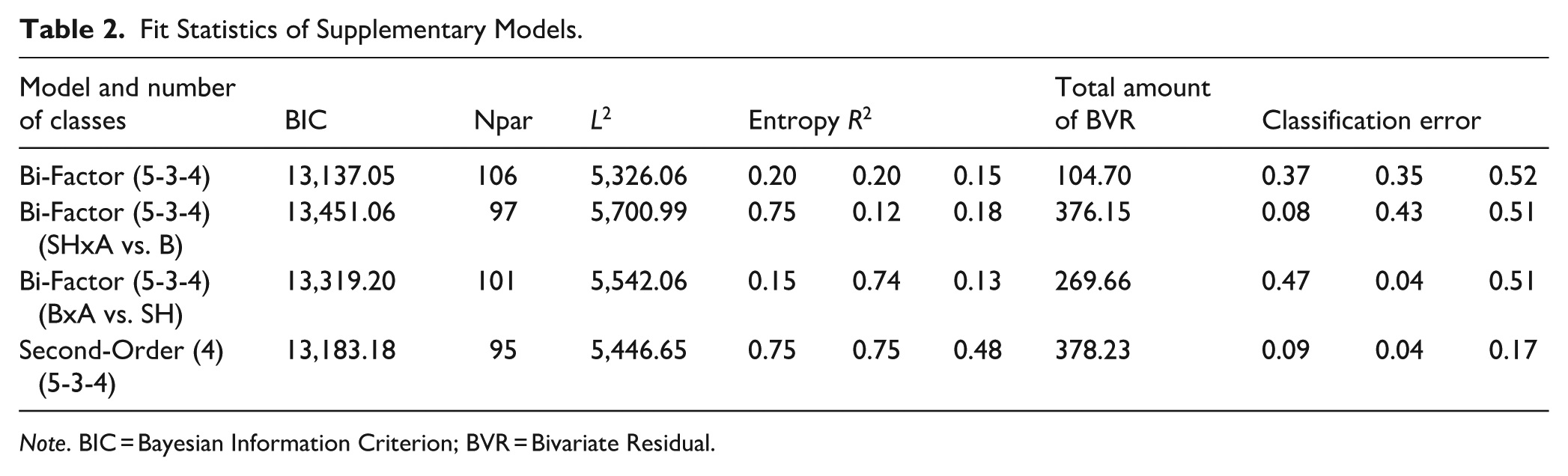
Note. BIC = Bayesian Information Criterion; BVR = Bivariate Residual.
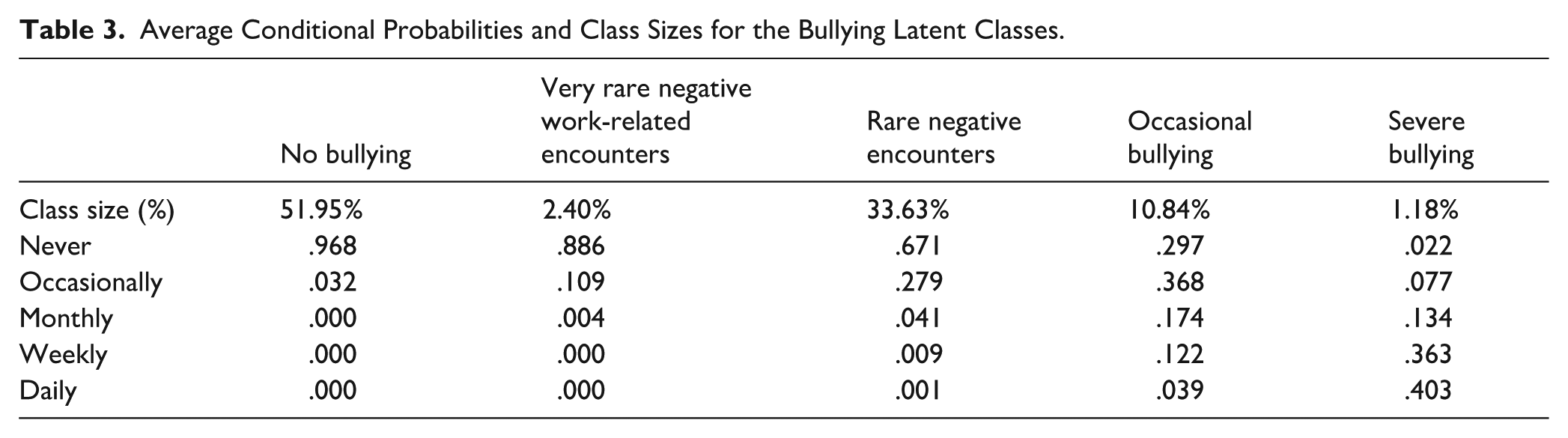
In this final (5-3-4) LCF model, the meaning of each of its classes is determined by their conditional probabilities (CPs). These results are summarized in Table 3 for bullying, Table 4 for sexual harassment, and Table 5 for aggression. The CP reflects the probability that a respondent in a given class chooses a certain response category for a certain item. In the tables, these CPs are averaged out. Taking bullying as an example, this means that Table 3 contains the average of the probabilities of responding never/now and then/once a month/once a week or daily across the items of the bullying scale. Looking into bullying, we labeled the first latent class as ‘not bullied’. These respondents had a .968 average CP of never experiencing any bullying behaviors at all. This group encompassed over 50% of the sample. The next group was small (2.40%) and had a similarly high probability of never encountering bullying on most items but had a slightly higher chance of very occasionally experiencing ‘withholding necessary information so that your works get complicated’, ‘gossip or rumors’, and ‘devaluing your work and efforts’. Therefore, we labeled this group the people with ‘very rare negative work-related encounters’. Next the ‘rare negative encounters’ class (33.63% of the sample) are those that have an increased average CP of encountering almost all behaviors of the SNAQ on a sporadic basis. When the frequency of exposure increased across the board toward more monthly and even weekly experiences, these were called ‘occasional bullying’ behaviors (10.84% of the sample). Finally, the respondents reporting ‘severe bullying’ behaviors had on average almost zero chance of never being bullied but had a 0.40 chance to be bullied on a daily basis. However, this class was the smallest with a size of 1.18%.
Average Conditional Probabilities and Class Sizes for the Bullying Latent Classes.
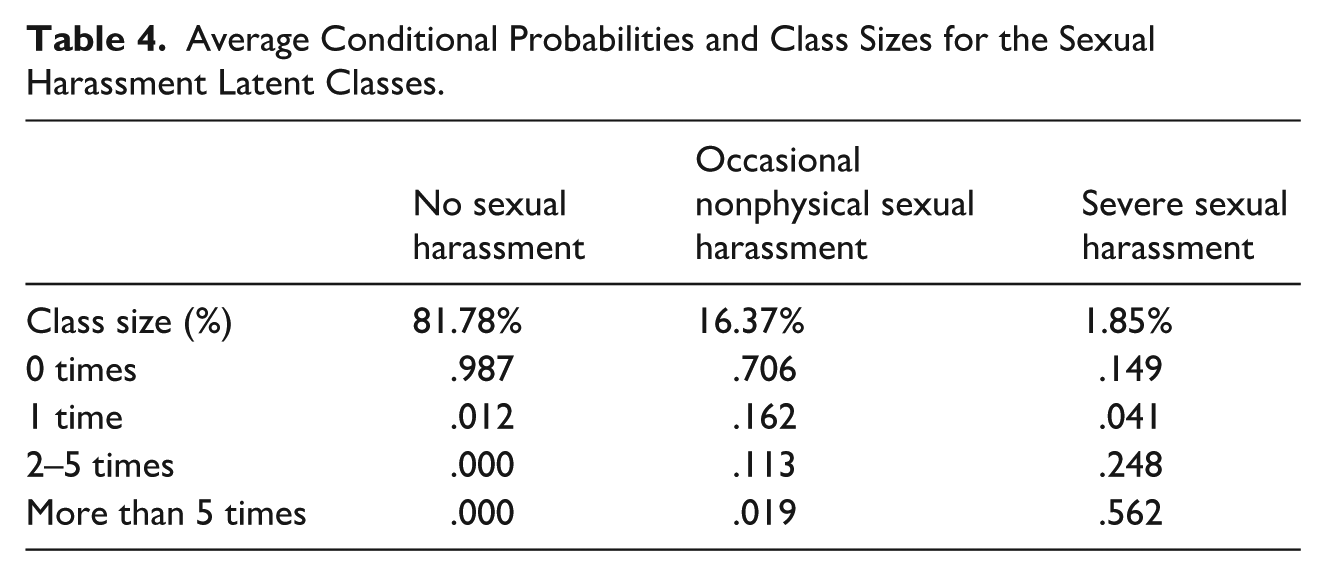
Average Conditional Probabilities and Class Sizes for the Sexual Harassment Latent Classes.
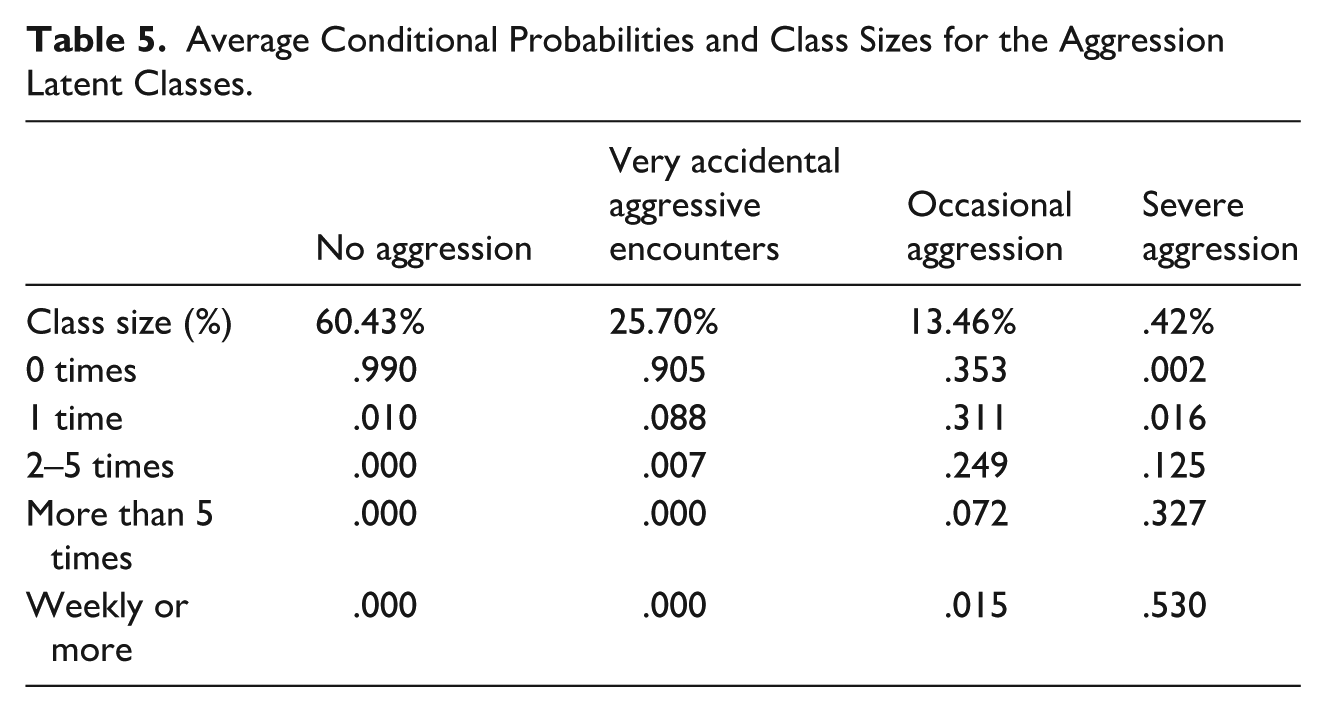
Average Conditional Probabilities and Class Sizes for the Aggression Latent Classes.
Concerning sexual harassment, the first class (81.78%) – again – exemplified those who were not sexually harassed as they showed a 0.987 average probability of never having experienced any of the items. Nevertheless, respondents in the second class (16.37%) showed a higher probability of having faced harassment once or, although to a lesser extent, two to five times during the past 6 months. Yet, this was only the case for the first three, nonphysical, items. The items covering sex-colored physical contact did not see such an increase in average CP. Hence, this class is labeled ‘occasional nonphysical sexual harassment’. Lastly, ‘severe sexual harassment’ are those who have a high average CP, both on nonphysical and physical items, which encompassed 1.85% of the sample.
In the aggression factor, the first latent class did not report any aggressive behaviors (60.43%). The respondents in the second class (25.70%) had a somewhat higher probability of reporting a one-time aggressive event, but it was still very low frequency with a remaining average CP of 0.905 to experience no aggression at all. Therefore, we call this ‘very accidental aggressive encounters’. The ‘occasional aggression’ class (13.46%) had the highest probability among classes to having faced aggression either one time or two to five times during the last 6 months. Lastly, there were 0.42% of people encountering ‘severe aggression’ with an average 0.53 CP to experience all aggressive indicators on a weekly basis or more.
Although the data showed three separate factors underlying sexual harassment, bullying, and aggression, these factors were considerably related to each other. The bullying factor showed a strong correlation of .69 with aggression and moderate to strong .49 with sexual harassment (Cohen, 1992). Similarly, sexual harassment and aggression were more moderately correlated (r = .44). The biplots (see Supplemental Material) give more insight into these relationships. These plots depict the connection between the answers on the indicators of one factor and the connection between the answers on the indicators of another factor. They indicate that, initially, at very low exposure levels, harassing, bullying, or aggressive behaviors are hard to distinguish. As they are reported more frequently, the relationships between the factors weaken: when they happen very rarely or once, the distinction between the three concepts is less clear than when they happen two to five times or monthly. As the behaviors become more extreme, they become easier to differentiate. However, when the behaviors are experienced at their most frequent level, the relationship between the factors strengthen again, especially between bullying and aggression. At very high frequency exposure, bullying and aggression experiences become increasingly hard to separate again and reconverge toward each other.
Discussion
Amid growing concerns about the potential overlap between sexual harassment, bullying, and aggression at work, this study aimed to empirically examine whether and how these phenomena are interrelated. While conceptual debates on their (non)overlap have intensified, little empirical research has actually tested how the suggested connections manifest in employees’ lived experiences. Using Latent Class modeling, we explored and tested different configurations of connections between sexual harassment, bullying, and aggression at work.
The findings indicate that sexual harassment, bullying, and aggression do not intertwine into a single overarching construct but are experienced as three distinct – yet highly co-occurring – phenomena, varying in differentiation across discrete levels of exposure. These levels or profiles reflect increasing likelihoods of experiencing sexual harassment, bullying, or aggression across items, highlighting that the three concepts are less homogeneous than typically assumed (Notelaers et al., 2006) and instead emerge in distinct degrees of severity. While scholars have increasingly advocated for consolidating these constructs under broader umbrella terms where possible (Dhanani & Bogart, 2025), our findings indicate that such an approach may not be suitable. They align with Tepper and Henle’s (2011) caution that collapsing constructs under one label such as ‘mistreatment’ risks obscuring important distinguishing features. Alternative ‘middle-ground’ factor structures designed to preserve domain-specific variance while accounting for shared variance, such as Second-Order and Bi-Factor models, also demonstrated poor fit. Across all analyses, the three-factor solution consistently emerged as the best-fitting model, underscoring that sexual harassment, bullying, and aggression at work are not, in any way, facets of a single overarching phenomenon, but are better understood as three distinct and conceptually unique constructs. Consequently, the findings do not seem to support the characterization of these workplace misbehaviors as mere ‘construct proliferation in a semantic jungle’. Rather than representing a jungle of interchangeable labels, the results reveal meaningful distinctions between them and underscore the utility of LCA in empirically examining claims of overlap.
Still, the correlations between the factors remain considerable, and our results suggest that the degree of differentiation among the phenomena depends on the level of exposure. At very low levels, the phenomena are not as clearly distinguishable, suggesting greater ambiguity in how the behaviors are experienced. However, as exposure increases, the factors diverge, and the distinctions between them become more pronounced. This pattern mirrors research on bullying as an escalating process (Björkqvist, 1992; Einarsen, 1999). In its early stages, bullying often comprises discrete, indirect acts that may be difficult to identify as bullying. As the process intensifies, the behaviors not only become more frequent, but also increasingly explicit, manifest, and overtly psychologically harmful, ultimately evolving into a clear bullying process. This escalation may enhances the visibility of the negative treatment, enabling targets to recognize it as bullying (Nielsen et al., 2011) and distinguish it from sexual harassment and aggression.
Interestingly, at the highest levels of exposure – particularly between bullying and either aggression or sexual harassment – the boundaries between these phenomena appear to blur again. The factors become more entangled, and their relationship seems to strengthen, suggesting that at extreme severity, the phenomena may converge. Again, the escalation perspective in bullying literature helps make sense of this pattern. While Notelaers et al. (2018) concluded that bullying and aggression diverge at higher frequencies, our findings suggest that escalation can also lead to their re-convergence in severe cases. Indeed, in its final stage, bullying can escalate into ‘both severe psychological and physical violence’ (Keashly & Jagatic, 2011, p. 51; Einarsen, 2000). At this point, mistreatment may follow an ‘anything goes’ mentality, where multiple harmful strategies – including repeated psychological violations and overtly aggressive, even physical assaults – are deployed, thereby blurring the boundaries between bullying and aggression. In such circumstances, targets may eventually report high exposure across several or all factors.
Importantly, reconvergence between bullying and sexual harassment was also present but less pronounced than that observed between bullying and aggression. In contrast, sexual harassment and aggression showed very little renewed convergence, even at high exposure levels. This pattern may indicate that bullying acts as the common denominator, characterized by more ambiguous and/or flexible boundaries that allow it to blend more easily with other negative experiences. Moreover, the findings also suggest that sexual harassment may represent a more unique experience that is not as easily conflated with bullying or aggression. This insight aligns with research advocating that sexual harassment is distinct from more generalized workplace abuse (i.e., aggression, bullying; Fendrich et al., 2002; Hershcovis & Barling, 2010; Raver & Nishii, 2010; Yang et al., 2014), given that it is ‘motivated by the target’s gender and is influenced by legislative regulations’ (Yang et al., 2014, p. 322). Nevertheless, the ample correlations between experiences of sexual harassment and those of both aggression and bullying underscore that while the phenomena may be distinguishable, they are still very much connected and co-occurring.
Taken together, the results suggest that workplace bullying, aggression, and sexual harassment occur through multiple levels of exposure, with each construct exhibiting distinct exposure profiles reflecting different levels of intensity. Crucially, the phenomena themselves appear to intertwine at both lower exposure levels and – particularly for bullying and aggression – again at the most severe levels, potentially reflecting the ‘final stages’ of escalation (Keashly & Jagatic, 2011). While escalation is well established in bullying theory and increasingly supported by empirical work (Reknes et al., 2021), it remains a relatively new lens for understanding aggression and sexual harassment. Except for scholars such as Glomb (2002) or studies on adolescent harassment (Wang et al., 2024), little work has examined the structural, persistent, and escalatory nature of aggression or sexual harassment. Yet, our results suggest that beyond clear-cut (singular) incidents, these behaviors rarely constitute an either-or experience. Instead, they occur at varying levels of exposure, with the most severe instances taking the form of extreme aggression or sexual harassment. At these extremes, the different behaviors appear more closely linked.
Limitations and Future Research
This study entails several limitations. First, consistent with the dominant perspective in the literature, we focused exclusively on targets’ experiences of sexual harassment, bullying, and aggression. Accordingly, our study relied on questionnaire-based behavioral measures that capture the subjective evaluations of acts by targets themselves. Yet, incorporating the perspectives of other actors involved, such as perpetrators or bystanders, introduces different challenges. Prior research shows that these actors may interpret and experience negative workplace behaviors differently from targets (Nielsen & Einarsen, 2013; Samnani, 2013). Nevertheless, future studies could compare the co-occurrence and convergence of the behaviors across these different perspectives, validate exposure profiles accordingly, and/or complement self-reports with registered complaints or case reports. Moreover, we strictly focused on three popularly studied (yet more general) constructs of negative social behavior at work, aiming to examine the relationships between experiences of sexual harassment, bullying, and aggression. However, each of these literatures is itself marked by internal distinctions and ongoing debates on subtypes and finer-grained conceptual nuances. To maintain conceptual clarity and avoid unnecessary complexity, we did not further unpack variations within each construct. Instead, we focused on the interrelationships between the three broader constructs, that is, how the three general forms relate to each other, rather than exhaustively addressing all potential subconcepts. Consequently, important conceptual questions – such as, for example in the bullying literature, the differentiation between workplace bullying, mobbing, incivility, ostracism, psychological harassment and more – were not addressed in the present analysis. However, our study offers an important first demonstration of how questions of conceptual overlap can be rigorously empirically unraveled in case of highly non-normal behavioral data. In doing so, it may inspire future research to extend this approach in addressing more fine-grained conceptual distinctions within each domain, such as those in the bullying literature. At the same time, examining overlap among even more closely related constructs as bullying, incivility, or mobbing may prove challenging, given the resemblances and similarities among their most commonly used measurements (Nixon et al., 2021).
In addition, the sample originated from a single organization within the higher education sector. Accordingly, the findings could be highly dependent on the organization’s specific context, workforce composition, and its established social climate, and should therefore not be generalized. Nevertheless, given the study acts as a first, more thoroughly empirical demonstration of examining conceptual overlap, extending this methodological approach to more diverse samples will be important for assessing the generalizability of these findings across organizational contexts that differ in industry, job characteristics, workforce demographics, and cultural backgrounds. Cultural differences, in particular, may determine how these concepts are understood and interpreted, which in turn may influence the extent to which they appear to converge or diverge. For instance, research by Salin et al. (2019) demonstrates that HR professionals across cultures differ in what they consider acceptable conduct and what they regard as workplace bullying. Similarly, employees’ own perceptions of the acceptability of behaviors associated with sexual harassment, bullying, or aggression may influence the extent to which these experiences are perceived as overlapping or distinct. This is an important avenue for future research as we hope empirical work on these conceptual questions continues to develop. Another sample aspect concerns the size of the most extreme exposure profiles, despite the inclusion of almost 900 respondents. The ‘severe target’ groups of all constructs were small, ranging from 1.85% for sexual harassment to 1.18% for bullying and 0.42% for aggression, reflecting a generally low prevalence of severe social maltreatment in the sampled organization. Such low prevalence rates for severe victim classes are consistent with prior LCA findings in this domain (Nielsen et al., 2009). However, the (non)convergence patterns observed in the biplots at the highest exposure levels should be interpreted with considerable caution, as they are based on a limited number of respondents. While the results seem to point toward reconvergence, the small class sizes make it impossible to draw definitive conclusions on how the three concepts behave in their most extreme levels. In consequence, future replication studies are needed to re-examine the re-convergence of workplace sexual harassment, bullying, and aggression at its most severe levels. This means larger and more diverse samples are required to be able to pass a conclusive judgment on the severe exposure levels of these three experiences.
Next, our findings reveal escalating profiles of intensity across all three experiences and suggest that such escalation processes may help explain why the experiences reconverge. However, the cross-sectional nature of our data prevents us from directly testing or modeling these escalation patterns over time. Therefore, future research could examine how these negative experiences actually unfold and whether they follow identifiable escalatory trajectories. For example, beyond merely co-occurring behavior (e.g., verbal abuse and gossip experienced simultaneously), the phenomena might also follow a sequential pattern in which one type triggers another (Verschuren et al., 2021). Established accounts (Einarsen, 2000; Kaukiainen et al., 2001) argue how singular aggressive acts precede more intense victimization, afterwards mutating into bullying or harassment. To deepen our understanding of how these experiences evolve, and when they diverge or converge, future studies could adopt longitudinal designs that capture these processes over time (Cole et al., 2016). Provided sufficiently large and diverse samples, temporal approaches such as Latent Transition Analysis (Reknes et al., 2021) could model changes across the three behaviors, identify latent classes, and illuminate when and how people move between them.
Furthermore, given that the present study identified distinct exposure profiles for each construct, another useful next step may be to further examine how these profiles relate to health and well-being outcomes. Prior research suggests that higher exposure is associated with more adverse consequences (Leon-Perez et al., 2014; Notelaers & Van der Heijden, 2019; Notelaers et al., 2006), and future studies could extend the current findings by testing whether a similar gradient emerges across the identified classes. Particularly so for sexual harassment and aggression, where evidence into criterion validity remains most limited.
Finally, given the variety of operationalizations of sexual harassment, bullying, and aggression at work, it would be valuable to replicate the current study using alternative measures to examine whether our findings hold across different scales and instruments. Additionally, traditional measures often struggle with construct validity, not fully capturing the exact theoretical definitions or dimensions that are assumed to distinguish these behaviors (e.g., intent; Shewach & Sackett, 2024). Examining conceptual overlap using updated measures that address these limitations may therefore provide the most meaningful insights.
Conclusion
This study examined if and how workplace sexual harassment, bullying, and aggression intertwine in employees’ lived experiences. Using LCA, it represents the first comprehensive empirical assessment of all three forms simultaneously. The findings indicate that the experiences are best understood as distinct phenomena whose interconnections shift with exposure levels. At minimal exposure, they are difficult to distinguish; as exposure increases, the associations between the factors weaken as they diverge; and at extreme intensity, particularly for workplace bullying and aggression, they reconverge. These insights provide a more nuanced understanding of how different forms of negative treatment at work interrelate and carry meaningful implications for future research. Given the homogeneity of our sample, we encourage future research to build on these findings in more diverse contexts and hope this study stimulates more refined and integrated approaches to understanding, analyzing, and addressing harmful social conduct at work.
Supplemental Material
sj-docx-1-jiv-10.1177_08862605261455717 – Supplemental material for Where Lines Blur: Exploring the Interconnections Between Workplace Sexual Harassment, Bullying, and Aggression Through Latent Class Analysis
Supplemental material, sj-docx-1-jiv-10.1177_08862605261455717 for Where Lines Blur: Exploring the Interconnections Between Workplace Sexual Harassment, Bullying, and Aggression Through Latent Class Analysis by Charlotte Franckx, Elfi Baillien and Guy Notelaers in Journal of Interpersonal Violence
Footnotes

Ethical Considerations
The project was approved by the Social Ethics Committee (SMEC) of KU Leuven [G-2022-5334-R2(MIN)].
Consent to Participate
All participants provided written informed consent prior to participating.
Funding
The authors disclosed receipt of the following financial support for the research and/or authorship of this article: This work was supported by the KU Leuven under Project Grant C24M/22/005.
Declaration of Conflicting Interests
The authors declared no potential conflicts of interests with respect to the authorship and/or publication of this article.
Data Availability Statement
The datasets generated during and/or analyzed during the current study are available by emailing the first author on request.
Supplemental Material
Supplemental material for this article is available online.
Notes
Author Biographies
References
Supplementary Material
Please find the following supplemental material available below.
For Open Access articles published under a Creative Commons License, all supplemental material carries the same license as the article it is associated with.
For non-Open Access articles published, all supplemental material carries a non-exclusive license, and permission requests for re-use of supplemental material or any part of supplemental material shall be sent directly to the copyright owner as specified in the copyright notice associated with the article.
