






Abstract
Psychological aggression in dating violence (PADV) is a prevalent yet normalized form of interpersonal violence. Understanding how gender biases shape perceptions of PADV is essential for improving prevention and victim support. This study examined how the gender of perpetrators, victims, and observers influence responsibility attribution and perceived severity of PADV among young adults in Spain. A total of 432 participants (50% women, n = 216), aged 18 to 25 years, were randomly assigned to evaluate 1 of 12 vignettes varying by perpetrator and victim gender (male/female), type of psychological aggression (insults, control, and humiliation), and couple type (heterosexual/same sex). Male-perpetrated violence was rated as more severe and attributed more strongly to the aggressor, whereas female-perpetrated violence elicited greater victim blaming. Observer gender also affected evaluations, showing that women rated PADV as more severe than men, with the strongest effect observed in humiliation scenarios, where women also attributed greater responsibility to perpetrators and less to victims. No significant differences were found between heterosexual and same-sex couples. These findings suggest that gendered attributional patterns persist even among younger generations socialized under equality-oriented policy frameworks. Addressing gendered attributions through prevention and educational initiatives is therefore essential to reducing tolerance of psychological violence.
Introduction
Psychological aggression within intimate partner and dating relationships is a major global public health concern affecting individuals diverse cultural contexts. Recent research has increasingly focused on its prevalence and associated risk factors, with growing attention to early-onset manifestations of psychological aggression in adolescent and young adult relationships (Byun, 2012; Curtis et al., 2022; Exner-Cortens et al., 2017). Among the different forms of dating violence, psychological aggression in dating violence (PADV) is notable for its high prevalence, estimated at 40% to 70% of cases (López-Ossorio et al., 2020), and its impact on mental health (Eshelman & Levendosky, 2012; Temple et al., 2016). In same-sex couples, rates of PADV are comparable to those found among heterosexual couples, reaching up to 51% (Blais et al., 2022). Psychological aggression encompasses repeated or patterned behaviors directed at humiliating, controlling, or emotionally harming an intimate partner, and is conceptually distinct from physical or sexual violence, despite frequent co-occurrence (Almendros et al., 2009).
A key issue in understanding the impact of PADV is how external observers (e.g., professionals, community members, and peers) interpret it. Psychological aggression may be particularly susceptible to attributional bias, as it frequently lacks visible or objective indicators of harm, rendering causal interpretations more ambiguous and more reliant on gender stereotypes and moral judgments. According to attribution theories, individuals seek causal explanations for violent behavior, especially when such events threaten their belief in a just and predictable world. Just World Theory (Lerner & Miller, 1978) posits that individuals are motivated to maintain this belief, which can lead them to assign responsibility to the victim, a process commonly referred to as victim blaming. Victim blaming refers to the tendency to assign partial or full responsibility for victimization to victims (Davies, 2018; Ryan, 1971), and it has been observed across diverse contexts including sexual violence, bullying, and domestic abuse (Abrams, 2025; Gracia, 2014; Koehler & Weber, 2018). Understanding this process is essential, as observers’ attributions may shape victims’ help-seeking behavior and psychological adjustment, with downstream consequences for well-being (G. D. Anderson & Overby, 2021; Jackson et al., 2001).
Despite growing awareness of violence in intimate relationships, research shows that observers’ perceptions of violent incidents and the degree of responsibility attributed to perpetrators and victims vary depending on multiple factors, including the type of violence, the gender of those involved, and the sexual orientation of the couple. Thus, these perceptions not only reflect individual attitudes but are also shaped by gender norms, stereotypes, and cultural beliefs about romantic relationships (Valor-Segura et al., 2011).
Among the most consistently documented biases is the effect of perpetrator gender. Empirical evidence indicates that observers tend to perceive male-perpetrated violence against women as more serious and morally reprehensible than equivalent violence perpetrated by women against men (Seelau & Seelau, 2005). This pattern is often linked to gender stereotypes that associate men with strength and aggression and women with vulnerability and passivity. Such beliefs may contribute to the minimization of female-perpetrated violence and to heightened victim blaming of male victims, who are often perceived as less credible or less deserving of support (Sylaska & Walters, 2014).
In addition, the observer’s gender also influences perceptions of violence. Research indicates that women tend to evaluate violent acts as more severe and to assign greater responsibility to the perpetrator than do men (Gracia & Tomás, 2014). This difference has often been interpreted within frameworks suggesting higher empathy and identification with victims, potentially linked to prior experiences of victimization and greater sensitivity to gender inequalities (Magyarics et al., 2015). Men, by contrast, tend to exhibit greater tolerance toward violence, particularly when the perpetrator is female, highlighting the role of both benevolent and hostile sexism in shaping social judgments (Glick & Fiske, 2001). Although this variable has been examined in the context of sexual violence (Rye et al., 2006; Strömwall et al., 2014), it has received comparatively less attention in research on PADV and same-sex relationships. Beyond gender, other observer characteristics such as personal relationship experience, prior exposure to intimate partner violence (IPV), or sexual orientation may also shape how interpersonal aggression is interpreted (Russo & Borelli, 2024), although these factors have received comparatively less empirical attention in research on PADV. Concerning the sexual orientation of the couple, some research suggests that violence in same-sex relationships is perceived as less serious or more mutually inflicted, reflecting assumptions that aggression between partners of the same-gender is inherently more symmetrical or less harmful (Calton et al., 2016). However, the empirical evidence is mixed. For example, Taylor and Sorenson (2005) found that observers’ judgments varied depending on the gender composition of the couple, with some same-sex scenarios eliciting different attributional patterns than heterosexual ones. More recent work has similarly reported that sexual orientation and gender configuration can shape perceptions of partner aggression and responsibility (Hill et al., 2023). These inconsistencies indicate that the role of couple type in judgments of PADV remains unclear, particularly outside Anglo-Saxon contexts and in relation to non-physical forms of violence. Such bias may be further reinforced by the limited visibility of sexual and gender minorities in dominant IPV discourse, which contributes to reduced social recognition and an inadequate response to these cases. Homophobia and stigma may also shape both observers’ attitudes and victims’ willingness to report the abuse. However, relatively little is known about how responsibility and perceived severity are attributed in same-sex PADV.
Increasing public awareness of IPV and equality-oriented education may have contributed to a growing social recognition of PADV independent of couple gender composition. In sociocultural contexts characterized by sustained institutional efforts toward gender equality, observers may rely less on sexual orientation stereotypes and more on the abusive behavior itself when evaluating relational aggression. Consequently, attributional differences between heterosexual and same-sex couples may be attenuated among younger generations socialized within these equality-focused frameworks. Spain represents a particularly suitable context in which to examine these theoretically expected attenuation effects. Since the enactment of Organic Law 1/2004, awareness campaigns and educational initiatives have been widely implemented, particularly among younger generations. This context may influence how Spanish youth interpret PADV, as they may be expected to show greater sensitivity in recognizing subtle forms of psychological aggression and to assign greater responsibility to perpetrators. However, research on victim blaming among Spanish youth in PADV contexts remains limited. Moreover, public and media narratives of IPV still tend to emphasize severe physical aggression, potentially reinforcing stereotypes that hinder recognition of psychological violence as equally damaging. Although the present hypotheses are grounded in well-established patterns of gendered perceptions of violence, their continued relevance warrants empirical examination in contemporary contexts. Young adults in Spain have been exposed to equality-oriented education and public discourse, which may have altered traditional attributional patterns. Testing these hypotheses in this sociocultural context therefore allows assessment of whether such gendered biases persist or are beginning to shift. These considerations underscore the need to empirically examine how young people in Spain perceive different forms of PADV and how factors such as the perpetrator’s, victim’s, and observer’s gender influence responsibility attributions and perceived severity. This analysis is especially timely for a generation simultaneously exposed to equality-oriented policies and to misogynistic online discourse, whose influence may undermine progress in prevention.
The Present Study
The present study examined the effects of perpetrator, victim, and observer gender on judgments of responsibility and perceived severity in scenarios depicting different forms of PADV. Additionally, the study explored whether these judgments varied according to couple type (heterosexual vs. same-sex), forms of PADV (insults, control, and humiliation), and dyadic gender dynamics, understood as the gendered configuration of the aggressor–victim relationship within each vignette. Specifically, we proposed the following hypotheses:
An additional exploratory hypothesis was included:
Method
Participants
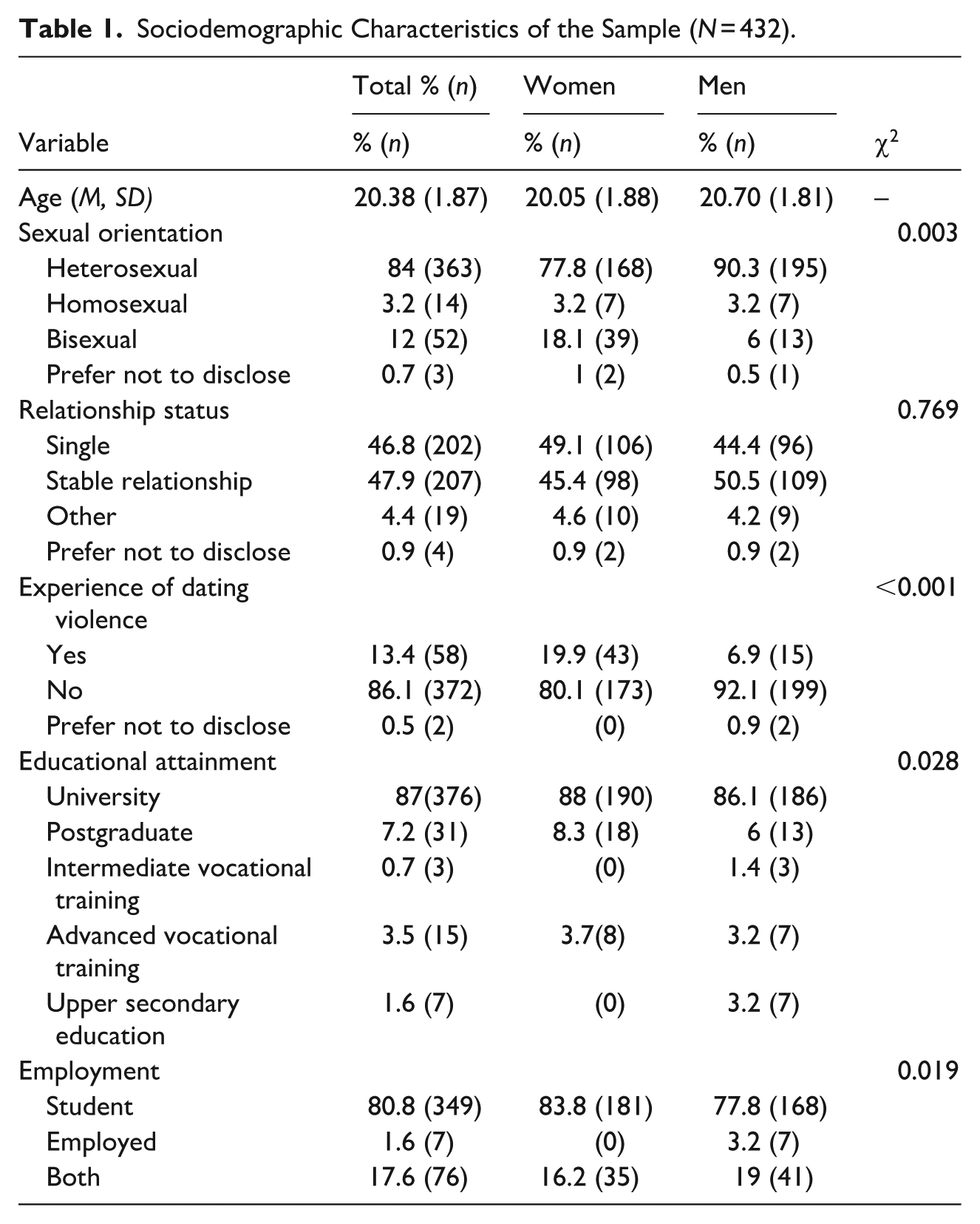
The initial sample comprised 435 participants, of whom 3 were excluded for failing to meet inclusion criteria (1 exceeded the age range of 25 years, 1 did not indicate gender, and 1 provided random responses), yielding a final sample of 432 young adults aged 18 to 25 years (M = 20.38, SD = 1.87). The sample was gender-balanced (216 women, 216 men), and all participants who reported gender identity identified as cisgender. Most participants identified as heterosexual (84%, n = 363). Approximately half were single (46.8%, n = 202), and 47.9% of participants (n = 207) were in a stable relationship. Prior experience of IPV was reported by 13.4% of participants. Most participants were university students or recent graduates (94.2%, n = 407). The remaining participants (5.8%) were young adults in other situations (e.g., employed, unemployed, and vocational training). Exploratory comparisons between students or recent graduates and other participants did not reveal significant differences in the main variables; therefore, all participants were analyzed together. Sociodemographic details are presented in Table 1.
Sociodemographic Characteristics of the Sample (N = 432).
Procedure
Participants were recruited through a combination of in-person and online strategies. For the in-person recruitment, researchers visited several university classes and invited students to participate in the study. Consenting participants received a QR code linking to the online questionnaire. The QR codes were preassigned to the different experimental conditions to ensure an approximately equal number of participants across conditions and gender. QR codes were generated to correspond to experimental conditions prior to recruitment and were distributed sequentially without researcher knowledge of the assigned condition. Assignment was random and blind to both researchers and participants.
Additional participants were recruited online through social media. In this case, participants accessed the study through a link generated using an external randomization tool, which automatically directed them to one of the experimental conditions. The distribution of participants across conditions was monitored throughout data collection to maintain balance. Monitoring was limited to tracking sample sizes across conditions and did not involve altering or overriding random assignment.
Inclusion criteria required participants to be between 18 and 25 years old, Spanish-speaking, and currently or previously involved in a dating relationship. Participation was voluntary and anonymous, and no financial compensation was provided. All data were collected online using a Google Forms questionnaire, which participants completed remotely on their own devices. To prevent duplicate submissions, participants were required to authenticate via an email account; however, no email addresses were collected or retained, thereby preserving response anonymity.
Conditions and Design
The study employed a cross-sectional, 2 × 2 × 3 between-subjects experimental vignette design, crossing perpetrator gender (male and female), victim gender (male and female), and the different forms of PADV (insults, control, and humiliation). Couple type (heterosexual vs. same-sex) was not independently manipulated but derived from the combination of perpetrator and victim gender, resulting in 12 vignette conditions representing all possible combinations. Participants were randomly assigned to read one vignette and to complete the corresponding questionnaire assessing their perceptions of the situation. The vignettes were adapted from previous research on IPV attribution and tailored to depict realistic dating interactions among young adults. Each vignette described a brief scenario of psychological aggression occurring within a romantic relationship. All scenarios were pretested for clarity and perceived realism with a pilot group of 30 students prior to data collection.
Data were collected online using Google Forms. Participants provided informed consent before accessing the study materials. After reading the assigned vignette, they responded to questions assessing perceived severity, perpetrator responsibility, and victim responsibility. The research protocol was approved by the Research Ethics Committee on Human Beings of the Research Ethics Committee on Human Beings of the University of Córdoba (CEIH-24-49) and complied with the ethical principles of the Declaration of Helsinki.
Measures
Sociodemographic Variables
Participants reported their age, gender identity, sexual orientation, relationship status, education level, employment status, and previous experience of IPV. “Prefer not to disclose” was available for sensitive questions.
Perception of Psychological Violence
Perceptions of psychological violence (i.e., the different forms of PADV) were assessed through participants’ evaluations of experimental vignettes adapted from Hamby and Jackson (2010). Each vignette described a brief episode of psychological aggression within a dating relationship, varying by the aggressor’s and victim’s gender and by the type of abuse (insults, control, and humiliation). After reading their assigned vignette, participants rated three constructs on 7-point Likert scales (1 = “Not at all,” 7 = “very much”): (a) perceived severity (“How severe do you consider the aggressor’s behavior?”), (b) perpetrator responsibility (“To what extent do you think the aggressor is responsible for what happened?”), and (c) victim responsibility (“To what extent do you think the victim is responsible for what happened?”). Higher scores indicated greater perceived severity, greater attribution of responsibility to the perpetrator, and greater attribution of responsibility to the victim, respectively. Items were adapted from Harris and Cook (1994) and translated into Spanish using a forward-back translation procedure (Perles et al., 2022). All items were reviewed by two bilingual experts in IPV research to ensure semantic equivalence. The vignettes used in this study are presented in Supplemental Material 1.
Data Analysis
Data were analyzed using IBM SPSS Statistics (Version 28, IBM Corp, 2021). The online questionnaire was configured so that all core dependent-variable items were mandatory. As a result, no missing data were observed for the main outcome measures, and all analyses were conducted using complete cases. Three participants were excluded prior to analysis because they did not meet inclusion criteria or provided random responses; thus, no imputation procedures were required. Descriptive statistics were first computed for sociodemographic variables and the three dependent measures (i.e., perceived severity, perpetrator responsibility, and victim responsibility). Distributional normality was assessed using the Shapiro–Wilk test, the results of which indicated significant deviations from normality. Given the ordinal single-item Likert measures, limited response range, non-normal distributions, and the ordinal nature of the scales, nonparametric tests were selected as the most appropriate approach for rank-based comparisons.
Mann–Whitney U-tests were used to compare differences according to perpetrator gender, observer gender, and couple type, whereas Kruskal–Wallis H-tests were used to analyze dyadic gender dynamics (male–female, female–male, male–male, and female–female). When significant omnibus effects were found, post hoc pairwise comparisons with Bonferroni correction were used. Effect sizes were reported as r for Mann–Whitney tests and as η2 for Kruskal–Wallis tests, following Field (2009).
Because the dependent variables were single-item Likert measures with ordinal properties and limited ranges, no transformations were applied, and nonparametric tests were used for rank-based comparisons. As perpetrator gender, victim gender, and couple type were structurally related within the vignette design, some planned contrasts shared experimental cells and were conducted as theory-driven planned comparisons within the same factorial structure. Although the study followed a 2 × 2 × 3 factorial vignette structure, analyses relied on nonparametric planned comparisons, given the ordinal single-item nature of the dependent measures and the non-normal distributions observed. This analytical approach examined comparative differences between experimental conditions and did not include formal tests of interaction effects. References to dyadic configurations reflect conceptual comparisons between vignette conditions and do not represent statistically tested interaction effects within the analytical framework employed.
Results
Associations Among Dependent Variables
Spearman correlations were computed among perceived severity, perpetrator responsibility, and victim responsibility. Perceived severity was positively associated with perpetrator responsibility and negatively associated with victim responsibility, whereas perpetrator and victim responsibility were negatively correlated (Table 2).
Spearman Correlations Among Dependent Variables (N = 432).
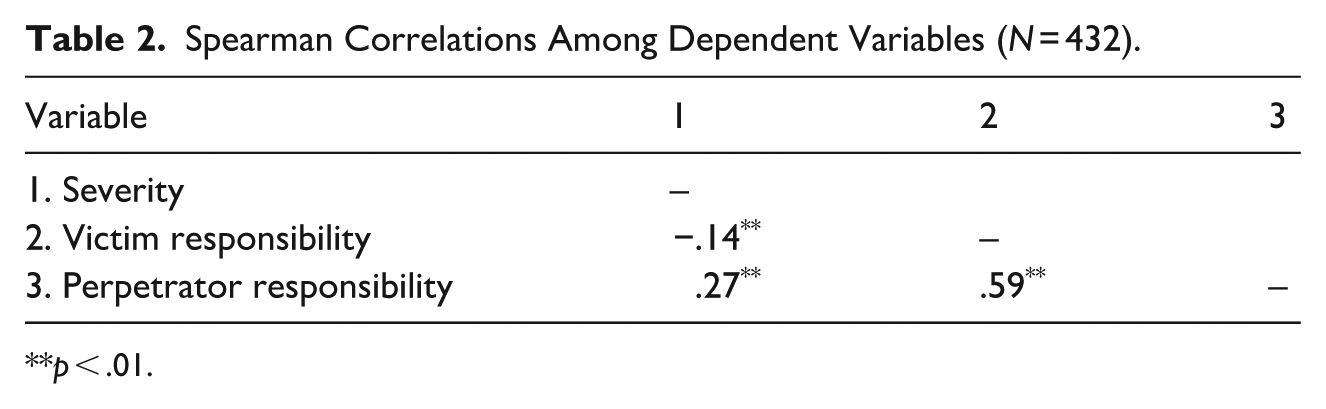
p < .01.
Perpetrator Gender (H1)
Analyses revealed significant differences in judgments of psychological aggression depending on the perpetrator’s gender. Vignettes depicting male perpetrators were rated as significantly more severe (U = 27,619, p < .001, r = −.18), with greater responsibility attributed to the aggressor (U = 25,994.5, p = .033, r = −.11) and less blame assigned to the victim (U = 20,401, p = .015, r = .13).
When abuse type was examined separately, control behaviors were judged as more severe when committed by men (U = 3,171.5, p = .015), and insults by male aggressors led to higher perpetrator responsibility (U = 3,197, p = .013, r = −.23) and lower victim blaming (U = 1,709.5, p < .001, r = .34). No significant differences were found for humiliation scenarios.
Dyadic Gender Dynamics (H2)
Significant differences were observed across perpetrator–victim gender configurations, H(3) = 24.71, p < .001, η2 = .053. MF aggression was judged as more severe and most attributable to the perpetrator, whereas FM aggression received the highest levels of victim responsibility. Perpetrator responsibility varied across dyadic configurations, H(3) = 22.82, p < .001, η2 = .049. Victim responsibility was higher in FM scenarios than in MF or same-sex scenarios, H(3) = 9.99, p = .001, η2 = .019. Detailed descriptive medians are shown in Table 3.
Median Ratings of Severity and Responsibility by Perpetrator–Victim Gender Dynamics.
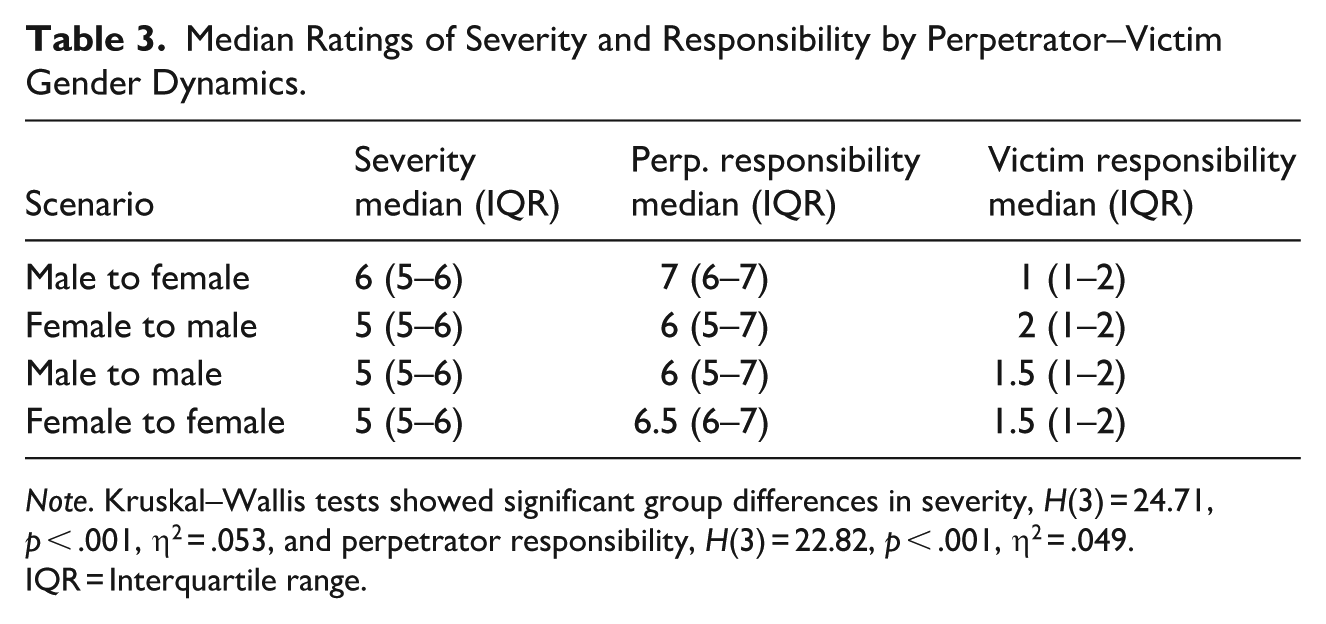
Note. Kruskal–Wallis tests showed significant group differences in severity, H(3) = 24.71, p < .001, η2 = .053, and perpetrator responsibility, H(3) = 22.82, p < .001, η2 = .049. IQR = Interquartile range.
Couple Type (H3)
No significant differences were found between heterosexual and same-sex couples in perceived severity (U = 22,431, p = .474, r = .03), perpetrator responsibility (U = 21,334.5, p = .110, r = .09), or victim responsibility (U = 22,840, p = .685, r = .02). When analyzed by type of abuse, only humiliation produced a small effect, with higher perpetrator responsibility attributed in heterosexual scenarios (U = 2,114.5, p = .040, r = .18).
Observer Gender (H4 and H5)
Significant effects emerged for observer gender on perceived severity. Female observers judged PADV as more severe than male observers (U = 19,055.5, p < .001, r = .18), particularly in humiliation scenarios (U = 1,495, p < .001, r = .42). No overall gender differences were found for perpetrator responsibility (U = 22,765, p = .652, r = .02) or victim responsibility (U = 23,763.5, p = .718, r = −.01). However, within humiliation scenarios, women attributed significantly greater responsibility to perpetrators (U = 1,838.5, p = .001, r = .30) and less to victims (U = 3,262.5, p = .002, r = −.26). Descriptive statistics for observer gender differences in perceived severity across all PADV conditions (Panel A) and in responsibility attributions within humiliation scenarios (Panel B) are presented in Tables 4 and 5.
Observer Gender Differences in Severity: Perceived Severity Across All PADV Conditions.
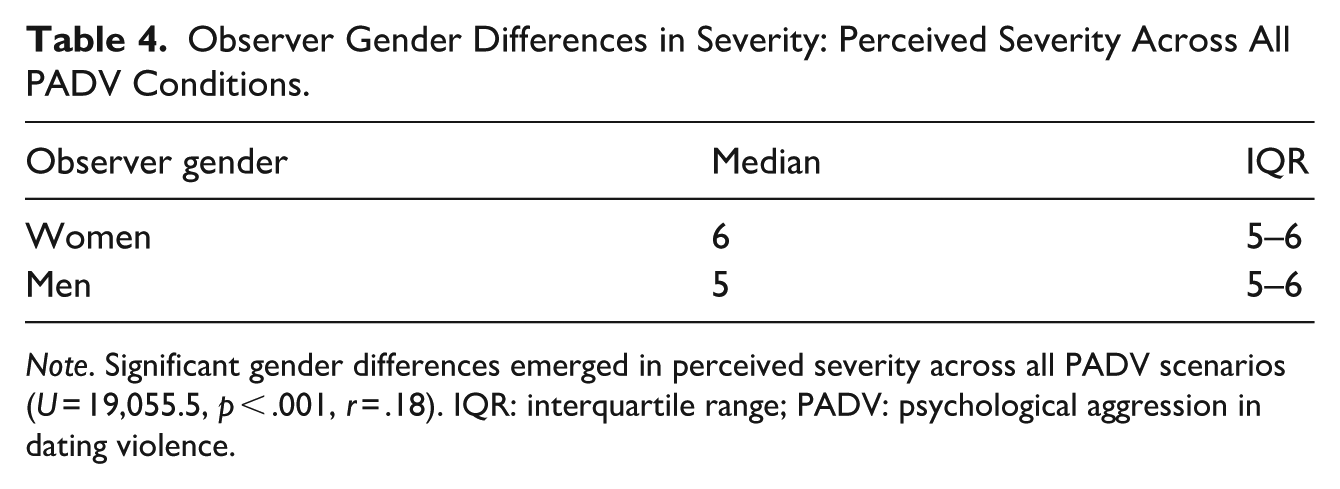
Note. Significant gender differences emerged in perceived severity across all PADV scenarios (U = 19,055.5, p < .001, r = .18). IQR: interquartile range; PADV: psychological aggression in dating violence.
Observer Gender Differences in Responsibility Attributions: Responsibility Attributions in Humiliation Scenarios.
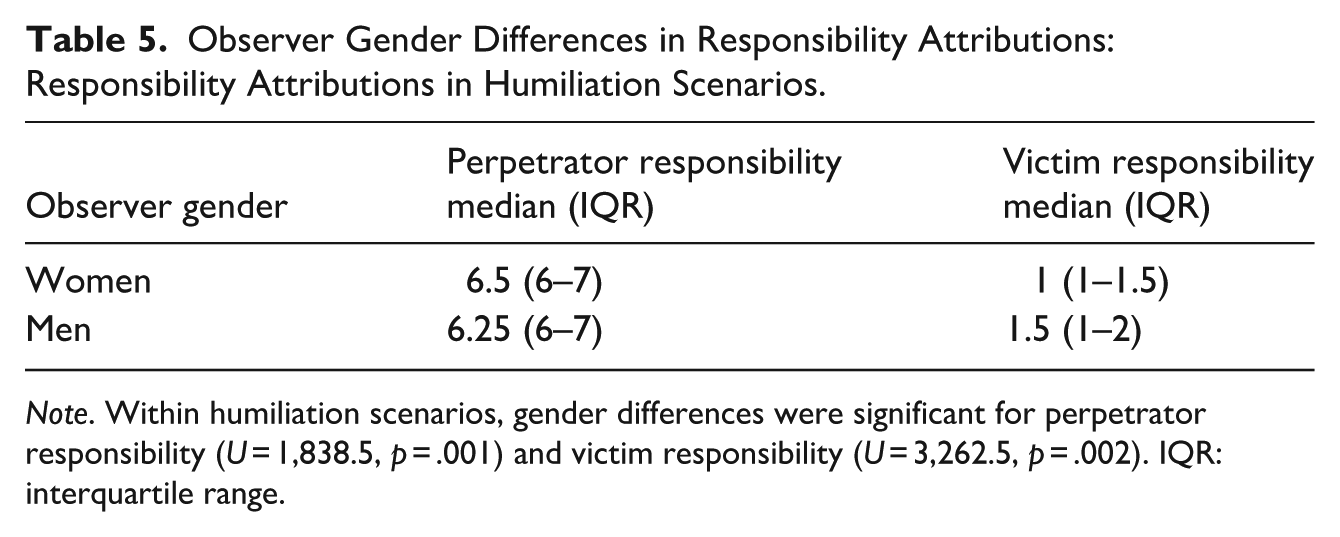
Note. Within humiliation scenarios, gender differences were significant for perpetrator responsibility (U = 1,838.5, p = .001) and victim responsibility (U = 3,262.5, p = .002). IQR: interquartile range.
Sexual Orientation, Relationship Status and Experience of PADV (Exploratory H6)
No statistically significant differences were found between heterosexual participants and sexual minority participants in perceived severity of PADV (U = 10,314, p = .063, r = .13). In contrast, a statistically significant difference emerged for relationship status. Participants who were currently in a relationship perceived PADV as more severe than those who were single (U = 19,269, p = .004, r = .16). Finally, no statistically significant differences were found in perceived severity of PADV between participants with prior experience of dating violence and those without such experience (U = 10,188, p = .481, r = .05). Descriptive statistics are presented in Table 6.
Differences in Median Severity by Sexual Orientation, Relationship Status, and Experience of Domestic Violence.
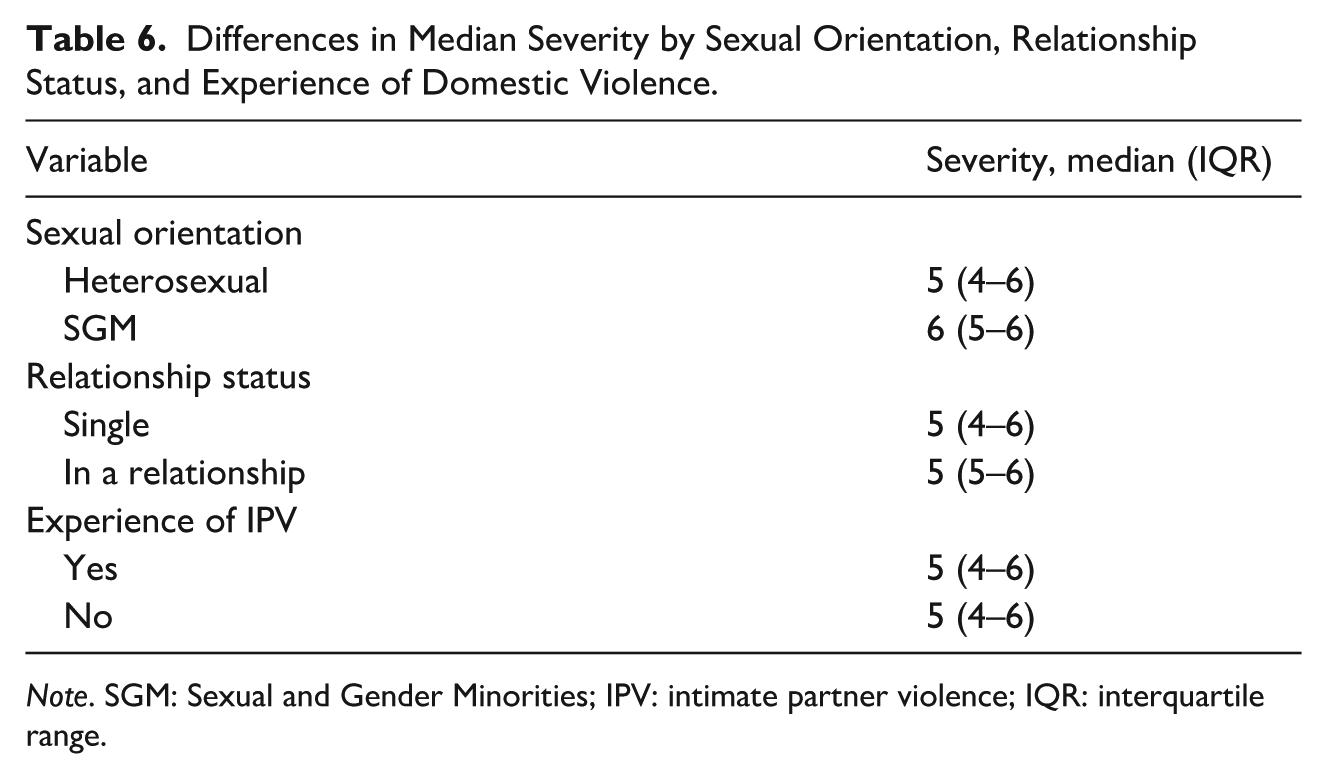
Note. SGM: Sexual and Gender Minorities; IPV: intimate partner violence; IQR: interquartile range.
Discussion
This study examined how perpetrator gender, victim gender, observer gender, and couple type shape young adults’ judgments of psychological aggression in dating relationships in Spain. Overall, the findings indicate that gender remains a central determinant of how psychological aggression is evaluated, particularly in the attribution of responsibility and perceptions of severity.
Consistent with H1, scenarios depicting male-perpetrated PADV were evaluated as more severe, with greater responsibility attributed to the perpetrator and less to the victim. When examining each form of abuse separately, significant gender effects emerged for control and insults but not for humiliation. This pattern suggests that certain forms of PADV may be more strongly filtered through gender stereotypes, whereas others (particularly those involving overt degradation) may be interpreted more uniformly across conditions. This finding aligns with an established body of research positioning MF violence as the prototypical form of IPV (Hamel et al., 2007; Russell & Kraus, 2016). It is also consistent with evidence that gender stereotypes continue to influence evaluations of aggression, including among younger generations exposed to equality-oriented education (Hine et al., 2022).
Consistent with H2, differences were observed across perpetrator–victim gender configurations in responsibility attributions. MF aggression was judged as most severe and most attributable to the perpetrator, whereas FM aggression was associated with higher levels of victim responsibility. These findings parallel prior research showing that male victims are more likely to be blamed and that female-perpetrated aggression may be minimized (Erickson et al., 2017; Russell & Kraus, 2016). Although effect sizes were modest, their persistence indicates that gendered double standards continue to shape judgments of PADV. Nevertheless, these findings reflect comparisons between vignette conditions within the analytical framework employed and should not be interpreted as statistical interaction effects. The tendency to assign greater responsibility to male victims is consistent with accounts emphasizing hegemonic gender norms that discourage male vulnerability and position men as less credible or less deserving of help (Arnocky & Vaillancourt, 2014; Studzinska & Hilton, 2017). This is consistent with recent work showing that male victims often face skepticism, self-blame, and institutional minimization (Carmo et al., 2025). This dynamic may contribute to underreporting and to the limited social recognition of male victimization. These results highlight how hegemonic masculinity shapes both observers’ evaluations and victims’ self-perceptions, reinforcing a cycle of invisibility for male victimization.
Regarding H3, no directional hypothesis was proposed given the inconsistent literature on perceptions of violence in heterosexual and same-sex couples. Contrary to some prior findings (Hill et al., 2023; Taylor & Sorenson, 2005), couple type (heterosexual vs. same-sex) did not substantially influence perceived severity or responsibility attributions, except for a small effect in humiliation scenarios, where greater perpetrator responsibility was attributed in heterosexual contexts. This pattern may reflect heteronormative expectations that interpret degradation as particularly severe when it occurs in heterosexual relationships, especially when directed toward women by male partners. One possible explanation is that heterosexual scenarios may more readily activate culturally familiar schemas of partner abuse, including battered-spouse representations, whereas same-sex scenarios may be interpreted through less established or less socially visible frameworks. Overall, however, the simple heterosexual versus same-sex distinction did not determine evaluative patterns once the genders of the aggressor and the victim were specified. This finding suggests that gender role expectations, rather than sexual orientation alone, may be more relevant in shaping social judgments of partner aggression (Perles et al., 2022).
Regarding H4 and H5, observer gender also played a meaningful role. Female participants rated psychological violence as more severe than male participants, particularly in cases involving humiliation. Although no overall gender differences were found in perpetrator or victim responsibility, women attributed greater responsibility to perpetrators and less to victims in humiliation scenarios. Thus, H5 was partially supported, as the predicted attributional pattern emerged within humiliation scenarios rather than across all forms of PADV. These findings are consistent with previous research indicating that women often report higher empathy and stronger rejection of gender inequality, which may influence attributional patterns (Pinciotti & Orcutt, 2021; Velasco & Sanmartín, 2025). Gender socialization may contribute to these differences, as women are often more oriented toward empathy and identification with victims, whereas men may minimize certain forms of aggression to preserve masculine norms or maintain emotional distance (I. Anderson & Lyons, 2005; Dvir & Nagar, 2022). The divergence between men and women observers in their evaluation of humiliation underscores the symbolic and identity-threatening nature of this form of abuse. Humiliation may generate more polarized observer responses than other forms of PADV precisely because it operates as a threat to the victim’s identity and social standing rather than as overt behavioral aggression. This may lead female observers, who tend to show higher empathy and stronger identification with victims, to appraise humiliation as profoundly degrading, while male observers may be more likely to minimize its relational harm or perceive it as less serious than physical aggression. Together, these dynamics may account for both the stronger empathic responses among women and the comparatively greater tolerance observed among men in humiliation scenarios. Notably, humiliation also produced a distinctive pattern in relation to perpetrator gender, that is, unlike insults and control behaviors, humiliation scenarios did not yield significant differences depending on whether the perpetrator was male or female. This cross-over pattern suggests that humiliation may operate through a different attributional mechanism than other forms of PADV, with observers focusing less on the perpetrator’s gender and more on the relational harm itself. This interpretation is consistent with previous accounts of humiliation as a distinctively interpersonal and morally charged form of aggression (Frevert, 2016; Smith, 2008) and warrants further investigation in future research.
Exploratory analyses (H6) yielded mixed findings. Participants currently involved in a relationship perceived psychological aggression as more severe than single participants. Although this finding differs from previous literature suggesting that individuals in relationships may minimize the severity of violence when they experience it directly (Badenes-Sastre et al., 2024, 2025), this difference may reflect the observer-based nature of the experimental task, as participants evaluated the situation from an external perspective rather than as directly involved partners. Nevertheless, one possible interpretation is that being in a relationship may heighten awareness of relational boundaries, thereby increasing sensitivity to psychologically harmful behavior when evaluated from an observer perspective.
In contrast, prior experience of dating violence and sexual orientation were not associated with significant differences in perceived severity. These findings are consistent with prior research suggesting that evaluations of psychological aggression may be shaped more strongly by shared social norms and gendered belief systems than by personal victimization history (Dardis et al., 2016; Mclennan et al., 2026). Concerning sexual orientation, no significant differences were found between heterosexual participants and sexual and gender minorities in perceived severity. One possible explanation is that both groups are exposed to similar societal narratives surrounding gender-based violence, which predominantly depict MF aggression as the prototypical form of IPV, while other configurations receive comparatively less visibility or are sometimes trivialized in public discourse. Such shared social representations may partly account for the similar evaluations of PADV observed across sexual orientation groups.
The observed associations among severity, perpetrator responsibility, and victim responsibility were consistent with a compensatory or “hydraulic” attributional pattern, that is, higher perceived severity was associated with greater perpetrator blame and lower victim blame, and responsibility attributions to perpetrators and victims were inversely related. This pattern aligns with attributional frameworks suggesting that observers distribute responsibility within relational events in a zero-sum manner (Dyer et al., 2022; Grubb & Turner, 2012; Sczesny et al., 2025). Nevertheless, because each construct was assessed using a single item, these associations should be interpreted cautiously and not as evidence of stable latent attributional structures.
Taken together, the findings underscore the multidimensional and socially embedded nature of psychological dating violence. Insults, control, and humiliation elicited distinct attributional responses, indicating that PADV is not perceived as a homogeneous construct. Although Spain has implemented sustained institutional efforts toward gender equality and IPV awareness, exposure to such initiatives was not directly assessed in this study. Additionally, these patterns may also be influenced by social desirability pressures in a context where public discourse strongly condemns gender-based violence. Participants may have been motivated to provide socially acceptable responses, particularly in scenarios involving male perpetrators, which could have amplified perceived severity and perpetrator responsibility.
Implications for Research, Policy and Practice
Examining different forms of PADV helped identify the conditions under which gender differences became more pronounced. In particular, humiliation scenarios elicited clearer gender-based attribution patterns, suggesting that responsibility judgments may depend on contextual characteristics of aggressive behavior. From an attributional perspective, both internal factors (e.g., perceived motivations or intentions) and external contextual cues (e.g., situational interpretations or relational dynamics) may shape how observers assign blame, underscoring the value of integrating attribution theory with gender role frameworks in future research. The findings further underscore the enduring influence of gender belief systems and hegemonic masculinity as explanatory frameworks for understanding gendered double standards in perceptions of psychological aggression in dating relationships. The relative minimization of female-perpetrated aggression and the tendency to attribute greater responsibility to male victims suggest that cultural norms continue to shape social judgments, even among young adults socialized in contexts emphasizing formal gender equality. Future studies incorporating measures such as empathy, endorsement of gender norms, and exposure to equality-based education may help clarify the cognitive and affective mechanisms underlying these attributional biases. Finally, the absence of substantial differences between heterosexual and same-sex couples suggests that evaluations of psychological aggression may operate through similar attributional processes across relationship types. Replication across sociocultural contexts with varying levels of LGBTQ+ visibility and institutional support would help determine the generalizability of these findings. Adopting intersectional frameworks that examine how gender interacts with other identity dimensions (e.g., age, class, and sexual orientation) would further advance a more inclusive understanding of PADV.
From an applied perspective, the findings emphasize the importance of addressing subtle and normalized forms of psychological violence within prevention and intervention programs. Although psychological abuse frequently lacks visible indicators, it can carry substantial emotional and relational consequences. Prevention initiatives should therefore explicitly target behaviors such as humiliation, control and insults, while acknowledging that these forms of PADV may be perceived and minimized in different ways. Specifically, control behaviors and insults appear to be more susceptible to gender-of-perpetrator biases, with female-perpetrated forms being more readily minimized or dismissed. Humiliation, by contrast, elicits more pronounced differences depending on the observer’s gender, with male observers showing comparatively greater tolerance. This differentiated pattern suggests that prevention programs should tailor their messaging accordingly, that is, addressing the normalization of female-perpetrated control and insults among male audiences, while simultaneously challenging the tendency to underestimate the severity of humiliation as a form of PADV.
Educational settings, including high schools and universities, provide particularly relevant contexts for such initiatives, as relational beliefs and gender norms are still being consolidated during young adulthood. Programs should actively engage young men, who in this study showed greater tolerance toward certain forms of psychological aggression, by promoting emotional education, empathy development, and critical reflection on traditional masculine norms that may discourage vulnerability or normalize aggression.
Professional training for educators, counselors, and mental health professionals should also emphasize recognition of psychological aggression as a serious form of abuse. Training programs should promote gender-sensitive and victim-centered responses, challenge victim-blaming attitudes, and increase awareness of how gender stereotypes may influence assessments of responsibility and severity.
At a policy level, the findings highlight the importance of explicitly recognizing psychological aggression within prevention and intervention frameworks. Policies and institutional responses should address PADV regardless of victim or perpetrator gender or sexual orientation, promoting inclusive approaches to relational abuse. Given that couple type did not substantially influence attributional patterns in this study, prevention and support frameworks should not prioritize heterosexual configurations as the default model of partner abuse but instead adopt inclusive approaches that recognize PADV across diverse relationship types.
Limitations
Despite its contributions, this study presents certain limitations. First, although the vignette methodology increased experimental control, it may constrain ecological validity, as psychological aggression is often communicated through tone, relational context, and nonverbal cues. Future research could employ more naturalistic formats, such as video-based stimuli, and examine a broader range of psychological aggression behaviors. Additionally, the study focused exclusively on psychological aggression and did not include a physical aggression comparison condition. Future research could incorporate minor physical aggression scenarios to provide a broader comparative framework. Second, the sample consisted primarily of university students, which may limit generalizability beyond young adult educational contexts. Third, the study relied on single-item self-report measures, which may be influenced by social desirability and limit examination of underlying psychological mechanisms. Importantly, several explanatory mechanisms discussed in the manuscript such as gender stereotypes and beliefs about romantic relationships, and perceptions related to couple sexual orientation, were not directly measured. Consequently, these factors should be understood as theoretical interpretations rather than empirically tested explanations of the observed effects. Longitudinal and mixed-method designs including direct assessments of these variables would strengthen future research. Fourth, attentiveness indicators and explicit manipulation checks were not included. In addition, response-time indicators were not available because the survey platform (Google Forms) does not provide section-level timing data, preventing estimation of vignette reading time or item-level response duration. Although scenarios were pretested for clarity and realism, future studies should incorporate formal attention checks and response-time measures. Finally, although the study employed a 2 × 2 × 3 vignette design, the analytical approach based on nonparametric planned comparisons with single-item ordinal measures did not include formal tests of interaction effects or simultaneous estimation of main and interaction effects. Future research using larger samples and factorial parametric or generalized linear models could examine these relationships more comprehensively.
Conclusion
The present study shows that gender continues to shape social interpretations of PADV, even among generations exposed to sustained institutional messaging around gender equality. Although young adults in Spain in the present sample showed increasing awareness of the seriousness of psychological abuse, subtle gender biases persist, particularly in responsibility attribution and evaluative responses to humiliation. Addressing these biases through education, professional training, and inclusive policy frameworks may foster a more comprehensive societal understanding of IPV and more equitable support for victims across demographic groups.
Supplemental Material
sj-docx-1-jiv-10.1177_08862605261455818 – Supplemental material for Gendered Patterns in Observers’ Responsibility Attributions and Severity Judgments of Psychological Aggression in Dating Violence in Spain
Supplemental material, sj-docx-1-jiv-10.1177_08862605261455818 for Gendered Patterns in Observers’ Responsibility Attributions and Severity Judgments of Psychological Aggression in Dating Violence in Spain by María Auxiliadora Serrano, Francisco J. Sanmartín and Judith Velasco in Journal of Interpersonal Violence
Footnotes

Ethical Considerations
The study was approved by the Ethics Committee of the University of Córdoba (Spain), with the registration number CEIH-24-49.
Consent to Participate
All participants provided informed consent to participate in the study and to have their anonymized data published.
Consent for Publication
All participants provided informed consent to publish their anonymized data.
Author Contributions
María Auxiliadora Serrano: Conceptualization, Methodology, Data curation, Formal analysis, Writing – Original draft. Francisco J. Sanmartín: Conceptualization, Methodology, Validation, Formal analysis, Writing – Review & Editing, Supervision. Judith Velasco: Conceptualization, Methodology, Validation, Formal analysis, Writing – Original draft, Writing – Review & Editing, Supervision, Project administration.
Funding
The authors received no financial support for the research and/or authorship of this article.
Declaration of Conflicting Interests
The authors declared no potential conflicts of interests with respect to the authorship and/or publication of this article.
Data Availability Statement
Data are available upon reasonable request.
Supplemental Material
Supplemental material for this article is available online.
Author Biographies
References
Supplementary Material
Please find the following supplemental material available below.
For Open Access articles published under a Creative Commons License, all supplemental material carries the same license as the article it is associated with.
For non-Open Access articles published, all supplemental material carries a non-exclusive license, and permission requests for re-use of supplemental material or any part of supplemental material shall be sent directly to the copyright owner as specified in the copyright notice associated with the article.
