






Abstract
The purpose of the study is to investigate the impact of compensation, training and development and supervisor support on organizational commitment in the cellular service industry of Pakistan. A large number of factors influence commitment of an employee within an organization, but this study focused on common and visible parameters happening in one’s service life. A questionnaire was used to gather data. Responses to each item are rated using a 5-point Likert-type scale. Participants of the research included 126 employees of five cellular service providers of the country. Statistical information in several areas was examined. The results revealed positive pattern of relationships between compensation, training and development and supervisory support and organizational commitment.
Introduction
An organization’s human resources have been referred to as a source of competitive advantage that cannot be easily changed or overcome by competitors. Committed employees tend to be more productive and creative for their employers. Organizations that can create work environments that attract, motivate and retain hardworking individuals will be better positioned to succeed in a competitive environment. One of the leading challenges for an organization is implementing effective human capital strategies to enhance employee performance and accountability. As a result of the emphasis on performance and results orientation, researchers and HR executives have stressed effective human resources management strategies such as better compensation, training and development, supervisor support and so on. This demands a change in corporate culture, in which everyone must adopt the new principles and values, particularly senior managers.
The government of Pakistan is trying to make the corporate sector better suited for investment and the overall uplifting of the economy. Organizations from different industries are playing a significant role in the economic development of Pakistan, for example, telecommunication, banking and oil and gas sectors. Despite their economic importance, Pakistan’s organizations suffer from a variety of structural and institutional weaknesses. This has constrained their ability to take full advantage in this rapidly advancing process of globalization. Particularly important is the effective management of the human resources employed by each organization.
This study presents research findings examining the relationship between compensation, training and development and supervisor support on employee commitment to their organization in cellular service companies of Pakistan. The study is based on data obtained from the employees of different cellular companies.
Better compensation is one of the management practices assumed to bring benefits like increased productivity, high employee morale, improved job satisfaction, greater employee commitment, faster adaptation to change, greater trust, better communication and better teamwork. Compensation is assumed to be the most effective predictor of an employee’s commitment as it can fulfill needs and wants of employees and the primary purpose of their employment. Training and development helps employees in their career progress and future employability. Supervisory support helps employees in their performance, guides in job-related matters, employee career progress, removes internal fear and so on.
Literature Review
One of the most pressing problem facing organizations today is how to motivate employees to work more productively and to increase their satisfaction, involvement and commitment. Research shows that employees who are highly satisfied with their work, coworkers, pay and supervision and who also derive a high level of overall job satisfaction are more likely to be committed to their employers. One usually feels obligated and committed to the source that offers satisfaction and happiness. Commitment indicates a relatively high degree of involvement and acceptance of goals and objectives of the organization. Commitment is an important factor in organizational success, especially at a time when competition is so intense. Commitment is important to research institutes as well as companies because of the relationship between commitment and performance.
Commitment has been defined in various ways. Steers 1 refers to commitment as congruence between the goals of the individual and the organization whereby the individual identifies with and extends effort on behalf of the general goals of the organization.
Becker, Randal, and Riegel 2 defined the term in three dimensions:
A strong desire to remain a member of a particular organization
A willingness to exert high levels of efforts on behalf of the organization
A define belief in and acceptability of the values and goals of the organization
For Northcraft and Neale, 3 commitment is an attitude reflecting an employee’s loyalty to the organization, and an ongoing process through which organization members express their concern for the organization and its continued success and well-being.
Mowday, Porter, and Steers 4 see commitment as attachment and loyalty. These authors describe three components of commitment:
An identification with the goals and values of the organization
A desire to belong to the organization
A willingness to display effort on behalf of the organization
Commitment is a broader concept and tends to withstand transitory aspects of an employee’s job. It is possible to be dissatisfied with a particular feature of a job while retaining a reasonably high level of commitment to the organization as a whole. When creating a commitment strategy, Armstrong asserts,
It is difficult to deny that it is desirable for management to have defined strategic goals and values. And it is equally desirable from management point of view for employees to behave in a way that support those strategies and values. (p. 37)
Building commitment involves effective communication, education, training programs and initiatives to increase involvement and ownership and the development of performance and reward management systems.
Becker 5 published the earliest relevant to this study. He proposes that organizational commitment is built on the principle of consistent behavior: “Commitment comes into being when a person, by making a side bet, links extraneous interests with a consistent line of activity” (p. 32). Side bets are defined as anything the employees would view as valuable or has invested, such as time, effort, money, pension plans, work relationships and organizational-specific skills. Consequently, when the employee terminates the employee–employer relationship, these investments are lost. Becker’s theory views commitment as a behavioral approach that predisposes employees to consistently engage in those behaviors as a result of the accumulation of “side bets” that would be lost if the behaviors were discontinued. Additionally, he argues that the value of this investment would be lost if the employee severed his or her relationship with the organization. Thus, employees have to consider the possible negative consequences of leaving and evaluate the potential rewards for continued service.
Etzione 6 suggests a commitment model focusing on employee compliance with organizational objectives. This commitment relationship is based on the argument that any actual or perceived authority or power organizations have over individuals is rooted in the nature of employee commitment in the organization. This means that organizations have substantially less authority or power over employees who have lower levels of commitment. Etzioni concludes that when employees have higher level of commitment to organizational objectives, the organization will have more authority or power over these same employees.
A model developed by Mottaz 7 suggests that as work rewards increase, there will be increasing organizational commitment; and second, this increase in rewards increases satisfaction, which in turn also significantly increases commitment. A number of important findings tend to emerge from this analysis. Perhaps the most significant of these findings is that work satisfaction and organizational commitment have reciprocal estimated effects.
Aven 8 concludes that committed employees are more likely to engage in the following four behaviors more often and more consistently than are noncommitted employees:
Committed employees have higher level of participation.
Committed employees remain with the organization for longer periods and make more contributions for achieving organizational objectives.
Committed employees are more highly involved in their jobs.
Committed employees exert considerably more effort on behalf of the organization.
There is general agreement that organizational commitment by employees is a highly desirable psychological state.
Whereas many previous commitment approaches have been one-dimensional, Meyer, Allen, and Gellatly’s model 9 recognizes the values of different facets toward commitment and integrates them into a theoretical framework. Their three-dimensional construct consists of the following components:
“Affective” commitment reflects the emotional attachment to an organization when employees identify with an organization and enjoy the membership.
“Continuance” commitment reflects the perceived cost–benefit evaluation of maintaining organizational membership.
“Normative” commitment reflects the feelings of obligation to remain with the organization.
Studies on commitment have provided strong evidence that affective and normative commitments are positively related and that continuance commitment is negatively connected with organizational outcomes.
Loui 10 examined the relationship between the broad construct of organizational commitment and the outcome measures of supervisory trust, job involvement and job satisfaction. In all three areas, Loui reported positive relationships with organizational commitment. More specifically, perceived trust in the supervisor, an ability to be involved with the job and feelings of job satisfaction were major determinants of organizational commitment.
Compensation
Compensation is the salary and benefits an employee receives from an organization for his or her services. It is said to be a controversial factor in the relationship with organizational commitment and its dimensions. In Pakistan, highly paid contract employees are willing to leave private organizations whereas almost all low-paid government employees intend to stay until their age of retirement.
Miceli and Mulvey 11 concluded that satisfaction with the pay system was strongly related to perceived organizational support, which—as in prior research—influenced commitment to the employer. Nijhof, de Jong, and Beukhof 12 did not find any meaningful correlation between the salary and commitment. Mottaz 13 reported that the extrinsic organizational rewards of pay, fringe benefits and the like appear to have a relatively small but significant effect on satisfaction but virtually no effect on commitment. His results further indicate that work rewards, and in particular intrinsic rewards, are the key predictors of work satisfaction. Moreover, intrinsic rewards are important predictors of organizational commitment. Thus, intrinsic rewards are estimated to have both an indirect effect (through satisfaction) and a direct effect on commitment.
Apparently, it seems natural that there is a positive relationship between annual income and overall organizational commitment. Some findings have conflicting opinions, perhaps due to the variation of cultures and economics systems/conditions of the places in which the research was conducted, but most of the findings favor the opinion that compensation has directly or indirectly a positive relationship with organizational commitment. This study looks at this relationship in the cellular service industry of Pakistan. Consistence with this discussion, it is expected that compensation will relate to organizational commitment. Thus, a hypothesis is specified as follows:
Training and Development
The Human Resource Development function can play a role in informing employees of the benefits of training and enhance their motivation to learn from training. 14 For young professionals, training fulfills their curiosity to understand new state of the art systems. For ambitious learners, successful training develops them to a higher mental level.
As Ahmad and Abu Bakar, 15 stated, the training and development of an employee have a significant impact on organizational commitment. They contend that encouragement from trainers or from top management influences an employee’s sense of attachment to the organization and feelings of moral obligation to stay. The training environment appeared in their research to be the most important predictor of organizational commitment. In addition, they concluded that the availability of training, support for training, motivation to learn, training environment and perceived benefits of training were all significantly correlated with affective commitment, normative commitment and overall organizational commitment. The training environment and perceived benefits were also significantly correlated with continuance commitment. However, their research shows that the availability of training, support for training and motivation to learn are not significantly correlated with continuance commitment.
The literature thus reveals the positive impact of training and development on job commitment. This study focuses on this relationship in the cellular service industry of Pakistan. Consistence with this discussion, it is expected that training and development will be related to organizational commitment. Thus, a hypothesis is set up as follows:
Supervisory Support
Research shows supervisory support plays a considerable role in influencing organizational commitment. As Jermgan and Beggs stated, 16 supervisor behaviors and actions reinforce positive attitudes and feelings of subordinates, and this should invoke a sense of moral commitment in subordinates. Immediate supervisors can build trust, inspire a shared vision, encourage creativity, emphasize development and recognize accomplishments. Five supervisor behaviors were found to be important: (a) how the supervisor reacts to mistakes, (b) the consistency of the supervisor’s behavior toward all subordinates, (c) the supervisor showing concern for employees’ career progress, (d) supervisor’s technical competence and (5) the supervisor backing up employees with other managers.
Mottaz 17 found extrinsic social rewards of supportive supervisors and co-workers to have a fairly strong impact on work attitudes of junior employees. Jermgan and Beggs 18 stated that an employee’s satisfaction with his or her supervisor can be an important factor associated with that individual’s commitment to the organization.
Managers who are consistent in their behavior toward employees are sending the message, “What you are doing is what we want; keep doing it.” When managers express concern for subordinate career progress, committed employees are likely to see this as acknowledgment of their dedication and contribution to the organization. This study looks at these conclusions in the cellular service industry of Pakistan. Consistence with the discussion, it is expected that supervisory support will relate to organizational commitment. Thus, a hypothesis is set up as follows:
Research Method
The broad purpose of the present study is to explore the relative importance of compensation, training and development and supervisory support as determinants of organizational commitment (Figure 1).
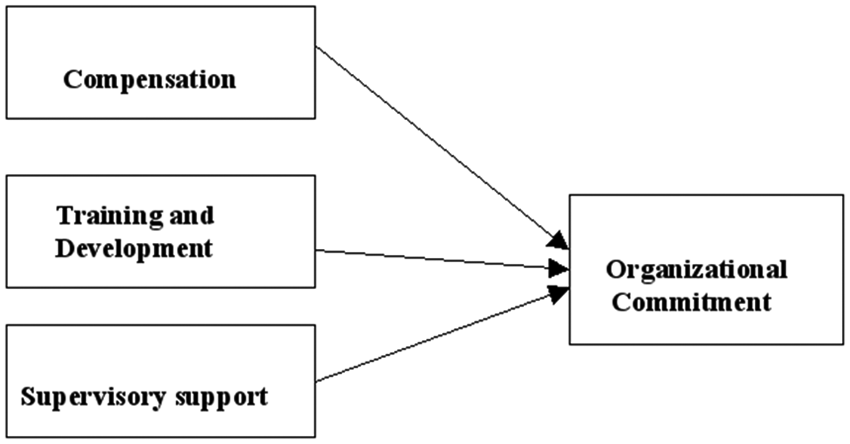
Research model and conceptual framework.
Research Design
An employee survey is considered the most effect practice to study commitment. Meyer and Allen 19 developed the Organizational Commitment Questionnaire (http://scholar.lib.vt.edu/theses/available/etd-04072003-224349/unrestricted/BarbaraBrown-4-22-03.pdf) to collect employee responses. This is a self-scoring questionnaire. Employees are requested to indicate how they feel about the issue in each question. Responses to each item are then rated using a 5-point Likert-type scale. The questionnaire was downloaded from an address included in the references.
Employee Sample
A nonprobability, “convenience” sampling method was used. A total of five cellular companies are actively operating in Pakistan, and 40 questionnaires were distributed in each company. Overall, the 200 questionnaires were assumed to be reasonable to generate representative results.
A total of 126 completed questionnaires were used in the final analysis. The distribution and responses are shown in Table 1.
Distribution and Responses.

Note. Ufone: http://www.ufone.com/about.aspx; Warid: http://www.waridtel.com/about/index.php; Telenor: http://www.telenor.com.pk/about/history.php; Mobilink: http://www.mobilinkgsm.com/about/index.php China Mobile: http://www.zong.com.pk/about_cmcc.html
Analysis of the Response Data
A statistical analysis was completed to determine how the employees covered who submitted questionnaires respond to the items under investigation. Descriptive statistics, correlation and multiple classification methods were employed to analyze the data.
Microsoft Excel was used to produce the statistical results. The results are discussed to highlight key findings and conclusions.
Demographic Characteristics of Respondents:
The first section of the questionnaire includes eight items asking for respondent demographic data. This section helps in understanding the industry’s workforce. Although the majority of employees are male, result shows that the industry includes a reasonable number of females. This trend is new in Pakistan.
Private companies’ employees are mostly in the prime of their careers. Only a few are older than 45 years; and they are likely to be in higher management. That illustrates how new the industry is to Pakistan. More than half of the respondents have earned a master’s degree. The majority of employees have been recently hired due to the recent exponential growth of the industry. The demographic facts are detailed in Table 2.
Demographic Statistics.

Summary of Statistical Analyses
The descriptive statistics summarize how employees view the four variables, as expressed on the 5-point scale. They are each above the midpoint on the scales, which signifies their overall positive sentiment. (Scores below 3 would be negative.)
Table 3 contains data for the variables.
Descriptive Statistics.

The means ratings in row 1 in Table 3 explain the intensity of organizational commitment along with employee responses to the three factors of HR practices. The responses are positively skewed; a value of 2.5 would be the mean for a normal distribution. The positively skewed distributions show that a majority of the employees favored the idea that increases in compensation, better training and development and supervisory support increase organizational commitment.
The standard deviations range from 0.046 to 0.066, reflecting the pattern of scatter of ratings around the means. The standard deviation is also important as it provides an indication of the average distance from the mean. Low standard deviations show that most observations cluster close to the mean.
Table 4 shows the correlation coefficients or more specifically the joint variation among the variables. The most widely used type of correlation coefficient is Pearson’s r, which has been used in this study.
Correlation Matrix.

Training and development proved to be the most closely related and most effective predictor (out of the three independent variables) of organizational commitment. In the Results, training and development is directly correlated to organizational commitment (r = +.614).
Supervisory support is the second most effective predictor (after training and development) of organizational commitment. In our results, supervisor support is directly correlated with organizational commitment (r = +.605).
The correlation analysis also shows that compensation is directly correlated to organizational commitment (r = +.597). That suggests compensation, which includes pay, fringe benefits and the like, has a significant impact on organizational commitment. The results are consistent with the common understanding of the relationship.
The correlation analyses support Hypotheses 1 to 3 that there is a positive relationship between compensation, training and development and supervisor support with organizational commitment in Pakistan’s cellular service companies. The results may be slightly different from earlier studies due to the different social and economic environment of different communities.
Multiple regression examines the interdependence of two or more independent variables, and their relative impact on a dependent variable, in this study organizational commitment. These relationships are summarized in the following linear model:

The R value measures the combined correlation of the independent variables with the dependent variable, organizational commitment.
Table 5 shows regression results based on the general statistical model.
Regression Statistics.

The fitted regression equation is
The multiple R measures the collective impact of the three independent variables, namely, compensation, training and development and supervisory support, on the dependent variable, namely, organizational commitment. The R2 (and adjusted R2) serves to explain the percentage (48.7%) of the total variation in the organizational commitment responses that are explained by the three independent variables.
Practical Implications
The research focuses on the commitment of employees in cellular service companies of Pakistan. The study findings indicate that all three HR practices (compensation, training and development and supervisory support) are positively correlated with employee commitment. Consequently, management should pay attention to each.
The most important determinant, that is, training and development, is important for two reasons. First, it contributes to career progress by enhancing employee skill and expertise that contribute to better performance and prepare them for promotions. Second, it strengthens a sort of future job security in the form of experience and expertise. The survey responses show that employees of cellular companies appreciate training to build their skills and encourage better use of their skills.
The findings related to supervisory support indicate that this is a key to retaining employees. That is consistent with other studies. The consistency of a supervisor’s behavior, his or her concern for employee career progress, the subordinate’s satisfaction with the supervisor’s technical competence, unbiased performance appraisals and good work-related behavior all contribute to the commitment of employees. The survey responses indicate that effective supervision can be expected to trigger a moral obligation to remain committed to the organization. So management should closely monitor this important determinant.
Compensation is the third most important contributor to an employee’s commitment to their organization. The findings suggest that more competitive compensation enhances commitment. Therefore, management should expect that modest, periodic increases in compensation will lead to more highly committed employees.
The findings thus suggest that organizations should emphasize training and development programs for employees to enhance their organizational commitment.
Conclusion
This study discussed the presumed impact on organizational commitment of three universal human resource practices. A firm’s human resources are now seen as the primary source of competitive advantage and the means to accomplish exceptional performance. For that reason, management would be advised to pay attention to how employees feel about the practices known to contribute to their commitment to their organization.
The results generated by this study are largely consistent with the conclusions of other researchers. Moreover, the results add to the growing body of empirical evidence that confirms a positive relationship between employee commitment and the way they are managed. It has been established that high levels of organizational commitment can be expected to contribute to higher performance. The research proves the positive impact of compensation, training and development and supervisory support as determinants of employee commitment to their organizations.
The leaders of cellular service companies in Pakistan should pay attention to the antecedents and consequences contributing to the organizational commitment of employees as a strategy to improve performance and reduce turnover. Ignoring or downplaying the importance of any of the three practices will lead to increased turnover. The business of providing mobile phone services in tough competitive environment is demanding and challenging. It is to be hoped that the lessons from this study can be used by mobile service operators in the country to aid in developing greater employee commitment in an environment of cutthroat competition.
Footnotes
Declaration of Conflicting Interests
The authors declared no potential conflicts of interest with respect to the research, authorship, and/or publication of this article.
Funding
The authors received no financial support for the research, authorship, and/or publication of this article.