






Abstract
Change in organization is a continuous process. With success in one change effort, organization has to go for successive changes. We categorize organizational change, depending on its nature and scope, into two types: transactional and transformational. Transactional changes are specific to some issues, such as change in performance management systems, a particular work process or systems, compensation policies and so on. Transformational changes are more holistic as major changes in the organization may be required. Managing a transactional change issue or issues may not require us to face major problems, when it is rational or legitimate. But a transformational change issue requires us to make effective use of change strategies, aligning with our people and organization, and it is more a long-term project. Reflecting on experience in managing change and organizational development, this article illustrates an organic model of change. The author had used this model in large- and small and medium–scale enterprises with success and had experienced it as dynamic and evolving. The author recommends a cross-country evaluation of the organic model for further validation.
Keywords
Introduction
What prompts organization to change is known to us all. Radical change in the business environment subsequent to globalization, among others, intensified the competition, changed the expectations of customers and significantly changed the landscape of the national and international economy. It requires our organization to more often calibrate and make it adapt to those issues that exert influence on business in one way or the other. We have to understand the triggers, which may even be remote to our organization. Nobody anticipated Microsoft’s introduction of Encarta CD-Rom would liquidate more than the 200-year old Encyclopedia Britannica’s print edition. And again, Microsoft had to withdraw Encarta. Or for that matter what prompted Pentair to sell their power tool business, despite being profitable with a good market share, for acquiring flow control business of Wicor. Hence, what could be a remote trigger for organizational change is difficult for an organization to visualize. It requires our business intelligence function to collect, compile and monitor the information; map the environment and make internal adjustments in our organization through changes on ongoing basis.
The need for change in organizations widely varies. But irrespective of the nature of change needs, we call every organizational change an organic adjustment. Such needs are compelling, and they evolve through our process of understanding, and mapping the environment. Primary change triggers include mergers and acquisitions, management restructuring, new technology and business relocation. Depending on the nature of the change triggers, the drivers of change may be business focused, environment focused, culture focused, strategy focused, business plan focused, process focused, competency driven, performance driven, innovation focused or technology focused. Whatever may be the change triggers, the management of change requires us to troubleshoot various issues and properly align our change strategies with the people and organization. While people issues require us to reinforce change through training and development, and motivation, organizational issues keep us engaged for the systems, structures, and so on. Our change pursuits may be planned, emergent, episodic (discontinuous change), continuous, developmental, transactional and transformational.
The introduction helps us understand the basics of organizational change. The purpose of this article is to examine the change processes in organizations, from a practitioner’s point of view, and then to suggest an organic change management model, based on experiences in managing changes in a number of organizations.
Overview of Change Management Models
To manage change in the organizations, let us first summarize briefly the leading change models. In the organizational change literature, we primarily find the use of three pioneering models: (a) McKinsey’s 7S model, (2) Lewin’s change management model and (c) Kotter’s eight-step change model. More recently, however, the ADKAR (Awareness of the need for change, Desire to support and participate in the change, Knowledge of how to change, Ability to implement the change, Reinforcement to sustain the change) change model, pioneered by Hiatt has gained acceptance. 1 There are several other less important models. It is important to understand that these models cannot provide a change management solution; rather they can help us manage the process of change, following a structured approach.
Keeping in mind this background, this article shares my practical experience, going beyond the theoretical parameters. Working with these models in actual organizational change initiatives for more than a decade, my understanding is that a strict model-bound approach to change is not the answer, as every organizational change is unique in nature and requires thorough understanding of the individual and organizational dynamics. Again, within the same organization, successful change achieved through one approach may need not hold good for similar cases in the future. Thus, change management knowledge makes us aware of the possible approaches that we can adopt.
McKinsey’s 7S model is named after McKinsey and Company and based on the applied research of Pascale and Athos 2 and Peters and Waterman. 3 McKinsey’s 7S model is more a strategic model, as it intends to achieve strategic fit for every change move by organizations. In the process of achieving strategic fit, the model basically helps align the change strategies to improved performance, while redesigning the organization. Though it is credited to Peters and Waterman, it is the outcome of decisions through interactions among groups of McKinsey people. The model has seven different factors: shared values, strategy, structure, systems, style, staff and skills, all of which work collectively to form the model. Many organizations in India and abroad have experimented with McKinsey’s 7S model. Indian organizations like Tata Iron and Steel, Infosys, HDFC Standard Life and Birla Sun Life and international organizations like Adecco, PepsiCo, Procter and Gamble, McDonald’s, Nokia, Kraft Foods, Toyota, Samsung, Nestle and others are known to have used this model.
Lewin’s change management model was first developed by Kurt Lewin 4 in the 1940s. Although the model dates back several decades, we still find its relevance in today’s organizational change initiatives. The uniqueness of this model is the simplicity of its three-step process of change. Lewin as a physicist and social scientist interpreted the change process scientifically, and he recommended the model, using the analogy of the changing shape of an ice block. To change the shape of an ice block to a cone, we first need to melt it. This is what he described as the process of “unfreezing.” Then we put the ice water into a mold in a cone shape (the stage of changing) and finally we refreeze it so it forms a cone. The lesson is needed for our preunderstanding of the change process, before we initiate the change in organization. A down-to-earth approach on change management made Lewin’s model popular, although today many researchers criticize his approach.
Kotter’s eight-step model of leading change, as pioneered by Harvard’s John Kotter, 5 observes that more than 70% of our change cases fail, which is attributable to the failure to take a holistic approach to the change management process. His suggested model, as conceived by him, helps organizations continuously adept to changes. Kotter’s model of change is actively used by several world-class organizations: Agilent Technologies, Google, Sony Corporation USA, British Airways, Coca-Cola, Dell, Compaq, Deloitte & Touche, Ernst & Young, ExxonMobil, Johnson & Johnson, Merrill Lynch, Microsoft, Mitsubishi, Nielsen, Novell, Novartis, World Bank, Yahoo and many more.
We understand from the discussion of these change models that the change process involves a broad collection of activities, pacing with employees’ and other stakeholders’ needs. No single model could be a solution for realizing organizational change. Rather, as leaders of change, we have to assimilate ideas from different models and develop customized solutions to achieve the desired change. Based on the my experience, a process-focused change model works best, as our people can relate their roles in the change process more objectively. But any change model requires teamwork and a supportive work environment. As change leaders, we have to understand that change always invites disagreement and contradictions. The role of the change leader is to address those issues successfully as they arise, as our success is possible only through collaborative inquiry and teamwork.
Experience With Manufacturing Organizations
Most of the author’s change assignments in manufacturing organizations have involved process-related changes, changes in technology and changes in product lines, except for one case of postacquisition changes after an Indian consumer electronics company acquired two units of a multinational in India. In all these cases, the author followed the organic model at least partially and achieved almost 75% positive change results. Getting predictable change results is not always possible. However, with sincerity and ingenuity we were able to achieve some positive changes within a time frame of 6 to 12 months. In some of the organizations, the change management process has subsequently been integrated and adopted as an ongoing exercise. Such institutionalization of a change management process could make these organizations viable, and they could even sustain their growth.
Change Experience in a Distillery
This company is engaged in the business of manufacturing alcohol and the bottling of branded alcoholic beverages as well as processed and packaged marine foods both for domestic and export markets. In Eastern India, it is the largest producer of alcohol. With six captive bottling plants, it is producing high volumes of sprits, liquor and alcoholic beverages. Apart from the production of liquor for domestic consumption, the company produces Indian-made foreign liquor.
The company processes industrial molasses to produce rectified spirits for the liquor and pharmaceutical industry. It began operations in 1987 with the latest state-of-the-art technology. The plant employs highly talented engineers, scientists and other technically qualified individuals. Even though the plant was running very efficiently for more than a decade, lately it started experiencing problems due to the unavailability of raw materials at competitive prices. To cope with the problem, the plant had shifted to grain-based distilling, but there again it faced the crisis of raw material availability. At present the plant has the capacity to produce 60,000 liters of rectified sprits from industrial molasses per day and another 60,000 liters of grain-based distilling per day. However, erratic availability of raw materials in both cases has forced them to suspend production frequently. To overcome this problem, the company has almost finalized the process of converting to multifeed distilling. Despite such operational problems, the company continues to generate surplus for their core competencies in distilling. Their people are outstanding in terms of both their performance and competence and are continuously engaged in innovation and various research and development activities. The company believes in systematic training for their employees and invests in such pursuits as an ongoing initiative.
I was involved in a series of change initiatives with this organization—initially to help them cultivate the creativity of their technical workers to play a role in transforming the production processes, then in developing by-products like pure and impure carbon dioxide through effluent treatment and finally with a workforce restructuring plan.
Introducing the idea of shared research, the research pursuit was narrowed to some critical operational problems, using the traditional Delphi technique, for obvious lack of opportunity for physical meeting with the entire team for shift work. Shared research led to the development of an indigenous yeast stain (yeast was earlier imported from Australia, and used in the fermenting process), and efficient energy utilization resulted in significant saving of energy costs, enhanced quality fermenting with the variation in yeast quantity, accounting for the raw material quality variation and so on. Some of the unanticipated outcomes of these change initiatives included captive power generation, developing new product lines like dry ice and industrial carbon dioxide from the carbon deposits, recycling of the sludge for quality manure among others.
The manpower restructuring plan for the shift workers was of different nature. The immediate outcome of the shared research, apart from those listed earlier, made significant numbers of operation workers redundant. Showing the exit door was not easy, as they are unionized. Efforts to redeploy them in new jobs also failed due to their reluctance. These people are operation workers doing the semiskilled jobs of quality monitoring through stagewise inspection, quick disposal of sludge to clear the pit to avoid overflowing, quick cleaning of the raw material pit for next discharge, power systems control, quick bottling of the rectified spirit from the yield point and so on. Negotiations with the union leaders failed, as they were reluctant to make members suffer. As redundancy is not possible, the only solution was for the company to redeploy them either in their new distilleries or in the existing one, putting them in currently outsourced jobs and reducing the head counts from the vendors. To carry extra inventory of 30 such workers, the company sustained huge loses. Through sustained training and participation games, workers agreed to redeployment, and even relocation to other bottling plants of the company.
Change Experiences in an Electronics Company
A legacy-bound multinational electronics operation in India was acquired by a traditional Indian electronics major company, whose price advantage made them successful competing in the market with Korean manufacturers. The acquisition was legally challenged and even violently opposed by the trade unions. Workers in large numbers decided not to work with the new entity. On acquisition, the Indian company first tried to assuage the feelings of irate employees and the unions by protecting their employment with a golden parachute option, that is, service conditions and salary and benefits remain unaltered. Even that did not help them win the confidence of their employees and the unions. Many employees took early separation and those in the higher age brackets opted for voluntary retirement, for which their parent company, before selling the stake to Indian electronics major, made available separate provisions. Some employees opted to wait and see how it unfolded.
With my intervention, during their first phase of operations, the company followed rigorous transparency of information and communication with all cross sections of employees. The chief operating officer (COO) was advised to spend more than 80% of his time in meeting and talking to cross sections of employees, clarifying their doubts and answering their queries, if any. Literally the COO kept himself busy in moving around the shop floors to meet people, ignoring the immediate production loss. The COO also made it a point to meet employees both in groups and individually in his office at designated times to discuss issues employees were reluctant to share on the shop floors. In between, the COO set an example before the employees, making it essential for all the managers and executives to be on time and disciplined at the workplace, as this practice had relaxed while they worked for the multinational entity. After a month of setting an example for the workers, managers started demanding similar behavior from the workers. Whenever workers found that things were not moving alright, they were given the freedom to manage their activities, deciding every aspect of their jobs on their own. Management extended all support and facilitated their activities and even made it a point to bring important visitors to the plant in order to show their appreciation of the way workers were taking charge of managing their shop floor activities.
The company then identified the common areas of interest shared by the workers and the management. A goal congruence model, developed in line with the common areas of interest, made it possible for them to assess the results of discussions on mutual interest. The company could see that management issues were not separate from workers’ issues. Hence they took the approach of integrating workers’ issues with those of management, thus reinforcing the workers’ appreciation for the need for change. Initial in-house training support to sell employees on the imperative for change was strengthened by retaining the services of expert consultants to reinforce the idea that workers should agree to scale up their activities.
Despite yearlong efforts to change the attitude of workers, it was observed that the company was still ridden with some deadwood, who were not only nonperformers but also chronic absentees. A list of 22 such employees out of 300 payroll workers was prepared and sent to their affiliated unions with a request to suggest what should be the company’s standpoint to tackle them. Unions were noncommittal initially, but on persistent communication, they asked the troublesome members to change their attitudes and behavior.
However, there was hardly any impact. Management then decided that no disciplinary action would be initiated against anyone but that external experts would work with the problem employees through rigorous attitudinal change sessions to help them understand the need for change. The unions agreed to this, and accordingly I was retained as the expert to work with the poor performers.
I first used successive icebreaking sessions in order to encourage the employees to discuss the situation. Some of them made excuses, ascribing their absences to the company’s failure to appreciate their achievements. They stated that the company’s productivity went up by 3 times after its acquisition, while their wages increased only marginally, which had led to their demotivation. Continued poor behavior sets a bad precedent for others who are hardworking. The change process first focused on the areas of common interests agreed to by employees and the unions, then slowly shifted the discussion to other areas of common interests, emphasizing the shared vision. Except for 2 recalcitrant employees (who later volunteered to quit), the other employees changed their behavior, and it was a happy ending.
The Organic Change Model
In change management, there are no universal approaches. But there is no harm in working to understand any divisive issues from the perspective of others. Leveraging the change experiences in these two organizations, along with the input from several other organizations, I have developed the following 10-step organic change model. To help readers understand the steps, I discuss my experience with analogies, along with the suggested approaches to ensure that one can cross every hurdle for a successful journey through the change process.
Step 1: Break the Ice First
Icebreaking requires the initial understanding of the people whom we want to change. Icebreaking could be anything apart from the traditional activity-centric tasks. In many cases, particularly when people are tense (usually a reaction to the prospect of change), activity-based icebreaking will not succeed; rather it can be counterproductive. The solution is to raise inquisitive questions to understand their concerns. It is like a role reversal from a teacher to a student. Give them the role of a teacher, you be the student. People like teaching what they know. Be a good listener, when they talk. Ask only questions to clarify any doubts. Record their experience sharing. Give them the sense you value their views. If you are convinced they are ready, slowly change the pattern of your questioning. Give them the more empowered role of a mentor. In some sessions, I have asked the individuals questions like “What do you suggest to build the competitive strength of your company?” That helps them open up to a meaningful discussion. Always remember the more you allow people to talk, the better you understand their issues and concerns. Your understanding later helps you convince them.
As an alternative or as a complement to questioning, you should consider storytelling as a tool to break the ice. You have to craft the story specific to the organization and must know how to tell stories. Here, in addition to the content of the stories, your skill in narrating the stories is also important. Your body language, your emotions, everything should be fine-tuned with your delivery. Your art of delivery must convince that the story is personal and meaningful.
I have also observed that people are interested in knowing themselves better. In many change assignments, I have used psychometric tools, emotional intelligence and leadership questionnaires, which are simple to administer. The results are not judgmental or critical and can be determined by the individuals with simple calculations. I never ask them to disclose their results; rather I tell them to discover themselves, if they so desire. In larger groups of 50 or more, I invariably observe the results are positive. It is a good morale booster for them. They gain confidence.
Activity-based icebreaking also works in organizations where people are not unionized and feel high insecurity. I use mostly shared activity-based exercises that promote togetherness. I often participate in such exercises with them as a player. Team-building and leadership exercises work here. Activities keep them engaged, and quickly diffuse their tension. Their minds unfold, and they become ready to accept the proposed changes.
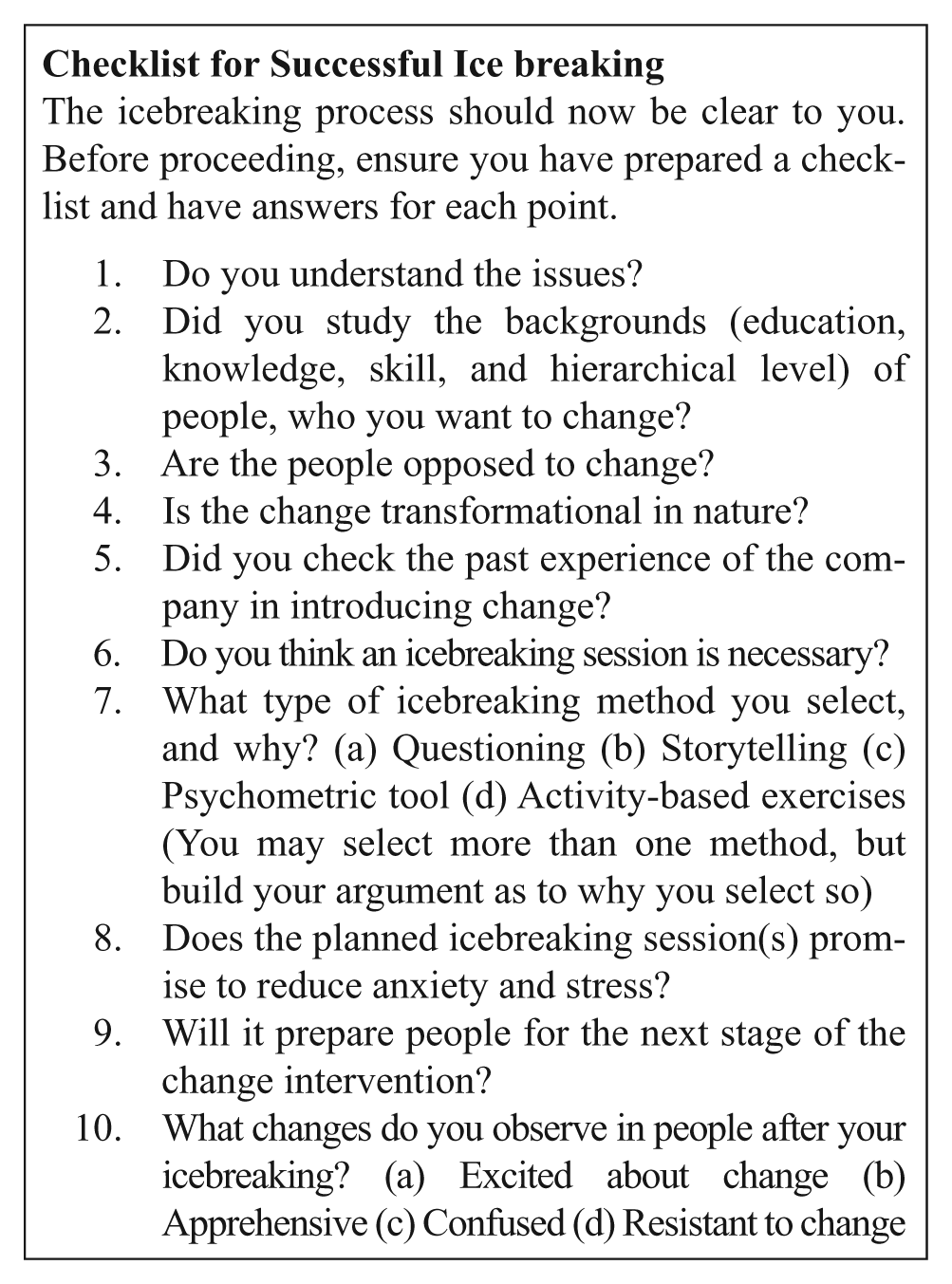
Answering all the questions on the checklist should help in understanding the efficacy of your icebreaking sessions. It is wrong to assume that after your icebreaking, people will readily accept the change. There may be continued resistance among a few. Separate those individuals into a different group for further reinforcement, so as not to delay the change process. Give them different support roles in the change management initiative. These people by nature are more opinionated. If you feel their presence may impede the change process, even after successive interventions, ask them to leave the group. In several organizations, my experience is that the message to quit often prompts them to consent to the change.
Step 2: Help Them Relate to Planned Change
Help people relate to planned change. “Appreciative inquiry” as a tool was found to be more effective when we follow the approach of normative-reeducative change. (That is when change occurs in the values, attitudes, skills and relationships of the employees or the followers.) To accomplish this, each individual involved in the change process must participate in the development of the plans for change. We normally rely on critical thinking as a process of knowledge reinforcement. This helps in building their understanding and appreciation for new ideas about the situation and the reasons for change.
It is obviously time-consuming. But in the long run it helps. To start the change process and connect the individuals to the process, I focus on the need to develop a shared vision. This is the dreaming phase. To develop a shared vision, I rely on the “critical success factors” approach developed by John Rockart. 6 Each member of a work group is asked to identify and list their perceived contributing factors for successful change. Such factors are then consolidated based on their commonality. This exercise is then extended to the entire organization and the shared vision is developed by consolidating the common successful change factors. Such an approach of shared or participative vision could help the employees to quickly accept the change process.
Other than the appreciative inquiry, storytelling also helps in getting people relate to change better.
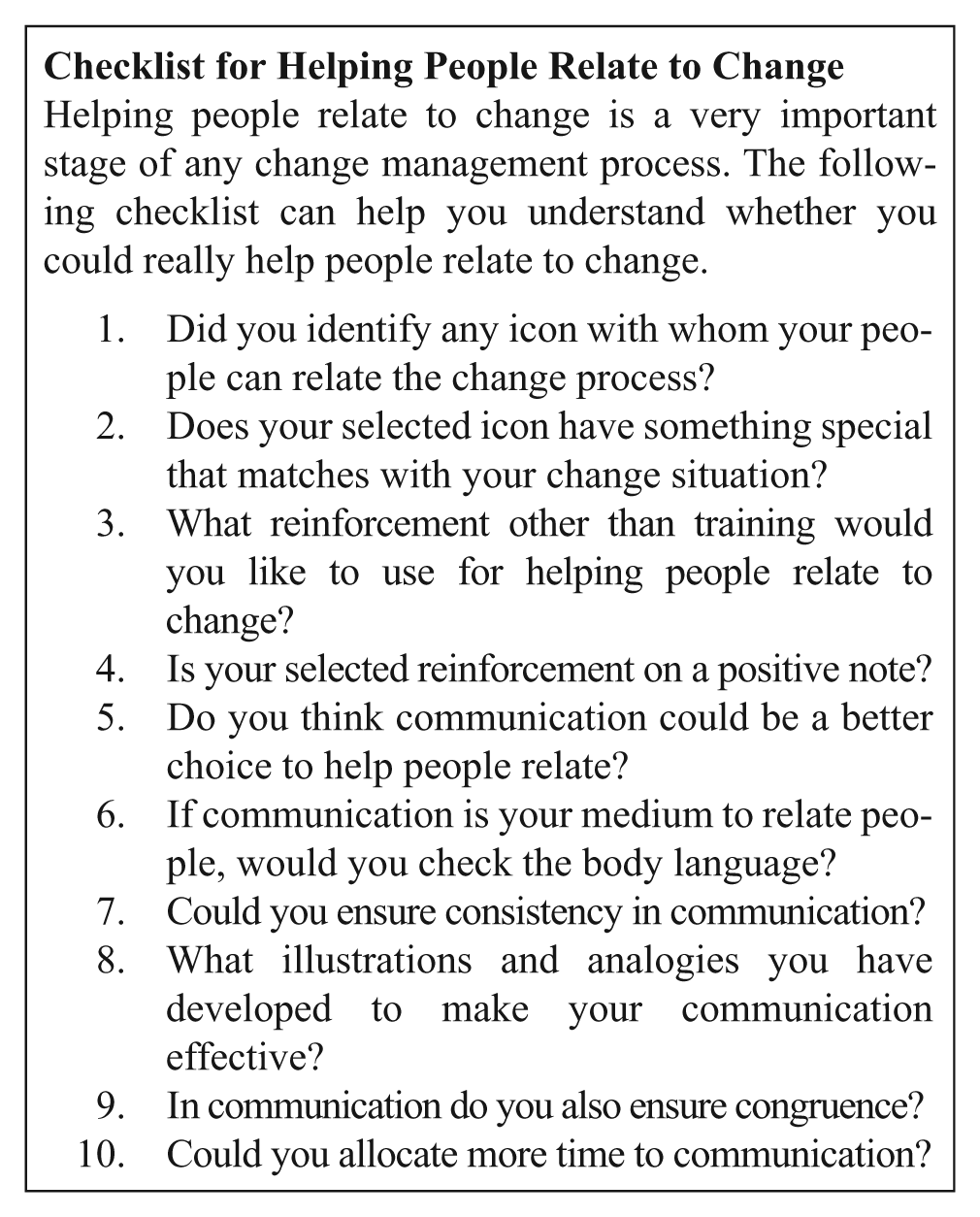
Obtain the answers to all your checklist points to understand how successful you are in helping people relate to change.
Step 3: Keep Them Informed
Based on my experience, I feel change requires empowering stakeholders to make informed choices. Never attempt to initiate change without informing your biggest stakeholder, your employees, since they are likely to be the first casualty of the change process. People are rational. They can understand the need for change, for right or wrong. It is the change agent’s responsibility to help them understand clearly. Map your company’s position vis-à-vis your competitors. Inform them of the consequences of not accepting change. In many change management assignments, I have even explained to employees the global economic scenario, the collapse of the mighty Lehman Brothers, the distress sale of Encyclopedia Britannica. The purpose is to sensitize them to the need for change in order to survive. Your focus while getting people informed is to empower them to make informed choices about the needed change. Once they are properly informed they will independently acquiesce to the need for change.
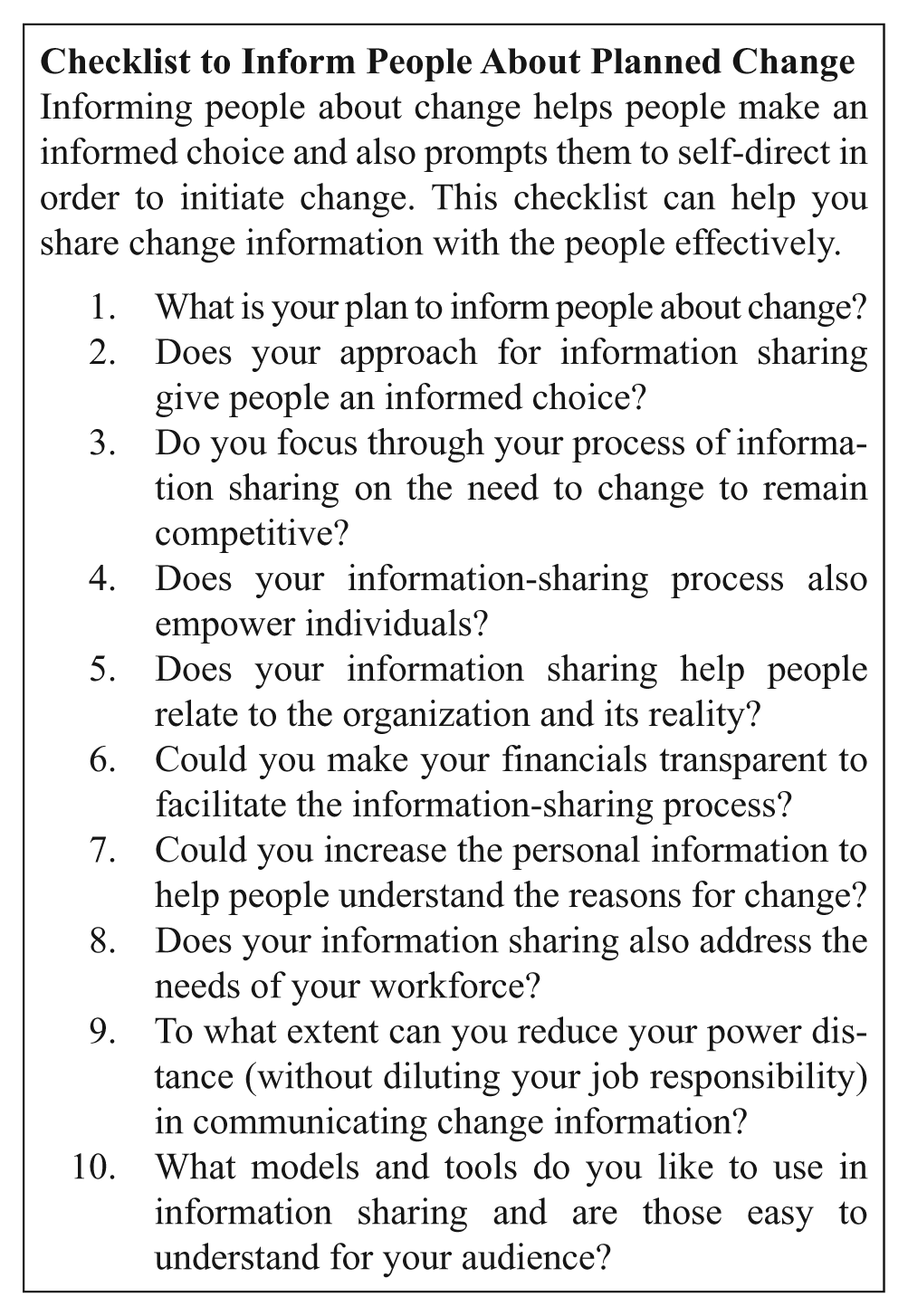
As effective change information sharing enables people to make their informed choice and be self-directed, you have to ensure that all these points are duly complied with.
Step 4: Communicate With Them
Reduce the power distance with your people. That is exactly what you do in managing a family crisis! Communicate with emotion. In a change situation, with emotional communication people are more likely to believe and relate to your message. Never be tactical or political in your communication in this situation. People can understand your manipulative intent. Give your people the feeling you are with them. Ensure that when you talk you mean it. Remember they also emulate you. Emotion can engage people in action. Communicating with emotion increases the commitment of people to change. A narrative technique of change communication works better. Disjointed communication fails to hold the attention of the people. Hence storytelling works better. However, this is more valid for lower level workers. With knowledge workers a serious, intellectual approach is better.
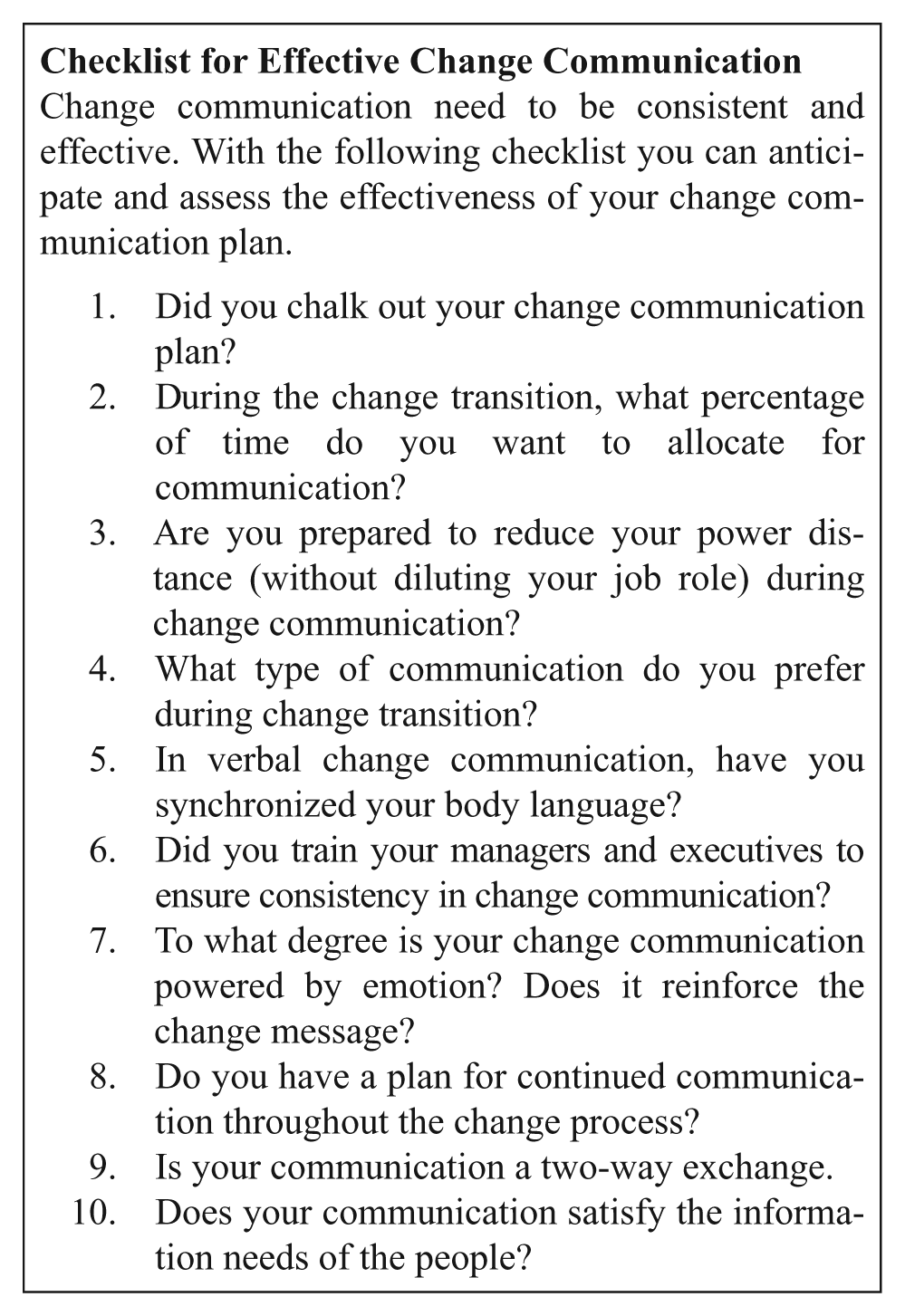
Complying with the above checklist, you can make your change information–sharing process result oriented.
Step 5: Show Them the Congruence With Their Goals
Have you come to realize that your change issues may have some commonality with the change percepts of employees? Draw a goal congruence model, and identify the overlapping commonalities between the goals of the organization and of employees. It is easy to convince people to action when they believe planned change is required. They will volunteer to change, and it is your task to slowly increase such areas of commonalities in order to ensure that they remain committed to change. Gradually you will find your change percepts and the change percepts of people converge to one and the same. This is what we learn while relying on the rational-empirical approach to change.
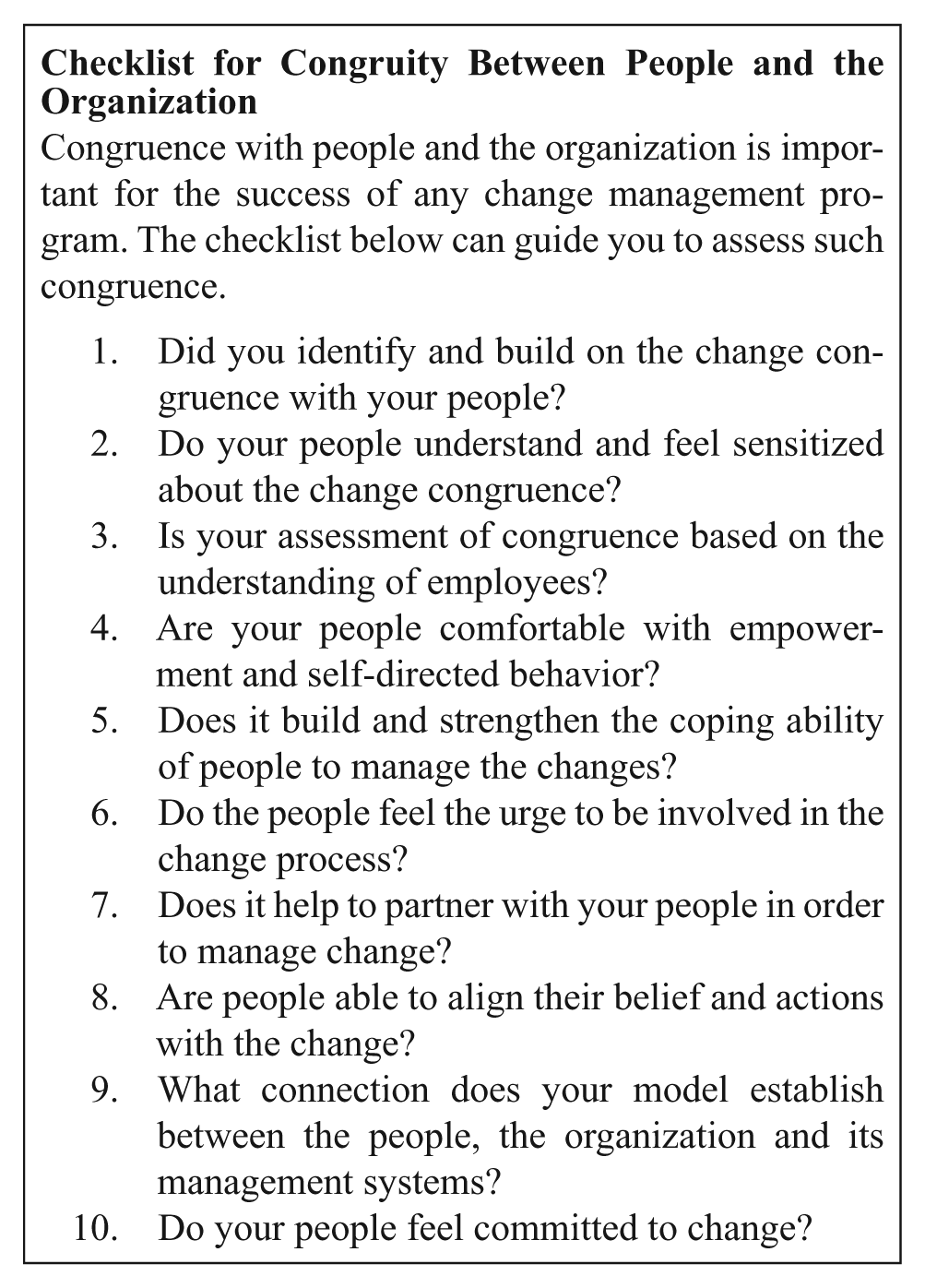
Using the above checklist, you can successfully develop your change congruence plan and obtain the commitment from the people in affected by change.
Step 6: Make Them a Party to Change
Are you comfortable including employees as contributing members of your change management team? It is important. Think of previous crisis situations in your organization that you managed with your people. Reduce your power distance and embrace employees as participants who share the responsibilities of change. I have seen in many situations that once they are involved in the change process, they feel responsible. They persuade others to join and feel responsible. They may not fit all change management activities, but at least where they fit, give them the chance.
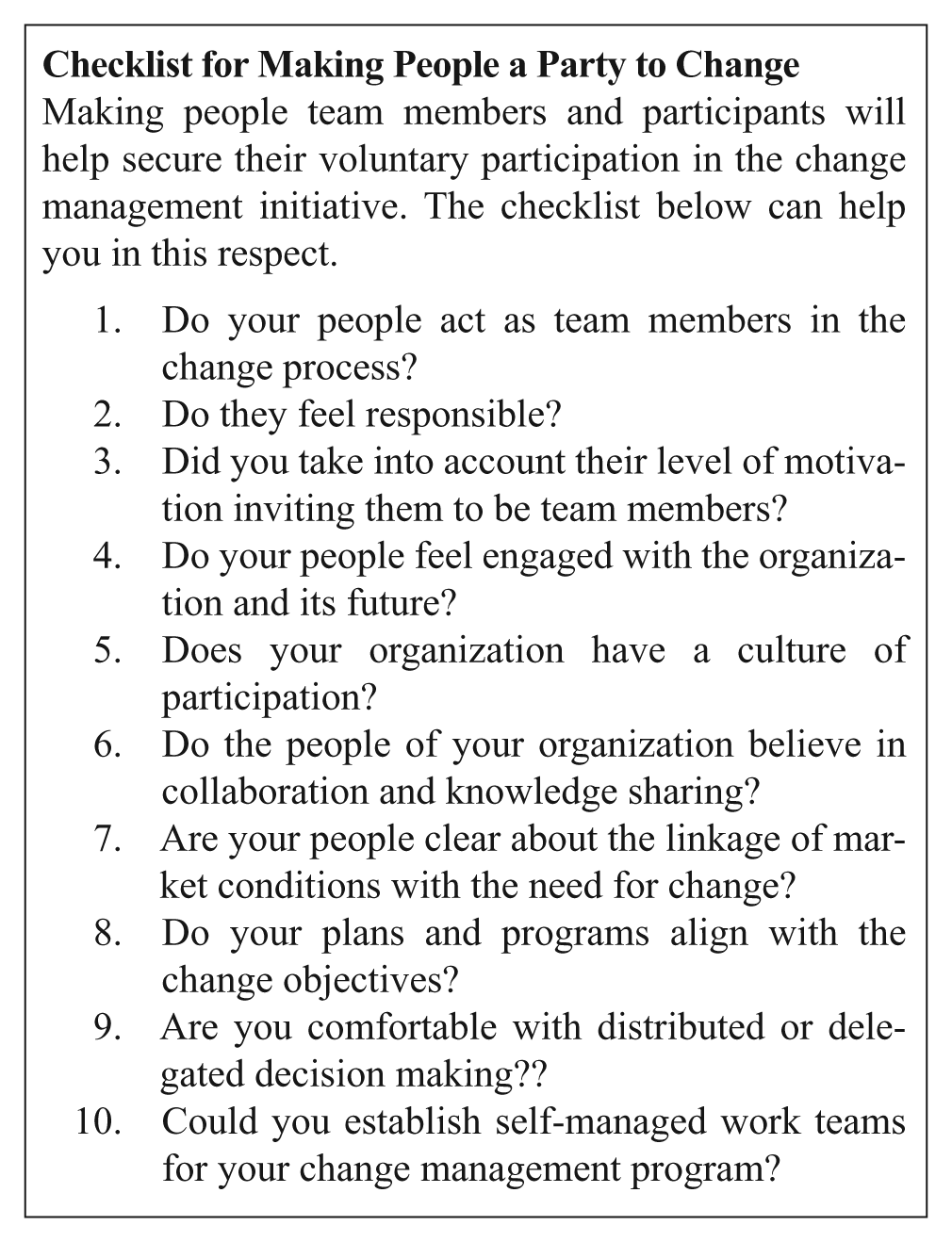
Adhering to the above checklist points, once you make people a party to the change process, your change management process will have broader support and become more effective.
Step 7: Help Them Learn Through Mistakes
Giving indulgence to commit mistakes and helping people learn through mistakes facilitate successful change management! With new learning, they feel the sense of importance and being empowered. They will also be willing to take risks. We often neglect this. We believe in giving advice, expecting people to learn and practice. But in change management, we have to quickly draw people to action and let them learn through mistakes.
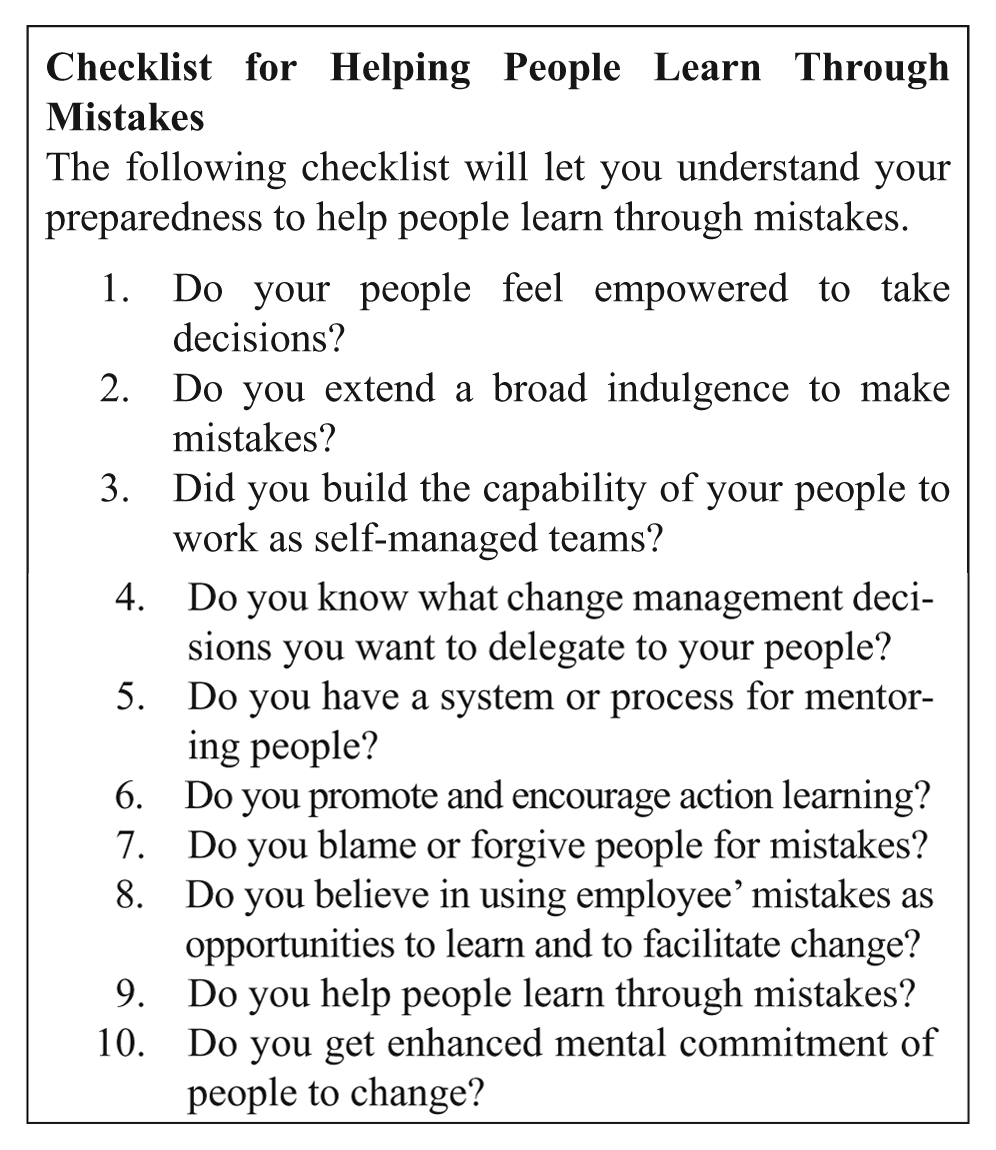
When you answer all the above queries, you are able to assess your preparedness to allow employees to learn through mistakes.
Step 8: Build Their Capabilities
Change requires reinforced and expanded employee capabilities. This is what our normative reeducative approach says: Train your people and build their capabilities. People feel more confident and prepared to address new problems when they have the required skills. With reinforced capabilities, they feel empowered and perform better during a change transition.
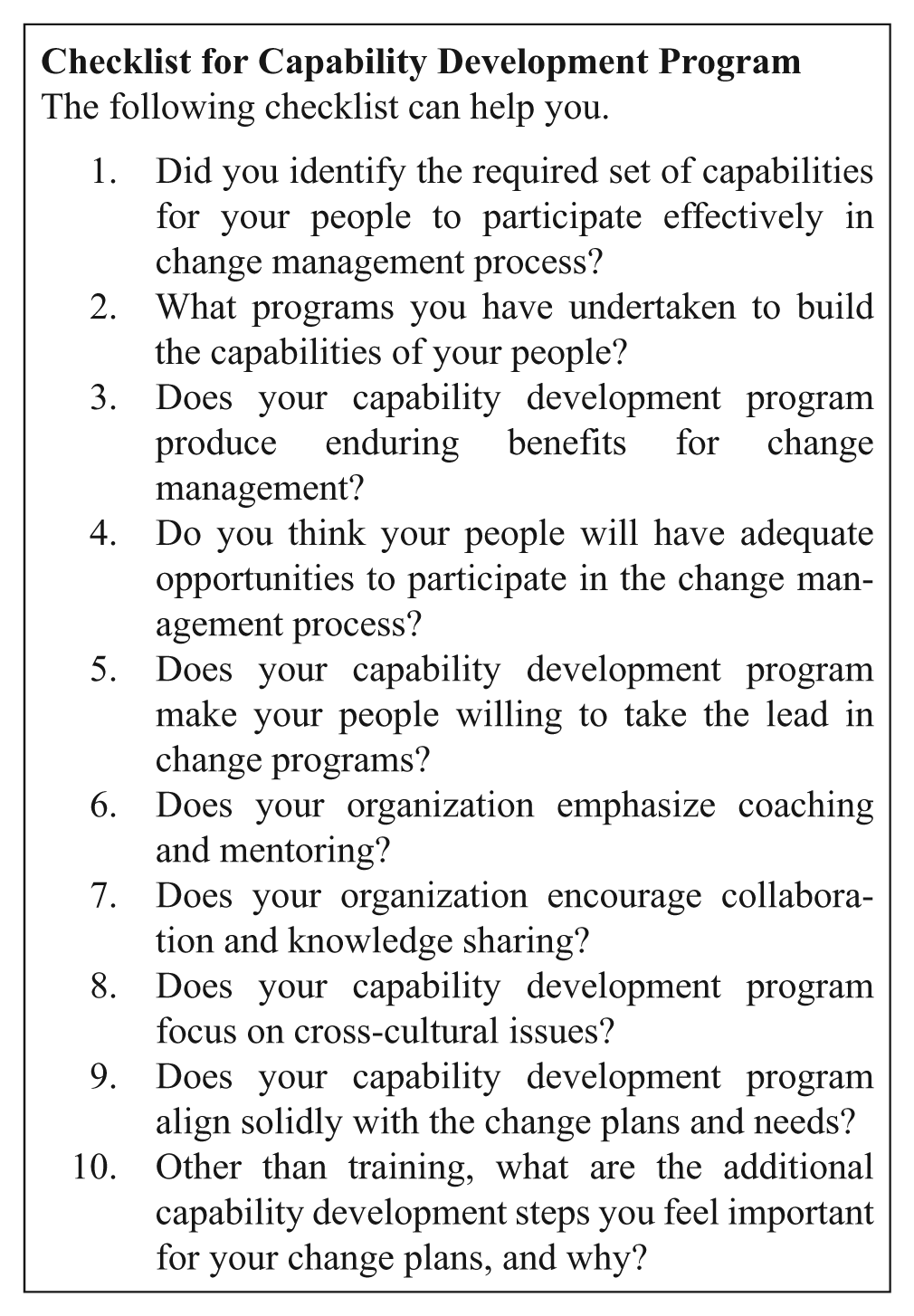
With the above checklist you can assess the strength of your capability development program.
Step 9: Work Out Joint Action Plans
With your people ready and on board, you can now work out joint action plans for change. Don’t impose; rather, be as participative as possible. Remember that participation enhances commitment to deliver results. When you and your people work together, nothing can stand against the success of change efforts. Your people will start feeling that they fight with you for a cause, the goal to survive and succeed in the competition for a better future.
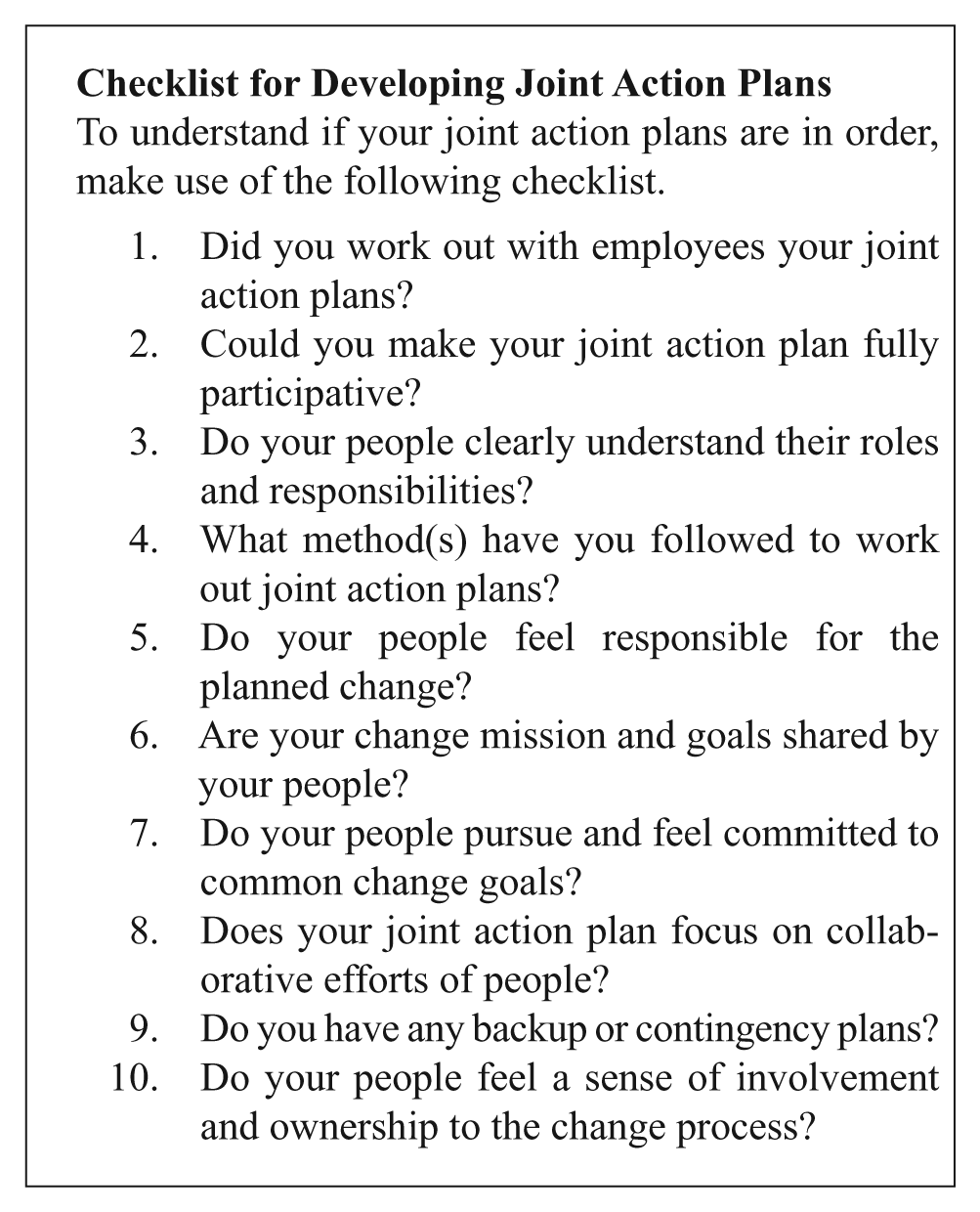
Complying with the above checklist, you can assess whether your joint action plans are in order.
Step 10: Show Them the Results
Finally, show them the results. Use those tools that they understand rather than complicated charts and diagrams. Tell them even if the results are negative. Discuss with them how to rework action plans. Never give up; rather, continue till you have a breakthrough with the people. Celebrate even small achievements to let them know that change is happening.

By following the above checklist you can successfully report the change outcome time to time to your people and renew their commitment to change.
Summary
The above model is organic, as it evolved through the experience of managing change in several organizations. The steps are interrelated, and some steps may be overlapping. But they are essential to ensure your change plan is successful. It is inappropriate to assume that complying with this model of change, by default, will give you the success you seek. This obviously depends on the nature of change issues, which may even require us to make people redundant and to scale down your operation in order for the organization to succeed. But the model can certainly help in managing the change process with minimum dissent and resistance from people and in that respect it will reduce the risks involved in the change process.
When I say it is an organic change management model, I mean that the model can be altered depending on your change circumstances. Instead of 10 steps, we can modify it and even delete steps. The checklist requirements listed with each step are based on my own experience, but they are consistent with the recommendations of others. You may find it necessary to change or modify it to fit your organization, your people and the change issues.
Finally, this organic change management model is valid for normative-reeducative and rational-empirical approaches to change. The model can also help with an action-centered approach to change, but it is not recommended for a power-coercive strategy or approach to change management.
Footnotes
Declaration of Conflicting Interests
The author declared no potential conflicts of interest with respect to the research, authorship, and/or publication of this article.
Funding
The author received no financial support for the research, authorship, and/or publication of this article.