







Abstract
The number of young women who knit has increased dramatically in the past ten years; however, there is little research focused on understanding young, female knitters. The purpose of this research was to examine the motivations of females 18 to 30 years of age, for participation in knitting. Uses and Gratifications Theory provided the theoretical framework for the study. Qualitative data were collected from 15 in-depth interviews. The interviews were analyzed with a constant comparative approach. Three major themes (incentives, barriers, and outcomes) and 12 subthemes emerged from the data. The emergent themes were compared to Uses and Gratifications Theory to determine the motivations for young women who participate in knitting. A Model of Motivations for Knitting among Young Women, was created to illustrate the relationship between the motivational themes that emerged from the data and categories within Uses and Gratifications Theory.
Knitting has undergone a significant and somewhat surprising revival in the new millennium. Once viewed as “grannies” practicing a domestic chore, knitters are shedding this stereotype and are knitting on New York City subways, in crowded pubs, and in other trendy places (Myzelev, 2009; Parkins, 2004; Pentney, 2008). Celebrities, young urban professionals, feminists, and men are participating in the traditional craft (Minahan & Wolfram Cox, 2007; Parkins, 2004; Springgay, 2010). The Craft Yarn Council (2012), which is the major trade association for yarn manufacturers, reported that 38 million consumers participated in either knitting or crocheting in the United States in 2011. In a survey of 5,000 knitters and crocheters, the Craft Yarn Council (2012) discovered that 18- to 34-year-olds comprised 18% of all respondents. Historian Abrams (2006, p. 150) proclaimed, “Today hand-knitting is regarded as a creative and skilled endeavor which is undergoing a revival and a re-evaluation by means of the re-appropriation and adaptation of traditional skills by modern artists and designers.” Clearly, there is noteworthy growth in the number of knitters and yet there has been little scholarly attention paid to understand the motivations of knitters and the artifacts they create. There has also been a lack of research on young female knitters who are some of the most avid participants in the craft, according to the Craft Yarn Council (2012).
The purpose of this research was to examine young (ages 18–30) female knitters to discover their motivations for participation in the craft. The researchers sought to categorize the motivations for participation in knitting held by the participants. Uses and Gratifications (UG) theory was employed to better understand their motives. The researchers attempted to determine whether the knitters fit into the categories of motivations, which are as follows cognitive, affective, personal integrative, social integrative, and tension release (Katz, Blumler, & Gurevitch, 1974).
Conceptual Framework
UG theory was the conceptual framework for this study. UG is grounded in the field of mass media studies and was originally developed in an attempt to describe the various reasons people sought out and used mass media, including radio, newspapers, books, and eventually television and the Internet (Severin & Tankard, 1997). One of the primary assumptions of UG states that the audience must be viewed as active participants who seek out various media sources in order to satisfy needs (Eighmey & McCord, 1998; Katz et al., 1974). UG has been utilized by researchers to describe interactions between people and mass media; examples include online shopping preferences (Cho, 2007), e-learning (Mondi, Woods, & Rafi, 2008; Severin & Tankard, 1997), and advertising effectiveness (Ko, Cho, & Roberts, 2005). UG describes several needs that individuals are motivated to fulfill by using mass media for leisure (Katz et al., 1974). Although the theory was originally developed to explain the use of mass media in the pursuit of leisure, knitting can be viewed as another type of leisure activity. Therefore, individuals who choose to knit may have motivations similar to those explained by UG.
The work of Katz et al. (1974) identified five types of motivations for using mass media. These categories were cognitive, affective, personal integrative, social integrative, and tension release. Cognitive motivations referred to the desire to seek out information, knowledge, and understanding. Affective motivations denoted the need for emotional fulfillment, pleasure, and aesthetic experience. Personal integrative motivations focused on credibility, confidence, and status. Social integrative motivations referred to the desire to seek out stronger bonds with family and friends.
Tension release or entertainment motivations referred to the need for soothing, diversion, and calming. Researchers of handcrafting have not previously explored these five categories. However, other researchers have found links between aspects of the categories and motivations to engage in needlework, including cognitive skill development in children using needlework patterns (Harris, 1988), opportunities to engage in creative or affective projects (Hawley, 2005), gaining status within the crafting community through consuming high-end yarns (Parkins, 2004), social needs being fulfilled through generativity within guilds (Schofield-Tomschin & Littrell, 2001), and tension-release needs being met through needlework (MacDonald, 1988). It is our conjecture that the five categories of UG also reflect the motivations for participation in knitting.
Background
September 11, 2001, and the Resurgence of Craft
Historically knitting has gone through many spikes in popularity and participation. In the United States, knitting was used as part of the home-front war effort in every major war (Strawn, 2007). Women and men used their needles and worked on creating garments for the troops. Crafting in general has a tendency to become popular in times of national stress, such as during wars or in the time of the Great Depression, and more recently after the terrorist attacks of September 11, 2001 (Strawn, 2007; Turney, 2009).
Scholars have pinpointed the terrorist attacks on the World Trade Center in New York City on September 11, 2001 (9/11), as one of the causes for the reemergence of knitting as a trendy occupation (Strawn, 2007; Turney, 2009). This event created a social backlash in America, which left Americans feeling vulnerable and in need of new methods to escape from stress (Wayment, 2006). Researchers who have studied the social changes following 9/11 have found some interesting trends. Depending on how deeply affected people were by the attacks, they might have engaged in behaviors such as turning to religion, increased volunteerism, seeking meditative opportunities, adopting new leisure pursuits, and spending more time at home (Stein et al., 2004).
Traditional textile handcrafts were one of the leisure pursuits adopted by American citizens in response to 9/11. These traditional textile handcrafts include but are not limited to knitting, quilting, crochet, beadwork, and embroidery. It has been suggested that crafting is appropriate for leisure time because it allows participants to create unique items, to multitask with other activities, and to engage in community building around the shared interest in crafting (Arai & Pedlar, 2003; Campbell, 2005). Online communities for crafters have helped to foster this interest. For example, etsy.com offers a simple-to-use retail outlet for finished craft projects and craft supplies (Jakob, 2013).
Another important online community for contemporary knitters is ravelry.com. Ravelry is an “online community of knitters, crocheters, and other artists who work with yarn and dyes” (Kuznetsov & Paulors, 2010, p. 3). This website allows participants to upload pictures of current projects, connect with other crafters, find crafting groups to join (both physical and digital), buy supplies, locate patterns, and find contests such as swaps to enter (Kuznetsov & Paulos, 2010; Rosner & Ryokai, 2009).
Personal Benefits of Knitting
Knitting has a number of advantages to offer participants. The soft clicking of needles and flow of the yarn into patterns has been called an alternative meditative process (MacDonald, 1988). Knitting has been endowed an almost Zen-like quality that allows the individual to retreat from a hectic lifestyle and focus instead on a simple, creative process (Parkins, 2004).
In addition to the meditative benefits, there are physiological changes that occur while one knits; these include a decrease in heart rate, slower breathing, and increased manual dexterity (Prigoda & McKenzie, 2007). Due to these positive effects, knitting has been explored as a therapy medium for individuals suffering from many conditions ranging from depression to chronic illness (Reynolds, 1997, 2009).
Knitting and other traditional textile handcrafts have been found to help create a sense of identity for the crafter (e.g., I am a quilter) (Hawley, 2005; Nelson, LaBat, & Williams, 2002; Schofield-Tomschin & Littrell, 2001). Identities such as being a knitter or a quilter are particularly valued in contemporary society as so few individuals have the ability to create homemade objects (Hawley, 2005).
Another personal benefit of knitting is the ability to multitask while working on projects (Myzelev, 2009). Knitters can work on a project while listening to music, carrying on a conversation, or watching television. The ability to engage in multiple activities at one time is seen as particularly important in postmodern society because the amount of leisure time available is significantly less than in previous generations (Arai & Pedlar, 2003).
Value of Knitted Objects
Knitting gives practitioners an outlet to showcase their skills, personal aesthetics, and creativity (Hawley, 2005; Johnson & Wilson, 2005; Schofield-Tomschin & Littrell, 2001). Even mistakes are embraced, as they allow subtle changes in the overall look of the product. The products created by knitters hold specific roles in the lives of their creators. Many knitters talk about strong emotional bonds with ongoing projects (Johnson & Wilson, 2005).
Handmade products and process are especially well regarded because they represent the unique, singular, and self-expressive (Campbell, 2005). Uniqueness is especially valued in postmodern society, where, due to globalization and mass production, many products are homogenized (Morgado, 1996).
Social Benefits of Knitting Circles
When women and men participate in knitting outside their home environments, they are often said to be members of knitting groups or knitting circles. Practitioners who form knitting circles discover positive social benefits like the ability to spend time with other crafters and to learn new skills. These groups allow members to pass on techniques, which can be seen as generativity, and is extremely important to members of crafting groups (Hawley, 2005; Schofield-Tomschin & Littrell, 2001). Many are compelled to teach other members of a knitting circle new stitches and methods of construction to keep the tradition alive. This is crucial today, according to Parkins (2004), because so many new knitting enthusiasts have learned from the Internet and books, which can make it difficult for them to get help on their projects.
Knitting groups can also be found online, where a number of social networking websites dedicated to knitting have cropped up since the year 2000 (Minahan & Wolfram Cox, 2007). Websites such as ravelry.com list knitting groups by geographic location, so knitters can find a group to join in their hometown (Minahan & Wolfram Cox, 2007). Ravelry is arguably the most prominent knitting website and currently boasts over 4 million members while offering regional knitting groups, knitting contests, and a large marketplace to buy supplies.
The trend of online knitting reflects how technologically savvy today’s crafters are. Additionally, many knitters have opened Internet-based businesses utilizing websites like etsy.com to sell finished products, homespun yarns, and patterns. Further, these cyber businesses suggest a level of comfort with technology among knitters (Chansky, 2010).
Research Questions
The review of literature revealed not only the importance of knitting in terms of both personal and social benefits, but also the value of this craft in postmodern society and changes in leisure activities following 9/11. There has been a call for research that addresses younger participants of crafting (Schofield-Tomschin & Littrell, 2001). Therefore, the following research questions were identified: (a) What are the motivations for knitting among young women, and what benefits do they derive from it? And (b) how do these motivations and benefits of knitting for young women relate to UG theory?
Methods
After approval by the human subjects’ research board, a sample of 15 female participants between the ages of 18 and 30 was identified. This age range was selected because young knitters have been identified as some of the most active and enthusiastic participants in the craft (Craft Yarn Council, 2012). These participants resided in a small college town in the Midwestern region of the United States. Participants were recruited through flyers posted at local yarn stores and a message posted on a regional forum on ravelry.com. Snowball sampling was employed after the initial participants responded and continued until theoretical saturation was met. Theoretical saturation can be met with a fairly small number of participants; Guest, Bunce, and Johnson (2006) were able to reach saturation in their experiment of sample sizes within only 12 interviews. Some researchers have suggested saturation is easier to obtain with small numbers in a fairly homogeneous sample (Kuzel, 1992). The sample utilized was quite homogenous (age, gender, hobby, and geographic location) which lent itself to reaching saturation quickly.
Semistructured in-depth interviews were conducted with the identified participants. The interviews took place on a university campus in a nondescript meeting room. These interviews lasted between 20 and 40 min and employed an interview schedule. Questions asked in the interviews covered information such as how participants had learned to knit, the types of items typically made, whether participants were involved in knitting groups or online knitting communities, and why the participants chose to knit as opposed to doing other leisure activities. A pilot interview was conducted with a single knitter to test the flow of the interview schedule and determine if any questions were difficult for participants to understand.
All interviews were transcribed verbatim. One researcher was responsible for the data analysis. The data gathered from the participant interviews were analyzed using constant comparison method, a systematic method of comparing concepts against one another to see how they relate to a similar phenomenon (Strauss & Corbin, 1990). The process involved three types of coding to identify, examine, and then build the data into understandable units: (a) concept identification, which required that the researcher identify data focused on similar phenomena and named concepts in a process called open coding, (b) axial coding, which allowed the researcher to make connections between concept categories and their subcategories, and (c) selective coding to identify emergent themes (Dey, 1999; Strauss & Corbin, 1990). To understand the motivations of the participants, the emergent themes were compared to UG Theory and the categories of motivations as suggested by Katz et al. (1974).
The trustworthiness and dependability of the data analysis was increased through the use of an audit coder with a fiber arts background. An interrater reliability coefficient was calculated on both sets of codes by dividing the total number of agreements by the total number of decisions made, resulting in an interrater reliability coefficient of 80.09%, which is acceptable for qualitative research (Touliatos & Compton, 1988, p. 122).
Results and Discussion
Upon analysis of the interview data, three major themes emerged such as incentives, barriers, and outcomes. The three main themes were comprised of 12 subthemes. These themes and subthemes helped to answer the first research question by revealing the various motivations, benefits, and meanings of knitting to young female knitters.
Incentives
The theme of incentives examined the various supportive elements for knitting. Motivations for participation in knitting by participants were also emphasized within the theme. The incentives theme was comprised of six subthemes: creativity, multitasking, alterations, information sources, social aspects, and a consideration of process or product.
Creativity
Knitters cited a variety of reasons for engaging in the craft. Knitting allowed the participants a creative opportunity which otherwise may not have been part of their daily lives. Knitting “gives me a creative outlet…I work at an insurance agent’s office selling insurance, which is about as least creative as you can possibly be” (Participant 1). Creating personalized items allows knitters to feel special and unique (Pentney, 2008). The creative potential of knitting was highlighted as important in today’s society because globalization has caused many products to become homogenized (Morgado, 1996).
Inspiration for knitting projects came from a variety of sources. Knitters in this sample displayed cases of synthesizing creative cognitive processes and inspiration from fashion trends, like one participant who wondered, “What could I do to make a unique earflap hat…I like to do something that’s popular so something that everyone is making” (Participant 10). Another area for inspiration was popular culture, where series such as Twilight and Harry Potter spurred knitters to create garments featured in the films. Researchers have noted a trend of creating handcrafted items inspired by popular culture (Turney, 2009). Comfort with popular culture and utilizing it in everyday wear is typical of dress in postmodern society (Morgado, 1996).
The knitters were excited to create items they perceived as distinctive or individualized. One woman illustrated this idea: I just feel so happy when I have it on because like I said no one else has, it’s all mine, no one else has it. Even if someone were to do the exact same pattern, even in the exact same yarn it would still be completely different. (Participant 9)
Some of the knitters commented that making their own garments and accessories allowed them to follow their own creative vision as opposed to that of retailers. They observed that items similar to what they had produced were not available for purchase. Other scholars (Rosner & Ryoki, 2009) have also observed the pride knitters felt in differences between their hand knits and mass-produced items.
The sense of creating a one-of-a-kind product translated into gifts made by the knitters as well. The perceived uniqueness or custom-made nature of a gift was viewed as being significantly better than store-bought; one knitter claimed, “I feel like it’s more personalized like the gifts, it’s better than like a gift card to Target, it’s like I spent 10 hours on this and I made this specifically for you” (Participant 11). As demonstrated by this statement handmade gift is meant as more than just the item, it is the time, effort, and thoughts of the maker as well (Johnson & Wilson, 2005).
Multitasking
Another incentive was the ability to multitask while engaging in their hobby. The knitters also reported feeling happy because they were able to be productive. The ability to simultaneously knit while doing other tasks made the knitters feel industrious. One woman decided, “You get a product out of it…I guess it’s better to watch TV and knit at the same time” (Participant 6). This incentive within the sample was in opposition to the claim that knitting was representative of a yearning for a slower, more balanced life as the need to feel productive at all times is indicative of fast-paced postmodern lifestyles (Parkins, 2004).
The ability to multitask was mentioned by all participants who enjoyed knitting while doing any number of activities such as waiting in lines, visiting with friends, or while watching television. One woman explained, “I just went to Disney World in December for a trip and I brought knitting because that’s what I do; there’s long lines” (Participant 9). Participants were happy to pull out their latest project and knit a few rows while in line at the post office, waiting for class to start at the gym, and even while sitting in the car. A number of reasons were cited for knitting in public, but the need for a quick relaxation session was most popular.
Alterations
Alterations to patterns served as one of the main challenges of knitting. A knitting pattern is typically used to create a product (e.g., a hat or sweater) and will detail the types of yarns and needles that need to be used in order to make the item. Adjustments vary in complexity from changing the type of stitch or yarn to completely resizing a knitted garment. Some of the less skilled knitters were intimidated by trying to alter because if the alterations were not correct they would have to take out a large portion of their knitting.
When altering a pattern, it often became necessary to plan for the project. Depending on the complexity of the change, some participants would use graph paper to map out stitches to better predict the outcome. For instance, “where it gets particularly hard is when you’re doing lace or something with more complicated textures, something like that you have to do a little more mapping” (Participant 2). The process of modifying a written pattern was dependent on math skills, and many knitters found it to be difficult but fun. Surprisingly, one knitter was a mathematician who aided many of her knitting friends with alterations.
Alterations in knit patterns were ultimately embraced by many of the participants. For knitters the motivator for many alterations “was trying to expand what I know, so trying new, different stitches and patterns” (Participant 12). Some of the participants described looking for projects that offered a new challenge, so with every project they would become more knowledgeable and improve their knitting skills.
Information sources
A variety of information sources were available for knitting. Nearly all of the participants were members of, or at least aware of ravelry.com. The website was viewed as a knitting staple by many of the women; one participant said, “It’s an awesome community and I honestly don’t know how people knit before it” (Participant 3). When describing the pattern offerings one woman stated, “Holy cow, I was floored the first time I went on there, like there’s that many patterns for knitting” (Participant 9). There were a host of other websites used to find information, help, tips, and patterns including YouTube, Google, and Knitty. Crafters’ adoption of technology such as the Internet is one way for them to enhance their lives as well as the physical artifacts they create (Johnson & Hawley, 2004).
Books and magazines offered another alternative for knitters to gain information and patterns. Many of these sources were gathered at the local library. Participants frequently mentioned this as a good place to obtain knitting information. By checking out books of patterns, the knitters could either complete a project prior to the due date or be able to search for favorite projects and make photocopies for later. Retail establishments catering to knitters were also patronized by participants in search of patterns and information
Social aspects
Nearly all of the participants regularly attended public gatherings of a knitting circle. The women had various reasons for participating in the social groups, but overall they enjoyed the company of other knitters who understood their hobby and shared the same passion. Making friends was cited as one of the best parts of the entire knitting culture, one woman claimed, “It’s opened a lot of doors for me socially, I think, I’ve met a lot of good friends through knitting” (Participant 3). The shared interest and excitement for knitting among knitters was continuously mentioned: “It’s just a really nice relaxed group of people who all have the same dorky interest in knitting that no one else in my life understands” (Participant 4).
Engagement with other knitters created an opportunity for many of the participants to learn new skills and get advice on how to fix mistakes. In addition, other knitters often provided design feedback for participants such as yarn and alteration suggestions. Teaching was another way for the knitters to cement their skills and to pass along knowledge (Prigoda & McKenzie, 2007). A couple of the less experienced knitters were eager to teach, and one participant remarked, “If there’s someone who wants to learn something I want to teach them that because that makes me better” (Participant 3).
The larger knitting community has created a number of different events to promote knitting. A couple of the participants were actively engaged in “swaps” via ravelry.com. Swaps are elaborate knitting gift exchanges conducted over the social networking website. Two participants had even created their own events, one woman started a knitting book club, and another held an alternative Super Bowl party, a “Sue Pearl Bowl” party. Stephanie Pearl-McPhee is a well-known figure in the knitting world, and the party celebrated knitting instead of watching the football game.
Social events and knitting circles helped motivate and provided a support system for knitters. The social aspects of knitting were highlighted by researchers as enormously important for receiving support for crafting and for enjoying camaraderie (Parkins, 2004; Schofield-Tomschin & Littrell, 2001). A number of these events and circles were on the Internet, which allowed a greater number of knitters to be involved. Online events and groups foster a sense of group identity among knitters by using a shared language and repeated interactions that strengthen the bonds between the knitters as well (Pentney, 2008). As a by-product, the knitters were able to forge important friendships in the virtual world (Rosner & Ryokai, 2009).
Process or product
Over the course of the interviews, it became clear that the participants tended to identify themselves as either process or product knitters. The process knitters were chiefly interested in the physical act of creating items. For instance, one process knitter explained, “Mostly I make things and give them away, I like the process” (Participant 8).
The product knitters, however, were concerned with the final result from their efforts and had less enjoyment from the actual knitting process. One product knitter stated, “I guess for me I’m more motivated by the finished product than the process, I know some people are the exact opposite, but I want it to be beautiful and perfect and done” (Participant 3).
The process of knitting has been cited as one of the most enjoyable aspects of knitting (Myzelev, 2009). The resulting knitted products have also been identified as an extremely important outcome (Schofield-Tomschin & Littrell, 2001). Benefits from both have been emphasized (Myzelev, 2009; Schofield-Tomschin & Littrell, 2001); however, results of this research contributed to and supported a distinction between process and product knitters.
Barriers
Barriers to knitting represented the negative aspects of the knitting process that the knitters were motivated to overcome in order to achieve a positive outcome. There were obstacles to knitting from other people as well as from the knitters themselves. The barriers theme was comprised of three subthemes, that is, expense, negative reactions, and mistakes.
Expense
The expense of knitting was a major factor for the participants, many of whom were students or living on a smaller income. Participants often desired quality fibers; as one knitter admitted, “I’ve always been kind of a fiber snob, I really only want to use like the good stuff, it usually ends up being the best that I can afford” (Participant 2). Participants who were unable to afford the higher quality materials felt limited in their ability to make projects. Other researchers have associated contemporary knitting with consumption and high-end fibers, but it is likely these studies focused on more affluent/older populations (Parkins, 2004; Turney, 2009).
The expense of a proposed project was stressed as an important consideration to be made in the planning stages of a knitting project. A couple of the knitters decided to avoid larger projects like garments because of the high yardage requirements and the expense they would incur. The women worked in a number of ways to counteract the costs associated with knitting. To cut costs, some knitters shopped thrift stores for materials and even recycled yarn from previous projects. One woman exemplified these practices when she stated, “I usually use yarn that was a gift, or…from a thrift store, or scrap bin fabrics” (Participant 8).
The participants frequently used coupons and watched yarn sales closely. When the participants were able to find yarn on sale they often engaged in “stash” building by purchasing yarn for future unspecified projects, a common activity for crafters (Pentney, 2008; Turney, 2004). Participants felt that possessing a stash of yarn helped minimize costs. However, some women expressed that stashing yarn may not be advantageous as they were unable to predict future project needs or yardage.
Negative reactions
Participants had encountered a number of different negative reactions to their knitting. A large portion of the knitters had been openly teased by strangers, friends, and family about their hobby. One woman found that her family in particular could not understand why she was passionate about knitting. She reflected, “They don’t necessarily devalue the things that I produce, but they don’t value the craft of knitting” (Participant 4).
Knitting, especially when done in public, was not well understood and often caused confusion among observers. Although a few participants felt empowered by the “rareness” of their hobby and general lack of understanding, others were annoyed by the confusion of knitting with crochet. The annoyance may have resulted from the fact that many of the knitters did not view crochet in the most positive light. One woman explained why she favored knitting by claiming, “I like the look of knitting more than crocheting just because crocheting kind of reminds me of old lady afghans and weird dollies and stuff” (Participant 7).
Unappreciative gift recipients were damaging to participants as well. A majority of the women expressed that the worst thing for a knitter was to have a gift recipient who did not value their present. When gifts are not appreciated, “it makes me want to knit for me more, make something really nice for myself” (Participant 2). Unappreciative gift recipients were also removed from the list of people for whom the knitters were willing to make items.
Mistakes
Mistakes were a typical occurrence for many of the participants. Sometimes they resulted from incorrect technique or general lack of know-how. Errors were also made on the design end of the process, and some participants discussed how they had made mistakes with the color choice, fit, or feel of their projects. The majority of the participants were less concerned with mistakes in their projects, which has been described as a characteristic of knitters by researchers (Rosner & Ryokai, 2009).
However, others were quite distressed by mistakes. A few women described a sense of unhappiness with aspects of their final projects, for instance one knitter claimed, “like my fingerless gloves, I totally need to repair them and I kind of feel self-conscious about it even though it’s cold, you have to wear them, and I kind of like want to hide them a little bit or hide certain parts” (Participant 5). Sometimes, the knitters even altered their project or pattern choices in order to avoid errors.
Outcomes
Outcomes to knitting participation represented the results of the knitting process. The beneficial results of knitting oftentimes encouraged knitters to continue with the craft. The theme of outcomes encompassed three subthemes, namely, products, tension release, and affirmations.
Products
The participants were involved in creating a number of different types of products. Interestingly, nearly all of the participants either had made or were making fingerless gloves, which appeared to be one of the most sought after projects. Fingerless gloves were even the motivator for one woman to become a knitter, and she remembered “the girl that I worked with who was knitting was making fingerless gloves and I wanted to make those” (Participant 1). In general, accessories were the predominant type of product created by the knitters. Accessories were viewed as more popular projects: “I think probably because they’re quick and I like instant gratification” (Participant 12). In addition to being quick, accessories were small enough to be portable, allowing for more public knitting opportunities.
Larger projects, such as blankets and garments, were not nearly as popular with the knitters. The lack of portability was a definite deterrent, and one participant remarked, “Right now I have this sweater that I’m knitting…and it’s like a pretty big chunk of fabric so it’s too big to carry with me” (Participant 8). A number of the knitters were worried about the cost of garments and were daunted by trying to understand how to fit garments correctly. The knitters who felt unprepared to work the stitches required for a garment often decided to avoid larger projects until they gained more knitting experience.
A specific type of product was related to knitivism. Knitivism is a type of activism that utilizes knitting to convey political messages, interest in social causes, or support charities (Pace, 2007). One woman explained her knitivism involvement by stating, “On Tuesdays I get together with these ladies, these older ladies from my church, so we get together and we knit these hats and blankets for the Alpha Center; it makes it more worthwhile for me” (Participant 10). The participant felt it was rewarding to use her skills to help other individuals. Another knitter made items for a local hospital, and the other knitter sent scarves to a women’s shelter. She commented, “I knitted like scarves to send to a nonprofit to make Christmas presents for like battered women so that was kind of neat and I was actually able to get rid of a bunch of scarves that I actually had, so that was nice” (Participant 8). Another knitter explained why she was less willing to partake in knitivism: “I’m more of a selfish knitter, more of a process knitter instead of someone who’s always giving to charity or this or that” (Participant 5). Researchers have stressed the importance of knitivism as part of the contemporary knitting culture (Pace, 2007; Pentney, 2008; Springgay, 2010). However, it was less popular among the participants, which perhaps implies that knitivism is less favored among young knitters (Pace, 2007; Pentney, 2008; Springgay, 2010).
There was a general interest in sustainability, and the physical products made by the knitters reflected this interest through use of sustainable materials. One woman discussed how knitting is “sort of self-sustaining and being like well I don’t need to go buy those things because I can make it myself” (Participant 13). As this comment illustrates, participants were pleased to “make my own” as opposed to being forced to consume. The idea that handmade is superior to mass-produced items has been noted by researchers as well, who found that some contemporary knitters were concerned with helping others to appreciate hand-knitted items (Rosner & Ryokai, 2009).
There has been growing support among all ages for “green” lifestyles, which emphasize recycling, consuming less, and even “do-it-yourself” projects. However, for individuals under 30, like the participants, green living can be especially important (Autio, Heiskanen, & Heinonen, 2009). Several of the participants had utilized sustainable yarns such as undyed fibers, natural animal fibers, or recycled fibers; these choices reflect the increasing availability of sustainable yarns in the marketplace (Minahan & Wolfram Cox, 2007). Another route toward green knitting employed by the knitters in the sample was to use recycled fibers from scraps and leftovers from past projects (Hiatt, 2012). Additional research into the perceptions and consumption of sustainable yarns is needed to determine if young knitters are particularly apt to purchase sustainable fibers as has been suggested by some participants in this research.
Tension release
Tension-release benefits were highly important to the participants who found knitting to be one of the absolute best ways for them to calm down during the day. One participant used the calming benefits of knitting to help her in social situations. She remarked, “I’m a pretty introverted person so if I’m going to do something social I feel like I need to be doing something” (Participant 4). Using knitting as a reward for a hard day’s work was mentioned by a few other participants who enjoyed working on projects at the end of the day to unwind and allow themselves some creative time.
Relaxation is a key benefit of the knitting process (MacDonald, 1988; Parkins, 2004; Turney, 2009). All of the women described knitting as a great stress reliever, and some continued to knit in order to prolong the relaxation that resulted from the activity. A number of the participants also utilized knitting to entertain themselves, which allowed them to focus on other tasks such as conversations, lectures, and movies.
Affirmations
Knitters receive a number of positive reactions to both the final products and the actual process of knitting. Compliments from others fostered a sense of pride in many of the knitters. Being able to say “I made it” was so enjoyable that some of the women admitted to showing off finished projects in order to get people to ask if they had made the item. One knitter explained: You just walk around waiting for someone to ask you about it so you can brag…a little added satisfaction to finding that dress you really love is that you got to make it yourself. (Participant 1)
The reinforcement offered by others was very important to the participants. These positive opinions often led the participants to try new patterns and skills: “When you get that feedback on your work you think I tried something new, I stepped out of the box on this one and I’m going to try something even more difficult on my next one” (Participant 3). As demonstrated in the quote, positive reactions from other knitters and outsiders further enhanced the enjoyment of the knitting process. Both the products and positive reactions received by crafters have been shown to lead to increased confidence and pride (Johnson & Hawley, 2004; Schofield-Tomschin & Littrell, 2001).
The majority of the participants felt very confident about their projects and skills as knitters. They were proud of their abilities and some felt they had a valued talent; one participant stated, “I love to knit; it makes me feel…I don’t know it makes me feel unique and special” (Participant 9). In addition, many of the knitters were extremely satisfied with the projects they had completed. The women were also able to post their work on ravelry.com or take it to “Knit Nights” to show other knitters who provided additional positive feedback.
Conceptual Model
The knowledge gained from the interviews with these knitters provides the foundation for the emergence of A Model of Motivations for Knitting among Young Women to graphically explain how the five tenets of UG Theory related to the emergent themes and subthemes (see Figure 1). The perceptions of these young female knitters offer an insight into understanding possible motivations for participation in this popular handicraft.
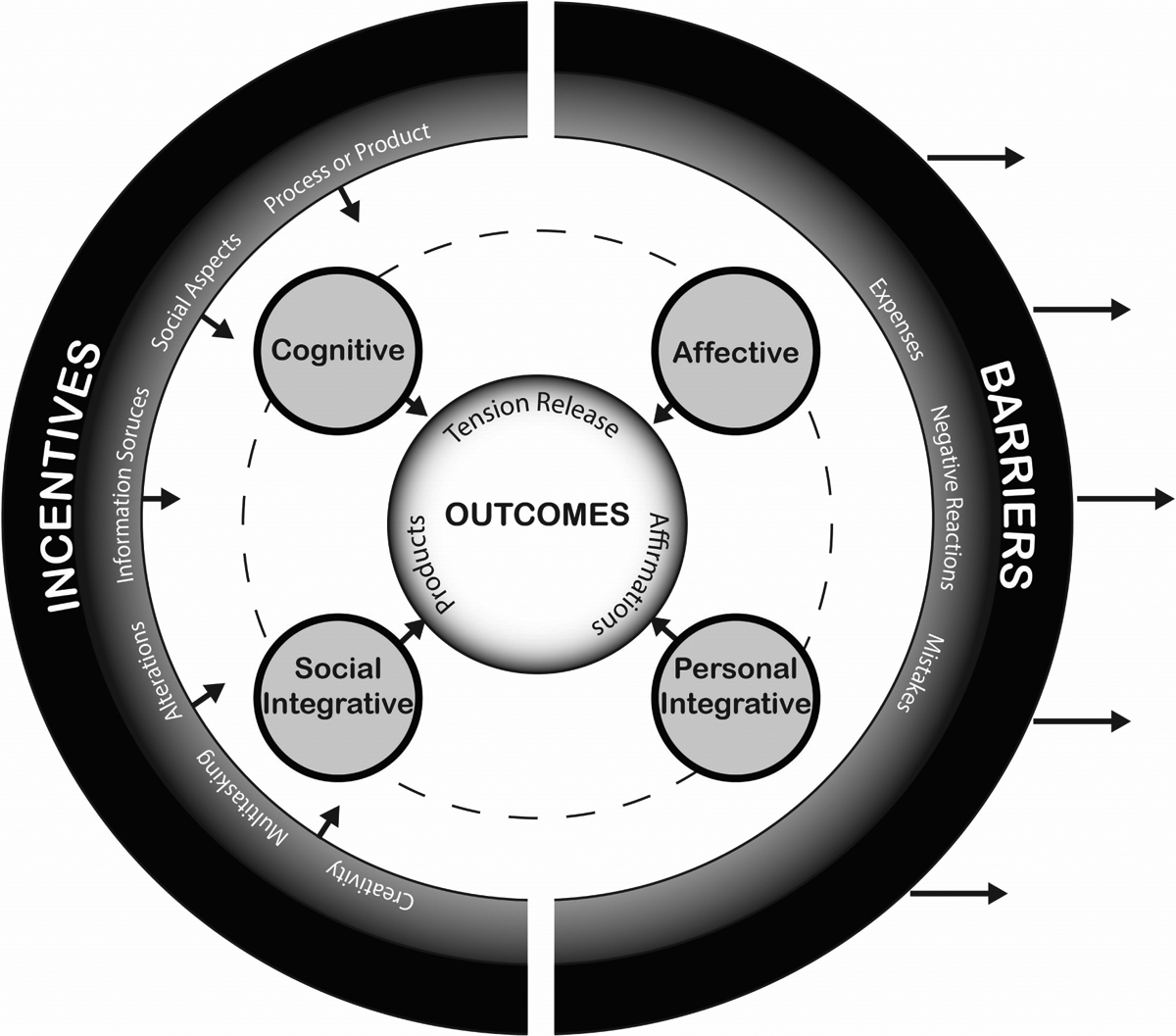
A model of motivations for knitting among young women.
At the core of the model are the three major outcomes this sample of knitters experienced from undertaking knitting, that is, creating products, experiencing tension release, and receiving affirmations. These outcomes also impacted continued engagement in knitting. The creation of products is an expected outcome of the knitting process and receiving compliments or affirmations for these hand-knit products is a natural by-product. Surprisingly, tension release was an outcome for this sample of young female knitters versus a motivation for participation.
Katz et al. (1974) suggested tension release as one of the motivations for consuming mass media as a leisure activity; however, for these knitters tension release was an outcome of participation. The relaxation and stress relief that resulted from the knitting process was deemed as vital by all 15 of the participants. Tension release that occurs from knitting results from physiological changes, such as a reduced heart rate, and also from psychological changes, such as taking time for the self (Pentney, 2008; Reynolds, 1997, 2009). The ability to knit simultaneously with other tasks allowed participants to stay entertained and feel productive and relaxed. Excitement over the ability to multitask while knitting is an attractive feature of knitting (Myzelev, 2009; Parkins, 2004). Portability and being able to work on projects in any number of venues was particularly important to the participants. Researchers have noted the portability and flexibility of knitting projects allows increased access to benefits, such as relaxation (Rosner & Ryokai, 2009). Therefore, tension release was one of the three major outcomes for participation in knitting and is placed at the center of the model.
The other four tenets of UG Theory—cognitive, affective, personal integrative, and social integrative—all motivated these knitters either independently or synchronously, ultimately impacting the outcomes of the knitting experience. Some participants articulated cognitive motivations for knitting such as, “I think it’s challenging, but I like being able to figure it out; it’s sort of like a puzzle” (Participant 12). The puzzle aspects and numerical thinking used to understand how to make knitted items are associated with cognitive thought (Edwards, 1999). Participants also expressed affective motivations that often manifested in generating a creative, unique product accompanied by an intense level of pleasure and motivation to continue working on products or continuing to engage in the process of knitting, which Csikszentmihalyi (1990) described as flow. Changes these knitters made in patterns and yarns allowed them to have creative control over projects, which increased enjoyment (Myzelev, 2009; Turney, 2004). Personal integrative motivations were met by compliments from others. For these knitters, compliments created an opportunity for the knitters to say, “I made it!” and was one of their favorite parts of the knitting process, supporting the belief that making handcrafted items helps to “instill a sense of pride, value, and status in the maker” (Turney, 2004, p. 278). Social integrative motivations were expressed in statements such as, “I do enjoy knitting with other people because it’s nice to just be able to talk and knit with people that actually understand what you’re doing” (Participant 10). The enjoyment knitters felt from sharing understanding, excitement, and their projects with one another has been described by many researchers studying handcrafts (Minahan & Wolfram Cox, 2007; Schofield-Tomschin &Littrell, 2001).
The interviews revealed the duality of the knitting experience for these young women knitters, that is, incentives and barriers. These knitters were incentivized or drawn into knitting by aspects of the craft such as creativity, multitasking, alterations, information sources, social aspects, or the preference for either the product or process. This research indicates that young knitters have a plethora of reasons to engage in knitting, reasons that range from tangible to value based. In other cases, these knitters were deterred from knitting by barriers such as expense, negative reactions, or mistakes. These barriers to knitting participation may be unique to young female knitters or commonplace for many knitters. However, the knitters in this sample were able to overcome these barriers.
Conclusion
This research confirmed the appropriateness of UG theory for describing the motivations of young women who participate in knitting. Knitters in the sample had numerous incentives for engaging in knitting, but the ability to multitask and the enjoyment of various creative aspects of the craft were frequently mentioned. Additionally, emphasis was placed on the various social aspects of crafting, whether from physical or digital knitting circles. Information about knitting was discovered in many locations and websites such as ravelry.com, which was critical to many of the participants. Finally, some knitters placed more importance on the knitting process while others highlighted the finished products. These knitters even identified themselves as “process knitters” or “product knitters,” both of which were introduced in this research.
The knitters in the sample encountered barriers to their participation such as negative reactions from the public. Mistakes on projects could cause knitters to be less pleased with finished products. The expense of knitting was keenly felt by young female knitters. Outcomes from knitting were also described, and all participants placed emphasis on the resulting relaxation from knitting. Positive reactions to finished products were also highly important. A Model of Motivations for Knitting Among Young Women contributes to the limited body of knowledge as to why young women knit. The model illustrates the relationship of the tenets of UG theory with the themes that emerged from interviews with this sample of knitters. Although this research and model provide information from a limited group of knitters, they also provide a foundation for future researchers to analyze the motivations of knitters with various demographic and psychographic characteristics.
This study is important because the scholarly literature concerning any aspect of motivations of knitters is sparse. The study of young knitters and the artifacts they produce has just begun. Rather than recruiting from a specific guild/knitting circle, which has been the sampling strategy of numerous studies (Prigoda & McKenzie, 2007; Schofield-Tomschin, & Littrell, 2001; Springgay, 2010), it was possible to document broader themes by examining young knitters from differing backgrounds, levels of participation, and social standpoints.
Future researchers may want to further investigate the applicability of A Model of Motivations for Knitting Among Young Women on larger and more geographically diverse samples, which can answer questions about whether the tenets of UG utilized in this research are pertinent in describing the motivations of individuals participating in other types of craft activities. Additional inquiries should also be made into the culture, products, and meanings that are created through participation in knitting.
Footnotes
Declaration of Conflicting Interests
The author(s) declared no potential conflicts of interest with respect to the research, authorship, and/or publication of this article.
Funding
The author(s) received no financial support for the research, authorship, and/or publication of this article.