






Abstract
The authors investigated the effect of the nine most accepted factors of online shopping orientation on online purchase intention through perceived behavioral control and attitude toward purchase of clothing. They suggest that in-home shopping tendency, convenience consciousness, and impulse purchase are the most significant constructs in building consumers’ online shopping orientation. Impulse and convenience for online shoppers appear to be more important than recreational shopping. Online shopping orientation seems to have a positive influence on perceived behavioral control and attitude toward purchase. Implications of the results are discussed to provide guidance for managers and future researchers.
The emergence of the Internet and rapid development of online shopping have allowed retailers to offer customers a broader variety of products while expanding their own business opportunities. Online commerce continues to exhibit rapid growth globally (Sung & Jeon, 2009). As of January 2014, Internet penetration was found to be 40.3% of world population, with growth between 2000 and 2014 of 601.5% (Internet World Stats, 2014).
Internet penetration in Western Europe is 78% and 54% in Central and Eastern Europe, much higher than the world average (Internet World Stats, 2014). European online consumers appreciate ease of search, greater access to information on a broader selection of products, enhanced price comparison, and the opinions of other consumers (Seybert, 2012). In 2012, 59% of Internet users in the European Union with 28 member states (EU28) reported having bought or ordered products over the Internet for personal use (Seybert, 2012). In the same study, it was found that clothing and sporting goods (32%) and travel and holiday accommodation (32%) are the most common online purchases (Seybert, 2012).
Increasingly online retailers are interested in understanding the determinants of online purchase intentions. Most researchers to date, however, have only explored the direct relationship between individual dimensions of online shopping orientation and purchase intentions (Liebermann & Stashevsky, 2009; Ling, Chai, & Piew, 2010; Seock & Bailey, 2008; Sung & Jeon, 2009) or attitude toward online shopping (Kim & Karpova, 2010). To date, no researchers have explored the ways that online consumers enact their online shopping orientation as purchase intentions or how the dimensions of online shopping orientation influence consumers’ attitudes toward online shopping and perceived behavioral control. Additionally, attitudes toward online shopping and perceived behavioral control as mediators between online shopping orientation and actual purchase intentions have not been explored.
The gap implied by these piecemeal approaches to the phenomenon represents an important area of concern for online clothing retailers. As one of the primary categories of products purchased online, clothing and accessories account for approximately USD$269 billion in annual sales with that number projected to see exponential growth over the next several years (Statista, 2015). This category is also interesting to academic researchers who recognize that clothing purchase represents a unique challenge to online marketers due to the inability of consumers to touch/try on the clothing prior to purchasing (Yu, Lee, & Damhorst, 2012). The growing online shopping population creates a greater need for online clothing retailers in particular because their product lacks trialability. Additionally, the exploration of consumers’ attitudes toward online shopping and perceived behavioral control as mediators rather than antecedents to purchase intentions introduces a level of understanding of the clothing category with implications in other product categories as well.
To fill this gap, we apply the Theory of Planned Behavior (TPB) to explore how consumers’ online clothing shopping orientation drives online clothing purchase intentions. TPB informs many prominent constructs in current marketing research (ie, self-efficacy, behavioral intentions, attitudes toward specific behaviors) and is especially relevant to this study because of the anticipated importance of personal beliefs and attitudes in driving online clothing shopping behavior, a relatively new shopping channel when compared to more traditional methods. We will attempt to accomplish the following with this research: (a) identify the extended dimensions of shopping orientation relevant to online clothing purchase and (b) examine the relationships between shopping orientation, perceived behavioral control, attitude, and online purchase intention based on the TPB model.
The population examined in this research is the Generation Y (Gen Y) consumer, born 1979–1996. This group is relevant because it bridges the 2 age-groups that comprise the majority of Internet shoppers: 16- to 24-year-olds and 25- to 54-year-olds represent the vast majority of online shoppers in the European Union (Seybert & Lööf, 2010). Gen Y consumers, as the mid-range of those groups, also represent a significant portion of Internet users in the European Union (Seybert, 2012).
Theoretical Background and Hypotheses
Online Clothing Shopping Orientation
Shopping orientation is one’s general predisposition toward shopping activities and influences various consumer activities such as information search, product selection, and alternative evaluation (Brown, Pope, & Voges, 2003; Ling et al., 2010). This definition applies well when adapted to describe online clothing shopping in particular. For the purposes of this research, we propose online clothing shopping orientation as one’s general predisposition toward online clothing shopping activities. Previous researchers claim that a consumer’s shopping orientation impacts all aspects of consumer behavior, but they have primarily examined the preference for shopping venue (i.e., in-store, online; Girard, Korgaonkar, & Silverblatt, 2003). Researchers using online shopping and clothing shopping orientation typologies, though, disagree about the number of dimensions that comprise the construct (Choi & Park, 2004; Donthu & Garcia, 1999; Gehrt, Onzo, Fujita, & Rajan, 2007; Hansen & Jensen, 2009; Ling et al., 2010; Seock & Bailey, 2008).
In order to identify the most established dimensions of online shopping orientation in the context of clothing, a systematic literature review was performed via automated search in electronic databases (EBSCO, Emerald, Elsevier, Science Direct, Springer, Taylor and Francis, Wiley, and ISI web of knowledge) for the last 10 years (2005–2014). The selection process for identification and inclusion of relevant research included a broad screen of the titles and abstracts and a strict screen of the remaining articles and selection of the most relevant. Thereby, the initial number of articles (1,602) was reduced to 79 after the first broad screen, and then to 29, regarded as the most appropriate and relevant to the topic of shopping orientations in general. The last group of articles pointed to other seminal and previously cited articles. Based on this review, nine different types or dimensions of shopping orientation emerged that focused on clothing or online purchase (Forsythe & Bailey, 1996; Gehrt et al., 2007; Hansen & Jensen, 2009; Seock & Bailey, 2008; Seock & Chen-Yu, 2007; Seock & Sauls, 2008; Sung & Jeon, 2009; Workman & Cho, 2012).
We examine shopping enjoyment as pleasure achieved during the online clothing shopping process, including the time spent browsing for items of apparel. Fashion consciousness reflects the consumer’s interest in fashion and trends. The greater efficiency of e-commerce allows the purchaser to reduce the cost of search, resulting in lower prices for various online products compared to their off-line equivalent, with the promise of good quality for thrifty shoppers (Hannah & Lybecker, 2010). Thus, online shoppers often demonstrate price consciousness and perceive greater benefits of online price and alternative comparison (Elliot & Fowell, 2000; Noh, Lee, Kim, & Garrison, 2013).
The concept shopping confidence reflects consumers’ belief in their ability to shop for clothing and select the right products for themselves. Brand or store loyalty describes a consumer’s tendency to continue to patronize the brand and/or online store they prefer, which also suggests self-confidence in the consumer’s ability to evaluate alternatives. In this study, convenience consciousness refers to consumers’ preference to put minimal effort into the clothing purchase process. Convenience therefore implies concern for ease-of-use issues such as accessibility and simplicity of navigation (Gehrt et al., 2007; Workman & Cho, 2012). Specifically in the online context, the ability to search in multiple online stores at once should also impact a consumer’s assessment of convenience. In-home shopping reflects the consumer’s tendency to enjoy shopping for clothing from home (Ling et al., 2010), which can also be regarded as a specific convenience as consumers do not need to visit brick-and-mortar stores. Quick shopping relates to consumers’ tendency to place value on time-saving clothing shopping techniques. These consumers tend to agree that they can accomplish their purchases more quickly on the Internet (Kim & Kim, 2004).
An impulse purchase occurs when a consumer feels a sudden impulse to buy something immediately, without substantial assessment, acting on the impulse alone (Amos, Holmes, & Keneson, 2014). Ling, Chai, and Piew (2010) state that impulsive purchase behavior is unplanned behavior that is reasonable when related to objective assessment and emotional shopping preferences. Impulse purchases generally arise in scenarios with higher emotional activation and less cognitive control, resulting in reactive behavior (Park & Lennon, 2004). Such purchasers are usually more emotional than nonpurchasers, leading Donthu and Garcia (1999) to suggest that online purchasers are generally more likely to be guided by impulse.
The nine established types or dimensions (shopping enjoyment, fashion consciousness, price consciousness, shopping confidence, brand/store loyalty, convenience consciousness, in-home shopping, quick shopping, and impulse purchase) describe unique facets that combine to form online clothing shopping orientation. Online shopping orientation, as enacted in the clothing context, is specified then as a hierarchical latent variable constituted by its nine dimensions, necessitating a second-order reflective–formative model (Jarvis, MacKenzie, & Podsakoff, 2003) that considers the reflective measures of its underlying dimensions. Online clothing shopping orientation describes a second-order construct composed of nine first-order constructs. Therefore, we propose the basis of our model:
Online Clothing Purchase Model Drawn From TPB
Within a cognitive goal-theoretic framework, shopping orientation is activated by process goals (Van Osselaer et al., 2005). Process goals refer to the ways in which consumers pursue a purchase, and so the consumers with an experiential shopping orientation pursue the process goal of experiencing pleasure, while task-focused consumers pursue the process goal of accomplishing their shopping mission as efficiently as possible. Personal values may be regarded as beliefs that guide behaviors. According to Solomon, Bamossy, Askegaard, and Hogg (2006, p. 113), a “value can be defined as a belief about some desirable end-state that transcends specific situations and guides selection of behavior.” Beliefs are considered to be drivers of attitudes, behavioral control, or behavioral intentions (Armitage & Conner, 2001 ). Based on the above-mentioned assumptions, TPB emerges as an appropriate theoretical basis for the current study.
Based on TPB, online clothing shopping orientation linked to personal lifestyle and values is a driver of perceived behavioral control and attitude. In the context of this research, the attitude toward online purchase represents the degree to which a person has favorable or unfavorable evaluations/appraisals of online purchase (Jarvenpaa, Tractinsky, & Vitale, 2000). Perceived behavioral control is an intrinsically motivating aspect of the interaction between human and computer (Suntornpithug & Khamalah, 2010). Control in this sense reflects the level of confidence a consumer has in his or her ability to control the online clothing shopping process by taking past experiences and expected obstacles into account. Considerations include access to information about products, access to interpersonal communications, the online navigation process, and the acquisition and purchase processes. Presumably, therefore, the more experienced a consumer is in online clothing shopping, and the more developed his or her online clothing shopping orientation, the greater will be his or her perception of control and positive attitude toward online purchase. Thus (see Figure 1):
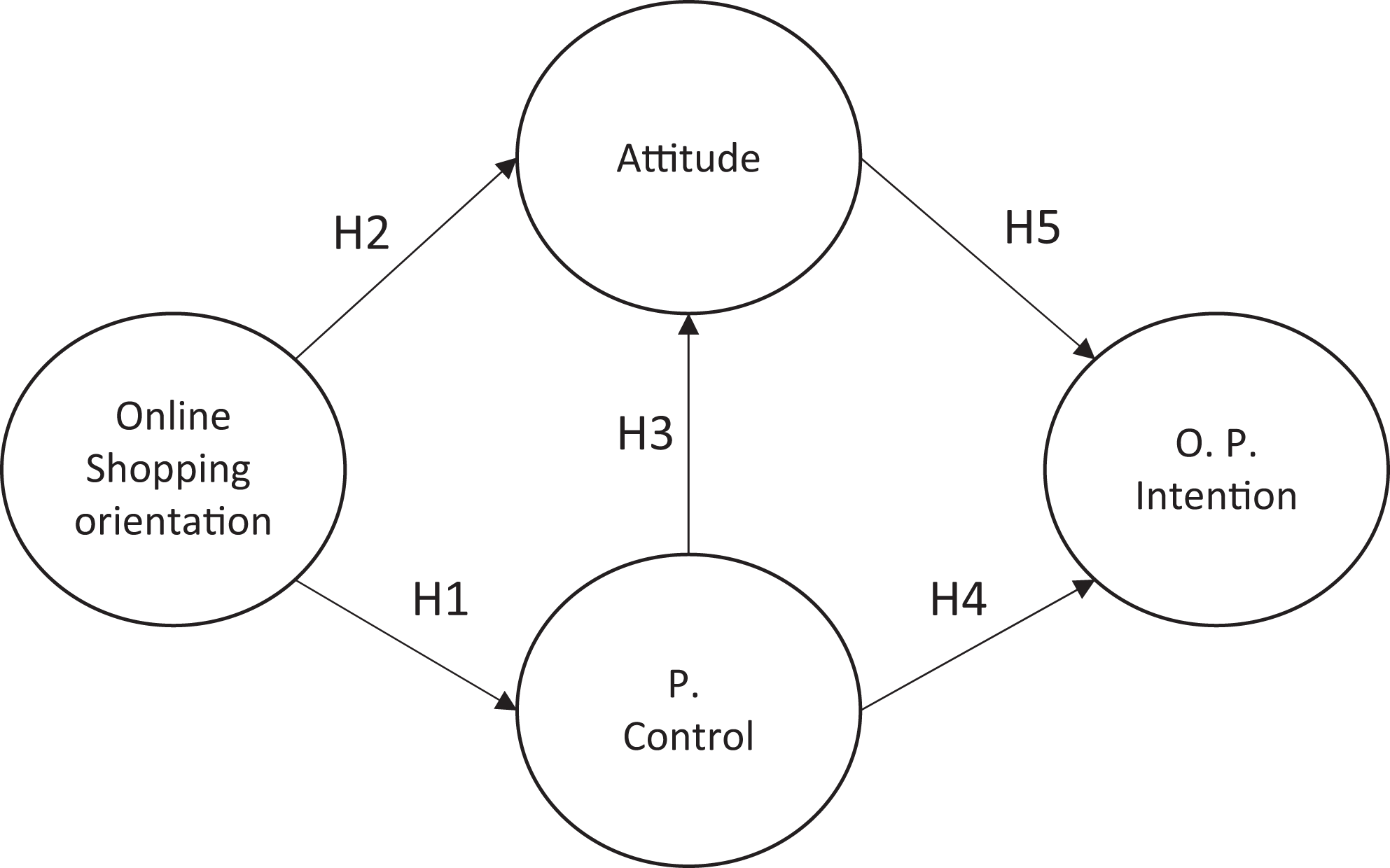
Proposed model.
TPB, with the inclusion of subjective norms as a predictor of behavior, was first proposed in 1985 (Ajzen, 1991). As early as 1988, however, the inclusion of subjective norms was being called into question, as several researchers found those norms to be the weakest predictor within the model (Sheppard, Hartwick, & Warshaw, 1988). Indeed, Armitage and Conner (2001), in their meta-analysis study, suggest that there is no conclusive evidence regarding the significant influence of subjective norms on intentions. Specifically, within the online context, Shim, Eastlick, Lotz, and Warrington (2001) do not find a significant effect of subjective norms on intent. Those authors suggest that the inconspicuous nature of online shopping influences consumers to pay less attention to the perceived judgments of significant others. That study was conducted in the earlier stages of the phenomenon of online shopping, but more recently researchers have found that subjective norms have no significant influence on Gen Y consumers’ purchase intentions in the case of apparel (Belleau, Summers, Xu, & Pinel, 2007; Wang, 2006). Accordingly, we do not include subjective norms in the proposed model. In the online context, we expect Gen Y consumers to act individually, wanting to control the process and feeling a positive attitude toward online shopping.
Experience in online clothing shopping allows customers to develop confidence in searching for relevant information, controlling navigation safely, and to do so at convenient times. Experience can make consumers feel somewhat in control of the interaction (Weiss & Jessel, 1998). A favorable attitude toward online purchase can be derived from the experience of machine interactivity and perceived control (Dongyoung, Cunhyeong, & Byung-Kwan, 2007). Therefore,
TPB further suggests that attitude toward behavior and perceived behavioral control inform individuals’ behavioral intentions and thus their behaviors. Customer online purchase intention in the Web-shopping context determines the strength of a consumer’s intention to purchase via the Internet (Salisbury, Pearson, Pearson, & Miller, 2001) or to press the “Buy” button. Thus,
Method
Data Collection
The majority of Internet users in the European Union are fairly young, 16–24 years old (Seybert, 2012). In Portugal, 35% of Internet users are e-shoppers, most of them being 16–24 years old, followed by the 25–54 age-group (Seybert & Lööf, 2010). Accordingly, the target population of this study is Gen Y consumers (Solomon, Bamossy, Askegaard, & Hogg, 2006) who use the Internet for recreation and purchase (Racolta-Paina & Luca, 2010). University students are a good proxy for the target population, and students with actual online purchase experience were targeted.
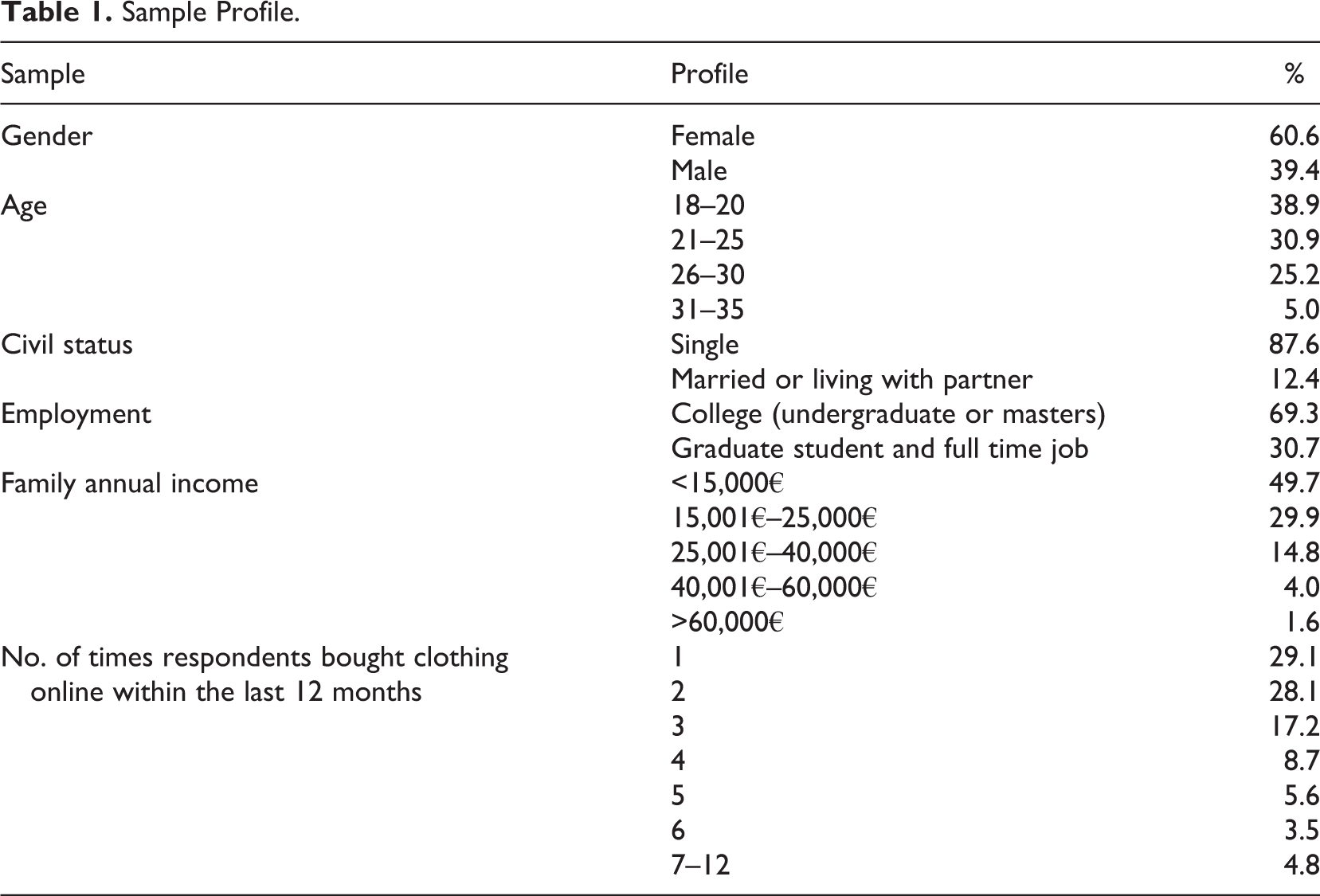
The questionnaire, which captured both latent and demographic variables, was pretested using 14 consumers who were personally interviewed (6 graduate and 6 undergraduate students and 2 marketing professors who had each made online purchases), which resulted in minor changes to the wording of some questions. An invitation to participate in the online survey questionnaire was subsequently sent to undergraduate and graduate students of two major universities in the north and south of Portugal, utilizing the mailing lists of student associations. Of the 1,044 students who returned the survey, 378 respondents, or 36%, had purchased clothing online at least once in the previous 12 months and were therefore eligible for the research. This number is consistent with the overall population (Statista, 2015). The resulting sample, those 378 respondents with recent online clothing purchase experience, consists of undergraduate and graduate students from a diverse range of disciplines that include biology, chemistry, physics, management, and economics. The average number of times respondents bought clothing online within the last 12 months is 4. A detailed description of the sample can be found in Table 1.
Sample Profile.
Although the questionnaire has been developed based on instruments used in previous studies, the structure was designed to avoid common method bias: (a) the items and questions were prepared to avoid ambiguity (i.e., keeping them simple and concise, without unfamiliar terms and complex syntax) and (b) the physical distance between measures of the same construct was also taken into consideration (i.e., items of the same construct were not placed next to each other; Weijters, Geuens, & Schillewaert, 2009).
Variables and Measurement
The constructs included in the study were measured via multi-item scales adapted from existing literature, following the protocol established by Anderson and Gerbing (1984). The items in the questionnaire were first written in English, translated into Portuguese, and then back-translated to English to ensure that the items in Portuguese communicated similar information to those in English (Sekaran, 1983), an assurance of conceptual equivalence. The items used to measure the nine types of shopping orientation were adapted from previous research on each orientation—shopping enjoyment (Seock & Bailey, 2008), fashion consciousness and price consciousness (Seock & Sauls, 2008), shopping convenience consciousness (Korgaonkar, 1984; Seock & Sauls, 2008; Shim & Kotsiopulos, 1992), convenience confidence (Seock & Bailey, 2008), in-home shopping tendency (Seock & Sauls, 2008), brand/store loyalty (Seock & Bailey, 2008), impulse purchase (Ling et al., 2010), and quick shopping (Hansen & Jensen, 2009). Including each of the types in a higher order structural equation model will allow us to determine whether all actually contribute to consumers’ online clothing shopping orientation as well as which of them have the greatest impact. Four items measured attitude toward online shopping and perceived control, each based on Suntornpithug and Khamalah (2010). Finally, the 2 items measuring online purchase intention, adapted from Chen and Barnes (2007) and Loureiro and Santana (2010), capture consumers’ intent to shop online as expressed to the researchers and to others. For each construct, respondents were asked to rate their level of agreement on a 5-point Likert-type scale.
Results
Measurement Model
Analysis and interpretation of the partial least squares (PLS) model were conducted in two stages. First, suitability of the measurements was assessed by evaluating the reliability of the individual measures and the discriminant validity of the constructs. Appraisal of the structural model followed. In order to evaluate the adequacy of the measures at the first-order construct level, item reliability was assessed by examining the loading of measures on their corresponding construct. Items with loadings of .707 or more were accepted, indicating that more than 50% of the variance in the observed variable was explained by the construct (Carmines & Zeller, 1979). In this study, all items loading were ≥.707 (see Table 2). Composite reliability was used to analyze the reliability of the constructs because this measurement has been considered more accurate than Cronbach’s α (Fornell & Larcker, 1981). All constructs were found to be reliable, with composite reliability values over .7 (see Table 2). Convergent validity of the measures was also demonstrated, as the average variance of manifest variables extracted by constructs (AVE) was at least .5, indicating that more variance was explained than unexplained in the variables associated with a given construct.
Measurement Results.
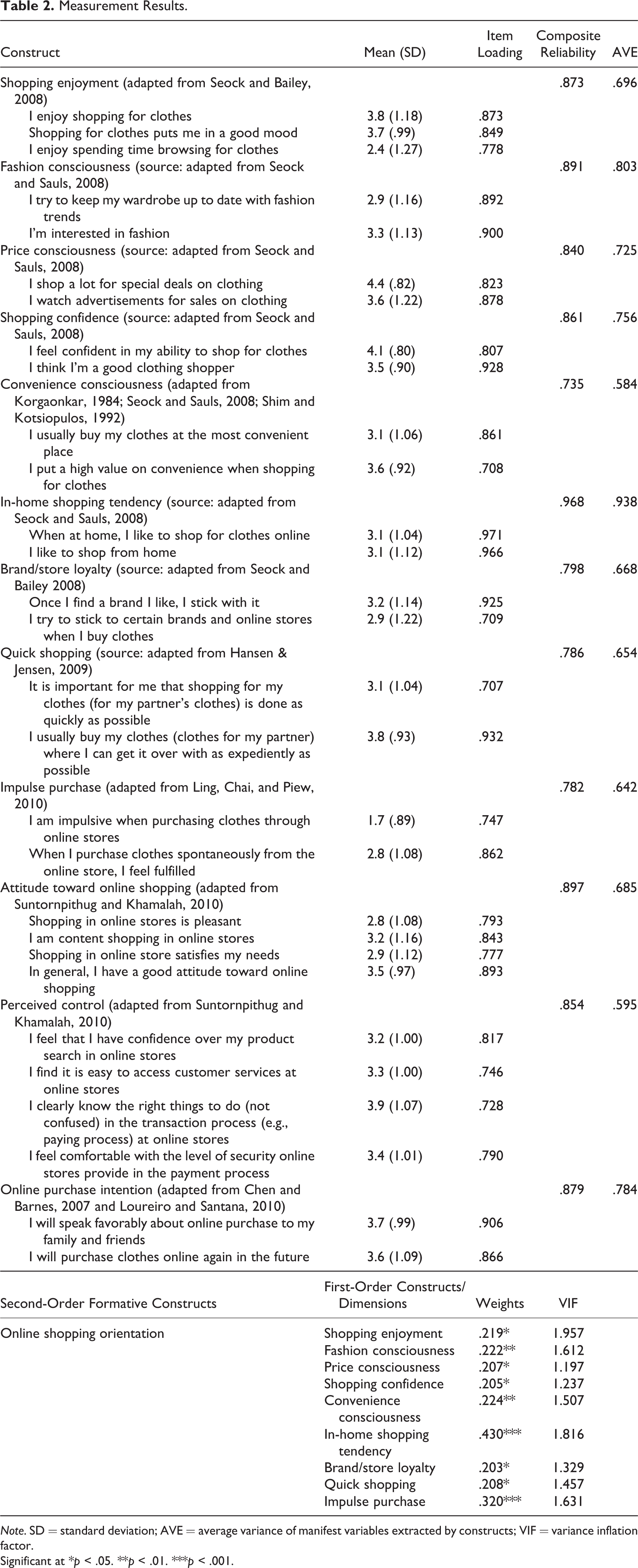
Note. SD = standard deviation; AVE = average variance of manifest variables extracted by constructs; VIF = variance inflation factor.
Significant at *p < .05. **p < .01. ***p < .001.
The criterion used to assess discriminant validity requires the square root of AVE to be higher than the correlation between the two constructs (Fornell & Larcker, 1981). In this study, all latent variables met the above-mentioned criteria and therefore exhibit discriminant validity.
At the second-order construct level, we analyzed the parameter estimates of indicator weights, significance of weight (t student), and multicollinearity of indicators. Weight measures the contribution of each formative indicator to the variance of the latent variable. A significance level of at least .05 suggests that an indicator is relevant to the construction of the formative index (online clothing shopping orientation) and thus demonstrates a sufficient level of validity. The recommended indicator weights is >.2 (Chin, 1998). All nine indicators have a positive β weight above .2, as indicated in Table 2. The degree of multicollinearity among the formative indicators should be assessed by the variance inflation factor (VIF). The VIF indicates how much an indicator’s variance is explained by the other indicators of the same construct. The common acceptable threshold for VIF is <3.33. VIF values were below 3.33, suggesting no multicollinearity problem. Thus, the proposition was confirmed.
Structural Results
The structural results are presented in Table 3. In this study, a nonparametric approach known as bootstrapping was used to estimate the precision of the PLS estimates and found to support the hypotheses (Chin, 1998; Fornell & Larcker, 1981). All path coefficients are significant at the 0.001 level, and so Hypotheses 1–5 are supported. However, as models yielding significant bootstrap statistics can still be invalid in a predictive sense (Chin, 1998), measures of predictive validity (such as R2 and Q2) for focal endogenous constructs should be employed. All values of Q2 (chi-square of the Stone-Geisser criterion) are positive, so the relations in the model have predictive relevance (Fornell & Cha, 1994). The model also demonstrates a good level of predictive power (R2), as the modeled constructs explain 60.3% of the variance in attitude toward online clothing shopping, 33.3% in perceived behavioral control, and 51.2% in online purchase intention. In fact, the high value of overall goodness of fit (GoF), regarding the large effect size and the high level of predictive power (R2), reveals a good overall fit of the structural model (Wetzels, Odekerken-Schröder, & Van Oppen, 2009; see Table 3).
Structural Results.
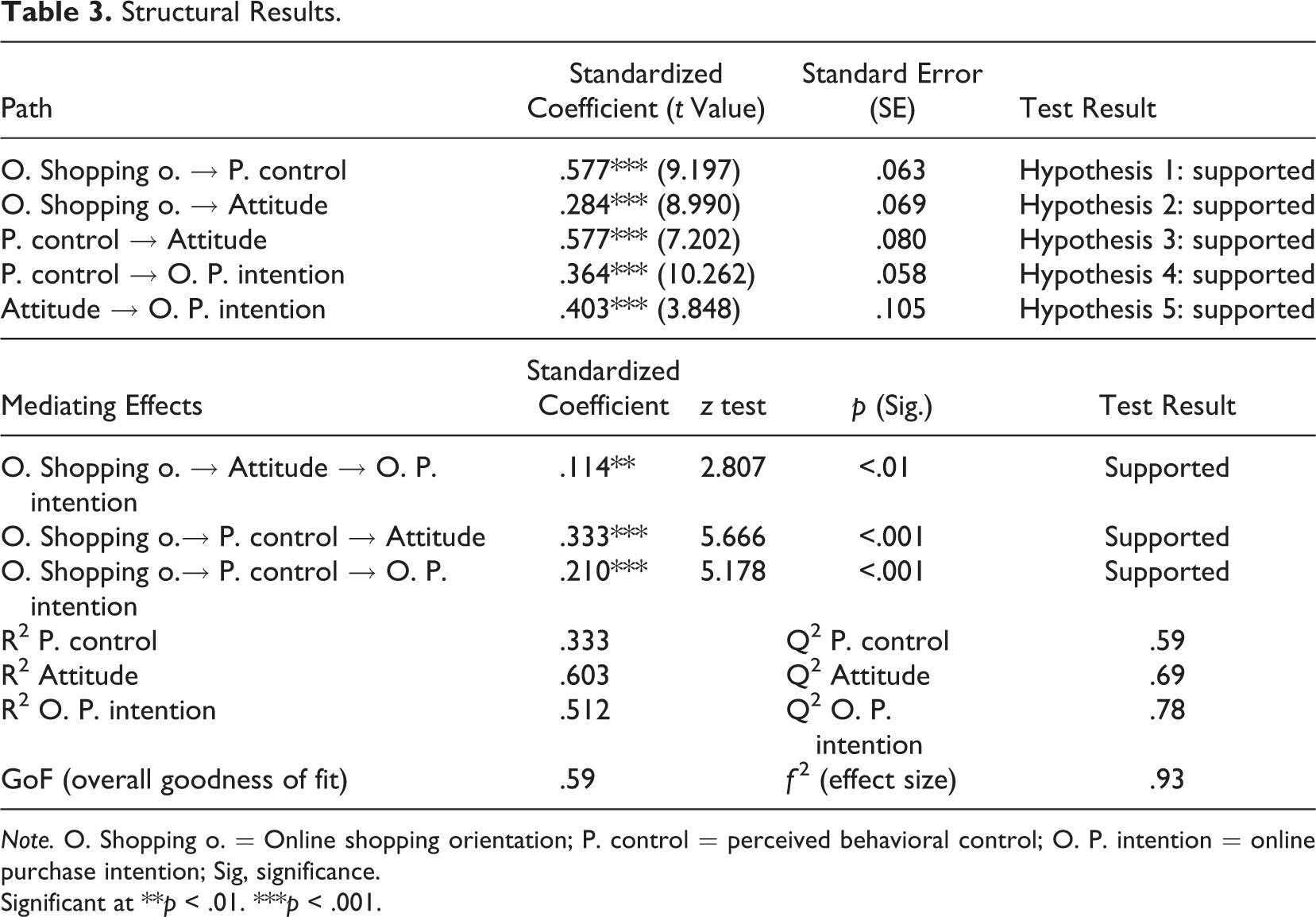
Note. O. Shopping o. = Online shopping orientation; P. control = perceived behavioral control; O. P. intention = online purchase intention; Sig, significance.
Significant at **p < .01. ***p < .001.
In addition to the bootstrapping approach, we used the Sobel test to investigate the mediating effects of attitude and perceived control. As shown in Table 3, the z test for online shopping orientation → attitude → online purchase intention (z test = 2.807, p < .01), the z test for online shopping orientation→ perceived behavioral control→ attitude (z test = 5.666, p < .001), and the z-test for online shopping orientation → perceived behavioral control→ online purchase intention (z test = 5.178, p < .001) reveal that the mediating effects of attitude and perceived behavioral control are confirmed.
Discussion
The proposed model is pioneering relative to the examination of online clothing shopping orientation (in its nine dimensions) as an antecedent of perceived behavioral control and attitude toward online clothing shopping. The idea of online clothing shopping orientation as a second-order reflective–formative model is supported in this study, and it is indicated that Gen Y’s online clothing shopping orientation leads to positive perceived behavioral control (Hypothesis 1) and a positive attitude toward online shopping (Hypothesis 2). In this research, we also study the effect of perceived behavioral control on attitude toward online shopping. The results confirm what was expected; that is, an online Gen Y consumer who feels he or she has confidence in his or her ability to search online stores, finds it easy to access customer service, knows clearly what to do in online stores, and feels comfortable with security in the payment process is more likely to have a positive attitude toward online clothing shopping (Hypothesis 3).
In accordance with TPB, we also found that perceived behavioral control and a positive attitude toward shopping have a positive effect on Gen Y’s intention to speak favorably about online clothing purchases to family and friends and to purchase clothes online again (Hypotheses 4 and 5). Using the Sobel test, we suggest the important role of perceived behavioral control and attitude as mediators between online clothing shopping orientation and online clothing purchase intention, going further than previous studies (Belleau et al., 2007; Kim & Karpova, 2010; Shim & Kotsiopulos, 1992). The path coefficients suggest some highly relevant implications. For instance, it is indicated that perceived behavioral control is the most impactful driver of online clothing purchase intentions in that it impacts those intentions directly, as well as indirectly, through attitude toward online clothing shopping.
In our findings, we suggest that online Gen Y consumers who like to buy clothes from home feel comfortable and put a high value on convenience in buying clothes, and those who tend to feel more fulfilled shopping spontaneously usually are more oriented toward online clothing shopping. Fashion consciousness is also an important dimension of online clothing shopping orientation that drives Gen Y’s online purchase intent. While it is not surprising that these factors contribute to an online clothing shopping orientation, the most interesting findings in this regard are again derived from the weights of those dimensions. Regarding the nine first-order dimensions of the second-order reflective–formative model examined, in-home shopping tendency and impulse purchase are the most important in building online clothing shopping orientation and, consequently, forming a positive attitude toward online shopping and leading consumers to realize they are in control. While it should come as no surprise that in-home shopping tendency is a strong driver of consumers’ online clothing shopping behavior (Seock & Chen-Yu, 2007), the strength of impulse purchase as a driver is a finding that has not yet been properly addressed (relative to the other dimensions) in previous research. Indeed, impulse shopping has been considered almost exclusively in the offline purchase setting. For example, Peck and Childers (2006) demonstrate the importance of being able to touch the products in driving impulse purchases in offline settings. Park and Lennon (2004) posit that the more time shoppers watch television shopping programs, the more likely they are to purchase products on impulse. Ling et al. (2010) do consider impulse purchase in an online context when they demonstrate that a tendency to impulse shop is positively related to online purchase intentions, but they do not consider the role of overall shopping orientation of the consumer in driving intentions nor does it demonstrate the importance of the role that impulse purchase plays.
Following these two major drivers are convenience and fashion consciousness. Thereby, impulse and convenience appear to be even more relevant for Gen Y online clothing shoppers than shopping enjoyment in creating an online clothing shopping orientation that contributes to online purchase intention. These results seem to contradict those of Brown, Pope, and Voges’s (2003) study, which revealed that recreational shopping (shopping enjoyment) is more important than convenience for online shoppers. This apparent contradiction may be explained by two points. First, Brown et al. (2003) do admit the importance of convenience orientations. Next, we explored shopping enjoyment as an antecedent to actual purchase intentions. Perhaps much of what these consumers typically consider to be the enjoyable aspect of shopping is embedded in the sensuous acts of touching and trying on clothing, pointing to a difference between shopping for pleasure and shopping with purchase intent. Forsythe and Bailey (1996) point out that consumers who enjoy shopping spend more time shopping per trip and prefer department stores to other offline stores, living the concrete experience of the store environment before purchase. In the online context, liebermann and Stashevsky (2009) found a negative relationship between shopping enjoyment and online purchase, and Cai and Xu (2006) similarly determined that enjoyment had no impact on online loyalty.
Another interesting finding from the study relates to the relatively low importance of shopping confidence in driving online clothing shopping orientation for Gen Y, especially when compared to the strong impact that perceived behavioral control has for both attitude toward online shopping and actual purchase intention. These two factors seem to represent similar consumer perceptions—the ability to be an effective consumer—but the answer to the possible contradiction lies in the location of each in the model. Shopping confidence is only 1 driver of online clothing shopping orientation. The items used to measure the construct relate to clothing shopping confidence, regardless of shopping channel. The items measuring perceived behavioral control emphasize online clothing shopping. The takeaway is that Gen Y consumers who lack confidence in their ability to shop for clothing in general are even less likely to shop for clothing online. By extension, those Gen Y consumers inclined to shop for clothing online are extremely confident in their ability to navigate the process online.
Although respondents had the highest possible mean scores for some items of shopping enjoyment (i.e., I enjoy shopping for clothes), price consciousness (i.e., I shop a lot for special deals on clothing), shopping confidence (i.e., I feel confident in my ability to shop for clothes), or quick shopping (i.e., I usually buy my clothes where I can get it over with as expediently as possible), globally, in-home shopping tendency, impulse purchase, and shopping convenience are more important drivers for these shoppers. Thus, interest in shopping from home, the convenience of shopping, and the possibility to purchase spontaneously are core motives for these consumers when shopping online for clothing.
Conclusion, Managerial Implications, and Further Research
Our findings contribute theoretically to this field of research in the following two points. First, the proposed model regards, for the first time, online clothing shopping orientation as an external variable of TPB, in other words, as an antecedent of perceived behavioral control and attitude. Second, in-home shopping tendency and impulse purchase are the most significant drivers (from the shopping orientations captured from a systematic literature review) in building online clothing shopping orientation for Gen Y consumers.
But what do these results mean to online clothing retailers? Several important managerial implications emerge that should be considered when making policy decisions. First, perceived control of the shopping process is a major driver of purchase intentions for this generation, both directly and through an enhanced attitude toward online clothing shopping. Respondents feel control when they are comfortable with search features, payment routines, security, and customer service functions. While many of these features translate to the brick-and-mortar shopping experience, the ways that they are enacted online will be quite different. To ensure this level of comfort, online clothing retailers must emphasize ease of use and the easy understandability of all features with clear instructions and simple directions, even at the expense of a quick shopping experience. (Quick shopping was a much less influential driver.)
Second, as mentioned previously, quickness is not one of the most important features for online clothing consumers, and neither is price consciousness. This suggests that these consumers are willing to spend time on the process of clothing shopping online, but that time is not spent, as we had previously thought, in price comparison. Consistent with the importance of impulse purchase shown by the model, Gen Y consumers are indeed willing to make unplanned purchases when they find an item they like, with little consideration for price. The equivalent brick-and-mortar features that tend to lend themselves to consumers’ willingness to stay longer in-store, such as themed environments, scents, and open spaces (Byun & Mann, 2011; Hyllegard, Ogle, & Dunbar, 2006), tend to be much more expensive for retailers to deliver than in the online setting.
Third, the exclusion of subjective norms is most likely unique to Gen Y in the online shopping context. TPB clearly emphasizes the importance of consumers’ perceptions regarding subjective norms when others could observe the purchase activity. The relative solitude and anonymity of online shopping creates a unique situation in this regard and justifies the explication of a new TPB in the online clothing purchase context.
Finally, and perhaps the worst news for retail brands, is the finding that brand and store loyalty are the least important drivers of online purchase intent for Gen Y. These consumers are not as concerned with seeking out specific brands and retailers as they are with factors related to convenience. Indeed, convenience ranked even higher as a driver of online clothing purchase than fashion consciousness, perhaps implying that Gen Y consumers who are extremely fashion conscious are less likely to shop online for their preferred brands.
Online retailers might also consider including more recreational features in their sites in order to enrich the online clothing shopping experience and induce more impulse and fun purchases. These features could include music, user communities (including consumers and brand owners), and even games related to clothing or specific brands. As long as these features are not perceived as contrary to the usability of the site, then the extra time spent on site could lead to additional impulse purchases.
Concerning the limitations of this research, the sample for this study was comprised of students at two major universities in the north and south of Portugal. While these respondents are fairly consistent demographically with Gen Y consumers in most developed nations, collecting data from a broader geographic and socioeconomic range would enhance generalizability. While threatening parsimony, the model could be improved by incorporating other variables such as actual use and past experience and by testing the model comparatively in different cultural contexts. Another limitation lies in the items used to measure in-home shopping tendency. With the growing proliferation of tablets and the ubiquity of smartphones, much Internet purchasing is not actually carried out in the home. In-home shopping tendency might need to be replaced by future researchers with items that measure mobile shopping tendency instead. While the 19-item scale employed in this research represents a reduced measure of the constructs, a possible limitation, our shorter scale does reduce the possibility of respondent fatigue that would be introduced by a significantly longer scale asking about all possible variations of shopper location.
Additionally, future researchers might aim for replication of these results across different samples and in other contexts, such as comparing consumers with experience in online purchase and those who have yet to make the move to online purchase. Also, the importance of this research lies in the clothing context relative to Gen Y, but exploring the model in other purchase domains—more utilitarian goods or even services—would be most enlightening.
While there has been some excellent work done regarding the online shopping context, we encourage further research in this important but still under-researched area. By demonstrating the need to adapt the well-accepted TPB to accurately describe the shopping behavior of Gen Y when shopping for clothing online, we suggest that there are other nuances of consumer behavior in this context that warrant further exploration. Additionally, Gen Y and Millennials have become consumers in an era in which the Internet has been ever present. As they have not had to adapt to this shopping channel in the way that older generations have, their consumer behavior may diverge from accepted norms that were empirically supported by earlier research.
Footnotes
Declaration of Conflicting Interests
The author(s) declared no potential conflicts of interest with respect to the research, authorship, and/or publication of this article.
Funding
The author(s) received no financial support for the research, authorship, and/or publication of this article.