







Abstract
The fashion industry is increasingly leveraging virtual reality (VR) technology to develop and promote its products while enhancing consumer experience. However, existing research on the exploration of VR within the field remains limited. This study aims to provide a comprehensive analysis of the application of VR in the fashion literature. We employed a systematic review methodology, incorporating an annotated bibliography into the screening and review process, which included 71 articles. Our findings revealed that VR in fashion research is primarily concentrated in a few countries, with a significant increase in output since 2020. Additionally, non-immersive VR and quantitative approaches have been widely utilized. Several theoretical frameworks, particularly in technology adoption, have also been applied. Our findings contribute to the literature by offering valuable insights into the current state and future directions of VR in fashion. Future research should focus on bridging the gap between potential and actual applications of VR.
The fashion industry is increasingly leveraging virtual reality (VR) technology to develop and promote products while enhancing consumer experience. This trend aligns with the global rise in VR adoption within fashion businesses, which is projected to grow at a Compound Annual Growth Rate of 13.4% from 2021 to 2026. Additionally, more than 75% of the world's leading fashion retailers have already created VR content to engage consumers (Worldmetrics, 2024). By utilizing VR to showcase products in 3D, many fashion companies are providing consumers with innovative and immersive experiences (Echo3D, 2022). For example, brands like Dior and Tommy Hilfiger have capitalized on this technology by integrating visually striking fashion shows into retail (Emperia, 2022; Fashion United, 2019). Similarly, Nike and Gucci are pioneering virtual environments and interactive gaming experiences within the metaverse, such as Nike Land and Gucci Town. These VR experiences allow consumers to explore various products virtually, helping brands formulate targeted product release strategies (Bobb Report, 2022; CNBC, 2021). These developments suggest that VR technology will continue to shape the fashion market in the future.
This growing trend highlights the increasing importance of VR in the fashion industry as a means to enhance consumer purchasing experiences while enabling brands to maintain competitiveness and achieve sustained growth. VR offers significant potential for business optimization and immersive consumer engagement (Hodges et al., 2020; Park & Ogle, 2021). However, research on how VR has been implemented and explored within the industry remains limited. There is a lack of clarity regarding its precise applications and effectiveness. Specifically, a systematic approach is needed to analyze existing research and identify future research directions in fashion, from product development to consumer experience.
A few studies have examined VR or technologies in general in limited review analyses using bibliometric measures within broader business contexts. For example, Goel et al. (2023) reviewed VR as part of technological trends, while Cai and Lo (2020) focused on exploring technology and retailing in general. However, there remains a need for a systematic review focused exclusively on the fashion sector, providing an in-depth examination of VR applications (as further discussed in the “Prior systematic reviews on VR in clothing and textiles” section below). Although VR has been applied in various fashion-related contexts such as design, merchandising, education, and consumer behavior, prior studies remain fragmented. There is a lack of comprehensive analysis that integrates these studies across categories, research designs, and theoretical frameworks. Thus, this study identifies key gaps in VR in fashion literature and highlights the need for targeted future research. To address these gaps, this study aims to address these gaps by conducting a systematic review of VR in fashion, focusing on study types, VR types, and theoretical perspectives.
To achieve this, the annotated bibliography is incorporated into the screening and review process. This approach enables a more thorough synthesis of existing research and a clearer identification of trends and areas for further exploration. Consequently, the study addresses the following research questions:
What are the publication trends in VR in fashion research? What types of VR technologies are utilized in fashion studies? What research approaches are used to examine VR in fashion? What are the theoretical foundations of VR in fashion research? What are the future research agendas for VR in fashion studies?
By addressing these questions and meeting our study objectives, this research will provide a clearer understanding of the current state of VR in fashion. By synthesizing existing literature, our findings will also help bridge the gap between theory and practice, offering actionable insights for industry stakeholders, including designers, marketers, consumers, and educators. This study also will inform the development of curricula and training programs that equip students with the essential VR skills needed for the digital fashion landscape.
Building on prior systematic reviews of VR in clothing, textiles, and retailing, the present study differentiates itself in several key aspects. Table 1 compares our review with others, emphasizing its unique perspectives. While previous reviews have broadly explored topics such as omnichannel management in retail (Cai & Lo, 2020) or self-service merchandising practices (Muñoz-Leiva et al., 2021), our study provides a comprehensive analysis of VR's application within the fashion industry. Additionally, earlier reviews have only briefly touched on VR as part of broader technological trends, without delving into its specific implications for fashion (e.g., Goel et al., 2023). In contrast, our review focuses exclusively on fashion, offering an in-depth examination of VR applications, with a particular emphasis on practical implementations and emerging trends in immersive environments.
A Comparison Table of VR Systematic Review Articles.
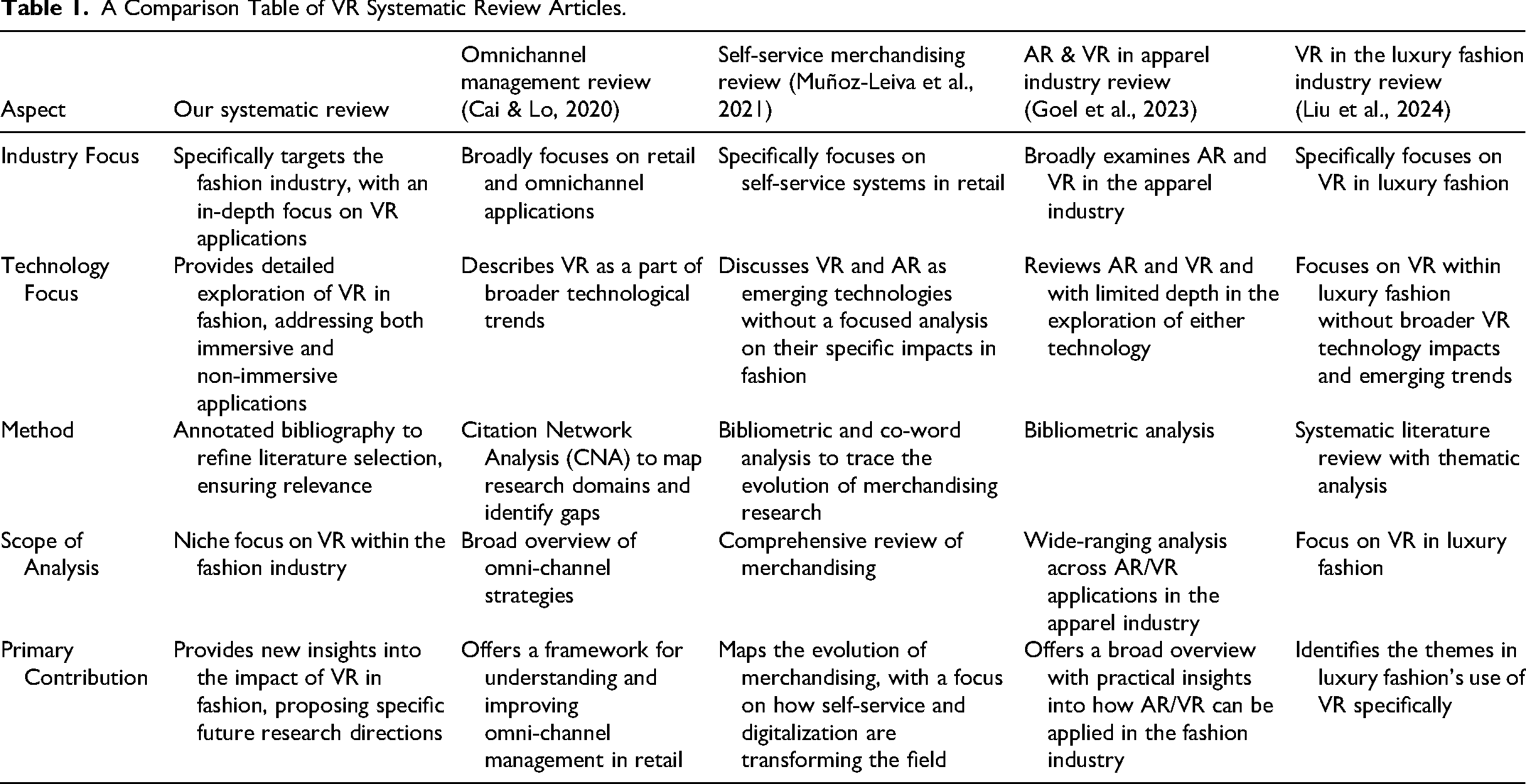
Furthermore, previous systematic reviews on VR have limited their analysis to bibliometric measures, focusing primarily on publication dates, journals, authors, affiliations, and keywords. While useful for mapping existing research, these metrics offer limited insight for guiding future studies. In contrast, our study broadens the analytical scope by critically examining the research methodologies and theories used in previous studies, offering a comprehensive assessment of the approaches employed. While Liu et al. (2024) focused on five VR application areas in luxury fashion, we take a broader view, examining VR's impact across multiple segments of the fashion industry, including education.
Literature Review
Defining Virtual Reality
Gigante (1993) defined VR as “the illusion of participation in a synthetic environment rather than external observation of such an environment. VR relies on three-dimensional (3D), stereoscopic, head-tracked displays, hand/body tracking, and binaural sound. VR is an immersive, multisensory experience” (p. 3). VR has also been defined as “the sum of the hardware and software systems that seek to perfect an all-inclusive, sensory illusion of being present in another environment” (Biocca & Delaney, 1995, p. 63). While VR definitions vary, this study adopts Kavanagh et al.'s (2017) broad definition, VR as a digital representation of a 3D object and environment, to include as many relevant articles as possible.
Furthermore, VR systems can be divided into two main types: non-immersive and immersive (Shahrbanian et al., 2012). The key differences between these two systems lie in the realistic interaction of the virtual environment with an individual's movements and the size of the virtual world (Park et al., 2018). Immersive VR requires higher-performance hardware, such as a VR headset, through which users experience a virtual environment. Conversely, non-immersive VR does not require special equipment; it can be performed with a computer and a high-resolution monitor. As a result, immersive VR users can experience a higher level of telepresence than non-immersive VR users (Park et al., 2018).
Research comparing immersive and non-immersive VR environments reveals distinct differences in user experience. Immersive VR generally enhances presence, particularly in sensory realism and involvement (Liu et al., 2023) and can increase intrinsic motivation and enjoyment (Vergara-Rodríguez et al., 2021). In contrast, non-immersive VR offers greater accessibility and more complex functionalities through sophisticated graphical user interfaces (Liu et al., 2023). This study reviews both non-immersive and immersive VR types.
Virtual Reality in the Fashion Industry
In the fashion industry, VR has been extensively applied, ranging from apparel product development (e.g., prototyping) to product marketing and promotion (e.g., virtual try-ons) (Hodges et al., 2020). Recent advancements in virtual try-on systems have significantly improved the accuracy and user experience in digital garment fitting.
Virtual try-on technology has become essential in e-commerce, enabling customers to visualize clothing on themselves, reducing returns, and improving conversion rates (Islam et al., 2024). Current models include image-based, multi-pose, and video try-ons, though challenges remain, such as dataset bias and maintaining realistic garment characteristics (Ghodhbani et al., 2022; Islam et al., 2024). Kinect-based systems use motion capture to enhance fit realism (Zhang et al., 2014), while UVIRT improves efficiency by eliminating the need for annotated data (Tsunashima et al., 2020).
Beyond product development and marketing, VR is transforming fashion education by enhancing creativity, engagement, and spatial awareness. It supports collaborative design exploration (Lee et al., 2021) and realistic garment-avatar visualizations (Sarakatsanos et al., 2024), helping students identify design flaws and refine their work (Queiroz et al., 2022). While still evolving, VR has shown the potential to improve learning outcomes, leading to wider adoption in fashion curricula (Starkey et al., 2021). VR also plays a crucial role in education and employee training, providing immersive simulations that improve customer service and technical skills (Lau, 2015). Given the structured nature of both academic and professional learning, VR-based training is categorized under “Education” in this study.
As VR adoption in fashion retail grows, its impact on consumer psychology is increasingly evident. VR shopping spaces foster cognitive presence and emotional engagement, enhancing consumers’ perceptions of usefulness, enjoyment, and adoption (Hur et al., 2019; Kim, 2023). Younger consumers value interactivity, personalization, and social networking features, underscoring VR's potential to transform brand engagement (Xue et al., 2020). Thus, our study explored four main categories of fashion research—design, merchandising, education, and psychology—which emerged from the articles we reviewed.
Methods
A systematic literature review—a repeatable analytical method to identify, evaluate, and summarize the findings from existing research articles—was conducted to address our research questions (Kitchenham et al., 2009). This review method was utilized to gain a comprehensive understanding of a specific research domain (Radianti et al., 2020). The systematic mapping approach outlined by Kitchenham et al. (2009) was adopted to acquire an overview of VR applications in fashion research. Compared to a traditional systematic review, this mapping review examines a broader subject and classifies the fundamental articles within the particular domain under investigation (Radianti et al., 2020). Figure 1(a) illustrates our radiant systematic mapping process, which begins with article identification, followed by an annotated bibliography, classification, and analysis and results answering our research questions, helping us develop a systematic map of VR in fashion research.

The Overall Process of our Systematic Review.
Systematic approaches similar to this study have been employed in prior VR-related studies. For example, Kavanagh et al. (2017) and Radianti et al. (2020) conducted systematic reviews on VR, following the process outlined by Kitchenham et al. (2009). Kavanagh et al. (2017) examined VR in education using the systematic review method, while Radianti et al. (2020) employed a systematic mapping approach to study immersive VR applications in higher education. However, our study focuses on the application of VR in the fashion industry rather than education in general. It further proposes five research questions aimed at structuring and systematizing the existing literature on VR utilization in fashion. Figure 1(b) illustrates the complete search process for identifying VR in fashion research articles.
The Review Process and Literature Search Method
Define the Review Scope and Keywords
Prior to reviewing VR articles in fashion research, our study first clarified the scope of the review. To ensure the inclusion of as many pertinent studies as possible, a broad definition of VR was employed, defined as a digital representation of 3D objects and environments (Kavanagh et al., 2017). This entailed encompassing both non-immersive and immersive VR types used in fashion research. Key information from articles indexed in five scientific digital libraries—namely, Business Source Complete (n = 75), Web of Science (n = 745), Textile Technology Complete (n = 95), Academic Search Complete (n = 211), and ScienceDirect (n = 16)—was extracted to apply a systematic mapping approach to the study (Kitchenham et al., 2009; Kumar, 2022).
Initial Paper Search
For the initial paper search, the following search string was defined: (“Virtual Reality” OR “VR”) AND (“Fashion” OR “Fashion Industry”; “Retail” OR “Retail Industry”; “Textile” OR “Textile Industry”). The search results covered peer-reviewed scientific journal articles written in English and published between 2001 and 2023. From this initial paper search, 1,142 candidate papers were obtained for further analysis.
Exclusion Method
All exclusion decisions were finalized by consensus among the researchers. The selection of key relevant articles for this study involved five steps. First, 16 papers that were not peer-reviewed journals—such as book chapters or conference papers—were excluded. Second, 325 duplicated articles were manually removed. Third, 597 articles with unrelated titles—those from different fields of study not covering VR—were eliminated. Fourth, 104 irrelevant articles were discarded after reading the abstracts. After filtering through the titles and abstracts, the researchers manually reviewed all contents and identified an additional 26 unrelated articles. Finally, after reviewing the research design, five review articles were excluded, resulting in 69 articles included in the final systematic review (Appendix A).
Annotated Bibliography
The annotated bibliography process, which involves summarizing and evaluating each of the sources, was employed (Pope-Ruark et al., 2019). We gathered all the information necessary to address the research questions by reviewing the contents of 69 relevant articles. The annotated bibliography includes citations, types of VR, areas within the fashion industry, study purposes, research designs, theories, and findings of each journal article.
Classification
Based on the research questions and annotated bibliography, a spreadsheet was developed to classify the 69 articles into 7 categories, including types of VR, specific VR devices, fashion research areas, research designs, and theories used in these studies. These categories are described in the following sections.
Categorization of Frameworks
The first category was the “Areas in Fashion Research,” which had four subcategories, including “Fashion Design,” “Fashion Merchandising,” “Fashion Education,” and “Fashion Consumer Psychology.” The “Fashion Design” subcategory included studies focusing on designing garments and using VR technology to answer research questions related to fashion design. For example, the new fashion product development process (De Silva et al., 2019), the creation of a digital human model for fashion designing purposes (Liu et al., 2017), and wearing comfort analysis (Liu, 2018). The “Merchandising” category encompassed articles related to marketing, fashion consumer behaviors (i.e., purchase intention), and experiences facilitated by VR technologies. Articles using VR technologies for educational purposes were categorized under the “Education” category. This category encompasses both academic education and professional learning. In the academic context, VR technologies were adopted in fashion design classrooms to enhance students’ learning experiences and workplace learning applications (Lau, 2015; Starkey et al., 2021). This comprehensive approach integrates both academic and professional education, characterized by instructional methods for knowledge acquisition and skill development. The final category under the “Areas in Fashion Research” was “Consumer Psychology,” which included an article focused on the self-concepts of VR users (Park & Ogle, 2021). This article was placed in a separate category due to its focus on consumer psychology rather than marketing.
The second category, “Types of VR,” consisted of three classifications: “Immersive,” “Non-Immersive,” and “Both.” The distinguishing factors among these classifications were based on the level of sensory engagement and the method of user interaction. Articles were categorized as “Immersive” when they utilized immersive VR technology, creating a complete sense of presence within the virtual environment and fully immersing users through VR technology, such as VR head-mounted displays. In contrast, articles were classified as “Non-Immersive” when VR technology maintained a boundary between the user and the virtual environment, typically limited to flat-screen displays on smartphone applications or computer software, where users engaged with the virtual environment from a fixed external perspective. The “Both” category encompassed articles that utilized both immersive and non-immersive VR technologies within their research framework. For example, studies comparing consumer behavior between fully immersive VR store experiences and non-immersive 360-degree panoramic views on desktop displays were categorized in this group.
In the “VR devices” category, all the VR devices mentioned in the articles were categorized. This category included the names of VR head-mounted displays, such as Oculus Quest, Oculus Rift, Samsung Galaxy Headset, HTC VIVE, and Google Cardboard, as well as applications and software utilized, including CLO 3D, CAD, Second Life, and MockShop.
In the “Research Design” category, the papers were classified into three categories: “Qualitative,” “Quantitative,” and “Mixed Method.” The “Qualitative” category showcased studies that adopted well-established qualitative methodologies (Creswell & Creswell, 2017), such as phenomenology, grounded theory, narrative research, ethnography, and case studies. The “Quantitative” category displayed studies that employed research designs ranging from experimental designs to correlational studies and relied on the numerical data collected from experiments and surveys. The last category, “Mixed,” encompassed studies that utilized a mixed-method approach, involving the collection and integration of both qualitative and quantitative data (Creswell & Creswell, 2017).
In the “Theory” category, all the theories (e.g., technology acceptance model, self-determination theory, and gestalt theory) used in the articles were collected and summarized.
Results and Discussion
Publication Trends of VR in Fashion Research
This study analyzed descriptive statistics to provide a comprehensive overview of publication trends. Figure 2(a) illustrates the annual publication rates from 2001 to 2023. During the period from 2001 to 2016, there was a low output of relevant research, followed by a rapid increase from 2016 onwards. However, there was a decline in publication between 2019 and 2020. Figures 2(b) and (c) depict the countries engaged in VR in fashion research. Most of the research is concentrated in South Korea and the USA, collectively contributing to 50.60% of the total articles. It is noteworthy that VR in fashion research is predominantly conducted in countries with advanced technological infrastructure that are striving for innovation. After 2020, the publication trend fluctuated over time, exhibiting a downward trend from 2021 to 2022 and an upward trend from 2022 to 2023. This indicates that VR researchers in fashion retailing might have been influenced by global externalities, such as COVID-19 in 2021. Publications from 2020 to 2023 account for 56.52% of the total research articles, indicating a significant increase in VR-related research. As the cost of immersive VR continues to decrease and as software development and smartphone-based VR become more widespread, access to this technology has improved significantly.
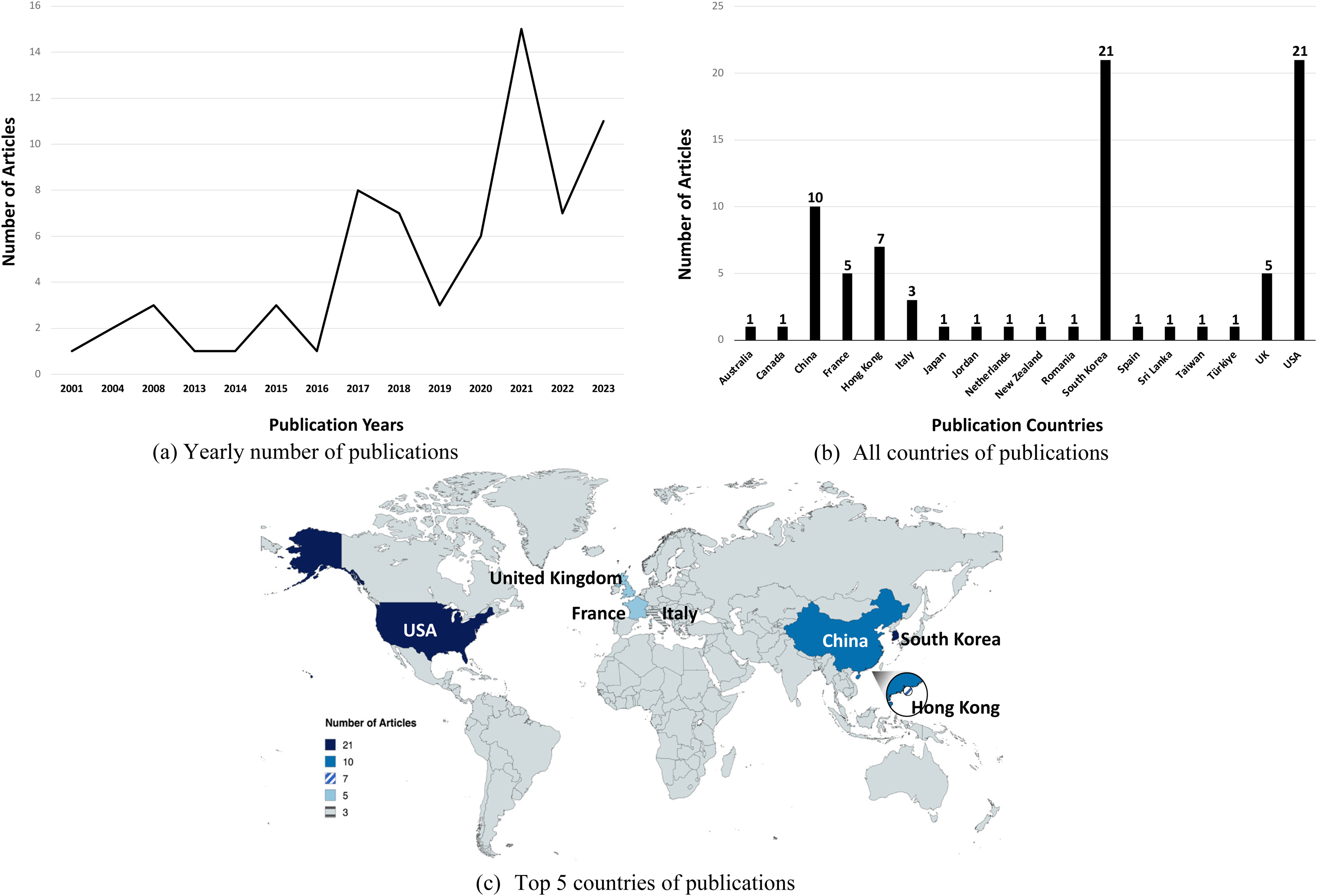
Publications Trends on Virtual Reality Applications in Fashion Retail Research from 2001 to 2023.
Types of VR Technologies
Among the 69 articles reviewed, our review revealed that 35 articles (50.72%) utilized non-immersive VR technologies, 17 articles (24.64%) employed immersive VR technologies, and 17 articles (24.64%) utilized both types of VR technologies. This distribution reflects a trend where non-immersive technologies are more frequently discussed, possibly due to their ease of integration and lower cost, particularly in applications that do not require full user immersion. Even in cases where fully immersive VR technologies would have been more appropriate for the research objectives, many researchers opted for non-immersive VR due to the challenges associated with creating fully immersive virtual environments. These challenges include not only the high costs but also the considerable time and effort required to develop and maintain these complex systems. Consequently, the extensive resources needed for fully immersive VR often exceed the research capacities, leading to a reliance on more accessible non-immersive technologies.
In the design research category, most studies on VR in fashion have used non-immersive technology, as evidenced by research on customized garment design using 3D virtual garment technology, exemplified by a customized garment design process using immersive VR and sensory evaluation for garment fit (Tao et al., 2018). The preference for non-immersive VR in design research reflects the practicality of these tools, which allow designers to visualize and iterate on garments quickly without the need for expensive immersive setups. In contrast, merchandising research often combines both immersive and non-immersive VR, as seen in studies on user experience and behavior in VR fashion shopping (e.g., Kim & Ha, 2021). Furthermore, in the areas of education and consumer psychology, relatively more VR research needs to be conducted, particularly studies using immersive VR or integrating both types of VR. The integration of immersive VR in educational contexts could revolutionize how students engage with fashion, providing hands-on learning experiences that are both interactive and highly engaging.
The results identified several VR devices used in fashion industry research, including 3D body scanners, VR headsets, virtual fitting rooms, software, and 3D glasses, particularly TC2 and VITUS models. Examples include the Body Line Scanner C9036-02 and 3D VITUS XXL for precise measurements, HTC VIVE and Oculus Quest headsets for immersive experiences, and BodymetricsTM and MyFitTM virtual fitting rooms for simulating clothing fit. Software like CLO3D and SketchUp enables design and simulation in VR. These devices highlight the versatility of VR in various stages of fashion design and retail. However, some articles, like Jin et al. (2021) and Jung et al. (2021), did not specify the VR devices used.
Research Approaches
The fashion business encompasses the complete process of transitioning fashion items from design to consumer, incorporating elements of both fashion design and merchandising (Koumbis, 2021). Moreover, it extends into education and psychology. In our systematic review, the study categorized fashion research areas into four categories as identified in the articles we examined: “Design,” “Merchandising,” “Education,” and “Consumer Psychology.” Merchandising research was the most popular area of VR in fashion research (47.83%). The second most popular area was fashion design (31.88%), followed by education (17.39%) and consumer psychology (2.90%).
The research designs were classified into three categories‒qualitative, quantitative, and mixed methods‒which were adapted from Creswell and Creswell (2017). Figure 3 illustrates the number of articles based on research designs and fashion research areas.
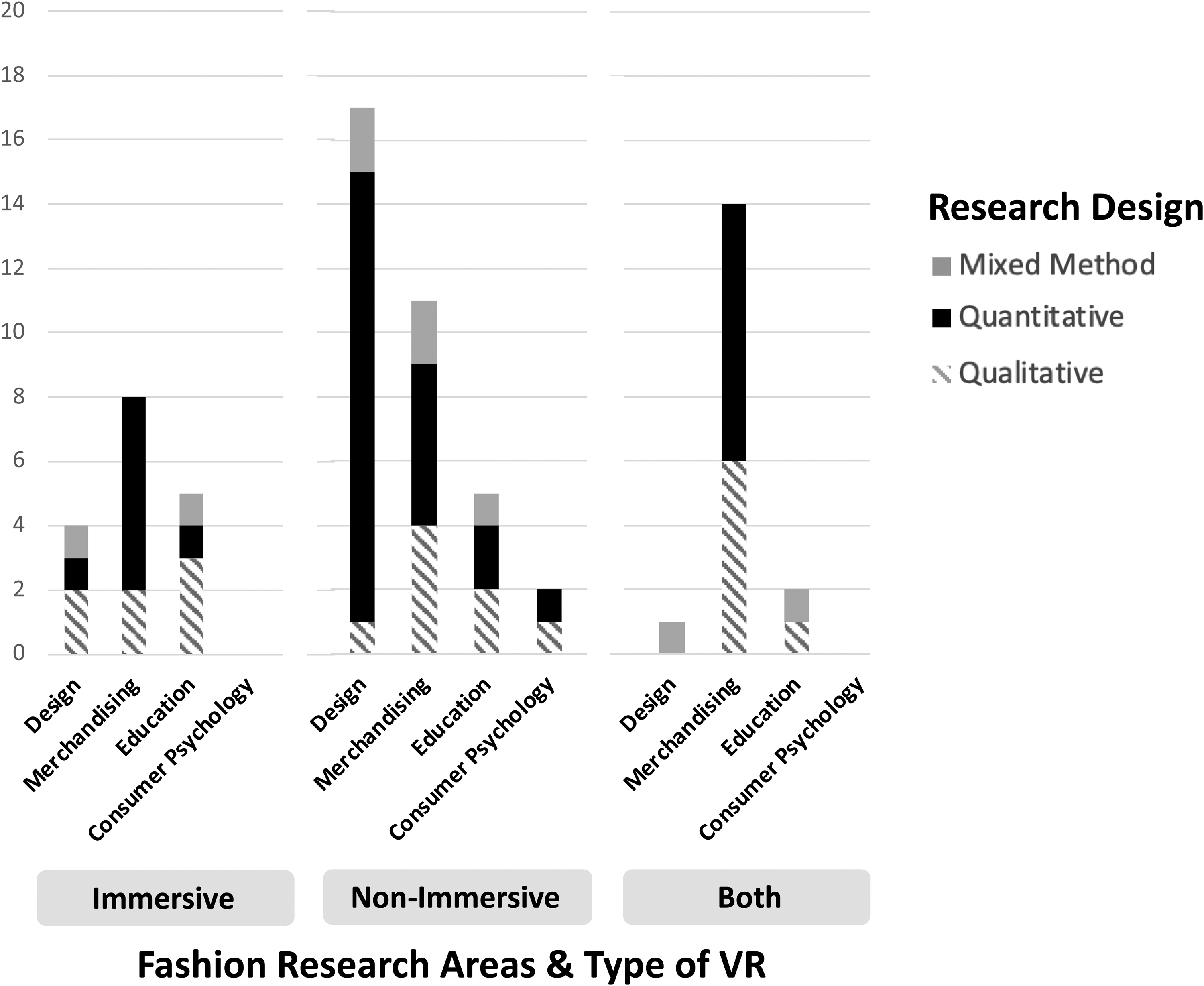
Research Categories.
The most popular research design among the 69 articles was quantitative research, consisting of 38 articles (55.07%) across all fields, including consumer psychology. The second most popular research design was qualitative, consisting of 21 articles (30.43%), and was used primarily in fashion design, merchandising, and education. Ten articles (14.50%) used a mixed-methods approach. This trend highlights a preference for numerical data and statistical analysis in VR research within the fashion industry, particularly to measure consumer behavior and psychological responses. However, there is also a need for more qualitative studies to explore creative and educational applications of VR in fashion.
In the field of fashion design, most articles focus on achieving an accurate fit, size, and color of garments, as well as on human body dimensions and movements in virtual environments using VR technologies (e.g., Tao et al., 2018). For instance, Liu et al. (2017) developed a rapid technique for creating a digital human model (DHM). One review shows that VR allows designers to simulate how garments will look and fit on various body shapes without the need for physical prototypes and visualize how garments behave in motion. These findings highlight the need for continued exploration of these topics in fashion design.
In the merchandising area, most articles focused on understanding individuals’ VR shopping experiences and their relationship to actual purchase intentions (e.g., Baek et al., 2020; Jang et al., 2019). For example, Lau and Lee (2019) explored consumer experiences using StereoVR (FutureShop), an immersive VR system with real-time interactivity, stereoscopic exhibits, and immersive features. The study found that StereoVR enhanced consumers’ hedonic shopping experiences and positively influenced purchase intentions. Our findings suggest that VR has great potential to improve retail experiences. While research on VR in consumer experiences is ongoing, few studies have addressed VR's impact on purchasing and post-purchase stages. Integrating VR with AI could reshape the future of fashion, enabling innovative home shopping experiences. Therefore, the future of fashion could be redefined by integrating VR with advancements in AI, such as enabling home shopping experiences through AI-connected VR.
In education, nine out of 12 articles utilized VR for fashion design topics, including fashion design (Starkey et al., 2021), textile education (Han et al., 2021; Lau et al., 2017), creativity in fashion design (Lee et al., 2021), and patternmaking (Boorady & Hawley, 2008). One article focused on VR for employee training within the fashion industry (Lau, 2015), comparing traditional training with stereo 3D VR training. Surprisingly, unlike the findings of other articles, no significant difference between the two groups was found. However, these mixed results highlight that VR's effectiveness in education depends on how well it integrates into existing frameworks and learning goals. Further pedagogical research on the use of VR in higher education for fashion will better prepare students for the workforce, as VR can provide real-world scenarios and be ready for practical applications.
This study analyzed three categories—Types of VR, Area in the Fashion Industry, and Research Design— to identify the most frequently studied combinations. From the results, the most studied types were non-immersive VR
Theories
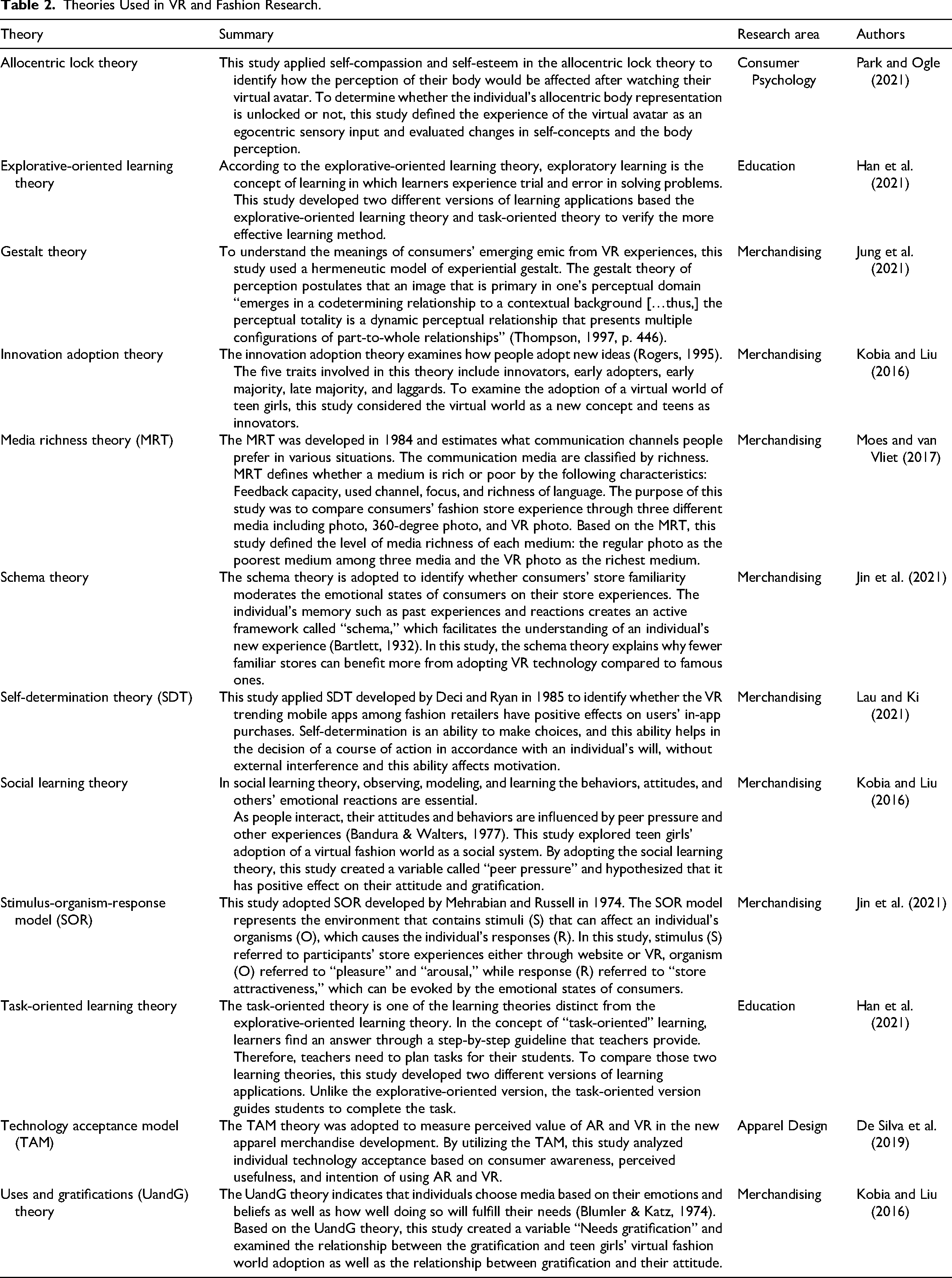
Among the 69 articles analyzed, a total of 12 theories have been utilized, summarized in Table 2. This includes the names of the theories, a brief overview of each theory, the research areas in which they were applied (i.e., merchandising, design, education, and consumer psychology), and the respective authors. Among these research areas, merchandising research has incorporated theories more extensively than design, education, and consumer psychology. With a significant focus on technology adoption (e.g., Jin et al., 2021), merchandising research has frequently utilized theories related to cognition and perception (e.g., Gestalt theory, schema theory, self-determination theory), behavior change (e.g., innovation adoption theory, social learning theory, SOR), and communication (e.g., media richness theory). This emphasis on theory-driven research in merchandising may be attributed to its focus on consumer decision-making and strategic communication. Design research, on the other hand, focuses on the creative process and the technical aspects of garment construction, which explains its relatively lower reliance on theories. However, integrating theories into design research could provide deeper insights into aesthetics and creativity. Similarly, education and consumer psychology research could benefit from incorporating more fundamental theories to enhance the rigor of studies.
Theories Used in VR and Fashion Research.
Future Research Agenda
VR in Fashion Design Studies
In fashion design studies, researchers have primarily focused on prototype testing with 3D fashion design software (e.g., Tao et al., 2018). As Liu et al. (2017) pointed out, modeling a 3D body is a prerequisite for designing garments in a virtual environment using 3D fashion design software. Current fashion design research often concentrates on 3D garment design and simulation, leading to limitations in modeling 3D bodies, developing accurate body sizes, and making this information accessible to the fashion industry. As confirmed in our findings, quantitative research employing non-immersive VR has been predominantly explored in fashion design studies. This indicates a need for more integrated and methodologically diverse research that can better capture both measurable outcomes and experiential aspects of VR in fashion design. For example, evaluating how immersive environments influence user engagement or design accuracy, or assessing simulation accuracy using immersive VR, could address critical gaps in current research.
Additionally, as De Silva et al. (2019) noted, consumers increasingly expect virtual experiences using VR, including during the design and development stages of their garments. Thus, the design process should also consider how to engage consumers and meet their expectations for virtual experiences. For instance, incorporating real-time customization and virtual try-ons through immersive VR could strengthen personalization and enhance consumer involvement in the design process. Furthermore, quantitative research using non-immersive VR has been predominant in fashion design research. To overcome these limitations, future research could address the following questions:
How can VR-based 3D body modeling (e.g., incorporating diverse body movements) enhance the fit and functionality of apparel design compared to traditional static modeling methods? How can incorporating consumer feedback and expectations during the VR prototyping process, as highlighted by the participants’ emphasis on real-time interaction and personalization, shorten and positively impact the overall design process? Given consumers’ expressed expectations for immersive and realistic experiences, what specific VR features (e.g., haptic feedback, customized avatar) most effectively increase engagement and satisfaction during the co-design process?
VR in Fashion Merchandising Studies
In the field of fashion merchandising studies, prior research has predominantly focused on consumer-side experiences with VR, particularly emphasizing engagement, convenience, and satisfaction (e.g., Silva & Bonetti, 2021). However, as VR adoption grows in the retail industry, there is a critical need to expand the research scope beyond consumer reactions to include operational, managerial, and financial outcomes. Specifically, little is known about how VR technologies are practically implemented and managed by sellers, and what operational challenges they face. Furthermore, although VR experiences often enhance consumer engagement, the direct effects on measurable business outcomes, such as sales and revenue, have not been thoroughly explored. Additionally, many existing VR studies have been conducted in controlled laboratory settings, raising concerns about ecological validity and whether consumer behaviors observed in experiments truly reflect real-world purchasing actions. To address these issues, some areas for future research could include:
How can VR technologies be effectively implemented and managed from the seller's perspective, particularly in areas such as store merchandising, visual display, and overcoming technological and cost-related challenges? To what extent do VR shopping experiences lead to actual increases in sales and revenue, and how can these outcomes be empirically measured? How does consumer behavior in real-world VR shopping environments differ from behaviors observed in controlled experimental settings, and what methodologies can best capture authentic purchasing behavior?
VR in Fashion Education Studies
Research in fashion education has increasingly focused on the interactive effects of using VR for instruction, including its application in apparel design education (e.g., Starkey et al., 2021), textile education (e.g., Lau et al., 2017), creativity in fashion design (Lee et al., 2021), and employee training (e.g., Lau, 2015). However, adopting VR in educational settings requires substantial investment in equipment, software, and infrastructure, including specialized learning spaces. VR technologies often present a high entry barrier, as they can be complicated for both instructors and students who are not familiar with programming or engineering (Han et al., 2021).
In VR-based fashion education research, meaningful educational materials have been developed, such as e-textile tools with virtual prototyping (Han et al., 2021) and an educational model to foster fashion design creativity (Lee et al., 2021). Future research can be guided by this literature to examine the effectiveness of these educational resources and the underlying framework. Our findings also highlight the specific VR skills necessary for fashion design and merchandising education, such as 3D garment modeling, virtual fitting, and the use of immersive VR for product visualization for consumers. Expanding existing initiatives to address this emerging need for VR education could provide valuable insights into effective educational practices and foster innovative learning experiences within the fashion industry. For example, creating partnerships with fashion companies to provide real-world VR applications in education can help bridge the gap between academic learning and industry needs. Key education areas for future research in VR-based fashion include:
How can we foster creativity in students by enabling them to participate in fashion business processes within virtual environments using currently available resources? How can VR be applied to teaching fashion trends and business, including virtual try-ons that help learners experiment with clothing and styles? How can existing tools be effectively implemented to deliver this content? How does utilizing VR facilitate a deeper understanding of various fashion materials and production processes by immersing learners in virtual simulations? How can VR-based fashion education be designed to reduce the technical entry barriers for both instructors and students who are unfamiliar with programming or engineering, and what tools or resources are needed to make VR more accessible in educational settings?
VR in Fashion Consumer Psychology Studies
In the field of fashion consumer psychology, research primarily explores the effects of virtual avatar experiences and the interaction between self-concept, as well as the impact of VR fashion store designs on consumer psychology (e.g., Park & Ogle, 2021; Sina & Wu, 2023). However, there is a notable gap in consumer psychology research, particularly regarding virtual identity construction, fashion consumption as an extended self on VR, and interpersonal dynamics. Thus, future research should explore how consumers construct and negotiate their identities through virtual fashion avatars, how virtual fashion consumption shapes and extends their sense of self, and how interactions with others in VR spaces.
Additionally, more research is needed to address the discrepancies between virtual and real-world environments, as well as privacy and ethics concerns in immersive VR settings and consumer psychology. The following questions can guide future research:
In virtual fashion shopping environments, how do consumers differentiate their personal style and identity from those of others? And how do they explore their self-concept and unique methods of expression through VR? How do consumers’ self-assessments and self-esteem in VR impact their selection and purchase of fashion products? How can retailers address potential psychological discomfort or alienation that consumers might experience due to unfamiliarity with immersive VR settings, and what psychological factors influence the adaptation process? How can future studies bridge the gap between consumer behavior in VR environments and real-world settings, ensuring that insights from VR research are applicable to actual consumer experiences? How can psychological principles, such as those related to consumer trust and risk perception, help improve data privacy and digital identity protection, thereby safeguarding the consumer experience in VR fashion settings?
Conclusion
This study provides a comprehensive understanding of VR technology in the fashion sector through a systematic literature review. Our findings show that practical research using actual VR in fashion remains limited, primarily due to the high costs and development challenges associated with technology (Hamad & Jia, 2022). Additionally, consumers may hesitate to adopt VR due to unfamiliarity and limited access, even as the industry promotes its use. However, as the technology evolves, we anticipate improved accessibility. The merit of our systematic review lies in offering direction for future VR research in fashion by providing a thorough and unbiased summary of existing studies on this topic.
While interest in VR technology for fashion has grown, its application remains limited, with most studies focusing on potential rather than the current use of VR for consumer engagement. Furthermore, there is a research gap concerning the use of immersive VR within the fashion industry, particularly in studies employing qualitative approaches. While quantitative studies can measure behavioral outcomes, qualitative methods are essential for understanding the nuanced experiences, emotional responses, and contextual interpretations of users interacting with VR. Therefore, future research should examine not only actual applications of immersive VR but also utilize qualitative approaches to explore how consumers perceive, make sense of, and emotionally respond to these experiences.
A key limitation of this study is that, as a systematic review, it may not capture the latest advancements in VR technology. Given the rapid pace of technological development, more recent studies may feature significantly more advanced VR environments and equipment than those included in this review. As a result, additional industry reports could shed light on recent trends in VR within fashion. Moreover, future research should expand its technological scope to include augmented reality (AR) and mixed reality (MR), in addition to VR, to explore enhanced immersive experiences. Embracing a broader concept such as extended reality (XR) could also improve systematic reviews. For empirical studies, providing participants with physical VR experiences is crucial for effectively evaluating both the technology's impact and user behavior.
Supplemental Material
sj-docx-1--10.1177_0887302X251352563 - Supplemental material for Virtual Reality in Fashion: A Systematic Review and Research Agenda
Supplemental material, sj-docx-1--10.1177_0887302X251352563 for Virtual Reality in Fashion: A Systematic Review and Research Agenda by Hyo Jung (Julie) Chang, Ho-Young Lee and Min Jung Kim in Clothing and Textiles Research Journal
Footnotes

Funding
The authors received no financial support for the research, authorship, and/or publication of this article.
Declaration of Conflicting Interests
The authors declared no potential conflicts of interest with respect to the research, authorship, and/or publication of this article.
Supplemental Material
Supplemental material for this article is available online.
Author Biographies
References
Supplementary Material
Please find the following supplemental material available below.
For Open Access articles published under a Creative Commons License, all supplemental material carries the same license as the article it is associated with.
For non-Open Access articles published, all supplemental material carries a non-exclusive license, and permission requests for re-use of supplemental material or any part of supplemental material shall be sent directly to the copyright owner as specified in the copyright notice associated with the article.
