







Abstract
In the early 1970s, the North Carolina textile industry (i.e., textile mills/textile mill products/apparel) was thriving and vibrant, one of the state's top manufacturing industries. Following peak employment and establishments in the early 1990s, plants began to close, and employment layoffs became common. A second wave of layoffs occurred in the early 2000s. In contrast, new textile and apparel companies opened in the subsequent decade and into the 2020s. This in-depth historical study examines primary and secondary sources, including government and company documents, archival newspapers and historic maps. The findings held evidence that the early publicly-traded mega-corporations were susceptible to competition from low-wage countries and hostile takeovers. A few long-term companies are survivors and have invested in their plants with capital improvements for high-tech processes. New textile and apparel companies continue to be located in North Carolina because of the state's skilled workforce and proximity to applicable suppliers.
The North Carolina [NC] textile industry (i.e., textile mill products, apparel, hosiery), as part of the greater textile industry in the United States, has a long history of industry development starting with the late 1880s (American Apparel Manufacturers Association [AAMA], 1987; Andrews, 1987; Kincade & Dull, 2017). Following the movement of textiles and apparel companies from the northeast United States in the mid-twentieth century to avoid unions, higher wages, and limited number of workers, the NC textiles industry became one of the top manufacturing sectors for North Carolina (Mittelhauser, 1997; Sharp & Stone, 2021). NC textile industry companies manufactured products that clothed people, filled linen closets, and upholstered furniture. The NC textile industry has and does provide employment for thousands of NC citizens and adds revenue to the state's tax base (Harrington, 2023; Sharp & Stone, 2021). By the early 1970s, the number of employees and factories in the U.S. textile industry began to peak (Taplin, 1999), marking a new period in NC textile industry growth and change.
Only a decade later, in the mid-1980s, newspapers began to fill with headlines about the closing of textile factories, the decline in textile industry employment, and the reduction in domestic textile and apparel production (e.g., Peterson, 1985). A second wave of closings occurred in the 2000s and 2010s when newspaper headlines appeared again about factory closings and loss of jobs and production (e.g., Christensen & Gardner, 2003; Patterson, 2005). By the early 2010s, an industry that in the 1970s accounted for over 30% of NC's manufacturing employment, now accounted for less than 10% of that employment (Harrington, 2023). In contrast to previous newspaper headlines about plant closings, headlines in the early 2020s begin announcing NC company openings and employee hirings (Harrington, 2023). Although size and growth have diminished since the 1970s, the NC textile industry continues to be a U.S. leader in textile and apparel production (Sharp & Stone, 2021).
This historical study documents changes for NC textile and apparel companies through the industry's transition from the 1970s to the 2020s
Methods
In this historical research study, the researchers identified companies and gathered data from relevant sources from the period. These sources were critically evaluated by cross-referencing them for validity and accuracy. Primary and secondary resources included, but were not limited to, the following: historical sources such as state government databases and directories; trade registers for available years; company web sites; online newspapers, both local and regional, and current and historical; corporate documents in relevant repositories; company, town and person-based archives at historical museums; and archival maps. Exact years of these data sources depended on availability of documents and the content of directories.
To begin the process of company characterization, the researchers used the Standard Industrial Classification (SIC) System and North American Industry Classification System (NAICS) coding systems. Both systems were needed as the span of time for the study bridged a change in the coding systems (NAICS, 2024). For the 1970s to the 1990s, the U.S. government codes of SIC 22 (i.e., textile mill products) and SIC 23 (i.e., apparel) were used to identify product categories for textile industry companies. As a further explanation of the scope of the study delineated by the SIC codes, products within the textile mill products (SIC 22) include both woven or knit fabrics (e.g., denim, rib knit yardage) that are sold to apparel cut-and-sew manufacturers and categories of goods that are considered finished and ready at the end of the mill production for sale to retailers (e.g., towels, sheets). Meanwhile, finished apparel products (e.g., jeans; SIC 23) are produced in a cut-and-sew plant are ready for sale to retailers. For data in the 2020s, the codes of NAICS 313 (i.e., textile mills), NAICS 314 (textile mill products), and NAICS 315 (i.e., apparel) were examined. In the NAICS system, the products in SIC 22 were separated into textile products (e.g., woven goods) and the textile mill products. Hosiery was also separated from the SIC code of 22 into a subcategory of NAICS 315. In view of code changes, the three product categories in the study are textile mill products, hosiery and apparel. Although the numbers for codes identifying product categories changed, the products categories examined in this study did not change. A listing of the selected companies can be found in Table 1.
Listing of NC Textile Industry Companies.
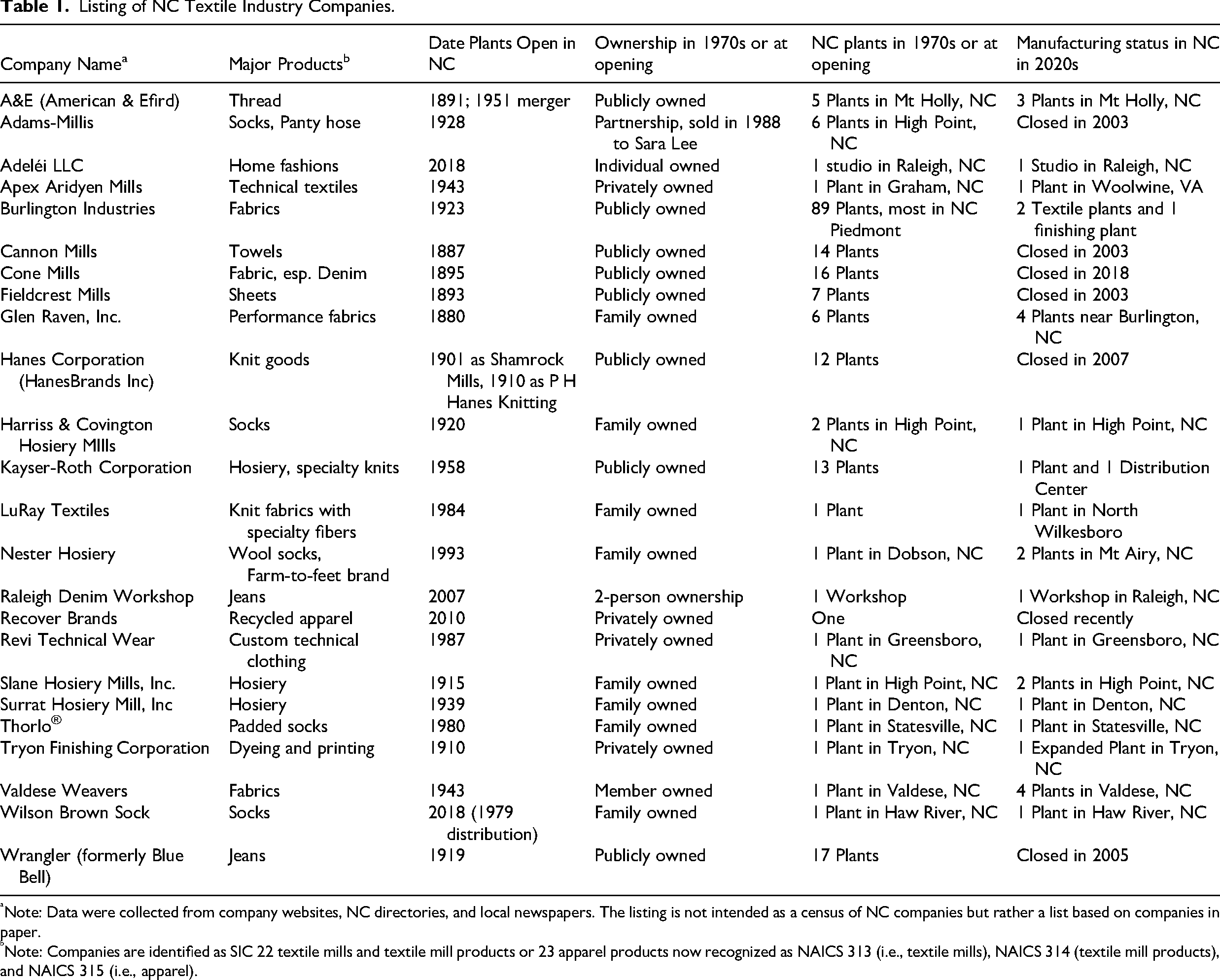
Note: Data were collected from company websites, NC directories, and local newspapers. The listing is not intended as a census of NC companies but rather a list based on companies in paper.
Note: Companies are identified as SIC 22 textile mills and textile mill products or 23 apparel products now recognized as NAICS 313 (i.e., textile mills), NAICS 314 (textile mill products), and NAICS 315 (i.e., apparel).
The collected data were evaluated and analyzed using a comparative method based on key terms governed by the research questions. Terms included company name, product and industry/government indexing code, dates of opening and closing, employment numbers, and plant locations, as found in NC Division of Commerce and Industry directories (e.g., Broughton, 1972). Researchers used a time series analysis to time-order data to examine trends and patterns.
Findings
As the chronology of the companies, associated measurements and historical context were examined, the researchers identified three emergent, main clusters of companies. The first cluster is comprised of large companies that originated in the early 1900s (e.g., Shipman, 1910; 1924) that experienced rapid growth in the 1970s and 1980s, ultimately becoming mega-corporations manufacturing a variety of textile mill products as well as brand-name apparel products. The second cluster consists of companies that experienced some growth in the 1970s, but over the subsequent 50 years, these companies remained smaller and lesser-known. They manufacture a variety of textile mill products from thread to commercial grade fabric and include dye and finishing operations. The third cluster consists of new companies, those with origins in the 2000s. These companies manufacture products which address new markets unique to the first decades of the 2000s. Products include high tech fabrics, fabrics from sustainable sources and fabrics and other textile mill products for special end uses. Overall, the time-series analysis is maintained in the findings within and across the clusters.
1970s to 2000s – From Rapid Growth to Dramatic Decline for Mega-Corporations
In the 1970s, the U.S. and NC economies were beginning to grow again in the post-Vietnam era. Consumer demand for apparel was changing, including the increased demand for branded apparel (Payne et al., 1992). The number and size of companies manufacturing textile mill products grew in response to the increased demand for fabrics. Growth in the production of basic apparel items was rapid and extensive – more plants, more production, more employees (Faircloth, 1978). Small to mid-size companies that had operated in North Carolina for a number of years were now rapidly growing in numbers of plants and in numbers of employees. By the 1990s, many of these companies reached mega-corporation status with large corporate headquarters and multiple plants operating within North Carolina. In the following three subsections, these companies are examined based on their product manufacturing output.
Early Textile Mill Products Companies
In the 1970s, several companies with name recognition (e.g., Burlington Industries, Cannon Mills, Cone Mills, Fieldcrest; see Table 1 for details) were already manufacturing textile mill products in North Carolina. Plants for these companies manufactured primarily flat fabrics and finished woven goods across a wide range of textile products. Much of the output was sold to apparel contractors for final apparel production. Over the next few decades these companies grew into mega-corporations with multiple plants hiring hundreds of employees. As one of the largest textile companies in the world, Burlington Industries, with headquarters in Burlington, NC, employed over 87,000 workers in North Carolina (Broughton, 1974). In the 1990s and 2000s, Burlington upgraded and automated many of its operations with updated manufacturing technology but was hampered from continued growth by hostile takeovers and competitive pricing from offshore production (North Carolina State University, 2025). By the early 2020s, after multiple restructuring attempts, buyouts and closings, the only NC plant remaining of the Burlington empire was the Burlington Finishing Plant (Manufacturer's News, Inc. [MNI], 2022). With a workforce in North Carolina of fewer than 1,000 people, Burlington, in the 2020s, manufactures fibers and fabrics for specialty purposes such as military and medical barrier fabrics (Elevate Textiles, 2019b; Elevate Textiles, 2019c; MNI, 2022).
Cone Mills Corporation is another textile company that was a booming powerhouse starting in the 1970s and growing through the 1980s (North Carolina Department of Economic and Community Development [NCDECD], 1992) and closing in the 2000s (Shuck, 2018). Throughout the 1980s, the Cone Mills White Oak Plant in Greensboro, NC, produced endless yards of denim to meet the demand by Levi Strauss and the growth in popularity of denim jeans (Payne et al., 1992). To remain competitive in the face of increasing levels of low-cost goods coming into the United States, shuttle-less looms were installed in the 1980s in several Cone plants to increase production speed and reduce employee numbers (Elevate Textiles, 2025). Even with equipment updates and a smaller employee base, Cone could not remain competitive against international fabric sources and closed its White Oak plant in 2018 (Shuck, 2018).
With a highly competitive and an increasingly global business environment, the corporate trajectories of Burlington Industries and Cone Mills Corporation, along with the restructuring of Cannon and Fieldcrest, followed a pattern common to many large NC textile corporations. These corporations thrived in the 1970s, reached peak growth and production in the 1980s and 1990s, and underwent buyouts, mergers, layoffs and plant closings through the 2000s. The largest single day layoff occurred in 2003 with the closing of 16 NC plants and the layoff of 6,450 employees, as a result of buyouts and restructuring of Cannon Mills and Fieldcrest (Whitmire, 2003). The competitive environment from low wage countries and the political support for environmental regulations in the United States (e.g., Clean Water Act) proved too hostile for the survival of these NC textile mill corporations (Taplin, 1999; Textile Mills Effluent Guidelines, 2025).
Early Brand-Name Apparel Companies
Other NC textile industry companies (e.g., Wrangler, Hanes; see Table 1) focused on manufacturing brand-name, apparel products. These companies are also called cut-and sew manufacturers. In response to consumer demand, brand-name NC apparel companies, thriving in the 1970s, grew to a size similar to that of companies manufacturing textile mill products. The Wrangler brand, doing business as Blue Bell/VF/Kontoor, reveals a typical path from the 1970s to the 2020s (Wrangler, n.d.). In the 1970s, Blue Bell Corporation manufactured Wrangler brand of jeans in 17 NC plants (Broughton, 1974). With an increased consumer demand for lower-priced goods along with discount companies (e.g., Wal-Mart) offering imported goods at lower prices, sales of premier products from brand-name companies such as Wrangler declined (Brainard, 2001; Taplin, 1999). Over the next two decades, Blue Bell/VF/Kontoor restructured and downsized to address the decline in demand. Cheaper sewing labor, especially in Mexico, resulted in cost savings to brand-named price-competitive companies (e.g., VF/Wrangler). This corporate strategy led to the earliest closings of sewing-intensive plants in the 1980s (ATMI, 1985). By the late 1980s, only two NC plants, one in Wilson and one in Greensboro, continued manufacturing Wrangler jeans (North Carolina Department of Commerce, 1989). The rest were manufactured offshore. By 2019, Wrangler products were no longer produced in the United States (Kontoor Brands, Inc., 2025).
In 1972, Hanes Corporation (n/k/a HanesBrands, Inc.) is another example of an apparel company with a known brand and multiple plants throughout North Carolina. In the early 1970s, 12 Hanes plants, employing thousands of operators, manufactured everything from yarns and narrow elastics to pantyhose, and men's and infants’ sweaters (Broughton, 1972). With corporate restructuring and plant closures, HanesBrands, Inc. closed Stratford Road and Weeks Plants, the last of their large plants in the early 2000s (Capital Broadcasting Company, Inc., 2009; Hanesbrands Inc., 2007).
Although earlier plant closings reduced some textile employee numbers, the number of those employees directly involved in sewing operations, peaked in the 1990s at over 90,000 located in over 1,000 plants (Quarterly Census of Employment and Wages [QCEW], 1974; QCEW, 1990). In sharp contrast by the late 2010s, employment in the NC apparel sector dropped to less than 6,000 workers in fewer than 100 plants (MNI, 2022; QCEW, 2022a, 2022b). As an effort to support the industry, organizations such as the American Society for Quality Control (ASQC) recommended automated equipment to provide a competitive edge (Cooper, 1980–1981). However, most cut-and-sew operations (i.e., apparel) found that the lack of flexibility in automated sewing equipment was restrictive to product style change (Kincade & Annett-Hitchcock, 2021). For NC apparel-brand companies such as Wrangler, the cost of what they perceived as inflexible equipment, and the rising cost of U.S. wages precipitated additional closing of their NC plants. Wage differentials were compounded by changes in trade rules in the United States (e.g., CAFTA, NAFTA), initiating more closings for tariff avoidance (Taplin, 1999). Further driving these closings was the influx of corporate buyouts for the ownership of known brands or for buy-and-sell corporate strategies and a volatile retail market (North Carolina in the Global Economy, n.d.; Taplin, 1999; 2014).
Early Hosiery Companies
In the 1970s, a third segment of the NC textile industry was booming with over 500 plants and thousands of employees (Broughton, 1972), driven by changes in fashions, including the popularity of women's pantsuits and men's leisure suits (Payne et al., 1992). By the 1990s, one company alone had 13,000 employees across 13 plants (QCEW, 1990). Hosiery in both the SIC and NAICS system ranges from children's, boys, and men's socks to women's panty hose (Broughton, 1972; NAICS;, 2024). From the 1970s to the 2000s, the largest of these NC hosiery companies (e.g., Adams-Millis, Kayser Roth; see Table 1) followed the growth trend of the textile mills and apparel companies through the 1970s and 1980s followed by downsizings and closings in the 2000s.
An examination of two large hosiery companies reveals details about this corporate pathway. Production in the Adams-Mills’ hosiery plants was dynamic through the 1970s and 1980s, reflecting the fashion popularity of women's pantyhose (Payne et al., 1992). In the 1990s, as part of the globalization of the textile industry, Adams-Millis was acquired by the Sara Lee Corporation (North Carolina Digital Heritage Center, 1996). Closings of Adams-Millis plants followed the buyout as many of these plants were duplicates of plants already owned by Sara Lee in other locations. In addition, cuts in employment and closings in outdated plants were seen as needed with changes in consumer purchases of hosiery and rising rates of U.S. wages in contrast to wages in offshore factories (Monroe, 1995). As Adams-Millis was a contract operation without brand recognition, the name Adams-Millis was not carried forward after the company's acquisition by Sara Lee.
In 1972, Kayser-Roth, best known as the manufacturer of “No nonsense” panty hose, had 13 plants in North Carolina (Broughton, 1972). With continued offshore competition and other cost-based considerations, the company stated on its corporate website that it maintained three plants and three distribution centers in North Carolina (Kayser-Roth Corporation, 2021). Facing continued price-competitive pressures and further changes in fashion, the company, in 2025, announced additional closings and layoffs, resulting in only one plant and one distribution center remaining in North Carolina (Finnegan, 2025).
In the decades from 1970 to 2000s, the largest NC textile industry companies manufactured (a) textile mill products, (b) brand-name apparel products, and (c) hosiery. At their peak, these companies owned hundreds of plants and employed thousands of workers, making them among the largest industries in North Carolina. As publicly traded companies, these companies were vulnerable to competition from low-wage countries as consumers sought cheaper products. Other forces included a business climate that favored hostile corporate takeovers as well as political pressures for changes in environmental and global trade rules.
1970s to 2020s – Starting Small and Staying Vibrant for a Long-Term Existence
In contrast to the NC companies that grew into mega-corporations in the 1970s and closed plants and/or went out of business in the 2020s, a cluster of small NC textile industry companies can be noted as long-term survivors. These companies have had small manufacturing plants within the state for many decades and continue to produce a product mix for niche markets. Organized according to three product categories: (a) textile mill products (e.g., yarns, threads, fabrics), (b) hosiery (e.g., socks, calf-length hosiery) and (c) dye and finishing (e.g., yarn, fabric bolt dye and finishing), these companies have adapted with technology and product mix variations to changing markets and business environments (see Table 1; Manufactured in North Carolina [MNC, 2024a] website).
Textile Mill Products Companies
Near the top of the MNC list (2024a) of textile mills is American & Efird LLC (A&E), an internationally known thread company. Continued operation for A&E has depended on producing a quality product that is widely needed and adapting to changes in fibers and mill operations as technology becomes available. For example, A&E was among the first NC textile companies to use digital technology for color matching. Since the invention of color matching in the 1960s, A&E has been in the forefront of this process. In 2016, they announced their newest color matching technology as part of a mobile app (Elevate Textiles, 2016). Confirming their commitment to innovation, the top banner of their website proclaims, “Science shapes our future” (Elevate Textiles, n.d.). They continue to produce threads in Gaston County, NC.
Three other small NC textile mill companies (i.e., Glen Raven Inc., Apex Mills, Valdese Weavers; see Table 1) stand out as examples of long-term survivors. Glen Raven Inc. (n.d.-a) began as a cotton mill in 1880, one of a series of mills to open along the Haw River [NC] in the late nineteenth century. The company gradually expanded from spinning to weaving as it met the U.S. demand for parachute fabric in the 1940s, following the entry of the United States into World War II (Glen Raven Inc., n.d.-a). In the mid-1960s as consumer interest in outdoor activities grew (Payne et al., 1992), Glen Raven developed a specialized outdoor fabric called Sunbrella®. From that decade into the 2020s, they have continued to use research and technology to meet changing market demands as is evident on their website where it states, “We take our customers’ challenges and provide solutions that are expressive, comfortable and of the highest quality” Glen Raven Inc. (n.d.-a, para. 3).
Apex Aridyne Mills, brags on its website that its products are made in two U.S. plants: one in Graham, NC, and one in Woolwine, VA (Apex Mills, 2024). Apex Aridyne specializes in knit fabrics, employs local workers, and uses high-tech, up-to-date knitting equipment. As with many of the surviving companies, Apex Aridyne's product developers work closely with customers to design specialized products for unique needs, such as medical fabrics for wound care. Further west in the NC mountains is the Valdese Weavers (2025). The company is now 100% employee-owned with all plants in and around the town of Valdese. While continually updating their equipment and expanding their facilities, the company maintains NC mountain traditions of sustainable, craft-expertise.
Hosiery Companies
In contrast to the fate of such hosiery mega-corporations (i.e., Adams-Millis, Hanes), three small and privately-owned hosiery companies (i.e., Harriss & Covington Hosiery Mills; Slane Hosiery Mills, Inc.; Surratt Hosiery Mill Inc., see Table 1) have survived into the 2020s. In the 1970s, these companies were small companies. For example, Harriss & Covington had only two NC sock manufacturing plants, and Slane Hosiery Mills, Inc and Surratt Hosiery Mill, Inc both had only one NC sock plant (Broughton, 1974). All three make socks for small retailers and large brand companies and socks for special uses. As with other long-term surviving NC textile companies, these small hosiery companies are oriented to quality production and hire highly skilled employees; both important to their long-term success. For example, Surratt, on their website, proclaims that “[through their] heritage, rooted in craftsmanship, Surratt Hosiery has been a trailblazer in the world of socks for years” (Surratt Hosiery Mill Inc., 2024, para. 4). Continuing to resist the “bigger is better” mentality as their company strategies, these companies remain active but small NC textile industry companies. Based on information on company websites (i.e., Harriss & Covington Hosiery Mills, Slane Hosiery Mills, Inc., Surratt Hosiery Mill Inc.), these three companies have kept their product mix focused and limited. In addition, these companies state on their websites and through their news releases that their survival is linked to the automation of knitwear, inclusion of new technologies, and the personal interest of generations of family, as owners.
Dye and Finishing Companies
Three NC dye and/or finishing plants (i.e., Burlington Finishing a/k/a Burlington Contract Fabrics; Hanes Dye & Finishing; Tryon Finishing; see Table 1) represent another group of NC textile industry companies that were active in the 1970s and are still surviving in the 2020s. In the 1970s, expansion of the Burlington and Hanes dye and finishing plants were part of the growth and diversification of textile, mega-corporations (i.e., Burlington Industries; Hanes Corporation; Broughton, 1972; 1974). Because of the uniqueness of the production processes and expertise needed for the chemical processes, these two dye and finishing plants were spun off as small, separate entities during the corporate restructuring and downsizing of the mega-corporations in the 1990s and 2000s (Company News, 1993; Elevate Textiles, 2019b). A third major dye and finishing company with long term survival is the independent Tryon Finishing, which remains a small but specialized operation and a key supplier to many textile companies (Tryon Finishing, 2024). As proclaimed on the websites for Burlington Finishing (Elevate Textiles, 2019a), Hanes Dye and Finishing (Leggett & Platt, 2025), and Tryon Finishing (Tryon Finishing, 2024), dye and finishing plants are surviving by embracing technology, seeking new markets, and developing new products to meet changing market needs.
Survival for these small and long-term NC companies has depended on their specialization of product, a focus on the customer, and an ability to adapt to a changing marketplace. For these small surviving companies, size and private ownership have been to their advantage, providing them with a focused interest in the companies’ success and a one-to-one relationship with their customers. Unlike many of the mega-corporations that closed plants in the face of cost-driven competition, wage-driven pricing has not been the key to the success of these privately held companies. In contrast, many of these companies have made extensive capital investments to update/expand facilities and to upgrade equipment; recommendations made by ASQC in the 1980s but, at that time, often not heeded by the large, multi-plant companies.
1980s to 2020s - New Life and Growth in the Specialty and Niche Markets
While the mega-corporations were closing NC operations and eliminating workers, new small companies were beginning their NC manufacturing journey. Although these start-ups often began with the same entrepreneurial spirit that drove the Cone Brothers in the 1880s through the 1970s, the founders of these more recent companies (i.e., founded 1980 or later) have kept the companies small and focused on specialized market niches. The strategic plans they have adopted are varied but market reactive. Often family-owned or employee-owned businesses, these new companies produce high-tech products with specialty equipment and/or market to a narrowly focused customer in areas such as health care or industrial safety.
Trading on its history as a textile state, North Carolina continues to serve as an incubator for new textile industry companies. A search conducted in 2024, on the MNC website (2024b), revealed 76 textile and apparel related companies. Taking advantage of advanced equipment technology and reduced dependency on wage-dependent employees, more than 20% of these firms are small hosiery or other knitwear companies. Many of these new companies have emerged with the assistance of state funding for equipment and building reuse (Berendt, 2024). Most of the remaining new small companies are specialized apparel companies hiring skilled sewing labor as available in North Carolina (Harrington, 2023). In addition, the insight and flexibility of these entrepreneurial owner operators are typical. Some of these companies have stayed in North Carolina for both business location and production, while others have chosen to locate design and marketing in North Carolina but have moved aspects of production offshore.
New Specialized Textile Mill Products Companies and New Hosiery Companies
Within this group of companies, founded since 1980, are those with product mixes of specialized fibers, yarns and knit or woven goods. These companies (i.e., LuRay Textiles, Wilson Brown Sock Company, Thorlo®, Nester Hosiery) value environmentally sustainable practices, a focus on the potential of new fiber technologies, and the possibilities of global markets with a foundation in NC manufacturing. For example, LuRay Textiles Inc, in Wilkes County, NC, makes protective gloves and other apparel for public safety and military personnel as well as textile products for industrial kitchens (LuRay Inc, 2025). Another new small company is the Wilson Brown Sock Company, headquartered in Haw River [NC], a small town with a major textile history. The philosophy expressed on the Wilson Brown Sock Company (2024) website shows its commitment to a specialized product mix: “As a family-owned company, Wilson Brown is committed to the resurgence of American textiles manufacturing. Our aim is not to produce socks at the lowest possible price point, but rather to invest in our products, our people, and our partners in a way that creates a rewarding experience from the field to the foot” (para., 2). ® is a small NC hosiery company that, according to its website, seeks to manufacture the perfect sock for the comfort of the wearer. Their high-performance products are made in Statesville, NC plants that use high-tech equipment and highly trained operators.
Nester Hosiery is a relative newcomer to NC hosiery, opening in 1993 in an abandoned grocery store in Dobson, NC (Nester Hosiery, 2025). With expansions through new equipment and bigger facilities located near their original NC plant, Nester is becoming a leader in the manufacturing of woolen socks. One of their most noted products is the Farm-to-Feet ® sock, which is 100% American-made starting with wool from American sheep. These products meet the consumers’ changing demand for types of socks beyond the basic dress sock (Monroe, 1995).
The unique product offerings of Nester Hosiery and other small NC hosiery companies are examples of how new NC companies are able to meet the changing consumer preferences of the 2000s. In addition, investments in technology and updates in knitting processes, made possible through state support, are part of why companies, such as Wilson Brown Sock Company (2024), can continue to manufacture in North Carolina. Small companies, such as LuRay and Nester, are bringing employment back to areas of the NC Piedmont region that were particularly hard hit by previous plant and factory closings in the furniture and textile industries.
New Apparel Companies
As with other new NC textile industry companies, the new apparel companies (i.e., cut-and-sew manufacturers) were started by individuals who have the same entrepreneurial spirit that has driven many of the textile industries companies throughout the past 50 years. This drive includes attention to the changing consumer and the product offerings (i.e., product mix) of the company. For example, the Raleigh Denim Workshop has turned a narrow market niche into a thriving business (Raleigh Denim Workshop, 2024). Two Raleigh [NC] natives became a husband-and-wife team, who wanted to create the perfect pair of jeans. From hand-cut selvedge denim, they create jeans with vintage sewing machines in their single workshop. They now manufacture a full line of denim products and employ, according to Raleigh Denim Workshop website (2024), certified nonautomated “jeansmiths” (p. 2). These jeansmiths work in a small boutique production facility in contrast to the large mass production plants of the previous mega-corporations that have gone offshore.
Also, from the MNC list (2024b) of NC apparel companies, Adaléi is described as a micro-manufacturer, providing custom-manufactured sewn products matched to specific customer requests. On their website, Adaléi (2025) states that it is both a design studio and a cut-and-sew operation. They make custom items in their Raleigh [NC] workshop for clients without trying to create a brand. Their work is unit (i.e., small one of a kind) production and not the mass production orientation of the previously, now closed, multi-plant companies. For one new product, the company is repurposing remnants of hides with hair and smooth leather from the easily accessible NC furniture industry to further cement its dedication to NC manufacturing.
Another example of a new NC company with a customized product mix, Revi Technical Wear (2025) has manufacturing operations in their Greensboro [NC] plant. One of Revi's specializations is the design and manufacture of clothing for extreme sports, where the fit of a shirt makes a difference for a competitive athlete. As with some of the new small NC textile companies, Revi's plant includes high-tech facilities. Their equipment supports their color and graphics work on high-performance fabrics. The availability of a trained workforce and high-tech workers has made this NC location viable (Harrington, 2023). Another company with roots in North Carolina is the Recover Brands company (Recover Brands, n.d.). The owner of Recover Brands grew up in a NC textile mill family and launched the firm in Charlotte, NC. The company's unique product mix is based on a closed loop recycling operation. With success and growth of distribution, the company has a plan that addresses newer concepts of sustainability (Hegel, 2024).
These new NC companies are privately owned and smaller in size and employment, in contrast to the publicly traded mega-corporations of the 1970s. With plants in North Carolina, these new companies manufacture customized items (e.g., eco-friendly sportswear) for small boutiques or high-tech items (e.g., hospital gowns, uniforms) for commercial or industrial use (MNI, 2022). Products from these new companies contrast with the wage-driven basic products manufactured by the mega-corporation factories in the 1970s, which benefited from being closed in the United States and reopened in offshore locations. In addition, the new small NC companies have manufacturing facilities full of highly specialized, digitally driven equipment with specialized technicians or artisan crafters who develop customized product solutions.
Conclusions
In the 1970s, as the evidence shows, the NC textile industry was a vital component of the manufacturing sector in North Carolina and in the United States. In the 1980s through the 2000s, negative headlines and government metrics indicated a decline in plant numbers and employment in the NC textile industry. These headlines were primarily a result of textile and apparel plant closings operated by NC mega-corporations. Publicly traded mega-corporations were susceptible to competition from low-wage countries and hostile takeovers from large holding companies and other firms wishing to make money on the ownership of branded merchandise.
In contrast, the findings held evidence that a few long-term companies are survivors and have invested in their plants with capital improvements, have gone high-tech or gained flexibility through digital processes, and continue to operate. Most of these long-term surviving companies are family or employee-owned with management decisions based on criteria other than profit margins, competitive pricing, or stockholder returns. Unique decisions and driving motivations to meet changing market conditions for these long-term survivors are often boasted on company websites. For example, Valdese Weavers says on their website, “[w]e are a 100% employee-owned company thoughtfully designing and responsibly weaving innovative textiles while striving to minimize our impact on the natural resources we share” (2025, para. 1). The website for Slane Hosiery Mills says “[w]e design and manufacture socks. Sounds fun right? Our processes have been fine-tuned with over 100 years of domestic manufacturing experience. We are committed to providing jobs for our community and manufacturing high quality socks” (SHM Socks, 2024, para. 1).
New textile and apparel companies have been drawn to North Carolina for assorted reasons. State governors and economic development commissioners have promoted and continue to promote the state as having a skilled and hard-working workforce (NCDECD, 1992; Harrington, 2023; Hill, 2024). The state also offers the advantage of locations close to raw materials and a solid infrastructure (Hegel, 2024). For example, GMAX, a manufacturer of specialized medical products, chose to relocate to North Carolina for access to the new textile mill products made in North Carolina (Hill, 2025). Adding to this raw material draw are the state and local incentive packages offered for locating in North Carolina. These incentives include funding in support of employee education, hiring and other economic development activities (Berendt, 2024; Clifford, 2013; Harrington, 2023). In addition, personal connections to the legacy of the NC textiles industry are mentioned by some owners of these new NC textile and apparel companies as additional reasons for locating in North Carolina (Hegel, 2024; Revi Technical Wear, 2025).
The textile industry, from yarn manufacturing to finished apparel products, was a vital part of the NC manufacturing economy in the 1970s. The industry was greatly reduced in the 1980s and 1990s, but with focused product selection and hands-on local management the textile industry has continued to be part of the NC economy into the 2020s. Throughout this 50-year period, the NC textile manufacturing added power to the NC economy (NCDECD, 1992). Although fewer in number, the textile mills category is still listed as one of the top 10 manufacturing subsectors in North Carolina and continued importance to the U.S. textile industry (Harrington, 2023). According to the Economic Development Partnership of North Carolina Inc (EDPNC, 2025) “North Carolina is where a rich textile tradition meets a thriving, high-tech, manufacturing hub” (p. 1).
Limitations and Recommendations
Limitations of this study include issues that are typical for historical research. Biased sources are always a concern and are a possibility with this study as the researchers used information from company websites. Triangulation of data was used, when possible, but often the website and a government listing were the only sources of information about some companies. Another issue is that of incomplete records or inconsistency in records. For example, the labor reports printed by the NC Department of Labor (NCDL) were not available for all 50 years, and the publications for some years lacked some of the demographics available in other issues and important to this study. Size, as measured by employment, was one of those demographics that was not always reported within the state directories. In addition, much of the information gathered by the NCDL was based on self-reported data based on what information companies were able or willing to release (NCDECD, 1992).
Future research based on the findings could examine company specific reasons and the cultural forces influencing the staying power of the few NC companies that survived and thrived over the entire 50 years. Deep mapping could be used to provide a complex picture of a particular company or community. Another study could incorporate interviews with current owners and operators or collect oral histories from retired employees. In addition, the findings could be used to examine the textile industry in other U.S. states as well as other countries. An examination of companies through the use of the SIC and NAICS codes is another point of view that could be used for future studies. Other studies could focus on new companies that open and operate in North Carolina with specific inquiry tracking the future of these companies for their choice of location in the state and their staying power with NC production. In addition, the examination of companies that originated in North Carolina with local plants but have moved operations to other locations, including offshore, raises new questions. Changes in political positions, including tariffs, provide another avenue for research for studying the future of this industry.
Footnotes

Funding
The authors received no financial support for the research, authorship, and/or publication of this article.
Declaration of Conflicting Interests
The authors declared no potential conflicts of interest with respect to the research, authorship, and/or publication of this article.