






Abstract
Despite the vital knowledge disabled people contribute to fashion innovation, fashion education has been largely absent from research on disabled students in higher education. This article examines the barriers disabled students encounter, the counter-strategies they employ, and their recommendations for inclusion. Guided by curricular cripistemologies, we conducted semi-structured interviews with 35 students across ten U.S. fashion programs. Three themes emerged: barriers, counter-strategies, and recommendations. Students identified structural, pedagogical, and cultural barriers, including medicalized and inflexible accommodations, inaccessible studios, and industry norms of speed and perfection. They resisted exclusion by cultivating peer and faculty networks and reframing disability as a creative resource. Students also offered recommendations such as studio-specific accommodations, proactive faculty disability education, and disability-inclusive curricula. This study extends existing scholarship on disabled students by introducing fashion education as a context, advances curricular cripistemologies in studio-based disciplines, and offers guidance for educators and accrediting bodies to foster structural transformation.
Keywords
U.S. legislation aims to reduce barriers for disabled students in higher education. Section 504 of the Rehabilitation Act of 1973 prohibits colleges from discriminating against disabled students, while the Americans with Disabilities Act (ADA) of 1990 requires institutions to provide “reasonable accommodations” to support access (Dolmage, 2017; Mitchell, 2015). Although this legislation has contributed to a 10-percentage-point increase in the enrollment of disabled college students over the past two decades (Miller McNeely & Blankstein, 2025), significant disparities remain. Only 17.8% of disabled adults have completed college, compared to 35% of non-disabled adults (Centers for Disease Control and Prevention, n.d.).
Researchers have shown that disabled students continue to face structural and cultural barriers in higher education (e.g., Dolmage, 2017; Ginsburg & Rapp, 2024; Kendall, 2016). While these studies focus on programs in the humanities and computer sciences, none examine disabled students in fashion education. Research in adjacent fields such as art and design offers a useful foundation (e.g., Alden & Pollock, 2011; Penketh, 2014). Fashion education's studio-based pedagogy—characterized by embodied labor, shared machinery, and fast-paced critique-based assessment—creates accessibility challenges that differ from lecture-based courses. Fashion programs also often model their educational culture on the fashion industry, privileging speed, stamina, and normative aesthetic standards (Barry et al., 2023), which can further marginalize disabled students. These conditions position access in fashion education as both an equity issue and a question of whose creative and pedagogical knowledge counts.
Our study addresses this gap by examining the barriers disabled fashion students face, the counter-strategies they enact, and their recommendations to create access in fashion education. These areas reflect themes identified in prior research on disabled students in higher education, which we extend to fashion education. We use the term disabled students to align with disability studies scholars who claim disability as an identity and as a source of pride (Titchkosky, 2011).
Background
Access in Higher Education
Researchers in education and disability studies show that legal provisions for disabled students in higher education often result in contingent and partial access. Most campuses retrofit spaces for physical access by adding ADA-compliant ramps and elevators. These changes technically enable access but require longer, more physically demanding routes that increase distance, time, and labor for disabled students (Dolmage, 2017). Rather than transforming the structures of teaching and learning, most colleges also retrofit their pedagogy (Dolmage, 2017; Kendall, 2016; Nieminen, 2023). Disabled students must navigate burdensome administrative procedures to request support and prove they are “disabled enough” within medical frameworks that privilege certain disabilities (Fuller et al., 2004; Ginsburg & Rapp, 2024). Once granted, accommodations are often standardized and poorly matched to disciplinary contexts (Dolmage, 2017; Kendall, 2016; Nieminen, 2023). For example, accommodations typically focus on exams, including alternative testing locations and extended time, but are rarely extended to studio work, critiques, or other pedagogical practices beyond assessment (Kendall, 2016; Nieminen, 2023).
Faculty often lack professional opportunities to develop disability literacy and inclusive teaching strategies (Seale et al., 2021). Without adequate training, educators may hold unexamined assumptions about disability, leading to low expectations of disabled students and inflexibility in implementing accommodations (Dolmage, 2017; Fuller et al., 2004; Gross, 2019). This lack of preparation may also lead faculty to resist accommodations or lack the knowledge to enact them effectively (Fuller et al., 2004; Seale et al., 2021). These conditions contribute to low disclosure rates—only 37% of disabled students in the U.S. disclose their disability to their college (Adam & Warner-Griffin, 2022)—and reluctance to use approved accommodations due to fear of faculty confrontation or stigma (Hong, 2015; Kendall, 2016).
Barriers in Art and Design Education
Although no studies to date focus on disabled students in fashion programs, research from art and design education offers insight given the shared emphasis on studio-based learning. Disabled students often choose these programs for their perceived flexibility and emphasis on creative expression beyond written forms (Alden & Pollock, 2011; Fuller et al., 2004). Yet they encounter many of the same barriers identified across higher education, including stigma around disclosure to faculty (Taylor et al., 2010), inflexible accommodation processes (Fuller et al., 2004), fast-paced instruction (Alden & Pollock, 2011), limited faculty disability literacy (Penketh, 2014), and studio spaces that, while legally accessible, remain obstructed by large furniture and student projects (Corlett, 1994; Dolmage, 2017). Distinctive to art and design education are challenges tied to studio critiques and disciplinary culture. The tradition of oral feedback, for example, can impede information retention and require articulate, on-the-spot responses during fast-paced critiques, creating barriers to disabled students’ success (Alden & Pollock, 2011). Moreover, art and design programs have been described as unwelcoming to disabled students, upholding ableist standards of “good sight and physical mobility” (Corlett, 1994, p. 271) and often avoiding disability content in the curriculum (Penketh, 2014).
Counter-Strategies
Despite these barriers, disabled students develop strategies to navigate and resist exclusion in higher education. Existing research has documented individual approaches, including creating personalized organizational systems such as color coding (Alden & Pollock, 2011), selecting programs that align with individual learning strengths (Fuller et al., 2004), and choosing schools near family to maintain support networks (Gibson, 2012). Disability studies scholars emphasize that these practices constitute forms of everyday resistance and access labor through which disabled students actively negotiate exclusionary educational structures rather than passively adapting to them (Dolmage, 2017; Titchkosky, 2011). More broadly within disability studies, disabled people have long adapted products, systems, and environments through everyday hacks, positioning disabled people as designers grounded in lived experience (Williamson, 2019). In studio-based and creative disciplines, these practices are often embodied, material, and spatial, as students hack tools, environments, and temporal demands to support their learning (Alden & Pollock, 2011; Corlett, 1994). However, these discipline-specific strategies remain underexamined in higher education research (Alden & Pollock, 2011).
Recommendations
Researchers offer recommendations to address barriers identified in their findings, including individualized accommodations and flexible assessment practices that support diverse learning styles (Fuller et al., 2004; Kendall, 2016). Additional recommendations include providing lecture materials in advance, integrating both oral and written feedback, and expanding faculty training to improve disability literacy (Alden & Pollock, 2011; Fuller et al., 2004; Gross, 2019; Penketh, 2014; Seale et al., 2021). Scholars further advocate for integrating disability studies and disability arts into curricula to challenge ableist assumptions and expand understandings of creativity (Hermon & Prentice, 2003; Penketh, 2014; Pickard, 2021). Such approaches emphasize learning through “visual, tactile, and sensory experiences” and encourage students to draw on their lived experiences in creative work (Hermon & Prentice, 2003, p. 273).
Theoretical Framework: Curricular Cripistemologies
To ground our analysis, we draw on David Mitchell's (2015) curricular cripistemologies. This framework emerges from disability studies to illuminate how disabled students respond to and reimagine university structures not designed for them. Mitchell argues that diversity initiatives in universities often serve to assimilate disabled students into normative academic structures and practices that privilege speed, individualism, and able-bodied ways of knowing. These initiatives are defined by ableism, “a system of assigning value to people's bodies and minds based on societally constructed ideas of normalcy, productivity, intelligence, excellence, and fitness” (Lewis, 2022, n.p.). Ableism positions able-bodiedness as the ideal or default for students in educational contexts, casting disabled students as abject and in deficit (Dolmage, 2017).
Mitchell describes curricular cripistemologies as the counter-strategies and alternative knowledges that disabled students generate when they refuse or fail to conform to non-disabled university norms. Merging “crip,” a reclaimed term that affirms disability experiences (Ginsburg & Rapp, 2024), with “epistemologies,” or ways of knowing, it highlights the pedagogical value of disabled students’ lived experience. These forms of knowledge help disabled students cope with inaccessible educational systems and enable them to actively reimagine them. While the framework has not been applied to the context of studio-based education, curricular cripistemologies helps examine how disabled students experience exclusion in fashion education, and how they resist it and envision alternatives by drawing on their experience.
Guided by this framework and past research on disabled students, we developed the following questions: RQ1: What barriers do disabled students experience in fashion programs? RQ2: What counter-strategies do disabled students develop to resist these barriers? RQ3: What recommendations do disabled students have for improving access in fashion education?
Methods
After obtaining Institutional Review Board approval, we recruited disabled fashion students to participate in semi-structured interviews. Disability studies scholars argue that involving disabled researchers strengthens the trustworthiness of research about disabled people (Kitchin, 2000). All members of our research team identify as disabled and/or neurodivergent. 1 We recognize that our intersecting identities shaped how we engaged with participants and interpreted the data, and we reflected on our positionalities throughout the study (Reich, 2021).
We used interviews to examine disabled student experiences in fashion programs because this method provides deep insights into participants’ experiences and systemic barriers (Creswell & Creswell, 2018). Eligible participants were 18 or older, enrolled as undergraduate or graduate students in U.S. fashion studies (i.e., history and theory), design, management, or merchandising programs, and self-identified as disabled. Graduate students were included because disability access remains underexamined at the graduate level (Mitchell, 2015). We use disabled as an umbrella term encompassing physical, sensory, mental, developmental, and cognitive disabilities, as well as neurodivergence and D/deaf identities (Wong, 2020). Both medically diagnosed and self-identified disabled students were included to account for financial and social barriers related to medical diagnosis and disclosure in higher education (Dolmage, 2017).
We recruited participants by sending a recruitment flyer to the 35 department heads/department chairs of U.S. fashion design and merchandising programs, identified by the member lists of the International Textile and Apparel Association (ITAA) and the Association of Independent Colleges of Art and Design (AICAD). We asked them to forward the flyer to students. The flyer included details about the study, honorarium information, and a link to a pre-screening survey. Each participant received a $100 honorarium in the form of a gift card upon completion of their interview. All individuals who contacted us to express interest were sent a pre-screening survey by email. This survey confirmed eligibility based on our inclusion criteria and collected demographic information (e.g., ethnicity, institution, major).
Recruitment occurred in two rounds to maximize outreach and allow students who did not initially respond another opportunity to participate. We received 49 completed pre-screening surveys. After each round, we reviewed these surveys and developed a ranked list of potential participants. In the first round, participants were selected based on the inclusion criteria and availability. In the second round, we used purposive sampling to enhance diversity across disability type, race, gender, program, institution type (e.g., public/private; small/large), and geography. This supported maximum variation sampling, a qualitative strategy that selects participants with diverse attributes to gain a range of experiences (Creswell & Creswell, 2018).
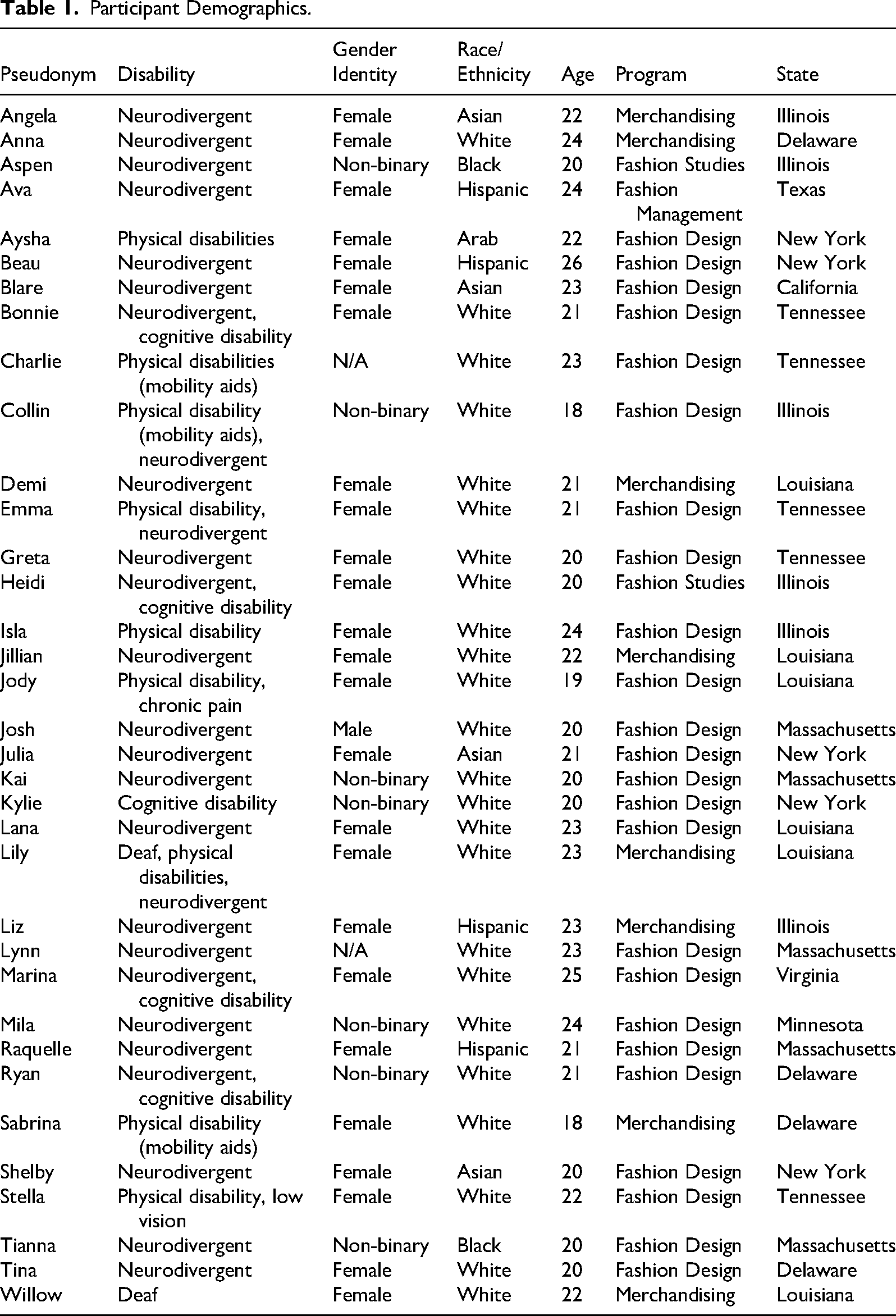
In total, 35 participants were interviewed. This cap aligns with precedents in qualitative studies of disabled students in higher education (e.g., Hermon & Prentice, 2003; Riddell et al., 2005) and with qualitative guidance emphasizing analytic depth over scale (Creswell & Creswell, 2018). The final sample included students from 10 institutions representing diverse disability experiences, racial and gender identities, institution types, and geographic regions across the U.S. (see Table 1). This range of institutional types and settings enhances the transferability of our findings (Lincoln & Guba, 1985). Most participants were neurodivergent (n = 27, 77%), female (n = 25, 71%), and white (n = 24, 69%). This profile is consistent with national data indicating that disabled students in higher education are more likely to identify as women and as white (National Center for Education Statistics, 2022), and with increased identification as neurodivergent (Kendall, 2016). Most participants were enrolled in undergraduate fashion design programs (n = 34, 97%), with one graduate student included. As the study is not comparative, all interviews were analyzed together. Participants were assigned pseudonyms and university names were removed to ensure confidentiality.
Participant Demographics.
Before interviews, participants provided informed written consent and shared access needs (e.g., American Sign Language [ASL] interpretation, breaks). Interviews were conducted by trained research team members. When interpreters or other support persons were required, they signed confidentiality agreements and were present solely to facilitate communication. All interviews took place on Zoom between November 2023 and February 2024 and were audio-recorded using Otter, a transcription software. Interviews lasted 28–73 min and followed a semi-structured interview guide developed from literature on disabled students in higher education, Mitchell's (2015) curricular cripistemologies framework, and the study's research questions. Interview questions were designed to elicit students’ experiential accounts, consistent with qualitative approaches that privilege participants’ meaning-making and lived expertise (Creswell & Creswell, 2018). The guide included 15 questions, such as: How are fashion classes accessible and inaccessible for your disability needs? (barriers); how have you found your disability to be a benefit to your work as a fashion student? (counter-strategies); and how can fashion educators better support disabled fashion students? (recommendations).
Data analysis was conducted using Reflexive Thematic Analysis (RTA) that emphasizes researchers’ roles in meaning-making and reflexive engagement (Braun & Clarke, 2019). RTA involves six recursive phases (Braun et al., 2018). First, each interviewer checked their transcripts for accuracy while listening to the audio recording. Identifying information was removed and the de-identified files were uploaded to a password-protected drive for collaborative analysis. Second, researchers independently coded four randomly selected transcripts and met to compare interpretations, generating a shared code list. The remaining transcripts were divided evenly among the team, with each reviewed by two researchers. Consistent with RTA, we did not calculate inter-coder reliability because RTA rejects a single objective coding “truth” and instead values the reflexive contributions of each researcher (Braun & Clarke, 2019). Accordingly, codes were discussed in weekly meetings to align interpretations and address coding disagreements through dialogue. Decisions were reached collectively and grounded in the research questions, theoretical framework, and engagement with the data. Third, codes were grouped into preliminary themes during team meetings based on both the research questions and emergent patterns in the data. This process was iterative, as codes were refined into themes. Fourth, themes were reviewed and refined for congruence with coded transcript segments, and their relationships to the full dataset were discussed. Fifth, theme names and definitions were finalized, and illustrative participant quotations were selected. Finally, themes were examined in relation to the research questions and existing literature.
Several strategies were used to ensure rigor and trustworthiness. Throughout the analysis, the team met regularly to reflect on the development of codes and themes and their alignment with the research questions (Braun & Clarke, 2019). These meetings also helped negotiate emerging meanings within the data and prevent “drift” in the code and theme definitions (Creswell & Creswell, 2018, p. 202). Moreover, we included responses from many participants to reflect a range of perspectives and enhance credibility through multivocality (Tracy, 2019).
Findings and Discussion
Analysis identified three themes aligned with the research questions: barriers (RQ1), counter-strategies (RQ2), and recommendations (RQ3). While these themes were informed by the research questions and literature, sub-themes were developed inductively through reflexive thematic analysis of the interview data. The first theme examines structural, pedagogical, and cultural barriers in fashion education. The second focuses on participants’ personal and relational practices of survival and resistance in fashion education. The third outlines participant suggestions for expanded disability education, accommodations, and fashion pedagogy.
Barriers
Disabled fashion students described a range of structural, pedagogical, and cultural obstacles that undermined their access, learning, and well-being (RQ1). Viewed through Mitchell's (2015) concept of curricular cripistemologies, these barriers illustrate how fashion curricula privilege normative bodies, temporalities, and ways of knowing, and position disability as a problem to be accommodated rather than as a source of knowledge.
Medicalization of Disability
Our findings suggest that universities require disabled students to navigate complex bureaucratic processes to verify their disability, echoing research that higher education only recognizes disability when it is medically certified (Ginsburg & Rapp, 2024; Kendall, 2016). Some students submitted existing documentation, while others were required to undergo costly re-assessment despite prior diagnoses. This reliance on medical validation reflects the dominance of the medical model in universities (Dolmage, 2017). Lana said: They wanted me to go through the process of re-evaluating to get a confirmation of disabilities. It was strange because they’re lifelong disabilities. The process was complicated […] It's hard to get diagnosed as an adult, so we had to find specific doctors who did both ADHD and dyslexia […] we spent over $2,500 to get tested.
The emphasis on a medical model of disability contributed to the erasure of non-apparent disabilities and limited accommodations for students who did not conform to dominant assumptions that disability is physical and visible (Nieminen, 2023). This assumption left students with non-apparent disabilities feeling that their needs were not taken seriously. Emma explained: There are some students in my program that have disabilities that you can see […] I feel like they’re treated a lot more delicately. They receive all these accommodations, which is great, they need them. But it makes it uncomfortable for me because my disabilities aren’t outward, so when I talk to professors, I almost feel like I have to convince them.
Ten participants chose not to disclose their disabilities or request accommodations from instructors because they feared they would be seen as less competent in meeting the demands of fashion school. Blair shared, “If I bring it up, it's almost like I’m making excuses, like I’m too incompetent to finish the work.” Shame and anxiety often led them to mask their access needs in pursuit of faculty approval, echoing past research that stigma and fear of judgment from faculty discouraged disclosure (Hong, 2015; Taylor et al., 2010). Willow feared that advocating for her access needs would put her on professors’ “bad side” and lead to poor grades. Greta shared a similar anxiety: “I want to succeed and not pressure the professor. I’m like, do I want to ask for this? So I just hold off and kind of persevere.”
Academic Accommodations
The academic accommodations offered, such as note takers and extended test time, were insufficient for fashion students’ needs, supporting past research that found standardized accommodations failed to account for disciplinary contexts (Dolmage, 2017; Kendall, 2016). Participants described a disconnect between studio pedagogy and disability services, noting most accommodations catered to lecture-based courses. Aysha said, “It's great I get a note taker, but as a fashion designer, I never need that.” Lana found extended time and an alternative test location unhelpful because the space lacked the necessary equipment: If we’re doing a draping test, we have three hours to drape something on a mannequin and sew it. It might be nice to use my accommodations for that […] But the accommodation halls don’t have a mannequin, a sewing machine or a flat pattern table, so I take my tests with everybody else. Sometimes I finish the test, sometimes I don’t.
Inaccessibility of Facilities
Participants reported that facilities for studio-based courses were inaccessible, reflecting longstanding barriers for physically disabled students (Corlett, 1994; Dolmage, 2017; Nieminen, 2023; Titchkosky, 2011). Participants with chronic pain, sensory sensitivities, and cognitive disabilities were also affected, as inaccessible spaces intensified pain and fatigue and compounded barriers to learning. For example, cutting and ironing tables were standing height and studio seating lacked back support. Charlie shared: In the sewing labs, the cutting tables are standing height for most people, so I have to transfer out of my chair into a higher chair if I want to sit and work. That's an adjustment they could make, but it costs money to get adjusting tables. So far it's been like, ‘well, we only have one student that needs it, so we can’t invest the funds into that sort of thing.’
Participants with physical disabilities encountered inaccessible tools and machines in design studios, from scissors, pliers, and pins to sewing machines. Consistent with the adaptive innovation of disabled people (Williamson, 2019), participants devised solutions to make studio tools usable. Aysha described customizing tools by adding soft materials to reduce pain and fatigue associated with prolonged gripping and fine motor tasks during sustained studio work: I have to wrap my own tools and create my own cushions, which also means that I need to buy my own tools, because I can’t do that to the ones that are there. It adds a cost to me that I don’t understand why I have to bear.
Influence of the Fashion Industry
Aligning with past studies (e.g., Barry et al., 2023), participants described fashion programs as mirroring the fast-paced, competitive, exclusive culture of the fashion industry. This culture created learning environments that perpetuated ableist norms (Mitchell, 2015) and made programs feel unwelcoming. Aysha said, “It's always ‘but that's how the industry is’ […] Well why keep imitating the industry? Why not teach in a more accessible way?” Participants most clearly identified this alignment through program pace: deadlines for large projects arrived quickly, workloads were overwhelming, and there was little flexibility when disabled students experienced changes in energy, pain, or cognition. Aysha noted: There's no space for a break or leniency when I’ve had an unexpected hiccup. It was very common for me to be like, ‘hey, I couldn’t do this. I didn’t have time, or I just couldn’t.’ And they’d be like, ‘what did you do yesterday?’ If I said I worked on it and then I slept, the response would be, ‘why did you sleep?’ […] I understand that a deadline is a deadline, but I don’t understand when my body won’t cooperate.
Participants also shared that a lack of disability representation in their programs and the industry made them feel that they may not belong in fashion. Isla said, “It can be very isolating because there aren’t a lot of other physically disabled students. And I understand why—it's not really an accommodating industry […] I feel that the fashion world might not be for me.”
Limited Faculty Knowledge
Consistent with prior research (Fuller et al., 2004; Kendall, 2016; Seale et al., 2021), participants described fashion faculty as having limited disability knowledge, resulting in instructional inflexibility and heightened shame for disabled students. As one example, Ava shared, “I had to educate my professor about ADHD and say I need this [additional] extension because of this. She said, ‘I've already given extensions to everyone else, so that wouldn’t be fair.’ So I just had to deal with it.” Eleven participants reported that faculty disability literacy gaps led to failures in implementing approved accommodations. Willow received an accommodation to record lectures, yet one professor refused to modify his strict no-recording policy. These accounts show how limited faculty disability literacy produces not only noncompliance, but learning environments marked by anxiety and shame (Dolmage, 2017).
A lack of education and negative attitudes from faculty made participants feel that their accommodations were seen as excuses rather than legitimate needs. Aspen felt as though their instructors “saw accommodations as cheat codes.” This finding echoes prior scholarship showing that without disability education and training, faculty often hold preconceived ideas about disabled students, resulting in minimal support and inflexibility (Gross, 2019).
Limited Disability Curriculum Content
Participants reported limited disability content in their courses, which instead focused on the idealized fashion body they described as “thin and white,” “tall and skinny,” and “straight sized.” Some participants noted that while size, race, and age were discussed, disability was largely absent or focused on physical disabilities. Anna said: “We kind of learned about accessible clothing for people with disabilities, but I didn’t learn anything about neurological disorders.” The dearth of disability content in fashion curricula extends prior research showing that disability has been excluded in art and design education (Penketh, 2014; Titchkosky, 2011).
In the few courses that included disability, the topic reinforced the dominance of the medical model by addressing disability as a problem to be solved through functional design rather than a creative opening. Collin said, “I hate when accessible fashion is portrayed as this infantilized version when it's for an adult […] I want disabled people to wear clothes that make them feel good about their disabled bodies without having to compromise.” Participants shared that this devalues disabled identities by positioning them outside of mainstream fashion. Aysha explained: “It's almost treated like it's a different idea, different market, different worlds.”
Counter Strategies
Despite these barriers, disabled fashion students developed creative interventions to support their access needs (RQ2), often cultivating community in the absence of formal support and introducing disability perspectives into curricular spaces. Rather than relying solely on formal accommodations, participants described personal, interpersonal, and curricular strategies that demonstrate agency in navigating exclusion and reshaping educational environments.
Cultivating Faculty Support
Because many faculty lacked disability knowledge, participants described supportive relationships with faculty as uncommon. However, when participants met faculty who were empathetic and accommodating, they looked to them for additional support. As a result, six participants reported forming close relationships with faculty who offered support beyond formal accommodations. They found these relationships particularly affirming when instructors took initiative to start conversations with students, asking if they needed additional support and what that might look like, or stepping in when students were overwhelmed. For example, Kai shared: My tics were acting up, and [the instructor] came over and talked to me and drew out the lines. He did a large amount of the pattern for me because I physically couldn’t. I thanked him and he was like, ‘of course, I got you, don’t worry about it.’
Developing Peer Community
Five participants looked to disabled peers in upper levels for guidance and support. Charlie explained that having a disabled friend in the program aided their experience: “We became instant best friends. She was here a year before me, so she had already done a lot of heavy lifting within the program to make it more accessible.” Participants described instances where disabled students came together to advocate for changes in fashion programs to improve accessibility. Isla said, “I feel like so many of these things are started by students, not by the school, until we raise hell about it. Why do we have to be the ones responsible?” Without this community, students felt their access needs would be overlooked.
Relying on Familial Support
Eight participants reported relying on family and friends to advocate for their needs and to navigate university spaces and systems. Anna described her parents as her “biggest support system.” For some participants, their reliance on external support systems influenced where they attended fashion school because they feared they would not have adequate support from the university. Marina said: “I live with my sister, and my parents are two hours away. It may not have been the best program for what I wanted to do, but it was the best place I could attempt to go to school.” This finding extends prior research that highlights the role of family and proximity in school selection for disabled students (Gibson, 2012) and adds nuance by illustrating how fashion students actively weigh creative goals against access to care.
Self-Advocacy
Due to a lack of effective accommodations and institutional support, participants self-advocated to meet their access needs. Isla said: “I’m spending $31,000 to go there. There's no way I'm not going to advocate for myself. It's a necessity. I can’t afford to fail.” Participants’ accounts build on past research that highlights how disabled students take initiative to improve educational access (Alden & Pollock, 2011), showing that it is central to survival in fashion programs. Seven students shared that the anxiety of self-advocacy posed a barrier to academic success. Kai noted, “I understand I have to advocate for myself, but sometimes I have a hard time doing that if my brain is being weird.” Participants expressed frustration with the labor it took to self-advocate. Liz said, “It's so exhausting to have to go out of our way to get resources.”
Incorporating Disability into Courses
While participants were critical of limited course content on disability, many drew inspiration from their own disability experiences. They integrated their experiences into their projects and class discussions, even when it was not required. In doing so, they found that non-disabled peers became eager to learn about disability and, in some cases, explore it in their own coursework. Stella said, “I’ve even had classmates give reports or projects on disability fashion.”
Participants described how their disability experiences informed and expanded their design practice. Six participants cited a lack of fashionable clothing or irritating textiles as motivation for new designs. Ten participants described how their disabilities fostered creativity and skills, echoing the history of disabled peoples’ innovative approaches to navigating and adapting inaccessible worlds through design (Williamson, 2019). Stella said, “When I run into an issue […] I'm more likely to try [to] adapt the design than scrap it entirely. I've learned nothing is ever broken, you just have to figure out a different way.” Participants’ disability experiences prompted creative approaches to combat inaccessible expectations in their programs, illustrating how disabled students navigate ableist structures (Titchkosky, 2011). For example, unexpected changes in pain and energy due to Aysha's disability meant she could not always meet course requirements. She developed a modular design aesthetic that honored her physical capacity:
Recommendations
Participants offered actionable ideas for how fashion education could better support disabled students (RQ3), drawing on insights from their lived experiences. Collectively, their recommendations point to institutional changes needed to move beyond minimal compliance toward more responsive, collaborative, and disability-affirming educational environments.
Tailored Accommodations
Participants emphasized that there is no “one size fits all” approach to access, expressing a strong desire for individually tailored accommodations. This finding extends prior scholarship on the need for individualized support (Kendall, 2016) by highlighting nuances that are unique to fashion education. For example, participants with physical disabilities said they would benefit from additional instructor support in design courses during pain flare-ups, leniency with lateness and absences, opportunities to work from home, and more on-campus space to store materials and books. While rare, this approach was exemplified by Stella's positive experience where disability services developed personalized accommodations based on her needs: “It's ‘what do you need?’ One of the first questions they asked was if I had accommodations previously. I hadn’t. So they went through the process, gave some examples, and asked about my experience and what would make it better.” Stella was provided with a dedicated computer and sewing machine, both pre-set to her needs. This eliminated setup time at the start of each class and enabled smoother participation. While sewing machines with adaptive features are commercially available (e.g., Bernina's 790 Pro model), adaptive alternatives for other essential fashion tools remain limited. Tools such as shears, clips, and pliers are rarely designed with disabled users in mind, requiring students to independently modify equipment, adding labor and financial burden. Stella's experience shows that assigning disabled students’ tools that can be customized to their access needs reduces daily modification time and mitigates the cost of purchasing personal tools.
Collaboration Between Disability Offices and Fashion Departments
Participants recommended that fashion programs collaborate with disability services to develop accommodations tailored to fashion design classes. These participant-generated recommendations reflect students’ experiences navigating studio-based learning environments, though implementation may be shaped by university policies, legal requirements, and disability services procedures. Participants’ suggested accommodations included options to work from home or alternative testing spaces suited to practice-based assessments. Aysha explained: I prefer to work at home, with my tools and set up. If I'm having a flare up in the studio, I won’t get the work done. I'm counting the hours I'm wasting. If I had the option, I would leave, not to take the day off, but to go home to a space that allows me to work better.
Removal of Disability Medical Documentation
Participants urged ending the requirement of formal or recent medical diagnoses to access accommodations, instead calling for the option to self-identify as disabled. Lana noted: “It's a hassle and a monetary burden, and it's not warranted for someone who has a disability that doesn’t go away.” Participants emphasized that faculty should initiate class-wide conversations about accommodations to reduce stigma and take responsibility for engaging students who disclose disabilities, rather than placing the burden of advocacy on students. Emma said: We send out our accommodation letters at the beginning of the semester through the disability department. I wish instructors would then come to me, but the policy is that we have to go to them. A lot of people with disabilities have bad anxiety, especially someone like me with autism. I wish they would just put in more effort to talk to me one-on-one.
Embedding Disability Curricular Content
Participants felt it was not their responsibility to educate peers about disability, and instead wanted the topic incorporated into fashion curricula. They wished disabilities were included beyond a medical lens, and that faculty highlighted neurodivergence and non-apparent disabilities. These suggestions echo past scholarships’ call to integrate disability content across curricula, to educate non-disabled peers and affirm the perspectives and aesthetic contributions of disabled students (Hermon & Prentice, 2003; Penketh, 2014). Tianna said, “People with physical disabilities, cognitive disabilities and neurodivergence should be incorporated, broadening our skills to make different kinds of clothes. We don’t evolve if we don’t have different people around us to evolve with.”
Participants believed that the inclusion of disability in fashion curricula would be strengthened if faculty were more educated about the breadth of disabilities. They hoped this knowledge would foster more accommodating pedagogical practices and help establish new attitudes and norms that begin in the classroom and extend into the industry. This perspective aligns with scholarship calling for greater faculty education and training to dismantle preconceived negative attitudes toward disability in higher education (Gross, 2019). Emma said, “They need to represent disabilities more. There have been enough disabled people in fashion to talk about, but they never do. They don’t realize how important it is to hear that there's somebody like you, to think, ‘I could be that person someday.’”
Participants emphasized the need to hire disabled fashion faculty. Aysha said, “We need more people with disabilities writing the curriculum […] What's the point of having a disabled professor if he can only teach a curriculum that doesn’t talk about disability?” These calls to integrate disability into curricula and hire disabled faculty reflect research that reframes disability as a vital source of creative knowledge and aesthetic innovation (Pickard, 2021).
Fostering Disability Community
To facilitate greater support networks, participants advocated for fashion programs to develop formalized peer support groups where disabled fashion students could provide guidance to one another. Jillian shared, “I'd like to see a system that groups disabled people together, so they can talk about tactics they use to get through college.” These peer support groups would provide new ways to navigate university systems and foster communities of disabled students. Additionally, participants emphasized the importance of including disabled fashion professionals in curricula, noting that greater representation could help counter feelings of exclusion and self-doubt. Collin shared, “So many people are worried about not getting into a fashion career because they don’t think it’ll work with their disabilities. I wish more disabled designers and creators were open about this to show we can.” They suggested that programs collaborate with disabled designers through integrated course projects or guest lectures.
Conclusion
This study examined the barriers disabled students face in fashion programs, strategies they use to navigate them, and their recommendations for fostering access. While prior research explored these issues across disciplines and in art and design education (Alden & Pollock, 2011; Corlett, 1994; Hermon & Prentice, 2003; Penketh, 2014; Pickard, 2021; Seale et al., 2021), this study contributes new insight by focusing on fashion education, a field not previously examined. Centering disabled students’ experiences extends Mitchell's (2015) concept of curricular cripistemologies by specifying how it operates within practice-led pedagogical contexts.
While curricular cripistemologies has primarily been used to critique assimilationist diversity agendas and foreground disability-centered ways of knowing (Mitchell, 2015), our findings suggest that in studio-based fashion education these knowledges emerge through sustained engagement with bodies, materials, tools, time, and aesthetic norms. Disabled students’ counter-strategies, such as adapting tools and developing modular designs, can function not only as survival mechanisms but also as embodied ways of knowing that may challenge dominant assumptions about productivity and creative legitimacy. At the same time, our findings show that these practices often emerge in the absence of institutional change and may relieve pressure on programs to address structural barriers. This finding suggests the need to pair curricular cripistemologies with university accountability rather than relying on student ingenuity to produce access. Together, these insights suggest that curricular cripistemologies may offer a useful framework for understanding pedagogical resistance and identifying forms of access that remain individualized rather than embedded in fashion curricula, spaces and culture.
Our findings show that disabled students face significant barriers in fashion programs (RQ1). While these do not always constitute ADA non-compliance—though some faculty, as in Willow's case, rejected approved accommodations—they point to limitations in how legal accommodation frameworks are enacted within fashion education. Although accommodations are authorized through disability services, students often remained responsible for ensuring their implementation, placing additional labor on disabled students. These findings suggest that improving faculty disability literacy is necessary but insufficient on its own. Universities must also establish clear accountability processes, including accessible reporting mechanisms, responsive intervention when accommodations are denied, and stronger coordination between disability services and faculty. These findings reflect Mitchell's (2015) argument that curricular cripistemologies emerge in response to disability's broader exclusion from university diversity agendas. Despite recent reforms around size inclusion and decolonization, disability remains marginal in fashion programs (Barry & Christel, 2023). These findings suggest that studio-based disciplines require approaches to access that move beyond lecture-based accommodation policies toward systemic change in curricula and design spaces.
We find that disabled fashion students are not passive recipients of inaccessible education but active agents of pedagogical resistance (RQ2). Their counter-strategies support curricular cripistemologies by showing how disabled students generate new ways of knowing and designing from within exclusionary systems. These approaches are not mere survival tactics but generative interventions into ableist curricula and culture. Participants drew on their disability experiences to reimagine aesthetics, develop new design systems, and frame disability as a creative resource. In Aysha's case, a modular design practice addressed course expectations and her disability needs while generating design innovation that can be included in fashion curricula. Participants’ practices reveal that curricular cripistemologies are lived and embodied. They underscore how disability can inform design, challenge standards of productivity, and offer alternative logics for fashion education. While these counter-strategies highlight disabled students’ creativity, they cannot replace institutional responsibility for structural change.
This study's recommendations encourage a reimagining of fashion education from the perspective of students who have experienced limited access (RQ3). Drawing on curricular cripistemologies (Mitchell, 2015), we suggest that these student-generated recommendations extend beyond practical accommodations by challenging ableist assumptions embedded in fashion pedagogy. These recommendations offer participant-informed approaches to inclusive teaching grounded in disability values of flexibility, interdependence, and disability affirmation (Ginsburg & Rapp, 2024). Pedagogically, they include strategies such as enabling studio participation through multiple modes of making and critique, providing customizable tools, and embedding disability-centered fashion content across courses. Participants also emphasized mentorship from disabled faculty and professionals, and pedagogies that position disabled students as knowledge holders rather than accommodation recipients. These recommendations call for justice-oriented pedagogies that embed access into the structure of studio teaching itself.
Implications and Contributions
While participants’ recommendations are detailed in the findings, many fashion programs, particularly in public institutions, operate with constrained budgets that may limit implementation. To enhance feasibility, schools can leverage existing infrastructures: teaching and learning centers and disability services can co-develop studio-specific accommodations, academic associations such as the International Textile and Apparel Association and the Costume Society of America can offer professional development workshops on disability-inclusive pedagogy at annual conferences, and advancement offices can establish corporate partnerships to fund access initiatives. For example, the Disabled Fashion Student Program at Parsons provides scholarships, adaptive studio furniture and tools, and faculty training funded by fashion brands. Accrediting bodies can also incentivize access by tying it directly to accreditation standards for studio-based disciplines, treating disability access as foundational to program quality rather than an optional add-on.
Limitations and Future Research
While we aimed to diversify participant demographics, most identified as white, female, and neurodivergent. This limited diversity may reflect how race, gender, and disability intersect to shape disability identity and access to services. For example, people of color are often reluctant to identify as disabled or disclose disability status due to racism and ableism in institutions. As a result, they are less likely than white peers to register with disability services (Smilges, 2023). Our largely neurodivergent sample aligns with what Mitchell (2015) terms the “able-disabled,” students whose disabilities are more easily accommodated within existing legal frameworks that avoid placing “undue burden” on institutions (p. 12). Physically disabled students reported less support, and these findings suggest that those whose disabilities more closely align with pedagogical expectations may be more likely to gain access to fashion education.
Addressing the limitations of our sample, future studies should recruit racialized, non-binary, and trans participants and those representing a wider range of disability experiences to illuminate intersecting oppressions in fashion education. Although we sought to include graduate students, only one participated, underscoring the need for research specific to graduate fashion education. Finally, future research should extend our findings by interviewing fashion educators to understand their experiences with disabled students and the support needed to foster disabled students’ success. Together, these directions highlight the importance of understanding disability as central to access, pedagogy, and creative knowledge in fashion education.
Footnotes
Acknowledgments
We extend our gratitude to the students who participated in this research. Their generosity, honesty, and insight made it possible to better understand disabled students’ experiences in fashion education and identify opportunities for change. We also thank David Suoth, who served as research assistant on the project, for his invaluable contributions.

Funding
The authors disclosed receipt of the following financial support for the research, authorship, and/or publication of this article: Ford Foundation, U.S. Disability Rights Portfolio, #149609; Student Research Assistant, The New School.
Declaration of Conflicting Interests
The authors declared no potential conflicts of interest with respect to the research, authorship, and/or publication of this article.