







Abstract
Finding legitimate employment upon release from prison is an important, yet daunting, aspect of offender reentry. Researchers have argued that negative employer attitudes toward hiring ex-offenders act as a barrier during the job search process. This study explored existing attitudes of employers in their willingness to hire ex-offenders in the current labor market and determined whether these attitudes were dependent on the concentration of ex-offenders in the surrounding geographical community. Mail surveys and follow-up telephone contacts with a random sample of businesses that typically employ ex-offenders within 12 Texas zip-codes (six high parolee concentrations, six low parolee concentrations) were conducted. Respondents indicated a general willingness to hire ex-offenders, which did not vary by concentration of parolees in the surrounding area but was found to vary by the conviction offense. Other significant predictors included the respondent’s age and arrest history, whether their business was currently hiring, and whether the business had previously hired an ex-offender.
Introduction
In the past two decades, the prisoner population has soared to a staggering new height. In 1990, fewer than 800,000 prisoners were housed in U.S. state and federal prisons (Beck & Gilliard, 1995). By year end 2008, the number of inmates had more than doubled, rising to 1,610,446 inmates (Sabol, West, & Cooper, 2009; West & Sabol, 2009). Given that 95% of inmates are eventually released from prison, the monotonic increase in the prison population has also resulted in a large influx of offenders returning to our communities (Hughes & Wilson, 2004). For instance, although approximately 1.6 million offenders were incarcerated in state and federal prison facilities in 2008 as noted above, more than 735,000 prisoners were released in that same year (Sabol et al., 2009). The large number of offenders returning home presents numerous challenges for both those communities and the offenders themselves.
The foremost challenge for offenders is finding legitimate employment which contributes to their successful reintegration as well as affects the overall prosperity of their community (Brazzell & La Vigne, 2009). Obtaining legitimate employment is challenging for the majority of ex-offenders as a result of barriers presented by the community structure, attitudes of potential employers within those communities, and individual characteristics of ex-offenders such as limited job skills or low levels of motivation. In terms of community structure, studies that have examined the residential patterns of offenders released from incarceration have found the majority of offenders released from prison tend to return to the same neighborhood in which they resided prior to incarceration (Clear, 2007; Harrison & Schehr, 2004; Holzer, Raphael, & Stoll, 2003; Lynch & Sabol, 2001; Petersilia, 2001a; Petersilia, 2001b; Petersilia, 2003). Typically, the structure of these communities is such that they are limited in employment opportunities because they are removed from job growth centers and employment networking areas (Holzer, Raphael, & Stoll, 2002). The impact of both limited employment opportunities and the clustering of ex-offenders in concentrated geographic areas on an ex-offender’s ability to obtain employment are unknown due to a paucity of research on these co-occurring aspects of offender reentry.
This study builds on existing literature by measuring the extent to which potential employers are willing to hire ex-offenders in the current labor market, and determining the role of contextual factors, specifically the concentration of ex-offenders in the surrounding geographical community, in an employer’s self-reported willingness to hire an ex-offender. Comparisons are made between the attitudes of potential employers located in geographical areas with high ex-offender concentrations and potential employers located in geographical areas with low ex-offender concentrations on their willingness to hire an ex-offender.
Literature Review
With the vast majority of incarcerated offenders facing eventual release, the sheer number of offenders reentering society has led policymakers and researchers to explore barriers faced by offenders upon return to their communities and realize the limited resources heretofore provided to these offenders (Lynch & Sabol, 2001). Ongoing challenges to successful reintegration include gaining legitimate employment, which is often impacted by the geographic area to which an offender returns on release. The majority of offenders return to the neighborhood they lived in prior to incarceration, resulting in a high concentration of previously incarcerated individuals in a few core counties (i.e., those counties that contain the central city of a metropolitan area) within relatively few states (Harrison & Schehr, 2004; Holzer et al., 2003; Lynch & Sabol, 2001; Petersilia, 2001a; Petersilia, 2001b; Petersilia, 2003). For example, Texas released 72,168 prisoners in 2008 accounting for almost 1 in 10 prisoners released in the United States (La Vigne & Kachnowski, 2005; Sabol et al., 2009). Of those prisoners released on parole in Texas, approximately 30% returned to seven different zip-codes in the Houston/Harris County area (Brazzell & La Vigne, 2009; La Vigne, Brooks, & Shollenberger, 2009; La Vigne, Shollenberger, & Debus, 2009). 1 Many of these areas not only have a high concentration of ex-offenders, but are also in urban areas that are spatially removed and lack resources needed by ex-offenders for successful reintegration (Holzer et al., 2002; Lynch & Sabol, 2001; Petersilia, 2001a). Resulting geographic clustering may unintentionally enhance existing barriers for offenders aiming to gain legitimate employment in the current labor market.
Barriers to Legitimate Employment
Although almost two-thirds of offenders are assisted financially by family members upon release from prison (Shollenberger, 2009). More than 90% of ex-offenders recognize that finding legitimate employment after release is paramount to their long term success (La Vigne & Kachnowski, 2005). Becoming financially independent, however, can be a daunting task given that the majority of jobs in the current labor market require a high school diploma, specific work skills, or prior work experience (Holzer, 1996). Even low wage jobs require rudimentary reading, writing, and arithmetic skills (Holzer et al., 2002, 2003), which according to Petersilia (2001a) are only possessed by 3 out of 10 prisoners. Many ex-offenders also exhibit an unstable work history prior to incarceration and lack intrapersonal skills (e.g., ability to effectively communicate with others, work well in groups, and the like), which further hinders their employability. Specifically, approximately one-third of offenders reported no legal employment in the six months prior to their incarceration. Of those offenders who were employed prior to incarceration, positions held were typically in industries relating to construction, maintenance, cleaning, automotive, and food services (Bushway & Reuter, 2002; La Vigne, Shollenberger, et al., 2009; La Vigne & Kachnowski, 2005; Lynch & Sabol, 2001; Petersilia, 2003; Visher, Debus, & Yahner, 2008).
Negative perceptions held by offenders may also play a role in obtaining employment. In a post-release survey completed by the Urban Institute, approximately 70% of offenders believed it was their criminal record that was a key factor keeping them from finding a job rather than considering their own skill deficits (La Vigne, Shollenberger, et al., 2009; Visher et al., 2008). If the “ex-offender” label is the greatest barrier, it follows then that the increasingly widespread ability of employers to verify the criminal histories of job applicants would be an added challenge in obtaining employment. While Title VII of the Civil Rights Act of 1964 legally disallows employers to discriminate against people because of their race, color, religion, sex, or national origin during any employment practice, it does not preclude employers from excluding a person from consideration due to a criminal record (Clark, 2004; Harris & Keller, 2005).
Recognizing that it is becoming increasingly difficult for ex-offenders to conceal their criminal past due to technological advancements in electronic access to legal documents and sources, researchers have renewed their interest in determining the willingness or reluctance of potential employers to hire ex-offenders. Previous research has shown that reasons for reluctance to hire include fear of victimization, a perceived potential for the loss of customers, and a perceived deficit of social skills held by ex-offenders (Giguere & Dundes, 2002). Interestingly, in the same survey completed by Urban Institute associates noted above, researchers found that of offenders who did find employment, almost 90% said their current employer knew about their criminal record (La Vigne, Shollenberger, et al., 2009; Visher et al., 2008). Thus, while reluctance to hire ex-offenders has been demonstrated to exist, subgroups of offenders are clearly able to find employment. This study further examines the perceived barrier of employer attitudes toward hiring ex-offenders in an effort to disentangle these seemingly contrary findings.
Employer Willingness to Hire Ex-Offenders
Existing studies on employer attitudes toward hiring ex-offenders has spanned 35 years to include a variety of economic climates and utilization of different methodological approaches. Over time, findings have been mixed with no general, discernable pattern of support among employers for hiring ex-offenders. Not surprisingly, one seemingly consistent finding is that the type of offense for which an offender was convicted is an important factor in hiring decisions. Contrary to more recent studies, the early work of Atkinson, Fenster, and Blumberg (1976), which used a basic survey methodology, found that the majority (69%) of potential employers expressed a willingness to hire ex-offenders. Interestingly though, both employers who had been victims of a crime and those who had previously employed an ex-offender (10 of 48) were significantly less likely to hire an ex-offender. When employers did express a willingness to hire ex-offenders, they reported that they would be least likely to hire offenders who had committed a crime of murder, rape, or mugging, but more willing to hire car thieves, burglars, drug addicts, and embezzlers.
Giguere and Dundes (2002) used a scenario method with 62 employers in suburban areas near Baltimore, Maryland to examine employer attitudes toward the hiring of ex-offenders. Although results indicated that more than half of the respondents were willing to hire an ex-offender similar to the offender described in the scenario, employers expressed concerns that the offender would not have the necessary people skills required by the position. Other concerns noted were coworkers’ discomfort, customers’ discomfort, lack of an ex-offender’s adjustment time outside of prison, and lack of training. Fear of victimization by the ex-offender was the least likely concern expressed by employers. Employers were also found to be more likely to overlook drug offenses and traffic violations in their hiring decision, but were much less willing to hire those who committed murder, robbery, and rape (Giguere & Dundes, 2002).
Employing a distinct two-phase methodological approach with a sample of businesses in Milwaukee, Wisconsin, Pager, and Quillian (2005) examined employment practices and attitudes toward ex-offenders of different races. The study presented “a direct comparison of self reported attitudes and corresponding behavior in the context of a real-world setting with important implications for inequality” (p. 361). In the first phase, four young men (two White and two African American; one of each ethnicity indicated a criminal record) applied for 350 randomly selected job openings. The willingness of employers to hire each of the applicants was measured based on the number of call backs each applicant received. The second phase of the study consisted of a telephone survey to the same 350 employers asking them to answer a survey regarding employers’ hiring preferences and practices. In the telephone survey, employers were read a vignette which described an applicant whose characteristics matched the profile of the person which applied for the job in the first phase. The results indicated that more than 60% of employers reported some amount of willingness to hire an ex-offender in the attitudes survey, but the audit portion of the experiment revealed that the White “ex-offender” was called back in 17% of the cases (White nonoffender was called back 34% of the time), whereas the African American applicant who indicated a criminal record was only called back in 5% of the cases (African American applicant with no criminal record was called back 14% of the time). This study demonstrates that although an employer may express a willingness to hire ex-offenders, other contextual factors and biases may play a critical role in hiring practices not captured by prior studies in this area.
Although not all studies have found that the majority of employers are willing to hire ex-offenders, findings on the relevance of the conviction offense in hiring decisions remain somewhat consistent in the literature. Whereas Atkinson and colleagues (1976), for example, found support for hiring ex-offenders using a survey approach, Albright and Denq (1996) found that only 12% of employers were willing to hire an ex-offender. Forty-two percent of employers, conversely, stated they would not be willing to hire an ex-offender, whereas 46% expressed neutral feelings. In addition, Albright and Denq (1996) found 21% of respondents reported that their decision to hire depended on the type of crime committed and the circumstances surrounding the commission of the crime. Specifically, more than 80% of employers surveyed stated that they would not hire someone who committed murder, sexual assault, or a sexual offense against a child, whereas 50% agreed that they would hire someone who had a driving while intoxicated (DWI) charge. In addition, Helfgott (1997) found in her study on community opportunities available to ex-offenders that although only one fourth of employers had previously hired an ex-offender, almost two-thirds would be willing to consider hiring an ex-offender in the future. Crime type, however, was a concern for employers, where employers indicated concern with hiring individuals convicted of felonies, violent crimes, and property crimes.
In sum, the existing literature demonstrates that to varying degrees a reluctance to hire ex-offenders exists and, although only explored in a limited manner, contextual factors such as the conviction offense and race of the ex-offender were important considerations for the employers. It is also important to not overlook that in some instances employers claimed they were willing to hire an ex-offender, but in practice would not actually do so when an individual with a “criminal record” applied for an open position (Pager & Quillian, 2005).
Though some advancements have been made by the previous literature, a number of weaknesses are evident, which may in part account for the inconsistent findings over time. In many studies, for example, the sampled populations were quite homogenous and drawn from a relatively small geographic area. Specifically, Giguere and Dundes (2002) and Pager and Quillian (2005) drew their sample from one city (Baltimore and Milwaukee, respectively). Albright and Denq (1996), conversely, sampled employers from both Houston and Dallas, but the industries to which the employers belonged were areas in which ex-offenders are not likely to be hired due to legal barriers or the position requiring a high skill level such as financial management, insurance, medical, and technical trades. More than half of the surveys returned to Albright and Denq (1996) were from service sectors such as health care and cosmetology, both of which cannot legally hire individuals who have a felony on their criminal record (Harrison & Schehr, 2004; Holzer et al., 2003; Petersilia, 2003). This could explain why only 12% of the sample in this study expressed some degree of willingness to hire an ex-offender. Furthermore, Giguere and Dundes (2002) did not include franchises in their sample, a common area of the labor market for ex-offenders. Finally, Albright and Denq (1996) did not send surveys to employers who were hiring for general or unskilled positions because of the low-pay that these positions offer. Employers who are looking to hire someone for an unskilled position should be included because these are the types of jobs that ex-offenders are more likely to obtain.
Is the Geographic Concentration of Ex-Offenders a Contextual Factor to Consider as a Potential Barrier?
Inconsistencies in the prior literature on an employer’s willingness to hire ex-offenders have recently lead to the consideration of other contextual factors that may have an impact on decision making such as conviction offense, race of offender, and prior experience with hiring ex-offenders. Not yet considered is the role of the ex-offender’s geographic location as it relates to the concentration of ex-offenders in the surrounding area. Specifically, researchers have found that ex-offenders tend to return to a limited number of geographical areas (e.g., Clear, 2007) and that there is a lack of employment opportunities in neighborhoods with high concentrations of ex-offender populations (Holzer et al., 2003). The existence of a suppressed labor market in these neighborhoods is also realized as a barrier to employment by members of the ex-offender population. In a study of prisoners returning to the Houston area, for example, researchers found that approximately half of the surveyed ex-offenders believed “their neighborhood was not a good place to find a job” (La Vigne, Shollenberger, et al., 2009, p. 7). Beyond suppressed labor market conditions, does the geographic concentration of ex-offenders further exacerbate the social context for prospective employers given the potential importance of employer attitudes and experience (e.g., prior victimization, experience with ex-offenders) in making their hiring decisions?
Current Study
The focus of the current study is to expand on previous literature by addressing some of the weaknesses of previous studies and examining the possibility of an interaction between geographical context and employer willingness to hire ex-offenders. Prior research has not examined employer attitudes as they relate to the area in which the employer is located and the concentration of ex-offenders that are also located within the geographic area of those being surveyed. This study targets areas in which there is a high ex-offender population and compares the attitudes of those employers with the attitudes of employers located within areas with a low concentration of ex-offenders. It is expected that employer attitudes will differ among those employers who are in areas that have high concentrations of ex-offenders, compared with those employers in areas that have low concentrations of ex-offenders. Moreover, based on prior literature, consistent results are expected such that few employers will be willing to hire ex-offenders, and employers will be less willing to hire individuals who have been convicted of more serious or violent crimes than property or drug offenses. Three specific research questions will be addressed throughout this study:
Research Question 1: To what extent are employers willing to hiring ex-offenders?
Research Question 2: Does an employers’ willingness to hire ex-offenders vary by conviction offense committed?
Research Question 3: Does an employers’ willingness to hire ex-offenders vary by the concentration of ex-offenders in the community surrounding their business?
Method
Community selection and Participants
A purposive sample of individuals responsible for hiring new personnel at 720 businesses located within 12 zip-codes in Texas were surveyed regarding their attitudes toward the hiring of ex-offenders. The Texas Department of Criminal Justice’s (TDCJ) Executive Director’s Office provided data identifying the 15 zip-codes in Texas that have the highest rate of ex-offenders on parole residing in these geographical areas. To ensure the study of a large geographic location, the two highest offender concentration zip-codes from Houston, Dallas, and Fort Worth were then selected. 2 These six “high offender concentration” zip-codes were matched, based on urban location, population size, population density, and geographic size using the 2000 U.S. Census Bureau data, with six zip-codes that had comparatively lower rates of ex-offenders on parole residing in them (i.e., “low offender concentration” areas). These 12 zip-codes are located within the cities of Houston (n = 4), Dallas (n = 4), and Fort Worth (n = 4). Table 1 provides the geographic information for the 12 zip-codes along with the number of offenders on parole, and the rate of offenders in the community.
U.S. Census and Offender Concentration Data by Zip-Code
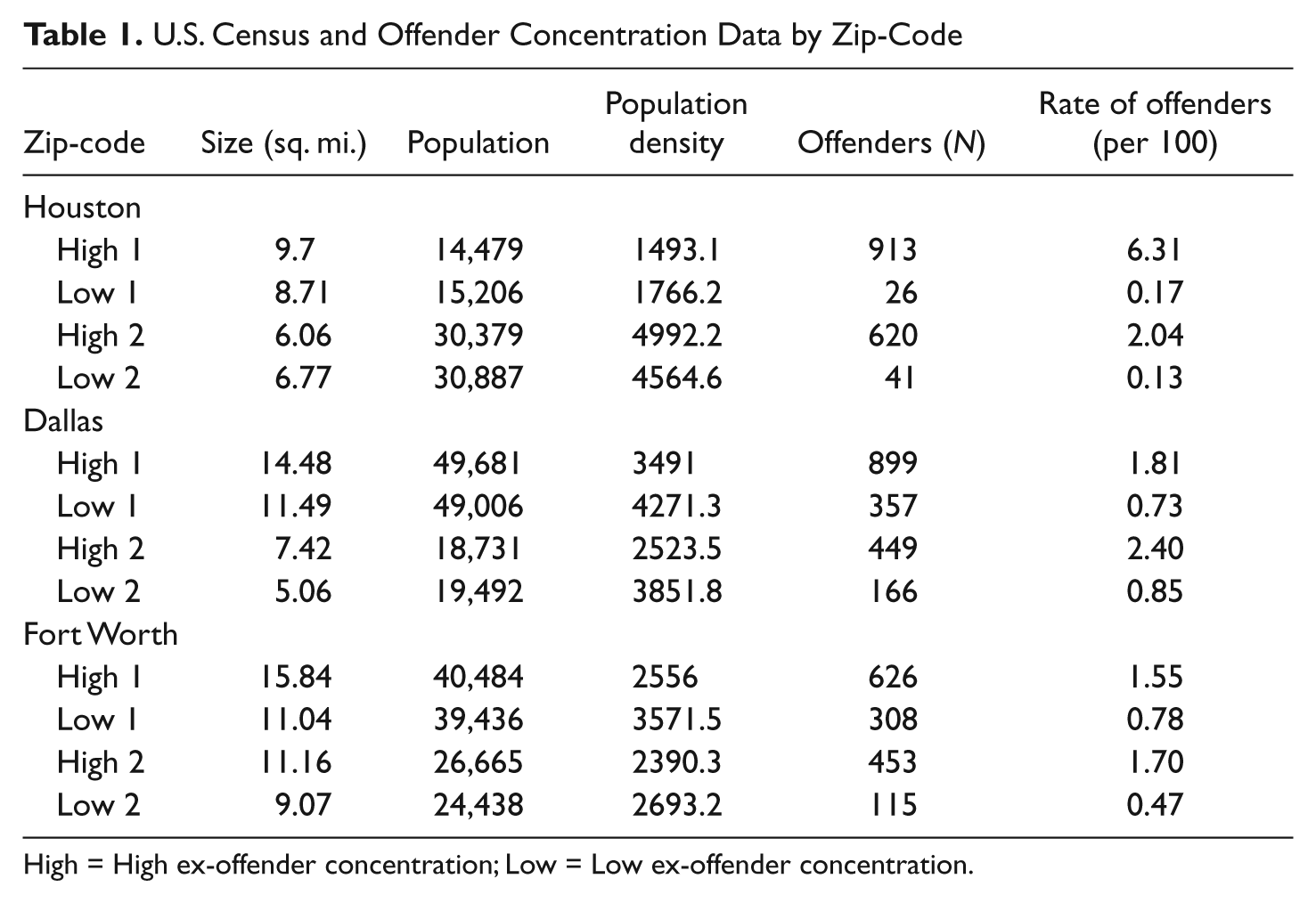
High = High ex-offender concentration; Low = Low ex-offender concentration.
Although the high and low offender concentration areas includes only ex-offenders on parole, and not ex-offenders on probation, those released from prison without parole, or ex-offenders who are no longer under any criminal justice supervision, the measure is meant to serve as a proxy for the total number of ex-offenders residing in a specific zip-code. Unfortunately, data on the number of probationers in a given zip-code were not available to the researchers and were unable to be used when determining the high and low offender concentration zip-codes. For every one offender on parole in Texas there are approximately four offenders on probation (Glaze, Bonczar, & Zhang, 2010), and because probationers were not included when determining high and low offender concentration zip-codes, the distribution of high and low concentration zip-codes could potentially be skewed. However, of the 72,320 offenders released from state prisons in Texas in 2009, approximately 80% were released conditionally on parole (West & Sabol, 2010). Therefore, even though probationers and nonsupervised ex-offenders are not accounted for when determining the high and low offender concentration zip-codes, the large number of ex-offenders released on parole in Texas provides an appropriate proxy for the number of offenders residing in a specific zip-code.
An online job search engine was used to find 60 businesses within each of the 12 zip-codes from industries that typically employ ex-offenders (e.g., automotive, construction, food services, maintenance, and carpentry/electrical/plumbing industries). The online job search engine allowed for searches based on zip-code and industry. Results from the searches provided the researchers with business names, addresses, and phone numbers. Unlike Giguere and Dundes (2002), both individual businesses and franchises were included in the sample, because individuals with a criminal record have a relatively high likelihood of applying and being employed at franchise corporations. Within each business, researchers asked an employee whose duties included hiring for the company to complete a brief survey. An overall response rate of 17.94% was obtained using both mail and telephone survey methodology.
Procedure
Initially, the Total Design Method (TDM) created by Dillman (1978) was used in part to conduct a mail survey which included using follow-up postcards and assurances of confidentiality; 3 however, after taking into account the surveys returned by the postal service due to invalid addresses, a low response rate (9.97%) resulted. Follow-up phone calls were made to a random subset of 267 of the remaining 659 businesses who did not respond to the mail survey. 4 After accounting for disconnected phones, no answer from the business, and the inability to contact the hiring manager, a response rate of 45.16% was obtained from businesses contacted via telephone. A total of 103 surveys (both mail and telephone) were completed for an overall response rate of 17.94%. 5
Analytic Procedure
Confirmatory factor analysis and reliability analysis were conducted to confirm the scale structures within the Employer Attitudes Toward the Hiring of Ex-Offenders (EATHE) Survey. Two principal components factor analyses were conducted. First, factor analysis tested whether a single factor structure existed among 19 questions that examined the multiple dimensions that an employer might consider as part of their hiring practices (e.g., personal attributes, qualifications, and the like.). A separate exploratory factor analysis was conducted based on 15 questions that examined possible variation of hiring attitudes based on the offense for which the offender was convicted. This analysis was conducted to confirm whether a single or multiple factor structure existed. Data were examined prior to the analysis to verify normality, linearity, and homoscedasticity. 6 A varimax rotation was used to minimize factor complexity and maximize variance for each factor.
The analysis of the 19 employer attitude questions demonstrated the support of a single factor structure despite the multiple dimensions included in the survey questions. Factor loadings ranged between .246 and .758 for the 19 employer attitude questions. The exploratory factor analysis of the 15 questions querying the employers’ attitudes based on the conviction offense of the ex-offender found three components. Component 1, Violent Offenses, included questions related to the offenses of sexual assault of an adult, murder, sexual assault of a child, aggravated assault, domestic violence, and robbery, and accounted for 44.89% of the variance. Component 2, Drug Offenses, included questions related to the offenses of possession/use of marijuana, possession/use of a drug other than marijuana, selling marijuana, DWI, and selling a drug other than marijuana, and accounted for 12.69% of the variance. Component 3, Property Offenses, included questions related to the offenses of burglary, motor vehicle theft, theft, and arson, and accounted for 9.97% of the variance.
Reliability analyses were also conducted on both the employer attitude and three offense type scales. The employer attitude section demonstrated strong internal consistency (α = .890). The reliability analyses for the three offense scales also indicated strong internal consistency (Violent Offense Scale α = .857; Drug Scale α = .874; Property Scale α = .829).
Results
Participants
As noted earlier, a total of 103 completed surveys were received. Three of the surveys had large amounts of missing data and were excluded from the analysis resulting in 100 usable surveys. When conducting the statistical analyses, listwise deletion was used, thus deleting any case that had a missing value from the analysis. This resulted in 97 cases being analyzed. 7 The average survey respondent was a White (63%; 25% African American; 9% Hispanic; 3% Other), male (72%), 48-years-old (SD = 12.75), who was in charge of hiring employees for their respective business, and had never been arrested or spent time in prison or jail (85%). The survey respondents represented a diverse set of businesses in three urban areas. Half of the businesses, for example, were located in areas with a high concentration of ex-offenders on parole, whereas the other half were located in areas with a comparatively low rate of ex-offenders on parole. Almost one third (31.3%) of respondents indicated their business was in the automotive industry, approximately one fourth (23.2%) of businesses were in the food service industry, and one-fifth (17.2%) were in the construction industry. In addition, the businesses employed an average of 17 employees (SD = 23.09), and 41% were male-owned companies (31% family owned 16% franchise; 12% female/multiple owners). More than half (53%) of the businesses regularly conducted background checks on potential employees, whereas 8% of respondents stated that they “sometimes” conducted background checks. Furthermore, 78% of respondents knowingly hired someone who had been incarcerated.
Respondent Willingness to Hire Ex-Offenders
In response to a global statement that stated “I am willing to hire an ex-offender,” 54% of respondents agreed or totally agreed that they were willing to hire an ex-offender, whereas only 14% indicated that they disagreed or totally disagreed with the statement. Interestingly, these results are in contrast to Albright and Denq’s (1996) study that found only 12% of respondents agreed with the statement “I am inclined to hire an ex-offender” and 42% disagreed with the statement. Composite scale score results, which included 19 other employer attitude statements, indicated an overall slightly better-than-neutral perspective (M = 3.39, SD = .516) in favor of employers’ willingness to hire ex-offenders (1 = totally unwilling, 2 = unwilling, 3 = neutral, 4 = willing, 5 = totally willing).
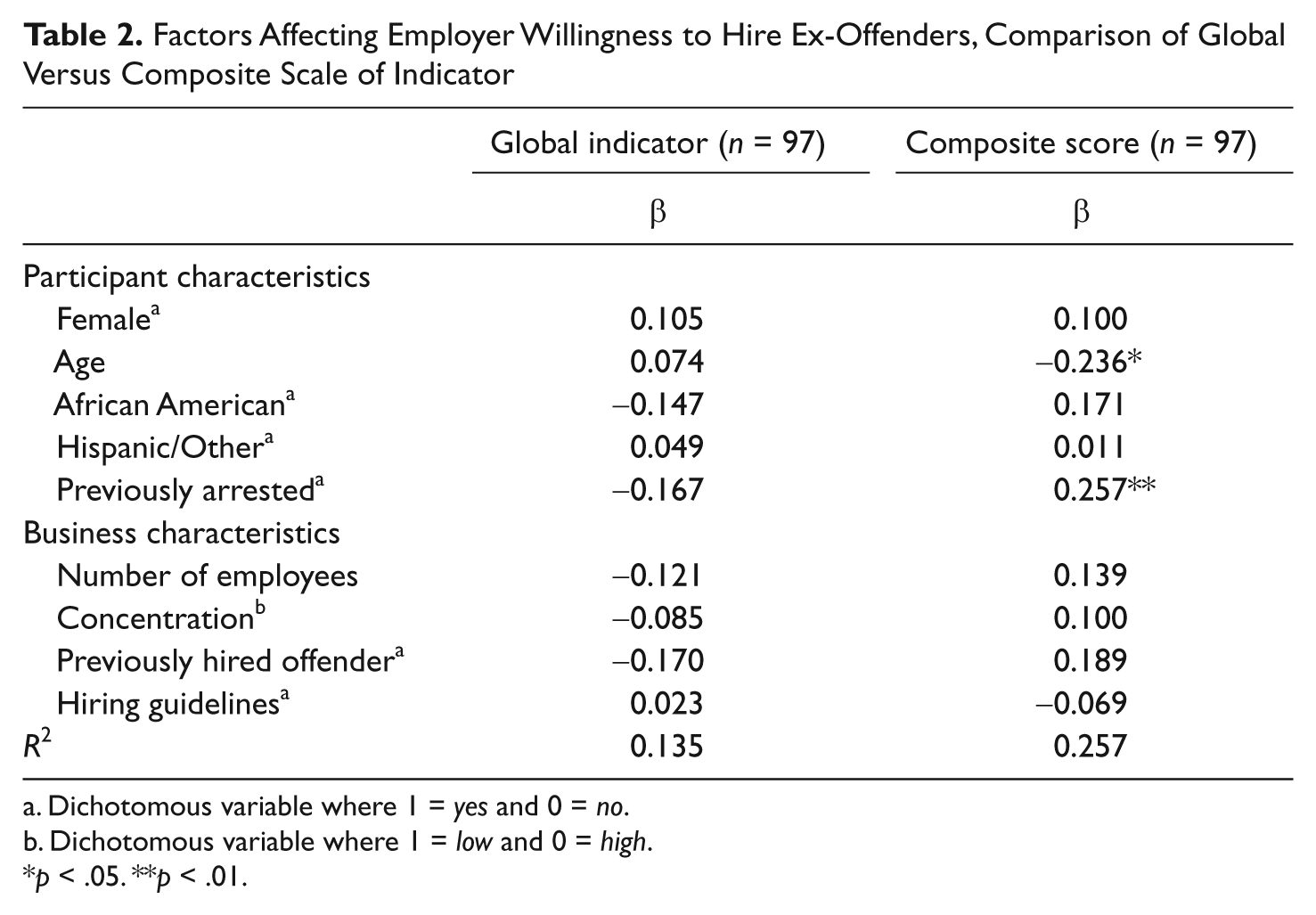
Independent sample t tests compared differences in attributes of respondent characteristics and the composite outcome measure finding significant differences in the willingness to hire an ex-offender scale score between respondents employed at businesses who were currently hiring versus those who were not hiring (M = 3.60, SD = .503 vs. M = 3.29, SD = .495, t (98) = −2.93, p = .004), businesses who had previously hired an ex-offender versus those who had not (M = 3.44, SD = .499 vs. M = 3.18, SD = .546; t (97) = -2.13, p = .036), younger respondents compared with older respondents (r = −.282; p = .005), and respondents who had previously been arrested versus those who had not been arrested (M = 3.72, SD = .462 vs. M = 3.33, SD = .507; t (97) = −2.78, p = .007). 8 However, when employing a multiple regression model approach, 9 as shown in Table 2, arrest history had a significant positive effect, while age had a significant negative effect on the employer’s willingness to hire an ex-offender on the composite scale score despite 26% explained variance in this model.
Factors Affecting Employer Willingness to Hire Ex-Offenders, Comparison of Global Versus Composite Scale of Indicator
Dichotomous variable where 1 = yes and 0 = no.
Dichotomous variable where 1 = low and 0 = high.
p < .05. **p < .01.
Employer Attitudes Versus Offense Type
Even though more than half of the respondents indicated an overall willingness to hire an ex-offender, when presented with different types of offenses, results demonstrated there was variability in the willingness of employers to hire ex-offenders by offense type. On average, more than 80% of employers expressed some degree of unwillingness to hire an ex-offender who was convicted of a violent offense (range between 79% unwilling to hire a person convicted of aggravated assault to 94% unwilling to hire a person convicted of sexual assault of a child), with the exception of domestic violence, where only 51% indicated an unwillingness to hire. In addition, between 53% (burglary) and 78% (arson) of respondents indicated they were either unwilling or totally unwilling to hire an ex-offender who was in prison/jail for a property crime. Finally, between 10% (possession/use of marijuana) and 46% (selling a drug other than marijuana) of respondents indicated they were unwilling to hire someone who had been in jail/prison for a drug offense. Employers were more willing to hire people who had been convicted of DWI and possession/use of marijuana, with 51% and 53% willing to hire, respectively. Thus, employers were more inclined to hire ex-offenders who were incarcerated for minor crimes, as opposed to hiring individuals who were incarcerated for more stigmatizing violent crimes such as sexual assault and murder.
Three multiple regression models were conducted to determine the influence of the respondent characteristics on their willingness to hire ex-offenders convicted of either a violent, drug, or property offense. As seen in Table 3, respondents who were African American were significantly more willing to hire an ex-offender who was convicted of a violent offense as compared with White respondents. Furthermore, respondents who had an arrest history as well as those with a greater number of employees were more willing to hire an ex-offender convicted of a drug offense. The characteristics included in the offense type models accounted for approximately 24% of the variance in willingness to hire an ex-offender convicted of a violent offense, 19% of variance in willingness to hire an individual convicted of a drug offense, and 12% of variance in the willingness of participants to hire an individual convicted of a property crime.
Factors Affecting Employer Willingness to Hire Ex-offenders by Offense Type

Dichotomous variable where 1 = yes and 0 = no.
Dichotomous variable where 1 = low and 0 = high.
p < .05. **p < .01. ***p < .001.
Employer Attitudes by Level of Ex-Offender Concentration
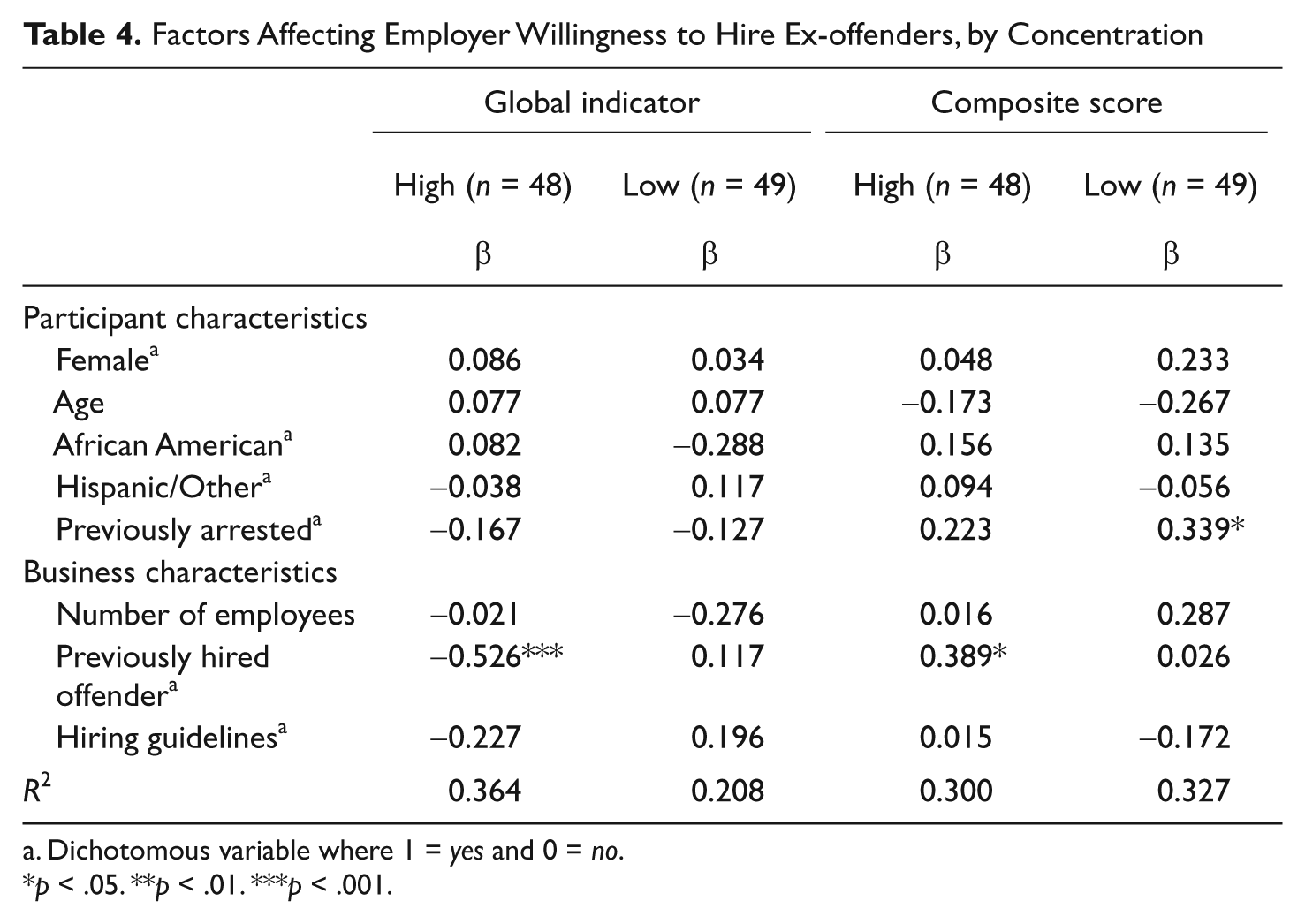
Results from an independent sample t test showed that there was no statistically significant difference in a respondent’s overall willingness to hire an ex-offender between those respondents located in a geographical area with a high concentration of ex-offenders on parole (M = 3.34, SD = .469) as compared with geographical areas with a low concentration of ex-offenders on parole (M = 3.43, SD = .561; t (98) = –.830, = .409). As seen in Table 4, multivariate models, which controlled for respondent characteristics, indicate that after accounting for the concentration of ex-offenders in the geographical area, respondent characteristics do differ for the global indicator measure. Specifically, in high concentration areas, having previously hired an ex-offender had a significantly negative relationship with willingness to hire ex-offenders; however, in low concentration areas respondent characteristics did not affect willingness to hire ex-offenders.
Factors Affecting Employer Willingness to Hire Ex-offenders, by Concentration
Dichotomous variable where 1 = yes and 0 = no.
p < .05. **p < .01. ***p < .001.
For the composite attitude scale, in high concentration areas a respondent that previously hired an ex-offender was more willing to hire an ex-offender, whereas a respondent in low offender concentration areas who themselves had an arrest history was more likely to hire an ex-offender. In conclusion, the influence of respondent characteristics on willingness to hire differed slightly depending on the concentration of ex-offenders in the community and depending on the type of outcome measure used (global indicator vs. a series of questions reduced to a composite scale score). Given that prior experience in hiring an ex-offender in high concentration areas was consistently significant across question type, we would argue this was the most robust finding.
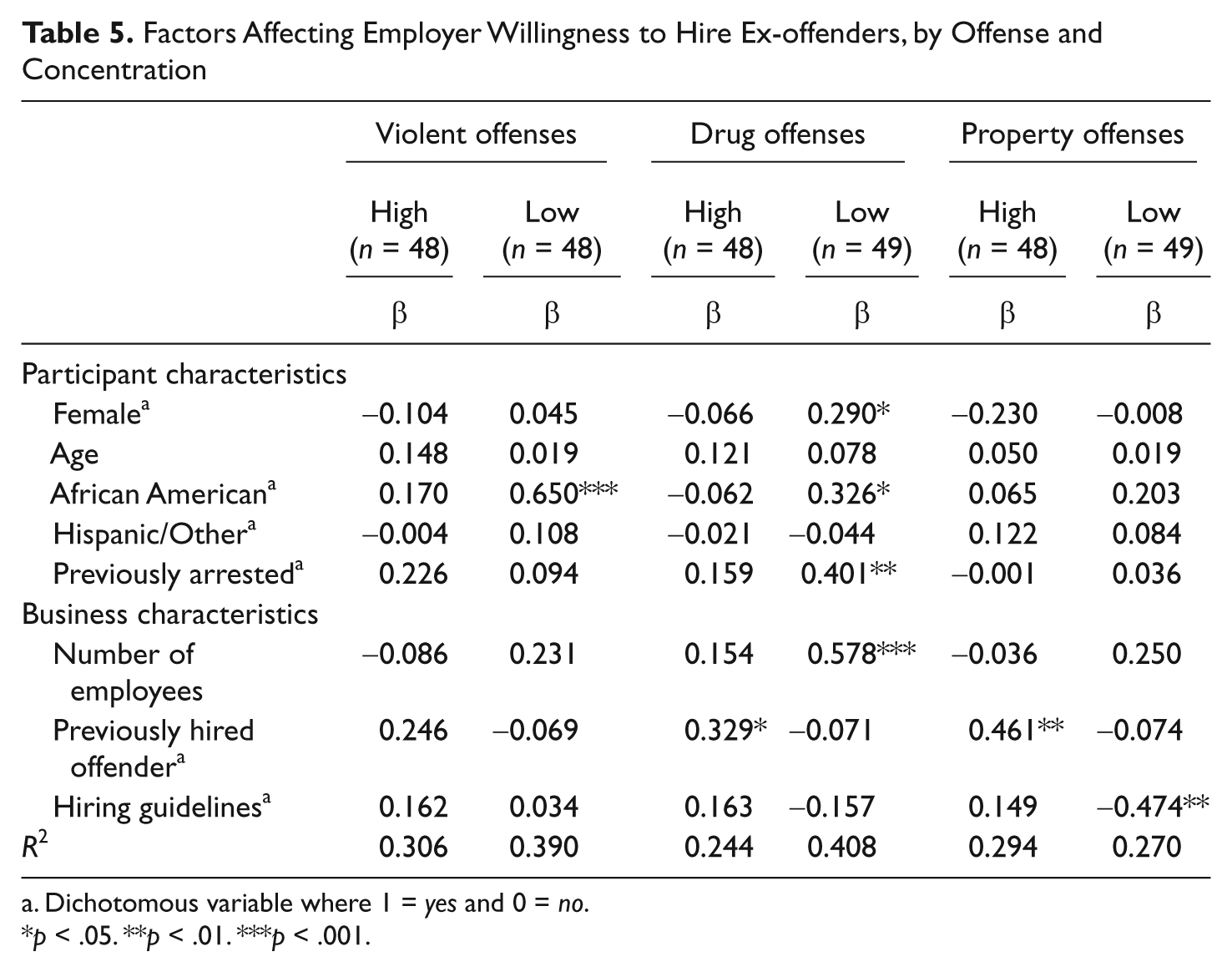
Multiple regression models were also conducted to determine the varying influence of respondent characteristics on willingness to hire between high and low concentration areas when accounting for the offense type of the ex-offender. As shown in Table 5, no independent variables significantly contributed to the violent offense model in high concentration areas. For the low concentration areas, respondents who were African American were more likely to hire violent offenders. Table 5 also indicates that previously hiring an ex-offender significantly contributed to the drug offense model for high concentration areas, while being an employer who is female, African American, or has an arrest history, in addition to the number of employees at the respondent’s business, significantly contributed to the drug offense model for low concentration areas. In regard to property offenses, respondents in high concentration areas that previously hired an ex-offender were more likely to hire ex-offenders, whereas in low concentration areas, having guidelines in place for hiring ex-offenders at the respondent’s business reduced the likelihood that a respondent would hire an ex-offender. In conclusion, some respondent characteristics did have a differential influence depending on the level of ex-offender concentration. Specifically, the most robust finding was, once again, that a respondent with prior experience hiring an ex-offender in a high concentration area was most likely to do so again in cases of a non-violent offender. No respondent characteristics, however, had consistent influence across offense type, indicating the complexity of making general assumptions about employer attitudes toward hiring ex-offenders.
Factors Affecting Employer Willingness to Hire Ex-offenders, by Offense and Concentration
Dichotomous variable where 1 = yes and 0 = no.
p < .05. **p < .01. ***p < .001.
Discussion
The necessity of understanding employer attitudes toward hiring ex-offenders is paramount, as finding legitimate employment upon release has been cited as one of the most important aspects of successful reintegration into society (La Vgine & Kachnowski, 2005). Prior research has shown an overall unwillingness of employers to hire ex-offenders (Albright & Denq, 1996; Giguere & Dundes, 2002; Holzer et al., 2002; Pager & Quillian, 2005; Petersilia, 2003). Prompted by research that has illustrated the geographic clustering of offenders released from prison within a limited number of urban areas, the purpose of this research was to expand on previous literature by examining current employer attitudes toward the hiring of ex-offenders, and whether employers’ attitudes differed depending on the concentration of ex-offenders that exists within the geographic area of the business, respondent characteristics, and offense type of the ex-offender.
Results did not find an overall statistically significant difference between employers’ attitudes in areas with a high concentration of ex-offenders on parole and those areas with a low concentration of ex-offenders on parole, using either a global indicator or a series of questions combined into a composite scale score. This finding demonstrates that ex-offenders who return to an area with an already high concentration of ex-offenders are not less likely to be hired by potential employers based on their criminal background than ex-offenders who return to an area with a low rate of ex-offenders. Thus, geographic clustering of ex-offenders does not exacerbate employment barriers. A remaining issue, however, is what other factors act as barriers to legitimate employment for ex-offenders, and whether these factors are influenced by the concentration of ex-offenders in the geographical area of the respondent’s business.
On the basis of recent literature (see Pager & Quillian, 2005; Graffam, Shinkfield, & Hardcastle, 2008), it was hypothesized that few employers would be willing to hire an ex-offender. Results proved contrary to expectations in that 54% of respondents agreed or totally agreed with a statement that they would be willing to hire an ex-offender, whereas only 14% of respondents disagreed or totally disagreed. These results are in contrast to Albright and Denq’s (1996) study wherein only 12% of respondents agreed with the statement “I am inclined to hire an ex-offender” and 42% disagreed with the statement. Thus, it appears that in contrast to perceptions of ex-offenders that their criminal record is a significant stigma for employment, only a marginal 14% of prospective employers held this perception. This difference in findings, however, could be due to the fact that Albright and Denq surveyed businesses in which ex-offenders are not likely to be hired due to legal barriers or skill deficits.
Instances in which the criminal record stigma hypothesis did hold true and likely would prevent an ex-offender from being hired resulted from an offender’s conviction of specific offense types. Similar to Giguere and Dundes (2002), who found that employers were more likely to look past crimes such as drug offenses and traffic violations, but were much less willing to hire those who committed murder, robbery, and rape, our results indicated that employers were less willing to hire individuals who had been convicted of more serious crimes as opposed to less serious crimes. Specifically, employers were much more willing to hire ex-offenders convicted of DWI or possession/use of marijuana than an ex-offender convicted of sexual assault or murder. Of interest, however, is that employers indicated more willingness to hire a violent offender convicted of domestic violence than any other violent offense (only 51% unwilling compared with the next lowest violent offense where 79% were unwilling to hire someone convicted of aggravated assault). This finding could be attributed to the fact that employers do not feel threatened by domestic violence offenders because the context of the crime is within domestic relationships.
Another important consideration in understanding barriers to gainful employment by ex-offenders was a respondent’s willingness to hire ex-offenders that varied by both individual and business characteristics. In contrast to Hirschfield and Piquero (2010), who found that older individuals hold less stigmatizing attitudes toward ex-offenders, we found older employers were less likely than younger employers to hire an ex-offender. Secondly, contrary to the study presented by Atkinson and colleagues (1976), businesses who had previously hired an ex-offender were significantly more likely to hold attitudes favorable to hiring an ex-offender than those businesses who had never knowingly hired an ex-offender in the past. This was especially evident for businesses in high offender concentration areas for nonviolent offenses. A number of reasons for this relationship may exist. Given the high concentration of ex-offenders in an area, it could be that employers simply do not have a choice to be so selective to the extent of exclusion given that ex-offenders comprise a significant proportion of their applicant pool. Alternatively, as based on anecdotal discussion with respondents, it simply may be that businesses who had previously hired an ex-offender for the most part had positive experiences with the previous ex-offenders they hired and for that reason do not hold a negative perception (stigma) against ex-offenders (see Hirschfield & Piquero, 2010 for a discussion of this issue).
Another respondent characteristic that influenced willingness to hire in some instances, specifically in low concentration areas for drug offenses, was whether the respondent had previously been arrested for a crime. Survey respondents who had previously been arrested were significantly more likely to hire an ex-offender than those who had never been arrested for a crime. This could also be explained because of the familiarity and ability to relate with the stigmatized group as noted by Hirschfield and Piquero (2010). Based on anecdotal discussion with respondents, it appeared that individuals who have been arrested for a crime may perceive that individuals make mistakes and deserve another chance, or that people are sometimes “in the wrong place at the wrong time” and hold greater empathy for the ex-offender.
From a methodological perspective, conflicting findings occasionally arose depending on whether a global willingness to hire question was posed compared with more detailed questions that were then combined into a composite scale score. Similar to studies that have examined public opinion on offender punishment models, although initial responses may seem harsh, when participants are presented with additional options the complexities of the issues are demonstrated and a less punitive attitude is often prevalent (Cullen, Fisher, & Applegate, 2000). Thus, future studies must carefully consider the construction of their instrument as well as their methodological approach.
Policy and Program Implications
Although robust, consistent differences were not evident between respondents in areas of high offender concentration areas and low offender concentration areas, the complexities of employer attitudes were highlighted and a demonstration of an overall willingness to hire many types of ex-offenders was evident. Consequently, these findings provide insight for a variety of programs and policies related to efforts to support employment of ex-offenders. First, given that level of offender concentration did not negatively influence respondents’ willingness to hire ex-offenders, an emphasis on disbursing offender clustering for the purposes of finding employment is not necessary. Instead, policies to encourage job growth in these labor markets should be favored. Clearly, there is a greater need to address areas and businesses in high offender concentration areas, given the sheer concentration of ex-offenders returning to a limited geographical area (Clear, 2007; Harrison & Schehr, 2004; Holzer et al., 2003; Lynch & Sabol, 2001; Petersilia, 2001a; Petersilia, 2001b; Petersilia, 2003).
Second, employment programs for ex-offenders can use this insight to inform its participants about the type of employers that are more likely to hire ex-offenders when they are applying for positions. Specifically, targeting younger business owners, those who have previously hired ex-offenders and those employers who have themselves had experience with the criminal justice system, as the results of this study suggest that employers with these characteristics are more open to hiring ex-offenders. The grouping of these characteristics underscores the potential importance of informal networks for an ex-offender in obtaining employment, whether that network is peers or relationships with community agencies serving ex-offenders with local businesses. Third, outreach programs could use this information to target potential employers who are less willing to hire an ex-offender and attempt to change their attitudes.
To enhance ex-offender employment rates, policy and program development efforts should focus on options such as developing a liaison between the prisons and jails and businesses in high concentration areas. Specifically, targeted businesses should include those that have previously hired an ex-offender, as well as young business owners, and business owners who have previously been arrested for a crime, as they may be less influenced by the stigma of the criminal history of a prospective employee. Forging successful employment partnerships with businesses and/or employers that fall into categories of typical ex-offender employment could be accomplished through job fairs held at the local jail/prison, or at a neutral location. In addition, keeping connections with other offenders who have participated in reentry programs and hired by a business would be beneficial. These types of efforts would allow for both employers and individuals near their release date to meet and reduce the stigma for employers without experience of hiring an ex-offender, and help reduce the fear that offenders may have of applying for jobs once released. This type of program could also provide recently released individuals with assistance when attempting to locate employment opportunities.
In addition to forming successful employment partnerships that result in employer buy-in, reentry programs for offenders should consist largely of employment readiness components. Supported by the results herein that the stigma of hiring an ex-offender is much less than previously thought, the barriers to gainful employment evoke consideration of the other half of the employment equation—the applicant. Employment readiness components of a reentry program should include, at the very least, how to fill out an application, development of interview skills, professionalism in the workplace, appropriate interpersonal and group interaction, effective self-presentation, how to show an employer that one is willing to change their criminal behavior, social interaction with prosocial segments of society, and perseverance in the job search process. Respondents indicated with comments on the survey data collected in this study the importance of professionalism and willingness of offenders to change. For example, one employer specified that they do not believe ex-offenders are much different in person than other employees; however, it is important for ex-offenders to maintain a professional appearance at work because of the contact they may have with the public. Other employers stated that ex-offenders need to show that they want to remove the label of “ex-offender” and that they are motivated and willing to change.
Many respondents also commented that their willingness to hire an ex-offender greatly depends on the type of crime committed and the number of times an individual has been arrested or spent time in prison/jail. It is important that reentry programs take into account that those offenders with more stigmatizing offenses (i.e., sex offenses) are going to have significantly greater difficulty obtaining employment upon release than offenders who have been imprisoned for crimes such as DWI or possession/use of marijuana. Moreover, offenders convicted of more serious offenses will likely have been removed from society for longer periods of time.
The development of policy and programs to improve the employment opportunities and marketable skill sets for ex-offenders upon release from prison is a daunting, but critical, undertaking. The more that prisoners are prepared for the workplace, successful employment partnerships are formed, and employers are educated about stigmatizing offenses, the more willing employers might be to hire an ex-offender. Accordingly, such opportunities afforded to ex-offenders by employers potentially serve to increase ex-offenders’ quality of life and decrease their likelihood to recidivate.
As with any study, this research is presented with some limitations that could bias the results. As was previously stated, the response rate for this mail survey was 17.94%. The low response rate of employers could be due to a number of explanations including the abundance of “junk” mail received by American households and businesses, the length of the survey (49 questions), and targeted population of human resource oriented persons in a business. The high level of work typical to the position of human resource/hiring manager allows for minimal “down time” to complete an unsolicited survey. A more traditional household target population may have elicited a higher response rate. Thus, a biased response set may exist. Those who feel very strongly about the topic (either very willing or extremely opposed to hiring an ex-offender), for example, could have been more likely to respond to the survey than those who had neutral or no opinion. If this is the case, nonresponse bias could be an issue where those employers with neutral feelings toward the hiring of ex-offenders are not included, thus skewing the results in favor of the findings that were presented.
Although this research shows no difference among employers based on location, some aspects considered by prospective employers may not have been adequately measured. A few employers, for example, commented that many factors are considered when hiring an ex-offender, such as their type of offense, the number of times incarcerated, the length of time that has passed since release, and whether the offender has been rehabilitated. Future research could further enhance this study by specifying different ex-offender subtypes to gain a more detailed viewpoint of employers, which could be done through the use of vignettes that vary by offense type and other variables that are deemed important in the hiring decision process. In addition, researchers could have employers who have previously hired ex-offenders further elaborate on their experiences, both positive and negative, of hiring an ex-offender, which might allow for a more in depth qualitative analysis of the reasons for which employers hired ex-offenders in the first place.
Footnotes
Declaration of Conflicting Interests
The author(s) declared no potential conflicts of interest with respect to the research, authorship, and/or publication of this article.
Funding
The author(s) received no financial support for the research, authorship, and/or publication of this article.