







Abstract
In this article, we use 3 years of youth court data from a southeastern state to examine whether referrals that originated from school resource officers (SROs) involve greater proportions of less serious offenses than referrals from other sources. Referrals from SROs during the 3-year period were similar to referrals by law enforcement outside of school for status and serious offenses. SROs were less likely than law enforcement officers outside of school to refer juveniles for minor offenses during the 3-year period. Our findings suggest that schools, not solely police in schools, make a large contribution to the number of juveniles referred to the juvenile justice system for less serious offenses. Implications for policy and future research are also discussed.
In a New York Times article from April 2013 titled “With Police in Schools, More Children in Court” (“With Police in Schools,” 2013), the authors argue that judges and youth advocates are seeing a “ . . . surge in criminal charges against children for misbehavior that many believe is better handled in the principal’s office” in schools where police officers are assigned as school resource officers (“With Police in Schools,” 2013, para. 1). The authors quote numerous school administrators, youth advocates, attorneys, and judges, along with one criminal justice researcher, who are highly critical of using school resource officers (SROs) because they bring children into the juvenile justice system for less serious behaviors that might better be handled by school administrators than law enforcement. A number of others have made that same charge (Kupchik, 2010; Na & Gottfredson, 2013; Theriot, 2009), most notably a widely cited report from the Justice Policy Institute (2011) titled Education Under Arrest: The Case Against Police in Schools. In the report, the authors review a number of studies that suggest the presence of police in schools has increased the number of arrests for minor offenses such as disorderly conduct and other misdemeanors. Consequently, in school districts throughout the United States, the presence of police in schools is highly criticized.
Nevertheless, the New York Times article, the Justice Policy Institute (2011) report, and the research cited in that report (much of which is reviewed below), suggest the need for a more careful examination of the claim that SROs bring more youths into the juvenile justice system for less serious offenses. In these studies, researchers typically (a) compare the number of arrests for minor offenses in schools that have police officers stationed in them with schools that do not have police officers stationed in them or (b) compare rates of arrests for minor offenses in schools before and after they implement an SRO program in that school. However, these strategies are not the most methodologically sound way to examine this research question.
In this article, we closely examine the research question of whether SROs lead to increased arrests for less serious offenses by using a method that, to our knowledge, has not been used before. Specifically, we compare the source of referrals for all juvenile offenses over a 3-year period in a southeastern state to determine whether referrals from schools with police officers are more likely to involve less serious offenses than referrals from other sources. Our findings suggest that, while SROs are more likely to refer juveniles who commit less serious offenses than law enforcement outside of school, family members, and Department of Human Services (DHS), SROs are actually less likely than school officials in schools where law enforcement officers are not stationed to refer students to the juvenile justice system for less serious offenses. We conclude by discussing the implications of this finding for school policy in general and for research around the effectiveness of SROs specifically.
Literature Review
School-to-Prison Pipeline
According to the Office of Juvenile Justice and Delinquency Prevention (OJJDP), there were more than 1.6 million arrests of juveniles in the United States in 2010, including 366,000 arrests for property crimes, 170,000 for drug abuse, and 156,000 for disorderly conduct (OJJDP, 2013). Recently, both the media and researchers have claimed that many of these arrests are made in schools, often for minor offenses. This process whereby juveniles are arrested in school and then entered into the juvenile justice system is commonly referred to as the school-to-prison pipeline.
According to the American Civil Liberties Union (ACLU; 2013), the school-to-prison pipeline is “the policies and practices that push our nation’s schoolchildren, especially our most at-risk children, out of classrooms and into the juvenile and criminal justice systems. This pipeline reflects the prioritization of incarceration over education” (p. 1). Simply put, schoolchildren are being severely punished for relatively minor infractions. These punishments often lead to students dropping out of schools and, subsequently, embracing deviant actions resulting in punitive consequences (Kim, Losen, & Hewitt, 2010). Although some would argue that the responsibility for such conduct lies solely on an adolescent’s own shoulders, this argument disregards the structural and systemic issues that shape and influence the actions of many young students (Hirschfield, 2008; Kim et al., 2010). For instance, children with learning disabilities, who suffer from broken homes, abuse, or neglect, or who are from poverty-stricken areas, are the group that is most likely to be subject to this pushing-out of the “problematic” students (May, 2014).
Christle, Jolivette, and Nelson (2005) argue that there are three primary components to the school-to-prison pipeline of students in the United States. First, when students act in a deviant manner and are punished accordingly, it often results in lower grades, less acquired knowledge, and lower overall academic success (Christle et al., 2005, 2007; Council on School Health, 2013; Mattison, 2004). Second, the school-to-prison pipeline involves the use of exclusionary disciplinary techniques, such as out-of-school suspensions, in-school suspensions, and alternative schools (Brownstein, 2010; Kim et al., 2010; Morris & Howard, 2003). This problem has been exacerbated by the adoption of “Zero Tolerance” policies, which remove teachers’ and administrators’ discretion in choosing less serious punishments for students, resulting in overly harsh punishments for students (Christle et al., 2005; Hirschfield, 2008; Schiff, 2013; Schiff & Bazemore, 2012; Theriot, 2009). Third, the school-to-prison pipeline leads to increased high school dropout rates (due to the lack of support) and stigmatization that often occurs when students are treated punitively in schools (Anderson, 2012; Kim et al., 2010; Theriot, 2009; Wald & Losen, 2003).
The third component is especially important given the strong link between dropping out of school and deviant, problematic, or criminal behavior (Anderson, 2012). This link can work in both directions. For example, Wald and Losen (2003) found that, in the late 1990s, nearly 68% of state prison inmates did not finish high school, suggesting that dropping out of school leads to criminal involvement. Alternatively, studies show that the majority of adolescents whose actions resulted in court involvement are at significantly higher risk of dropping out of school altogether (e.g., Petteruti, 2011). This suggests that problem behavior, and especially harsh punishments, leads to students dropping out of school.
It is important to note that not all students are at equal risk of falling victim to this process. Between 1973 and 2006, school suspension rates for African Americans increased from 6% to 15% (Losen & Skiba, 2010; Osher et al., 2012). Compared with their White peers, non-White students (specifically African Americans and Latinos) are at a much higher risk of being funneled through the school-to-prison pipeline (Alexander, 2010; Hirschfield, 2008; Peguero & Shekarkhar, 2011; Wald & Losen, 2003). Recent research controlling for additional explanatory variables reveals this discrepancy may be partially explained by previous problem behaviors of the students involved (Wright, Morgan, Coyne, Beaver, & Barnes, 2014) or by the seriousness of the offense in which the youth is alleged to have participated (Caudill, Morris, El Sayed, Yun, & DeLisi, 2012).
In sum, it has been argued that increased punitiveness in schools has resulted in a greater presence of juveniles in the criminal justice system. Because of this, many people have decried the increased presence of the justice system, particularly SROs, inside schools. Nevertheless, relatively little is known about whether SROs contribute to this problem and, if they do, the type of contribution they make. Below, we review research around SROs and the contribution they make to the school-to-prison pipeline.
School Resource Officers (SROs)
School resource officers (SROs) are law enforcement officers from local police departments who are assigned by their departments to work in a specific school or school district (Kennedy, 2000). According to the National Association of School Resource Officers (NASRO), there are currently more than 3,000 SROs internationally, but some scholars argue this number is underestimated because (a) there is no national census of SROs and (b) funding for SROs comes from numerous sources, meaning no one agency is in charge of keeping data on SROs (see Brown, 2006; Reaves, 2010; Theriot, 2009). The NASRO website claims “school-based policing is the fastest growing area of law enforcement” and states that SROs make referrals to local police officers on incidences of violence, theft, and non-fatal victimizations that occur within schools (NASRO, 2013). Kennedy (2000) outlines three primary objectives of SROs: (a) to connect the gap between police officers and students, (b) to encourage students to cooperate with law enforcement, and (c) to decrease deviant behavior and crime within schools.
The responsibilities of SROs are based upon the “Triad Concept.” The responsibilities include the roles of (a) teacher, (b) counselor, and (c) law enforcement officer (Hickman & Reaves, 2003; NASRO, 2013; Petteruti, 2011). First, they are teachers of the law, either granted with full authority of their own class or through visitations and guest lectures for other classes. Second, they serve as counselors, addressing issues relating to the law, and also guiding children in acts of community service. Finally, SROs have the ability to arrest students. This three-pronged approach allows law enforcement officers to not only use a variety of methods to enforce laws and school rules but also become role models for students to help shape children into productive members of society (Gonsoulin, Zablocki, & Leone, 2012).
On the surface, it would appear that the presence of an SRO in schools would deter crime and increase the likelihood of conforming behavior; in fact, a number of researchers support this claim (Brown, 2005; Jennings, Khey, Maskaly, & Donner, 2011; Johnson, 1999; May, Fessel, & Means, 2004; Trump, 2001; Virginia Department of Criminal Justice Services, 2001). However, numerous studies argue that the implementation of SROs into public schools is not beneficial, and is in fact harmful, to the students (e.g., Jackson, 2002; Mayer & Leone, 1999; Petteruti, 2011; Rimer, 2004). In 2011, the Justice Policy Institute found that having SROs in schools increases student arrest rates and significantly reduces the agency of school administrators in handling disciplinary measures (Petteruti, 2011). Through various techniques (e.g., investigations and incarcerations), SROs can often alienate students, hinder student participation in education, and cause both further student resentment toward law enforcement officers and increased levels of deviant behavior (Jackson, 2002). Scholars (e.g., Kim & Geronimo, 2009; Rimer, 2004) argue that SROs must refrain from practices used when they are on patrol, such as using handcuffs too quickly.
The main concern of opponents to the SRO system is the use of harsh punishments for relatively minor offenses. Theriot (2009) argued that the line between legitimate and illegitimate threats to the safety of students is becoming increasingly blurred. SROs have the discretion to determine what exactly constitutes assault, fighting, disorderly conduct, class disruption, felony robbery, and petty theft, to name only a few examples (Theriot, 2009). Within juvenile courts, Rimer (2004) found that the overwhelming majority of the arrest cases of juvenile offenders were for minor, non-violent incidents. In addition, Brooks, Schiraldi, and Ziedenberg (2000) reported arrest incidents that labeled adolescents involved in a relatively harmless verbal exchange during a school lunch as making “terroristic threats” (Brooks et al., 2000; Theriot, 2009).
The unnecessary arrests of students for minor and often frivolous incidents contradict the purpose of education programs to inform students and enhance their well-being (Petteruti, 2011; Skiba, 2000). When schools increase the presence of SROs, there is a significant increase in the amount of drugs, weapons, and less serious (e.g., fighting and insubordination) offenses reported (Na & Gottfredson, 2013). Kupchik (2010) found, particularly for minor offenses, that police officers are much more stringent in punitive measures than school administrators. Although advocates of strict discipline policies (e.g., Zero Tolerance) argue that SROs are the primary reason for the continued maintenance of rule conformity and social order in schools, research in educational settings points to factors such as schoolwide positive behavior interventions and supports and the presence of caring teachers and other adults as effective methods through which school safety can be improved (May, 2014).
In sum, critics suggest that the presence of law enforcement officers in schools “pushes” even more kids out of school with arrests that would not have occurred had the SROs not been present (Justice Policy Institute, 2011; Kupchik, 2010; Theriot, 2009). This argument is intuitive. If SROs in schools are doing their job, they will make more arrests than law enforcement officers who are not assigned entirely to schools but patrol in the community and are called to schools only as a reaction to alleged crimes committed on school grounds.
In this study, we contribute to the literature around whether SROs push more kids out of schools with arrests by addressing three research questions:
Our hope is that the answers to these questions will provide guidance to school and law enforcement administrators considering full-time assignments of law enforcement officers to schools.
Method
Data
Data were obtained from the Youth Information Delivery System (YIDS) of a southeastern state by members of the author team. YIDS is a web-based application system for the real-time management of the activities of the state’s Court System that allows members working in the juvenile justice system (e.g., intake officers, youth counselors, court administrators) to track juveniles at various phases of the juvenile justice system.
Data regarding intake of youths into the court system, scheduling of youth cases, management of court dockets, and tracking of custody situations are all included as part of the YIDS data collection efforts. For the purposes of this analysis, a referral occurs when any person involved in a youth’s case refers that youth to the county youth court. Referral data are typically entered at intake by one of the previously mentioned actors who work with the youth at intake. As workers enter the referral into the system, they typically enter the charges for which the youth are referred, the reason for referral, the date of the referral, and the source of the allegation (hereafter referred to as the referral source) into the system.
The worker entering the referral may choose multiple referral sources when the referrals originate from two or more sources. For example, juveniles who are truant may be referred by their parents, their school, and/or by law enforcement (if they are arrested for truancy).
In the data files, each referral source is treated as a separate variable. Thus, the first source listed becomes “Referral_Source1,” the second becomes “Referral_Source2,” and so on. For these analyses, we used all referrals of juveniles that were included in the 2009 to 2011 YIDS data. Between 2009 and 2011, there were referrals for 72,447 separate offenses entered into YIDS. 1
Across the 3-year period, 72,447 individual referrals were made for 168 separate offenses. To compare the types of offenses referred by SROs with referrals from both their counterparts not stationed at schools and other referral sources, we categorized the 168 offenses into one of four types of offenses using a standard categorization model provided by the state’s DHS/Division of Youth Services. The four types of offenses included 10 status offenses (e.g., truancy, running away), 25 minor offenses (e.g., shoplifting, petit larceny), 68 moderate offenses (e.g., simple assault, probation violations), and 65 serious offenses (e.g., domestic violence, residential burglary).
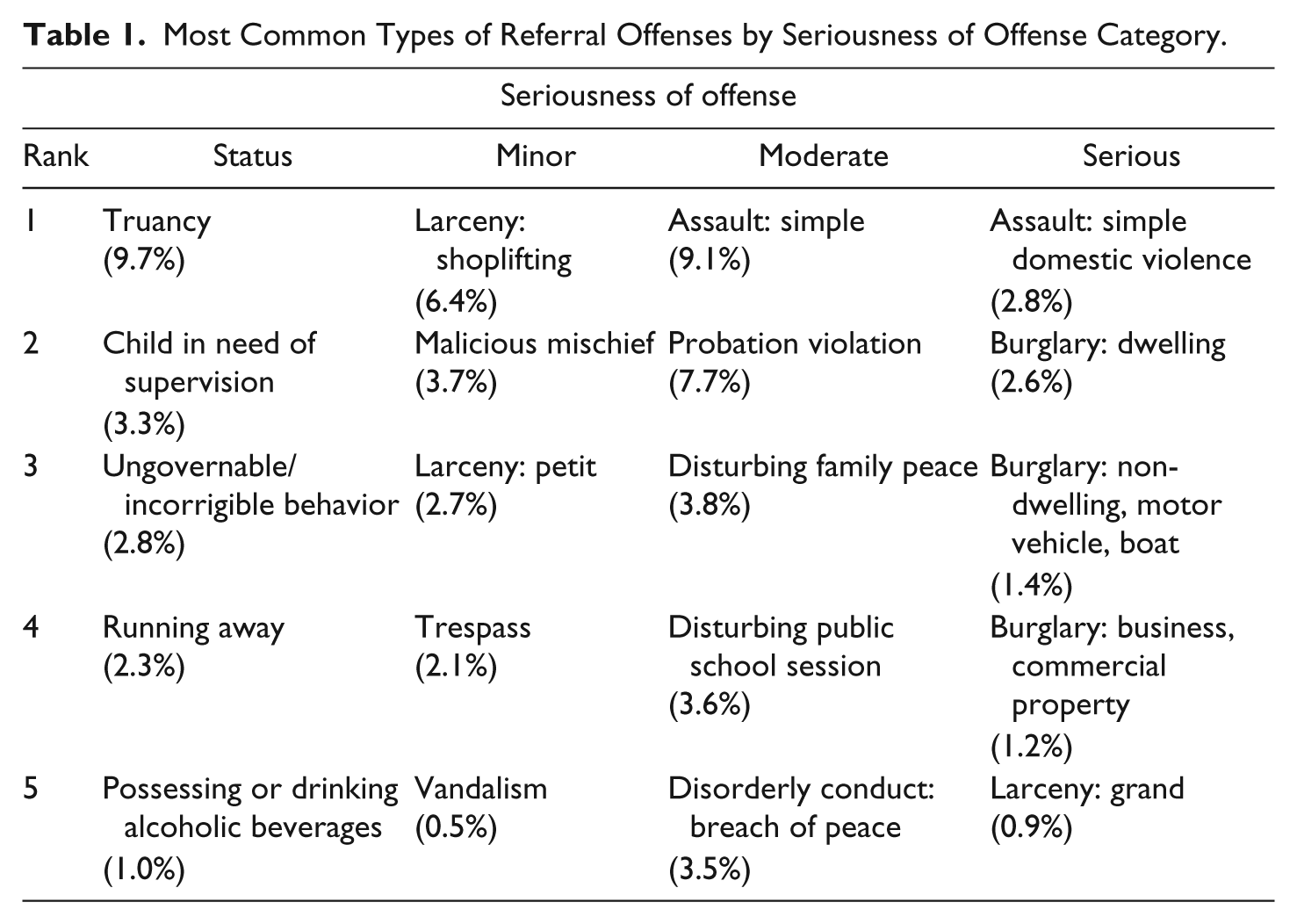
The results presented in Table 1 depict the five most common referrals for each of the four types of offenses. For status offenses, the most common referrals were for truancy (9.7% of the total referrals during the 3-year period), children in need of supervision (3.3%), and ungovernable/incorrigible behavior (2.8%). For minor offenses, larceny/shoplifting (6.4%), malicious mischief (3.7%), and petit larceny (2.7%) were the most common offenses. For moderate offenses, simple assault (9.1%), probation violation (7.7%), and disturbing family peace (3.8%) were most common, and for serious offenses, the three most common offenses were simple assault/domestic violence (2.8%), burglary of a dwelling (2.6%), and burglary, non-dwelling, motor vehicle, boat (1.4%).
Most Common Types of Referral Offenses by Seriousness of Offense Category.
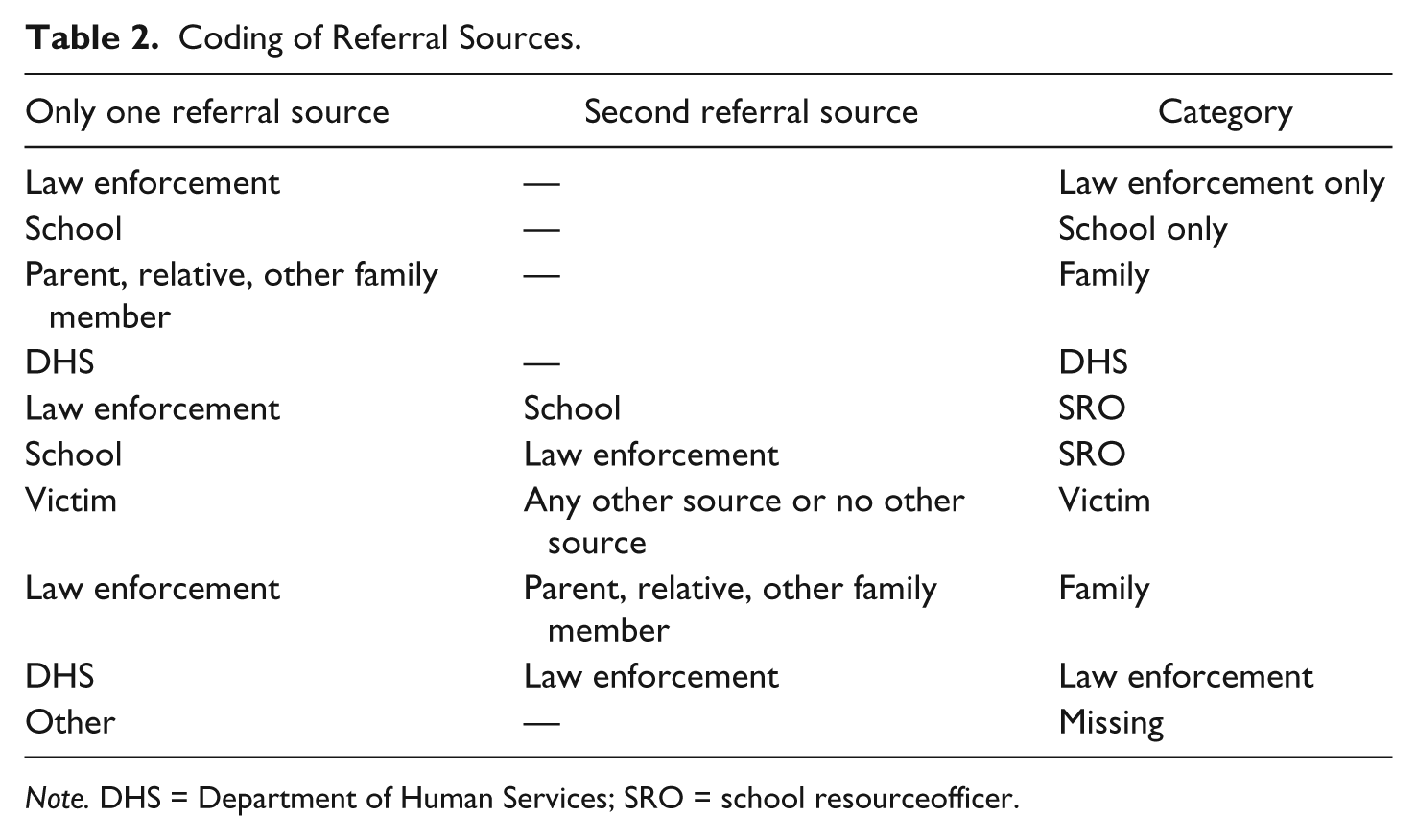
In Table 2, we present the referral sources included in the data set. For the purposes of these analyses, we categorized referrals into one of six categories: law enforcement only, school only, family only, DHS only, victim, and SROs. For the victim category, we included all referral sources that included a victim.
Coding of Referral Sources.
Note. DHS = Department of Human Services; SRO = school resourceofficer.
As the variable of interest in this study is the referrals that originated from SROs, we took particular care in identifying that referral source. According to the Administrative Office of the Courts, any referral that originated from a law enforcement officer assigned to a school listed both law enforcement and school as the two referral sources (and did not include any other referral source). Thus, any referral that included those two sources was coded as SRO. Other referrals with multiple sources include (a) both DHS and law enforcement, which was categorized as Law Enforcement as they have the final say in determining whether to make an arrest or take informal action; (b) both family (e.g., relatives, parents, other family members) and law enforcement, which was categorized as Family as these referrals would not have occurred had the family not reported the situation to law enforcement; and (c) both victim and law enforcement, which was categorized as Victim as those referrals also would not have appeared had the victim not contacted law enforcement to make them aware of the offense.
Of the 72,447 referrals entered into the system described above, 60,140 listed only one referral source, 5,859 referrals listed a second source, 102 listed three or more sources, and 12,307 did not list any referral source. Because the referral source is the variable of interest in this study, we excluded any referral that did not include a referral source. In addition, 3,123 referrals had a second referral source other than the ones listed above and thus were excluded from the analysis because they could not be categorized in any logical manner. For example, 971 were coded as “other” in the original data set on the first referral source; additional referral sources included court personnel, medical personnel, mental health, and loss prevention personnel. Furthermore, we excluded all cases with three or more referral sources because it was difficult to logically categorize those referrals into just one of the eight categories described above. Consequently, we excluded all cases that were (a) missing the referral source entirely, (b) had three or more referral sources, or (c) had one or more referral sources that were not able to be logically categorized into the categories created for this study. The data analyzed here thus include approximately 57,017 referrals.
Results
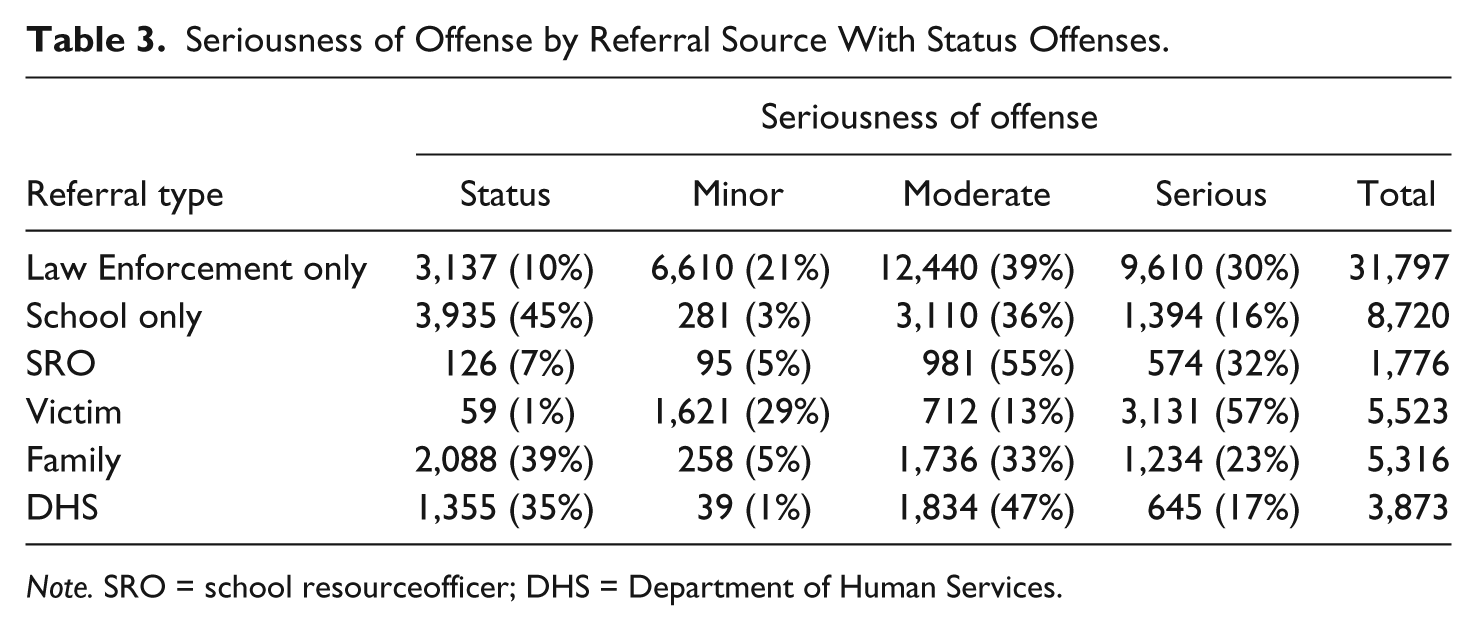
In Table 3, we display the results of a cross-tabular analysis where we categorize the types of offenses by referral sources. The majority of the offenses for each referral were moderate/serious offenses, although SROs (87%) were the most likely to refer youths for moderate (55%) and serious (32%) offenses. The school (45%), family members (39%), and the DHS (35%) were far more likely than law enforcement (10%), SROs (7%), and victims (1%) to refer youths for status offenses. Law enforcement (21%) and victims (29%) were most likely to refer juveniles for minor offenses.
Seriousness of Offense by Referral Source With Status Offenses.
Note. SRO = school resourceofficer; DHS = Department of Human Services.
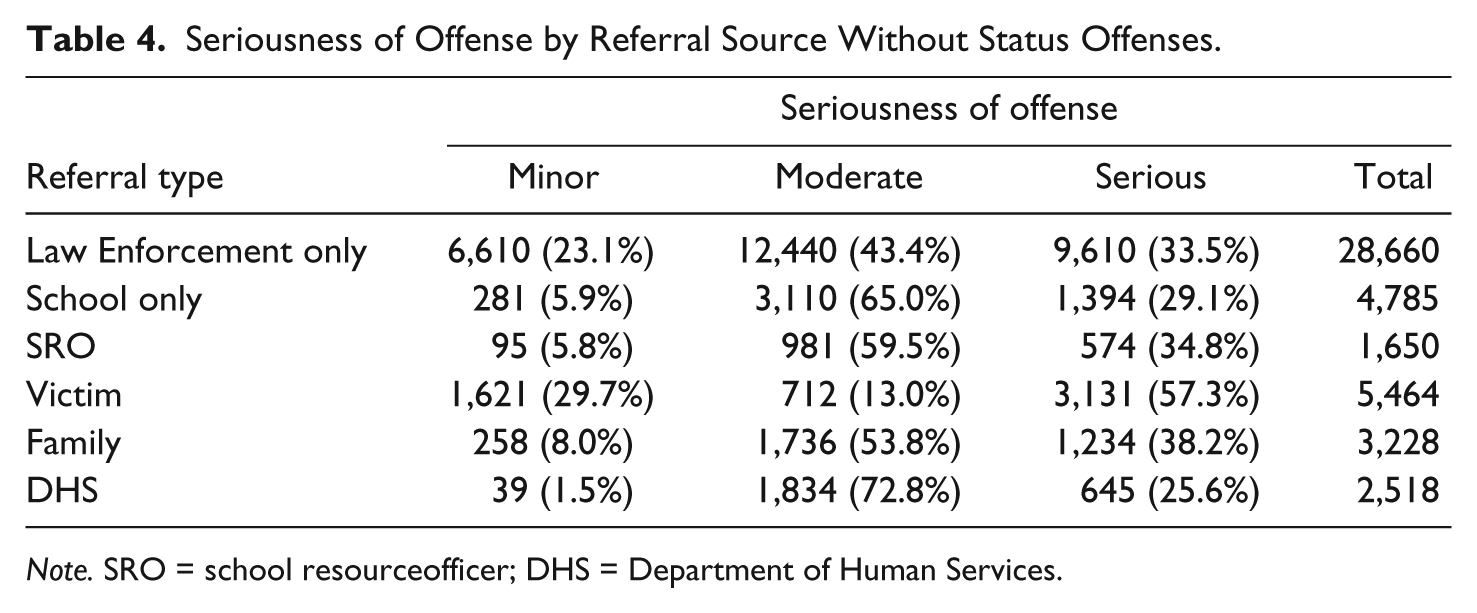
As with any examination of juvenile delinquency, examining referrals or arrests for status offenses is somewhat problematic. A number of situations that do not involve law breaking (e.g., ungovernable behavior/incorrigible, child in need of supervision) are categorized as status offenses and are typically reported directly by school officials (e.g, for situations involving children in need of supervision, or CHINS) or family members (ungovernable behavior). Furthermore, substantial percentages of the referrals from schools (45%), families (39%), and DHS (35%) were for status offenses while only small percentages for the other sources were for these offenses. For clarity, and to allow for a more direct comparison of referrals for only law-breaking behaviors between SROs and both schools and law enforcement without the interference of status offenses, in Table 4, we display the results presented in Table 3 with status offenses excluded. When status offenses are excluded from consideration, victims (57.3%) became most likely to refer juveniles for serious offenses, followed by family (38.2%), SROs (34.8%), and law enforcement (33.5%). Victims (29.7%) and law enforcement (23.1%) were most likely to refer juveniles for minor offenses, while schools (65.0%) and SROs (59.5%) were most likely to refer juveniles for moderate offenses. Thus, with the possible exception of serious offenses, after excluding status offenses, referrals from SROs appeared much more like referrals from schools than referrals from law enforcement outside of schools. If anything, SROs were slightly less likely to refer juveniles for moderate offenses.
Seriousness of Offense by Referral Source Without Status Offenses.
Note. SRO = school resourceofficer; DHS = Department of Human Services.
Discussion
In this study, we used referrals obtained from the Administrative Office of the Courts in a southeastern state to examine whether SROs were more likely to refer juveniles to the court system for less serious offenses than either schools in general or law enforcement officers outside of school settings. The data analyzed herein (all referrals from a statewide juvenile justice system) provide a novel approach to considering this important research question. Consequently, the conclusions outlined below provide a unique contribution to discussions of the roles of police in school and the effect that SROs have on the school-to-prison pipeline.
The analyses presented here suggest that, at least in this state during the time period under study, SROs do not increase the size of the school-to-prison pipeline. This conclusion is based on a variety of factors. First, and perhaps most importantly, SROs were responsible for approximately 3% of all referrals over a 3-year period (1,776 out of 57,005 total referrals). As seen in Table 3, only 95 of those referrals were law violations that we categorized as minor offenses. Thus, assuming there had not been any police stationed in schools during the 3-year period and the schools would not have referred the juveniles themselves if law enforcement were not present (an improbable assumption, as discussed below), then the total number of referrals would have been reduced by about 600 total referrals per year (1,776 referrals for the 3-year period/3 years = 592 referrals per year) and approximately 32 referrals per year (95 / 3 = 31.67) for minor offenses (where SROs typically receive the most criticism). Removing police from schools would thus have a minimal impact in reducing referrals for minor offenses.
Second, when comparing referral sources for all offenses (including status offenses), the proportions of total referrals that involve both status and serious offenses are remarkably similar for both SROs (7% of all referrals were for status offenses and 32% were for serious offenses) and law enforcement outside of schools (10% and 30%, respectively). Furthermore, the data analyzed here suggest that SROs are significantly less likely than their counterparts outside of schools to refer juveniles for minor offenses (as seen in Tables 3 and 4). Consequently, referrals by SROs are very similar to referrals by law enforcement outside of school for status and serious offenses, and SROs are actually less likely than law enforcement officers outside of school to refer juveniles for minor offenses.
The unique nature of the data analyzed here also allows us to uncover a third important finding. The previous findings, coupled with the fact that referrals from schools already dominate the status offense category, suggest that the school-to-prison pipeline is a school issue, rather than an SRO issue (Table 3). Excluding status offenses (where schools were the leading referral source across all sources), schools referred more than four times as many juveniles to the system as SROs (8,720 referrals from schools vs. 1,776 referrals from SROs). A careful examination of the proportions of total referrals reveals that small proportions of each group’s total referrals (5% for SROs vs. 3% for schools) were for minor offenses. If anything, given the fact that almost half of all referrals from schools (48%) were for status offenses or minor offenses, the results presented in Table 3 suggest that schools were more likely to refer juveniles to the juvenile justice system for less serious offenses than were SROs.
Consequently, the data analyzed here suggest that schools (and, to some extent, families), not SROs, play an important role in shaping the school-to-prison pipeline. In this analysis, they do this by referring kids to the system for status offenses at rates greater than any other entity; in fact, almost half of all referrals for both schools and family were for status offenses. One in ten (9.7%) referrals across the 3-year period was for truancy, the most common referral in the data set. Thus, if schools were able to deal with truancy in ways that did not involve referrals, the number of children entering the juvenile justice system in this 3-year period would have been reduced by approximately 10%. Such a change in policy should be attractive to policymakers because it would result in a substantial decline in the number of juvenile referrals the system would process. In addition, a number of researchers have determined that one of the most important determinants of future problem behavior is both the nature and enforcement of school board policies in school settings (see Zimmerman & Rees, 2014, for review).
The results presented here also allow us to shed further light on the debate about police in schools by comparing referrals from SROs with referrals from law enforcement officers outside of school. This comparison suggests that law enforcement outside of schools is significantly more likely than SROs to refer juveniles to the justice system for minor offenses. Although the limitations of our data do not allow us to know exactly why that is, it is possible that, in counties where schools do not have SROs, school officials call law enforcement for minor offenses and, when law enforcement officers arrive, the law enforcement officer make the referral for the minor offense instead of the school. Adding further evidence that this might be the case is the proportion of referrals for minor offenses that originate from victims. Approximately one in three (29.7%) referrals that are not status offenses and originate from victims are referrals for less serious offenses. Given extant evidence that law enforcement officers are more likely to process citizen complaints involving less serious offenses when the victim is present and insistent that charges be pressed (Kappeler & Gaines, 2015), it may be that law enforcement officers outside of schools are more likely to process referrals from schools and victims than SROs who were present when the situation in question occurred (and thus may view it as less “charge-worthy” because they are more familiar with the situation). Future research should continue to delve into these relationships to obtain a better understanding of the processes through which the patterns discovered here occur.
Limitations
This study is not without limitations. First, the data do not allow us to examine the effect of school characteristics on the referrals; we simply know whether the referral originated from a school, from an SRO, or from some other source. Characteristics about the school (such as enrollment, racial heterogeneity, urbanicity, and the proportion of students receiving free/reduced lunch) are important and should be considered in future tests of these relationships. In addition, characteristics of the SROs are important considerations as well. The data analyzed here only allow us to distinguish between SROs and other sources; they do not allow us to compare referrals within SROs. We were unable to compare experienced SROs and inexperienced SROs or SROs that are part of a school district’s own law enforcement agency with those that were assigned to a traditional police agency, for example. Finally, the data are from one state over a 3-year time period; thus, generalizations outside of this time period or outside of the state should be taken with caution. Nevertheless, we feel the findings presented here add to the research in this area and, thus, are important in their own regard, despite these limitations.
Conclusion
To begin this effort, we posed three research questions. The short answers to those questions are as follows. The first question asked whether SROs refer youths to the justice system who would not have been referred had the officer not been assigned to the school. Conclusions based on the data presented here would suggest that the answer is no. If status offenses are removed from consideration, referrals from SROs look remarkably like referrals from schools where law enforcement officers are not assigned. In response to the second question of whether SROs arrest youths for less serious offenses than their counterparts who are working in the community outside of the school, the evidence presented here indicates the exact opposite association—law enforcement officers outside of schools are significantly more likely to refer juveniles to the system for minor offenses than their counterparts working in schools. Finally, the answers to the first two questions presented above yield the answer to the third question—referrals made by SROs are much more similar to referrals that occur in schools without an assigned law enforcement officer than they are to referrals made by law enforcement officers outside of schools. Answers to these questions thus present evidence that family members, schools, and the DHS may be widening the school-to-prison pipeline by referring large proportions of juveniles to the system for status offenses. In addition, victims and law enforcement officers outside of schools, not SROs, widen the school-to-prison pipeline by referring juveniles to the system for minor offenses. In sum, the evidence presented here suggests that SROs do not widen the school-to-prison pipeline as previous research has suggested.
Implications
The results presented here have a number of implications for police in schools and for steps that might be taken to reduce the school-to-prison pipeline. First, we are neither advocating nor criticizing the use of SROs. We simply wanted to use better data to examine the research question of whether SROs were referring juveniles who committed less serious offenses to the juvenile justice system at rates greater than schools or law enforcement officers outside of schools and, by doing so, were increasing the number of juveniles in the school-to-prison pipeline. The data analyzed here suggest that is not the case. Nevertheless, there are a number of reasons why schools should carefully consider the use of SROs. If schools choose not to use SROs, it should not be because they are afraid inordinate numbers of students will be arrested for less serious offenses.
Given that referrals for status offenses make up almost half (45%) of the referrals from schools in the 3-year period, schools in this state, and probably throughout the United States, should carefully examine their referral policies for status offenses. As mentioned earlier, referral policies that make it easy for students to be referred to the juvenile justice system for truancy need serious reconsideration. States should also consider policies that use referral to the juvenile justice system for incorrigible behavior as a last resort.
A final implication for policy and future research has to do with the role of families in the school-to-prison pipeline. Although SROs and, to some extent, schools in general, have been criticized for their role in increasing the size of the school-to-prison pipeline by referring juveniles to the juvenile justice system for less serious offenses, no research of which we are aware examines the role of referrals from families in that pipeline. The data analyzed here show that, if status offenses are included, family members are responsible for 8% of all referrals. This relationship is particularly important in the area of incorrigible behavior. About one in five family referrals is for incorrigible behavior; the source of almost half of all referrals for incorrigible behavior is a family member. Strategies designed to assist parents in controlling the behavior of their children, or assist children in channeling frustrations in less harmful directions, would be helpful in this regard. Although a detailed examination of that relationship is beyond the scope of this study, future research should attempt to better understand the causes of these referrals and develop policies and strategies to deal with them.
Footnotes
Declaration of Conflicting Interests
The author(s) declared no potential conflicts of interest with respect to the research, authorship, and/or publication of this article.
Funding
The author(s) received no financial support for the research, authorship, and/or publication of this article.