







Abstract
Police research and planning units have been in existence for decades, yet little is known about these types of organizational functions. This study compared research and planning staffing arrangements within American police organizations with the reported implementation of innovative practices to assess the association between unit existence and innovative practice. Utilizing a national survey of police practices, we found that agencies with formal research and planning units reported significantly greater levels of innovative practices than those without units. This study suggests that investing in research and planning may have a positive influence on the adoption of innovative police practices. As expectations for more progressive and sophisticated policing intensifies, then a promising pathway may be building the internal capacity via research and planning-type functions. Results from this study are of value to leaders and researchers who want to understand the organizational mechanisms that support innovative police agencies.
Introduction
In recent decades, the demands on police to account for their activities and use of resources has grown, and even more so during volatile economic conditions. There are pressures from citizens, researchers, policing peers, and policymakers to adopt innovative and creative strategies to solve today’s public safety problems. As demands increase, “the standards by which the public judges police success in meeting their expectations have become more exact and challenging, and police agencies today must find ways to respond in an effective, affordable, and legitimate way” (Skogan & Frydl, 2004, p. 1). No longer are police allowed to address crime by primarily relying on the “trial and error” approach (Weisburd, Mastrofski, McNally, Greenspan, & Willis, 2003). Instead, police are expected to consult the growing body of evidence that contemporary police practices (Weisburd & Braga, 2006), much of which may result in positive crime control outcomes (Bond & Braga, 2015; Weisburd, Telep, Hinkle, & Eck, 2010).
As many have noted, the policing industry has and continues to change (Bayley, 1994; Skogan & Frydl, 2004; O. W. Wilson, 1951). Contemporary research centers on the process by which police organizations change with a particular interest in the processes or structures that facilitate productive change and innovation in police organizations (Bond & Braga, 2015; Skogan & Frydl, 2004; Willis & Mastrofski, 2011). Some scholars believe that the adoption of new and innovative strategies would be more alluring to police if we identified and understood the structural, procedural, or cultural factors that facilitate innovation, change, and effective outcomes (Skogan & Frydl, 2004; Willis & Mastrofski, 2011). Here, research from other sectors may provide insights to police. Private sector organizations looking to create and manage effective innovation and change tend to invest in research and development (Argyris, 1989; Matheson & Matheson, 1998). Research and development (R&D) is broadly characterized as a mechanism to renew or advance current practices or create new practices for the purpose of organizational improvement (Matheson & Matheson, 1998). This concept seems aligned with ideas put forth by policing scholar Herman Goldstein (1979) who suggested that a police research and planning unit might support the type of problem-oriented policing approach that was needed in modern policing. In fact, as early as 1951, O. W. Wilson suggested that changing police agencies used new technologies and early statistics for police planning. But still, Reiss (1992) recognized that progressive police research and planning practices had not been fully realized in modern policing.
In light of increasing pressures to perform, police must adapt and change in pursuit of improved public safety. One way to do so may be through an investment in specialized research and planning units. We know that some of the activities that fall under private sector R&D, for instance, identifying and evaluating new technologies, processes or partnerships, tend to live in police research and planning (R&P) units (Haberman & King, 2011). Research and planning units tend to engage in policy and program activities, thus, serving as a formal structure through which internal and external pressures are filtered (Scott, 2005) and organizational reactions occur. The use of research and planning units is not new, but exploring the value added to the organization by these units may be. Albert J. Reiss, Jr. noted that research and development in the traditional sense consists of functions within an organization that help the institution adapt or advance within the shifting internal and external environment. Thirty years ago he suggested “police organizations essentially lack research and development units” (Reiss, 1992, p. 86). Reiss’s assumptions were partly true. Some police agencies have supported research and development (or planning) units, but the extent to which units help the organization adapt is not well known.
Given its intended purpose, making R&D an organizational priority helps create a more forward-thinking, dynamic organization that is better equipped to deal with the ever-changing nature of crime fighting. However, compared with evidence in the private sector about the role and organizational impact of R&D, less is known about the role of research and planning in adaptation and in furthering new and innovative practices in policing. Developing this body of research is necessary and valuable because it will help police practitioners think more strategically about how to use human and financial resources to create organizations that respond to constantly changing public needs. Furthermore, police must understand how their organizations create and use innovation to support and respect a more advanced type of active learning designed to advance their ability to achieve organizational effectiveness.
Revolutionizing the management and operations of police agencies in this way would allow practitioners and researchers alike to better understand if and how a focus on research and planning-like efforts in the policing world could lead to a more progressive organizational model that readily supports thinking, learning, and doing in an effort to best respond to public safety challenges. Indeed, it may be that the use and contributions of police research and planning units offer the foundation, or rationale (Scott, 2005) through which new and innovative practices are undertaken. What’s more, a focus on research and planning as an organizational function may in fact guide the policing industry toward a more reformist model that readily and systematically adapts to the dynamic needs and expectations of constituents, and the growing knowledge-base in policing.
The current study sought to understand whether the existence of a formal research and planning unit was associated with higher levels of reported innovation. Using institutional theory as a framework (Scott, 1995), we hypothesized that a formal organizational structure (i.e., a research and planning unit) would be positively associated with an organization’s adoption of specific types of innovation. Using a national survey of law enforcement agencies, we categorized innovative police practices into four groups: administrative, programmatic, strategic, and technological, and then compared the reported use of each type of innovation across agencies. 1 Our categorization serves as a useful measure for comparison across innovations, assisting practitioners in assessing their own innovative practices and offering a benchmark for future research. This critical step in our methodology, a recommendation of concerned scholars (Haberman & King, 2011; Willis & Mastrofski, 2011), is something that has been absent in the few studies of R&P functions in American police agencies, a problem because it makes it difficult to build from existing research or to replicate studies of innovation.
We found that agencies with formal research and planning units reported significantly greater levels of innovative practices than those without units across innovation categories. In turn, we explore the role of institutional theory in interpreting this relationship, and then we suggest that building organizational capacity via research and planning may serve as the facilitating innovation instrument in the 21st-century police organization. It may be that research and planning unit efforts help guide the organization and operations, but more so, that they provide a place within the organization to think about how the organization places itself within the local and broader community. Indeed, these findings can inform how police organizations are structured, and by extension, how they respond to the needs of the communities they serve. The findings may also inspire a more comprehensive investigation of the contributions of research and planning to police innovation and change.
Police Research and Planning Units
In many ways, the concept of police research and planning units mirror private sector R&D practices when it comes to introducing or evaluating ideas. Historically, research and planning (R&P) in policing has focused on change and evaluation (Reiss, 1992), but today R&P has a much broader definition. 2 The Commission on Accreditation of Law Enforcement Agencies (2010) (CALEA) states that “planning is the development of strategies for bringing about a desirable future condition” (Standard 15.1). Police research and planning units are believed to engage in a range of tasks such as researching best practices; planning for capital, equipment, personnel, or strategy; conducting needs assessments; conducting internal research and evaluation projects; policy development; crime analysis; grantwriting and management; as well as a number of other “catchall” functions to support organizational effectiveness (Haberman & King, 2011; Police Executive Research Forum, 2008). Importantly, some evidence on police research and planning units highlights a heavy emphasis on administrative tasks and reactionary activities, rather than proactive, analytical, and research-focused improvement efforts (Haberman & King, 2011; Weatheritt, 1986).
The National Research Council (Skogan & Frydl, 2004) writes that research and planning units represent the “administrative units that produce the infrastructure that prepares the police to act effectively operational, and to be accountable to the public for the way that police resources are used” (Skogan & Frydl, 2004, p. 94). In fact, recent findings by Darroch and Mazerolle (2013) revealed a strong association between the adaptation of technology and the overall uptake of innovation in police agencies. Police research and planning units can be viewed as another type of specialized police unit created to perform an important police function (Langworthy, 1986; Scott, 1995).
Despite the conceptual potential offered by research and planning ideals, we know very little about the nature of these functions or how these functions relate to proactive change and adoption of new and innovative practices (Skogan & Frydl, 2004; Weisburd & Braga, 2006; Willis & Mastrofski, 2011). As communities and policymakers expect the police to utilize substantial public resources and their unique authority to prevent and respond to emerging crime (Skogan & Frydl, 2004), then the police must learn to adapt, innovate, and learn from the adoption of new and evidence-based approaches (Skogan & Frydl, 2004). A focus on structures and processes may help us identify mechanisms for orchestrating and carrying out innovation and change (Skogan & Frydl, 2004). Police research and planning units may offer valuable contributions to the adoption and dissemination of innovative practices, but we have yet to generate a body of evidence showing if and how police research and planning units as a formal structure are in any way associated with innovative police practices. In the next section, we examine change and police innovation as an output of police work and the potential role of research and planning in that process.
Change and Innovation in American Policing
Notwithstanding contemporary pressures to adjust and change, police organizations have historically adapted to new technologies, community demands, and public safety threats (O. W. Wilson, 1951). Later, Reiss (1992) also recognized that the police face a changing environment and for the most part, adapt to accommodate or respond by changing the way they deliver police services; yet he also suggested that police are less likely to look ahead and prepare for changes in a more proactive way. Moore (1995) subsequently observed that there is intensified pressure to tackle public safety problems in new and effective ways. He remarked that public agencies must find ways to “best experiment, innovate, and reposition themselves in their changing environments” (p. 6). These calls over time may have reached practitioners, as The National Research Council (Skogan & Frydl, 2004) suggested that the police have become the most open-minded of the criminal justice components when it comes to experimentation and innovation. Indeed, the past three decades have produced significant changes in policing practices (Bayley, 1994; Skogan & Frydl, 2004; Weisburd & Braga, 2006).
Highlighting some of the major innovations in modern policing, Weisburd and Braga (2006) described the major innovations in modern policing. These innovations include community policing, problem-solving, third-party policing, CompStat, and the adoption of evidence-based practices. As these reforms are implemented and become more precise, the field accumulates knowledge in regard to their usefulness, effectiveness, and efficiency. These innovations have also allowed police agencies to better understand the nature of crime in their respective communities, information that allows for a more informed, deliberate, and strategic approach to organizational decision-making.
While there is progress in describing these innovations, attempts to define innovation in general and specifically in the realm of policing are ongoing (Skogan & Frydl, 2004; Willis & Mastrofski, 2011). Innovation is a well understood concept in the private sector, recognized as doing something in a new or in a different way, or it may entail change of the status quo (Rogers, 1995). In this sector, research and development is viewed as “any technologically related activity that has the potential to renew or extend present businesses or generate new ones, including core competency development, innovation, invention, product development, and process improvement” 3 (Matheson & Matheson, 1998, p. 1). Here, R&D strategies assist organizations by creating and supporting the best mechanism for effective innovation and outcomes (Leonard & Straus, 1998; Matheson & Matheson, 1998).
Despite the ambiguous understanding of innovation, studies to date have informed the way we understand its characterization (Weisburd & Braga, 2006; Willis & Mastrofski, 2011). A well-recognized grouping scheme organizes innovation according to four different, yet sometimes overlapping categories—administrative, programmatic, strategic, and technological (Moore, Sparrow, & Spelman, 1997). Others address the significant variation by condensing the list into two categories—process and product (Bingham, 1978; Schafer, Burrass, & Giblin, 2009; Tan & Heracleous, 2001).
These groupings offer valuable ideas about what innovation is, but there is a parallel need to more clearly understand how innovation comes about within police organizations (Skogan & Frydl, 2004; Willis & Mastrofski, 2011). Darroch and Mazerolle (2013) noted that less than 10 studies on the causes of organizational innovations in police agencies have been published in the last 15 years (see also Darroch, 2009). Research from private sector contexts offers some insight into what triggers innovation. Innovation may be stimulated by research, through interdependencies with other organizations, in response to errors, or when faced with outdated organizational missions or goals (Argyris, 1989; Gottshalk, 2008; Kortland & Bekkers, 2007; Rumbaut & Bittner, 1979; Tan & Heracleous, 2001). Clarification and additional knowledge within the policing context would serve as a valuable resource for organizations making an intentional attempt to become more innovative in their processes and practices.
A particularly important dimension of change and the adoption of new practices is resistance. Resistance to change from within is a common reaction to the introduction of new ideas (Davies & Thomas, 2003; Lingamneni, 1979), often because of concerns over adequate capacity to change. Organizational members may question whether the agency has the financial, human, and technological resources and support for change, consequently creating a climate of uncertainty and discomfort around change (Davies & Thomas, 2003; Fairchild, 1987; Ford, 2007; Jacobs, Keegan, Christe-Zeyse, Seeberg, & Runde, 2006; Nowell, 2009; Tan & Heracleous, 2001). For these reasons, organizational features are an important consideration in changing the way organizations deliver products and services (Huff, 1987; Kortland & Bekkers, 2007; Tan & Heracleous, 2001; Tseng & Kang, 2008). Historically, in the policing context, new and specialized units are established to address capacity concerns and to focus on organizational goals and priorities (Farrell, 2014; Langworthy, 1986). Therefore, what seems of value in understanding the adoption of new and innovative practices is a focus on the structural arrangement that facilitates change within contemporary police organizations.
Theoretical Framework
Institutional theory provides a framework to understand the connection between police research and planning work, and the adoption of new and innovative practices. Grounded in economics, political science, and sociology, institutional theorists examine institutions and organizations at a variety of levels, considering broad institutional structures and systems, with an equal interest in inter-organizational systems and individual behaviors (Scott, 1995). Institutional theory seeks to explain relationships between organizational structures, behaviors, processes, and the individuals who operate within (Scott, 2005).
There are several aspects of institutional theory of particular interest in this study. Institutional theory examines the intersection between the broader environment or context and organizational activities and processes (Scott, 2005). In this sense, organizational structure can be understood by examining the cultural, social, and political forces surrounding the work of the organization. Scott aptly presents the notion that organizational structure seeks to support a means–end relationship, whereby the various structural scenarios within the organization are created and supportive of achieving specific work tasks and goals in response to contextual influences and demands. Second, institutional theory helps to understand change processes—how institutions shape change and are shaped by change, and how organizations change the way they operate. Institutional theory also supports analysis at various levels, looking at specific types of organizations and the sub-units within those organizations (Scott, 1995). Finally, institutional theory seeks to understand structure, processes, and behaviors as a mechanism through which organizations achieve legitimacy, accountability, reputation, and acceptability within their broader operational context (Dacin, Goodstein, & Scott, 2002; Oliver, 1991; Scott, 2005).
Institutional theory seems fitting for the current study in that we are seeking to understand connections between a specialized function within the police organization structure (i.e., police research and planning units) and outcome variables of interest (i.e., new and innovative practices). While the current study is not intended to measure a cause–effect relationship, we can situate the study within the broader context of pressure to perform and to change the way police provide public safety services, and by postulating that research and planning units are, in theory, created to support planning, adaptation, and organizational improvement. By comparing agencies with and without certain research and planning staffing scenarios, we are in a position to examine a key domain of institutional theory that looks at how “technical forces (e.g., pressure to employ effective strategies and police practice) primarily shape the core functions, including work units” (Scott, 2005, p. 468). In turn, we are able to examine similarities and differences between organizations and structures, setting the stage for more explanatory studies in the future.
The Current Study
This study sought to answer whether or not having a formal research and planning unit is positively associated with greater levels of reported administrative, programmatic, strategic, and technological innovation and change.
Data and Method
Data were obtained from the 20074 Law Enforcement Management and Administrative Statistics (LEMAS) survey, administered by the Bureau of Justice Statistics to agencies with over 100 full-time sworn officers. 5 Administered every 3 to 4 years, LEMAS is an “extraordinary vehicle” (Langworthy, 2002, p. 36) for learning about police organizations and is one of few national surveys of law enforcement agencies (Maguire, 2002; J. M. Wilson & Heinonen, 2011). The LEMAS survey tool has multiple benefits. It allows for national comparisons of police agencies and serves as a platform for both describing organizational structures and for promoting comparative analysis of structures (Langworthy, 2002; J. M. Wilson & Heinonen, 2011). For the 2007 LEMAS survey, the response rate for the agencies with more than 100 full-time sworn personnel was 91% (N = 1,961 agencies). Despite concerns about the instrument’s limitations, LEMAS benefits from a consistently high response rate, which makes data from its sample robust and more reflective of a true national sample (Langworthy, 2002; Walker & Katz, 1995; J. M. Wilson & Heinonen, 2011).
Sample and Measures
We selected a sample (N = 839) of 279 sheriff offices and 560 municipal police agencies, taken from the total respondents (N = 1,961) to the 2007 LEMAS survey. This study examines those law enforcement agencies that responded to the 2007 long survey because the short survey did not include the question of interest about how agencies address research and planning. 6 This sample includes all of the sheriff and municipal police agencies with 100 or more full-time sworn personnel that completed the long survey and answered Question No. 44: How does your agency address research and planning? State agencies were excluded from this study because they tend to cover large geographic jurisdictions, and they tend to engage in more narrow types of crime control responsibilities than local law enforcement (Haberman & King, 2011; Roberts & Roberts, 2009).
Agency answers to 62 LEMAS questions that represented a broad range of innovative strategies were analyzed to measure whether agencies with a formal research and planning unit reported engaging in more of these activities than agencies without formal units. 7 The 62 questions for analysis were selected based on categories of innovation established through both a review of the literature and conversations with practitioners in the field. 8 Defining and identifying police innovation is difficult because practices are not uniform across departments, which is why Willis and Mastrofski (2011) argued that it is important to involve practitioners in the definitional process. This can be an arduous step because perceptions of innovation are often influenced by workplace culture and personal experiences (Willis & Mastrofski, 2011), but it helps to make the study relevant for researchers who wish to duplicate it as well as those currently in the field.
The independent variable of interest in this study is the research and planning unit. In line with institutional theory (Scott, 1995) we were interested in the presence of a specific structural arrangement relative to outcomes of interest. Agency responses to the LEMAS long survey question about R&P staffing designations were the sole source of this information. Control variables included the number of full-time sworn personnel, chief maximum salary, 9 collective bargaining rights for full-time sworn personnel, geographic region, and agency type. Because LEMAS does not include geographic region as a survey variable, we created and added four new dichotomous variables to the data set, one for each geographic region as established by the U.S. Census Bureau. Control variables were selected based on previous studies that found that agency type, number of officers, and financial resources influence the innovative activities of the organization (King, 2000; Morabito, 2008; Roberts & Roberts, 2009). In addition to controlling for these three variables in this study, we also controlled for region to account for innovation diffusion theory and collective bargaining rights as potential influences on the ability to adopt new and innovative practices. These contextual influences are likely to affect the organizational sub-unit’s performance (Scott, 1995).
Given that our interest was on the existence of a research and planning unit and the envisaged products of these specialized units, to change and innovation, we selected several dependent variables. We utilized the innovation categories put forth by Moore et al. (1997). These included four innovation indices: administrative, programmatic, strategic, and technological.
Analyses
The 62 selected questions were categorized according to a recognized schema for classifying innovations in policing (Moore et al., 1997): administrative (14 survey questions), programmatic (21 survey questions), strategic (18 survey questions), and technological (nine survey questions). We consulted the literature during this categorization process to properly operationalize the LEMAS questions according to previous studies (Braga & Weisburd, 2007; King, 2000; Moore et al., 1997; Willis & Mastrofski, 2011), and to Moore et al. (1997). Specifically, for the administrative measures, we included performance measurement and evaluation activities, citizen feedback using data for operational decisions, and training. Programmatic innovation was defined as creating or adopting new methods or programs with new and existing resources for the purposes of achieving a particular result (Braga & Weisburd, 2007; King, 2000; Moore et al., 1997). Programmatic innovations included specialized task forces and units, and dedicating personnel to specific tasks such as hate crimes, child abuse, or crime analysis, to name a few. Informed by extant research, we operationalized innovations as those in which there was a fundamental change in the services and objectives of the agency (Braga & Weisburd, 2007; Farrell, 2014; Moore et al., 1997; Willis & Mastrofski, 2011). For instance, policies directed at the checking of immigration status by officers, procedural directives on interacting with individuals with mental health challenges, or formal agreements regarding problem solving with a variety of external groups such as nonprofit, business, and faith-based organizations. Other strategic innovations measures included adopting geographic-based deployment strategies, creating formal protocol and plans not only for community policing, but also for terrorist attacks. These measures represent a change in the scope of police work. Finally, technological innovations represented the use of new equipment to perform everyday tasks (Braga & Weisburd, 2007; Moore et al., 1997; Willis & Mastrofski, 2011), such as new computer terminals in patrol cars, adoption of 9-1-1 systems that display caller phone number and location, use of digital imaging technologies, and the use of video cameras on a regular basis. The categorization of innovations was driven primarily by existing research and operationalized to meet category definitions.
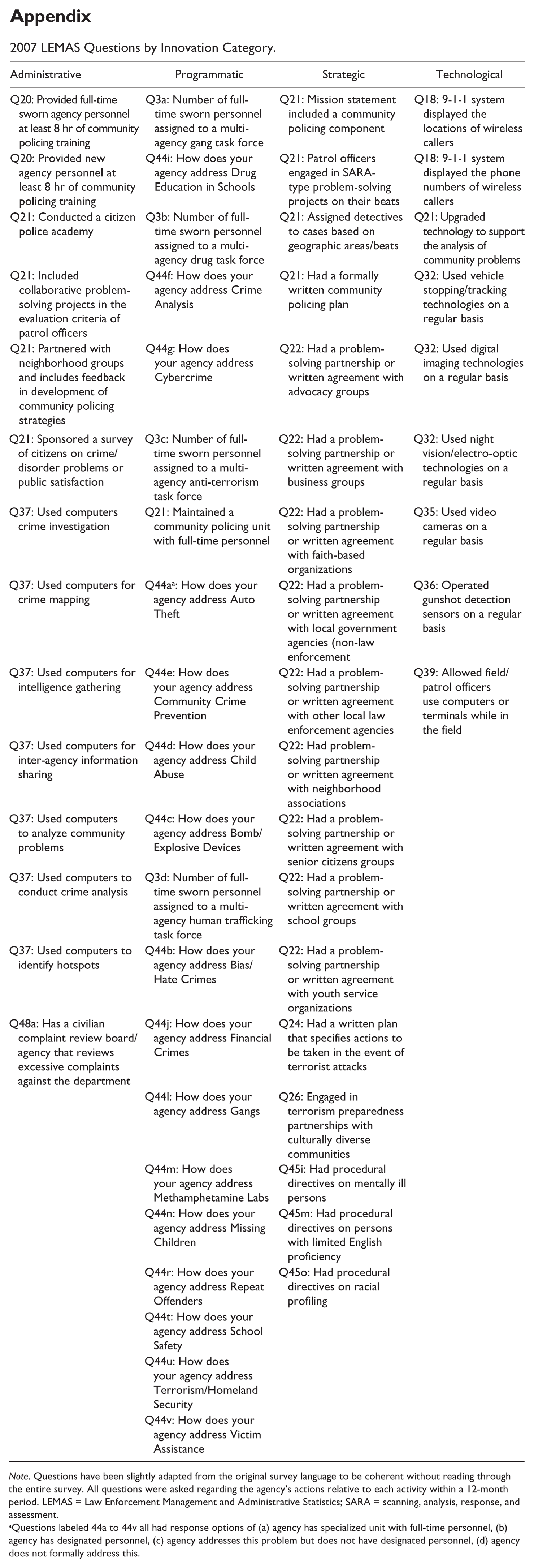
Cronbach’s alpha was used to check internal reliability of each scale. The internal reliability was strong for strategic (.840) and administrative (.776), while only acceptable for programmatic (.526) categories. The internal consistency coefficient for technological was .286, which while low, may be partially explained by the fact that the scale itself contains fewer items than the others. A full list of the 62 identified questions and their corresponding innovation category can be found in the appendix. Table 1 below provides specific examples of the 2007 LEMAS questions placed in each innovation category.
Excerpt of 2007 LEMAS Questions by Innovation Category.
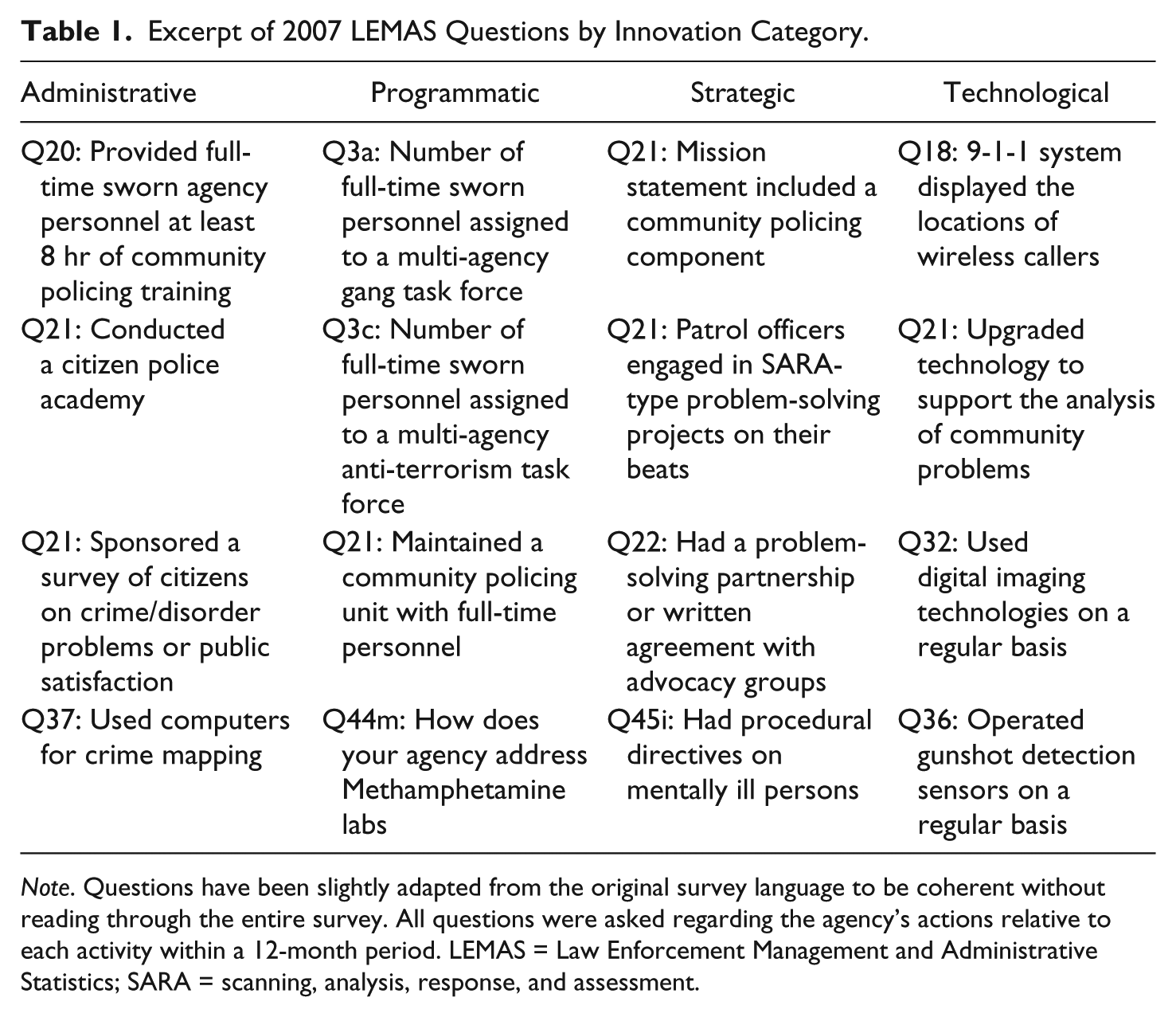
Note. Questions have been slightly adapted from the original survey language to be coherent without reading through the entire survey. All questions were asked regarding the agency’s actions relative to each activity within a 12-month period. LEMAS = Law Enforcement Management and Administrative Statistics; SARA = scanning, analysis, response, and assessment.
Although there are discretionary challenges to categorizing innovations according to these four labels, it was a necessary step in the analysis. Police innovation research should provide guidance for developing a meaningful and functional body of knowledge about the topic (Roberts & Roberts, 2009; Willis & Mastrofski, 2011). Police innovation research needs to be conducted in a manner that allows it to be easily duplicated (Roberts & Roberts, 2009). By identifying certain police activities as innovative, this study contributes to the development of a generalizable body of knowledge and measurement techniques related to police innovation.
Forming categories of innovation resulted in the creation of indices representing the sum of all actual innovations in use for a given agency in a given category. Four indices were created, one for each category of innovation: administrative, programmatic, strategic, and technological. 10 Using descriptive statistics, we examined administrative, programmatic, strategic, and technological innovation relative to how agencies address R&P. We then sought to investigate whether having a formal research and planning unit was associated with reporting greater levels of innovation by generating four multiple linear regression models, one for each innovation cluster. This allowed us to assess the influence of formal R&P staff designations on the use of each type of innovation. The regression analysis for each of the four innovation categories was run controlling for number of full-time sworn personnel, chief maximum salary, collective bargaining rights for full-time sworn personnel, geographic region, and agency type. Variance inflation factors (VIF) were used to check for multicollinearity in all models. The largest VIF score observed was 1.51, which is below the commonly accepted threshold of 3.
Results
Descriptive Analysis
As noted, a sample of 839 municipal police (N = 560) and sheriffs (N = 279) organizations was selected. The average number of full-time sworn personnel was 450 and, of the 839 agencies, 58% had collective bargaining rights for full-time sworn personnel. Table 2 shows that just under 50% of the sample had a formal research and planning unit, with an additional 24% informally designating personnel to research and planning tasks. The remaining 33% had either no formal unit (7%) or only policies (26%) addressing research and planning activities.
Sample Overview.
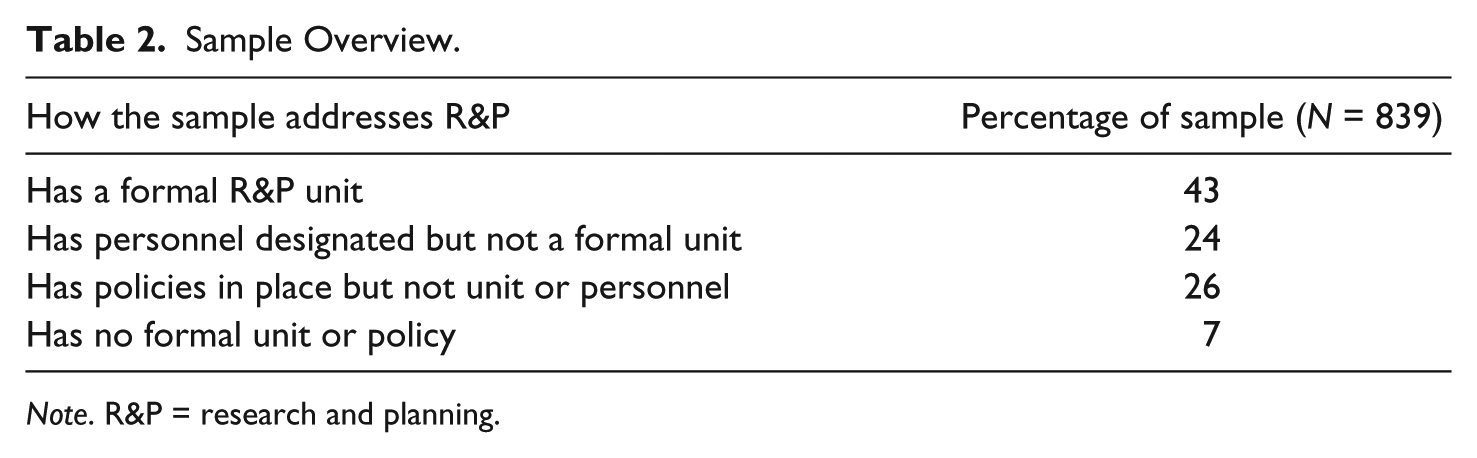
Note. R&P = research and planning.
The descriptive analysis of how agencies address R&P relative to organizational characteristics revealed significant differences (p < .05) between some but not all R&P groups for agency type, maximum chief salary, and number of full-time sworn personnel, but not for region or collective bargaining rights. For both municipal police and sheriff departments, the only significant mean difference between groups was between those with units or designated personnel and those that only have policies or do not address R&P. For chief maximum salary, there were significant mean differences between those with R&P units and those that designate personnel or have policies for Quartiles 1 and 4 only. Similarly, when looking at full-time sworn personnel, there were significant mean differences between those with R&P units and all other R&P groups for Quartiles 1 and 4 only. This suggests that agencies that do not currently address R&P in any formal way may have not only the financial resources but also the human resources to do so.
The descriptive analysis for administrative, programmatic, strategic, and technological innovation clusters relative to how agencies address R&P revealed significant differences between those with formal R&P units and all other designations of R&P for administrative, programmatic, and strategic innovation. These same three innovation categories also showed significant differences between those that designate personnel and those that only have policies to address R&P. Agencies with formal units reported using the most innovative strategies, yet the informal designation of personnel to address common R&P activities also resulted in a higher reported use of innovative strategies. The significant difference between those with policies and those who do not formally address R&P for the administrative and strategic indices suggests that even formal policies can improve an agency’s adoption of innovative policing strategies in these two areas. For technological innovation, there were significant differences between those with both a formal unit and informal staff designations and those that only had policies and did not formally address R&P. Table 3 shows the descriptive statistics for the innovation indices.
Descriptive Statistics for Innovation Indices.
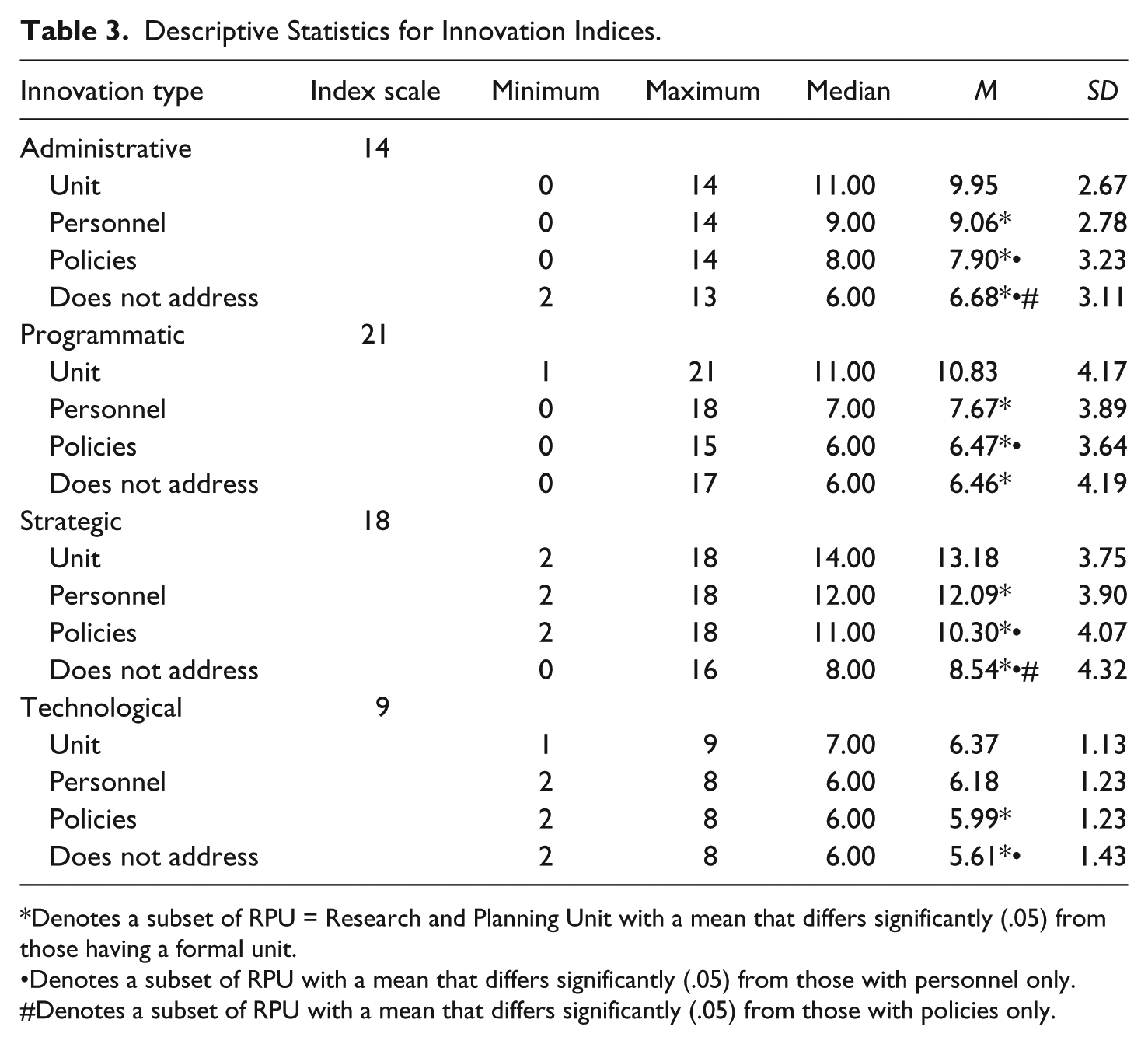
Denotes a subset of RPU = Research and Planning Unit with a mean that differs significantly (.05) from those having a formal unit.
Denotes a subset of RPU with a mean that differs significantly (.05) from those with personnel only.
Denotes a subset of RPU with a mean that differs significantly (.05) from those with policies only.
Regression Analyses
The regression results in Table 4 show that all four models are significant at the .01 level. When controlling for the effect of number of full-time sworn personnel, maximum chief salary, region, collective bargaining rights, agency type, and the omitted variables, those with either just policies and procedures, or who do not address R&P are less innovative than those with informal personnel designations and formal units for all models. The standardized coefficients for agencies that either only have R&P policies or do not formally address R&P were significantly different from and negatively associated with agencies that have formal R&P units across models. For the programmatic and strategic models, there is also a significant difference in standardized coefficients between those agencies with informal personnel designations and those agencies with units. The standardized coefficients show that those agencies with policies were less innovative than those who do not formally address R&P for the administrative, programmatic, and strategic clusters when compared with agencies with formal R&P units. This may be explained by the descriptive analysis that revealed less difference in maximum chief salary and full-time sworn personnel between those with units and those that do not address them between those with units and those with policies.
Multiple Regression Results Explaining Reported Innovation Adoption.
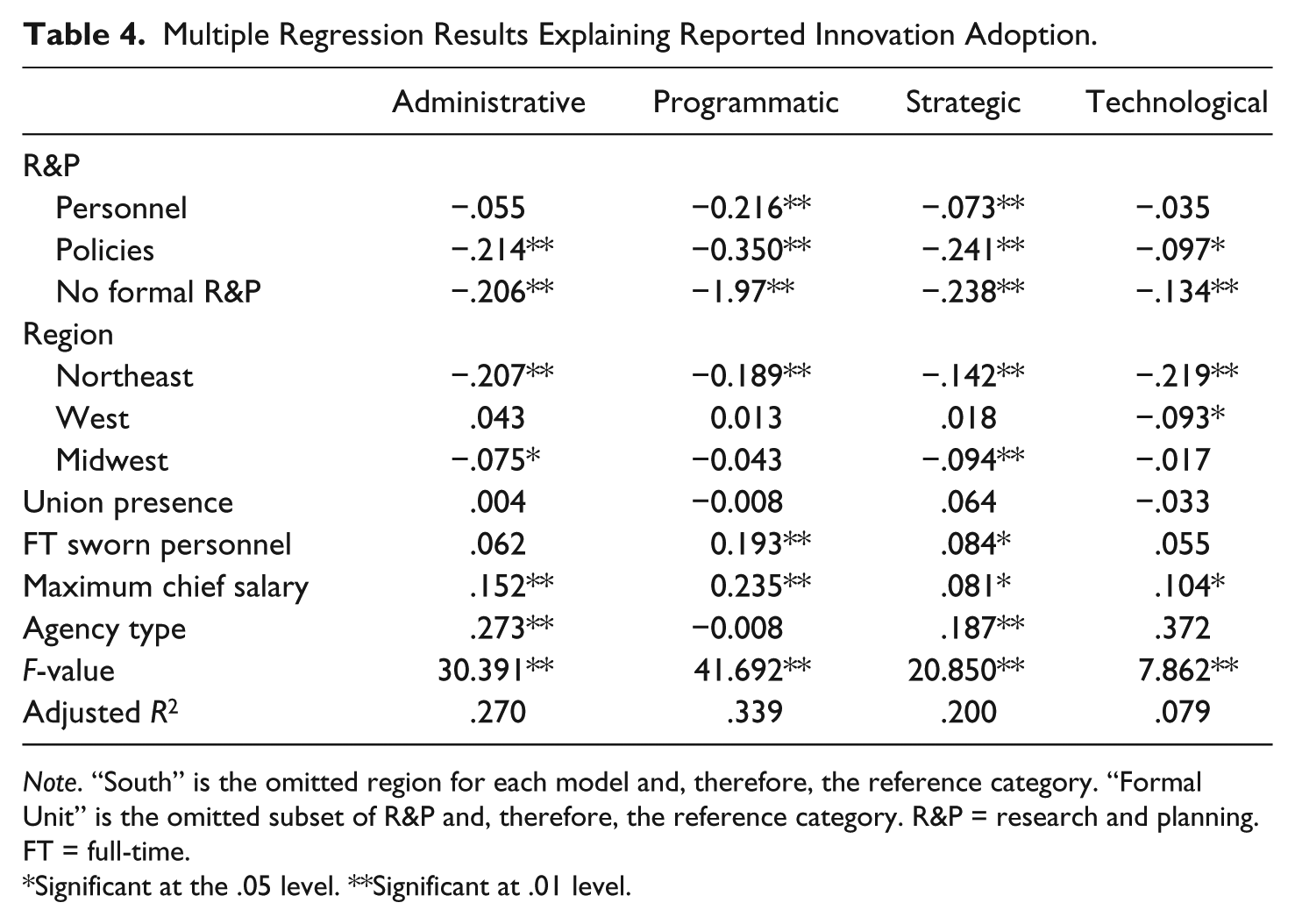
Note. “South” is the omitted region for each model and, therefore, the reference category. “Formal Unit” is the omitted subset of R&P and, therefore, the reference category. R&P = research and planning. FT = full-time.
Significant at the .05 level. **Significant at .01 level.
The R&P unit was the most important variable and positively associated with all innovations in the programmatic and strategic models. This suggests that having a formal R&P unit has a stronger relationship to adopting programmatic and strategic innovations than any of the control variables. Region and salary were significant controls across all models, which suggests that these two control factors may also strongly influence the adoption of these four types of policing innovations. The northeast region’s significant and negative correlation to the south for all innovations may be explained by the higher concentration of agencies with collective bargaining rights for full-time sworn personnel in the region.
The strongest regression model was programmatic innovation. The adjusted R2 value (.339) suggests that 33.9% of the variation in the dependent variable is explained by the independent variables. There is a moderate relationship between the independent variables and programmatic innovation and the R&P unit is the most important variable in this model.
Discussion
The results of this study show support for the current study’s suggestions that an investment in formal research and planning staffing may positively influence the use of innovative police practices, though only moderately for some, not all innovations. Specifically, we observed significant differences in the reported use of administrative, programmatic, and strategic innovative practices when comparing agencies with units and without units dedicated to research and planning (see Table 3). Significant differences also existed between the reported use of these same three innovations between agencies with informally designated personnel to perform R&P tasks and those without any designated personnel (see Table 3). Having a formal unit appears to also moderately influence the impact of the adoption of administrative and programmatic innovations (see Table 4). Although having a formal R&P unit may result in creating the most “innovative” agencies, particularly in the areas of programmatic and strategic innovation, having at least personnel dedicated to R&P work can also play a critical role in creating a more “innovative” organization. Our findings suggest that institutional theory is a constructive framework through which we understand these results, and in how we further investigate the research and planning unit as a structural mechanism for change and innovation. More pointedly, institutional theory proposes that specific work structures are created to facilitate specific organizational outcomes (Scott, 1995). The observed positive relationship between R&P unit and staffing, and increased reports of innovation, suggest further investigation is needed to more rigorously identify means–end relationships between the organization and its sub-unit’s outcomes. Moreover, further study should seek to not only illuminate the means–end (i.e., cause–effect) relationship, but also seek to understand why some police organizations create and utilize police research and planning while others do not. Given that the American policing industry is a decentralized system, understanding the contextual influences on the use of R&P as an organizational tool is also important to contemporary policing knowledge. What we have observed may speak to ideations of what R&P units should be doing in the policing industry (Cordner & White 2010; Goldstein, 1979; Reiss, 1992).
Despite concerns over the capacity to invest in research and planning (Haberman & King, 2011), the descriptive analysis revealed that financial resources (i.e., chief salary and human resources) only differed significantly between those with formal units and those that designate personnel or have policies for Quartiles 1 and 4, not between those that did not address R&P. More importantly, while the regression analysis showed that these same financial resources are significant for some but not all innovation categories, the association for each significant value is quite weak. Although this may suggest that police agencies, regardless of their access to human and financial resources, could place a larger emphasis on R&P in some capacity, any agency looking to redistribute existing resources to better target R&P functions still has to prepare itself for change. Given the nature of the identified R&P functions, a focus on R&P at any level is likely to more effectively guide organizational planning and result in a more dynamic and progressive organization.
Our examination of the relationship between research and planning staffing arrangements and innovative practices was intended to focus in on a specific organizational activity that is conceptually designed to facilitate innovation and change. This focus on how police organizations are structured and administered is as important today as it was in the 20th century (O. W. Wilson, 1951). An important question that results from our study is whether the research and planning arrangements were created to accomplish one or more specific goals, as the “means–end” relationship depicted in institutional theory purports that organizations support certain structures and specialized functions as a means through which certain activities or goals are achieved (Scott, 2002). We were not able to fully investigate whether or not the existence of R&P staffing explains the adoption of innovation, nor were we able to uncover what R&P units might be doing to influence innovation (Haberman & King, 2011). Nonetheless, our observations suggest that an investment in research and planning staff may facilitate change and prompt innovation in police organizations to better equip them to institutionalize specific practices that make them more able to respond to the ever-changing public need. This point seems to be of importance in an evolving and increasingly demanding public safety context. Understanding if and how research and planning helps the organization respond to or proactively influence the context in which the police operate, could certainly be considered as an organizational tool that promotes and facilitates thinking, learning, and adapting as the police revisit and recreate their products and processes. These ideas are reflective of the interface between organizations, their environment, and the structures, processes, and practices that constitute organizational work (Scott, 1995).
Our categorization of innovation is an equally valuable outcome of this study. Identifying, measuring, and comparing various types of innovations to better understand adoption, implementation, and impact remains a challenge and a need (Skogan & Frydl, 2004; Willis & Mastrofski, 2011). Thus, our method of culling and categorizing LEMAS measures according to the literature (Moore et al., 1997) and practitioner opinions allows for standardization and replication. Categorization in this way provides a foundation by which others can dive deeper into innovation processes and structures, such as research and planning units that may positively influence outcomes. This step in the methodology, therefore, sets the stage for developing another necessary body of research that could help police organizations further examine their processes and structures in both a comparative manner and in relation to organizational outcomes.
Conclusion
If there is an expectation that police organizations change and innovate to improve organizational efficiency and impact, then we must ask how they do so and in what ways police research and planning investments contribute. This study offers empirical and practical insights into the use of innovation and the existence of research and planning in modern police organizations. Examining the interplay between research and planning, and change and innovation using institutional theory is an appropriate starting point for further exploring the relationship between the two. It also offers a way in which police scholars and practitioners can identify and measure innovation over time. Police leaders should consider if and how their organizational structures and processes support and facilitate innovation and change. Could R&P investments serve as the instrument for innovation in modern police organizations? What is it about the structure and functions of R&P that foster, introduce, or create innovation? What other factors might also influence innovation and what role does R&P play in the existence of those factors? These insights provide a foundation for further investigation into the causal link between police R&P and their outputs and outcomes. These are important questions to police research and practice, and thus a deeper dive into the relationship between R&P and police innovation is needed.
Footnotes
Appendix
2007 LEMAS Questions by Innovation Category.
| Administrative | Programmatic | Strategic | Technological |
|---|---|---|---|
| Q20: Provided full-time sworn agency personnel at least 8 hr of community policing training | Q3a: Number of full-time sworn personnel assigned to a multi-agency gang task force | Q21: Mission statement included a community policing component | Q18: 9-1-1 system displayed the locations of wireless callers |
| Q20: Provided new agency personnel at least 8 hr of community policing training | Q44i: How does your agency address Drug Education in Schools | Q21: Patrol officers engaged in SARA-type problem-solving projects on their beats | Q18: 9-1-1 system displayed the phone numbers of wireless callers |
| Q21: Conducted a citizen police academy | Q3b: Number of full-time sworn personnel assigned to a multi-agency drug task force | Q21: Assigned detectives to cases based on geographic areas/beats | Q21: Upgraded technology to support the analysis of community problems |
| Q21: Included collaborative problem-solving projects in the evaluation criteria of patrol officers | Q44f: How does your agency address Crime Analysis | Q21: Had a formally written community policing plan | Q32: Used vehicle stopping/tracking technologies on a regular basis |
| Q21: Partnered with neighborhood groups and includes feedback in development of community policing strategies | Q44g: How does your agency address Cybercrime | Q22: Had a problem-solving partnership or written agreement with advocacy groups | Q32: Used digital imaging technologies on a regular basis |
| Q21: Sponsored a survey of citizens on crime/disorder problems or public satisfaction | Q3c: Number of full-time sworn personnel assigned to a multi-agency anti-terrorism task force | Q22: Had a problem-solving partnership or written agreement with business groups | Q32: Used night vision/electro-optic technologies on a regular basis |
| Q37: Used computers crime investigation | Q21: Maintained a community policing unit with full-time personnel | Q22: Had a problem-solving partnership or written agreement with faith-based organizations | Q35: Used video cameras on a regular basis |
| Q37: Used computers for crime mapping | Q44a a : How does your agency address Auto Theft | Q22: Had a problem-solving partnership or written agreement with local government agencies (non-law enforcement | Q36: Operated gunshot detection sensors on a regular basis |
| Q37: Used computers for intelligence gathering | Q44e: How does your agency address Community Crime Prevention | Q22: Had a problem-solving partnership or written agreement with other local law enforcement agencies | Q39: Allowed field/patrol officers use computers or terminals while in the field |
| Q37: Used computers for inter-agency information sharing | Q44d: How does your agency address Child Abuse | Q22: Had problem-solving partnership or written agreement with neighborhood associations | |
| Q37: Used computers to analyze community problems | Q44c: How does your agency address Bomb/Explosive Devices | Q22: Had a problem-solving partnership or written agreement with senior citizens groups | |
| Q37: Used computers to conduct crime analysis | Q3d: Number of full-time sworn personnel assigned to a multi-agency human trafficking task force | Q22: Had a problem-solving partnership or written agreement with school groups | |
| Q37: Used computers to identify hotspots | Q44b: How does your agency address Bias/Hate Crimes | Q22: Had a problem-solving partnership or written agreement with youth service organizations | |
| Q48a: Has a civilian complaint review board/agency that reviews excessive complaints against the department | Q44j: How does your agency address Financial Crimes | Q24: Had a written plan that specifies actions to be taken in the event of terrorist attacks | |
| Q44l: How does your agency address Gangs | Q26: Engaged in terrorism preparedness partnerships with culturally diverse communities | ||
| Q44m: How does your agency address Methamphetamine Labs | Q45i: Had procedural directives on mentally ill persons | ||
| Q44n: How does your agency address Missing Children | Q45m: Had procedural directives on persons with limited English proficiency | ||
| Q44r: How does your agency address Repeat Offenders | Q45o: Had procedural directives on racial profiling | ||
| Q44t: How does your agency address School Safety | |||
| Q44u: How does your agency address Terrorism/Homeland Security | |||
| Q44v: How does your agency address Victim Assistance |
Note. Questions have been slightly adapted from the original survey language to be coherent without reading through the entire survey. All questions were asked regarding the agency’s actions relative to each activity within a 12-month period. LEMAS = Law Enforcement Management and Administrative Statistics; SARA = scanning, analysis, response, and assessment.
Questions labeled 44a to 44v all had response options of (a) agency has specialized unit with full-time personnel, (b) agency has designated personnel, (c) agency addresses this problem but does not have designated personnel, (d) agency does not formally address this.
Acknowledgements
The authors would like to thank the anonymous reviewers for their comments and suggestions, as well as Steve Edwards, Jerry Gianakis, Melissa Morabito and Nicole Rivers for their suggestions throughout the study and writing process.
Declaration of Conflicting Interests
The author(s) declared no potential conflicts of interest with respect to the research, authorship, and/or publication of this article.
Funding
The author(s) received no financial support for the research, authorship, and/or publication of this article.