







Abstract
In light of the limited resources available in the criminal justice system, and given the financial costs and inmate mental health risks associated with disciplinary segregation, the practice warrants testing and evaluation. Limited research exists on the effect disciplinary segregation has on subsequent inmate misconduct in state prisons. Institutional violation rates for a cohort of male inmates incarcerated by the Oregon Department of Corrections were analyzed. Controlling for other factors, the results of this study indicate that disciplinary segregation was not a significant predictor of subsequent institutional misconduct. The findings also indicate that the experience of disciplinary segregation does not reduce subsequent prison inmate misconduct and therefore suggest that it may not be an effective institutional practice. These results signal that disciplinary segregation should be used in a more judicious and informed manner and that further research should be performed to determine whether disciplinary segregation has a general deterrent effect.
Introduction
The practice of disciplinary segregation is widely used in institutional correctional environments in the United States (Frost & Monteiro, 2016). In this practice, inmates who are officially found to have committed a prison rule violation may be removed from the general inmate population and confined in a separate cellblock, frequently referred to as disciplinary segregation units. The purpose of disciplinary segregation, at least in part, is to provide a punitive action to deter inmates from engaging in subsequent prison misconduct (i.e., committing rule violations). Although the practice is viewed as anecdotally useful by correctional administrators (Mears & Castro, 2006), scientific evidence regarding its effectiveness is scant (Frost & Monteiro, 2016; Labrecque, 2015; Lucas, 2015; Morris, 2016).
The weight of the extant research on prison segregation indicates that the practice can have negative psychological and physiological effects on inmates, although these effects might only be associated with longer periods of isolation, and such research has focused primarily on solitary confinement. There is limited research examining prison segregation in relation to deterrence, so it is currently unclear whether segregation practices have a deterrent effect on prison inmate misconduct. Furthermore, there is very little published research concerning disciplinary segregation. Arrigo and Bullock (2008) noted this “absence of studies focused specifically on short-term segregation for disciplinary and/or punitive purposes” (p. 638). This quantitative study assists in filling this gap via an examination of the effectiveness of disciplinary segregation in deterring prison inmate misconduct within the Oregon Department of Corrections (Oregon DOC) prison system.
Disciplinary Segregation and Solitary Confinement: Differences and Similarities
Although there is limited research on disciplinary segregation, there is much research, however, on the topic of solitary confinement. Although disciplinary segregation and solitary confinement are sometimes viewed synonymously, in practice that is not always the case. The primary differences between solitary confinement and the Oregon DOC’s disciplinary segregation unit are as follows: (a) the offenders serve their punishment in a two-person cell (and sometimes have a cellmate, depending on the housing situation), whereas in solitary confinement they are housed in one-person cells (J. Duncan, personal communication, March 13, 2014), and (b) the length of stay in disciplinary segregation is shorter, with the maximum length generally being about 6 months (Oregon Administrative Rule 291-105-1066(10), 2014).
Some of the characteristics that disciplinary segregation (as used by the Oregon DOC) and solitary confinement have in common are as follows: (a) the prisoners are isolated from the general prison population in a separate cellblock; (b) they are held within their cells for 22 to 24 hr each day and only permitted 1 hr of exercise, and they are placed in restraints when removed from their cells; and (c) they are housed in cells that are continuously lit all day and night by artificial light, with no prisoner control over how brightly their cells are lit, and their exposure to physical and social stimulation is severely limited (Arrigo & Bullock, 2008; Briggs, Sundt, & Castellano, 2003; J. Duncan, personal communication, March 13, 2014; Haney, 2003; Haney & Lynch, 1997; Lippke, 2004; Pizarro & Stenius, 2004; Smith, 2006).
Potential Harmful Effects
Solitary confinement has a demonstrated potential for causing serious negative effects on inmates subjected to it (Arrigo & Bullock, 2008; Haney, 2003; Haney & Lynch, 1997; Pizarro & Stenius, 2004; Smith, 2006). Some of those negative consequences include suicidal ideation, lethargy, rage, hallucinations, panic, cognitive dysfunction, emotional breakdowns, aggression, anxiety, insomnia, paranoia, depression, “increases in negative attitudes and affect,” self-mutilation, hypersensitivity, withdrawal, hopelessness, and “loss of control” (Haney & Lynch, 1997, p. 530). Because disciplinary segregation and solitary confinement are closely related practices, these research findings suggest that subjecting inmates to disciplinary segregation might place them at risk of psychological and physiological harm. This creates a clear need to review disciplinary segregation with a critical eye and determine whether the subjective experience of disciplinary segregation deters prisoners from engaging in subsequent prison misbehavior. This study was therefore designed to fill this gap in knowledge to better inform this potentially harmful disciplinary practice.
Segregation and Deterrence
Deterrence theory suggests that the practice of disciplinary segregation has some benefit because increasing the costs associated with wrongdoing can outweigh the benefits associated with committing the offense (Nagin, 2013; Paternoster, 2010; Zimring & Hawkins, 1973). A key assumption of the theory is that individuals who commit offenses are rational individuals who calculate and weigh the costs and benefits of a course of conduct prior to taking action (Nagin, 2013; Paternoster, 2010). Research on deterrence theory has found moderate support for the hypothesis (e.g., Dölling, Entorf, Hermann, & Rupp, 2009), but it can be difficult to isolate and detect the deterrent effect of specific policies and practices (Paternoster, 2010). Furthermore, some of the research has produced mixed results and is hampered by methodological criticism (see Nagin, 2013; Paternoster, 2010).
Barak-Glantz (1983) performed one of the first modern studies directly investigating solitary confinement. Data were gathered on prisoners from the Washington State Penitentiary who spent time in solitary confinement, delineated into four groups categorized by year (1966, 1971, 1973, and 1975), which were compared with data gathered on prisoners who had been discharged from the Washington State Penitentiary during those same 4 years (Barak-Glantz, 1983). Barak-Glantz found that solitary confinement had only a “minimal” deterrent effect on inmates. Unfortunately, Barak-Glantz does not clearly explain the process or basis for reaching that conclusion.
Briggs et al. (2003) tested whether supermaximum (supermax) prisons reduced “inmate-on-inmate violence” and whether supermax prisons reduced “inmate-on-staff violence.” Their analysis, which encompassed data gathered from four states, revealed that the supermax prisons did not reduce inmate-on-inmate violence (Briggs et al., 2003). However, their analysis of the impact of the supermax prisons with regard to inmate-on-staff violence revealed “inconsistent” results (Briggs et al., 2003, p. 1365). Furthermore, Briggs et al. concluded that their findings were inconsistent with deterrence theory.
Mears and Bales (2009) tested two competing hypotheses: (a) supermax incarceration decreases recidivism versus (b) supermax incarceration increases recidivism. Mears and Bales selected a group of inmates who had experienced supermax confinement for at least 91 days or more and compared that cohort against general population inmates (Mears & Bales, 2009). Prior to matching, the supermax inmates recidivated at a much higher rate when compared with nonsupermax inmates (58.8% vs. 46.6%; Mears & Bales, 2009). However, after matching the two groups using propensity scoring, the supermax inmate recidivism rate was only slightly higher than that of the nonsupermax inmates (58.8% vs. 57.6%; Mears & Bales, 2009). Upon the division of recidivism into crime categories (any recidivism, violent recidivism, property recidivism, drug recidivism, and “other” recidivism), the picture became even clearer (Mears & Bales, 2009). Within the five categories, the only statistically significant difference was among violent recidivism, with the supermax inmates’ recidivism rate being 3.7% higher than the nonsupermax inmates (Mears & Bales, 2009).
Mears and Bales (2009) also analyzed whether the length of time inmates spent incarcerated in a supermax institution affected their recidivism rate, but did not find evidence indicating any effect of sentence length on recidivism. Mears and Bales also evaluated whether the recency of an inmate’s stay in supermax incarceration, relative to being released, affected their recidivism rate. Again, the data did not indicate that the recency of supermax confinement in relation to the inmates’ release influenced their recidivism rate (Mears & Bales, 2009).
Motiuk and Blanchette (2001) compared the characteristics of those inmates who had been in administrative segregation (both voluntarily and involuntarily) in Canada’s federal prison system against a group of randomly drawn nonsegregated inmates from Canada’s general prison population. Significance tests showed that there were very few differences between the voluntarily segregated inmates (54.8% of the treatment group) and the nonvoluntarily segregated inmates (45.2% of the treatment group; Motiuk & Blanchette, 2001). Specifically, the two types of segregated inmates did not significantly differ with regard to age (Motiuk & Blanchette, 2001), risk/need levels at admission, risk of recidivism, security classification, and criminogenic needs (Motiuk & Blanchette, 1997). A comparison of prison release outcomes of the segregated and nonsegregated prisoners found that when compared with the nonsegregated prisoners, it was significantly more likely that the segregated prisoners would be sent back to federal custody while on release (Motiuk & Blanchette, 2001). Overall, the analyses suggested that Canada’s administrative segregation does not have a deterrent effect on postrelease offending (Motiuk & Blanchette, 2001).
Labrecque (2015) examined whether the experience of prison solitary confinement as punishment for institutional misconduct impacted subsequent inmate misconduct. Using data from the Ohio Department of Rehabilitation and Correction and employing a pooled time series panel design, Labrecque’s analysis revealed that the experience of disciplinary solitary confinement did not significantly affect subsequent institutional misconduct. This was true for each of three different types of institutional misconduct that were studied: violent misconduct, nonviolent misconduct, and drug misconduct (Labrecque, 2015). Labrecque’s research results also suggested that the length of time spent in disciplinary solitary confinement does not influence subsequent institutional misconduct.
Morris (2016) studied whether punitive short-term solitary confinement imposed as punishment for a physically violent prison rule violation affected subsequent prison misconduct among those inmates who experienced the punishment. The treatment cohort comprised inmates who were subjected to solitary confinement as a punishment for their first act of violent misconduct (Morris, 2016). The comparison cohort comprised inmates who had not received solitary confinement as a punishment for their first act of violent misconduct (Morris, 2016). Morris, using propensity score matching, found that exposure to solitary confinement as punishment for an act of violence was unlikely to affect the likelihood of an inmate engaging in a subsequent act of violence. Furthermore, the experience of solitary confinement as punishment for an initial violent act did not appear to affect the timing of subsequent violent misconduct (Morris, 2016). In addition, imposing solitary confinement as punishment for an initial act of violence did not appear to affect subsequent prison misconduct in general (including both violent and nonviolent misconduct; Morris, 2016). The individual inmate-level covariates included in the propensity score matching included age, race, marital status, body mass index, prior incarceration history, number of days incarcerated prior to initial act of violence, and the number of punishments received prior to the initial act of violence, among others (Morris, 2016). In addition, prison-level covariates were also used, such as the mean age of the inmates in the prison unit itself and the ratio of prisoners to prison staff (Morris, 2016).
Variables Related to Prison Misconduct
Several control variables were used in this study to isolate the effect of disciplinary segregation on subsequent prison misconduct. These variables were selected based on prior research showing their predictive relationship with prison misconduct.
Age and prison misconduct
Strong support can be found in the extant literature with regard to age being a predictor of offending (e.g., Farrington, 1986; Gendreau, Little, & Goggin, 1996; Hirschi & Gottfredson, 1983; Nagin & Land, 1993; Sweeten, Piquero, & Steinberg, 2013), including support for age as a predictor of institutional misconduct (Alexander & Austin, 1992; Celinska & Sung, 2014; Cunningham & Reidy, 1998; Cunningham, Sorensen, & Reidy, 2005; Flanagan, 1980, 1983; Gendreau, Goggin, & Law, 1997; Jiang & Winfree, 2006; McCorkle, 1995; Sorensen & Wrinkle, 1996; Steiner, Butler, & Ellison, 2014; Toch & Adams, 2002). Haun (2007) studied the static and dynamic predictors of institutional misconduct for inmates housed within the Oregon DOC prison system (n = 17,054). Haun found that among Oregon inmates, age was significantly correlated with the overall yearly disciplinary infraction rate (r = .157, p < .001). In all three of the infraction categories, as age increased, the yearly rates of infractions decreased (Haun, 2007). The three infraction categories were as follows: (a) physically aggressive/violent infractions, (b) verbally aggressive/defiant infractions, and (c) nonaggressive/nonviolent infractions (Haun, 2007). After controlling for the length of time served using hierarchical binary logistic regression analysis, Haun’s results showed that age was still a significant predictor of prison misconduct (b = .037, Wald = 747.76, p < .001).
Length of time incarcerated and prison misconduct
The length of time an inmate has spent on his present sentence can serve as a predictor of institutional misconduct (Cunningham et al., 2005; Gover, Pérez, & Jennings, 2008; Haun, 2007; Reidy, Cunningham, & Sorensen, 2001; Sorensen & Wrinkle, 1996; Steiner et al., 2014; Toch & Adams, 2002; Toch, Adams, & Grant, 1989; Zamble, 1992; but see Flanagan, 1980; Harer & Langan, 2001). Toch and Adams’s (2002) evaluation of prison adjustment among New York inmates also investigated patterns of inmate misconduct over the length of the prison term. The authors found that disciplinary infraction rates are typically subject to a sharp rise in the beginning of inmates’ sentences, which is then followed by a decline in disciplinary infractions (Toch & Adams, 2002). Notably, shorter sentences were accompanied by a steeper decline in infractions, and longer sentences were accompanied by a more gradual decline (Toch & Adams, 2002). However, although this pattern was generally characteristic of the younger inmates, the disciplinary infraction rate of the older inmates was “relatively flat” over time (Toch & Adams, 2002, p. 57). Because age has consistently been found to be a significant predictor of disciplinary infractions, Toch and Adams (2002) also investigated whether the predictability of the variable time served was simply due to inmates getting older as their length of time served increased. They measured the misconduct rates of specific age groups at different times during the prison sentence (e.g., first 6 months vs. last 6 months; Toch & Adams, 2002). Their data showed that age was a stronger predictor of institutional misconduct than length of time served (Toch & Adams, 2002). Nevertheless, their data also indicated that length of time served was an independent predictor of institutional misconduct apart from age (Toch & Adams, 2002).
Haun’s (2007) study on Oregon inmates revealed that the length of time served by an inmate on his or her current sentence term was a statistically significant predictor of prison misconduct. The evidence showed that as the length of time incarcerated increased, the yearly infraction rate declined within every type of infraction category (Haun, 2007).
Level of Service/Case Management Inventory (LS/CMI) and prison misconduct
The LS/CMI (Andrews, Bonta, & Wormith, 2004) is a risk assessment tool that is administered to Oregon inmates during the initial intake process (J. Hanson, personal communication, February 20, 2015). The LS/CMI is part of a family of risk assessment instruments known collectively as the LS scales, with the LS/CMI being the most recently developed instrument (Olver, Stockdale, & Wormith, 2014). Research has shown that the LS/CMI is a reliable and valid predictor of offending (Andrews et al., 2004; Andrews, Bonta, & Wormith, 2006; Jung, Daniels, Friesen, & Ledi, 2012; Olver et al., 2014), although there appears to be a lack of studies testing the predictive validity of the LS/CMI with regard to its accuracy in predicting institutional misconduct, especially among male inmates. However, several studies have evaluated the ability of its predecessors the Level of Service Inventory (LSI; Andrews, 1982) and the Level of Service Inventory–Revised (LSI-R; Andrews & Bonta, 1995) to accurately predict institutional misconduct. These previous studies have indicated that the LSI (Bonta, 1989; Bonta & Motiuk, 1987, 1990, 1992; Motiuk, 1991) and the LSI-R (Campbell, French, & Gendreau, 2009; Gendreau et al., 1997; Kroner & Mills, 2001; Olver et al., 2014; Swoboda, 2006) are valid predictors of institutional misconduct. The LSI-R and the LS/CMI are closely related, with the LS/CMI serving as an improved version of the LSI-R, and there is a high correlation between the LSI-R and the LS/CMI (Andrews et al., 2004). In addition, Stewart (2011) studied the predictive validity of the LS/CMI in predicting prison misconduct among female inmates. Stewart’s analysis of 101 female Canadian federal inmates found that the LS/CMI was indeed statistically significantly correlated with prison misconduct (r = .502, area under the curve [AUC] = .798, p < .01). The field of research on the prior LS scales, especially the research pertaining to the LSI-R, along with Stewart’s study on Canadian female inmates all indicate that the LS/CMI Section 1 risk score is a good predictor of institutional misconduct.
Beginning in 2007, the Oregon DOC administered the LS/CMI to all incoming prison inmates who had scored as medium risk or high risk on the Automated Criminal Risk Score (ACRS; J. Hanson, personal communication, February 20, 2015). The ACRS is an internal static risk tool developed and used by the Oregon DOC (J. Hanson, personal communication, July 20, 2015). The LS/CMI began to be administered to all incoming inmates in 2011 (J. Hanson, personal communication, February 20, 2015).
Prior prison rule violations and subsequent prison misconduct
Earlier research has demonstrated that prior prison rule violations can be a predictor of subsequent prison misconduct. Some of this research has directly indicated that prior prison misconduct can predict subsequent misconduct (Camp, Gaes, Langan, & Saylor, 2003; Drury & DeLisi, 2010; Gendreau et al., 1997; Steiner et al., 2014). Other research provides indirect support that prior prison misconduct can predict future misconduct. For example, there is research that indicates that prior prison violence can predict subsequent prison misconduct (Cunningham & Sorensen, 2007). In addition, there is research that indicates that prior violence can predict future violence (Bonta, Law, & Hanson, 1998; Durose, Cooper, & Snyder, 2014; Sorensen & Pilgrim, 2000) and that prior criminal history can predict subsequent criminal offending (Bonta et al., 1998; Drury & DeLisi, 2010; Durose et al., 2014; Gendreau et al., 1996; Loza, 2003). The proposition that prior prison misconduct predicts future prison misconduct fits within the popular notion that “the best predictor of future behavior is past behavior” (e.g., Cunningham & Reidy, 1999; Mischel, 1973; Ouellette & Wood, 1998; Walters, 1992).
Gender and prison misconduct
The rate of institutional misconduct can differ between male and female inmates (Celinska & Sung, 2014; Craddock, 1996; Harer & Langan, 2001; Haun, 2007; but see, Gover et al., 2008; Jiang & Winfree, 2006). In addition, male inmates and female inmates may adjust differently to prison life (Jiang & Winfree, 2006; Warren, Hurt, Loper, & Chauhan, 2004). Haun’s (2007) study of Oregon prison inmates also found that gender was a significant predictor of prison misconduct, with total yearly misconduct rates significantly higher for male inmates than female inmates. Among the different misconduct categories, the rates were significantly higher among male inmates for physically aggressive/violent infractions and nonaggressive/defiant infractions, but there was no significant difference between male and female inmates on their rate of verbally aggressive/defiant infractions (Haun, 2007). A hierarchical binary logistic regression analysis that controlled for the effect of length of time served confirmed that gender was a significant predictor for each of the misconduct categories (Haun, 2007).
Current Project
The purpose of this study was to examine whether disciplinary segregation is effective in deterring subsequent prison misconduct among those inmates subjected to it. In this study, the rule violation rates of two cohorts were compared using multiple regression analysis. The time frame for this study spanned 48 months. The first 24 months (January 1, 2011, through December 31, 2012) were for categorization purposes, in that the participants were selected for either the treatment cohort or the comparison cohort based on whether they had spent any time in disciplinary segregation during those 2 years. The next 24 months (January 1, 2013, through December 31, 2014) comprised the follow-up period, from which the rule violation rates of the two cohorts were compared and contrasted to test the hypotheses. Walters (2007) explained that when examining prison adjustment, “a 2-year follow-up offers the best balance in terms of maximizing the number of IRs [institutional reports, e.g., rule violation convictions] available for analysis while minimizing the number of participants lost to analysis because of release” (p. 73).
The treatment cohort comprised those inmates who spent any time in disciplinary segregation during the years 2011 and/or 2012. The comparison cohort comprised those inmates who, as of January 1, 2013, had not spent any time in disciplinary segregation. Data were analyzed using multiple regression analysis to see whether cohort membership (treatment cohort or comparison cohort) significantly predicted prison misconduct during the years 2013 to 2014, controlling for the effects of certain extraneous predictor variables that are related to prison misconduct (e.g., age, length of time spent incarcerated on current sentence).
The following three null hypotheses were tested:
NH1 was designed to examine whether the experience of disciplinary segregation has an effect on subsequent prison misconduct. NH2 examines whether the experience of disciplinary segregation has a deterrent effect on subsequent prison behavior. NH3 examines whether the experience of disciplinary segregation has a criminogenic effect on subsequent prison behavior.
Method and Data Analysis
Sample
The population for the study consisted of 3,375 inmates who had been incarcerated from January 1, 2011, through December 31, 2014, in an Oregon DOC facility or facilities that had a medium-security component. Inmates who began their incarceration after January 1, 2011, were excluded from the study, and inmates whose incarceration ended prior to December 31, 2014, were excluded from the study. Of the 3,375 participants, one individual was excluded from the study due to missing data on a few key variables, and 1,263 were excluded from the study due to meeting neither the comparison cohort criteria nor the treatment cohort criteria. These 1,263 individuals had spent time in disciplinary segregation at some point prior to January 1, 2011 (thus excluding them from the comparison cohort), and did not serve any time in disciplinary segregation during the year 2011 or 2012 (thus excluding them from the treatment cohort). Of the remaining 2,111 participants, 853 served time in disciplinary segregation and 1,258 did not. However, of those 2,111 participants, only 228 had scores on the LS/CMI (Andrews et al., 2004). These 228 participants comprised the final sample used for the study. A priori power analysis, with power at .80, assuming medium effect size, returned a required, total sample size of 103. Of the 228 participants comprising the total final sample, 191 were grouped into the treatment cohort (those who were previously exposed to segregation), and 37 were grouped into the comparison cohort (those who were not previously exposed to segregation). Tables 1 and 2 provide the descriptive statistics for the overall sample. For a further breakdown, in the appendix, the descriptive statistics for the comparison cohort are provided in Tables A1 and A2, and the descriptive statistics for the treatment cohort are provided in Tables A3 and A4.
Descriptive Statistics for the Sample.
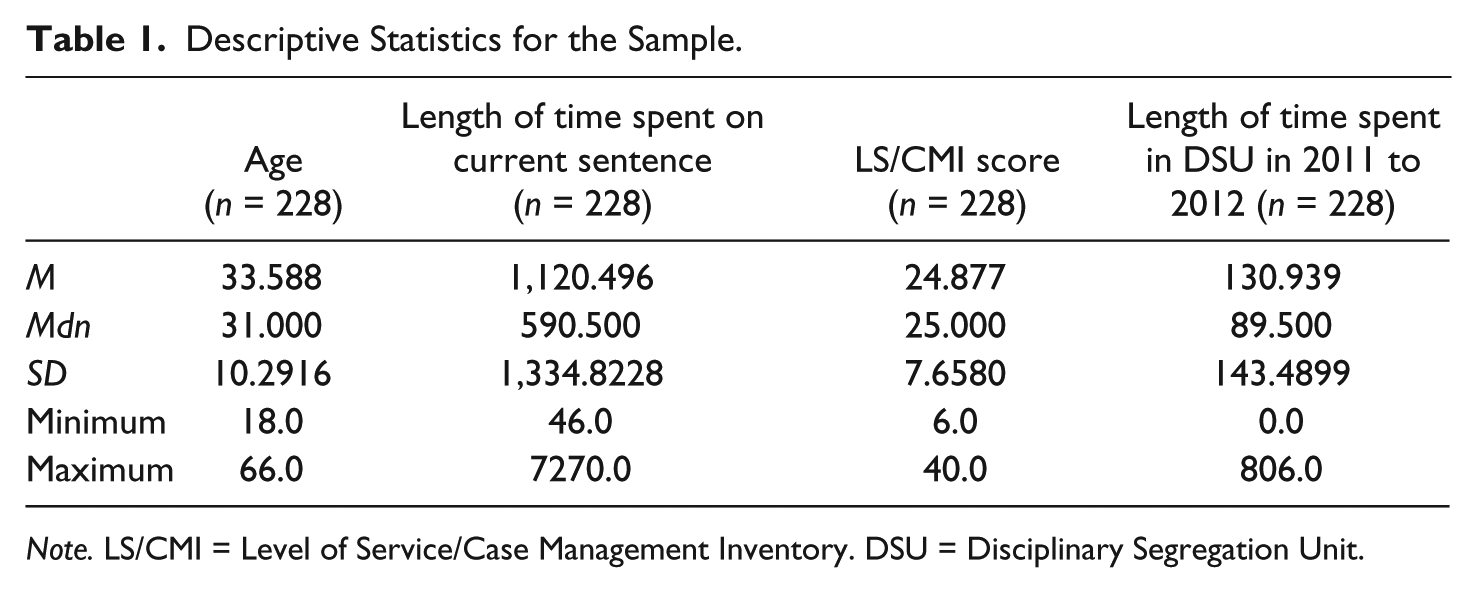
Note. LS/CMI = Level of Service/Case Management Inventory. DSU = Disciplinary Segregation Unit.
Descriptive Statistics for Sample Rule Violation Rates.
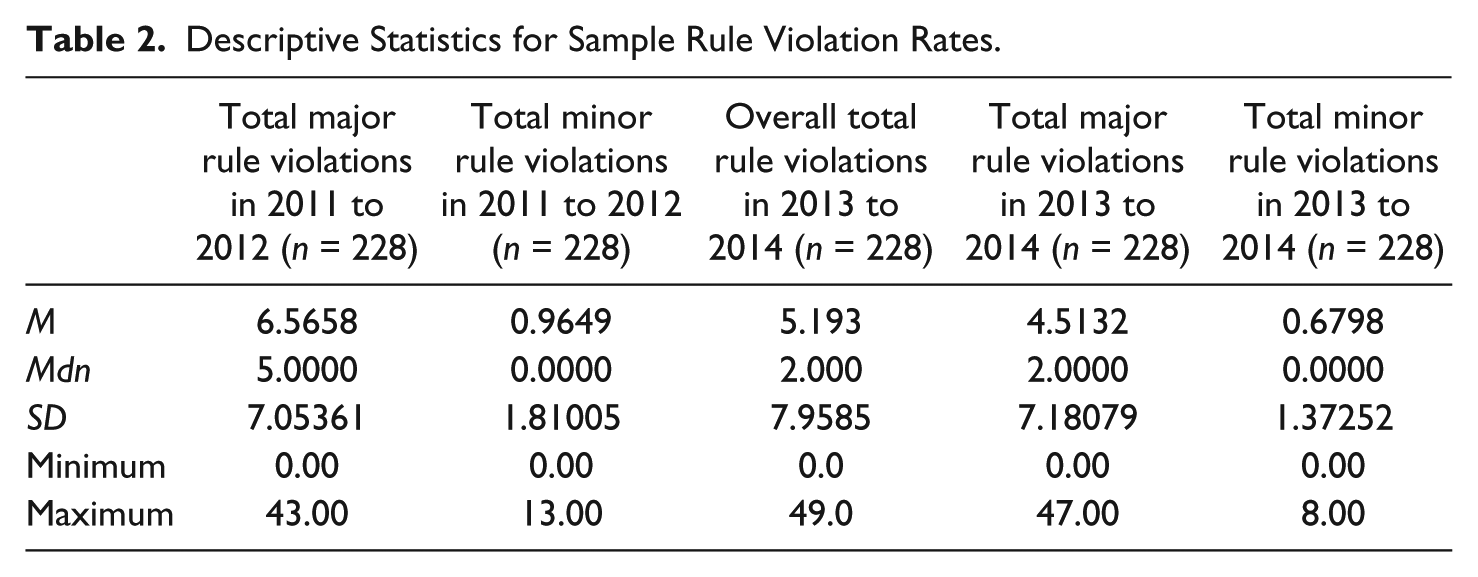
The five prison facilities from which the two cohorts were drawn were the Oregon State Penitentiary (OSP), the Eastern Oregon Correctional Institute (EOCI), the Oregon State Correctional Institute (OSCI), the Snake River Correctional Institute (SRCI), and the Two Rivers Correctional Institute (TRCI). These facilities housed only male inmates (J. Duncan, personal communication, September 26, 2016; Oregon DOC, n.d.). The facilities were selected because their security-level classification was at least at the medium-security level. Facilities classified at only the minimum-security level were excluded from the study. The five facilities that were used in the study each housed a mixed population, in that each facility held inmates of different security-level classifications (J. Duncan, personal communication, September 26, 2016; Oregon DOC, n.d.). There were no significant structural differences between the five facilities, other than OSP having a large wall surrounding it, whereas the other four facilities had fences and electronic warning and barrier devices (J. Duncan, personal communication, September 26, 2016). Inmates who spent time during the study period in a strictly minimum-security facility or facilities (i.e., those facilities that did not also have a medium-security component) were excluded from the study to control for and exclude the possible effects of being incarcerated in a facility where the disciplinary segregation unit is qualitatively different from the disciplinary segregation units in facilities with at least a medium-security component. At a minimum-security facility, the disciplinary segregation unit resembles more of a holding cell unit, with only a few cells and the inmates generally do not serve significant amounts of time in disciplinary segregation (J. Duncan, personal communication, September 26, 2016). When longer disciplinary segregation punishments are imposed, the inmates are sent to serve the punishment at a facility with a higher rated level of security (J. Duncan, personal communication, September 26, 2016).
Variables
Several variables were involved in this study. The dependent/outcome variable was prison misconduct, measured as overall total institutional rule violations for 2013 to 2014. A rule violation was defined as an official finding by the prison authorities of an inmate rule violation. The independent/predictor variable was cohort (i.e., the grouping variable). Cohort was a dummied variable, with 1 = treatment cohort, and 0 = the comparison cohort. The control variables were age, length of time served on current sentence, LS/CMI risk score, prior major rule violations in 2011 to 2012, prior minor rule violations in 2011 to 2012, length of time spent in disciplinary segregation in 2011 to 2012, and gender.
Age was a continuous variable measured as the participants’ chronological (biological) age in years as of January 1, 2011. Length of time spent incarcerated on current sentence was a continuous variable, measured as the number of days the participant had spent incarcerated on the current sentence as of January 1, 2011. LS/CMI risk score was a continuous variable and measured as the participant’s numerical total score from Section 1 of the LS/CMI. Gender also served as a control variable, in that the sample was limited to only male participants.
Length of time spent in disciplinary segregation in 2011 to 2012 was a continuous variable and was measured as the number of days the participant spent in disciplinary segregation in 2011 through 2012. In the data provided for this variable by the Oregon DOC, the parameters for these data also included days consecutively spent in disciplinary segregation where at least one of those days was within the treatment window (January 1, 2011, through December 31, 2012). The number of days were calculated as the date the participant moved out of disciplinary segregation (or December 31, 2012, whichever was earlier) minus the date the participant moved into disciplinary segregation, plus any additional days the participant spent in disciplinary segregation in 2011 or 2012.
Prior major misconducts in 2011 to 2012 was a continuous variable, measured as the total number of official findings by the prison authorities of inmate rule violations classified at the “major” level during the years 2011 to 2012. “Major” rule violations included offenses such as arson, sexual assault, fraud, and contraband in the second degree (Oregon Administrative Rule 291-105-005 et seq., 2014, Exhibit 1). Prior minor misconducts in 2011 to 2012 was a continuous variable, measured as the total number of official findings by the prison authorities of inmate rule violations classified at the “minor” level during the years 2011 to 2012. “Minor” rule violations included offenses such as gambling, contraband in the third degree, and disobedience in the third degree (Oregon Administrative Rule 291-105-005 et seq., 2014, Exhibit 2).
Analysis
The overall total rule violation rate in 2013 to 2014 was analyzed using ordinary least squares multiple regression. The total sample for the analysis was 228; to fully capture the variability of the Oregon population, no outliers were removed for this analysis. 1 The initial data screening process indicated that the assumption of normally distributed errors was violated and that the model suffered from mild heteroscedasticity, and therefore, bootstrapping using bias-corrected and accelerated confidence intervals was employed for this multiple regression analysis.
Results
The overall regression model was statistically significant, adjusted R2 = .455, F(7, 220) = 28.059, p < .001. The predictive relation of cohort to overall total rule violations was not statistically significant, p = .364. The results of this model indicated no difference in overall rule violation rates between the two cohorts. Therefore, disciplinary segregation is not a significant predictor of subsequent misconduct. This result therefore suggests that the experience of disciplinary segregation does not affect subsequent overall prison misconduct (i.e., it has a null effect). The only statistically significant predictors of misconduct were LS/CMI score, p = .017; total major rule violations in 2011 to 2012, p = .001; and total minor rule violations in 2011 to 2012, p = .002.
The global effect size for this model was f2 = 0.455. The local effect size of the independent/predictor variable cohort was also calculated, but variance uniquely explained by the predictor cohort was minimal, sr2 = 5.76E−4. The results are summarized in Table 3.
Linear Model of Predictors of Overall Total Rule Violations in 2013 to 2014.
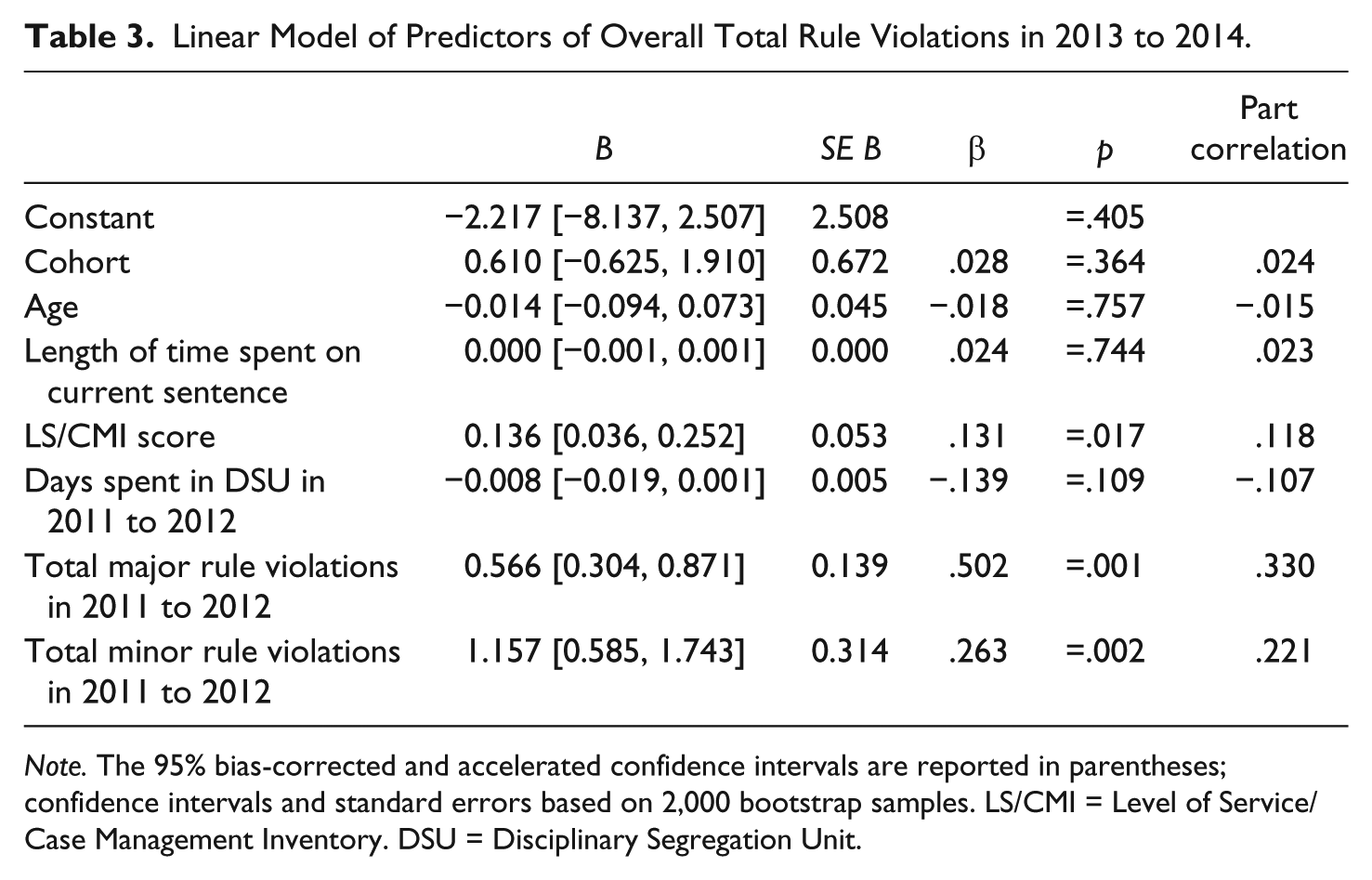
Note. The 95% bias-corrected and accelerated confidence intervals are reported in parentheses; confidence intervals and standard errors based on 2,000 bootstrap samples. LS/CMI = Level of Service/Case Management Inventory. DSU = Disciplinary Segregation Unit.
Follow-Up Analysis and Results
Two further analyses were performed to develop a more refined understanding of the effect of disciplinary segregation on subsequent prison misconduct. These analyses followed the same steps and design as the primary analysis (described above), except that they each operationalized the outcome variable in a different way. No outliers were removed for these follow-up analyses. The first follow-up analysis featured total major rule violations in 2013 to 2014 as the outcome variable, whereas the second follow-up analysis featured total minor rule violations in 2013 to 2014 as the outcome variable. The results of the follow-up analyses were similar to the results of the primary analysis.
For the model that operationalized the outcome variable as total major rule violations in 2013 to 2014, the overall regression model was statistically significant, adjusted R2 = .411, F(7, 220) = 23.621, p < .001. The predictive relation of cohort to total major rule violations was not statistically significant, p = .445. The only statistically significant predictors of misconduct were LS/CMI score, p = .025; total major rule violations in 2011 to 2012, p = .001; and total minor rule violations in 2011 to 2012, p = .007. 2
For the model that operationalized the outcome variable as total minor rule violations in 2013 to 2014, the overall regression model was statistically significant, adjusted R2 = .328, F(7, 220) = 16.843, p < .001. The predictive relation of cohort to total minor rule violations was not statistically significant, p = .314. The only statistically significant predictors of misconduct were total major rule violations in 2011 to 2012, p = .018, and total minor rule violations in 2011 to 2012, p < .001. 3
The results from the primary and follow-up analyses all indicate that the experience of disciplinary segregation does not significantly increase or decrease subsequent prison misconduct among those inmates subjected to it.
Discussion
The results of this study suggest that the deterrence theory–based approach of disciplinary segregation does not explain the relationship between the experience of disciplinary segregation and subsequent prison misconduct among those inmates subjected to it. Just as Lynch (1999), Kovandzic and Vieraitis (2006), and DeFina and Arvanites (2002) found “little or no significant relationship” between incarceration rates and crime rates, this study similarly found no significant relationship between the experience of disciplinary segregation and subsequent prison misconduct among those subjected to it. This is in contrast to other studies such as Levitt (1996, 2004) and Marvell and Moody (1994), who found a negative relationship between the incarceration rate and the crime rate (e.g., an increase in the incarceration rate decreased the crime rate).
The findings of Nagin, Cullen, and Jonson (2009) and Bales and Piquero (2012) indicated that custodial sanctions (e.g., incarceration) may have a criminogenic effect when compared with noncustodial sanctions. In contrast, the results of this study did not indicate that the experience of disciplinary segregation had a criminogenic effect on subsequent institutional behavior. Dölling et al.’s (2009) meta-analysis of 700 deterrence studies found that for 50.5% of those studies, the deterrent effect estimate was not significant, whereas for 41.7% of the studies the deterrent effect estimate was significant and supported the deterrence hypothesis, and for 7.8% of the studies the deterrent effect estimate was significant and did not support the deterrence hypothesis. Similar to those studies in the 50.5% category in which the deterrent effect estimate was not significant, here in this study, the effect of the experience of disciplinary segregation on subsequent prison misconduct was also not statistically significant. Dölling et al.’s meta-analysis also revealed that deterrent effects are more pervasive for property and administrative-type offenses, as opposed to serious and violent crimes. This suggests that even if the experience of disciplinary segregation does not decrease subsequent major rule violations, it may, however, decrease subsequent minor rule violations. However, in this study, the results of the follow-up analyses indicated that the experience of disciplinary segregation does not actually decrease minor rule violations to a significant extent.
The results of this study are generally aligned with much of the previous research on segregation and its relationship with deterrence. Barak-Glantz (1983) found that solitary confinement had only a “minimal” deterrent effect on inmates. In addition, the results of the study by Motiuk and Blanchette (2001) on Canadian segregation and recidivism also did not support the deterrence theory (in fact, their results suggested that segregation may have a criminogenic effect on subsequent offending). Labrecque’s (2015) research showed that disciplinary solitary confinement did not significantly affect subsequent institutional misconduct within the Ohio correctional system. Morris (2016) found that punitive solitary confinement imposed as punishment for an initial act of violent misconduct did not appear to affect subsequent prison misconduct. The results of these studies did not support the deterrence hypothesis in the punitive/disciplinary segregation context. Similarly, the present study also failed to reveal evidence supporting the hypothesis that segregation has a deterrent effect on those subjected to it.
Disciplinary segregation may have a null effect due to certain influencing factors, or alternatively its deterrent effect might be masked by other stronger influencing factors. Some of these potential factors influencing the subsequent behavior of inmates after spending time in disciplinary segregation may be explained by social learning theory. Social learning theory holds that an individual may engage in criminal behavior due to receiving rewards for engaging in criminal behavior, acting in imitation of others, and/or acting in accordance with certain beliefs or attitudes that they hold (Akers & Jennings, 2009). In the disciplinary segregation/prison misconduct context, disciplinary segregation may not have an effect on subsequent misconduct because inmates are acting pursuant to an overriding anti-institutional attitude. Another possibility under social learning theory is that the inmate is acting in imitation of another when committing rule violations. Or the inmate may have received some reward (e.g., recognition and esteem) in the past for committing rule violations and/or spending time in disciplinary segregation.
Other Considerations
Regardless of whether the experience of disciplinary segregation is effective at reducing the subsequent misconduct among those subjected to it, it may serve other beneficial purposes that should be kept in mind. For example, disciplinary segregation could serve the purposes of retribution and just deserts. Furthermore, and perhaps more importantly, the institution of disciplinary segregation may serve as a general deterrent to other prisoners and may prevent them from engaging in prison misconduct (or at least limit their misconduct). Disciplinary segregation could hypothetically have both a deterrent effect on the general population and a criminogenic effect on those directly subjected to it; the two possible results are not mutually exclusive (Nagin et al., 2009). Even if later studies show that the experience of disciplinary segregation may increase subsequent prison inmate misconduct, a fair evaluation of disciplinary segregation should involve an analysis of both the potential costs (e.g., a criminogenic effect on those subjected to it), with the potential benefit (e.g., a general deterrent effect on the general inmate population). Zimring and Hawkins (1973) pointed out that “some methods of punishment . . . may themselves be criminogenic. Insofar as this is the case the preventive effect of punishment on other potential offenders has to be weighed against the possible criminogenic effect on the offender” (p. 43). In addition, the potential benefits of disciplinary segregation are not necessarily limited to behavior modification. Disciplinary segregation might be used to remove a dangerous or troublesome inmate from the general inmate population to promote the well-being and safety of the inmate population and correctional staff, as well as facilitate the smooth operation of the institution. Arguably, these benefits could also be achieved through the use of administrative segregation, but nonetheless such benefits may be realized through the practice of disciplinary segregation as well.
The results of this study indicate that the experience of disciplinary segregation does not reduce subsequent prison misconduct among those inmates subjected to it. Given these findings, especially in light of the possibility that the experience of disciplinary segregation may place inmates at risk of physiological and psychological harm, it would be prudent to further critically evaluate the practice of disciplinary segregation within the Oregon DOC system and elsewhere. Such a critical evaluation should take into account the following: (a) the findings of this study, which indicate that the experience of disciplinary segregation does not affect the subsequent behavior of those subjected to it; (b) the practice of disciplinary segregation may place those inmates subjected to it at risk of negative psychological and physiological effects; (c) the other potential costs associated with the practice of disciplinary segregation (e.g., monetary costs); and (d) the potential benefits of disciplinary segregation (e.g., a potential general deterrent effect). Such a cost–benefit analysis should lead to positive social change, in that it could lead to the practice of disciplinary segregation being exercised in a more judicious and informed manner, and thereby reduce the possibility of unnecessarily placing inmates at risk of psychological and physiological harm.
Limitations
A limitation of this study may be the choice of the control/predictor variables that were used. Only major rule violations may be punished by disciplinary segregation; minor rule violations by themselves and unaccompanied by major rule violations may not be punished by disciplinary segregation (Oregon Administrative Rule 291-105-005 et seq., 2014). Given this fact, the control/predictor variable prior major rule violations in 2011 to 2012 and the independent/predictor variable cohort may have been targeting the same phenomenon. This is because each of the participants in the treatment cohort was placed in that cohort because they had spent time in disciplinary segregation in 2011 to 2012, as punishment for a major rule violation within that same general time frame. However, in response to this critique, it should be noted that not all major rule violations are punished by disciplinary segregation. The choice of disciplinary segregation as the selected punishment is based on the severity of the rule violation and the inmate’s prior misconduct history, among other considerations (Oregon Administrative Rule 291-105-005 et seq., 2014).
Study validity also serves as a possible limitation on this research. First, the internal validity of the study was threatened by a possible selection bias. Here, the cohort that comprised inmates who had previously spent time in disciplinary segregation may have been more predisposed to committing rule violations, whereas the cohort that comprised inmates who, as of January 1, 2013, had not been sent to disciplinary segregation may have been more predisposed to not committing prison rule violations. Either of these circumstances would compromise the accuracy of any inferences that could be drawn from the results. To reduce the chance of selection bias interfering with the study, the statistical technique of multiple regression analysis was used to partial out the impact of certain variables that research has shown to influence prison misconduct (such as “age” and “length of time spent incarcerated on current sentence”).
Another limitation is that the sample was not randomly selected, because this was a retrospective study and only those inmates who met the cohort selection criteria described earlier were included within the study. Also, because this study utilized administrative/archival data, the sample selection process may have resulted in reducing the external validity of the study. That is, limiting the sample to only those inmates incarcerated throughout the entire study period (2011-2014) within a facility containing a medium-security component may have decreased the representativeness of the sample with regard to the whole Oregon prison population. However, keeping that limitation on the sample in place was important for other reasons, including issues related to internal validity and allotting a time frame long enough to collect enough data to compile meaningful results.
Recommendations
More research should be performed to develop a full and accurate picture of the effect of disciplinary segregation on prison misconduct. It is especially important to understand whether disciplinary segregation has a general deterrent effect. To that end, two similar prisons could be examined—one that practices disciplinary segregation and one that does not—and then the prison rule violation rates of the two prisons could be compared and contrasted. This could also take the form of a longitudinal study, where a single prison’s rule violation rates for multiple years are compared; for example, where the rule violation rate of a past year when disciplinary segregation was practiced is compared with the rule violation rate of a year when disciplinary segregation was not practiced.
Another potential avenue for future research is that of obtaining information on disciplinary segregation directly from the inmates themselves. This could take the form of administering surveys to the inmates, or even conducting interviews. The information could be gathered from both the general inmate population and inmates who were recently released from disciplinary segregation. The inmates who had spent time in disciplinary segregation could be asked how they felt their experience will affect their subsequent behavior, and the general population inmates could be asked how they felt the possibility of being sent to disciplinary segregation impacted their behavior.
It is further recommended that this research be replicated in other jurisdictions. For example, similar studies could be carried out in other states, or within the U.S. Federal prison system, or in other countries such as Canada. In addition, in a few years, a follow-up study could be conducted again on the Oregon prison system, which could yield a larger sample size because the LS/CMI began to be administered to all incoming inmates beginning in 2011. Given the results of the current study, it is possible that these future studies may reveal that the use of disciplinary segregation solely for the purpose of subsequent behavioral modification may not be justified.
Conclusion
The purpose of this quantitative study was to examine the effectiveness of disciplinary segregation in deterring prison inmate misconduct within the Oregon DOC prison system. The findings of this study indicate that the experience of disciplinary segregation does not significantly affect subsequent prison inmate misconduct. These findings were consistent regardless of whether outliers were included or excluded from the data set. Because the findings suggest that the experience of disciplinary segregation does not decrease prison misconduct, a critical evaluation of the practice of disciplinary segregation would be prudent to undertake.
Footnotes
Appendix
Declaration of Conflicting Interests
The author(s) declared no potential conflicts of interest with respect to the research, authorship, and/or publication of this article.
Funding
The author(s) received no financial support for the research, authorship, and/or publication of this article.