







Abstract
Mitigation evidence consists of information about an accused person that is typically used to advocate for a less severe sentence. Such evidence most frequently consists of information related to the crime and personal factors that can be separated into two broad categories: deficits and assets-based mitigation. This article focuses on the importance of assets-based mitigation in sentencing and evaluates if and how state sentencing procedures contemplate and allow for consideration of such evidence. A content analysis of available state sentencing procedures reveals that states tend to circumscribe mitigation to factors related to the crime or deficits, but largely neglect to give a vehicle to consider assets-based mitigation, which should play a central role in achieving just outcomes. This article therefore argues for reform to sentencing laws to better accommodate assets-based mitigation by including information related to the defendant’s capacity for growth, self-improvement, and redemption.
Introduction
Individualized sentencing is only required in a limited group of criminal cases in the United States—those which involve the death penalty or sentences of life without the possibility of parole for juvenile offenders. Its use in this subset of criminal cases demonstrates the principle that arriving at just punishments should include considering factors beyond the crime. Much of the jurisprudence concerning individualized sentencing has focused on death penalty cases because courts have viewed capital punishment as decidedly different to all other forms of potential penalties (Woodson v. North Carolina, 1976). Yet much of the same justification for permitting the character and background of a defendant to be considered when the death penalty is a sentencing option applies to noncapital cases (Gohara, 2014, 2018). This is especially true with regard to mitigation evidence.
Mitigation evidence is best understood as a reason to exercise leniency in sentencing. The most conventional type of mitigation connects to the circumstances of the offense, such as whether the defendant was a minor participant in the crime or whether the victim was the aggressor or a party to the criminal act. However, mitigation evidence can also be directly related to the defendant’s personal history, including background and character evidence. Such personal mitigation can be separated into two categories: deficits and assets-based mitigation. Deficits-based mitigation relates to a defendant’s mental and physical disabilities, mental illness, intellectual limitations, trauma disorders, poverty, experiences of neglect or abuse, or other aspects of a defendant’s history or character that highlight the disadvantage between the defendant and an average functioning individual.
Deficits-based mitigation has featured prominently in death penalty cases. For instance, the U.S. Supreme Court has held that a person with intellectual disability cannot be subject to the same penalties as those with greater mental capacity (Atkins v. Virginia, 2002). Similarly, the Court has determined that mitigation related to abuse, parental incarceration, neglect, instability, adverse experiences in foster care, limited education (Williams v. Taylor, 2000) parental substance abuse, parental abandonment (Wiggins v. Smith, 2003), and traumatic brain injury (Porter v. McCollum, 2009) are all relevant considerations in sentencing.
These same cases also acknowledge, however, the need to present a fuller picture of a defendant beyond the deficits or dysfunction experienced. For example, in Williams, the Court identified the importance of assets—or positive character traits—in reaching a just outcome. The Court singled out numerous instances in the defendant’s history that were relevant to sentencing, such as commendations for helping to infiltrate a prison drug ring; returning a guard’s missing wallet; evidence that Mr. Williams was among the inmates least likely to act in a violent, dangerous, or provocative way; evidence of Mr. Williams’s sincere devotion to prison ministry; Mr. Williams’s capacity to thrive in a more regimented and structured environment; and his successful completion of classes related to earning a carpentry degree while in prison (Williams v. Taylor, 2000).
The Supreme Court has been explicit in finding that mitigating evidence does not need to be connected to the crime (Tennard v. Drekte, 2004), nor it is limited to evidence of irreversible damage or defect (Penry v. Lynaugh, 1989). Rather, it encompasses factors about the positive traits and characteristics that speak to the potential of a defendant to rehabilitate, redeem, grow, or change (Skipper v. South Carolina, 1986). Such evidence that focuses on the assets or strengths of a defendant is critical to addressing a defendant’s future behavior, including whether an incarcerated person can be safely housed in a correctional facility (Miller, 2013; Sorensen & Pilgrim, 1999) or whether an offender can successfully return to their community and what support, if any, is needed for them to do so (Listwan, 2009).
Much of what is presented in mitigation in capital trials can be termed as “empathy evidence” (Perlin, 1996, p. 233), and that is due to the recognition in capital cases that the most effective way to disrupt dehumanizing narratives of capital defendants is to present sentencers with evidence of positive character traits. For the sentencing to be just, sentencers must traverse the “empathic divide”: the cognitive and emotional distance between [decision-makers and the defendant] that makes genuine understanding and insight into the role of social history and context in shaping a defendant’s life course so difficult to acquire. The recognition of basic human commonality—an opportunity for [decision-makers] to connect themselves to the defendant through familiar experiences, common moral dilemmas, and recognizable human tragedies—is the starting point for compassionate justice. (Haney, Sontag, & Costanzo, 1994)
Coming to view a defendant as not so dissimilar to oneself makes it hard to view that person as inherently evil. Similarly, viewing a defendant as similar to oneself makes it more likely one will view the criminal act as a situational, not dispositional, attribute.
Assets-based mitigation can therefore provide a way in which sentencers are confronted with the humanity of a defendant and forced to consider their unique human attributes in ways that do not seek to differentiate or “other.” In this way, the ability for assets to be considered in sentencing can facilitate the empathic divide between the sentencer and defendant, resulting in more just outcomes.
Despite the recognition that assets-based mitigation is important to achieving just outcomes in cases where a defendant’s life is at stake, there is little available empirical information regarding how it is treated by sentencers, especially in cases that do not involve the death penalty. The need to understand how such evidence is conceptualized in noncapital sentencing, however, is significant. Comparatively few criminal cases actually involve the death penalty. The vast majority of approximately 1.5 million people in correctional control are there for noncapital offenses (Bureau of Justice Statistics, 2018a). Similarly, it is estimated that approximately 95% of state inmates sentenced to prison will be released (Bureau of Justice Statistics, 2018b), making it essential to determine the strengths of defendants to provide the most accurate support to ensure their successful return to the community.
This article focuses on determining the role of assets-based mitigation in noncapital sentencing. As discussed below, the study focuses on state sentencing procedures, specifically on statutory laws enacted by legislatures or sentencing commissions in felony cases. As a growing chorus of policy makers continue to grapple with ways to better address mass incarceration, assets-based mitigation appears to be crucial to filtering out those convicted defendants for whom alternatives to prison may be warranted. Finally, although this study speaks directly to sentencing policy, considering an assets-based model of mitigation can also add value to other criminal justice agents, such as parole boards, who effectively operate as a sentencing authority by determining the point at which a defendant is able to return to the community.
Current Uses and Support of Assets-Based Mitigation
Deficits and assets-based mitigation are not mutually exclusive. Rather, both are needed to ensure a sentence is based on consideration of all relevant factors. In that sense, the presentation of assets-based mitigation evidence has been the foundation of creating a constitutionally permissible capital sentencing system. In establishing guided discretion as the means by which capital punishment statutes were to operate, the Supreme Court aimed to ensure that no person facing a potential death sentence would be treated as a “member of a faceless, undifferentiated mass to be subjected to the blind infliction of the death penalty” (Woodson v. North Carolina, 1976, p. 19). In Lockett v. Ohio (1978), the Court noted that the constitution requires a sentencing authority not be precluded from considering as a mitigating factor any aspect of a defendant’s character or record and any of the circumstances of the offense that the defendant proffers as a basis for a sentence less than death. The Court based this decision on the long history within criminal cases, generally of individualized sentencing, in which judges considered a range of factors. Central to the Court’s argument was that where sentencing discretion had been permitted, the possession of the fullest information possible concerning the defendant’s life and characteristics was “[h]ighly relevant—if not essential—[to the] selection of an appropriate sentence” (Lockett v. Ohio, 1978, p. 603).
In noncapital cases originating in federal jurisdictions, the Federal Sentencing Guidelines and the Federal Sentencing Statute, 18 U.S.C. § 3553, also encourage judges to consider and give weight to assets-based mitigation when contemplating departing from the sentencing guidelines (Federal Crimes and Criminal Procedure, 2016; United States Sentencing Commission, 2018). In several cases, the U.S. Supreme Court has reiterated the need for federal judges to engage in sentencing that encompasses an array of factors. The Court’s decision in United States v. Booker (2005) and United States v. Fanfan (2009) abolished mandatory sentencing in federal cases and directed judges to use the previously mandatory guidelines as advisory only. In 2007, the Court reaffirmed that the federal sentencing guidelines were advisory and judges were able to consider a range of factors in sentencing in an effort to avoid sentencing disparities (Gall v. United States, 2007; Kimbrough v. United States, 2007). In Gall v. United States (2007), the Supreme Court sided with a federal district court judge who sentenced a defendant to a lesser sentence than the recommended range for his role in a drug-selling conspiracy. The Court signaled the importance of assets-based mitigation to this sentencing departure, stating the following: The District Court quite reasonably attached great weight to Gall’s self-motivated rehabilitation, which was undertaken not at the direction of, or under supervision by, any court, but on his own initiative. This also lends strong support to the conclusion that imprisonment was not necessary to deter Gall from engaging in future criminal conduct or to protect the public from his future criminal acts. (Gall v. United States, 2007, p. 21; emphasis added)
The Supreme Court has also held that it is essential for sentencing judges to consider “the fullest information possible concerning the defendant’s life and characteristics” (internal quotes omitted). Thus, the Court has determined that the punishment should fit the offender as well as the crime and that, in deciding how best to determine the penalty, factors related to the assets of the offender should be considered (Pepper v. United States, 2010).
In addition to Supreme Court rulings, presenting assets-based mitigation evidence is encouraged in the standards of practice and norms for defense counsel in a variety of cases. A review of professional standards in noncapital criminal cases from the American Bar Association (ABA), the National Legal Aid and Defender Association, and the American College of Trial Lawyers collectively outlines the need for a broad investigation into the life history of the defendant, including the potential for rehabilitation (Gohara, 2014). The trial manual published by the American College of Trial Lawyers offers the most direct guidance to defense teams regarding assets-based mitigation: “[I]n noncapital sentencing there must be more emphasis on positive factors in the defendant’s life, such as educational and employment opportunities, family support, and access to and amenability to rehabilitative services” (Gohara, 2014, p. 69).
More recently, the national not-for-profit organization the Campaign for the Fair Sentencing of Youth (CFSY) published guidelines for the representation of child clients facing life sentences, which directly reference the ABA Guidelines for Appointment and Performance of Defense Counsel in Death Penalty Cases. In the CFSY Guidelines, much attention is paid to investigating and presenting assets-based mitigation evidence (CFSY, 2015).
Mitigation evidence includes, but is not limited to, the following: the ability to make a positive adjustment to incarceration, the realities of incarceration, capacity for redemption, remorse, vulnerabilities related to mental or physical health, explanations of patterns of behavior, negation of aggravating evidence regardless of its designation as an aggravating factor, positive acts or qualities, responsible conduct in other areas of life (e.g., employment, education, as a family member, etc.), any evidence bearing on the degree of moral culpability, mercy, and any other reason for a sentence other than life (CFSY, 2015, p. 17).
The recognition that assets-based mitigation is central to fair sentencing is seen in the increased efforts of defender offices throughout the United States to hire and integrate mitigation specialists—the defense team member responsible for constructing the social history of the accused—in noncapital cases (Stetler, 2018). After the sentencing guidelines for federal cases became advisory in United States v. Booker (2005), many federal defender offices began hiring noncapital mitigation specialists. Although the incorporation of mitigation evidence into regular practice in the federal system has been expanding, this practice was already common in many holistic public defender offices throughout the country (Buchanan & Nooe, 2017).
Evidence also suggests that the general public views the inclusion of assets-based mitigation in sentencing decisions as essential to just outcomes. A study by Lovegrove found that the general public’s sense of justice extends beyond an inquiry into the circumstances of the offense and the need to censure the defendant. The rehabilitative potential of the defendant and the “impact of the severity of the sanction on the offender, the collateral consequences of the sentence for not only the offender but also the offender’s family” may be important matters (Lovegrove, 2010, p. 344). Similarly, although the general public may broadly feel that sentencing is too lenient, studies have shown that when given information about a crime and a defendant’s “human complexity,” people view less severe punishments as the most fitting (Tonry, 2016, p. 31).
It is not clear whether state sentencing procedures in noncapital cases provide for the consideration of mitigation evidence or, if not, whether there are other vehicles for considering assets-based mitigation evidence in sentencing. While a growing literature exists concerning the Federal Sentencing Guidelines (Nowacki, 2017; Spohn, 2013), there appears to be no empirical analysis solely focused on state sentencing procedures. This article is an effort to address that gap by undertaking an analysis limited to state sentencing procedures in felony cases. The study is limited to felony cases due to the more consequential nature of the punishments, with the hope that future research can also address sentencing procedures in misdemeanors. Furthermore, it is also hoped that this work will be a starting point for additional investigation into sentencing factors in states and that future studies will more broadly investigate how sentencing procedures are conceived and applied in cases.
To determine the extent to which assets-based mitigation is a part of noncapital state sentencing practices, a content analysis was conducted. As described in section “Method and Analysis”, a review of available state sentencing procedures was undertaken between September and December 2018. Data were collected using Internet sources and searches of state codes and guidelines made available online. In Stage 1 of the analysis, each state was coded for whether it had a system for decision-making and, if so, whether that system included consideration of aggravating and mitigating factors. In the event the state statute mentioned mitigation, Stage 2 was a further assessment to determine what additional guidance, if any, was provided about mitigating factors. Those statutes in which mitigation was dealt with substantively were included in Stage 3 of the analysis, which categorized the mitigation referenced in the statute to understand which states encouraged the sentencing authority to consider assets-based mitigation.
Although there is no direct literature regarding assets-based mitigation in noncapital sentencing throughout the United States, empirical research regarding noncapital federal sentencing and capital sentencing can, at a minimum, inform the present analysis. The next section sketches out what is empirically known about assets-based mitigation as interpreted by sentencers in these settings.
The Role of Assets-Based Mitigation
Prior studies have addressed the ways that mitigation evidence is received and used by sentencing authorities. A study by Garvey using posttrial interview data with individuals who had served as jurors on death penalty cases in South Carolina identified the most salient mitigating factor to be the level of involvement of the defendant in the crime (Garvey, 1998). With respect to personal mitigation, the study noted that the evidence that was most mitigating concerned factors proximate to the defendant’s culpability, including evidence of intellectual disability or age. More remote personal mitigation, which Garvey defined as circumstances over which the defendant had no control, but nonetheless misshaped the person’s behavior, did not strongly mitigate against a death sentence. These factors included being raised in poverty or suffering abuse. Although the study did not include factors related to the defendant’s general good character, evidence of remorse, information that indicated a positive adjustment to prison, and evidence that supported the defendant’s inability to obtain treatment for past problems were all highly mitigating.
Later studies with mock jurors confirmed these results. A study by Barnett, Brodsky, and Davis found mock jurors who were presented with vignettes containing various types of mitigating evidence primarily related to mental health and self-medicating behavior gave a greater proportion of life sentences than in cases where such mitigating evidence was absent. Interestingly, the findings also showed that participants did, at times, view such mitigation evidence as a reason to sentence a hypothetical defendant to death when the vignette lacked context establishing that the mental health issues were treatable. Crucially, it was the belief that the defendant was not irreversibly damaged and thus had the ability to change, grow, or be redeemed that gave the mental health evidence its mitigating effect (Barnett, Brodsky, & Davis, 2004).
A study by Riner and Vartkessian (2019) of Texas death penalty trials further supports the need for broad-based information in sentencing. The researchers identified how narrative evidence presented by defense attorneys in several capital trials in Texas established empathy in juror’s decisions. For instance, one juror who had decided to sentence a man to life without the possibility of parole for his role in the death of a police officer relayed the following: There was a lot of support there for the death penalty for an individual that truly had no conscience—that the discussion this is for the worst of the worst, the serial rapist, the people who go out and intentionally target an individual for the purpose of killing that person, and we did not see that in this case whatsoever, although James had been abusive. When he had been in jail it seemed like when he wasn’t on drugs he had a conscience—he was a good person even—and he held a job—he was a good worker. It seemed like the drugs were the primary, not cause, but led him to be a different person. But even that person was not so horrible as, like I said, someone with absolutely no conscience. And again it came down to the fact of the majority of the individuals, including me, thinking that the death penalty is for the worst of the worst and he just didn’t quite fit that category. We didn’t feel he was that person and again I’ll throw out that word stupid, he was just stupid. He got himself backed into a corner and instead of thinking it through he just acted very stupidly. (Riner & Vartkessian, 2019; emphasis in original removed)
This juror’s view on punishment rested on being able to understand a spectrum of the defendant’s behavior to determine the most appropriate outcome.
The language of a sentencing statute also matters and a slight change of words may impact sentencing decisions. A study by Vartkessian, Soresen, and Kelly (2017) of the Texas death penalty statute looked at the effect of a change in a sentencing statute on the ability of capital jurors to give mitigating effect to evidence in sentencing. Prior to 1989, the Texas sentencing statute directed capital jurors to consider the defendant’s role in the crime, the victim’s role in the crime, and the defendant’s future danger to society. It did not mention the need to consider mitigation. The statute changed in response to the U.S. Supreme Court decision in Penry v. Lynaugh (1989) to include a directive to consider mitigation. The study found that jurors were less likely to view sentencing evidence as mitigating after the statute changed. The authors suggested that this failure could have been caused by the linguistic ambiguity still present in the statute. The term mitigation was not further defined by the statute, and thus jurors may have believed, incorrectly, that mitigating evidence did not include personal factors about the defendant, including assets-based mitigation. Similarly, a study by Kremling, Smith, Cochran, Bjerregaard, and Fogel (2007) looked at a statutory change in North Carolina aimed at permitting greater consideration of mitigating factors in death penalty trials. The authors found that after this change, defense teams presented more mitigating factors and that jurors, in turn, accepted more mitigating factors. However, the study also found that this increased use and acceptance of mitigation evidence had diminishing returns at sentencing. In other words, sentencing outcomes were not significantly impacted by the increase in mitigation being presented or accepted by the jury. The authors suggest that one reason for the observed outcome was that a requirement to consider a factor did not necessarily mean the juror would give significant weight to the factor (Kremling et al., 2007).
Studies of race and capital sentencing also provide insight into the role of assets-based mitigation. Experimental research by Lynch and Haney (2000) found that the defendant’s race influenced sentencers’ use of certain categories of mitigation evidence. Arguments related to the defendant’s history of child abuse, mental health problems, and substance abuse were viewed as less mitigating when the defendant was Black (Lynch & Haney, 2000). A later study by Brewer using postservice juror interview data found that Black juror receptivity to mitigation evidence was more pronounced when a Black defendant was accused of killing a White victim, a particular situation in which Black jurors may be responding to a greater concern for fairness for the defendant (Brewer, 2004).
In noncapital cases, studies regarding the differential treatment of defendants by gender are also illuminating. A study by Spohn and Beichner which looked at rates of imprisonment by race and gender combinations found that differential sentencing by judges for female offenders was connected to views that female defendants were less culpable, less likely to recidivate, and more amenable to rehabilitation (Spohn & Beichner, 2000). This study corroborated previous research by Daly which suggested that judicial sentencing decisions were affected by factors related to a defendant’s marital status and living with a spouse, living with parents or other relatives, or caring for young children. According to Daly, this reflected judges’ beliefs that these offenders had greater informal social control in their lives (Daly, 1989).
The results of Spohn and Beichner and other studies are also consistent with federal sentencing concerns. Between 1987 and 2005, noncapital federal sentencing was governed by mandatory guidelines. As such, judges were limited in their abilities to consider the characteristics of defendants at sentencing. Federal judges and the probation service, responsible for sentencing and reentry, respectively, were dismayed with their inability to consider personal mitigation in determining punishment (Freed, 1992, p. 1715). Among the characteristics that they could not consider were age, education, vocational skills, mental and emotional state, substance abuse history, previous employment history, family relationships and responsibilities, and community relationships. A study by the Federal Courts Study Commission issued in the wake of the adoption of the mandatory guidelines reported that 82% of responding judges believed they were not able to engage in just sentencing because “the guidelines do not authorize the court to adjust the sentence in light of the defendant’s personal history, including such factors as age and employment history” (Federal Judicial Center, 1990, p. 137).
When the mandatory federal sentencing guidelines were found unconstitutional in United States v. Booker (2005), one study noted that sentencing practices post-Booker indicated that downward departures from the guidelines were the largest outside-the-range deviation. The same study conducted an analysis of the reasons judges reported for downward departures and found offender characteristics to be one of the leading factors in lower sentences (Hofer, 2007). By 2017, nearly 50% of federal offenders were sentenced below the recommended range (United States Sentencing Commission, 2017).
Thus, in different sentencing contexts, studies have consistently showed that sentencers, whether judges or jurors, clearly value and respond to mitigation evidence in how they make their decisions. Broadly, judges—typically making sentencing decisions in noncapital cases—find information related to assets of defendants frequently mitigate the severity of their sentence. Similarly, jurors who are most often in the position of determining a sentence when the death penalty is involved, at a minimum, consider that mitigation evidence adds to the complexity of their decision-making process when considering punishment. When assets-based evidence is a part of sentencing, it also lends an otherwise absent mitigating effect to deficits-based mitigation. In other words, when deficits-based mitigation is the only mitigating evidence presented, the defendant’s redemption and rehabilitation may be viewed as less attainable. Thus, for the sentencing to be fair, the literature suggests that assets-based mitigation is critical.
Method and Analysis
Each state and the federal system is able to determine its own individual sentencing procedures. This is most often achieved through the passage of a law by a legislature or by the adoption of guidelines that are the product of a Sentencing Commission. Although nongovernmental organizations such as the National Center for State Courts have at various times attempted to catalog the ways in which states attempt to guide sentencing decisions, there is no single database where such information is held.
The primary source of information for this analysis originates from state sentencing laws or guidelines passed by legislatures or Sentencing Commissions and contained within a state’s Criminal Codes of Procedure or governing sentencing publications, all available online. Between September and December 2018, each individual state was searched using the name of the state followed by “sentencing guidelines.” After reviewing all results responsive to that general query, a more refined Internet search of each state was undertaken to focus on noncapital sentencing by specifying “felony sentencing” in each state. In addition, reviews of state Sentencing Commission websites, criminal codes, and where available worksheets required to be completed by the sentencing authority were also researched. Although the results provided in this article are the most comprehensive attempt to collate information publicly available through Internet searches of state statutes and guidelines, it is possible that they do not represent all sentencing guidelines, laws, and customs applicable for felonies within each state in the United States.
Finally, it is important to note that given the focus of this article on statutory law and not common law, the research does not address potentially applicable case law within each state. At times, sentencing guidelines established by sentencing commissions as an arm of the legislature have been included in the analysis where the criminal code of procedure left open the possibility of such guidance. Although a deep dive into case law would add to the understanding of local practice and a fuller understanding of how courts have come to understand sentencing evidence, such an assessment was beyond the scope of this study.
Results
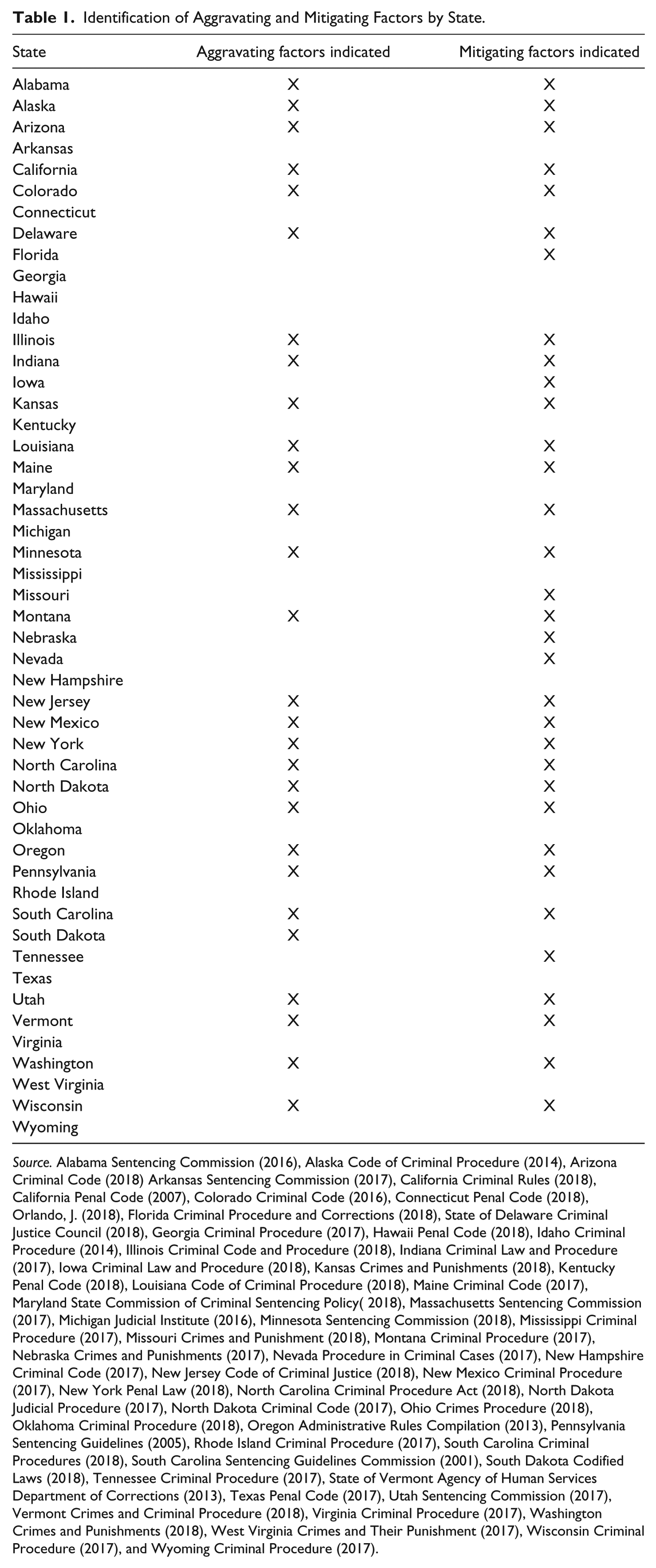
After collating available noncapital felony sentencing procedures, first cycle coding was conducted. In this cycle, each state was evaluated by whether or not it had statutory sentencing factors that were explicitly identified as aggravating and/or mitigating. As aggravation and mitigation are the most common ways in which sentencing is determined, this straightforward assessment made it possible to obtain a baseline for the framework of sentencing in each state. Although some states provided guidelines that could be understood as evidence that would mitigate or lessen a sentence or aggravate or increase a sentence, only those states that specifically used the designations of aggravating or mitigating to speak about sentencing factors were marked as having such factors in sentencing. The results of the first cycle analysis are represented in Table 1.
Identification of Aggravating and Mitigating Factors by State.
Source. Alabama Sentencing Commission (2016), Alaska Code of Criminal Procedure (2014), Arizona Criminal Code (2018) Arkansas Sentencing Commission (2017), California Criminal Rules (2018), California Penal Code (2007), Colorado Criminal Code (2016), Connecticut Penal Code (2018), Orlando, J. (2018), Florida Criminal Procedure and Corrections (2018), State of Delaware Criminal Justice Council (2018), Georgia Criminal Procedure (2017), Hawaii Penal Code (2018), Idaho Criminal Procedure (2014), Illinois Criminal Code and Procedure (2018), Indiana Criminal Law and Procedure (2017), Iowa Criminal Law and Procedure (2018), Kansas Crimes and Punishments (2018), Kentucky Penal Code (2018), Louisiana Code of Criminal Procedure (2018), Maine Criminal Code (2017), Maryland State Commission of Criminal Sentencing Policy( 2018), Massachusetts Sentencing Commission (2017), Michigan Judicial Institute (2016), Minnesota Sentencing Commission (2018), Mississippi Criminal Procedure (2017), Missouri Crimes and Punishment (2018), Montana Criminal Procedure (2017), Nebraska Crimes and Punishments (2017), Nevada Procedure in Criminal Cases (2017), New Hampshire Criminal Code (2017), New Jersey Code of Criminal Justice (2018), New Mexico Criminal Procedure (2017), New York Penal Law (2018), North Carolina Criminal Procedure Act (2018), North Dakota Judicial Procedure (2017), North Dakota Criminal Code (2017), Ohio Crimes Procedure (2018), Oklahoma Criminal Procedure (2018), Oregon Administrative Rules Compilation (2013), Pennsylvania Sentencing Guidelines (2005), Rhode Island Criminal Procedure (2017), South Carolina Criminal Procedures (2018), South Carolina Sentencing Guidelines Commission (2001), South Dakota Codified Laws (2018), Tennessee Criminal Procedure (2017), State of Vermont Agency of Human Services Department of Corrections (2013), Texas Penal Code (2017), Utah Sentencing Commission (2017), Vermont Crimes and Criminal Procedure (2018), Virginia Criminal Procedure (2017), Washington Crimes and Punishments (2018), West Virginia Crimes and Their Punishment (2017), Wisconsin Criminal Procedure (2017), and Wyoming Criminal Procedure (2017).
Based on the review, Table 1 shows whether a state’s Criminal Code of Procedure, guidelines, or sentencing commission, which collectively will be referred to as a state’s sentencing procedures, explicitly designated the sentencing authority to consider either mitigating or aggravating factors. Sixteen states did not explicitly mention aggravating or mitigating factors to be considered in sentencing. This was due to mandatory sentences upon conviction of specific crimes, parole boards bearing the responsibility for determining release in states with indeterminate sentencing, provisions for departures from ranges that provided a list of considerations, but did not designate the factors as aggravating or mitigating, or seemingly unlimited discretion without any formal statutory guidance for sentencers. For example, Arkansas, Connecticut, Idaho, Kentucky, Maryland, and Virginia had restrictive sentencing procedures where mandatory sentencing or fixed ranges were in place (Arkansas Criminal Offenses, 2017; Connecticut Penal Code, 2018; Orlando, J., 2018; Idaho Criminal Procedure, 2014; Kentucky Penal Code, 2018; Maryland State Commission of Criminal Sentencing Policy, 2018; Virginia Criminal Procedure, 2017).
Georgia and Michigan allowed for downward departures from sentencing ranges for “good reason” but did not specify what could constitute such a reason (Georgia Criminal Procedure, 2017; Michigan Judicial Institute, 2016, p. 3). Hawaii provided a list of factors to be considered in sentencing but did not indicate whether the factors should justify an enhancement or downward departure (Hawaii Penal Code, 2018). Similarly, Rhode Island permitted the trial judge to impose a sentence outside the presumptive range if “substantial and compelling circumstances exist which justify imposition of an alternative sentence” (Rhode Island Criminal Procedure, 2017). Mississippi, New Hampshire, Texas, West Virginia, and Wyoming did not provide sentencing procedures (Mississippi Criminal Procedure, 2017; New Hampshire Criminal Code, 2017; Texas Penal Code, 2017; West Virginia Crimes and Their Punishment, 2017; Wyoming Criminal Procedure, 2017)
As this study was concerned with sentencing in felony cases, where a state only noted the consideration of aggravating and/or mitigating factors for narrow groups, such as juveniles or veterans, those states were excluded. Oklahoma singled out veterans as a group for which mitigation could be considered, but did not provide any mechanism for mitigation to be applied in other circumstances (Oklahoma Criminal Procedure, 2018).
Six states (Florida, Iowa, Missouri, Nebraska, Nevada, and Tennessee) explicitly mentioned mitigating factors and not aggravating factors in sentencing (Florida Criminal Procedure and Corrections, 2018; Iowa Criminal Law and Procedure, 2018; Missouri Crimes and Punishment, 2018; Nebraska Crimes and Punishments, 2017; Nevada Procedure Tennessee Criminal Procedure, 2017; Nevada Procedure in Criminal Cases, 2017). Despite not using the word “aggravating” in sentencing, these states did speak of enhancements to sentences or potentially aggravating topics that could be considered in determining punishment. For example, Missouri instructs the sentencing authority to regard “the nature and circumstances of the offense and the history and character of the defendant and render judgement accordingly” (Missouri Crimes and Punishment, 2018). Research has shown that such phrases are linguistically ambiguous, making them subject to wide interpretation (Haney et al., 1994; Riner, 2015), and that the designation of evidence as either aggravating or mitigating frames the sentencing effect of the information. Absent such express designation, these states were therefore viewed as distinct to those which provided an aggravating designation to factors for the sentencing authority and excluded from this categorization.
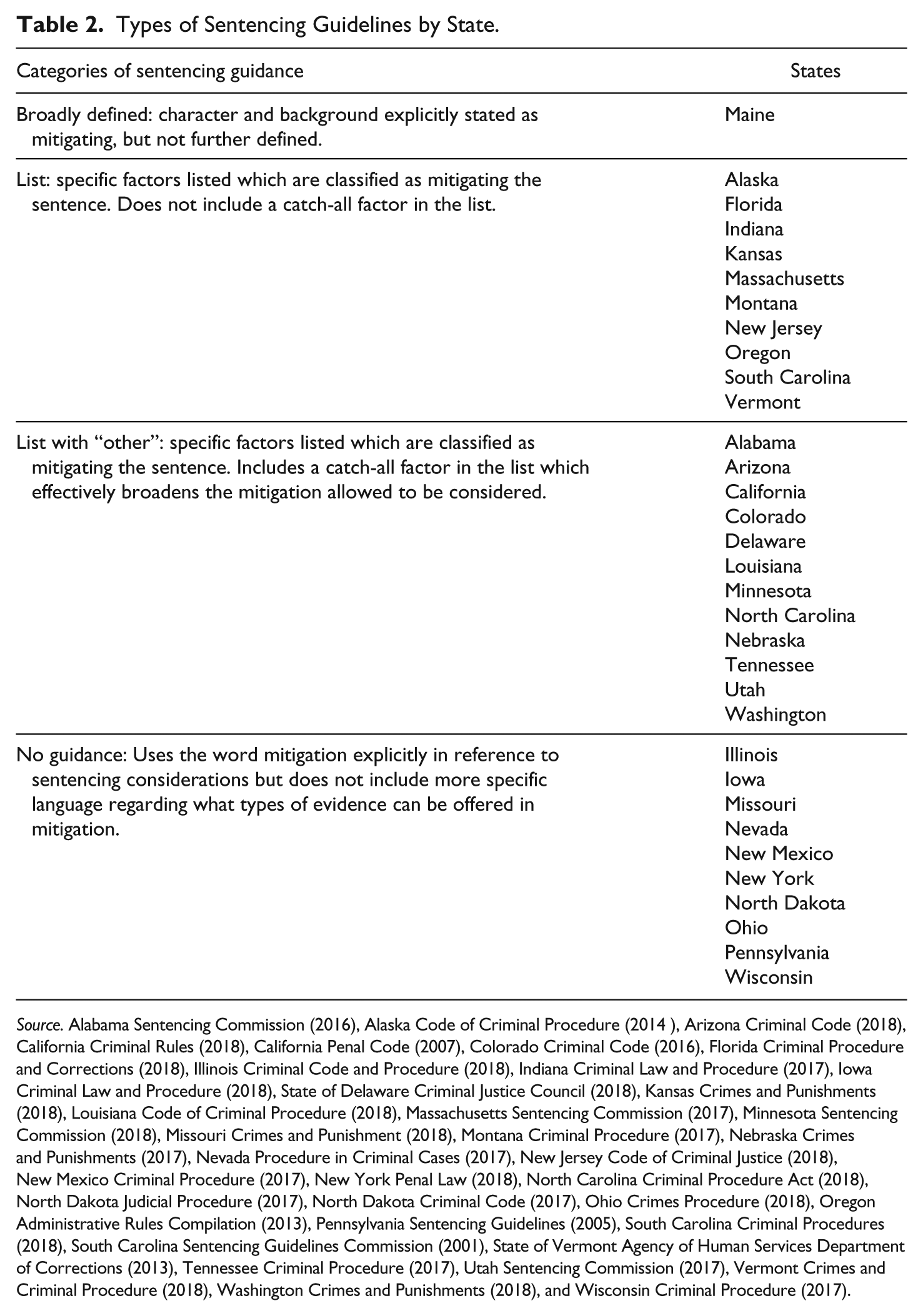
Thirty-three states therefore explicitly mentioned aggravating and mitigating factors. These states were subject to a second cycle analysis regarding mitigating factors specifically. This second cycle review was chiefly concerned with understanding the form in which mitigation was presented to the sentencing authority to better understand the degree of guidance and discretion provided, as previous research has determined that fundamentally different sentencing frameworks alter the decision-making process (Haney et al., 1994). A review of the factors listed in mitigation revealed four general categories. Sentencing procedures that simply stated mitigating factors were related to the character and background of the defendant, or any evidence relevant to sentencing was categorized as providing “broad” guidance. States where the word mitigation was explicitly stated, but no additional guidance was found, were marked as providing “no guidance.” States which enumerated a specific list of factors as the only reason for a downward departure from a sentencing range were identified as “list” states. Finally, those states which specified factors, but included an open-ended or catch-all factor designating an opportunity for sentencers to exercise discretion outside of the listed factors, were coded as “list with other.” Table 2 shows the results.
Types of Sentencing Guidelines by State.
Source. Alabama Sentencing Commission (2016), Alaska Code of Criminal Procedure (2014 ), Arizona Criminal Code (2018), California Criminal Rules (2018), California Penal Code (2007), Colorado Criminal Code (2016), Florida Criminal Procedure and Corrections (2018), Illinois Criminal Code and Procedure (2018), Indiana Criminal Law and Procedure (2017), Iowa Criminal Law and Procedure (2018), State of Delaware Criminal Justice Council (2018), Kansas Crimes and Punishments (2018), Louisiana Code of Criminal Procedure (2018), Massachusetts Sentencing Commission (2017), Minnesota Sentencing Commission (2018), Missouri Crimes and Punishment (2018), Montana Criminal Procedure (2017), Nebraska Crimes and Punishments (2017), Nevada Procedure in Criminal Cases (2017), New Jersey Code of Criminal Justice (2018), New Mexico Criminal Procedure (2017), New York Penal Law (2018), North Carolina Criminal Procedure Act (2018), North Dakota Judicial Procedure (2017), North Dakota Criminal Code (2017), Ohio Crimes Procedure (2018), Oregon Administrative Rules Compilation (2013), Pennsylvania Sentencing Guidelines (2005), South Carolina Criminal Procedures (2018), South Carolina Sentencing Guidelines Commission (2001), State of Vermont Agency of Human Services Department of Corrections (2013), Tennessee Criminal Procedure (2017), Utah Sentencing Commission (2017), Vermont Crimes and Criminal Procedure (2018), Washington Crimes and Punishments (2018), and Wisconsin Criminal Procedure (2017).
As shown in Table 2, 11 states specify mitigation evidence as relevant to sentencing, yet provide no additional instruction as to what constitutes such evidence. For example, Wisconsin’s Code of Criminal Procedure contains a section on the consideration of aggravating and mitigating factors, yet provides just three categories to consider—protection of the public, gravity of the offense, and rehabilitative needs of the defendant. It does not state whether these considerations are meant to mitigate the sentence (Wisconsin Criminal Procedure, 2017).
Ten states list specific mitigating factors that can justify departing from the sentencing range provided, but do not provide unfettered discretion. For instance, Oregon’s statute, which encapsulates many of the mitigating factors identified within other statutes, provides the following list: The victim was an aggressor or participant in the criminal conduct associated with the crime of conviction; The defendant acted under duress or compulsion (not sufficient as a complete defense); The defendant’s mental capacity was diminished (excluding diminished capacity due to voluntary drug or alcohol abuse); The offense was principally accomplished by another and the defendant exhibited extreme caution or concern for the victim; The offender played a minor or passive role in the crime; The offender cooperated with the state with respect to the current crime of conviction or any other criminal conduct by the offender or other person. The offender’s refusal to cooperate with the state shall not be considered an aggravating factor; The degree of harm or loss attributed to the current crime of conviction was significantly less than typical for such an offense; The offender’s criminal history indicates that the offender lived conviction-free within the community for a significant period of time preceding his or her current crime of conviction; The offender is amenable to treatment and an appropriate treatment program is available to which the offender can be admitted within a reasonable period of time; The treatment program is likely to be more effective than the presumptive prison term in reducing the risk of offender recidivism; and the probation sentence will serve community safety interests by promoting offender reformation; The offender’s status as a service member as defined in ORS 135.881. (Oregon Administrative Rules Compilation, 2013)
Of the listed factors in Oregon’s sentencing procedure, the majority of considerations highlight issues related to the commission of the crime, with only a few factors relating to potential assets-based mitigation of the defendant. An additional 12 states provide similar lists of considerations for mitigating a sentence, and also contain an all-inclusive factor expanding the universe of possible reasons for mitigating a sentence (Oregon Administrative Rules Compilation, 2013)
Wisconsin was alone in its broad mandate for the sentencer to consider mitigation by simply stating, “When a court makes a sentencing decision concerning a person convicted of a criminal offense committed on or after February 1, 2003, the court shall consider . . . any applicable mitigating factors . . .” (Wisconsin Criminal Procedure, 2017).
Assets-Based Mitigation
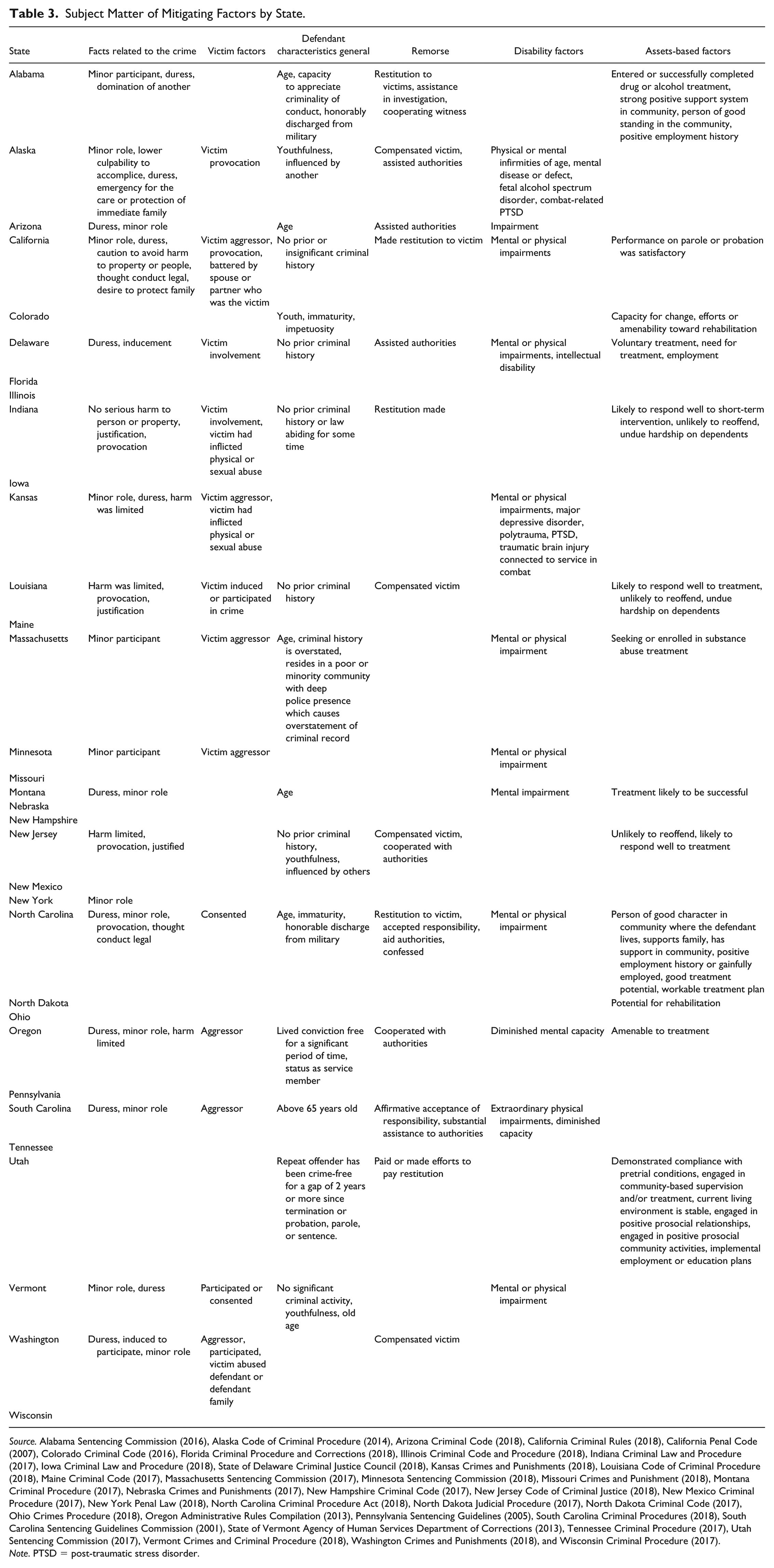
To determine which states included assets-based mitigation, a third coding cycle focused on identifying distinct categories of mitigation in those states that explicitly identified mitigation as a part of their sentencing procedures. Thematic analysis was the method by which the coding was conducted. Thematic analysis was most suitable for this study as it sought to capture a level of patterned factors in state sentencing procedures (Braun & Clarke, 2006, p. 82). Six categories of mitigation were identified: crime, victim, general characteristics of the defendant, remorse, disability, and assets-based mitigation.
States were coded as having mitigation related to the crime when sentencing procedures specified downward departures due to the level of participation of the defendant, duress, and whether the crime was due to necessity (such as having to provide for immediate family members). A significant number of crime-related considerations were also concerned with the level of involvement of the victim. To highlight the difference between a defendant and victim’s role in the crime, factors such as whether the victim provoked the incident were grouped separately. In other words, victim factors involved actions for which the victim was responsible, even if it impacted whether the defendant committed the crime.
Factors that were coded as general characteristics of the defendant were age, lack of a previous criminal history, and low chance of recurrence. Remorse was placed in its own category because it encapsulates both assistance to law enforcement and personal acceptance for the crime. Included in this category was whether the defendant compensated the victim before being arrested.
Factors that were coded for disability or dysfunction included mental and physical health issues or limitations, such as being a person with fetal alcohol spectrum disorder, post-traumatic stress disorder, combat injuries, and drug or alcohol addiction. These factors highlighted struggles that may have caused or led to the commission of the crime, but were not sufficient for a defense.
Assets-based mitigation was coded as any instance where a sentencing procedure mentioned a positive action of the defendant as a reason for leniency. Engaging in or amenability to substance abuse treatment, compliance with pretrial conditions, educational efforts, employment efforts, prosocial relationships, and positive living environment were all coded as assets-based mitigation. Table 3 provides the results of the coding.
Subject Matter of Mitigating Factors by State.
Source. Alabama Sentencing Commission (2016), Alaska Code of Criminal Procedure (2014), Arizona Criminal Code (2018), California Criminal Rules (2018), California Penal Code (2007), Colorado Criminal Code (2016), Florida Criminal Procedure and Corrections (2018), Illinois Criminal Code and Procedure (2018), Indiana Criminal Law and Procedure (2017), Iowa Criminal Law and Procedure (2018), State of Delaware Criminal Justice Council (2018), Kansas Crimes and Punishments (2018), Louisiana Code of Criminal Procedure (2018), Maine Criminal Code (2017), Massachusetts Sentencing Commission (2017), Minnesota Sentencing Commission (2018), Missouri Crimes and Punishment (2018), Montana Criminal Procedure (2017), Nebraska Crimes and Punishments (2017), New Hampshire Criminal Code (2017), New Jersey Code of Criminal Justice (2018), New Mexico Criminal Procedure (2017), New York Penal Law (2018), North Carolina Criminal Procedure Act (2018), North Dakota Judicial Procedure (2017), North Dakota Criminal Code (2017), Ohio Crimes Procedure (2018), Oregon Administrative Rules Compilation (2013), Pennsylvania Sentencing Guidelines (2005), South Carolina Criminal Procedures (2018), South Carolina Sentencing Guidelines Commission (2001), State of Vermont Agency of Human Services Department of Corrections (2013), Tennessee Criminal Procedure (2017), Utah Sentencing Commission (2017), Vermont Crimes and Criminal Procedure (2018), Washington Crimes and Punishments (2018), and Wisconsin Criminal Procedure (2017).
Note. PTSD = post-traumatic stress disorder.
Of the 33 states to specify mitigation in sentencing procedures, 19 specified mitigating factors related to the defendant’s role in the commission of the crime. Thirteen states specified mitigating factors related to the victim’s participation or role in the crime. Sixteen states specified general characteristics of the defendant, such as youthfulness or old age, a lack of criminal history, or honorable service in the military as a basis for imposing a lower sentence. Interestingly, some states like Massachusetts highlighted circumstances in which “the defendant’s residence in a poor or minority area with deep police penetration causes overstatement of the seriousness of the criminal record” (Massachusetts Sentencing Commission, 2017, p. 57). Such a factor imbued the context of the factor within the factor itself.
Twelve states specified mitigating factors related to mental or physical disability or dysfunction. Some statutes were extremely specific with the factors listed in this category. For instance, Alaska singled out people impacted by fetal alcohol disorder or fetal alcohol spectrum disorder, defining it as “a condition of impaired brain function in the range of permanent birth defects caused by maternal consumption of alcohol during pregnancy” (Alaska Code of Criminal Procedure, 2014). Similarly, Alaska also specified mitigation related to the long-term impact of combat injuries, including post-traumatic stress disorder, defining it as combat-related post-traumatic stress disorder or combat-related traumatic brain injury . . . resulting from combat with an enemy of the United States in the line of duty while on active duty as a member of the armed forces of the United States. (Alaska Code of Criminal Procedure, 2014)
Similarly, Kansas specified both major depressive disorder and polytrauma (Kansas Crimes and Punishments, 2018).
Thirteen states also specified mitigating factors related to expressions of remorse. These expressions included overt admissions of responsibility, but were more often connected to efforts the defendant made to compensate victims. Similarly, assistance to law enforcement in providing information related to accomplices or other crimes was also categorized as remorse.
Thirteen states explicitly allowed for the consideration of assets-based mitigation in sentencing. The most commonly identified factor focused on whether the defendant had become involved in or successfully completed substance abuse or other treatment programs in the aftermath of the crime or whether the defendant had sought voluntary drug treatment. The defendant’s potential to respond well to treatment more broadly was also considered in this category. Although a defendant’s willingness and ability to engage in self-improvement is a positive action, the connection to substance abuse as it relates to the crime can also bring such assets-based mitigation in close proximity to the offense itself.
Alabama, Colorado, North Carolina, and Utah provided the most closely aligned assets-based mitigating factors in their sentencing considerations (Alabama Sentencing Commission, 2016; Colorado Criminal Code, 2016; North Carolina Criminal Procedure Act, 2018; Utah Sentencing Commission, 2017).
These factors included the capacity to change, prosocial relationships, efforts in self-improvement through training, education, healthy living environments, and community engagement. Utah was the clearest in its articulation of assets-based mitigation in sentencing: 1. Offender has engaged in the voluntary screening process in the county jail. 2. Offender has paid restitution and/or made good faith effort to begin repayment of restitution to the victim. 3. Offender has demonstrated compliance with all pretrial conditions. 4. Offender is engaged in community-based supervision and/or treatment services consistent with a validated risk and needs assessment. 5. Offender’s current living environment is stable and supportive of offense-specific interventions which do not enable continued criminal or unlawful conduct. 6. Offender is engaged in positive, supportive, pro-social relationships. 7. Offender is engaged in positive, supportive, pro-social community activities. 8. Offender has implemented positive educational or employment plans. 9. Repeat offender has demonstrated ability to remain crime-free, with a gap of 2 plus years since termination of previous probation, parole, or completion of sentence of incarceration in jail or prison. (Utah Sentencing Commission, 2017, p. 31)
Although Utah’s sentencing procedure includes some mitigating factors that were also specified in other states, it was the only jurisdiction that did not focus on the role of the victim or factors related to the crime and instead based sentencing on an offender’s prosocial relationships and community activities. Similarly, it was unique in providing credit to offenders who had made plans—though not necessarily completed these plans—to obtain gainful employment, education, treatment, and safe and supportive housing.
Discussion
There is a high degree of variation in sentencing procedures across states, including whether aggravating and mitigating factors are specified in statutory codes or sentencing commission guidelines at all. Where specific mitigating factors are provided, states vary in the level and specificity of information provided to sentencers.
Overall, noncapital sentencing procedures in states largely fail to identify assets-based mitigation as meaningful to sentencing. Of the 13 states to consider this type of mitigation, just four directed the sentencing authority to credit a defendant’s capacity to change or efforts to improve, and of these four, only Utah positioned the capacity of the defendant at the center of the sentencing calculus.
Although it could be argued that assets-based mitigation is included in, or at least not excluded from, those statutes that provide broad instructions to consider the character and background of the defendant, the failure to explicitly include such factors has a potential skewing effect. For one, research indicates that the form and focus of sentencing procedures can limit decision-making to only the factors specified (Haney et al., 1994). Similarly, broad sentencing procedures tend to be the least understood (Riner, 2015). In other words, ambiguous language can obscure decision-makers from seeing the mitigating effect of sentencing evidence.
Moreover, given the high degree of specificity of other mitigation factors included in some statutes, such as considering whether the defendant has fetal alcohol spectrum disorder or has suffered a combat injury while serving in the military, it is likely that without clear language, sentencers will be functionally restricted from crediting assets-based mitigation.
The consideration of deficits-based mitigation evidence alone presents its own unique challenges. These factors can easily be seen as excuses, undercutting expressions of remorse and acceptance of responsibility for the offense (Haney et al., 1994; Vartkessian, 2011). In addition, deficit-based mitigation has the potential to backfire (i.e., support a harsher sentence) as much of this kind of evidence highlights limitations in reasoning and capability that might concern sentencers when considering the ability of the defendant to conform. Similarly, deficits-based mitigation such as limited intellect can be hard for sentencers to appraise and may feed into and reinforce preexisting stereotypes and prejudices about what certain people are capable of, leading them to categorize defendants as part of a class of people who cannot be expected to do anything positive with their lives. Thus, deficits-based mitigation may not be viewed as a reason to depart from a sentencing range or may even be the reason for sentencers imposing a harsher sentence.
Sentencing is an inherently subjective task. Those who argue for limited consideration of mitigating factors tend to point to the potential for bias, unconscious, or otherwise to have a greater chance of infecting the process when personal factors are given weight. Some argue that given the history of race in the United States, specifically counting factors such as education, work history, and efforts to receive treatment for mental health concerns might further exacerbate sentencing disparities due to structural discrimination that limits access to services in many marginalized communities. These concerns are real, yet it is possible that focusing more on assets may be the solution to fairer sentencing and not a threat. Sentencing is harsher when a defendant can be viewed as inherently different to the sentencer. By focusing on universal experiences and common moral dilemmas facing individuals, more tailored and therefore most appropriate punishments can result. For assets-based mitigation to fill this role requires a broad understanding of such evidence. Credit must be given for both formal and informal efforts to this end. States like Massachusetts have shown the way forward by finding ways in which to better guide sentencing by providing context for decision-making. In Massachusetts, one of the mitigating factors listed is whether the defendant’s residence in a poor or minority area with deep police penetration causes overstatement of the seriousness of their criminal record (Massachusetts Sentencing Commission, 2017, p. 57). This is a good example of formulating assets-based mitigation in such a way as to limit the potential for bias to further exacerbate disparities in sentencing.
Moreover, much has been learned about how to address implicit biases that are a part of American culture. One way is to slow the decision-making process down by adding questions that remind the decision-maker that race should not be a factor in determining outcomes (Eberhardt, 2019). Anti-discrimination policies that provide language and imagery affect how norms are perceived. For instance, on-line platforms have had to find effective ways to mitigate the influence of implicit bias. Platforms like Nextdoor provide an interstitial prompt intended to minimize bias. These prompts can get people to think more about or attend more closely to race (Levy & Barocu, 2017, p. 1205).
To determine how assets-based mitigation can affect sentencing outcomes in the long term, research should focus on Utah’s sentencing guidelines as a starting point. Utah provides a sentencing grid from which judges can depart, relying on the assets-based mitigation discussed previously. The state’s Sentencing Commission indicates that Utah utilizes an “evidence-based sentencing framework” with a major focus on risk management, risk reduction, and restitution (Utah Sentencing Commission, 2017, p. 3). The Sentencing Commission has relied on research conducted in both North America and Europe, which has demonstrated success in reducing recidivism. Reliance on validated risk and needs assessment tools that focus on what tangible factors prevent an offender from engaging in future risk is at the center of the Sentencing Commission’s guidance. The Commission notes that incapacitation has a minimal specific deterrent effect on an offender or may actually increase recidivism, and that the goal of risk reduction, which is an often neglected aim of punishment, extends beyond incarceration and must be a part of appropriate post release programming (Utah Sentencing Commission, 2017, p. 6). Although there is a need for caution in embracing the various risk assessment models in use throughout the country—most notably regarding the potential introduction of bias against members of racial minorities or those who grew up in poverty or living in marginalized communities—Utah’s unique focus on evidence-based sentencing appears to set it apart as a prime locale for future empirical work. Similarly, since in Utah assets-based factors are used to depart from the sentencing range and judges are expected to explicitly state their reasons for departures, it would be highly useful for researchers to review these reasons for departures to better understand how assets-based mitigation is presented and interpreted by judges. More broadly, research should investigate how different sentencing procedures correlate to actual sentencing outcomes. This would enable policy makers to better determine which procedures resulted in sentencing disparities.
Defense attorneys in felony cases may also fall victim to focusing on investigating only the specific factors mentioned in their state sentencing law at the expense of assets-based mitigation, believing that there is no basis to think that a judge would credit such evidence. Defenders should consider the ways in which existing state sentencing structures leave open the possibility for presenting assets-based mitigation and what further steps can be taken to provide decision-makers with such evidence. Both Supreme Court jurisprudence and professional guidelines suggest that considering individual characteristics of defendants and highlighting positive attributes are central to reaching a just sentencing decision. Defense teams should keep the need to present such evidence in mind when preparing to litigate felony cases and in preparation for the possibility that the defendant ends up facing a sentencing hearing.
There are a multitude of demands placed on defense attorneys, many of whom are public or court appointed defenders representing those who cannot afford to hire private counsel. To help assist them in the development and presentation of assets-based mitigation, state and county defender officers should prioritize hiring mitigation specialists who are able to conduct social history investigation in felony cases. As noted previously, many federal public defender offices now have mitigation specialists on staff. These individuals are not testifying experts, but rather members of the defense team who are able to assist counsel in collecting records and conducting interviews as part of the preparation of the case. For court appointed attorneys, requests for funding for this kind of assistance should be made to courts or commissions, as the need to balance the evidence presented in sentencing is essential to obtaining the most just outcome.
Conclusion
Defined mitigating factors based on defendant assets or capacity for change are rare in state sentencing procedures. This exclusion or limitation of assets-based mitigation from consideration is significant not just because of what it means for individual sentencing outcomes but because of how it defines the very purpose of the sentencing process. When the application of mitigation is limited to a carved out set of exceptions—that is, when the default is to assume that a defendant deserves a higher sentence unless certain factors can set them apart from a “normal offender”—the balance of the sentencing process will remain tipped toward retribution and removal from society. Creating a structure in which the role of assets-based mitigation is integral is an opportunity to advance equity in sentencing.
Footnotes
Declaration of Conflicting Interests
The author(s) declared no potential conflicts of interest with respect to the research, authorship, and/or publication of this article.
Funding
The author(s) received no financial support for the research, authorship, and/or publication of this article.
