







Abstract
Offenders do not always operate within jurisdictional boundaries and, as such, neighboring law enforcement agencies can benefit from sharing crime data and other investigation-related information with one another, with the shared goal of reducing crime throughout their region. In 2016, one such partnership was formed with seven law enforcement agencies, the District Attorney’s Office, and public health officials in King County, Washington. As part of a larger evaluation of this regional collaboration, the authors assessed the data and intelligence-sharing behaviors of key personnel from each participating agency over an 18-month period. This was done through a series of interviews with key personnel and the use of social network analysis. Results suggest that, although data-sharing networks increased in size and project personnel were able to identify benefits to sharing crime data with one another (e.g., seeing the “bigger picture” regarding crime in their region, using shared crime data to track and combat violent crime), they also identified a number of obstacles associated with cross-jurisdictional data sharing. Findings from this evaluation contribute to the collective understanding and implementation of a regional approach to crime control. If criminal justice agencies plan to work together to reduce crime, data and information sharing are essential. Therefore, it is imperative that agencies are aware of the positive outcomes associated with regional data sharing and the challenges that can arise throughout this collaborative effort.
Introduction
Local criminal justice agencies, such as police and prosecutors, often work together to curb crime in their region, both reactively and proactively. The former requires law enforcement officials to respond to crime, identify offenders, and collect evidence that will then be passed to prosecutors with the goal of charging and trying said offenders. The latter requires a commitment from both parties to pinpoint regional crime issues and collaborate on a response with the goal of preventing crime before it occurs. Regardless of which approach these agencies decide to take, communication between agencies is key. Prosecutors rely on police to collect crime data and identify crime trends so that they can determine which type of criminal cases need their attention, which can then lead to the use of targeted prosecutorial strategies. Police rely on prosecutors to charge, try, and successfully convict the offenders they have identified and apprehended, leading to a reduction in local crime through either deterrence or incapacitation.
Prior research findings have demonstrated that offenders do not operate within jurisdictional boundaries (Fox et al., 2020; Lammers & Bernasco, 2013; Porter, 1996). In fact, it is shown that the probability of arrest declines as geographical dispersion of offenses increases (Lammers & Bernasco, 2013). That is, offenders can easily move from area to area committing a series of crimes and this patterned behavior may go unnoticed if police within a single jurisdiction treat such crimes as isolated incidents within their area. Therefore, if a particular region, such as a county, has an increase in crime, it may be beneficial for law enforcement, prosecutors, and other relevant personnel to take a data-driven, collaborative approach to crime control in the area.
We have seen a rise in multi-jurisdictional partnerships between law enforcement and other criminal justice agencies in the United States in recent years. Such partnerships can occur when local, state, and federal law enforcement work together to combat crime on a national scale, as is the case with fusion centers designed to combat domestic terrorism post-September 11 (International Association of Chiefs of Police, 2002; National Institute of Justice, 2003). Others have taken a more regional approach, with local law enforcement agencies collaborating with county prosecutors and community stakeholders to effectively address local crime issues, such as rising homicide rates, gun-related crimes, or violent crimes more generally (Moore, 2018; San Francisco District Attorney’s Office, 2020; Tallon et al., 2016). The aforementioned collaborations are grounded in good intentions and thought-out plans to facilitate data and intelligence sharing across multiple agencies to achieve a common goal, but the reality of such a partnership may not be so simple (Sheptycki, 2004). Therefore, it is important for scholars to empirically assess these partnership efforts to follow how these agencies come together and collaborate in real time and under real-world conditions to identify what works and what does not work when it comes to building a multiagency regional collaboration (Sanders & Henderson, 2013).
This study contributes to our knowledge regarding multiagency criminal justice partnerships by taking quantitative and qualitative approaches to understanding data and intelligence sharing across multiple agencies. From 2016 to 2018, the authors conducted a federally funded evaluation of a multi-jurisdictional partnership in King County, Washington, which was designed to reduce violent crime across the county. For 2 years, the King County Prosecuting Attorney’s Office (KCPAO), Seattle and King County Public Health, and seven local law enforcement agencies within King County were encouraged to share violent crime data and intelligence with one another on a regular basis in an effort to construct a more accurate picture of crime in the greater Seattle area. As such, one of the many components of this evaluation required the authors to empirically assess whether and how data and intelligence sharing across participating agencies changed throughout the duration of the funding period. The authors did this by interviewing key personnel from all participating agencies multiple times over an 18-month period to capture any changes over time. Interviewees were asked a series of questions related to the frequency of information sharing, their perceptions regarding the advantages and disadvantages to sharing crime data and intelligence with other agencies, and recommendations they would have for how data and intelligence sharing across agencies can be improved. The results from the aforementioned evaluation will be reviewed, followed by a discussion of how these findings fit into the larger body of literature regarding criminal justice agency partnerships and recommendations for others looking to implement this type of regional collaboration.
Literature Review
Although law enforcement officials work within specific jurisdictional boundaries, offenders are not restricted to operating within these same geographical confines. Findings from prior research suggest that multiple factors can impact offender mobility and their journey to crime, including offenders’ age, gender, and the type of crime they commit (Ackerman & Rossmo, 2015; Capone & Nichols, 1976; Groff & McEwen, 2006; Hesseling, 1992; Nichols, 1980; Wiles & Costello, 2000). In addition, as Warr (2002) so aptly notes, the social aspect associated with criminal activity cannot be ignored. That is, offender decision-making may be influenced by their peers and associates. Today, scholars can utilize social network analysis to identify relationships between individuals to assess the existence and strength of these relationships. Prominent studies that have relied on this analytic tool to examine criminal behavior in a specific jurisdiction have found that a small number of offender networks account for a large percentage of crimes known to police (Papachristos et al., 2015). Although these studies undoubtedly contribute to our understanding of the social and fluid nature of crime, most have been limited to an examination of a single jurisdiction. This can be problematic, however, as it ignores the fact that offenders can cross jurisdictional boundaries without having to travel that far from home. If criminal justice agencies, such as neighboring police departments and the district attorney’s (DA) office, are not communicating and sharing crime-related information, it is possible that these agencies are failing to connect the dots between offenders and their crimes. Egger (1990) referred to this as “linkage blindness,” which occurs when police fail to connect multiple crimes to a single perpetrator. Therefore, when law enforcement personnel fail to share intelligence or crime data with agencies in neighboring jurisdictions, linkage blindness transpires (Sheptycki, 2004).
To address the aforementioned issues, police, prosecutors, and other agencies could work together to adopt a more collaborative approach to crime analysis, crime control, and prevention. After September 11, 2001, local, state, and federal agencies in the United States were encouraged to coordinate and share data and intelligence as a way to combat terrorism (International Association of Chiefs of Police, 2002; National Institute of Justice, 2003). The creation and use of fusion centers across the country allowed for criminal justice agencies from various jurisdictions to share information with one another with the shared goal of combating various types of crime (e.g., terrorism, drug manufacturing and sales, and illegal firearm sales and use; Department of Homeland Security, 2019). In addition to fusion centers, other federal-level agencies, such as the U.S. Department of Justice (2020) and the Federal Bureau of Investigation (2020), have created and designed data deposits to promote and facilitate fast and easy information and data sharing across criminal justice agencies, such as the Global Justice Information Sharing Initiative and the National Data Exchange System.
In addition to multiagency collaborations designed to address national crime concerns, we have seen the use of multiagency partnerships involving police, prosecutors, and other relevant agencies at the local level across the United States in cities such as New York, San Francisco, and New Orleans. These multi-jurisdictional partnerships were designed to tackle region-specific issues, such as increases in homicide, firearm, and gang-related crime, and promote the use of intelligence-driven prosecution strategies (Moore, 2018; San Francisco District Attorney’s Office, 2020; Tallon et al., 2016). The aforementioned partnerships were spearheaded by a crime strategies unit (CSU) housed within the DA’s office in each county. As a county-level agency, the DA’s office is tasked with prosecuting cases from the multiple law enforcement agencies whose jurisdiction lies within that county. Therefore, the DA’s office serves as a natural facilitator for this kind of regional collaboration. Although the makeup of the CSUs in each jurisdiction differed slightly based on local needs, each CSU had prosecutors, law enforcement officials, data analysts, and key community stakeholders who worked to collect, analyze, and share crime data and intelligence to successfully identify, prioritize, and address local crime concerns.
As previously noted, data sharing is key to a multi-jurisdictional partnership among various criminal justice agencies. If the goal of working with neighboring agencies is to identify offenders whose criminal paths cross jurisdictional bounds, it is imperative that these agencies communicate with one another consistently and exhaustively. Scholars who have studied interagency partnerships among law enforcement have found that officers recognize and acknowledge the benefits of sharing information with other agencies due to the fact that offenders can—and do—cross jurisdictional bounds and, as such, there is a need to share data and intelligence with other agencies to identify and apprehend offenders within the region (Marks & Sun, 2007; Sedgwick & Hawdon, 2019).
Prior research, however, suggests that encouraging and facilitating data sharing across multiple agencies is often easier said than done. First, it is no secret that police departments are often resistant to change (Braga & Weisburd, 2007; Schaefer-Morabito, 2010), so asking these organizations to shift away from traditional operations and to embrace something new can be challenging. Second, the process of cross-jurisdictional information sharing requires multiple agencies (e.g., law enforcement, prosecutors, and public health) to engage in the sharing process. Ratcliffe (2007) notes that members of law enforcement agencies struggle to share data with others within their own agency due to the siloed and unit-specific nature of certain types of investigations. Therefore, it may be difficult to encourage officers to share data with other police departments or criminal justice agencies if they are reluctant to share data within their own agency.
Third, even if criminal justice agencies can get their employees to share intelligence and crime data with others, this is not always a smooth process. For example, previous scholars have identified “information hoarding” as a barrier to cross-jurisdictional data sharing that is particularly problematic within law enforcement. This behavior occurs when investigators are reluctant to share information they have collected about a particular crime with others (International Association of Chiefs of Police, 2002; Lambert, 2018; Sheptycki, 2004). Scholars have found that officers can be hesitant to work with and share information with officers outside their department due to their belief that others are incompetent and have failed to demonstrate that they have a true need for the intelligence or information they are requesting (Cohen, 2017; Lambert, 2018; Rossmo, 2000; Taylor & Russell, 2012). Agencies, but law enforcement in particular, may be hesitant to release data or share information for fear that it will negatively impact their reputation. As noted by Boba et al. (2009), police departments may be afraid to share crime data because they are afraid these data will make their city less appealing to the general public and that other law enforcement agencies will use this information to pass judgment on the amount of crime and disorder taking place in their jurisdiction. They may also view other agencies as rivals or feel a sense of competitiveness with them, thus reducing the likelihood of cooperation across agencies (Brewer, 2013). Sanders and Henderson (2013) argue that police departments may say they enjoy sharing information with other agencies, but “what that really means is that I like to get your information and not necessarily give you mine” (p. 255).
In addition, although advancements in technology have helped cross-agency data collection and dissemination efforts tremendously over the past few decades, this process may not be as flawless as agencies would like it to be. Specifically, there are many different record management systems (RMS) that are used by law enforcement agencies across the country, which can lead to differences in data entry, coding, and storage among these agencies. This becomes particularly problematic when agencies want to share data with other agencies in a timely manner, as the use of a different RMS may require additional data recoding and intelligence analysis, thus slowing down the sharing process (Sheptycki, 2004). Finally, even if agencies agree to share data and intelligence with others, such sharing may not always be consistent or equal. That is, there may be some agencies that consistently share everything, whereas others may share sporadically and choose to withhold information from other agencies (Sedgwick & Hawdon, 2019). In sum, the aforementioned issues may lead to instances where multiagency collaborations become a source of conflict rather than a source of mutual support, leading such partnerships to be unsuccessful, fizzle out quickly, and/or exist in name only (Crawford, 1997).
Given that multi-jurisdictional criminal justice partnerships continued to be utilized across the country, it is important to continue assessing these multiagency collaborations. As Sheptycki (2004) notes, participating agencies may spend a significant amount of time designing data-sharing systems and partnerships that should work, but they do not always spend enough time assessing whether they truly do work. Therefore, scholars need to empirically assess and document the detailed realities of intelligence and data-sharing processes within multiagency partnerships, given that this component is often missing from evaluations of such collaborations (Sheptycki, 2004). To aid in this effort, the authors analyzed the intelligence and data-sharing behaviors of key personnel within a multiagency partnership in King County, Washington over an 18-month period as part of a larger, federally funded initiative. By interviewing key personnel at various times through the duration of the partnership, the authors hoped to answer the following questions:
Method
In 2016, the KCPAO was interested in creating a regional task force to address an increase in firearm-related violence in the county. Population forecasting completed by the county suggests that, as of 2018, King County was home to 2.1 million people (King County, 2017). The county encompasses the greater Seattle area and includes 39 different cities and towns, most with their own law enforcement jurisdiction (King County, 2017). After analyzing firearm-related homicide data from 2001 to 2012, however, it was revealed that 94% of all gun crime was concentrated in seven of these 39 jurisdictions. The police departments in these jurisdictions were working separately to investigate crime and referring cases to the KCPAO, but these agencies were failing to consistently collect and share crime data and intelligence with one another. As a result, the KCPAO, along with the Auburn Police Department, Federal Way Police Department, Kent Police Department, King County Sheriff’s Office, Renton Police Department, Seattle Police Department, Tukwila Police Department, and Seattle and King County Public Health, 1 applied for and received federal funding to initiate a multiagency collaboration to combat firearm violence in King County. One of the primary goals of this partnership was to encourage and facilitate crime data and intelligence sharing across agencies on a regular basis.
To do this, the KCPAO created a CSU housed within their office, which served as a liaison among all partnering agencies with respect to data and intelligence sharing. Members of the CSU, including prosecutors and data analysts, worked to facilitate regular data collection, distribution, and analysis among partnering agencies by hosting monthly meetings with key personnel from each agency and by distributing a daily regional crime bulletin to all key personnel. These bulletins included data and information submitted by participating agencies detailing information about active cases regarding violent crimes. By the end of the 18-month observation period, this crime bulletin was being distributed to key personnel in every partnering agency on a daily basis.
For the purposes of the evaluation of this multiagency collaboration, “key personnel” were identified by the project manager as leaders from each agency (e.g., police chiefs, lead prosecutors), data/crime analysts housed within each agency, and individuals within the agency who regularly utilized data and intelligence to address the common goal of reducing firearm-related crime in the region (e.g., detectives, prosecutors, and public health officials). In addition to the aforementioned efforts led by the CSU, key personnel from each agency shared crime data and intelligence with key personnel in other agencies when it was specifically requested. Finally, key personnel were aware that an increase in information sharing was a key component of this regional partnership and, as such, they were encouraged to share data and information with other agencies regularly, so that offenders operating across multiple jurisdictions could be identified, apprehended, and prosecuted for their crimes.
To determine whether data and intelligence-sharing behavior among key personnel had changed throughout the duration of the project, the authors completed an evaluation of the King County Police–Prosecution Partnership (KCPPP) from 2017 to 2018. To capture any changes in the collaboration and data-sharing 2 behavior of key personnel within these agencies, the authors took a mixed-methods approach. First, key personnel were interviewed 3 times over an 18-month period, which gave researchers the opportunity to ask each individual about the kinds of information that were being shared with partnering agencies, the frequency at which data were being shared across agencies, along with other data-sharing-related experiences (i.e., successes and challenges). Next, the research team used social network analysis to monitor the evolution of the collaboration network across agencies over this 18-month period.
Qualitative Methodology and Analysis
As one of the objectives of the KCPPP was to increase data sharing within individual agencies and across all agencies involved, the authors chose to evaluate this process through qualitative data collection and analysis. The KCPPP began in February 2017 and, in July 2017, the authors began collecting qualitative data from key personnel in all participating agencies regarding their data-sharing habits. To capture any change over time, the authors conducted a series of interviews with key personnel over an 18-month period. These key personnel included lead prosecutors, police chiefs, crime analysts, and public health officials who worked for one of the following agencies: The KCPAO (n = 14), the U.S. Attorney’s Office Western District of Washington (n = 1), Department of Public Health—Seattle & King County (n = 3), Auburn Police Department (n = 2), Des Moines Police Department (n = 3), Federal Way Police Department (n = 2), Kent Police Department (n = 3), King County Sheriff’s Office, Renton Police Department (n = 4), Seattle Police Department (n = 3), and the Tukwila Police Department (n = 2). 3
The first wave of interviews with key personnel from the aforementioned agencies was conducted in July 2017 (6 months after the project began). The second wave of interviews was conducted in January 2018 (12 months into the project) and the third and final wave was completed in July and August 2018 (18 months after the project began). The research team interviewed 23 key personnel during Wave 1 (W1). During Wave 2 (W2), 25 key personnel were interviewed. Of these 25 individuals, 64% had been interviewed in W1, with the other 36% being new to the list of key personnel at this time. During Wave 3 (W3), 23 individuals were interviewed. Of the 23 individuals who were interviewed in W3, 74% (n = 17) of them had participated in the interview process before. Forty-eight percent (n = 11) of key personnel participated in all three waves of interviews and 26% of those who participated in W3 had participated in either W1 or W2 interviews. 4
Prior to participating in the interview process, all key personnel were provided with and signed an informed consent form. During each interview, participants were asked a series of questions regarding data collection and data sharing, both within their agency and across other agencies participating in the KCPPP. Next, participants were asked to identify any benefits they felt were associated with sharing crime data across agencies and any challenges they faced related to sharing crime data with others. To ensure that (a) any change over time would be captured, and (b) participants’ responses could be compared with one another, all participants were asked the same questions during all three waves of interviews. The only exception to this was a question that was only asked during the last wave of interviews. Given that the evaluation was concluding, corresponding with the end of federal funding, during the third wave of interviews, participants were asked to share any recommendations they would have for others who were considering forming a multi-jurisdiction partnership now that they themselves had been through this process. All interviews were conducted through telephone 5 by the same interviewer and each interviewee was asked the same questions by the interviewer during each of the three data collection waves. Interviews typically ranged from 20 to 30 minutes in length and each interview was audio recorded using Zoom and transcribed verbatim for analysis.
The interviewer used a semi-structured interview format during each round of interviewing. This format not only allowed for the interviewer to ask predetermined questions during each round of interviews, but also provided the flexibility necessary to follow up with probing questions when new topics arose during the interviews or when clarification was needed in regard to interviewees’ responses. In addition, this interview format provided the structure necessary to capture change over time and the ability to compare participants’ responses across interviews, while allowing for the participants and the interviewees to—at times—have a free-flowing conversation about the interview topics. The latter is imperative when working to build rapport between the interviewer and the participants.
The transcripts from each interview across all three waves of data collection were then analyzed to isolate patterns across participants’ responses. The authors relied on a grounded theory approach, which required them to systematically analyze participants’ explanations and understanding of the topics they were asked about (e.g., intelligence and data sharing across agencies; Glaser & Strauss, 1967). The first step in the qualitative analysis was an open coding of each interview transcript. This initial coding process helps the researcher to identify early concepts and themes that emerged from the data (Glaser & Strauss, 1967; Strauss & Corbin, 1990). Once initial patterns surfaced during the open coding phase, the authors utilized memo-writing to identify, record, and track specific patterns and themes that emerged from the interviews during each of three waves (Charmaz, 2006). To assist in identifying patterns and themes that were visible across interviews, the authors compared participant responses across interviews with other participants (Glaser, 1965; Glaser & Strauss, 1967; Strauss & Corbin, 1990). This process was completed to identify similarities and differences in participants’ responses to each question during each wave of interviews. Basic tabulations were then used to assess the strength of the patterns that existed in the data collected from key personnel in each wave of interviews and the strength of the patterns that emerged from the data across all three waves of interviews. To assess inter-rater reliability during the analysis, another member of the research team reviewed the transcripts to ensure that the codes applied to the data by the first author were valid and reliable.
Social Network Analysis
Social network analysis was used to analyze how the communication network evolved across the aforementioned three time points. Transcriptions from all three waves of interviews were coded to identify the agencies or individuals identified as collaborators during the interview. At each of the three time points, participating key personnel was asked,
If you were to request violent crime data from 10 individuals either from your agency or from surrounding agencies, who would you contact? For each individual, can you specify whether they are within your agency or from a different agency?
6
For each of the three networks, the authors compared the size of the network (number of nodes), the number of ties between nodes, the density (the number of ties that exist out of all that could exist), the average degree (the average number of ties per node), and the centralization for both degree and betweenness centrality (Wasserman & Faust, 1994).
Centralization measures the flow of information throughout the network. High levels of network centralization indicate role differentiation in the network (i.e., not all in the network are equal). The more roles there are in the network, the more some individuals will be advantaged in terms of access to information (or whatever else the network has to offer). Centralization refers to the entire network, not specific nodes. Degree centralization is a measure ranging from 0 to 1, with 1 indicating the most centralized network. The degree of a node is the number of ties it has to other nodes in the network. Thus, degree centralization is calculated as the variation in degree among nodes divided by the maximum possible variation in a network of the same size (de Nooy et al., 2011; Wasserman & Faust, 1994). The more variation in degree there is in a network, the more centralized that network is. This might seem counterintuitive at first, but if everyone had equal access to all other individuals in a network, everyone would have equal access to information. Betweenness centralization can best be understood in terms of the flow of information, where there are few people who are in positions to bottleneck the flow of information in a network. Again, higher variation is an indication that the network is more centralized, and that information must flow in distinct ways and not through random avenues (de Nooy et al., 2011).
Results
One of the main goals of the KCPPP was to facilitate data and intelligence sharing among all participating agencies. The interviews conducted with key personnel provided the authors with some insight regarding changes in information-sharing networks and data-sharing frequency over the 18-month observational period. In addition, key personnel shared perceived benefits to data sharing across agencies, perceived challenges to this process, and recommendations for others looking to implement a similar kind of partnership.
Intelligence and Data-Sharing Patterns
When reviewing participants’ responses during the interview process, it became clear that across-agency data and intelligence sharing had increased over the 18-month period. During each interview at all three waves, participants were asked to identify individuals with whom they currently shared violent crime data and intelligence. Some significant changes occurred in the collaboration network over time. As depicted in Figures 1 to 3, the size of the information-sharing network grew significantly from W1 to W3. At W1, the network included 63 nodes; at W2, it included 87 nodes; and, at W3, it included 175 nodes. The increase in network size indicates that people were starting to share information with more people over the course of the evaluation period.
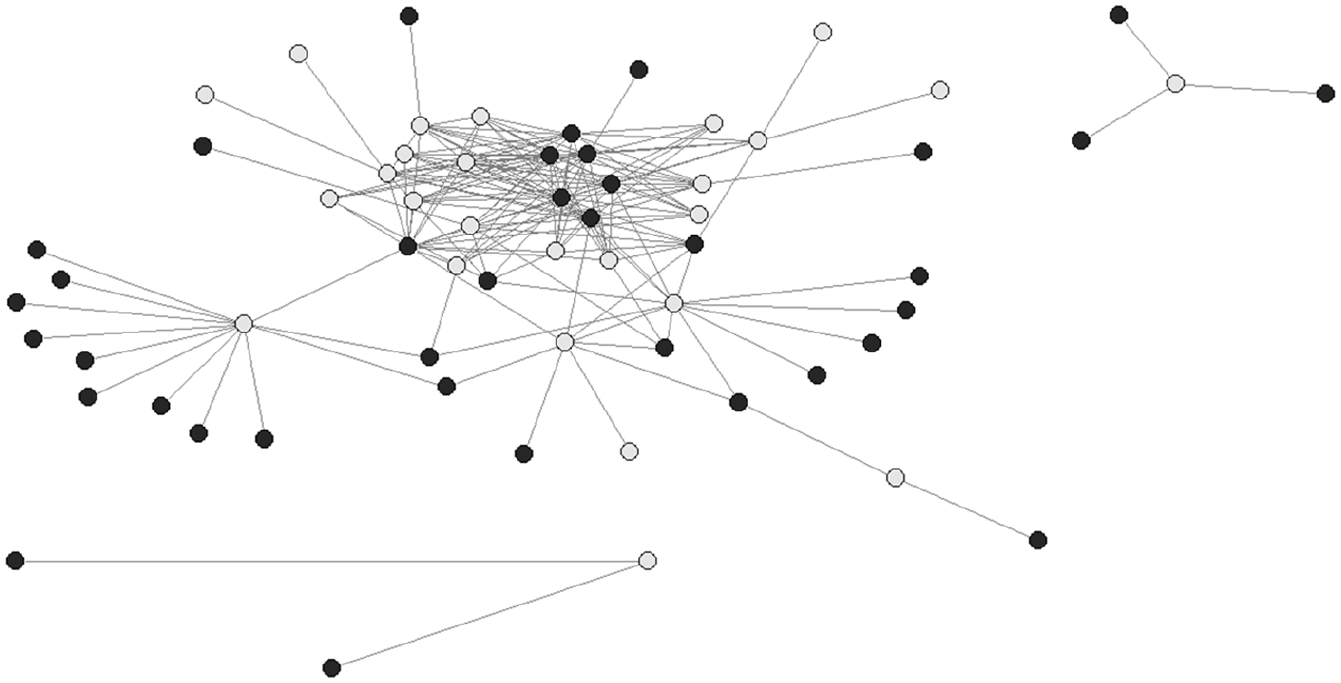
Time 1 communication network (gray = individuals, black = agencies).
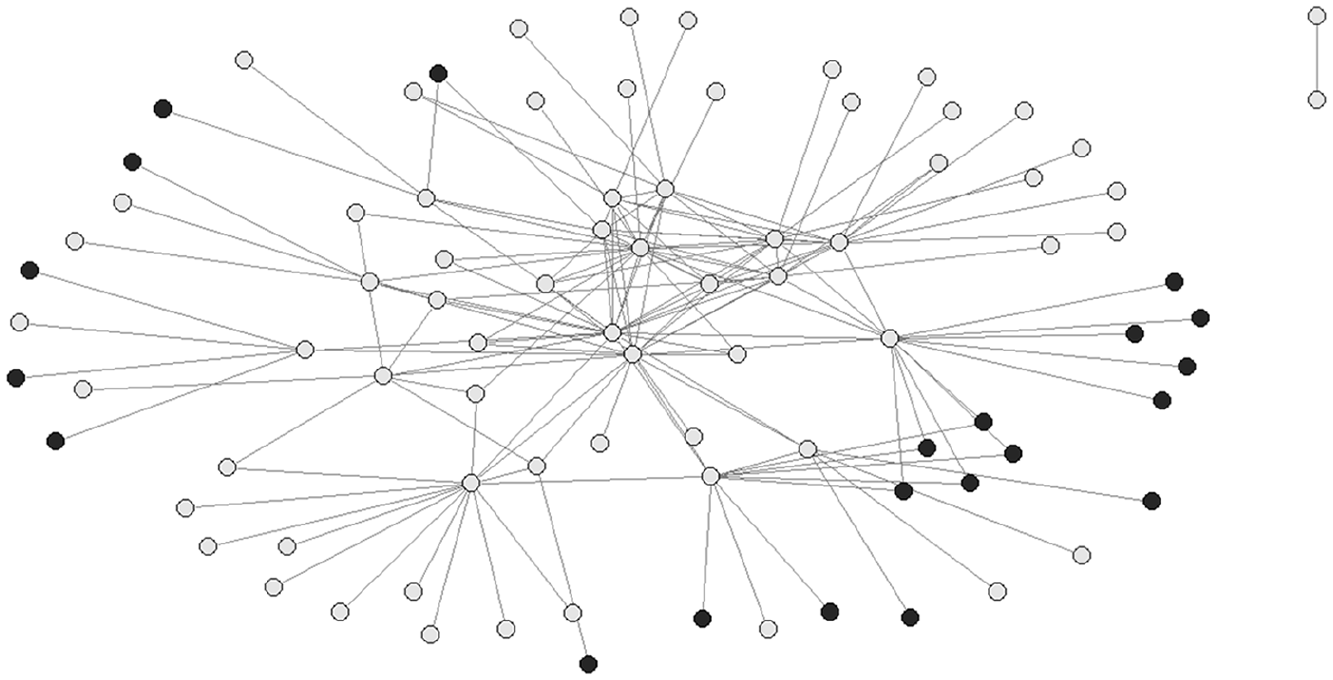
Time 2 communication network (gray = individual, black = agencies).
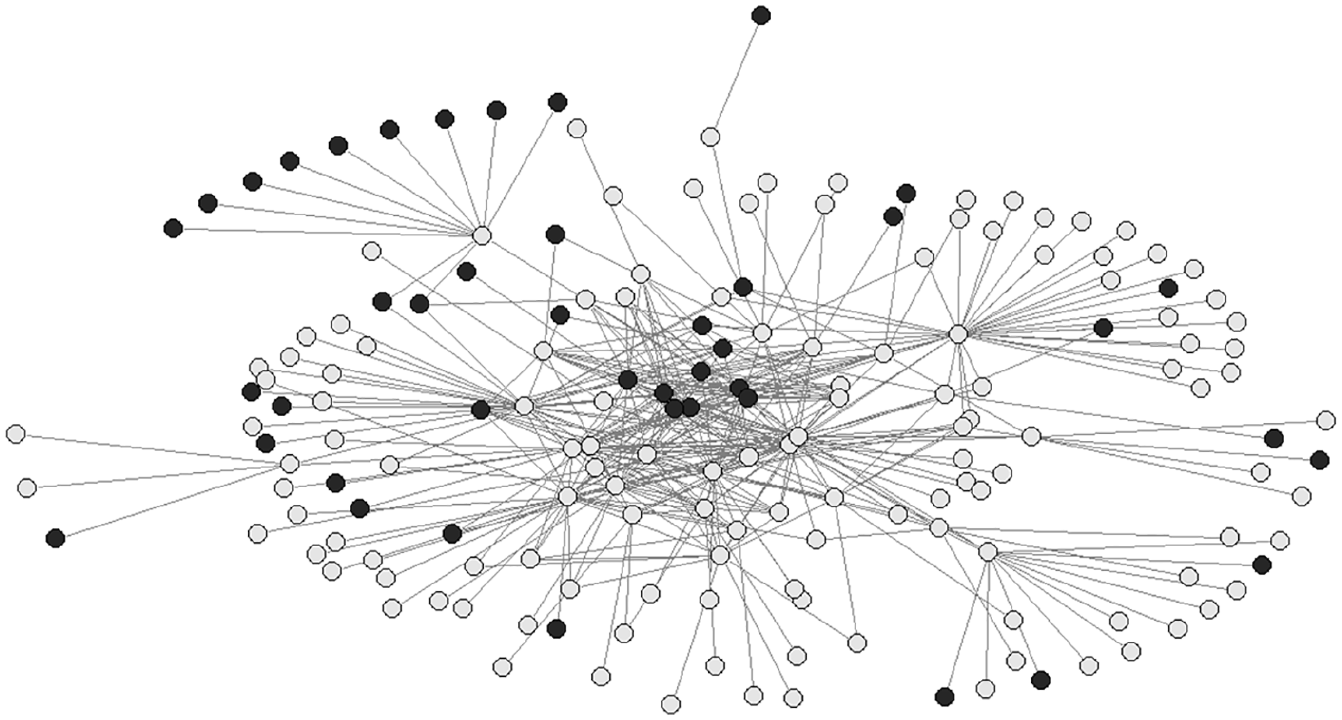
Time 3 communication network (gray = individual, black = agencies).
These findings suggest that the network evolved over time. First, between W1 and W2, participants changed from having general knowledge of others in the network (naming agencies rather than individuals as contacts) to having specific knowledge (naming individuals within agencies as contacts). From W2 to W3, the communication network expanded significantly. In fact, it doubled, growing from 66 individuals having been identified to 132 individuals (Table 1). The network density reduced over time, highlighting fact that, as the collaboration network grows, it might be more difficult to manage. As a network grows, density tends to go down because everyone would be required to become more connected to maintain the same level of density. For example, if there are 100 individuals in a network with a density of 100%, if one person is added to the network, to maintain the high level of density, that new person would need to be tied with all 100 in the network. As a network grows, it will take time and intentionality to fully integrate new individuals in the network, if a high level of density is going to be maintained.
Data Communication Networks Across Three Time Points.
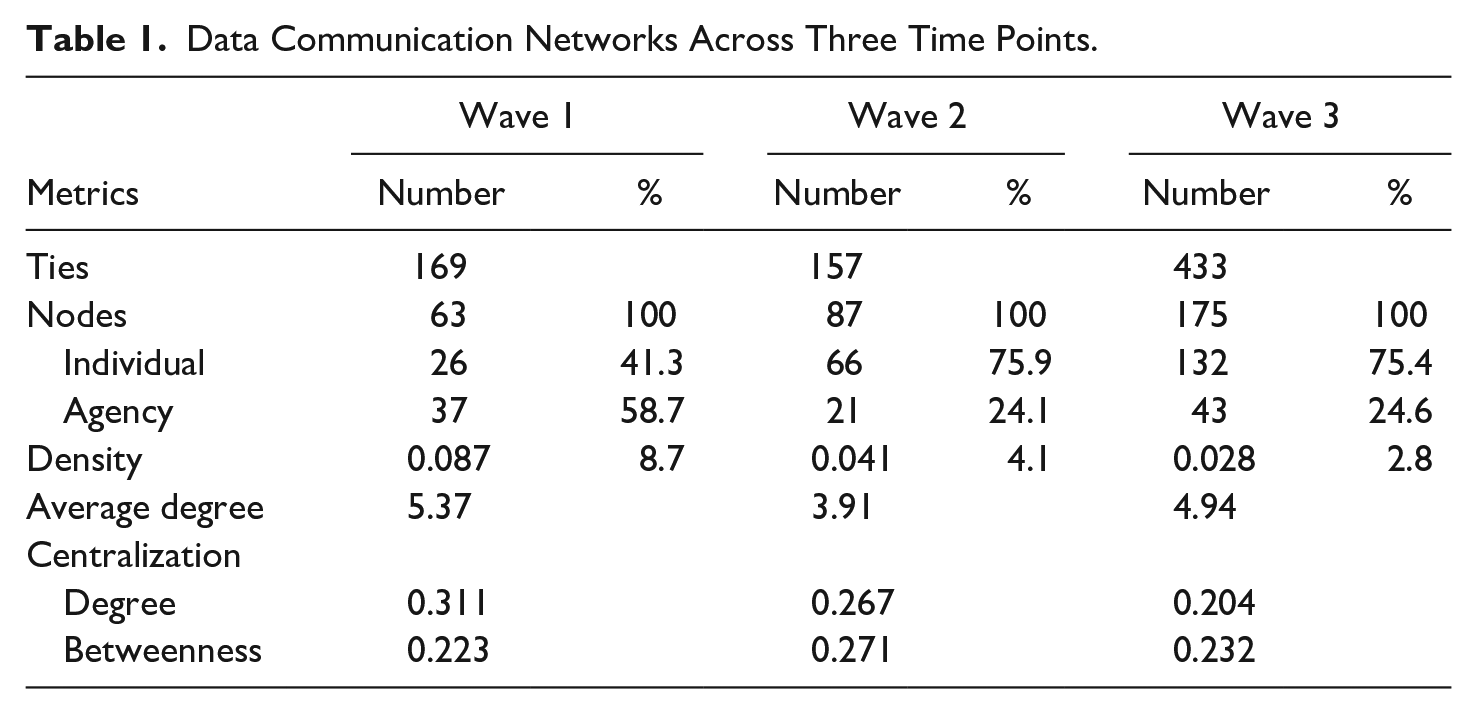
The results from the network analysis demonstrate the evolution of the communication network over the three time points. At W1, the data-sharing network was small and respondents were less likely to name specific people at other agencies with whom they shared data. At W2, those in the network become more familiar with each other and the cohesion in the network increased. At W3, the network started to expand, growing significantly. These data clearly show that the effort had an impact on the expansion of the communication network around violent crime in King County.
The frequency at which participants were sharing data with others, however, did not change substantially over time. During W1 of interviews in July 2017, 65% of respondents reported that they shared crime data with other agencies daily. This figure dropped to 60% during W2 in January 2018 and then increased to 70% during W3 in July-August 2018. One of the reasons for the observed consistency in data sharing across waves was the daily crime bulletin facilitated and dispersed by the CSU. This document was a daily compilation of data and intelligence regarding known crimes and active offenders being investigated and/or pursued by participating law enforcement agencies. As the CSU relied on participating law enforcement agencies to share data and intelligence to be added to this document, partnering law enforcement agencies had motivation to share information daily. It is also important to note that, during the second and third waves of interviews, many respondents identified the daily crime bulletin produced by the CSU as being helpful to their organization. If participants were not sharing crime data with others daily, they were sharing it at least once a week or as needed/requested by another agency.
Perceived Benefits and Challenges to Cross-Jurisdictional Data Sharing
A finding that was consistent in interviews across all three waves was that nearly all participants saw benefits to sharing violent crime data with other agencies. The most common benefit to cross-agency data sharing that participants regularly identified across each wave of interviews was the fact that these data would give all agencies a more accurate picture of regional crime (W1 = 70%, W2 = 68%, and W3 = 65%). As one respondent explained, neighboring agencies are “basically working with the same pool [offenders],” so they should be committed to sharing information and working together to solve crimes. Another participant voiced the same concerns, stating,
We just suffer when we don’t [share information], especially in law enforcement. We have to be able to communicate with each other in order to prevent and solve crime. People don’t move just within their little borders. . .both victims and suspects. I, myself. . .I’ll be in Seattle this morning and then I’ll go down to Kent and maybe make a trip over to Auburn and then I’ll go back to Bellevue. I’m in four or five different cities just in one day and I am just doing that for work. So, when you are talking about victims. . .they may go be a victim in one city and then they go to their home, which is in another city. . .there are just so many crossovers that if we are not communicating with different law enforcement agencies, we are really missing out on a lot of really good information.
Another benefit to cross-agency data sharing identified by participants in all three waves of interviews was the ability to use these data to identify priority offenders within King County (W1 = 65%, W2 = 36%, and W3 = 65%). Key personnel acknowledged that offenders do not operate within jurisdictional boundaries and, as such, neighboring agencies should work together to identify and apprehend prolific offenders in the region. As one participant explained,
We had two individuals whose [crimes were] stitch[ed] together [through] NIBIN, and stitching [them] together across agency data, we are able to show these two individuals have been involved in 15+ shootings. And when those two individuals [were] actually [removed from the community], it’s quite a dramatic and noticeable drop in numbers of shooting incidents we are having. And those types of incidents have been noticed across all of the [partnering] agencies. So, there have been a few successes which have helped people understand the benefit and the need to continue this data sharing.
Although key personnel identified important benefits to cross-agency data sharing, they were also quick to point out challenges associated with this effort. The most common challenge to data sharing that was identified by participants in all three waves of interviews was the reluctance of some agencies to share crime intelligence or violent crime data with other agencies (W1 = 65%, W2 = 36%, and W3 = 35%). That is, many participants felt that law enforcement personnel specifically were hesitant to share crime-related information with others for fear that other officers and other agencies would get credit for the arrest. As one participant described,
A lot of times you get specific people who don’t see the value of sharing information and they say “I only care about my case or my jurisdiction” and “I don’t want you stealing credit” or “I don’t want you messing up my case.” That’s very common, especially with individual detectives. That’s sort of [an] old-school mentality, but there’s plenty of younger guys that say the same thing. There’s this idea that if I share information with you, you are going to somehow screw up my case. That’s been a big battle that we fought. . .trying to convince people. What’s the use of having all this information if you are not going to share it with somebody else?
Another participant voiced this same concern, but proffered an explanation as to why law enforcement personnel may be reluctant to share detailed information with others, explaining,
The only challenge that I have experienced is—and it’s, I guess, kind of understandable—is a detective not wanting to share all of the information that they necessarily have. . .because you have [to] keep some information confidential to preserve the integrity of the investigation, if that makes sense. Like you can’t just tell somebody “Hey, here is all the information.” What if some of that information then gets out to somebody and you are looking for a witness and that witness says, “Oh yeah, he was wearing purple tennis shoes,” and that was information that was withheld during the course of the investigation? Only the person who was there would have known. So, there is a need for withholding some of that stuff. It’s kind of a double-edge sword. You want to have a lot of information, because if we come across a guy wearing purple tennis shoes, that’s going to be good information for us, but then that also might be something that the detective needs to keep confidential to preserve the integrity of the investigation.
This was noted as a concern by key personnel throughout all three waves of interviews although the percentage of participants who mentioned this as a concern decreased from W1 to W3 of interviews. Whereas some seemed to understand why certain people were reluctant to share information, others were concerned that failing to share data with others signaled a failure to recognize the bigger picture associated with sharing crime data on the part of others. Regardless of the reasons behind this behavior, participants who voiced this concern clearly recognized that such behavior could prevent this multi-jurisdictional crime prevention approach from reaching its full potential.
Another challenge associated with data sharing across multiple agencies that was identified by key personnel was a lack of consistency in record collection and management. For example, participants in each of the three rounds of interviews noted that inconsistencies in the records management systems (RMS) used by participating agencies made the data sharing process difficult. Law enforcement agencies across the country use RMS for “the storage, retrieval, retention, manipulation, archiving, and viewing of information, records, documents, or files pertaining to law enforcement operations” (Bureau of Justice Assistance, 2003, p. 10). Although the RMS used by law enforcement agencies serve the same purpose, there is variation in how data are coded, consolidated, and stored by these systems. As one participant noted, these inconsistencies can make it difficult for agencies to share data with one another in a timely fashion. A crime analyst explained,
I spend a lot of my time consolidating this data right now. I mean, it’s mind boggling to me that within a single county, seven agencies have seven different [record management systems and] each RMS. . .I mean, it just makes consolidating data so messy. Some way to unify that data on a county level at least. . .would make things so much faster and easier.
A crime analyst from another agency echoed the same concern, explaining that the extra work needed to make data files compatible across jurisdictions may discourage agencies from sharing data with other agencies that do not have the same RMS. He noted,
If it’s not compatible with our record management system, or if it’s not compatible with another jurisdiction’s either, they don’t participate. . .or there’s extra processes involved in getting the data uploaded, in which case [it] takes [a] longer time [to get the data]. All of [this] stuff takes time for us to get and by the time we get it, we’re [already] looking at new [crime] trends.
It is worth noting that, whereas 35% of respondents identified different RMS as a hindrance to multi-jurisdictional crime data sharing during W1, these figures decreased to 16% and 17% of respondents in W2 and W3. This decrease may represent an acceptance of RMS variation among some key personnel and/or their ability to adapt to this variation while continuing to share crime data with neighboring agencies.
Recommendations for Future Multi-Jurisdictional Partnerships
During W3, which is when the federal funding period was coming to an end, the authors felt it was important to ask key personnel to reflect on their participation in the multi-jurisdictional partnership over the previous 18 months to make recommendations to others who were looking to implement a similar partnership. The most common recommendation made by just more than half (52%) of the respondents was reiterating the importance of establishing a positive working relationship among all participating agencies. First, it was suggested that all key personnel from all involved agencies ensure they are in agreement about the goals of the partnership prior to beginning the regional collaboration. As one participant explained,
[Making sure] that everyone is on the same page—I feel that is the most important thing. I mean, I can only imagine if [all] agencies weren’t on board with it, then how much more difficult that could be. . .
Another participant stressed the importance of ensuring that this sentiment continues after the partnership has been established and data sharing across jurisdictions has commenced. To do this, members of the King County partnership met regularly to discuss data sharing, data analytic techniques, and crime trends. As one participant detailed,
I would say that a good way to start is the way [we] did . . . to have meetings between agencies and to start sharing these reports, because the relationships and the information sharing. . . they start running on their own after you break down those barriers and start having those conversations. I do think that as painful as meetings are, actually forcing people to sit in a room and talk about what they are seeing in their communities and what they know and compiling it all in a place that is easy to find and talk about really is helpful.
Key personnel also discussed the importance of highlighting the goals of the multi-jurisdictional partnership, and the positive outcomes resulting from this collaboration, as time progresses, so that this continues to resonate among all involved parties. As one participant noted, it may be natural for key personnel to judge the success of the partnership based on any observed changes in their jurisdiction but, as he noted, this is not necessarily a sound way to measure success. He explained,
You want to work together and understand the bigger picture. That’s the important thing. You may [think] that utilizing your resources in this manner is a waste because it doesn’t touch much on what you are encountering [in your jurisdiction], but what you’ll find is that ebb and flow—that ripple effect—that is going to come out of those types of things really will pay dividends in the end. So really, kind of showing the wins [across participating jurisdictions].
This statement also coincides with those made by key personnel throughout the partnership: continuing to recognize and acknowledge the benefits associated with taking a county-level approach to crime control. At times, this approach may benefit certain jurisdictions more than others (i.e., more arrests, decreases in crime), but continuing to remind key personnel of the potential for long-term, large-scale solutions associated with this approach can ensure that everyone remains dedicated to the collaborative partnership in the future. This is important, considering some participants (n = 5) voiced their concerns that commitment to this multi-jurisdictional partnership would fade once federal funding had ceased.
Finally, key personnel also highlighted the importance of having a “neutral” agency spearhead this collaborative effort (n = 7). In the case of the KCPPP, the KCPAO served in this capacity. The CSU was housed within the KCPAO and they were responsible for collecting data from participating agencies daily and disseminating the daily crime bulletin to these agencies. They also facilitated the monthly meetings among participating agencies wherein data collection, sharing, and analysis procedures were discussed. To many, having KCPAO take on this role was important. As one participant noted,
[My colleagues and I] have been [sharing data with other agencies] for three years and us as [a] police department. . .trying to go out to these other agencies and say “Hey, you need to start sharing information with us” was not well received. It wasn’t until the prosecutor’s [office], as neutral grounds so to speak, got involved [that data were shared]. [KCPAO] was an agency that everybody has to work with, [so] we started to pick up some steam on the effort as a whole. So, finding that neutral agency or an agency that every other law enforcement agency has to work with was definitely useful.
Another participant echoed this statement while also emphasizing the importance of having a single agency within the partnership serve in a leadership capacity. The participant explained,
It just takes a leader. I mean, somebody has to step forward and be the focal [point] and that’s what the prosecutor’s office did. [It] was kind of not even in their line of work. . . it’s not really what they do, but they stepped up and got an analyst and resources and prosecutors that work part time on it and they do this on a daily basis. . .put this information out. You know, they stepped up and did what any one of us other agencies [that] were really on the ground floor on the streets should do, but the King County Prosecutor’s Office did it and it’s been good so far. I hope they stay with it.
These findings highlight the benefits of having a single agency—particularly one that is perceived as “neutral” among the participating agencies—take the lead when it comes to intelligence and data sharing across agencies. In the case of King County, the Prosecuting Attorney’s Office was viewed as such because all local law enforcement agencies in the county have to collaborate with them. In the case of the KCPPP, key personnel who identified this as recommendation for others also recognized the use of the KCPAO as the data-sharing facilitator as a success of this partnership.
Discussion
Jurisdictional boundaries do not confine offenders and findings from prior research serve to confirm this (Fox et al., 2020; Lammers & Bernasco, 2013; Porter, 1996). When considering a large, metropolitan region like King County, Washington, which includes the greater Seattle area, it is possible for individuals—and offenders—to move from one jurisdiction to another relatively easily and quickly. Therefore, adopting a regional approach to crime control may prove promising for large, urban areas. For this large-scale collaborative to be successful, however, it is imperative that law enforcement agencies in the area, as well as other county and local level stakeholders, such as prosecutors and public health officials, communicate and share information with one another. By doing so, police can identify chronic offenders in the region, determine whether the same individuals are responsible for crimes in different, yet neighboring jurisdictions, and work together to apprehend offenders who operate across jurisdictional boundaries.
One of the main goals of the KCPPP was to foster and facilitate communication and information sharing among the criminal justice agencies that participated in this collaboration. Results from the network analysis suggest that data-sharing networks expanded throughout this time period. That is, the number of people that key personnel reported sharing information with increased from July 2017 to July-August 2018. In addition, results from the qualitative analysis revealed that, by W3, most key personnel reported sharing information with contacts in other participating criminal justice agencies daily. As noted by many of those who were interviewed, the daily crime bulletin distributed each day by the KCPAO’s CSU was particularly helpful in facilitating consistent data and intelligence sharing among the agencies involved. Key personnel from these agencies could then use this information to address crime not just within their jurisdiction (i.e., identifying and apprehending chronic offenders, implementing data-driven crime control strategies), but also across the region.
Participants across all three waves of interviews recognized that sharing crime-related information with other agencies can help to provide all participating agencies with a more accurate picture of crime across King County. Many of these individuals communicated their understanding that offenders can move across jurisdictions and, without communication with one other, neighboring agencies would have no idea they were pursuing the same offenders. Therefore, communicating with other local agencies and sharing crime data can help law enforcement officials identify persistent offenders in the region and agencies can work together to apprehend these offenders. This finding is consistent with those from prior studies (Marks & Sun, 2007; Sedgwick & Hawdon, 2019), providing more evidence that criminal justice personnel recognize the benefits associated with sharing information with other criminal justice agencies. It is important that key personnel acknowledge—and believe in—the benefits to cross-jurisdictional information sharing as this may solidify their continued commitment to this large-scale data-sharing effort after grant funding for this partnership has ceased.
Cross-jurisdictional data sharing is not without its challenges, however. As many key personnel in this study noted, some were reluctant to share data—particularly incident-specific details—with other law enforcement agencies. This finding is consistent with the “data hoarding” phenomenon exhibited by investigators (International Association of Chiefs of Police, 2002; Lambert, 2018; Sheptycki, 2004) and reluctance on the part of police to share information with others outside of their agency (Brewer, 2013; Cohen, 2017; Lambert, 2018; Sanders & Henderson, 2013; Taylor & Russell, 2012). Within our study, this hesitation seemed to be driven by two concerns: first, the fear that another individual and/or another police department would get credit for apprehending the suspect and closing the case, and, second, that providing too many details to others may compromise their investigative efforts. Although both of these are legitimate concerns on the part of police, they hinder a collaborative approach to combating crime.
Rather than focusing on the potential downsides to sharing information with others, police personnel should instead consider the potential for success that could accompany such an effort. Data sharing across police departments can help neighboring agencies determine whether they are searching for the same offenders who are active in their jurisdictions, thus reducing the potential for “linkage blindness” (Egger, 1990). Officers from these agencies could then work together to identify and apprehend suspects. This kind of team effort has the ability to reduce the time it takes police to complete an investigation and apprehend offenders. Cross-jurisdictional law enforcement efforts can then assist local prosecutors when it comes it charging the offender, potentially offering a plea bargain, or moving the case to trial.
Key personnel—primarily those who were directly involved in data collection and/or data analysis within their agency—noted that a lack of consistency among RMS among the agencies involved in this cross-jurisdictional partnership made data sharing difficult. Ideally, all local criminal justice agencies that utilize crime data should use the same RMS to facilitate quick and consistent data sharing with one another. Many of the interviewees who identified this as a hindrance, however, recognized that having consistent RMS within a given geographical area (i.e., the county) is easier said than done. First, local participating agencies would need to agree upon a single RMS that all would need to use. Second, the agencies who use a different RMS would need to purchase and transition to said RMS. These systems are often expensive, which would require agencies to have the financial means to make this shift. Data analysts within these agencies would then need to be trained on how to input, code, and analyze data in a consistent manner to make sharing data with others a more seamless process.
As completing the aforementioned shift may be near impossible for local criminal justice agencies looking to take a regional approach to crime control, a more feasible alternative would be to have a unit within a single agency that is tasked with crime data management. For this partnership, the CSU within the KCPAO was tasked with the collection and dissemination of crime-related information to all participating agencies on a consistent basis. Designating these tasks to a single agency then may help to ensure that all agencies are regularly sharing crime-related information with others, either through the use of a daily crime bulletin or by other means (e.g., weekly or monthly meetings and/or conference calls with key personnel from all agencies).
Results from prior studies on police partnerships suggest that law enforcement agencies can struggle with sharing information with others (Brewer, 2013; Cohen, 2017; Lambert, 2018; Sanders & Henderson, 2013; Taylor & Russell, 2012) and our findings lend additional support to this reality. Key personnel in this study reported a hesitancy to share intelligence and crime data from their jurisdictions with others for fear of judgment or compromising ongoing investigations. To ease such fears, future multiagency partnerships could benefit from selecting a single agency that others view as impartial to lead this collaborative effort. In the KCPPP, key personnel saw the KCPAO as an impartial agency, therefore making them a prime candidate for leading the data collection efforts in this partnership. Utilizing an agency that is viewed as a neutral party may provide a sense of security to other participating agencies—particularly law enforcement agencies—which may then, in turn, increase data-sharing efforts among all parties involved in the partnership. The coordinating agency should also be aware of the findings around network density from this study. As the network grows, the collaboration will need to be consciously maintained. As new members are added, they will need to be connected with others in the network, so that density can remain high and prevent network fragmentation.
While the authors believe that the findings from this study contribute to our collective understanding of regional approaches to crime control, these results are not without limitations. The aforementioned findings were the result of an evaluation of a single multi-jurisdictional collaboration and, as such, generalizability may be limited. Should others choose to implement a similar regional partnership to address crime control and prevention, the authors encourage scholars to evaluate these efforts to determine whether they encounter the same successes and challenges observed by key personnel in the KCPPP. Second, the authors did not have an opportunity to observe and assess the intelligence and data-sharing efforts of the participating agencies prior to the initiation of this collaboration. Therefore, future research designed to assess information-sharing behaviors among multiple agencies should collect baseline data to capture a more comprehensive view of changes over time in sharing behavior among key personnel. Future research should also examine the qualities and characteristics of individuals who facilitate communication and intelligence sharing in law enforcement networks. Third, due to personnel turnover in some of the participating agencies, the authors were unable to interview some of the same individuals during all three waves of data collection. This may have impacted the amount of knowledge—and the responses—given by some who were new to their position when interviewed during the second and third waves of interviews. It is also important to recognize that, given the sample size, participant turnover could have impacted our findings. The authors had no control over personnel changes within participating agencies, however. That being said, this occurrence highlights the realities of personnel changes during criminal justice partnerships and how even low levels of turnover can change the dynamics of the network.
The results from the evaluation of the KCPPP suggest that regional multiagency partnerships can yield positive outcomes, one of which is an increase in data and intelligence sharing across multiple agencies. Neighboring criminal justice agencies can work together to collect, share, and analyze crime data to gain a more comprehensive picture of crime within the greater area. Police and prosecutors can then utilize this information to develop data-driven strategies to identify, apprehend, and successfully prosecute offenders in the area. The authors are pleased to report that, today, the KCPPP continues and has evolved to include community-based organizations and efforts to identify high-risk youth and engage in prevention efforts. It is the hope of the authors that the findings from this case study can inform practitioners who are interested in establishing and facilitating this type of partnership, as well as contribute to our collective understanding of the successes and challenges associated with multi-jurisdictional collaborations among local criminal justice agencies.
Footnotes
Declaration of Conflicting Interests
The author(s) declared no potential conflicts of interest with respect to the research, authorship, and/or publication of this article.
Funding
The author(s) disclosed receipt of the following financial support for the research, authorship, and/or publication of this article: The data used in this study came from a project supported by Grant Number 2016-DG-BX-K002 awarded by the Bureau of Justice Assistance. The Bureau of Justice Assistance is a component of the Office of Justice Programs. Points of view or opinions in this document are those of the author and do not represent the official position or policies of the US Department of Justice or the King County Prosecuting Attorney’s Office.
