






Abstract
This paper explores the wide diversity of practices of volunteer policing across Europe. The study explores where models of volunteer policing exist and the similarities and divergences of volunteer policing approaches, reflecting that most practice has emerged independently across different countries. Some countries build on historic volunteering traditions, while other countries have more recently emerged models of volunteer policing. The overall picture of volunteer policing practice across Europe, as it is currently known, is summarised, alongside short case studies of contrasting models, together with an explorative approach to providing a classification of national programmes. This paper represents one of the first to bring an international scholarly perspective across this vibrant mosaic of volunteer policing practices. The various forms, underlying ideas, identities, and rationales of volunteer police are explored, considering future directions for policy and practice and priorities for future academic study of volunteer policing across Europe.
Introduction
The objective of the paper is to provide a foundational overview of European volunteer policing practices. Many European countries engage individuals from local communities to serve as part-time volunteer police. Such roles encompass uniformed volunteer police officers with full powers, auxiliary or ancillary police roles (typically uniformed, front-line roles but without full powers and in more of an assisting role), together with other specialist and support volunteer police roles. This paper presents one of the first international comparative reviews of volunteer policing across Europe, examining an increasingly important yet often-neglected area of policing practice and providing an initial, provisional, high-level overview of the diverse and complex practices of European volunteer policing across 43 countries. There are significant gaps, as little or no comparative empirical fieldwork has been conducted on European volunteer policing. Most countries with volunteer policing in Europe have limited data on their volunteer programmes. Detailed information remains unevenly available across the volunteer policing practice in the 43 countries engaged in this review. The paper relies on the considerable and diverse expertise of its international authorship, notably including three authors from Central Europe. It draws on numerous country visits to volunteer programmes in European countries undertaken by the authors, an international conference on volunteer policing, research work conducted in individual countries, and liaison by the authors with policing institutions in all 43 countries.
History and Development of Volunteer Programmes
Several of these volunteer police roles across Europe have deep historical traditions. The U.K. Special Constabulary traces its formal origins to the early nineteenth century, alongside deeper historical roots of the role of volunteer constables that stem back at least to the thirteenth century (Leon, 2018; Seth, 1961; Wolf & Borland Jones, 2018). The volunteer antecedents of the Honorary Police in Jersey are said to be one of the oldest organised police services in the world (Gill & Mawby, 1990).
The past half-century has also seen substantial development and innovation in European volunteer policing. One key element of these strategic developments is the large-scale emergence of several new or recently transformed national programmes in Central and Eastern Europe in the context of the post-Soviet or post-communism period, such as in Hungary, Estonia, Lithuania, and Slovakia (Krulík & Klíma, 2024). There have also been new volunteer police programme commencements in some Western European countries. Most notably, the Republic of Ireland is sitting alongside the development of innovative and diversifying new volunteer roles in some countries with established police volunteer traditions. Specialist volunteer roles in the Netherlands (Britton, 2024) have developed in recent years. In England and Wales, Police Support Volunteers (M. Pepper, 2022a), the specialist cyber and digital volunteers programme (Britton, 2025), and initiatives in Kent Police to establish volunteers with specific designated powers (Britton, Johnson, Barnard & Lodge, 2022). Other emergent initiatives include volunteers searching for missing people in Sweden (Löfstrand & Uhnoo, 2020; Uhnoo & Löfstrand, 2018) and supporting missing people investigations in the United Kingdom and the Netherlands (van der Heijden & Collie, 2024). There has also been development of ‘Virtual Volunteering’, which refers to online volunteering methodologies (Cockcroft & Wright, 2025).
While there have been some significant and transformational developments across volunteer policing in several European countries in recent decades, volunteer policing in Europe is not a modern phenomenon, as indeed it is not worldwide (Dobrin & Wolf, 2016; Greenberg, 2015; Leon, 2018). As is still the case today, the historical developments of volunteer policing in different countries have mostly been independent and largely non-cognisant of one another. This has produced a mosaic of distinct and contrasting traditions of volunteer police across different countries, over which modern developments are being interwoven.
One commonality across numerous European countries is the deeply ancient, historical roots of many volunteer policing models, often predating modern forms of organised paid-service police organisations. Van Steden and Mehlbaum (2019) refer to the famous Dutch painting De Nachtwacht (The Nightwatch), by Rembrandt, which depicts seventeenth-century Dutch citizen volunteers patrolling the streets to keep the peace after dark. Scholars of English volunteer policing history reflect to the Statute of Winchester in 1285, with watch and ward systems in which ‘all able-bodied townsmen were required to take turns to guard the town during the hours of darkness’ (Gill & Mawby, 1990). The origins of the Polgárőrség in Hungary track back several centuries, with examples of civil guard formations to protect and defend towns (Molnár, 1992) with further evolution of models during the Napoleonic Wars in the early nineteenth century (Bíró, 2013).
The interweaving between developments of volunteer and paid forms of policing throughout history presents varied patterns in different European countries. Commonly, more formalised and consolidated (and predominantly paid service) policing structures, such as the new Peelian police in Ireland and then later in London in the early 19th century, are preceded by less formalised, often more locally focused, historic forms of community-based watch and guard organisations, which tended to have more of a mixed economy of paid and voluntaristic elements (Leon, 2018; Van Steden & Mehlbaum, 2019). Going further back in history, volunteer and community-based models predate the evolution of paid policing roles in several countries (Krulík & Klíma, 2024; Leon, 2018). It is interesting that in countries such as Hungary, following the fall of Soviet occupation, perceived gaps in security allied with community concerns over the inadequacy of formalised paid policing led to the resurgence of volunteer community-based guard organisations (Christián, 2022; Fellegi, 2009; Kardos & Szőke, 2017).
Modern perspectives on policing tend in most European countries towards normative assumptions of the primacy of organised, prototypically paid-service organisational models. An alternative lens is to recognise that volunteer models often came first historically, and that there have been long periods of mixed economy (volunteer and paid side by side) in many countries. There is a resurgence of volunteer forms in some countries, challenging perspectives of this mainstream thinking (Callender et al., 2021).
A salient feature in the history of several European countries is the problematic history of volunteer police in some communities. Examples include volunteer police formations that developed during the Cold War era in post-communist or former Soviet republics, during the Second World War under German occupation, and in the context of the sectarian troubles on the island of Ireland. All these contexts leave complex, contested histories and reflect that volunteer policing is not always a benign construct and that it also has a more malign potential to integrate and interrelate with state violence and oppressive or discriminatory forms of law enforcement (Leon, 2018).
Volunteer policing has also often developed at moments of particular threat or need in a national setting, geopolitically or in specific periods of social transition or crime problems (Greenberg, 2015). Both World Wars saw the expansion of volunteer policing in numerous countries, at a considerable scale for the Special Constabulary in the United Kingdom (Leon, 2018). The post-war period saw the development of new or expanded forms of reserve and volunteer police in several countries, such as Sweden and the Netherlands (van Steden & Mehlbaum, 2019). The post-Soviet era saw a rapid growth in volunteer programmes in several post-Soviet and post-communist countries (e.g., Estonia, Lithuania, Hungary), although interestingly not in others (e.g., the Czech Republic, Latvia, Poland, Romania). Considerations of current significant geopolitical and security challenges have prompted some strategic, national-level consideration of introducing or reintroducing volunteer police models in several European countries (e.g., Albania, Finland, Sweden, and Norway).
Gaps in the Literature
Despite the scale, variation, and innovation of volunteer policing within many European countries, there has not previously been an international, continent-wide scholarly attention to this vital dimension of policing. This gap resonates with wider observations across the literature on volunteer policing, which repeatedly identify it as a neglected area for scholarly research (Bullock & Leeney, 2016; Cheah et al., 2021; Dobrin & Wolf, 2016; Wolf et al., 2015). The literature observes a regular-centric skew towards paid-service police officers across police scholarship that tends to neglect volunteer policing (Britton & Callender, 2018), alongside a sense that volunteer policing is often missing in action in discourse on police reform (Britton & Callender, 2018; Britton & Knight, 2021).
There is a relatively small, compared to other areas of police studies, but growing canon of international and comparative literature across the field of volunteer policing. This includes a handful of empirical studies involving comparative research fieldwork, primarily interview-based and survey-based studies, and chiefly relating to comparisons of reserve police in the United States and the Special Constabulary in the United Kingdom (Britton, Wolf, & Callender, 2018; I. Pepper & Wolf, 2015; Wolf et al., 2016). It also includes a comparative interview-based empirical international study of volunteer police experience in the Police Volunteer Reserve of the Royal Malaysia Police and reserve policing in the United States (Cheah et al., 2024). Several studies have also engaged across multiple national case studies, including, in some cases, volunteer police in European countries. One edited collection (Albrecht, 2017) provides mainly descriptive case studies of volunteer police in the United States, Canada, Hungary, South Africa, the Netherlands, Singapore, Israel, and the United Kingdom. Another study (Britton, 2024) focuses on Canada, the United States, the Netherlands, and the United Kingdom. Wolf and Borland Jones (2018) compare volunteer police in the United States and the United Kingdom. Similarly, identifies the value and potential of comparative international perspectives for the field and focuses again on comparisons between the United Kingdom and the United States. Bayes et al. (2011) examined case studies in the United Kingdom, Italy, France, Germany and Lithuania. Krulík and Klíma (2024) undertook a high-level review across 13 new EU member states (Bulgaria, Croatia, Cyprus, Czech Republic, Estonia, Hungary, Latvia, Lithuania, Malta, Poland, Romania, Slovakia, and Slovenia). More historically, Gill and Mawby (1990), in their book, which focused on Special Constables in the United Kingdom, have a chapter reviewing, at a high level, practice in a range of countries globally. However, most published studies in what remains an emergent, fledgling field of volunteer policing research have been single-country in scope, the United Kingdom or the United States–focused, and have tended to foreground volunteer experience rather than more strategic questions about the ideas, concepts, purpose, and policy of volunteer police.
The Importance of Volunteer Policing
A growing body of literature globally points to the strategic importance and potential of volunteer police. Greenberg (2015), writing in the context of what he perceives to be the need for American volunteer police to mobilise for security, reflects that while volunteer police across the United States have a long history of serving in many roles, unprecedented modern security, geopolitical, climate, and other threats present generational societal challenges for which direct civil participation in law enforcement will prove essential. This resonates particularly with the geopolitical drivers (proximity to a hostile and unpredictable Russian Federation) for volunteer police programmes in Estonia and Lithuania, with overlaps to the security and military sphere covered by this study. It also reflects the emergent challenges, particularly reflected in this study by specialist cyber and digital police volunteering programmes in the Netherlands and the United Kingdom (cf. Britton, 2025), of online crime, insecurity, and vulnerabilities.
Britton and Knight (2021) suggest that volunteers in policing represent a distinct and potentially transformational opportunity for resetting the community-police relationship. Dickson (2021) builds on this concept, focusing on the potential of volunteer Special Constables in Police Scotland to embody community policing goals and to bridge the gap between communities and the police.
Albrecht (2017) argues that, while it is ‘difficult to fathom’ (p. 3) why individuals commit to volunteer roles of this challenging and dangerous nature, ‘police executive should take heed to harness this positive energy and enthusiasm and the opportunity to strengthen further collaboration between law enforcement and the community being served’. In their comparative study of volunteer police in the United States and the United Kingdom, Wolf and Borland Jones (2018, pp. 15–20) begin their scholarly review by citing the remarkable individual stories of volunteer police impact. Studies have started to explore and establish the value to policing and communities of volunteer police activity (Britton, Johnson & Barnard, 2022, in the U.K. context). Bullock and Leeney (2016), in their study of U.K. Special Constables, identify a coming together of key strategic pressures regarding policing budgets, workforce recruitment and retention challenges, and increasing demand and expectations on policing organisations, to suggest that this may become a key period for volunteer policing models to demonstrate their worth. Ayling (2007), reflecting on volunteers in policing in Australia, accepts that the concept of police volunteering brings some complexities but also sees volunteers as potentially presenting a significant force multiplier. Van Steden and Mehlbaum (2019), in their study of politievrijwilliger (police volunteers in the Netherlands), likewise reflect some of the operational challenges of developing effective volunteer police programmes but also conclude that ‘the contribution that volunteering – more specifically, volunteer policing – can make to society and to public service delivery is of growing importance in Western societies’.
This paper examines the strategic overview of volunteer policing in European countries and offers initial insights into its nature, development, and future significance. In so doing, the paper aims to provide a foundation for the future comparative and international study of this critical but repeatedly neglected area of European policing. The paper represents one element of developing this nascent field of international and comparative analysis of volunteer policing, which promises to create significant policy, practical, and scholarly value.
Method
The objective of this paper is to present an initial, provisional overview of the diverse and complex practices in European volunteer policing, serving as a foundational first phase of an ongoing European volunteer police research study encompassing countries across the continent of Europe. The wider study programme engages interested academic researchers from several countries, and this article relies heavily on the expertise, experience, and knowledge of a team of international authors drawn from Western Europe, the United States, and, importantly, Central Europe.
The first phase of the study, upon which this paper is based, has involved (a) site visits to a small number of countries, including the Netherlands, the United Kingdom, Hungary, Scotland, Sweden, the Czech Republic, Lithuania, and Estonia, (b) drawing upon the experience and knowledge of the multiple authors of the paper, most of whom live, and work, and have a direct knowledge of volunteer programmes, within several of the countries covered by the paper, (c) an international symposium, convened in Edinburgh, Scotland, in May 2024 and attended by 11 countries, which shared considerable knowledge about the detail of individual volunteer programmes in 8 of the countries covered by this review, (d) enquiries systematically made by the authors to every European country’s policing agencies, enquiring about their volunteer programmes, (e) online research, including systematic searching for online material from every country covered in this review based on several pertinent key terms and phrases (translated where necessary), (f) literature review, considering all academic published material on volunteer policing in Europe, and (g) consideration by the authors of key areas for further scholarly research, and comparative data analysis.
Where specific countries are considered as case studies later in this paper (Hungary, the Netherlands, Estonia, the United Kingdom, Czech Republic, Slovakia, and Slovenia), the authors bring a much more detailed experience and knowledge directly in each of those settings, having visited the volunteer programmes (in several cases, multiple times), and in the case of three of the countries, with members of the authoring team living in those countries and directly having contact with the programmes concerned.
The findings in this paper should be considered as provisional and tentative. While this paper represents the most comprehensive overview of volunteer policing across Europe ever compiled, there may still be some gaps in knowledge. This is a relatively new emerging field, and there is not a significant or substantial body of published work upon which the paper can build. Given the numerous and diverse country settings covered, the knowledge gathered will be unevenly distributed across those settings, and for a small number of them, it remains relatively sparse.
Findings
Significant limitations exist in the current available picture of volunteer policing across Europe. No international body, such as the European Union or the Organisation for Security and Co-operation in Europe, is currently compiling data internationally on police programmes. At a national level, most countries (except for the United Kingdom, the Netherlands, Estonia, and France) do not have particularly robust national-level approaches to data, in several cases, even at the most basic level of reliably being able to report volunteer headcount. The challenges of multiple languages and variation in terms used to describe police volunteer programmes make definitive online searching for volunteer programmes across countries challenging.
The scholarly literature bringing together knowledge on volunteer programmes across Europe is equally thin. An EU-funded project (Bayes et al., 2011) reported on a study across five countries, with much of the focus of the work being on broader Watch-type projects beyond the boundaries of volunteering directly in or with the police. An edited collection was published in 2017 (Albrecht, 2017), providing descriptive case studies of three European countries. The most comprehensive work, covering the most countries, is the recent study on the 13 new EU accession countries (Krulík & Klíma, 2024), albeit their paper does not provide substantial detail on individual country programmes.
While this paper seeks to bring together the picture internationally across Europe for the first time, it should be considered foundational and explorative. It may contain omissions, and it is necessarily only doing so at a broad level, in very general terms. Much of this uncertain and incomplete picture of volunteer policing across Europe resonates with earlier scholarly work elsewhere globally, particularly a study exploring what is known and unknown about volunteer policing in the United States (Dobrin & Wolf, 2016). That study concluded that there was no single reliable source of data at the national level, significant gaps in knowledge about which agencies had and did not have programmes and of what nature, and that estimates of volunteer numbers were broad and speculative. Similarly, Cheah et al. (2018) reflect, in their study of volunteer reserve officers in Malaysian policing, the absence of scholarly literature or an available data picture of volunteer police across Asia.
Scale of Volunteer Police Programmes
Looking across European volunteer policing, it is apparent that volunteer programmes exist in many countries and that volunteering is on a significant scale in a sizable proportion of these national settings. The largest programmes, the Hungarian Civil Guards (numbering 67,000), and the French reservists (some 80,000+, albeit that programme has a paid element which shifts it somewhat from the core focus of this study), are on a substantial scale. Scale also varies markedly, with some programmes, such as the Assistant Police in Estonia, many times larger when set against the country’s population than programmes such as the Special Constabulary in the United Kingdom. There are also starkly different trends in scale. Programmes such as those in Estonia and Lithuania have grown markedly over the past 10 years, while programmes such as, again, the U.K. Special Constabulary have reduced in numbers of volunteers by three-quarters in the past decade.
Variations in National Volunteer Police Programmes
One of the most marked characteristics of volunteer policing across the continent of Europe is the extent of variation between countries in roles, scale, structure, and operating models. In part, this may reflect the absence, discussed earlier in this paper, of international networks, data, evaluation, and research. Most programmes have grown isolated from a knowledge of practice elsewhere and without any form of what works evidence base to shape thinking and practice.
The result is an intriguing variation in approaches. Table 1 presents a categorization of volunteer policing practice across European countries. There are many subtle variations between volunteer police models in each country. The categorization provided in Table 1 does not try to describe all this complexity but rather provides a broad modelling of the alignment of different approaches to police volunteers in different countries. The model typologies A and B represent established, national-scale volunteer police approaches, with model A sitting within policing, and model B sitting outside of formal policing structures. Model C sees a more localised, or emergent, volunteer police approach. Model D reflects no volunteer police, but typically there will be some wider voluntarism in community safety. Model E (volunteers in wider emergency services and response), and model M (volunteers in military or security with some overlapping to policing) reflect volunteering with some operational linkage to law enforcement. Model X reflects where there are patterns of voluntarism which are not necessarily aligned with the state, nor cooperative with policing.
Conceptual Modelling of European Volunteer Policing.
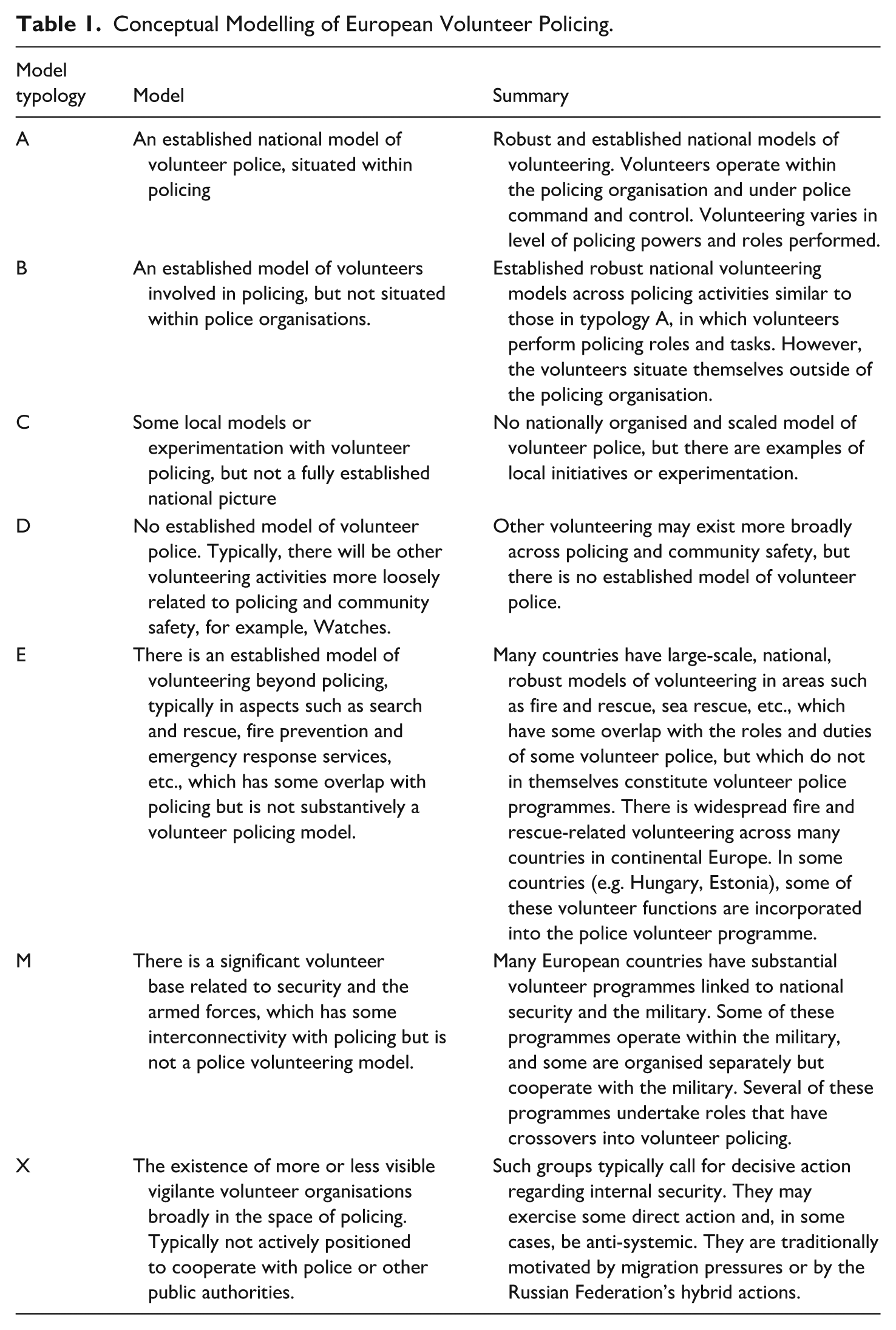
Table 2 provides details on what is known about police volunteer programmes across European countries and draws on a number of key previous studies regarding the information in a range of different countries (Britton, 2024; Krédl, 2021; Krulík et al., 2022; Krulík & Klíma, 2024).
Summary of National Police Volunteering Models.

As reflected in Table 2, nine countries have established national-scale police volunteer programmes organised and operated within police organisations. Both the United Kingdom and the Netherlands – and also, but on a much smaller scale given their small size as countries, Guernsey and the Isle of Man – have volunteer police roles who have full powers of a police officer, and where the volunteer roles essentially directly mirror that of a paid-service regular police officer. Four further countries, the Republic of Ireland, Estonia, Lithuania, and Slovenia, have auxiliary police programmes where volunteer roles operate on the front-line and in uniform, but without all the full powers of a police officer. Sweden has police volunteers who play a supportive operational role. France has a model akin to that in the United Kingdom and the Netherlands, but the French model differs because it is established as a paid reserve.
Four other European countries have national-scale models of police volunteering with substantial volunteer programmes. In these models, volunteers are again in visible, front-line, operational policing-natured roles, but what is different is that the volunteering is organised outside of the police organisation. All four of these models are also interestingly different from one another. The Hungarian Civil Guard is a grassroots development of community-organised auxiliary police. The Jersey Honorary Police has an interesting blend of policing and other community roles and responsibilities, and a centuries-long history. The Danish Police Home Guard is essentially a spin-off from the wider Home Guard arrangements in the country, which are otherwise (as is typical in many countries) primarily military in their orientation. The Neighbourhood Watchers in Cyprus are an extended, more proactive, operationally active and visible variant of the kind of Watch programmes found in numerous other communities across countries in Europe and beyond (with parallels to crime prevention volunteers in Japan).
Several other European countries have also developed similar approaches to volunteer policing. However, in these cases, the models are nascent, at a stage of only partial development, or the police volunteering only exists in small, specific areas of the country. Germany has the most developed model of these countries, with some well-established volunteer programmes, but only in a handful of states. Meanwhile, developments in Belgium, the Czech Republic, Italy, Moldova, Romania, Slovakia, Switzerland, and Ukraine are either very new, or presently very small in scale, or both.
Categorising the various forms of volunteer policing is challenging, and there are challenges in consistently defining the boundaries of police volunteering where it overlaps in practice with various forms of volunteer activity. Many European countries have established defence, security, and military volunteering programmes. In many of these countries, for example, Andorra, Estonia, Finland, Latvia, Lithuania, Poland, and Ukraine, some of the roles played by volunteers in relation to public order, event policing, community safety, and the like, relate to the roles elsewhere performed by volunteers within policing. It is perhaps not surprising that these are mostly countries on the eastern flank of Europe, on the border with the Russian Federation and Belarus. In a similar vein, many countries across Europe have volunteers engaged in fire services and in search and rescue activities. In Hungary, volunteer fire services are very much integrated with the Civil Guard model in some areas of the country. In Estonia, inshore sea search and rescue is performed by volunteers of the Estonian Police and Border Guard Board. However, in many other countries, these other volunteer models in fire, search and rescue exist at scale and have key operational overlaps with policing.
In a small number of countries – chiefly in Bulgaria, Hungary, Italy, Romania, Slovakia, and Slovenia – volunteer structures have emerged that tend towards anti-system positionalities and not being as collaborative with or supportive of the formal police, and indeed of the state and government. Hungary has, over the years, very successfully legislated against this development, defining the Civil Guard as being the only legitimate community organisation in the policing and security space through statute, and effectively absorbing much of this activity positively into the pro-system Civil Guard model (Krulík, 2022). In some of the other countries, such movements are growing. They represent a potentially challenging and problematic element of volunteering in policing.
Brief Case Studies of Volunteer Police Programmes
This section of the paper provides brief, summative case studies of several distinct and, in many cases, highly contrasting models of volunteer police in different countries across Europe.
The Hungarian Polgárőrség (Civil Guard)
Hungarian civil volunteer security guards perform a range of auxiliary complementary policing functions (Christián & Kardos, 2019), including visible patrols, supporting the policing of the night-time economy, providing mounted support and police dogs, operating drones, supporting border policing, and undertaking a wide range of community engagement, youth engagement, and crime prevention activities in local communities (Kardos & Szőke, 2017). The Polgárőrség is not armed, and its powers are limited compared to those of the police. The primary mission of the Polgárőrség is crime prevention, trust building with the community, and also collecting and sharing relevant security-related information (Christián, 2022).
The modern Civil Guard auxiliary complementary policing model emerged in the aftermath of the Soviet era as a response to community concerns about rising crime and insecurity (Christián, 2020; Gönczöl, 2004; Túrós, 2023). The model arose from locally orchestrated, direct vigilante activity to reassure local communities and deter crime (Fellegi, 2009). Over the ensuing years, what was initially a local patchwork of bottom-up locality-driven associations was codified into national legislation, increasingly professionalised and organised at the regional and national level, and developed a formal statutory requirement to cooperate with the Hungarian Police.
It is somewhat hard to define and categorise this Hungarian model, and align it precisely to roles and programmes elsewhere. The translation of the term Polgárőrség into English is challenging. Direct translations as ‘vigilante’ entail connotations which are not reflective of the Hungarian volunteer policing model, and the translation as ‘Civil Guard’ adopted in this paper may also risk confusion with Civil Guard models in other European countries, such as the Spanish Guardia Civil, which is a paid, armed state law enforcement agency. In effect, the Hungarian model is a hybrid amalgamation of what would be considered auxiliary police, watch movements, and community crime prevention projects in other national settings.
The Polgárőrség, as a volunteer auxiliary policing model, has several features that distinguish it from many other European police volunteer programmes. First, the Civil Guard has a substantial volume of volunteers, with 67,000 volunteers in a country with a population of 9.5 million. This makes it comparatively far larger than most other programmes. Second, the Polgárőrség is structured separately and independently of the Rendőrség (the Hungarian national police). While Civil Guards have a statutory requirement to operate collaboratively with the paid-service police, the local, regional, and national organisations of the Civil Guard exist outside of, and are independent from, the direct command, funding, and authority of the police. Third, the Civil Guard has a democratically elected volunteer leadership model. Fourth, as reflected above, the Civil Guards undertake a particularly extensive range of volunteer activities (Kardos & Szőke, 2017).
The volunteer programme in Hungary is challenged with an ageing demographic and what are perceived as significant challenges in recruiting a volume of younger Civil Guards. In this respect, it resonates with many volunteer programmes in the United States and the Japanese Crime Prevention Volunteer organisations. Two interesting innovations are being developed in this regard. One reflects the Hungarian requirement for young people to undertake voluntary civil service, with the Polgárőrség being an engaged partner on that scheme, and the second being the creation of a Junior Civil Guard in some parts of the country, particularly in Budapest.
The Polgárőrség is similarly experiencing an ageing demographic in leadership, with a significant cohort of leaders who were directly engaged in establishing the Civil Guard organisations some 30 years ago, and a need to evolve future generations of leadership. Over recent years, there has been a programme to support and professionalise leaders, including national standards and training, and a national residential training course for regional leads.
The Estonian Abipolitseinik
The Estonian Assistant Police has some parallels in origin story to the Hungarian Polgárőrség. It came into being in 1994 with the creation of the new Estonian Police following independence from Soviet rule. Unlike the Hungarian model, the Abipolitseinik is a volunteer police role organised, resourced, and commanded within the Estonian Police and Border Guard Board. While not quite at the same comparative scale, the Abipolitseinik has over 1,150 volunteers in a country of 1.3 million population, making it a considerably larger programme compared to some of the more established models in the United Kingdom and in the Netherlands for uniformed police volunteers (‘Assistant Police Officers Worked . . .’, 2019; Estonian Police and Border Guard Board, 2025; Kriis, 2025; Päästeliit, 2025).
Assistant Police have an auxiliary policing role, possessing some but not full policing powers. While some volunteers are involved across a wide variety of roles – in border policing, sea rescue, and across investigatory and specialist contexts – the bulk of Abipolitseinik perform front-line, uniformed operational policing duties, as an integrated part of local patrol and neighbourhood policing. Some Assistant Police have the training to operate separately to paid-service officers, while most accompany paid service personnel in an effectively ancillary officer function. A sizable minority of Assistant Police, with the required training and experience, are armed. In Estonia, the police and border guard functions have been combined since 2010 in a single organisation, and this is reflected in the auxiliary police volunteer roles undertaken, with a sizable cohort of the volunteers involved in border guard-related functions of airports and port policing, rescue functions, and immigration-related activities.
No scholarly studies of the Estonian Assistant Police have been published. However, the model appears promising in several respects: it has a higher female participation rate of 45% (which is quite rare in volunteer policing programmes), a comparatively high headcount of volunteers, strong governmental support, is well-integrated into the broader policing model, and there are significant ambitions for future growth. The security concerns in Estonia, prompted by hybrid activities from the neighbouring Russian Federation, appear to help in driving recruitment of volunteers, with individuals enthusiastic to find ways to serve their (still relatively newly independent) country, albeit that contact does also create a degree of competition for recruits with other defence and military-related volunteer roles.
Special Constables and Citizens in Policing in the United Kingdom
In contrast to the Hungarian Polgárőrség and the Estonian Abipolitseinik, the U.K. volunteer Special Constabulary is not a relatively recent addition to the U.K. policing landscape but instead has a long history and tradition, stretching back almost two centuries in its current legislated form (Leon, 2018). Special Constables also differ from the Hungarian and Estonian auxiliary policing models in that they are part-time volunteers who have full policing powers, entirely equivalent in that respect to their paid service regular police officer colleagues.
Over recent decades, the role undertaken by the volunteer police in the United Kingdom has fundamentally shifted, becoming much more front-line integrated, particularly in uniformed response policing (Britton, 2023). Training approaches have significantly strengthened, and the role has developed into more specialist policing activities (Britton, 2023, 2025; Britton, Callender, et al., 2019). Again, unlike the models in Estonia and Hungary, U.K. policing is not structured nationally, and volunteer officers serve in Special Constabularies within each of 45 separate policing services. This leads to wide policy variation and uneven practice in different localities (Britton, 2023; Britton, Knight & Lugli, 2018).
The U.K. Special Constabulary context is the only volunteer policing setting across Europe that has been subject to any volume of scholarly activity. Studies have primarily focused on volunteer motivations, experience, and engagement and on the organisational effectiveness and integration of volunteer police (Britton, 2023; Britton & Callender, 2018; Britton et al., 2022; Bullock & Leeney, 2016; Callender et al., 2018, 2021; Dickson, 2021; Gaston & Alexander, 2001; Gill & Mawby, 1990).
The model of Special Constables across the United Kingdom is facing significant strategic challenges. Numbers have fallen by over three-quarters in the past decade (Britton, 2023), and the volunteer programme has had a structural challenge of volunteers joining young and staying short, often individuals joining in their late teens or early twenties, who are interested in evolving into paid policing careers (Britton, 2023, 2024).
One interesting area of innovation is in digital, cyber and specialist volunteering (Britton, 2025). The Cyber and Digital Specials and Volunteers (CDSV) volunteer initiative has developed nationally, focusing on identifying and engaging those with specialist technical skills to address skills gaps in policing. Beyond the Special Constabulary, there is a broader programme of ‘Citizens in Policing’, recognising the diversity of volunteer roles within the police and more broadly across policing and community safety. There is a nationally overseen but locally delivered programmes of Police Support Volunteers (not in Scotland, only in England and Wales), which have a diverse range of non-frontline volunteering roles (M. Pepper, 2022a, 2022b) and a youth volunteer programme of Volunteer Police Cadets with a Scottish equivalent of the Police Scotland Youth Volunteers (Callender et al., 2019; M. Pepper & Silvestri, 2017).
The Netherland Politievrijwilligers
The Netherlands has the most similarities to the United Kingdom, having a more extended history of volunteer police and having volunteer police officer roles with full policing powers, representing the only two larger European countries to have this. The Netherlands national police force (Politie) has four volunteer roles: politievrijwilligers uitvoering generiek (equivalent to U.K. Special Constables, uniformed police officers with full powers), politievrijwilligers uitvoering specifiek (specialist investigator police officer volunteers), politievrijwilligers ondersteuning (police support volunteers), together with a fourth role of specific investigator volunteer that is currently under development. All these roles are (similarly to the United Kingdom and Estonia) embedded in the police organisationally and under the command and control of policing (Britton, 2024).
Like Scotland in the United Kingdom, volunteering in the Netherlands has evolved from various models across multiple local and regional police services into a single nationally coordinated model, reflecting the reorganisation into a single national police service in January 2013. However, some challenges remain in balancing national ambition, direction, and consistency with regional delegation, innovation, and integration.
As with the United Kingdom, the Netherlands has evolved in recent years an interesting model to address specialist skill gaps in policing through attracting individuals with relevant professional skill sets to volunteer part-time in policing (Britton, 2024). The politievrijwilligers uitvoering specifiek (specialist investigator police officer volunteers) role is unique across Europe in creating a police officer investigative volunteer role, with policing powers. The strategy in the Netherlands has been very much one of targeted recruitment of identified skill requirements, particularly in finance, technology, cybersecurity, and other specialist professional areas.
The Netherlands volunteering model faces similar challenges to those in the United Kingdom (van Steden & Mehlbaum, 2019) relating to culture, organisation, experience and delivery. While there has not been the same scale of reduction in volunteer numbers, the national governmental aspiration to achieve 5,000 volunteers has fallen short (the current figure is 2,750, including 1,200 police officer volunteers, 280 specialists, and 1,270 support volunteers). As in the United Kingdom, initial training for new police officer volunteers has proven difficult for the Politie to prioritise and resource, with only one new training cohort nationally in the past 5 years. Also similarly, while some creative and impactful roles have been developed in the support volunteer space, there remain strategic uncertainties about what support volunteers are for, about their professional identity and place within the organisation, together with problems of inconsistency of interest and commitment across the policing organisation as a whole.
Limited and Local Police Volunteering in the Czech Republic
What limited scholarly attention there has been given to volunteer police in Europe has tended to foreground Western Europe, and especially those countries with established volunteer programmes (in particular the United Kingdom and the Netherlands), with some more recent interest in central and eastern European settings such as Estonia and Hungary which have seen the emergence of programmes in recent decades. There has been little or no focus on those countries where police volunteering has not emerged at scale, such as the Czech Republic. This is a gap in the literature, as those countries without an established or evolving model of police volunteering provide very different insights into the issues around it and possibilities and potential for the future (Krulík & Klíma, 2024).
Before 1989, in the former socialist Czechoslovakia, the Auxiliary Public Security Guard operated, with significant involvement of volunteers. It was a relatively robust body; its membership was larger than the ranks of the national police force itself, the National Security Corps. The Soviet internal security model at that time was quite different from that of the current Czech Republic or Slovakia. Several bodies were sitting between the space of the army and the police alongside developed structures of state secret security. After 1989, the entire system was restructured in several phases. One of the changes was the abolition of the Auxiliary Public Security Guard – without any replacement (Stejskal, 2013).
Only with time, after 1999, did the Ministry of the Interior of the Czech Republic begin to map the potential for creating a volunteer base in internal security (Krulík, 2014). At the same time, uncertainty persisted regarding several parameters. Where would this volunteering situate, with the nationwide Police of the Czech Republic, in municipal police bodies (which are established in about 400 municipalities), with municipal councils, or in some newly created independent space? Together with eligibility questions (age, health status, integrity, education), training, certification, governance, and powers. However, the entire project was discontinued due to narratives that it was a recreation of a former communist body. Similar considerations have taken place in ensuing years, but again without progression.
In recent years (between 2012 and 2025), there has been an enablement for municipalities to participate in Municipal Security Volunteer programmes, but only five have done so (Strakonice, Stříbro, the Prague 7 city district, and two smaller municipalities in the Moravian-Silesian Region). However, with the exception of Strakonice and Stříbro, activities have not developed in substance. A new initiative based on the concept of a Security Volunteer is expected to be launched nationally in 2026 (Ministry of the Interior of the Czech Republic, 2025).
In addition to these developments, various models of neighbourhood watch-related volunteer activities have emerged in a small number of places (Krulík, 2014). This has included locations with poor security and high crime rates (in some districts of large cities, and Chomutov and Dobromilice), prevention of looting after natural disasters, especially floods, in some locations, and some ad hoc volunteer models relating to contexts such as a series of arson attacks or waves of thefts. None of these projects have been sustained over time, mainly due to leadership changes, fading out of the volunteer membership base, issues being resolved, or becoming subject to some other response. As with Estonia and Hungary, no fieldwork on these developments has been undertaken, although studies are planned for the coming years.
Slovakia’s Patchwork of Police-Related Volunteering
As with the Czech Republic, there has not been a development at scale of police volunteering in Slovakia, in contrast to neighbouring Hungary, but there have been some developments of several volunteering approaches in the policing space across the country to a greater extent than has, to date, been the experience in the Czech Republic. Volunteer Order Guards (Dobrolní strážci poriadku, DSP) are based on legislation passed in 1993. To some extent, this volunteering model is a successor to the Auxiliary Public Security Guard from communist Czechoslovakia. Their objective is to assist in ensuring public order in traffic situations, sports, and cultural events. The volunteers are unarmed and act only under the supervision of the Police of the Slovak Republic (Valkovský, 2014).
Slovakia has (similar to several other, mainly northern, European countries) also developed a volunteering model of Night Ravens (Noční havrani), a concept inspired by the Scandinavian model (the Swedish Nattvandrarna and Norwegian Natteravnene). Volunteers move around public spaces in the evening to help prevent violence, victimisation, and risky behaviour with their presence. They operate mainly in larger cities and often focus on youth, for example, to prevent underage drinking (Rundesová, 2005). A model of volunteer patrols in Roma localities that operate under the auspices of local governments and are often financed from local or European Union funds has also been developed. These patrols aim to improve communication between the Roma community and the police, increase mutual trust, and prevent incidents.
Finally, as is the case in several European countries, especially those more geographically proximal to the Russian Federation border, paramilitary or anti-system volunteer patrols have developed, typically unofficial, paramilitary groups, often nationalist and in some cases also openly pro-Russian. After the success of the populist-pro-Kremlin coalition in the 2024 parliamentary elections, these groups are receiving more attention and, in some instances, support from the state. The activity often balances on the edge of the law – it can be perceived as inciting hatred (especially against the Roma community), intimidation, and violation of public order (Mareš & Milo, 2019).
The Pomožni Policisti in Slovenia
In contrast to the Czech Republic, Slovakia, and Hungary, Slovenia has developed a volunteering model within the policing organisation. Auxiliary police officers in Slovenia (Pomožni policisti) serve as support in ensuring public order, in crises, during disasters (COVID, migration pressures 2015–2016), during significant events (sports, cultural, protests), and a range of similar roles. In the case of non-crisis engagement, this may involve several hours of activity per month. Their number is stated to be between 500 and 800 people (data varies depending on the year and need). The tasks of the Pomožni policisti may include traffic control, assistance with evacuation, involvement in the protection of objects, or assistance in the search for people lost in the countryside. Volunteers always serve under the direct supervision of paid service police officers. The initial training for volunteers lasts approximately 200 hr (at the start), with the possibility of further training, so for an auxiliary programme, there is significant training input, alongside standards, structure, and support. Some of the inspiration for developing the model in Slovenia came from volunteer models in various states in Germany (Policija Slovenija, 2025). Alongside this volunteering model within the police, the country also has a paramilitary organisation, the Guard of Slovenia (Slovenska Varda), which is not affiliated with the state and exhibits some anti-systemic stances (Stojanovic, 2019).
Discussion
This study shows that volunteer policing in Europe is an understudied area, and that much remains unknown about the practice. This resonates with other studies elsewhere, particularly Dobrin and Wolf (2016), who identified significant gaps in basic data regarding volunteer police in the United States. While this article seeks to bring together a basic descriptive overview of volunteer policing Europe-wide, it is necessarily tentative, accepting that gaps may remain in the current knowledge base, and it is necessarily high-level and largely with an absence of comparative data and of comparative research.
In policy terms, as reflected throughout this paper, most national programmes have grown in isolation, mainly with a near-total unawareness of practice elsewhere. Bringing together collective knowledge, ideas, innovation, and learning from volunteer programmes has the potential to enhance future police volunteer programme development across countries. Policing faces generational challenges, many of which are consistently felt across different national settings – such as workforce recruitment and retention, representation diversity and reach of policing organisations, police legitimacy and problematic police-community relations, the emergent challenges of the digital age, geopolitical and climate threats, rises in demand and expectation, challenges relating to mental health, domestic abuse, violence against women and girls, child safeguarding and child sexual and criminal exploitation, to name but a few. Volunteer policing brings the potential to be part of the solution to many of these challenges of the present policing age.
In terms of developing practice, if the field can build and grow fieldwork internationally beyond what is currently a primary focus in the United States and particularly in the United Kingdom to other countries, then this would significantly strengthen and deepen the development of what works in volunteer policing and provide rich insight from comparative empirical evidence in different settings. This could develop rich international understandings in areas which have been subject to research in one or two countries but not more broadly. This could include volunteer leadership (cf. Britton et al., 2019, as indicative of past empirical work in the United Kingdom), volunteer morale and motivations (Callender et al., 2018; Millie, 2019; M. Pepper, 2021), and volunteer longevity (Britton, 2023). Similarly, there could be further academic exploration internationally of volunteer professional identities (M. Pepper, 2022b) and of public perceptions of police volunteering. Further attention could be given across Europe to early experiences of becoming a police volunteer (Britton, Callender, & Farquharson, 2022), and to the development of learning and practice confidence and competency (Wolf et al., 2016), critical elements in shaping the overall volunteer experience. Future comparative research could also address paid-service occupational cultures towards volunteers (Britton et al., 2021), strategic and senior cultures towards volunteers (Callender et al., 2021), and female participation (Frayling & Britton, 2026).
An international, comparative study of police volunteering can also contribute significantly to the broader field of police studies. As this paper reflects, there is a large number of volunteers in policing in most countries. Yet, the spotlight of scholarly enquiry rarely captures and engages with this element of plural policing (Britton & Knight, 2021; M. Pepper, 2022a). Wider research and academic discourse on police-community relationships, police legitimacy, leadership in policing, gender inclusion, diversity, policing careers, policing histories, policing occupational and organisational cultures, police professional identities, could all be enriched by broadening focus away from an exclusive spotlight on regular paid service police officers to engage more widely across the policing family, and in particular on the diverse occupational forms and experiences of volunteers in policing.
International and comparative approaches to volunteer police are complicated. Even the basic definition and scope of volunteer police become complicated across multiple national settings. Volunteer policing overlaps with other forms of volunteering and is organised and located very differently in different countries. For example, search and rescue volunteers are an integrated part of volunteer police in some countries and stand entirely separate in others. Fire service volunteers are a separate phenomenon in some countries; in others, police and fire volunteering is organised as one. This paper has necessarily taken a simplifying approach, mainly focused on volunteer police where volunteers directly undertake clear policing functions, mostly within policing organisations. However, the broader potential scope of volunteering across policing (in the broader senses of community safety, emergency response, security, search, criminal justice, volunteering with victims and with offenders, and encompassing community-based models such as Watch organisations) is far wider and more complex to capture regarding international categorisations and comparisons.
This paper is intended as foundational work upon which a field of comparative research across European volunteer policing can, in time, be established. Volunteer police are potentially important in developing effective, sustainable, reformed policing models for the future. As a site for resetting and reimagining police-public relationships (and of rebuilding trust and confidence), as one key element of the pivot towards preventive, problem-oriented, community policing approaches, as a gateway for engagement and attraction of younger generations in the context of deepening police recruitment challenges, as a methodology for drawing in further skills, diversity, cultural capability and experience into policing, as a means of growing capacity in policing organisations stretched by increasing demand and expanding expectations, as a petri dish for forging new professional identities and disrupting police cultures, and as a way of opening up policing. The promise and potential of volunteer policing to do all those things – and the assessment and evaluation of the relative effectiveness of different models in achieving them – should forge the key research questions for ongoing research of volunteer policing across the continent of Europe.
The findings suggest some key areas for potential consideration in informing the development of existing volunteer programmes, drawing on lessons learned from practices in other European countries. While volunteer police officers with powers have been at the core of the larger volunteer programmes in some Western European countries historically (notably the Netherlands and the United Kingdom), some of the emergent and expanding volunteer programmes across Europe, especially in Eastern and Central Europe, are of an auxiliary model. Auxiliary volunteer policing, as seen in Hungary, Estonia, Lithuania, and Slovenia, involves volunteer roles that are often uniformed, engaged in visible policing in communities, and perform operational tasks, but do not have full policing powers. There could be significant merit in countries such as the Netherlands and the United Kingdom considering such roles as an addition to their current volunteer efforts, given the potential benefits of scaling numbers and broadening accessibility and appeal.
There are other cross-cutting themes in programme development. The level of government support and investment appears to be important. Where programmes are strongly supported at a national level by government, such as in Estonia and Hungary, there has been significant expansion and ambition. Where police volunteering seems to resonate with public concerns and priorities, such as in the emergence and growth of the Polgárőrség in Hungary in response to security concerns, and the Abipolitseinik in Estonia in response to geopolitical threats, programmes appear to flourish. Where there is national coherent leadership and coordination of the volunteer programme, this appears to be another success factor.
What this paper reveals is a complex range and variability of volunteer police practices. Unlike many aspects of policing, where there has often been a great deal of international dialogue and policy exchange, a long history of academic and evaluative engagement internationally, and bodies of international and comparative research, many of these models of volunteer police in different countries across Europe have in contrast grown isolated and unaware of the practice of volunteer policing elsewhere. This leads to two areas of considerable potential in the field. The first is that, because there are fundamentally different models and practices, very few of which are imitative, there is enormous potential for countries to benefit from policy and practice insight into the different ways volunteer policing is delivered elsewhere and from policy transfer between countries. The second is that the variation in practices provides a rich and extensive terrain for empirical work to evaluate the efficacy of different approaches to volunteer police, and to develop further knowledge of what works across evidence-based volunteer policing, in terms of roles, attraction and recruitment, training and development, deployment, leadership and organisation, and operational and cultural integration, which could be insightful.
Conclusion
This paper provides a review of volunteer policing practices in 43 countries across continental Europe. The findings reveal a wide range of variation and point to significant areas for development. The findings identify challenges faced by some existing programmes, strong growth in others, and provide pointers for future practice. Across Europe, many countries have some form of volunteer policing. Fourteen countries have a national, organised model, either of volunteer police with powers or of varying models of auxiliary police, while several others have similar models on a more localised basis. Most European countries have some form of volunteerism in policing. Only 15 European countries are identified in this study as not having models of police volunteering. In those settings, some may have relevant volunteering in some form, which may not have been identified in this study. The case studies in this paper provide a summary of practices in several countries, highlighting the vast scale of variation in practices across different national settings.
Across Europe, volunteer police models exist in numerous countries and are evolving rapidly in different forms. Some countries build on historic police volunteering traditions spanning many centuries, while several other countries have more recently emerged forms of volunteer police (Britton, 2024; Krulík & Klíma, 2024). The diversity of volunteer models is striking. Some countries have substantial volunteering programmes with thousands of volunteers, and some countries have little or nothing in the police volunteering space. Some volunteer programmes are thriving and growing, and some are struggling and shrinking. Volunteer roles range from volunteer police officers with full policing powers to auxiliary and support volunteering roles. Volunteers are situated both inside and outside of police organisations. Some countries have youth volunteering programmes in policing, and others do not.
What seems more consistent continent-wide is the relative lack of visibility, strategic engagement, and societal concern for the role of volunteer police, reflective of observations across the literature on volunteering in policing that this tends to be a neglected, unseen, and unengaged aspect of the police (Britton, 2024; Britton & Callender, 2018; Callender et al., 2021; Dickson, 2021; Dobrin & Wolf, 2016; Uhnoo & Löfstrand, 2018; van Steden & Mehlbaum, 2019). A handful of European countries (Hungary, Estonia, Lithuania, and, to a degree, the Netherlands) have significant governmental focus, ambition, and some emphasis from senior police leaders. However, these contexts appear to be the exception to the rule. In very few countries does volunteer policing appear to be a prioritised issue, or often even a very visible one, in discourse on police reform. For some countries, there is a complex legacy of past volunteer policing models that have been problematic, for example, in Northern Ireland and former Soviet republics and other post-communist countries such as the Czech Republic, which may account for some of the reticence. In many others, volunteer policing seems, no doubt for a host of reasons that would be an interesting topic for scholarly enquiry, to occupy a space of peripherality and relative disinterest. Unfortunately, police scholarship has mirrored this policy and practice lacuna, with a near-absence of scholarly focus on most volunteer police models identified in this paper.
Despite the relatively complex and chaotic picture of volunteer police practice reflected in this paper, some broad Europe-wide conclusions can be reached. First, volunteer policing exists across Europe in many countries and on a considerable scale. While we lack robust continental data, there are several hundred thousand police volunteers across Europe. This large cohort of volunteers will serve tens of millions, if not more, hours each year in their local communities. Second, volunteer policing appears to be making a significant and diverse (albeit also uncaptured, unscrutinised, unevaluated) contribution to policing, particularly within the countries where it has been developed at scale. Third, there is a sense of recognition in many countries that volunteer policing can play a growing role in the emerging and generational challenges collectively facing police organisations and can align well with primary policing priorities. This is reflected in the picture across Europe in recent decades of new, or re-emergent, volunteering programmes in several countries, alongside a near-absence of volunteer programme closures, together with examples of volunteer programme innovation and expansion in countries with long-established models, such as in the United Kingdom and in the Netherlands.
European volunteer policing looks set to grow and to further innovate in the coming years. Suppose this growth can be supported by effective models of policy exchange and translation, by international work to develop the evidence base for effective practice across police volunteer programmes, and by building a new strategic paradigm in policing that better appreciates the many dimensions of potential that volunteers can bring. In that case, it will have a greater impact on police organisations and the local communities that they serve.
Footnotes

Funding
The authors received no financial support for the research, authorship, and/or publication of this article.
Declaration of Conflicting Interests
The authors declared no potential conflicts of interest with respect to the research, authorship, and/or publication of this article.
Data Availability Statement
Data sharing not applicable to this article as no datasets were generated or analysed during the current study.