






Abstract
Using both survey and administrative data, we examined the relationship between prison misconduct and involvement in structured activities, which include programming, work assignments, education classes and homework, and religious services, as well as unstructured activities such as physical recreation, prayer, and watching television. The results showed that greater involvement in structured activities significantly predicted both general and violent prison misconduct. Participation in structured activities not only decreased the risk of time to first general and violent misconduct, but it also led to significantly fewer misconducts overall. Additional analyses revealed that greater involvement in work assignments significantly reduced general misconduct, while more time spent on homework significantly decreased violent misconduct. The overall measure for unstructured activities did not significantly affect misconduct, although time spent in prayer reduced violent misconduct, while the amount of time writing “kites” (messages directed to staff) increased both general and violent misconduct.
Introduction
How to best manage incarcerated people has been a topic of interest for decades. There is now ample literature that provides evidence of what works and what does not for managing residents in correctional facilities (Andrews & Bonta, 2010; Duriez et al., 2018; Smith et al., 2009). However, misconduct still occurs within prisons. All facilities, whether local, state, or federal, have their own formal rules for how residents should conduct themselves while incarcerated. Departures from those established codes of conduct are often referred to as “misconduct” (DiIulio, 1987; Eichenthal & Jacobs, 1991; Irwin, 2005; Wooldredge, 1994) and are generally addressed within the facility in which they occur. Given the implications that misconduct has for the security and safety of both residents and staff, numerous studies have been conducted to determine its causes and correlates (Adams, 1992; Bottoms, 1999; Byrne & Hummer, 2008; Gendreau et al., 1997; Goodstein & Wright, 1989; Schenk & Fremouw, 2012; Steiner et al., 2014; Wooldredge, 1991).
More recent work has focused on the prison environment, specifically, how residents’ activities—or lack thereof—are related to misconduct and post-release outcomes such as recidivism, employment, and mortality (Duwe et al., 2025; Duwe & McNeeley, 2020). Greater involvement in structured activities such as education classes, treatment, and work-related programming reduces the amount of unstructured time for residents, thereby minimizing opportunities in which they are free to commit acts of institutional misconduct (Steiner & Wooldredge, 2008; Wooldredge, 1994, 1998). Indeed, even outside of prison, criminological literature has provided evidence that there is a correlation between unstructured activities and engaging in crime (Osgood et al., 1996). Moreover, previous work in this area has suggested that the fewer programs or work assignments an institution has for incarcerated persons to engage in, the higher the levels of misconduct and violence within those facilities (Colvin, 1992; Huebner, 2003).
To better understand the relationship between prison misconduct and structured and unstructured activities, we designed and administered a survey to a sample of residents in Minnesota’s prison system. The survey addressed numerous topics, one of which being their engagement in structured and unstructured activities while they were incarcerated. We paired their responses with administrative data that measured their involvement in prison misconduct following the completion of the survey. This study thus extends the literature by determining whether there may be a significant relationship between structured activities and prison misconduct.
Literature Review
The criminological literature has long recognized unstructured time as a conduit for deviant behavior, particularly among young people (Agnew & Petersen, 1989; de Jong et al., 2020; Engström, 2021; Hoeben et al., 2016, 2021; Osgood & Anderson, 2004; Osgood et al., 1996). Young people socializing together in the absence of structured activities (e.g., school, work, organized sports, afterschool programs) and outside of the supervision of authority figures (e.g., parents, teachers, other responsible adults) are more likely to engage in crime, delinquency, and substance use. Conversely, young people engaged in structured, prosocial activities are less likely to engage in antisocial behaviors (Agnew & Petersen, 1989; Mahoney & Stattin, 2000; Yin et al., 1999).
Most of the research on the link between unstructured time and deviance has been focused on adolescents, so it is unclear whether this finding extends to adults. However, a lynchpin of life-course criminology scholarship is that as young people transition into adulthood, informal sources of social control (e.g., employment, committed relationships, parenthood) serve both as stakes in conformity and modifiers of routine activities (Laub & Sampson, 2003; Sampson & Laub, 1993, 2003; Sampson et al., 2006). Adults work to preserve these commitments by avoiding deviant behaviors, and these commitments leave individuals with less time to get into trouble. Research has generally supported the proposition that stable committed relationships and quality employment reduce the likelihood of criminal behavior (Savolainen et al., 2018; Theobald et al., 2018; Uggen & Wakefield, 2008).
Among adults who have been involved in the criminal justice system, poor use of leisure time is considered a risk factor for recidivism (Andrews & Bonta, 2024). In the Risk-Needs-Responsivity framework—the dominant model of correctional treatment—poor use of leisure and recreational time is one of the “central eight” criminogenic needs, alongside criminal history, antisocial personality, antisocial peers, and other predictors of future criminal behavior (Andrews & Bonta, 2024; Duriez et al., 2018). Prior research has consistently found that individuals who work, attend school, and spend their leisure time in structured activities are less likely to reoffend, commit technical violations, or engage in substance use (Giguère et al., 2023; Girard & Wormith, 2004; Palmer & Hollin, 2007; Wooditch et al., 2014).
Use of Time in Correctional Facilities
Unlike individuals living in the free world, incarcerated persons have much less autonomy when deciding how to spend their time. Correctional institutions often have rigid schedules for wake up, meals, recreation, visitation, programming, and sleep (or “lights out”) (Austin & Irwin, 2012). Most adult prisons offer employment readiness, education, life skills, and substance use disorder treatment programs, in addition to employment opportunities within the facilities (Maruschak & Buehler, 2021; Stephan, 2008). While these programs may be available in most facilities, it is evident that they do not have the capacity to serve all or most incarcerated persons, given the large and growing swaths of incarcerated populations that sit idle while behind bars and do not participate in any structured activities (Austin, 2001; Duwe & Clark, 2017; Lynch & Sabol, 2001). On average, incarcerated persons spend only 3–4 hr of their day in structured programs and activities, leaving most hours of their days unstructured (Batchelder & Pippert, 2002; Bureau of Justice Statistics, 2004; Steiner & Wooldredge, 2008).
Very few studies have examined how incarcerated persons use all the hours in their days, and the few studies that do exist rely on data from two or more decades in the past. In a survey of adults incarcerated in Nevada state prisons, Frey and Delaney (1996) found that socializing with other incarcerated persons, reading books, and watching television were the most common leisure activities. One-third of incarcerated persons in their sample spent more than 10 hr per week socializing with other incarcerated persons, while 39% reported spending the same amount of time reading books and 43% spent that time watching television. That is compared to less common activities, including weightlifting and playing cards, where only 18% and 8% of incarcerated persons, respectively, reported spending more than 10 hr per week on those activities.
In a study of Canadian prisons, Zamble and Porporino (1988) found that incarcerated persons spent more than 9 hr of their days on leisure activities. That is more than twice the time that the average incarcerated person spends on structured programs and activities (Batchelder & Pippert, 2002; Bureau of Justice Statistics, 2004; Steiner & Wooldredge, 2008). According to Zamble and Porporino (1988), more than one-third of those 9 hr of leisure time was spent socializing with other incarcerated persons, approximately one-third of the time was spent listening to the radio or watching television, and the remaining time was spent playing sports and writing letters or taking in outside visits.
The above results were similar to what the Bureau of Justice Statistics (2004) found in the Survey of Inmates in State and Federal Correctional Facilities, where incarcerated persons reported spending 5 hr per day on passive activities like watching television or reading, and approximately 1 hr per day on more active pastimes like playing games or doing arts and crafts (Bureau of Justice Statistics, 2004). This pattern of leisure time appears to hold true among incarcerated persons in jails (Vuk & Doležal, 2020). Using data from the 2002 Survey of Inmates in Local Jails, Vuk and Doležal (2020) found that individuals serving time in jails spent approximately 7 hr per week working, and less than 4 hr per week in religious activities. They spent a combined total of nearly 5 hr per day reading and watching television and a little more than 1 hr per day doing arts and crafts, playing cards, or other forms of recreational activities. They spent less than 1 hr per day doing physical activities, including sports and exercise. Taken together, the results of previous studies clearly demonstrate that incarcerated persons spend most of their waking hours in unstructured activities.
More recent research indicates that the lack of available structured activities in prisons leaves residents with a sense of hopelessness and boredom. Rocheleau (2013) found that one-third of surveyed men in Rhode Island state prisons rated boredom as “very hard” to deal with while incarcerated. In a separate survey of adult men incarcerated in Vermont prisons (Fox & Crocker, 2024), 85% of the respondents reported that there was often “nothing productive (or meaningful)” for them to do (702). A similar percentage of respondents indicated that “they do not have access to activities that promote wellbeing and growth” and that prison does not give them the opportunity to “feel proud and accomplished” (702).
Use of Time and Institutional Behavior
Corrections scholars have relied primarily on two theories to explain institutional violence and misconduct. First, importation theory holds that the characteristics, experiences, and beliefs that incarcerated persons bring with them into prisons determine how they adjust to the prison environment (Irwin & Cressey, 1962). Essentially, individuals who are more likely to engage in violence and deviance on the outside are also more likely to engage in these behaviors once inside prison. Indeed, research has found that incarcerated persons who are young and male with more extensive criminal histories are more likely to engage in misconduct (for a review, see Steiner et al., 2014).
Second, and more pertinent to the present research, deprivation theory holds that frustrations caused by the “pains of imprisonment” is the underlying cause of institutional misconduct (Sykes, 1958). These pains include the loss of freedom and autonomy, separation from family and loved ones, lack of privacy, and adverse facility conditions (Rocheleau, 2013). This theory has also received empirical support given that more restrictive prisons with fewer programs and high levels of idleness have higher levels of misconduct (Colvin, 1982; Griffin & Hepburn, 2013; Hassine et al., 1996; Huebner, 2003; Irwin, 1980; Jiang & Fisher-Giorlando, 2002; Morris, 1988; Parisi, 1982; Steiner & Wooldredge, 2008; Useem, 1985).
At the individual level, several studies have demonstrated support for deprivation theory by finding that incarcerated persons involved in structured activities were less likely to engage in misconduct. These structured activities include institutional employment (Duwe & McNeeley, 2020; Flanagan, 1988; Huebner, 2003; Steiner, 2009; Steiner & Wooldredge, 2009; Vuk & Doležal, 2020), education programming (Courtney, 2019; Lahm, 2009; Pompoco et al., 2017; Reale et al., 2025), behavioral treatment programs (for a meta-analytic review, see French & Gendreau, 2006), and religion-based programs (Camp et al., 2008; Johnson et al., 1997; O’Connor & Perreyclear, 2002).
Few individual-level studies have examined the relationship between unstructured time and misconduct. Using a nationally representative sample of persons incarcerated in jails, Vuk and Doležal (2020) found that the number of hours spent watching television each day was inversely associated with misconduct; more hours spent watching television decreased the likelihood of incurring a misconduct charge. Conversely, hours spent reading and doing recreational activities increased the likelihood of misconduct. Each additional hour of reading and recreational activities increased the odds of misconduct by 5% and 4%, respectively. Rocheleau (2013) found that incarcerated persons who struggled the most with feelings of boredom committed significantly more disciplinary infractions. Incarcerated persons in England cited boredom as the reason for illicit drug use while incarcerated (Nurse et al., 2003; Woodall, 2011).
Present Study
Few studies have examined the balance of structured and unstructured time among incarcerated persons and how this impacts institutional discipline. Moreover, the few studies that have examined this topic are now based on data from more than 20 years ago and rely exclusively on self-report data. The present study uses a mix of survey and administrative data to examine the effect of structured activities on institutional misconduct while also controlling for time spent in unstructured activities, risk level, and other quality of life measures (e.g., sleep quality, feelings of safety). Given that prior research has found that boredom, idle time, and some leisure activities increase the likelihood of misconduct, we expect to find that time spent in structured activities will decrease incidents of misconduct.
Data and Method
To examine the effects of structured activities on prison misconduct, we surveyed a sample of individuals confined in Minnesota’s prison system. Prior to administering the survey, we obtained approval from our institution’s Human Subjects Review Board. The survey was self-administered on desktop computers using computer-assisted survey software. Incarcerated persons selected to participate in the survey were notified in writing by their case manager about 1 week prior to taking the survey. Individuals were advised that their participation in the survey was completely voluntary, and they could refuse to participate or skip any questions that they did not want to answer. Incarcerated persons signed a consent form prior to beginning the survey, and respondents were not offered any incentives in exchange for their participation.
The survey was administered to incarcerated persons at all 11 adult prisons in Minnesota during September 2024, which was the time period determined by the Minnesota Department of Corrections’ (MnDOC) leadership. These facilities include a range of custody levels from minimum to maximum throughout the state. All but one of the facilities house men, while the remaining facility houses women. In an effort to achieve the largest sample possible without unduly burdening staff at the men’s facilities, half of the 6,762 men who were incarcerated at the time of the survey were randomly selected. Given the relatively small number of incarcerated women (520), all individuals housed in the lone women’s facility were invited to participate. Of the 3,381 men and 520 women who were invited to participate, 1,739 men and 294 women completed the survey, resulting in a total participation rate of 52% (51% for men, and 57% for women).
The survey instrument included 277 items, but not all participants were asked all questions, as the survey used skip logic for some questions. On average, the participants completed the survey in 42 min. The survey included questions that covered a broad range of topics, including access to health care, use of time in prison, and personal safety. However, the present study is focused primarily on the items pertaining to time spent in structured activities.
The administrative data used for this research come from the MnDOC primary database used to house all information about incarcerated persons and details about their time in incarceration: the Corrections Operations Management System (COMS). Survey participants were asked to provide their last names and MnDOC identification numbers so that survey data could be linked to COMS data.
Survey Measures
The survey was designed to cover a multitude of topics relevant to MnDOC residents and staff. In Appendix A, we present the sections from the survey that are used in this study, including how residents use their time in prison, quality of sleep, nutrition, mental and behavioral health, perceptions of personal safety, a culture of violence, and impulsivity. Based on the survey data, we created measures for time spent in structured and unstructured activities, personal safety, a culture of violence, impulsivity and scales for sleep, hunger, and mental health.
For the time use portion of the survey, we divided the 22 items into structured and unstructured activities. Structured activities were operationalized as work assignments, education classes and homework, programming, and religious service attendance (Items 16–22), while unstructured activities (Items 1–15) included the other time use items such as physical recreation, time spent in prayer or meditation, and watching television. Higher values for the structured and unstructured activity variables indicate that individuals spent more time involved in these activities within the week preceding the survey.
We used the responses provided from Question 32 to create the personal safety scale, ranging from a value of 5 for “Strongly agree” to a value of 1 for “Strongly disagree.” The only exception was item “f,” where “Strongly disagree” responses were assigned a value of 5 and “Strongly agree” was given a value of 1. The values from the six items were summed to create a Safety score, ranging from 6 to 30, where higher scores denote perceptions of greater safety.
Responses to Question 33 were used to create the Culture of Violence score. “Strongly agree” responses were assigned a value of 5, while “Strongly disagree” was given a value of 1. The values for the six items were summed to produce a total impulsivity score, where a higher score suggests that individuals are more likely to endorse a code of violence in prison.
Responses to Question 34 were used to create the Impulsivity score. “Strongly agree” responses were assigned a value of 5, while “Strongly disagree” was given a value of 1. The values for the six items were summed to produce a total Impulsivity score, where a higher score suggests that individuals are more impulsive and lacking self-control.
The responses to Question 30 were used to create the Sleep score. “Strongly agree” responses were given a value of 5, while “Strongly disagree” was assigned a value of 1. The values for the five items were summed to create a total sleep score, with higher values indicating greater difficulty sleeping at night. The Hunger score was created based on responses to Questions 26 and 27. “Strongly disagree” responses were given a value of 5, and “Strongly agree” responses were assigned a value of 1. The values for these four items were summed with the value from Question 26 to produce a Hunger score, where higher values reflect greater hunger. Responses to Question 31 were used to create the Mental Health score. If individuals responded “Yes” to one of the four items, they were given 1 point for that item, resulting in a potential maximum score of 4.
Administrative Measures
In addition to the survey data, we used identifying information provided by respondents to pull administrative data from COMS. Specifically, we used COMS to extract data for the following measures: prison misconducts, gender, race/ethnicity, age (in years) at the time of the survey, custody level, the amount of time (in months) from the most recent admission to prison through the survey date, index offense type, prison misconduct risk, and recidivism risk level.
Prison misconducts were operationalized as rule violations that resulted in a discipline conviction. As shown below, we performed analyses in which we examined all discipline convictions as well as violent misconduct involving assaults against other residents and staff. To allow for a sufficient period of time to measure misconduct following the completion of the survey, we obtained data on discipline convictions through May 31, 2025. 1
Gender was dichotomized as male (1) or female (0), while race/ethnicity, custody level, and offense type were categorical measures. Our measure of risk for prison misconduct was the score from the Minnesota Severe and Frequent Estimate for Discipline (MnSafeD), a risk assessment instrument that has been validated on Minnesota’s prison population (Duwe, 2020). The MnSafeD score is a percentile ranking that ranges from 0% to 100%. For the recidivism risk level, we used the rating provided by the Minnesota Screening Tool Assessing Recidivism Risk (MnSTARR) 2.0, which has been customized to, and validated on, Minnesota’s prison population (Duwe, 2024). The MnSTARR 2.0 contains the following four risk levels: (1) low, (2) medium, (3) high, and (4) very high. Although both instruments contain some items that pertain to the completion of prison programming, the structured activity time variable is a broader measure that includes participation in programs, work assignments, and education classes.
Analytical Strategy
After combining the survey and administrative data into a consolidated dataset, we performed two sets of analyses. First, we estimated the Cox regression models to examine the impact of structured activities on the risk of time to first misconduct. We examined all discipline convictions as well as violent misconducts committed against staff and other residents. In addition to including measures for structured and unstructured activities in the Cox regression models, we controlled for other factors that may influence misconduct by including covariates relating to demographic characteristics, offense type, assessed risk for misconduct and recidivism, and scales derived from the survey. As shown in Appendix B, all of the variance inflation factor (VIF) values among the covariates in our models were below 3, which indicates a relatively low level of multicollinearity.
The Cox regression contains both “time” and “status” variables. The “time” variable measured the number of days from the survey completion date in September 2024 until (1) the date of the first discipline infraction, (2) the date of release for those without misconduct, or (3) May 31, 2025, for residents without a discipline infraction who have yet to be released. The “status” variable, on the contrary, measures whether a resident had a discipline conviction (both general and violent misconduct) during the period in which they were at risk for misconduct. Missing data were handled using listwise deletion. The sample size after listwise deletion was 1,557.
Second, to examine the impact of structured activities on the number of misconducts overall, we used negative binomial regression because it is designed to analyze count data. We did not estimate a separate model for violent misconducts, however, due to the few residents who had multiple violent disciplinary infractions. We opted to use negative binomial regression because the conditional mean and variance of prison misconducts were not equal, which is what the other commonly used count data technique—Poisson regression—assumes. As with the Cox regression analysis, our covariates in the negative binomial regression model consisted of the structured activities measure and the same control variables. Likewise, after using listwise deletion, the sample size was 1,557.
Results
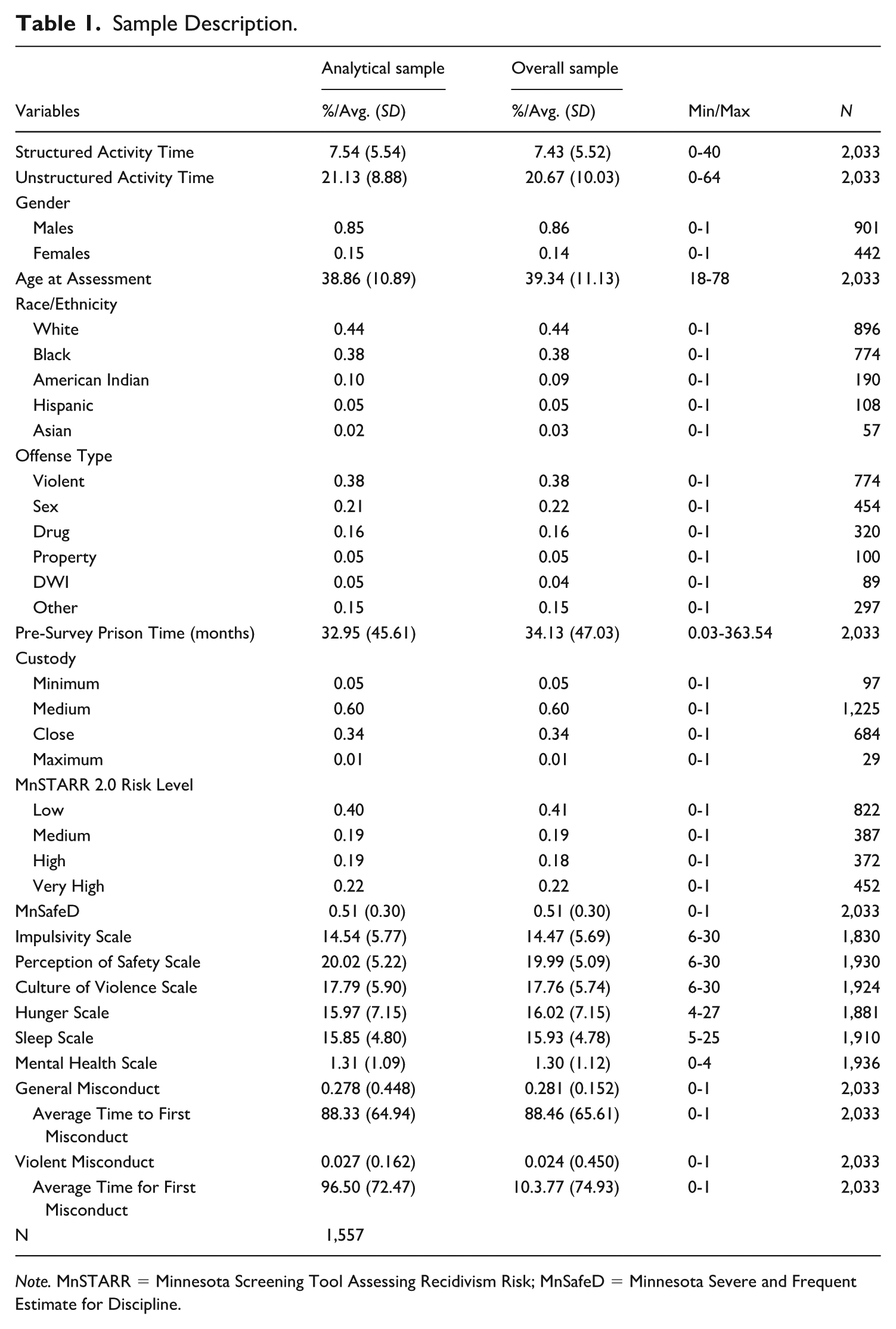
As shown by the descriptive statistics presented in Table 1, our sample closely resembles Minnesota’s prison population overall. For example, the average age for the respondents was 39 compared to an average age of 40 for Minnesota’s prison population (Minnesota Department of Corrections, 2025). The percentage of respondents identifying as White was 44 (43% for the overall population), 60% were in prison for a violent offense (58% for the overall population), and 40% were either high or very high risk for recidivism (40% for the overall population). The only exception is that the percentage of women (14%) in our sample is twice as high as that currently observed for people in Minnesota’s prison system, which is due to the fact that we invited all of the women at the Minnesota Correctional Facility-Shakopee to participate in the survey.
Sample Description.
Note. MnSTARR = Minnesota Screening Tool Assessing Recidivism Risk; MnSafeD = Minnesota Severe and Frequent Estimate for Discipline.
Nearly 95% of our sample was in either medium or close custody, while the average length of time in prison at the time of the survey was almost 3 years. Yet, the median length of stay was 17 months because the mean was skewed by some respondents with confinement periods greater than 10 years. The average MnSafeD score for our sample was 51%, which is close to the expected average for a percentile ranking.
The average value for our structured activity time measure was 7.43, with 14% of the respondents indicating they had not been involved in any structured activities within the previous week. Working a job in prison was the most common type of structured activity, as 61% reported having a work assignment. Nearly 40% of the respondents spent time attending education classes and doing homework, 34% reported involvement in religious worship services, and 27% indicated they had participated in programming during the prior week.
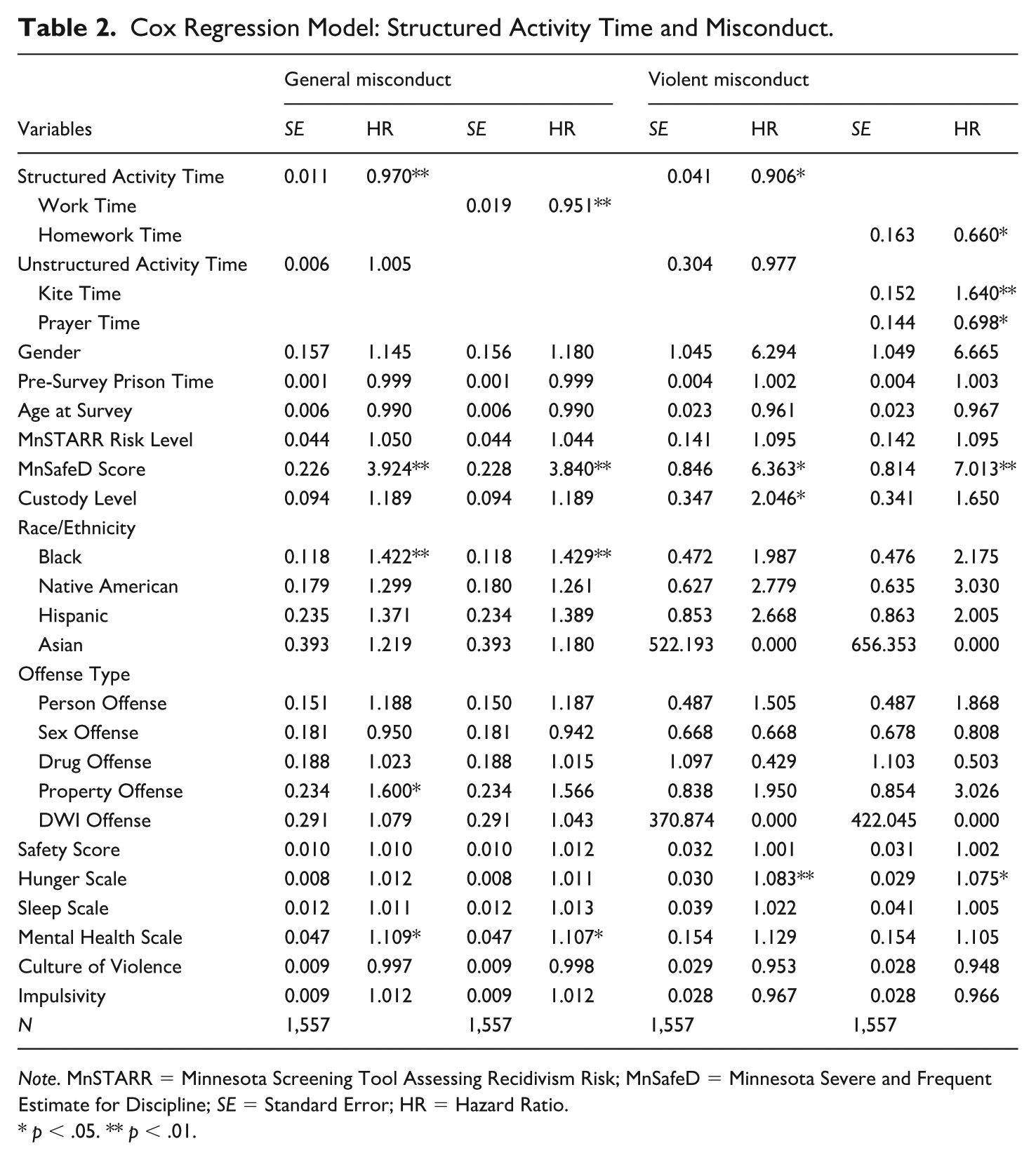
The results presented in Table 2 show that structured activity time significantly predicted the risk of time to first discipline conviction for both misconduct measures. A one-unit increase in structured activity time reduced the hazard of any prison misconduct by 3.0%. Greater involvement in structured activity time had a larger effect for violent misconduct, reducing the hazard by 9.4%.
Cox Regression Model: Structured Activity Time and Misconduct.
Note. MnSTARR = Minnesota Screening Tool Assessing Recidivism Risk; MnSafeD = Minnesota Severe and Frequent Estimate for Discipline; SE = Standard Error; HR = Hazard Ratio.
p < .05. ** p < .01.
To gain a better understanding of what types of structured activities significantly reduced the risk of time to first misconduct, we estimated Cox regression models that contained covariates for time involved in work assignments, education classes and homework, programming, and religious services. Although the unstructured activity measure did not have a significant effect on either misconduct measure, we also tested whether specific types of unstructured activities may be associated with discipline convictions.
Time involved in work assignments was the only type of structured activity that significantly predicted general misconduct, reducing the hazard by 4.9% for every one-unit increase. For violent misconduct, a one-unit increase in time spent on homework decreased the hazard for violent misconduct by 34.0%. None of the unstructured activity measures had a statistically significant effect on general misconduct, while significant results in the violent misconduct model were observed for time spent in prayer and writing “kites,” i.e., messages written to staff that consist of requests for assistance or, more commonly, complaints. Specifically, a one-unit increase in prayer time reduced the hazard of violent misconduct by 30.2%, whereas more time spent writing kites was associated with a 64.0% increase in the hazard for violence against staff and other residents.
As expected, the MnSafeD score significantly predicted the risk of time to first discipline conviction for both misconduct measures. Consistent with prior research on Minnesota’s prison population (Duwe et al., 2023; Rocque et al., 2023), Black residents had a significantly greater hazard of prison misconduct compared to White individuals. In addition, a one-unit increase in the Mental Health scale significantly increased the hazard of prison misconduct by 11%. The results also showed that higher custody levels and scores on the hunger scale significantly increased the hazard for violent misconduct.
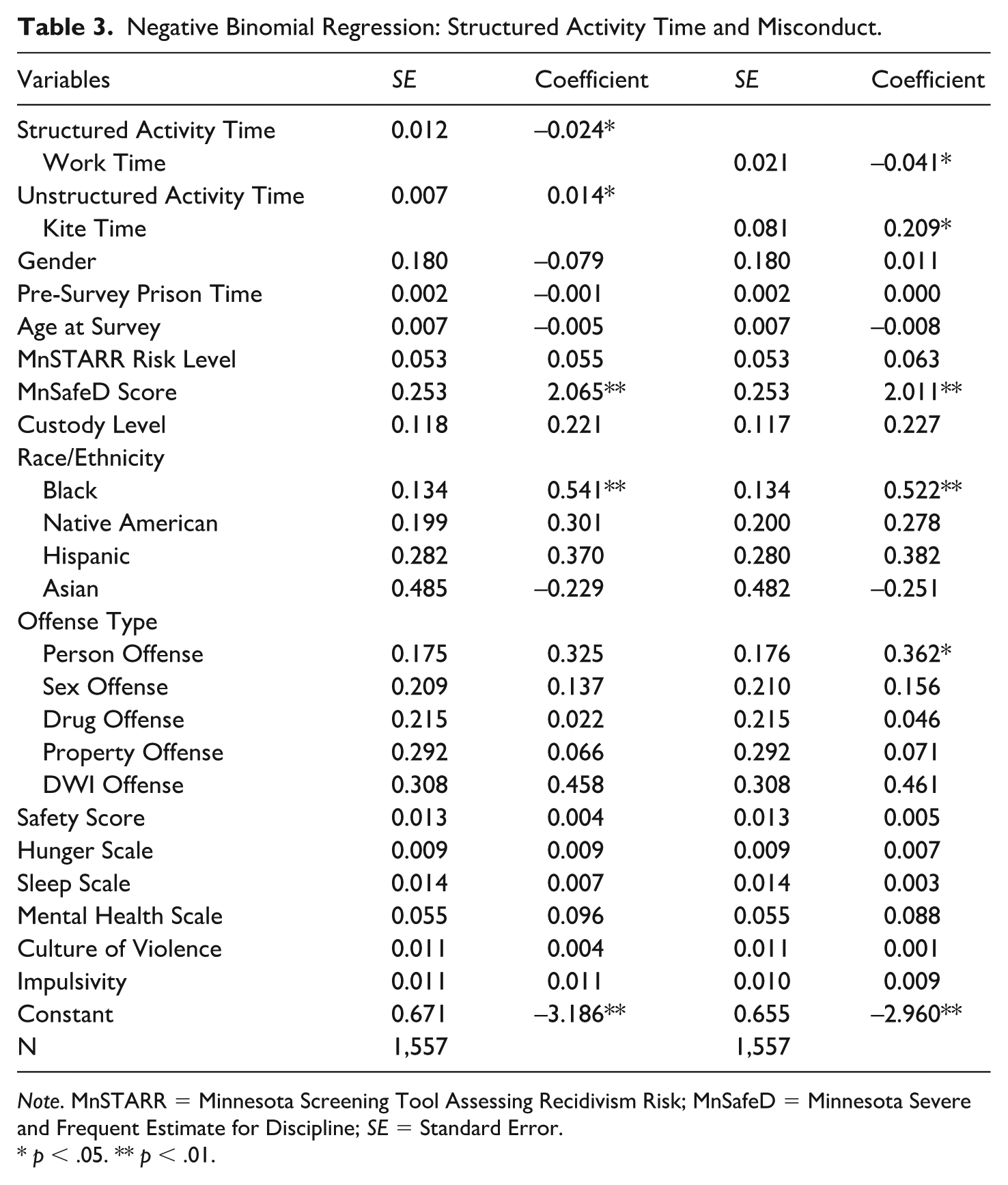
The results from the negative binomial model, which are shown in Table 3, are largely similar to those presented above. Greater involvement in structured activities significantly reduced the number of prison misconduct convictions. A one-unit increase in structured activities decreased the expected count of prison misconducts by 4.1%. In contrast, greater involvement in unstructured activities significantly increased the number of prison misconducts.
Negative Binomial Regression: Structured Activity Time and Misconduct.
Note. MnSTARR = Minnesota Screening Tool Assessing Recidivism Risk; MnSafeD = Minnesota Severe and Frequent Estimate for Discipline; SE = Standard Error.
p < .05. ** p < .01.
As with the analyses that examined the risk of time to first discipline conviction for general misconduct, we estimated additional negative binomial models that individually tested the effects of each type of structured and unstructured activity on the number of discipline convictions. The results showed, once again, that time involved in work assignments was the only one that significantly reduced general misconducts. Conversely, the results suggest the positive association between unstructured activities and general misconduct was influenced by the effect observed for time spent writing “kites,” i.e., messages written to staff that consist of requests for assistance or, more commonly, complaints. Residents who reported spending more time writing kites had significantly more discipline convictions during the follow-up period.
Consistent with the results from the Cox regression models, a resident’s MnSafeD score significantly predicted the expected count of prison misconducts. Moreover, compared to White individuals, Black residents had a significantly greater number of misconducts. The results also showed that higher custody levels at the time of the survey were positively associated with greater misconducts during the follow-up period.
Discussion
Routine activities theory suggests those who engage in unstructured leisure activities are more likely to engage in crime, while structured activity reduces the likelihood of criminal behavior (Osgood et al., 1996; Svensson et al., 2023). Beyond the behavioral change that is expected to result from structured activities such as programming and work, social bond theory (Hirschi, 1969) suggests involvement in prosocial activities reduces time spent in activities that are likely to result in misbehavior. This study used a representative survey of people incarcerated in Minnesota state prisons to examine whether structured and/or unstructured activities were associated with misconduct. In line with theory and prior research (Camp et al., 2008; Colvin, 1992; Courtney, 2019; Duwe et al., 2025; Duwe & McNeeley, 2020; French & Gendreau, 2006; Johnson et al., 1997; Lahm, 2009; O’Connor & Perreyclear, 2002; Pompoco et al., 2017; Reale et al., 2025; Steiner & Wooldredge, 2008; Vuk & Doležal, 2020; Wooldredge, 1994), we found time spent in structured activities—which included work, education classes, programming, and religious services—was associated with lower risk of general and violent misconduct and fewer misconduct incidents, above and beyond the contribution of other relevant predictors such as the MnSafeD score.
Our analyses showed time spent working was significantly related to general misconduct, which is consistent with prior literature that shows prison work is negatively related to misconduct (Duwe & McNeeley, 2020; Flanagan, 1988; Gover et al., 2008; Huebner, 2003; Steiner, 2009; Steiner & Wooldredge, 2008, 2009; Vuk & Doležal, 2020; Wooldredge, 1994). The stronger effect size for work may simply be due to larger cell sizes; a larger proportion of the sample were working compared to those in education or other types of programming. However, working could be more strongly related to misconduct than other structured activities, for several reasons. Incarcerated people could spend more time in some work assignments compared to the scheduled time for classes or treatment sessions; work may be more structured and more supervised and therefore allow less time and freedom for misbehavior, and there may be more incentive to avoid rule-breaking even outside of scheduled work hours due to the threat of losing income.
Our finding that time spent on homework for education classes and programs reduced violent misconduct is generally consistent with prior research. Given that Pompoco and colleagues (2017) found that earning secondary degrees and completing college classes decreased violence among incarcerated individuals in Ohio, residents who spend more time on homework may be more likely to complete education classes and the requirements for earning degrees. We also found that time spent in prayer significantly reduced violent misconduct. Although we are unaware of any prior studies that have demonstrated an empirical connection between prayer and violence reduction, this finding aligns with research promoting the benefits of meditation (Derlic, 2020), mindfulness (Bouw et al., 2019), and greater religiosity (Johnson, 2011).
The frequency of misconduct was higher among those who spent more time in unstructured activities such as physical recreation, reading, and watching television, consistent with past research (Nurse et al., 2003; Rocheleau, 2013; Vuk & Doležal, 2020; Woodall, 2011). However, the analyses also showed writing kites was the only specific unstructured activity that was associated with higher misconduct, including assaults against staff and other residents. In line with the concept of procedural justice (Tyler, 1990), incarcerated people who believe they are treated badly and/or perceive correctional staff as unjust are less likely to follow prison rules (Alward et al., 2021; Reisig & Mesko, 2009; Tostlebe & Pyrooz, 2022). Those who spent more time writing kites may have had issues with the facility that were unresolved, reducing their perception of procedural justice and increasing the likelihood they would engage in misconduct.
The results suggest increasing the availability of vocational, educational, and rehabilitative programming and encouraging participation in these activities may be an especially important way to improve safety in correctional facilities. First, correctional agencies should endeavor to increase the availability of programming. To do so, they may consider strategies such as leveraging external collaboration to address gaps and expand program offerings, assisting incarcerated people in accessing financial aid to pursue higher education, investing in staff training, and making sure facilities are equipped with the necessary space and technology for programming. Second, given the importance of work, education, and rehabilitative programs for reducing misconduct, it could be a mistake for correctional agencies to establish eligibility criteria that exclude those with histories of misconduct from these activities.
Third, we recommend introducing incentives (such as certificates, commendation letters, special privileges such as extra phone time or visitation, or monetary incentives) for participation in structured activities and especially work as a way to motivate incarcerated people to become involved in structured activities. Focusing on incentives rather than solely on punishment is more likely to result in long-lasting change (Marlowe & Kirby, 1999). It is recommended that incentives outnumber punishments by at least 4 to 1 (Gendreau, 1996; Wodahl et al., 2011). In justice-involved populations, financial incentives have been found to improve treatment retention (Carroll et al., 2006), and early discharge has also been suggested as an effective motivation to participate and succeed in treatment (Sarver et al., 2015; Wodahl et al., 2011; Wodahl et al., 2017).
While this study offers valuable insights into the relationship between activities and prison misconduct, several limitations should be acknowledged when interpreting the findings. First, the study is based on a survey from a single state’s correctional system. The results may not be generalizable to other states or correctional systems with different institutional cultures, policies, or programming availability. Second, the time use measures were created from self-reported survey questions that could suffer from recall bias and could be influenced by social desirability. Third, our measure of misconduct was based on official records of disciplinary convictions, which could be influenced by staff, discretion, facility culture, or reporting practices. Fourth, while the survey took place in 2024, well after the onset of the COVID-19 pandemic, the availability of structured activities decreased due to the pandemic (see Lindell et al., 2025) and may not yet have reached pre-pandemic levels. Finally, while our measurement of misconduct following the survey is a strength in that it preserves temporal order, our research design did not account for either the influence of selection bias on participation in structured and unstructured activities or for potential changes in these activities after the survey was completed.
In conclusion, this study found individuals incarcerated in Minnesota prisons who spent more time in structured activities—especially work—were significantly less likely to engage in misconduct. These findings support theories that structured, prosocial engagement can reduce misbehavior, partly by enhancing perceived fairness and limiting opportunities for misconduct. To reduce institutional misconduct, correctional administrators should expand the availability of education and rehabilitative programming, establish inclusive eligibility criteria so as many residents as possible can enroll, and offer incentives for participating in structured activities. It is important to note that, given the relationship between prison misconduct and prison victimization (Clark et al., 2025; Ellison et al., 2018; McNeeley, 2022; Steiner et al., 2017; Wooldredge & Steiner, 2014), increasing participation in structured activities to reduce misconduct will also make those same individuals safer.
A common suggestion for increasing incarcerated people’s participation in programs is to increase the availability of programming delivered virtually. However, it is unknown whether time spent in virtual programming would be equally beneficial in reducing misconduct. In addition to evaluating the effectiveness of virtual programming, future research should examine how participating in virtual programming affects residents’ time use and other outcomes such as misconduct. The racial disparity in misconduct observed in this study also underscores the importance of future research examining whether disciplinary practices reflect systemic bias.
Footnotes
Appendix A
Appendix B

Funding
The authors received no financial support for the research, authorship, and/or publication of this article.
Declaration of Conflicting Interests
The authors declared no potential conflicts of interest with respect to the research, authorship, and/or publication of this article.
Data Availability Statement
Data sharing is not applicable to this article, as no datasets were generated or analyzed during the current study.