






Abstract
There appears to be a virtual absence of any serious distinctions in the programs and rhetoric of the three leading political parties in Ukraine: The Party of Regions, Bloc of Yulia Timoshenko, and Our Ukraine. Each party is in support of the market economy, democracy, human rights, and joining the European Union. The major distinction between these parties is in the way they see the country’s past. Such an intensive use of the past reflects the absence of differences in the way they see the future. This article is dedicated to the analysis of how the past has been used in Ukrainian politics during the period of active political and regional confrontation in 2004–2010. In particular, what specific historical stories and topics are in high demand in the political rhetoric and why, and how all of these factors may prevent the process of political consolidation of the nation. The article concludes that major political parties will most likely use the same regional stereotypes of viewing the past in mobilizing their electorate during the coming parliamentary elections of 2012. The technology of confronting the “two Ukraines” will be employed by the competing political camps once again.
Introduction
There appears to be a virtual absence of any serious distinctions in the programs and rhetoric of the three leading political parties in Ukraine: The Party of Regions, Bloc of Yulia Timoshenko, and Our Ukraine. Each party is in support of the market economy, democracy, human rights, and joining the European Union. Also, all three parties use elements of populist demagogy that come from the Socialist era. The major distinction between these parties is in the way they interpret the country’s past. Their overwhelming focus on the past reflects the absence of differences in the way they see the future. Ukrainian elites have yet to formulate an attractive projection for the future and a clear way to pursue their projections. Post-Soviet elites, who are also often owners of former state enterprises, spent past two decades fighting for the state’s property. The majority of the Ukrainian population are dissatisfied with their present standard of living. Because the leading political parties were repeatedly replacing each other in power, they are not able to indefinitely accuse each other of being at fault for the unsatisfactory present living conditions. They must inevitably share the blame for the current low living standards. This desire to place blame explains why the relation to the past has become the main field of struggle between the political parties. The past is being referenced as the twentieth century. The parties’ differences in approaches to the past are characteristic of not only different social groups but also the population of two macro-regions. These two macro-regions have consistently supported either the “orange,” that is, West and Center, or “blue and white,” that is, South and East, over the past six years. In this article, we intend to show that the regional differences have emerged much earlier, in the second half of the eighteenth century. Also, we are going to show the evolution of the internal borders that exist in the consciousness of the people of Ukraine and continue to divide them.
This article is dedicated to the analysis of how the past has been used in Ukrainian politics during the period of active political and regional confrontation in 2004–2010. In particular, what specific historical stories and topics are in high demand in the political rhetoric and why, and how all of these factors may prevent the process of political consolidation of the nation. Additionally, this article analyses how the historians can search for a solution for this problem and overcome these obstacles. Political scientists and public intellectuals have often examined the conflict around the perceptions of past in a society. However, their works were somewhat superficial in that they merely established the fact of societal division, or had a utilitarian and applied character. Their works focused on the issue of how politicians use or can potentially use the issue of societal divisions to improve their position. Starting in the beginning of the 2000s, a few Ukrainian and foreign historians also addressed this problem, 1 but only irregularly, depending on their awareness of works on nationalism and post-colonialism offered by Western scholars. The traumatizing experiences of the 2004 presidential election force historians to turn to the problem of how history is used by politicians. 2 The analysis of the present situation is at an early stage and many aspects of the issue have yet to be touched on by researchers.
In this article, we are going to research the following issues:
The extent to which regional preferences of the electorate are predetermined by the language factor
Ways that the historical past of different Ukrainian regions have influenced the formation of their regional memory places
The deep formative causes of the image of a divided Ukraine in the consciousness of modern society, including real and imaginary borders
How the history of Ukraine’s different regions is reflected in the national grand narratives, collective memory, and official policy of memory, including normative historical didactics, commemorations, and political myths and rhetoric
How populations of different regions react to the official version of the past, including textbooks, commemorations, and political rhetoric in Ukraine
We understand that it is virtually impossible to conduct such an extensive comprehensive study of all of the stated issues within the limits of just one article. This study is intended to highlight the future program of research rather than to lay out its results.
The major object of this research comprises historical grand narratives, that is, extensive reviews of Ukrainian history from ancient times until present, created by Ukrainian historians after 1991, as well as official commentaries, that is, formal events conducted by the state bodies and devoted to the memory of certain historical events or figures, such as the opening of monuments, the naming of streets and squares, presentation of state awards, organizing celebrations and commemorations, etc., and their acceptance and discussion by the society.
Analysis of these sources will allow us to establish the extent to which the content of historical grand narratives and official policy of memory correspond to the historical consciousness of population in the different regions of Ukraine and which events of the past, including script lines, explanations, interpretations, and estimates, contain the most potential for a conflict and why.
What Influences Electoral Preferences: The Language or the Past?
The ongoing political turmoil that has been taking place in Ukraine for more than two decades now attracts not only political scientists 3 but researchers from other fields as well. The Orange Revolution, and numerous attempts of its analysis, led to the need to reconsider the local concepts of nationalism, identity, and civil society in Ukraine. 4 The resurge of the interest in Ukrainian politics came with the results of the 2010 presidential elections. 5 The elections show that the regime change in Ukraine is not only a mere opportunity but the reality, and this rather unusual phenomenon for the post-Soviet states needs to be explained. Kuzio (2011) points out that “The failure of the Yushchenko presidency to implement the majority of the hopes placed in it by millions of voters and protestors, specifically to decisively change the manner in which politics and economics are undertaken, is a good opportunity to analyse why Ukraine is a difficult country—an immobile state—in which to undertake change of any type.” 6 D’Anieri (2011) examines what has made consolidation of power more difficult in Ukraine than other post-Soviet societies. 7 Some authors look into the nationalist dichotomy between the civic and the ethnic. 8 Others investigate rules of engagement in ethnically charged battles in Ukraine 9 and the role of populism in such battles. 10 The issue of identity 11 and forming of the national idea 12 unavoidably deals with imperial legacies, nostalgia for socialism, 13 and post-communist pathways. 14 The elections are not only a field of battle but one of learning. 15 Elections politicize masses and organizations, 16 and raise issues of democratic competition 17 and other aspects of competition and competitiveness as well, including competing memories. 18 Ukraine struggles between its historical legacies and the promise of Western integration. 19
Many political scientists and public intellectuals discuss the results of the 2004 and 2010 presidential elections and 2006 and 2007 parliamentary elections and the changes in electoral preferences, depending on geographic location of the region. The further west the district lies, the greater is the number of supporters of the “Orange” political forces, including Yushchenko’s “Our Ukraine” and “Bloc of Yulia Timoshenko.” To the contrary, the further east the district is, the more supporters of the “Blue-and-White,” that is, the Party of Regions and Victor Yanukovych.
Colton (2011) finds that identity-based variables based on macro-region and language are the greatest predictors of the strong continuity across successive elections, although economics is also of some relevance. The author shows that identity politics lost their salience as of the late 1990s and then resurged immediately after. Colton (2011) connects the reasons for this reversal with the elite’s habit of relying on identity messages to compete for high office and the penetration of the Ukrainian political space by international actors. 20 D’Anieri (2011) points to a certain consistency in Ukrainian electoral politics, especially in regional dynamics. The author suggests that these enduring constraints limit the options of political leaders. 21 Herron (2011) reassesses the dominant narratives of Ukraine’s 2010 presidential election in order to answer the question of how Viktor Yanukovych won. The author explores two prominent narratives, including possible fraud and the East–West separation. “The first narrative is that Yanukovych’s win was legitimate. While fraud may have been present, its scale was small and it was not decisive. The second narrative suggests that Ukraine’s major operational political cleavage separates eastern and western regions, rendering the central region of the country a crucial prize for candidates to secure victory in presidential contests.” 22
The significant differences in the electoral preferences exist not only between the opposite poles—Western Ukraine, including Galicia and Volhynia, and Donbass and Crimea—but also between the neighboring oblasts, located along the invisible borderline that divided the electorate consistently during the 2004, 2006, 2007, and 2010 elections. If in their “own” oblast’ a candidate receives 65, 75, or 80 percent of the votes, then in the “alien” oblast’ he or she receives 35, 25, or 20 percent of the votes, respectively. Such a consistent trend has been observed in the 2004 presidential elections and continues with little deviation through 2010. 23 Electoral preferences in the electoral borderlands of the Center and South-East are presented in Table 1.
Electoral Preferences in the Electoral Borderlands of the Center and South-East
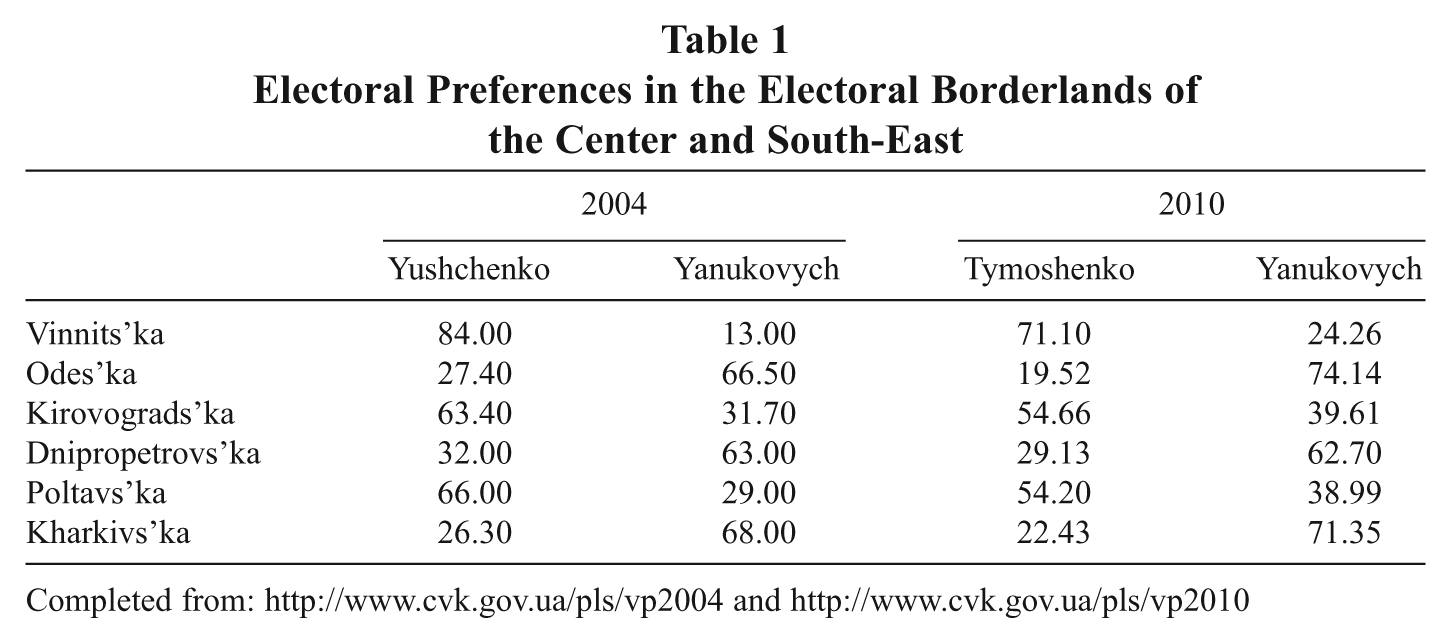
Completed from: http://www.cvk.gov.ua/pls/vp2004 and http://www.cvk.gov.ua/pls/vp2010
This causality has been traditionally linked to the Russian language, that is, the Ukrainian-speaking population votes for the “Orange,” while the Russian-speaking population votes for the “Blue-and-White” and the Communist Party. According to this view, language is the determining factor in the self-identification of the population. But this view ignores the fact that the majority of Ukraine’s population is bilingual 24 and that a significant part of this population uses both languages equally, depending on the context of the situation. Thus, although language is a factor, it is not the dominant factor that influences the electoral preferences and self-identification of populations.
Situations that do not fit into the simple scheme of language–self-identification–vote are normally ignored by political scientists and observers. For instance, during the presidential elections held on December 26, 2004, 25 Zhytomyrska oblast’ gave Yushchenko 66.86 percent of the votes while Kyivs’ka oblast’, located to the east, gave Yushchenko 82.7 percent of the votes, and Cherkas’ka oblast’, located in the South-East, gave 79.1 percent. It is hard to explain such a discrepancy, the difference of 12 to 16 percent, with the over-simplistic language scheme. Along the same lines, the city of Kiev with its predominantly Russian-speaking majority has been constantly voting for the Orange candidates—78.37 for Yushchenko in 2004 and 65.34 percent for Timoshenko in 2010. A very significant difference exists among the White-and-Blue regions of the South-East. While Donets’ka and Lugans’ka oblasts gave Yushchenko 4.2 and 6.2 percent of the votes, respectively, the neighboring Kharkivs’ka oblast’ gave 26.37 percent, Zaporiz’ka oblast’, 24.5 percent, and Dnipropetrovs’ka oblast’, 32 percent. At the same time, the structure of the population of these oblasts has many similar features. It includes large industrial centers with Russian-speaking population and predominantly Ukrainian-speaking villages and rural areas.
Moreover, the a priori assumption that a Russian-speaking population votes for Yanukovych and a Ukrainian-speaking population votes for Yushchenko simply does not work if one is to consider carefully the results of the votes in particular oblasts. For instance, in 2004 in the Russian-speaking city of Kharkiv, with half of the population of the entire oblast’, the electorate voted for Yushchenko more actively than did people in the predominantly Ukrainian-speaking rural areas of Kharkivs’ka oblast’. In the eight districts of Kharkiv, Yushchenko received 33.44, 32.43, 28.39, 27.64, 24.27, 26.90, 27.00, and 25.60 percent of the votes, higher than his average score in the oblast’ overall, which was 26.37 percent, while in the rural Ukrainian-speaking districts he received 15.68, 17.00, 18.90, 25.33, 30.00, and 36.97 percent, that is, in half of the cases lower scores than on average in the oblast’. In absolute numbers, Kharkiv gave Yushchenko 280,348 votes while in the countryside he received only 166,447 votes. Thus, it is Russian-speaking Kharkiv that ensured Yushchenko a relatively good result in Kharkivs’ka oblast’, not the rural Ukrainian-speaking districts of the oblast’. The situation in Kharkivs’ka oblast’ is not an exception. Similar proportions were found, for instance, for Zaporiz’ka oblast’. In four districts of the Russian-speaking city of Zaporizhzhia, a large industrial center, Yushchenko received 32.85, 32.00, 31.36, and 26.13 percent of the votes—much higher than on average in the oblast’, 24.5 percent. At the same time, in five rural Ukrainian-speaking districts he received 15.50, 18.29, 20.66, 20.96, and 24.46 percent, which were lower than on average in the oblast’.
The level of support enjoyed by Yanukovych in southeastern oblasts is not always in direct proportion to the percentage of the Russian-speaking population. Moreover, there are instances that undermine the well-established stereotype about the direct positive correlation between the electoral support of Yanukovych and the percentage of the Russian-speaking population in a given oblast. During the 2010 presidential elections, Yanukovych received 71.5 percent of the votes in Mykolaivs’ka oblast’ and the same percentage of votes in Zaporiz’ka oblast’. At the same time, the Russian-speaking population in Mykolaivs’ka oblast’ constitutes 66 percent and in Zaporiz’ka oblast’, 81 percent. Comparisons of the South-East region’s electoral preferences with ethnic and language self-identifications are presented in Table 2.
Comparisons of the South-East Population’s Electoral Preferences with Ethnic and Language Self-Identifications
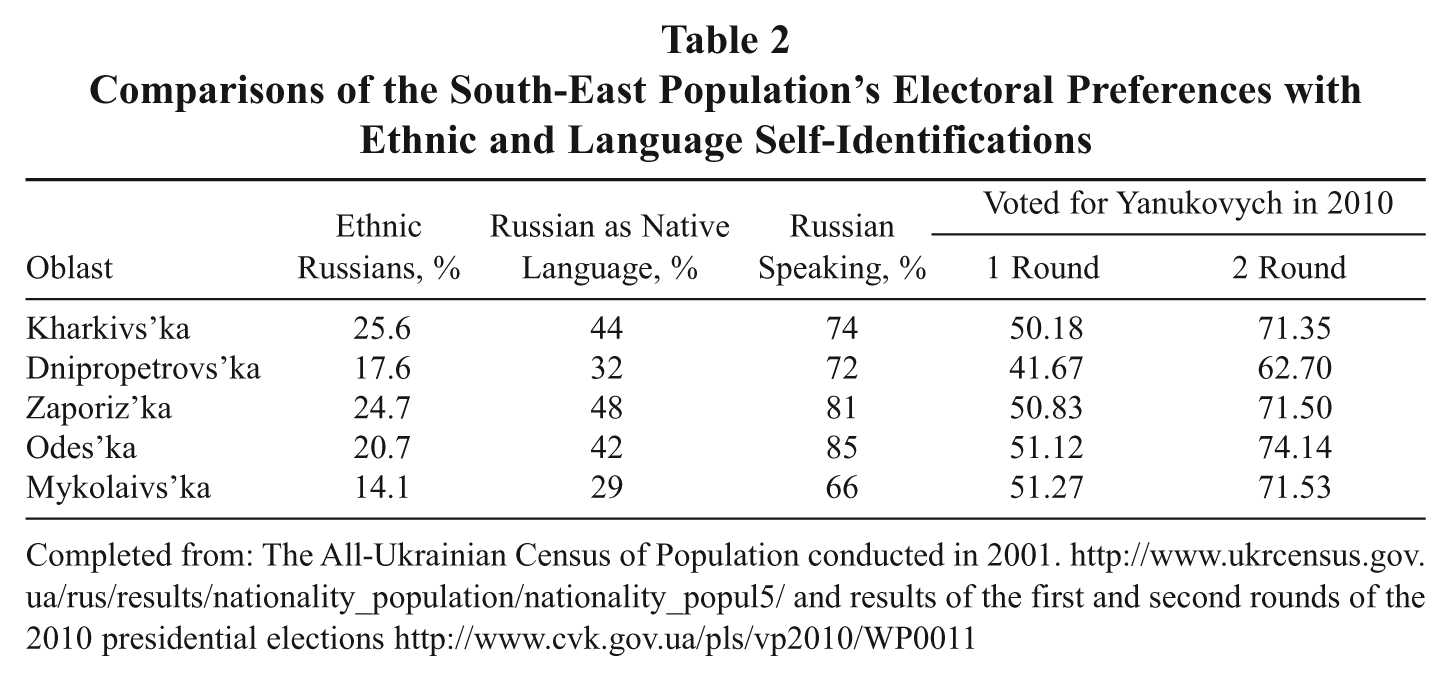
Completed from: The All-Ukrainian Census of Population conducted in 2001. http://www.ukrcensus.gov.ua/rus/results/nationality_population/nationality_popul5/ and results of the first and second rounds of the 2010 presidential elections http://www.cvk.gov.ua/pls/vp2010/WP0011
The exemplary case of Dnipropetrovs’ka oblast shows how significant the sense of regional solidarity is of the oblast’s electorate with their candidate compatriots. In the first round of the 2010 presidential elections, voters of the four districts of Dnipropetrovs’k gave their votes equally to their compatriot Sergiy Tigipko (32–36 percent) and the candidate from Donbass, Victor Yanukovych (31–37 percent). Comparative analysis of voting patterns in the South and East regions with votes given to Yanukovych and Tigipko in the first round of the 2010 presidential elections, held on January 17, 2010, is presented in Table 3.
Comparative Analysis of Voting Patterns in Southern and Eastern Regions with Votes Given to Yanukovych and Tigipko in the First Round of the 2010 Presidential Elections, January 17, 2010
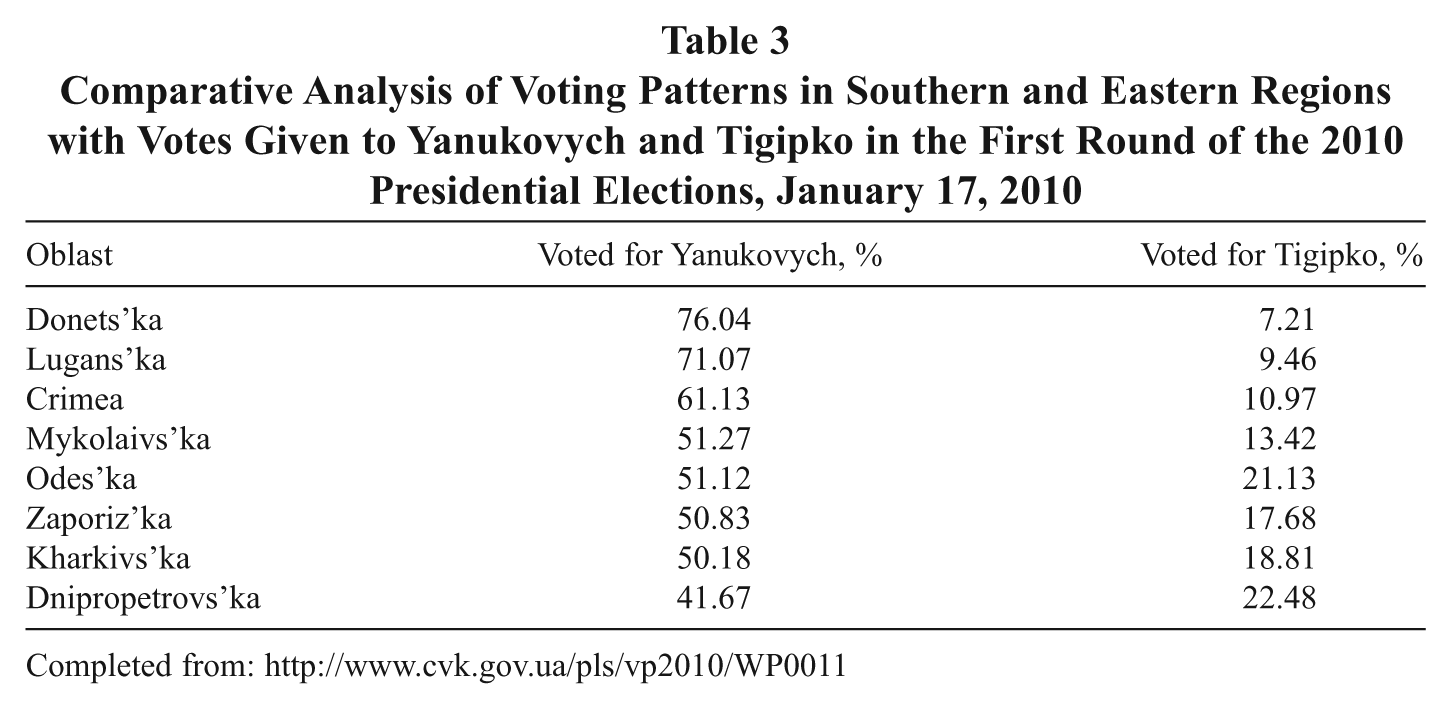
Completed from: http://www.cvk.gov.ua/pls/vp2010/WP0011
During the second round of the 2010 presidential elections, people of Dnipropetrovs’ka oblast actively supported their compatriot, Yulia Timoshenko, giving her 29.13 percent of the votes, while Victor Yanukovych collected in this oblast’ the least number of votes as compared to other regions of the South-East, only 62.7 percent. Such a low result of Victor Yanukovych in Dnipropetrovs’ka oblast and especially in the city of Dniporpetrovs’k as compared to other Blue-and-White oblasts may be explained by the long-lasting rivalry between the elites of Donets’k and Dnipropetrovs’k. This rivalry has been reflected in self-identification and electoral preferences of the populations of these two most industrialized regions of Ukraine. Comparative analysis of voting patterns in the southern and eastern regions of Ukraine with votes given to Yanukovych and Timoshenko in the second round of the 2010 presidential elections, held on February 7, 2010, is presented in Table 4. Comparisons of the South-East population’s electoral preferences at national– parliamentary and presidential –and local elections in 2007-2010 are presented in Table 5.
Comparative Analysis of Voting Patterns in Southern and Eastern Regions with Votes Given to Yanukovych and Timoshenko in the Second Round of the 2010 Presidential Elections, February 7, 2010
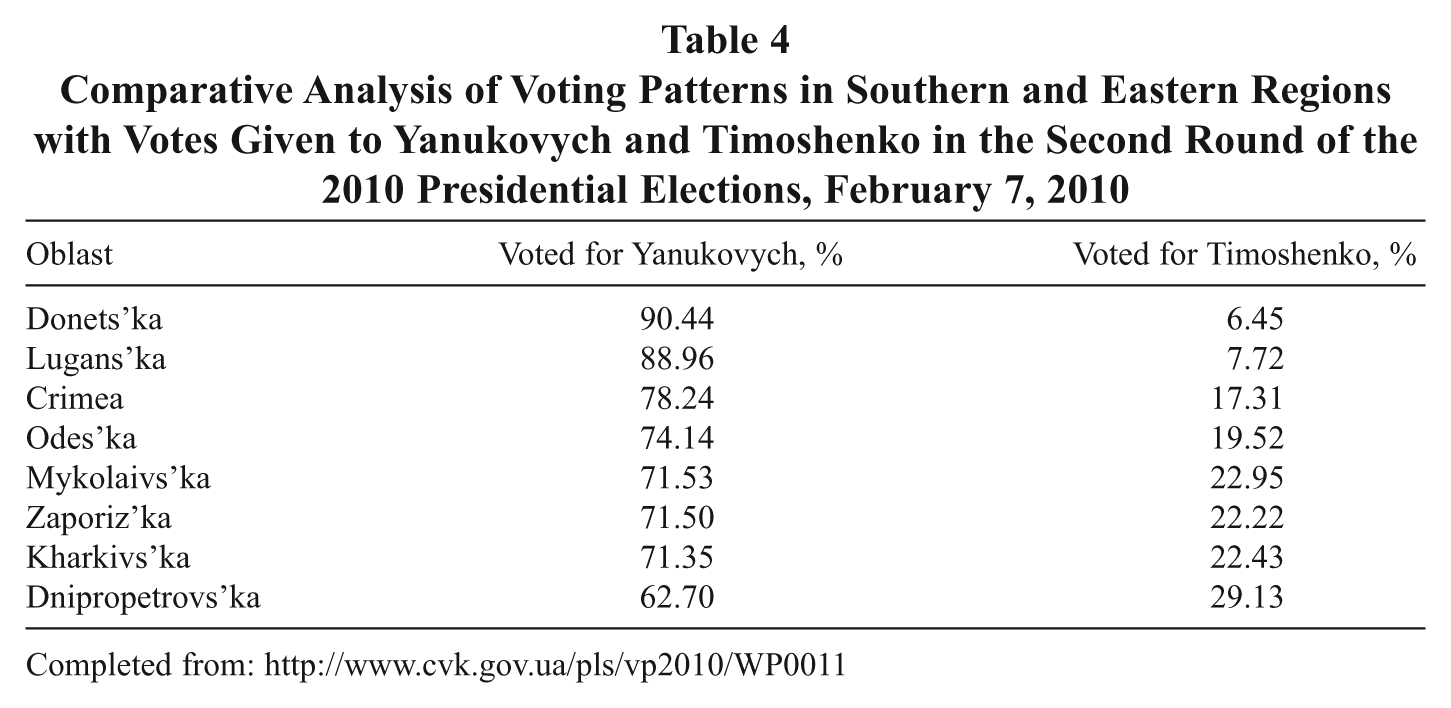
Completed from: http://www.cvk.gov.ua/pls/vp2010/WP0011
Electoral preferences in favor of presidential candidates Yanukovych and Timoshenko, who received the largest percentage of votes by rayons or districts and cities of republican (oblast’) status on February 7, 2010, are depicted in Figure 1.
Comparisons of the South-East Population’s Electoral Preferences at National—Parliamentary and Presidential—and Local Elections in 2007–2010
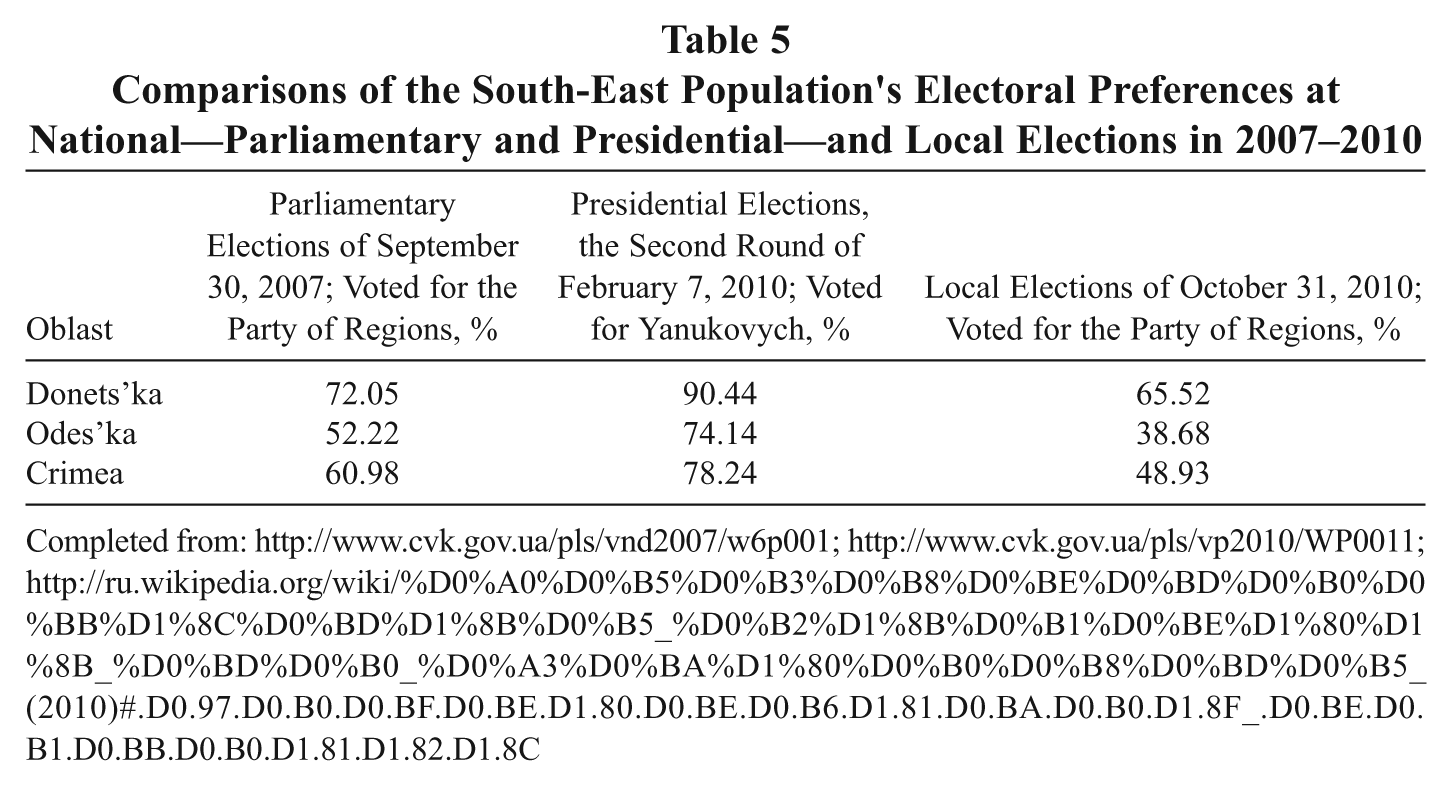
Completed from: http://www.cvk.gov.ua/pls/vnd2007/w6p001; http://www.cvk.gov.ua/pls/vp2010/WP0011; http://ru.wikipedia.org/wiki/%D0%A0%D0%B5%D0%B3%D0%B8%D0%BE%D0%BD%D0%B0%D0%BB%D1%8C%D0%BD%D1%8B%D0%B5_%D0%B2%D1%8B%D0%B1%D0%BE%D1%80%D1%8B_%D0%BD%D0%B0_%D0%A3%D0%BA%D1%80%D0%B0%D0%B8%D0%BD%D0%B5_(2010)#.D0.97.D0.B0.D0.BF.D0.BE.D1.80.D0.BE.D0.B6.D1.81.D0.BA.D0.B0.D1.8F_.D0.BE.D0.B1.D0.BB.D0.B0.D1.81.D1.82.D1.8C
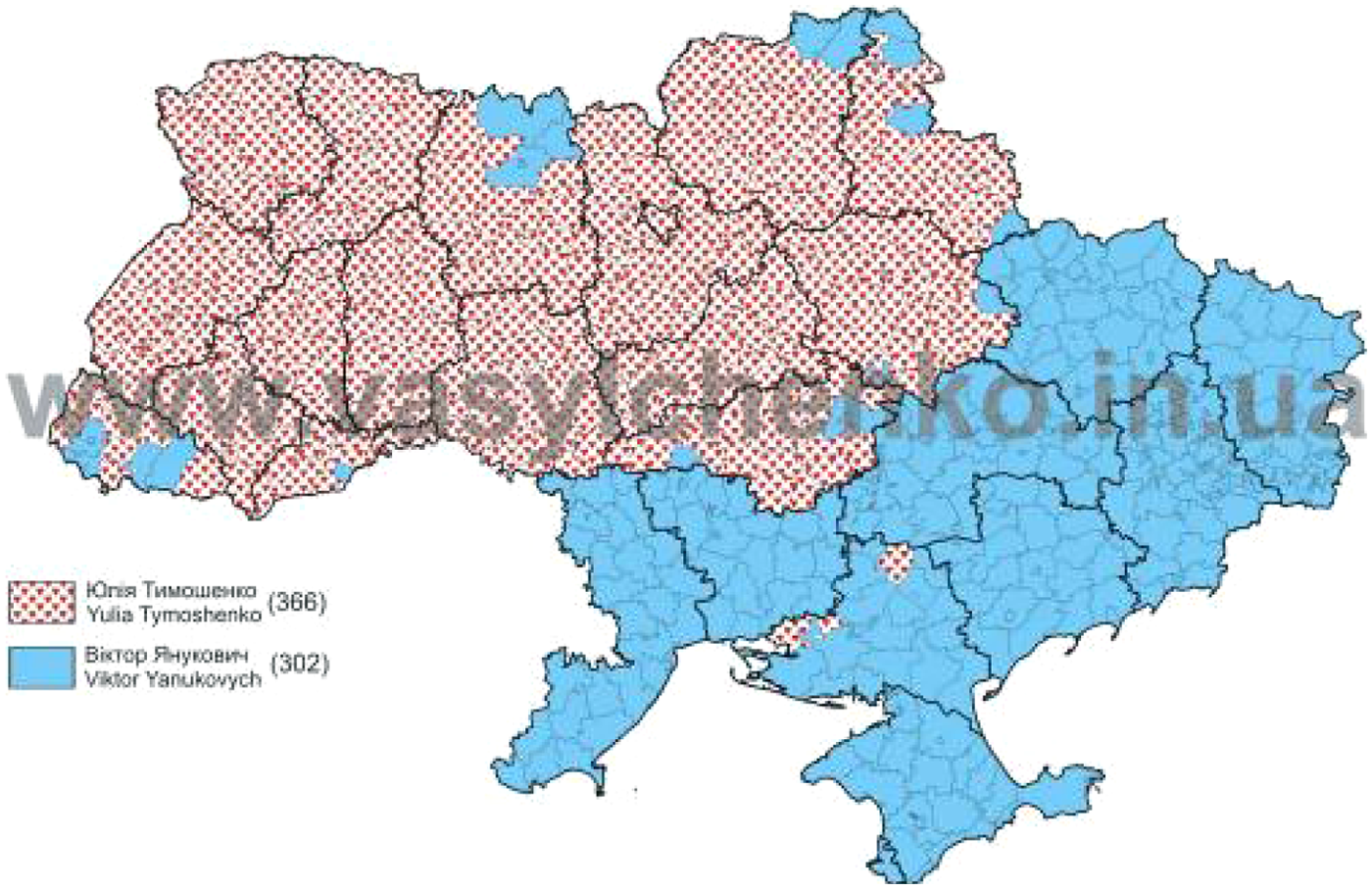
Presidential candidates who received the most percentage of votes by rayons and cities of republican (oblast) status, February 7, 2010
It is obvious that the South-East is not a monolithic macro-region that serves as an exclusive domain of the Party of Regions. On the contrary, there are clear and significant distinctions in the electoral preferences of people in different oblasts of the same macro-region. The key role here belongs to the territorial affiliation or belonging of a candidate. The voting for “our man,” our compatriot dominates the electoral landscape. In fact, the voting is for the one who came from our regions, since all leading Ukrainian politicians moved to Kiev a long time ago and now reside in the capitol city, not in their respective regions.
Regional Identity and Electoral Preferences: A More Nuanced Vision Is Needed
If there is no clearly determined causality or at least no strong link between language and electoral preferences, then why do political analysts and public intellectuals point to the language factor and why do politicians appeal in their political rhetoric to the language factor when using the division factor? The reason is that the language diversification, as well as any other broadly used electoral issue, such as relation to NATO or Russia, is based on the statistical data and sociological population surveys and can be relatively easily calculated and interpreted. Accordingly, the preference is given to quantitative, not qualitative, methods of analysis. But it is more difficult to figure out the views of Ukrainians regarding history or policy of memory based on sociological surveys, if at all possible. Views on the past are a very delicate matter. Oftentimes people are irritated not by a certain fact but by its interpretation or wording and the way details and nuances are stylistically shaped in presenting the information. Inexperienced spectators, listeners, or readers are often unable to understand, and even less able to articulate, that it is exactly these nuances that irritate them. They are unable to express their point of view even if given carefully designed sociological survey questionnaires, because even such questionnaires simplify the spectrum of possible opinions, and narrow it down to a limited set of options. The customer who requested the survey is interested in the result: he or she wants to know whether his or her rating is going up. The customer, that is, the politician, is not really interested in the nuances of the electorate’s views on different aspects of offerings about the past in historical didactics and commemorations. The complex problem of how constituents view history, the policy of memory, their own identification with certain actors and events of the past, and in political rhetoric is being replaced with the simple and seemingly unambiguous category of language and the issue of the status of the Russian language.
The suggestions offered above are supported by the results of the sociological survey, conducted in Donets’k in April 2005, in which the respondents were asked the following question: “What exactly had the major impact on your vote in the election program?” This open-ended question was asked instead of offering respondents a choice among several different options. Out of 323 respondents, of which 95.6 percent voted for Yanukovych, only 7, that is, 2.2 percent turned to the issue of relations with Russia and the status of Russian language as a motivation for their choice. 26 At the same time, when the issue about the status of Russian language was included in the questionnaire, 90.2 percent of the respondents supported the idea of giving Russian language the status of the second state language. This number correlates with the 93.54 percent of votes given to Yanukovych in Donets’ka oblast’. 27 Thus, it appears that the language issue is not that important for the people of Donets’k but is rather imposed on them from the outside by politicians, political scientists, and sociologists. It is nevertheless of interest to people and serves as a marker of self-identification with a certain candidate or a political party. Furthermore, 74.2 percent of the respondents think that the future of their region is bound with that of the rest of Ukraine, 28 despite the fact that according to the population census of 2001, ethnic Russians constituted 38.2 percent of the region’s population 29 while in Donets’k this indicator is even higher.
The majority of the Russian-speaking population in Ukraine does not feel any language discrimination. To the contrary, one can speak about a certain discrimination of the Ukrainian-speaking minority in large cities of the South and East. One can suggest that a vivid reaction of the people from the South and the East on the issue of the status of Russian language is an indication of the position of confronting oneself with the “rest of Ukraine.” Such a reaction can also be interpreted as an oversimplified marker of expression of some kind of dissatisfaction. However, they only see themselves within Ukraine, with no indications of separatism. Indications of separatism may only be an exclusive characteristic for the Autonomous Republic of Crimea.
In December 2005, the Institute of Sociology of the National Academy of Sciences of Ukraine conducted a sociological survey covering the whole of Ukraine. Eighty-six percent of the respondents said they consider Ukraine as their motherland, and only 4 percent responded negatively. At the same time, in the Crimea, these numbers were 47 percent and 40 percent, respectively. 30 Five options were offered to answer the question: “What causes the divide between people of the East and West?” The respondents chose political reasons most frequently. The second most frequently chosen answer was psychological factors. Third place was given to history, that is, historical memory. Fourth place was given to culture while economic factors were marked as the least important. 31 We can dismiss the political factors as most important determinants, because political factors are not endogenous for the electorate. These factors were brought in by the political propaganda and intentional confrontation of the East and West by political technologists during the presidential campaign of 2004. 32
A well-expressed regional identity of the people of Donbass guaranteed a wide support for Yanukovych as “their man” by the voters in Donets’ka and Lugans’ka oblasts, 93.54 percent and 91.24 percent, respectively. 33 Psychological and historical factors appear to be the leading determinants in the thoughtful imaginary border between “us” and “them.” The divisiveness of historical memory, and feelings of psychological discomfort and frustration connected to it, is the factor that divides the people of Ukraine in their own views. Cultural factors, including language, are only in the fourth place. Psychological discomfort or even irritation are brought to life by the mismatch of historical memories of the populations in the South and East with those presented as the official version for Ukraine, including the rhetoric of the nation’s leaders, historical didactics, commemorations, celebrations, jubilees, anniversaries, publications, etc. The dissatisfaction with the way the past of the South-East is presented, or rather even not presented, is even higher. Not least important in the continuous success of the Party of Regions in the South and East of Ukraine during the elections of 2004, 2006, 2007, and 2010 is the fact that this party is considered as the party of “frustrated and suppressed regions.” This, of course, is combined with the capacities of administrative resource and the financial power of big capital tied with this party. Such a frustration arises from underestimation or even ignorance of the role of these regions in the creation of modern Ukraine found in the official discourse. The issue of the status of Russian language is in fact a laconic expression of the demand to recognize the equal status of the frustrated people of the South and East. The recognition of the historical role and contributions made by the people of these regions would confirm their equal status and rights.
Internal Borderlands: Real and Imaginary
A simplistic thesis about the confrontation between West and East became a dogmatic axiom of Ukrainian political discourse. However, the situation is much more complex. It is true that if one is to consider Galicia and Donbass as West and East, respectively, then such a distinction is obvious based on several criteria. These regions have very well-expressed regional identities. However, Galicia and Donbass are two extremes in political and historical and cultural respects, not only in terms of their geographic location. 34 These regions are located in the opposite ends of the country and have no adjacent borders geographically. Figuratively speaking, Ukraine is located between these two “poles.” If one is to exclude such unique and distinctive multiethnic regions as Crimea, Bukovina, and Transcarpathia with their distinct pasts and heritage, then the remaining Ukraine, located between Galicia and Donbass, that is, 17 of the total of 25 oblasts, does not have such drastic distinctions. Such characteristics as nature, climate, landscape, economy, practices of everyday life, urban and rural architecture, identities, and balance of languages transition smoothly from northwest to southeast within the main body of Ukraine. A traveler cannot observe a distinct border between these regions. This border becomes evident only when it comes to politics; it is visible largely on the electoral maps. Nevertheless, the majority of politicians and election managers prefer to use Galicia and Donbass as paradigms and concepts of West and East precisely with the content. This helps make the whole confrontation more prominent and hence more effective, which facilitates manipulation of the electorate and voters’ opinions. Rather than distinguishing East and West, our study finds it necessary to distinguish not two but three large regions—Center, South-East, and West—which correlates with historically shaped regions named, respectively, as Malorossiya (Little Russia), Novorossiya (New Russia), and Zakhidna Ukraina (West Ukraine). 35
The map of electoral preferences of Ukrainians during the 2004 presidential elections indicates that the division line goes from southwest to northeast, separating White-and-Blue south and east, that is, eight oblasts and the Autonomous Republic of Crimea, from the Orange center and west that includes sixteen regions. This line did not emerge over the past few years. It reflects a latent borderline that has existed for many centuries. It is a borderline between the region composed mostly of steppes on one side with well punctuated forested land on the other. It is a borderline that divides a civilization of settlers who cultivated land from a civilization of nomads who bred cattle. In the steppes, the changes happen slowly in nomadic tribes, but their way of life did not undergo any major changes. Only in the seventeenth century did Cossacks, who previously settled the region of mixed forests and steppes, cross this borderline and start to settle on the lands that received the names Zaporiz’ka Sich’ and Slobids’ka Ukraina. Zaporiz’ka Sich’ is the modern territory of Dnipropetrovs’ka oblast’ and the neighboring territories of Zaporiz’ka and Khersons’ka. Slobids’ka Ukraina is modern Kharkivs’ka oblast’ and northern parts of Lugans’ka oblast’.
This borderline also denotes a political division. Orange regions are those that were part of the Polish-Lithuanian state, called Rzeczpospolita, or commonwealth, starting in 1569. The Union of Lublin (1569) made the Polish kingdom and the Grand Duchy of Lithuania a dual state—Rzeczpospolita. Left-bank Ukraine (Livoberezhna Ukraina) was part of Rzeczpospolita until the mid–seventeenth century and Prikarpattya (Galicia) and right-bank Ukraine (Pravoberezhna Ukraina) remained its part until 1772 and 1793–1795, respectively. White-and-Blue regions were never a part of Rzeczpospolita. Only the lands of the autonomous Zaporiz’ka Sich’ were listed there formally. Hence, the experiences of being a part of Rzeczpospolita, and thus of Europe, left their imprint in the memory and culture of the Orange regions, including architectural landmarks, monuments, legends, and such. The appeals of politicians and artists to this heritage continue to influence the population of the western and central Ukraine. People of the central parts of the country also have the heritage of their own statehood that comes from the times of Hetmanate (Hetmanshchina)—Ukrainian Cossack autonomous state in 1648–1763. The southern and eastern regions do not have such kind of heritage or experiences, and thus the appeals to these values have no significant effect on the electorate of the White-and-Blue regions.
The political borderline disappears at the end of the eighteenth century as a result of a successful expansion of the Russian Empire that includes the incorporation of Hetmanate/Malorossiya in 1763, 36 Russian-Turkish wars of 1768–1774 and 1787–1791, the annexation of the Crimean Khanate in 1783 and Ottoman territories on the northern shores of the Black Sea in 1774, 1791, and 1812, the start of the settlement of Novorossiya, 37 and second and third partition of the Polish-Lithuanian commonwealth Rzeczpospolita in 1793 and 1795. 38 In the nineteenth century, this borderland gradually transforms into a latent form under the unification enforced by the Russian Empire. In spite of political unification, the process of consolidation of culture, historical memory, and self-identification of the people of Malorossiya and Novorossiya did not take place. That is why in 1917–1919 this borderline or division has surfaced again, when a significant part of the population in Novorossiya actively or inactively spoke against the inclusion of their region into both the Ukrainian People’s Republic (Ukrains’ka Narodna Respublika, henceforth UNR) and the Ukrainian Soviet Socialist Republic (henceforth Ukrainian SSR) proclaimed by the Ukrainian Bolsheviks and military supported by the Soviet Russia. Thus, the majority of the politically active urban population of Novorossiya did not identify itself with “Ukraine.” In their point of view, Ukraine—UNR or Ukrainian SSR—was encircled within the borders of former Rzeczpospolita domains and Hetmanate/Malorossiya, while Novorossiya had nothing in common with Ukraine. Ukrainian peasants dominated in the countryside in the southeastern regions, including the Katerynoslavs’ka, Khersons’ka, and Tavriys’ka provinces (gubernias), but there were also numerous non-Ukrainian settlers, including Russians, Germans, Greeks, Bulgarians, Gagauz, and so on. Even the most active part of the rural population of the Novorossiya, the Ukrainian peasant partisans of the local anarchist leader Nestor Makhno, were indifferent to the idea of Ukrainian statehood, fighting against the troops of the UNR, the Ukrainian SSR (Bolshevik’s Red Army), the Ukrainian state of Hetman Pavlo Skoropadsky and his German and Austrian allies, as well as against the White Army of Russian General Anton Denikin.
A new borderline emerges at the end of the eighteenth century and later became more prominent during the nineteenth century. This is the borderline between the Austrian and Russian Empires. Galicia, Bukovina, and Transcarpathia were parts of the Austrian Empire, called Austro-Hungary starting in 1867. These regions were very similar, yet with different historical experiences and ethno-confessional populations that belonged to different ethnic groups and religious denominations. In these regions, the Ukrainian nationalist movement was shaped under the conditions of competing with other, stronger national movements, supported by their national elites, such as Polish, Romanian, and Hungarian nationalist movements. The Ukrainian nationalist movement developed along the lines of similar nationalist movements in Poland, Romania, and Hungary. The attempt of creating its own independent state in Galicia in 1918–1919 had failed. West Ukrainian People’s Republic (Zakhidno-Ukrains’ka Narodna Respublika, henceforth ZUNR) was declared in November 1918, and was occupied by the Polish troops by June 1919. The unification of UNR and ZUNR was declared on January 22, 1919. However, this declaration rather had a propagandist character, since both of the republics were preoccupied with local wars and led by very distinct political parties. Real unification, however, simply did not occur. Moreover, after ZUNR collapse in July 1919, military detachments of the Ukrainian Galicia Army (UGA) fought against UNR along the side of Bolshevik’s Red Army and the pro-Tsarist White Army of general Denikin. In turn, the leadership of UNR formed military and political alliance with Poland in 1920 and agreed to recognize Poland’s right on Galicia. Nevertheless, all these “confusions” were forgotten and marginalized in historical narratives, or simply not mentioned at all. Instead, the Unification Act of January 22, 1919 was given most attention in the Ukrainian national myth.
According to the Riga peace treaty of 1921 between Poland and the Russian SFSR and the Ukrainian SSR, Galicia and Volhynia became parts of Poland. As a result of World War II, Galicia and Volhynia in 1939, Bukovina in 1940, and Transcarpathia in 1945 became parts of the USSR and the Ukrainian SSR. These events led to the emergence of the macro-region Western Ukraine. The character of this region became firmly embedded in the consciousness of the people in other regions of Ukraine and later of the people of Western Ukraine itself. Despite the obvious differences between the four territorial components of this macro-region, something common kept them together. One of the commonly shared features is late sovietization. People of the region did not go through the tragic transformations of 1917–1939, which other regions of the Ukrainian SSR suffered.
Until the early 1950s, detachments of the Ukrainian Povstans’ka [Insurgent] Army (UPA) were active in Galicia and Volhynia. These detachments continued their armed resistance to the Soviet regime, which was viewed as an occupying force by a significant part of the local population. That is why Western Ukraine as a specific region was under the close attention of the communist leadership of Ukrainian SSR. The smoothing of the differences between the West and Center occurred during the 1960s–1980s. This process gained pace after independence. The Unification Act of 1919 plays a significant symbolic role in this process. It was celebrated informally by the new political parties as the living chain between Kiev and Lviv in 1990. After the declaration of independence in 1991, The Unification Act’s ratification day became an official holiday. Many important moments in the history of Western Ukraine, earlier marginalized or silenced in the Soviet historiography and policy of memory, are now being inducted into the normative charter of historical narratives as important components of the national myth: Galichia and Volhynia principality, national renaissances of the late sixteenth to early seventeenth centuries and of the nineteenth to early twentieth centuries, the ZUNR, the Organization of the Ukrainian Nationalists–Ukrainska Povstanska Armiya (OUN-UPA), and few others. 39
The situation in relations between the Center and South-East is different. From 1917 to 1919, Khersons’ka, Tavriys’ka, Katerynoslavs’ka, and Kharkivs’ka provinces were resisting their inclusion in the UNR. It is indicative that during the negotiations between Centralna Rada (Central Council of Ukraine) and Vremennoe pravitelstvo (Temporary Government of Russia) in 1917, the latter agreed to recognize the limited authority of Centralna Rada in only five provinces of former Malorossiya or Hetmanate, including Chernigivs’ka, Poltavs’ka, Kyivs’ka, Podils’ka, and Volyns’ka provinces. Considering the predominantly Ukrainian rural population in the other four provinces as an ethnographic principle of defining borders was not considered in Petrograd as a sufficiently convincing argument. Odesskaya Soviet Republic and Donetsko-Krivorozhskaya Soviet Republic were created as a result of the Bolshevik offensive, on January 17, 1918, and January 30, 1918, respectively. Leaders of these two republics did not obey the puppet government of the Ukrainian SSR, created by Bolsheviks in order to confront UNR. They reported directly to the All-Russian Central Executive Committee of the Workers and Peasants Soviets (of Bolsheviks) in Petrograd and later Moscow. In April–December 1918, all nine provinces were included in the Ukrainian state under Hetman Pavlo Skoropadsky, former general of the Russian Army who was accused of being a Russophile by Ukrainian socialists and, later, authors of memoirs and historical grand narratives. A significant part of the urban population of Novorossiya, eventually a part of the Ukrainian SSR, passively resisted the policy of ukrainisation in the 1920s. In the 1930s, major investments during the process of industrialization were made in the projects of South and East Ukrainian SSR. 40 The leadership in these regions demonstrated genuine dedication to Moscow leaders and to the regime overall. This dedication found its reflection in the names of cities, including Stalino (Donets’k), Voroshilovgrad (Lugans’k), Zhdanov (Mariupol’), Dniprodzerzhins’k, Sverdlovs’k, Ilichevs’k, Krasnoarmejs’k, Krasnodon, Kommunarsk (Alchevs’k), etc. All of these factors helped maintain the invisible but tangible internal border between Malorossiya and Novorossiya in the interwar Ukrainian SSR.
The situation changes during the postwar period, after Western Ukraine appears on the scene as a radically different third player. The differences between the Center and South-East did not appear as significant compared to Western Ukraine. The majority of the industrial giants, including the military-industrial complex, metallurgy and machine-building plants, located predominantly in the south and east of the Ukrainian SSR, were subordinated directly to the central authorities in Moscow. Decisions were made and resources allocated in Moscow. Directors of these plants used to go to Moscow to influence decisions and resolve problems. Moscow was the center of gravity and going there was a high benchmark of career growth. Regional party bosses and especially directors of Soviet enterprises of the large industrial centers of South-East Ukrainian SSR rarely traveled to Kiev and considered Moscow as the only capital. For that reason, Kiev was not considered by the political and industrial elites of the South-East as a field for competitive struggle with other regional elites. The nomenclature in Kiev positioned itself as an arbiter between the “west” and “east” of the Ukrainian SSR, a guarantor of stability in the republic. This positioning was later used successfully by Ukrainian presidents Kravchuk and Kuchma. 41
The memory places of the South-East found their places in the narrative canons of the Ukrainian SSR: the Russian–Turkish wars of the eighteenth and nineteenth centuries (Russian general Suvorov, admirals Ushakov and Nakhimov, storming of the fortress Izmail, and the defense of Sevastopol’ in 1853–1855), settlement of the north shores of the Black Sea, industrial development of the region, the revolutionary struggle of the proletariat (such as the uprising on the ironclad Potemkin in 1905), the civil war of 1918–1921, industrialization (Dneproges and giant plants, worker-heroes Stakhanov and Izotov), the Great Patriotic War (the defense of Odesa, the liberation of Kharkiv, the liberation of Donbass, the crossing of Dnipro, defense of Sevastopol, and the antifascist resistance group Molodaya Gvardiya in Donbass). Three of four hero-cities of the Ukrainian SSR, Odesa, Sevastopol’, and Kerch’, are located in the South-East.
The situation has changed again after the declaration of independence in Ukraine. Kiev has become the center of decision making and allocation of resources. The struggle between regional elites for domination in Kiev has begun. The symbolic capital played an important role in corporate and individual strategies of participation in privatization and career growth. The contributions of each region in the multicentury struggle for the independent Ukrainian state were considered as symbolic capital. Regionalism was and still is an important component of the Ukrainian politics on symbolic and anthropological levels. Every new head of the state tries to place as many of his compatriots as possible in key positions in the state government and the municipal government of the city of Kiev. These positions include ministries, state administrations, police, etc. A significant part of the electorate votes for the representatives of their region in a hope that, once in Kiev, their compatriots will pay more attention to their interests. This practice shows the presence of strong elements of a traditional society and the weakness of the commonly shared, unifying national identity and national interests. Political elites of Galicia presented their region as the “Ukrainian Piedmont.” This idea was taken by the elites of the South-East as an attempt to play a special role in the governance of Ukraine. The past has started converting rapidly into a tool in the competitive struggle between regional elites. These elites imposed their aspirations and fears on the population of their regions.
In independent Ukraine, the places of memory of the South-East were quickly marginalized, completely vanishing from the official policy of memory as well as from the new historical narratives, created on the basis of pre-revolutionary historiography and narratives written by the Ukrainian Diaspora during the Cold War era. This is one of the main reasons for trauma in the historical memory of a considerable part of the population of the region. This marginalization led to the fact that a latent border zone in the Soviet period arises again in the 1990s and has acquired absolutely clear boundaries during the elections of 2004. This phenomenon culminated in the demand for declaration of a South-East Ukrainian autonomous republic 42 at the meeting of regional representatives of political authorities of all levels in Severodonets’k in late November 2004.
Independent Ukraine never had a symbolic act of unification of Hetmanate/Malorossiya and Novorossiya, similar to the Act of 1919 between UNR and ZUNR. To the contrary, there is an ignorance of historical predetermination of regional borderlines in the official rhetoric even after 2004. Already during the first few months of his presidency, Yushchenko was insisting that he will be the president of entire Ukraine, not only one half of it, and that he will not allow the division of Ukraine along the Dnipro River, that the two sides of the Dnipro will live together. It is easy to see on the political map of electoral preferences that in fact the Dnipro never was a divisive borderline. There is no one single part of the border between the Orange and White-and-Blue that goes along the Dnipro River. To the contrary, the border goes perpendicular to the Dnipro. Why does the President ignore this fact well known to him in his rhetoric? It is highly unlikely to be merely erroneous, because Yushchenko operated with this definition of the divisive line during the entire period of his presidency. Perhaps the answer should be sought in the area of symbolic geography.
First, president Yushchenko positions himself in the system of coordinates of the Cossack-oriented vision of the history of Ukraine. Indeed, the Cossack state Hetmanate split into two competing parts in 1658–1663 in the process of the struggle for power after the death of Hetman Bogdan Khmelnitsky. By 1663, there were two Hetmans, in Pravoberezhna Ukraine (Right-bank Ukraine) and Livoberezhna Ukraine (Left-bank Ukraine), and the Dnieper River served as a natural border between these two domains. The peace of Andrusovo deal of 1667 between Poland and Russia reconfirmed this line as the official border. The civil war or “the Ruin,” in Hetmanate continued until 1676–1678. The “Eternal Peace” of 1686 between Poland and Russia formalized the division of Ukraine along the Dnipro until 1793, that is, until the second division of the Polish–Lithuanian Commonwealth (Rzeczpospolita), when Right-bank Ukraine became part of the Russian Empire.
The primordial national myth anticipates eternal occupation of the nation’s land. In the symbolic geography of the nation, the motherland is frequently presented as one body; that is, nation and motherland are ascribed with anthropomorphic features. 43 A nation and its territory constitute one body that cannot have internal borders. Any division can only be external, coming from outside and perceived as a division that should be overcome. “Sobornist’” [Unity] is one of the most popular theses of the Ukrainian national discourse. Ukraine was divided between two empires, Austrian and Russian, and united as a result of the symbolic Unification Act of 1919. The real unification that occurred in 1939–1945, very tragic within the borders of the totalitarian USSR, is ignored in the official post-communist politics of memory. According to the national myth, during the Ruin, the Hetmanate split and Poland and Russia utilized this time to divide it into two parts along the Dnipro River. At a certain period in time, the Ottoman Empire was also involved in this process. The internal borderline between Malorossiya and Novorossiya is ignored since both of these regions were parts of the Russian Empire and later of the Ukrainian SSR as part of the USSR, and they were not divided by the state or internal administrative border.
Second, in the national myth, the entire territory of the contemporary Ukraine is being thought of as ethnically homogenous: “Ukrainian state emerged on the ethnic Ukrainian territories.” 44 And if so, then no one has the right to claim distribution based on specific features; everyone must conform to some unified norm because of the common ethnic etiology: “The most important, essential characteristic is that there are no other lands within the limits of modern Ukraine other than Ukrainian lands. And all the consequences of it are absolutely clear.” 45 The standardization of the heterogeneous space takes place in the symbolic geography: “national history calls to life a master-narrative, which gives very rigid exclusive borders and pushes out heterogeneity of the past by constructing the progressive map of the nation’s development. . . . Ethno-populist historical canons of non-Russian national movements are being built on the same romantic and alter positivist explanation of history as evolution of the common national body.” 46
In the primordial concept of the nation, ethnos and nation are seen simply as two stages in the development of the same society. 47 A substantial part of territories of southern and eastern contemporary Ukraine was settled by representatives of the Ukrainian ethnos, along with Russians, Germans, Greeks, Bulgarians, Moldavians, and other ethnic groups only in the second half of the eighteenth and the first half of the nineteenth centuries. Rural areas of Transcarpathia and Bukovina are populated, among others, by Slovak, Hungarian, Romanian and Moldovan communities, located at the borders of these respective states. Is Crimea also ethnic Ukrainian land? How about Crimean Tatars? The population of almost all of the large cities and many of the small cities and towns is polyethnic. However, all of these issues do not fit into the rigid limits of the primordial concept of the nation as a direct descendant of ethnos and thus is ignored within the limits of the national discourse.
A Lviv-based historian, Yaroslav Hrytsak, points out in 2003 that “one can consider the absence of consistently aggressive views of other ethnic groups or alien peoples in historical works of the post-Soviet period as the positive features of the process of modern Ukrainian myth creation. A failure of the attempt to understand the polyethnic and polycultural character of Ukraine can be considered as a negative feature of this process. This attempt, if successful, could bring to life a very interesting and promising direction for future research. According to one recent review, contemporary Belorussian historians remain within the limits of the old pan-Slavic and Soviet myths. On the contrary, Ukrainian historians were quite successful in the restoration and modification of a relatively coherent narrative of [the nation’s] genesis and continuity. New Ukrainian myths are quite attractive for nationally conscious minorities. But there is a risk that they will alienate the Russian-speaking half of Ukraine’s population, which does not share these myths or does not believe in them.” 48
Kiev-based historian Natalia Yakovenko points out that in Ukrainian historical narratives, “Ukrainian society is described as ethnic, linguistic, and confessional unity with a clear goal and shared ideals.” 49 The exaggerated role of ethnic culture, folklore traditions, ethnocentric historical narrative, homogenization of regions within the limits of the state borders, and frequent interchangeable use of the terms ethnos and nation prove that the demotic scenario of nation building, that is, ethno-nationalism remains predominant in the case of Ukraine.
Unfortunately, the leadership of the country does not do anything to mitigate the interregional confrontation of historical myths and perception of the “Other.” During the period of his presidency, Yushchenko took part in official commemorations of a historic and cultural nature exclusively in the Orange regions, in the Center and in the West of Ukraine. 50 The most frequently visited oblasts are Kyivs’ka, Chernigivs’ka, and Sums’ka. These are lands of Old Malorossiya. Thus, rhetoric about the united Ukraine remains just this—rhetoric. In the case of rhetoric about the “two sides of Dnipro,” one can see an attempt to replace the real borderline with an imaginary one. The head of the state, bearer of the highest authority and guarantor of civil rights, intentionally or unintentionally ignores the places of memory of the South-East and gives preference to the Center and West. The South-East is quite sensitive to such slights.
The fact that regional places of memory are not included in the national grand narrative strengthens regionalism, gives local elites the support of their electorate, and prevents the process of constructing common national identity. In the 2004 presidential elections, abuse of the past was a part of political strategy. During the 2009–2010 electoral campaign, presidential candidates intentionally include a policy of memory in their programs. For instance, in October 23, 2009, Yanukovych was chosen to run for presidency in the 12th assembly of the Party of Regions. He states in his program:
I will unite the Ukrainian society. As the president of the state, I will guarantee the legal right of the regions to have their own humanitarian policy. The central authorities will not dictate from Kyiv, which language school teachers and students should use during class breaks. Native languages will be equally honored in Ukraine and will have equal rights. The central authorities will not dictate from Kiev, to which monuments the local authorities should bring flowers. These issues the regions will decide themselves.
51
During the past year, president Yanukovych has demonstrated much less of an interest in the policy of memory than did his predecessor Yushchenko. The term modernization dominates the rhetoric of president Yanukovych. 52 The new authorities delegated the task of fighting the heritage of “Orange nationalism” to the Minister of Education and Science, Professor of History Dmitry Tabachnik. The results of the monitoring of media resources, including news and talk-shows on the leading TV channels, show that after a relatively calm period of a few months, the combat over history has intensified starting in mid-October 2010. In this combat, different political forces use traditional issues, such as the project of preparing textbooks on the history of Ukraine and Russia by the joint efforts of Ukrainian and Russian historians, 53 rescinding Yushchenko’s presidential order on awarding Stepan Bandera the title of Hero of Ukraine, which took place on January 11, 2011, and OUN-UPA. The discussions heat up in November and December 2010 and especially in January 2011.
The narrow circle of professional participants in the TV combat over history remains stable for several years. There are also some changes, however. Leader of the radical nationalist movement Svoboda, Oleg Tyagnybok, and representatives of the even more radicalized political movement Trizub started appearing on talk-shows hosted on the only state TV channel Pershij and also on some TV channels privately owned by the oligarchs. Their appearances began in November and December 2010, and January 2011; before that period, they were kept away from the mass media. The bombing of the monument to Stalin in front of the Communist Party’s headquarters in Zaporizhzhe also received a lot of media attention. The bombing was organized by an until then unknown group, called 1 Sichnya on December 31, 2010.
This increase in media coverage in state-controlled outlets reflects the political preparations of the ruling party. The ruling Party of Regions is conducting preparations for the 2012 Parliamentary elections and consistently and deliberately pushes out the moderate Bloc Yulii Timoshenko (BUT) from public politics, vacating BUT’s electoral space in the West and Center for radical nationalists. This political trick was first applied by the Party of Regions during the local elections on October 31, 2010, when BUT/Bat’kivshchina was removed from elections in several oblasts with the help of the administrative resource. In a similar scenario, it is expected that the radical part of the Orange electorate in the West will vote for Svoboda during the 2012 parliamentary elections. At the same time, the more moderate part of the Orange electorate in the central regions of Ukraine will face the choice between the Party of Regions or radical nationalists and will either ignore the elections or will vote for the Party of Regions, supporting the Regionals’ rhetoric of “modernization,” “successful” overcoming of the 2008–2009 economic crisis, and equally “successful” preparation for the European Soccer Championship in the summer of 2012. In this way, the Party of Regions will try to achieve the majority in Parliament and eliminate the need for coalition-building with other political parties. It will also receive a convenient radical nationalist minority, a very convenient opponent for combat over history, distracting the attention of the electorate from urgent political and economic problems. One may reasonably expect this type of political technique being applied on an even larger scale during the 2015 presidential elections. President Yanukovych will be confronted by a radical nationalist, supported mainly in the western regions. The high level of radicalism of the potential political opponent will guarantee a high level of support for Yanukovych not only in the traditionally supportive South-East but also in the central regions.
Conclusion
Fears of the “Other,” or as is the case here, before Other regions of Ukraine, are based on stereotypes and historical myths in which the Other or otherness is ascribed negative features. In the mass consciousness, the Others are holders of an imminent threat to our unique identity. People of the West and the Center see the South-East as an agent of Russia or the Empire that intends to swallow Ukraine and convert Ukrainians into Russians. People of the South-East believe that the Center, and especially the West, of Ukraine want to enter NATO and, in doing this, break the old ties with Russia and forcefully ukrainize the people of the South-East. That is why all national elections—presidential and parliamentary—turn into an apocalyptic confrontation of “us” versus “them,” an absolute good against an absolute evil. First, this consciousness motivates the electorate to vote in order to confront the “absolute evil.” Second, it consolidates the voters around “their” candidate and “their” party. Third, confronting the absolute evil justifies the electoral fraud in favor of “our” candidate, in which tens of thousands of members of the local and district electoral committees take part. Thus, electoral fraud is converted into a “necessary evil” in confronting the absolute evil. Understanding the need to confront this threat and the strong regional identity consolidates members of the electoral committees, especially in villages and small towns with no branches of the “enemy” party. Members of the electoral committees trust each other and can commit fraud without much fear of being detected and exposed. This approach makes the usage of the administrative resource by the regional elites in their respective regions so effective. It is very indicative that during the local elections, 54 when there is no apocalyptic confrontation, the support of “our” candidate or “our” party is much weaker. Local elections are about who will be responsible for the utility services, funding of repairs, building infrastructure, and similar issues. Local elections do not carry the task of confronting the absolute evil. That is why the voters are more skeptical about the abilities of “their” candidates in these elections. The voter turnout during local elections is also lower than during national elections. Ukraine is unlikely to overcome the negative economic consequences of the 2008 recession in the near future. Thus, major political parties will most likely use the same regional stereotypes of viewing the past in mobilizing their electorate during the coming parliamentary elections of 2012. The technique of confronting the “two Ukraines” will be employed by the competing political camps once again.