







Abstract
Croatia represents in many respects a unique case in the world in the way it standardized the right to vote, the electoral model, and the pattern of political representation of the diaspora in the national parliament. Besides standard theoretical arguments that explain the right of diaspora members to vote in parliamentary and presidential elections in the country, the authorities made use of a number of contextually specific political, economic, military, and moral reasons for that. It was shown that principled reasons which were used to justify legalizing diaspora voting rights and institutionalization of special electoral models as well as the patterns of political representation in the Croatian parliament were subordinated to the interests to symbolically integrate the Croats from Bosnia and Herzegovina in the political system of Croatia, who would then, as a sort of generic voters, secure safe votes and bonus seats for the Croatian Democratic Union.
Legalizing Diaspora Voting Rights in Croatia
Despite the fact that different types of diaspora voting and voting of citizens temporarily living outside their mother countries existed already in some older historical periods, 1 this issue did not come into focus of theoretical and political disputes until the end of the twentieth century. Economic, political, and cultural globalization, mass migration from economically undeveloped to developed countries, an increasing number of refugees, expellees and displaced persons from conflict and postconflict societies, the third wave of democratization, and the formation of new nation-states in Europe and Asia as well as political activation of old and new diasporas changed the perception, standardization, and institutionalization of constitutive political categories such as citizenship, voting rights, and political representation. Numerous citizens who left their mother countries faced many states with three key questions: 2 (1) Should citizens who temporarily or permanently left their mother countries be allowed to keep their citizenship? (2) Does the right to citizenship include the right to vote? (3) Does the right to vote imply a special form of political representation of diaspora in a national parliament? In the first decade of the twenty-first century, citizenship or voting from abroad was legalized in more than a hundred states. 3 These states enabled their citizens living permanently or temporarily outside their country of origin to keep their citizenship and voting rights. Nevertheless, they differ from one another according to the requirements for granting as well as forms of achieving that right. Croatia’s way of dealing with this problem is in many ways unique in the modern world.
Theoretical Arguments
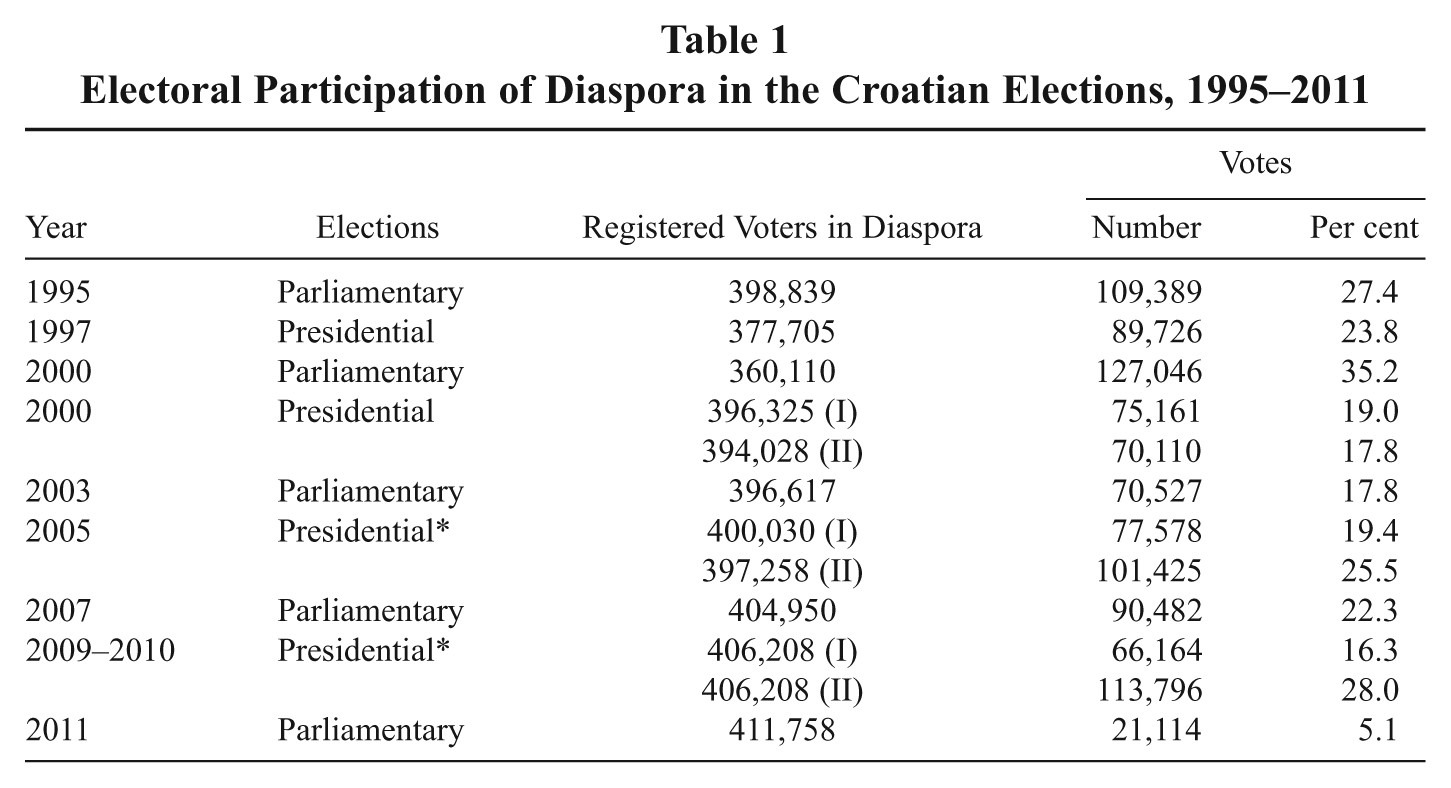
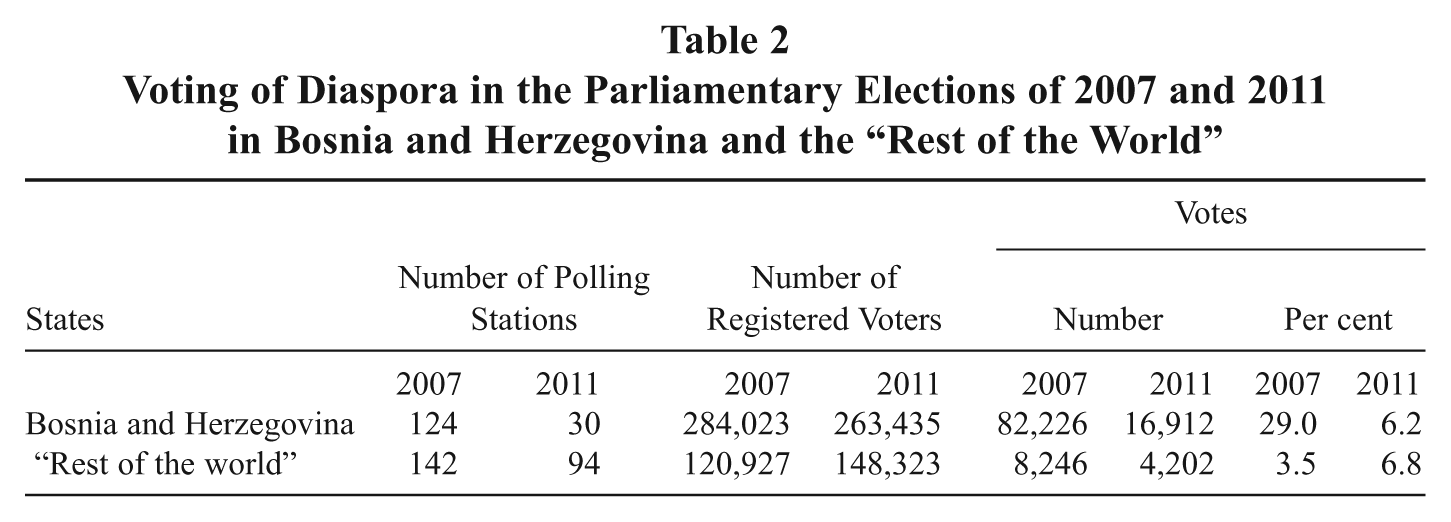
There are many theoretical and political arguments in favour of legalizing voting rights of diaspora, that is, citizens without permanent residence in the Republic of Croatia. The key argument concerns the replacement of the classic concept of territorial citizenship connected to residing of individuals on the territory of the respective state by the concept of ethnic citizenship according to which all members of a titular ethnic community of a state can be its citizens. 4 A citizen is not only the one who was born on the soil of a particular state and resides in it (ius soli or law of the soil) but also all members of an ethnic community, no matter where they were born or where they live (ius sanguinis or law of the blood). Demos, consisting of all citizens living within borders of a particular state, is replaced by ethnos, comprising all members of an ethnic community no matter where they live. 5 This interpretation was particularly well accepted in states with so-called substantial diasporas, that is numerous emigrant communities with a large emigrant share of the total electorate. The most frequently quoted example is Mexico, where emigrants make up about 15 per cent of the national electorate. By this criterion, Croatia also belongs to states with substantial diasporas since the number of citizens living abroad also makes up about 10 per cent of the total electorate. Besides, this way of perceiving citizenship is particularly spread in spatially small states and states with small populations whose subordinate role in international economics, politics, and culture is so to say “predetermined.” Therefore they make efforts to strengthen their position by increasing population size through including emigrants in the census. Furthermore, this kind of perception is easier accepted in newly formed states, including new post-communist states in Central and Eastern Europe, where the fear of losing the national state once again is still present, so that the newly acquired statehood is tried to be strengthened and secured by means of diasporas. This is accomplished in two ways: firstly, by including diasporas in national resident populations in order to increase, as already mentioned, the national population, and secondly, by mobilizing and activating emigrant communities in different countries in achieving national political goals. A typical example is mobilization of Croatian emigrant communities in North America, Australia and West Europe in the struggle for the international recognition of Croatia from 1990 to 1992. Accordingly, The Act on Croatian Citizenship gives the right to citizenship to all ethnic Croats in the world. 6 Apart from members of the conventionally perceived Croatian diaspora, 7 the citizenship and, consequently, voting rights were also given to the Croats in Bosnia and Herzegovina who are an autochthon ethnic community in that country and who used to have the status of one of its three—alongside with the Muslims/Bosniaks and Serbs—constitutive peoples in the Socialist Republic of Bosnia and Herzegovina within Yugoslavia (1945–1992) and in the independent Bosnia and Herzegovina (after 1992). The Croats in Bosnia and Herzegovina are not a classical diaspora since they have never lived in Croatia, so they could not have emigrated from it. However, they began to be considered as a part of the single national corpus consisting of the homeland and expatriate Croatia. 8 Such an attitude strengthened the behaviour of Croatian emigrants from Bosnia and Herzegovina in North America, Australia, and Western Europe, who consider themselves exclusively a part of the Croatian diaspora and not as a part of the Bosnian diaspora. This type of behaviour is mostly seen in sports, above all in mega-popular soccer. Descendants of Croatian expatriates from Bosnia and Herzegovina, who made successful sporting careers in the Western European countries, took almost without exception the citizenship of the Republic of Croatia and became members of its national teams. 9 Furthermore, legalizing voting rights of citizens living abroad is interpreted as a contribution to achieving the universality of democratic voting rights. Since constitutions of democratic states guarantee equality for all their citizens, it can be concluded that every citizen has the right to take part in elections for national representative bodies. Permanent residence in the territory of a particular state has hereby ceased to be a typical requirement for acquiring voting rights, which consequently changed the classical concept of voting rights on which modern representative systems of democracy are based. 10 Finally, it is stated that electoral participation and thus democratic inclusiveness and legitimacy of political authority are increased by legalizing voting rights of citizens living abroad. On one hand, it increases the total number of voters in general elections, but on the other hand it decreases voter participation rates because of low turnouts (see Table 1). 11 If it were not for the Croats in Bosnia and Herzegovina, the participation of the Croatian diaspora in parliamentary and presidential elections in the country would be symbolic (see Table 2). There are a number of administrative, financial, political, and psychological reasons for this: the distance between polling stations in embassies and consulates and voters’ place of living, the lack of timely and complete information, administrative barriers to voter registration, the fear of repression among political refugees, unwillingness to divide political loyalty between the country of origin and the country of temporary residence, the feeling of having no moral rights to make decisions about a country one does not contribute to through taxes and is not under its jurisdiction, as well as the feeling of identification with a new homeland.
Electoral Participation of Diaspora in the Croatian Elections, 1995–2011
Voting of Diaspora in the Parliamentary Elections of 2007 and 2011 in Bosnia and Herzegovina and the “Rest of the World”
Political Arguments
Whereas theoretical explanations of diaspora voting rights are in many ways similar in all countries, political arguments differ from country to country. It is claimed in Croatia that the Croatian diaspora has to a large extent emerged as a result of political persecution of the Croats in non-national and non-democratic political regimes from the end of the nineteenth to the end of the twentieth century, that is, in Austria-Hungary, the Kingdom of Yugoslavia (1918–1941), and in the Socialist Federal Republic of Yugoslavia (1945–1992). The right to citizenship and the right to vote are interpreted as some sort of moral compensation for political persecutions and as a reward for their contributions to the “nation and homeland” in the past, but also as a way of reintegrating homeland and expatriate Croatia. However, opponents of this kind of argumentation claim that the right to vote should not be a form of compensation for victims of violence of political regimes in the past. Besides, the Croats have for centuries emigrated for economic reasons, so not all emigrants have been victims of regimes of terror. 12 The fact that it is impossible to separate political emigrants from the economic ones, which therefore excludes partial moral compensation of victims of political regimes, makes the whole argument spurious. Furthermore, the right to vote is justified by the huge economic contribution of the diaspora to the homeland. When Croatia was still not an independent state and when its diaspora was a typical example of a stateless diaspora, emigrants financially supported their homeland by sending money to their families in the homeland and by investing in the construction of sacral and secular buildings. In the process of achieving independence and after the process was completed, emigrants started to invest directly in the national economy. According to some sources, “since the early 1990s emigrants have donated about 700,000 million DM so that an independent Croatia could be established. Money transfers sent to their families on a daily basis are not included in this figure.” 13 Some other sources claim that from 1992 to 1999, Croatian emigrants invested 151,385 million DM in the Croatian economy through the Croatian Privatization Fund: “a large majority of foreign investments in most cases were directly or indirectly connected with the Croatian immigrants.” 14 There are also those who claim that from 1992 to 2000, emigrants invested 151.3 million DM in the country through the Croatian Privatization Fund, but the actual investments were more than 600 million DM. Besides, emigrants sent about 250 million DM help to their families during the war from 1991 to 1995. Since foreign investments in Croatia before the end of the war were very small, every dollar invested by Croatian emigrants was “much more valuable than one that was invested later.” Based on these data and estimates, studies concluded that “along with tourism and the economy, emigrants constitute the third pillar of the national budget.” 15 The opponents, on the contrary, claim that money cannot buy voting rights. If this were the case, then basically every foreign citizen investing in a country could obtain them. López-Guerra ironically noticed that, according to this criterion, Bill Gates should in many states obtain the right to vote because the humanitarian aid he sent was more valuable than financial investments of a large number of ethic emigrants. 16 This criterion could be applied to George Soros in East and Central Europe, including Croatia. He invested more money in the development of civil society and political democracy than ethnic emigrants. The slogan of once rebellious citizens no taxation without representation was changed to no representation without taxation by the critics of diaspora voting rights.
Since the process of achieving independence of Croatia was accompanied by the civil war between the Croatian majority and the Serbian minority (1990–1992), as well as by the international war of Yugoslavia (Serbia and Montenegro) against Croatia (1992–1995), there were also some military arguments that came into play. Diaspora voting rights were justified by its military contribution to the victory of Croatia in the war. 17 The Croats born in America, Canada, Argentina, Chile, Bolivia, Venezuela, and in other countries “voluntary joined the newly formed military units, and with rifles in their hands they went to the front-lines.” 18 The Croatian diaspora was directly involved in illegal arms supply and delivery after the UN imposed an arms embargo on the countries of the former Yugoslavia: “Besides the embargo on weapons, Argentina illegally sold the weapons to Croatia as a result of Croatian immigrants influence.” 19 Furthermore, “the Croatian diaspora and the Croats from B-H—as the other half of the Croatian national body—knew how and sought together with the home country to establish and defend a modern and sovereign Croatia, so there was no reason why they should not be equally entitled to take part in its construction, as well.” 20 What also counted as war contributions were mass demonstrations of the diaspora in the capital cities of many countries organized to put pressure on the governments of these countries to recognize Croatia and to support its defence, as well as lobbying among members of parliament, ministers, and other high-ranking officials of numerous states. 21 The following facts stand against this argument: many non-Croats coming from numerous countries voluntarily fought in the war on the Croatian side and many non-Croats took part in lobbying for “the Croatian cause,” but can claim neither the Croatian citizenship nor the right to vote. It was also pointed out how spurious it was to reward somebody with voting rights for participating in illegal arms supply, that is, for breaching international law and conventions. Finally, some moral and psychological arguments came into play, too. It was claimed that the Croatian diaspora kept “close ties with homeland and helped it in various ways.” 22 “The eternal love” of expatriates for their homeland is explained as an indicator of their wish to return to it. Voting rights should act as a stimulus to make them feel even more connected to their homeland. In the meantime, the “eternal longing” for the homeland and the wish to return to it have in most cases turned out to be a myth. 23
The majority of previously mentioned arguments are based on Claudio López-Guerra’s principle of affected interest, according to which expatriates and their descendants have an interest in participating in the political life of their mother country to which they remain financially and emotionally connected, and thereby are given voting rights based on the contributions for the national economy, society, and state, as well as on the principle of equality of all citizens. 24 The opponents of this point of view think that a long absence from a country deprives an individual of full democratic rights, which also includes voting rights, because they have ceased to be subjects affected by the laws of the respective state, first and foremost, paying taxes and military service as fundamental duties of citizens. The concept of affected interest is opposed to the concept of subjection to the laws. The principle of democratic inclusiveness does not apply to those who have the affected interest, but only to those who live in the same legal order and are subject to the same laws. Accordingly, it is reasonable to exclude from a democratic political system all those who are not subject to its rules and restrict the participation in political processes to the citizens living within the territorial borders of a state. The ethnic criterion is not a valid reason to include those in the demos of a political community who do not permanently live in it. 25 The government established through elections can send people to war and prison, give them and take away from them money and property, and give privileges or discriminate. It can have a huge impact on one’s private life through laws on marriage, abortion, adoption of children, euthanasia, same-sex unions, etc. Although they take part in the formation of the government that makes those laws and decisions, citizens living abroad stay completely out of its jurisdiction, so only those citizens who live in the country bear the consequences of their electoral decision. If states have substantial that is very numerous emigrations, they can decisively influence election outcomes. Even if they do not have substantial emigrations, diaspora voters can sometimes considerably influence election results. For example, expatriate votes practically forced Croatia’s incumbent president Stjepan Mesić into a run-off in the 2005 presidential elections, who did not manage to defeat his rival from the Croatian Democratic Union (HDZ) party—a party that is traditionally favoured by the diaspora—in the first round. Another example is the close result of the 2006 Italian parliamentary election. 26
Electoral Systems and Political Representation of Diaspora
Diaspora members are officially categorized in Croatian laws as citizens or voters without permanent residence in the Republic of Croatia. Their voting rights were for the first time legalized in the Act on Election of Representatives to the Croatian parliament (Hrvatski Sabor) that was adopted shortly before the 1992 parliamentary elections. Diaspora voting rights were differentiated between the elections for the upper and the lower house of the Croatian parliament. Expatriate voters were given the universal active and passive right to vote in the election for the House of Representatives (Zastupnički dom), the lower house as a general representative body, and only the passive right to vote in the election for the Chamber of Counties (Županijski dom), the upper house of the Croatian parliament representing 20 counties (županije) and the capital city of Zagreb. 27 The electoral system that was institutionalized in Croatia in those days was the so-called segmented or parallel mixed electoral system: sixty representatives were elected according to a plurality system in single-member constituencies, and sixty in one land-wide electoral constituency from closed and blocked electoral lists with a 3 per cent threshold, whereas the seats were allocated according to the D’Hondt method. The legislator was faced with the problem of ensuring equal participation of all citizens in elections. It was obvious that voters without permanent residence in Croatia could not have the right to vote in single-member constituencies. Therefore it was decided to reduce their voting rights only to the proportional segment of elections. 28 It can be concluded, with reason, that exactly the intention to enable voting of citizens outside Croatia considerably influenced the designing of the proportional segment of the electoral system. It was practically possible only if single party lists competed in the election, i.e. if the state was not divided in multi-member constituencies, which would bring up the question of allocating external voters to particular constituencies and create a wide space for political manipulation in elections. The way of voting allows us to conclude that the law did not foresee any special political representation of the diaspora in the Croatian Parliament. It was obvious that diaspora voting rights additionally sharpened the question of the electoral system. A whole spectrum of electoral systems that is based on single-member or multi-member constituencies implies that it is necessary to know the permanent residence of citizens living abroad in order to determine the electoral constituency in which they are going to vote. In fact, only proportional representation in an at-large system does not bring up the question of voting of citizens without permanent residence in the country. If it is abandoned, the problem may be solved in two ways: (1) citizens without permanent residence in the country can be arbitrarily allocated to particular electoral constituencies in the country or (2) special electoral constituencies can be created outside the country. Both approaches result in serious institutional and political consequences. The former excludes the institutionalisation of a special form of political representation of diasporas in national parliaments, with the establishment of some kind of “fused” political representation of the electorate in the country and abroad. This kind of approach was for instance used in Indonesia and Belarus. At the same time, this leaves considerable room for manoeuvre for political manipulations. Electoral administration, which is controlled by state authorities, can on their instruction allocate citizens living abroad to marginal electoral constituencies and thus directly influence election results in them. The latter implies the institutionalization of special political representation of diasporas in national parliaments that establishes some kind of “divided” political representation of the electorate in the country and abroad. This kind of approach used to be applied or is still applied in Angola, France, Italy, Columbia, Macedonia, Mozambique, Portugal, the Cape Verde Islands, and in Croatia.
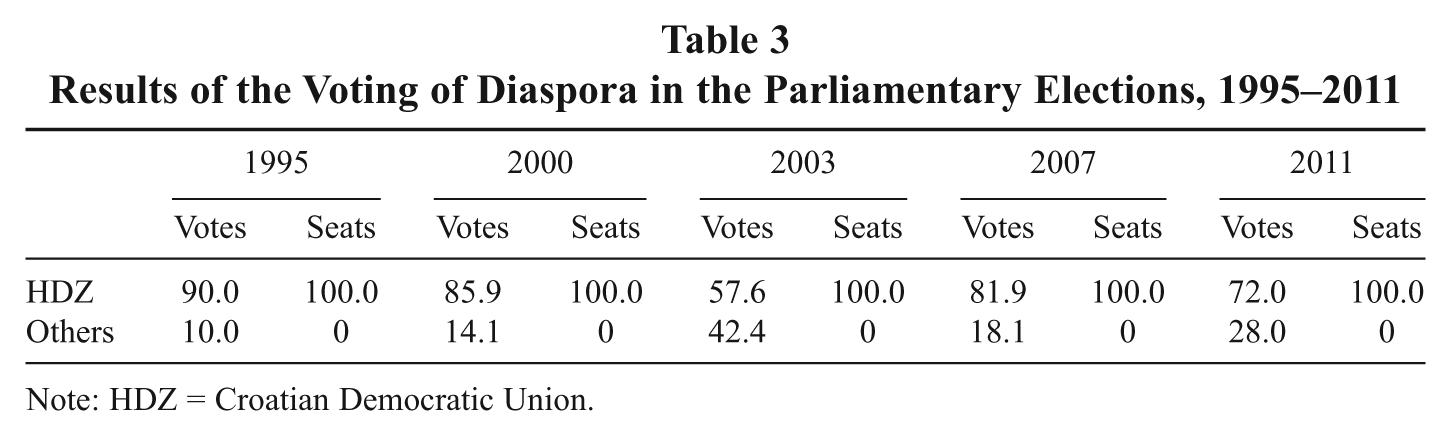
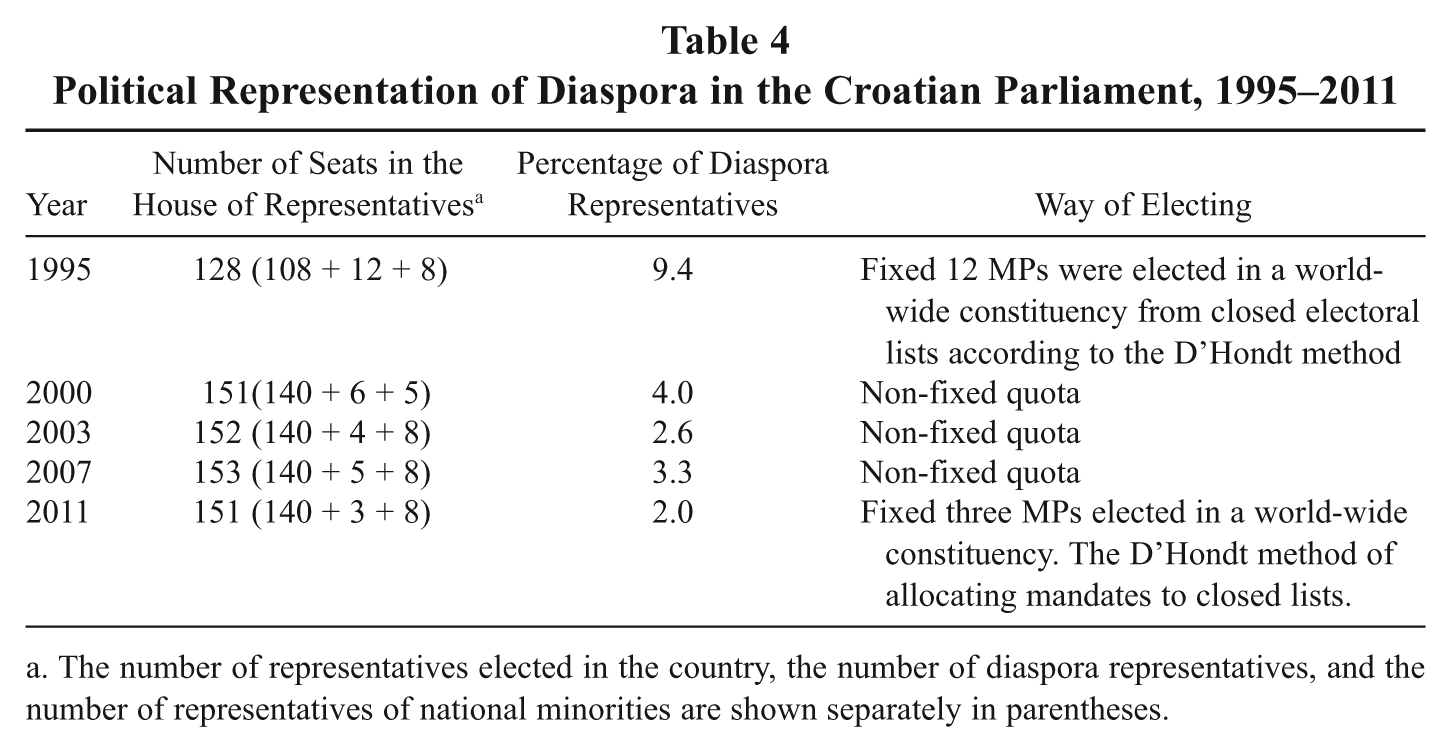
Already the early election of 1995 showed that the existing electoral system did not have to be a structural obstacle to parliamentary representation of diaspora in Croatia. The segmented mixed electoral system was kept, but the number of direct and list mandates was significantly changed (eighty members of parliament were elected according to the proportional electoral system and twenty-eight according to the plurality system), which was in accordance with calculations and perceptions of the ruling HDZ. 29 External voters were for the first time given voting rights in a special constituency and got their own political representatives. A worldwide electoral constituency was formed in which twelve members of parliament were elected under the same conditions as in the proportional segment of the elections in Croatia. 30 The special diaspora constituency and its special political representation in the national parliament existed from 1995 to the 2011 election. As the electoral systems and political constellations in the country changed, so were the way of voting and the number of diaspora representatives in the Croatian parliament modified. In 1999 the mixed electoral system was replaced with the proportional electoral system. The country was divided into ten constituencies. Fourteen members of parliament were elected in each constituency from closed and blocked electoral lists with a 5 per cent threshold, and the D’Hondt method was used to allocate mandates. Besides the ten electoral constituencies in the country, one more was created for citizens of Croatia living abroad. This eleventh worldwide electoral constituency enabled diaspora members to choose their representatives under the same conditions as voters in the electoral constituencies in Croatia. The number of diaspora representatives was no longer fixed (in our case at fourteen), but it was determined by the so-called non-fixed quota, which was the most important innovation of the new electoral system. The non-fixed quota was introduced due to public pressure and political pressure from the opposition that were dissatisfied with the fact that the previous way of voting did not ensure equality in voting rights since diaspora votes were much more valuable than votes cast by voters in the country. A group of experts composed of five professors of the Faculty of Law and the Faculty of Political Science of the University of Zagreb, which laid down the fundamental principles of the electoral reform that legalized the proportional electoral system, also offered the so-called non-fixed quota as a way to calculate the number of diaspora representatives in the Croatian parliament, having been guided by the idea of ensuring equality in voting for all citizens. The following formula was applied to determine the number of diaspora representatives: The total number of votes cast in the eleventh constituency should be divided by the average number of votes needed to obtain one mandate in the country. The quotient determined the number of seats in the parliament, which were then allocated according to the D’Hondt method to the electoral lists that passed the threshold. The introduction of the non-fixed quota resulted in a considerable decline in the number of diaspora representatives: from twelve (1995) to six (2000), four (2003), and five (2007) (see Table 3). This was favourable to the opposition since all the elected diaspora representatives in the history of the Croatian state have without exception been HDZ candidates. Heated disputes between the HDZ and most right-wing political parties that strongly defended diaspora voting rights, on one side, and the Social Democratic Party (SDP) and all left-wing and left-of-centre parties, on the other side, temporarily cooled down, although they never fully ended. They broke out again in 2010 when the HDZ and the SDP, actually the presidents of the two strongest parties in Croatia, agreed in closed-door negotiations to elect three fixed diaspora representatives in future. This was interpreted as “a reasonable compromise” that was reached by mutual concessions on both sides: the SDP suspended its request for completely abolishing diaspora voting rights in national elections and referendums, whereas the HDZ gave up on its goal to maximize the number of party mandates in the Croatian diaspora. The SDP left diaspora voting rights off the political agenda in the parliamentary elections in December 2011 and gave up the mobilization of the electorate in Croatia, which, according to the polls, is overwhelmingly against that right. On the eve of the parliamentary elections, the HDZ practically gave up the political mobilization of diaspora, especially of the Croats in Bosnia and Herzegovina, in order to turn out in large numbers and win as many mandates as possible for the HDZ. According to the new pattern, the electoral participation abroad is completely irrelevant since the three diaspora representatives can be elected by hundred, ten thousand, or hundred thousand voters. The participation of the Croatian diaspora in the 2011 parliamentary election was therefore the lowest since it was given the right to vote (see Tables 1 and 2).
Results of the Voting of Diaspora in the Parliamentary Elections, 1995–2011
Note: HDZ = Croatian Democratic Union.
Political Representation of Diaspora in the Croatian Parliament, 1995–2011
The number of representatives elected in the country, the number of diaspora representatives, and the number of representatives of national minorities are shown separately in parentheses.
Croatia is one of the few countries that institutionalized the special political representation of diasporas in national parliaments, which would then time after time reach a high level and secure important bonus seats for only one party. There are only four countries in Europe which did the same: France, Italy, Macedonia, and Portugal. It was incorporated into the French Senate, the upper chamber of the parliament, in 1983. Twelve senators are not elected by the French people living abroad in direct elections but by a special electoral body, Conseil Supérieur des Français de l’Etranger, consisting of 183 members. About two million registered French citizens living abroad elect 150 members of this electoral body in a direct election, who then cast their votes for the 12 of 321 members of the Senate. Special political diaspora representatives have been elected in Italy since 2006. The Italian people living abroad elect twelve (or 1.9 per cent) members of their House of Representatives and six (or 1.9 per cent) members of the Senate. Expatriates are entitled to elect four (or 1.7 per cent) members of the national parliament in Portugal. For the first time, Macedonians living abroad were entitled to vote and elect 3 out of 120 members of the national parliament in the 2011 Macedonian parliamentary elections. In contrast to the invariant symbolic diaspora representation in the French, Italian, Portuguese, and Macedonian parliaments, it ranged in the Croatian parliament from a high 9.4 per cent in 1995 to the more symbolic 2.0 per cent in 2011, turning the parliament consequently into a body with a non-fixed number of representatives and non-fixed overall majorities, necessary for the government to win a vote of confidence. Whatever the quota, it has so far secured seats for only one party, the HDZ, and has proven to be a politically biased institution within the Croatian parliamentary system. The way for that was paved already before the first free parliamentary elections in 1990 when the HDZ, as a newly formed opposition party, established a very widespread network of party branches in all the countries Croatian expatriates lived in. Already in 1989, before the First General Party Convention was held in February 1990, the HDZ had set up its branches in more than fifty cities with numerous Croatian expatriate communities in Canada, the United States, and Australia. The party established about a hundred branches in the Federal Republic of Germany, a West European country with the most numerous Croatian guest-worker (Gastarbeiter) and expatriate community in Europe. HDZ party branches were also founded in Austria, Switzerland, Sweden, Norway, the Netherlands, France, Belgium, New Zealand, Argentina, Chile, and Uruguay as well as in some other countries on all the continents on which the first, second, third and even fourth generation of Croatian emigrants lived. Nevertheless, the most important thing was undoubtedly the fact that the HDZ of Croatia established the HDZ of Bosnia and Herzegovina as its “sister party” that practically worked as a branch of the HDZ of Croatia and was ideologically, organizationally, and financially dependent on it as well as subordinate to it. Since the HDZ of Bosnia and Herzegovina, already at the beginning of the process of democratic transition, “colonized” the Croatian community of the place, remaining up to now its convincingly strongest party option, and since diaspora seats are actually decided upon by Croatian voters in Bosnia and Herzegovina, conditions were created for diaspora elections to turn into an almost uncompetitive political process with a well-known outcome. This outcome stood in many cases—in the 2000, 2005, and 2010–2011 presidential elections as well as in the critical 2000 and 2011 parliamentary elections—in stark contrast to the will of the majority of voters in Croatia, which obviously did not contribute to “the reintegration of the homeland and expatriate Croatia” as one of the main goals emphasized by the party, which actually legalized the whole project of “diaspora voting.” Whereas the project had some kind of political and moral significance in the formative period of the Croatian state (1990–2000)—which was significantly marked by the civil war, incited by the rebellion of the Serbian minority in Croatia, and afterwards by the international conflict caused by the military aggression of the then Yugoslavia (Serbia and Montenegro) on Croatia—it was to a large degree desubstantialized and gradually lost its meaning after the year 2000. This is supported by the fact that all three diaspora representatives elected to the Croatian parliament in the 2011 election have their permanent residence in Croatia.
Conclusion
Several conclusions can be drawn from the previous account. Firstly, voting rights of citizens without permanent residence in the Republic of Croatia were introduced mainly because of the Croats in Bosnia and Herzegovina and not because of the traditional Croatian diaspora in other countries. However, the legislators were not guided by principled reasons but mainly by pragmatic interests. According to the Washington (1994) and the Dayton Agreement (1995), both of which were imposed on the Croats in Bosnia and Herzegovina by the international community and by Croatia, they remained within the Bosniak-Croat Federation as one of the two entities in Bosnia and Herzegovina and were therefore offered a kind of political and psychological compensation in the form of a symbolic integration into the Croatian political system. Secondly, diaspora voting rights were exercised almost exclusively by the Croats in Bosnia and Herzegovina, who made up an absolute majority of external votes in all parliamentary and presidential elections. Participation of the Croats from other countries was purely symbolic. The same goes for the old and the most numerous expatriate communities in Canada, Australia, the United States, and Germany. Thirdly, voters in Bosnia and Herzegovina were very aware of critical moments in elections, so that they helped the HDZ of Croatia to come or stay in power. The highest turnout was recorded in the critical parliamentary election in 2000 when the HDZ lost power (35.5 per cent) as well as in the 2007 parliamentary election when the power of the HDZ hung by a thread (22.3 per cent). The turnout was considerably higher when the voters in Bosnia and Herzegovina wanted to help the HDZ candidate to defeat Stjepan Mesić in the runoff presidential election. The 2009–2010 presidential election is certainly an exceptional case. The electoral mobilization reached an enviable level, especially in the second round, when the Herzegovinian wanted to help their compatriot Milan Bandić to defeat the SDP presidential candidate, Ivo Josipović, in the runoff election. It could be assumed that the mobilization would have been the same or similar if anybody else had been the countercandidate to Josipović, because the prime motive of voters was to hinder the victory of an SDP candidate. Fourthly, the HDZ electoral body is very loyal, with almost generic party voters who have given an absolute majority of votes to the HDZ and its candidates in all parliamentary and presidential election cycles, except in the 2009–2010 presidential election. The HDZ won all diaspora mandates in the four parliamentary election cycles. Therefore, Croatian citizens living abroad have never had any MP who would represent some other political party or option. Finally, the whole concept of legalizing diaspora voting rights in national elections and referendums, of patterns for electing diaspora representatives to the national parliament, and of presenting diaspora interests as partial interests of one party, refers to the fact that it was one of the biggest projects of political engineering in independent Croatia. We are talking about an independent and in many ways obscure project of the HDZ, a party that governed Croatia independently from 1990 to 2000, making out of it a political instrument for strengthening its power in the parliament and its political authority in the state.